He’s currently chronicling the adventures of the Man of Steel in Superman Year One, but it seems Frank Miller’s heart will always bring him back to Batman. DC Comics announced that Miller will be writing the Black Label book Dark Knight Returns: The Golden Child, illustrated by Rafael Grampá and colored by Jordie Bellaire.
According to the press release:
The story takes place three years after the events of Master Race, where Batman, Superman, Wonder Woman, Carrie Kelley, and Lara Kent overcame the renegade priest Quar and his cult of Kandorian fanatics in their bid to convert humanity into worshipping them as gods. During this interim, Lara has spent time learning about what it means to be human, while Carrie has grown into her role as Gotham City’s new protector, Batwoman.
So, who is the “Golden Child” of the title? None other than Jonathan Kent, who now “possesses power unlike anything the world has ever seen and could be all that stands in the way of the destruction of Gotham City, as well as the whole planet.”
“The possibilities for what he could be just started coming to mind like crazy. I thought the contrast between him and Lara could be really exciting. Lara has so much power and passion, so for the little boy to embody all of the wisdom and intelligence of the Kryptonian race would be an exciting new dimension. He really sort of developed as a little floating Buddha, someone who when he wasn’t even a toddler yet was speaking in full sentences and had an understanding of events that surpassed anybody else’s. He’s the most magical member of the family.”
Dark Knight Returns: The Golden Child will be a Black Label 48-page prestige format one shot in stores December 11. Variant covers will be available from Miller, Paul Pope, Joelle Jones, and Andy Kubert.
Are you ready to see Miller back in the Dark Knight world? Leave us a comment!
With the concluding issue, DEAD END KIDS #3 wraps up its emotional coming-of-age story on a somber, yet high note. Word of warning, you may need some tissues on hand.
Issue three of the murder mystery from Source Point Press releases September 25th, culminating with the reveal of who killed Ben. If you haven’t read the previous issues, it’s highly suggested. If not, check out our reviews for issue one and issue two.
Dead End Details
Kicking off this issue, we see Murphy as an adult in 2019, his narration stating that the story you are about to read is real life, “not a f***ing fairytale,” hinting at the hard realism the reader is about to endure. In the previous issues of Dead End Kids, writer Frank Gogol used time hops and blank pages to help break up moments and create tension while building momentum. This technique is used here, with a great placement of the title page after Murphy (back in 1999) declares he knows the killer. This break in story causes you to page turn so fast you may cut yourself.
Nearly every page is filled to the brim with tension you could slice with a knife, causing you to charge through the plot, yet stay on each page to soak in every detail (which there are plenty of). Throughout Dead End Kids, Gogol has excelled at creating drama, grief, and many other emotions. One page will make you overjoyed, then the next sad enough to want to abandon ship (but you can’t). This varying of feelings is done with immense skill, as Gogol never goes for cheap or easy emotions. With the motivations of the “villain,” you even feel for him, while still not agreeing with his actions.
Dead End Design
Continuing on art duties for Dead End Kids #3 is Nenad Cviticanin, who hits all the emotional beats that Gogol throws his way. While taking the emotional spectrum up a level with his use of paneling and character actions, Cviticanin also handles colors, which should be noted for the great use of a grey shading for night. The colors added or lost help amplify each scene, especially when portraying the cold night time and “break up season.” With his pencils showing the winter months in near perfection, you can feel the winter chill, as if you were in Alaska.
Cviticanin’s art is soft in a manner that feels inviting, no matter what is displayed. This feeling of softness comes off as human, helping Gogol’s characterization and plot, with it only falling flat in a few moments where the characters feel stiff. But hey, sometimes humans are stiff.
While letterer Sean Rinehart changed colors multiple times in the previous installments for effect, that isn’t seen as much in Dead End Kids #3. But by placing the dialogue bubbles in a varied amount of locations, he continues to help pacing, while hitting the punch when it comes to emotions, by guiding your eyes through the panels. When characters yell, Rinehart helps hammer it home with bold lettering, helping convey emotions, but the best examples would be when characters speak quietly. For these, a small bubble and small lettering is used to help the low speaking of the moment, which – at a critical moment – conveys the emotion on a more subconscious level.
Dead End Denouement
Gogol’s characterizations of the kids and the emotions they go through in Dead End Kids #3 feel real, as if they could be a group of kids down the street. Cviticanin’s art adds to this realism with each panel, making this finale feel like a memoir, not just a comic. Dead End Kids may not be for everyone, as it deals with hard and heavy emotions that some may not enjoy. But this series is amazing in a myriad of manners, with a recommendation for any of those even slightly interested to go check it out.
Memorable Quote: “But life’s not a fucking fairytale.” – Murphy
As someone who is going through personal stuff, this sentence hit hard; so did this series.
Dear Reader
What did you think of the finale? And, were you able to guess who the killer was?
Relics of Youth #1 Cover B by Nathan Gooden and Tim Daniel, paying homage to Wes Craig’s Deadly Class #1 cover.
Unmapped Story
Nat Rodrigues is having strange visions and dreams of a mysterious island, and she locates six other teens who have been experiencing this phenomenon. But that’s not where the coincidences stop, as one day they all awaken with a tattoo only they can see. Right out of the gate, Relics of Youth #1’s plot sounds like a mystery movie from the adventure-filled ’80s (The Goonies is even mentioned) with each character fitting a trope, while not being an exaggeration of said tropes. Luckily, co-writer Chad Rebmann and screenwriter Matt Nicholas (the 80’s film vibe now makes sense) don’t fall into the ‘teens becoming best friends at the first meeting’ trope.
As Nat gathers the grouping of teens in person, their tattoos begin to glow, setting the course for The Bermuda Triangle, where it seems most of Relics of Youth‘s story will take place on. To get to their destination, trust fund baby Garret Evans uses his families yacht —Seas The Day. With the story revolving around the group of six, writers Rebmann and Nicholas’ dialogue for the teenagers work perfectly with each character, as the duo have a great sense of how to write for the situations throughout. Plus the writing duo keeps the mysteries as hidden as they can while giving each moment a sense of wonder.
Within the first issue of Relics of Youth, the 28-page count is used to the max, as the writers cram in as much information as possible (while keeping the mystery alive), leaving little room to breathe, or showing how Nat was able to locate and find the others like her. For a title such as this, the story matters as much as the adventure aspects, but in multiple moments it seems a lot is being said, yet a substantial amount of it feels unimportant.
Interior art by Skylar Partridge
A Treasure Trove of Art
As Relics of Youth #1 spends the majority of its pages introducing the plot and characters, there’s only one moment of violence, which comes towards the end. To make these moments of character interactions flow better, artist Skylar Partridge keeps their personalities and movements in motion. In these moments Partridge portrays quite a bit of the youths personality in the way they are drawn, and how they act. The characters really drive the plot for Relics of Youth #1, meaning that Partridge isn’t given the opportunity to let her art breath. That is until they discover the mysterious island.
With the teens finally finding the unmapped location, the dialogue takes a step back, while the art is given its opportunity to shine, and shine it does. Using a full page to flex her art muscle, Partridge illustrates a vibrant island that seems teeming with life. By making the ship small, she shows the full scale of the monstrous island, adding a cloud of dust and dangers in the water to help steer home how uncharted this land is.
Relics of Youth #1’s colors are tackled by Vladimir Popov, whose natural colors blend perfectly with the pencils and story being told. Popov’s colors bring life to Partridge’s art, especially during the Island reveal. While the line work illustrates the island beautifully, Popov’s bright vibrant greens help it come alive. This accomplishment is done by his use of lifelike colors that are beautiful, yet can be seen in the real world.
Interior art by Skylar Partridge
The Land of Lettering
Being void of its share of adventuring, Relics of Youth #1 doesn’t have much in the way of sound effects or other unrealistic happenings. This means Letterer Deron Bennett has no moments to play around. Although Bennett isn’t able to mess around with font styles, or colors, he does place the dialogue bubbles efficiently. During the heavier dialogue moments, the bubbles never clutter the page. This may not seem like much, but when your comic is dialogue/plot heavy it helps the flow greatly while keeping the art malleable.
Relics of Youth/Relics of Conclusion
If Relics of Youth #1 was a film, it would easily be classified as an 80’s adventure. Although it may be heavy with dialogue that doesn’t explain or adds much to the plot. Any fan of adventure comics or movies would love the mysterious start to this adventure! While it seemingly ends on a note promising an explosive next issue!
Charting The Lands With Our Readers
Are you looking forward to the newest Vault Comics series? Their recent number ones have been pretty great. To check out those go here (The Plot, Mall, Sera, Resonant, Test, She Said Destroy).
Guardians of the Galaxy #9 hits your local comic book shop on September 18, but thanks to Marvel Comics, Monkeys Fighting Robots has a five-page preview.
If you were hoping for unicorns and rainbows, this is not the reading material for you. Donny Cates brings death and tons of it.
About Guardians of the Galaxy #9: The Guardians have been torn asunder by the Universal Church of Truth! After revealing his secret, Rocket has come out of hiding to help rescue his former team, but will Groot be able to forgive him long enough to save their friends or is this the end of the Guardians?!
The issue is written by Cates, with art by Cory Smith, Victor Olazaba on inks, David Curiel’s colorwork, and Cory Petit letters the book.
What do you think of Cates’ run on the cosmic heroes of the Marvel Universe? Comment below with your thoughts.
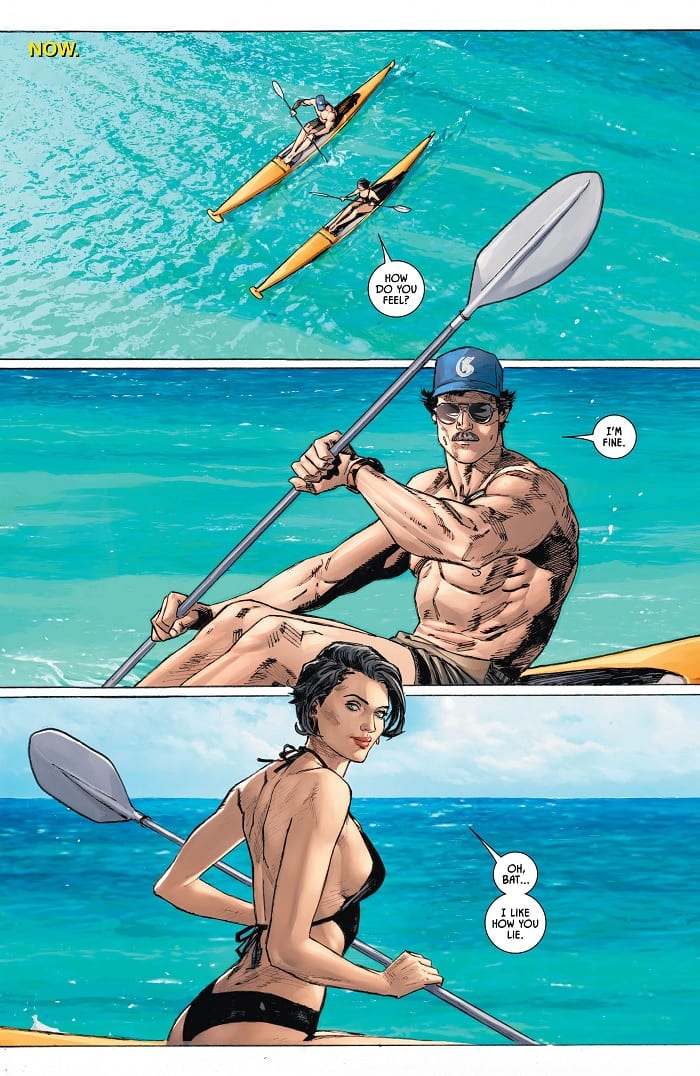
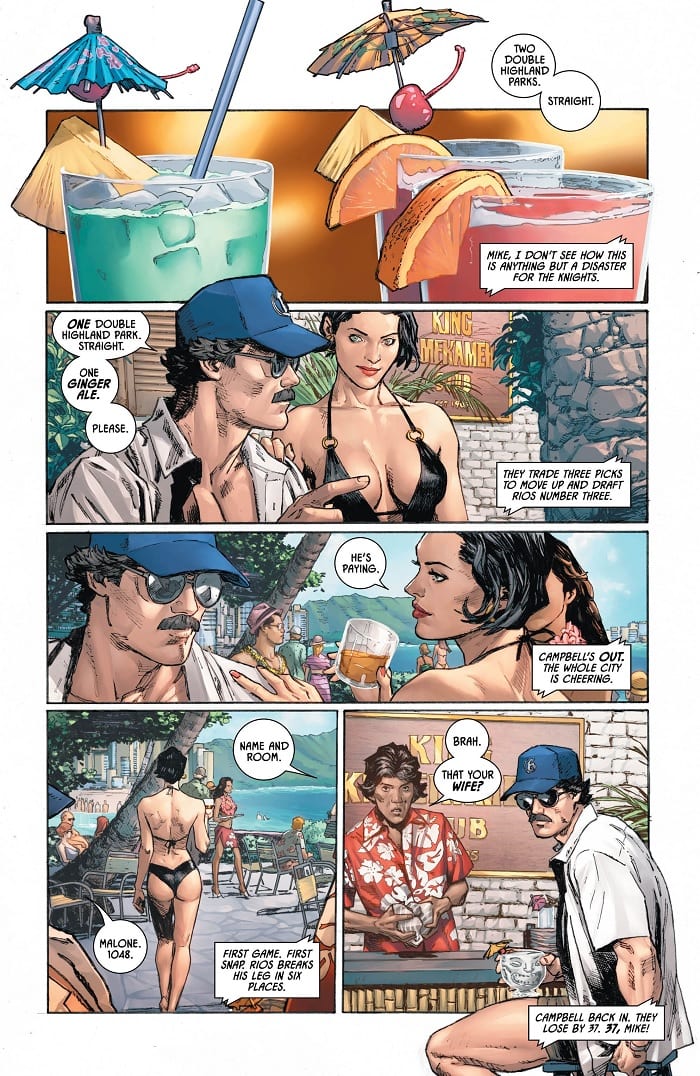
After the shocker presented in our last issue, few readers may be ready for what we find in Batman #78, out this week from DC Comics. What is it, you ask? Why…it’s a beach vacation.
Bruce and Selina unwind on a beach, soaking up the sun and making up for lost time. It’s not all relaxation, though; Batman is—in a roundabout manner—training to face Bane and his father and to retake Gotham, with Selina’s help.
The Writing
Batman #78 isn’t a conventional Batman book. Then again, King’s approach to the character has never been conventional.
The writing is carefully-metered and well-paced internally. However, the book leaves the tension from our last issue unresolved. Instead of following on the events transpiring in Gotham, we’re with Batman and Catwoman in a tropical island setting. This is frustrating on a certain level; while it’s good to draw out tension, the weight of the narrative makes it hard to feel fully invested in what’s happening here. On a certain level, we want the story to hurry up and get back to the action.
Batman #78 reads in some ways like a surreal, alternate version of a lighthearted Silver Age story. The book’s marked by complex emotional tumult; it’s difficult to read where either character stands, or where they will end up. They each struggle to resist their feelings for one another and find a way forward, but falter multiple times. It feels like a realistic take on a pair of exes awkwardly attempting to find a way to interact around one another.
The writing is good on its own, but it tugs against the impetus of the larger narrative. We feel the story moving toward its peak, but this chapter runs counter to what would be conventional structure. Thus, it doesn’t necessarily serve the larger story well at this point in the sequence of events.
The Artwork
Artist Clay Mann has a great eye for employing cinematic techniques, and isn’t shy about showing it in Batman #78.
Mann creates continuity from one panel to the next. This is displayed very well in one sequence around the book’s middle point; although Bruce and Selina are broken up between panels and are in different rooms, they match one another’s eye line, opposing one another as if inches apart. As panels move from one to the next throughout the book, there’s a distinct continuum of movement.
The use of repetition for effect throughout the book is a nice touch as well. There are several points at which we see near-identical—or in some cases, replicated—images repeated over and over. This lends the visuals in Batman #78 a great sense of symmetry. It could even be read as a visual metaphor; the two characters are stuck, unable to move forward until the tension between them is resolved.
The illustrations themselves are nicely stylized. They’re sharp, yet given a soft glow, like an idealized flashback, owing to Tomeu Morey’s color palette. Morey’s a skilled colorist, and this is some of the artist’s best work yet on the series.
Final Thoughts
Batman #78 is an interesting and compelling story on its own. It might have been better suited placed a couple of issues earlier, though, as it creates some tonal clash following from our last issue.
Bad Reception #2 hits your local comic book store on September 25, but thanks to AfterShock Comics, Monkeys Fighting Robots has a four-page preview of Juan Doe‘s amazing work.
Doe, known for his work on DARK ARK, AMERICAN MONSTER, and WORLD READER is the artist and writer on the series. Bad Reception is a searing horror story that doubles as a topical, satirical critique on society’s obsession with technology, social media and the cult of celebrity.
About Bad Reception #2 : The toast has been made, and the cake has been cut. The most intimate wedding reception of the century has started, and all the guests are suffering a bad case of nomophobia (a.k.a. “no-mobile-phone phobia”). But things get real in a hurry when the mysterious killer sets off a frenzy that drives the remaining guests into a world of unknown primal fear. Now they must learn to depend on each other if they are to survive the hunt.
The bold opening and the approach that Doe has chosen may put some people off. This is a challenging comic with some moments more challenging than others. However, if you commit to it, and allow yourself to get lost in this world Doe has created, the payoff from each section is wonderfully handled and will make you want the next chapter straight away. – Darryll Robson’s review of Bad Reception #1
What did you think of the first issue? Comment below with your thoughts.
Jonathon Hickman’s House of X and Powers of X stories are proving to be classics and Powers of X #4 is no exception. Hickman’s dialogue is punchy and sharp, and his story is thorough and detailed. R.B Silva’s linework is equally effective, and his action scenes are visceral and destructive, and Marte Gracia’s colors are stellar as well. It can’t be said enough of what a fantastic job Hickman has done with the X-Men line so far, but my favorite innovation has been the introduction of a sassy Mr. Sinister now to be formally labeled as Sassy Sinister. Anyone with a passing interest in anything X-Men should be reading these series, and Powers of X #4 might be the best one yet.
Powers of X #4 begin with an allied Magneto and Professor Xavier approaching Bar Sinister with the intent of asking for cooperation. After that Xavier tasks his student, Cypher with constructing a Mutant language. Hickman’s introduction to Mister Sinister is perfect. As the masked sentinel removes his helmet, and it is shown that this is a Sinister clone, the irony and humor also come into play.
This sinister clone speaks as a child would with no regard for how others may interpret their words. He insults Magneto’s cape (Big no-no) and then says Xavier cannot enter the bar because he is disabled. Obviously, Mr. Sinister is a villain, so I’m not expecting him to embrace PC culture or common decency, but the forthrightness with which he says this is shocking considering he knows how powerful Xavier is. And of course how Magneto is, as Magneto throws him through the wall.
But this is also a fantastic introduction to the outright insanity of the main Mr. Sinister, aka Sassy Sinister. Not only speak like the first Sinister but even more childlike, but he also treats everything, and everyone is a plaything. When Sassy Sinister orders the execution of his Butler clone because he did not suggest that he have a cape, he does so maniacally. This action works double as it also is a showing of ruthlessness and power. The ending of the Sinister introduction cements his ruthlessness and puts his loyalty into consideration.
If there is one fault to this story, it is the number of things going on, if anything it is merely difficult to keep track of several stories happening in three separate timelines in the same book. Due to this, the scene in the Year 1000 can be a tad jarring. It is also difficult to decipher the intent of this chapter. Is this still the natural evolution of the mutant/human/machine conflict or is this the actual ending of it as the tiny blue alien Librarian is negotiating with the human/machine Phalanx. It’s exceptionally heady and convoluted, so casual readers may be turned off. However, if you have been paying attention, this is the stuff you live for.
R.B Silva, Marte Gracia, and VC’s Clayton Cowles’s combined efforts for the dream art department for Powers of X #4. Silva shows a real talent for luring the reader in with quick small frames only for them to be blown away with gorgeously detailed splash panels. The initial conversation between Sentinel Sinister, Magneto, and Professor X seems like it will just be tense dialogue, but then Silva’s’s detailed action scene shocks the reader into attention. The detail of all the tiny pieces of crystal in the aftermath of Magneto’s throw is fantastic.
A Brief Conversation With The Sassiest Sinister
Gracia’s colors add a nice touch to the comic as he gives each scene its designated color. Sinister’s is purple-red, Cypher’s mission to form the Mutant language is basked in yellow, and the future is a muted blue/gray before it’s climactic finale. These tones set the mood for each of the stories, but his colors in the individual scenes are also successful. And Clayton Cowles’s letters feel weighty. When the sinister clones are dismembering Butler Sinister, the chop in panel looks like it echoes throughout the room.
Readers should know just by following the reviews how monumental Powers of X and House of X have been. Powers of X #4 is further testament to that claim, as even a chapter with little plot advancement where no one died can feel so impactful and memorable. Jonathan Hickman, R.B Silva, Marte Gracia, and Clayton Cowles should all be commended, as this is another fantastic entry in a fantastic run of comics.
The Forces are in danger of collapsing. As the Sage, Strength, and Still Forces continue to make waves on Earth, the Speed Force is beginning to grow weaker. As Barry, Wally and Avery try to figure out what is wrong; the Flash Museum gets a surprising guest: The Black Flash. The speedster of death, however, isn’t here to claim the life of a speedster. His targets are the other Force users, attacking the Still Force’s avatar, Steadfast first.
Barry is able to save his new ally and cause the speedster to vanish but realizes he needs to gather the other users to keep them safe. He is able to convince Fuerza and Psych to meet up, but the latter sees a vision of the Black Flash. Afraid for his life, Psych uses his Sage force powers to cause Steadfast to lash out. Can the Force users get their act together, or are they doomed to die at the hands of the Black Flash?
**Some Spoilers Below**
Story:
After a brief opening of Barry saying he’s felt the Black Flash always right behind him, we return to the present where the Force users are fighting each other. Psych refuses to believe he could keep any of them safe and uses Steadfast lashing out as an escape. Using the lessons he learned from Year One, Barry is able to short out Steadfast’s powers and free him from Psych’s control. Realizing this could cause their powers to drain faster, the Force users fall back to the Flash Museum. Meanwhile, CaptainCold searches for the next Rogues to recruit: Mirror Master and Golden Glider.
This issue will definitely be a let down for a few people, as most of it is exposition of how dangerous the Black Flash is. We do get an epic opening battle between the Force users as well as glimpses of action between the younger members of the Flash Family, but for the most part, it’s catch up. On the one hand, a new reader might want to know how dangerous of a threat this Black Flash is. We are able to see the full effect of him with the monster claiming his first victim at the end of the book. However, when Commander Cold explains how they can’t outrun him, he has no proof to show it.
On the subject of Cold, the rogues building back up in the side story feels forced. It has no impact on the current story and while seeing the new designs are cool, it feels like this was added at the last minute for Year of the Villain. There is no doubt this will be a great story in the future, but for now, our focus should be on the Flash and the other Force users.
Art:
While my gripes with the story are large, the art from Rafa Sandoval continues to be amazing. The designs for each of the characters and their powers are breathtaking, especially the new Rogues and Black Flash. The villains look more threatening than ever, with an actual chill running down my spine after Black Flash claims his first victim. Add that with incredible colorwork, and we have a great looking comic.
Conclusion:
This issue was a bit of a letdown. While the art is very well done, this issue slows down a bit on the action. We get a cool explanation of the Black Flash, but it can get a bit boring without a battle against the speedster of death. The ending certainly gets this reviewer excited for next issue, but not enough to praise this one.
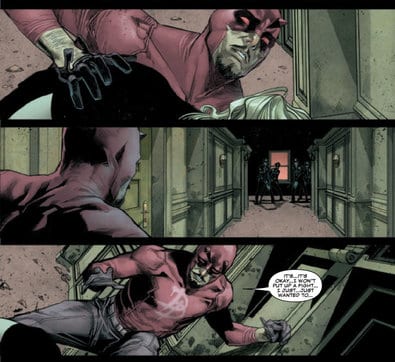
DAREDEVIL readers are undoubtedly still reeling after the explosive events that took place in issue #10. They saw Matt Murdock dive face-first into his affair with Mindy and witnessed an attack on Detective Cole North occur within his own precinct, but the biggest surprise came in the duo’s unexpected team-up against dirty cops. Now the hero formerly known as “Daredevil” questions whether he’s really decided to give up crime-fighting or if it was just a lie he was telling himself. At the same time, Spider-Man returns onto the scene, and he has a few questions he’d like to pose to Cole following the previous issue’s incident.
Readers will get to experience even more action alongside Matt in DAREDEVIL #11, available in comic book stores on Wednesday, September 11.
Story
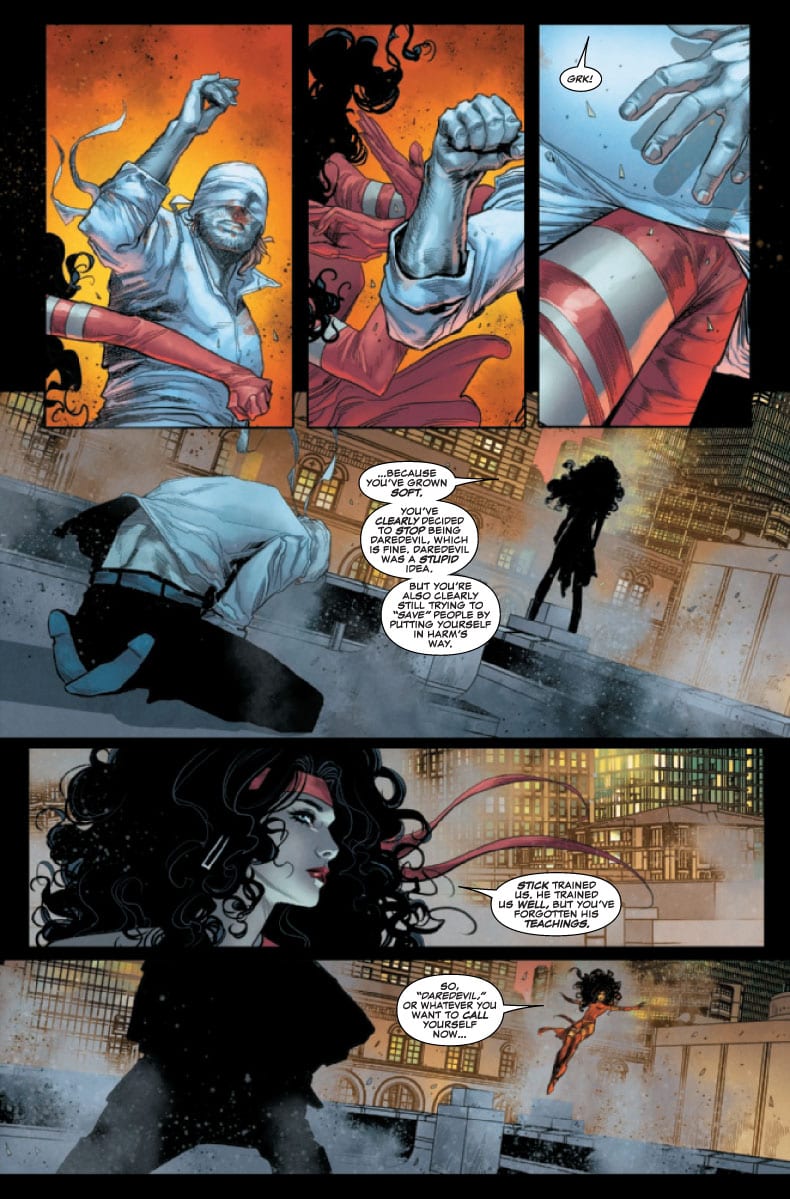
Following the shootout with the crooked cops last issue, Matt takes to the rooftops once again, only to be confronted by none other than Elektra. His rival and former lover asks him why he seems to be half-heartedly continuing the fight despite swearing off of it. In her mind, he needs to find a new way of combating the evils that plague Hell’s Kitchen. But with the lingering guilt of his accidental killing as Daredevil, coupled with his affair with Mindy, the Man Without Fear realizes the line between good and evil is more complicated than he once believed.
At the other end of the spectrum lies Cole, who’s been reevaluating his own particular brand of black and white thinking (in this case regarding the law). After patrolling the streets for a while he’s apprehended by Spider-Man, the one hero who felt it was his duty to encourage Matt to relinquish the Daredevil identity for a time. Cole questions whether the Wall-Crawler believes he’s above the law, to which the hero replies,
Yeah. I kinda do. Happy now? What kind of laws are there about a guy who can throw cars and jump over buildings and save thousands of people but needs to wear a mask to keep his loved ones safe?
Cole takes all of this in and decides to act, but it’s unclear whether he still believes superheros should be punished according to the traditional laws or not. One thing is certain, though: Cole now knows more about the complexities that arise when one equates following the law with being morally right.
Artwork
Marco Checchetto’s pencils and inks, Nolan Woodard colors, and Clayton Cowles’ letters are spot on in this issue. The coloring of the copycat Daredevil vigilantes use an almost identical shade of red to trick readers into believing they’re the real deal. The penciling contains the slightest details that distinguish it from Matt’s official suit, forcing us to analyze everything going on in these action-heavy scenes. In addition, the lettering boxes give us great insight into each character’s internal dialogue, clearly differentiating it alongside their spoken words.
Comic Covers
Main Cover
Julian Totino Tedesco’s cover artwork features an image of Spider-Man’s face bursting forth out of Matt’s own. This surreal illustration reminds readers of the hero’s close connection, especially in regards to Matt’s decision to quit being Daredevil.
Immortal Wraparound Variant Cover
Koi Pham and Romulo Fajardo Jr.’s Immortal Wraparound variant art is a sight to behold; it features all of the iterations of Matt/Daredevil, hearkening back to the internal war within our hero as he tries to decide what kind of identity to adopt.
Conclusion
DAREDEVIL #11 asks hard questions about morality, offering an intriguing philosophical approach to this action-heavy series. We’re excited to see what Matt and Cole do next in issue #12.
What did you think of Spider-Man’s guest appearance in this issue? Let us know the comments below!
Hana and Kenichi—the dynamic duo who put aside their differences to fight the monstrous Byonin—have been separated for quite some time. After the warriors learned the region’s Shogun was the one who unleashed the Byonin in order to conquer the world, the latter fled to warn Ronin Island of the army’s impending assault. At the same time, Hana realized she must work within the Shogun’s military to prevent the attack. But will she be able to make a difference?
Story
One would think learning the Shogun’s forces created the Byonin would be horrific enough, but the maniacal overlord outdoes himself in this issue—he instructs his soldiers to shackle up the creatures and prepare them to be used as a weapon. He plans to set them against all the innocent people living on the Island and its surrounding areas.
Hana is mortified by this new battle tactic, and understandably so. But her fellow peasants enlisted in his army don’t seem as appalled by the Shogun’s actions. Many are simply grateful to be a part of a powerful army that will keep them safe, especially after leaving their lives of poverty. To this Hana implores them to seek rather the community on the Island, a group she claims will accept them. But one of her comrades questions why they should trust her community when they haven’t even accepted her.
Greg Pak touches on important themes through Hana’s interactions with her fellow peasants, including loyalty, resentment, and forgiveness. The reader has the privilege of joining alongside her as she questions the merits of both her homeland and new community.
Artwork
The artwork within RONIN ISLAND #6 captures the hopelessness facing Hana and Kenichi through its desert landscapes and hideous Byonin. Giannis Milonogiannis’ penciling and inking, combined with Irma Kniivila’s coloring, offers intricate detailed illustrations of their fights with the Byonin throughout each protagonists’ journey. However, the backgrounds offer little to help readers imagine the land the Shogun is currently conquering. The scenery isn’t the point of the story, but it would have been great to see more details. Still, the artists’ gruesome depictions of the Byonin’s mutated flesh as it’s sliced into pieces by samurai swords makes up for much of what detail is missing in the background illustrations.
Simon Bowland’s lettering for the issue fits well within the action of this story. Readers can shift between the fighting scenes and dialogue easily, taking in the deep storytelling from both the illustrations and the dialogue.
Comic Covers
Main Cover
Milonogiannis’ and MSASSYK’s main covert art depicts a samurai sword stuck in a skull with both objects covered in the fungal residue left by Byonin. This offers an ominous vision for the story ahead, asking an important question: Will it be the samurais or the Byonin who are ultimately destroyed?
Preorder Cover
Ethan Young’s preorder version depicts a monochromatic illustration reminiscent of traditional East Asian art forms. It features an army of highly detailed Byonin charging an opposing force, implying an impending attack upon the story’s humans.
Unlocked Retailer Variant Cover
Takeshi Miyazawa’s and Raúl Angulo’s unlocked retailer variant artwork features Kenichi fighting with the band of outlaws who captured him last issue; this suggests an unlikely alliance in the near future.
Conclusion
RONIN ISLAND #6 is a philosophical look at what makes a group worth fighting for. Readers will see how Hana, who represents all of us, discerns the difference between an unaccepting, morally depraved empire and her own country that acts the same way while professing to adhere to higher values.
What did you think of Hana’s diplomacy in this issue? Let us know in the comments below!