How does a vampire “get a life?” If you’re Vampirella, the answer is simple: team up with squadron of heavily-armed combat nuns to take on an underground group of devil-worshippers and werewolves, as she does in Vampirella #2, out this week from Dynamite Entertainment.
As intriguing as that premise sounds, though, the execution is not as consistent as one would hope.
The Writing
With his run on Vampirella, writer Christopher Priest seems interested in deconstructing the character, putting her on the psychiatrist’s couch (literally) to explore her persona. We can appreciate the deconstruction of a classic character. Vampirella #2 is less of a deconstruction, though, and more abstraction. We get more nonlinear storytelling, using the psychiatrist’s couch as a framing device. However, it doesn’t feel cohesive or coherent. Instead, the storytelling comes across as having nothing driving the narrative in any particular direction.
In Vampirella #2, you get the sense that Vampirella is an interesting character. That said, we’re not really seeing it transfer over to the page as fluidly. It’s as if the author is explicitly telling us the character is interesting, without giving us any actual reason to believe that’s the case. Her portrayal feels somewhat stiff, while the characters around her remain one-dimensional.
The first half of Vampirella #2 is rather dull from a storytelling perspective. A good chunk of it is more of the same banter between Vampirella and her psychiatrist. While it had a certain level of charm the first time, that quality seems to offer diminishing returns. The humor doesn’t land very effectively, and there aren’t any real narrative stakes or reasons to care that can keep the reader’s interest.
It’s in the book’s second half that when it feels like the narrative really gets underway in earnest. There’s plenty of action here, and although we don’t yet have a clear motivation for our titular character the chapter is at least compelling and catches the reader’s interest.
The Artwork
Artist Ergün Gündüz does a fairly impressive job with the material in Vampirella #2. He divides the pages into regularly-spaced panels, employing a lot of repetition and variation on his motif to provide a nice cohesive product without feeling repetitive. This is especially prominent in the book’s first half, which feels very much like a slice-of-life story.
The latter half of the issue is much more action-packed and chaotic. Gündüz manages to relay information effectively through his visuals, while also delivering some eye-catching, stylized gore. The work has a delightfully campy aesthetic in that section (werewolves vs. combat nuns, anyone?), making for a fun visual sequence.
The colors are rich and vibrant in Vampirella #2. We see lots of contrasts between dull grays and sharp splashes of red, making for a striking presentation. The only real complain in the art department is that the character designs can sometimes feel a bit static and lifeless. Otherwise, it’s a good showing.
Final Thoughts
Vampirella #2 isn’t bad. However, the first half of the book is dedicated mostly to extraneous tedium, while the second half offers action with some missing context. Check it out for yourself at your local comic book shop.
Long before Freddy Krueger came to Elm Street, before Michael Myers came home, or Jason took Manhattan, one horror icon haunted the dreams of people across the nation: the Headless Horseman, and the legend is returning in Headless, a new series from Scout Comics.
In the hundred plus years the horror legend has existed, he’s become some people’s absolute favorite ghastly villain. So a comic about him has a lot to live up to. Happily, Scout’s venture into the world of Washington Irving’s monster is a worthy title, even without the preconceived adoration of those Headless HorseStans, and if horror comics mean anything at all to you, it’s worth the cover price.
Photo courtesy of Scout Comics, Robert Ahmad
A Sleepy Town, A Hollow Job
We begin at a crime scene in Salem, Massachusetts, where rookie cop Rick Winter has just stumbled into a gruesome crime scene. Rick just transferred from a rural community, a fact his condescending fellow officers won’t let him forget, and is having no luck to adjusting to life, much less police work, in Salem. The Sheriff ushers Rick out of the crime swiftly, and within the few moments he’s away, the Salem cops have finished their “investigation.” Of course, what Rick doesn’t know is that they’ve already located the culprit of the crime: an invisible demon that the cops exorcise. Rick heads home from his shift confused, angry, and completely unaware of the supernatural turn his career path has taken.
Also adjusting to Salem is Rick’s brother, Chris. Not only will Chris have to deal with strange, demonic forces intimately involved with his new life, he’ll also have to tackle being a teen in the 80s. And as several horror franchises have gone out of their way to prove recently, that’s pretty much a death sentence. Still, Chris has a loyal group of new geek pals by his side, and it appears he’ll need them soon. By the end of this issue, we’ll see that the Winter brothers are facing a threat that stretches back to the Knights Templar, and down into the depths of Hell.
Photo courtesy of Scout Comics, Robert Ahmad
CSI: Spooksville
Writer Alexander Banchita starts the story in blood, with our main character standing over two brutalized teenagers. Not only does this scene confirm we’re in for some drive-in slasher fun, it kicks our tale off with a punch to the nerves, which is a great way to tell a horror story. From there, we’re introduced to a deep lore that Banchita has buried under Salem, with interesting lead characters and a big bad who’s already a horror legend. The story in Headless #1 is sure to have you excited for this this plot unfold, and find out the Winters’ part in it, not to mention see a new take on a fantastic baddie.
One critique of Banchita’s writing is that the dialogue is pretty on-the-nose. A lot of it felt expositional, like the characters were explaining their backstories to the reader instead of talking with each other. Still, that’s hard to avoid in an introductory issue, and though Banchita trips up a bit in this field, he’s effectively gotten on course to run.
Detailed Devils
Robert Ahmad will definitely not disappoint anyone coming to Headless for the art. Ahmad’s got a great eye for minute facial details, so even though his style is minimalistic, there’s plenty of variety in character design. Still, Ahmad can separate himself from humans long enough to put a very effective demon on to the page. Fans of either Mike Mignola or Todd McFarlane will find something to love in Headless. As for its colors, it might have been better had Ahmad used some of the watercolors that he frequently posts to Twitter, but the simple pinks and blues of the world do the job well enough. They give it a retro vibe, and any lack of diversity in the tones gets made up for in shading and pencils.
Photo courtesy of Scout Comics, Robert Ahmad
Overall Thoughts
Headless #1 is a strong start to an interesting series. Fans of It, Stranger Things, or even just the X-Files will no doubt come to adore it, but there’s plenty to love for the average teen-slasher fan as well. The comic does a great job of grounding the series so that we know enough of what’s going on, but keeping back elements of a larger mystery at play. Hopefully the creative team will keep that flow of information going, revealing more about the evil in the town and its inhabitants, who may or may not have a different evil within themselves. You can find Scout Comics’ Headless #1 at your local comic book store on August 28th, and we highly recommend that you do. Headless will appeal to any horror fan with a brain…and maybe some without theirs.
Photo courtesy of Scout Comics, Robert Ahmad
For more comic reviews, previews, and creator interviews, stay tuned to Monkeys Fighting Robots.
Venom #17 is out August 28th, but thanks to Marvel Comics, Monkeys Fighting Robots has an exclusive five-page preview to share with you.
The book is by writer Donny Cates and artist Iban Coello, with colors by Rain Beredo and letters by Clayton Cowles. The cover is by Kyle Hotz and Dan Brown.
Coello previously worked on this volume of Venom while it was tying into War of the Realms (issues 13-15).
About the issue: ABSOLUTE CARNAGE TIE-IN! With CARNAGE on the loose, VENOM must protect his son Dylan — at all costs! But as longtime Venomaniacs know, VENOM AND CARNAGE aren’t the only symbiotes loose in New York!
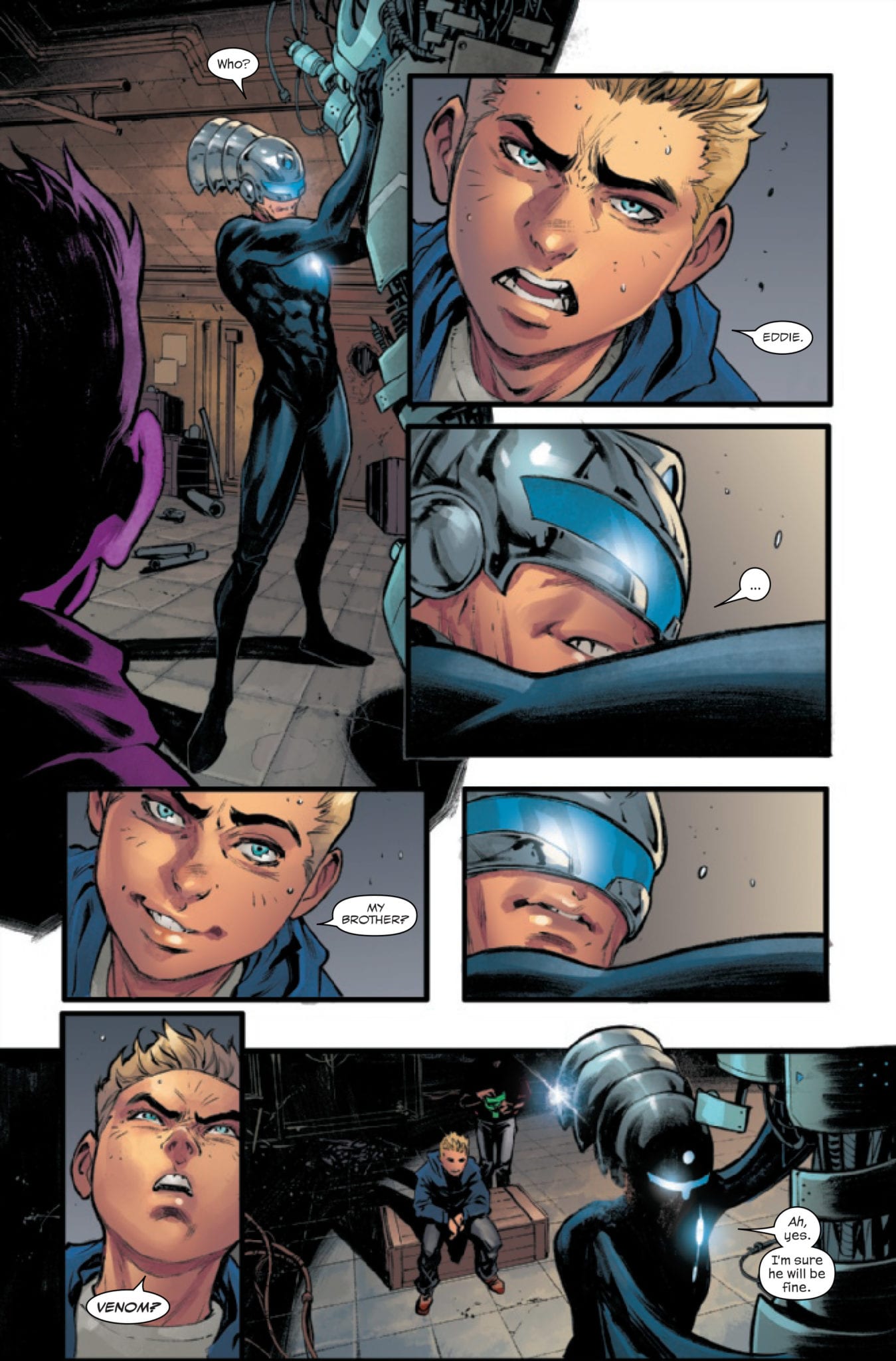
As stated in the description, this issue is a tie-in to Marvel’s current Absolute Carnage event, by Cates and Ryan Stegman (Venom‘s usual series artist). In the preview below, readers get to see the other side of the event: while Venom and Spider-Man are off taking on Carnage, Eddie Brock’s son Dylan is hiding out with Normie Osborn and The Maker, an alternate Reed Richards carried over from the Ultimate Universe.
Cates and Stegman’s Venom run has been both a critical and a commercial success for Marvel, with Absolute Carnage #1 now going to a fourth printing. The writer/artist duo have been building towards this event since they launched the symbiotic solo title last year.
Babyteeth #16 hits your local comic book store on September 11, but thanks to AfterShock Comics, Monkeys Fighting Robots has an exclusive four-page preview to share with you.
The series is by writer Donny Cates and artist Garry Brown, with colors by Mark Englert, letters by Taylor Esposito, and a cover by Brown.
AfterShock didn’t give out much information on Babyteeth #16, just a mysterious Bible verse. What do you think it means? Comment below with your thoughts.
2 Corinthians 11:14
“And no wonder, for even Satan disguises himself as an angel of light.”
Take your first look at Babyteeth#16:
About the series:
Vol. 1 Sadie Ritter is sixteen years old, nine months pregnant, and scared out of her sweet nerdy mind. Having a baby that young is tough, but with the support of her loving family behind her, everything should be okay.Oh yeah—and also her baby is the Antichrist and it’s going to break open the barriers between the earthly and demonic planes and unleash eternal suffering to all of humankind. Plus there’s a shady government organization and a Satanic cult both intent on kidnapping Sadie’s baby for their own nefarious purposes.
Other than that, though…should be fine.
Vol. 2 Crazy Warlock dudes, super secret cabals, inter-dimensional portals, new assassins, and the horrors of airline travel with a (demonic hellspawn sent to destroy the universe) baby! Plus—Marty, your new favorite demon-raccoon-thing friend!
Vol. 3 – available November 26, 2019 The story of the Antichrist and the people who love him continues as we enter into the most terrifying chapter of our journey so far: THE TERRIBLE TWOS! With almost every horrible truth laid bare for the Ritter family, the journey to save Clark and Heather (And Marty??) begins.
THE TERRIFICS #19 hits your local comic book store on August 28, but thanks to DC Comics, Monkeys Fighting Robots has an exclusive five-page preview.
THE TERRIFICS #19 is written by Gene Luen Yang, with art by Max Raynor, Dan Mora is the cover artist and he also worked on the “battle-damaged” variant, Photobunker is the color artist, and Tom Napolitano lettered the pages.
About the issue: Somewhere in a twisted, distant corner of the Multiverse, up is down, back is front, a smile is a frown—and Bizarro is king! But light is the head that wears the crown, and Lex Luthor’s offer of time manipulation has given our villain a new purpose: to turn back the clock on creation. To win, Bizarromust enlist the help of the only team that could tackle a task such as this: the Terribles!
Bizarro is right up there with the Joker as one of the most iconic villains from DC Comics. He has to be one of the most lovable villains too as he has some qualities of the HULK and The Thing that makes Bizarro endearing. What do you think? Comment below with your thoughts.
CHECK OUT THE TERRIFICS #19 PREVIEW BELOW
Bizarro was created by writer Otto Binder and artist George Papp as a “mirror image” of Superman and first appeared in Superboy #68 (1958).
The 2019 Mike Wieringo Awards have been announced. Known as the Ringo Awards, the award is named after famed and beloved artist Mike Wieringo. The third annual ceremony will be held at this year’s The Baltimore Comic-Con on Saturday, October 19, 2019. You can check out all the nominees below!
Best Cartoonist (Writer/Artist)
Echorise
Enjelicious
Terry Moore
Sean Murphy
Jim Woodring
Best Writer
Brian Michael Bendis
Richard Dent
Rylend Grant
Jeff Lemire
Scott Snyder
Brian K. Vaughan
Best Artist or Penciller
Joe Bennett
Shawn Daley
Ezra Claytan Daniels
Steve Ellis
Ronilson Freire
Dan Mora
Dustin Nguyen
Ryan Ottley
Sean Phillips
Best Inker
J.P. Mayer
Mark Morales
Ron Randall
Fiona Staples
Sana Takeda
Best Letterer
David Aja
Arechan
Taylor Esposito
Jared K. Fletcher
Todd Klein
Best Colorist
Tamra Bonvillain
Steve Conley
Matt Hollingsworth
Rachel Smythe
Dave Stewart
Matt Wilson
YaongYi
Best Cover Artist
Travis Charest
Nick Derington
Dan Mora
Sara Richard
Alex Ross
Fiona Staples
Jim Woodring
Best Series
Batman: White Knight, DC Comics
Bitter Root, Image Comics
Black Hammer: Age of Doom, Dark Horse Comics
Blammo, Kilgore Books
The Highest House, IDW Publishing
The Immortal Hulk, Marvel Comics
Venom, Marvel Comics
Best Single Issue or Story
Aberrant #4, Danger Zone
Black Hammer: Cthu-Louise, Dark Horse Comics
Champions #24, Marvel Comics
Klaus and the Crying Snowman, BOOM! Studios
Swamp Thing Winter Special, DC Comics
Best Original Graphic Novel
The Ghost, The Owl, Action Lab Entertainment
My Heroes Have Always Been Junkies, Image Comics
Son of Hitler, Image Comics
Upgrade Soul, Lion Forge
Woman World, Drawn & Quarterly
Best Anthology
Action Comics: 80 Years of Superman, DC Comics
All We Ever Wanted: Stories of a Better World, A Wave Blue World
Femme Magnifique: 50 Magnificent Women Who Changed the World, Black Crown/IDW Publishing
Grief, Source Point Press
Twisted Romance, Image Comics
Where We Live, A Benefit for the Survivors in Las Vegas, Image Comics
Best Humor Comic
Bluechair, Line Webtoon
Get Naked, Image Comics
Love Advice from the Great Duke of Hell, Line Webtoon
MAD, DC Comics
Rick and Morty vs. Dungeons & Dragons, IDW Publishing
Best Comic Strip or Panel
Amazing Spider-Man, Stan Lee/Larry Lieber, King Features Syndicate
Bloom County, Berkeley Breathed, Andrews McMeel Universal
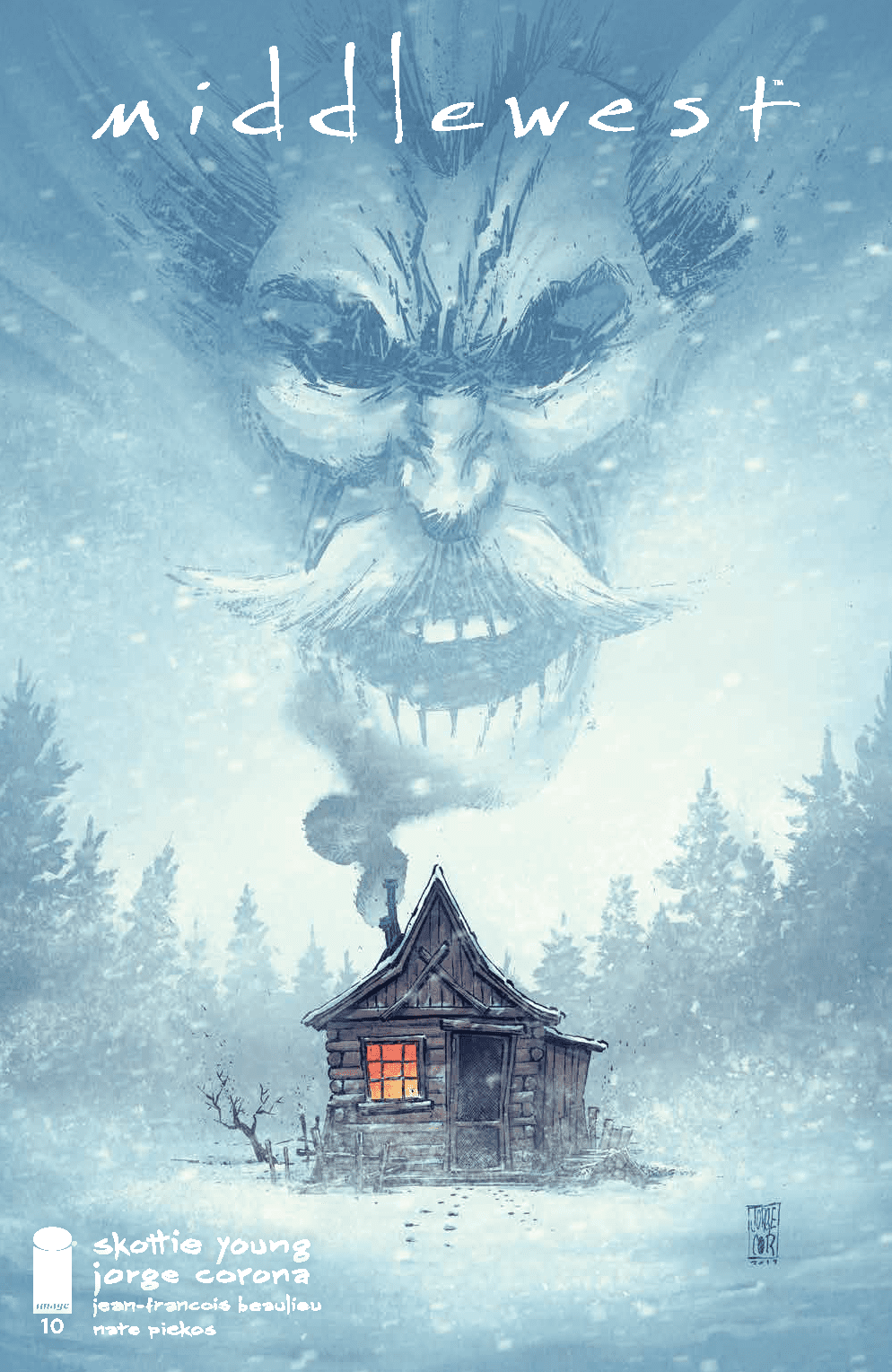
Middlewest #10 is published by Image Comics, written by Skottie Young, with art by Jorge Corona, colors by Jean-Francois Beaulieu, and lettering by Nate Piekos.
Previously on Middlewest, it seemed as though there would finally be a glimmer of hope for Abel. He had already been through so much – fighting to quell the storm within him; chased by an abusive father; shunned by the friends he found at the travelling carnival. When he arrived at The Winter Woods in hopes of finding a cure, Abel and readers stumbled upon a chilling revelation – the words “hello, grandson,” blowing through the wintry winds.
** Some Spoilers Below **
Story
Abel is brought before a long-forgotten figure from his past who offers some insight into the boy’s present and future. Feeling the weight of this unexpected reunion, Abel is left as he has been most of his life—cold and alone.
The first few pages of Middlewest #10 make it seem like Abel has finally found the wizard in his journey through Oz. The great and powerful grandfather seemed like the family figure Abel needed, as well as the answer to the questions burning inside of him. Writer Skottie Young starts off the book by keeping his cards close to his chest. He takes us back a few instances from the past, giving a better idea of who Abel’s grandfather really is, and more importantly, why his father acts the way he does.
What starts as a fairly timid issue, the final pages are exciting and tragic. It seemed that Abel’s grandfather might be the answer to control the storm within. Rather, the man behind the curtain is revealed, and he’s much more monstrous than Abel’s father. From the jarring moment you realize that the grandfather is not the kindhearted man he initially appeared to be, the story builds and builds until it explodes in a literal blizzard.
Art
Once again, Jorge Corona’s artwork on Middlewest is nothing short of stunning. This time around, he creates a world of winter that’s both terrifying and mesmerizing. The detailing of the snow and winds as they overwhelm Abel is a perfect display of Corona’s finesse and genius. Furthermore, the face of Abel’s grandfather as he transforms into the monstrous blizzard is awe-inspiring, intimidating, beautiful, and terrifying all at once.
Conclusion
Middlewest #10 is a fantastic step forward in Abel’s quest. It is a sorrowful yet bewitching piece of storytelling, enhanced by pitch-perfect artwork.
What did you think of Middlewest #10? Let us know in the comments!
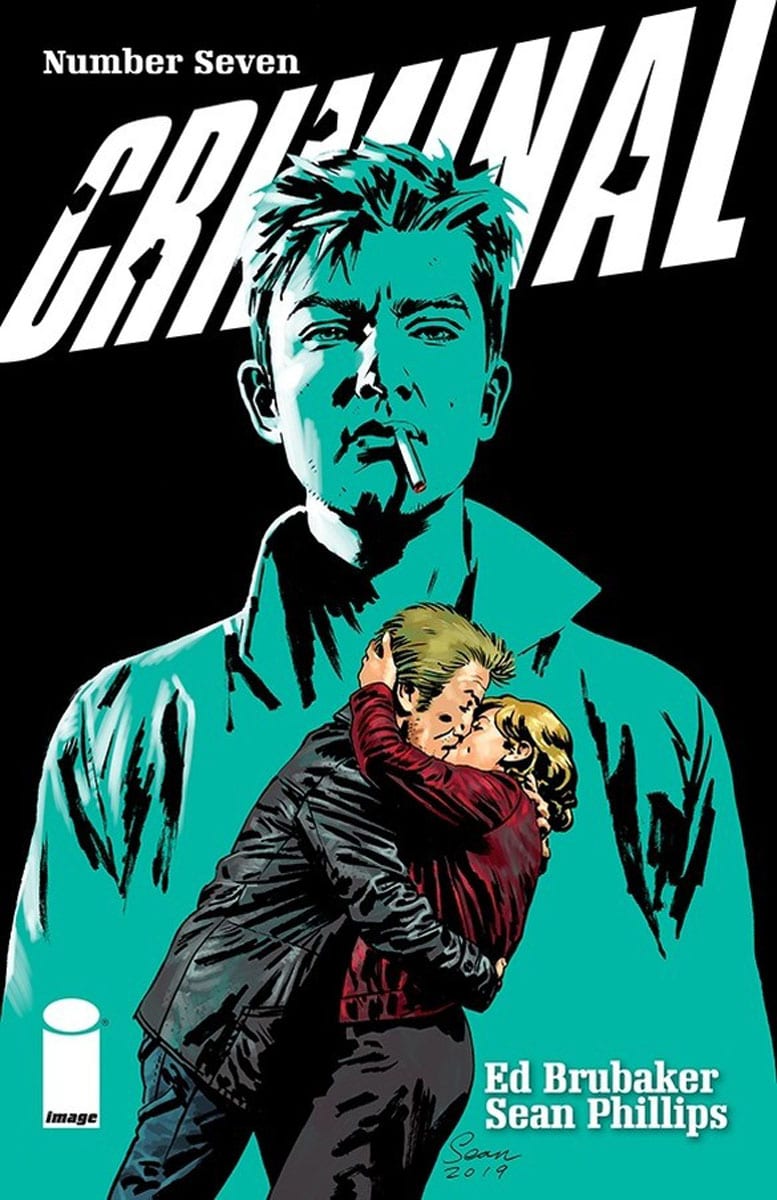
Image Comics’ Criminal #7 by Ed Brubaker, Sean Phillips and Jacob Phillips continues the excellent ‘Cruel Summer’ and once again cements this title as one of the best on-going monthly books the comic book medium has to offer
Young Ricky Lawless and Leo (from CRIMINAL, VOL. 1: COWARD) take the spotlight this issue, as the epic story of the death of TEEG LAWLESS continues!
Criminal #7 Written by: Ed Brubaker Art by: Sean Phillips Colors by: Jacob Phillips Published by: Image Comics
Story
Criminal is so fucking good it’s ALMOST getting difficult to review, only because as a critic you begin to wonder how much more you can praise and say about something that month in and month out is undoubtedly one of the best books in the market. But then you read the damn thing and you start to see reasons to praise it on just about every page, every word balloon and every panel.
Criminal #7 jumps back in time again (that’s one of the great things the on-going has been doing-seamless time/narrative jumping) to give us a hard look at Ricky Lawless. And Brubaker, ever the clever writer, uses an early scene involving Ricky and his friends (which include Criminal mainstays Jacob and Leo) playing Dungeons & Dragons to add layers to Ricky. Ricky’s post juvie anger and hatred for his dad comes out hard in his chaotic neutral character. He nearly ruins the game for his friends, and the scene makes it clear how much further Ricky is slipping into another Lawless criminal. It’s a dark twist on the recent role RPGs seem to be playing in pop-culture, but it also furthers both the character and the ongoing arc.
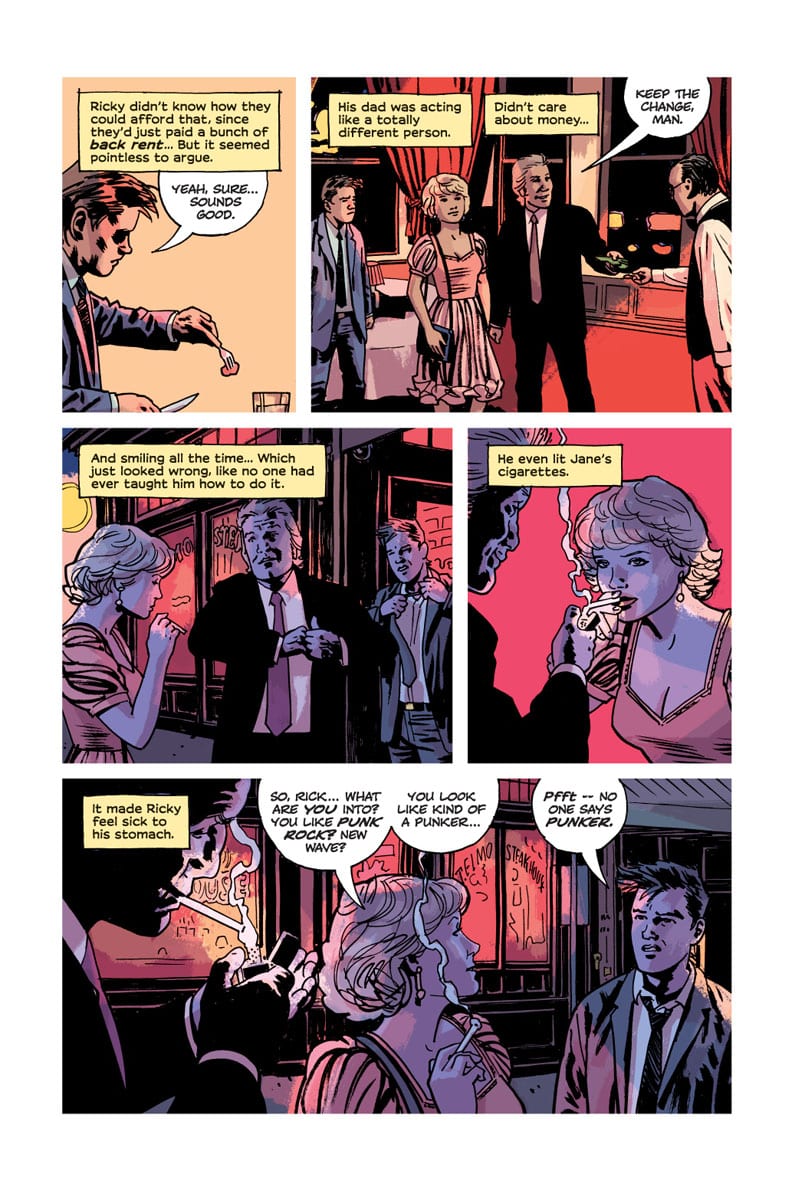
This chapter also sheds new light on what we saw in the previous issue, which focused on Ricky’s father Teeg and his new girlfriend Jane. Here we see Teeg and Jane through Ricky’s eyes and it’s clear the young Lawless doesn’t care for either. The relationship with his father is still complicated (as are ALL the relationships in Criminal) but there is darkness and hatred bubbling for Ricky and it’s crystal clear here.
There’s also a good focus on the friendship between Jacob and Leo. The two friends go on a small crime spree, and it’s obvious even then how dangerous Ricky is becoming. His antics are inching closer and closer to situations that put him in very real danger despite his age.
Brubaker’s narration also continues to be the best in just about any comic. Whenever he writes in a character’s voice it comes across as so raw and visceral it’s utterly realistic. You can hear the words coming off the page. We care about these characters despite the things they have done or will do. We care because they seem real, flawed and sometimes just trying to survive
Art
The art in Criminal has been excellent from the very first mini-series (Coward for those keeping score). There is no question that the linework of Sean Phillips is sublime, haunting, beautiful and unique. This world could not exist without him drawing it. No one draws faces like this, no one draws a smoking cigarette like this; it’s just about perfect.
But ever since Jacob Phillips took over the colors, this series has exploded in atmosphere and mood. Jacob Phillips is one of, if not THE most, talented colorists in comics and this issue has examples on just about every page. This issue, in particular, has a perfect example in its final scene/pages. The colors here help carry the emotion of the scene and sometimes something as simple as a red background to a muted color scene can pack a punch that makes you sit back and say ‘holy shit’. That happens on just about every page and it’s been consistent since the series began, and it really pops in this issue. This is exactly how you use color in sequential art.
Conclusion
If you read comics on a monthly basis, you need to be reading this book. With its fantastic back matter and letters pages, it’s MEANT to be read as a monthly. Do yourself a favor and add it to your pull list or just go down to your local comic book shop now and pick up the thing. You’re truly missing out by not reading this book.
Past and present collide with dire consequences in chapter four of Killer Groove, published by AfterShock Comics this week. Memories and desires fill the character’s minds as the various story threads begin to come together.
Ollie Masters (The Kitchen) tears away the rose tinted glasses and delves into the disturbing history of his creations, showcasing some of their worst memories and drawing parallels with their current situations.
Killer Groove #4 Credit: AfterShock Comics
Killer Memories
Jackie is forced into a position of responsibility where the young Lucy is concerned. Left alone and hoping that the detective can help her, Lucy strikes out at the world. Elsewhere Jonny is getting twitchy as everything is quite on the hit-man front and as a result his musical inspiration is drying up.
Master’s doesn’t leave it too long, however, before injecting some action into the script and suddenly everything begins to fall apart.
The plot of this issue is broken into two clear sections. The first is the present day, from the point of view of the characters, where clever manipulation by Masters brings the cast together in surprising ways. The second element is a collection of flashbacks, touching on the characters past to shed light on their personalities.
Masters uses the two time lines in conjunction to bring out the most from a character development point of view. The flashbacks are cleverly placed for the reader to reflect on current plot lines and gain a deeper understanding of the journey leading to that particular moment. They help to broaden the character’s experiences and give the reader context for the choices that have been made.
There are some shocking moments in this issue and Masters builds up the tension, leading sedate scenes into acts of violence. Sometimes there is a slow build up in a scene, creating a level of anticipation where as other scenes have a sudden shock moment, hitting the reader after a page turn. Mixed with the emotional, and often cruel, flashbacks Masters has written an intense, packed issue with a lot for the reader to digest.
Killer Groove #4 Credit: AfterShock Comics
The Art of the Killer
Eoin Marron (Army of Darkness) adopts an expressionistic style for Killer Groove using heavy lines and stylised forms to bring out the characters. He focuses on expressions and stance, exaggerating the casts features for optimum effect. This approach is effective and gets the reader closer to the characters.
Marron is able to capture the essence of a character in a single panel and also express complex flows of narrative in abstract panel transitions. He juxtaposes similar forms to illustrate moods or actions, such as the jump from a bloodied baseball bat to a used needle.
Sometimes less is more so Marron empties panels of their backgrounds to emphasis the foreground creating a dynamism to some of the scenes. The pages’ flow effortlessly from domestic drama to criminal violence. However, the highlight of this issue are the flashback sequences. It is during these pages where Marron captures the emotional heart of Killer Groove.
Of course, the coloring by Jordie Bellaire (Buffy The Vampire Slayer, Redlands) helps to focus the reader by putting certain characters into the centre of the scenes. A simple technique of coloring only one character in the panels illustrates the world revolving around them; the reader can see instantly who they should be following across the page. It also amplifies the actions around the character adding weight to the story. It is clear from these pages that these are memories, raw and still fresh in the character’s minds.
The unique lettering style adds another level to the storytelling. By using slight changes in color for the speech balloons, Hassan Otsmane-Elhaou is able to portray subtle fluctuations in the tone of the speech. The character’s voices appear to range from whispers to screams, all because of the alteration to the balloons the text is placed in.
Killer Groove #4 Credit: AfterShock Comics
Conclusion
Like any good thriller approaching the end game, Killer Groove slowly draws the characters together, merging their lives in disturbing ways. Masters brings out the best, and worst, in his cast this issue and there are moments that will make your heart stop for a beat.
The pacing of the narrative is beautifully handled and the art work leads the reader through the complex personalities. The layers are still being stacked but the whole picture is finally taking shape, ready for the big finale next month.
Each issue of Killer Groove has something to offer the reader. It is riveting and shocking in equal measure, moving away from the glitz of the music business and instead focusing on the violent underbelly of society where people are just trying to survive.
Check out the spookier corners of your local comic book shop and you’re sure to come across a few titles by James Tynion IV. The prolific writer not only spearheads the creepy side of the DCU as writer of Justice League Dark, but he’s also got several horror titles lurking over at BOOM! studios, including his GLAAD-award-winning series The Woods.
Recently, James announced his terrifying return to BOOM! with the title Something is Killing the Children, a spine-tingling supernatural thriller written by Tynion and edited by Eric Harburn, with art by Werther Dell’Edera and Miquel Muerto. Monkeys Fighting Robots was recently able to chat with Harburn and Tynion about the upcoming book, and just before our interview began, we received some thrilling news: Something is Killing the Children has officially been promoted to an ongoing series. Check out what the creative team had to say about the book, and its new development.
Grant DeArmitt for Monkeys Fighting Robots: Well first of all, congratulations on the story’s move to becoming an ongoing series! That is incredibly exciting news. I guess my first question is: what’s it going to be like to write a comic forever?
James Tynion IV: (Laughs) Great question. Honestly it’s really exciting. This is a story that has shifted around in terms of its format a few times. When I was pitching it at the end of last year, I saw it as a series of one-shots. Erica Slaughter, that’s our monster hunter, would arrive in a small town and would take care of a monster. People would bear witness to this strange figure who they never fully understand, then she would move on. It was in the writing of the first issue that I saw the story I was writing wasn’t actually built for these one shots. It was something bigger and stranger. It was something that would live in the quieter moments.
Now the story is finally in its true form, what it always should have been. It’s this long-form horror novel in a comic book. There is an ending to the story, but the ending is now further out. We’re going to really be able to live in this world, in this town of archers Peak. I’m really excited about that.
MFR:Yeah, I read that this was a story that was brewing in your head for a while, so this is very cool. Now, onto the first issue of SIKTC: One of these characters seems to be semi-autobiographical. This kid’s name is James, he has long black hair and glasses, and he loves telling spooky stories. Am I correct in assuming that that’s you, James?
Tynion IV: Yes, that is absolutely correct. It’s funny because honestly, I could give a whole bullshit answer about how “this is me trying to tell this autobiographical story,” but the truth is when I was writing that first scene I didn’t know what the names of the kids were going to be. So I plotted in the names of me and my closest friends from when I was growing up.
But that just changed the emotional intensity of the book for me. For a long time, even into writing issue two, I would talk to Eric and say, “I’m still thinking I might change the name as the main character. It won’t be James.” But the character forming there is kind of this miniature version of me, circa 8th grade. That felt more authentic, and it means that I can get into a fictional version of myself’s mind pretty easily. It really opened up the horror of the series too. I remember how it feels to be afraid at that age. That’s where my whole fascination with horror comes from. So it’s me tapping back into that.
MFR:So the key to the horror of this piece is what you grew up scared of?
Tynion IV: In a way, yeah. Not in a literal sense; I wasn’t afraid of monsters coming out of the woods and murdering me and all of my friends. But the monsters in [this story] represent a larger type of fear. It’s the fear of threats that you don’t really understand, of something out in the world that you don’t know about,. And when you try to explain it to the adults around you, they can’t really see or they can’t put themselves in your shoes. And so you feel vulnerable. It’s those types of fears that really build up inside you.
In this story, those fears become something more in a very literal sense. We’ll learn a lot about the nature of these monsters and also why, in the world of this book, adults can’t see these monsters. The only adult who can see them is Erica Slaughter. And the reason she can see them, which is part of the mystery of her character, will now unfold over the whole long-form series. I’m excited to dig in deep and go to some pretty dark places with it.
MFR:So James, you obviously have a very long history with this project. But Eric, what’s your history with Something Is Killing The Children? Where do you come into the project?
Eric Harburn: I think the first time James told me the title was probably about five years ago. This was, I believe, in Emerald City in 2015, maybe 2014. I can’t remember exactly. But I knew, even way back then, that it was a scorcher of a title. I think it might have gone through a few different iterations before we finally started working on it together late last year. I’ve been working with James for six plus years now; we worked on The Woods together, we worked on the Apocalypse trilogy, we did a book called Ufology together. In the last year or so, we’ve been gearing up toward the next slate of titles, this next phase of James’s career in creator-owned comics, with his BOOM! collaborations. Something is Killing the Children felt like it was an excellent vanguard title for what James is doing here.
So we’ve been talking on and off about the book for a while, but we’ve been in production on it coming up on a year now. Probably last October was when we first hit pedal-to-the-metal and James whipped up a story document, plus a description of Erica Slaughter as this ghostly, ethereal protagonist for this book. It’s bloomed from there.
MFR: Is that where artist Werther Dell’Edera comes in, once you have that very iconic image of Erica? She’s got this fantastic character design. Was that something that he came into it with, or did you have that idea in your heads?
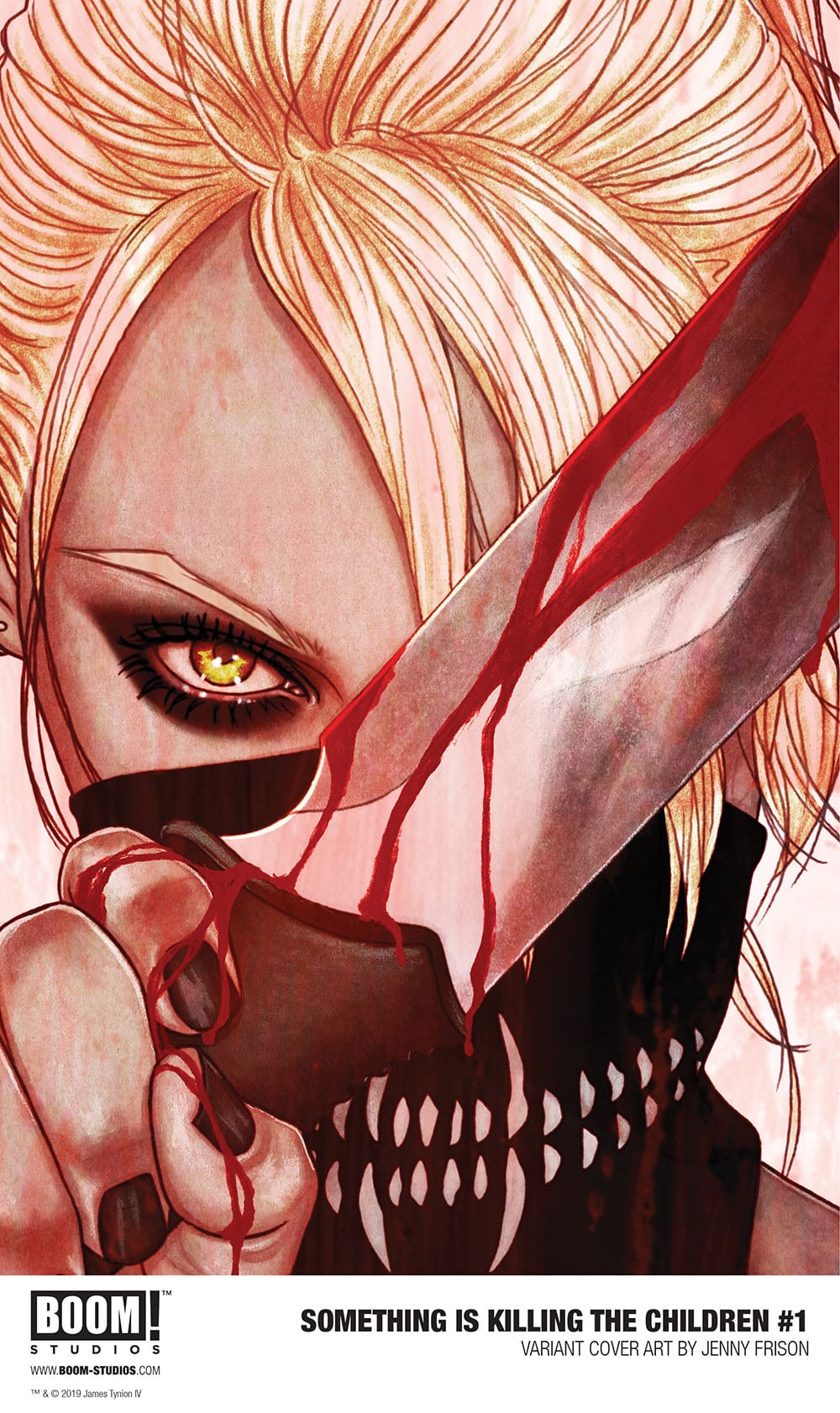
Tynion IV: There was an image of her that was forming in my head. It was of this blond woman with her hair parted over one eye to cover this scar on the back of her head. It was also the idea of the sleep-deprived, shadowy eyes. The idea of someone who has just been doing this for so long, and you can see the effects of it on her. Once we brought Werther onto the book, we started talking about the character, and in the first few sketches he added a few of these elements that really brought her whole design together. It was Werther that came up with the idea for the bandana with teeth on it. He gave her the “strange” vibe.
Something is Killing the Children Issue One: Variant Cover by Jae Lee, Boom! Studios
Tynion IV (continued): So much of the book is grounded in the real world. It exists in a space that you can really touch and feel and live in. [Erica] is the character who looks like she’s almost from a different comic book. That was part of the idea, we wanted her to be a little out of place. And Werther just captured that so effortlessly. The other person that’s just an inexorable part of this creative team is our colorist, Miquel Muerto, who just has brought this series to life in such vibrant color. I’m so excited about this world that we’ve started building together.
MFR: All right, last question. This first issue deals with the spooky stories that we tell each other as kids. That’s the opening scene, a bunch of kids telling stories to freak each other out at a sleepover. So I was wondering from both of you, what is the spookiest story you remember telling your friends or your friends telling you when you were a kid?
Tynion IV: The scene at the beginning of this comic is very true to life. [My friends and I] would prompt each other to tell these scary stories. The exact story that the character James tells isn’t the real thing I remember telling, but I remember sitting in my room and staring out into the forest it just freaking me out. I had a very active imagination, and I would just imagine these things coming out of the forest. It was always something different. I made up different things to be afraid of. For a long time I couldn’t even watch horror movies, because if I let my brain alone I would get scared. More than anything, that is the genesis of this project. It’s also the thing that guided it into its current form. It was writing that first scene that made me see what the series needed to be.
Harburn: I’m kind of similar. I didn’t grow up watching horror movies, I was kind of a wuss as a kid. I probably saw some a little too early. And now I work on ten horror books? I don’t know how the hell that happened. My earliest memory of…well, it’s not even a horror movie, but I was watching Gremlins with my parents and I just couldn’t handle it. When the lead character goes into a, what is it, a laboratory? I had to run out of the room. I think it was probably another five or ten years before I started watching horror movies again.
(Laughs) So this book right up my alley.
Pick up Something is Killing the Children at your local comic book store on September 4th. Once you do, let us know what you think of it in the comment section below, or over on our Twitter page. For more on this comic, and for every other title you love, stay tuned to Monkeys Fighting Robots.