Home Blog Page 399

G.I. JOE #2 Puts The Fight and Joe in Family

Monkeys Fighting Robots

This Wednesday, IDW’S G.I. JOE #2 shifts the focus from recruitment to basic training as Tiger learns what it is to be a Joe, and a fighter.

Haven’t been recruited to the new G.I Joe yet? Check out the first review, or grab it from your local Comic Shop!

A Family That Fights Together

Unlike the first issue’s adrenaline filled opening, G.I. Joe #2 begins on a somber down beat. But starting on a down beat means you can only go up, which is were the characters and plot go as they work their way through grief while becoming a family.

Writer, Paul Allor keeps the plot primarily on the Joes, via an overall narrative coming from General Hawk. Hawk’s speech exudes the theme of grief and its effects. This theme is then carried through Scarlett, while Allor shows the slow transition of Tiger becoming part of the family through training. By mixing these elements, Allor showcases how average and realistic the team is. This all accumulates towards then ends where the Joes act as a family, coming together when one of them is in need.

G.I. Joe #2 ends on a huge cliffhanger that’d been building in General Hawk’s narrative throughout the issue. Classic fans may not be that surprised by what transpires. But newcomers will, forcing them to do a quick Google search.

The Art Of Fighting

Artist Chris Evenhuis continues to blend realism and animation with each line drawn. The somber moments look fantastic as each emotion felt is seen on the characters face. But one of the highlights seen throughout is how Evenhuis portrays the action sequences. This is due to the abundance of them, and simplicity.

Much like the previous issue, Evenhuis showcases a singular fighting motion in a single panel, helping emphasis what’s happening. Furthering this spotlight on a single action is Brittany Peer’s colors. Or lack of color in some cases. Peer’s keeps the tone inviting with bright colors, making the serious matter not so imposing.

During the fighting panels, Peer’s portrays the background as a singular color, helping exaggerate what transpires. This usage of a one-color background bodes well with Evenhuis’ singular movement panels. During one case, Peer’s voids half the panel of color, making the impact of Scarlett’s kick feel more impactful.

Some moments of gun and explosives were void of sound effects in the first issue, which seemed weird. G.I. Joe #2 follows this trend with letterer Neil Uyetake voiding the fight scenes of sound. But in this case, it helps amplify the simplicity the others strive for.

G.I. Joe Basic Training (Conclusion)

G.I. Joe #2 expands upon its ‘everyone’s a Joe’ concept by delving a little deeper into the characters. Mix in easy to follow, fun fight scenes and you’ll soon find yourself a Joe!

Memorable Quote: “The best defense against a punch is to punch them first.” – Scarlett

I mean, she isn’t wrong?

Being a Joe

With basic training under way how do you feel on the new G.I. Joe series? Let us know below!

Monkeys Fighting Robots Youtube

LUMBERJANES #67 – A Strong Reminder Why We Love This Series

Monkeys Fighting Robots

LUMBERJANES #67, out this Wednesday from Boom! Box brings with it several journeys. Not least of which is the battle between two goddesses for the cutest cat in the realm. This delightful tale is a strong reminder for why we love this series so much.

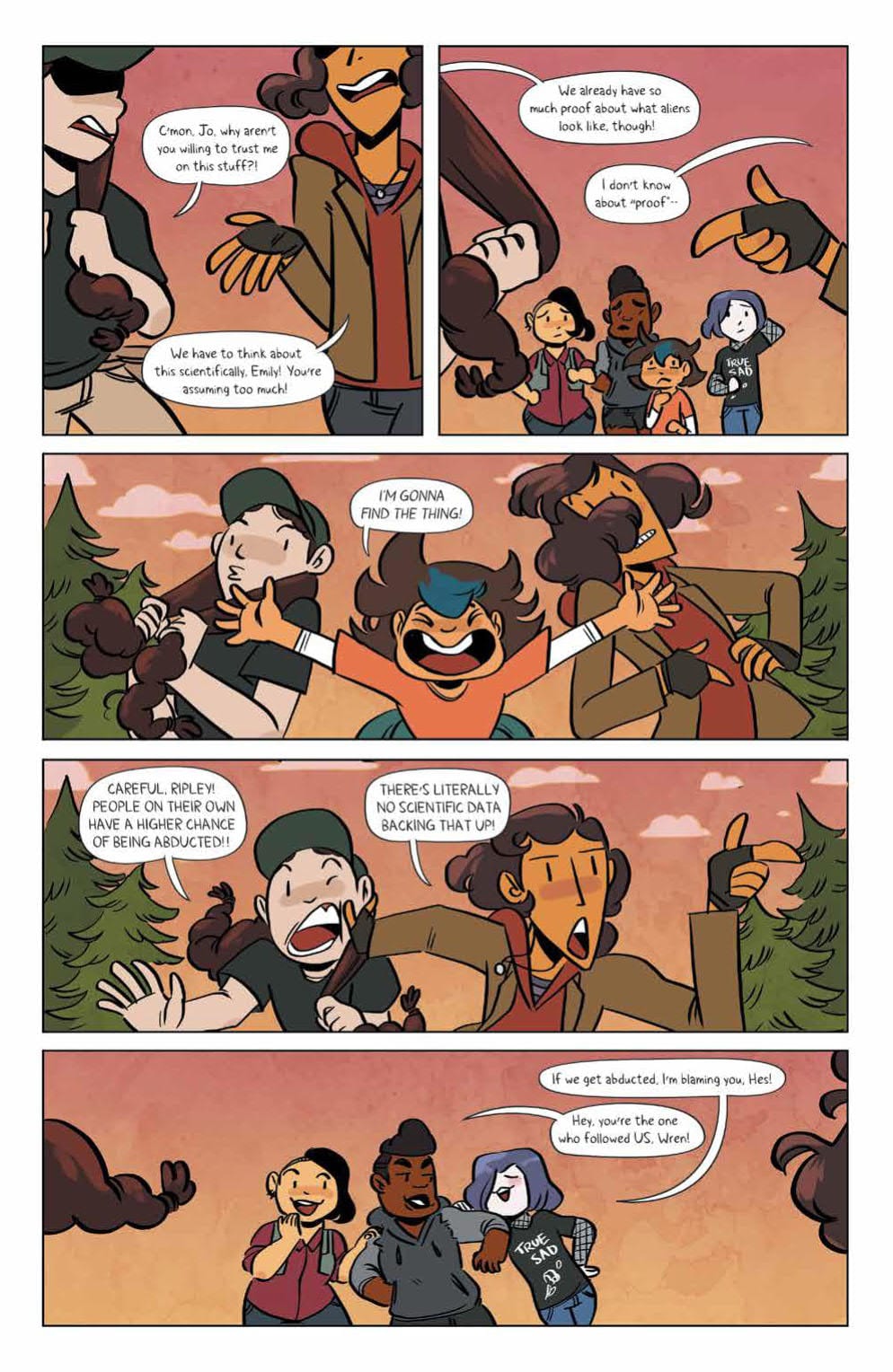
Looks like somebody may have spotted an alien!

***SPOILER WARNING***

If you tuned in during the last issue of Lumberjanes, then you’re already aware that our campers have split up into two groups for fun adventures. Or chaos. Really, whatever will entertain them. One group had a blast frolicking with the goddess Freya…well up until she went on a catnapping mission. The other group has been on the hunt for proof of extraterrestrial life. So just another day at camp, right?

Once again, we find ourselves in a tale with plenty of twists and turns. Lumberjanes #67 brings with it a battle, an emotional confession, and plenty of confusion. But that is why we love the Lumberjanes so much.

Our Lumberjanes are enjoying a nice and oddly relaxing day on this alternate cover.

Shannon Watters and Kat Leyh are the minds behind this chaotic issue, and they clearly had a little bit of fun here. After all, it isn’t every day you get to see a bunch of campers tracking a goddess, or try to track down an alien or two (okay, maybe that last part happens more often than we’d like to admit).

The two plots at times have felt entirely unrelated, and at other points, it seemed like they were all tracking the same person (hint: Freya). But this issue makes us wonder if that was all a misunderstanding, and that there is indeed, even more, going on than meets the eye. It wouldn’t surprise us, given how chaotic this camp can get at times. After all, who’s to say that they can’t have both a goddess and an alien hanging out at the same time? Or perhaps even a second god or goddess? Only time will tell.

Lumberjanes #67 was a fun read, giving Diana a chance to really shine, thanks to her hunting and tracking abilities. And that’s something she’s never really been able to show the other campers before. On the flip side, this issue does have one of those classic Lumberjanes moments. You know, when one of the campers feel safe enough to reveal something deeply personal? You have to love those endearing moments. If only all childhood friendships were like these.

A difference of opinion?

The artwork behind Lumberjanes #67 was exceptional, and a little bit quirky. In short, it was perfect for the Lumberjanes and their quests. Kanesha C. Bryant was the lead artist behind this issue, and her portrayal of our beloved characters was spot on. She showed their varying emotions in such an endearing manner; it’ll make you want to reach out and hug them.

Meanwhile, Maarta Laiho did the coloring. And she made their world seem so vibrant and full of life. Which is precisely how it should be, given who we’re talking about here. The backgrounds and sunsets (or is it sunrise) were an especially nice touch.

Finally, Aubrey Aiese was the letterer for this issue, and she did a brilliant job of showing off the varied emotions from our characters. You could tell when they were whispering (or trying to), shouting, or just emoting in general.

And once again, Ripley is all sorts of into this plan.

Lumberjanes #67 was a fun-filled issue, with some tension and sentiment sprinkled throughout the panels. And let’s not forget an exuberant beginning to a goddess battle. And really, what more could you possibly ask for?

Monkeys Fighting Robots Youtube

How FEARLESS #4 Concludes A Memorable Series

Monkeys Fighting Robots

FEARLESS #4, out this Wednesday from Marvel Comics, brings an end to this adventurous series of miniaturized plots. But it isn’t afraid to go out on a bang. Fans will be overwhelmed by emotions while reading this issue.

Ms. Marvel takes front and center on the final cover of Fearless.

***SPOILER WARNING***

Fearless has been a series getting a lot of ink, which is impressive given that it’s a miniseries. The whole point of it was to give female creators and characters a chance to shine all in one concise and adventurous series. And it’s safe to say that it more than succeeded there.

Each issue in the series has been broken up into several different stories, the first one being a long-running plot arc (that carries through to each issue) the other two being short but exciting stories. And obviously, they all revolved around female leads.

Fearless #4 contained within it four parts, though the last two are the shortest of the series thus far. You can find ‘Campfire Song Part 4’, ‘Atmospheria,’ ‘Golden Girls’, and ‘Two Gals Eating Ice Cream’ in this issue. Consider yourself warned, the latter few plots are shockingly intense and will make you feel things.

Storm is helping with the cleanup and checking on the emotional stability of the girls.

‘Campfire Song Part 4’ is the first tale in this issue, and it also concludes the longest-running plot in the series. It’s difficult to read this plot and not feel inspired by the end. Campfire Song felt like a tale of acceptance, not just of others, but of yourself and any changes you might face. But it’s also about so much more than that. It’s no wonder this plot became the anchor of the series.

Featuring Captain Marvel, Storm, the Invisible Woman, and Ms. Marvel, it’s safe to say that this story has a lot of heavy hitters in it. These are all strong and dynamic women – women who aren’t afraid to speak their minds or have a little fun during their time off. And there’s a lesson to learn from that. And okay, it also had a little bit of fun at Tony Stark’s expense, but he can afford it, right?

Seanan McGuire was the brains behind this inspiring tale, while Claire Roe provided the lines, and Rachelle Rosenberg the colors. And honestly? These three are a dream team. It’d be amazing if we could see them work together sometime in the future.

Namor has no interest in Namora’s concerns.

Next up is ‘Atmospheria.’ Feel free to say that name ten times fast. But seriously, Tini Howard wrote a shockingly intense plot here. It’s one of those tales that starts interesting, piquing your curiosity but isn’t afraid to hit you over the head with an important message.

Namora’s tale had several twists and turns, which is surprising given the length of it. Yet every turn was meant to bring us back to one point. It was the driving force behind this issue, and it’s clear that the author felt it’s something we need to talk about more.

The beautiful seascapes and interesting aliens all came from the minds of Rosi Kampe (pencils & inks) and Muntsa Vicente (colors). And the last panel of this story is perhaps the most memorable, being both adorable and full of meaning.

Boy, is he in for the lesson of his life!

The last two stories of the issue came from the same creative team, and consist of only a few pages put together. ‘Golden Girls’ and ‘Two Gals Eating Ice Cream’ are pure nostalgia, while also addressing the elephant in the room: women’s history in comic books. It’s something that is so frequently written out of our minds and history, so seeing the reminder here is appreciated.

Trina Robbins’ two stories are beautifully written, fitting in with both the time period and overall theme of the series. It tackles conversations that many fans have forgotten, and it does so in a way that reminds us of the humanity behind the creators.

Marguerite Sauvage was the artist, and there is so much to love here. She perfectly portrayed the wardrobes and fashion styles of each creator during her time period, all with this light and bubbly feeling to the colors. The lighter tone is misleading, as these reminders won’t hesitate to hit you in the feels.

And here’s a good look at all of the creators involved with the final issue in the series.

Fearless #4 had plenty of factors to tie it all together. For one thing, every story focused on a fearless and dynamic woman in the Marvel Universe. This issue also seemed to be focused on making some important points, whether it is a tale about trusting yourself, respecting the environment, or remembering the past.

And of course, there’s the letterer, Cardinal Rae, who stayed consistent throughout. That helped to tie things together visually.

In a way, it’s a bit sad to see Fearless come to a conclusion. It was a powerful and moving series. The emotions it was able to elicit prove that the series managed to succeed in its goal. And of course, we’ve got to love the fact that they were able to bring so many awesome characters and creators together for one massive project. And hopefully, this project also succeeded in putting a few new names on your automatic ‘to be read’ list.

Monkeys Fighting Robots Youtube

Review: Booze, Monsters, & B-Horror in COUNT CROWLEY: RELUCTANT MIDNIGHT MONSTER HUNTER #1

Monkeys Fighting Robots

Actor and horror-lover David Dastmalchian cuts his teeth in the world of comics with the first issue of his debut series “Count Crowley: Reluctant Midnight Monster Hunter.” The first of this four-issue horror-comedy mini-series from Dark Horse Comics will arrive on shelves this Wednesday just in time for Halloween. While it stumbles a bit out of the gate, there’s still plenty of boozy and monster-filled fun to be had.

MINOR SPOILERS AHEAD

Small town television reporter Jerri Bartman is in danger of losing her job due to her volatile on-air attitude. That is until she’s given a chance to host the network’s late-night creature feature and B-movie slot, filling in for the missing Count Crowley. While wearing the ridiculous costume and introducing old horror movies seems simple enough, her first night quickly gets complicated. A crazed stranger approaches her, demanding to see Count Crowley; A crazed stranger that turns into a werewolf. It seems that being a cheesy monster-flick host has more to it than was put in the job description.

Dastmalchian’s sense of dialogue is smooth and natural, and the humor is pretty on point for this type of book. Each character has his or her own believable voice, from Jerri’s dry sarcasm to her manager’s desperate but friendly demeanor. The book is a fluid page-turner carried entirely by character dialogue and action. There’s no additional narration, as this isn’t the sort of story that needs it. While the characters feel like tropes that have been done hundreds of times before, it fits the story’s simplicity. This is meant to be a comedic love letter to Hammer films and EC comics, and so far it nails it.

Playing as Count Crowley may be a bit tougher than they let on.

The major flaw in the writing, and honestly the only real flaw in the entire issue, is the opening sequence. It’s a flash-forward to what happens at the end of the book. Which works as the plot point the rest of the issue builds up to. Not only is it unnecessary and robs tension from the rest of the issue, but it also has some problems that make it feel tacked on. There’s a specific sequence with a magically appearing gun that then randomly appears in Jerri’s hands in the next panel. This “wait, where did that come from?” moment completely breaks the story’s immersion in the first few pages.

The art team’s work here on “Count Crowley” is pretty stellar. Lucas Ketner’s pencils and inks are full of believable environmental detail, bringing the 1980’s small-town feel to life in a quiet way. His stellar character drawings easily convey emotion to the reader and are honestly a bit reminiscent of hyper-detailed Scooby-Doo art. This is in no way an insult, and it works perfectly for the story being told. Ketner’s art is filled in by Lauren Affe’s fantastically appropriate colors, as she creates a sort of grainy overcast effect to the panels. She uses a muted color palette that simulates the look found in the classic Creepy and Eerie horror comics that “Count Crowley” pays tribute to. It’s a neat blend of nostalgia and modern technique.

“Count Crowley: Reluctant Midnight Monster Hunter” #1 is a simple yet fun jaunt into a nostalgic horror-comedy made just for fans of the genre. Despite a shaky opening, the story smooths out into an enjoyable page-turner with likable characters and great work from the art team. If you’re looking for a fun new read just before Halloween, David Dastmalchian’s debut comic is worth adding to your pull list.

Monkeys Fighting Robots Youtube

Review: BOOKS OF MAGIC #13—Can Tim Fix His Crumbling Relationships?

Monkeys Fighting Robots

BOOKS OF MAGIC #13, available in stores Wednesday, October 23rd, brings the focus back to one of the main themes within this series: relationships. Writer Kat Howard hones in on Timothy Hunter and Ellie, separately, as they try to fix the damage the world of magic has wrought upon their personal lives. For Tim, the only clear answer involves literally repairing the magical bonds keeping his father from full consciousness; for Ellie, the best course of action requires her to alert the authorities.

These two former friends’ paths continue to diverge, but it’s only a matter of time before their courses collide once again.

Story

In a fit of desperation, Tim uses his inventive side to create a device that would allow him to examine the exact magical spells bonding his father. This item is worn over the eye and function almost like x-ray glasses—the sheer fact that a novice wizard like himself could craft such a device in an afternoon is nothing short of amazing.

Tim makes his magical seeing device

But Tim refuses to dwell in the success of his accomplishment and immediately tests the device on the older man. As expected, most of the spells surrounding him are Tim’s own doing, adding more weight to the already guilt-ridden boy. He throws all caution to the wind and attempts to sever the magical bonds with his screwdriver wand, but to no avail.

What Howard does next is quite surprising, given the nature of her angsty protagonist. Instead of having him attempt to “fix” the situation as usual, she has Tim opt to spend some quality time with his father. It’s as if the boy’s realized no amount of repair in a relationship can occur without quality time between both parties. Sometimes, simply “being” with someone will heal more than a magical “fix” ever could. And, amazingly, Tim’s magical bonds begin to fade away as his father slowly remembers all the time spent with his son over the years.

But not all is fine within Tim’s web of relationships; Ellie is still traumatized after seeing him use magic to seemingly kill Mr. Davies last issue. Afraid for her life and the lives of others at their school, she reports to an investigator in the hopes they will restrain Tim before something else horrible happens. But there’s more to this investigator that meets the eye, and she appears to have further plans for the wizard boy.

Elli is interrogated by the detective

Artwork

The artwork within BOOKS OF MAGIC # is incredibly unique, even for this fantasy series.  Penciler Tom Fowler, inker Craig Taillefer, and colorist Jordan Boyd alternate between a standard view of Tim’s world and the “magic vision” granted by his device, alternating between the bland colors of the London streets to the bright colors of magical elements brilliantly highlight the differences between worlds. And letterer Todd Klein, with carefully place dialogue bubbles, allow the writing to guide readers between these two “views” of reality with little confusion.

Comic Cover

Kai Carpenter’s cover art depicts Tim and his trusted owl Yo-yo staring out into the distance, possibly preparing for new challenges. This shows readers that despite the evil Davies’ demise, trouble lies not far behind.

Conclusion

BOOKS OF MAGIC #13 gives us a look at Tim’s relationships that have been damaged due to his wizard life, but all hope is not lost. We’re treated to glimpses of redemption and repair through the quiet moments between our hero and his father. But can the harm done to Ellie be undone as well?

Did you agree with Ellie’s decision to encourage the authorities to arrest Tim? Let us know in the comments below!

Monkeys Fighting Robots Youtube

Review: The Future Is In Danger in AMAZING SPIDER-MAN #32

Monkeys Fighting Robots

In Marvel Comics’ Amazing Spider-Man #32, on sale October 23, the future is now. Spencer doesn’t give Spidey any time after Absolute Carnage; there’s a new crisis and it threatens tomorrow’s world today. Spencer establishes these dire stakes and leaves us wondering what’s menacing Miguel O’Hara’s home.

Amazing Spider-Man #32

Writer: Nick Spencer

Artist: Patrick Gleason

Colorist: Matthew Wilson

Letterer: VC’s Joe Caramagna

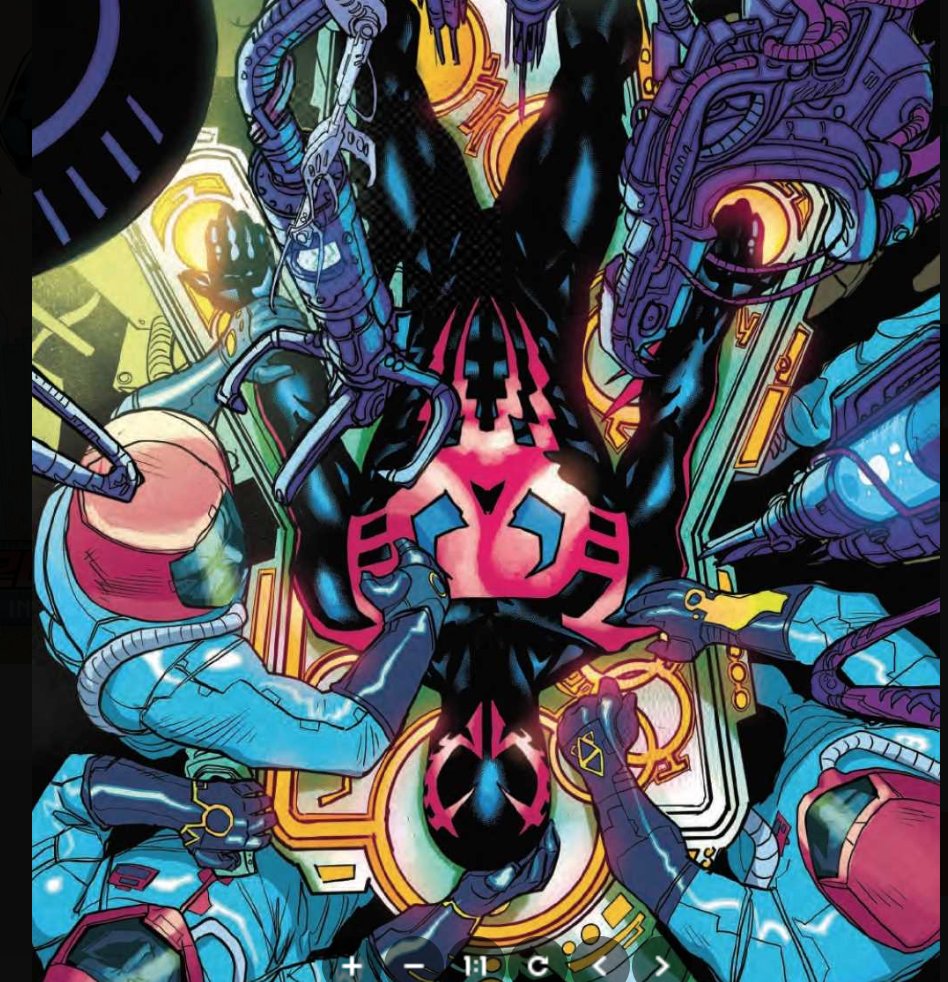
As established in Amazing Spider-Man #25, Miguel is back in the present because he needs help. Spencer leaves many the specifics of his situation unanswered; it’s unclear how Miguel wound up in an sinister science facility but the mystery is intentional. But Spencer drops enough hints that draw the reader in without leaving us totally in the dark. The art team complements this narrative secrecy.

Amazing Spider-Man #32
Miguel O’Hara finds himself at the mercy of some invasive scientists.

Artist Patrick Wilson and colorist Matthew Gleason consistently shroud scenes with shadows. Early on, a group of ominous-looking bad guys stand in a dimly lit room while they discuss their plans for Miguel. “Think of the discoveries, the breakthroughs…think of the patents,” one of them says with an evil smile on his face. The image of these men secretly scheming in a dark room pairs with Spencer’s script to heighten the tension-packed story.

Amazing Spider-Man #32
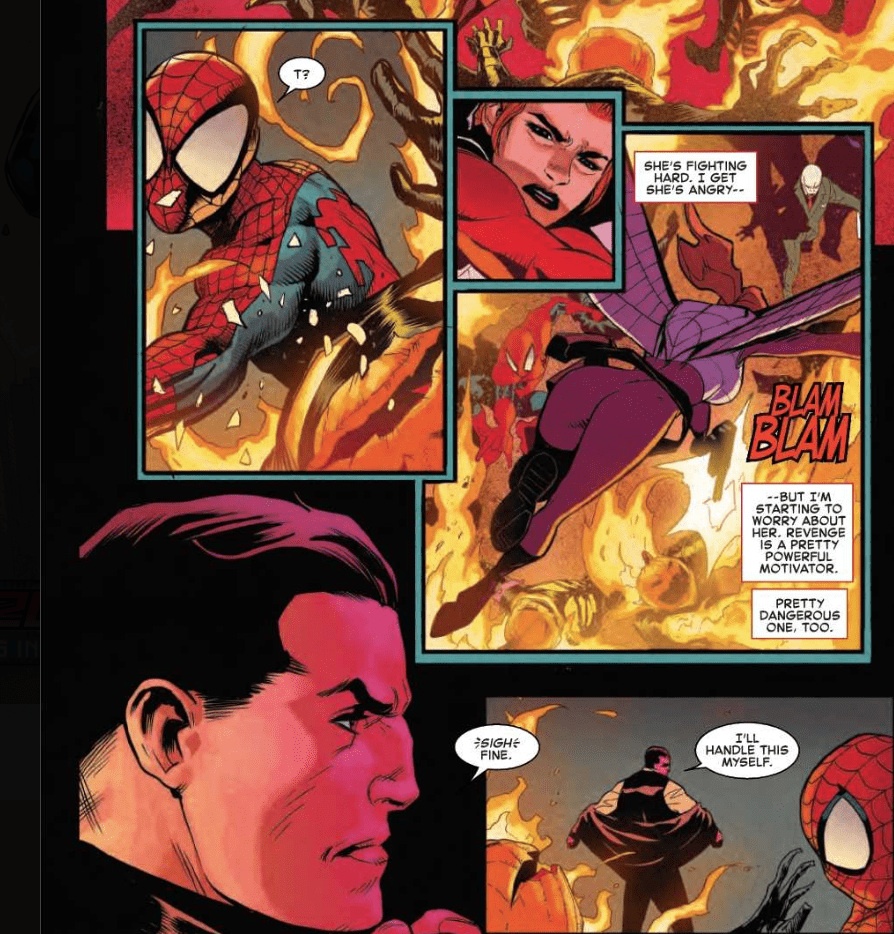
It wouldn’t be a Spider-Man story without a team-up!

Similarly, the art team augments Kindred’s brief inclusion in the issue. Spidey’s newest villain received some narrative attention in the Absolute Carnage; though he may take a backseat in this story, Spencer and the artists want to make sure the reader remembers Kindred. When Peter Parker first appears, he recaps the challenges he’s faced in recent weeks, including Carnage and the feeling that an unknown danger looms near. Here, the art team shows Kindred surrounded by darkness. As with the group who abducted Miguel, the art team conveys his intimidating nature. In both cases, we’ll just have to wait and see how Spencer develops both respective antagonists. But Spencer swings for the fences with Miguel’s return and kicks the storyline into high gear with a gripping cliffhanger.

Amazing Spider-Man #32
Miguel O’Hara is out of time.

“What has yesterday done to tomorrow?” Miguel asks on the last page. With just one line, Spencer subtly echoes real-world questions about the environment and other issues. As with the villains, Spencer plants some seeds; he shows glimpses of a futuristic city’s destruction (with Doctor Doom standing under it), and Miguel bluntly says, “something is very wrong.” Some readers might be turned off this vague storytelling. But Amazing Spider-Man #32 is the first chapter of another mini-event, so Spencer has plenty of time to show his cards and the issue’s strengths make us want to dive deeper into this dangerous problem heading right for Spider-Man.

It may have been nice to have at least one issue where Spidey’s life relatively returned to normal. Packing too many events together can be overwhelming but constantly dealing with disaster is part of the superhero’s lifestyle. So it’s fitting that Peter must head right into another crisis. Amazing Spider-Man #32 doesn’t tell us much about what that threat is but with its compelling real-life connections and more time-travel chaos to follow, it’s a successful start to Spidey’s next adventure.

What’d you think of Amazing Spider-Man #32? Are you glad Spider-Man 2099 is back?

Monkeys Fighting Robots Youtube

Review: GOING TO THE CHAPEL #2 Keeps the Flame Alive

Monkeys Fighting Robots
Not every comic can make a kiss more explosive than a shotgun, but if you remember the very end of Issue One, you know that Going to the Chapel can. That kiss, shared by a bride-to-be and the thief holding up her wedding, made an already deadly situation even deadlier, but fans of the latest Action Lab series were left in the dark as to why it was happening. With Issue Two, the Going to the Chapel team explores the complicated, dangerous past that lead to that kiss, and the disaster it’s making in the present.

THE STORY

As it turns out, Emily and Tom have a romantic history, one that ended very badly. Now, Emily is not only unsure of how she feels about Tom now that he’s back, but his presence is reminding her of how unsure she is of marrying her fiancé, Jesse. Meanwhile, tensions are building in the chapel’s main room, where the Bad Elvis gang is seriously regretting holding the dysfunctional Anderson family hostage. The robbers have firearms, sure, but a rifle isn’t much compared to Grandma Harriet’s attitude. If that’s not bad enough, bridesmaid Natalie has an un-confiscated phone on her, capable of giving the cops outside a leg up. If, of course, she can stay off Instagram.

THE WRITING

Writer David Pepose has a unique gift for crafting lovable characters and writing great, exciting action sequences for them to play a part in. He could get you to appreciate a friendship in the midst of a speed of chase. Going to the Chapel #2 is a great example of his talent in the way he fleshes out the people that attend and complicate this wedding, without losing focus on the main character arcs. The Bermuda’s Love Triangle of Tom, Emily, and Jesse is still front and center, and as the saying goes, it’s causing them to make some very stupid choices.

THE ART

Those choices lead to an incredibly tense, white-knuckled action sequence at the close of the comic, with edge-of-your-set visuals good enough for any Quentin Tarantino fan. The pencil behind those visuals is Gavin Guidry, whose choreography of the blockbuster scenes provides the fun and danger of this comic. Like a good symphony, Guidry’s art can thrill by either going big or by staying small; in the moments when nothing’s exploding, the tension on his characters’ faces is enough to string along the reader. But Gavin’s work doesn’t just shine in tense moments. Much of the humor of the book rests on his shoulders, brought to life in the small actions and reactions he gives his characters. Gavin could draw his way around a scene from the A-Team, sure, but he could also rock the hell out of a cold open on The Office.

THE COLORS

Providing the vibe for this comic is colorist Liz Kramer, whose sunset tones give this book its warm, seventies detective TV vibes. Liz’s choice to give everything a soft glow anchors the emotion of the page for the reader. In flashback scenes of Emily and Jesse’s engagement, Liz set the stage for what could be a romantic night in Paris. In the climactic sequence at the end, she paints the scene like something straight out of a Wild West shootout. If David’s writing gives this comic its action and Gavin’s art its humor, you can credit Kramer’s skill in coloring for its soul.

THE LETTERS

Bringing it all home is Ariana Maher’s lettering, which plays a big part in how smoothly this comic reads. There’s a uniformly laid back texture to Ariana’s words that can transition between small, whispered lines and loud exclamations easily and without changing so much to distract a reader. Plus, music is very important to this book, and without Ariana’s way of working its lyrics onto the page, we wouldn’t have the great mental soundtrack that helps this comic work. Like any great comic, a soundtrack is very important in Going to the Chapel.

OVERALL THOUGHTS

Look at at a lot of major comic publishers right now, and you’ll see that so many are focused on cross-company storytelling. There’s nothing wrong with that; we all love a good major event from the Big Two, as all the Absolute Carnage reviews you’re seeing now will tell you. However, there’s a special quality to a comic that is self-contained, one that puts character over crossover and soul over spinoffs. That’s what Action Lab has with Going to the Chapel, backed up by some true masters of the craft and a strangely relatable story. After all, who hasn’t been to a terrible wedding?
****
You can pick up Going to the Chapel at your local comic shop and on ComiXology October 23rd. For more reviews like this one follow us on Twitter. And for all the best comic book reviews, news, and discussion, say tuned to Monkeys Fighting Robots.
Monkeys Fighting Robots Youtube

Review: The Zombie Action Continues In SONIC THE HEDGEHOG #22

Monkeys Fighting Robots

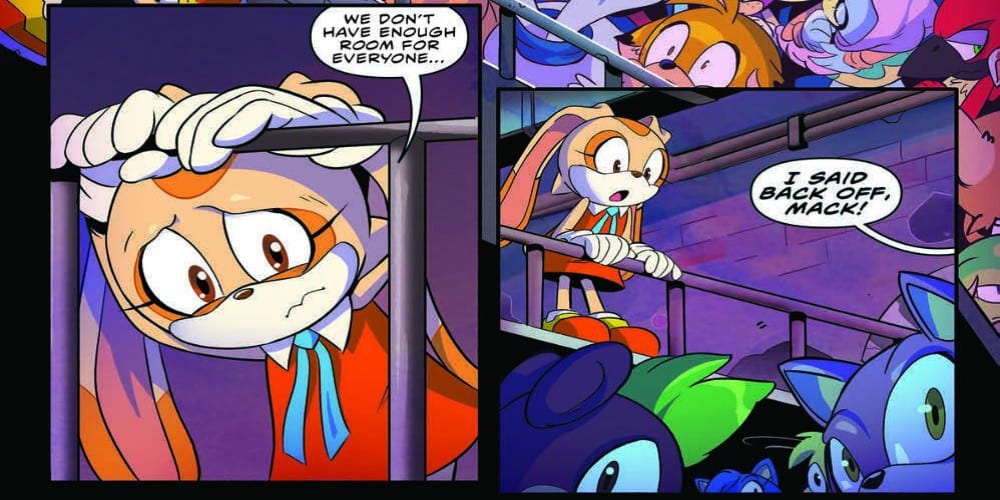
As the Zombots continue their rampage through IDW’s Sonic The Hedgehog, more and more cast members get corrupted. As more zombie tropes are utilized, does the story take a turn for the mundane or does it keep manage to keep the intensity from the previous issue?

Summary

Amy and her team find the base compromise and must evacuate before they are all become Zombots.

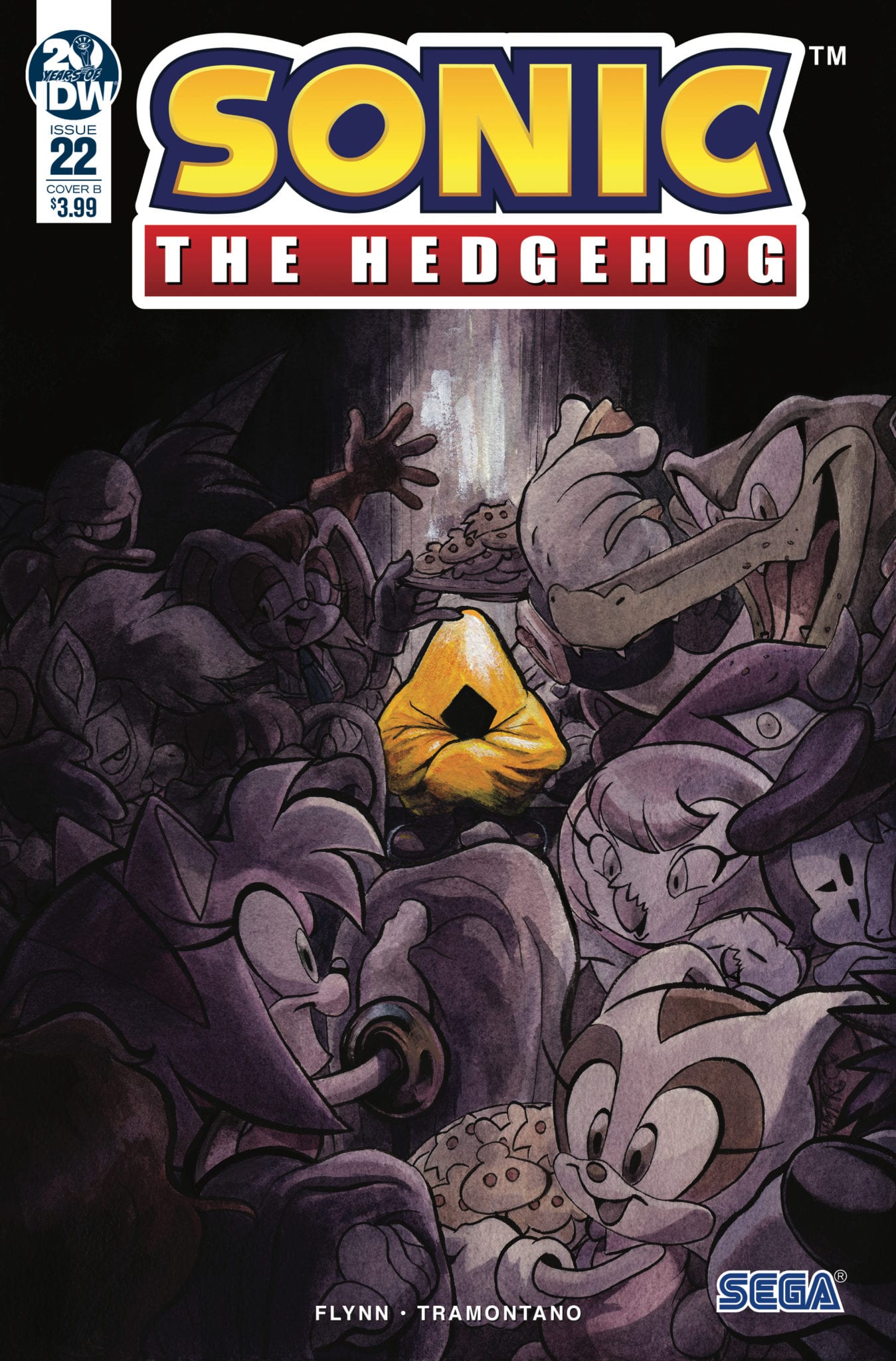
Sonic The Hedgehog

Writing

Considering where the previous issue left off and the cover art for this issue, the actual outcome was already broadcast far in advance. The Restoration Headquarters falls to the clutches of the Zombot horde. The only surprise in this issue is to find out how it happened and who was lost in the ensuing chaos. There will be no spoilers here as it is an interesting scenario to watch play out.

Ian Flynn is leaning into the tropes associated with zombie media. This issue plays out the whole “large area thought to be sheltered turns in an instant” plotline. Yet, a quick cut to the creatures from Lost Hex island is enough evidence to showcase Flynn knows where the story is going and has every intention to make sure he doesn’t overuse the zombie arc. One can only hope he succeeds with what he has planned out.

Sonic The Hedgehog

Artwork

Priscilla Tramontano is the only individual credited with artwork for the issue. The skill on display here, especially for a single artist is overwhelming. The terror and panic from the chaos which erupts in the course of the issue would not be as palatable if the art wasn’t of such a high caliber. Special respect for the scene where Amy Rose changes seamlessly from heartbroken to determined in two panels.

Shawn Lee does a fantastic job of lettering this issue. It’s amazing to see which special effects will be utilized in the issue. Bonus points for making sure Amy’s hammer made a “piko” sound every time it was used and totally nailing an alarm as being “awooga.” It makes the entire issue seem audible while reading.

Sonic The Hedgehog

Conclusion

Despite how the zombot arc seems to be have been going for a while in Sonic The Hedgehog, it still manages to be a lot of fun. The art helps by showcasing the terror and pain the characters are experiencing. Fans need to make sure they don’t give up on this series any time in the future or they will miss out on a lot of great moments.

Monkeys Fighting Robots Youtube

Review: IMMORTAL HULK #25 – The Breaker of Worlds is Inevitable

Monkeys Fighting Robots

Nothing can save you, nothing is left to hear you scream, and there is no escape from the Breaker of Worlds in Immortal Hulk #25, out this week from Marvel.

Al Ewing takes the story billions of years into the future and into the 9th cosmos. German Garcia and Chris O’Halloran are charged with creating a brand new universe, while Joe Bennett, Ruy Jose, and Paul Mounts are the usual suspects handling the last 2 pages of the current timeline.

World building a completely untouched universe within Marvel is a great honor, but comes with tremendous pressure. Garcia takes the reins and just slays it. Conceptual science fiction is a veer off the path from what Immortal Hulk has been, but Garcia is able to capture the essence of body horror we’ve come to love while leaping into an unexplored cosmos.

O’Halloran does a masterful job of capturing vibrant beauty in a dying universe. Worlds are breaking, color is gone, but O’Halloran accentuates every light in the darkness, and green is the last thing anyone will see. The last living world is a vivid geometric one that permeates a pleasing pastel palette. If this is all that is left, at least it is beautiful.

VC’s Cory Petit takes care of the letters in Immortal Hulk #25. His work is very subtle as this is a universe void of life, and void of sound. Par%l connects to the Breaker of Worlds witnessing darkness in the mind of the hulk, and this is where Petit’s skills shine. The words from the hulk look like they bring the depths of hell with them.

Ewing uses language to express that this is not our universe. This is something no one has ever seen before. I think it’s pretty easy to believe that this is brand new territory through Garcia’s art without Ewing making it harder than it needs to be. Writers tend to “get cute”, as my father would say, or try too hard.

These beings are telepathically communicating with English words, but the only real differences are proper nouns and “hir” instead of what I assume to be “her”. I was actually enlightened by the comment section that “hir” is a gender neutral pronoun. It never occurred to me to Google it because I just assumed it was for “her”. You know what they say about assuming, and you learn something new everyday.

These beings use what they call “manipulators” to connect and communicate, but they don’t know the word “hands”. Ewing tries too hard here and instead of being something that could add to the story it seems like a few lazy changes that ultimately just distract from the story and strip it of its desired effect.

Rather than soaking up the beauty in the entropy of this new universe, I’m trying to figure out who this 3rd person narrating the story is and why they know 18th century French words like “creche”, but not “hands”. These are the types of things people focus on and get distracted by when writers get too cute. If you’re going to make changes to the language, go full Hickman, no half measures.

Cheese

And I know you’ll say “well these beings don’t have hands or arms so how would they know those words?” Ok, well how would they know a French word from the 18th century that is rarely ever used by anyone?

Other than that this is some very fascinating sci-fi with some truly terrifying images that Immortal Hulk has been known for. Think Interstellar, but a giant green monster is coming to destroy all the planets being explored. After 24 horror filled issues, this issue raises the stakes. Hulk is not just the Earth’s problem anymore. He is everyone’s problem. The Breaker of Worlds is inevitable, and he’s coming for you.

What did you think of Immortal Hulk #25? Are you interested to see more from the 9th cosmos? Let us know in the comments below.


Monkeys Fighting Robots Youtube

How SANDMAN Changed My Concept Of What A Comic Could Be

How SANDMAN Changed My Concept Of What A Comic Could Be

After being drawn into comics by superheroes, Neil Gaiman’s Sandman showed me how much more the medium had to offer.

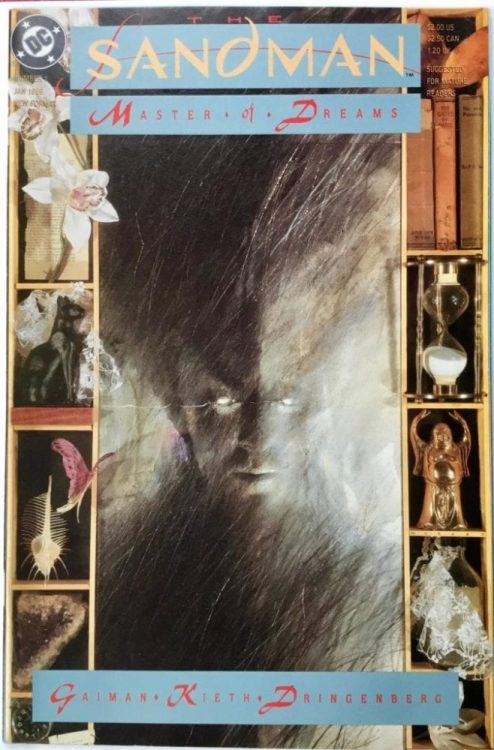
When I first started reading comics, I did not have any real preconceptions as to what they were (or were not) capable of as a medium. I never thought of them being just for superheroes, as posters of stories like Saga and Y: The Last Man had already told me otherwise. Though every time I looked around at recommendations for the so-called “best” comics to read, the title Sandman by renowned fantasy author Neil Gaiman popped up. It wouldn’t be for another couple years after I had gotten into comics before I made the gamble and scooped up the first omnibus volume. It was not until I broke in the spine and sat down to read issue number 1, “The Sleep of the Just,” that I realized what comics were truly capable of as a medium.

How SANDMAN Changed My Concept Of What A Comic Could Be

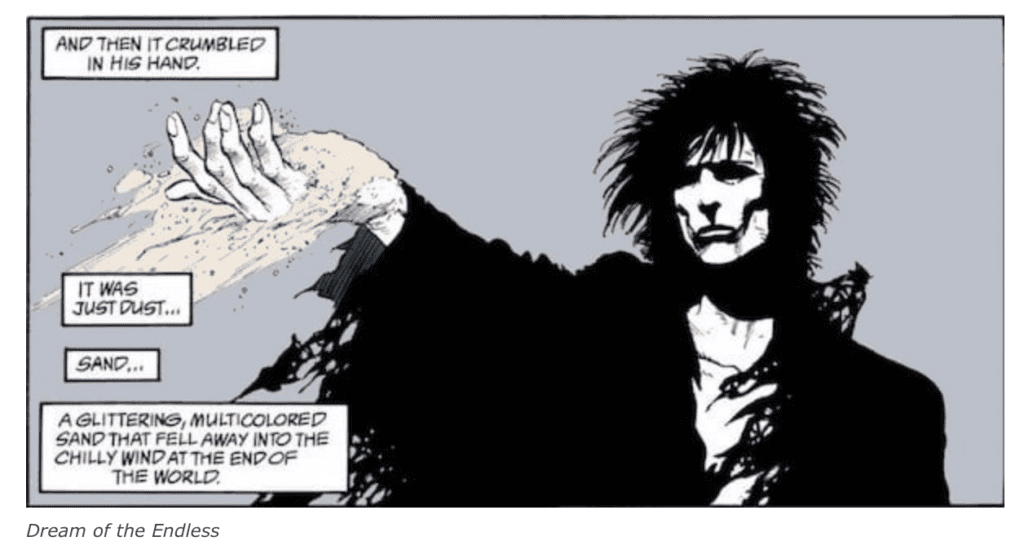
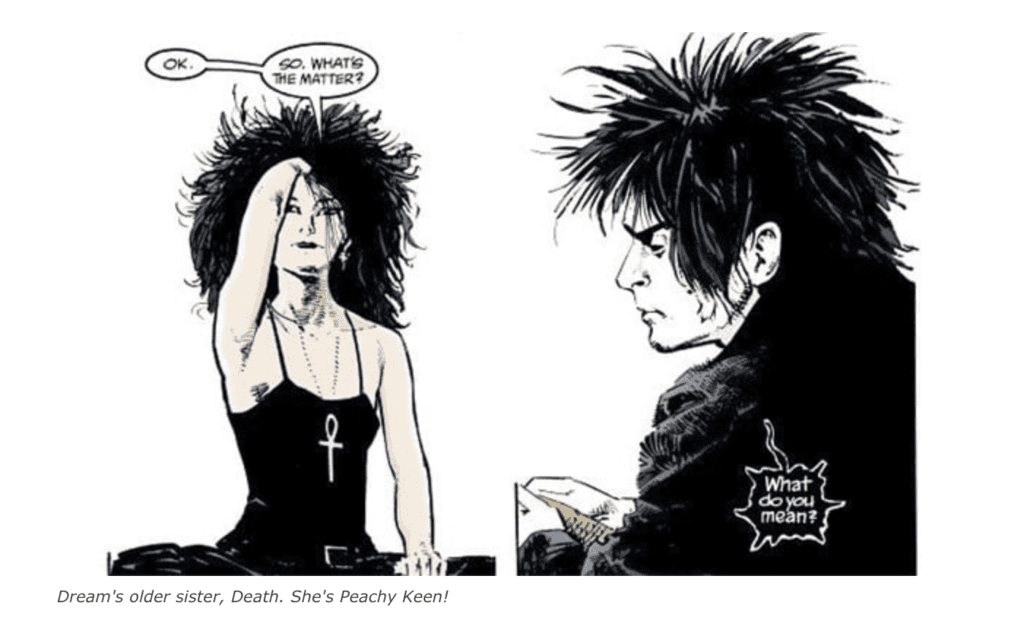
In the beginning, Sandman has the tone and appearance of a sophisticated horror comic. DC’s Vertigo imprint has (er, had) its fair share of such stories, from Alan Moore’s Saga of the Swamp Thing to The Hellblazer. However, Gaiman quickly sets his story apart from its contemporaries with the scale of the story he chooses to tell. Dream of the Endless, a.k.a Morpheus, a.k.a. The Sandman is the physical and ethereal embodiment of dreams. He is the patron saint of stories. He has existed since the first living thing in the universe fell asleep and will continue to do so until after the last one passes on. His family, “The Endless,” are all manifestations of universal concepts (Destiny, Death, Destruction, Desire, Despair, and Delirium). Gaiman’s 75-issue tale gets to know every facet of Dream’s job as the keeper of dreams and his relationship to his family, all while running a full spectrum of genres. Where one arc maybe a dark horror story, the next issue could easily be a high-fantasy tale, followed by a comedic commentary on Shakespeare’s plays. Yet it never skips a beat.

Sandman’s narrative swerves from the main continuous story-arcs that contain Dream’s “current” story to flashbacks and anecdotal one-shots. Several of the stories do not even have Dream as a character, and instead feature other minor characters in semi-related stories of their own. One such story-arc is about a motley group of characters all staying at an inn and swapping fantastic tall-tales. Since Dream is the literal embodiment of storytelling, he’s by extension included in this arc even if he doesn’t make an actual appearance.

How SANDMAN Changed My Concept Of What A Comic Could Be

Despite how odd Sandman’s structure may be, it never gets overwhelming or confusing. Gaiman’s ability to tell such a wide range of far-reaching tales and make the whole story wrap-up into itself is what makes Dream’s story so memorable. It’s also where I realized how special the comics medium really was. Unimaginable concepts are brought to life in a massive variety of art styles. Gaiman’s poetic prose is blended with the varied dialogue of a cast of dozens. The fact that this sort of story told over 7-years and 75-issues makes a cohesive whole with such craft is what sold me on what comics can really be. I had never thought of comics being such a different medium than novels or film. I had never thought of the idea that there are stories that can only be told in a comic, as they were too imaginative for novels or too massive in scope for television and movies. Since reading Sandman, I’ve noticed its influence through a similar style of narration in other comics. Sandman is high-art in a comic book. It’s one of the most imaginative pieces of fiction of the 20th century, and it’s what made me realize what exactly comics were capable of.

Monkeys Fighting Robots Youtube