Marvel Zombies: Resurrection #1 hits your local comic book shop on October 30, but thanks to Marvel Comics, Monkeys Fighting Robots has an exclusive five-page preview as a zombie reboot is on a collision course with Marvel Universe.
The book is written by Phillip Kennedy Johnson, with art by Leonard Kirk, Guru-eFX worked on colors, Travis Lanham handled lettering, and In-Hyuk Lee brought the cover to life (zombie jokes). Nick Bradshaw & Rachelle Rosenberg, Greg Land & Frank D’Armata, and Jung-Geun Yoon provide the variant covers.
About the Marvel Zombies: Resurrection #1:
THE HORROR SMASH-HIT LIVES AGAIN!
When Galactus’ corpse appears at the edge of Earth’s solar system, the Avengers, X-Men, and Fantastic Four investigate. Too late, they discover that Galactus’ body is now the vessel of an interstellar terror, which one-by-one transforms Earth’s Mightiest Heroes into the universe’s most terrifying predators! As our heroes try to escape the superpowered, cannibalistic aberrations that were once their friends and family, will any survive? And even if they do, can they hope to protect Earth from the infestation that has already claimed half of the known universe?
Don’t miss the FIRST ISSUE of this terrifying new vision of the classic Marvel tale!
For those of you that were too young to read zombie books back in 2005, the Marvel Zombies were part of Marvel’s Ultimate Universe and discovered by the Ultimate Fantastic Four. When look you look back on it now, it makes sense that Robert Kirkman was the author on the first mini-series with art by Sean Phillips and covers by Arthur Suydam.
What is your favorite Marvel Zombies memory? Comment below with your thoughts.
Check out our Marvel Zombies: Resurrection #1 preview:
Countdown is the latest PG-13 horror film that reinforces just how cancerous they are to the horror genre. It is a rushed film with a moderately interesting plot device that plays out like your typical modern horror film with an unbearable amount of jumpscares. Sitting through the mess of Countdown is the equivalent of self-torture and there is very little to commend in this film.
Death is an inevitability in life as every living person comes to know with time. However, no one knows when it will be their time to take one final breath. Countdown offers the answer with an app, but this app becomes an issue for a few people when they learn they only have a couple of days left to live. Directed and written by Justin Dec, the film stars Elizabeth Lail, Jordan Calloway, Talitha Bateman, Anne Winters, Peter Facinelli, and Tom Segura. Countdown follows Quinn (Lail), a young nurse who tries to avoid death after the app predicts she only has three days to live.
Elizabeth Lail as Quinn in COUNTDOWN
Countdown is a massive misfire mostly do to its wasted potential. The characters are horribly written and there is hardly any development. Also, the film suffers from bad dialogue that is the epitome of cringeworthy. Stupid decisions from characters are in large quantity, it gets to the point where it seems the filmmakers wanted to fit as many moronic moments in as possible. Quinn is a likable character that leads the film, but everyone else feels like an annoyance, or they are introduced midway through with little reason for audiences to care about them. For instance, Quinn becomes acquainted with Matt (Calloway) midway through the film and the two bond over their experiences with the app. The fact that it all happens so fast leaves little time to get invested in his character.
Adding to that, after squandering a ninety-minute runtime, Countdown has the nerve to plant the seeds for an unwarranted followup. It comes at a time where just as you think the film won’t anger you any further, it rushes in the chance for another film to happen. Hopefully, this potential sequel avoids shoving jumpscares in every scene because Countdown offers so many in every other scene that it’s almost laughable at how so many people will still be scared of it. It follows the formula of music leaving the scene, brief silence, and then a sudden loud noise. If you want to mask your failures at telling a compelling and terrifying story you result to inserting a streak of formulaic jumpscares.
Lail does what she can, but her performance seems uninspired and it feels like she is playing the exact same character from her role as Beck in Netflix’s hit series YOU. Not a bad performance, just not good enough to warrant interest for ninety minutes of unbearable trash. The one redeeming quality was Segura, who stole every scene his character Derek participated in. Other than that, most of the acting was subpar at best or just difficult to sit through.
Elizabeth Lail as Quinn in COUNTDOWN
Dec didn’t impress as a writer or director and most of the film is shot in such an odd way, but the biggest crime might have been the pacing. As mentioned earlier, Countdown moves so fast its as if the film is running away from its self. No time whatsoever is available to fully get behind any of the characters introduced and it’s a shame because that may have ended up making the film better overall if it slowed down a bit. However, this would have just lead to spending more time watching a sequence of nonsense unfold so perhaps the shorter the better. There are plenty of effective ninety-minute horror films, but this film misuses the time it has sadly.
Countdown is not a movie worth seeing in theaters or seeing at all for that matter. It is a rushed mess that should have gone straight to home media. The film is generic, hollow, and unbearable. While it does have a few enjoyable moments and some decent technical work, as a whole the film is a complete misfire.
In an industry dominated by cape comics, Giant Days gives you a peek at what else the medium has to offer. Part of this likely has to do with its unique origin from writer and creator John Allison. Allison got his start writing webcomics back in the late ’90s early 2000s with titles such as Bobbins and Scary Go Round. Because of this, Giant Days challenges traditional comic book practices by keeping its webcomic roots intact. Essentially, it has big webcomic energy.
Additionally, Giant Days successfully manages to divide its narrative among its ensemble cast. There is no singular center of attention to whom the story belongs. While there are the three lead heroines, Susan, Esther, and Daisy, character arcs are given amply to the endearing supporting cast as well. In contrast to most solo driven narratives in mainstream comic book media.
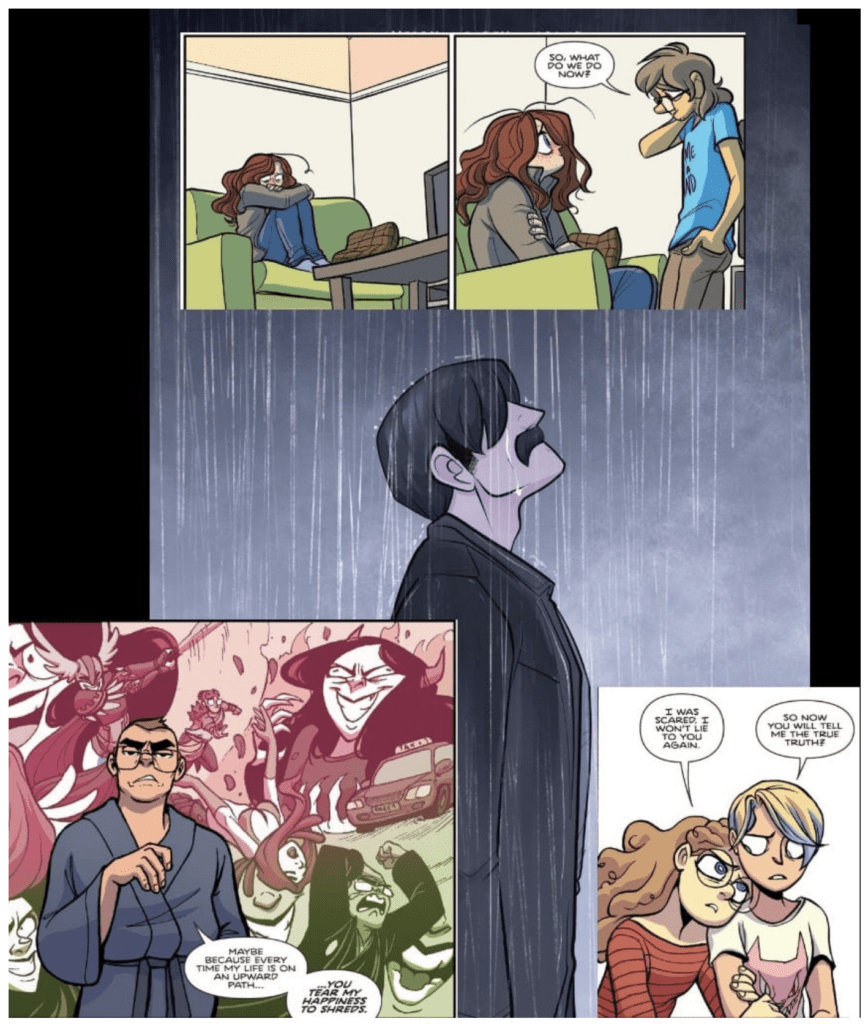
An example of the supporting cast, including the cover to issue # 51 which focuses on McGraw. Other characters included are Nina and Ed on the top, Dean Thompson and Esther (Demonized in the background) and on the bottom right are Daisy and Ingrid.
To further break the mold, Giant Days maintains a thematic and believable passing of time that is usually absent from comics you find front and center of the rack at comic shops. For starters, it ended. But leading to that ending, were semesters of growth, and struggles that truly hit home for any college student.
From the very beginning, there was a clear finish line for this story, graduation. This became more apparent as the first semester came to an end in issue #18, which then set a precise pace for the remaining story to follow. The more the flow of time passes, the more our characters grow figuratively and literally. The closer we get to graduation, the closer we come to the end of the tale.
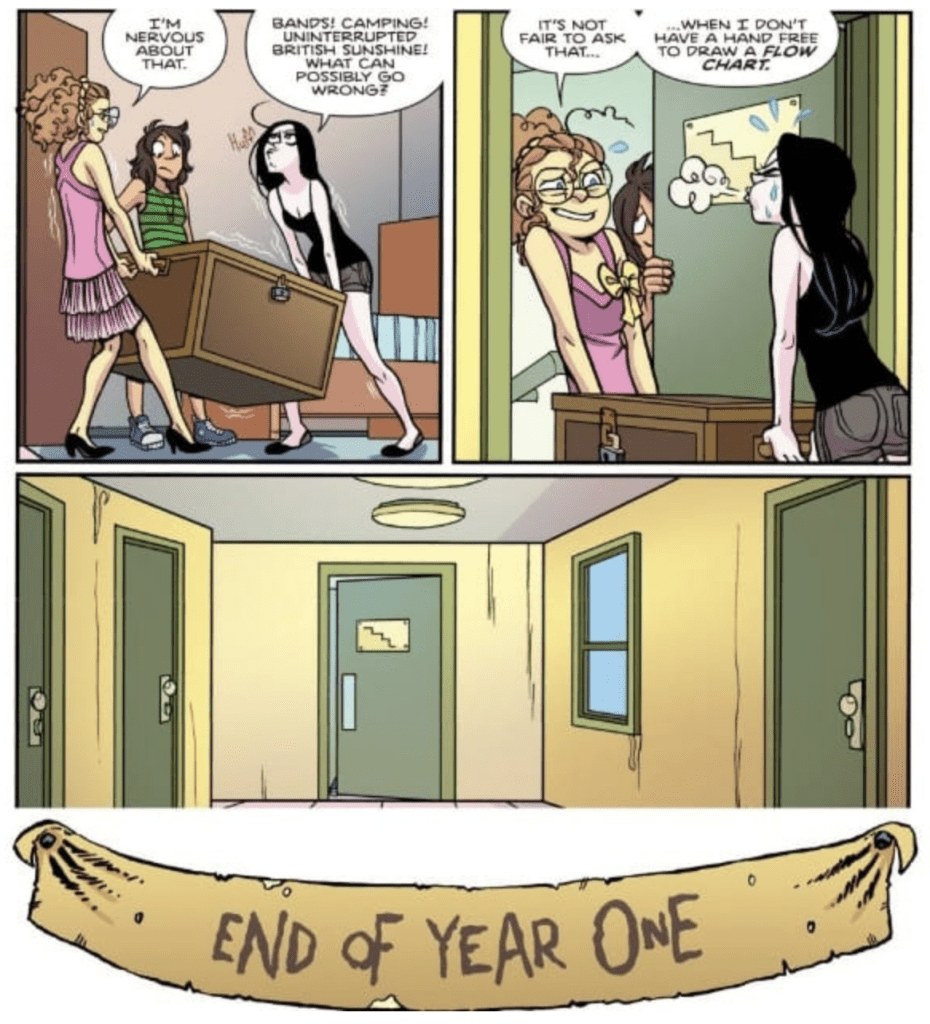
Last panels of issue # 18 concluding the first semester
Being someone who started with superhero comics from DC Comics and Marvel, reading this series to its finale challenged my perspective of what defines a comic book. In this day and age, comics cover many genres. This wasn’t something new to me, but it was something I had to explore more to understand. Giant Days pushed me to look for stories outside my comfort zone. Not just other similar grounded stories, it led me to try comics I was previously indifferent to.
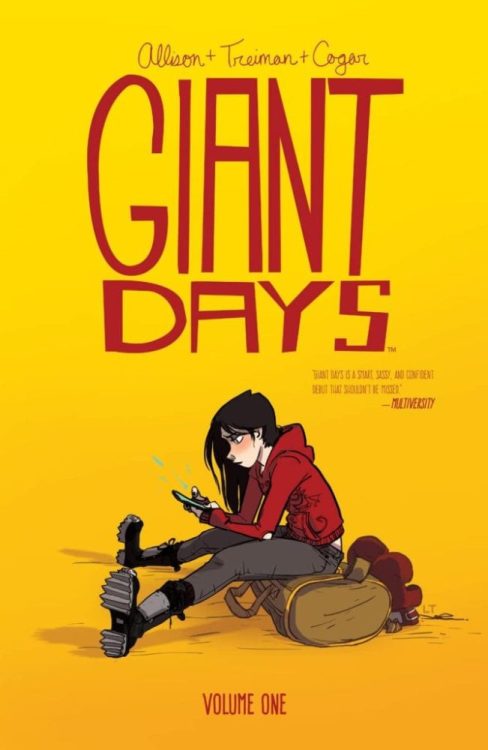
Suddenly I find myself reading Lumberjanes and Chilling Adventures of Sabrina. Both are great stories I might not have given a chance if I was never pulled in by Lissa Treiman’s captivating cover of Giant Days #1.
What comic first challenged your perspective of what a comic book can be? Let us know in the comments.
There have been many adaptations of Jane Austen’s work for film and TV. The latest is Sanditon for ITV and PBS, where they attempt to finish her unfinished novel.
Charlotte Heywood (Rose Williams) is a young woman who lives on her family farm with her ten siblings. After helping Tom and Mary Parker (Kris Marshall and Kate Ashfield) after an accident, Charlotte agrees to go with them to Sanditon, a town they plan to develop into a seaside resort. In the town, Charlotte makes friends with Georgiana Lambe (Crystal Clarke) and has a love-hate relationship with Tom’s handsome brother, Sidney (Theo James).
Also, within the town, Tom tries to keep his financial troubles secret, two cousins battle to inherit their childless aunt’s wealth, and two step-siblings are stuck in a scandalous relationship.
Sanditon was written by Andrew Davies, a man for adapting classic literature for TV. His credits include the BBC adaptations of Pride and Prejudice, War and Peace, and Les Misérables. Sanditon was different because the novel never finished. The first episode follows the 17 chapters that Austen wrote and everything after that was an original work.
Davies aimed to make a darker version of Austen’s work. That meant the series had more sex and violence than other adaptations, and there were themes of rape, child abuse, incest, and forced marriages. The first episode established this when Charlotte caught two characters having a secret liaison in the woods and doing adult actions.
This darker approach worked best with Clara (Lily Sacofsky), a young woman who in the care of her aunt, Lady Denham (Anne Reid). Clara revealed early on that she was sexually abused as a child, and that shadow still lingered over her because if it’s revealed she would be tainted. She was innocent and frankly, a bit thick around her aunt – but this was an act. Clara partook in some passive-aggressive sparring with Esther (Charlotte Spencer), one of her rivals to the inheritance. They had to remain calm and polite as they taunt each other.
Episode Six was the one that went down a darker route because a character was kidnapped and taken to London. This was an episode where London was shown to be a sleazy place of gambling houses, and brothels and women are literally gambled away. While in Sanditon, this episode had a fairly graphic sex scene. This sort of material has divided Austen fans since her work was generally seen as clean, cute fun.
Although the series had darker aspects, Sanditon still uses a lot of Jane Austen tropes. This was a series that men dressed in fancy suits, women wore pretty dresses and there events like balls and cricket matches. Women spoke in a refined manner, and the show’s focus was on all the character dynamics. The relationship between Charlotte and Sidney was basically Elizabeth Bennett and Mr. Darcey because they argued, had contempt for each other, but were also attracted as well. Their relationship swung like a pendulum.
The more interesting romantic relationship was between Esther and her love interests. She was in a relationship with her stepbrother (Jack Fox) and believes they are in love with each other. But he is a manipulative figure who knows how to control Esther. She has a courter interest in her in the form of Lord Babington (Mark Stanley), a nice wealthy man who Esther tries to resist. But she does let her guard down around him and reveals an occasional smile. Esther does soften as the series progresses, going from an unlikeable ice queen to being more sympathetic as more was revealed about her.
Sanditon‘s cast was mostly made up of up-and-comers and fairly well known British actors. Theo James was the biggest star in the series and also acted as a producer. The most memorable cast member was Reid because she was biting in her comments and observations and had an ‘I don’t care’ attitude. Along with her role in Years and YearsReid has had a stellar 2019. Sacofsky and Spencer had juicy roles as they acted ‘politely bitchy’ to each other, and they potentially long careers ahead of them.
Williams was the star of the show, and she did perfectly well as a prim and proper regency woman. Williams was a beautiful woman and had a unique look compared to the other women in the town because she has a more olive skin tone and a notable chin dimple. The writers were trying to make Charlotte an Elizabeth Bennett type by being a strong, opinionated woman. But, the first half of the season, the character came across as a Mary Sue, someone who could barely do any wrong.
Charlotte’s role was to act as the audience’s surrogate. She was the eyes into this world because she had a settled upbringing living on a farm. Sanditon is a new experience, and she’s excited about the town and falls in love with it, but others, like her friend Georgiana, has been exposed to London, and she sees it as nothing more than a backwater. I note I was surprised to hear Crystal Clarke speak with an American accent when promoting the show because I thought she was English.
Turlough Convery and Alexandra Roach offered comic relief as the younger Parker siblings. Convery looked and acted like a British version of Josh Gad, being friendly if an enthusiastic man. While Roach played a hypochondriac, who was overprotective of her brother. They made for a great double act, especially in episode four, where they have a day on the beach. Sadly, Adrian Scarborough didn’t fare so well because his role as a comedy German.
The ending of Sanditon has upset Austen fans because it goes against convention. The ending did bring some realism to the show, and there was a logical train of thought that dictated the characters’ actions. The showrunners were properly hoping for a second season to be commissioned.
Although the darker material that was on display, Sanditon was a reasonably safe period-drama that the costumes, Georgian buildings, and English restraint. It was a show made just for fans of the genre.
The first X-Men comic I read was Uncanny X-Men No. 144. Cyclops was center stage against D’Spayre with the help of Man-Thing in the Florida Everglades. The death of Jean Grey was still heavy on Scott Summers’ mind, and D’Spayre used this beautifully against him, Dave Cockrum’s pencils and Chris Claremont’s words creating some pretty heavy imagery in my eight-year-old mind.
A couple of years later, a friend traded me a stack of X-Men comics (starting with Paul Smith’s incredibly-underrated run & ending with the seminal “LifeDeath” story, drawn by Barry Windsor-Smith) for Van Halen’s 5150 on cassette. I definitely got the better end of that deal. I was officially an X-Men guy and still am.
But even with Claremont’s hall-of-fame-worthy run as writer, no storyline ever affected me the way Age of Apocalypse did. AoA was groundbreaking in a lot of ways, but for me, the best thing about it was, I never knew it was coming.
We’ve gotten spoiled. I know I sound like a grumpy old man, and I’ll cop to it. We know months in advance when a storyline is going to happen, and we know, usually, how it’s going to play out. We also have the never-ending barrage of fanboys using every social media platform available to bitch about how the latest arc is ruining their childhood. Said fanboys also cloud the airwaves with declarations that they’ll never buy X, Y, Z comic again because those corporate jerks at Marvel and DC Comics have ruined their books by doing (insert perceived offense here).
If you don’t remember, AoA began with the X-Men heading to Israel to stop Legion from getting up to his usual shenanigans, i.e. parlaying his daddy issues into wanton destruction. It was a four-part story between X-Men and Uncanny X-Men with a special story over at Cable’s book. The internet was young, and while there was Wizard magazine, if you weren’t up on what was going on, AoA represented a massive shift in the X-Men’s world. And that was the beauty of it, the not knowing. Obviously, the reasonable assumption was that the X-Men would be returned to their normal timeline and stories at some point, but at the time, it was riding a roller coaster with your eyes closed.
There’s something compelling about seeing people you’ve grown up with devolve to their base personality, both good and evil, and seeing Nightcrawler as a mercenary only helping people because money’s involved. Kitty and Colossus as hard-nosed teachers/sergeants for the next generation of mutants. And Cyclops as the right-hand man of Apocalypse? Seriously?
But it worked. This dystopian nightmare was started with the accidental death of Charles Xavier at the hands of Legion in the Earth-616 past. Xavier’s death allowed Apocalypse and his Horsemen to take over the world. And again, no internet to talk about what was going to happen after AoA. No comment sections filled with complaints from alleged fans lacking the patience to watch a brilliant storyline unfold. This affected every X-book. They changed the names of those books along with the numbering. Where these going to be permanent books? Astonishing X-Men? Amazing X-Men? Factor X? If you weren’t aware of the planned storyline by reading the trade magazines, it was an incredible moment in comics.
Plus, who didn’t just totes love Rogue’s hair?
Throughout, there was the usual X-Men-brand of pearl-clutching and hand wringing, but the beauty of this series is, everything boiled down to love. The Age of Apocalypse was formed from a foundation of hate and a lack of human empathy. Survival of the fittest and all that. But almost the entirety of the series and all its side stories boiled down to love. Magneto and Rogue loved each other and their baby, Charles. Gambit still loved Rogue while taking advantage of Lila Cheney’s affections. Logan and Jean loved one other, although it didn’t take much for her to see something in Horseman Cyclops. The brotherly affection Colossus felt for his sister turned into an obsession, which would eventually lead to the death of Kitty Pryde (spoiler). It was for love that Magneto led his X-Men to the destruction of their universe in order to prevent the madness of Apocalypse from spreading. And by the way, all that led pretty solidly into the recent Age of X-Man, where love does rule all, to disastrous results.
In the world of redheads, the one-eyed man is king.
To me, the difference between Marvel and DC Comics has always boiled down to this: DC is about superheroes who occasionally have to pretend to be ordinary people, while Marvel is about real people whose private lives were disrupted by the fact they were superheroes. And both are awesome when done correctly. The Kitty Pryde-led X-Men Gold nailed it, while X-Men Red came off as preachy, sacrificing a good story for the sake of incorporating today’s headlines. That being said, Champions has introduced progressive themes and pulls it off well.
Kevin Moench’s “Knightfall” (btw, Moench doesn’t get the credit he deserves for his stellar career) was my other favorite arc of the 90s. Until Batman’s back is actually broken by Bane (spoiler), we barely see anything having to do with Bruce Wayne’s “real” life. AoA was set in a real post-Apocalypse world, but nearly every single storyline was about the actual person, not their larger-than-life persona. The writers made you care about them. Given their new personalities, some, like Havok, you stopped caring for. Others, like Scott Summers, you saw something there maybe you didn’t notice back in the 616.
And then, they started killing them off.
That’s always the payoff for books like that. Another great X-Men story, “The End” (written by Claremont), was gut-wrenching at times because we saw the final story of the X-Men and how they were going to turn out. I’ll give you a hint: not everyone makes it, and those who don’t, die pretty horribly and as tragically as Chris Claremont can write it. In AoA, it always felt like the entire universe was going to end, so seeing some of the individual characters die shouldn’t have been as effective as it was.
However, Colossus killing Kitty was one of those moments where I stopped reading and had to process what I had just seen. One of the greatest romances in Marvel Comics ended due to Peter’s obsession-built rage regarding finding and saving Illyana. The story was real and gritty. Some of your favorite heroes did not die well. Their deaths weren’t noble. And that was a reality that we, as fans, had to accept, that maybe, deep down, our favorite characters were flawed. You know, like people.
Hey, Pete, you stepped in–Oh. Nevermind.
Age of Apocalypse stands out for its innovative storylines, for its once-in-a-generation art, and for the permanent waves it made within the X-Men titles that still reverberate. But for me, a guy in his early 20s who had been reading about Xavier’s School for Gifted Youngsters since Jean Grey’s (second?) death, it wasn’t the violence and epic battles and death that stuck with me.
It was love.
What are your memories of Age of Apocalypse? Comment below with your thoughts.
BATGIRL #40, out this week from DC Comics, finally brings our two leads face to face in a dramatic moment. Where does Batgirl end and Oracle begin? And how much of herself did Barbara put into both personas? These questions and more are explored within these pages.
That…doesn’t look good, does it?
***SPOILER WARNING***
We’ve seen Barbara Gordon take up several different mantles since she first appeared in Detective Comics #359. Her two most iconic, of course, are Batgirl and Oracle. But what happens when these two dominant personalities clash? And what will it cost Barbara to resolve the tension?
Batgirl #40 continues the tie-in adventures from DC’s Year of the Villain, and it does so with brilliant writing and intensity. This tie-in doesn’t hesitate to pull Batgirl’s past to the forefront or make her pay for past decisions. There is no hiding from this story.
Also, for any of those who are hesitating, even though this is a tie-in issue, you don’t need to be following along with the main YOTV story in order to understand what Barbara faces here. So go ahead and pick up this issue. It’s worth the read.
Burnside is burning, and it’s in the rather iconic shape of a bat.
Batgirl #40 proves that a plot can be multitasking. Is it a tie-in issue? Absolutely. But it’s also so much more. There are multiple threads twisting throughout this issue, creating a complex tale that only Batgirl can unravel.
Cecil Castellucci’s writing has created a whole new level of danger for Barbara Gordon. She’s used to being physically intimidated and assaulted. She’s even had to face threats from her family and her past. But she’s never quite had to face something of her own making. Not like this.
In many ways, she is the Oracle, and the Oracle is her. So seeing her legacy turned into something foul and dangerous is surely not a good feeling. At best, she’ll feel violated for what has been done to her Oracle. At worst, she’ll blame herself and see this as all the evil within herself. And there can officially be no doubt about Oracle, not after the acts she committed within these pages.
In that sense, Castellucci has clearly woven a fine net with which to trap Batgirl. The fight has only just begun, and yet Burnside is already paying the price. Readers are left wondering how far this plot is going to push Barbara, and what the cost will be in the end.
Oracle has targeted Burnside, knowing that it’ll force Batgirl out into the fray.
The artwork behind Batgirl #40 was a perfect fit – just take a look at the cover and you’ll already have a good idea of the danger Batgirl is facing. Despite the nighttime setting, this issue was brightly lit – and given the source of light, that isn’t great. But our artists did an excellent job of constantly reminding us of the source of the light, and what that could mean for our heroine.
The fight scenes in this issue are another element worth talking about – especially how Oracle looked. She’s finally starting to show off some of her new abilities, and the artists rendered them in creative and distinct ways.
Carmine Di Giandomenico was the lead artist for this issue, and his work shined especially bright during the action – Batgirl’s mad rush to get there in time, a desperate battle, things like that. Meanwhile, Jordie Bellaire provided the coloring, and her use of colors added a sense of foreshadowing and foreboding that could not be overlooked. It was a constant feeling. And finally, Andworld Design did the lettering for this issue. As always, they did an excellent job making the characters’ voices distinct throughout.
The real question is, can the Operator reach out to Batgirl?
It’s hard to believe how far this plot has come in such a short amount of time. And only time will tell how much more Batgirl is going to have to put up with until it’s all said and done. Still, Batgirl #40 was a tense read, showing us just how dangerous Oracle as become. And just how much more dangerous she can potentially end up being.
STAR WARS ADVENTURES: RETURN TO VADER’S CASTLE #4, out this Wednesday from IDW, continues the series of tales revolving around Darth Vader’s Castle. This time the focus has turned to Jabba the Hutt, and a misadventure of his own.
It’s time for Jabba’s tale. Also, brains.
***SPOILER WARNING***
Fans just can’t stop obsessing and wondering about the darker side of Star Wars. That’s likely the reason we’ve found ourselves with Return to Vader’s Castle. This series is actually a collection of short stories (so if you’re only interested in hearing about one character, go for it). But each issue is tied to the rest thanks to the comic’s storyteller/narrator, Thom Hudd.
Hudd made the unfortunate mistake of trying to break into Vader’s Castle. Well, he actually succeeded in the “breaking in” part. It’s the getting out that he’s struggling with. In an attempt to stave off his imminent death (via torture), Hudd has gone full Nights of Arabia, telling tales to buy him some time.
So far, we’ve been told stories about Darth Maul, Tarkin, and Ventress. So, who does that leave for us to learn a bit more about next? The tale he tells in Star Wars Adventures: Return to Vader’s Castle#4 revolves around one Jabba the Hutt, and his conniving cousin, Crakka.
Looks like Hudd is about to get caught…again.
Cavan Scott writes the series, and in this issue he gave readers the rare opportunity to see how Jabba and his family interact. Or how he interacts with one of his family members, at any rate.
The tale is a fascinating one, if a bit brief. And it’s good to know that Jabba isn’t the only one in his family out for himself. Crakka may think she’s brilliant at planning…but she’s not. Actually, that isn’t quite fair. Her plan got her a lot farther than you might expect; it isn’t her fault that the item she sought to steal was much more fragile than she had hoped.
This is one of those tales that raises a lot of questions. Yes, the backstory of what Crakka was after was fully explained. But it feels like there’s so much more to this story. That there’s more we can learn or dive into here. With any luck, we’ll see it come up again someday.
Thom Hudd’s side of the story has been interesting as well, of course. His main purpose has been to present a reason to tie all of these stories together, and he’s done his job well. But Scott made the right call in adding a bit more to Hudd’s tale – he’s more than just a storyteller. We just have to put the pieces of the puzzle together, in order to have a chance at discovering what is going on here.
Thankfully, it looks like another tale will buy Hudd some time.
Star Wars Adventures: Return to Vader’s Castle#4 has perhaps some of the best artwork from the series. It might not match the looks of the movies, but it is unashamed in doing its own thing, and it looks amazing.
The world and characters look so vibrant in this issue. Jabba and Crakka each have their own unique color palette and showing off a stylized version of the Hutts. But it is oddly striking and effective, proving the risk was worth taking.
Francesco Francavilla and Nicoletta Baldari were the artists behind all of those decisions, and we applaud their bold decisions. The heavier inkings and lines blend well with the brighter and vibrant color palette. And let’s not forget the lettering, which was done by Andworld Design. It was the right balance for the tale being told.
Look at those colors! We’re in love.
Star Wars Adventures: Return to Vader’s Castle#4 felt right at home with the rest of this series. Though in many ways, this plot was one of the more intriguing of the bunch. Where the rest felt complete, this one felt like there was more we could learn. And that’s not a bad thing. We just have to hope that someday it’ll be revisited.
As for Thom Hudd? It feels like his plot arc is nearing its natural conclusion, whatever that may be. Feel free to root for him, or not, as you please. We’re not going to judge.
Batman and Superman try anything they can to get to the bottom of the plans of the Batman Who Laughs in Batman/Superman #3, out this week from DC Comics.
Joshua Williamson is the scribe for this journey through madness. David Marquez continues his beautiful work on this title. Alejandro Sanchez takes care of the colors for Marquez, and John J. Hill handles the lettering.
Marquez is crushing this title and giving us some of the best work of his career. The detail in each panel is astounding. He’s raising the bar for interior artwork from the major publishers and putting his all into it. He takes the time to draw dirt, dust, blood mist, and anything else that might be in the air. This is truly remarkable artwork and it sets a high standard for this title for the next artist that takes over.
Sanchez’s colors are inspiring as well. He works flawlessly with Marquez and his colors are vibrant and vivid. The color palette brings a brutality to the page that fits the Batman Who Laughs and what he has in store for this world. Every source of light glows and illuminates the dust around it, while car headlights flare up the lens of our eyes. Batman/Supermanhas been gorgeous so far and #3 continues the trend.
Hill is providing some of the most impressive lettering I’ve seen recently. Most of what I’ve been reading has been dialogue heavy and without much action, but this is definitely not one of those. The non-stop action is bountiful which gives Hill so many opportunities to shine, and he is taking full advantage. There are action words on almost every single page in Batman/Superman #3. This title must be a delight for Hill to work on.
Batman/Superman #3 is a very busy issue. The action is non-stop and a ton is happening very rapidly. Williamson lays everything out in a way that doesn’t lose the reader or distract them from anything that’s going on. The narrative is linear and doesn’t jump all over the place like some writers just love to do. An interesting story doesn’t need to get fancy with the way the story is told. Films like Pulp Fiction have really influenced new stories, and it can be hit or miss, but it’s already hard enough to follow DC and Marvel continuity, so it’s a relief when a single issue doesn’t just add to the confusion.
This chapter ends the same as just about every DC title this month and foreshadows a Year of the Villain story line with Lex Luthor. The Batman Who Laughs has gathered his Infected, while Lex is teaming up with as many villains as he can get to join him. Are these two teams filled with evil on a collision course? Maybe Batman and Superman should sit back and let things happen and just take on whoever comes out of that fight alive.
The Batman Who Laughs is scheming and everything seems to be going to plan, except for Lex. I can’t wait to see what is in store for this showdown of ultimate evil in the multiverse.
What did you think of Batman/Superman #3? What do you think the Batman Who Laughs is planning? Can even Apex Lex stop him? Let us know in the comments below.
The latest issue of Tony Stark: Iron Man from Dan Slott and Christos Gage offer further evidence of what fans can expect with the upcoming Iron Man 2020 event. Just as much as the new series has promised to be a major change, this issue proves those around Tony may have to do some deep reflection in the future.
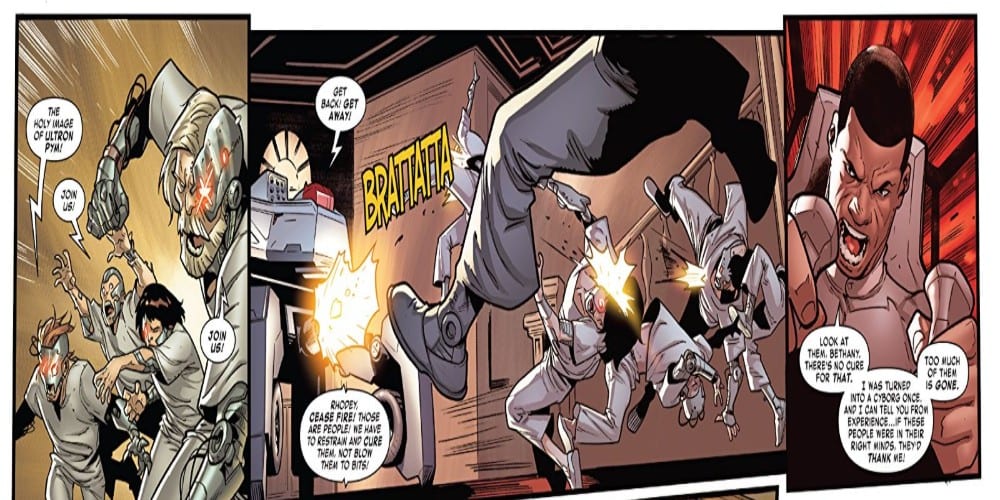
Tony, now fused with his armor unintentionally, must face Pym Ultron with Rhodey, Jocasta, and The Wasp by his side.
Writing
There are a lot of great behind the scenes moments here. As Tony struggles to deal with his condition after the previous issue, his team at Stark Unlimited is working hard to try to counter Ultron’s plot to turn the world into a cyborg horde he can control. Prompts once again to Dr. Shapiro, the talking cat who is such an entertaining character to read. If there is another Pet Avengers series in the future, Dr. Shaprio and his giant robot have to be in it.
Dan Slott and Christos Gage seem to have a plan in mind where they are taking the series as it journies towards Iron Man 2020. Rhodey finds himself having to fend off the rampaging onslaught of cyborgs trying to tear him apart and has to make some hard choices to survive. Given how things are going to flip very soon for the characters surrounding Iron Man, it would not be at all surprising if the decisions he made in this issue follow him into the new storyline. As long as this level of depth is kept with the writing moving forward, fans will have nothing to worry about.
Artwork
The artwork by Francesco Manna offers a great sense of the destruction taking place in the course of the fight. Explosions, property damage, and equipment getting toasted are all on display. Manna is making a point to show just how much of a threat Pym Ultron is and succeeds in an impressive way.
The colorwork by Edgar Delgado helps to highlight not only the damage done in the battle but also nails the inhuman aspect of Pym Ultron. The creepy color radiating from his body is unsettling and makes it abundantly clear, even though part of him has the face of a former Avenger, this creature should be feared.
With VC’s Joe Caramanga on lettering a lot of great flow to the issue. Between great dialogue and adding the right effects to help the action flow, Caramanga adds to the overall fantastic quality on display with this issue.
Conclusion
Tony Stark: Iron Man #17 may seem like a senseless battle issue but the reader needs to look a little deeper. Events are being set in motion which are going to affect the cast on a larger scale. Ultron may be the catalyst for all the big changes which have been rumored to be coming just around the corner.
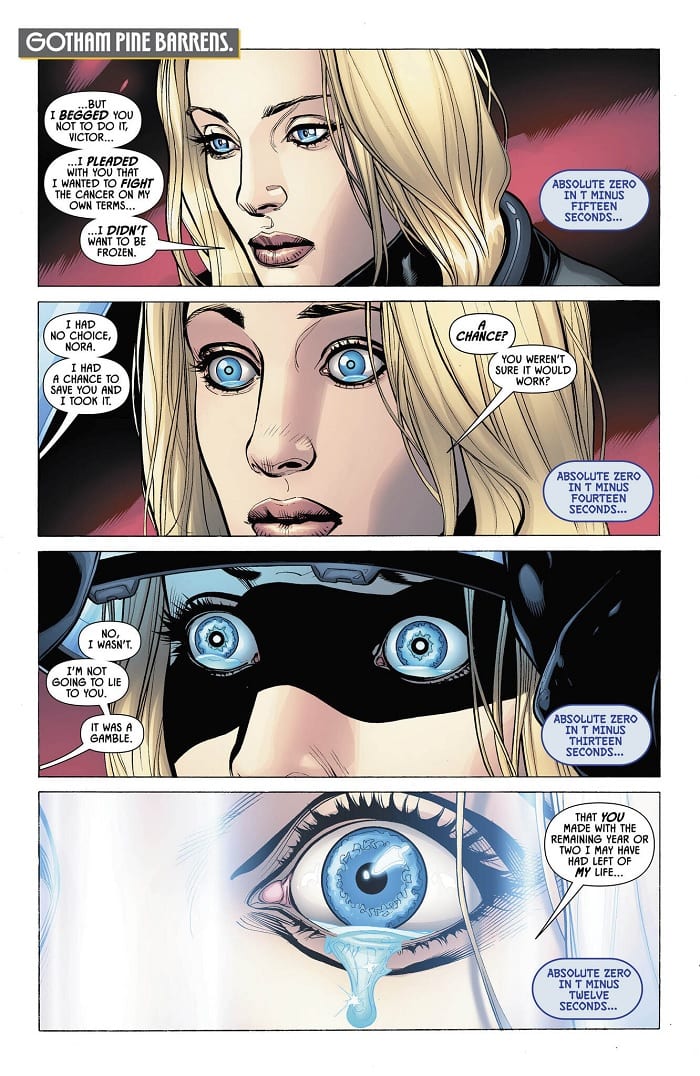
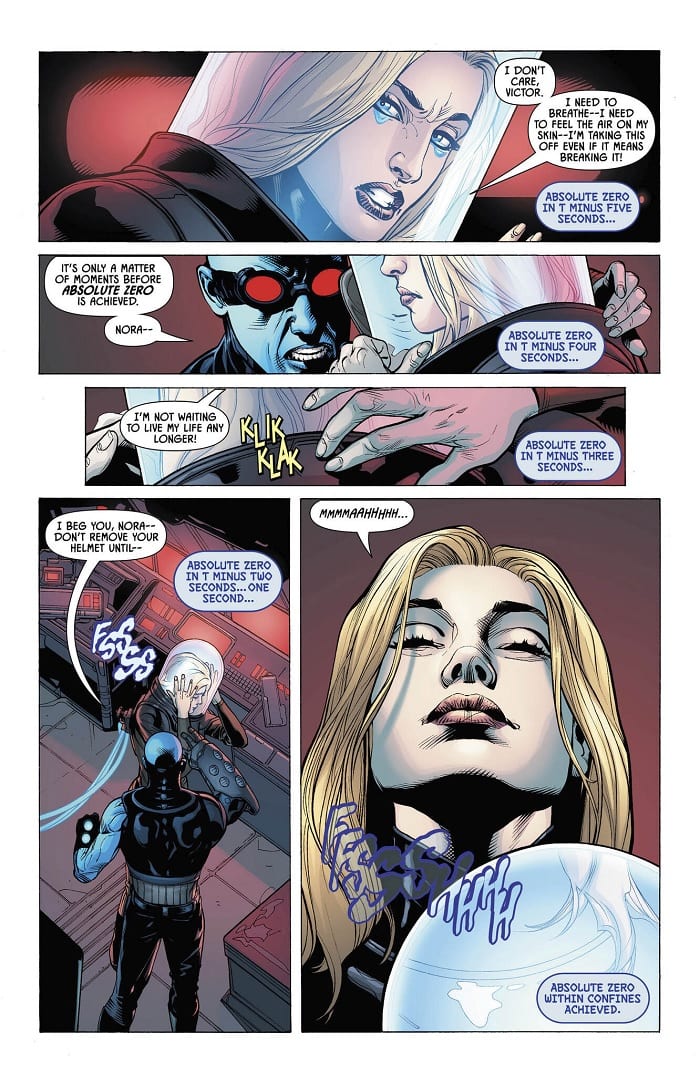
What would you do if you suddenly woke up years in the future, having been frozen (against your will, might I add) by the person you trusted most? In Detective Comics #1014, out this week from DC Comics, Nora Fries faces that very scenario.
Mr. Freeze finally achieves his greatest ambition: the resurrection of his wife, Nora. The question: how will she react to her sudden return to the world of the living? And, what consequences will it have for the citizens of Gotham?
The Writing
Batman himself doesn’t factor in as much as he would in a typical issue. Instead he, Alfred, and Lucius find themselves in the role of reacting to what is definitely Victor and Nora’s story.
In the first half of Detective Comics #1014, we’re following Freeze and the newly-revived Nora. The latter character’s emotional state is the narrative crux of this issue. We watch as Nora sorts her feelings, working through her sense of betrayal and hurt, while also figuring out what it means to be alive again in her present state.
The book is interesting, presenting an engaging narrative. There’s not as much for readers to sink their teeth into in terms of emotional payoff, though. Nora’s trauma, despite being painted as a primary motivation for her character in the book’s first half, is undermined by a sudden about-face. She seems to get over it very quickly, making it feel rather superficial and derailing the pathos being built behind the character. It might have been better to give this story more room to breathe and to accentuate the human drama by stretching this into multiple issues.
Despite that complaint, the action in the pages of Detective Comics #1014 is still compelling on its own. The reader is curious to see what Freeze will do now that he’s achieved his primary goal. Will he give up crime and runaway somewhere with his beloved? Unlikely, but the question of what Victor and Nora will do next should keep readers engaged until the last page.
The Artwork
Artist Doug Mahnke’s work on Detective Comics continues to be one of the series’ most consistent strongpoints. He very effectively conveys the right level of emotionality, pain, and hurt in the face of characters to reflect the emotional pitch of the moment. There are panels and pages herein that feel like they could be pulled out of the book and hung on one’s wall.
At the same time, Mahnke doesn’t lose sight of the importance of conveying narrative momentum. Throughout Detective Comics #1014, the artist delivers some excellent sequential storytelling, maintaining a consistent tone and aesthetic throughout and propelling the reader forward.
It’s the subtle notes here that make the work shine. The reflection of a figure in Freeze’s goggles, the weary expression on Bruce’s face…these elements really bring the book to life. There are touches of the macabre sprinkled throughout the book, too, making it a nice seasonal read in the lead-up to Halloween.
Detective Comics #1014 features the coloring talents of David Baron who, as always, brings a palette that is suitably cartoonish, while still eerie and just a little bit sinister. Baron has a great eye for selecting the right colors to match the emotional and thematic tones of the narrative.
Final Thoughts
Detective Comics #1014 is another strong chapter in the ongoing Year of the Villain event. While it could have used a little more narrative development, what Tomasi, Mahnke, and Baron give us here is plenty strong enough to bring readers back for the next issue.