Home Blog Page 340

LOIS LANE #9 is Everything That Makes This Series So Brilliant

LOIS LANE #9 is Everything That Makes This Series So Brilliant

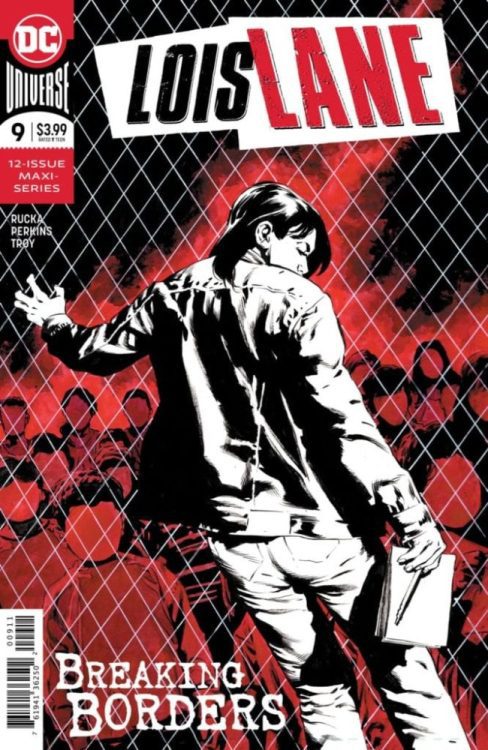
Written by Greg Rucka, with art by Mike Perkins, colors by Andy Troy and letters by Simon Bowland, Lois Lane #9 is an unassuming masterpiece. In some ways, it feels like an injustice to write a single article on this issue. A ten-page paper or a college class might be more fitting. It’s the quiet culmination of an already brilliant series, and it’s a creative team at their best. So let the injustice begin:

Writing

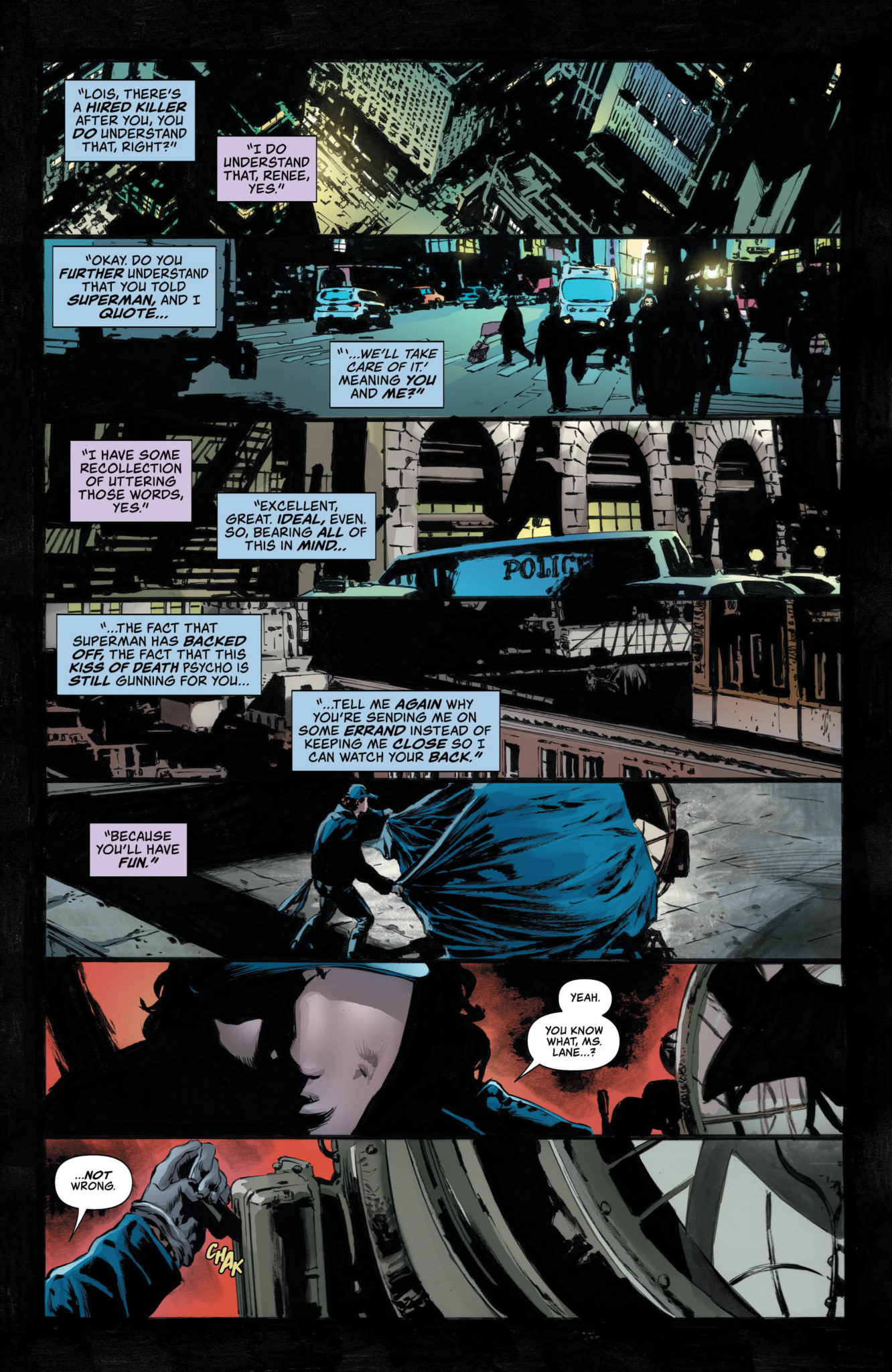
Rucka knows every character inside and out. Every line or gesture feels like the result of him pouring over all their appearances in the history of comics. Yet it also feels new and fresh. The Question and Batman talk like familiar pals, yet Renee throws Bruce completely off-kilter. We see a side to Batman that feels like a secret we shouldn’t know. But where Rucka sticks the landing in this issue, is his inclusion of immigration. Instead of politicizing his series and drawing a line in the sand of who is welcome to be a reader and who isn’t, Rucka takes the human angle. No matter what side of the aisle you’re on, can you imagine for a second what it would be like to be detained? He dodges political heavy-handedness but retains his authenticity brilliantly.
Lois Lane Rucka Batman the Question

Art

Perkins proves his intimate understanding of each character. He puts smiles on the faces of the perpetually frowning and raises the eyebrows of those who know everything. But each choice feels earned and genuine to the moment. It just feels like it hasn’t happened ever before. After all, nothing about this series feels recycled or used. In this issue, Perkins allows us to see cracks in the masks of the stoic. We see Lois fighting back tears (the fact that she never actually cries drives the moment home.) Then Alejandra tearfully speaks about her lost family. We even see the faceless Question grin. The humanity of the issue is impossible to miss. Even in the rare moments when it happens beneath a mask or cowl.

Coloring

Troy’s coloring plays against every moment in the issue. He creates balance by giving the darker moments in the writing a splash of orange, and the lighter moments an overhanging shadow. When the Question and Batman talk on a Gotham rooftop, they’re so dark it’s hard to tell where they start and the night begins. But the tone of the writing is surprisingly light. It’s Troy’s work of setting a dim stage that makes the levity of the scene a delightful surprise. Similarly, when Lois visits Alejandra in the detention center, everything is well-lit and clean. And so their conversations, about loss and despair, feel as though they are happening in an unsympathetic world.

Lettering

Bowland’s lettering is often easy to miss. While there are a couple of colorful sound effects, few and far between, much of Bowland’s lettering is worked into the artwork. Handwritten letters, signs out the front of buildings, magazine covers. It’s all so seamlessly worked into the rest of the artwork we get completely lost in the world we’re visiting. Yet in bright blue and red letters, he reminds us at the end we’re reading a series. We snap out of it just long enough to go, “Dang, I need to pre-order that next issue.”


At face value, this issue might not seem like much. A few conversations, a brief cameo by Batman, a chase for an off-panel killer. But the sheer humanity and groundedness of the issue make it one for the history books. It’s raw and hopelessly ordinary, in a world of the superpowered stoics. Don’t miss this issue or this run. Pick up Lois Lane #9 March 4th and a comic book shop near you.
Monkeys Fighting Robots Youtube

STRANGE ADVENTURES #1 Gives Us Two Stories for the Price of One

STRANGE ADVENTURES #1 Gives Us Two Stories for the Price of One

Writer Tom King and artist Mitch Gerads are back! This time, they’re working with artist Evan “Doc” Shaner. Or are they? The King and Gerads duo that has become known for gritty tales like Sheriff of Babylon or Mister Miracle bring their distortions and grime to Adam Strange in Strange Adventures #1. But King works with Shaner to tell a different story. A story of crisp lines and flawless heroes. The question inevitably becomes, who is Adam Strange really?

King and Gerads: Adam Strange the Warlord?

Writing

King crafts two opposing narratives in this brilliant first issue. In one tale, Adam Strange is on a book tour with his wife for his autobiography, also called Strange Adventures. He’s fought wars in outer space; he’s earned his retirement on Earth ten times over. Or at least that’s what he wants to believe. When Adam is accused of having committed atrocities on Rann, everything begins to fall apart. Alanna, Adam’s wife, defends him like a wolf backed into a corner. Adam, on the other hand, seems like he’s trying not to look resigned over the whole thing. Only putting the amount of effort necessary into proving his innocence that will get people off his back.

Art

Gerads’ art gives us a slightly distorted view of a man trying to look like he gives a damn. This half of the issue is colored brightly in an almost artificial way. Insisting nothing is wrong. The first time we see Adam smile at a book signing, it seems genuine and kind. When Gerads recreates that smile for another signing later in the issue, and then another, and another, the sincerity fades. Adam Strange suddenly seems like the kind of man that can’t muster a genuine smile. Even when his innocence is questioned, he can’t quite set his jaw like Alanna. When we see him lying down on a bed in full uniform, we get the picture. He’s in a costume he doesn’t care for, living a life he’s too bored to fight for. He’d just rather be in bed.

Lettering

Clayton Cowles’ lettering for this narrative is minimal. We get three sound effects in this half of the issue, that’s all. The most noticeable of these is the sound of clapping on a morning show. Big and yellow, it draws attention in a way that the later sound effects don’t. Every other sound is pushed to the side or written in small letters. It gives us the impression that life through a screen is not as realistic as it may seem. Everything but that one moment feels as true to life as possible. Even the credits and end quote are made to look like they were written on a typewriter. It’s only on TV that lettering suddenly becomes larger than life.

King and Shaner: Adam Strange the Hero!

Writing

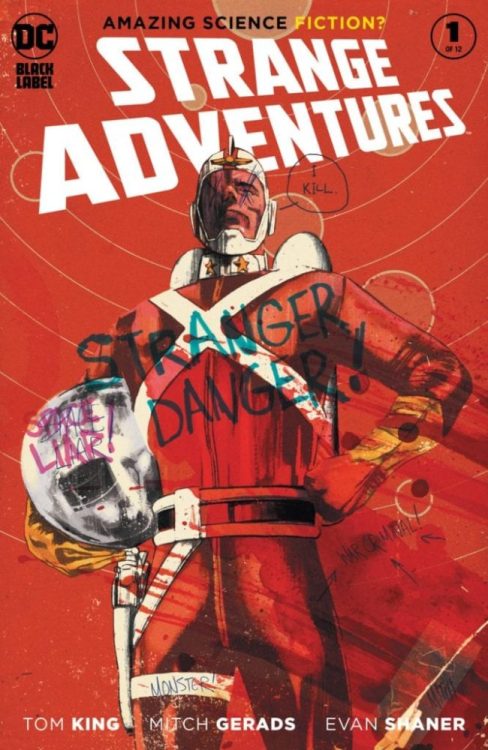
King tells the other half to this story in a voice that is unfamiliar. Rarely with King is something cut and dry. It’s the consequences and fallout of humanity that are his bread and butter. So it’s telling when every time Adam Strange shoots his laser gun, it hits someone off-panel. We never see the damage; we only see the smiling, adventurous hero. King echoes the writing of the Silver Age. Consequences have no home in these pages; the hero must always win. And he must win with honor and dignity. The chilling realization of the issue is that these are not necessarily events as they transpired, but what Adam Strange and Alanna are telling themselves. After all, it’s Shaner’s cover that appears in the issue as the cover to Strange’s autobiography. These are his version of events.

Art

Shaner’s art similarly echoes the Silver Age of comics. But in the same way that Gerads’ brightness seems to be a facade, Shaner creates a false dark tone. It’s as though the hero is ever aware of the great odds he faces. He’s David, covered in the shadow of Goliath, so there is no reason to question his actions. The crisp lines and over-explanatory dialogue assure us we are in the quintessential comic book. Shaner’s art is the clean, perfect comic book world we’ve come to know and love. And with big spaceships and monsters, the problems are forever on the outside and our chin-dimpled hero is a light in the darkness. Though it’s clear from the tone of this book that Shaner’s art represents the lies Adam tells himself, it’s hard not to believe the lies too. Shaner tells them so well.

Lettering

Cowles pulls out all stops in the Shaner half. He makes up for every moment he holds back in the Gerads’ pages. Large orange letters make the sound of an alien chomping down. Electric blue sound effects accompany Adam’s pistol and jetpack. Huge explosions splash across the page. It feels as though Cowles has been tasked with distracting us. We aren’t allowed to think about the inner turmoil, or perhaps lack thereof, so our gaze is constantly drawn outward. It’s a brilliant reminder of the fun of Silver Age comics, paired with a satire and commentary of those same works.


It feels like we know how this is going to end. The tone, the characters, the inciting incidents have already established a coming doom. It’s up to the creative team to make us care that these characters might be headed for the slaughterhouse. And in one issue, they seem to have already achieved it. Strange Adventures is the start of something brand new in comics. So new, I had to come up with new ways to review it. Don’t miss this brilliant series, starting March 4th with Strange Adventures #1 coming out in a comic shop near you!

Monkeys Fighting Robots Youtube

Review: Magic School Begins In STRANGE ACADEMY #1

Review: Magic School Begins In STRANGE ACADEMY #1

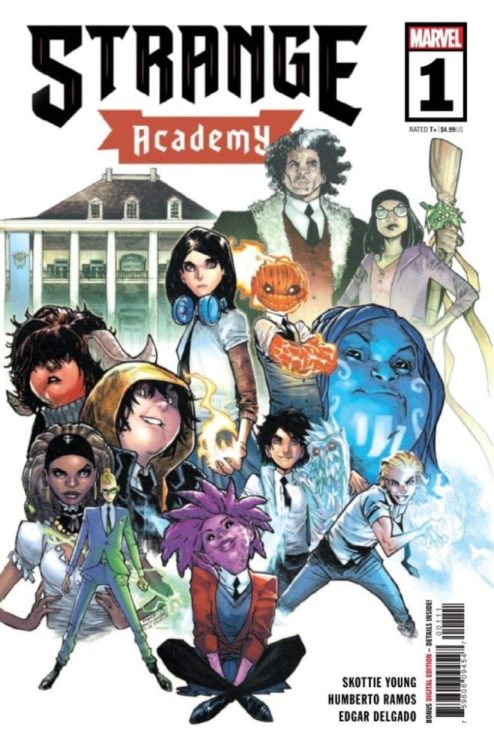
What do you get when you have two Asgardians, a Sorcerer, a Fairy, a Frost Giant, a minion of Dormammu, a demon from Limbo, and a creature from Weirdworld in a school? – Marvel Comics’ newest institution, Strange Academy #1.

If you’d like to check out more about Strange Academy #1 before going to your LCS this Wednesday, take a gander at our preview and synopsis here.

What kind of monster is attaching Dr. Strange and the Strange Academy?
Art by Humberto Ramos. Colors by Edgar Delgado. Letters by VC’s Clayton Cowles.

WELCOME TO STRANGE ACADEMY, HOPEFULLY, YOU SURVIVE

Writer, Skottie Young, is no stranger to stories revolving kids, humor, and all-around weirdness. This past experience helps him craft Marvel Comics’ newest school that hosts kids with magic from all walks of life. That’s were Strange Academy #1’s story succeeds, yet takes a dip. There is such a vast array of students with varying powers that no two are alike. Even the twins aren’t much like each other.

On the contrary, that’s where the quality dip occurs. All students introduced are only named once or twice. That in mind, towards the end of the issue, you’ll be racking your brain to remember who is who. This could easily be fixed in future issues with a “roll call” page with names, powers, and whatnot. This “roll call” page makes even more sense, as each character seems to be a newer Marvel Comics entry.

Name confusion aside; Young sucks you into Strange Academy #1 fast. Every new character introduced is fun, different, and makes you want to know more about them. The same can be said of the building itself that houses multiple unique classrooms. Young’s newest school story is a great new idea that with a few fixes could be the next Avengers Academy.

Time to meeet some of the teachers
Art by Humberto Ramos. Colors by Edgar Delgado. Letters by VC’s Clayton Cowles.

MAGIC WORDS

Strange Academy #1’s cast is all visually distinct, yet VC’s Clayton Cowles lettering makes them even more so. There are a few human (that we know) characters that retain the usual lettering. But, when it comes to the other characters, Cowles letters them differently. The Demon from Limbo is pink/purple, Dormammu’s “minion” has a shaky lettering bubble with symbols under some words and the Asgardians have the usually stylized lettering. These differing letter styles significantly improve each character design, plus it helps visually.

MAGICAL SCHOOL, MAGICAL ART

Humberto Ramos is known for his overly stylized exaggerated art in The Amazing Spider-Man that may divide some readers. Yet, his work has an in motion feeling that perfectly fits the comic medium. Strange Academy #1 cements this feeling, especially in the magic and fight scenes. That’s not to say his conversational moments are stiff, as they are the opposite. But, when the story revolves around gifted students using powers, those powers better hit hard. That they do. The few moments where the student’s powers are showcased Ramos makes you believe in magic. These are far and few in between; nonetheless, they look fantastically magical with his execution.

Ramos’ visual magic and the character design are taken to the next level with Edgar Delgado’s lively colors. Delgado keeps the trend of portraying each character differently with the use of colors. This can be seen when all of the kids in Strange Academy are near each other, and the color palettes differ. Yet, the highlight of his colors is during power usage. As the kids have visually different powers, Delgado colors them as such, yet keeps them vibrant. Furthermore, the vast usage of bright colors complements each other in these action moments, making for some beautiful panels.

Visually gorgeous action
Art by Humberto Ramos. Colors by Edgar Delgado. Letters by VC’s Clayton Cowles.

SCHOOL HAS BEGUN

Strange Academy #1’s only fault is trying to explain too much in a singular first issue. Young’s great storytelling is there and beckons you to read more. Alas, at times too much info is being thrown at you, causing pages to feel to word heavy. Nonetheless, with all the info dropped in the first issue the following shouldn’t feel as such. Now, just a “roll call” page for the students and faculty, and you’ll have an A+.

Extra: Strange Academy #1 does include an application letter, which is really cool to add.

Memorable Quote: “I know some of you are freaking out at how awesome and scary this all is. And some of you are probably thinking you don’t need to be here because you’re such badasses already. Either way, soak it all in. Have fun, and most of all, try not to die.” – Dr. Strange

What a great Introduction speech, complimented with an amazing final few pages.

DEAR NEW STUDENT

What did you think of the first day of magic school? let us know below.

Monkeys Fighting Robots Youtube

Review: BATMAN #90 Shows The Villains’ Past With The Designer

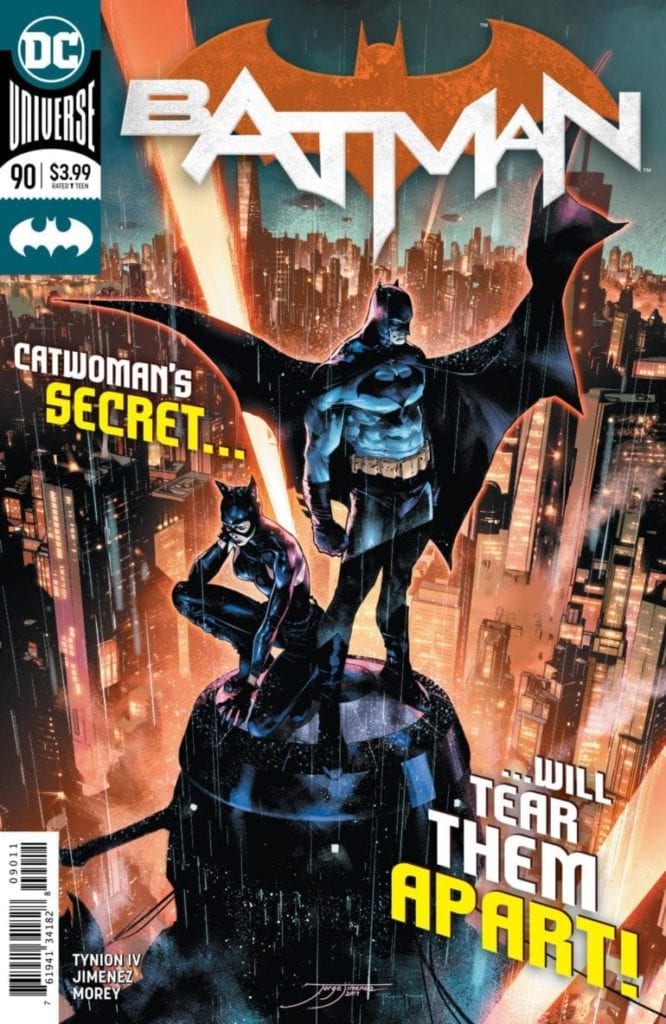
Batman 90 cover

The Conspiracy against Batman Begins

With the start of a new Batman run, we were going to get a big overarching villain eventually. For King’s run, it was Bane. For this run, we get the new villain, The Designer. This strangely decorated supercriminal has helped Gotham’s most famous criminals create the ultimate plan. The shocking part is the fact that The Designer has also turned his gaze on the criminals. Through the help of the world’s deadliest assassins, Penguin has been sent to the emergency room, and Riddler has been taken. Catwoman, being a part of this grand conspiracy, steps forward, to tell the truth to Batman. So how did this all begin?

Batman 90 cover

**Some Spoilers Below**

Story:

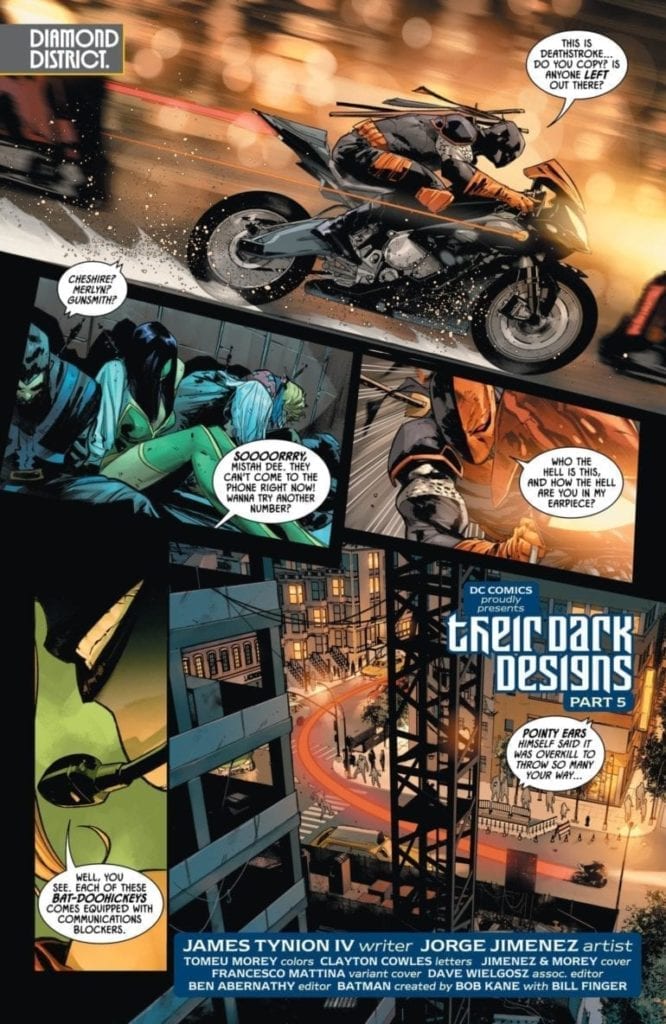
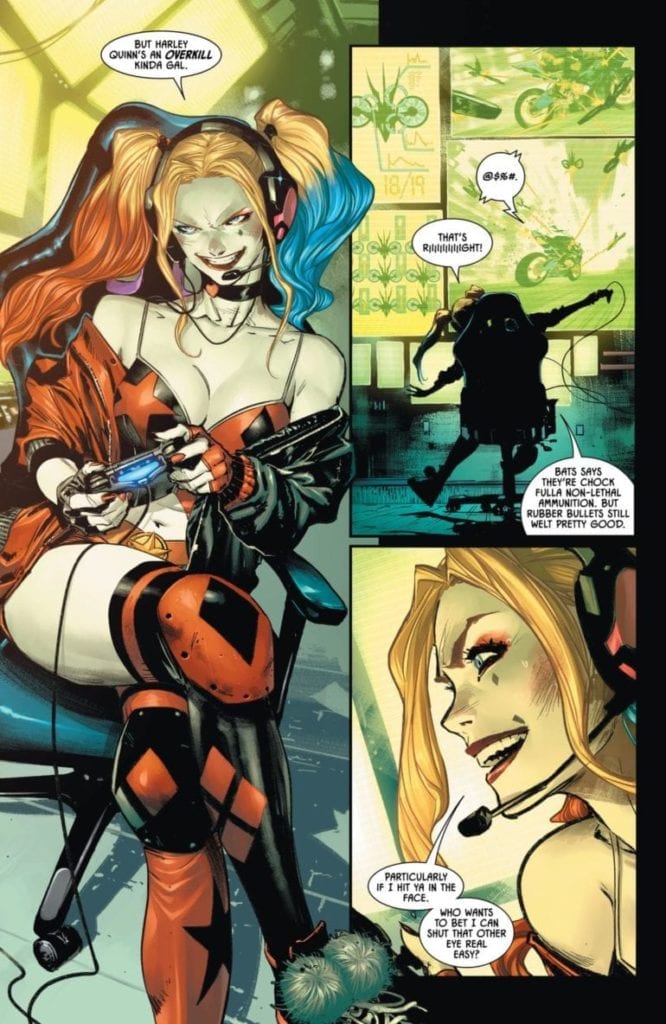
While Harley uses Bat-drones to chase down Deathstroke, Catwoman explains what happened. Near the beginning of Batman’s career, Selina is invited to meet with a legendary villain named The Designer.

Along with her is Riddler, Penguin, and the Joker as they head to the docks on Gotham Bay. There the group finds a boatman who takes them to a strange mansion out on the water. The Designer welcomes them all and gives us vague details of his tale. After the introductions, he takes each member into another room where he presents them each with a perfect crime designed for them.

Batman 90 p1

Well, we finally got information on our mastermind, and honestly, it has me more hooked than ever. The Designer telling his tale to the villains had my brain circulating possibilities of who it truly is. He’s treated like a boogeyman of crime, and it helps that the criminals treat him as such. It also brought a laugh when it was revealed why The Designer turned on the Bat-Villains. It makes perfect sense why a villain such as the Designer wouldn’t mesh with Gotham’s worst.

The biggest issue is how this whole story is presented to us. This story would have benefited if we got each bit of this history given to us throughout the arc. With it poured on all at once, it’s incredibly hard to digest. A superhero comic should find a balance of both action and story to hold readers properly. If we wait until the fourth issue of a six-issue arc to do an info dump, it’s going to turn people away. Obviously, the big Batman fans will be in it for the long haul, but it doesn’t make the issue any less dense and hard to completely enjoy.

Batman 90 p2

Art:

This time around, we have Jorge Jimenez doing the art, and he keeps up the quality the series has had so far. The classic looks of the Batman villains thrive off of his style of illustration. The best look of the bunch is the Joker, who pops off the page, thanks to the colorwork of Tomeu Morey. Another positive the team does exceptionally well is the flashback within the flashback recounting the origin of The Designer. They purposefully left out any major detail to allow readers to start forming theories on who the identity is. 

Conclusion:

Overall, while not a perfect issue, we finally get more than just action sequences with teases of a deeper story. The Designer continues to intrigue and has revitalized my hope for this new run. While the art team continues to rotate in and out of the series, this one does a great job of creating a classic Batman feel. The previous reviews have made it clear that the biggest issue was a lack of progression in the story. As we move forward in the series, I can only hope that the team can find that proper balance to reach the potential I know it has.

Monkeys Fighting Robots Youtube

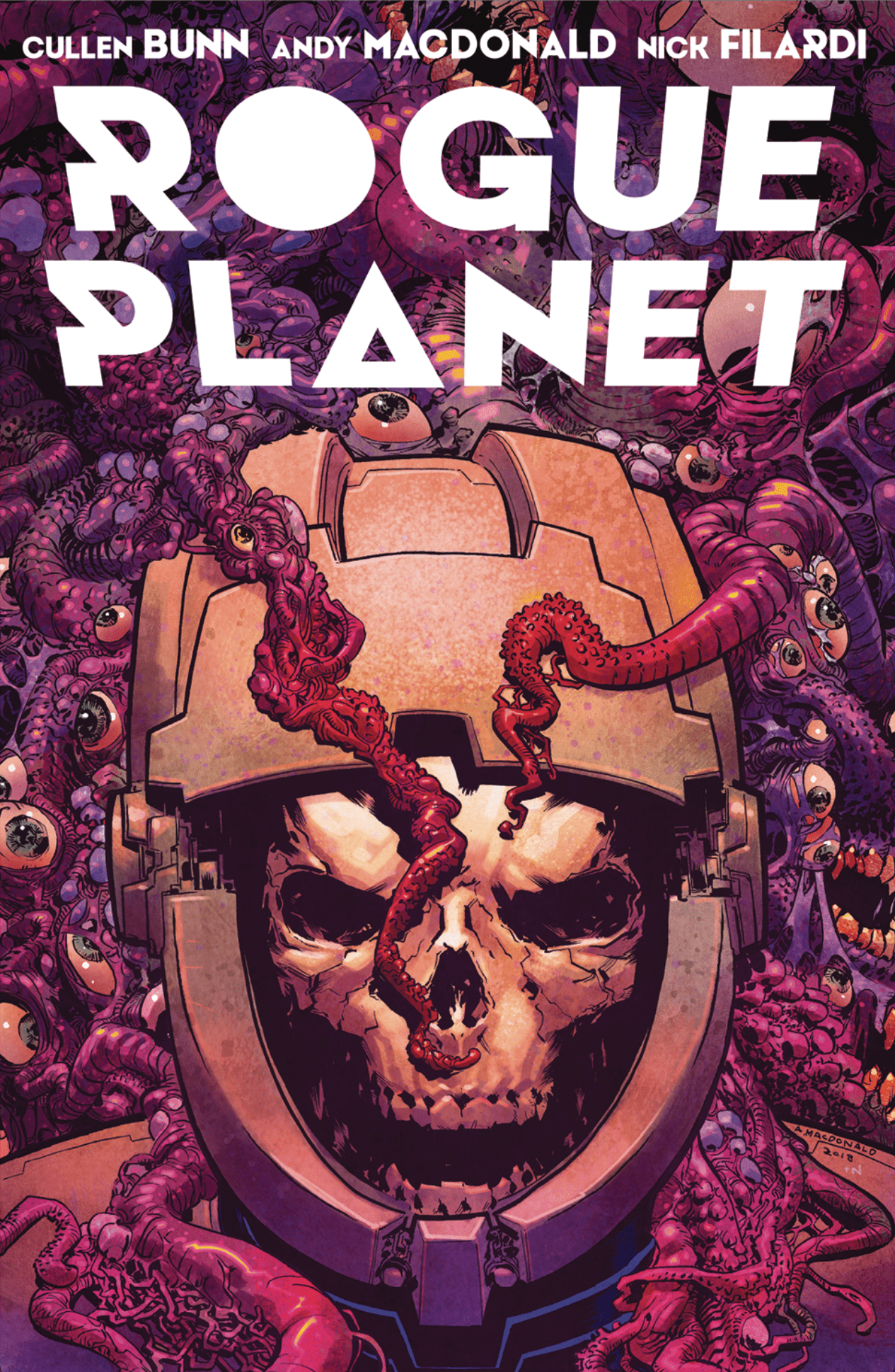
Advance Review: ROGUE PLANET #1 – A Planet Of Horror Waiting To Be Explored

This April 1st join the crew of salvage vessel Cortes as they land on a planet filled with grotesque horrors in Oni Press’ newest series, Rogue Planet #1.

ROGUE PLANET – HORROR PLANET

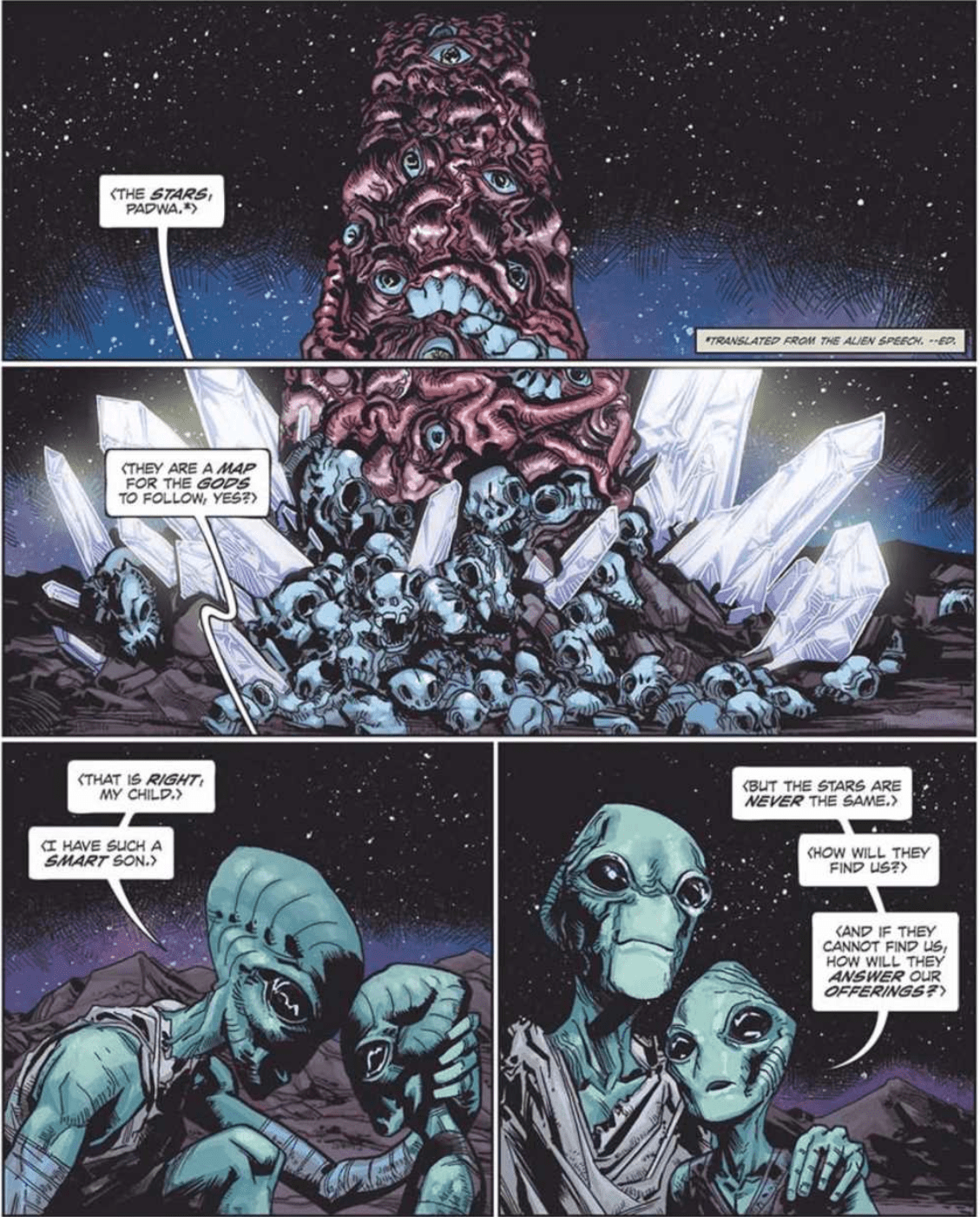
Rogue Planet #1 shows that Cullen Bunn knows how to start a DAMN comic! Within the first two pages, Bunn is able to draw you into this new space horror. Alas, Bunn isn’t new to horror, as he has written multiple amazing titles in this genre. You don’t have to look far to know this with his famous series, Harrow County receiving a sequel series. Yet, where Harrow County takes place on earth, Rogue Planet takes us to the deep, dark, terrifying space.

Ah, the quit before the storm in Rogue Planet #1
Art by Andy MacDonald. Colors by Nick Filardi

Rogue Planet #1’s plot is familiar to 1979’s Alien, yet mixed with mind-boggling cosmic horror. Nonetheless, it isn’t a beat-by-beat tale, as Bunn’s own ideas make the first issue unique and stand out. One such idea that stood out was something I’d never seen before; the way hypersleep is handled. From the small amount shown, it looks as if the crew takes turns in having their bodies used by robots/drones. Furthermore, they take turns sleeping while another team makes the rounds working.

The captain of the crew – Joel Narris – mentions their brains being “turned off.” Thus it seems the crew’s bodies are used by the ship to maintain it while the mind is asleep. Once you see it, you’ll wonder why it hasn’t been done before. Brain sleep aside, Bunn brings a lot to the space horror genre in Rogue Planet #1. Each character seems to fit the typical characteristic you’d see in one of these stories. Yet, Bunn keeps them fun and fresh, much like the rest of Rogue Planet #1. Well, fun and fresh from a horror perspective.

What a family-friendly event! Rogue Planet #1
Art by Andy MacDonald. Colors by Nick Filardi. Letters by Crank!

THE BEAUTY OF DESIGN

On art duty is Andy MacDonald, whose work throughout the first issue is fantastic. Nonetheless, the highest praise goes toward his designs of aliens, creators/monsters, the spaceship, and the crew’s suits. For a space-faring story to stick, it needs a great design all around. But, for horror to stand out, you need to make the monster terrifying and grotesque. MacDonald knocks it out of space in all of those aspects. Sadly speaking on the design of the monsters in Rogue Planet #1 may ruin the surprise for some. However, it’s a sight to behold.

Cortes’ interior design looks extremely claustrophobic, even for just a crew of only eight. That in mind, this closed corridor ship seems like the perfect place for the team to have more horror-filled moments transpired. Yet, one ship design stood out most—the cockpit. As a fan of clustered cockpits in spaceships, MacDonald nailed the design.

Helping Rogue Planet #1’s creepy factor is the bleak colors by Nick Filardi. When the Cortes is introduced drifting through space, Filardi keeps the colors deep and dark, with only sprinkling of stars seen throughout. That is until their destination; planet Lonely Orphan comes into view. Lonely Orphan is a dulled down red with a bright red hue circling it. If we didn’t already know that horrors awaited our crew here, Filardi’s colors would tell us.

When the crew arrives on Lonely Orphan, Filardi gives the interior a brighter color. This color never betrays the darker shades but helps the planet’s creepy factor. Furthermore, once the creature makes its debut, Filardi colors add another layer upon its hideous appearance. Filardi’s colors mixed with MacDonald’s fantastic design makes the creatures in Rogue Planet #1 something that’ll stick with you.
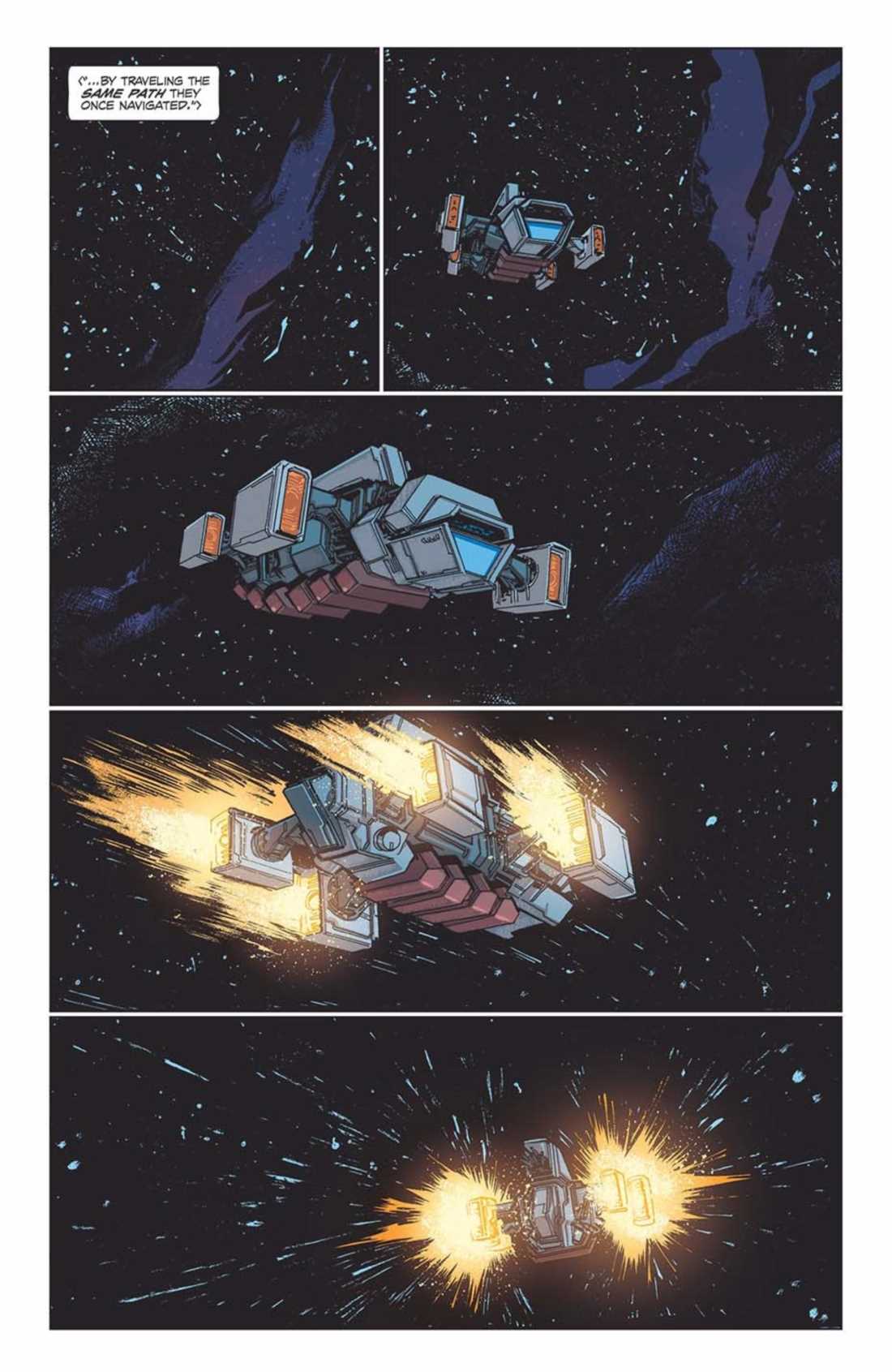
The silence of space.
Art by Andy MacDonald. Colors by Nick Filardi. Letters by Crank!

ALIEN LANGUAGE

Crank!’s sound effects help bring Rogue Planet #1 to life. When the Cortes is drifting through space, Crank! makes sure there is no sound. A great portrayal of the vast soundless space. But, when building up to the creature the team does so with haunting sound effects. Once introduced the size of the creature is amplified by Crank! hiding part of the sound effects behind it.

HORRIFIC HAPPENINGS

Although Rogue Planet #1 feels familiar to other stories, it adds in its unique twists and does so amazingly. Yet, there was one thing that felt needed—name tags. Thankfully when introduced character’s name and title are included in a box. Yet, when they’re in their suits no name is displayed. However, this isn’t that big of a deal, yet having a name tag would’ve been great. Alas, if horror, space, creepy monster are your bag then tell your LCS that you want it!.

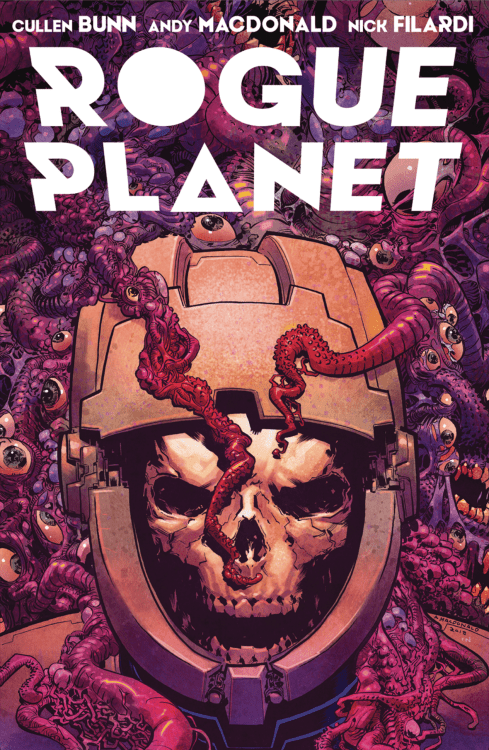
Cover Story: Honestly, I didn’t even read the synopsis for Rogue Planet #1, I just went in blind. The thing that sold me? This beautiful cover by MacDonald.

What a gorgeous cover.
Cover by Andy MacDonald.
Monkeys Fighting Robots Youtube

Review: FARMHAND #14 Reveals The History Of The Jedediah Seed

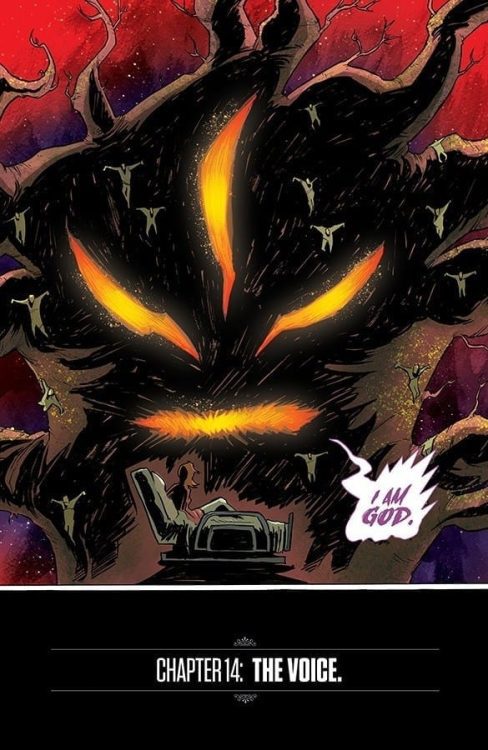
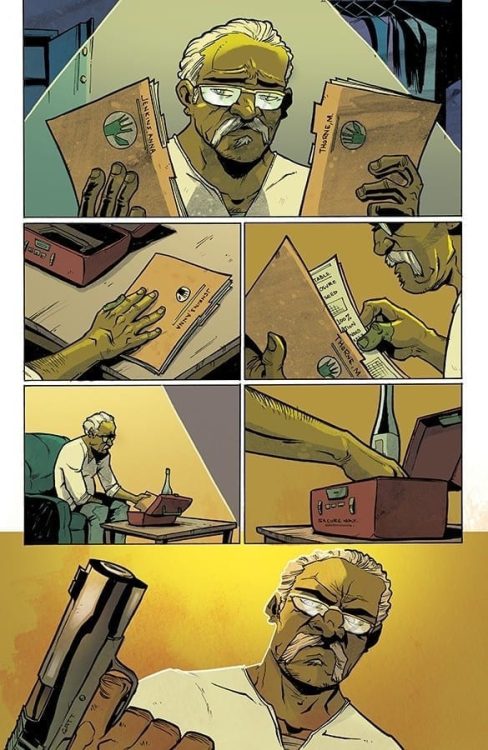
FARMHAND #14, available in comic book stores on Wednesday, March 4th, answers a question that’s been on fans’ minds: How was the Jedediah Seed created? Writer and creator Rob Guillory takes readers on flashbacks to Katrina 2, a horrific natural disaster that destroyed Freetown twenty years earlier. It is here Monica Thorne experiences a vision of a mysterious being claiming to be “God.” And it’s ready to alter the course of events in Freetown forever.

Story

In the present, widespread panic spreads throughout Freetown. The Jed Seed’s effects have been showing up in the townsfolk, even if they didn’t receive transplants.

Zeke and company conduct separate investigations throughout town, learning just how far the adverse effects have reached. People and animals are becoming more plant-like. Zeke and the group soon find that Thorne, manipulating Jeb, is behind it all. And Jeb is not happy.

Guillory’s writing plays out like the beautifully constructed sci-fi horror comic that it is. One thinks of cult classics such as The Happening in its ability to show what our world would look like of our ecosystems started fighting back.

Artwork

Guillory’s penciling and ink work is just as engaging as his writing. The blending of human anatomy with green plant-like appendages gives this issue an unsettling surrealness. Rico Renzi’s coloring helps create this effect by contrasting the “unnatural” colors of artificial items throughout the town with the earthy colors of those affected by the Seed.

Kody Chamberlain’s lettering fits wonderfully with the horror theme, employing erratic, red fonts when used for the demonic speech of the “God” figure.

Comic Cover

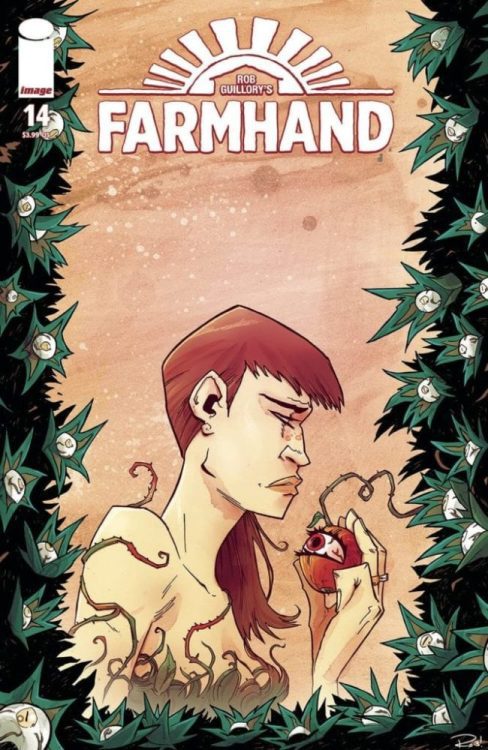
Guillory and Taylor Wells’s cover artwork features Thorne examining an eyeball growing from a mysterious plant, showing readers how integral she is to the Seed pandemic.

Conclusion

FARMHAND #14 reveals more about the Seed’s history than ever before, showing how involved Thorne was with it from the very beginning. The engaging narrative, digging deeper into the earth of Guillory’s imagination, keeps us coming back for more.

Do you think the Seed’s effects will spread to the rest of the country? Let us know in the comments below!

Monkeys Fighting Robots Youtube

Review: JUSTICE LEAGUE ODYSSEY #19 — A Fight Against Time

JUSTICE LEAGUE ODYSSEY #19, available in stores on Wednesday, March 4th, dives deeper into the mind of Epoch, the mysterious “Lord of Time.” Apparently, he’s a person of interest to Darkseid and his forces, meaning the League members could find some pertinent information. But in a race against the clock, what could the master of time unveil to combat the coming threat?

Story

The League members, along with Gamma Knife and Orion, met Epoch last issue after exploring Darkseid’s vessel. They learned that he was human who could manipulate time as he willed it. But with so much data and contraptions procured by the man, we still don’t know what his intentions are. One might reasonably wonder if he’s planning to take on the villain’s approaching kill team all by himself.

Earlier on in this storyline, Cruz saw her close friend and fellow Justice League member Cyborg fall prey to Darkseid’s control. But now it appears the evil overlord has overtaken Starfire, the sister of Blackfire and beloved Titans member.

The team must now decide how to alleviate the threat: should they attempt to subdue their mind-controlled friend without killing her, or would it be best to wipe her out completely? Ironically, Blackfire, in a true example of compartmentalization, calls for the latter. Her reasoning? Epoch can rewrite time/history and erase Darkseid and his evil influence plaguing the universe, saving her sister. And indeed, this method is the one Epoch proposes.

Dan Abnett’s writing asked a a hard-hitting philosophical question at the core of any person who’s serious thought about the evil in this world: What would the world look like if we could edit out all the bad parts of life? Unfortunately, our heroes may soon learn the ramifications of such a circumstance.

Artwork

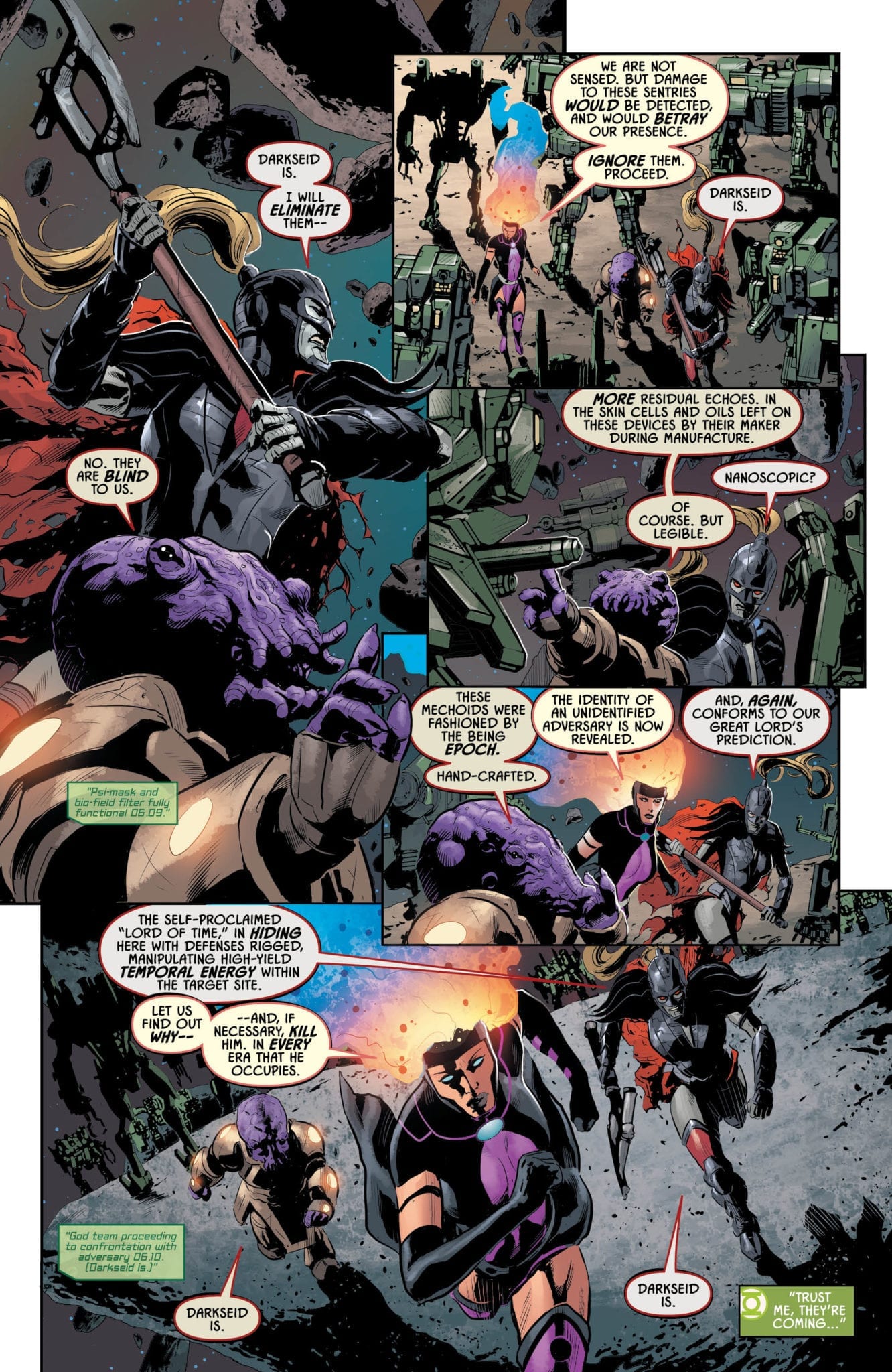
Cliff Richards’s penciling and ink work, Rain Beredo’s coloring, and Andworld Design’s lettering come together beautifully in this issue. The sleek designs of Darkseid’s heralds have multiple variations of black armored suits that fit each character’s color palette. In addition, the letter boxes pace well with the action, increasing and decreasing in spacing depending on how quickly the scene is moving.

Comic Book Covers

Main Cover

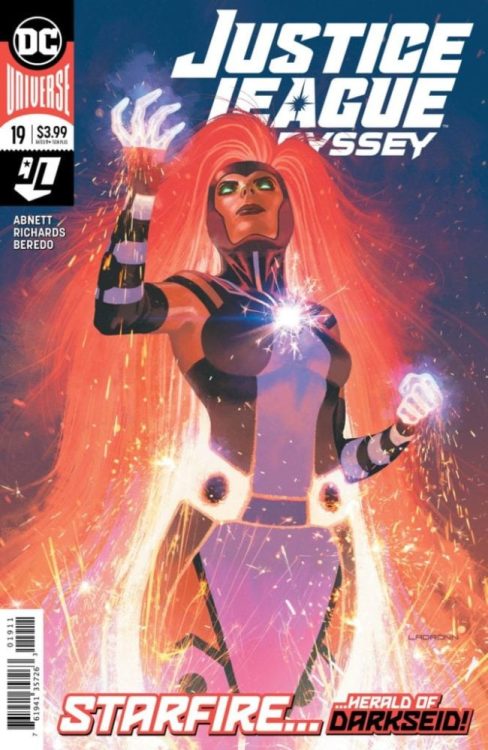
José Ladrönn’s main cover gives readers a look at the Darkseid-controlled Starfire, showing us how far one of DC’s beloved heroes has fallen.

Variant Cover

Skan’s variant cover features Darkheid and his newly recruited minions, including Cyborg and Starfire. This shows readers just how complex the army our heroes are facing has become.

Conclusion

JUSTICE LEAGUE ODYSSEY #19 ramps up the stakes ten-fold by revealing Epoch’s plan. Only time will tell (no pun intended) if he will be able to pull it off, and what it will mean  for history itself.

Do you think Epoch’s plan will come to fruition? Let us know in the comments below!

Monkeys Fighting Robots Youtube

Review: The Fall of a Regime, the Rise of New Deceptions in THE BUTCHER OF PARIS #4

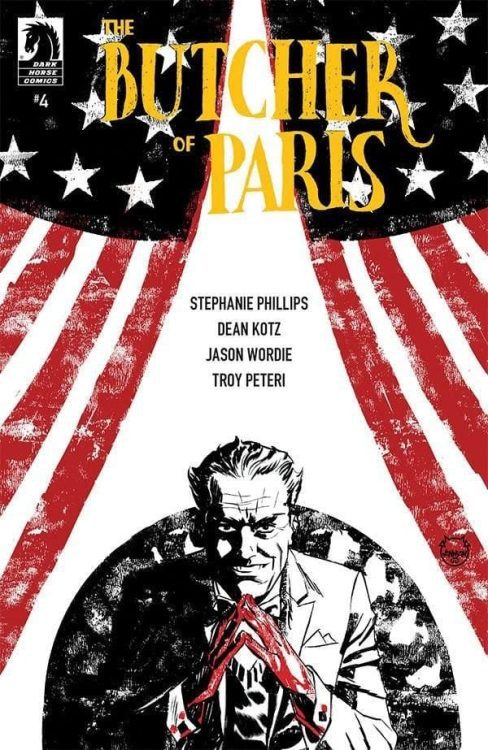
The fourth issue of historical crime-thriller “The Butcher of Paris” is here, and it once again provides intrigue and tension in spades. Stephanie Phillips’ scripts continue to be the perfect meld of WWII character commentary and sharp detective storytelling. This fact coupled with the artwork of Dean Kotz and Jason Wordie makes this another stellar chapter in a fantastic series.

“Paris has been liberated, but as the citizens rejoice, the killer’s wave of terror begins to fade from the public eye–which means he has an opportunity to escape!
Meanwhile, the French police begin to strive to oust the remaining Nazis inhabiting the city. Could there be one hiding in their own ranks?”

Writing & Plot

The biggest strength of “The Butcher of Paris” in terms of storytelling is its consistently sharp plotting despite handling so many subjects at once. This issue’s tackling of the liberation of France from Nazi occupation is riveting, but so is the underlying main plot of Detective Massau’s hunt for the Butcher. The way these two overlap while maintaining the gravity of both is what keeps this story so compelling from month to month. The dialogue as well is intelligent and naturalistic, making the narration-free read a smooth page-turner of an experience. Phillips‘ juggling of the winding plot is the work of an expert, and makes this series one of the most well-written in recent memory.

Art Direction

Artist Dean Kotz strikes again in “Butcher of Paris” #4 with his brand of unique character art and sense of visual direction. The panels for this series continue to give the essence of watching a well-directed thriller. Kotz’s unmistakable pencils provide the aesthetic of a European graphic novel, further entrenching the setting in the eyes of the reader. Jason Wordie‘s colors provide deep hues of red and rusty browns that sell the idea that there is a gross threat still at large in the midst of the Parisian population’s victory over the Nazis. An unsung hero of the visual direction of this comic is the wholly unique lettering of Tror Peteri. The fonts he uses look as though they were etched into the page by a crude ink quill, and they create a looming sense of atmospheric foreboding in the reading experience. This fourth chapter is yet again a triumph of visual storytelling in tandem with a phenomenal script.

“The Butcher of Paris” #4 is an excellent chapter near the end of this series. Stephanie Phillips’ airtight script and control of the plot balances the conspiratorial elements of the French victory over the Nazis with the thriller aspects at the comic’s core. The visual work by Dean Kotz and Jason Wordie maintains the comic’s unique vision and stands out as some of the most interesting work in the medium. Be sure to grab a copy on 3/4!


Monkeys Fighting Robots Youtube

Review: DOCTOR WHO THE 13TH DOCTOR Year 2 #3

Doctor Who 13th Doctor Year 2 #3
Doctor Who 13th Doctor Year 2 #3 Credit: TITAN Comics

Two Doctors and two alien threats mean four times the fun in Titan Comics Doctor Who The 13th Doctor Year 2. The third issue is released this week and the inevitable happens as the 10th Doctor meets his future. Or the 13th meets her past, depending on how you look at it.

It is a complicated story with a lot of back and forth but the writer Jody Houser has got Doctor Who under her skin. All of the elements of a classic duel Doctor story-line are here with the added bonus of two of the best foes of any era. As the action builds can the creators keep up?

Doctor Who 13th Doctor Year 2 #3
Doctor Who 13th Doctor Year 2 #3 Credit: TITAN Comics

Adventures in Time

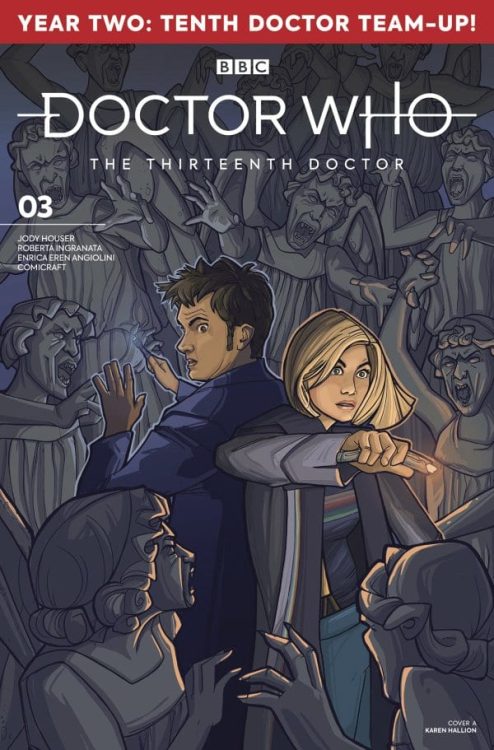
The 10th Doctor and his future ‘fam’ have come, literally, face to face with a Weeping Angel. Meanwhile the 13th Doctor and Martha take flight from an army of Auton. All in all, the Doctor is having a busy day.

This issue sees the pace increase dramatically from previous issues. This is a standard turnaround for this type of Doctor Who story where the tension is slowly built to introduce the villains. Then comes the running, the shouting, and finally the reveal of the villains goal. It’s a classic four part Doctor Who story structure, although there is no motive in this issue. That has been left for future chapters.

Houser has a firm grip on the different characters from each of the time periods. The interactions between old and new are perfectly balanced although the 13th Doctor has an energy more akin to her past counterpart. It’s as if she is feeding off the vitality of her youth while maintaining the characteristics that she has developed. People will still recognise Jodie Whitaker in the speech that Houser scripts but the story is definitely more 10th Doctor.

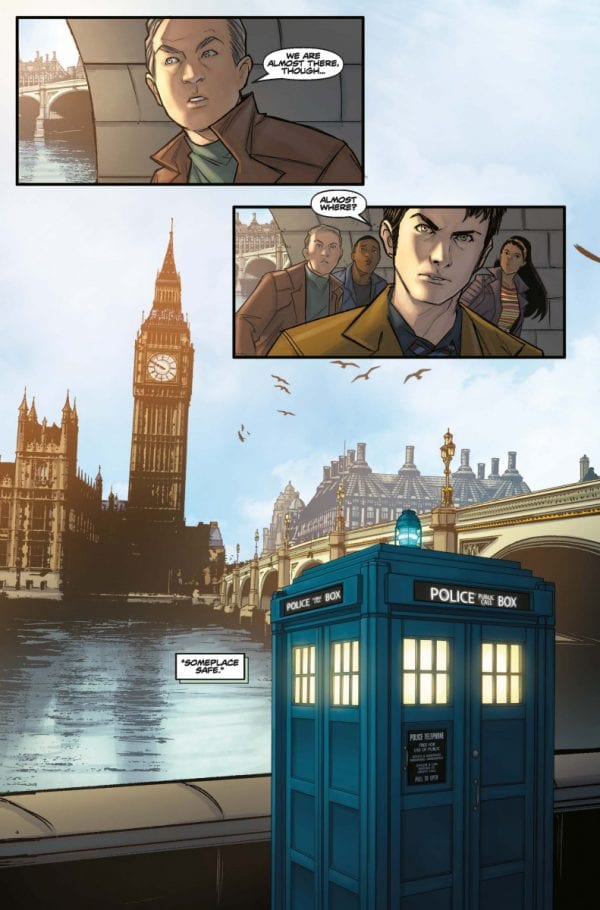
The highlight of this issue involves the 10th Doctor’s discovery of the TARDIS, which is clearly a future version. The child like excitement of the character is reminiscent of Sarah Jane Smiths’ encounter with the time ship in School Reunion. There is a sense of awe, of wonder, and of longing.

Unfortunately this whole scene overshadows the Fam’s escape from the Weeping Angel and reduces the scary threat to something more comical. The intimidation of the Angels comes across much better later in the issue but surprisingly the Auton threat seems greater.

Doctor Who 13th Doctor Year 2 #3
Doctor Who 13th Doctor Year 2 #3 Credit: TITAN Comics

Drawing the Cast Together

There is a simplicity of form to much of the art work, with only a few backgrounds containing complex detail. This is because Roberta Ingranata is able to represent the characters with a minimum number of lines, almost like a caricature but without the comical exaggeration. She captures the essence of the character and relays this to the reader, rendering each cast member in a unique way. The general shapes of the cast are enough to identify who is depicted.

This simplicity makes the comic easier to read. The audience is able to immediately identify who is in each panel and is therefore not wasting time trying to work out which character they are following. This became a problem with some of BOOM! Studios Buffy comics last year where big reveals were dampened by lack of immediate identification. That is not a problem here. Ingranata’s character work is perfect.

There is also a certain dynamism to the pages. Not necessarily with the depiction of movement but just in the presence of the characters. The Doctor specifically holds the attention on the page, giving the reader a focus with which to follow the story. Each page of the comic has one aspect of the famous Time Lord and it is this figure that leads the directional reading.

Design and Color

The design of the page is such that the reader zones in on the Doctor in the opening panel and then weaves their way through the page, jumping from panel to panel in a search for the Gallifreyan. The placement of the speech by letterers Richard Starkings and Sarah Hedrick facilitate this movement. There is an easy to follow flow in this comic which helps to build the pace of the story.

The colorist, Enrica Eren Angiolini, picks out each iteration of the Time Lord and represents them through alternating color palettes. Each page that is dominated by one Doctor or the other has a theme that matches their general appearance.

The 10th Doctor is quite subdued with muted hues. There are a number of browns and deep blues with a serious, dark purple color flowing through his backgrounds. The 13th Doctor has much more color and vibrancy. Backgrounds feature an array of color, a range across the spectrum, much like the Doctor’s own clothes. It’s as if the very environment that the Doctor enters twists to fit them and their personality.

Doctor Who 13th Doctor Year 2 #3
Doctor Who 13th Doctor Year 2 #3 Credit: TITAN Comics

Conclusion

With the final episode on the most recent series now out in the world, almost any story is going to have difficulty following in the wake. Luckily for readers of the Titan Comic, Jody Houser is exceptional at writing Doctor Who. She captures the characteristics and mannerisms of the TARDIS crew but more importantly she brings the tone of the series to the pages of the comic.

With wonderfully fun and entertaining art work, this second comic season of the 13th Doctor is a great read for any fan. Not everything quite fits together yet but there is no indication that it won’t in the end: there is a definite feeling that this is heading somewhere fantastic.

Monkeys Fighting Robots Youtube

Exclusive First Look: QUANTUM & WOODY #3 With Commentary From Christopher Hastings

Quantum & Woody #3 doesn’t hit your local comic book shop until March 25, but thanks to Valiant Entertainment, Monkeys Fighting Robots has an exclusive four-page first look with commentary from series writer Christopher Hastings.

The four-issue mini-series is written by Hastings, with pencils & inks by Ryan Browne, Ruth Redmond handles colors, and you will read Hassan Otsmane-Elhaou letters (just not today).

About the Quantum & Woody:
Quantum & Woody — the worst superhero duo in the world — are Earth’s LAST hope against stopping a coalition of mad scientists from destroying the planet!

Ejoy the Preview – Page One

Quantum and Woody are two superhero brothers (one of whom is adopted, hence the difference in melanin across the two) who just do not get along. Unfortunately, their superpowers come paired with individual bracelets that will disintegrate the boys to nothing if not touched together every 24 hours. So they’re stuck with each other.

When telling a story about mismatched superhero brothers, you’re going to have to go back to their shared past from time to time, so here we show off a moment in their youth when Woody was bullied, Eric (Quantum) tried to help out, and it didn’t go great. – Hastings

Exclusive First Look: QUANTUM & WOODY #3

Page Two

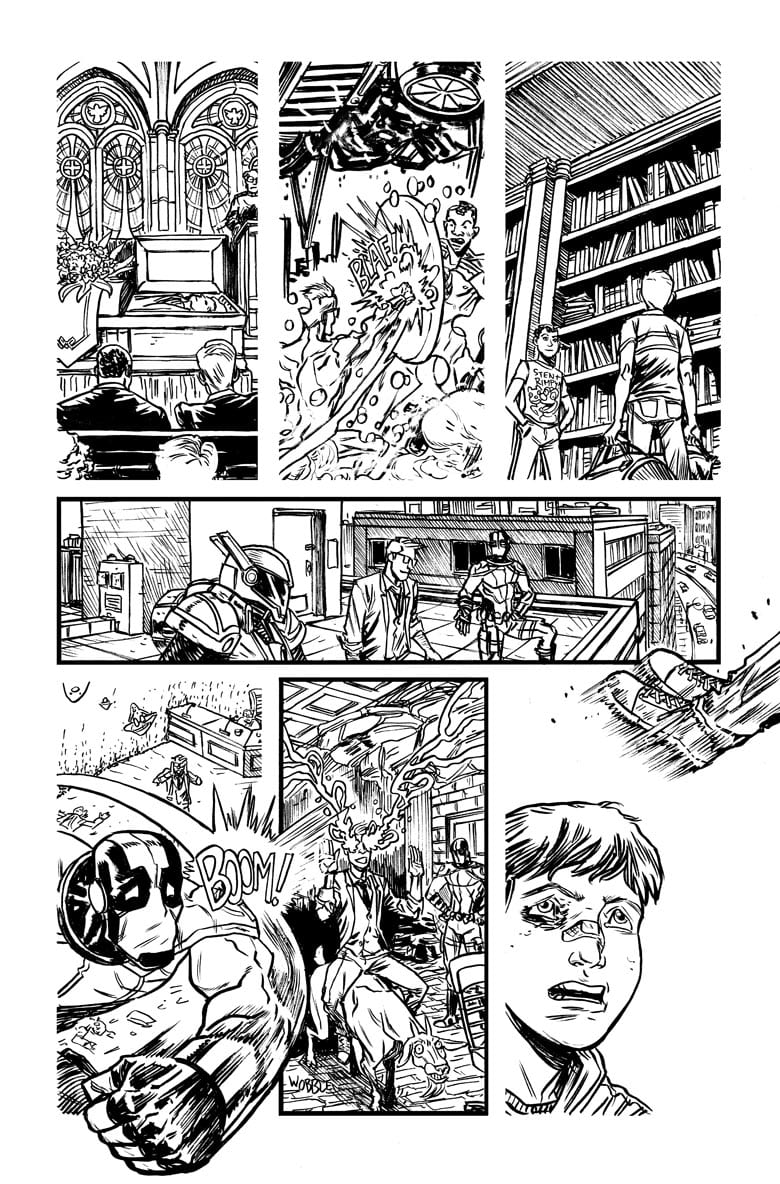
Moving on to the present, at that very same locker room, a couple of teens sneak off to vape some kind of cool flavored nicotine product, but are interrupted by A SPOOKY GHOST. Quantum and Woody’s old high school is h-h-h-aunted! – Hastings

Exclusive First Look: QUANTUM & WOODY #3

Page Three

And just in case you skipped my first paragraph here, page three features our little recap/comic book theme song that tells you everything you need to know about Quantum and Woody (once it’s lettered). We’re big on doing self-contained, episodic stories that anybody can pick up, whether they’ve read previous installments or not, and this segment does most of the heavy lifting on the necessary continuity. – Hastings

Exclusive First Look: QUANTUM & WOODY #3

Page Four

And here’s Quantum! Lately, his slacker brother Woody has been showing off some mysterious new powers, so the much more disciplined (and jealous) Quantum is training hard to achieve the same super-powered growth. Right now, he’s trying to maintain his quantum energy shields under the tremendous heat and pressure under the Earth’s crust.

Will such training help at all while going undercover as substitute teachers at the old high school? Is there some sort of terrible link from that moment in Quantum and Woody’s past and the mystery of the present? Yes! Obviously! Read the book to find out what, please! – Hastings

Exclusive First Look: QUANTUM & WOODY #3


What have you thought of the series so far? Comment below with your thoughts.

Monkeys Fighting Robots Youtube