Home Blog Page 196

Review: RAIN LIKE HAMMERS #1 – Living The Stagnant Life In A Walking City

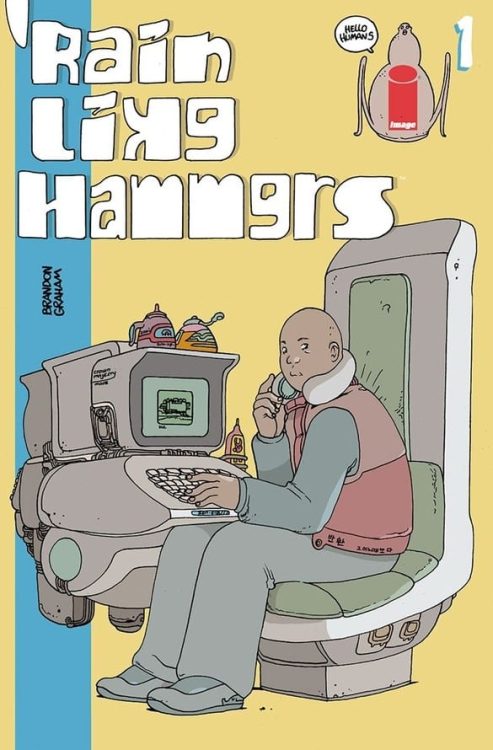
Master of weird and subversive comics, creator Brandon Graham (King City, Prophet) returns again with dead-future sci-fi comic “Rain Like Hammers” #1. This strangely beautiful first chapter echoes with its scant storytelling style and huge, empty rooms and landscapes. A clever and effective look at depression and dealing with change, this is likely to be one of the most unique and noteworthy comics in 2021.

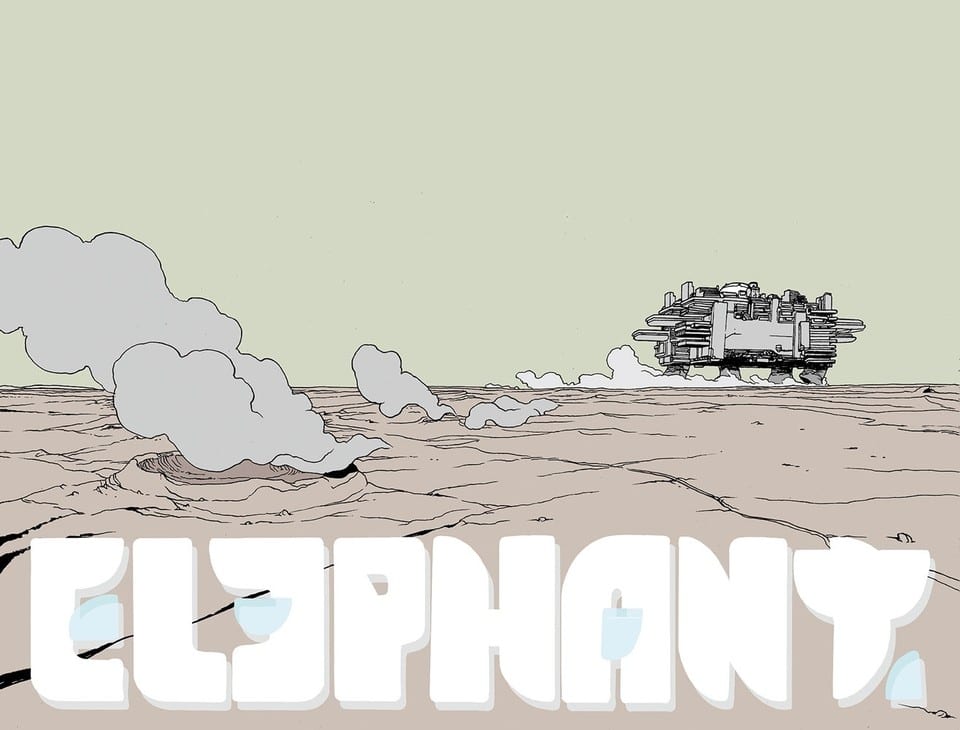
“Eugene is a new inhabitant of Elephant, a walking city on the desert world of Crown Majesty. Far from friends and family, he spends most of his time navigating melancholy daydreams, toying with alien technology, and researching the best places to find high-quality fast food. At best, his life is lonely and monotonous—but all of that changes when a mysterious force begins destroying Crown Majesty’s walking cities!”
Writing & Plot

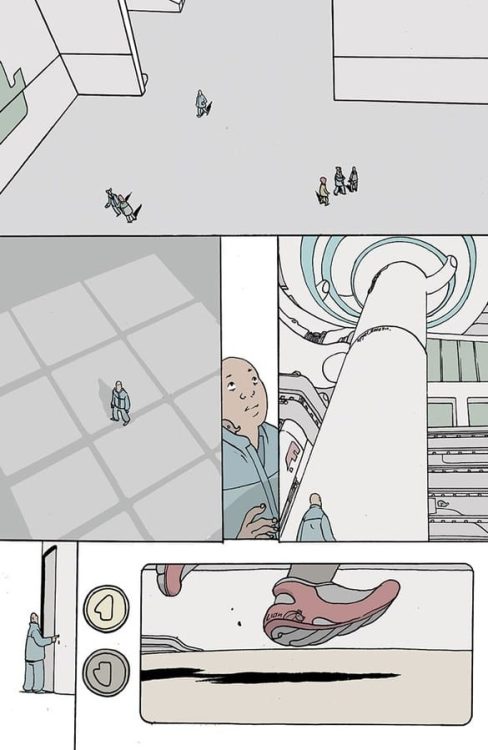
Brandon Graham’s messaging behind “Rain Like Hammers” #1 isn’t  grandiose in scale or subject like you may expect a science fiction comic to be. In fact, this is a book that only focuses on the monotonous day-in and day-out activities of the protagonist, Eugene. This entire comic is told from his perspective as he wakes up, gets cheap meals from a vending machine, goes to work, and comes home to his tiny apartment to watch reruns of his favorite tv shows before falling asleep. Then he wakes up and does the exact same thing. The fact that this all takes place in a walking city on a distant planet sometime in the presumably distant future means basically nothing until the last few pages of the comic. This could easily take place in Seattle or Little Rock for all we know. The only things going through Eugene’s mind are the people he misses in the city he came from and what he’s looking forward to later in the week (he saves his money to buy a better quality meal to go with his favorite show). Watching Eugene’s life felt uncomfortably relevant, which is exactly what good sci-fi does. What’s different here though is that the most obviously relevant part of this story is just how similar life for so many of us feels compared to Eugene’s. The man’s highlight of the week, after days of cyclically working a mind-numbing office job, is coming home to see a movie or show and getting to spend a bit extra on some slightly better quality food. The same could likely be said for many of us. The rest of the comic’s dystopian commentary doesn’t feel intentional, and more like a byproduct of the story Graham is telling. The vast emptiness of the environment reflects this dismal future, where the technological advances are incredible but they aren’t actually benefitting anyone. The scripted writing is a mixture of some scant dialogue among Eugene and his coworkers, but it mostly involves an omniscient third person take on Eugene’s own thoughts that elaborates on elements beyond the protagonist’s own understanding. There’s a quirky humor here that keeps the comic from being too bleak, as the story’s obvious commentary on depression would be too much if not for the small does of goofiness. This is a completely unique story in terms of writing, equal parts inventive, weird, and frighteningly relevant.
Art Direction

Like most comics, the true beauty and meaning “Rain Like Hammers” has is taken from the artwork, and Brandon Graham’s abilities as both artist and writer bring this book’s written and visual cohesion is as near-perfect as a comic can be. Graham’s quirky, minimalistic designs inhabit a gaping world devoid of personality, and this is exactly the point. Watching Eugene wander the massive near-empty rooms of Elephant makes the audience feel just as alone as he does. Stylistically, the art is definitely reminiscent of some of Moebius’s works, especially in the designs of the landscapes and the moving cities themselves. What’s so different in Graham’s work though is that his details are more pointedly obvious than they are just to make the world seem “real.” Everything in the city feels so sanitized, and every room looks almost the exact same as the last because that’s the point. We only get to see a few different rooms, from Eugene’s tiny apartment to the mess hall and to his office, and they all lack any sort of definition besides a couple objects and how Eugene interacts with them. The visuals make this story echo with both confused wonder and sadness and sadness. The color palette is scant and often dull, focusing on pale blues, grays, and pinks that engulf the entire page that they’re on, occasionally dotted by streams of abstract color. Eugene is often lit by the images of his television screen, which display a much larger variety of color than anything actually going on within the comic. Small details like these amplify the resounding sense of isolation that this book offers, even while its demonstrating its clever sense of humor. The lettering is a hand drawn and highly dynamic font that punctuates every moment with dialogue and narration in a manner that carves its tone across the panel just as much as the art does. This is a beautiful book in its own right, crafted in a manner that makes perfect sense for the kind of comic it strives to be.
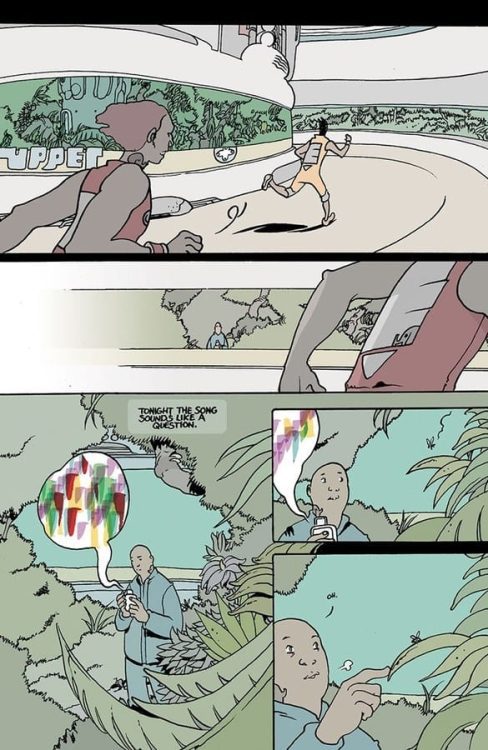
“Rain Like Hammers” #1 is an immensely clever, deeply sad, and frighteningly relevant comic for our era in history. Brandon Graham has crafted an opening experience that is a one part dialogue on depression, another part commentary on life in our society, and another part dystopian science fiction tale. The dialogue and narration is deeply poignant and wickedly clever, while the visuals are perfectly unorthodox in such a manner that this story could only be presented in. Do yourself a favor and grab a copy when it hits your local comic shop on 1-20.


Monkeys Fighting Robots Youtube

Review: TEENAGE MUTANT NINJA TURTLES: JENNIKA II #3 Solves A Mutant Town Mystery

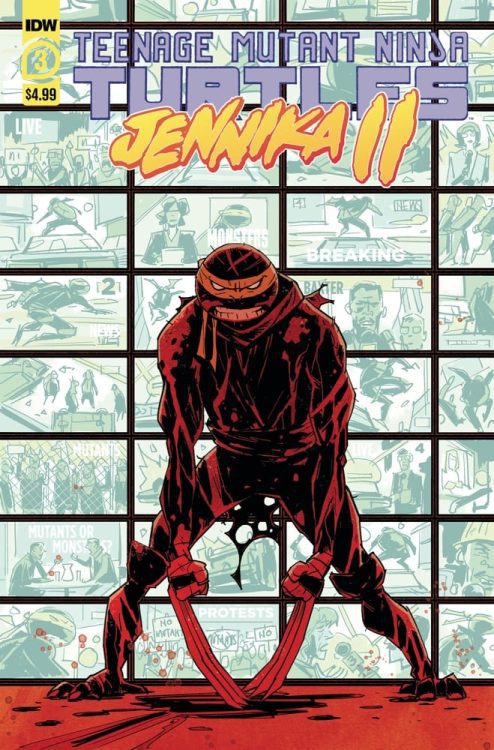
TEENAGE MUTANT NINJA TURTLES: JENNIKA II #3 hits comic book stores on Wednesday, January 20th, revealing the true culprit behind the unstable mutations in Mutant Town. These dangerous transformations of citizens living underground have led to an even greater stigmatization of the disenfranchised community. Fortunately, Jennika and her acquaintance Ivan are here to unearth the mystery. And as readers will find, appearances can often conceal the truth.

Story

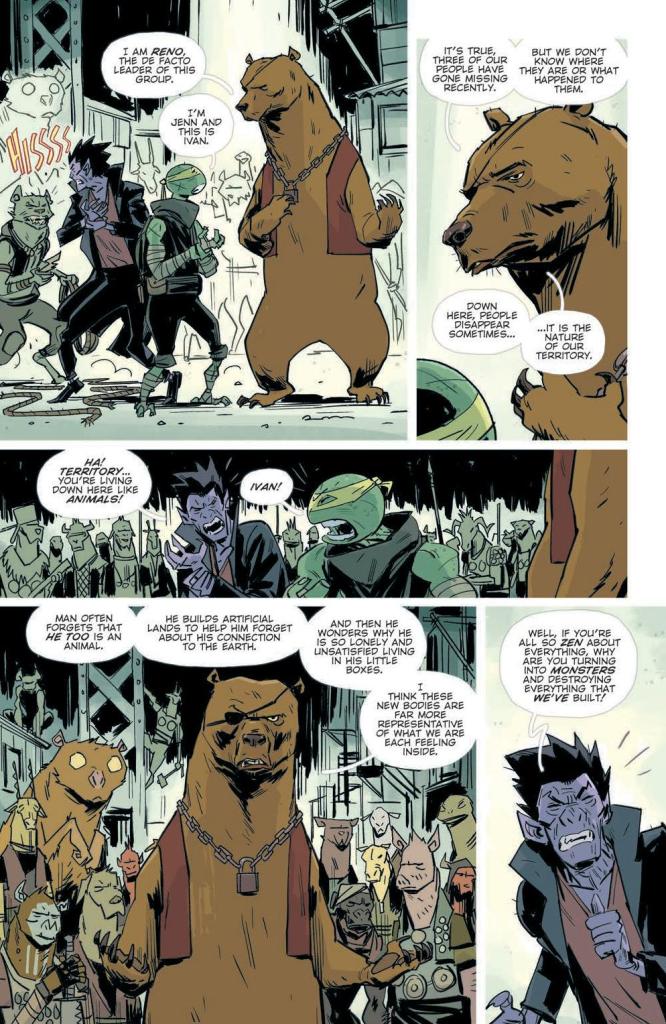
This story opens with Jennika and Ivan exactly where it left off last issue—smack dab in the middle of a group of mutants living in the underground. Despite rumors of their danger, the two find the truth to be much more interesting. It turns out they’re no different than those living aboveground, yet they somehow face even more hardships.

Unfortunately, the conversation is broken up by an abrupt scorpion mutant’s attack. Armed with strange syringes, it becomes clear this mutant is responsible for initiating the underground people’s mutations. But is she acting alone?

Brahm Revel’s narrative accomplishes an important task. It offers clever social commentary on the nature of the haves and have-nots. Despite the supposed scariness of the mutants living underground, it appears there’s a separate player taking advantage of them. The question: Who is funding them?

Artwork

Revel’s penciling and ink work simultaneously details fast-paced action sequences and dramatic exchanges between Jennika and the other characters. These are fleshed out with his use of bright hues for our heroes set against darker backdrops, helping make their movements pop off the page. And Revel’s lettering is effectively placed around each character, preventing them from becoming obscured while simultaneously framing their forms.

Conclusion

TEENAGE MUTANT NINJA TURTLES: JENNIKA II #3 reveals the Mutant Town mystery in satisfying fashion. We’re anxious to see where this knowledge pushes Jennika in the following stories.

Do you think Jennika can handle these threats facing Mutant Town all by herself? Let us know in the comments below!

Monkeys Fighting Robots Youtube

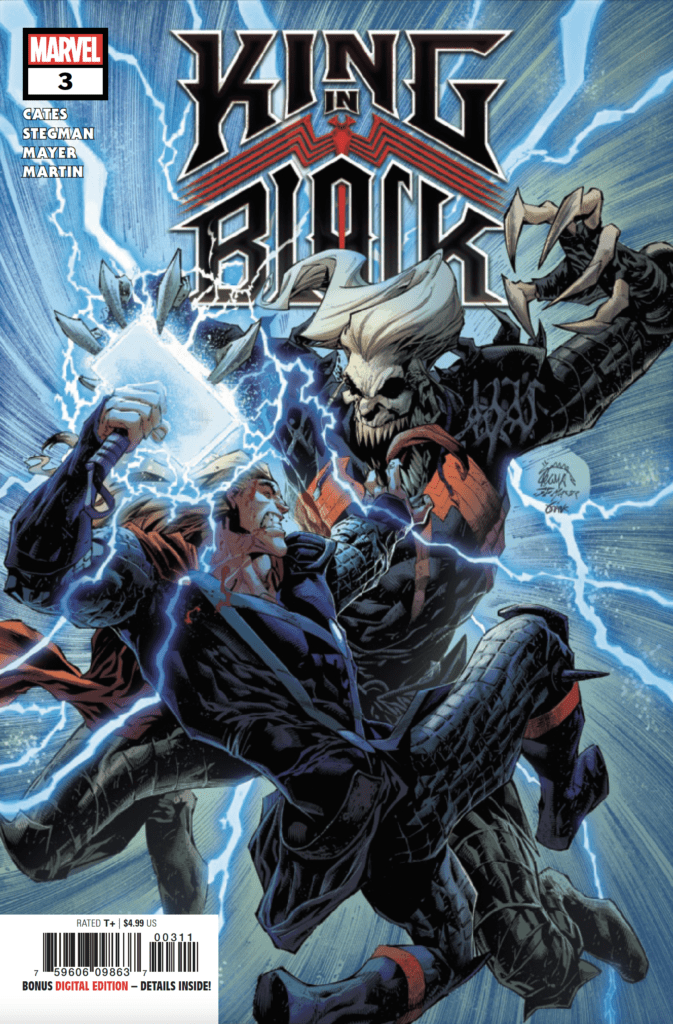
Review: KING IN BLACK #3 – “Oh Shit!” Moments A Plenty

Review: KING IN BLACK #3 "Oh Shit!" Moments A Plenty

King in Black #3 hits your local comic book shop this week, and Donny Cates throws out one of my favorite insult lines which brought a chuckle to my body and had my kids questioning my sanity.

The first issue of King in Black was full octane, issue two took the pacing down several notches, and issue three is somewhere in the middle. King in Black #3 had several “Oh shit!” moments, but the book also felt very intimate and less like a blockbuster event. It’s like the difference between a Michael Bay and Robert Rodriguez film. This is where you would like to be a fly on the wall for the discussion between Cates and artist Ryan Stegman. Who chose the “camera angles” in the panel layout? My preference is wide shots so the reader can feel the scale of the story. The tighter shots used in King in Black #3 didn’t convey the story’s emotional tone and felt stiff. Stegman’s art is beautiful but didn’t take the story to the next level like he did in the first issue.

Review: KING IN BLACK #3 "Oh Shit!" Moments A Plenty
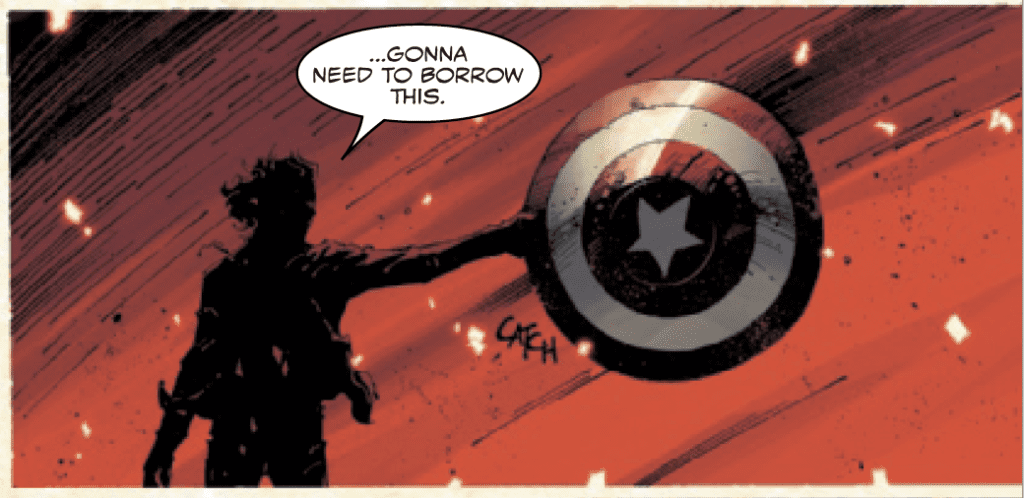
More panels like this, please!

Cates’ pacing in King in Black #3 works well, providing several insane comic book moments and leaves the issue with a solid cliffhanger begging us to read the next issue. Cates also sets up the issue well with the unknown narrator and hits the home run with the payoff. You can actually hear comic book nerds squeal when you read the last page of King in Black #3. It does crack me up how Cates uses Reed Richards, as he appears to be the story’s court jester. Reed is either aloof or panicking in the issue, and Cates’ intent is missed on me.

Review: KING IN BLACK #3 "Oh Shit!" Moments A Plenty
Is this in the 2021 “Marvel Way” handbook? Asking for a friend.

There were 12 large sound effects used in the story: THOK, BOOM, FWOOM, FWOOSH, BOOM (again), WHUMP, VWOOM, KRAK, KRAKKA-DOOMMM, SPLITCH, SKASH, and CLANG. Stegman and Clayton Cowles’ letter work was hit-or-miss in King in Black #3. Some sound effects were perfect and elevated the story, while others took you out of the moment. The BOOMs are the perfect example. The first BOOM looks like something directly from the current “Marvel Way” handbook given out every year (I don’t think that is a real thing, but you get the reference). The second BOOM reminded me of something out of the British animated series Danger Mouse from the early 80s. The fonts and design were all over the place.

Frank Martin’s colors are fine. I wish that the creative team took chances with a title called King in Black. The preference that appeals to me is more darkness and black tones. Convince me the heroes are going to perish with the color palette alone. You can evoke emotions with color; Martin needs to take every advantage possible to take over the reader’s mind with an epic comic book.

Overall, King in Black #3 has me excited for the next issue, the mystery at hand, and what Iron Man will do next (no spoilers!).


Review: KING IN BLACK #2 – Isn’t The Journey Supposed To Be The Fun Part?

Review: KING IN BLACK #1 — An Action-Packed Blockbuster With Heart

Monkeys Fighting Robots Youtube

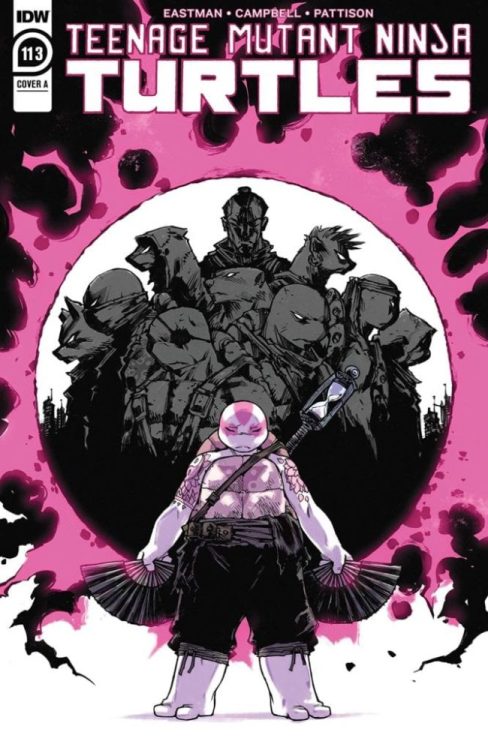
Review: TEENAGE MUTANT NINJA TURTLES #113 – Can We Change Fate?

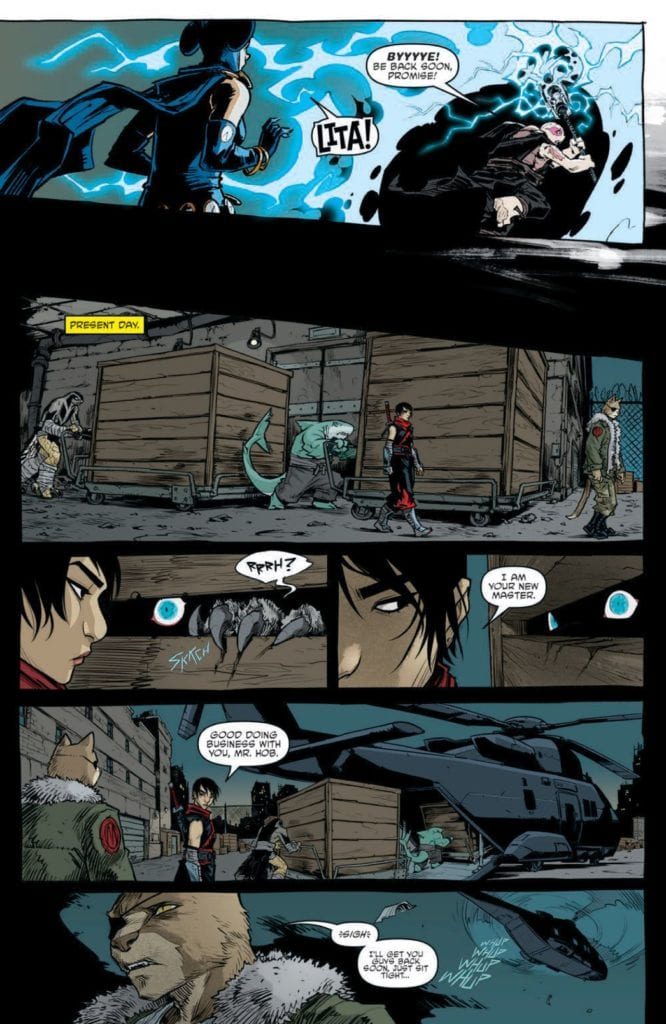
TEENAGE MUTANT NINJA TURTLES #113, available in comic book stores on Wednesday, January 20th, dives into the mysteries of time travel. A future version of Lita travels to the Turtle’s present in hopes of preventing dystopia in her own time. But knowing one’s destiny may prevent one from actually changing it. Readers will find that despite the numerous challenges the Turtles face in the present, the situation could prove exponentially worse if they don’t work together.

Story

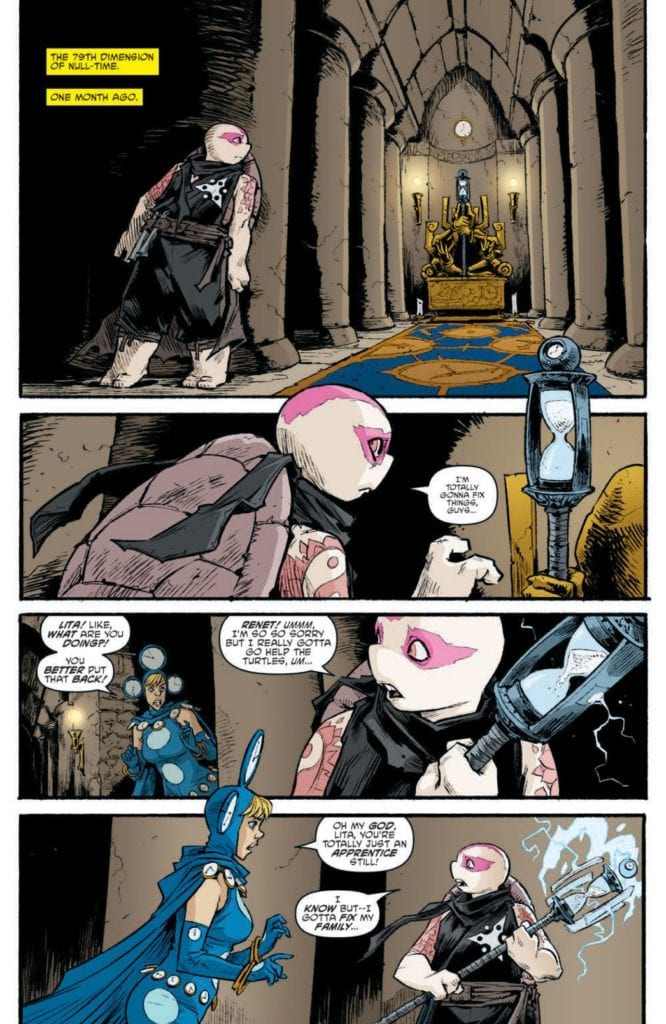
This issue opens with an adult Lita in an unknown temple set in the future. Readers can tell she’s on a mission, taking a mysterious staff from a throne. She uses this to travel to the past in hopes of rewriting her family’s history.

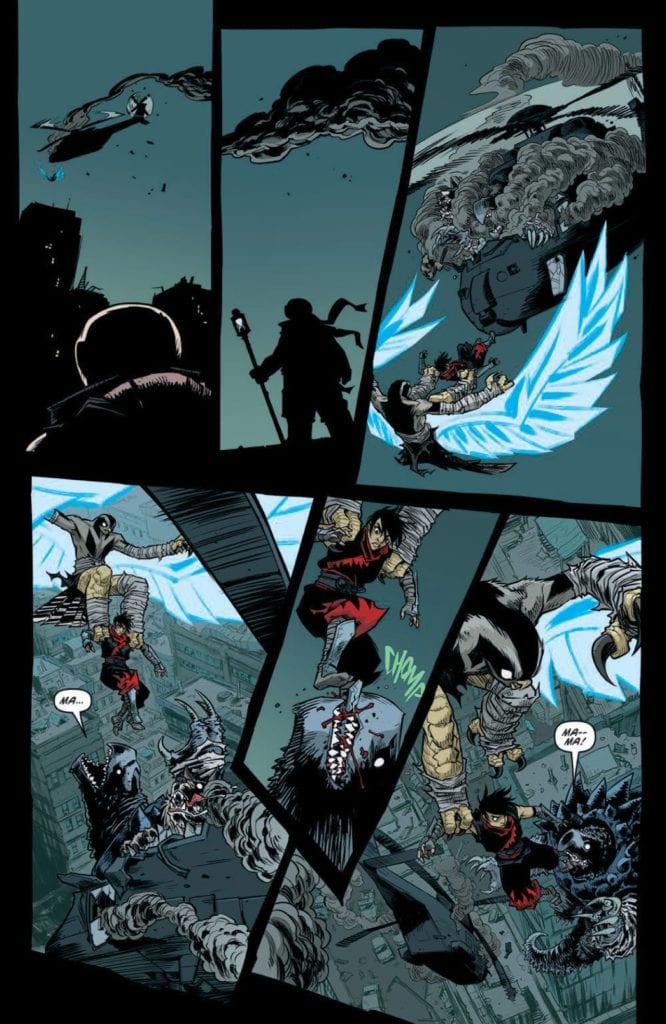
Back in the present, readers find the Turtles’ nemesis Karai on a rooftop with none other than Hob; the person responsible for unleashing the Mutant Bomb. The villain appears to have gained access to a number of crated housing some creatures that readers might remember from issues past.

While this is all taking place, the Turtles continue to lead self-defense classes for the community. Their sole purpose at this point appears to be the disruption of Hob’s Mutant Town empire. But when Lita arrives on the scene, her foreboding words call for an altered perspective.

Sophie Campbell’s writing asks readers an important question: how much control do we have over our destiny? If certain events are set to take place, do we have the ability to choose otherwise?

One thing is certain: Lita and the Turtles have a long road ahead of them. Will Lita’s dystopian vision come to fruition?

Artwork

The illustrations in this dystopian-esque issue flow well with the narrative. Campbell’s penciling and ink work transitions smoothly from the dystopian future scenes to those set in the present. These are fleshed out more starkly with Ronda Pattison’s coloring, which uses lighter shades for the present events and darker colors for the future scenes. In addition, letterer Shawn Lee’s word balloons are placed effectively in each panel, helping pace the reader so they can take in every detail.

Conclusion

TEENAGE MUTANT NINJA TURTLES #113 ups the ante in the already fragile environment of Mutant Town. And now that time travel has been introduced, we’re sure to see more mind-boggling events in issues to come.

Do you think Lita can really change the team’s future? Let us know in the comments below!

Monkeys Fighting Robots Youtube

Review: BARBALIEN: RED PLANET #3 Begins Finding Its Balance

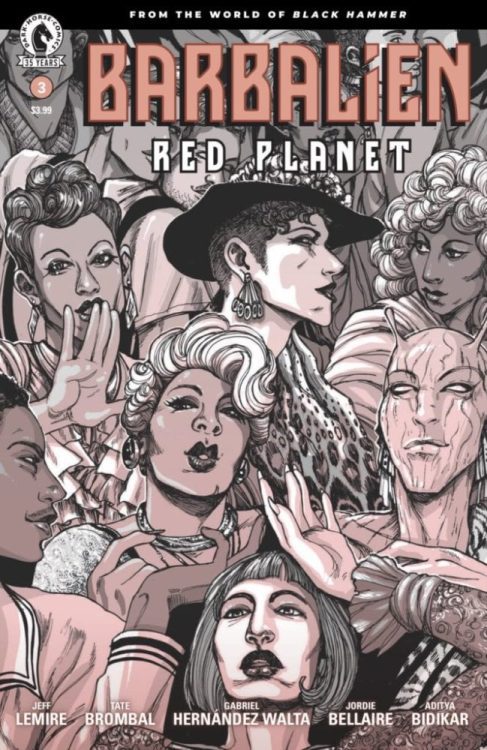
There’s so much to love about Dark Horse’s Barbalien: Red Planet #3. That might be why it gets a little frustrating when it feels it’s not living up to its potential. Writers Tate Brombal and Jeff Lemire, with artist Gabriel Hernandez Walta, colorist Jordie Bellaire, and letterer Aditya Bidikar begin to course correct after their last issue, but still have room to grow.

Writing

Brombal and Lemire continue to show their passion on every page. You can hear it in their characters’ voices. These are characters who are fed up with injustice, fed up with being treated as “other.” It’s beautiful, what they have to say, but this script suffers from being a little one note. What the first issue of Barbalien did brilliantly was juxtapose all the gay characters and how open they are with how closed off and scared Mark Markz was. With Markz coming out of his shell and beginning the process of coming out of the closet, Brombal and Lemire have lost their balance. Every character now wears their heart on their sleeve. Whether it’s their bigotry and hate they’re showing to the world or their brave love and fearless showing of who they are and how they feel.

Of course, it would be silly to say Markz needs to get back in his shell. But Brombal and Lemire need someone who keeps their cards close to the vest. Someone who isn’t willing to explain why they hate Markz or why they’re proud to be who they are. The characters in this series are acting as a juxtaposition to “acceptable” society. Barbalien, as a series, beautifully shows how the underground gay community is bravely in touch with their emotions and shameless about their rage. But to not see what it is they’re bravely different from, to not see the “closed-offishness” they’re rejecting, the effect loses its potency. That said, with characters like Markz’s tight-lipped and closed-minded partner Officer Cole, Brombal and Lemire are beginning the road back to that balance. And with details like Dr. Day talking to a dying patient’s mother over the phone, they’re heart wrenchingly showing scenes of the gay experience in the 80’s.

Art

Walta creates an emotional rollercoaster. We open on a scene of Dr. Day standing over a young man dying of AIDS-related pneumonia. Walta’s beautiful rendition of the young man’s face as he dies will haunt readers. On the next page, we’re seeing Barbalien and Boa Boaz’s confrontation. Walta wants us to focus in on the anger and the violence of the scene. He zooms in on the angry faces of Markz and Boaz, and on their fists as they meet their mark. Then we’re immediately back in the hospital. Walta shows the scared faces of Markz and Miguel as they burst into the room. What Walta does here is he shows the inner turmoil of the gay community in the 80’s. They’re surrounded by injustice, full of rage, and both perplexed and deeply moved by any sign of help. Walta creates an issue that’s sad yet stunning all at once.

Barbalien Brombal Dark Horse

Coloring

Bellaire also highlights the violence of this issue. Her pages are full of red. Whether it’s the red of Martian skin, or the red of blood or paint, it’s all violence. We see that when Barbalien and Boaz come head-to-head. Violence runs through their system. We haven’t seen Barbalien quite as deranged. In the world of Black Hammer, Martians were bred to be warriors. And so, this is Barbalien’s “true form.” But the issue doesn’t stop there. We’re quickly met with the healing yellow powers of Dr. Day. She shows Markz how he can be a light in the midst of darkness. So when he and Miguel take a walk at night, with the sky looking red in the background, it’s not the red sky we notice as much as the yellow lamps lighting their way. Bellaire uses the mix of yellow and red to create a beautiful page.

Lettering

Bidikar creates a great back and forth between being bold and reserved. In fact, Bidikar seems to understand the need for a balance in these characters. The need for characters to be both brave and a little scared. When Barbalien and Boaz fight, Bidikar releases all hell. The sounds of fists hitting flesh are large and colorful. There’s a reveling in the violence that’s happening. But when we see Markz again, he seems much more reserved. Almost as though he scared himself. His word balloons give lots of space to everyone else’s. You can hear the pauses he gives people, trying to be sure he doesn’t interrupt.

And when Miguel and Markz leave the hospital, Miguel proudly yells about Dr. Day and the Sunlight Sisters. Bidikar gives them their own font and shows in the jagged edge of the balloon that their names are being yelled. “They’re incredible,” Markz says quietly at the bottom of the page. Bidikar’s lettering is pushing for a balance. It’s showing reservations and fear where the dialogue often doesn’t.

Barbalien Brombal Dark Horse


Dark Horse’s Barbalien: Red Planet is just so interesting. It’s ripe with dramatic potential and full of poignant moments. Some of that potential gets squandered in the script. It’s not interesting to read every character’s thoughts, it’s interesting to guess at what they may be thinking. But this creative team is starting to reach a balance between the reserved and the bold. Hopefully, they’ll get at the subtlety of what’s going on between the lines soon. Pick up Barbalien: Red Planet #3, out from Dark Horse January 20th, at a comic shop near you!

Monkeys Fighting Robots Youtube

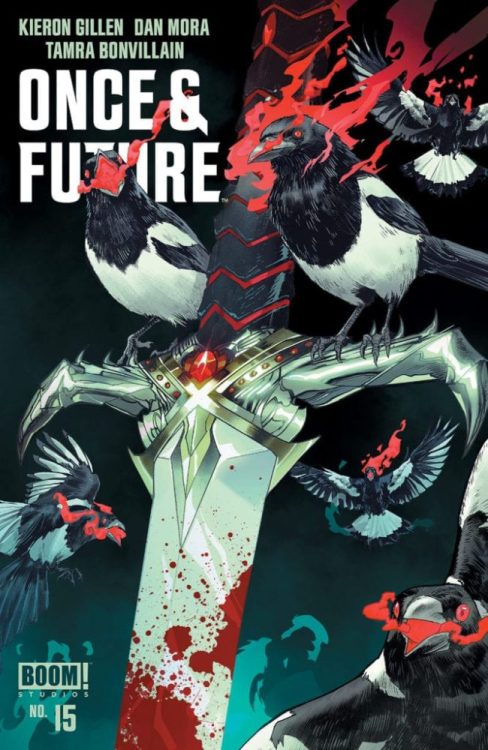
Review: When New Players Enter the Field in ONCE & FUTURE #15

ONCE & FUTURE #15, available Wednesday from BOOM! Studios is about to complicate further an already dangerous situation involving legends of old and the havoc they can wreak on the modern world.

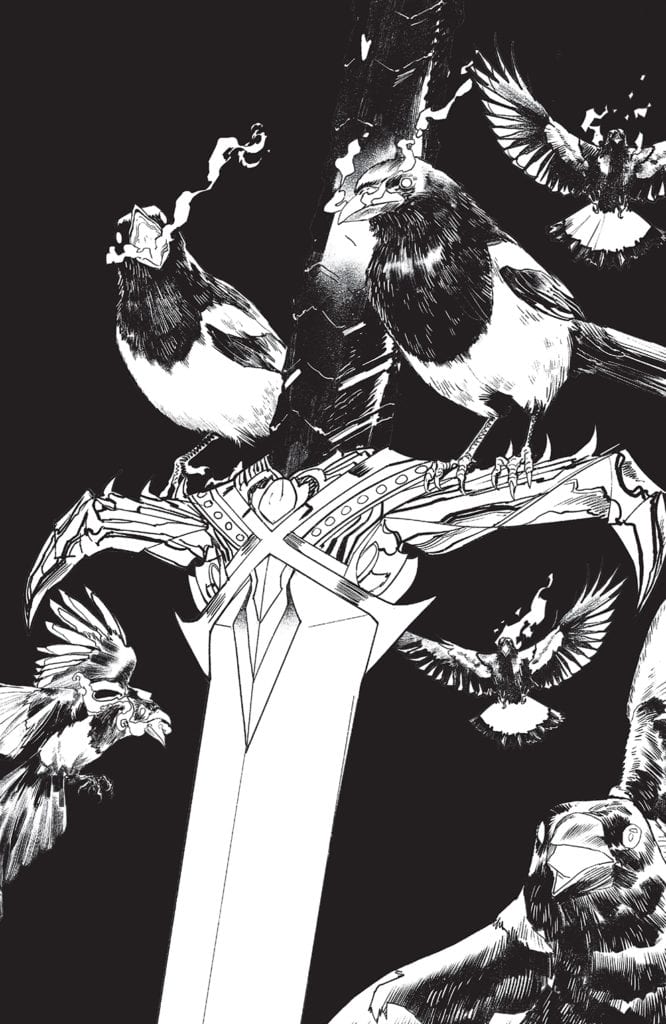
What could the ravens be foretelling here?

The McGuire family has long stood on the line between legends and humanity. There was a time when they were the defenders, willingly giving up their lives to protect others. For some, that is a fact that still holds true. For others…well, not so much.

The family dynamics alone are enough to make this the conflict of the century, and that’s before they started bringing legends and lore into the mix. Now it seems like every life is on the line, as at any moment, a monster has the chance to appear and cause some genuine damage.

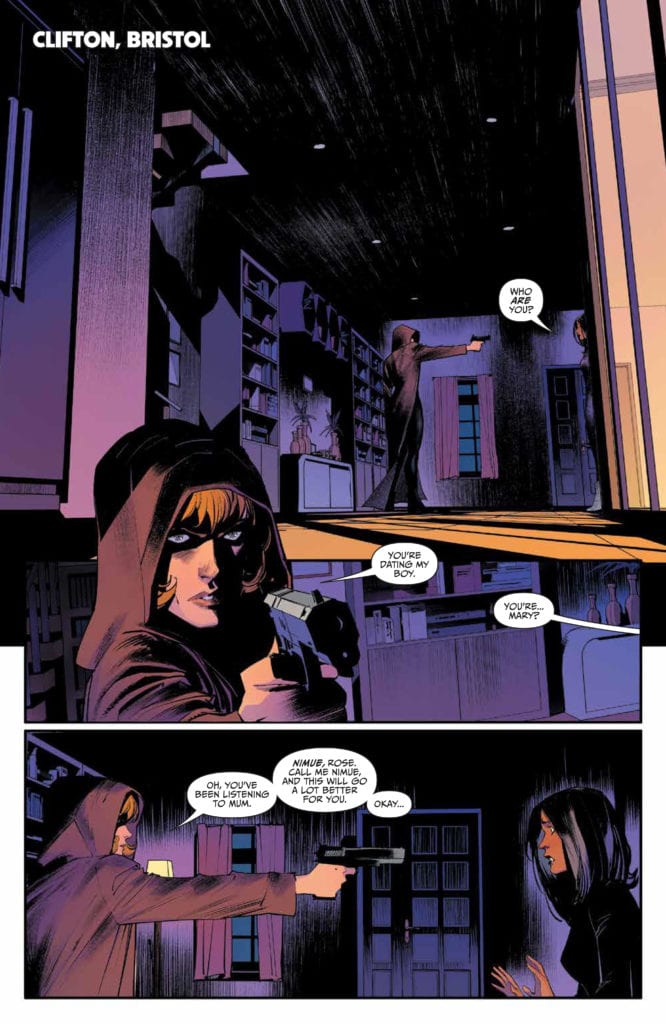
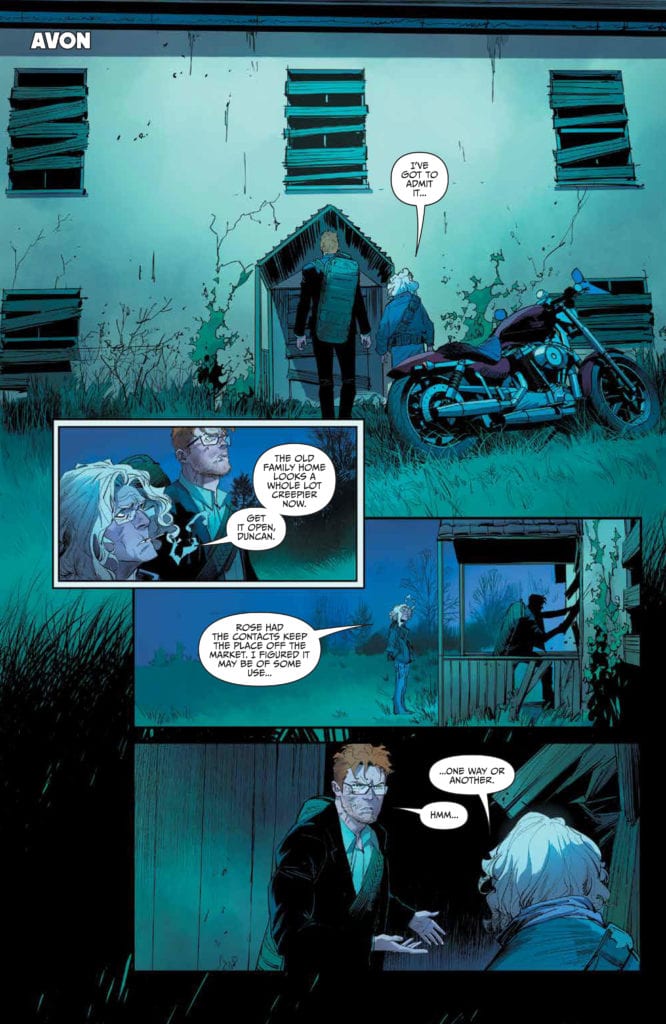
Once & Future #15 is about to throw Duncan and the rest of his family back into the thick of things, as he and his grandmother seek to learn the damage one of their own has wrought. As always, there is a difference between knowing what has been done – and seeing it. A lesson that they’re about to learn the hard way.

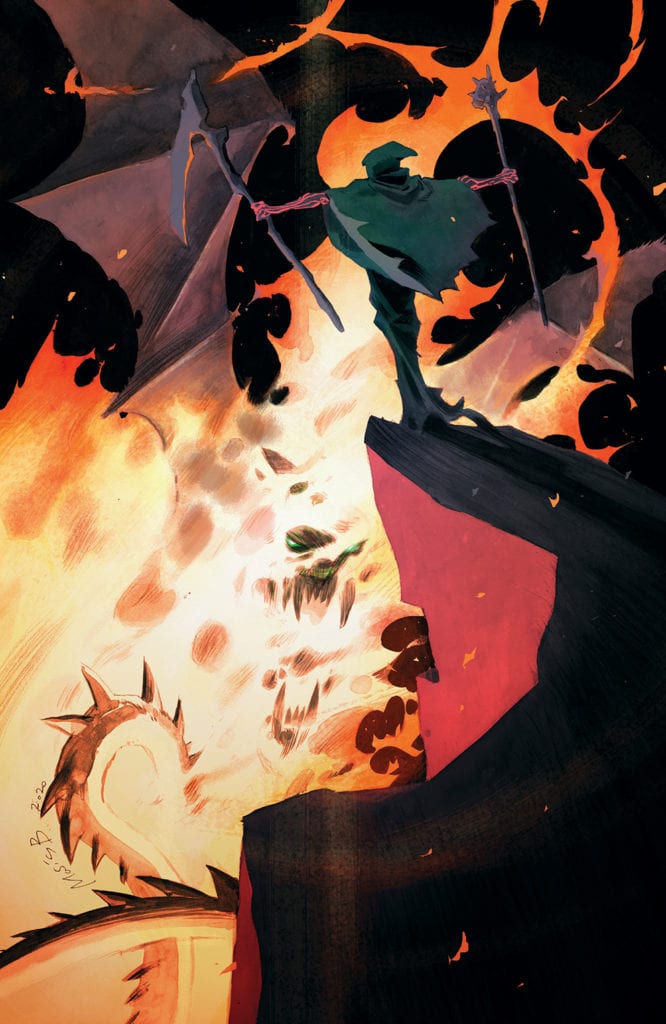
There are some enemies we’d prefer not to see come to the surface once again.

The Writing

The entirety of the series has been moving forward in leaps and bounds, so when I say that Once & Future #15 progresses the plot faster than any of its predecessors, I want the weight of that statement to be acknowledged. It feels like a hundred different things happened in this issue when in reality, it’s really just a few enormous implications that raised their heads.

Since Kieron Gillen writes it, that probably shouldn’t be too much of a surprise. The issue is split into two main narratives, which isn’t an unusual tactic. Doing so allowed readers to better grasp what is happening in the world – all while experiencing a sense of anxiety as tensions rise.

The culmination of which brings with it a couple of major surprises. This twist is unlike any other in the series, which is saying something. Well, one of the twists, at least. The other one looks about par for the course with Duncan’s luck.

Together, both endings are enough to leave readers looking forward to the release of issue number 16, as there are so many questions that need answers. Gotta love a series that worms its way into your brain, yeah?

Well, that might just be a problem.

The Art

The entire series has been a display of vibrant and wonderful artwork, yet in many ways, Once & Future #15 has some of the most striking designs yet. The characters, the scenery, and so much more all work together flawlessly with the plot itself.

Dan Mora’s latest monster (thing of legend? Whatever one feels compelled to call it) is…fascinating. Not at all what the legend would have you picture, and yet it is so painfully perfect at the same time.

Combined with Tamra Bonvillain’s colors, it makes for a striking appearance. Her colors are actually stunning all around, but especially so when there’s magic to be portrayed. That’s when the pages start to truly pop.

The lettering, provided by Ed Dukeshire, is the grounding that this artwork needs. His work frames the panels, setting the scene in subtle yet vital ways. The result is one cohesive piece that is delightfully visually compelling.

Conclusion

Once & Future #15 brings many changes, hints, and concerns, all of which have worked well to increase the tensions for this series. It’s hard to believe that the ante is still being raised, but the evidence is all right there in front of our eyes. The real question is, how much longer can the McGuire family hold out?

Monkeys Fighting Robots Youtube

Folklore & Personal Tales Combine in CRIMSON FLOWER #1

One woman's quest for revenge is fueled by the legends of old.

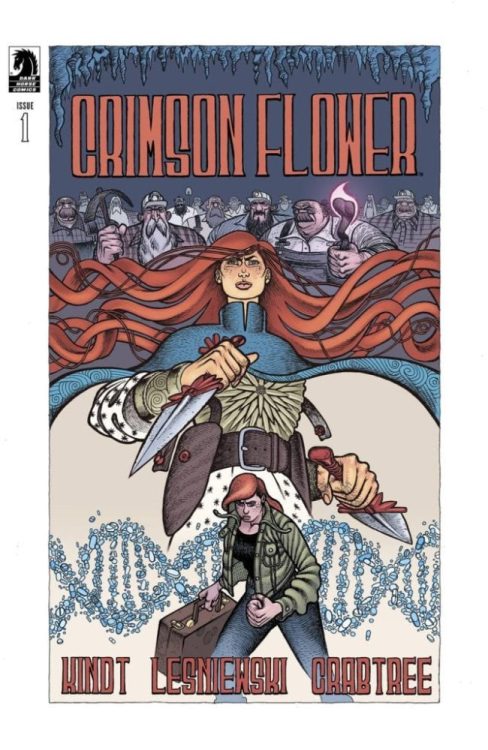
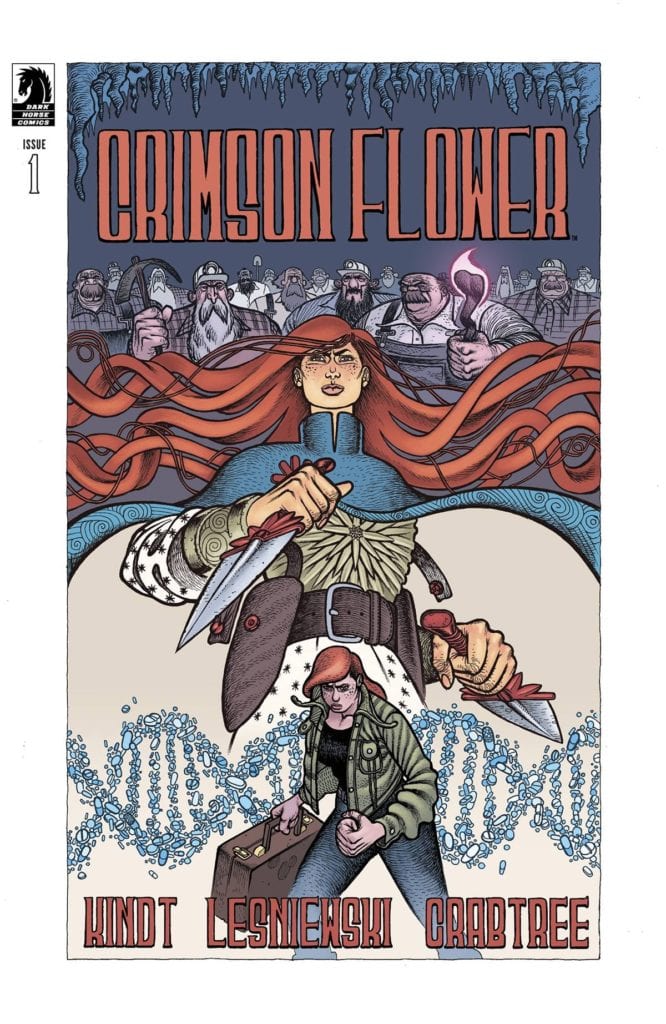
CRIMSON FLOWER #1, available Wednesday from Dark Horse Comics, is the start of a new series full of lore and revenge, as one woman seeks to right the wrongs of her past. The lines between fantasy and reality are about to blur thanks to this series.

One woman’s quest for revenge is fueled by the legends of old.

Avid readers are certainly familiar with the concept of infusing an active (and frequently alarming) plot with bits of folklore. Or they’ve come across a fairytale retelling or something else. Yet these twists aren’t as common in the comic book world, making Crimson Flower a standout right from the start.

To be clear, this is not a fairytale retelling. Though it is twisted, so it has that much going for it. The series follows a young woman, one who has always had a love of Russian folklore. Her love wasn’t diminished, even after witnessing a horrible event.

If anything, it solidified the world for her. Now she has an escape, as well as a plan for acting out her revenge fantasy. And it all starts with Crimson Flower #1.

The Writing

Crimson Flower #1 is a disturbing yet enchanting beginning to this series. With a few quick flourishes and some personal information, readers are quickly sucked into this harrowing adventure. The folklores pulled into this issue certainly feel right at home with the gore and bloodshed that splashes across the pages.

Written by Matt Kindt, there is something almost ethereal about how the stories seep onto the page, around the protagonist and her actions. The result is an intentionally confusing situation, as the lines between fact and fiction fade away, giving the character complete control over the narrative.

There are moments wholly grounded in reality – most of which surrounding the main character’s backstory and her explanation for being. Once that bit is out of the way, readers are thrown headfirst into something else.

The lore pulled into this issue would have been powerful enough on its own, but it’s the visual storytelling elements that take this series to a whole new level, as the two work flawlessly together.

The Art

Crimson Flower #1 is, visually speaking, one of the most unique issues out there right now. The characters are heavily stylized, while their worlds are open to new interpretations and changes in form, as legends take over the storytelling.

Matt Lesniewski (artist) and Bill Crabtree (colorist) did a truly wonderful job here. One of the most striking decisions made for Crimson Flower is the choice to play with proportions. One moment the world looks ordinary. The next, a hallway grows in length, or a hand or hair grows a mind of its own.

It is alarming and compelling, all at the same time. When combined with the textures and colors, it becomes an absolute mind-bending experience. One that is narratively fitting and admittedly highly unique. All of which leaves an intense first impression about this series.

Conclusion

Crimson Flower #1 is a bold and somewhat dark introduction to a series that is as memorable as it is unique. The inclusion of Russian folklore has already done so much to make this story feel alive, especially when used alongside all of the spirited artwork.

Monkeys Fighting Robots Youtube

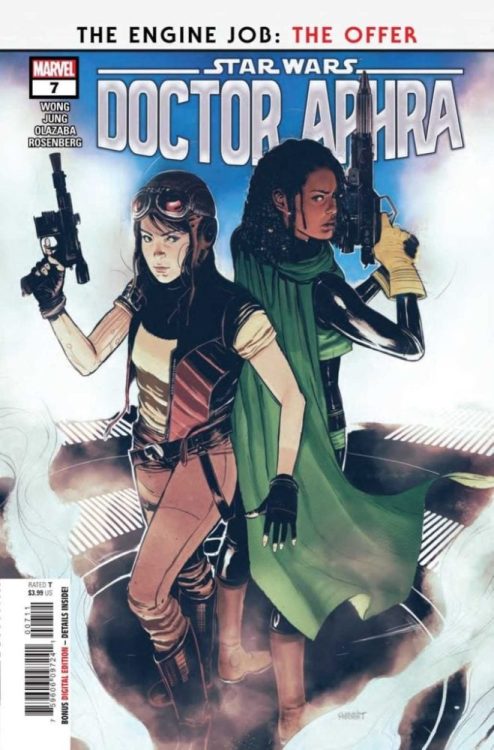
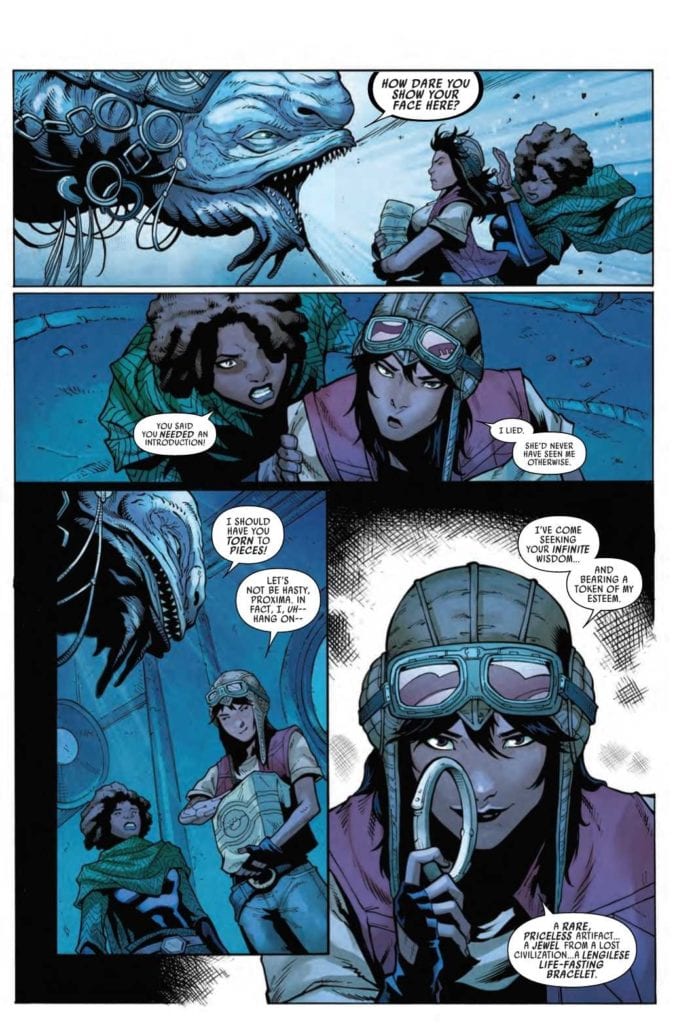
Old Allies and Loves in STAR WARS: DOCTOR APHRA #7

STAR WARS: DOCTOR APHRA #7, available Wednesday from Marvel Comics, continues Aphra’s latest (and chaotic) run. It appears that she hasn’t learned her lesson about sacrifice for the sake of others. Or the concept of laying low.

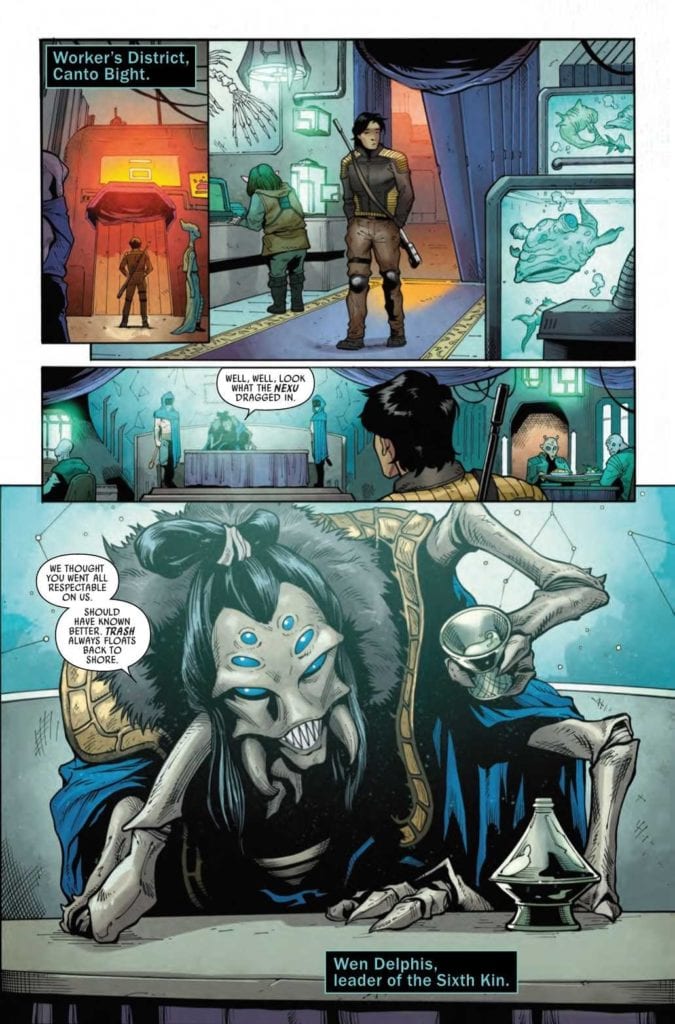
Back to Canto Bight, huh?

At this point, fans of Doctor Aphra are already painfully aware that she is not a character capable of laying low. Even when her life depends on it. As evidenced by her latest series of events – when by all accounts she should probably still be hiding from a certain big bad in her life.

That being said, if there’s one thing that Aphra is good at, it’s being entertaining. Okay, that and turning friends (and more) into enemies. It’s a talent of hers, though probably not one that she’d be willing to brag about.

In Doctor Aphra #7, she’s going to have to rely on one of those friends turned enemies (of a sort) in order to achieve her goal. Well, her latest in a long line of goals. All while still having several bounties on her head. Because, well, she’s Aphra.

That….that probably is going to go well, is it?

The Writing

Doctor Aphra does her best work when she’s under pressure, doesn’t she? Perhaps that will go a long way in explaining some of the events in Doctor Aphra #7. She’s been hired by somebody who by all rights should be her enemy, with the hopes of getting her hands on a shiny piece of tech. That sounds about right, doesn’t it?

Alyssa Wong has written an issue full of sass and quips – in a way that only Aphra can elicit. The inclusion of a favorite character helped to carry the narrative for this story, leaving moments of tension and humor all over the place.

Throw in the thrill of a chase, and building concerns from a secondary plot, and suddenly there’s a whole lot going on in Aphra’s life. Not all of which she’s completely aware of. A fact that will almost certainly change in due time.

The end result is a highly entertaining issue, one that feels surprisingly lighthearted, despite everything else going on. In that sense, this probably is more akin to a set-up issue than not, which leaves readers wondering how it’s all going to play out. (Knowing Aphra, something is bound to go wrong at the worst time possible).

Who’s surprised by that reaction?

The Art

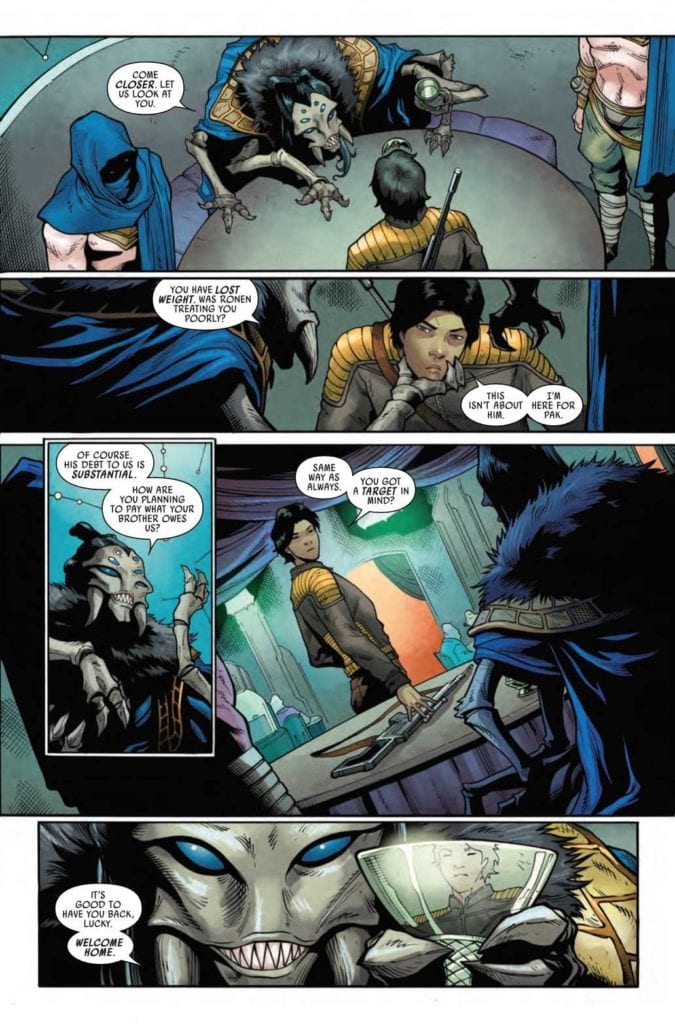
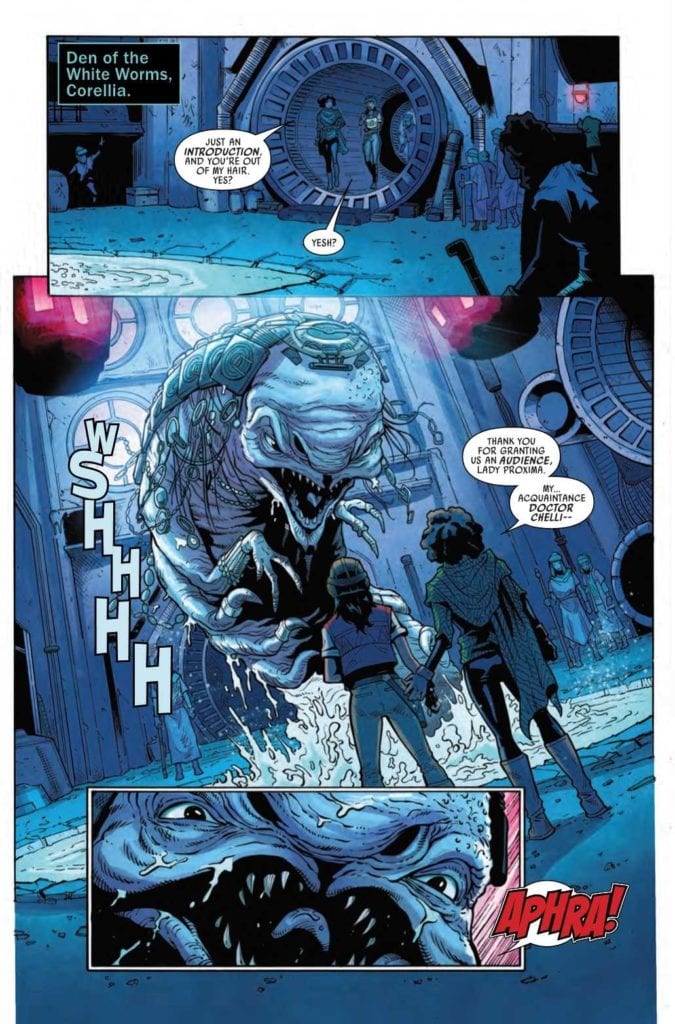
Once again, the artwork in Doctor Aphra #7 succeeds in being impressive. This series really does nail the whole look of Star Wars as a whole, while throwing in some visual twists that are pure Doctor Aphra.

Minkyu Jung (pencils) and Victor Olazaba (inks) found the perfect balance between action and humor. One moment Aphra has a gun to her face, the next minute she’s laughing it off and portraying that swagger we all know and love.

Rachelle Rosenberg’s help to enhance the entire look, going for a brighter palette to compliment the serious use of tech in her life. There’s a lot to love here, but it’s perhaps the lighting that steals the show.

Finally, VC’s Joe Caramagna’s lettering leaned toward the informative side of things, but it is exactly what this issue called for. With all the scene changes happening all over, it would have been so easy to get lost otherwise. Though Caramagna did run with the excuse to be expressive when sent his way.

She’s got her scheming face on.

Conclusion

Doctor Aphra #7 was another entertaining addition to this series, as she stumbles and schemes her way through a life of crime. This is an issue that many fans will appreciate, if for no other reason than the inclusion of a fan favorite.

Monkeys Fighting Robots Youtube

Interview: Darick Robertson on His Process in SPACE BASTARDS

Chances are, if you visit Monkeys Fighting Robots a lot, you’ve heard a little about Space Bastards already. That’s because the wonderful people at Humanoids have been super generous in giving us information on this awesome new series. We’ve reviewed the first issue, which was a blast, and interviewed writers Eric Peterson and Joe Aubrey. But the fun doesn’t stop there! MFR got to send in some questions to superstar artist, Darick Robertson, best known for his work on The Boys. Robertson gave us amazing behind the scenes looks at his process and talked about his role in forming the world of Space Bastards!


Monkeys Fighting Robots: From what I know of your work, Mr. Robertson, Space Bastards just seems like a perfect title for your style. How soon did you know you wanted to join the project?

Darick Robertson: Actually, it took some persuading. Not because I didn’t see the potential, I was just so busy with other projects at the time that I didn’t see room on my plate for anything more than a few covers for the original Kickstarter inception that Joe & Eric had. Eventually, I got to know Eric and Joe better and they came at me with an offer to fund the project and make me a co-creator of the property, and with that I got on board and set about redesigning the characters and the visual world.

MFR: You’re working on Space Bastards for the first volume, “Tooth & Mail,” featuring the characters Manny “The Manicorn” Corns and David S. Proton. What was the process like working with Peterson and Aubrey to bring these characters to the page?

DR: Actually, the work was completed back in March of 2019. I penciled and inked over 200 pages for this first arc. Working with Joe and Eric was fun, in that they have such a deep rooted passion for the characters and story, going back to making short films about the cast years ago. Joe has a keen eye for continuity and details, while Eric is happiest it seems when discussing story ideas and making things work. They both have a great sense of humor and are a lot of fun to be around. Promoting this with them years back at San Diego Comic Con was some of the best times I’ve had there.

MFR: This is a really cool futuristic, maybe even dystopian, world that you’re a big part of creating. Most people reading Space Bastards are going to see your version of this world first, and artists that follow will likely take cues from you as well.

DR: That’s been the case, yes, the forthcoming artists are working from my initial designs from what I can tell.

MFR: What about that was challenging?

DR: The only challenging part was the schedule, as I was pouring a lot of detail into the pages and also taking the scripts and tinkering with it, so that I could navigate the pacing of the story, page turns, and panel management. We ended up with like five drafts of the first issue script.

Even with the most experienced of comics writers that I’ve created with, I tend to work things out on the page so things flow a certain way and I’ll bring suggestions and workarounds. Being somewhat new to this format, Joe and Eric had essentially taken their screenplay and had converted it into a comic script format, with page breaks and some panels with sizes suggested, but ultimately they wanted me to have fun with it and do my thing, so that took a little getting under the hood in places and making things flow visually.

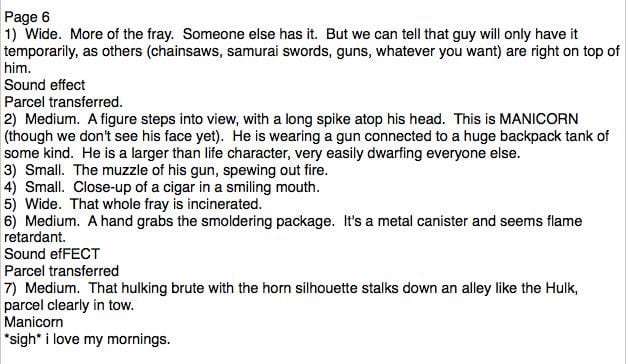
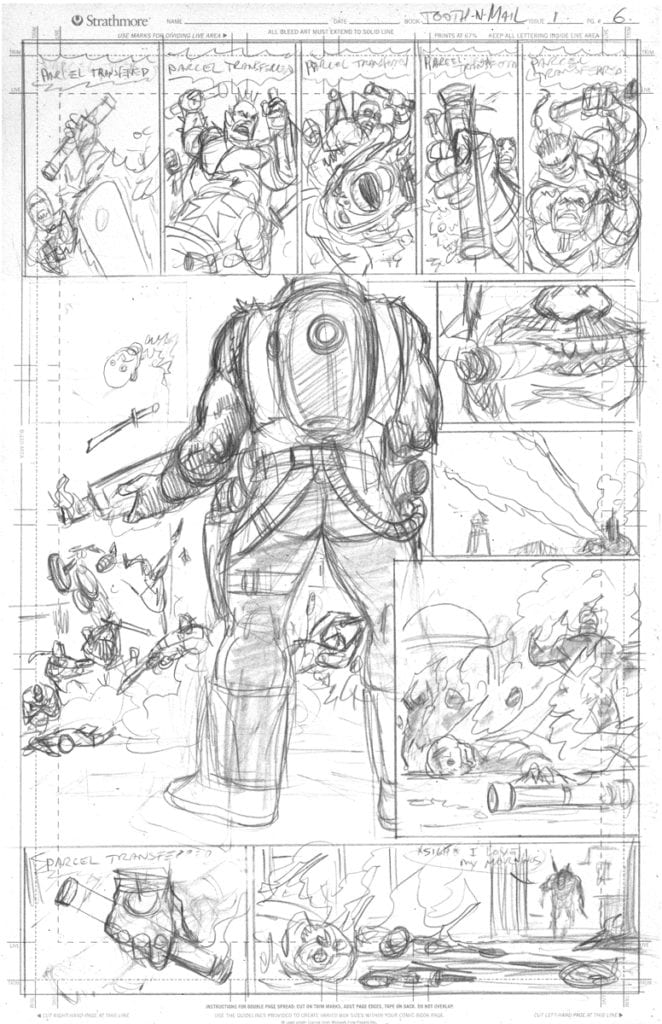
There’s a thing that happens between screenplays and comics that people unfamiliar with the format don’t always recognize and it’s how the ‘real estate’ of a comic page is different than how things play out on film. In a film, you don’t have to leave room for the dialogue or the sound effects; The characters just speak. But in a comic, if a character is making a big speech, then backgrounds and things like that, are going to be obscured. So the scripts would have suggestions for panel sizes, but often I’d come back with suggestions how we could keep the point of the moments but play it out a bit differently. When inking my own work I pencil very loosely, just to get the story beats established and then present it to the writer so we are in agreement before I go and put all the ink detail in.

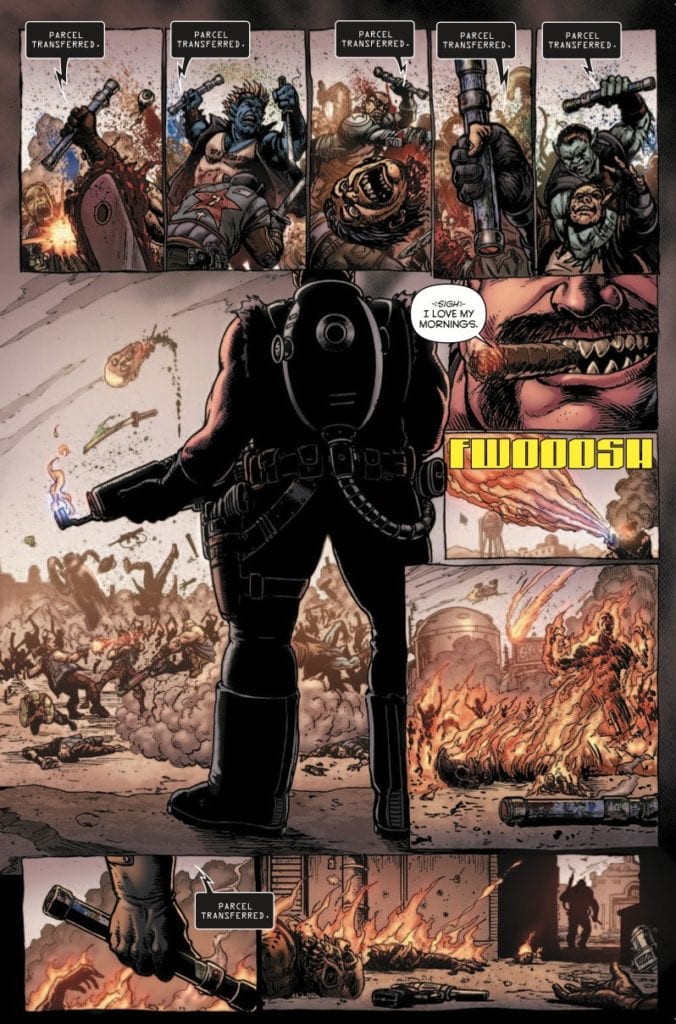
For example, this is a place where I suggested breaking the melee into multiple panels across the top and have the parcel transferring in every panel of the melee might work better as a gag… The story is the same, I just changed up the beats a bit, and Joe and Eric loved it.

MFR: What about it was exciting?

DR: It’s a really imaginative platform and concept they created, and anything seemed possible. That’s one of the things I loved about Transmetropolitan and Ballistic; the worlds where I can create in a space where anything goes are the most fun for me. Joe and Eric like to push boundaries and create outrageous scenes, and trying to capture that lightning in a bottle was fun. I really wanted to maintain that crazy energy we had at the beginning of the project and bring that forefront for the story.

MFR: In the first issue, you do a great job of giving us visual cues of the dynamic in the room, particularly with Proton and Manny.

DR: Thanks!

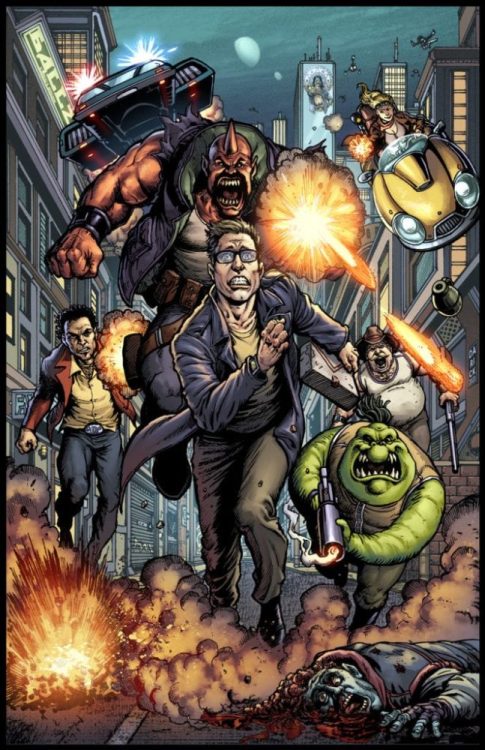
MFR: Manny towers above anyone, but you really show us just how much bigger and better he is than Proton. The first scene of the issue, a flash forward, shows us there are going to be lots of characters joining the cast. As dynamics shift and as we get more people on each page, did you change your approach of using size and position to show power?

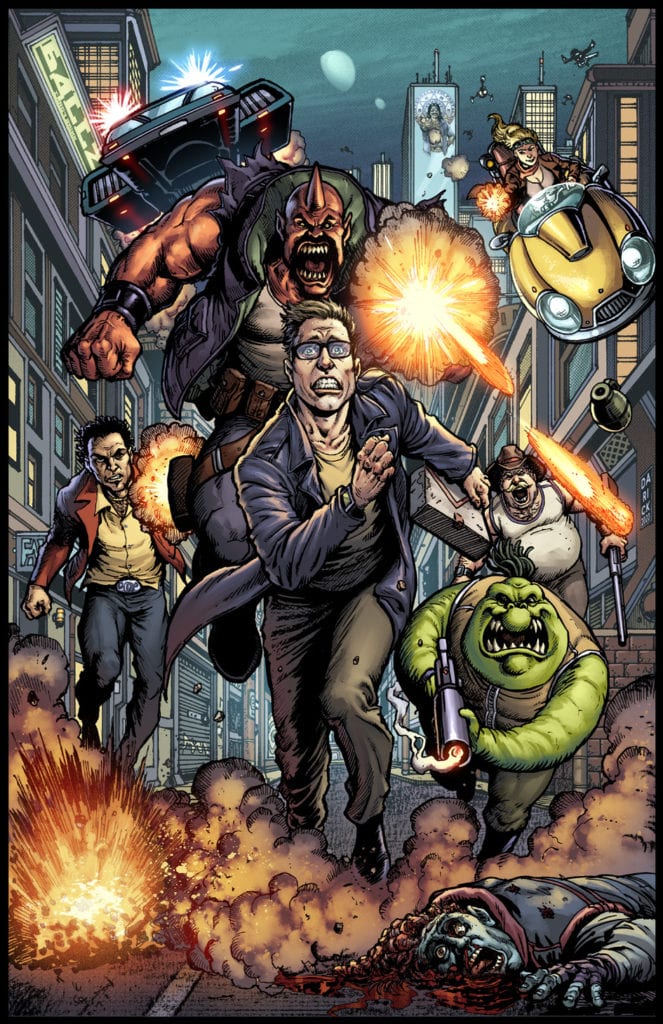
DR: Yeah, that did become challenging as the final issues I drew are absolutely bonkers. I was drawing the whole cast, which you can see on my virgin variant cover for #1, and multiple locations with things happening simultaneously in space as well on Roy Sharpton’s crazy refuge planet with alien dinosaurs and absolute craziness going on. But my approach remained focused on telling the story through character dynamics and such… in issue 3 you’ll see how Davey has grown in confidence and skill, but how Manny remains a threat.

MFR: Space Bastards is a perfect series to just go on and on, with a revolving door for new characters. Hopefully, it runs for a very long time. It certainly deserves to. In that case, do you hope to come back and do the art for more issues in the future someday?

DR: Yeah, I’d be into revisiting this. I designed and co-created these guys, so there’s a little bit of an attachment there… doing the Virgin cover, which I created recently, was the first time I revisited this world since I finished the art in 2019 and it was like hanging out with old friends.

MFR: Last question. What exactly do you have againssst Lizard People?

DR: Lizards, fine. People, fine. Lizard people… Go shed your skin somewhere else! No sleestaks here!


The first volume of Space Bastards, published by Humanoids, is written by Eric Peterson and Joe Aubrey, with art by Darick Robertson, colors by Diego Rodriguez and letters by Simon Bowland. And starting in the second volume, writers Peterson and Aubrey are getting a bunch of different artists in for a one-shot, a couple annuals and some specials. Artists include such talents as Simon Bisley (Lobo) and Clint Langley (2000AD)!

Jump aboard the Kickstarter to keep so this wild series keeps going, and so Peterson and Aubrey can pay advances to their awesome artists! And for all other Space Bastards information, go to Spacebastards.com!

Monkeys Fighting Robots Youtube

Review: RORSCHACH #4 and the Dangers of Cultism

Rorschach King DC Comics

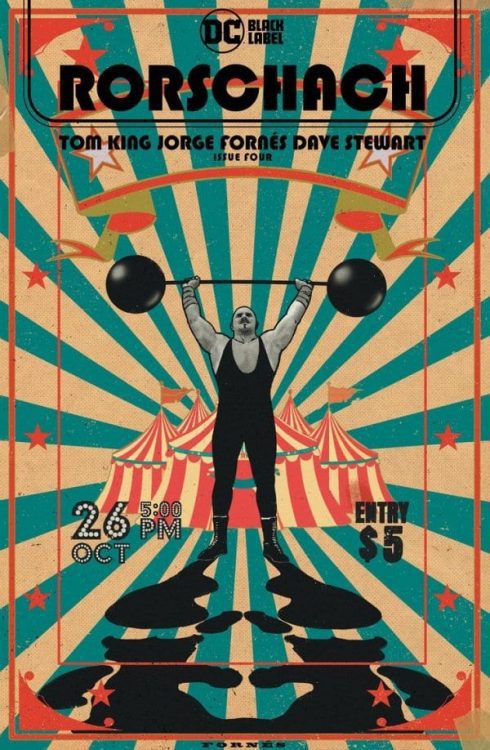
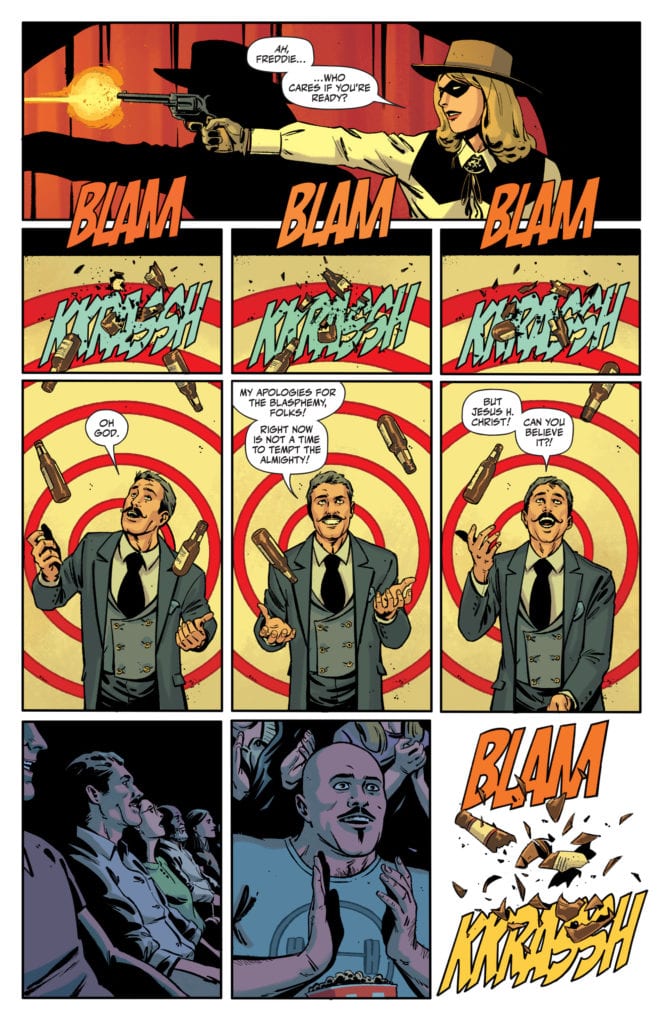
DC Comics’ Rorschach #4 is not an easy read. That’s not because it’s not good or clear. In fact, it’s devastatingly clear. No, Rorschach #4 is hard to read because it feels right on the money. Writer Tom King, artist Jorge Fornes, colorist Dave Stewart and letterer Clayton Cowles put forth an issue that discusses insanity. But it’s an insanity that feels dangerously accepted.

Writing

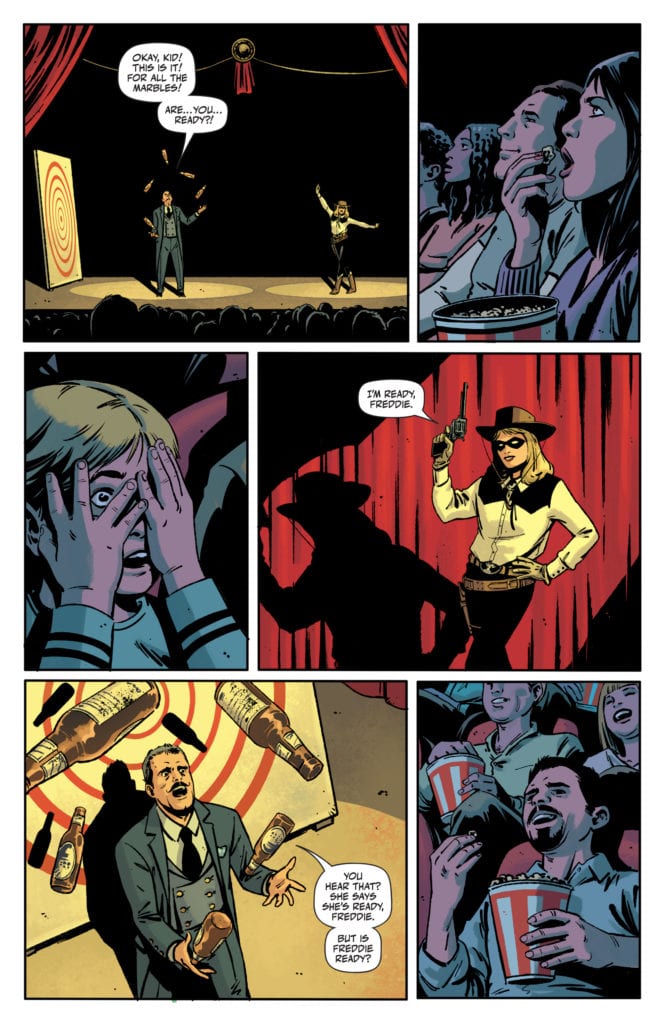
King introduces us to a new character in this issue. A strongman from a circus who knew Laura Cummings, the Kid, very well. In this issue, King begins to show how big the image of Rorschach has become. Rorschach is no longer just a man, he’s a way of life. And the beliefs of The Kid and Muscles, the Man Mountain, feel both insane and strangely believable. We see The Kid’s obsession with Rorschach is not something that’s new. She’s practically begun her own cult.

And watching Muscles respond to question after question, King shows us how deeply the Kid’s roots go into her followers. Logic can’t stand against a cult. Every moment that our detective protagonist tries to push Muscles to see the truth, is met with a vacant smile. King isn’t grasping at straws here. He’s, sadly, depicting what it’s like when someone can do no wrong in your eyes. That’s why this issue feels so timely.

Art

Fornes seduces us into accepting this dangerous view of the world as normal. Not only do all of the interactions between The Kid and Muscles seem completely innocuous, but Fornes dives right into typical comic book action. We see Rorschach and a supervillain on a rooftop or Rorschach pummeling crooks. Fornes makes it look like any ol’ comic. His sound effects do the same. The “AAAAAAAAAAA!” of someone falling down an elevator shaft is playful. The “SKRKKRKKK” of them hitting concrete is minimal and muted. Fornes is highlighting the fun in the brutality, not the consequences of it. He’s showing us how someone could get lost in the high. How someone could lie to themselves and believe it.

Rorschach King DC Comics

Coloring

Stewart makes this issue beautiful. The beautiful lie Muscles is telling himself. When Rorschach is on the rooftop, having a showdown with a dramatic villain, Stewart sets the stage fantastically. In fact, fantastic is the right word for it. It’s a fantasy lighting that gives each moment a sense of relevance. But something changes when Rorschach drags the villain inside. The greenish hue of fluorescent lighting is like a wake up call. And the red panel of someone plummeting to their death is like a smack in the face. It’s a reminder. This might look beautiful, it might seem steeped in relevance and honor, but it’s brutal and unhinged.

Lettering

Rorschach #4 has one hefty script. But part of what makes it work is how Cowles punctuates scenes with short lines. Separated from the rest of someone’s dialogue, Cowles finishes a monologue by leaving a final line alone on the page. These are the lines that get under the detective’s skin. “See, that’s just me,” Muscles says after describing a particularly disturbing scene. Muscles’ nonchalance is terrifying. “I wasn’t crazy,” Muscles says after a speech that definitely sounds psychotic. Cowles underscores Muscles’ most dangerous lies. He doesn’t let them get lost in the rest of Muscles’ tirades.

Rorschach King DC Comics


DC Comics’ Rorschach #4 is terrifyingly normal. Our new character, Muscles, the Man Mountain, is completely bought in to the lies he’s been told and the lies he’s told himself. King, Fornes, Stewart and Cowles tell a story we need to hear. They show us how easy it is to fall for a narrative that makes us the center of the universe. It’s another chapter in a series that has its finger on the pulse of our historical moment. Pick up Rorschach #4, out from DC Comics January 19th, at a comic shop near you!

Monkeys Fighting Robots Youtube