The adult version of the Losers Club is complete as all seven members are now all grown up for IT: Chapter 2, fresh off the announcement that Bill Skarsgård has signed on to return as Pennywise ‘The Dancing Clown’.
That’s right, the team that championed the nightmarish Pennywise in the 2017 reboot of IT are now their adult versions. So, with that, let’s meet the team that will soon take on Stephen King’s killer clown, which will again be directed by Andy Muschietti.
The ‘Old Spice Commercial Guy‘ has been tasked with serving as the member that stays behind in Derry to keep an eye out for a possible return of Pennywise, Mike Hanlon, who was formerly played by Chosen Jacobs. In the book, he suffers from a drug addiction as a way of coping with his nightmares of the shape-shifting clown.
The not-so-subtle New Kids on the Block fan and Pennywise researcher, Ben Hanscom, is not the bullied version anymore, which was portrayed by Jeremy Ray Taylor in 2017. He grows up to shed his hefty disposition in the book and becomes a successful architect. The ‘H’ carved into his stomach remains, but so does his longtime crush on fellow Loser, Beverly.
Here is your adult version of Stanley Uris (or Wyatt Oleff). This is the most-reluctant character to return to Derry to battle Pennywise, should he return. In the original film, you might remember him getting pulled into the jaws of the killer clown, after being lured into the sewers, face-first.
Fans of the series remember one of Pennywise’s favorite lines, “Eddie!”, in reference to his character, Eddie Kaspbrak. In the first film, he dealt with an overbearing mother that deemed him a hypochondriac, played by Jack Dylan Grazer.
Beverly Marsh, is all grown up. Most know her as ‘Bev’, the girl that the entire Losers Club was infatuated with and the one with an alcoholic father. In 2017, she was played by Sophia Lillis, who confronts her father to join the club and develop a social life outside of an abusive home.
His mutant abilities as Professor Charles Xavier in the X-Men films won’t help him much as ‘Stuttering’ Bill Denbrough. Inheriting the role from Jaeden Lieberher, he was the leader of the Losers Club and Georgie’s older brother. By book standards, he will have grown to become a successful author.
We couldn’t think of a better casting job than that for Richie ‘Trashmouth’ Tozier, which was done masterfully by Stranger Things star Finn Wolfhard in 2017, than this Saturday Night Live alum. The character serves as the comic relief with a potty mouth.
What do you think of this cast? Are you excited for the sequel? Let us know your thoughts in the comments section below.
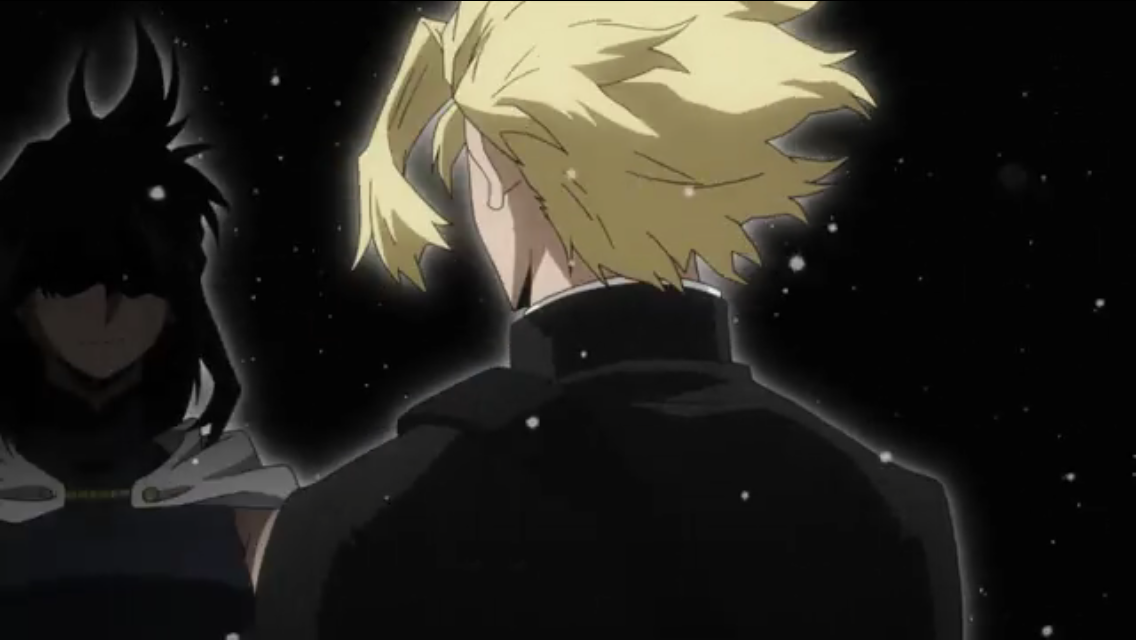
The latest episode of MY HERO ACADEMIA is both the origin story and the final chapter for All Might.
SPOILERS BELOW
MY HERO ACADEMIA picks up from last week, in the middle of the climactic super-fight. All Might faces off against the villainous All For One, and he doesn’t do great. Throughout the fight, All Might loses more and more of his inherited quirk. All Might is also confronted with the reality that the villain Tomura Shigaraki is the grandson of Nana Shimura, his mentor. Despite his ever-weakening body, All Might conquers One For All, putting the villain away… for now.
“One For All” embodies what the series is all about – the importance of hope. Toshinori (All Might) has to go through the same struggle to succeed despite losing steam that Midoriya has. All Might continues to fight, even as his body is decimated. At the fight’s darkest hour, the world rallies around All Might, including Midoriya, Endeavor, and civilians. It’s through that courage that All Might is able to attack with the all-powerful and incredibly-named “United States of Smash.”
While it’s an incredible win for the heroes, it comes with huge consequences. Technically, this episode was also the death of All Might. While Toshinori succeeds in putting away All For One, it’s clear that he uses all of his strength. That loss is what makes his message to Midoriya so important. Toshinori can no longer hold onto the remains of One For All, now that he has passed the Quirk onto Midoriya. All Might may have won the fight, but if One For All ever escapes (and he most certainly will), All Might cannot help.
This episode bookends both sides of the legendary saga of All Might. “One For All” shows us All Might’s origin, without distracting from the fight. We learn as much about Shimura as we need to feel All Might’s anguish and drive to honor her legacy. Toshinori uses All Might to avenge his mentor, while passing along a warning to his mentee. All Might may be gone, but as evidenced by the cheering crowd, he will never be forgotten.
The second season of Netflix’s wrestling comedy G.L.O.W. capitalizes on the potential of what the first season brought to the ring.
G.L.O.W, the series based on the Gorgeous Ladies of Wrestling of the 80’s, returns to Netflix on June 29th. When it comes back, viewers will get the same amount of fun and fighting that made season one a hit. However, season two takes everything up a notch, and surpasses the first season on nearly every front.
The central conflict is far stronger than the framework for the previous season. Season one mostly stuck to covering the Ruth-Debbie struggle, and how it affected the creation of G.L.O.W. However, the second season digs more into the power struggles amongst the wrestlers and producers. The go-getter Ruth (Alison Brie), the experienced actress Debbie (Betty Gilpin), and grizzled Sam (Marc Maron) all fight for control of G.L.O.W. The show does a great job jumping between the three, as each creative tries to claim power. It’s a far better arc for the show than Ruth and Debbie fighting over a husband. It’s all about making sure that one of them, and their “vision,” winds up on top.
There are some wonderful side character plot lines as well. The other wrestlers don’t get quite as much exploration as the leads, but some absolutely shine. Tammé Dawson, aka Welfare Queen (Kia Stevens) and Debbie have powerful mirrored storylines about motherhood. Likewise, themes of racism plague several wrestlers, including Welfare Queen and Arthie Premkumar (Sunita Mani). Season two works so well because it feels more and more like a well-rounded ensemble showcase.
This new season is all about show business, and all the problems that come with it. Along with the various characters fighting for power, there are other societal problems that plague the wrestlers. For example, the sexual politics in show business are painstakingly prevalent, and all too reminiscent of today’s landscape. Alison Brie’s Ruth helms the most pivotal and heavy scenes, bringing raw and visceral emotion to the screen. G.L.O.W also tackles racism and sexual identity, much of which is played wonderfully by the slept-on Sunita Mani.
The writing and directing of G.L.O.W. is beautiful across the board. The shots are crisp and the writing is sharp, so all the wrestlers feel like real characters. The season is also fairly consistent across the board, picking up steam with each episode. There is a dud or two along the way, and a few wrestlers who don’t quite get their due. However, the well-polished conflict at the heart of G.L.O.W, and the clear passion infused into the series by everyone involved, makes it a television powerhouse.
Morgan Neville’s Won’t You Be My Neighbor? is an illuminating look at how one man’s convictions were able to shape a generation.
While society was undoubtedly afflicted with any number of issues back when his television career started in 1966, Fred Rogers believed that kindness was always the answer, and most problems resulted in some way from a lack of love. His message was moving, and his impact was profound. Won’t You Be My Neighbor? shows everyone how necessary courage is when showing kindness and the thunderous impact it can have.
What’s fascinating is how simple the sets of Mister Rogers’ Neighborhood were and how original their show was in comparison to other children’s television of the day. Won’t You Be My Neighbor? is meticulous in explaining the show’s humble beginnings and how they mirrored Rogers’ faith. It was never about impressing children with a shiny set; it was about the simple yet resonant message he shared. At one point, the iconic television figure had intended to become a minister, but after coming home from seminary and seeing how children were entertained on television, he resolved that society should be using this medium to educate children as well.
Rogers often made a statement with just the simplest of acts. Won’t You Be My Neighbor? dives into one of the more memorable episodes involving Officer Clemmons (François Clemmons). In 1969 during the height of civil rights tension in the south, Rogers wrote an episode where he and Clemmons shared a kiddie pool together and put their feet in to cool off. The visual of both of their feet in the pool is powerful and sent the message, contrary to popular opinion, that two different races can co-exist peacefully.
Neville also spends a great deal of time establishing that our favorite television host wasn’t perfect. Clemmons goes into great detail about how he had a tough time adjusting to the idea that he was a homosexual and Rogers’ role in that process. As the years went on, Rogers became less concerned about his initial beliefs and more about letting him know his worth. Won’t You Be My Neighbor? does not characterize Rogers as being a saint but the film does show that he always strived to improve in all areas every day he was alive.
Neville makes ample use of family members, friends and colleagues from the show to demonstrate how authentic everyone’s favorite neighbor was. Rogers never had a TV persona. What we saw was who he was, and that’s precisely why everyone loved Mister Rogers’ Neighborhood. Won’t You Be My Neighbor? tells the story of how he once made an appearance at a station in Boston and how the line looped around numerous city blocks just for a chance to meet the man who liked us just the way we were. Rogers’ presence was comforting and his words reassuring.
Public television turned to their most recognizable figure during its harshest moments. When children were hurting themselves pretending to fly like Superman, Rogers did a week on superheroes. Mister Rogers’ Neighboorhood often tackled life-altering events such as death, divorce and even war. PBS also brought him out retirement for a series of PSAs to help others cope with the events of September 11, 2001. Won’t You Be My Neighbor? shows how even in our darkest moments, kindness and love can uplift others.
Neville best crystalized Mr. Rogers by revisiting the last commencement address he gave at Dartmouth University in 2002. Rogers wanted the world to take stock of how kindness has impacted us all and recognize we had the power to affect others positively. He stated:
I’d like to give you all an invisible gift. A gift of a silent minute to think about those who have helped you become who you are today. Some of them may be here right now. Some may be far away. Some, like my astronomy professor, may even be in Heaven. But wherever they are, if they’ve loved you, and encouraged you, and wanted what was best in life for you, they’re right inside your self. And I feel that you deserve quiet time, on this special occasion, to devote some thought to them. So let’s just take a minute, in honor of those that have cared about us all along the way. One silent minute.
Neville immediately asks various luminaries connected to Rogers and the audience who they thought of. For me, it was my mother and father who even during the worst of times managed to guide me with kindness and compassion. Perhaps Rogers’ greatest gift to us all is an appreciation of what once was and what could be if we were kinder to one another. Won’t You Be MyNeighbor? is a gift wrapped in nostalgia with lessons which are timeless.
Paramount has announced that it has pulled the sixth Transformers movie from their schedule, and the studio is already rumored to be eyeing the reboot button. The most recent film in the series, Transformers: The Last Knight, was considered a disappointment despite making $600 million worldwide, and none of the films has ever received a positive Rotten Tomatoes score. However, there is still one more Transformers film on the release schedule, Bumblebee, which hits in December. Four of the Transformers were financial successes — two of them even made over $1 billion worldwide — so the series must have done something right.
I enjoyed the special effects, the action and Peter Cullen saying awesome things in the Michael Bay films. Scenes involving Optimus Prime flying around with a jetpack and fighting a robot dinosaur appealed to my inner 10-year-old. But the films were bogged down by Bay’s juvenile humor which boiled down to sexism, racism and toilet jokes as well as his military fetishism. Old-school fans have been longing for a reboot of the series.
My criteria for a reboot would be as follows:
The films need to appeal to families. So tone down the swearing and sex jokes.
Match the special effects and action of the Bay films.
To that end, here are 10 directors who I believe would be able to reboot the series.
Brad Bird
Director Brad Bird on the set of MISSION: IMPOSSIBLE – GHOST PROTOCOL, from Paramount Pictures and Skydance Productions.
Brad Bird is an animator turned live-action director and a veteran of Disney. He is best known for making The Incredibles for Pixar and Mission: Impossible – Ghost Protocol. His whole filmography shows he would be a great fit for the Transformers franchise. Whether in animation or live action, Bird can craft an exhilarating action sequence and still gives his films a lot of emotional depth.
With The Incredibles, Bird made a great revisionist take on the superhero genre, as the actions of superheroes have huge consequences. Meanwhile, The Iron Giant was a touching American adaptation of Ted Hughes’ children’s novel of the same name. The Iron Giant was a Spielberg-esque about a boy befriending a giant alien robot, the kind of story we would expect from the start of a new Transformers series.
All of Bird’s films have had a distinct look. The visuals in The Incredibles were influenced by ’60s era Bond films. The Iron Giant was set in the ’50s, and Tomorrowland went for a retro-futurism look. So it would be easy for Bird to honor the ’80s origins of the Transformers franchise and give the reboot an ’80s look.
Bird was considered to direct Star Wars: The Force Awakens but lost out to J.J. Abrams. His last live-action film, Tomorrowland, was a box office disappointment, but making a Transformers rebootcould be part of a deal allowing him to make a dream project afterward like 1906.
James Bobin
Englishman James Bobin is also a Disney veteran, having directed 2011’s The Muppets, its 2014 sequel and Alice Through the Looking Glass (a sequel that was a massive improvement on the Tim Burton original). Bobin films are known for being bright and colorful affairs, and he has mastered making movies that please parents, children and the inner child of many adults. The Muppets was a hilarious film that had many subversive jokes while Bobin got to show off what he could do with special effects with Alice Through the Looking Glass. With Alice Through the LookingGlass, he mandated that the villains should be more sympathetic. So, if he gets to make a Transformers film, he can give some more focus to the Decepticons.
Bobin is currently making the Dora the Explorer moviefor Platinum Dunes, Michael Bay’s production company. If Bay does stay on as a producer for Transformers, Bobin would already have a working relationship with him.
Moreover, Bobin has also been linked to direct that long-rumored Men in Black/Jump Street crossover, a film that sounds like it would be a Jump Street joke. Many film fans hope it would never actually be made, and it is stuck in development hell.
Gareth Edwards
During his short career, Gareth Edwards has made some impressive special effects movies: Monsters, 2014’s Godzilla and, most recently, Rogue One: A Star Wars Story. Edwards started his career as a visual effects artist and made a splash with his sci-fi road movie Monsters, which was made on a budget of $500,000, and Godzilla was made as a disaster movie.
Even the harshest critic of Bay’s Transformers series would have to concede that the special effects were second to none. The effects in the 2007 film still hold up and should have won the Academy Award for Best Visual Effects that year. Whoever takes over the Transformers movie franchise needs to match these high standards, and Edwards would be able to step up.
He has proven that he can handle the action that would be expected from fans, with Rogue One having some fantastic scenes, especially on and around Scarif. Imagine what he could do with the Transformers franchise.
The biggest issue affecting Edwards were issues regarding the Rogue One shoot. The filmunderwent extensive reshoots, which were handled by Tony Gilroy. In addition, Edwards has stepped away from the Godzilla sequel so he can work on smaller projects. However, since the Disney takeover of Lucasfilm, production problems seems to be synonymous with the Star Wars franchise. The Force Awakens had various rewrites. Solo was pretty much reshot by Ron Howard, and Colin Trevorrow left directing duties on Episode IX because of creative differences. A Transformers reboot could be a way for Edwards to bounce back.
Joseph Kosinski
Joseph Kosinski is a director who specialized in effects-laden films, making his debut in 2010 with Tron: Legacy and following it up with the Tom Cruise sci-fi vehicle Oblivion. Regardless ofwhat you think of their storytelling, both Tron: Legacy and Oblivion are fantastic-looking films and the former has one of the best soundtracks, thanks to composers Daft Punk.
In addition to his work in the sci-fi genre, Kosinski made drama Only the Brave based on the real-life story of the Granite Mountain Hotshots, a crew of firefighters who died during a wildfire in New Mexico. This film captured hard-working American men risking their lives.
Kosinski is currently attached to direct the long-delayed Top Gun sequel. If the producers of the Transformers movies want to keep the military aspects of the Bay iteration, then Kosinski would be able to combine his sci-fi experience with his more grounded films.
Travis Knight
Travis Knight is best known for his work as an animator and producer at Laika. He made his directional debut with the critically acclaimed Kubo and the Two Strings, a wonderful animated dark fantasy film based on Japanese folklore. The film follows a young boy forced on an adventure to save his mother from his powerful grandfather and aunts. In all honesty, it easily matched anything Disney and Pixar could do.
Knight’s follow-up film is Bumblebee, the first spin-off film in the Transformers franchise, and if the reboot rumors are true, this would be the last installment in this version of the series. It may seem weird to suggest a director working one version of a series to also work on a reboot, but it has been done before. Martin Campbell rebooted the Bond series, twice, Bryan Singer produced X-Men: First Class (which was a soft reboot of the X-Men franchise) and James Cameron is currently producing the sixth Terminator movie.
Although we have only seen one trailer for Bumblebee, Knight seems to have an understanding of the franchise. The film looks bright and colorful. Characters look more like the versions in the ’80s animated series, and it is going to be aimed towards kids like the franchise should have been all along. Knight may as well have a clean slate to work with.
Shawn Levy
Canadian director Shawn Levy has had a long career of making films and TV episodes, focusing mainly on comedies. His filmography is a mixed bag. He sadly has films like The Pink Panther remake and The Internship to his name, but there is one entry that acts like a calling card for the Transformers franchise: Real Steel.
On the surface, Real Steel looked like a silly sci-fi film that made some people wonder if Hugh Jackman needed a better agent. But it turned out to be a fun family film with a touching story about a father and son reconnecting because of their work on a fighting robot. Real Steel was basically sci-fi Rocky. With fantastic special effects and action sequences in which the robots remain distinct, the film is exactly what fans would want from a Transformers film.
Levy has also found great success as a producer: his recent credits include the critically acclaimed The Spectacular Now, Arrival — which earned him an Academy Award nomination — and hit Netflix series Stranger Things. Even if Levy doesn’t want to direct, he would be a solid choice to work as a producer.
Justin Lin
Since taking over the Fast & Furious franchise, Justin Lin became one of the most in-demand action directors in Hollywood. He was able to transform the series into one of Universal Studios’ biggest cash cows.
When helming the Fast & Furious movies, Lin managed to bring back stars like Vin Diesel, Paul Walker and Michelle Rodriguez and turned the street racing series into a globe-trotting action ride. Lin also introduced Dwayne “The Rock” Johnson and Luke Evans to the series. But his best feature as a director is his use of practical effects and stunts.
When CGI is used in the Fast & Furious series, it falls on the poor side, but Lin redeemed himself with Star Trek Beyond, matching the effects of the previous movies in the Kelvin timeline. Lin pleased Trekkies who were critical of the J. J. Abrams Star Trek movies, and he could do the same with Transformers fans who were turned off by Bay’s approach.
Lin’s films also share a theme of family and togetherness, and he could bring that to the Transformers franchise as well. The Autobots are a tight-knit group, the last good robots from their dead world, and Lin could counter criticisms of the Bay films that claim the Transformers are supporting characters in their own films. Lin is also able to handle a large cast of characters. So he could give a fair amount of screen time to the Autobots, Decepticons and human factions.
According to IMDB, Lin is rumored or attached to six movies, including two more Fast & Furious movies, a sequel to The Bourne Legacy and Space Jam 2. Yet, considering some of those films have been in development for years, it is safe to say nothing in Lin’s schedule is set in stone.
Phil Lord and Christopher Miller
Like Brad Bird, the directing duo of Phil Lord and Christopher Miller has successfully worked on both animated and live-action films, such as the Jump Street series, Cloudy with a Chance of Meatballs and The Lego Movie. With a filmography like that, Lord and Miller has developed a devoted fanbase. They turned a teen drama with a bit of a silly premise into a brilliant satire of the buddy cop genre and, most importantly, turned a film that seemed like a corporate cash-grab into a hilarious and heartfelt film for the whole family.
Under Bay, the Transformers franchise seems to have forgotten who its target audience is: kids. Lord and Miller could manage to do what they did with The Lego Movie to Transformers, making it family entertainment.
The biggest issue affecting Lord and Miller is their experience with the Star Wars franchise. They were originally set to direct Solo: A Star Wars Story but were fired by Kathleen Kennedy due to creative differences. Hopefully, they have learned from this experience and can use it to direct another big-budget studio film.
Jonathan Mostow
Jonathan Mostow is a director with plenty of experience working on movies about robots. So perhaps he could pull off a hattrick and move right into the Transformers franchise. Mostow is best known for making Terminator 3: Rise of the Machines. Although the film was met with fairly positive reviews, the audience reaction has been more mixed, since it’s basically a comedy remake of Terminator 2: Judgment Day. Even so, Terminator: Rise of the Machines does have some memorable moments like the truck chase and the fight between the T-800 and the TX.
Mostow’s other robot move is Surrogates, a loose adaptation of a comic book series by John Brancato. It was an underrated sci-fi film that features Bruce Willis, Radha Mitchell, Rosamund Pike, Ving Rhames and James Cromwell. Set in a world where humans are able to control robot bodies with their minds, the foundations of this society are shaken when people are murdered through their surrogates.
Mostow is also known for making the World War II submarine movie U-571, a film that annoyed British veterans and historians. He also directed an episode of The Last Ship, a show produced by Bay.
Rupert Sanders
Completing this list is English director Rupert Sanders, best known for directing Snow White and the Huntsman and the 2017 Ghost in the Shell. Sanders started his career directing commercials, winning two Golden Lions at the Cannes Lions International Advertising Festival.
While Sanders’ films have been met with a mixed critical reaction, there is no denying that they are fantastic-looking films. Snow White and the Huntsman is a standard fantasy film mixed with excellent CGI, practical effects and costumes. Ghost in the Shell is nowhere near as bad as some film fans feared it would be, and Sanders was able to recreate the look of the anime, if not the philosophy of the Japanese source material.
Sanders is adept with action and using multiple types of special effects. If he has a good script to work with, Sanders would be able to make a PG-13 film that should be fine for older preteens to see.
It’s been a hell of a week for the so-called DC Extended Universe (a name that is still, to my knowledge, unofficial). While the internet is still reeling about Chris Pine’s confirmed role in the now-titled Wonder Woman 1984, the most impactful news has been that Geoff Johns is stepping down as president and chief creative officer of DC Entertainment. The decision was apparently designed to allow Johns to focus on the film side of things, including writing and producing the long-talked-about Green Lantern Corps. But it’s also indicative of DC Films’ ongoing effort to find a clear path to success.
Rumors and reports about what direction the franchise will take next — especially after the underwhelming box office response to Justice League — have run rampant. Thankfully, it is starting to sound like DC Films, under the leadership of the recently appointed Walter Hamada, is making some critical decisions behind the scenes, according to a recent piece by THR. The Flash film will reportedly be inspired by Back to the Future now (meaning Flashpoint fans might have to wait for that adaptation), and a pair of Joker-centric films, as previously reported, are definitely in the works. Whether this slate — along with the in-production Shazam! and aforementioned Wonder Woman sequel — inspires confidence in fans or not, at least the studio is making some steps forward.
Perhaps the most curious and surprising revelation in the THR story is that the current script for Matt Reeves’ The Batman focuses on a younger version of the Dark Knight, likely precluding the 45-year-old Ben Affleck from donning the cowl in Batman’s first live-action solo film since The Dark Knight Rises. After months (years?) of back and forth regarding whether Affleck would stay in the role, it’s encouraging that we’re beginning to get some sense of where The Batman is headed, including who the main villain might be. Yet, of all the ways Reeves and DC could take the Batman franchise in particular, this doesn’t feel like their best option.
Bear in mind, details at this point remain sketchy. We still don’t know if this “young Batman” angle is meant to serve as a story separate from the main DCEU — like the Todd Phillips-directed, Joaquin Phoenix-starring Joker film — or a Gotham-style prequel following an earlier incarnation of the Bruce Wayne that Affleck has been playing. Still, considering the actor’s reported reticence to return to the role, the former seems far more likely, giving DC and Warner Bros. the opportunity to reboot the character’s future role in the greater DCEU without the need for Flashpoint-level time-travel shenanigans.
The problem here is two-fold. On the one hand, the gruff, Arkham-esque hero Affleck played in both Batman v Superman: Dawn of Justice and Justice League is one of the few aspects of the DCEU that most fans can agree the franchise and director Zack Snyder actually pulled off. Snyder’s approach to the material has proven divisive, to be sure, but scrapping “Batfleck” entirely seems rash and, honestly, foolhardy. DC Films would be better off to keep the character intact and simply recast the role. After all, it’s not like fans won’t accept a new actor in an iconic superhero role.
If Affleck is no longer interested in playing Batman, plenty of other actors of a similar age and build could slip right into the role (Jon Hamm, anyone?), allowing future DCEU entries to continue in its course-correcting without having to muddy the narrative waters. Although Snyder’s films (oh, and Suicide Squad, lest we forget) may not have provided a strong enough foundation for the DCEU, many of the individual characters and performances (Margot Robbie’s Harley Quinn, Gal Gadot’s Wonder Woman, Ezra Miller’s The Flash, etc.) they introduced are certainly worth salvaging. That includes the current version of Batman, whether or not Affleck keeps the part. Imagine what a filmmaker like Reeves could bring to it.
The other reason — and perhaps the more important one — that The Batman shouldn’t bother honing in on the early part of the Dark Knight’s crimefighting career is that, well, it’s an angle we’ve already seen recently depicted onscreen. With its heavy influence by Frank Miller’s Batman: Year One, Christopher Nolan’s Batman Begins took a similar approach to the character. Although The Batman may not be a straight-up origin story as Begins is, it feels unnecessary to revisit an earlier Batman when the DCEU has to date successfully focused on the opposite. Even The Dark Knight chronicled the first conflict between Batman and the Joker, technically qualifying as a young Batman story itself.
Accordingly, the DCEU would be opening itself up to comparisons between its new take on Batman and Nolan’s beloved trilogy. Considering its struggle to nail down a trajectory, this is probably the worst thing the DCEU can do at this point, as it’s only been six years since Christian Bale bid farewell to Gotham City. Part of what audiences responded to with Affleck’s version was how starkly different it was not only from Nolan/Bale’s Batman but any other that had appeared on the big screen up to that point. Any exploration of a young Batman, especially now coming on the heels of Justice League, will only be setting itself up for unrealistically high expectations, a scenario that the DCEU would be wise to avoid for now. Does anyone seriously have faith in the current DC Films team to deliver a film up to par with The Dark Knight? Anyone?
While the idea of simultaneously exploring multiple versions of really any of these iconic characters isn’t necessarily a bad one, such an approach smacks of audience goodwill that the DCEU simply hasn’t earned yet. The films released so far have varied so wildly in quality and consistency that the company should place its focus on developing a concrete plan long before taking on the ambitious task of a full-on multiverse. Batman has specifically taken on so many forms since his 1939 introduction in the comics, and it’d be fun to see more of the gruff, older Batman many fans have embraced. Something tells me audiences aren’t ready to move on just yet.
Agree or disagree with my thoughts? Comment below to let me know or chat movies with me on Twitter @crookedtable!
Jason Aaron’s mighty run with Odinson and his Asgardian adventures continues. Thor #1 debuts for Marvel’s “Fresh Start” initiative with the original God Of Thunder back in the driver seat. Aaron’s superb era of Jane Foster’s worthiness is going to be a tough act to follow.
***SPOILERS LIE AHEAD***
Jason Aaron has been writing Thor comics for a very long time, already cementing himself as one of the all-time greats. However, this new series unfortunately has to follow the gut-wrenching finale of Jane Foster’s triumphant tenure wielding the hammer. We got a taste of Odinson in Aaron’s Avengers series that just started, but here is a greater task.
Thor is on a mission to retrieve a stolen Asgardian artifact from the almighty Cyttorak. Their champion is the unstoppable Juggernaut at the height of his powers within the Cyttorak temple. Aaron has a great voice for Cain Marko, his teasing of Thor’s lack of two arms and a hammer is delightful.
The identity crisis that Thor is going through without his hammer is amusing. After shattering one on Juggs’ face, Thor tells Screwbeard to “send all the hammers.” It’s a great comic book moment seeing the shower of hammers rain down on the enemies of Odinson.
Screwbeard himself is also a very enjoyable supporting character. His exchanges with Thor are a joy, especially his misunderstanding the “juggler” enemy that destroyed all his hard work.
The Asgardians becoming refugees on Earth, Thor living on a small boat with his trusty dog and goat, and Loki’s deal with his brother to chase down Malekith as he sprays blood across the realms. There’s a lot going on in this issue, Aaron keeps everything tight and entertaining with a great script and playful dialogue as always.
Mike Del Mundo is one of Marvel’s “young guns” artists. He’s a much better fit on Thor than he was for Mark Waid’s recent Avengers run. I feel like Marvel has yet to put him on a title that fits perfectly, he’s clearly a talented artist. Is he still a young artist yet to blossom, or a creator that hasn’t been tasked with the proper match yet?
Perhaps even a different approach to coloring would keep these action sequences from seeming like a washed away mess. All of Del Mundo’s character models are spot-on and designed to satisfaction. There’s something amiss in the final execution. A good portion of these panels detract from the scene rather than expand on them.
There’s a back-up story starring the darlings of Thor continuity, his three future granddaughters. It’s a joy to read them as always, even with such tragic subject matter. The cliffhanger, setting up Thor #5, is bat-shit comic book craziness that’ll give you something to look forward to if this main story didn’t tickle your fancy. It also features art by Christian Ward of Black Bolt fame.
Similarly to Mark Waid’s Doctor Strange #1, this debut doesn’t quite live up to the preceding Marvel Legacy series. Thor #1 has plenty to hook readers and keep us coming back for more, but the visual approach is troublesome. Thankfully it’s Jason Aaron, so we know Thor is in the most capable of hands.
The highly popular Netflix animated series created by Dreamworks Animation, Voltron: Legendary Defender is back for a 6th season this week. The previous season focused more on Lotor, the son of the team’s worst enemy and seemed to not give the Voltron team as much attention. Does this season follow suit?
SPOILER WARNING FOR SEASONS 1-5
Summary
As Lotor and the Voltron Paladins work to unite the universe, Keith finds a link to his past which may just help him to discover a dark truth hiding in the shadows.
Writing
It is revealed in the first episode of this season, Vrepit Sa (the salute used by the Galra Empire) translates to “Killing Thrust.” This seems symbolic as season six seems all about delivering dramatic moments which hit close to home. Once the drama shifts into high gear and the Vrepit Sa is delivered, the Paladins are pushed to their breaking point. It is here where the show’s strength truly shines.
The revelation with Keith in the previous season is flushed out more. Thanks to a cosmic phenomenon he and Krolia (his mother) find a way to learn about each other’s past. It helps you to understand Krolia, her motivations, and some of the questions Keith always wanted to ask her. It also feels like this season is giving fans more Keith to make up for how he was underutilized for most of the previous two.
This season also features a comedic episode overflowing with so much humor it may have dethroned Space Mall as being the most insane episode to come out of this series. How funny is it? The team plays their universe’s equivalent of Dungeons and Dragons. Yeah. You read it correctly.
By the end of it, both the Paladins and the audience are taken on a ride which will leave them emotionally drained, spiritually satisfied and eager for more adventures to come.
Animation
The animation has returned to being top notch. While there were moments in season five which seemed unpolished compared previous seasons, season six has much fewer of these to speak of. There was briefly a moment where the animation shifted in a way which was not as clean as the rest of the episode, but this was during a scene of intense action. A minor error on an otherwise exceptional season. One which produced a lot of defining moments which were solidified thanks to the use of the improved quality in the animation.
Music
The music finds a way to become even more powerful than in previous seasons. While it was utilized previously to illicit emotions at just the right time, this season it seems to have changed its purpose entirely. Often the soundtrack seems to tell a story of its own and helps to draw the audience into different moments than relying on the animation alone. Scenes without dialogue with the aid of this style of soundtrack are where this form of storytelling truly shines. Also, a salute to the team for including the Chrono Trigger reference.
Conclusion
Voltron: Legendary Defender continues to be one of the best things to come out of Netflix. The series didn’t slow down for a moment this season. Instead, it delivered powerful moments which will make fans of the show scream in delight at what they are witnessing. The Paladins of Voltron are never more entertaining to watch than when they are pushed to their limits and this season finds a way to back them against a wall leaving them nowhere to go but up.
Outstanding performances from the cast plus a well-crafted narrative which weaves in themes that are both compelling and socially relevant reaffirm that Luke Cage is Marvel’s best television show.
While some fans might still be irritated after the death of Cottonmouth in Season 1, and others might claim that Cloak and Dagger is a better show, the second season of Luke Cage is a bubbling cauldron of ferocity seeping out into the far reaches of Harlem. The most notable change to Luke Cage is how the focus is no longer on the ex-convict turned defender of all. In our new season, we follow the character arch of four people fans are familiar with and two new individuals who are introduced this year.
Marvel’s Luke Cage
Showrunner Cheo Hodari Coker has focused the second season on exploring if it’s okay to do something wrong for the right reasons. Luke Cage (Mike Colter) is feeling the crush of being a national celebrity whose primary goal is cleaning up the streets of Harlem. However, with this fame comes an expectation of being all things to all people.
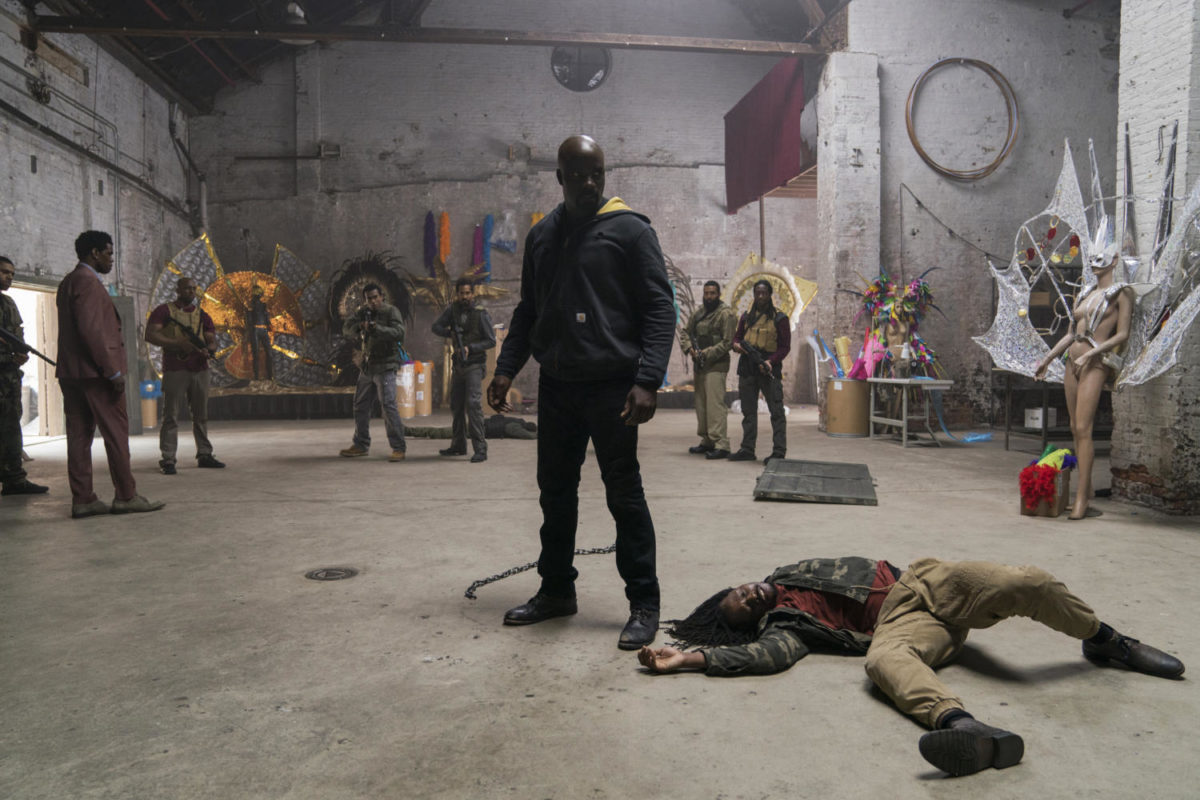
Cage attempts to follow the law when protecting the citizens of his community, but increasing loopholes and slipups from the police are frustrating him. He’s increasingly seeing the benefits of taking another approach (the use of brute force) which may be illegal, but it eliminates the problem. Could Cage become the very thing he’s sworn to root out of Harlem?
Marvel’s Luke Cage
What stood out to me was the difference in writing between the first and second season. To me, the first season was committed to establishing who Cage was. In the second season, the focus was shifted toward showcasing the depth of each principal player in the storyline.
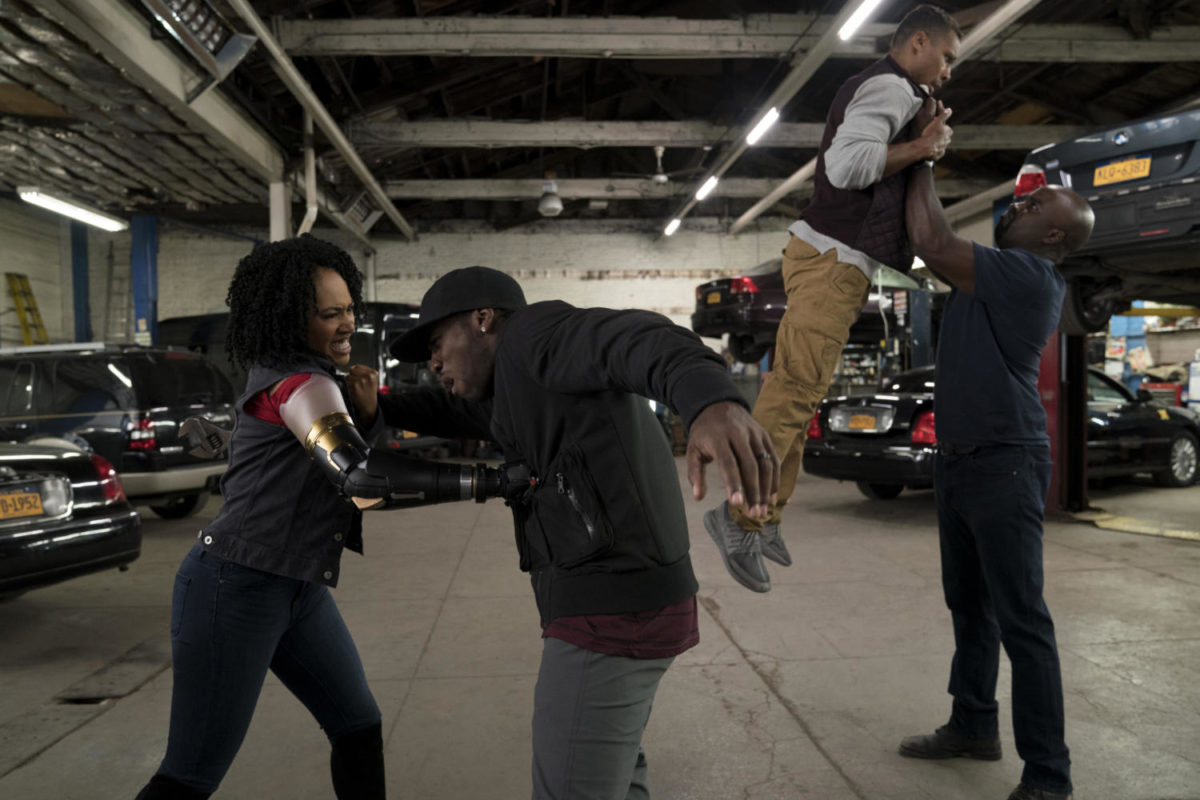
Mariah Dillard (Alfre Woodard), Detective Misty Knight (Simone Missick), Tilda Dillard (Gabrielle Dennis), John “Bushmaster” McIver (Mustafa Shakir), and Shades (Theo Rossi) are all experiencing the same inner turmoil as Luke Cage (Colter). Mariah is concerned about her legacy and is willing to sell out (by any means necessary) to become legit in the eyes of her community- which she hopes will erase her past. Detective Knight is still haunted by the accident which took her arm and the lives shattered by bloodshed. She’s prepared to take down anyone who is associated with Dillard even if it means doing so illegally.
Tilda Dillard is trying to reconcile with the past misdeeds of her mother, Mariah. It doesn’t take long for her to figure out who her mother is and she begins to wonder what a world would be like with her locked up. Bushmaster has come to Harlem to seek vengeance for the death of his mother which was indirectly caused by Mariah. He doesn’t attempt to destroy anyone else but quickly has to decide if there’s a limit to what he’ll do to exact revenge. Devotion towards Mariah has blinded Shades, but when she chooses to violate the unwritten rules of the street, he begins to wonder if she’s worth protecting anymore. There are no quick solutions, and each character walks a very fine line throughout Season 2.
The entire cast delivers fantastic performances, but Woodard, Missick, and Dennis stood out to me. Woodard brought out the duality of Mariah’s character. There’s a part of her who wants what is best for everyone in her family, but she’s attracted to the glamour of being a gangster and doesn’t seem to escape it. She’s reached a moment in her life where what people remember about her appears to matter. Woodard can project that while still being able to show her ruthless side.
Missick’s character has to try and move on from her accident while adjusting to life with only one arm. The perception surrounding her disability and whispers at the station is beginning to take a toll on her. She’s no longer what she was, but with the help of a friend, Ms. Knight becomes so much more. She’s able to show the pain and torment she projects on her face makes her portrayal seem extremely real.
Dennis’s character development is the most intriguing journey of the entire cast. Miranda’s daughter starts the series off as a naive yet hurt young woman. As the season progresses, she begins to morph into someone who is hardly recognizable. Tilda eventually reaches a crossroads which could impact everyone in Harlem. This type of character development requires a rawness which Dennis exudes on screen.
The themes of the new season are equally intriguing and socially relevant. Marvel fans will appreciate the numerous easter eggs this season. The music selections for each episode reflected the tone and feel of that moment. Most importantly, the pacing of Luke Cage was adjusted to reflect what fans were craving. It’s as if the first season was the appetizer and now we are getting the main course. Fans couldn’t have asked for a better second season and will no doubt be pumped when they see where the series is headed next.
Tandy (Olivia Holt) and Tyrone (Aubrey Joseph) keep getting pulled together. Their worlds are nothing alike, but there’s a constant draw to each other. Why does this keep happening?
In tonight’s episode of Cloak & Dagger, “Stained Glass,” we’re swept into visions of hopes and desires, pains and nightmares, and it draws a great deal of sympathy for each character.
Wayne Pare, Aubrey Joseph & Olivia Holt (Freeform/Alfonso Bresciani)
We’re finally getting to tie the story’s setting into the mix. New Orleans VooDoo is full of religious and cultural traditions and beliefs and can be thought to remove curses. Seem like this is something right up Tyrone’s alley. As schoolmate Evita (Noelle Renee Bercy) said, “You don’t have to believe in it for it to work.”
The shrouding illusions of each character are both bright and dark, respectively of Tandy and Tyrone, and give each a look at the other as a child. We are then thrust into the hearts of their agony, witnessing revenge and dejection. They seem to want to protect each other, though. Both of them said to the other, “You have to try something else.”
Emma Lahana (Freeform/Alfonso Bresciani)
Detective Brigid O’Reilly (Emma Lahana) seems like she’s hot on Tandy’s tail of theft and assault, but we’re not sure of her angle yet. Does she really want to help Tandy, or is she setting her up for a life behind bars?
This episode takes us on a complex journey, and it’s about time for these two get together and help each other figure out what the hell is going on. Soon.