Home Blog Page 454

Review: DESCENDENT #2 Asks Who Should We fear?

Monkeys Fighting Robots

Kidnapped children, strange symbols, and secret societies form the basis of Descendent from AfterShocks Comics. While reminiscent of a 1970’s horror movie or one of Jonathan Hickman’s side projects, Descendent proves that conspiracies and their perpetrators can still fire the imagination of creators and readers alike.

Descendent asks who should we fear?
Descendent #2 Credit: AfterShock Comics

Writing/Story

David Corey posts YouTube videos about his investigations into the conspiracy he believes surrounds the missing children of high ranking politicians. Unfortunately for him, he is being observed by a robed society who wish him ill.

Meanwhile Agent Hernandez is carrying out her own investigation but seemingly with no success.

Could the two meeting prove to be beneficial or will they be drowned in the secrets surrounding them?

Stephanie Phillips packs this issue of Descendent with threat and mystery. Although not excessively original in the general plot, it is the telling of the story that makes it fresh and exciting. Secret robed sects are two a penny and can be found in numerous movies, novels and comics the world over, however Phillips expands on the familiar with engaging characters and gives the whole story a modern twist.

One of the stand out aspects of Phillips script is the inclusion of humour into characters and scenes. Where you might expect straight faced situations to play out, Phillips injects a comical glance between characters or a panel of childishness that contrasts the seriousness of the moment. This integration of comedy is a dying skill in the world of intense action and sombre reality but it adds depth and a relatability to the characters. Phillips makes her central cast complex and more than the sum of their parts; they are not simple plot devices used to move the narrative forward.

Descendent asks who should we fear?
Descendent #2 Credit: AfterShock Comics

Art

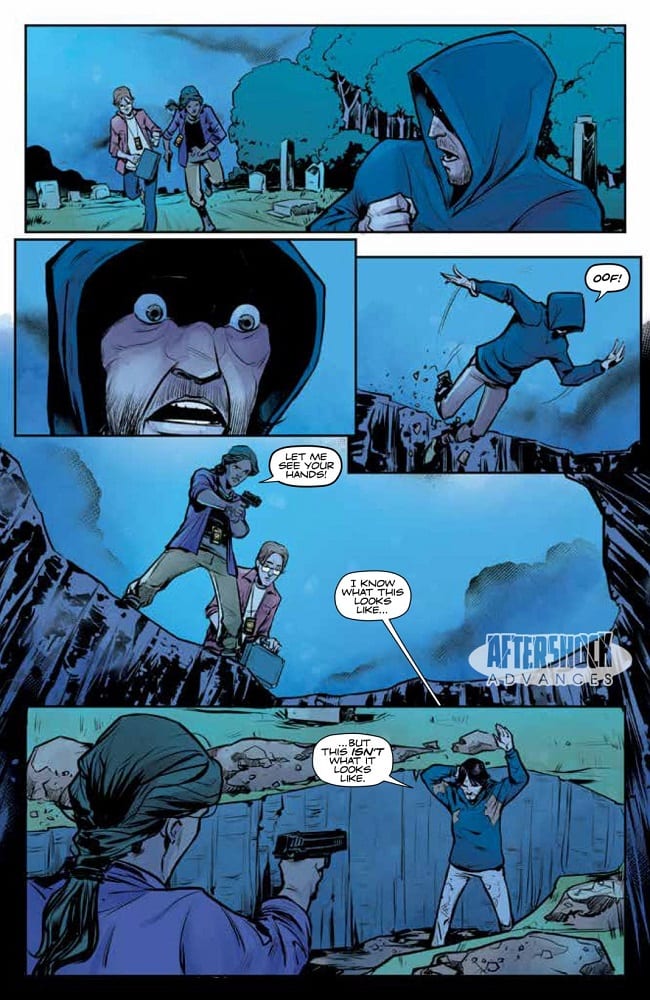
The main art work by Evgeniy Bornyakov is atmospheric and adopts a tense, thriller feel. The acting of the character’s works best during the static interactions; they have an emotional physicality expressed through posture and facial expressions. Where Bornyakov’s art sometimes falls flat is during action sequences. With some panels he produces an impressive composition with altering viewpoints to add suspense and drama, however there are moments that lack the required dynamism or threat.

The coloring does an impressive job of setting the scenes. Lauren Affe creates an eerie night for the graveyard scene but turns the light up for the saturated modern police station setting. The contrast between the police headquarters and the secret societal room exists because of Affe’s coloring.

There are some subtle touches to Troy Peteri’s lettering that helps the storytelling process. An occasional alteration to the tail of a speech balloon gives that particular piece of speech an added element or indicates that the speech is somehow different; this is most noticeable in a conversation between a police officer and a prisoner when they communicate through glass. Peteri is able to effectively dampen one character’s speech by changing the end of the balloon tail.

The subtleties in the art work help to reinforce the realism that Phillips utilises in her script. The narrative has an edge because the world of Descendent is relatable: this approach made the X-Files popular in the 1990’s.
Descendent asks who should we fear?
Descendent #2 Credit: AfterShock Comics

Conclusion

Although there is an odd wobble in some of the panels, the overall structure and narrative flow in Descendent #2 is pleasing and effective. Phillips’ story has credibility which is backed up by the complex art work, and as such draws the reader in. She has control over the plot and shows just enough to give the reader a shock without making everything obvious.

One of the outstanding elements of this comic are the little character moments that add depth and humour; whether this is David blowing out his cheeks on a glass patrician or a shrouded figure quipping a cheesy one liner. These moments breathe fresh air into an all too serious genre and allow the reader to engage with the narrative on a more comfortable level.

Descendent is proving to be an intriguing, character driven comic to rival great conspiracy stories like Saucer State or the Black Monday Murders. Different enough to stand out but similar enough to bare comparison.

Monkeys Fighting Robots Youtube

Review: Oliver Queen And Hal Jordan Team Up In THE GREEN LANTERN #8

Monkeys Fighting Robots

Now that Hal Jordan is back from his cosmic battles against Controller Mu’s forces, he’s ready to reacclimate himself to Earth life again. And what better way to do this than to team up with his old pal Oliver Queen, a.k.a. Green Arrow? THE GREEN LANTERN #8 is a fun, buddy cop story that addresses the ever-present reality of drug abuse in our society.

Story

Grant Morrison takes readers to the planet Hadea-Maxima, a war-obsessed world that believes institutionalized murder is required to maintain a healthy population level. One of the occupants, a drug lord named Brotorr, enlists an assassin to take out a dealer called Glorigold who’s based on Earth. The job? Kill Glorigold and destroy the planet.

The story shifts to a drug deal taking place in an abandoned alley, featuring a desperate man willing to pay handsomely to get his fix. It’s here we see a classic Green Arrow/Green Lantern team up in action. And we see them uncover something quite disturbing.

Oliver and Hal team up against drug dealersThe interplay between these two heroes gives readers the impression of a long friendship that’s been neglected. The amount of time apart, while somewhat of a sore spot for Oliver, nevertheless subtracts nothing from their personalities’ chemistry. And their comparability makes them the perfect heroes to investigate the true purpose of the intergalactic drug trade.

Readers will enjoy this detective story as it deals with both cosmic and contemporary issues. It serves as a quintessential Green Arrow/Green Lantern team up story for seasoned and new readers alike.

Art

Liam Sharp’s penciling continues to astound readers in this series addition. The way he seamlessly shifts between the street level drug deal to the dimension hopping scenes is nothing less than impressive. Steve Oliff’s coloring complements these illustrations beautifully by using a wide range of colors to feature the aliens, heroes, and drug dealers’ interactions. And Tom Orzechowski’s lettering perfectly captures the characters’ emotions, such as the drug dealers desperation after being apprehended by the green clad heroes.

Sharp’s main cover shows the two heroes poised for action in front of an alien with a drug needle, giving readers a preview of the story’s subject matter. Toni Infante’s variant cover focuses on Hal, granting him an emerald sword conjured by the ring. This is a cool illustration highlighting Hal’s battle prowess and ingenuity, two qualities which he will need in this story.

THE GREEN LANTERN #8 variant cover art

Conclusion

THE GREEN LANTERN #8 takes a topical subject and adds the chemistry of Oliver and Hal to craft a satisfying story. It’s just the boost of motivation Hal needs to jump back into action after the Controller Mu saga.

What did you think of this team up story? Let us know in the comments below!

Monkeys Fighting Robots Youtube

WAR OF THE REALMS #5 And Why This Event Is A Cut Above The Rest

Monkeys Fighting Robots

WAR OF THE REALMS #5 brings one step closer to a glorious finale. Jason Aaron’s masterpiece epic reminds us with every issue why crossover events were popular to begin with.

WAR OF THE REALMS 5 CVR

***SPOILERS LIE AHEAD***

Malekith’s forces continue to wage war on the final realm, Midgard. The Earth’s mightiest heroes and company fight for the fate of the world. War Of The Realms #5 is loaded with tons action and surprises. This event continues to be a major home run for the creative team.

A few years ago when Jason Aaron wrote Original Sin, one of the biggest highlights of that story was the character pairings and team interactions. While the event itself may not have been the most memorable or epic, it was loaded with great dialogue and character interplay.

Jason Aaron extracted what worked well about that event and injects it into this massive epic story that he’s been building towards for years. On a major scale, War Of The Realms satisfies with epic action and grave stakes. On a smaller scale, it’s loaded with charming and memorable scenes between characters that we adore.

It’s not just about the pairings this time and the dialogue between them this time. It’s about how all the heroes of this universe come together and unite as a front against overwhelming odds. Along the way, we get these abstract collaborations and team-ups that should bring a smile to any Marvel fan.

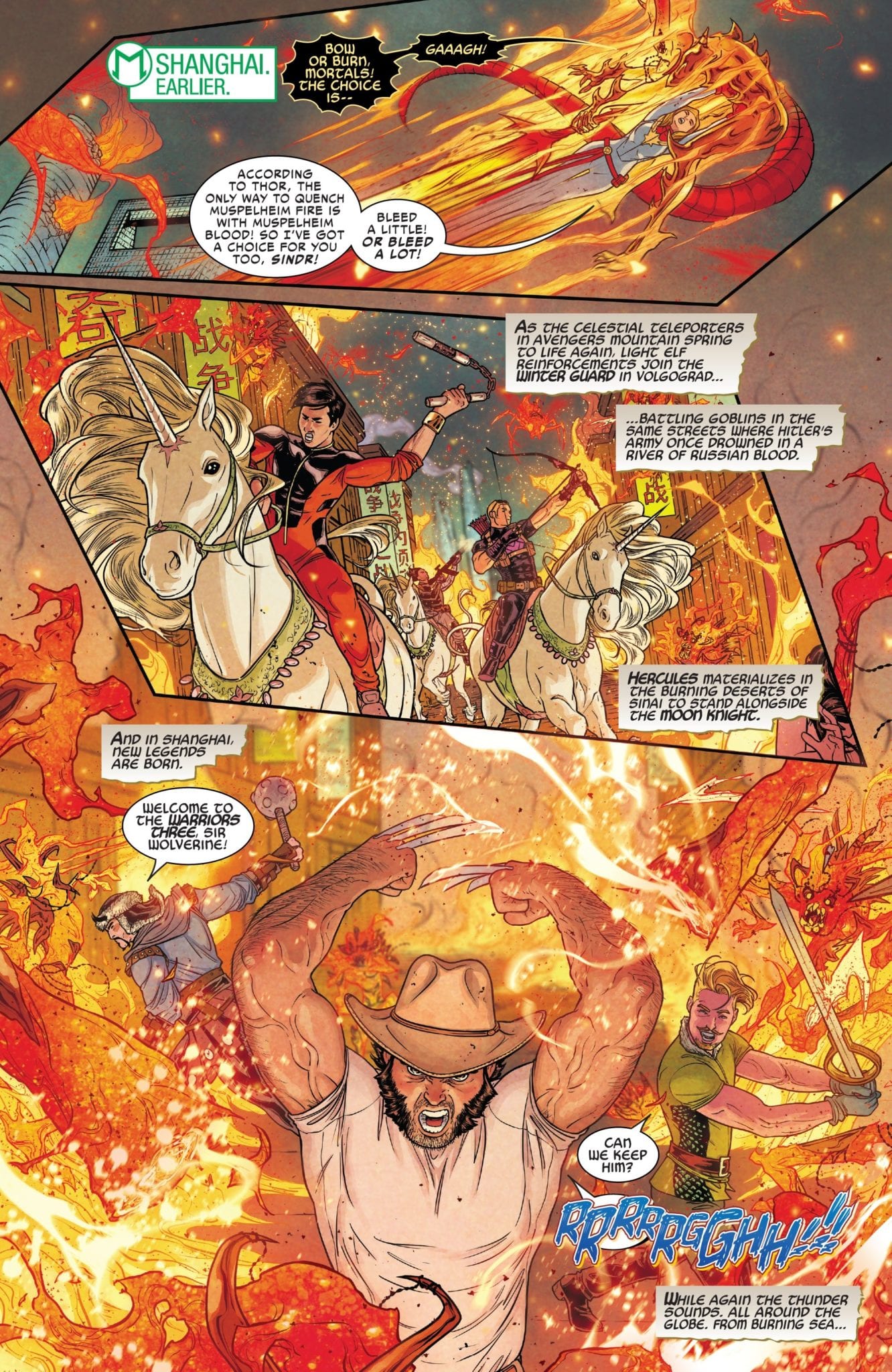
Moments like Spider-Man leading “The Spiders Of Hel” or Wolverine joining the Warriors Three are satisfying quick bits that fans will remember fondly long after the event concludes. Jason Aaron creates these insane scenarios and takes time to have characters like Spidey be in awe of how bizarre and awesome the world they live in is.

It’s impressive that Jason Aaron is able to have his cake and eat it too as far as Thors are concerned. We have a triumphant return for Odinson as he returns to form in glorious fashion. We also have the continuing saga of Jane Foster as a nonstop force of will and determination.

Jane Foster’s new role as All-Mother/Valkyrie doesn’t come across as the usual re-purposing of a character that was momentarily holding a superhero’s mantle. The journey Jason Aaron has taken Jane Foster on has been both satisfying and rewarding.

Colorist Matthew Wilson fills the backgrounds of each and every battle scene with glorious movement and action. Up front we have fleshed out characters, blushing with exhaustion and anger through the blended colors. Fires burn bright and the ensuing chaos explodes off the page, Wilson is the perfect extension of Dauterman’s illustrations.

Artist Russell Dauterman does a lot of interesting panels utilizing depth perception and a blurry effect that look wonderful. There are a few characters that he doesn’t have the best eye for yet but that barely matters when he has such a huge cast to work with. Dauterman’s action scenes hit hard and his dramatic panels carry plenty of weight.

Dauterman has also shined brightly when it comes to the violence and gore of the series. Handing a bunch of Asgardian weaponry over to Earth’s mightiest, and heavily featuring Frank Castle, yields a lot of bloody action and Dauterman has delivered on every brutal blow.

Ultimately, what makes War Of The Realms succeed where so many Marvel/DC events have failed over the past decade or so is inclusion. This story affects every single corner of the 616 universe, but doesn’t shake the makeup of the universe. It’s a good old-fashioned fight against the forces of evil to save the universe.

Rather than taking an entire reboot of a publisher’s whole line to have a united front, War Of The Realms unites the whole Marvel line against a single enemy. It doesn’t feel forced or fabricated because it’s a threat that’s slowly been developing over years and not just some new big-bad who knocked out the previous big-bad.

There’s a palpable sense of comradery among these heroes, they’re facing this invasion together. From the main book to all the various tie-ins, so much is happening out in the open. This isn’t a story of secret missions, this is a public stance to save our realm. The story isn’t complicated or trying to say much other than that comic books are still fun.

It’s exciting to see all our favorite heroes, as well as the lesser-known, step-up and do what they do best. Malekith and his forces are also a familiar and interesting threat, not just faceless hordes of enemies. Each ally of Malekith is a faction or figure prominently featured in a Thor story at some point.

War Of The Realms is a return to form for Marvel events, it’s an instant classic that just has fun being a Marvel comic book. This should be the blueprint for large-scale comic book crossover events going forward; hopefully DC is paying attention as well.

Monkeys Fighting Robots Youtube

How JUSTICE LEAGUE #25 Plunges DC Into “Year Of The Villain”

Monkeys Fighting Robots

With Justice League #25, writer Scott Snyder delivers a riveting prologue to “Year of the Villain,” DC’s upcoming company-wide event. By the end of the issue, the reader will be left begging for the official introduction to the expansive crossover.

Warning: this article contains spoilers for Justice League #25. Reader discretion is advised.

Superman in Justice League #25
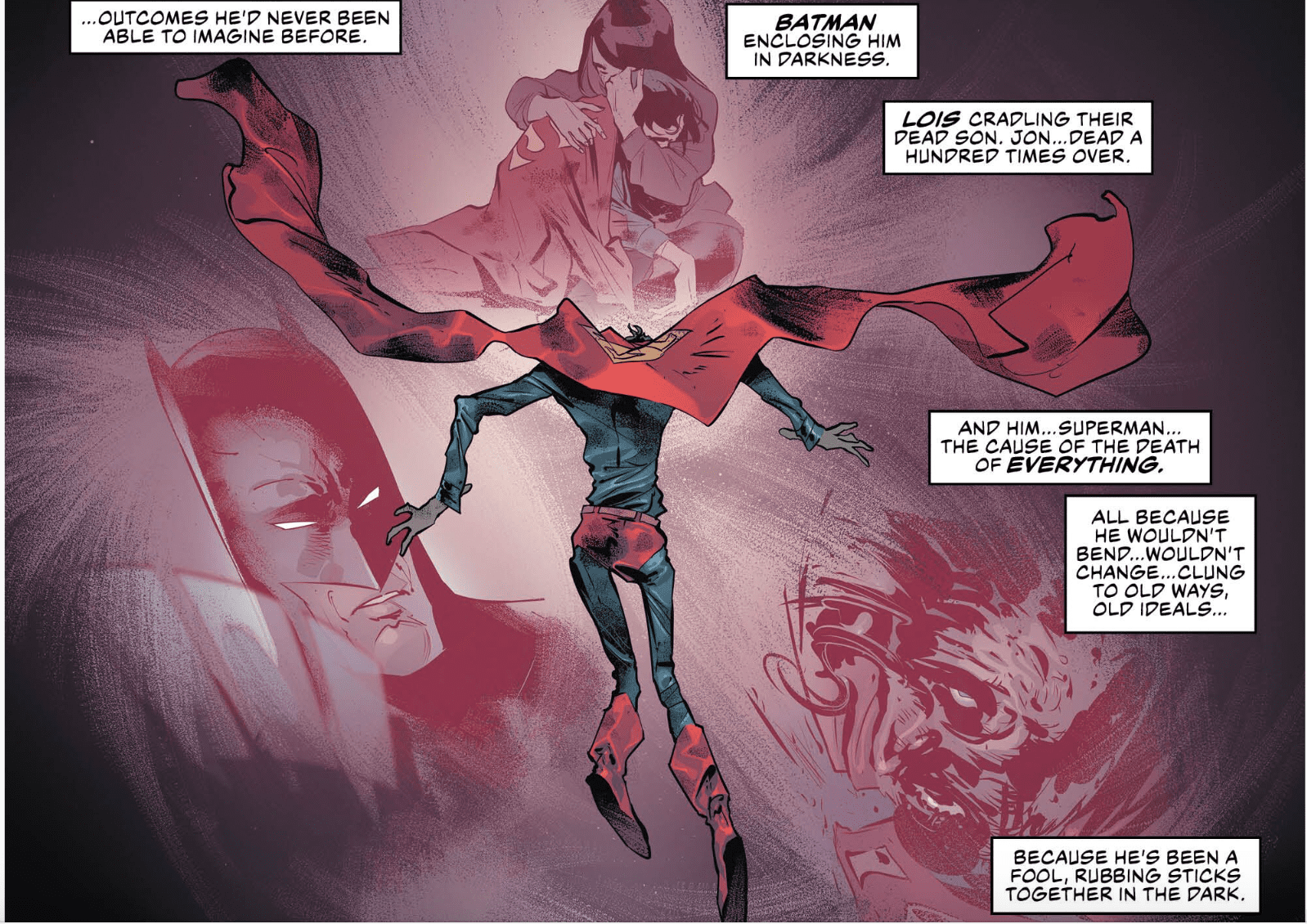
Superman nearly loses all hope in Justice League #25

THE ONLY WAY OUT IS TOGETHER

Since March, the “Sixth Dimension” storyline has dominated Justice League; in this climactic issue, the team narrowly avoids yet another universe-altering crisis, as well as a conflict similar to Marvel’s Civil War. Batman plays Tony Stark’s role when he seemingly betrays his teammates by aligning with the World Forger. The Dark Knight believes his actions are essential for the heroes’ victory but, like Steve Rogers, the Flash and his allies refuse to compromise their morals by joining him. Another full-fledged battle between Batman and the Leaguers could be an enthralling story and hopefully we’ll get to see it someday. But, as it turns out, the Caped Crusader didn’t turn to the dark side this time; instead, he secretly had the heroes’ triumph planned out all along.

Seeing Superman swoop in and save the day might make the reader want to sigh with disappointment. Countless other times, the Justice League has faced an insurmountable threat, and Big Blue’s heroics are the deus ex machina that bails them out. While Snyder’s climax calls back to Final Crisis, where the Man of Steel overcomes darkness and doubt with his unfailing optimism, it tells a more intimate story. Unlike Grant Morrison’s famous event, Snyder’s tale individually focuses on the Last Son of Krypton; the hero must push past his own insecurities rather than those of the entire world. Subsequently, Snyder holds a microscope to Superman’s strained psyche. The hero’s time as a prisoner in the Sixth Dimension has eroded the Kryptonian’s persistently hopeful attitude. He can imagine eventualities where Batman will betray him, which demonstrates a steep drop from the Man of Steel’s legendary optimism. Still, when he’s on the verge of giving up, Superman reminds himself of his friends and teammates and draws strength from these memories.

“Together, we are more than we can even imagine,” Snyder narrates while Superman inevitably beats the World Forger. The Justice League may have bent under the pressure during “The Sixth Dimension,” but they certainly didn’t break. Though the heart-pounding conclusion to this issue doesn’t paint a rosy picture for the team’s future, the Leaguers’ latest test has only strengthened the bonds between them.

Justice League #25, Flash, Wonder Woman
The League’s fight with themselves seems like the main story but there’s a more dire threat on the horizon.

IT’S ALL COMING TOGETHER

DC’s Year of the Villain #1 gave fans an explosive preview of the titular event that could radically change the status quo of the DC Universe. In that one-shot, some of DC’s top writers, including Snyder, Brian Michael Bendis and James Tynion IV, revealed that many of the company’s worst villains are teaming up in another ambitious attempt to beat the heroes once and for all. Naturally, as the author of Justice League, Snyder hosts the opening round of this brewing war.

At the end of this issue, Batman, Superman and their teammates return home and quickly learn there’s no rest for the weary. During their absence, Lex Luthor and the Legion of Doom saved the world from Mister Mxyzptlk, one of Superman’s classic antagonists. Luthor used the victory to globally broadcast a devastating speech in which he told billions of people that, thanks to the Justice League, the multiverse is dying. Snyder crafts a masterful monologue for Luthor, who tells everyone to reject the Justice League in order to save themselves. With just one broadcast, Luthor has turned the world against the League. Plus, thanks to his self-sacrifice, first seen in DC’s Year of the Villain #1, he made himself a martyr. Mera delivers these world-changing news updates to the League and, just like that, the “Year of the Villain” has begun.

The heroes begin to deliberate their response(s) to these developments (finding the Monitor and the Anti-Monitor and assembling a multiversal army), but Luthor’s schemes have the League on the ropes, if not already defeated.

What did you think of Justice League #25? How do you think “Year of the Villain” will change the DC Universe?

Monkeys Fighting Robots Youtube

Review: JUSTICE LEAGUE #25 and One Punch Superman

Monkeys Fighting Robots

In Justice League #25, the Sixth Dimension storyline culminates with an explosive brawl for the fate of the Multiverse. Will the Man of Steel be able to find his super friends, or be forever lost in a pocket dimension of infinite darkness? Will the Justice League defeat their older, more powerful super-dopplegangers? Has Batman truly turned heel in order to preserve this idyllic future? Read on to find out.

Previously, on Justice League, the team hurtled through Sixth Dimension space, with Apokalyptian guards Lois Lane and Jimmy Olsen on their tail. Thanks to this dimension’s versions of Darkseid and The Legion of Doom, the heroes managed to escape. However, the World Forger, Justice League of Tomorrow, and a super-powered, super-suited Batman now stand in their way.

** Some Spoilers Below **

Justice League #25 Cover

Story

The “Sixth Dimension” storyline wraps up in this oversize issue as Superman faces down the World Forger to save the Justice League! Can Superman withstand the might of a being that can create worlds from nothing?! Plus, with the Justice League away, Mr. Mxyzptlk’s been wreaking havoc! Can anyone on Earth stand up to the fifth-dimensional menace?

As far as comic book conclusions go, Justice League #25 has proficient pacing. It gives the right amount of time for each beat in the over-sized issue. What stands out in the writing is the narration Snyder scribes as Superman makes his last stitch effort to escape his galactic prison. It starts out as something grim and full of despair. From there, it builds into words of inspiration and full of hope.

Snyder concludes the issue with a positively sinister message from Lex Luthor. He encourages the world to unleash their inner villains in order to save the world. It’s a chilling and exhilarating set up for the upcoming Year of the Villain event. This issue proves once more that Scott Snyder is one of the most talented storytellers working in the comic book industry today.

Justice League #25 Page

Art

The artwork is masterful, as we’ve come to expect from Jorge Jimenez and Alejandro Sanchez.

Yes, the intense action sequences of Leaguer versus Leaguer are expertly illustrated and colored. However, what truly stands out in Justice League #25 is Superman’s visual journey. Starting out as a deflated and emaciated version of himself, Superman makes a stunning transformation before the readers’ eyes when he reaches the suns.

A splash page featuring the Man of Steel, his father, and his son is as heartwarming and powerful and intense as the suns he flies through. It builds and culminates in the single punch heard around the Multiverse. It is visual storytelling at its apex.

Conclusion

Snyder and Jimenez craft an exciting, adrenaline-fueled conclusion to one of the best Justice League arcs – both in terms of storytelling and artwork – in years. The book is made that much more enticing by the set up for the Year of the Villain event.

What did you think of Justice League #25 and the conclusion of The Sixth Dimension? Let us know in the comments!

Monkeys Fighting Robots Youtube

JOKER/HARLEY Coming To DC’s Black Label

Monkeys Fighting Robots

DC Comics already has a Joker-centric Black Label book on their hands with Batman Damnedand all the controversy that’s come along with it. Now the publisher has announced a new BL book debuting this October: Joker/Harley: Criminal Sanity. Much like Sean Murphy’s Batman: White Knight, the series puts a new spin on an old relationship.

Joker/Harley DC Black Label

Joker/Harley will be written by Kami Garcia (author of the upcoming Teen Titans: Raven) and illustrated by Mike Mayhew and Mico Suayan. DC put out this plot description:

The nine-issue psychological thriller follows Harley Quinn, the young and brilliant forensic psychiatrist and profiler consulting for the Gotham City Police Department (GCPD), as she pursues a vicious killer terrorizing the city. She has no idea the investigation will bring her face-to-face with the most notorious serial killer in Gotham’s history—the Joker.

Writer Garcia said,

“There is no character more terrifying than the Joker. He is one of the most complex psychopathic killers ever created. I wanted to approach the project as if  the Joker was a real person—an intelligent and sane psychopath, who kills because he wants to, not because he suffers from delusions… In the series, Harley is the only character with the skill set and intelligence to hunt the Joker, but the investigation will force her to confront her own inner demons.”

Dan DiDio added,

“When Kami came to us with the idea of profiling one of the most mysterious and dangerous characters in the DC Universe, it felt so new and original. Kami, Mico and Mike are taking great care to ensure that the mystery surrounding the Joker and Harley Quinn remains intact, while delivering a story that’s both compelling and haunting. This series is exactly the kind of unique, standalone story that’s perfect for DC Black Label, one we hope will engage both casual and new fans of these characters.”

You can read the full press release here. Joker/Harley hits comic stores on October 2.

Are you interested in seeing the Harley Quinn-Joker story retold as a Black Label, out-of-continuity series? Leave us a comment!

Monkeys Fighting Robots Youtube

SUPER SOLDIERS Exclusive Excerpt: Is War Machine A “Good Soldier?”

Monkeys Fighting Robots

Super Soldiers is out June 18th, and thanks to author Jason Inman, Monkeys Fighting Robots has an exclusive excerpt to share with you.

The book is an exploration of the correlations between the real-life American Armed Services and superhero comic books, and how the former influences the latter. Each chapter breaks down a different comic book service member – such as Captain America, Batwoman, and even Beetle Bailey – with the goal of deciding whether or not they are a “good soldier” by realistic, contemporary military standards. Inman also shares never-before-told stories about his time in the Army, deployed as a soldier in Iraq.

In addition to serving in the military, Inman has written the creator-owned comic book series Jupiter Jet, and has appeared on DC All-Access, Collider, Nerd Alert, and Screen Junkies. Super Soldiers is his first prose novel.

Pre-order Super Soldiers on Amazon by clicking here, and keep scrolling to read an exclusive excerpt from the chapter on Marvel’s War Machine.

super soldiers exclusive preview excerpt jason inman war machine

Take an exclusive look at Super Soldiers‘ chapter on War Machine:

When Tony came across Rhodey in the steamy jungle, the billionaire philanthropist was clad in the very first Iron Man suit he ever designed. (We’ll not mention why Tony is also wearing a trench coat and hat on top of the armor. That subject could fill another three-hundred-page book.) Rhodey was desperately trying to fix his helicopter to get back in the air when the newly minted “Iron Man” loudly lumbered through the trees. Rhodey did what any decently trained airman would do—he pointed his M16 at the monstrosity and fired! When the bullets had no effect on the Iron Man, Rhodey remarked, “Oh mama, looks like I’ve stepped in the bad stuff this time.” Iron Man assured Rhodey he would not harm him, but he needed the batteries from Rhodey’s downed helicopter to recharge his suit. If he couldn’t get a boost soon, the suit would fail and Tony Stark’s heart would stop. (This was during the time in Tony Stark’s career when he still needed the Iron Man suit to survive.) The two men barely had a moment to consider their next moves when a Viet Cong patrol attacked their position. The two were forced to unite against a common enemy. There’s no quicker way to forge a bond than that! Iron Man saved Rhodey’s life, which ultimately convinced James Rhodes to allow Iron Man to drain his helicopter’s batteries. As a result, the helicopter was permanently down for the count. Not only that, but Rhodey’s leg had been injured during the surprise attack. Determined not to leave behind the brave soldier who had helped him, Iron Man carried Rhodey on foot until they reached the American perimeter and safety. After being released from the hospital, Tony Stark appeared to Rhodey and thanked him for helping his Iron Man reach safety; he then offered Rhodey a job after the hostilities in Vietnam ended.

(Readers’ note: Iron Man kept his real identity secret from Rhodey and made him believe Iron Man was Tony’s bodyguard. One can only imagine the conversations they must have had, jaunting through the jungle. “Hey, Iron Man, what movies do you like?” This was a ruse that Tony Stark perpetrated on several people in the comics over the years, not just Rhodey.)

This brief encounter proves Rhodey was ready to think outside the box. He wasn’t—and is not—limited to the rules and standard procedures of the Air Force. Rhodey is willing to critically think about the situation and use the available means to accomplish his goal. You don’t look a gift iron robot man in the mouth. After a series of other jobs, Rhodey left the military and finally accepted Stark’s offer. He became Tony’s personal pilot and aviation engineer.

super soldiers exclusive preview excerpt jason inman war machine
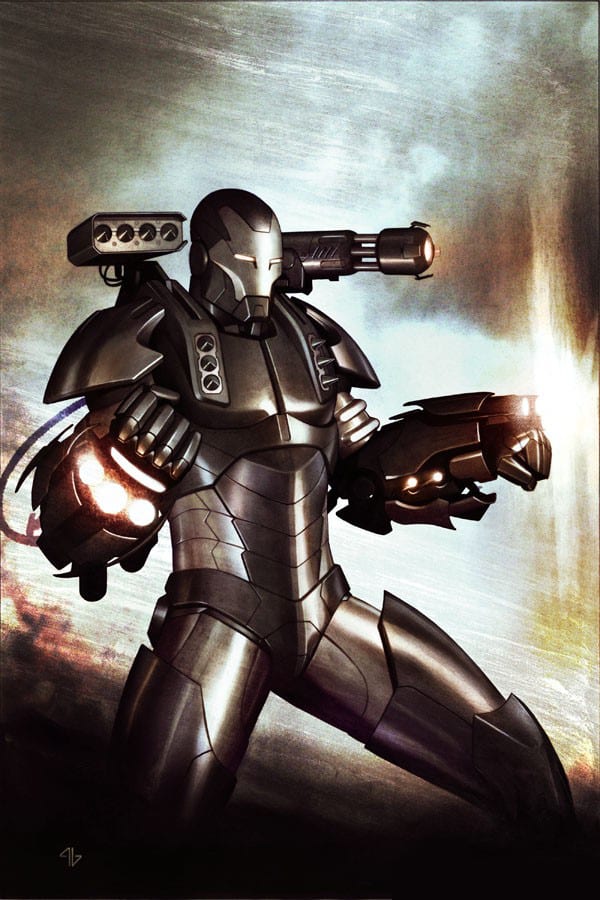
War Machine by artist Adi Granov, from the cover of IRON MAN: DIRECTOR OF S.H.I.E.L.D. #33

Many people like to put service members in a box—typecasting them, if you will. If you join the Air Force, then the only career fields for you after your service are flying jumbo jets for airlines, or NASA. Rhodey took a job that was a little of both. If not for his acceptance of the strange, he would never have found himself working for a multibillionaire superhero, a job which would eventually lead him to his own true destiny: becoming a superhero.

When my time in the service was over, I considered many jobs connected to my old life. I had just come back from a year in Iraq, and many of the civilian contractors who staff bases in the combat zone are always looking for experienced former soldiers. Since you’ve already seen the combat theatre up close, you know exactly what to expect. There would be no surprises. (In retrospect, I can’t imagine any full civilian non-veteran who would accept a job in a combat zone. No job pays that well.) There is one employer whose pay is woefully poor—the US armed forces. Join any of the branches and, unless you quickly move up the ranks to captain or major, you’re going to find your paycheck lacking. Now, there are plenty of other benefits that sometimes make up the difference when you are serving, but not many. Our fighting men and women are severely underpaid for the job we expect them to do. Civilian contractors in a combat zone, on the other hand, are paid handsomely. I remember asking the civilian who managed our fuel base on Tallil Air Force Base (the post I was stationed at in Iraq) how much he made. He simply laughed and said, “It’ll make your head spin, kid.” It’s the only reason I ever considered going back to the dusty lands of the Middle East, because maybe, just maybe, the pay would make it worth my time. I obviously never made that choice, since I now sit here writing this book. However, this exact choice was made by James Rhodes, and I like to think his Stark paycheck was very handsome. It’s a choice I think many combat veterans would have also made.

Rhodey is also a character who values loyalty. Perhaps it was his many years serving in the Air Force, perhaps Rhodey always had a loyal bent, but this trait has come to define his relationship to Tony Stark. While many people in the world do not trust Tony, Rhodey always sticks by him. This essentially makes Tony his civilian battle buddy. That’s a term for when you are partnered to another soldier in combat; it’s your duty to look out for each other and ensure you both make it through the mission unscathed—no matter what. I believe this is Rhodey’s mechanism for coping with civilian life and the strangeness of working for (and later with) Tony Stark. Think about it: most days on the job at Stark Enterprises, the Living Laser or Spymaster will come crashing through your windows, then try to steal the newest technological invention built by your boss. Only by focusing on his loyalty to Tony, a person who gave him a shot—a friend who took a chance on him—can Rhodey deal with the insanity destined to occur in the same building as Iron Man’s exploits.


Super Soldiers is out June 18th; you can pre-order it on Amazon by clicking here. And keep it tuned to MFR for our review in the coming weeks.

See what others are saying about Super Soldiers:

“Jason Inman provides a manual which utilizes and analyzes subtext to offer psychological profiles of our favorite superheroes viewed in the context of their fictional experiences as warriors and veterans in the US Armed Forces. He demonstrates vividly and entertainingly how the superhero pantheon is firmly rooted in the disciplines, lore, and traditions of American combatants throughout history. The creators of all these characters took a good look at real-life military heroes for their inspirations and now Mr. Inman makes this link clear.” ―Dan Aykroyd, actor/writer of Ghostbusters and The Blues Brothers

“Finally, someone takes a deep dive into two of our best American institutions. From Captain America to the rest of this elite unit, get ready to salute.” ―Brad Meltzer, bestselling author of The First Conspiracy

“Super Soldiers is a hell of a fun book. Jason Inman has written a love story to soldiers, to comic book heroes, and to his country. Witty, fast-paced, and nerdy (I mean learned) on his subject, Inman is a perfect guide for a deep dive into the interwoven historiographies and mythologies of American warriors and pop culture.” ―Anthony Swofford, former US Marine and author of Jarhead

Monkeys Fighting Robots Youtube

Review: Raising the Stakes in RED SONJA #5

Monkeys Fighting Robots

To achieve victory, you often have to make a sacrifice. It’s a much harder call to make, though, when peoples’ lives and livelihoods are on the line, which is the theme of the core narrative in Red Sonja #5.

The Hyrkanians are still on the run from Dragan’s advance.  Sonja orders a scorched earth approach in response, hoping to turn the tides against him. The plot thickens, though, when one of Sonja’s closest allies and confidants is drawn into a trap.

The Writing

Early in the issue, we see another flashback to Sonja’s earlier days as a student under Domo of Khitai. Domo imparts a utilitarian lesson on Sonja: you can’t always save everyone. “To defend everything is to defend nothing,” he says. Sonja applies this lesson as a calculated strategy against her enemy.

Mark Russell’s writing on the series thus far has been marked by a deft balance of humor and drama. That balance of elements has been one of the series’ strongest assets. Red Sonja #5, though, largely eschews the former to emphasize the human toll of the story. Downplaying the humor here in favor raising the stakes for the Hyrkanians, as well as for Sonja herself, adds pathos to the storytelling and enriches the narrative.

The story has additional dimension to it as well. Sonja doesn’t order a scorched earth retreat lightly. Instead, she orders her men to round up as many of the stragglers of Hyrkania who refused to flee and rescue them from Dragan’s army…by force, if necessary.

That said, Sonja doesn’t come across as an unreasonable tyrant. Her decisions in Red Sonja #5 feel guided, ultimately, by compassion and a desire to rescue her people. It’s a very difficult balance for a writer to strike but, to Russell’s credit, he manages the task well.

We also see solid development of supporting characters about whom we’d previously known relatively little. Their development enriches the plot and heightens the stakes of the narrative within the issue.

Red Sonja #5

Red Sonja #5

The Artwork

Mirko Colak’s illustrations in Red Sonja #5 are strong throughout. Panels flow well, drawing the eye smoothly from one image to the next and matching the story beats.

Much of the issue is dialogue-heavy. Thus, most of the panels are limited to tightly-cropped images of characters’ faces. However, he doesn’t pass up the opportunity to open up occasionally into impressive full-page illustrations when called for. Add to that the fact that the slower moments and occasional pops of rich art allow for the color work to shine. Readers can pick up on the more subtle tones employed, and appreciate the detail in the contrasts.

As the issue is so dialogue-centric, it highlights that Colak has a slight tendency to present characters with fairly uniform, unexpressive faces. Dialogue is mostly presented with either closed mouths, or a cynical sneer. That’s the only real gripe to be had, though. Overall, it’s a strong showing in the art department.

 Final Thoughts

Red Sonja #5 is a turning point in the series. While it backs off from the humor that was a strong suit in previous issues, it more than makes up for it by advancing the narrative, heightening the stakes, and deepening our cast of characters. Highly recommended.

Monkeys Fighting Robots Youtube

Top Five Moments In DETECTIVE COMICS ANNUAL #2

Monkeys Fighting Robots

Watching Batman come face-to-face with a dark version of himself isn’t a new experience; Last year, DC churned out an extensive event primarily focused on the idea. Still, in Detective Comics Annual #2, writer Peter J. Tomasi revitalizes an idea plenty of Batman stories have explored over the years.

Story by Peter J. Tomasi, art by Travis Moore and Max Raynor, color by Tamra Bonvillain and Nick Filardi, letters by Rob Leigh, cover by Guillem March.

In many ways, Tomasi’s self-contained adventure organically connects to Tom King’s Batman. From Alfred’s sass to Bruce’s introspection, this annual borrows several elements from King’s successful run. The only significant difference between Tomasi’s Bruce and King’s version comes when Bruce semi-dates an eligible bachelorette who isn’t Selina Kyle. Otherwise, the two iterations of the character are practically identical. Some readers may wish to see more differences between Detective Comics and Batman, but this overlap is satisfying because it feels like Tomasi is playing off of King’s narrative. Nonetheless, in addition to the main story, Tomasi packs several compelling snippets into this issue.

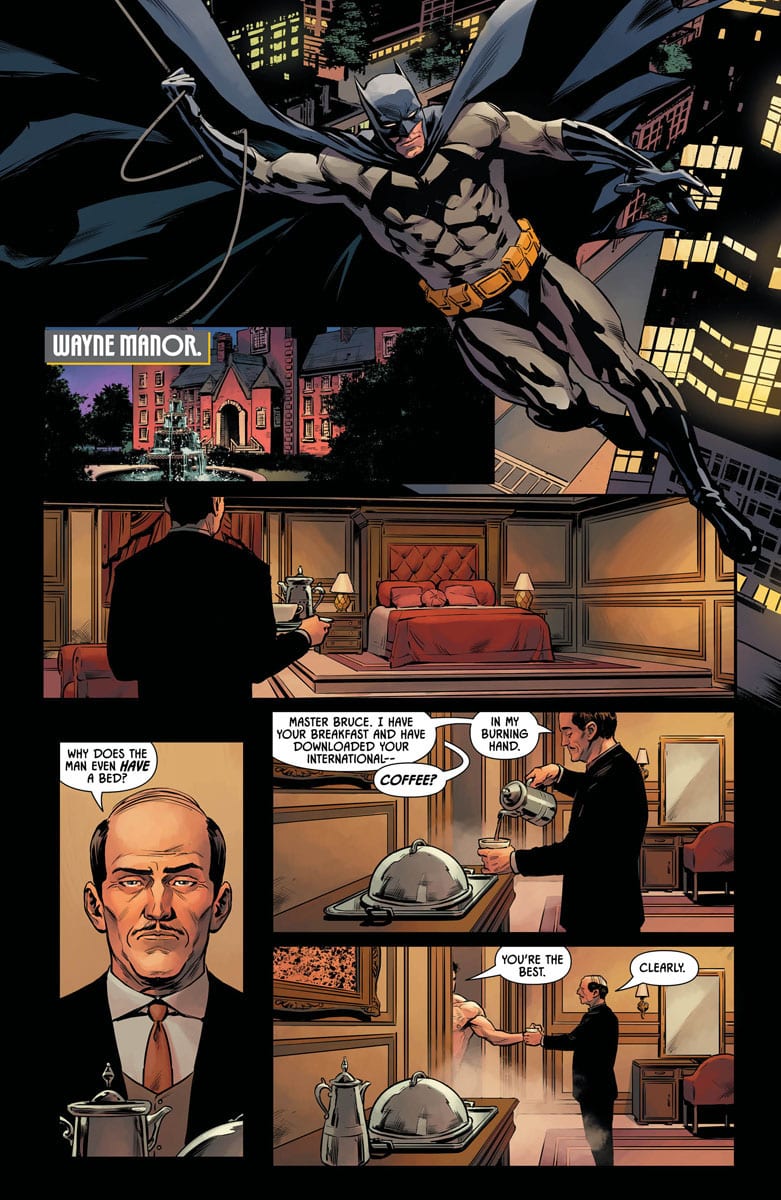
Bruce Loves Coffee

Witty exchanges between Bruce and Alfred are often the best part of any Batman story. Here, Tomasi delivers several delightful moments. Early on, everyone’s favorite butler bemoans Bruce’s lackluster sleeping habits. Alfred calls to Bruce, who’s in the shower, and begins to tell him that his coffee his ready. Bruce interrupts his butler and completes his sentence by loudly saying, “coffee?” The comedic timing of the line is elevated by letterer Rob Leigh’s use of bold text, which allows the reader to hear the eagerness in Bruce’s voice at the prospect of a fresh cup of joe. At least for this coffee addict, Tomasi delivered one of the most relatable moments in a Batman comic in recent memory.

Detective Comics Annual #2, Bruce Wayne, Alfred
Hot take: this exchange is the best moment in the entire issue.

Batman Gives Gordon Lollipops

Another brief scene comparably boosts another strong issue. When the Dark Knight catches up with Jim Gordon, the two friends engage in small talk, and one particular sequence stands out. Gordon, who always has a cigarette in his mouth, thanks Batman for giving him a box of lollipops because it’s helping him cut back on smoking. With a hint of a smile, the Caped Crusader says, “my pleasure.” There might not be a more wholesome moment in Batman comic for the rest of the year. These snippets aren’t significant in the main story, but they make the issue even more enjoyable.

Detective Comics Annual #2, Batman, Jim Gordon
There might not be a more wholesome moment in a Batman comic this year.

Bruce’s Profile of The Reaper

It’s likely that the reader didn’t pick up this comic for those moments alone. The primary hook here is the return of the Black Casebook and, specifically, the Reaper, or Judson Caspian. Using streamlined exposition, Tomasi recaps Batman’s history with the villain while also establishing Caspian as a foil to Bruce. The information, which is primarily delivered on one full page, conveys the striking parallels between Batman and the Reaper. Both men experienced a tragedy and used it as the catalyst for a war on crime. Caspian only diverges from Bruce in his willingness to kill. (Obviously, Batman would never kill anyone…right?)

At times, Tomasi makes the characters are too similar for their own good. The best foil characters diverge in a number of ways whereas Batman and the Reaper have one key difference. Otherwise, every time Bruce talks about Caspian, he might as well be talking about himself. But this parallelism allows Tomasi to show some tangible growth between the Batman who initially encountered the Reaper years ago and the one who faces off with the villain today. Tomasi’s version of the Dark Knight has a (mostly) secure grip on his no-killing policy and there’s a clear line between him and the criminals he fights. (King’s version of the character, as seen in recent issues of Batman, clashes with Tomasi’s vision, which softens the resemblance between the two.)

The Reaper, Batman, Detective Comics Annual #2
The Reaper looks like a classic horror movie monster.

The Debut of The Reaper

From the first time the Reaper appears, the villain instills the reader with a sense of dread. He silently kills criminals, who don’t scream or react during these violent acts. The first appearance of the Reaper makes this eerie effect even more notable. When he arrives, the reader can practically hear the soundtrack of an old-school horror movie in the background.

Detective Comics Annual #2, Batman, The Reaper
The artwork in Detective Comics Annual #2 makes the Reaper look like a fresh take on a mythological ghoul.

The First Fight Between Batman And The Reaper

The work of artists Travis Moore and Max Raynor, as well as colorists Tamra Bonvillain and Nick Filardi, repeatedly captures the idea that superheroes and supervillains are the modern world’s answer to ancient mythology. With one panel, in which the Reaper flies through the night sky in front of the full moon, the art makes the villain feel like a macabre demon. In the same scene, Batman and the Reaper both get full-panel shots where they swoop in front of a background lit up by street lanterns. The lights add a sense of surrealism to the inevitable fight between the two characters and make it feel like a clash between mythological Titans.

Detective Comics Annual #2 features many memorable moments, and we’ve only outlined a few of them. What’s your favorite moment from this issue?

Monkeys Fighting Robots Youtube

Review: An Old Foe Back from the Grave in DETECTIVE COMICS ANNUAL #2

Monkeys Fighting Robots

What’s the Caped Crusader to do when one of his earliest foes returns from the dead? Detective Comics Annual #2 reopens a chapter Bruce thought he’d closed long ago within his Black Casebook.

Batman discovers that Gotham’s former lethal enforcer, The Reaper, is now stalking the cities of Europe. Fortunately, Bruce Wayne has a convenient cover story to allow Batman to head for Greece and investigate The Reaper’s apparent return.

The Writing

Tomasi delivers a well-constructed story in Detective Comics Annual #2. It’s a compelling narrative that keeps the reader’s interest throughout. It’s open-ended, and there’s no immediate resolution here. However, it lays the groundwork for future chapters to continue the story, which is an optimal role for an annual issue to play in a long-running narrative.

One of Tomasi’s strengths is writing sharp, witty dialogue. We see that reflected in the banter between Bruce and Alfred, which some writers tend to treat as disposable or best for throwaway jokes. Here, though, their interactions are lively and entertaining. Tomasi’s mentioned in past interviews that one of his goals is to explore the more human side of Batman. And, while showcasing Bruce’s failings is certainly part of that, showcasing the character’s wit and sense of humor is just as important.

There is a two-page info dump in which Tomasi relays key points in Bruce’s history with the Reaper (as illustrated in the 1987 story Batman: Year Two). Even this recap is fairly concise, though, and with Travis Moore’s formidable illustrations, it doesn’t slow the book’s momentum. Detective Comics Annual #2 delivers well-paced storytelling, and primes readers’ anticipation for when Tomasi picks up this story thread again.

Detective Comics Annual #2

Detective Comics Annual #2

The Artwork

Moore’s artwork in this issue is meat-and-potatoes. The designs and style are not exceptionally unique, but they feel very lively, and work well alongside the serious, yet humorous storytelling. Characters’ faces tend to be illustrated with closed mouths, but he conveys emotion effectively through subtle brow furrows and poses.

Moore’s eye for detail is on display in Detective Comics Annual #2. Plants in the backgrounds and bottles on shelves are illustrated with individual, painstaking detail. Panels flow well from one to the next, never giving the reader’s eye license to wander from the current image.

Colorists Tamra Bonvillain and Nick Filardi employ a similar effect for the colors in the book. The colors hue toward a realistic reflection, but they’re richly detailed. The art team collectively showcase their skills here.

Final Thoughts

Detective Comics Annual #2 is a diversion from Tomasi’s ongoing story in the main Detective Comics continuity, but it’s a very enjoyable one. Definitely worth picking up.

Monkeys Fighting Robots Youtube