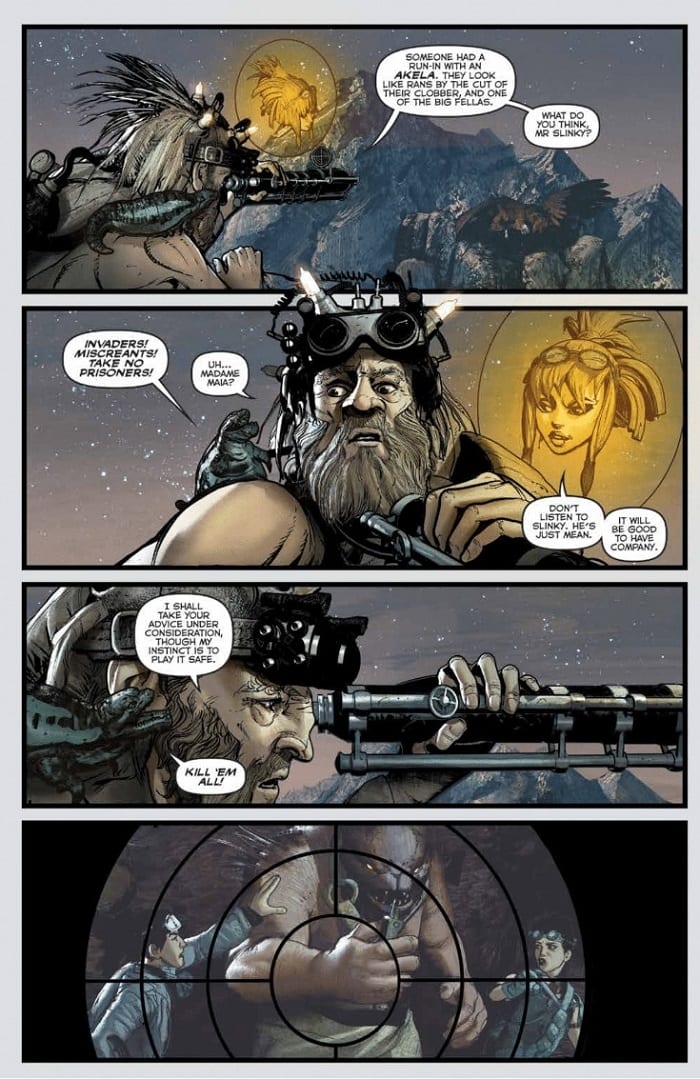
Dark Red #6 hits your local comic book store on September 4, but thanks to AfterShock Comics, Monkeys Fighting Robots has an exclusive four-page preview to share with you.
The series is by Tim Seeley and Corin Howell, with colors by Mark Englert, letters by Marshall Dillon, and a cover by Meghan Hetrick. The incentive cover is by Howell.
About Dark Red #4: NEW ARC STARTS HERE
In the aftermath of war, Fall’s End is littered with the dead. Chip has his territory back…until something else walks into his town.
Something not human. Not vampire.
Something hungry.
Tim Seeley (BRLLIANT TRASH, Hack/Slash, Grayson) and Corin Howell (Ghostbusters, Bat-Mite) bring you a contemporary and horrifying tale of vampirism in the heart of America—one that’ll make you jump right out of your boots.
DEADPOOL ANNUAL #1 hits your local comic book store on August 21, but thanks to Marvel Comics, Monkeys Fighting Robots has an exclusive four-page preview.
DEADPOOL ANNUAL #1 is written by Dana Schwartz, with art by Reilly Brown, Aaron Kuder is the cover artist, Nelson DeCastro & Craig Yeung inked the book, Matt Herms with Guru-eFX are the color artists, and Joe Sabino lettered the pages.
About the issue: ACTS OF EVIL! Eight-year-old Peter Quincy is willing to pay seven dollars to the person who can kill his bad dreams, and the Merc with a Mouth is on the case! But if Deadpool wants to earn that sweet, sweet paper, he’s going to have to throw down with Nightmare himself!
If you are a podcast nerd you know Schwartz as the host and creator of the podcast Noble Blood.
Schwartz is a fresh voice for Marvel as she’s written for Entertainment Weekly The New Yorker, The Guardian, The New York Observer, Marie Claire, Glamour, Mic, GQ, VICE, and others according to her website.
Schwartz could be a perfect fit for Deadpool as she’s created a parody Twitter account called @GuyInYourMFA based on the people she’s encountered in fiction workshops, and another one called @DystopianYA about the tropes in all of the young adult fiction books she’s read.
With Schwartz as the writer, are you more excited for the DEADPOOL ANNUAL? Comment below with your thoughts.
CHECK OUT THE DEADPOOL ANNUAL PREVIEW BELOW
Deadpool (Wade Winston Wilson) was created by writer Fabian Nicieza and artist/writer Rob Liefeld, the character first appeared in The New Mutants #98 (cover-dated February 1991).
With Sonata #3, in stores this week from Image Comics, creators David Hine, Brian Haberlin, and Geirrod Van Dyke recover much of the magic they kindled on the first issue.
Sonata, Pau, and Treen are thousands of kubits from home, in the planet’s southern hemisphere. At the same time, the Ran and Tayan put aside their differences momentarily, deciding to brave the Valley of the Sleepers to try and rescue the kids. However, the situation may not be as it appears, with one side planning an unexpected double-cross.
The Writing
Sonata #3 follows two concurrent plot threads: that of Sonata, Pau, and Treen, and that of their people back at the Lumani village. The book opens to the trio being observed by a lone figure in the desert. We presume this figure to be a survivor from one of the Ran’s expeditions, which is later affirmed. Meanwhile, the village falls under attack from a giant, which displays some unusual abilities we’ve not yet seen them exhibit.
The narrative in Sonata #3 is driven primarily by human drama. There’s plenty of interpersonal squabbling, but it manages to avoid becoming irritating or frustrating. The conflict between these groups is believably written and compelling overall.
We’re also treated to a broader look at the world itself. For instance, we get contrasting creation myths from Sonata and Pau, each ascribing a different significance to the Sleeping Giants. They suitably reflect the diverging worldviews and attitudes of their respective cultures. Then there’s the Lumani, who seem to know more about the planet’s history than they let on to the offworlders.
One sticking point, however, is the lack of urgency in Sonata and Pau’s story. They resolve that it would be wise to head back through the portal. However, they seem content to spend all of Sonata #3 putzing around in the Southlands regardless. Much of the action is focused on the other narrative thread here.
The storytelling is engaging and evocative overall. It’s less reliant on genre tropes than our previous issue, and provides a few genuine surprises along the way.
The Artwork
Brian Haberlin’s dreamy, cloudy artwork is a treat in Sonata #3. While not quite as striking as in our first issue, it retains the rich detail and ethereal mood that really sell the illustrations. The mood makes the work feel like a cohesive whole, contrasting closely-cropped panels and wide, open images in regular intervals.
While the environments are more barren, the artist beings some inventive creature designs to the table in this issue. We see more of the Sleeping Giants, plus some bizarre, wendigo-by-way-of-hyena creatures, reinforcing the danger as well as the beauty of the planet our characters inhabit.
Van Dyke’s coloring completes the illustrations, bringing the pages of Sonata #3 to vivid life. Though muted, the color palette of earth tones interspersed with quick flashes of bright reds and gold give the images a lot of gravity. It’s hard to separate the illustration from the colors; the two form a perfectly-cohesive, singular presentation.
Final Thoughts
Sonata #3 is another winner. It’s a strong chapter in an increasingly-complex work of science-fantasy. Highly recommended. Check it out this week at your local comic book shop.
If you’ve been enjoying The Green Lantern by Grant Morrison and Liam Sharp, your reading list will be soon be undergoing a big change.
DC Comics has announced that October’s issue #12 will be the end of the series (for now). This isn’t a huge surprise, as Morrison confirmed before the book even launched that issues #1-12 would be the “first season” of his storyline.
But with an ending comes a new beginning. DC also announced a November debut for Green Lantern: Blackstars, written by Morrison and illustrated by Xermanico, spinning out of plot thread from the current series.
DC’s official description reads as follows:
Following the catastrophic events of The Green Lantern #12 by Grant Morrison and Liam Sharp, scheduled to hit shelves October 2nd, 2019, no Green Lanterns can be found patrolling their space sectors…not a single power ring lights the darkness! What happens in the finale of Morrison and Sharp’s incredible year-long run is shrouded in mystery, but the Green Lantern Corps is no more! Scratch that—they never existed in the first place. What has Hal Jordan done?
According to the writer,
“Oa is the skeleton-paved haunt of vengeful demons. And the Blackstars—a sinister cult of universal peace and harmony, involving surrender to the will of the insidious and/or possibly illuminated Controller Mu—are in the process of subjugating the universe to their creed.”
Here’s the solicitation for October’s last TGL issue:
THE GREEN LANTERN #12
written by GRANT MORRISON
art and cover by LIAM SHARP
variant cover by RILEY ROSSMO
The Green Lanterns will fall! Insidious plans meticulously set in motion since
issue #1 have reached their boiling point. As defeat looms for the Corps, Hal
Jordan’s showdown with his monstrous antimatter counterpart sets the stage for the final pages of this issue—and the moment that will echo throughout the entire DC Universe! How bad is it for Hal and the Corps? There’s no GREEN LANTERN #13 next month…but writer Grant Morrison is crafting the next chapter of this story, and it’s coming soon! Only there’s no “Green Lantern” in the title. After the events of this issue, how could there be?
ON SALE 10.02.19
$4.99 US | 40 PAGES
FC | RATED T+
Have you been keeping up with The Green Lantern? Will you follow Morrison over to Blackstars? Leave us a comment!
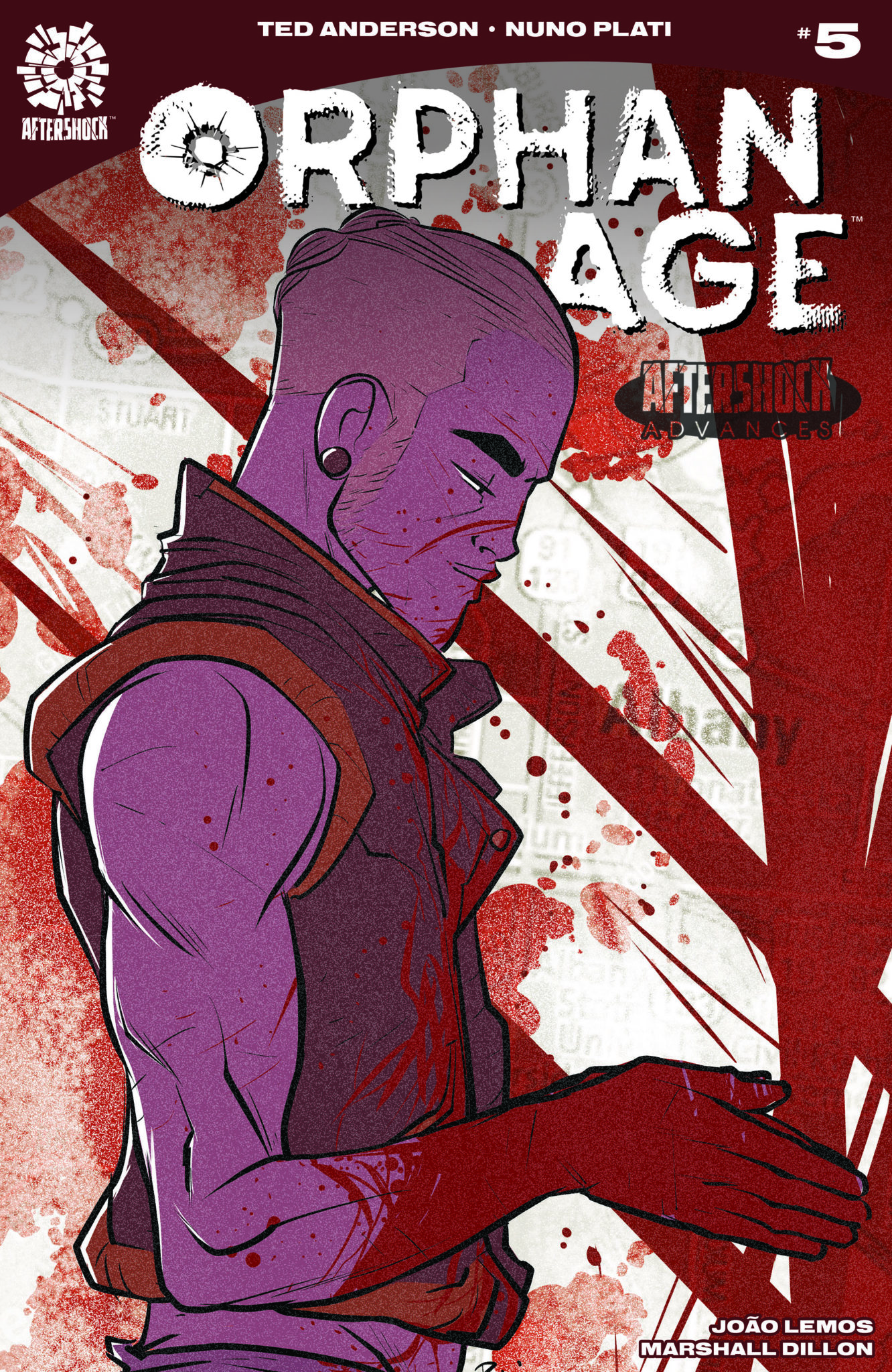
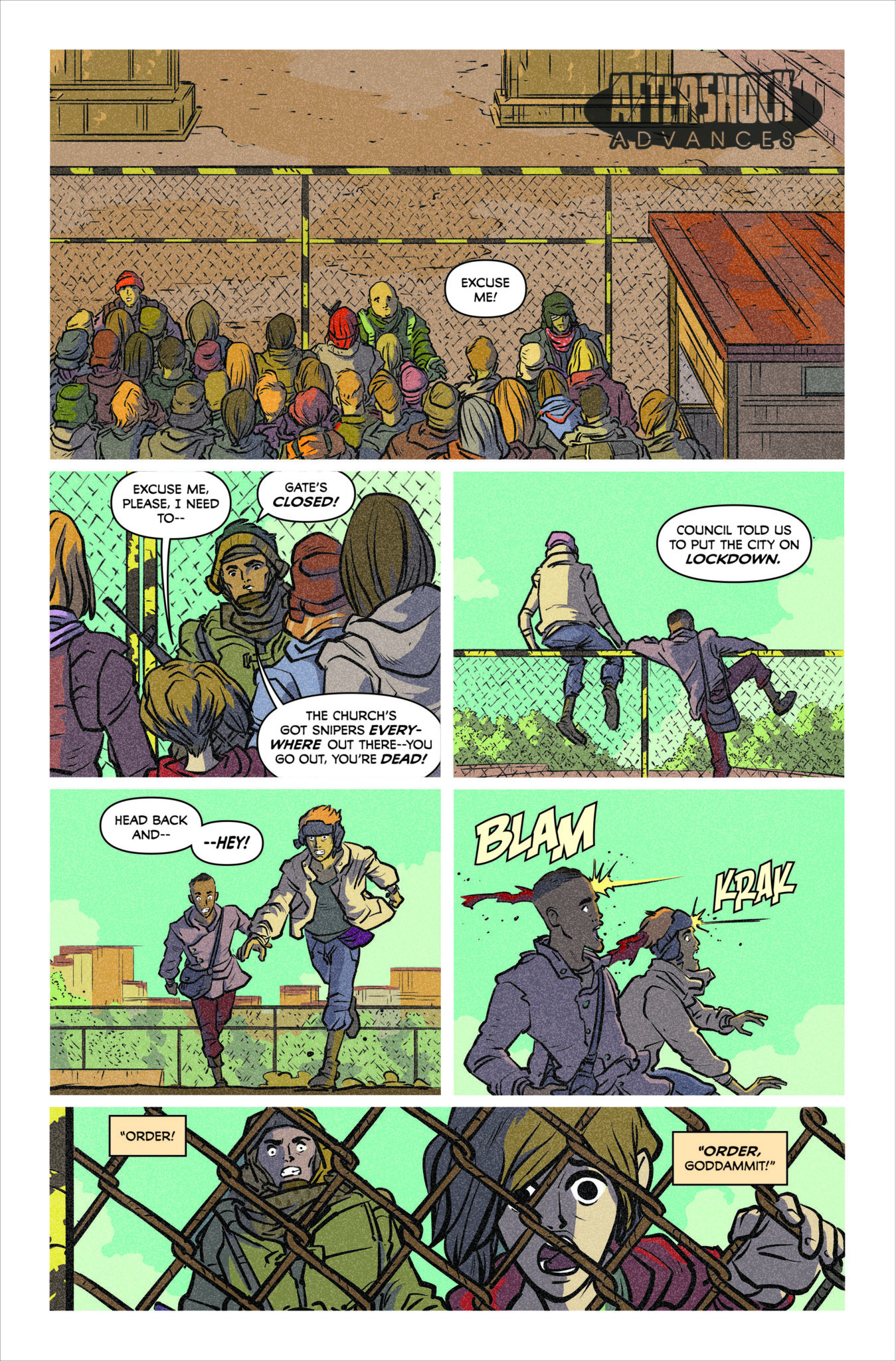
Fear grips the city of Albany as members of The Church bring violence to their community in the latest issue of Orphan Age from AfterShock Comics. The terror of living in a post apocalypse world is hammered home by the creators as the plot takes a disturbing turn.
Chapter 5 of Orphan Age is entitled Exodus and deals with themes familiar to anyone who has every read a post-apocalypse style story. Whether it is the fear of starvation or a hoard of brain eating zombies, the decision to stay or flee a settlement faces anyone who has survived for any length of time. In Ted Anderson’s vision the threat comes from a violent, misguided religious sect who set siege to the free state of Albany. Much of this issue is taken up with the reaction of the towns folk, focused of course on the central cast.
ORPHAN AGE #5 Credit: AfterShock Comics
A Shrinking Landscape
Anderson uses the situation to explore the relationships of his cast and to allow new facets of their personalities to shine through. Jeopardy creates drama and drama produces the chance to really get into a character’s psyche. The beauty of this chapter is that Anderson introduces the threat and then increases the tension via the reactions of the people. The Church and their followers are barely seen, their actual actions a side note to the narrative. This chapter, like each previous one, is about the characters, about Princess, Willa and Daniel especially.
The plot revolves around a siege and all that it entails. The strain it puts on the inhabitants of the city and the divisions that can form. Nuno Plati’s art work captures this aspect of the story stunningly. He uses the panels to board the characters in, reinforcing the imprisonment with crisscross wire fences, walls of small windows and gutters running through images. For many of the panels, he places single characters in the scene with virtually no background. This highlights the separation between the characters and is heightened even further when Plati stretches the same close up over two panels.
The effect this has on the comic is that it creates an uncomfortable atmosphere. The fear and desperation of the town is evident without having to show a city in turmoil. This also permits Plati the opportunity to focus on specific relationships, drawing attention to them.
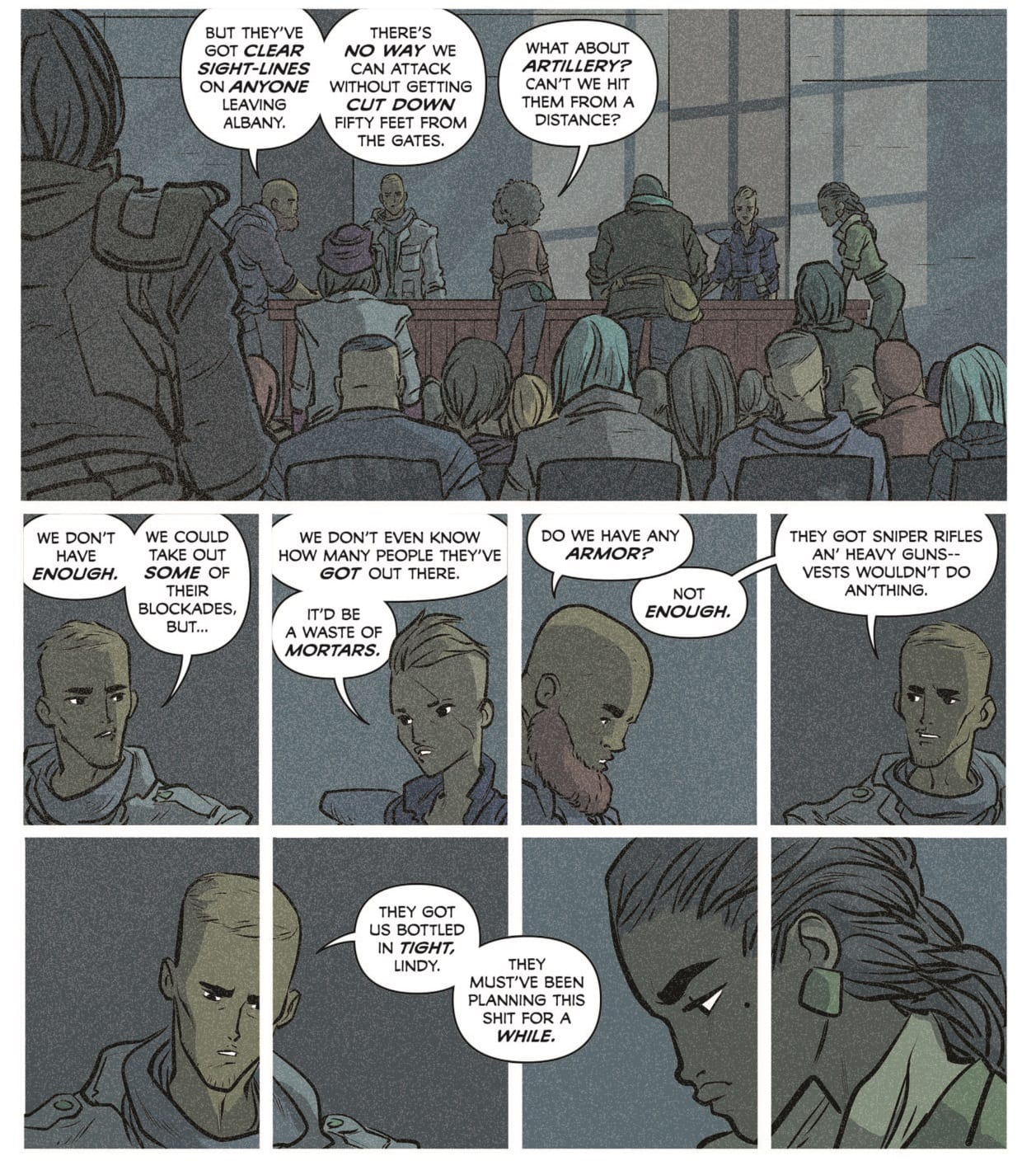
This is most notable with Daniel and Lindy who are growing closer and closer. Plati allows them to share panels with tentative transitions from one moment to the next illustrating the nervousness surrounding them. Plati then draws back to extreme close ups with room for only one character when their discussion turns to the problems they face.
ORPHAN AGE #5 Credit: AfterShock Comics
Orphaned Characters
The coloring helps to set the atmosphere of the piece. Nuno Plati and Joao Lemos flood the town of Albany with dark, shadowy hues. Blocks of color mark out backgrounds but the foregrounds are not much different in tone. The isolation of the people and foreboding they feel about the situation is made clear via the oppressiveness of the color.
The speech balloons are like white holes piercing this gloom. It draws the reader to the speech allowing the character interactions prominence on the page. The emphasis in the text by Marshall Dillon is juxtaposed against the facial images drawn by Plati giving each moment a fuller reading.
The contrast of the speech and art on a page is used to not only focus the reader’s attention on character but also to highlight moments where there is no speech. Some establishing panels lack sound helping to fix location and others act more like inserts with an abstract moment breaking up the scene. This is most often used to create character isolation or a strong emotional reaction.
ORPHAN AGE #5 Credit: AfterShock Comics
Conclusion
This issue is very conversation heavy but there does come a moment of action at the end which is a release for the reader as much as for some of the characters. The moment is like a cork popping from a bottle with all the tension building behind it. It is a much needed scene and finishes the chapter off in style. The consequences of this issue will follow the characters through the next stages of their story and there are a number of haunting images that will take a long time to shake off.
This embracing style of storytelling is perfect for comic books. The pacing can be difficult but when it has this calibre of artist working on it the story flows, beat for beat. The strong layouts and attention to character makes this issue of Orphan Age work in spectacular fashion. This series is heading in the right direction and slowly marking itself as a worthy successor to The Walking Dead.
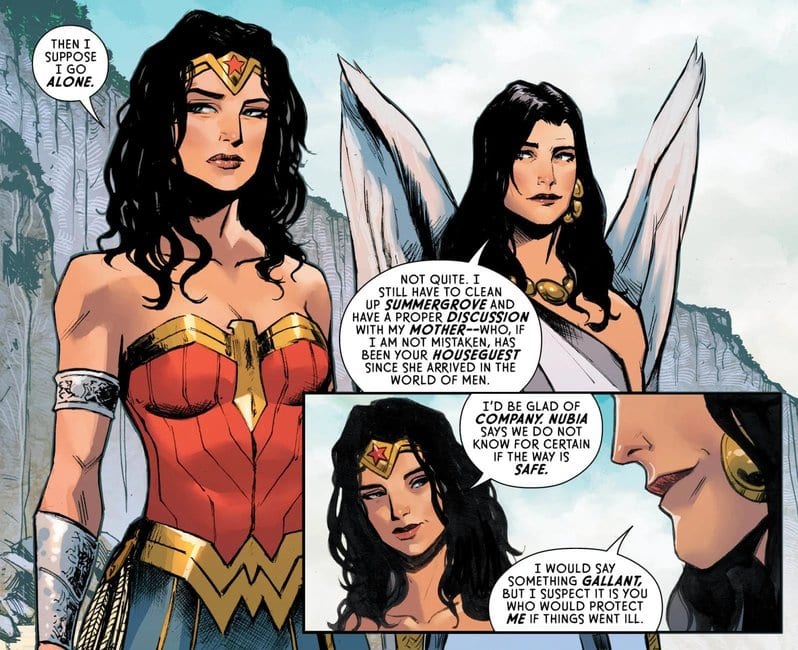
WONDER WOMAN #76, available in stores August 14th, is a story of return. Readers get to see Diana Prince reunite with her mother Hippolyta in Themyscira after being separated by the dimensional barrier dividing their world from Earth. But their reunion is short-lived when Diana makes plans to return the daughter of one of her worst enemies, Veronica Cale, through the newly opened barrier.
Story
G. Willow Wilson’s latest issue could easily have been marketed on Mother’s Day—the mother-daughter interactions throughout the story are incredibly heart-felt. We witness Diana undergo the pain of parting with her mother once again so that another mother and daughter may experience the joys of such a relationship. It’s this heroic quality of self-sacrifice that fans love about Wonder Woman—something Wilson captures beautifully in her depiction of the character.
The person assisting Diana in her journey back to the world of men is none other than the goddess Atlantiades, the daughter of Aphrodite. This poses another opportunity for a mother-daughter reunion, adding a greater sense of reassurance that she’s doing the right thing.
What’s largely missing from this issue is the presence of the villain Cheetah, who’s been planning to ambush the Thermysciran hero for a while now. It’s understandable that she would bide her time and cautiously stalk the warrior, but it would have presented more conflicts for the heroes to face and made for a more engaging story. Nevertheless, the realness in the familial relationships is what makes this story shine, and we’re happy to see the characters reunited with those they hold dear.
Art
Lee Garbett’s penciling, Romulo Fajardo Jr.’s coloring, and Pat Brosseau’s lettering are stunning in this issue. Garbett illustrates Diana and the other warriors beautifully, showcasing their perfect balance of grace and fighting prowess. And Fajardo Jr.’s coloring bolsters their Themysciran environment with stunning gold shades to emphasize its enchanting qualities.
Pat Brosseau’s lettering is a strong component of the issues artwork as well. His placement of the dialogue sets the pace of the story so readers can experience the full effect of the mother-daughter interactions.
Comic Covers
Jesus Merino and Fajardo Jr.’s main cover features Diana in a battle pose with the ever-elusive Cheetah attacking her from behind; this reminds the reader of the villain’s plotting amongst these joyous occasions. Jenny Frison’s variant cover is a slight variation of this, depicting Diana and Cheetah’s claw in front of a dark red background to highlight the danger lurking around every corner in their world.
Conclusion
WONDER WOMAN #76 is a great transition issue which places Diana back in her rightful position: the bridge between Themyscira and the world of men. We’re excited to see what new adventure the warrior princess embarks upon in WONDER WOMAN #77.
Did you wish Cheetah had played a larger role in this issue? Let us know in the comments below!
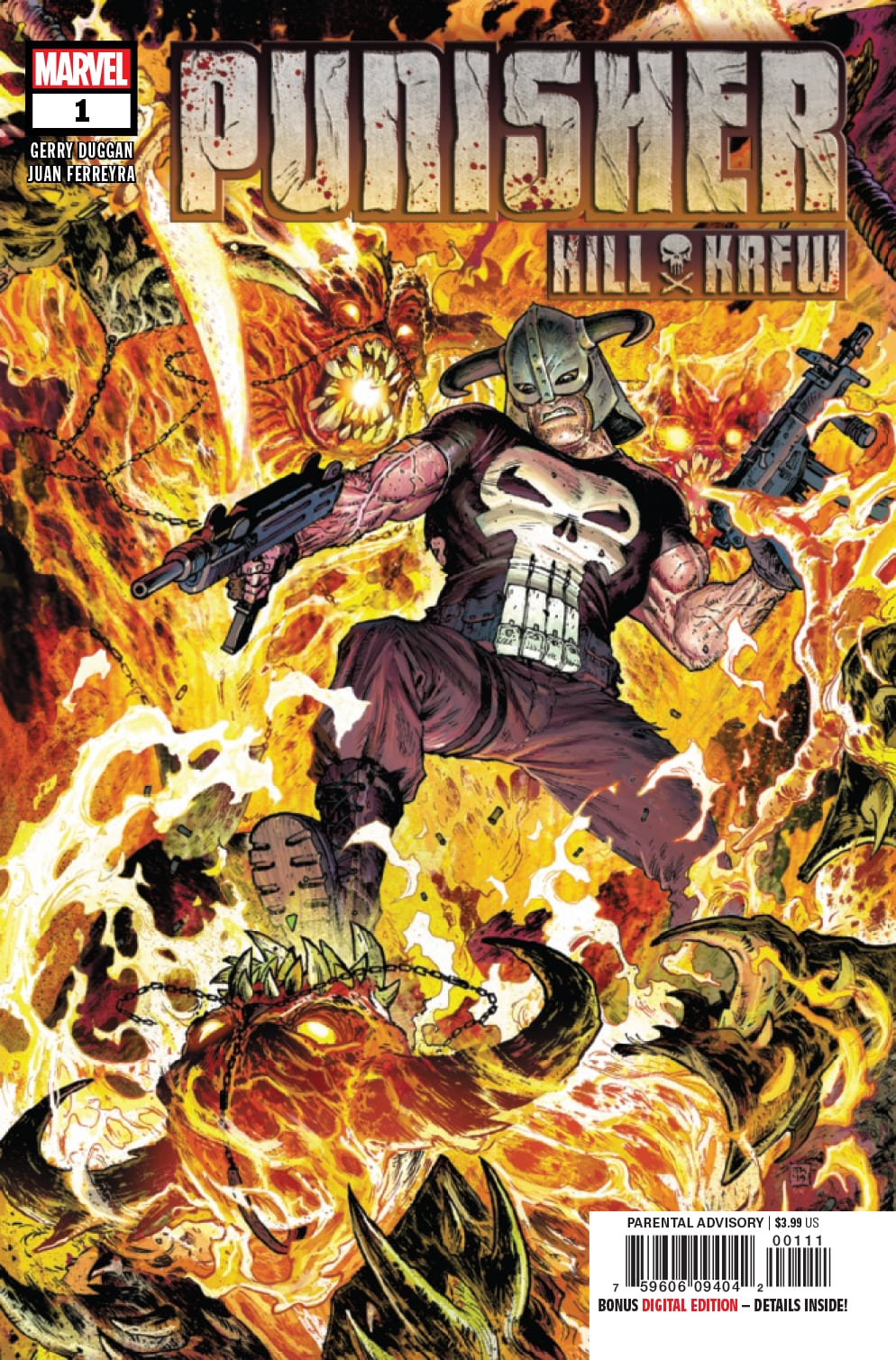
Punisher Kill Crew #1 by Gerry Duggan and Juan Ferreyra from Marvel Comics is the start of a great new five-issue mini-series.
Cover by Tony Moore
Punisher Kill Krew #1 Written by: Gerry Duggan Art by: Juan Ferreyra Letters by: Corey Petit Cover by: Tony Moore
ONE MAN. TEN REALMS. TOTAL WAR. During the War of the Realms, Frank Castle made a promise of vengeance, and Frank Castle keeps his promises. A van full of orphans is about to make that promise a lot more complicated. How does a man kill gods and monsters?
Writing
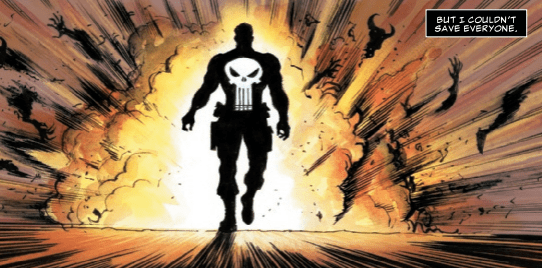
Gerry Duggan is quickly becoming one of the most fun writers to read in comics. Punisher Kill Krew is a prime example. It’s a lighter take on The Punisher, sure, but it’s not out of character. Castle is STILL a killer, he just happens to be killing trolls and tree gods instead of criminals. Oh, and at one point he wears a horned helmet. And did I mention the magic goat? And that’s the thing, the plot is so nuts you can’t help but embrace it (things like that are one of the reason’s War of The Realms is such a great crossover). Dr. Strange shows up, which is always welcome. Duggan also adds a man seeking vengeance and a group of war orphans (great concept. War of The Realms orphans.) to add some weight to the story. But the overall tone here is more light and fun, and that’s what makes the book unique.
Art by Juan Ferreyra
Art
Juan Ferreyra illustrates the hell out of this book. These are some truly beautiful pages. The figures and faces are all full of expression and emotion. The linework is thick and heavy but it doesn’t slow or weigh things down. It makes the images explode, adding to the relentless narrative. The colors and palette are muted and matte and together they create a texture you can almost feel. It’s refreshingly non-glossy.
Some fantastic panel layouts by Juan Ferreyra
The panel shapes and layouts are very inventive. Some pages are beautifully balanced and others are filled with jagged, off-center energy. But everything works together to great a truly breathtaking book to absorb and take in.
Last but not least is the gorgeous cover by Tony Moore that is ready for any wall as a piece of art.
Conclusion
Punisher Kill Crew #1 by Gerry Duggan and Juan Ferreyra is fun, exciting, filled with some truly “oh sh*t” moments and beautifully drawn. It’s one of this week’s best books and available at your local comic shop.
Unearth #2 wears its horror inspirations proudly and boldly, and while frightful and unique, the separate storylines and frantic pace seem to be holding this chapter back from its hidden potential.
Cullen Bunn and Kyle Strahm’s script is wild and imaginative, and it is apparent they have a huge well of horror film knowledge to draw from, but they simply don’t let the horror breathe long enough. Similarly, Baldemar Rivas’s art certainly has its high points but suffers from lack of detail and odd positioning.
Unearth #2 first picks up in Mitlan Itza, with the information that the two blobby, swollen patients are mysteriously missing. It then cuts to the mother and daughter playing a game before the daughter brutally murders her mother, and then continues the tale of the two teams investigating the tunnel system. Bunn and Strahm intend on linking these three-story branches, but due to the brevity of the first two scenes, it is hard to get invested in these stories. In fact, due to the brevity and frantic pace of almost every scene, the book itself can be a bit exhausting.
Bunn and Strahm use a large blend of horror staples that offer hope for future chapters. The mix of tropes from Alien, The Descent, and almost any Lovecraft work gives the story an intriguing tone and setting. Though, this series can use a quieter chapter focusing on the company or government employing this exploration crew because such little is known about them. Hopefully, Bunn and Strahm can use these mechanics as a springboard to create their own horror staples.
In most successful horror, the fear is a slow burn. It crawls to the shocks, which makes the tension so much more palpable while also allowing the viewer/reader to be comfortable with the characters. Unearth #2 doesn’t allow that, instead opting for an “everything-at-the-wall” strategy. A large part of horror is identifying with the main characters, or at least being able to acknowledge who they are, and with Unearth #2, this can prove challenging. I found it difficult to point out who each character is, their role, and what exactly their relationship is to others. One of the characters trapped with Morris (whose name I think is Nails) is a main player in this chapter and he was simply not even in the first entry.
I understand that a large part of the horror genre is the slow dwindling numbers of seemingly unimportant grunts, but in successful horror works, the creator gives the illusion that these grunts are important. If they’re not important, they at least linger enough on them for the trauma to register.
There is a definitive reason why Private Hudson’s “Game Over, Man” line in Aliens is so iconic. It is the culmination of a former macho military man crumbling into a frightened child. Instead, Bunn and Strahm take these clever ideas and characters and rush to combine them. That is how we get Morris floating in the area surrounded by the murderous worms as they seemingly protect Morris. The lack of context and breathing room almost make this scene laughable.
Someone should tell her not to brag too much.
There are scenes when Baldemar Rivas’s artwork works exceptionally well, unfortunately, they are few and far between. When Rivas is above ground his colors are spot-on. He shows a talent for finding just the right color and composition and then leaving something just off to make the reader uneasy. Take the scene in which the girl bludgeons her mother. Blood is normally not that pinkish hue, it’s normally crimson and dark, but the bright neon pink draws our eye to it more because of it.
However, when the story shifts below ground this changes drastically. This is mostly due to the cramped confines of the underground tunnels and the overall pace of the story. Because of all the action, it’s a little difficult deciphering what in all actuality is happening. In one scene Morris is attempting to dig the team out of the blockade, but then seconds later Morris is several feet away from the rubble watching as giant centipedes stab one of the other explorers who was right beside them. Similarly, when Amelia’s squad is looking for an exit in the blue pustule room when the ceiling drops falls (which should have collapsed the room entirely), it looked as though Amelia ran away from her squad entirely. However, once everyone escapes, Amelia is back with the team? The lack of differentiating markers on the uniforms doesn’t help the confusion as it is very easy to lose a character in the scuffle.
It is very easy to see what writer Cullen Bunn and Kyle Strahm, artist Baldemar Rivas, and letter CRANK! are attempting to achieve with Unearth #2, and a lot of what it attempts is novel and intriguing. Unfortunately, the execution leaves a whole lot to be desired.
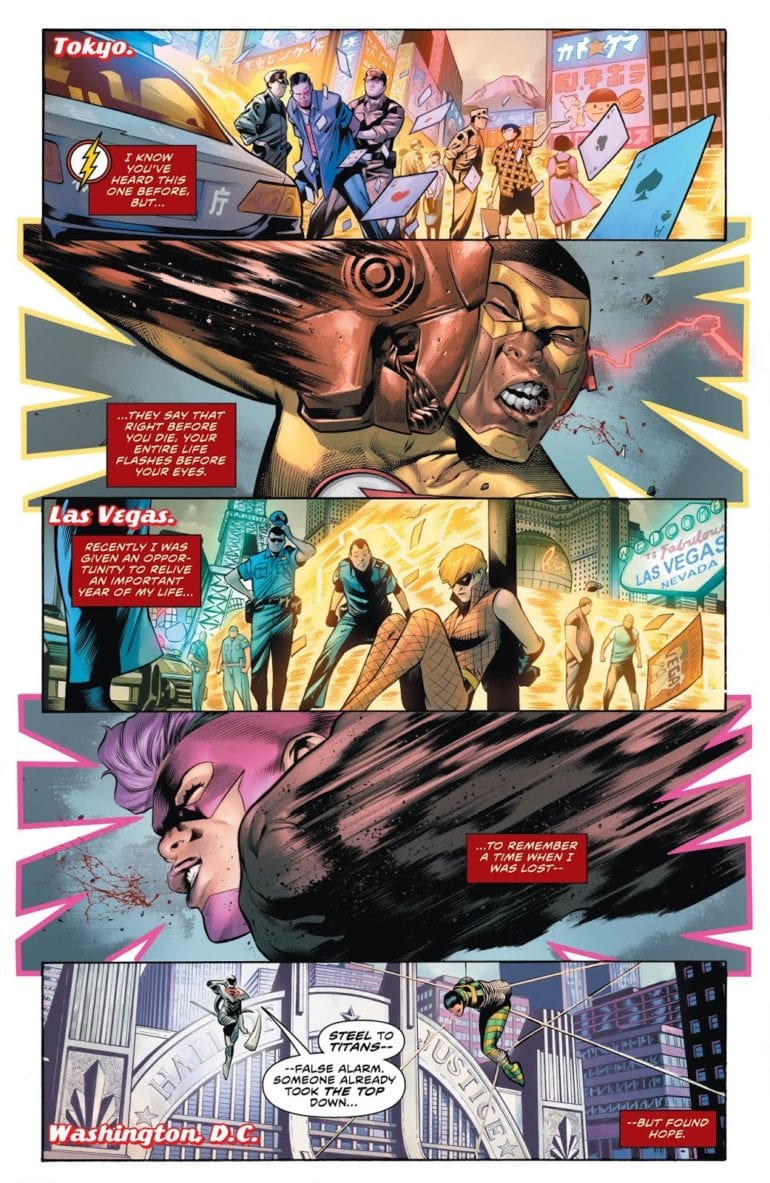
The Flash faces an old enemy to kick off Death of the Speed Force!
The Flash Year One has come and gone. As we return to the present, Barry has made a new ally in the form of Steadfast, wielder of the Still Force. With the coming war between the Forces, Barry decides he has to reorganize himself and his family. The first step comes in the form of rebuilding the Flash Museum. After completion, he makes amends with Commander Cold and asks him to help upgrade the museum. While all of this goes on, Captain Cold has been working with the Suicide Squad but was freed due to Lex Luthor and his pursuit for new members. Is the leader of the Rogues coming home to face The Flash once again?
**Some Spoilers Below**
Story:
We open our tale with the two youngest members of the Flash Family taking on Tarpit and Girder. While they are formidable foes, the young speedsters were able to outrun them in the past. This time, however, Wallace and Avery are having a hard time keeping up. Before they can lose, Barry pulls them to safety. He gives them a quick rundown on how they could use their lightning to fuse the villains. The young speedsters do it, and the pair of villains end up a large mass stuck to the ground. As the cops arrive to take the pair off to Iron Heights, Flash offers to show Wallace and Avery the improvements to the Flash Museum, including their new base of operations, the Speed Lab. Meanwhile, in Barcelona, the new and improved Captain Cold finds Heat Wave for their next big heist.
This opening chapter is a bit of a mixed bag in terms of theme. On the one hand, it feels like a new start thanks to the new lab and how Flash is now teaching the younger members how to be more calculating in their approach. On the other hand, this feels like we’re approaching the climax of the New Forces overarching story. It will be ironed out throughout the upcoming issues, but it was a weird sense, to say the least.
That being said, the content within the issue is still pretty awesome. The action sequence is a great way to show the new methods Barry is going to use moving forward. We see that Flash and his family are evolving with the world as new forces and enemies come around. While that doesn’t mean characters entirely change, it is a start, and that’s a good sign. Another great part is the cliffhanger ending, revealing another player to this giant war of Forces. While I won’t say who it is, it brought a smile to my face and dread in my heart. I can’t wait to see how this arc plays out.
Art:
Rafa Sandoval has returned to The Flash series, and his style continues to be amazing. Every panel is well done, capturing the emotion or action near perfectly. The prime example of this is the opening battle, where Sandoval uses excellent detail in the speedsters’ powers. The speed blurs on Wallace and Avery look awesome and show the speed behind each of the young heroes.
Sandoval also did a great job in the designs of Cold’s new look and our surprise character. Cold’s new outfit is the amalgamation of the New 52’s metahuman power and the technology we’ve come to love from the character. While I can’t say the choice of color is my cup of tea, it fits the Year of the Villain motif that has been growing. If the rest of the Flash Rogues are going to have updated gear, this will be the comeback of the year.
Conclusion:
Even though the theme is a bit confusing, I do like this opening. It gives us the new status quo and brings the Flash Family back together. The tie to Year of the Villain didn’t feel forced and didn’t take away from the villain of the arc. The art looks phenomenal, with great detail going into the powers and looks of all of our favorite heroes and villains. This reviewer excited for what’s to come, both for the Flash and for the Year of the Villain.
Image Comic’s newest mini-series The White Trees #1 hits your local comic shop on August 14, when asked what this series is about White Trees artist Kris Anka said it best, “This book has everything: action, suspense, romance, Daddies.” If that doesn’t sell it, then this review will with The White Trees #1 quickly transporting you into its world promptly grabbing your interest with driven characters sent on a quest for loved ones.
Before we talk of the story (Spoiler Free of course) lets go over one of the best things a creator can add to his or her product; an extra behind the scenes look or items that expand the story for the reader. White Trees #1 has these bonuses in the form of character sketches and one of the best editions: a map. To some a map may not mean much, but whenever one is added it helps the reader become invested in the world by giving them the knowledge of where certain places are located. That’s what a map is by definition and when added shows just how much work the creators put into their world building.
Within the first few pages of The White Trees #1 (from here on out, White Trees) writer Chip Zdarsky introduces us to the world of Blacksand by having our three main characters called upon by their king who informs them of their missing children. In each character introduction we learn much without the need of exposition, just interactions between the three. White Trees wastes no time in it’s flow of story beats with each conversation adding information to the characters or the world they inhabit.
This is due to Zdarsky packing motivations and glimpses of history between each character in every scene. This method of world building could easily unfold and make a story messy, or give the feeling of exposition, but White Trees never feels like too much. It helps that it’s an 40 page ‘oversized’ issue due to it being only a two issue Mini-Series.
With our cast of three on their search for clues we meet friends, lovers of the past, and other creatures of Blacksand. Throughout the beautiful fantasy landscape our character’s speak often (beside Krylos) with each other of the war from twenty years past. With very little action White Trees relies heavily on its characters by diving deep with great dynamics and depth. In these interactions you can feel their pain, motivation, and history they share.
Our main cast are the fantasy classes you would find in a game with Krylos being the DPS (even though he stopped being violent), Dahvlan as the Tank and Scotiar as a Range. Zdarsky plays with a multitude of fantasy tropes in White Trees but never makes them feel stale.
Without going into spoilers Krylos often feels like 2018’s Kratos from God Of War. That isn’t a bad thing per se, more of an observation. Even comparing the two names they are nearly identical. Our first introduction of Krylos is of a peaceful farmer picking a flower from the field. In this scene alone we learn much about the character even with the lack of dialogue due to the great art of Kris Anka. Throughout White Tree #1 we have a fantastic written story with pencils and colors that equally match that quality.
No matter if it’s a mountain landscape, sprawling city, or a little town on the coast Anka draws panels that could tell a story without dialogue. When characters emote you can clearly see their feelings worn upon their faces. In some instance Anke goes with a blank background (akin to manga) to greatly express said emotions.
In other panels the background is busy teaming with life making White Trees world feel alive. Anke doesn’t use panels in complex ways keeping it with the usual boxes and not doing anything crazy, but this works out wonderfully by not taking too much away from the characters or plot. Working in perfect conjunction to the art is Matt Wilson’s gorgeous colors. With the ability to illuminate certain moments, then dampen the mood with darker tones of colors or shadows Wilson’s colors stand out just as much as the others hard work.
Towards the end of the issue there are a few pages with dreamlike colors that stand out brightly to the point you may need sunglasses. While the campfire our characters build dances around mesmerizingly, constantly reminding us that the world of White Trees is fantasy based with it’s vivid colors mixed with some gritty grays and browns.
With a perfect blend of plot, characters, art and colors White Trees #1 knocks it out of the park in a world full of fantastic fantasy stories.