BATGIRL #39, which is set to release this Wednesday from DC Comics brings the tale of two Oracles to ahead. And to think, one of them doesn’t even know the gravity of the situation yet.
The new Oracle does not play around, does she?
***SPOILER WARNING***
Once again, an issue of Batgirl has been split in twain. The Year of the Villain event is still going strong, and it doesn’t think twice about steamrolling into Batgirl’s territory. Fans that haven’t been following the event might find themselves a bit confused here – but don’t worry, Batgirl doesn’t know a whole lot more about what is going on. So you’re in good company.
Thanks to the unique way in which Batgirl has been handling crossovers, that means that there are essentially two plots running through this issue. It’s quite clever when you think about it.
Batgirl is flying into action in this alternate cover.
Not all fans enjoy crossovers, and not because they can be challenging to keep up with. That’s why it’s always a relief when a series handles them in a different fashion. Batgirl mashes the elements together, rather than giving over the reins entirely. It’s the best compromise fans are going to get. And it can have some interesting side effects. Such as a Batgirl who has no idea what has gotten into the minds of the people around her.
Cecil Castellucci is the brains behind that shrewd move. One would argue that she’s taken the writing style to a whole new level; throwing enemies and diversions at Batgirl from every level and direction.
Batgirl #39 is full of lots of minor events for Batgirl to deal with – all while she is forced to cope with something much more significant and harder to explain. The sense of grief and loss is palpable in these moments, all while the foreshadowing builds.
This whole plot has gone a long way in reminding us that behind every mask, behind every cowl – is a human being. One who has a life, has the right to feel emotions, and sometimes will even break down. We all know what it feels like when we’re juggling too much at once – but the superhero life is basically that emotion on steroids.
Barbs has been down in the dumps for several issues now, a fact that the series has not made any attempt to hide from us. It’s a poignant reminder of her humanity, while also likely building up to a higher peak in Batgirl’s plot arc. Tear them down to build them up, and all that jazz.
The real question is; how far are they going to push Barbara? How much can any hero take, before feeling the need to walk away? And when is the showdown happening? Because we all know that there is one on the horizon.
The Oracle has begun her hunt – how long before she strikes?
The artwork within Batgirl #39 did a pretty solid job of supporting all of the events and emotions crammed within its pages. Barbara’s grief and depression are respectively shown, portraying all of the nuances to the point where it seems like there’s almost a literal weight on her head and shoulders.
One of the true highlights in this issue comes from what should have been a casual little jaunt around Burnside. Here the past and the present merge, with phantoms of Batgirl’s battles running through the streets. It’s both a beautiful and heartbreaking sight, especially when coupled with the works of her companion. And when one considers the vast array of emotions she’s been dealing with.
All of these emotions and different points can be laid solidly at the feet of the creative team involved. Carmine Di Giandomenico was the lead artist – and the one responsible for drawing out all of these powerful moments. Jordie Bellaire’s colors were vibrant when the occasion called for it, but also not afraid to be subdued as needed. And finally, Andworld Design provided the letters, without which we surely would have lost a lot of the impact of this tale.
The issue starts off with a brilliant fight – full of many of our favorite characters.
Batgirl #39 is a somber issue, but it’s also setting up for something more. It feels like something horrible is about to happen, while also oddly giving readers the impression that Batgirl will be better off when it’s all said than done. Or perhaps that’s just the optimist in the readers talking.
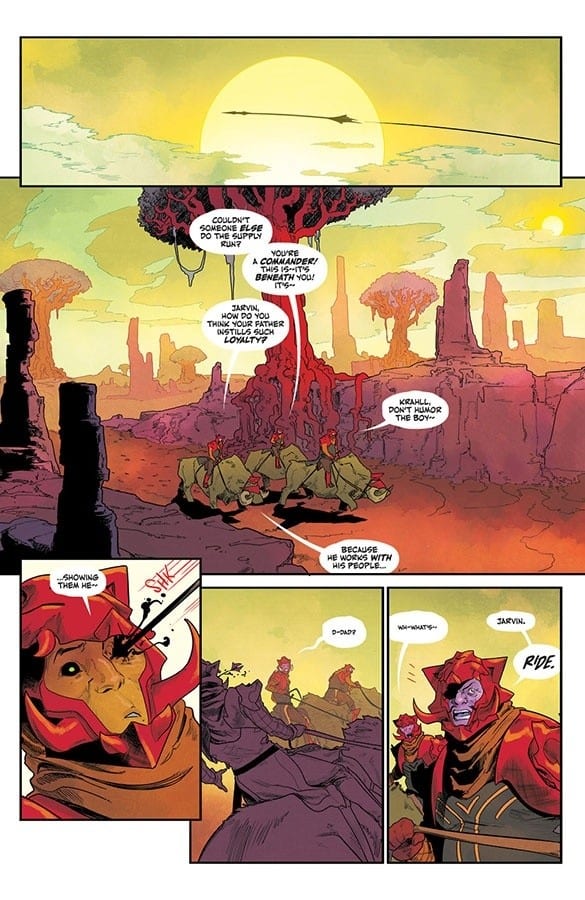
This Wednesday Image Comics’ epic fantasy, WHITE TREES #2 concludes in a beautiful, yet emotional issue.
White Trees #1 introduced the readers to a fantasy world brimming with gorgeous landscapes and ablaze with color, wrapped in an emotionally rich story. If you haven’t read the first issue, check our review here
Interior Art by Kris Anka, Colors by Matt Wilson and Letters by Aditya Bidikar
Fantasy Tales
Chip Zdarsky is known for his comedy, just check out his twitter. But with White Trees he hitts emotional highs that feel like a gut punch, and that is what makes the book so good. The writing shines as it is all over the emotional spectrum. During one panel you’ll laugh, and then the next panel you’ll be holding back tears.
White Trees consists of two forty-page issues which cause the pacing to move quickly; but there are still down moments that break up the speed, helping keep its scope. White Trees #2 may conclude the trio’s search for their kids, but Zdarsky puts a heavier emphasis on Krylos. This shifted focus works as Krylos is an interesting plot driver. But the trio shines when together, speaking volumes on their history.
Interior Art by Kris Anka, Colors by Matt Wilson and Letters by Aditya Bidikar
A Picturesque Fantasy
Continuing on art is Kris Anka, whose pencils and inks are a sight to behold. Some panels are simple having only one character reacting, but this simplicity works out magnificently. Anka showcases so many emotions in character anatomy that they feel real. This emotional awareness shines through when Krylos snaps.
Krylos’ bottled up rage come undone, as Anka inks a heavy shadow falling across his face. This simple panel of Krylos highlights Anka’s life-like facial emotions. This isn’t the only moment Anka introduces heavy inks for effect. But each moment it’s implied it amplifies the panel.
Anka doesn’t just excel at character moments, but in environments as well. Each building or set-piece feels straight out of a fantasy; beautiful, vast, and intimidating. As White Trees #2 includes more action, Anka’s precise, yet chaotic pencils help the flow.
Taking Anka’s art to another level is Matt Wilson’s fantastic colors. When a panel focuses on an emotional beat, Wilson amplifies it with colors to match. When Krylos’ rage erupts, the panel screams red. Wilson keeps the bright colors attributed to Fantasies while adding in darker shades. These moments of darker colors help drive the weight of the actions transpiring. Also, when highlighting an action sequence, Wilson voids the background colors.
Interior Art by Kris Anka, Colors by Matt Wilson and Letters by Aditya Bidikar
The lettering by Aditya Bidikar never changes in the form of sizes or colors, except in one scene. In Krylos’ scream, Bidikar breaks the bubble into spikes, while enlarging the font. Although that is the only moment the lettering changes style, Bidikar helps the pacing as much as the others. As the issue delves into more talkative moments, the lettering layout helps guide your eyes.
A Classic In The Making (White Trees Conclusion)
Each emotional beat hits hard. As the blend between the colors, art, and story work in perfect harmony. White Trees is a fantasy that’ll go down as a classic.
Memorable Quote: “You could have been the man I once knew and burst through the ropes regardless…” – Dahvlan
Extra Credit: As with the first issue, White Trees #2 has maps! It also adds a rundown of three panels narrated by Zdarsky. This bonus content is a great behind the scenes, and per usual it is hilarious. The author bios are great are entertaining as well.
This week Marvel drops AMAZING SPIDER-MAN #30 into our laps. This Absolute Carnage tie-in issue is much more than your average tie-in comic. Nick Spencer’s other half, Ryan Ottley returns and puts on a show.
***SPOILERS LIE AHEAD***
Symbiotes, goblins, and centipedes–oh my! Amazing Spider-Man #30 is fully-loaded with way more than most event tie-in issues have over the years. This issue is more focused on the continuing threads of Spencer’s ongoing Spidey adventures than it is fitting into Donny Cates’ Absolute Carnage puzzle–and it’s better for it.
The mysterious Kindred takes center stage as he talks trash to Norman Osborn in a padded cell. Throughout his menacing monologue there are a few hints or probable red-herrings as to who Kindred could possibly be.
Nick Spencer leads us towards the lord of evil centipedes being Harry Osborn, Flash Thompson, or someone else who has been in Peter’s life since childhood. It’s a masterful job by Spencer to keep the reader guessing without losing steam or becoming stale.
Kindred telling Norman “You won a long time ago” in his battle with Peter is absolutely chilling. This issue sheds a new light on Spidey and Osborn’s history of hatred. This is all while continuing to build Kindred into a potentially monumental adversary.
BUT WHY DO WE FALL MASTER BECK?
As for the tie-in bits, Peter protecting his godson and Brock’s secret son is good old fashioned Spider-Man super-heroics. This issue doesn’t factor into the grand scheme of the event’s story in a big way, but it moves the ongoing scenario along enough to be worth a read for those just interested in the event.
Spencer digs into Peter’s past once again and either creates or extracts these little moments that play such a crucial role in Peter’s current story. It’s an impressive show of comic book craft and continues to give this Amazing Spider-Man run the feel of a classic run.
Ryan Ottley graces us web-heads with his presence this issue, it’s a breath of fresh air as always. Without Ottley’s pencils, who knows how much any of us would really care about this mysterious Kindred character.
ALL THE BEST SPIDEY VILLAINS HAVE PURPLE
We may not get him on every issue in the run but it’s still superbly entertaining to witness Ottley draw Spider-Man issues. His action is big, heavy scenes are impactful, emotions are conveyed and felt by the reader.
Colorist Nathan Fairbairn floods our brains with glorious contrast and style. All of the symbiotes and Carnage-babies we’ve been seeing lately across all of Marvel yet all of it looks and feels fresh here.
Amazing Spider-Man #30 is a fantastic issue on its own as well as a tie-in issue. TELL US WHO KINDRED IS!
While we open the story with The Avengers, the action quickly shifts away from them to focus on our new team who, as the publisher explains, “fight the fights that no other Marvel team can take on.” That’s certainly one way to put it, as our heroes are tangling with a new foe originating from off-world, and familiar to only one member of the crew.
The Writing
First off, we should note that Strikeforce #1 covers a lot of narrative ground. The book is a fast-paced and engaging read from beginning to end. In addition, the characters forming the core crew—Blade, Angela, Spectrum, Spider-Woman, Winter Solider, and Wiccan—provide a fun balance of divergent personalities.
A downside to the story’s pacing, however, is that a considerable amount of dialogue ends up dedicated to exposition. We’re setting up the dynamics of an Avengers story…then suddenly pivoting to an entirely different team. It’s not a major problem, but it can lead to some interactions feeling a bit stilted and long-winded to fit in a single issue. This might have been better-served split into two more even-keeled books that are allowed some space to unravel their narrative a bit.
Tonally, Strikeforce #1 hits a good balance between its horror and action aspects. The creatures facing our heroes are an interesting concept that really help sell the horror facet. Not to give any spoilers, but suffice to say they are, as one character describes them, “a virus of thought.” Writer Trini Howard describes the story as “a horror book about trust,” which, ultimately, is an apt description. The book contains elements borrowed from a classic Body Snatchers premise, but spun in an interesting new direction.
Despite a few qualms, Howard lays the groundwork for an interesting story with this first issue. The future’s looking bright for Marvel’s newest team-up.
The Artwork
German Peralta takes on art duties for the book, turning in a solid final product overall.
As mentioned before, we’re moving at a brisk pace in Strikeforce #1. While that’s alright for the narrative, it’s less than ideal for the artwork, as some of the pages can feel crowded. In an different setting, we’d have an even balance between those denser pages and more expansive illustrations that offer some breathing room.
That said, Peralta does still get some time to shine, particularly in the book’s last third. Here, as the action picks up considerably, the artist seems a bit more free to play with the images, rather than sticking to the tightly-gridded and cropped panels in the earlier pages.
The colors by artist Jordie Bellaire are stellar. The work is nice and vibrant, while remaining tonally cohesive and coherent. Pages are dominated by fiery reds, icy blues, and unearthly purples in equal measure.
Final Thoughts
Strikeforce #1 is not without its faults. However, it’s an above-average start for the new series, and it promises interesting things are in store. I’d recommend giving it a shot.
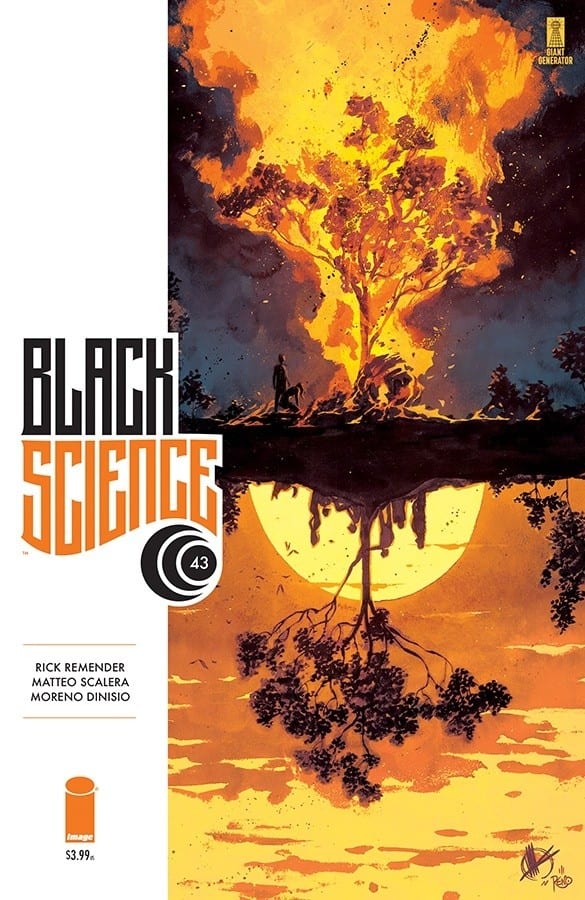
This week from Image Comics comes the final issue of their acclaimed series BLACK SCIENCE. Creators Rick Remender and Matteo Scalera send us off with an emotional finale in issue #43.
***SPOILERS LIE AHEAD***
Black Science debuted back in November of 2013. It unleashed the madness of Grant McKay upon the world as he struggles like any of us to try and navigate the chaos he’s created for himself and his family.
Through forty-three issues we’ve seen brilliant sci-fi concepts pour out of the mind of superstar writer Rick Remender. We’ve been treated to six years of gorgeous Matteo Scalera art that pushed the limit of comic book art and constantly reminded readers why we all love this medium.
It’s sad to see this monumental series come to an end, but at least it was ended on the terms of the creators. Black Science will have a definitive ending, rather than continue on into obscurity once the idea well inevitably dries up.
Our final issue jumps around a bit, utilizing the plus-size amount of pages that we’re provided. The story centers around Grant and Sara, as it should. Their tragic story never gets a “happy ending” but only through the lens of ignorance does any story really happily conclude. Remender reminds us that there is always somebody left behind.
We get a satisfying end to Kadir by the hand of Sara. Grant completely f*ucks up once again and causes their children to die, but as always he promises to fix it. We take a look at the “weathered” Grant and Sara that we encountered long ago in the series as they embark on their own journey to get their kids back.
This infinite onion filled with infinite possibilities and futures doesn’t end and never will. Ending this series was no easy task as there was no real way to close the story. Remender takes the best possible approach to at least send readers off with a smile rather than a pit of despair in their stomachs.
With Black Science #43 we say goodbye to not only these beautifully flawed characters, but their creators as well. Remender and Scalera have been one of the most dynamic duos in comic books for six years now–what happens now? Hopefully we’ll see Scalera again soon enough, his style and creative lens is top-tier.
We can’t forget about colorist Moreno Dinisio either, wherever Scalera pops up again hopefully he takes Dinisio with him. Their chemistry in bringing these obscure and gorgeous illustrations to life is magnificent. Not just character models or creature design, but layouts and landscapes are impossible to ignore as every panel in this entire series is worth getting lost in.
Black Science #43 is probably the best ending we could’ve possibly gotten given the subject matter and commitment these rules and characters. It’s an impressive issue that will satisfy readers who have kept up for an inconsistent six years.
Vault Comics continues its streak of great comics with Wednesday’s Mall #2, which includes equal shares of world building and action.
If you haven’t read Mall #1 or just need a refresher, check out our review here (P.S. the first issue is great).
A Mall Full of Stories
Writers Michael Moreci and Gary Dauberman open Mall #2 with an introduction of Andre’s family. This opening helps expand the world, much like Mall #1’s opening. The duo showcase Andre’s father, who exudes the vibe of a wealthy man of power. Within this conversation about his son’s rescue, the unknowingness of ‘the world beneath’ is expanded upon. This information comes naturally, while adding elements that further the plot.
Andre still feels like the odd one out in this world, as throughout the story he questions everything and is surprised as new facts arise, all while seeing the wrongs that are transpiring. These facts combined make him a great main character, continuing the trend of someone you can root for.
Andre’s skepticism is emphasized by the inclusion of his partner, who at the moment has no name. Much like Andre, she can see the insanity of what’s going on. But unlike him, it seems she goes about her way. Namely with a sword and violence. Lots of it. Moreci and Dauberman don’t give much away of her story or drive just yet. But what they do show keeps the reader interested, primarily due to her similarity to Andre. That and her great witty banter, which elevates serious matters.
That doesn’t mean Mall #2 goes the route of being funnier or completely light-hearted. It keeps the serious themes and moments that Mall #1 had.
The Scenery of A Mall
Mall is a post-apocalypse story, which is amplified by artist Zak Hartong’s work. Throughout the issue, Hartong’s pencils are heavy lined and dirty feeling. This is the exact mood the team is going for.
Hartong’s art also adds great pacing with panel placement and movements. No two pages’ panel layouts are the same. Instead, Hartong plays around with different sizes and placements to make pages feel unique, while keeping the pace fast. This speed is showcased in the way he handles fights.
Each fight draws blood, while hitting hard. Every movement during the fights feel fluid and fast paced, especially when the sword slices. This fluidity isn’t just limited to the fight scenes, as when conversations occur they share the energy.
Adding to Hartong’s post-apocalyptic vibes are Addison Duke’s darker shaded colors. During most of Mall #2, the colors are on the darker side. But when action occurs, Duke livens the mood with brighter, yet still dark colors.
Duke’s coloring shines during an alarm sequence. During this moment of violence and alarms blaring, Duke adds a red filter over the pages. This filter seems simple, but is employed to great effect. Within the chaotically fast paced moments you’ll swear you can hear the alarm.
In fact, you can hear the alarms, thanks to letter Jim Campbell. Throughout the alarm sequence Campbell adds a ‘REH’ flowing through the panels. This sound effects help excel the feeling that Duke’s filter implies.
During the same scene the characters fall under attack via mutantesque creators. Hartong’s design for these creators are great, but Campbell’s ‘SKRRH’ sound effects makes them terrifying.
Closing Time
By delving deeper into its world, Mall #2 expands its view in way that’ll keep readers wanting more. If you enjoyed Mall #1, you’ll love its follow-up.
Memorable Quote: “ Come closer and I’ll tear your nose off with my teeth.” – Andre’s Savior
Little is known about her character as of now. But damn, I’ve already fallen in love.
Dear Faithful Shoppers
How are you enjoying Vault Comics newest series? Let us know below! If your interested in checking out Vault Comics catalog, check out their website. It’s highly recommended!
Shortly after the new Buffy the Vampire series landed at Boom! Studios, fans were thrilled to learn that audience-favorite and series spinoff Angel was getting his own storyline from the new home of Sunnydale’s finest. Fans were even more excited to hear that Detective Comics and Witchblade veteran Bryan Edward Hill would be weaving the tale of the monster-turned-do-gooder, telling horror comics stories as he never has before. Monkeys Fighting Robots sat down with Hill to discuss the first collected volume of Angel (out October 1st), and what we heard certainly had us turning on some lights and pulling up some sheets. Just not for the reason you might expect. Read on for all the spookiness Hill had to impart…
Grant DeArmitt for Monkeys Fighting Robots: This is a really deep, thematic comic, and there’s so much to talk about on things like social media and redemption. But first, let’s talk about the mechanics of this book. Can you tell us about bringing Angel to Boom? What was your collaboration like with Buffy writer Jordie Bellaire? How did you build this new mythos?
Bryan Edward Hill: This all happened because my editor, Jeanine Schaefer, reached out and asked if I would be interested in writing Angel. I was glad to receive the email, because no one understands how much I like horror. Most of my work is sci-fi, or action, or thrillers. Plus, I talk about Tom Ford on Twitter all the time. So Nobody knows I’m a huge horror fan too. That’s a shade to my rainbow that I haven’t been able to explore. So Jeanine reached out and we talked through what this book could be, how it could be relevant. She is one of the most warm and genuine people in the business, and I can’t say enough good things about her. Working with her with a book was certainly something I was interested in doing in general. I’m a huge fan of the show too, of Joss [Whedon]’s work. So it was a natural fit.
Now, as to what Jordie’s doing; because these books are a little siloed, at least prior to [upcoming storyline] Hellmouth, I would be aware of what was going on. There was mutual awareness. But it wasn’t like one person gave the other person rules. It was more like, “Oh what’s happening over there? This might give me an opportunity to do this or do that.” So the collaboration has been very smooth and pleasant and I’m really excited about what happens with the books going forward after Hellmouth. That’ll be really exciting for people. It’s been a beautiful process so far.
MFR: That’s awesome to hear that you’re such a huge horror fan. Can you talk about that a little bit? What kind of horror do you like? What are your influences?
BEH: Well, when I was a kid, I saw a ghost in my grandmother’s basement.
MFR: Wait, what?
BEH: Yep. I saw an actual ghost. I walked into this basement, and there is no wind there, but there was a coat that was on a clothesline. It just started swinging. Back and forth back and forth. Like the blade of a fan, or a pendulum. At one point, it swung to the right, and I saw an older white man in formal wear, but formal wear of the day. It was from the 40s, I imagined? It wasn’t aggressive, but he pointed at me and muttered something. Well, I ran out of that basement. I bounded up those stairs. I too maybe two steps of the whole flight to get up there, which was impressive, because I was a pretty chubby kid. I didn’t go back in that basement for years, but it wasn’t the last supernatural experience I had. So that got me interested in exploring those things. From there it was esoteric thought, and studying the different schools around that stuff.
As far as cinema goes, I think The Exorcist was a formative experience for me. I rented it on VHS from a video store that would rent R-rated movies to kids. And at the time I took it home and I watched it, I didn’t know what a subliminal thing was, what a flash frame was. Then there’s that moment in the movie when Damien Karras is having the dream, and that face comes on screen. I thought that was only on my tape. And I’m like, “Oh no there’s a demon in my television; I’m going to die. I rented an R-rated movie and now I am being punished by the universe.”
So when I got the chance to work on Angel, I saw this really great opportunity to bring in Byzantine, almost classical, horror elements. I looked at the work at Mike Mignola on Hellboy, or even his adaptation of Bram Stoker’s Dracula. (Which I think is an under-seen masterpiece, it’s incredible.) Being able to do that stuff in comic form, that’s incredibly exciting, especially when I can filter it through a contemporary narrative.
MFR: You talk a lot in this book about evil and its nature. Do your supernatural experiences or interest in the esoteric factor into that? When I was reading this, I got the sense that you were talking about a very modern evil. Namely, bullying on social media. But does that classic, Byzantine idea of evil affect this story?
BEH: One of the things I think about a lot is subjective and objective evil, snd how ethics can shift and change based on how civilization evolves. If we were to go back to ancient Rome, we would find most of what they did to be evil, to be abhorrent. But that was just the way they lived. So there is a subjective definition of evil. But then you wonder: underneath that, are there sentient forces that exist only to destroy? I think that’s been one of the questions that mankind has had ever since the first time the sun went down.
I’ve always felt that what lives in the darkness is what lives inside of ourselves. One of the ways to understand oneself is to understand your own darkness, to confront those aspects of your own nature. Carl Jung talked about it in Psychology and the Occult. When I was growing up, comics were always the place I went to to get discussions about those kinds of broad, almost primal ethics. So when I write books, I tend to write engaging those things. Angel is the story about a character who has been evil. Now he’s trying to be good, but still carrying the memories, and likely some of those desires still.
The question Joss asked when he created Angel, to me, was, “Can a monster be a hero?” I think that’s still relevant question for the day. Is redemption possible? Do you deserve redemption in the face of the things you’ve done before? That’s an ongoing discussion in popular culture right now.
As far as social media goes, I’m very concerned. I’m concerned about what it does to people’s self-esteem. I’m concerned about how it exposes us to so many opinions. We might not be biologically engineered to engage with that many people at a time. I’m concerned with how it forces us to demonstrate our lives to others. It’s performative living. It can be very difficult on a soul.
So I wanted to explore that and ask the question: is there something truly Insidious at play there? If it’s not the cause of it, is it taking advantage of its existence? You can look at social media as its own hive mind, as its own kind of global consciousness. And if it is a global consciousness, what lives in that global subconscious? That seems like a good way to approach a narrative.
MFR: This theme of redemption comes up a lot in your book. Do you think the character of Angel believes that he can be redeemed?
BEH: You know, I think he believes he should try to redeem himself. What makes him heroic is that separation from what I deserve and what I must do. I don’t think Angel is a person that sits and thinks very much about what he deserves. That to me is the essence of heroism. It’s not doing something so that it will change someone’s perception of you. It’s doing something because you know it must be done. I’ve always been attracted to those characters. It’s what drives me to Batman. It’s the idea of becoming a thing, and saying “I might be judged because of the thing I become, but I must.. Because that’s more important than my desire at the moment.” That’s what I’ve kind of always been drawn to with Angel as a character.
I personally believe in redemption. I think when you have a society that will not allow redemption and rehabilitation, then you have a society based on punishment. And if you remove hope from the punished, then you have to make sure that the punished can no longer affect you, which is very difficult to do. Or, you’re going to get people who just never want to be better. If you tell people you can never be better, you can never be redeemed, then why are they going to try to be better? I think it’s incredibly dangerous to remove the concept of rehabilitation and redemption from the world. I’m not saying it should be easy. There should always be a price. But hopefully we can evolve into a society that seeks to do more than punish.
MFR: Returning to the story, you created an awesome new character, a new addition to the Boom Angel universe, and that’s Lilltih. Can you tell us a little bit about who she is and what went into creating her?
BEH: Well, I didn’t create her. Lilith has existed in mythology and religion and esoteric thought far, far before I ever existed. And if I were to say I created her, she might be very angry. (Laughs) but I did decide to incorporate her into the story, at least, a version of her as I understood her. Mainly because I wanted to bring in an ancient archetype into this world. It was really about making [Angel] feel a bit more epic, like a story that has spanned time and space. Having a character that can represent that helps facilitate that feeling in the book.
I’m also interested in her divine archetype: feminine power without regret. Certain cultures and viewpoints demonize her because she simply wanted to be equal to Adam. Other cultures have seen her as the catalyst for not only the empowerment of women, but for the empowerment of anyone who wants to live at the beat of their own drum. Angel is a character that is somewhat of an outcast, by his own choices and the world in which he lives. Lilith has always been symbolic of an esoteric idea about the value of being an outcast. Having this rebellious ancient spirit that is leading this group of vampires and people and other things towards a better end, I thought, would be really cool. And any time I can put a really cool female character into something, I’m certainly going to do that. I grew up with a single mom and, in a lot of ways, my work is always kind of a testament to her and her strength and what was required of her to raise me. That’s how the Night Mother wound up in the story.
MFR: Along with introducing Lillith into the story, you reinvent two very popular Angel characters: Charles Gunn and Fred Burkle. How much of that was your twist on these characters and how much of it was Boom?
BEH: It was all really organic, through those long conversations with Jeanine Schaefer about what I wanted to do a thematically and emotionally. We sort of landed on some things together. I did pick that cast because I thought they would be the most interesting to this first story, but not at the exclusion of other characters. They’re dealt out at their own pace. I’m trying not to change anything I believe is essential to these characters. I like to have a light touch in that way. There are a lot of creators, brilliant creators, who like to come in and turn the apple cart upside down. I’m not that way, I like to find my own way in, but still work with what I think are the basic qualities of these characters.
But I have to give full credit to Boom for giving me as much space as possible to work. Licensed work can be difficult. It can come with a lot of rules, I’ll just be frank. I have turned down opportunities to work on certain projects because I didn’t want to deal with the rules. I never want to write a story where I can’t actually do anything, where the ball just spins but nothing really changes. This isn’t that. I’m able to tell a good story and work with these characters and advance them in ways that a lot of license fiction won’t allow. That’s not me putting an edict down, that’s Boom being willing to create an arena in which myself and Jordie can work with these characters in a way that we feel is best for the stories we are trying to create.
MFR: We’ve talked about social media and how it plays into Angel Volume One. So going back to our hero, what would social media look like to a centuries-old vampire? What does Angel think of this modern thing going into the story?
BEH: I think he wonders why people are so fascinated with themselves. I can’t imagine Angel would understand why anyone would want to see an image of someone else’s lunch. This is a strange thing to him. But the other side of him is that he understands the need to connect, especially the need to connect through an avatar. To find a safe way of building community and self-esteem around yourself, and also be able to live as an imagined version of yourself. I think he, more than most people, would understand the need for that.
But ultimately, Angel likes to fight his battles in the real world. I think he is wary of the lowest hanging fruit of self-esteem that can be out there. And the way that fantasy can enrapture us and also keep us from manifesting what we want in the actual world, with our feet on the ground. So while he can understand the need that people have and the reasons why it is what it is, I think he ultimately will see it as something that might prevent people from manifesting actual change in their lives that can make them happy.
MFR: Volume One is wrapped up now. I know you can’t give us too many details, but what is on Angel’s mind moving into moving into the next segment of the story?
BEH: Many things. The events of Hellmouth are going to shift his perspective for sure. If he has been fighting this battle on his own terms mostly, I think he’ll come to realize that he can’t do that anymore. He’ll come to realize what is truly at stake and how far advanced the march of evil has made it, in a way that he hasn’t been able to see. That’s going to renew his dedication to things.
He’s also forming these bonds with new people. He’s making a pledge to protect them from things that he does understand and some things he doesn’t. That’s the heaviness on him. Sometimes you realize you can be lonelier with people than you are by yourself. I expect him to have thoughts and experiences on leadership and purpose. He’s going to be asking: “How do you bring people into a world of madness without making them go mad?”
****
Angel Vol. 1: Being Human is written by Bryan Edward Hill, drawn by Gleb Melknikov, colored by Gleb Melknikov and Gabriel Cassata, and lettered by Ed Dukeshire. You can pick up a copy at your local comic store on Tuesday, October 1st. Until then, tell us what you think of Angel over on our Twitter page. And for more comic book interviews like this one, plus reviews and discussion, stay tuned to Monkeys Fighting Robots.
Monkeys Fighting Robots, POPAXIOM, and Warner Bros. have teamed up to bring you a special screening of the JOKER!
The screening will be held in Tampa on Wednesday, October 2.
AMC Veterans
9302 Anderson Rd
Tampa, FL 33634
The contest is straightforward to enter:
• Join our newsletter
• Comment on this post below.
***Bonus entry, share this contest on social media.
Good luck! Winners will be chosen at random on Monday, September 30, at 3 p.m. EST.
Step 1 – Join our newsletter
Step 2 – Comment on this contest below.
***Bonus entry, share on social media***
About the film: Forever alone in a crowd, Arthur Fleck seeks connection. Yet, as he trods the sooted Gotham City streets and rides the graffitied mass transit rails of a hostile town teeming with division and dissatisfaction, Arthur wears two masks. One, he paints on for his day job as a clown. The other he can never remove; it’s the guise he projects in a futile attempt to feel he’s a part of the world around him, and not the misunderstood man whom life is repeatedly beating down. Fatherless, Arthur has a fragile mother, arguably his best friend, who nicknamed him Happy, a moniker that’s fostered in Arthur a smile that hides the heartache beneath. But, when bullied by teens on the streets, taunted by suits on the subway, or simply teased by his fellow clowns at work, this social outlier only becomes even more out of sync with everyone around him.
Directed, co-written and produced by Todd Phillips, “Joker” is the filmmaker’s original vision of the infamous DC villain, an origin story infused with, but distinctly outside, the character’s more traditional mythologies. Phillips’ exploration of Arthur Fleck, who is indelibly portrayed by Joaquin Phoenix, is of a man struggling to find his way in Gotham’s fractured society. Longing for any light to shine on him, he tries his hand as a stand-up comic, but finds the joke always seems to be on him. Caught in a cyclical existence between apathy and cruelty and, ultimately, betrayal, Arthur makes one bad decision after another that brings about a chain reaction of escalating events in this gritty, allegorical character study.
Three-time Oscar nominee Phoenix (“The Master,” “Walk the Line,” “Gladiator”) stars in the titular role alongside Oscar winner Robert De Niro (“Raging Bull,” “The Godfather: Part II”). The film also stars Zazie Beetz (TV’s “Atlanta,” “Deadpool 2”), Frances Conroy (TV’s “American Horror Story,” Hulu’s “Castle Rock”), Brett Cullen (“42,” Netflix’s “Narcos”), Glenn Fleshler (TV’s “Billions,” “Barry”), Bill Camp (“Red Sparrow,” “Molly’s Game”), Shea Whigham (“First Man,” “Kong: Skull Island”), Marc Maron (TV’s “Maron,” “GLOW”), Douglas Hodge (“Red Sparrow,” TV’s “Penny Dreadful”), Josh Pais (upcoming “Motherless Brooklyn,” “Going in Style”) and Leigh Gill (HBO’s “Game of Thrones”).
Oscar nominee Phillips (“Borat,” “The Hangover” trilogy) directed from a screenplay he co-wrote with Oscar-nominated writer Scott Silver (“The Fighter”), based on characters from DC. The film was produced by Phillips and Oscar nominee Bradley Cooper (“A Star Is Born,” “American Sniper”) under their Joint Effort banner, and Oscar nominee Emma Tillinger Koskoff (“The Wolf of Wall Street”). It was executive produced by Michael E. Uslan, Walter Hamada, Aaron L. Gilbert, Joseph Garner, Richard Baratta, and Bruce Berman.
Behind the scenes, Phillips was joined by director of photography Lawrence Sher (“Godzilla: King of the Monsters,” “The Hangover” trilogy), production designer Mark Friedberg (“If Beale Street Could Talk,” “Selma”), editor Jeff Groth (“War Dogs,” “The Hangover Part III”), and Oscar-winning costume designer Mark Bridges (“Phantom Thread,” “The Artist”). The music is by Hildur Guðnadóttir (HBO’s “Chernobyl,” “Sicario: Day of the Soldado”).
Warner Bros. Pictures Presents, in Association with Village Roadshow Pictures, in Association with BRON Creative, a Joint Effort Production, a Film by Todd Phillips, “Joker.”
An homage to turf war films like The Warriors and The Outsiders, 20 Fists #1 is written by Frankee White, with art by Kat Baumann, and lettering by DC Hopkins. The first issue is currently crowdsourcing on Kickstarter.
Story
20 FISTS is a queer Romeo & Juliet during a break-up meets The Warriors. It’s a tale as old as time. Two women, who met on the battleground, find themselves sorting through the rubble of their relationship in the illegal and unlicensed fight league that runs rampant throughout their city. Issue #1 features two chapters: Round One is the first part of the fight between The No Names & The Big Jackets. Following Round One is a flashback that sets up the growing friction between Chel, Billie, and their crews.
In 20 Fists, writer Frankee White successfully manages to put the reader in the middle of the action right from the get go. There is little dialogue in the first half of this book, which adds to the tension within the pages. It forces the reader to question which one of the rival gangs will strike first, and when. And just as the heated battle begins, it ends, and we are then thrust into the past, getting a glimpse as to why these rival street gangs decided to rumble. In the midst of the brewing feud, there is a romance in the vein of Romeo & Juliet. Here, White brings the much needed exposition, giving the reader a good sense of the individuals who make up these rival gangs.
Art
Artist Kat Baumann crafts a grungy and broken world in 20 Fists #1. The very first page perfectly sets up the tone of the book. The buildings are cracked and dilapidated, with a steeple looming in the background. The sky is black and starless, as if a dark cloud hangs just above. Baumann also does commendable character work, helping distinguish the members of the rival gangs through their hairstyles and clothing.
The lettering by DC Hopkins stands out particularly well, with the clever additions of sound effects, using onomatopoeic words frequently for anything from loud music to glass clinking and cigarette inhalation.
Conclusion
You can pick up a copy of 20 Fists by supporting it on Kickstarter. For more information on this book, follow writer White on Twitter and Gumroad.
Do you have an independent or small press book crowdfunding on Kickstarter to review? Let us know!
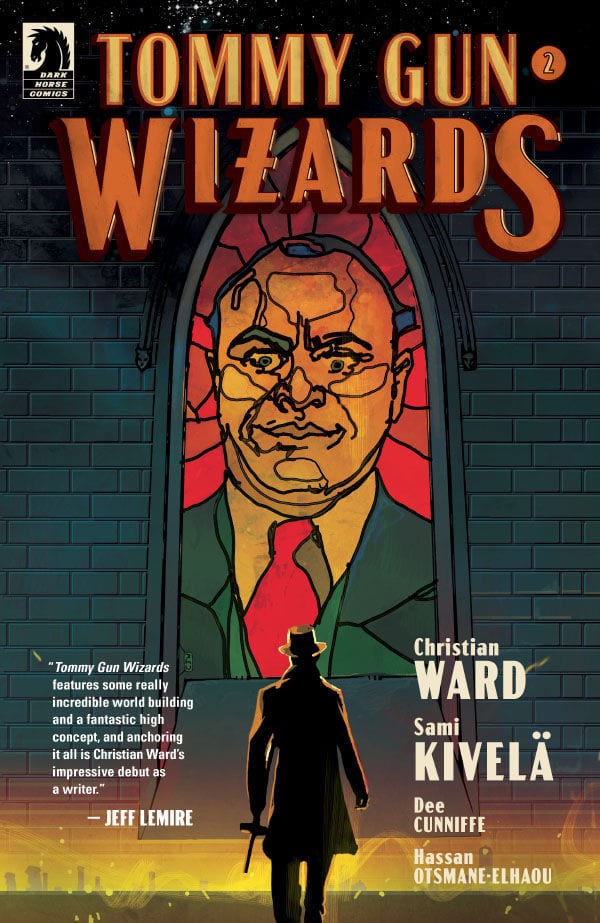
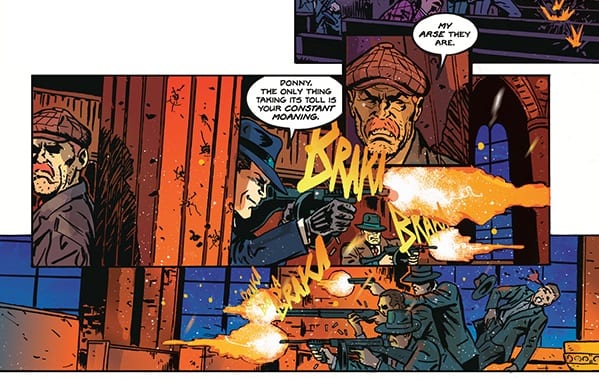
A world of prohibition, Gangsters, and Al Capone isn’t enough for Christian Ward as he packs the second issue of Tommy Gun Wizards with magic, mayhem, and a rogue’s gallery fit for Dick Tracy. Dark Horse Comics bring all of this, neatly packaged, to the shelves this Wednesday.
After the scene setting first issue, Ward pushes the boat out on action, adventure and alternative historical drama. Although some of the sequences may seem a little bit ‘out there’, no-body cares because the entire creative team are clearly enjoying themselves.
Tommy Gun Wizards #2 Credit: Dark Horse Comics
Magical Scripting
The first issue of Tommy Gun Wizards was a wonderfully written drama that carefully led the reader into Ward’s world. In contrast, this second issue goes full pelt from the opening pages. Ward uses a flash back sequence to allow the reader to become better acquainted with the gorgeous Candice; get a closer look at the relationship between Elliot Ness and the underground wizards; and finally to expand on the history of the source of the magic. There is so much going on in the first four pages that you’ll need a few reads to digest it all.
Moving forward, the action hots up and Ward proves that he can write engaging fight sequences as well as character interactions. The banter between Ness’ Untouchables adds an air of lightness to the scene, creating a bombastic theatrical scene that is a joy to read.
And then Ward introduces Red and the Boys. Without giving too much away, this gang is a cross between the X-Men and Chester Gould’s greatest grotesque villains from the 1940’s. With each encounter, Ward ups the ante with a whirlwind story and several shocking moments, including a mouth dropping final page.
Tommy Gun Wizards #2 Credit: Dark Horse Comics
The Art of Wizardry
Ward gives the rest of the creative team plenty to get their teeth into. The design of the characters and the scenery is a mix of authentic 1920’s Chicago and an otherworldly fantasy almost beyond imagining. Sami Kivela brings both aesthetics together, overlaying them seamlessly to create a natural, logical world. The characters may appear to be larger than life but they fit snugly within the world of underground, black market magic facing a gang of straight laced police officers.
Kivela has a highly detailed style allowing him to cram each panel and page with massive amounts of story and character but does not overwhelm the reader. The coloring and lettering, provided by Dee Cunniffe and Hassan Otsmane-Elhaou respectively, in turn enhances the blend of magical and historic making the entire comic function with a single purpose and direction.
Cunniffe uses an array of color to create vast scenes of exuberance, such as in The Curtain Room which is an exclusive magic club. It reflects the opulence of the rich speakeasies as depicted from the early 1920’s but adds a surreal edge. Behind this he gives the scenes a color theme to represent either the action or central character being explored. This allows the reader to adjust to the change in setting and time almost subconsciously, allowing in turn Kivela to keep the story moving at the fast pace dictated by Ward’s narrative.
The lettering controls the readers flow through the panels and across the pages. Caption boxes are positioned, often in a staggered formation, to slow the reader, forcing the eye to move more around the page instead of straight across rows of panels. Otsmane-Elhaou also uses cleverly stylised fonts for some of the title/captions. These work to remind the reader of setting but also stop the reader. The titles are humorous in appearance, as if they are gently mocking the seriousness of other comics that apply similar motifs, especially superhero comics.
Tommy Gun Wizards #2 Credit: Dark Horse Comics
Conclusion
Ward enjoys merging genres and playing in multiple sand boxes at once. Tommy Gun Wizards isn’t your average noir, gangster story. It isn’t even a straight forward magical fantasy tale. Tommy Guns Wizards effortlessly blends multiple genres into an amazingly entertaining read with stunning visuals. It tells a tall tale inspired by Sunday afternoon movies and early adventure comics, and never takes itself too seriously. It mocks itself, and other such stories, in a fun, inoffensive way.
With an additional back up story entirely written and drawn by Ward, the second issue of Tommy Gun Wizards has as much, if not more, to offer than the first issue. The comic is pure escapism and a must read for anyone wanting to disappear into a magical, exhilarating world, even if it’s just for a few glorious moments.