Home Blog Page 480

Review: BATMAN #66 Sees Bruce Still Trapped in a Nightmare

Monkeys Fighting Robots

With the Batman/Flash crossover event The Price concluded, Batman #66 returns to the Knightmares story arc, dragging Bruce back into an endless string of bad dreams.

Selina and The Question sit down to try and re-litigate the wedding’s last-minute cancellation. Along the way, Selina recounts episodes in her courtship with Batman, and delves into the idea of whether or not Batman can ever find peace and happiness.

The Writing

As with other chapters in the current story, Batman #66 takes place in Bruce’s mind. He’s tortured by a question he can’t—or doesn’t want to—answer: why did Selina break it off?

The issue is an enjoyable retrospective on the gradual development of between Batman and Catwoman’s relationship. Around the halfway point, it pivots to commenting on Batman’s character; specifically, what about him makes it hard to maintain a connection like he had with Selina. By the book’s end, though, something The Question asks makes it seem like she may have second thoughts.

Batman #66 is a good chapter on its own. However, we’re not any closer to uncovering the plot of the story arc, and readers can’t really blamed for feeling that the story’s dragging a little. If you missed it, you would be unlikely to miss much of the broader narrative.

The Artwork

Artist Jorge Fornés contributes art for this issue, and does a great job capturing the tone of the work. Pages of conversation between Catwoman and The Question are divided primarily into grids, but with variation to the pattern. He matches the beats of the writing, rather than trying to force the writing to conform to the visual motif.

Fornés embraces a sparse, spacey, and minimal look for the conversation, as though it’s happening in a void. He breaks up Batman #66 with action-filled flashbacks, though, keeping it from getting boring. It’s in these moments that his skill really shines through; you can clearly read emotion in characters’ expressions, and get a feel for tone in a panel’s composition. It’s the mark of a skilled artist.

Dave Stwart opts for a high-contrast look in the conversation pages, giving it a sterile, clinical look to match the line work. In flashbacks, though, the colors are perfectly-toned to the emotional pitch of the situation.

Final Thoughts

Batman #66 is a good exploration of Selina’s feelings, and of Bruce’s character. However, it’s not a necessity if you’re just trying to keep up with the narrative.

Monkeys Fighting Robots Youtube

Review: GREEN LANTERN #5 And The Fear Of Losing Oneself

Monkeys Fighting Robots

Hal Jordan and the Green Lantern Corps have spent most of Grant Morrison’s run fighting valiantly against the evil Blackstar militia group. But a new twist of fate sees Hal volunteering to join their ranks. Which isn’t all too surprising given his growing dissatisfaction with the Corps methods. Now readers will see if Hal has what it takes to survive the Blackstar initiation process.

Green Lantern #5 main cover

Story

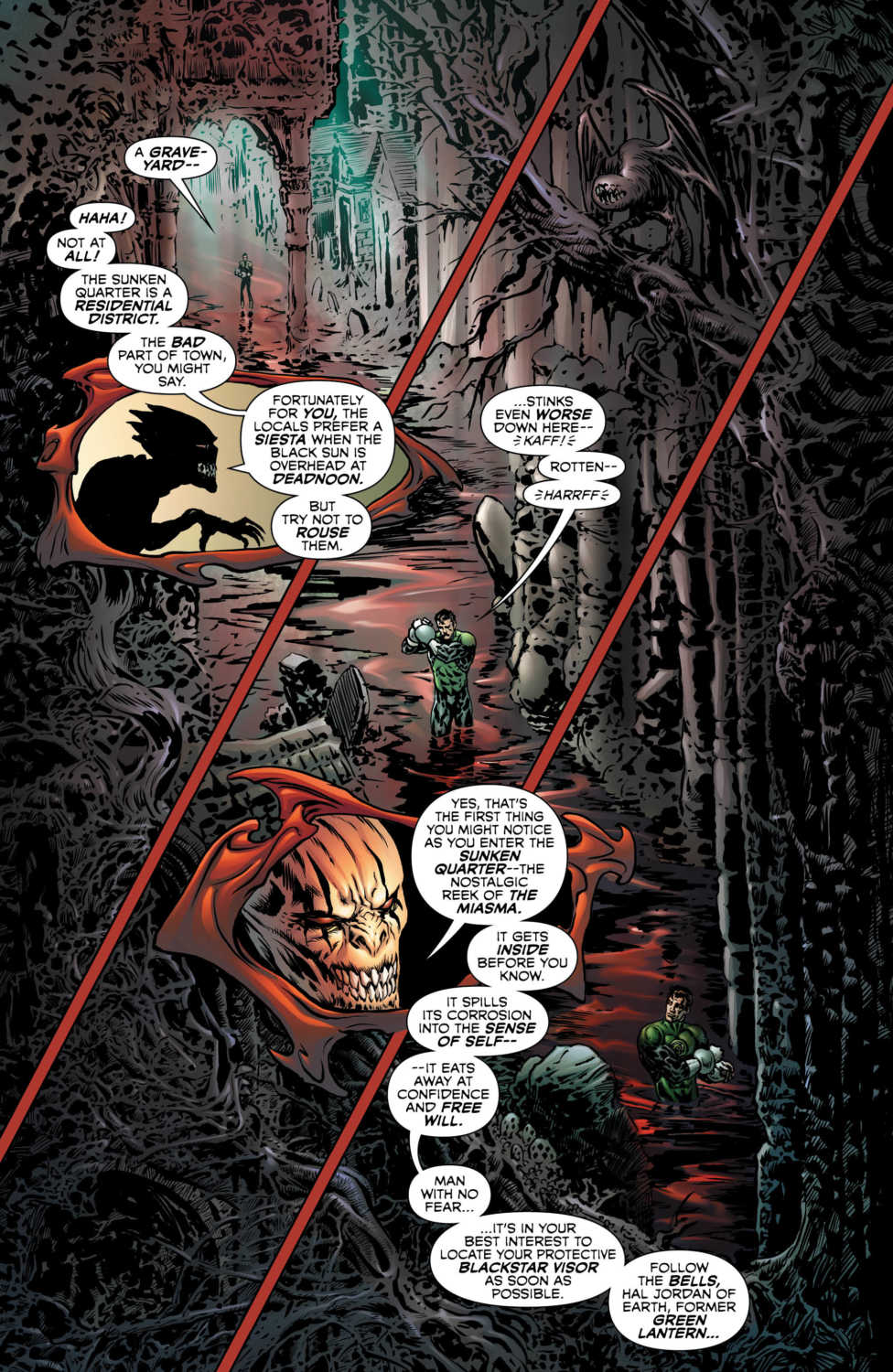
The issue wastes no time getting the initiation process underway by plunging Hal into the vampire-filled planet of Vorr. Countess Belzebeth, after handcuffing him, leads Hal through a landscape of gore and horror. The space cop soon realizes everything is not as it seems and finds he must leave aspects of himself behind in order to survive.

Hal is introduced to Vorr

Hal ventures into Vorr

It seems Morrison is leading Hal down a path of no return in this issue, but not in the way one might think. The story’s danger lies less in the vampires attacking Hal and more in the psychological ramifications of each initiation task.

Hal learns Belzebeth’s initiation test was designed to serve as the antithesis to his most cherished qualities: individuality, confidence and willpower. These qualities are preventing him from passing the test, and Hal must learn to let go of his bravado and surrender to the Blackstar Collective.

Belzebeth explains Vorr Belzebeth tells Hal he may lose himself

Morrison presents two intriguing versions of Hal in this issue. The classic version of Hal confronts his doubts and fears head-on with a smirk, while the new version, the Blackstar recruit Hal, begrudgingly surrenders his will to Belzebeth. It’s up to the reader to decide which version is truly “Hal” as he dives deeper into the Blackstar’s ranks.

Art

Issue #5 is another visual treat for fans of Liam Sharp’s cosmic artwork. His penciling on the cover and throughout the issue brings to mind the complexity of life in all its glory and horror. It’s almost as if the reader feels the life in each illustration through Sharp’s use of sketched lines that pulse throughout the pages. Also, Steve Oliff’s coloring adds a clear distinction between Hal’s costume and the gray colors of Vorr, further emphasizing his disintegration from the Green Lanterns. Tom Orzechowski’s lettering gives character to the inhabitants of Vorr as Hal navigates his way through their neighborhood.

The variant cover more or less serves the purpose of highlighting Hal’s former Green Lantern glory. Joe St. Pierre and and Steve Firchow use bright greens to emphasize the light he’s leaving behind. The artists also use solid shading and straight lines to represent the straight-laced, uncompromising attitude Hal must also abandon.

Green Lantern #5 variant cover

Conclusion

Hal undergoes a grueling self-discovery process that’s full of action. Regardless of motive, it’ll be interesting to see how this Blackstar ordeal impacts his psyche. Rest assured, the masterful writing of Morrison will make sure it’s mind-blowing.

What did you think of Hal’s Blackstar initiation? Let us know in the comments below!

Monkeys Fighting Robots Youtube

Review: RONIN ISLAND #1 And Why We’re Stronger Together

Monkeys Fighting Robots

The creative minds of Greg Pak and Giannis Milonogiannis have introduced RONIN ISLAND, an engaging story centered on a group of displaced peoples from China, Japan and Korea. Issue #1 follows two brash samurai students as they learn to overcome their animosity towards one another and work together. Their struggle underlies a deeper unrest within the community as they seek to forge a collective identity amid cultural conflict.

Ronin Island cover artwork

Story

Many writers struggle to define their characters at the beginning of a new series, but Pak is up to the challenge. The issue dives right into characterization from the get-go, presenting concise backstories for its two main characters: Hana and Kenichi. Readers learn Hana, an orphan, comes from a poor farming community while Kenichi hails from a prestigious line of samurai warriors. The only bigger clash than these distinct backgrounds is their competitive personalities.

Kenichi speaking with his mother Hana speaking with worker on the farm

A big theme in this story is multiculturalism, which is wonderfully emphasized by the village’s mantra: “Together in Strength.” Hana and Kenichi struggle to apply this motto during a samurai trial. One can feel the frustration in both characters as they let loose their preconceived prejudices. They eventually find that it’s much more difficult to succeed when cutting the other person down. The challenge ultimately shows the students the importance of embracing differences and coming together; that is where one finds true strength.

samurai race start

The samurai trial serves as a foreshadow for an impending threat, one bigger than they’ve ever faced. And their only hope of survival lies in the words of a mysterious stranger.

This story wonderfully underscores the very real human fear of the “other.” Readers will find new BOOM! Studios’ favorites in Hana, Kenichi and the others as they face their fears in the coming issues.

Art

Milonogiannias’ penciling creates a solid structure for the issues artwork while the collaborative work of Irma Knivila and Simon Bowland bring it to life. The vast landscapes of the island are coupled with highly-detailed houses and buildings to provide the reader with an authentic East Asian setting. Knivila uses variations of brown and green to emphasize the community’s dependence on the island’s natural environment. In addition, Bowland’s variations in lettering sizes underscore crucial thematic elements, such as the island motto.

The main, preorder, and variant covers give alternative takes on the story in masterfully diverse ways. Milonogiannias’ penciling and Msassyk’s colors give form and structure to the main cover by highlighting the determined looks of its main characters.

Ethan Young’s preorder cover depicts the story’s East Asian setting with monochromatic shades to bring to mind peacefulness and traditional art from the time period. The variant covers offer unique interpretations as well; David Lafuente and Germán García’s version focuses on the coming conflict while Kris Anka’s emphasizes each of the protagonist’s weapon of choice.

RONIN ISLAND #1 variant cover

Conclusion

RONIN ISLAND #1 offers an engaging story with highly relatable characters. Themes of multiculturalism and diversity abound, making this one of the most fitting tales of our modern time.

Are you looking forward to issue #2? What do you think of the threat? Let us know in the comments below!

Monkeys Fighting Robots Youtube

[Review] JUSTICE LEAGUE #19 Enters the Sixth Dimension with Mr. Mxyzptlk

Monkeys Fighting Robots

Teased back in December of last year, JUSTICE LEAGUE #19 is the first part in Snyder and Jiménez’s storyline The Sixth Dimension, where the League is pit against older versions of themselves, courtesy of Mxyzptlk.

Justice League 19 Cover

This first issue of the event is, to me, a much needed respite from the overarching (and sometimes overwhelming) story involving The Source Wall. Huge revelations were made, and the team is now one step closer on their journey to saving everything. But before the Justice League can make their way to this sixth dimension, they must first deal with an utterly unhinged Mr. Mxyzptlk.

**Some Spoilers Below**

Story:

“The Sixth Dimension” part one! At last, the Justice League has the map to the Sixth Dimension in hand—and with it, they have the key to saving the Multiverse from utter destruction! But things aren’t as simple as they seem, because they still need to get to the doorway—and to do that, they’ll have to go through the only being in all of existence who can get them there: Mr. Mxyzptlk!

After doling out justice at various places in the cosmos, as well as uncovering more of the mystery of The Source Wall, the core members of the league (now with more Starman) are finally back together. They now have a plan to prevent Lex Luthor from awaking Perpetua, and bringing about the end of the Multiverse.

In JUSTICE LEAGUE #19, Scott Snyder once again delivers on his quest to completely change the DC Universe. He does so by utilizing Mr. Mxyzptlk in a way that has rarely been seen before. This is a Mxy who, if given the chance, could take down every single member of the Justice League in a manner of minutes. The way that Snyder chose to write this, a sequence in which Mxyzptlk brings familiar buildings to monstrous life while manipulating the reality of some of the League members, is both entertaining and horrifying.

The dialogue is worth noting, too. I couldn’t help but smile at Superman’s moments with his signature messages of hope. Where Snyder excels is in his exposition, particularly when Mxyzptlk reveals information about his fifth dimension, as well as the newly unveiled sixth.

Justice League 19 Page 6

Art:

Jorge Jiménez creates some wonderful visuals in this issue. From something like the angle and curvature of Metropolis as Superman flies through it, to a beautiful spread containing imagery of the League, the Multiverse, and the Sixth Dimension, Jimenez masterfully lays out panels that are unique and intricate.

It all comes together with the colors of Alejandro Sanchez, particularly in the background of the panels. Standouts include the pinks and purples of inter-dimensional space, the whites and beige of the Hall of Justice, and the glowing and glittering look of the new, elder Superman.

Conclusion:

Snyder and co continue to make JUSTICE LEAGUE a great book to read, with a high concept story, sincere heroes, terrifying villains, intriguing revelations, and captivating artwork. If you’re a fan of this run of JUSTICE LEAGUE, this issue will not disappoint. Conversely, it will get you excited with what’s to come, both as an introduction to the “The Sixth Dimension” event, as well as a continuation of the overarching Source Wall story.

What did you think of Mister Mxyzptlk in JUSTICE LEAGUE #19? Let us know in the comments!

Monkeys Fighting Robots Youtube

DEADLY CLASS #37 – Saya’s Family Saga Rules

Monkeys Fighting Robots

Rick Remender and Wes Craig’s brilliant series continues it’s brutal and shocking run with DEADLY CLASS #37.

deadly class 37 cvr

***SPOILERS LIE AHEAD***


Saya and her f*cked up family drama continues to take center stage–and for good reason. Quan continues to see his stock fall after betraying his fellow classmates. Saya’s brother, Kenji, has been slowly becoming one of the best adversaries our cast has faced.

Deadly Class #37 focuses entirely on Quan, Saya, and Kenji’s gang. Remender has really put Quan threw the ringer in service of Kenji. His role at the bottom of the totem pole serves as a reminder of how sick and twisted the series can be.

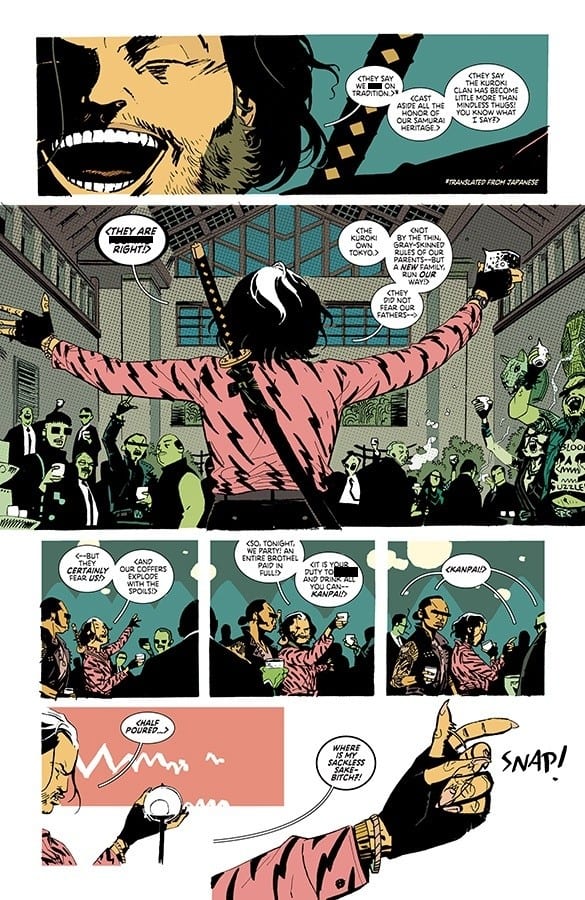
Kenji treats his gang to a night out at a brothel and it gets pretty vulgar before the fireworks begin. Remender has done an exceptional job at slowly but surely molding Kenji into a fully-formed villain with a clear objective.

This whole chapter of Deadly Class has pushed Saya back into the forefront, even if she spends a lot of it as a captive. At the end of issue #37 she’s primed and ready to get back to work–weapon in hand. She also dispatches of Quan in a shocking moment after his desperate attempt at redemption.

Saya and Kenji’s inevitable showdown will most likely be a memorable and explosive epic. As much as I would like to get Saya back to Marcus and the other students, her family saga has been highly entertaining and I wouldn’t mind lingering a bit longer.

Wes Craig delivers another platter of brutal action and stylistic sequences. There is nobody else in comic books right now that illustrates action and chase sequences as effective as Craig. Every time the pace picks up, it’s a shot of adrenaline directly into the reader’s brain.

Colorist Jordan Boyd is an underrated member of this creative team. Boyd’s work on this series gives an added layer of style and appeal. The old school color pallet and subtle deployment of that beautiful red blood helps this book continue to stand out in an era full of creative comic book art.

Deadly Class is one of the strongest long-running ongoing series. Remender, Craig, and Boyd are a creative trio operating on another level that many teams can’t maintain for this many issues. The series continues to get better and better, still keeping us all on our toes.

Monkeys Fighting Robots Youtube

Review – AVENGERS: WORLD TOUR

Monkeys Fighting Robots

Avengers volume two, “World Tour”, is out this Wednesday, and it’s a fun, thought-provoking read to keep you entertained while waiting for Avengers: Endgame to come out.

The paperback collects issues #7-12 of the series written by Jason Aaron. Artists include Sara Pichelli, Elisabetta D’Amico, Justin Ponsor, David Marquez, Ed McGuinness, Mark Morales, Cory Smith, Erick Arciniega, and others. Cory Petit letters the series.

“World Tour” opens with a one-shot story, a flashback to One Million B.C. Aaron, Pichelli, and company reveal the origin of the woolly mammoth-riding Ghost Rider first seen in Marvel Legacy #1. It’s a story with action and heart, and it’s a strong entrance to this collection. Readers immediately know that this is a grand-scale Avengers story. The tone is set.

The succeeding issues all tell a connecting story, but they also feel episodic. They can each be enjoyed on their own, which is great if you don’t have the time to sit down and read the whole paperback at once. The stories also strike a balance between light, fun superheroing and more thought-provoking, political storytelling.

“Light, fun superheroing” is the Avengers comic’s bread and butter. It’s what puts butts in the seats (or whatever the appropriate expression for comics would be). This team has real chemistry, both in and out of action. Whether it’s seeing Captain America mentor Ghost Rider, or watching Thor’s courtship of She-Hulk, readers will enjoy how this cast interacts. Aaron also has a few issues where he jumps around, bringing the audience on a tour of Avengers Mountain, or following Black Panther as he recruits various agents. It sounds basic, but “fun” really is the best way to describe these stories, and sometimes that’s all a superhero comic needs to be.

It’s not all fun, however. There’s also a lot of poignant, smart commentary here to sink your teeth into. First off, the Avengers are at odds with the United States government. Anytime you have tension between Captain America and America itself, it makes for a good story. Steve Rogers wears the flag, but he represents an ideal, not a government. Watching him tell the Pentagon that he doesn’t work for them is so satisfying. Black Panther also has some strong dialogue in the final issue here, speaking with international leaders and discussing how they need to come together for the betterment of the world. There are many lessons that readers can glean throughout “World Tour”.

Perhaps the most powerful and fulfilling subplot, though, is Namor’s. In fact, issue nine may be this collection’s high point. The Sub-Mariner is yet again sick and tired of how the surface world treats the sea. And, honestly, who can blame him? The Prince of Atlantis is such a compelling antagonist here because you can so vividly see where he’s coming from, especially in this issue’s closing pages where Aaron shows the pain that Namor is dealing with.

Side note: Justin Ponsor’s colors on this issue are magnificent. He utilizes blues heavily, obviously, because it takes place mostly underwater, but it creates an atmosphere and tone that’s unlike anything else in this collection.

If you’re jonesing for a fix of Earth’s Mightiest Heroes, pick up Avengers: World Tour this Wednesday.

Monkeys Fighting Robots Youtube

Review: THE GIRL IN THE BAY #2 Pushes The Boat Even Further

Monkeys Fighting Robots

Following the excellent first issue of The Girl In The Bay from Berger Books, the creative team do not give the reader time to relax. The quality and compelling nature of the first issue is continued throughout issue 2.

The Girl In The Bay beautifully marries together magical fantasy with gruesome horror. The Characters could have been stolen as easily from a 1930’s pulp noir novel as from the pages of The Sandman comic. What happens within this comic is surprising and under a less capable writer would quickly devolve into farce but luckily for the reader, J.M. DeMatteis is a master of his craft.

The Girl in the Bay #2 Credit: Dark Horse Comics

Writing/Story

50 years out of her time and face to face with an older version of herself, Katherine Satori thought her day couldn’t get any worse. But she was wrong, dead wrong.

Hugh Lansky thinks he may be losing his mind. Not because of the ectoplasmic, rag creature he talks to but because he’s just seen Katherine, a girl he believed he killed 50 years ago.

In this second issue of The Girl In The Bay, J.M. DeMatteis ups the weird factor and adds layer after layer of creepy. From the opening scene with Hugh Lansky sat on a bench talking to his ‘imaginery’ friend to Katherine’s strange encounter with herself, the mystery is deepened and the threat level enhanced.

DeMatteis focuses the story on the hero and the villain, contrasting their plights as they try to come to terms with something beyond their understanding. The character work on Katherine is especially effective as the reader is forced, along with her, to face some extremely difficult situations. Add to this that she, and the reader, does not understand what is actually happening and this creates an uncomfortable atmosphere.

The Girl In The Bay takes some surprising turns and has changed in theme from the straight forward ‘girl out of time’ story from issue one. There are magical and other worldly elements controlling the action but their motives are yet to be seen.

Elements of the story are reminiscent of the 80’s movie Flight of the Navigator but with magic replacing the aliens. However, there is more of a horror genre slant to the comic and this is best reflected through the disturbing character of Hugh.

The Girl in the Bay #2 Credit: Dark Horse Comics

Art

Although the story is compelling, it is the art work which draws the reader into Katherine’s world. The natural and the supernatural sit side by side, separate but still occupying the same space. Take for example Hugh and his twisted alternative version; it is clear that they bare an uncanny resemblance but Corin Howell uses much heavier inked lines to define the ‘real’ Hugh while leaving out any black shadows and strong defining lines from his alter ego.

The coloring in The Girl In The Bay by James Devlin also helps to highlight the two states of being; the natural and the supernatural. By using strong coloring for the real world and a hazy, washed out coloring style for the supernatural elements, Devlin is able to make the two worlds easily distinguishable on the page.

These two art styles service a larger purpose for the narrative as they make the reader question Katherine’s existence. Throughout the entire comic she is depicted in striking colors, a pink blouse and bright blue jeans, and she stands out of each page she is on. She has an effect on the people, real or not, that she meets, dragging them into her version of the world; this leaves the reader with questions about who and what is real.

The Art work deepens the mystery of the story through some very clever visual signifiers. This is something that Clem Robins understands when it comes to his lettering. He uses different styles for his speech balloons depending on the character. And his emphasis on certain speech brings out the emotions of the character brilliantly.

Conclusion

The turn that The Girl In The Bay has taken may initially put some readers off. With the inclusion of more expressive, supernatural elements, it becomes easy to lose track of the central theme surrounding Katherine’s plight. However, DeMatteis is a strong writer and manages to push the characterisation more than the more ludicrous elements of the story.

Plus, each element of the Art work separates the different worlds enough so that the supernatural does not over shadow the natural world.

And through it all, Katherine’s story is heart-breaking and compelling. The reader is taken on an emotional rollercoaster as the central character tries to find some way to cope with her desperate situation.

The Girl In The Bay is a magnificent read with grotesque and wondrous characters. As the mystery surrounding Katherine increases so does the readers compulsion to keep reading. Once DeMatteis has his hook in you he will not let go.

Monkeys Fighting Robots Youtube

Mike Deodato Leaving Marvel Comics

Monkeys Fighting Robots

Mike Deodato Jr., a Marvel Comics mainstay, is leaving the publisher after the completion of his work on Savage Avengers in order to concentrate on new creator-owned books. The artist announced his decision via Twitter, saying he’d achieved his boyhood dream of being a Marvel artist, but that at age 56 the time has come for a new dream.

deodato marvel

Deodato added that he informed Marvel management of his plans last year, and that he got nothing but support.

deodato marvel

The artist ended his Twitter thread with the news that his farewell will be the recently announced series with writer Gerry Duggan. deodato marvel

deodato marvel

During the course of his long Marvel career, Deodato has illustrated a variety of characters. His reference to Marvel as “home” in his Tweets seems to indicate just how deep of a connection he developed during his time there.

What was your favorite of Deodato’s Marvel work? Will you follow him on his new creator-owned adventure? Let us know in the comments!

Monkeys Fighting Robots Youtube

INTERVIEW: Composer Carla Patullo On Making Music For PORNO

Monkeys Fighting Robots

South by Southwest, otherwise known as SXSW, is an upcoming film festival in Austin, Texas, and Porno is a new horror-comedy scored by Carla Patullo that’ll be premiering on March 9th, 2019.

The frights and fun of Porno wouldn’t happen without the work of composer Carla Patullo. The “White Widow” is a musician-turned-composer (and sometimes director) who’s been busy building a filmography that includes several upcoming films. Carla’s music is vibrant, ethereal, sometimes haunting, and so often mesmerizing. It’s a mix of her influences blending together into something familiar but new.

PopAxiom got stuck in the White Widow’s web to speak with her about making rock music, composing, and scoring Porno.

carla patullo-porno-film-horror
Carla Patullo with Porno director Keola Racela. Photo courtesy of Impact24 PR

Getting In Tune

Carla’s musical career started with singing and piano and evolved from there “I started writing songs. I had a band. I started touring with Sandra Bernhard.”

Though capable of playing many instruments, Carla says “My vocals are my primary instrument.”

Carla didn’t have her sights set on working in the film industry, but her talent as a songwriter started to merge the two worlds “I wrote a few songs that got onto TV shows. And the more that happened, the more I thought about visuals.”

Carla created a concept album that earned her the nickname of White Widow. And it was there that the connection to film made itself secure “I hooked up with these animators out in Brooklyn for that concept album I did. That really drew me into working with visuals.”

Carla put her rock career on pause “So, I moved out to L.A. to start working with filmmakers,” and, naturally, she got into Porno.

About Porno

Our talk with Carla started with a lot of laughs. As the interviewer, I did my due diligence and researched Carla’s new film Porno. Of course, Google searches came up with some very different results “I have a lot of files on my computer labeled Porno.” And my search history looks a lot more interesting.

Porno is a horror-comedy from director Keola Racela that focuses on several teens in a small Christian town who work at a movie theater and uncover demonic secrets hidden within. Having mentioned that her vocals are her primary instrument, Carla relates to how that helped make the music in Porno “My vocals got to play a big part of the demon/succubus thing in the film.”

Carla was honored as Composer Fellow for the Sundance Film Music and Sound Design Lab. Through Sundance, she was paired with Keola for the making of Porno. What was it like working with him? “Keola is really into music. And he’s an editor. So it was easy tapping into his rhythm.”

What was it like working on Porno compared to her previous work? “On a lot of projects you just hit the ground running. But we got to talk a lot about music. What soundtracks we liked. It’s great to be able to have that time to understand each other.”

Music For Porno

Carla and Keola started their musical discussions as big fans of the same composer “… we both love Jerry Goldsmith.”

If you’re not familiar with Goldsmith, get to Google immediately after this interview. But some hit soundtracks from Goldsmith include Total Recall (1992), a lot of Star Trek, and Mulan “We both had different favorite Jerry Goldsmith scores. But it was a cool starting point.”

Most movies have a temp track “A lot of composers don’t like temp music. But in this case, it was so great. Keola really knew what he wanted and did so much work to get that across.”

As for some of the musical influences on the Porno soundtrack “Alien from [guess who] Jerry Goldsmith. The Omen soundtrack. The Witch. Phillip Glass.”

Wrapping Up

How does Carla connect with projects from one to the next? “I just took a trip through Big Sur and cleansed my palette.”

About hiking and other palette cleansers, she adds “How you start the next project doesn’t immediately mean ‘bam!’ get to the computer and start writing. Give yourself time to think about it.”

When asked about influences from the world of composing, Carla responds with “I really like Laurie Anderson. What she does is amazing. I love so many, it’s so hard. I love Desplat, Morricone … Danny Elfman, Thomas Newman.”

Up next for Carla? “I’m working on Lotte: The Shadow Behind the Silhouette. It’s a film about animation pioneer Lotte Reiniger.”

Thanks to Carla Patullo and Impact24 PR for making this interview possible.

Monkeys Fighting Robots Youtube

COSMIC GHOST RIDER DESTROYS MARVEL HISTORY…And Your Dignity

Monkeys Fighting Robots

The hotter than hot brainchild of Donny Cates gets a silly comedy book. COSMIC GHOST RIDER DESTROYS MARVEL HISTORY #1 puts Cosmic Ghost Rider in the hands of writers Paul Scheer and Nick Giovannetti.

cosmic ghost rider marvel history

***SPOILERS LIE AHEAD***


The Cosmic Spirit of Vengeance, Frank Castle, pays a visit to the past before his family is murdered. He pretends to be Frank’s Uncle Fredo and begins telling fake superhero stories to his son once Mrs. Castle anoints him as babysitter.

This is the first time we’ve had a Cosmic Ghost Rider of any sort written by anyone other than Donny Cates. Scheer and Giovannetti take the comedic route as Marvel tries to squeeze some more coin out of their hottest new character.

Cosmic Ghost Rider Destroys Marvel History #1 tries to tap into the silliness and free-wielding continuity fun that Marvel has in the past with the various “Marvel Character Destroys The Marvel Universe.” This new take on the niche is problematic right out of the gate.

This isn’t a rewriting of Marvel’s continuity with a Cosmic Ghost Riding twist, it’s Frank narrating a series of Fantastic Four stories with himself inserted to tell really poor jokes. The narration of the entire issue is written as if the reader is an eight year old boy–it wears out its welcome very quickly.

Enlisting comedians to write comic book stories has worked wonders in the past. Almost every time Scott Aukerman’s name is attached to a comic, it’s worth a read. The same cannot be said about this issue filled with cheap punchlines and a flimsy premise.

Scheer and Giovannetti don’t fit this character as well as their previous work on Deadpool. There’s nothing gained from inserting Frank into these historical FF moments. Each tale is crafted to hold our hand and walk us into an eye-roll inducing joke, one after another.

Cosmic Ghost Rider Destroys Marvel History is such an unfunny chore that by the time they attempt to explore Frank’s emotional state during this painful charade, it feels pointless to even acknowledge. A single panel of Frank shedding a tear as his son gets him another beer is the best they could do to make this anything more than an unfunny joke book?

The premise of the book says that Frank is rewriting Marvel history, but what we get in this issue is Frank simply bullsh*tting his son with tall tales. This makes the finale, with Uatu showing up, all the more puzzling and uninspired.

The only element of this issue that could possibly entertain you is the artwork. Penciler Gerardo Sandoval, inker Victor Nava and colorist Antonio Fabela do their best to liven up this uninspired cash grab. Sandoval does a fine job revisiting some of the more memorable scenes in Fantastic Four history. Cosmic Ghost Rider is such a great design that it’s near impossible to make him unappealing (despite the story really trying to make you hate him).

There’s an appealing 90’s tinge to the Ghost Rider action, particularly his transformations. This style lends a hand to our main character but has the reverse effect on his son who is the focal point of the issue’s weakest visual moments.

If you’re a fan of Donny Cates’ Frank Castle stories you would do well to stay away from this one. It provides nothing for fans of Marvel history, Cosmic Ghost Rider, or comedy. Cosmic Ghost Rider Destroys Marvel History #1 is unfortunately a major dud.

Cates designed a very specific and sarcastic tone for this character, which leaves room for plenty of humor. The problem is that this creative team completely misread that tone and wrote a watered down version of their previous Deadpool work with some history thrown in.

Monkeys Fighting Robots Youtube