Written by Daniel Gordon with artwork by Adrian Sibar, Revenge of the Fanboys, which just began its Kickstarter for the second (of a planned) four issues, is described as “the greatest parody in comic book history!”
A definition of fanboys is, “a passionate fan of a particular product or company – whether it be comics, television, films, video games, etc. – blindly supports the every action of said product/company without question or reasoning.” While a fan will display admiration for a piece of entertainment, a fanboy is a devotee. They love it to the point of almost being a fault. So, what’s a fanboy to do when a greedy corporation is on the verge of shutting down a major comic book publishing company in lieu of making movies about said properties? They seek revenge, of course.
Story
What if the movie industry tried to put the comic book industry out of business?
In this alternate reality a corrupt movie executive is trying to buy out “The Big Two” to use the characters in their movies, and is planning on letting the comic book side die away. To prevent that from happening Jack and Todd have to go to the convention where the sale is going to take place and cause enough controversy and chaos to scare the movie executive off!
On the way Jack and Todd will face off against parodies of the most popular comic book creators of the past 20 years as they desperately fight to save the comic book industry!
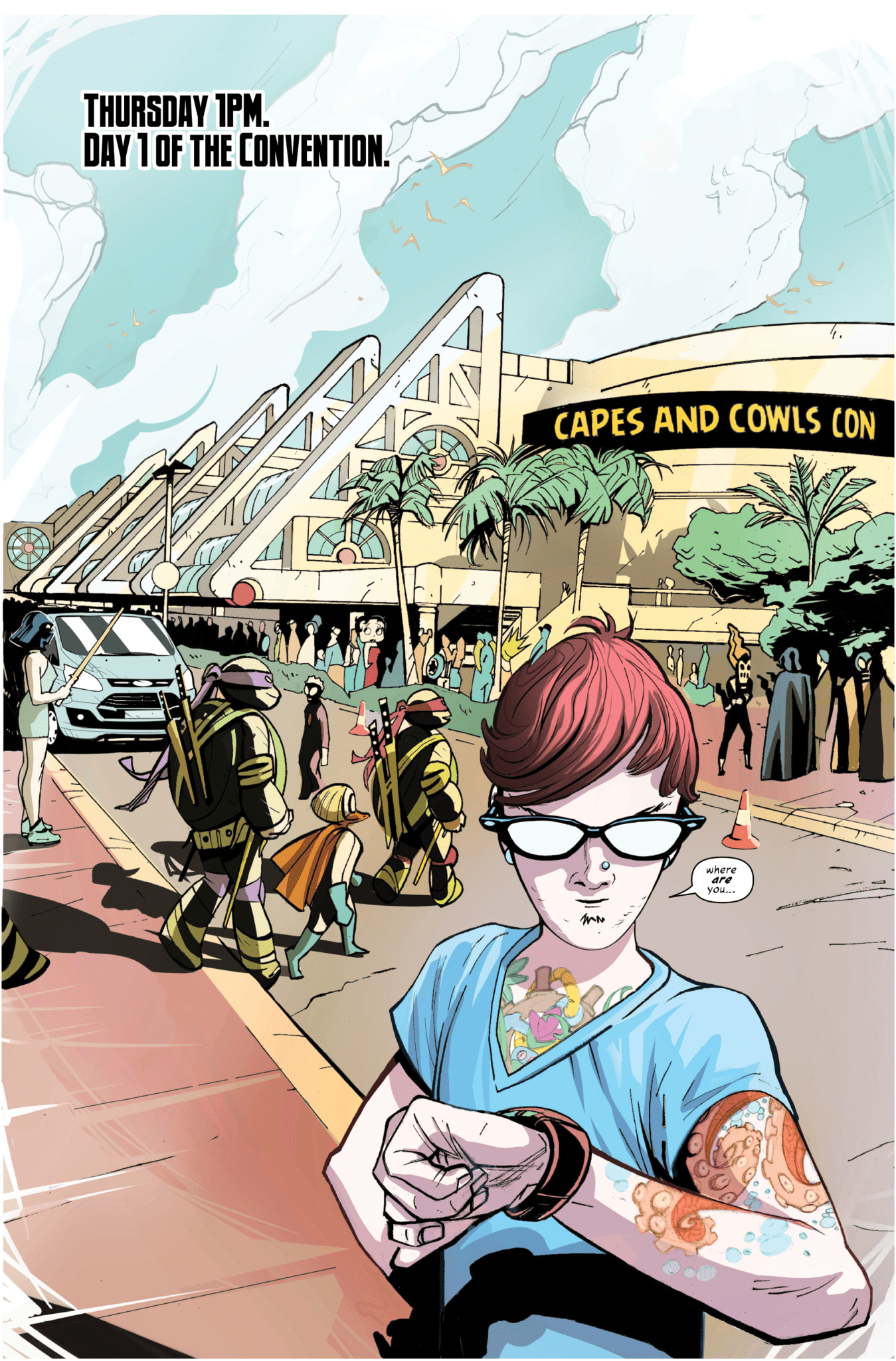
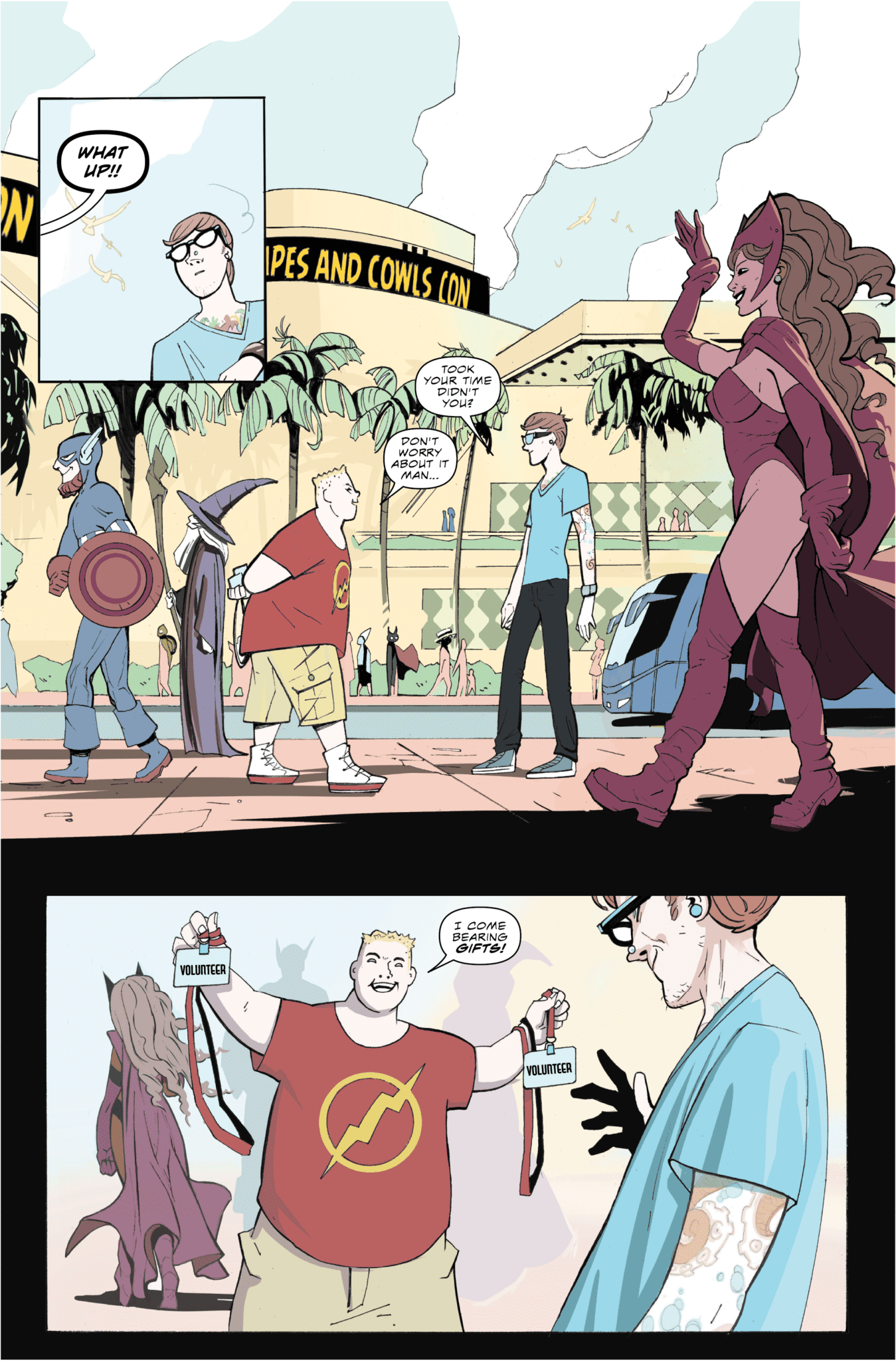
The first issue of Revenge of the Fanboys is a satisfying introduction to the main characters and the challenges they will eventually face. We follow the main duo as they enter a major comic book convention. Each panel in the book is sprinkled with cosplayers donning familiar, yet just different enough to avoid any copyright infringement, costumes.
What occurs over the next 22 pages is a chuckle-inducing dive into comic book fanboys and comic book convention stereotypes. Writer Daniel Gordon has clearly been to a Con or two, poking fun at the long lines and the stenches one would expect to find at an overstuffed convention center. Gordon also showcases his love/hate relationship with comics through his two main characters. It is apparent from the very beginning that they love comics. They love discussing comics, and using comic references in their dialogue. They also seem frustrated by the direction the industry has veered, what with the movies overshadowing the books that they draw the source material from. We all have friends like them. Heck, we are them.
The second issue of Revenge of the Fanboys takes the story in an interesting turn. While the first book is a comedic, heightened journey through a comic book convention, the second book adds a heaping dose of fantasy and surrealism. You will find deadly and villainous writers, drug-induced trips to another plain of existence, and the discorporated head of an Alan Moore-ish looking sage. It almost feels like the story was meant to be at this level from the get go.
Art
Adrian Sibar’s artwork on Revenge of the Fanboys looks as if Skottie Young did some work on Archie Comics, and that is said with the best of intentions. Sibar crafts a unique style that’s manic and cartoonish. His work with the cosplayers in the convention hall is a fun who’s who of superheroes and pop culture characters. The characters appear in their traditionally illustrated size and style, making it seem as if the eponymous fanboys stepped into a nerdy version of Who Framed Roger Rabbit’s Toontown.
The artwork is amped up in the second issue as much as the writing. Sibar adds different artistic styles, coloring, and panel designs for each flashback and reality trip. Readers are sure to feel like they’re going on the surreal journey with the fanboys to save comic books from The Man.
Conclusion
Revenge of the Fanboys is a humorous, increasingly fantastical adventure that slams the comic book industry as much as it idolizes it.
You can read and support Revenge of the Fanboys through its Kickstarter campaign, and follow creator Daniel Gordon on Twitter for updates.
Stan Sakai brings his beloved rabbit ronin Usagi Yojimbo to IDW with a brand new full-color series. Colored by Tom Luth (Groo: The Wanderer) USAGI YOJIMBO #1 starts an epic new chapter the ongoing adventures of Usagi.
Miyamoto Usagi wanders Edo period Japan on his warrior’s journey. In the start of this three-part story, Usagi becomes embroiled in a puppet drama where the players are not quite what they seem!
Usagi Yojimbo #1 ‘Bunraku’ part 1 Written by: Stan Sakai Art by: Stan Sakai Colors by: Tom Luth Letters by: Stan Sakai
Story
Usagi Yojimbo has always been a deceptively ‘simple’ concept; a samurai rabbit. It’s the kind of ‘funny book’ idea that has been rooted in comics since the newspaper strip days. What Sakai has always done, though, is execute his idea with such care and attention to detail (throwing in LOADS of history, mythology and a growing cast of recurring characters) that an entire world has been created over the years. And it’s such a rich world, that it’s easy to drop in and out, catching glimpses through the eyes of Usagi. That’s what the best Usagi stories have always done, and “Bunraku” continues that tradition. “Bunraku” re-introduces readers to Sasuke, a supporting player and demon fighter with a mysterious past. It also touches on Japanese puppet drama, the titular Bunraku. Both of these build enough plot points and narrative momentum to get a solid story started. It’s a great introduction for new readers and a welcome return for long-time fans. There’s plenty of action, demons and monsters too.
Art
Stan Sakai’s art has always been phenomenal. His care for the craft is evident in everything from the line work to the lettering (Fun fact: Sakai lettered the Spider-Man newspaper strip for years). He is able to capture the true emotion in the faces too, which is not always easy with anthropomorphic characters that can easily slide into parody. “Bunraku” is no different, and when you add in the vibrant colors of Tom Luth, you get a comic book the pops off the page. This is classic, elegant and effective sequential art. It truly understands the language and narrative nature of comics.
Conclusion
If you love comics, you owe it to yourself to check out Usagi Yojimbo #1 from IDW. This is a classic property being given a fantastic new launch. Having a monthly Usagi book is a gift, so take advantage and follow the rabbit! Find it at your local comic book shop.
Darcy Van Poelgeest took us into some pretty bleak territory over the previous three issues. With Little Bird #4, though, he manages to up the ante even further, giving us perhaps the darkest chapter yet.
Little Bird, the people of Elder’s Hope, and all the other rebels are either dead or captured. Bishop’s plan to consolidate his power over the land seems nearly complete. And yet, there seems to be unrest within the New Vatican. Bishop needs a miracle to quell the people…and he plans to procure it from Little Bird herself.
The Writing
Little Bird #4 is perhaps the most expository issue of the series yet. Within the book’s first few pages, we discover key information about Little Bird, her origins, and her connection to Gabriel. Van Poelgeest ties the information into the narrative, revealing key points through visions rather than direct address or info dumping.
The titular character has always been shown as a competent and skilled fighter. By this point, though, she’s come into her own as a rebel, managing to escape and locate Gabriel with ease. There’s still vulnerability and dimension to the character, though, making her as compelling as ever. To that point, some of the strongest moments in Little Bird #4 are the quieter, less action-oriented ones. Gabriel and Little Bird conversing and trying to understand and relate to one another is a high point. It adds depth to one character in particular, making that individual much more of a fleshed-out figure.
Throughout the book’s first three issues, perhaps the only real weakness is that we see characters enter and leave the narrative before they’re fully-developed. On multiple occasions, we’ve seen characters die, without fully feeling the emotional weight. In Little Bird #4, though, we really do feel the significance of the last few pages.
It’s skillful, solemn writing, hitting the right emotional beats from page to page. This makes for one of the strongest issues in the run so far, and sets us up for the climax in issue #5.
The Artwork
Ian Bertram again turns in excellent illustrations for Little Bird #4. While his work on this issue is a little less expansive in its design, it makes up for that with a level of coherence and cohesion that was present, but not always consistent in previous chapters. Bertram manages to inject plenty of dynamic images into the work, while maintaining an even flow between panels. The reader always feels grounded in the scene without ever feeling lost.
What Bertram manages to achieve brilliantly in this issue is focusing the reader’s eye on the characters, while still keeping up the imaginative settings in the background. When the work opens up into a large panel that dominates much of the page, it feels that much more impactful.
Matt Hollingsworth’s colors in Little Bird #4 have an integral, symbiotic relationship with Bertram’s illustrations. They’re moody and dark, yet full of life. It’s hard to imagine one without the other. As a bonus, a gallery of the pair’s artwork occupies the last quarter of the book, offering more poster-worthy imagery.
Final Thoughts
Little Bird #4 is another excellent chapter in one of the most original, compelling narratives of the year in comics. Still worth it, so pick it up at your local comic shop on June 19.
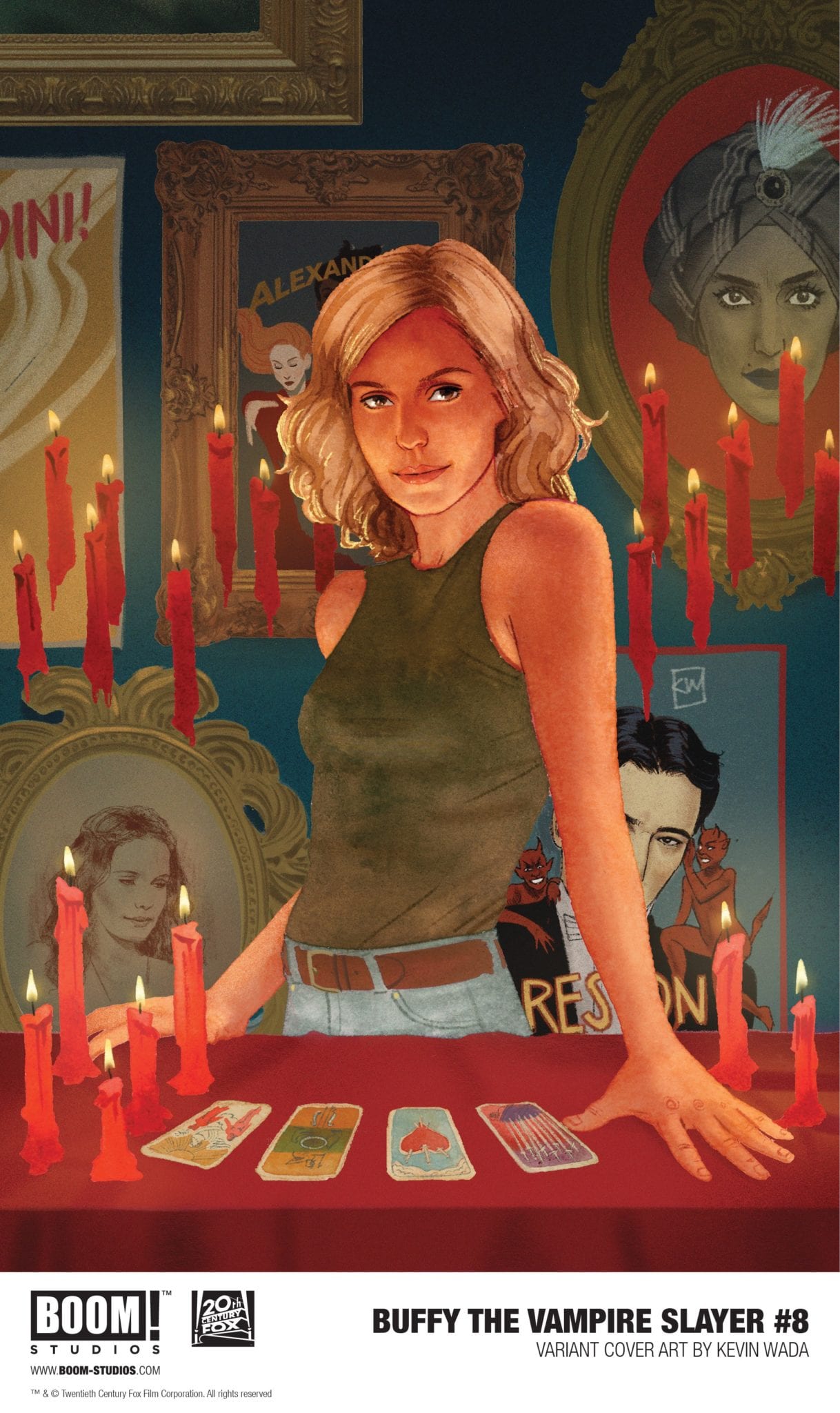
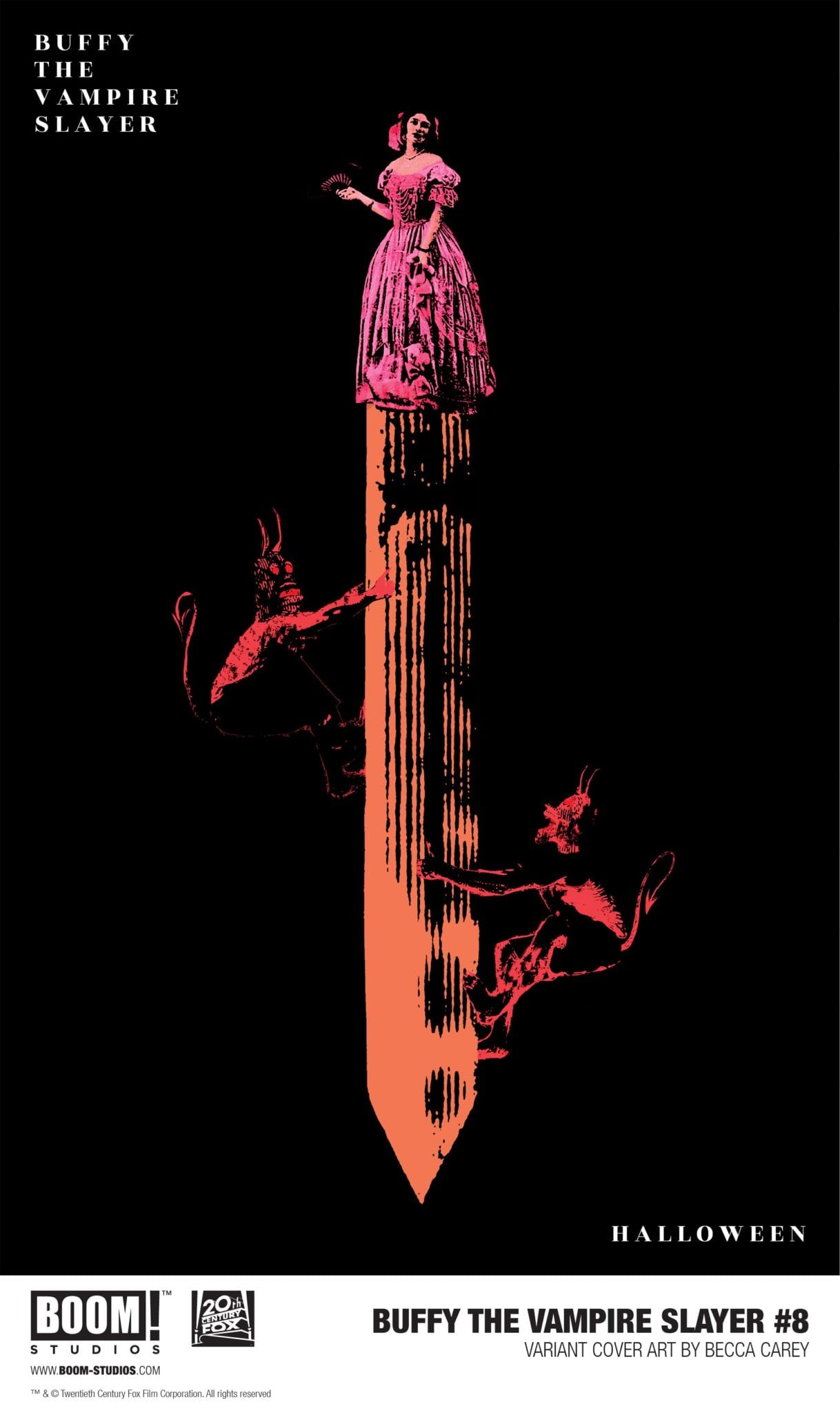
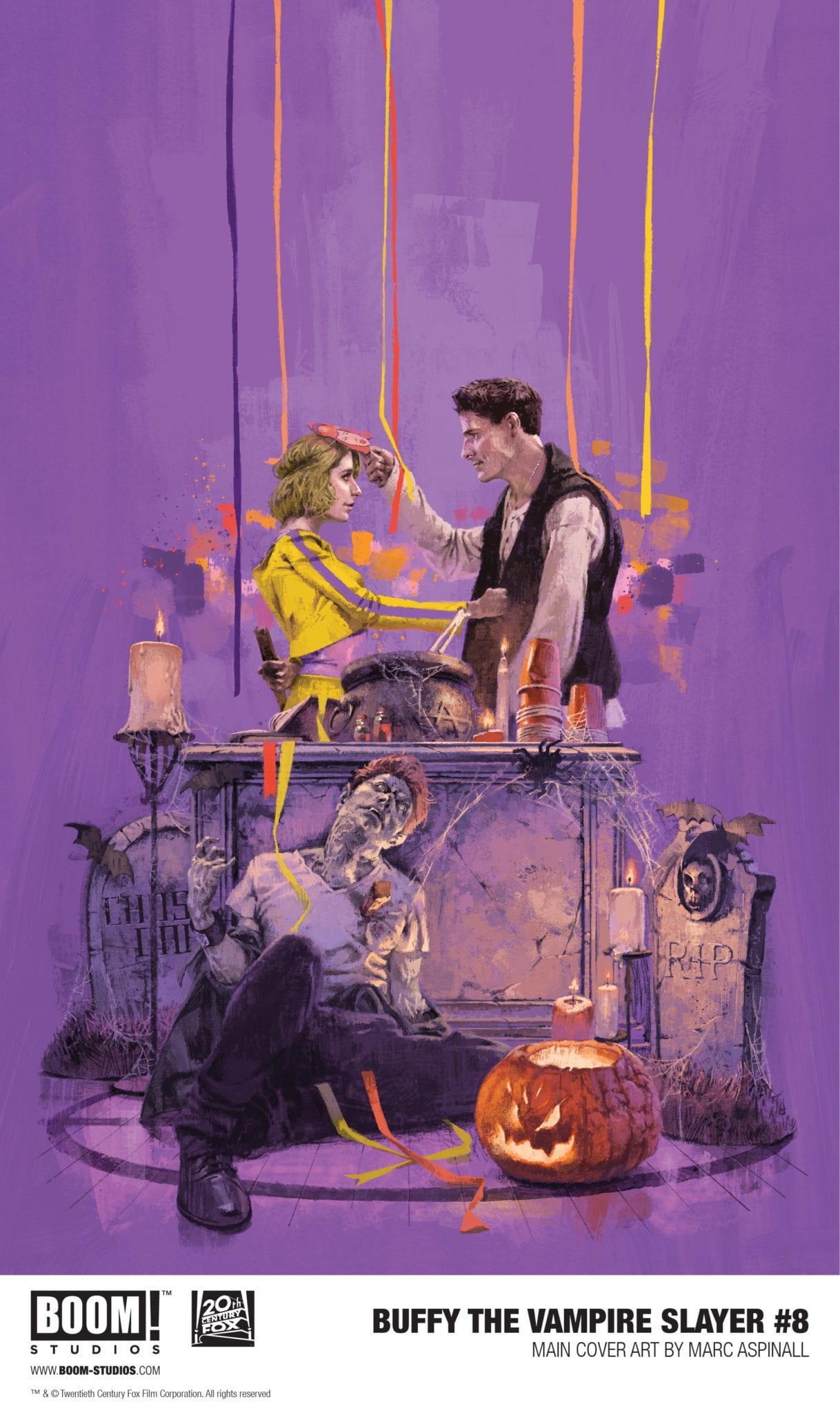
Buffy the Vampire Slayer #8 hits your local comic book store on September 4, but thanks to BOOM! Studios and 20th Century Fox Consumer Products, Monkeys Fighting Robots has an exclusive look at the three covers for the issue by Kevin Wada (She-Hulk), Becca Carey (Bitch Planet), and Mondo illustrator Marc Aspinall. Check out the covers below.
Wada’s cover features Anya, the proprietor of Sunnydale’s hottest underground magic shop:
Carey pays tribute to the season two episode, “Halloween”:
Buffy and Angel meet at a Halloween party on Aspinall’s cover:
About Buffy the Vampire Slayer #8:
This game-changing issue of the acclaimed series will debut in stores September 4, 2019. While the Slayer and the rest of the Scooby Gang were fighting to save Xander’s soul, the Mistress Drusilla and her lieutenant Spike were busy searching for a way to open the gates of the Hellmouth so they could flood Sunnydale, then eventually the world, with demons and hell on Earth. And they’re close. Can Buffy stop them in time to save the world from utter destruction?
Buffy the Vampire Slayer is written by Jordie Bellaire (Redlands), with art by David López (Captain Marvel). Joss Whedon serves as a story consultant on the book.
What do you think of BOOM! Studios version of Buffy? Comment below with your thoughts.
In September, Marvel Comics goes off the deep end with the 40-page anthology one-shot called CRAZY #1, featuring the return of Obnoxio the Clown.
The issue features the writing talent of Gerry Duggan, Frank Tieri, and Jon Adams to name a few. Don Simpson, Scott Koblish along with several others will help bring Crazy #1 to life artistically. John McCrea’s artwork graces the cover.
“I actually grew up a “Crazy” kid — with everything from Obnoxio the Clown to Teen Hulk– so it’s been an absolute blast to be part of the revival. And the best part is? Me and John Cerilli will be doing more Ziggy Pig and Silly Seal bits for this! Hey, we told fans if they supported that whacky book that there’d be more– and since fans were crazy enough to do just that– we figured Crazy would be the most apropos place for their return. I don’t know about the rest of you, but I think this calls for a round of floor sandwiches and mouthwash martinis to celebrate…,” said Tieri.
Ziggy Pig and Silly Seal
The editor on the book, Mark Paniccia chimed in with a behind-the-scenes look at the brainstorming process of Crazy #1.
“The brainstorming sessions for this were a blast. Part of it was looking through the old magazines and remembering how much we loved seeing Marvel making fun of itself…all those in-jokes the staff was letting readers in on and the fact that Marvel was cool enough to show its funny side…not take itself so seriously. The other part was looking at each other and saying, “Hey, we get to make fun of ourselves and not take ourselves so serious!!! Wouldn’t it be hilarious if…?” As we each took a turn throwing out ideas, it just kept growing to the point where we didn’t have room for everything. There’s a lot of funny stuff that had to get cut. But there’s going to be something for everyone. Like the original, there’s a variety of ridiculous humor in this book. We’re celebrating the fact that we can tickle ourselves and not have to worry about how loud we’re laughing,” said Paniccia.
MARVEL’S GREATEST…ER…MOST DEMENTED COMIC MAGAZINE
OBNOXIO THE CLOWN is back and so is one of MARVEL’S most hilarious titles thanks to a momentary lapse in sanity on the part of a few over-worked editors and a gang of writers and artists ready to take advantage of it. No superhero is safe! No comic book event is sacred! Will the Marvel Universe ever be the same? Will, we want it to?
Not Final Artwork
What do you think, are you going to add Crazy to your pull list? Comment below with your thoughts.
Fans of the former Dr. Harleen Quinzel, now know as Harley Quinn, got some good news from DC Comics recently: two new Harley miniseries will be arriving in September.
Arriving September 4 is Harley Quinn and Poison Ivy, a six issue series spinning out of the events of Heroes in Crisis, written by Jody Hauser and illustrated Adriana Melo. DC’s solicitation below seems to confirm that this story will be set in regular continuity — unlike Harley’s current title.
HARLEY QUINN AND POISON IVY #1
written by JODY HOUSER
art by ADRIANA MELO
cover by ELENA CASAGRANDE
Harley Quinn card stock variant cover by STANLEY “ARTGERM” LAU
Poison Ivy card stock variant cover by STANLEY “ARTGERM” LAU
blank variant cover
Harley Quinn and Poison Ivy are taking their show on the road in this new miniseries! They’ll have to evade villains and heroes alike while they exploreSe their relationship and unpack their time and experiences at Sanctuary. Set after the events of HEROES IN CRISIS and smack in the middle of “Year of the Villain,” it’s a journey across the DC Universe that will change their friendship forever…if they live that long!
ON SALE 09.04.19
$3.99 US | 1 OF 6 | 32 PAGES
CARD STOCK VARIANT COVERS $4.99
FC | RATED T+
HARLEEN #1
written by STJEPAN ŠEJIC
art and cover by STJEPAN ŠEJIC
variant cover by STJEPAN ŠEJIC
“The road to hell is paved with good intentions. On that road I saw a pale man, and he smiled at me…”
Dr. Harleen Quinzel has discovered a revolutionary cure for the madness of Gotham City—she just needs to prove it actually works. But with the criminal justice and mental health establishments united against her, the brilliant young psychologist must take drastic measures to save Gotham from itself. Witness Harleen’s first steps on a doomed quest that will give birth to the legendary super-villain Harley Quinn in this stunning reimagining of Harley and The Joker’s twisted and tragic love affair by visionary storyteller Stjepan Šejic (AQUAMAN: UNDERWORLD, SUICIDE SQUAD, Sunstone).
ON SALE 09.25.18
$7.99 US | 1 of 3 | 64 PAGES | BIMONTHLY
FC | APPROX. 8.5” x 10.875”
MATURE READERS
Following in the format of Batman Damned (but hopefully without all the controversy), Harleen will be published as three oversized issues which will later be collected in 2020.
Keep in mind, this book will be running at the same time as another Black Label title: the previously announcedJokey/Harley: Criminal Insanity.
If you’re a Harley fan, which of these books are you more excited for? Or is it too hard to choose? Leave us a comment!
To say that Tom King’s Heroes in Crisis take on Wally West was controversial is an understatement. Speaking to CBR last month, King had this to say about the character:
“We took this character that I love — my first introduction to DC Comics was Wally West. He’s my favorite Flash, and he’s really the Peter Parker of the DCU. He’s our every man. And for over ten years he’s not had his own book and has been at the periphery of things. Basically, since before the New 52, he’s been gone. This story puts Wally back at the center of the DC Universe, where he belongs.”
Now, the former Kid Flash is about to embark on a mission to “find redemption” in the new series Flash Forward by writer Scott Lobdell and artists Brett Booth and Norm Rapmund.
Check out DC’s official solicitation:
FLASH FORWARD #1
written by SCOTT LOBDELL
art by BRETT BOOTH and NORM RAPMUND
cover by EVAN “DOC” SHANER
variant cover by INHYUK LEE
blank variant cover
His name is Wally West—and he was the Fastest Man Alive. That is, until the Multiverse was rewritten without him or his family in it. Wally returned and tried to make it work, but the damage was done. Spinning out of the events of HEROES IN CRISIS, follow the man who called himself Flash on an adventure to find redemption in a cosmos that has fought so hard to destroy him.
ON SALE 09.18.19
$3.99 US | 1 OF 6 | 32 PAGES
FC | RATED T+
Note the “T+” rating, which implies this likely won’t have the lighthearted tone of Wally’s earliest adventures.
What did you think of Wally’s portrayal in Heroes in Crisis? Will you be picking up Flash Forward? Let us know in the comments!
Game of Thrones has ended after eight seasons. It was a wild ride of ups and downs – both emotional and in the field of quality. The show has led to an increased interest in historical shows and many networks have attempted to make their own Game of Thrones. Shows filled with sex, violence, war, and political power plays. Now that the show is over it is a great time to look at similar series that could fill that Game of Thrones hole that you might have.
10. Spartacus
The legend of Spartacus is famous and Starz broadcast their version from 2010 to 2013. Spartacus is one of the more action-packed shows on this list – it was made on the back of the hit 2007 movie 300 and wanted to capture that movie’s grotesque slo-mo action. It was unabashed fun and that was why people were drawn to the show.
Spartacus was filmed in New Zealand and most of the cast were from Australia and New Zealand. The show was beset with tragedy when the original star, Andy Whitfield was diagnosed with non-Hodgkin lymphoma and died at the age of 39. Starz made a prequel miniseries in between season one and two – focusing the gladiators and after Whitfield’s passing Liam McIntyre took on the role.
9. Black Sails
Black Sails is an 18th-century set show that was broadcast by Starz, focusing on the Golden Age of Piracy. Black Sails was made as a prequel to Robert Louis Stevenson’s Treasure Island but was a lot less family friendly due to the show’s use of sex and violence. The show aimed for a more realistic take on piracy as it shows the pirates in conflict with major naval powers (i.e. Britain and Spain) and with each other as they try to dominate the criminal world. The mix of history, politics, and crime and setting the show mostly in a town made Black Sails the pirate version of Deadwood.
The first season was mired by the overuse of sex and swearing but it improved massively after that shaky start.
8. The Tudors
A predecessor to Game of Thrones was the Showtime series The Tudors. As the title suggests The Tudors focused on everyone’s favorite obese king, Henry VIII of England and his struggles against the church, international rivals, and his various marriages. It lasted for four seasons and started a successful career in TV for the showrunner Michael Hirst. The show was historically dubious, playing fast and loose with the facts, condensed events and most importantly Henry VIII reminded a handsome man despite in real life he developed a big waistline as he got older.
The show had a massive cast that featured respectable actors like Jonathan Rhys Meyers, Sam Neill and, Peter O’Toole, and emerging talents. Actors like Henry Cavill, Natalie Dormer, and Annabelle Wallis have gone on to big things since appearing in the show.
7. The Borgias
Another show offering political intrigue in the late-medieval/early modern period was The Borgias. The House of Borgia was a powerful noble family in Europe and their patriarch, Rodrigo Borgia, became the Pope despite the facts that he had children, loved to the ladies, and exceedingly corrupt. The show looks at how Rodrigo Borgia became Pope by using every political trick in the book and keep power whilst facing threats, both foreign and domestic.
The Borgias lasted for three seasons and it garnered a fanbase. After its cancellation fans launch a campaign for revival and Showtime did consider making a two-hour finale but decided against it because of the cost. The showrunner, Neil Jordan, did intend for a four-season run.
The Borgias was not the only recent show about the famous family. There was also a multi-national production known as Borgia: Faith and Fear. So history fans can have a double helping of Borgia actions.
6. I, Claudius
The oldest show on this list is the BBC classic I, Claudius. Based on the novels by Robert Graves I, Claudius focuses on the early history of the Roman Empire and the Julio-Claudian dynasty. Spanning 12 episodes I, Claudius was one of the most ambitious shows of its time due to its production values. It had a tremendous cast of British talent with big names like Derek Jacobi, John Hurt, Brian Blessed, Patrick Stewart, and John Rhys-Davies. It was also one of the most controversial shows of its time with one of the most infamous being Caligula eating an unborn baby.
I, Claudius was incidentally criticized by critics but grew to be an award-winning show in the UK and US and is often considered one of the best British shows ever made.
5. The White Queen
The War of the Roses was one of the biggest influence on Game of Thrones. It was a dynastic conflict between the House of York and House of Lancaster for the throne of England. So a series about The War of the Roses would be a fitting Game of Thrones fix.
The White Queen was based on a trilogy of novels by Philippa Gregory, focusing on Elizabeth Woodville, the wife to Edward IV. She was a woman of lowly status and by marrying the king her family was awarded land and titles – but also made themselves a lot of enemies at court. Elizabeth Woodville and her family were an influence for the Lannisters.
The White Queen was made by the BBC and Starz and it gave Rebecca Ferguson her first major leading role. Starz has released two sequel series, The White Princess which starred Killing Eve‘s Jodie Comer and The Spanish Princess.
4. The Hollow Crown
Some of William Shakespeare’s most famous plays were his histories and The Hollow Crown series spanned from the reigns of Richard II to Richard III. The Hollow Crown was made for the BBC and broadcast by PBS in the US. This was a series based on famous pieces of theater and focuses on a period of near-constant conflict – whether it was England at war with France or English nobles fighting themselves. That alone is a draw for Game of Thrones fans.
The series was made by celebrated theater directors and attracted many great British actors. These include Benedict Cumberbatch, Jeremy Irons, Tom Hiddleston, and Patrick Stewart. The series even had Game of Thrones alumni Michelle Dockery. The series went for a realistic look and it was an expensive production.
3. The Last Kingdom
The Last Kingdom is a series based on The Saxon Stories by Bernard Cornwell. The BBC and Netflix produced the first two seasons and the third was solely distributed on Netflix.
The Last Kingdom set in 9th Century England when the Vikings are conquering the land. In the middle of the conflict is Uthred of Bebbanburg, the son of a Saxon lord who was captured by the Danes as a child – leading to him having divided loyalties between the Saxons and the Danes.
Like many of Cornwell’s work, The Last Kingdom does a fantastic blending fact and fiction and showing that there are heroes and villains on both sides. This leads to great characterization because most characters are a mixed bag. Like Game of Thrones there was plenty of court intrigue on a political level as people compete for land, a personal level due to people liking or despising Uthred.
The Last Kingdom is a smaller scale, Earthy show compared to other shows that go for an epic view. Battles and fights were won by outsmarting the enemy and rarely led to a massive brawl. The show does tough on hard subject matter like murder and rape yet kept mostly a fun tone.
2. Vikings
Out of all the Game of Thrones clones Vikings is one of the best. As the title implies the show focuses on everyone’s favorite raiders, rapists and pillagers during their golden age. The series focus was on legendary Ragnar Lothbrok and his sons who lead to the rise of the Vikings. This show looked at famous events like the raid on Lindisfarne, the Siege of Paris, and the Great Heathen Army’s conquest of England. The show has to play fast and loose with the facts because these are events take place over hundreds of years.
The big draw of Vikings was the action scenes. It was filled with bloody battle sequences that could rival Game of Thrones and movies like Gladiator and Braveheart. The best came during the third season during a three-episode arc where Ragnar Lothbrok’s forces try and fail to capture Paris.
1. Rome
Rome is arguably the main predecessor to Game of Thrones, an ambitious show that HBO used as a building block for the fantasy series. Romewas a co-production between HBO, the BBC and RAI (Italy’s public broadcaster) which looked at the fall of the Roman Republic and rise of Julius Caesar and Augustus.
Rome was an ambitious show – it was the most expensive show made at the time. It was filmed mostly in Italy, including at the famous CinecittàStudios in Rome. It had an impressive cast featuring the likes of Kevin McKidd, Ray Stevenson, and James Purefoy. Some cast members even appeared in Game of Thrones, i.e. Ciarán Hinds and Tobias Menzies.
Rome was a huge production that looked at both the power struggles amongst the elites of the Republic and issues affecting the regular people. All of this was seen through the eyes of two veterans of Caesar’s army. History buffs and politics nuts enjoyed the power plays and there were plenty of subplots looking at the underworld and domestic situations. Like Game of Thrones there was plenty of sex, violence, and nudity.
The showrunners planned a five-season run for Rome but it was cut down to two. This forced the show to cram in a lot during the second and this is where Rome faltered. The worst example of this was the subplot involving two Jewish rebels tried to assassin King Herod. It was a plot that went nowhere and did not add anything to the series.
Whether you’re a military buff or a comics buff, but especially if you’re both, then Super Soldiers by Jason Inman is the book for you.
In Super Soldiers, Inman – himself a veteran of the United States Army – explores the relationship between the American Armed Services and comic books. Each chapter breaks down a different fictional service member to try and figure out if they’re a “good soldier” by contemporary military standards. Along the way, Inman shares never-before-told stories about his own time serving overseas.
First off, kudos to Inman. This is the author’s first novel, and it’s a thoroughly enjoyable read. His prose is casual and conversational, making for a comforting and inviting experience. It never feels like Inman is lecturing the reader. He’s having a chat, and giving you a peek behind the curtain at what it’s like being a soldier in the US Army (in his experience).
Each chapter is essentially an essay unto itself. So, if you’d like, you can actually jump around a bit and first read the chapters on characters that interest you the most. Reading it straight through will give you the most fulfilling experience, though, as Inman builds on topics and references past chapters frequently.
Still, the structure does allow for a lot of freedom, which makes Super Soldiers a great book to revisit, instead of reading it once and then letting it collect dust on a bookshelf. You’ll be tempted to pick this book up again and again, whether to refresh yourself on how War Machine represents loyalty among battle buddies, or how Beetle Bailey reminds soldiers that they’re still humans, and not just “a walking, talking uniform.”
You’re going to learn a lot from Inman while reading this book, both from a comics perspective and a military one. You’ll probably find at least one chapter about a character that you’re unfamiliar with, which will just wet your appetite to find out more about them. And with characters you are familiar with, Inman will give you a fresh spin on them as only he can, by comparing the characters’ experiences with his own.
On the military front (pun unashamedly intended), you’ll hear firsthand what it was like being deployed in Iraq. What did Inman and his fellow soldiers do in their downtime? How did they keep themselves from cracking up? What was it like being out on missions? You’ll also learn about military rules and procedures that you probably didn’t know existed (I, for instance, didn’t know under what circumstances soldiers could disobey direct orders). It’s fascinating, especially if you have even a fleeting interest in the military, and it helps keep the book grounded. You’re not just reading about fictional characters and their adventures; you’re reading about real people.
Inman isn’t just interested in glorifying the military or military life, either. He talks plenty about the (literal) dirty work he had to do, and his own doubts and reservations. He openly discusses the faults and failures of the military, as well as some of the comic characters (what, did you think he was going to write about how great Nuke or the Punisher are?). Inman describes himself as a “peace-loving hippie” in the book, so whatever side of the political spectrum you fall on, he wants you to be able to enjoy yourself reading. That kind of a bipartisan transparency is refreshing and welcome in 2019.
Super Soldiers is a great summer read. You’ll get sucked into Inman’s stories, and you’ll learn a thing or two along the way. And really, what more can you ask from a book?
Jason Inman is the writer of the creator-owned comic book series Jupiter Jet and the host of the Geek History Lesson podcast. You’ve also seen him on DC All-Access, Collider, Screen Junkies, and Nerd Alert.
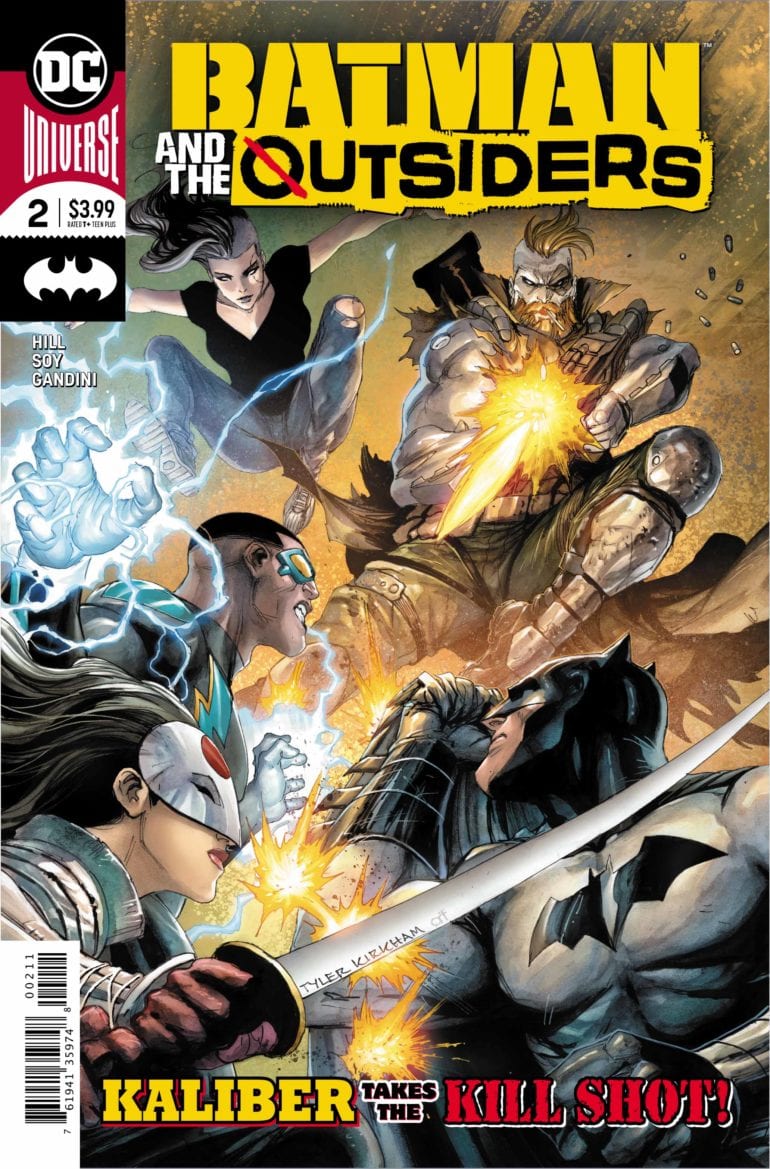
Batman and The Outsiders race to Save a Metahuman!
Batman and the Outsiders are back in the spotlight! Batman has reformed his team consisting of lesser-known street-level heroes. We have old favorites such as Katana and Black Lightning, making their return, as well as newcomers Signal and Orphan. Together, they will work from the shadows to defend Gotham City.
Their first mission comes when a young girl and her father are attacked on the road. The girl, Sofia, was a part of a metahuman creation program and someone wants her for themselves. The reason he knows about this is that Bruce saved her and took her to safety. While the team does agree to help, Black Lightning begins to wonder what other secrets does the Dark Knight has hidden from them. Will this mistrust be put aside to save an innocent?
**Some Spoilers Below**
Story:
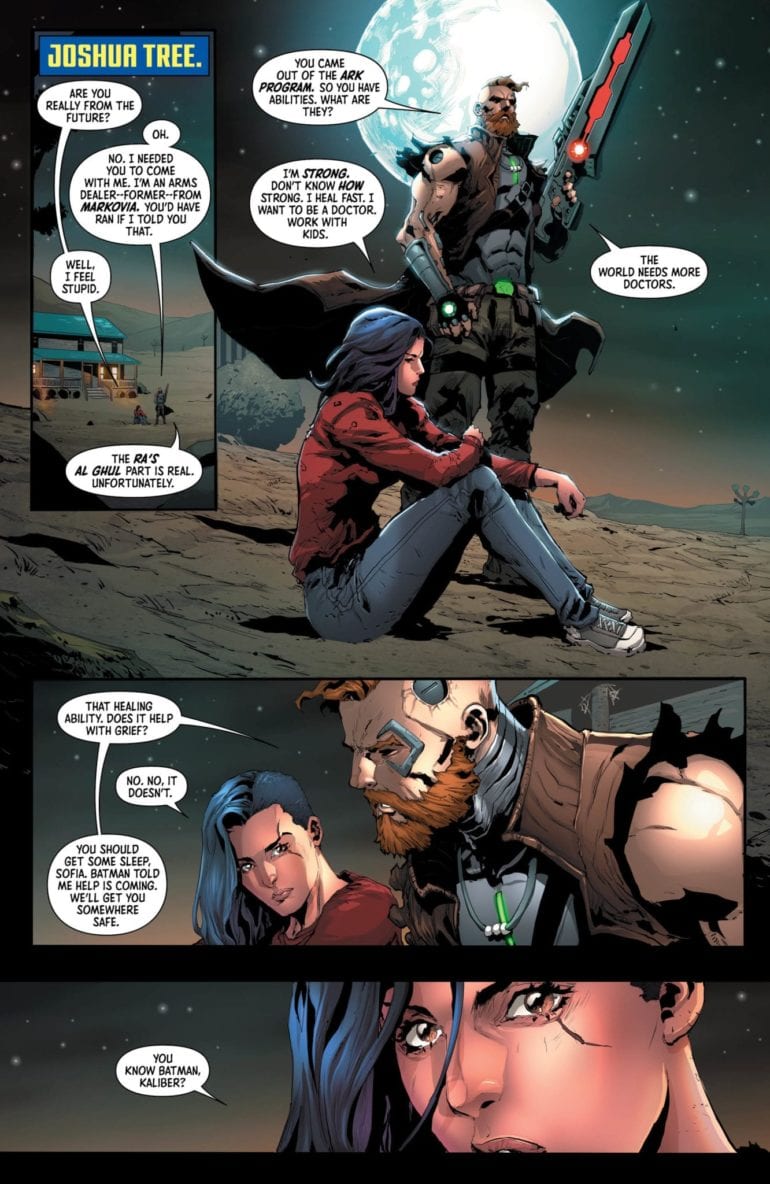
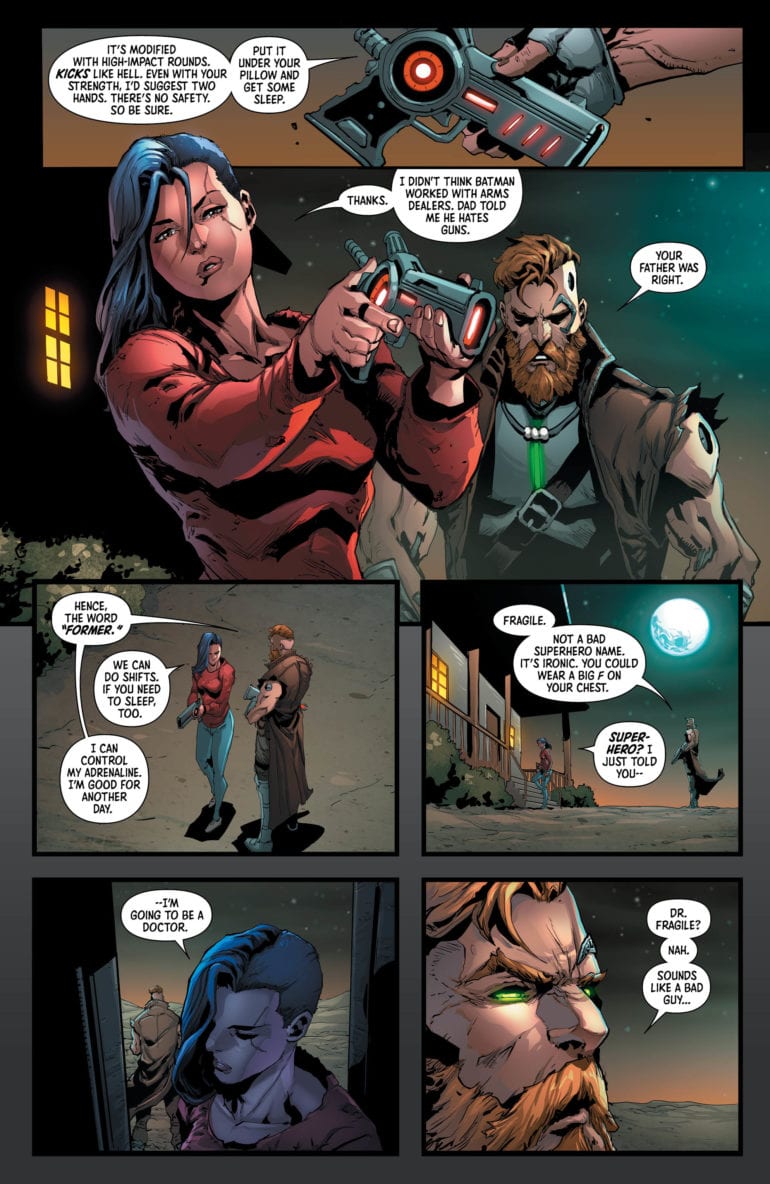
We open with Bruce talking to Black Lightning about the girl they need to help. Sofia has been picked up by another of Batman’s associates, Kaliber, and is on the run from a man called Ishmael. Black Lightning, despite his curiosity of the cyborg protecting her, agrees to take the team to help. Meanwhile, Kaliber tries to explain the situation to Sofia, but she isn’t on board. She asks Kaliber to give a gun to her to defend herself. As she is about to turn the high tech weapon against herself, Ishmael arrives to take her. Kaliber leaps in to protect her, as well as the Outsiders.
In the last issue, I had a problem with the fact that Batman had taken a back seat. Despite headlining this story, the Dark Knight continues to stay in the background, letting the B-list characters do the work. The issue this time around, however, is the fact that the team itself gets put in the back seat. Of the usual 21 pages, we only get the Outsiders in a quarter of them. The rest of the story revolves around Kaliber and Sofia. This is still early in the story, and we should learn more about these new characters, but there’s something offputting about the lack of title character in this story.
As for Kaliber and Sofia, only one of them intrigues me. Kaliber is your standard, run of the mill, soldier. He’s gruff, demands to stick to a plan and doesn’t trust Sofia. Old soldier characters like this are seen quite often in comics, but they are a strong character for a story like this.
On the other hand, Sofia is a much more intriguing character. She is learning to survive in this world without her father, and she literally has this moment of weakness where this reader was scared to see if she’d go through with it. Despite her being only two issues old, this girl might be one of the more fleshed out characters amongst the Outsiders, and I love it.
Art:
Dexter Soy has been kicking ass with his illustrations in the book. Every one of the Outsiders looks badass, and the action is drawn exceptionally well. While I may have noted that Kaliber is a basic character, I can’t say he doesn’t look cool. Even the villain looks fantastic, as he prepares a ritualistic communication with his employer. The level of detail in each panel brings a smile to my face and brings the book up.
Conclusion:
While the action is fun and our new character is interesting, this is a step down for the Outsiders. The second issue focused on Sofia and Kaliber, with the rest of the team hurrying to join them and Batman just not being in it. The series is still young, and with the big bad being revealed, we will probably get more of the team moving forward. For now, however, this issue was just “meh.”









 Rome is arguably the main predecessor to Game of Thrones, an ambitious show that HBO used as a building block for the fantasy series.