Home Blog Page 335

SPARTACUS: What A Rebel Gladiator Says About Mythology in Entertainment

Monkeys Fighting Robots

The entertainment industry is very much about superheroes right now. But that doesn’t stop mythological figures and stories from sneaking in alongside modern and sci-fi elements. And we’re loving the mix of ideas almost as much as a full-fledged epic movie or TV show. Classic features are still very popular across all sectors of entertainment, including comics. So it’s worth exploring what exactly makes ancient Greek, Roman, Norse, and Chinese myths so attractive. After touching upon various examples of how they influence modern audiences, we’ll focus on a particular hero that has inspired generations: Spartacus.

Mythology in Movies, TV and Comics

Readers of comic books know very well how much creators enjoy throwing ancient legends into their stories, whether obvious or obscure. A good example of the past few years is Avengers: No Road Home having Hercules take center stage on the team’s quest to reverse the darkness that has taken over the galaxy. The hero’s involvement follows the destruction of Olympus and its Immortals, at which point he joins forces with the likes of Voyager, Rocket, Hulk, and Scarlet Witch.

And then you have TV and streaming technologies starting to outshine the movie industry. Amid megastars like Antony Hopkins and Reese Witherspoon joining shows, there are also lots of great productions popping up to enhance mythology promoted by blockbusters. Netflix’s Ragnarok is a refreshing Norwegian retake on Thor, Loki, and the giants. One of several unique programs to change everything we think we know about our favorite legends.

But the silver screen isn’t done yet. The next live-action adaptation of Disney’s beloved animations is Mulan, set for release in July 2020. What some people may not know is that the story is based on the Chinese legend of a warrior woman called Hua Mulan. Whether real or fictional, Syfy Wire explains how the tale was retold many times before and after Disney’s contribution. Have you heard of Deadpool Killustrated? In Vol 1 #2, she’s one of the characters trying to stop Deadpool from slaughtering literary figures.

You’ll find mythological influences in the strangest of places. Take, for example, the link between Attack on Titan and Francisco Goya’s paintings, including Saturn Devouring His Son. Protagonists and ideas of the past seem to serve modern creators quite well, somehow inspiring brand new concepts. That’s why classic heroes like Spartacus stay – or are kept – in the spotlight. Their stories continue to make an impression on viewers and readers.

Who Was Spartacus?

Long before Pacific Rim 2’s Steven DeKnight directed the Spartacus TV series, the Roman slave turned-gladiator and rebel leader was a real person. Born in Thrace, the former soldier ended up starting the Third Servile War. He’s remembered as a symbol of revolution against tyranny, one that’s carried a powerful message over the ages.

Encyclopedia Britannica states that Spartacus’s forces grew to over 90,000 strong. They fought their way across Italy in pursuit of freedom, and were only defeated when commander Marcus Licinius Crassus caught them between eight legions of trained soldiers. Spartacus apparently died fighting, which only added to his fame as a strong and honourable leader. And today his legend lives on in screens and comics.

Spartacus Themed Entertainment

The first production to flesh out the gladiator’s story was Stanley Kubrick’s Spartacus (1960), starring Kirk Douglas. While Ridley Scott’s Gladiator (2000) could be seen as an adaptation or homage, no other Spartacus-related movie has tried to rival the original’s critical acclaim. But then 2010 saw the introduction of the TV show that enjoyed an equally warm welcome and continued to captivate viewers to its end in 2013. The actual title of the series, however, suggests a connection to another medium of entertainment.

The Spartacus: Blood and Sand comic books by Devil’s Due Publications were a smooth prelude to the show, focusing on minor characters that would later appear on people’s screens. This project also inspired a four-part motion comic available on retailers like Microsoft and Amazon. But the hero has kept gamers busy too.

Spartacus Legends, developed by Kung Fu Factory and published by Ubisoft in 2013, was a short-lived free-to-play video game based on the Starz TV series. Then there are also other titles in the further entertainment industry featuring the famous rebel. For instance, Betway has SG Gaming’s new Spartacus slot with a classic Roman design and gladiator-themed symbols. When you’ve had your fill of reels and bonuses, why not try a round of Spartacus: A Game of Blood and Treachery? The board game comes with an expansion that allows four players to battle and scheme their way to victory.

This is only a sample of the range of merchandise you’ll find out there making use of Spartacus’s inspirational status. Depending on your tastes – cinema, books, video games – you can find out for yourself just how extensive classic mythology’s effect on entertainment really is.
Monkeys Fighting Robots Youtube

Are Alternate Comic Book Sizes Better Than the Standard Format?

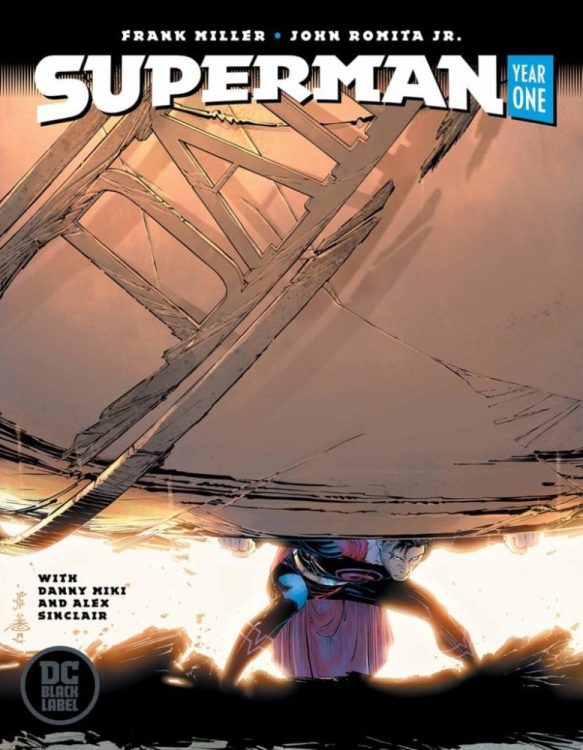
Superman: Year One

The size of Comic books has remained relatively constant since the Golden Age, but through printings such as DC Comics’ Black Label line, we are now being introduced to page sizes that completely alter how we take in the beloved medium. The only question is: are these new sizes superior to the standard format we have been reading for years?

The Dark Knight Returns was the first comic book to be referred to as “prestige.” These books are typically longer in length and are printed on a higher quality paper but still have the same page sizes as standard comic book issues. Now, with comic books such as Superman: Year One and Batman: Damned, page sizes are larger and drastically change how panels are presented.

Superman: Year One has a format so that the side ratios almost create a square, measuring 8.5” by 10.75.” One of the advantages to this new size is the freedom it gives to the artist, in this case, John Romita Jr, to create visually stunning single-page spreads, that achieve almost the same effect as a double-page splash would in a standard issue of a comic. A double-page spread can have a more significant impact than could be achieved in the standard issue of a comic and provides the artist with the freedom to go into more detail in his or her artwork, knowing it will come across effectively on the page. The artist for Batman: Damned, Lee Bermejo, once said in an interview with Syfy Wire about the new page size that “You fell into the story more, widescreen scenes got really widescreen. The new format really brings something else to the storytelling. I think it was more immersive.”

Superman: Year One Splash Page

However, changing the size of comic books makes it difficult for long-time collectors. Different sizes mean that packaging these books requires new bags, which a collector may not have on hand. While DC’s Black Label wants these larger issues to be able to fit in magazine storage bags, but collectors who did not already collect magazines need to go out and purchase them. Even then, comic book storage bags often come in bulk, but larger issues do not come in a large enough quantity to warrant such a purchase. If a collector were to spend money on these new sizes, they would most likely have a large surplus of magazine bags afterward.

Probably the most important aspect of what these larger sizes do is allow pages heavily crowded with individual panels to remain stunning. Take the 16-panel grids that Frank Miller used for his iconic story The Dark Knight Returns: these panels allowed for a lot of story to be covered in a short space, but did not allow for much artistic flexibility in a normal-sized comic book. The Dark Knight Returns was beautifully crafted and allowed for each of these panels to still be enjoyable, but the 16-panel grid is extremely difficult to pull off when limited by the size of the standard comic book. If the same technique was utilized on a page the size of those in Superman: Year One, however, the same effect could be achieved at a much larger scale. Each of the small panels would be much easier to comprehend, there would be less worrying about dialogue cluttering a panel, and there would not be confusion resulting from having small images tell the story. The ratio of width to height of these pages would also cause each of the panels of the grid to have a shape much closer to a square, as opposed to the movie-poster-like ratio that occurs in The Dark Knight Returns.The Dark Night Returns Sixteen Panel Grid

With all the advantages that this new expanded size brings, the main factor that could limit their success would be pricing. Comic books started as a cheap form of entertainment but have become quite an expensive hobby. These new comic books are larger, so it is only natural that their prices are higher. The average comic, such as Batman #87, costs the reader around $3.99 to purchase. The first issue of Batman: Damned cost $6.99, and Superman: Year One #1 cost even more at $7.99. Obviously, this is because of the better quality of the paper and longer page count of each comic book, but it is up to the reader to decide whether this increase in content and quality is worth it. To be fair, the first issue of Superman: Year One was twice the size of a standard comic book, and with the larger page size and better paper quality, you are actually getting a better deal for its price. Still, the cost of these new formats might be more than some people wish to spend on comic books.

These alternate page sizes are a new frontier for comic artists and writers alike and have the potential to revolutionize the medium. While dialogue and the artwork play a major part in comic-book storytelling, it is the layout of the panels that make it a story. Due to the page size changing, so will the way stories are told upon it, which is why this is such an exciting area in comic books at the moment. Alternate sizes have several distinct advantages over what we see every day in our local comic book stores, but might be too expensive for the casual reader.


Do you want to see more variety in comic book page sizes? Let me know in the comments below!

Monkeys Fighting Robots Youtube

INTERVIEW: Chad Rehmann And The Spooky Kids From Camp Cold Brook

Camp Cold Brook is a new horror film starring Chad Michael Murray (One Tree Hill) and Danielle Harris (Halloween 4) as the leaders of a ghost-hunting team that finds more than they could ever imagine and composer Chad Rehmann brought the sonic tension.

Produced by Joe Dante (Gremlins), Camp Cold Brook centers around the film crew behind a T.V. series that’s losing popularity. The team’s leader and the show’s host Jack (Chad Michael Murray) receives word that they’ve got one episode before the series is canceled. The pressure is on for the team to find a haunted place that can save the show. Their fingers point to creepy old Camp Cold Brook.

PopAxiom spoke with Chad Rehmann about making creepy music and how his own kids took the tension to a whole new level in Camp Cold Brook.

Pre-Show

Chad began playing piano “… at around five.” He continues, “At around 10 I went through the phase of ‘I don’t want to do this anymore, I want to play outside.’”

However, music was a part of him, and what he needed was a muse. “In high school, I realized girls like guys who play music.”

After high school, a new motivation was added. “In college, I started making money doing it.”

Learning & Composing

At an early age, Chad was already creating his own brand of songs. “I think I frustrated my music teachers because every time I would come play a song, I would add my own stuff to it. It wasn’t necessarily an act of defiance as much as it was that I just loved creating and experimenting.”

By high school, Chad wasn’t much aware of composing for film and television. “I didn’t realize … film composing was a thing. I grew up in a really small town. So, this whole idea that I could make music for movies and make a living was very foreign.”

While studying at Michigan State University, Chad knew. “… it was what I wanted to do. So, after college, I went out to L.A. with no money and no job.”

Now married with children, Chad says, “I look back on it now, and it seems absolutely insane.”

Cheer & Fear

Chad’s filmography is an interesting one. Versatility is too light a word. “I’ve fallen into two very distinct camps. I work for a company called Ninth House, and they do a lot of holiday movies and thrillers. So I’ve worked with them a lot on holiday films.”

From holiday to horror. “I’ve worked with [director] Andy Palmer and his team on a lot of horror stuff.”

The varying styles is an afterthought for Chad. “Since I was a kid, I just loved telling stories. I loved being a concert composer, but it’s a very isolating experience. In film, you get to collaborate, and that always drew me to this job.”

Chad explains making music to fill people with Christmas cheer or ramp up the fear. “For me, the commonality is how can I help these people tell their stories. For a holiday movie, it’s jingle bells, flutes, and strings. For a horror film, it’s what’s the most messed up thing I can think of to throw up on this image. It’s different tools from the toolbox.”

Merry, Scary Moods

Still, working on holiday joy one day and horrifying imagery, the next has to have interesting effects on Chad. “It’s impossible as an artist to not be affected by the material you’re working with … there is a shift in mentality when going from happy Christmas films to horror.”

Chad does make an interesting note about working on holiday films. “… we’re doing post-production on a lot of the holiday movies in June, July, and August to get them ready for the holiday season. That’s a whole other mindset. It’s 100 degrees outside, and it’s sweltering, and you’re watching all these images of snow and sleigh bells. It’s a fun juxtaposition.”

About Camp Cold Brook

Camp Cold Brook is the fourth collaboration between Chad and director Andy Palmer. The pair met circa 2013, and Chad tells the story. “It was a cold call. When I got enough credits under my belt, I just started cold calling anybody and everybody. I called Andy, he had a film called Find Me, it was originally called Hide and Seek. From what he told me was that he was coming out of a meeting with one of his producing partners talking about who would score the film.”

Talk about timing. “I happened to call at the right time, we talked about it, and I sent Andy a demo.”

Repeated collaborations breed a language all its own. “It’s great working with a director so many times because you start to develop a short-hand. I know what he likes and doesn’t like. Andy is great about allowing me to experiment. He communicates ideas really well.”

chad michael murray-horror-film-camp cold brook
Chad Michael Murray in Camp Cold Brook

Making Scary Sounds

As their newest collaboration, what did the pair want for the music of Camp Cold Brook? “First, we wanted to make two entirely different scores. There’s a score that’s happening when they’re inside the camp, which is a lot of instruments that I created using water, twigs, walkie talkies, all these objects you’d find inside a camp. The second score was for outside the camp, which was a more traditional orchestral score.”

The word experimenting comes up a lot with Chad. It’s a big reason Camp Cold Brook has such familiar but eerie new sounds. “We had the idea of creating instruments from stuff you’d find in a camp. I recorded my kids laughing and screaming, which they loved, ‘How loud can you scream?’”

Camp Cold Brook centers around ghost children and sacrifices. “A lot of the rises and crescendos in the films actually have my kids screaming layered in there. It’s one of those layers I hope hits people on a visceral level.”

danielle harris-scream queen-camp cold brook
Danielle Harris in Camp Cold Brook

Let’s Try It

Now longtime collaborators, Chad explains, “Andy gives me a really big heads up while he’s got his next production coming. So, while they were in production in Oklahoma, before I even saw a cut, my team took a few weeks to find all these objects and recorded them and came up with all these unique things we could do with them. We came up with this palette of sounds created for the film.”

As a rabid fan of experimentation, it also means learning. “A lot of the techniques I used for the film I actually learned how to do for the film.”

Chad shares a key reason he loves working with Palmer. “Andy’s go-to line is ‘Let’s try it.’” Maybe in the back of his head, he’s thinking there’s no way this will work, but he gives me the ability to try new things without any preset boundaries.”

What are the results of this freedom and experimentation? “Sometimes you hit the mark and sometimes you don’t.”

Chad shares a missed mark. “One of the things I tried for this film was doing a lot of things with children’s voices. But no matter what I did when I’d put it up against the picture, it just wasn’t right. I never even sent Andy those drafts because it never got to the point that I felt comfortable showing it to him.”

Self-editing is a vital tool in any artists’ arsenal. “Looking back on it, had I tried it that way, I think it would’ve been a bit of overkill.”

As the process moved along, Chad, “… slowly stripped away layers. On this film, there was definitely a less is more approach.”

Wrapping Up

Inspiration is a big part of life. For an artist, the hints of creators past pepper the work. “A lot of people my age talk about Star Wars, but the film that always spoke to me was Field of Dreams. I remember watching that film with my grandfather, and for the longest time, it was a film we’d watch together. James Horner did an amazing job on the score. That was the first film I remember hearing the score and thinking ‘Who does that?’”

Chad shares a few more composers who make up his musical DNA. “I’m a huge Marco Beltrami (Logan, Scream) fan. I’m really impressed with was Michael Abels (Get Out, Us). The first couple minutes of the Get Out really hit me. John Powell (Shrek, Bourne Identity) is just a master of his craft.”

In the age of remakes, what movie re-imagining would Chad love to be a part of? “Awww, man. That is a fantastic question. I have to say this, there have been a lot of orchestras that have been doing live to picture stuff. That would intrigue me or doing re-scores of old black and white films; the Phantom, Dracula, stuff like that.”

Camp Cold Brook came out on February 14th, and the soundtrack is available on Spotify, Google Play, and just about every streaming service. “I just finished a film called Heart To Heart. I’ve started working on some of the Christmas stuff, but I can’t talk about it just yet.”

Is Camp Cold Brook on your horror watch list?

Thanks to Chad Rehmann and Impact24 PR for making this interview possible.

Want to read more interviews like this? CLICK HERE.

Monkeys Fighting Robots Youtube

WannaCon is the Virtual Comic Convention We Need Right Now

Wannacon Featured

It’s an anxiety-inducing moment in history. Nearly every industry is taking drastic measures to prevent the further spread of COVID-19 (coronavirus). This includes the delaying of major motion pictures, sporting events, film festivals, and comic book conventions. Thankfully, amidst the grey cloud that has brought the world to a standstill, there are a few glimmers of sunshine breaking through.

One example of such is Russell Nohelty – a USA Today bestselling writer, publisher, producer, and podcaster. Nohelty created WannaCon – a virtual comic book convention, complete with indie artists and creators. Best of all, it’s free for anyone to live stream from the comfort of your home on Facebook, Twitch, or YouTube. The virtual convention is today (Friday the 13th) through Sunday, March 15th, from 12-4 pm Pacific Time.

Wannacon Logo

Here is the official message from Nohelty on WannaCon:

“We’ll be having panels all through the live stream filled with awesome writers and artists talking about the process of making comics, writing books, and drawing art. Below is a schedule of our artist schedules. Schedule is subject to change.

You can learn, hang out, and enjoy without ever leaving the comfort of your sweat pants and favorite chair. All times are Pacific Time, which is UTC -7 for those of you not in the USA.”

The website also features a list of every creator participating in WannaCon, with links to their online stores.

Below is a list of the streaming schedule:

FRIDAY, 3/13
12 pm PDT – Leah Lederman and Katrina Kunstman
1 pm PDT – David Avallone and Cammry Lapka
2 pm PDT – Matt Knowles and Steph Cannon
3 pm PDT – Nicoline Evans and Diana Levin
Saturday, 3/14

12 pm PDT – Christie Shinn and Carolyn Carter
1 pm PDT – Madeleine Holly-Rosing and Eddie Deangelini
2 pm PDT -Kathryn Calamia and Leanne Ingino
3 pm PDT – Melissa Pagluica and Moana McAdams

Sunday, 3/15
12 pm PDT – Comfort Love and Adam Withers
1 pm PDT -David Pepose and Jonathan Howard
2 pm PDT -Travis Gibb and Erik Lervold
3 pm PDT -David Lucarelli and Melissa Massey

Register for WannaCon by clicking here. You can also learn more about Russell Nohelty and his works on his Facebook page.

Monkeys Fighting Robots Youtube

Exclusive Marvel Comics Preview: 2020 MACHINE MAN #2 (OF 2)

Exclusive Marvel Comics Preview: 2020 MACHINE MAN #2 (OF 2)

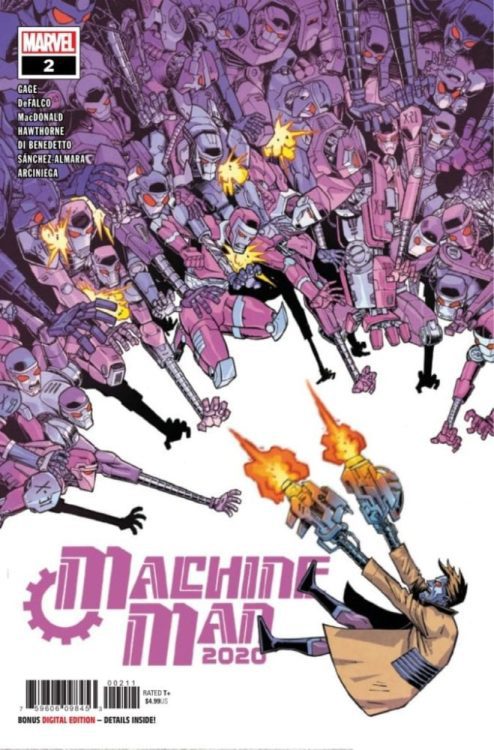
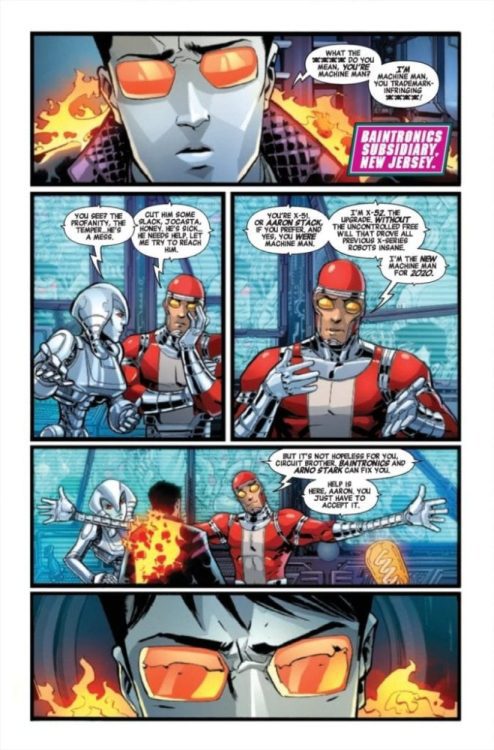
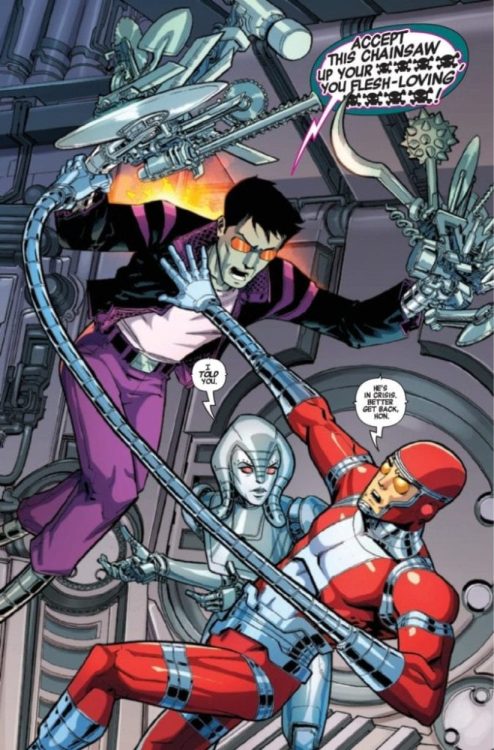
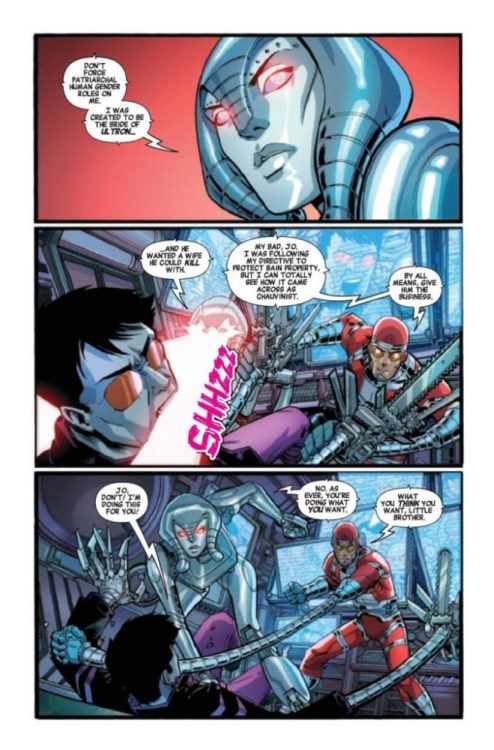
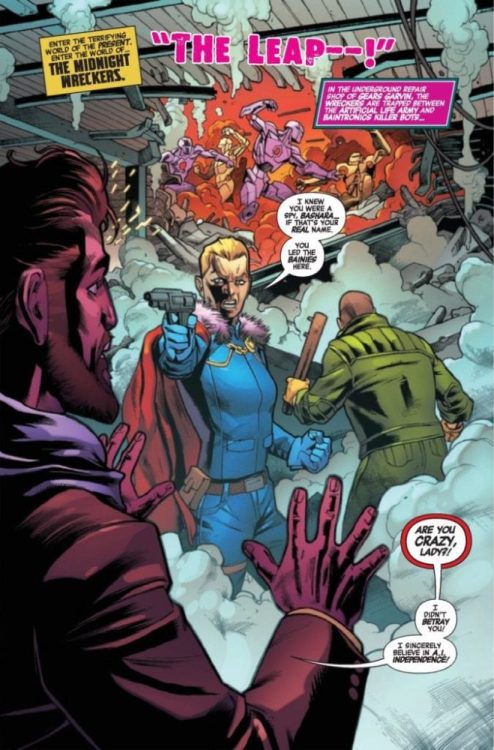
2020 Machine Man #2 of 2 hits your local comic book store on March 18, but thanks to Marvel Comics, Monkeys Fighting Robots has a four-page preview to share with you.

About the book:
Machine Man is fighting to save his true love, but will he be able to defeat – himself?! Outdated and overpowered, Machine Man goes head-to-head with the updated X-52 model. Will Machine Man be able to overcome or will he find himself paved over in the name of progress?

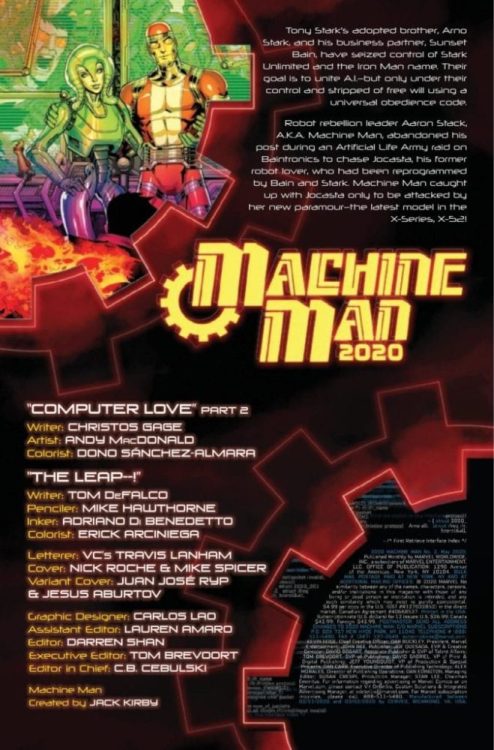
There are two stories in 2020 Machine Man #2. “Computer Love” Part 2 is written by Christos Gage, with art by Andy MacDonald, and colors by Dono Sánchez-Almara. “The Leap–!” is written by Tom DeFalco, with Mike Hawthorne’s pencils, Andriano Di Benedetto’s inks, and Erick Arciniega. You will read Travis Lanham’s letter work throughout. Nick Roche and Mike Spicer worked on the main cover.

Are you reading the 2020 crossover event, what do you think? Comment below with your thoughts.

Enjoy your preview:

Monkeys Fighting Robots Youtube

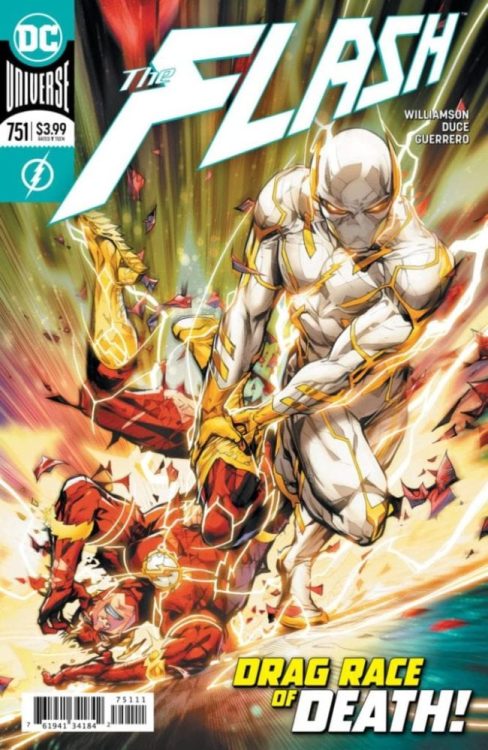
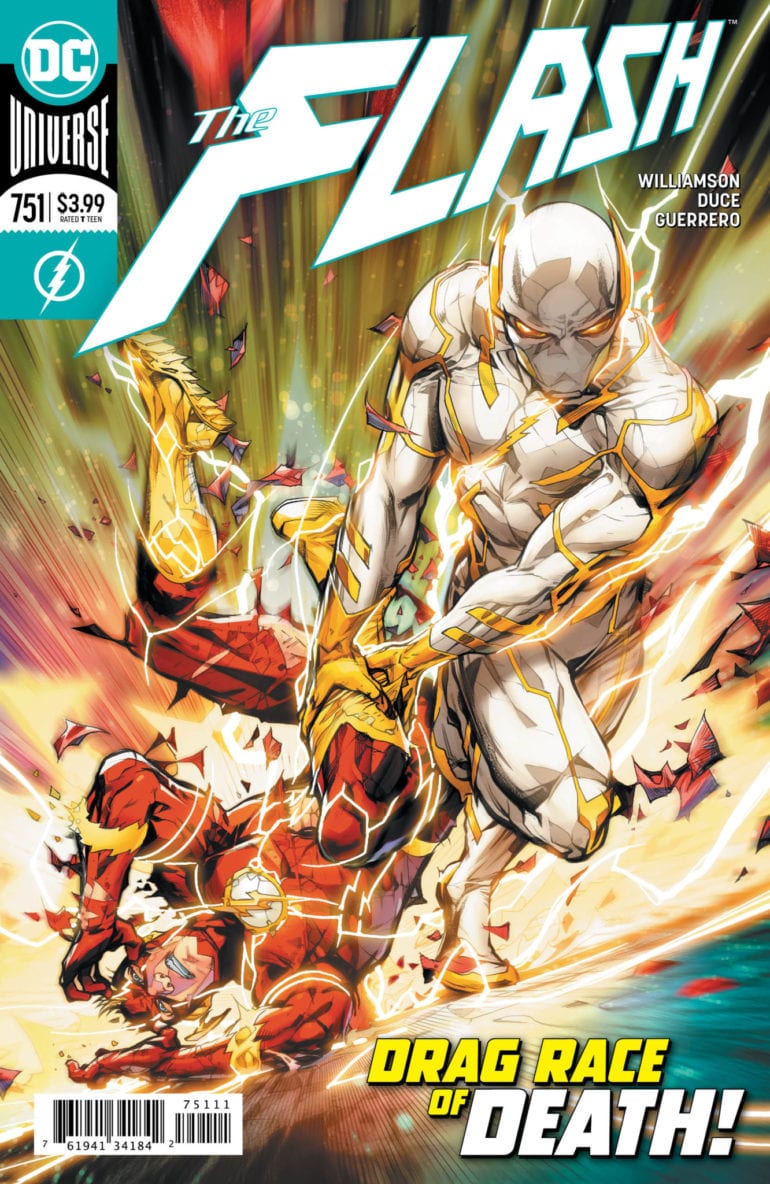
Review: Barry Face Godspeed and Paradox in THE FLASH #751

The Flash 751 cover

The Flash Faces Paradox for the Future

The Flash has a special place in the Multiverse and the DC timeline. Along with being the hope of Central City, his abilities shape the Multiverse through the crises. This has gotten the attention and fury of Paradox. This former scientist learned of the Multiverse after Barry’s battle with Turtle during Year One sent him to another dimension. After spending years in there, he was trapped in the future. Godspeed would eventually become his avatar, and the pair returned to the present to face their mutual enemy. Can The Flash stand a chance against these threats from the future?

The Flash 751 cover

**Some Spoilers Below**

Story:

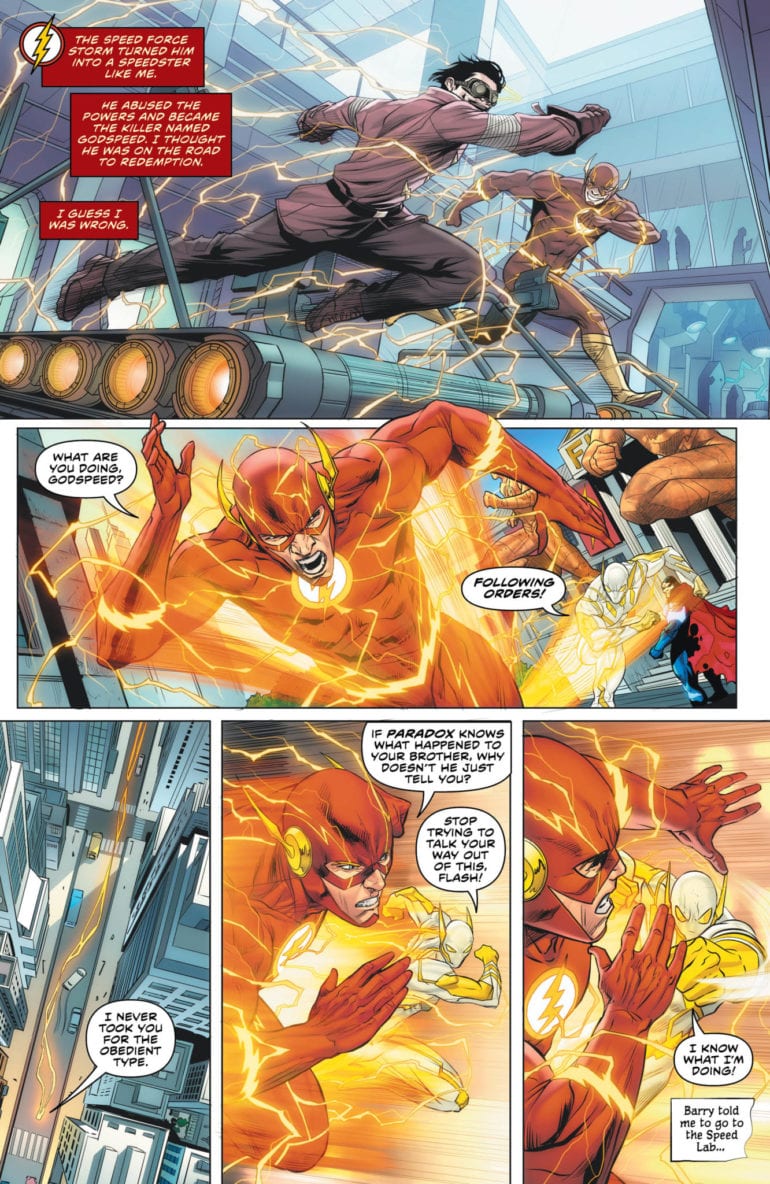
We open with Godspeed beating on Barry for his new master, Paradox. The new villain has told him that the Flash is truly a scourge of the Multiverse and must be killed. Soon it is revealed that Godspeed is a double agent, hoping to take down Paradox. Before the speedsters can team up, however, the future threat beats them both. Iris can only watch from within the Speed Lab as she uncovers an AI left behind by the late Commander Cold. Using the databases held within, Iris learns only one man defeated Paradox: Reverse Flash.

Flash 751 p1

This issue has a problem with reliving the past. A large part of the issue is giving readers background on Godspeed. While this might be good for newcomers, for long time readers, it’s seen as a bit of a waste of time. We know about Godspeed and want to know what Paradox’s plan is. We get it in the end, but it feels like we took the scenic route down memory lane. For a story that has many effects on the future, this story has been focusing a little too much on the past.
That being said, the twist of Godspeed turning on Paradox was a pleasant surprise. It’s nice to see the character changing for the better.  In older stories, he would have been just the herald of Paradox and be done with it. Due to his connection and constant return, we were able to see Godspeed change throughout the series. He has gone from being the supervillain that started the Rebirth era to a Red Hood of the Flash Family. 
Art:

This time around, Christian Duce returns as illustrator for the Flash. His style has always been a favorite of mine, and he brings his A-game for this story. Duce is able to provide both epic-looking action and a heart-tugging beautiful ending. Even his design for the menacing Paradox is amazing and only gets me more drawn in.

Hi-Fi and Luis Guerrero share the weight for colorwork. Together, they provide a vibrant palette for readers to enjoy. The characters pop off the page with every battle, and every use of their powers pulls us right in. Alone, they have blown us away, but together they thrive.

Conclusion:

The Flash Age still shows promise, but it still needs work. The last two issues have had a problem looking back at the series thus far. While it’s okay to reflect on the past, especially with the topic of Barry Allen’s legacy. The problem is the story relies too heavily on it instead of moving forward. The action in the present was exhilarating and had this reader on the edge of his seat. The art team brings their best to the front as this is one of the best-looking comics on the shelves. As we get further into the arc, I have no doubt we’ll find a proper story balance of past and present. Until then, we just have a pretty middle of the road comic.

Monkeys Fighting Robots Youtube

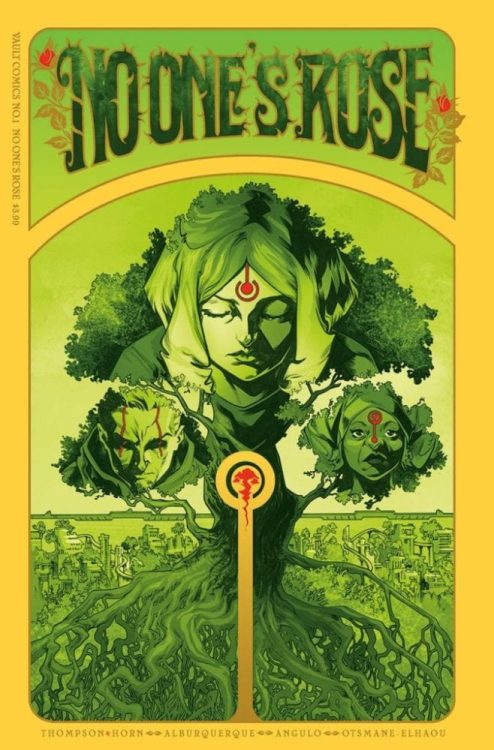
Review: NO ONE’S ROSE #1 Is Post-Apocalyptic Class Commentary

A dystopian post-apocalyptic world created by humanity’s own hubris is far from an original concept, but writers Zac Thompson and Emily Horn along with artist Alberto Alburquerque are here to try their hand at the trope with “No One’s Rose” #1. While it does have some cool moments and solid artwork, it doesn’t do enough in terms of characterization to make it stand out from the crowd.

“Centuries after the fall of the Anthropocene, the last vestiges of human civilization are housed in a massive domed city powered by renewable energy, known as The Green Zone. Inside lives teenager Tenn Gavrilo, a brilliant bio-engineer who could rebuild the planet. But there’s one problem: her resentful brother Seren is eager to dismantle the precarious Utopia.”

Writing & Plot

While “Solarpunk (sci-fi that utilizes environmental conservation in its plot) is a fairly new subgenre of science fiction, it shares much of its lineage with other post-societal sci-fi. The first issue of “No One’s Rose” is proof enough of that sentiment. Zac Thompson and Emily Horn have done a commendable job in crafting a world and backstory that feels both worryingly feasible and compelling. The brother and sister protagonists are each given relatable stories with personalities that should be easy enough for a reader to interface with. However, their characterization gets a bit lost in the blobs of exposition-filled dialogue. Instead of using overhead narration or specifically info-oriented dialogue, the Tenn and Seren each speak in bubbles that are half naturalistic speech, half exposition. For Tenn this fits to a degree, as she’s a scientist explaining to her peers what she’s working on. For Seren however, it makes him a bot of an unsympathetic character. There’s also a major attempt at creating a futuristic dictionary of slang on Tenn’s part, and it just comes off as trying a bit too hard. This sort of world-building through language rarely works, and the dialogue here is Exhibit A for why to avoid its temptation. These could easily just be “first issue woes,” as setting up a brand new world does require a bit of info dump. However, this first issue doesn’t do much to separate itself from the crowd of teenage-led dystopian post-societal stories as it sits right now.

Art Direction

Any great sci-fi comic has to be brought to life by stellar visuals, so it’s fortunate that Alberto Albuquerque is on hand to deliver the goods. The visuals here are pretty fantastic, with an excellent blend of clean techno-futurism and chaotic desolation for the environments. There’s a neat mixture of earthly grit and sci-fi cleanliness that helps push the comic’s tone as well. Characters are drawn distinctively with very clear and natural mannerisms and expressions. The stellar linework is fleshed out by Raul Angulo’s range of colors, which are a mix of suitable flat tones and vivid neons. The effect given here is not unlike Sean Gordon Murphy’s work on Tokyo Ghost if one’s familiar. Otsmane-Elhaou’s letters differ in font and color when switching from narration to dialogue, and then shift greatly based on delivery. There’s a solid amount of variety in the visual department that really draws (no pun intended) the audience in where the writing falls short.

“No One’s Rose” #1 is a promising Solarpunk concept with great visual direction that falls a bit short in terms of character or personality. The dialogue is full of exposition and over-exerted slang that harms rather than helps a pair of protagonists with genuine potential. Hopefully, these minor missteps are just first issue struggles and the script can match the stellar artwork found in this debut’s panels. Should you choose to explore this new world, be sure to grab a copy when it hits shelves on 3/25!


Monkeys Fighting Robots Youtube

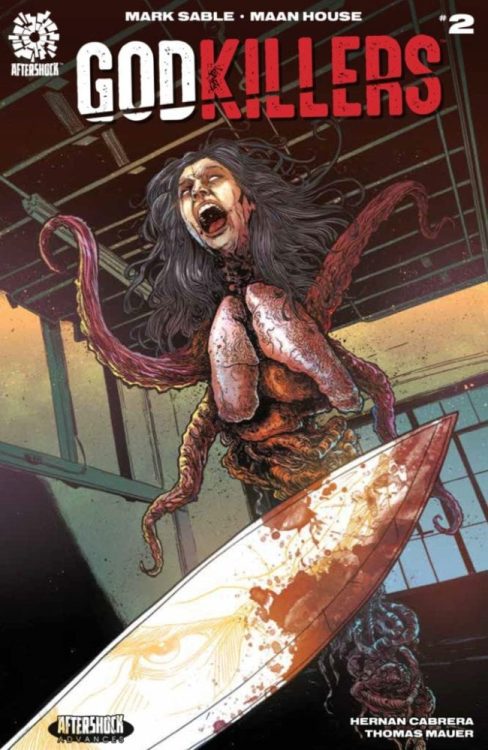
AfterShock Exclusive Preview: GODKILLERS #2

AfterShock Exclusive Preview: GODKILLERS #2

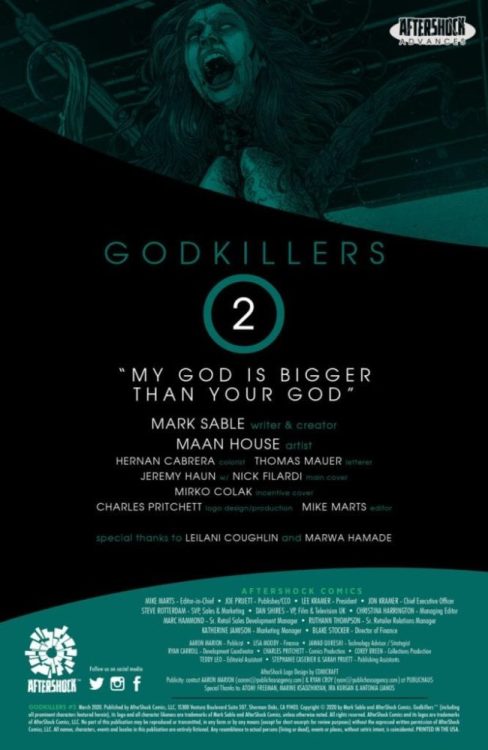
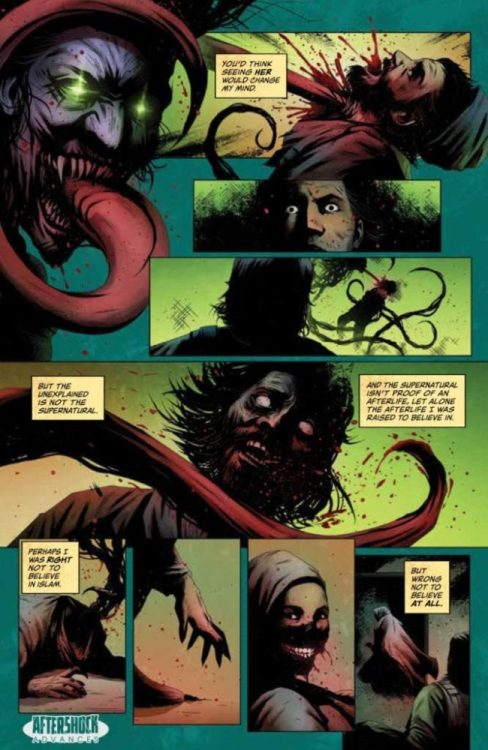
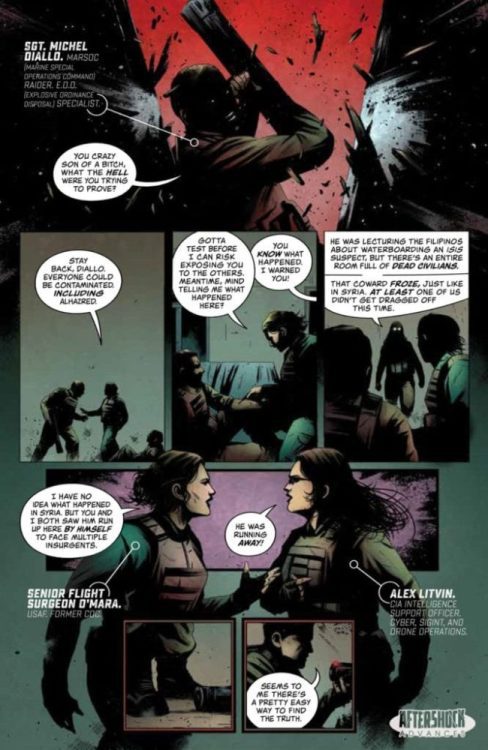
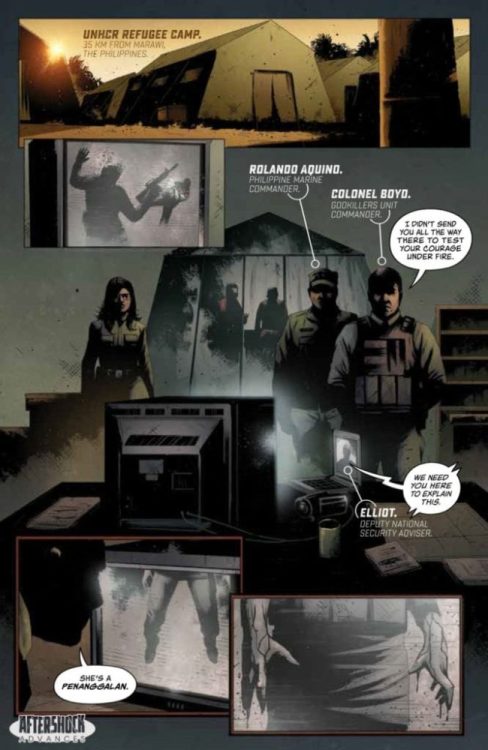
Godkillers #2 hits your local comic book store on March 25, but thanks to AfterShock Comics, Monkeys Fighting Robots has an exclusive four-page preview for you to check out.

The book is written by Mark Sable, with art by Maan House, Hernan Cabrera dropped some color, with letters by Thomas Mauer, and main cover by Jeremy Haun & Nick Filardi. Mirko Colak worked on the incentive cover.

About Godkillers #2:
The Godkillers is an elite special forces unit created to fight insurgents who are using mythological creatures.  As they battle a Penanggalan in the Philippines that may be in league with ISIS, the Godkiller’s first Arab American officer is forced to grapple with both his inner and outer demons.


Did you read the first issue, what did you think? Comment below with your thoughts.

Enjoy the preview

Monkeys Fighting Robots Youtube

Ahoy Comics Exclusive Preview: DRAGONFLY AND DRAGONFLYMAN #5 Puts A New Spin On A Classic Tale

DRAGONFLY AND DRAGONFLYMAN #5 exclusive preview ahoy comics comic books

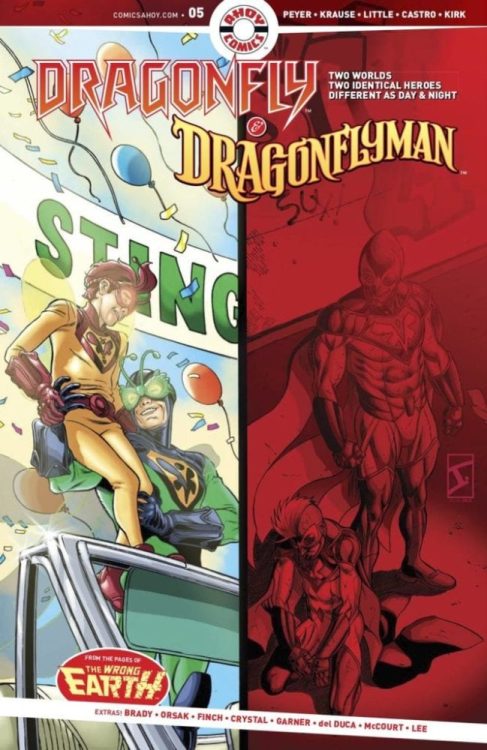
DRAGONFLY AND DRAGONFLYMAN #5 hits your local comic book store March 18th, but thanks to Ahoy Comics, Monkeys Fighting Robots has an exclusive four-page preview for you.

About the issue:
Our season concludes with a final confrontation between Dragonfly and Stinger! Will the partners make amends? Or do some wounds just run too deep? Meanwhile on Earth Alpha, Fortune City holds a parade in honor of its truly inspirational hero—STINGER! But wait…will someone feel left out? Find out the answers to this and more in our grand finale! Plus illustrated text stories!

DRAGONFLY AND DRAGONFLYMAN #5 is by writer Tom Peyer and artist Peter Krause, with finishes by Leonard Kirk and Juan Castro, colors by Paul Little, and letters by Rob Steen. The cover is by Jamal Igle.

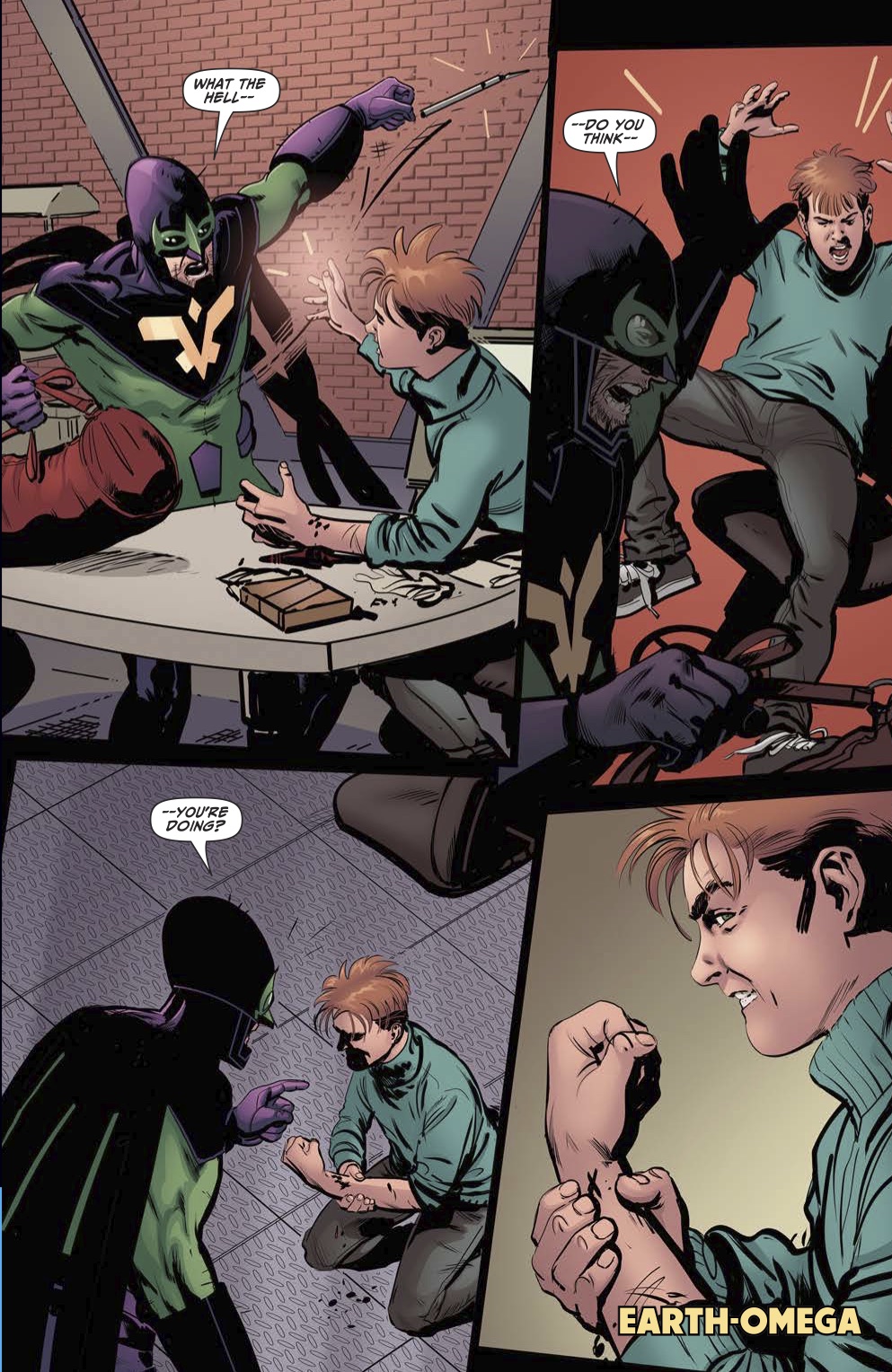
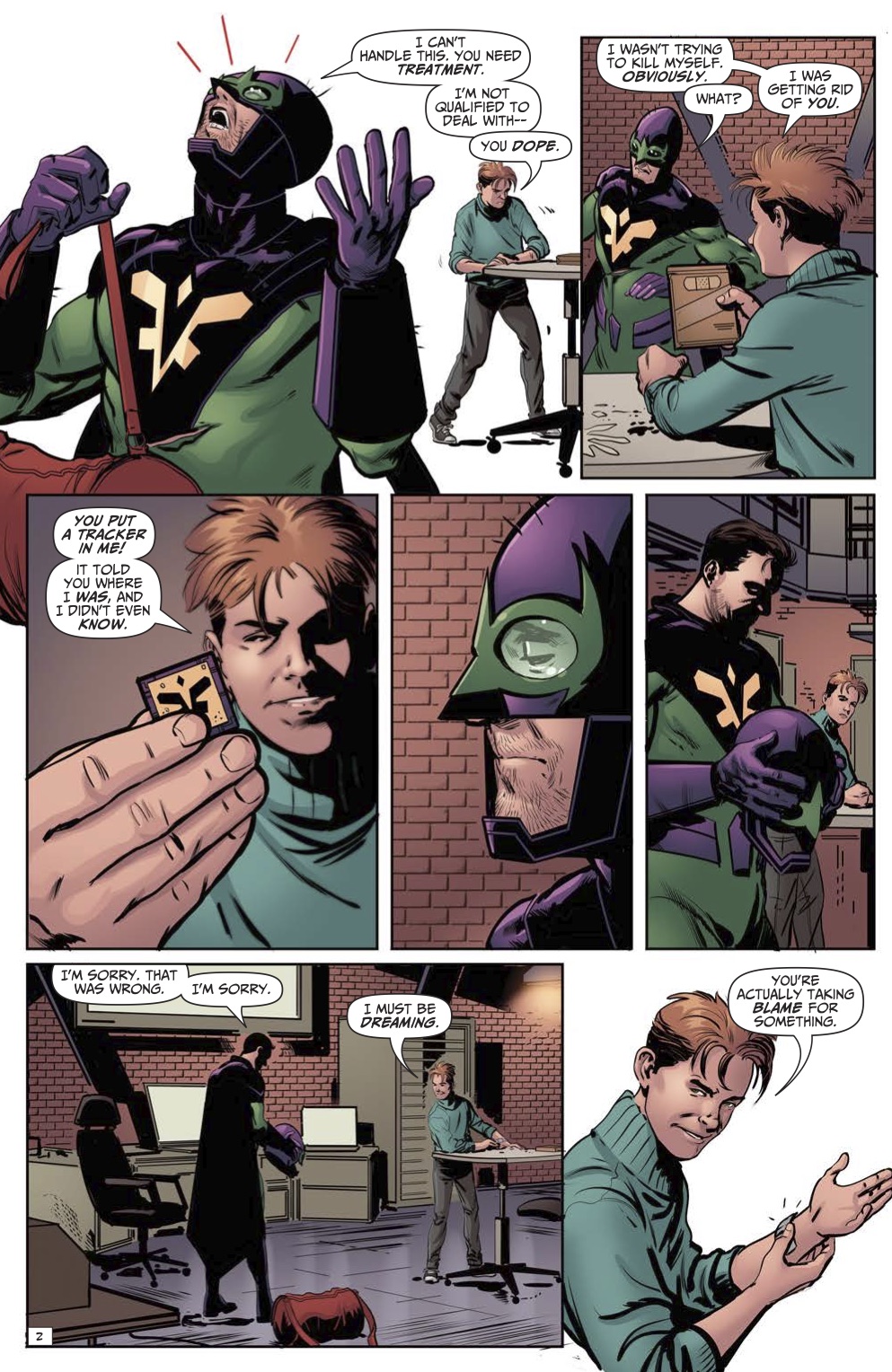
As seen in this exclusive preview, this issue puts a satirical spin on “Snowbirds Don’t Fly”, the classic anti-drug story from Green Arrow/Green Lantern issues #85 and 86 by Dennis O’Neil and Neil Adams. The story featured Green Arrow discovering that his sidekick Speedy was addicted to heroin, and became an iconic and historic landmark in comic book history.

Ahoy really tries to give their readers a big bang for their buck, so for your $3.99 you’ll also get a slew of backup content in addition to the main comic (see the credits page below). The publisher is one of many smaller publishers making a name for themselves in recent years by putting out original, inventive, and thought-provoking stories.

Check out the DRAGONFLY AND DRAGONFLYMAN #5 preview below:

DRAGONFLY AND DRAGONFLYMAN #5 exclusive preview ahoy comics comic books

DRAGONFLY AND DRAGONFLYMAN #5 exclusive preview ahoy comics comic books

DRAGONFLY AND DRAGONFLYMAN #5 exclusive preview ahoy comics comic books

DRAGONFLY AND DRAGONFLYMAN #5 exclusive preview ahoy comics comic books

DRAGONFLY AND DRAGONFLYMAN #5 exclusive preview ahoy comics comic books

DRAGONFLY AND DRAGONFLYMAN #5 exclusive preview ahoy comics comic books


Are you reading DRAGONFLY AND DRAGONFLYMAN? Sound off in the comments!

Monkeys Fighting Robots Youtube

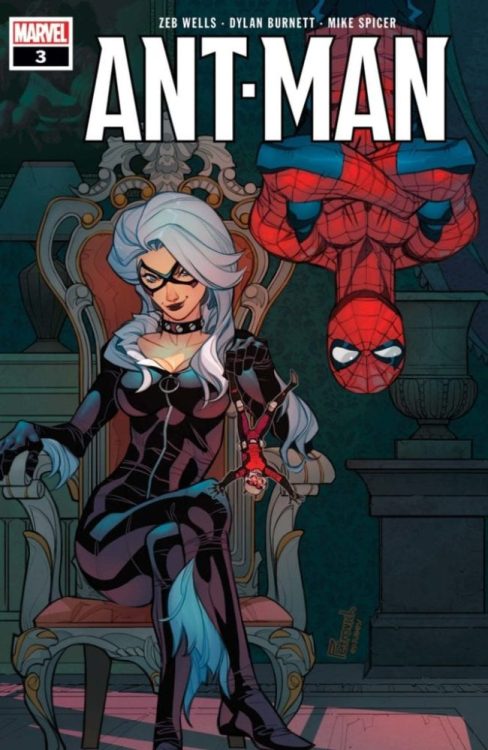
Review: Best/Worst Father Daughter Bonding Ever In ANT-MAN #3

Ant-Man

The hilarity of Ant-Man #3 is off the charts thanks to Zeb Wells, Dylan Burnett, Mike Spicer, and VC’s Cory Petit. Though the issue is entertaining, does it have more to offer than just putting a smile on the reader’s face?

Summary

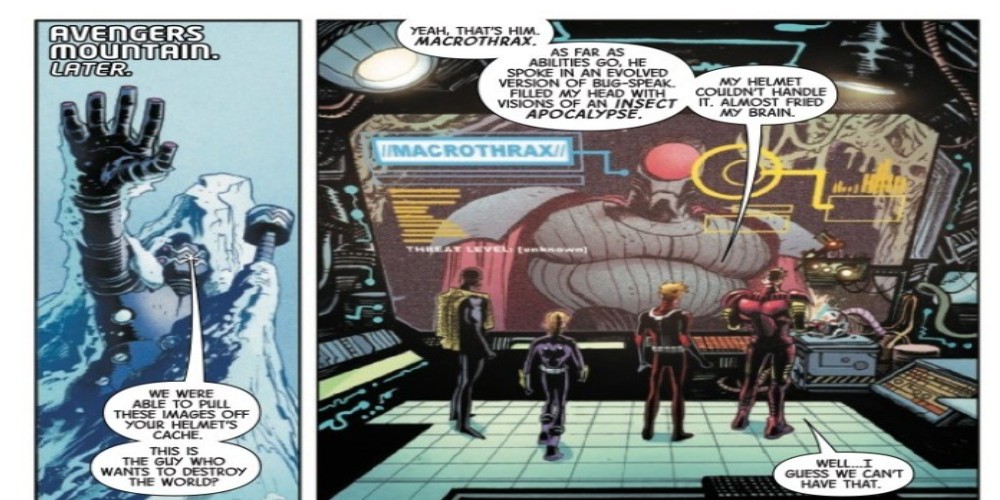
The threat of Macrothrax and the impending invasion looms large! With no choice but to call the Avengers for help, will Ant-Man be able to convince them to take both this threat and himself seriously?

AAnt-Man

Writing

This installment gives more of what was teased in the first issue. Father and Daughter bonding through hero work as Ant-Man tries desperately to show he isn’t a loser to Cassie. He fails at this fantastically as everyone from Iron Man to Black Panther, and even the friendly neighborhood Spider-Man is quick to throw a jab or make a joke at Ant-Man’s expense.

The writing remains comical thanks to Zeb Wells work but keeps alluding to more things are coming on the horizon. The final showdown with Macrosthroax and Cassie’s future are the two major examples. Hopefully, Pamela the Ant can survive too so she can do the introduction for every comic Ant-Man stars in for the rest of eternity.

Ant-<am

Artwork

The artwork by Dylan Burnett aids in the delivery of the humor. There are lots of great facial expressions aid in ensuring the comedy succeeds. Also, the scene with the Avengers eating dinner is entertaining as Ant-Man arrives is guaranteed to put a smile on anyone’s face.

With Mike Spicer doing the coloring work, the issue has a very distinct look to it. It offers a creepy and unnatural look to the villainous insect creatures. Especially when they journey through the sewers and come across a former ally of Black Cat.

Ant-Man

The lettering by VC’s Cory Petit helps to give a distinct sound to the issue. The sound effects help with the action and the humor from panel to panel. It also helps to give a sense of the different styles of speech coming from the villains.

Conclusion

Ant-Man #3 proves everyone should keep reading this mini-series. It seems to only get better from issue to issue. All the team has to do now is to make sure they land the ending with the final two issues.

Monkeys Fighting Robots Youtube