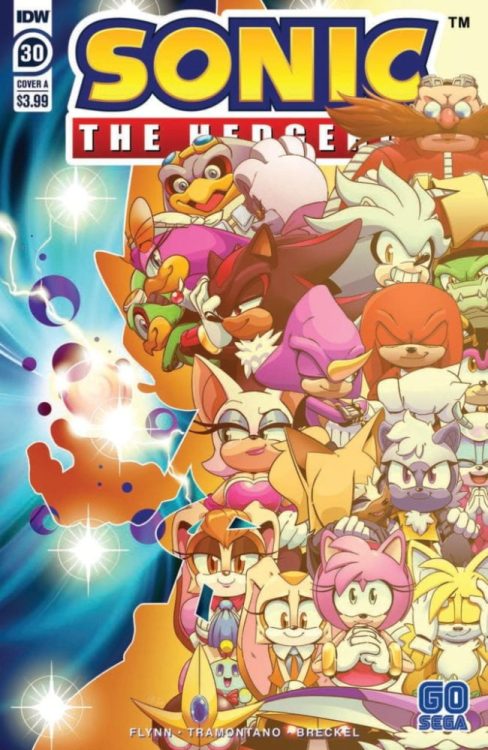
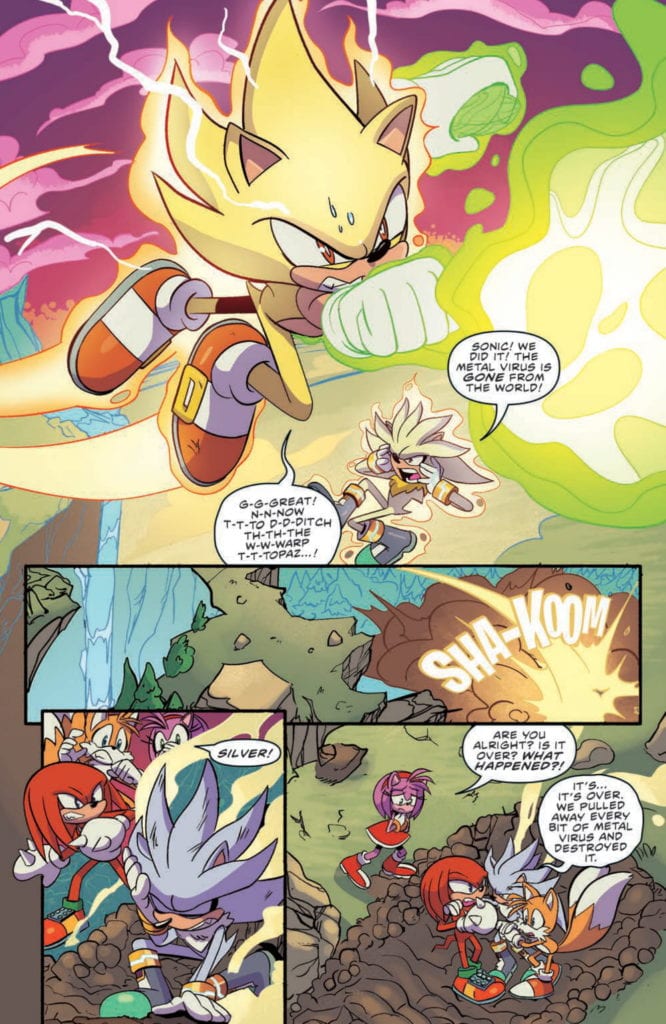
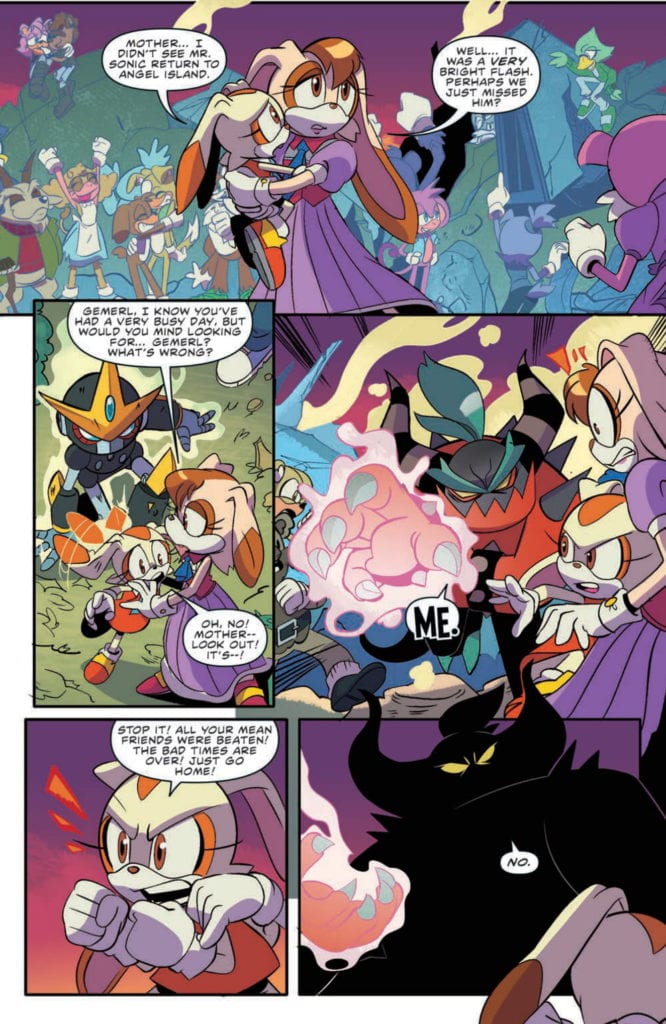
Sonic The Hedgehog #30 by Ian Flynn, Priscilla Tramontano, Heather Breckel, and Shawn Lee doesn’t let the heroes take a break after saving the world from the Zombots. After such an intense arc, you’d expect the issue to be filled with foreshadowing through dialogue and reflection. Instead, the reader is treated to adrenaline-filled action scenes to set up future events.
The Metal Virus Saga is over, but that doesn’t mean things are back to normal. As the world begins picking up the pieces, who will be missing? What villains will escape? And who will go back on their word?
Writing
Despite this being the issue after a major event comes to an end, there is no time to decompress. Few panels feature characters standing around the entire time talking and reflecting on the apocalypse they just prevented. Instead, The Deadly Six find a way to remain a thorn in everyone’s side and prove a problematic threat for the resistance fighters who want to take the time to count their blessings after the entire world being overrun by the metal virus.
Ian Flynn’s use of the Deadly Six showcases he’s a writer who doesn’t like to hand easy wins to the protagonists. Instead of simply showing the Deadly Six being captures and taken away in a few simple panels, Flynn shows just how credible a threat the team is even without the Chaos Emeralds powering them up. Also, Dr. Eggman manages to stir up some trouble as well by having Metal Sonic cover his escape.
Artwork
With Priscilla Tramontano on art, the action scenes offer an intensity the reader is able to feel. The highlight of the issue comes as Shadow The Hedgehog faces off against Metal Sonic. The panels convey how both fighters are forced to push themselves to the limit as battle one another.
The colorwork by Heather Breckel adds to the look of the action scenes but also conveys a sense of emotion to the characters. The joy and happiness of the characters freed of the metal virus are on full display and is a heartwarming sight. On the other side the coin, the colorwork showcases the damaged characters take as the action unfolds.
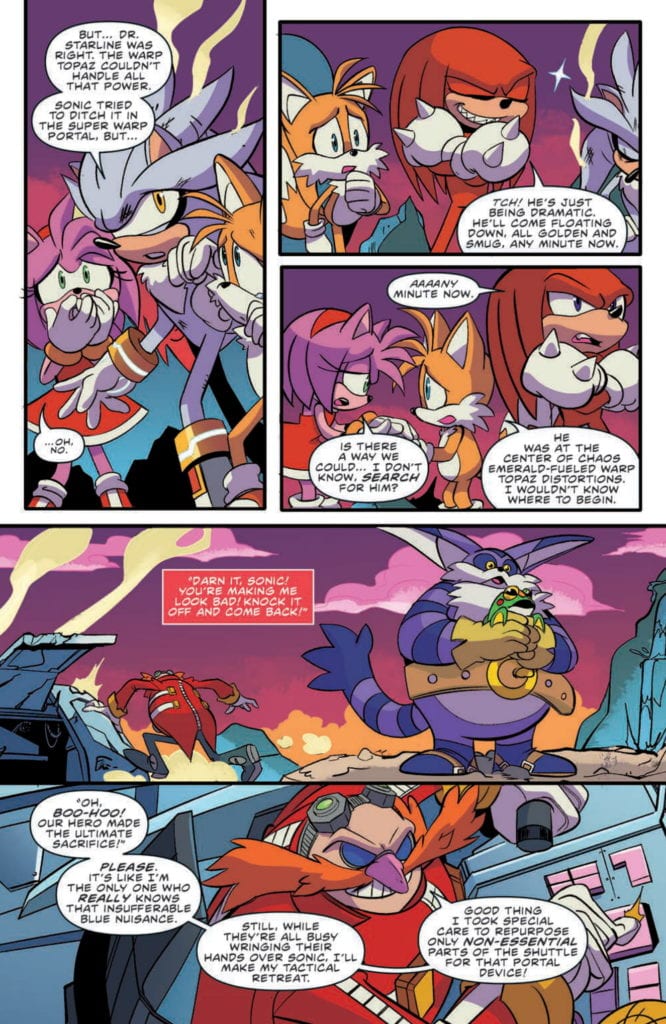
The letters by Shawn Lee helps to add bits of personality to the comic. One of the best examples is when Knuckles does a “He’ll be back any minute now” line about Sonic early in the issue. The line is repeated a few times in the comic until its delivery comes off as Knuckles pleading for Sonic to show up because he is worried about him.
Conclusion
Sonic the Hedgehog #30 is still good even as Ian Flynn winds down his run on the series. Still setting up plenty of problems for the next creative team to cover. The issue stands as a testament to show the characters are in need of a break. Hopefully, the next two issues will finally give them some kind of a break as Ian Flynn finishes his run.
Livewire from Valiant Entertainment has superstar writer Vita Ayala attached for a take on crossover event fallout. This former henchwoman built up a reputation as one of Valiant’s best superheroes only to get caught in a cash-in event that puts Livewire and her handlers in a bad situation. One with an ending that, while not bad, is bittersweet in how it clashes with political developments. The conclusion implies that the only way out of a rock and a hard place situation is to blame it on external factors and never actually take responsibility. Yet in a world where people of celebrity or power are called out on abusive actions barring their money and or influence, almost every other week. Using excuses just doesn’t work anymore even if Ayala’s story has more authenticity than the similar situation in Marvel’s Civil War II and Captain Marvel.
Livewire Background Conflict
Before we get into details, we should go over who Livewire is. At first, Amanda McKee was a henchwoman to extremist supervillain Toyo Harada of Harbinger. Later she defects upon seeing how heinous Harada’s plans are and leads two teams of superheroes. The latter of the groups, Secret Weapons, were under threat by a government fearful of people with psychic powers. Partly because of Amanda’s old boss Harada who demonstrates his ability to cripple countries.
This Harbinger Wars II pushes Amanda over the edge. In a desperate attempt to get people to stop looking at sycophants’ projections of psiots, Livewire emits a countrywide EMP. Unfortunately, this causes thousands of deaths of patients on life support. Branded a fugitive, Livewire does all that she can to survive while keeping Psiots safe.
Main Conflict
Back in the real world, Harbinger Wars II was mainly a means of advertising the forwarding of movies based on the original Harbinger Wars. All of which would begin with the Vin Diesel movie, Bloodshot. Unlike the original series, however, which was emphasized by character development from the Harbinger Renegades and Bloodshot, this series was more or less made on the whim of Valiant’s owners DMG Entertainment. Unfortunately, this parallels with the similarly named Civil War II by Marvel Comics, which was an advertisement for the film, Captain America: Civil War. Both comic events end with its lead characters worse off than before. All because of corporate greed, which imply messages that don’t sit well with audiences today.
Warning: Political Livewire
By the third trade, Vita Ayala needs to wrap up Livewire‘s conflicts relatively quickly so that the story doesn’t drag on. But how do you redeem someone guilty of mass slaughter? Apparently, by helping a councilman in an election against a straw conservative Senator. In essence, it’s a battle of choosing the lesser of two or more evils. Both Livewire and the councilman are trying to protect people they care about, like the Secret Weapons and the councilman’s daughter. Still, to do so, they have to scapegoat the Senator who is pushing an anti-psiot program.
A lawsuit against the federal government that the councilman proposes for his campaign is viable. With previous storylines of Livewire showing cruel and unusual punishments like a lobotomy, this violates the Eighth Amendment. However, it comes back to the original question from earlier; despite the good intentions and consequences, does it justify the crimes that got them there in the first place? Or is it easier to just blame others for your flaws and find ways to exploit the others to avoid punishment?
Livewire Spoiler!
As it turns out, the councilman is the one who covertly drove Harbinger Wars II to fruition through a list of psiots. To protect his daughter and get Livewire’s help with his campaign, he plays both sides of the psiot conflict. With Amanda’s support, the councilman’s campaign manager exposes the former Senator’s embezzlements. Winning the election and federal lawsuit, the councilman’s position now allows him to avoid taking any responsibility for his initial involvement in the psiot hunt. Thus a bittersweet ending.
Implicational Problems
In today’s climate, many celebrities and law enforcers are getting called out for various acts of authoritative abuse. Harry Potter author J.K. Rowling, for example, uses social media to spread her influence in divisive topics involving transexuals. Given her money and influence over what she produces, some Harry Potter fans can’t enjoy pieces of their childhood without supporting Rowling’s actions. In a more extreme case, recall how 9/11 kickstarts George W. Bush’s presidential reelection campaign. With the vow to bring al-Qaeda leader Osama bin Laden to justice… with a bullet. To say nothing of the “command responsibility” war crimes to get to that point.
As for comics, several Marvel fans still have it out for Captain Marvel over Civil War II. Unlike Livewire, who remains in character for Harbinger Wars II and Ayala’s run; Marvel plays off Carol’s extreme behavior like it was business as usual. While she feels guilty over her actions after the event, her resolution with it practically says, “it happened, get over it.” Yet later comics reveal Captain Marvel actually killed Iron Man. This presents a problem with Captain Marvel, Livewire, and their real-time corporate sponsors. They might recognize their faults, but they’re not exactly looking for forgiveness. Just because the people in question tries to be better this doesn’t necessarily mean they were justified.
Calling Out The Unheroic
In today’s popular media like Rick and Morty as well as Bojack Horseman, the antiheroic acts of the title characters have to face up to the consequences of their actions. While the latter series does emphasize the importance of taking personal responsibility and rectifying guilt; what makes these series stand out is how they shame bad behavior rather than reset the status quo. These come in reaction to the above climate where celebrities who seem above the law are getting revealed for their misdeeds. But where does this leave characters who believe they’re justified in what they do and are given sympathy for their flaws rather than despite it?
The Present Livewire
Even though the former Senator’s arrest and Amanda’s crimes are pardoned, this doesn’t feel like a victory. While the public welcomes her, Livewire is just a means of getting likes and followers to them. The police meanwhile are still on the fence about psiots and Livewire.
What the series evokes is how lesser or necessary evils become less like reasons to do harm and more like excuses. Just because characters are relatable in how they deal with the fallout, it doesn’t necessarily make what they did okay. If anything, guilt becomes an excuse not to take responsibility. Some comics like Blackhand Ironhead comment on this to display how dangerous a way of thinking this is.
What do you all think? Could Livewire have been handled better? Or was this a topic too big to tackle without division? Leave your thoughts in the comments.
DC Comics and WarnerMedia have heavily advertised the upcoming DC FanDome virtual event for this coming Saturday, August 22nd. The event is a virtual convention exclusively focused on DC-related content.
If you’ve seen the schedule for the one-day event, it’s packed, and that’s putting it mildly. In response to the cries of “NO MÁS” added a second day on September 12th. Some of the panels have shifted to the second date, and DC added a few new ones for good measure.S” from intended attenders, DC added a second day on September 12th. Some of the panels have shifted to the second date, and DC added a few new ones for good measure.
You can read all about it in the official DC press release below, and check out a trailer for DC FanDome: Hall of Heroes.
Were you planning to attend the one-day event and felt overwhelmed? Does adding a second date get you more excited for the event? Let us know what you think in the Comments section, and please share this post on social media using the links below.
We heard the fans: DC FanDome, a first-of-its kind, virtual experience for DC superfans around the world, was a lot to handle in one day! It turned out to be so massive that with so many hours of programming, not even The Flash could get through it in 24 hours!
In order to super-serve our fans and provide the best possible experience, DC FanDome has been expanded into two global events — the first on August 22nd – DC FanDome: Hall of Heroes, and a second on-demand experience in DC FanDome: Explore the Multiverseon September 12th, where fans can create and curate their own adventure. And — fans can now teleport their FanDome experience as both will be accessible across all mobile platforms (in addition to desktop).
By making these two separate events we can ensure you are able to see and cover everything with no stress!
Here’s a quick breakdown of what you and fans everywhere can now expect:
DC FanDome: Hall of Heroes: On Saturday, August 22, at 10:00 am PDT, fans will be transported into the DC FanDome: Hall of Heroes, an epic world designed personally by Jim Lee featuring special programming, panels and exclusive reveals from a wide variety of films, TV series, games, comics and more.
The superpowered eight-hour show will be available for fans around the world to watch exclusively 3x in the 24-hour period.
DC FanDome: Explore the Multiverse: On Saturday, September 12, at 10:00am PDT, fans will be able to create their own timeline! The great thing about this event is that it will be on demand, giving you the ability to curate your own unique experience via our Official DC FanDome Online Scheduler Tool. [Scheduler tool for the Sep 12th event will go on live tomorrow after we announce!]
A lot of the content you were super excited to see from our multiple islands will now be housed here, and will be available for you to watch throughout the 24-hour period.
Fans can now choose their own adventure and will have more time to immerse themselves in all the hours of curated programming — at their own pace and on their own schedule.
This also allows us to provide the best user experience, and will now not only be available on your desktop computer but across all mobile devices.
DC Kids FanDome will also launch on Saturday, September 12, at its own kid-friendly companion site at DCKidsFanDome.com.
All content from both events will still be available in nine languages, including Portuguese, Chinese, English, French, German, Italian, Japanese, Korean and Spanish.
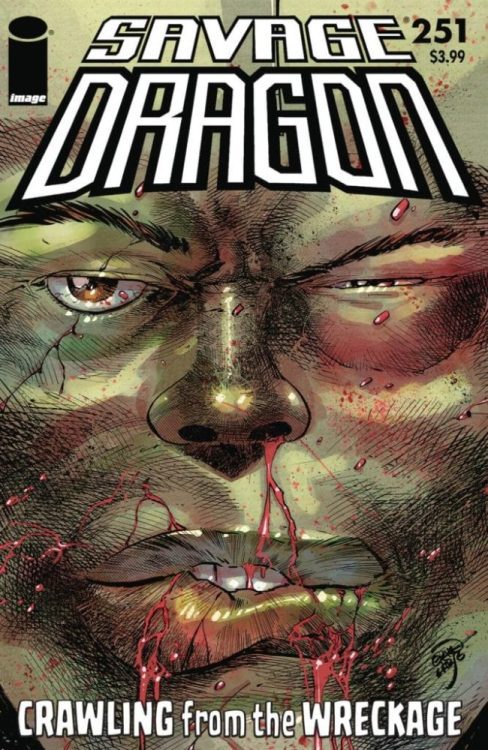
Savage Dragon #251 is a fresh new start for this 30-year-old series by Erik Larsen. Joining Larsen for this week’s release are letterer Ferran Delgado and colorists Nikos Koutsis and Mike Toris.
Recap
Prior to Savage Dragon #251, Malcolm Dragon is dealing with the COVID pandemic as well as supervillains. But nothing could prepare Malcolm for a visit from an alternate version of his dead father.
Savage Dragon #251 Hijinks
Savage Dragon #251 follows the classic Larsen formula of absurd superhero hijinks that anybody can jump into. The alternate classic Savage Dragon, Paul, is learning to deal with filling in for the late hero. Despite having the general outline of tropes and elements of the original dragon-like supporting characters and villains, he makes it clear he’s not exactly the same. Paul has experiences entirely unlike the original Dragon; for example, Malcolm does not exist in his world. Yet despite how shaky this introduction is, by the end, it looks like fitting in won’t be too big a deal. Malcolm and his half-sister Angel accept that Paul’s the least weird thing in their lives. Especially with the uncertainty of then pandemic.
Art
Larsen continues to provide the pencils and inks for the character designs in Savage Dragon #251. Paul Dragon’s distinctly different head fin attests to how he’s not necessarily the same character. All while keeping the panel work to fit in with situations. One page has 15 panels depicting a conversation between Malcolm and Paul that doesn’t feel overwhelming. It’s just a back-and-forth attempt to find even ground. One that suddenly erupts into a brawl that it’s almost funny with how it comes out of nowhere.
The coloring is shared between Toris doing the flats and Koutsis doing the decorative details. Toris’ simple colors that often have gradients provide a great canvas for Koutsis to fill in highlights like lighting against shadow. Each of these techniques perfectly complements Larsen’s designs, making the inks look much bolder as a result.
Delgado’s lettering is professional in how his word balloons stay within the panels to focus on the task at hand. That is until they need to reach out to complementary panels. Other times they color code like in Malcolm’s conversation with Maxine to display playful emotions. And then, there are the wordmarks that have creative uses in how they present actions. Almost none of them come out completely the same, this prevents the action in Savage Dragon #251 from feeling dull.
Enjoy Savage Dragon #251
Savage Dragon #251 continues what makes it so enjoyable. Sure it has some of the standard superhero tropes like alternate universes, but it’s mostly for laughs. The new character practically serves as someone just entering this part of Savage Dragon, along with the new readers. Because who cares about continuity if you can still have a good time?
What do you all think? Is this new development worth the time? Leave your thoughts in the comment section below.
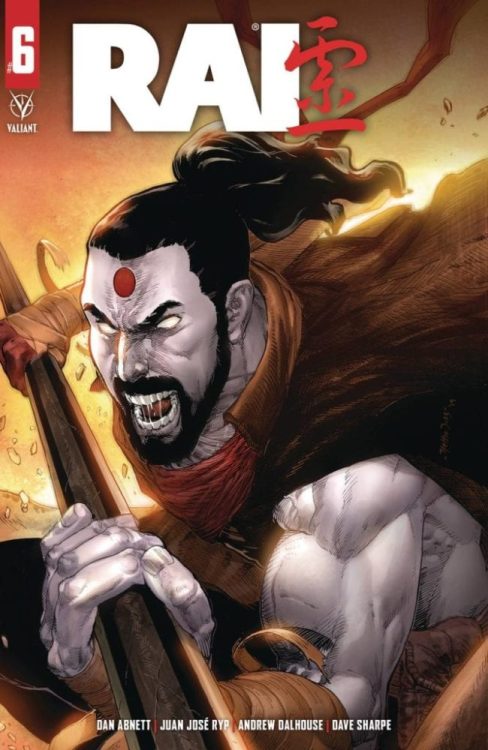
Rai #6 is the start of a new arc for the cyborg ronin releasing this week by Valiant Entertainment team of Dan Abnett, Juan José Ryp, Andrew Dalhouse, and Dave Sharpe.
Recap
Following cyborg brothers, Rai and Raijin, they are on a quest to eliminate their AI creator’s backups. Rai’s activities from previous storylines, however, give him a divisive reputation. To some, he’s a hero doing what’s necessary; to others, he single-mindedly ignores the smaller problems.
Rai #6 Story
Rai #6 focuses mostly on the title character’s divisive in-universe reputation. It’s something Abnett makes use of since the beginning of Fallen World. The positronic legionnaires that Rai and Raijin encounter looks to Rai as their savior. For his efforts in liberating them from Father, they live in peace with humans, something Rai tries to do earlier but encounters difficulty. Yet a more difficult challenge comes from Rai’s task to eliminate Father. Not that it seems impossible, Rai proves himself highly capable in the opening action sequence. It’s how continues to display tunnel vision in his quest; practically ignoring the pleas of the legionnaires. That is until Raijin’s own plea gets the brother’s into a cliffhanger.
Art
Rai #6 features the realistically rough pencils and ink from José Ryp. The scenes in the rain alone feel like they have weight. As the raindrops fall, the weight of them in comparison to the bold inks of the lead legionnaire Tekus really tell the important elements of this arc. It’s also why the shifting colors from uniform blues, greens, and reds of the setting and legionnaires against the chaotic colors of wild hybrid mutants feel so artistic. Especially when half of the panels on one page get a red accent to highlight the bloodshed. The act is a full display of orderly civilization against an uncompromising nature. It’s also why Rai’s first appearance in the issue with his illusory duplication and clean, bright glow feel godly.
Sharpe displays the practicality of jugglingmultipleseries in Rai #6. Each word balloon is contained within their panels unless they directly lead to the next, never getting in the way of the action. Occasionally there are moments of higher emotion; shouting in rejoice is higher and orderly while spitting out a bug is chaotic. The Caption boxes meanwhile always change to fit the coloring of the backgrounds so that they never blend in. Wordmarks, in the meantime, are extensions of character natures. Repeating footsteps match the legionnaires while growling matches the hybrid mutants.
Rai #6 Is Only A Beginning
Rai #6 can serve as a new place to jump into as this new arc builds up to what hopefully becomes a good character arc even if it is only to see a bigger world where Rai isn’t just a cyborg Yojimbo. With such a creative team behind him, there are no insignificant points.
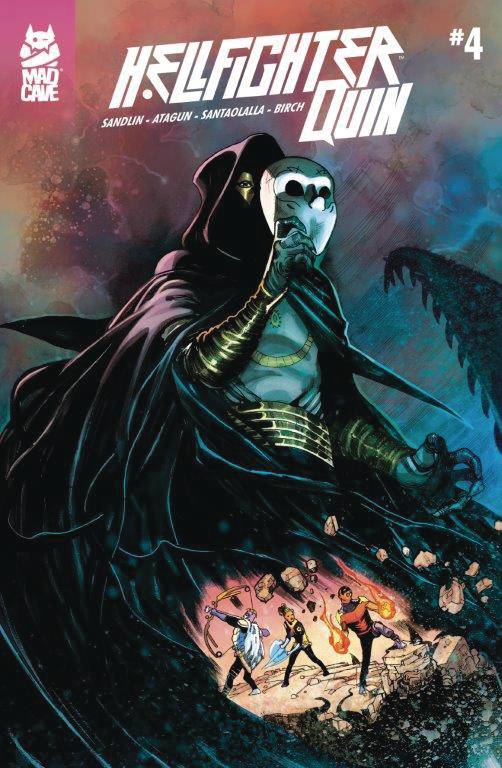
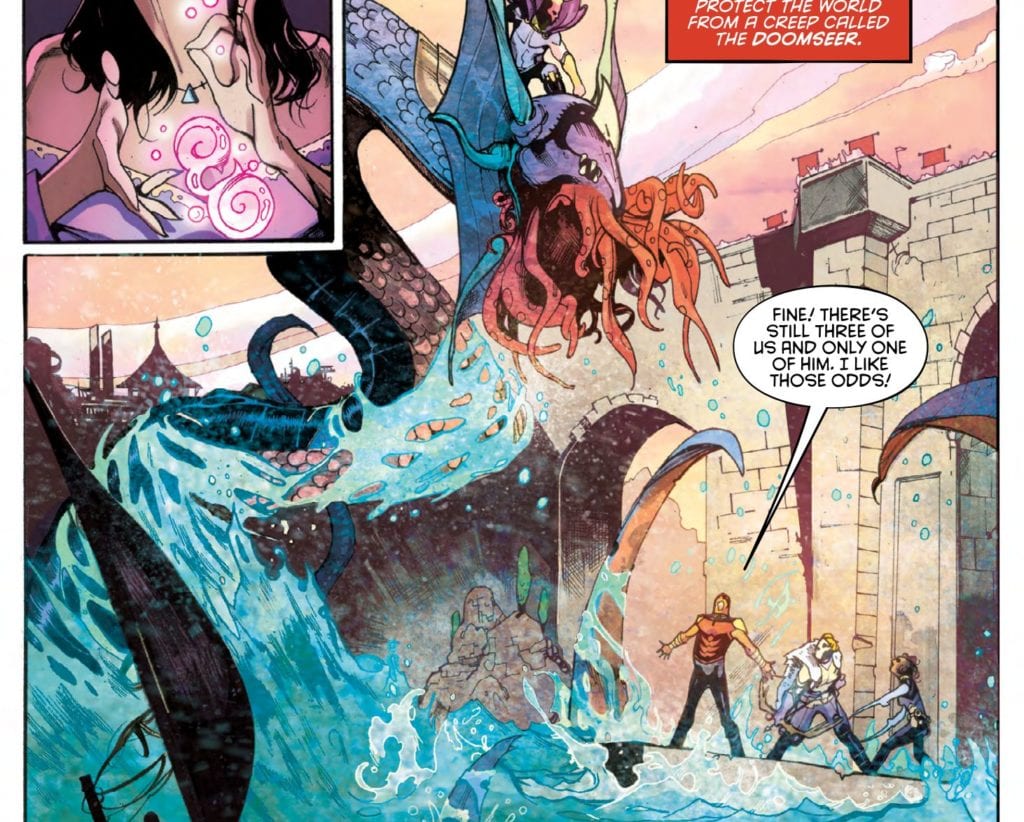
HELLFIGHTER QUIN #4, available from Mad Cave Studios on August 12th, follows Quin, Shard, and Deadeye as they enter the arena against Invictus and his allies…plus one big kaiju. Jay Sandlin’s story pulls no punches (literally) in an issue that’s almost wall-to-wall super-powered action.
Cover Art
Atagun Ilhan’s cover lays the foundation for the big reveal in this issue. Who is the Doomseer? You’ll find out at the end, but in the meantime, the cover projects an excellent sense of mystery and foreboding. Doomseer looms as a spectral menace that haunts Quin’s team fighting through the tournament, and that juxtaposition is perfect in more ways than one.
Writing
Sandlin’s story is the highlight of this issue. When putting a comic script together, it’s not enough to write, “And now they fight.” The action is typically a collaboration between writer and artist to choreograph action that looks cool and also continues the story through the action.
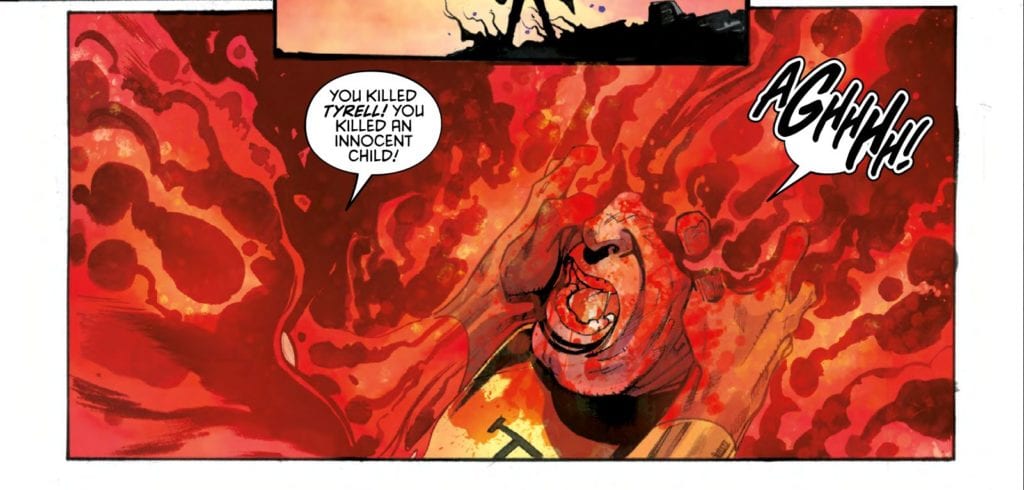
Here, Sandlin furthers the potential for romance between Quin and Shard in between the punches, and the conclusion of the fight plays right in the Overseer’s hands. You get the distinct impression that the fight’s outcome was part of a greater plan that makes the story significantly more layered.
Pencils/Inks
Ilhan shows some improvement in technique over prior issues (see our review of issue #2 here). In particular, the scenery and backgrounds are eye-catching in detail and really set the stage for an ancient Colosseum-style battle. Also, the action sequences, which take up a majority of this issue, are full of life and energy. Ilhan is demonstrating a strong command of kinetic action in the panel layouts and composition.
That said, the anatomy and renderings of the characters is a weak point in this issue. Faces are ill-defined to the point of looking distorted or misshapen. When an issue is so heavily dependent on the wow factor of the action sequences, the anatomy of the characters moving through the fight has to be tight. Ilhan’s art is improving over prior issues, but at its current level, it’s distracting enough to detract from the story.
Coloring
Maria Santaolalla’s coloring work has a lot more room to shine in this issue. The brightness of the airy Colosseum, the sparkling waterfalls, Quin’s blazing attacks – just to name a few – stand out to add pop to the story. Santaolalla’s colors are significantly improved over the muddled shadows so strongly present in issue #2, and they amp up the energy prevalent in Ilhan’s artwork.
Lettering
Justin Birch’s lettering is a prime example of organic integration. The word bubbles are placed well and keep the reader’s eye moving briskly through the pages, but what stands out is the use of coloring on the sound effects. Birch chose to add color and shading to the sound effects to match a visual focal point if the panel in which it’s placed. It’s a nice touch that makes the sound feel more integrated to the action taking place.
Conclusion
HELLFIGHTER QUIN #4, available from Mad Cave Studios on August 12th, is a bright, energetic, action-packed issue with a twist reveal at the end. The art team is showing significant improvements over the previous issues, and the writing is top-notch — lots of promise for what’s to come.
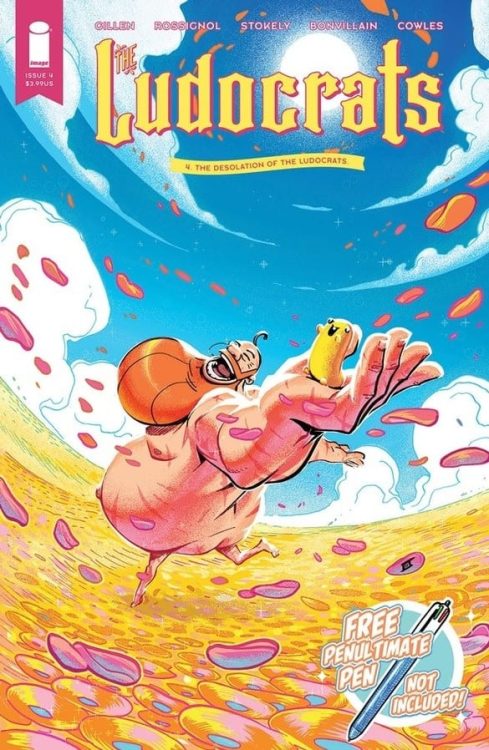
Despite what the cover of Ludocrats #4, there is no free pen.
LUDOCRATS #4, available this Wednesday from Image Comics, continues this quirky and obscenely chaotic tale. Providing readers and creatives alike a break from the stability that comes with common sense and rules of nature.
Ludocrats #4 is every bit as chaotic as it’s predecessors, if not more so. The series has taken some odd twists and turns along the way, but in a refreshingly honest way, the series has also refused to explain many of those very twists.
Instead, the series simply…exists. It’s a work (and world) of chaos, one that abhors logic and rules, as those sorts of things are simply too dull for the Ludocrats. It’s in their very name.
You’ll note that the cover of this issue promises a free pen. It also points out that said free pen isn’t actually included with the comic. This is a perfect peek into the chaos that lies within these pages. However, it’s far more kid-friendly than many of the images (and implications) within.
A new mystery to tackle in Ludocrats #4.
The Writing
Ludocrats #4 is the comic book equivalent of an insane roller coaster. Don’t skip over the insane part in that description. This is a series that defies description and logic, but it does provide for quite the break from the real world.
Written by Kieron Gillen and Jim Rossignol, this series isn’t afraid to take risks. In fact, risk-taking is kind of the name of the game. It’s quirky and zany, and not afraid to show it’s freak flag. The pandemonium in these pages knows no bounds.
As with the last issue, this one is set to yank a variety of reactions from the readers. Confusion, amusement, curiosity, horror, and alarm all go rather nicely with the Ludocrats. Sometimes all at once. Actually, it’s a bit more often than sometimes. It’s pretty clear that the intent is to leave the readers in a similar state; a jumble of colors and emotions.
There’s a strong running joke throughout this issue in particular, one that seemed to get funnier as time went on. It perfectly encompassed the personality of all the characters, while setting up for the explosive finale.
Now would be a good time to run.
The Art
Take a look at the cover for Ludocrats #4. That cover is probably the best summary one could hope to find for this series. That applies to both the plot and the artwork. It’s fun and bubbly while also being bright and unafraid to let it’s characters be free. Sometimes literally.
There are a few scenes worth highlighting in this issue. Mainly the one that comes from the first set of circumstances, our heroes (?) come across. It’s a fun little twist that added (or took away) extra depth to the series.
Jeff Stokely is the lead artist for this project, so give him credit for all of those crazy scenes. Even (perhaps especially) the ones that make you want to look away. This is a series that wouldn’t have been nearly as effective if not for the artwork involved, especially in regards to character design (which does carry the series from one event to the next).
Tamra Bonvillain is the one behind the colors, as you can clearly tell at just a glance. The colors are bold and bright, which is actually pretty perfect for this series. The world of the Ludocrats is bright and full of life, and sometimes death.
Clayton Cowles provided the lettering, showing off all the quirks and insanity that this oft-overlooked artform can provide. It’s ideal for this series for more than one reason—all while (almost) adding a sense of structure to the world.
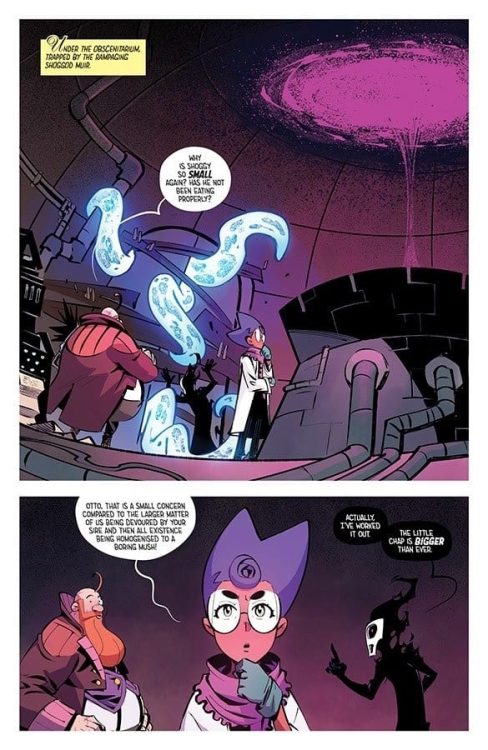
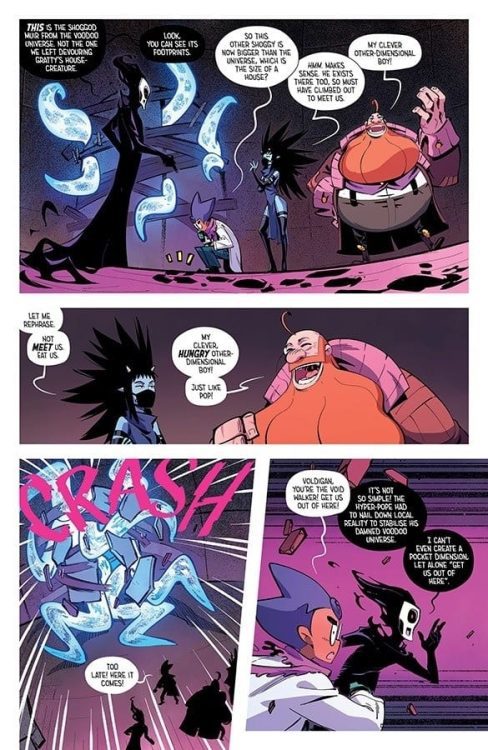
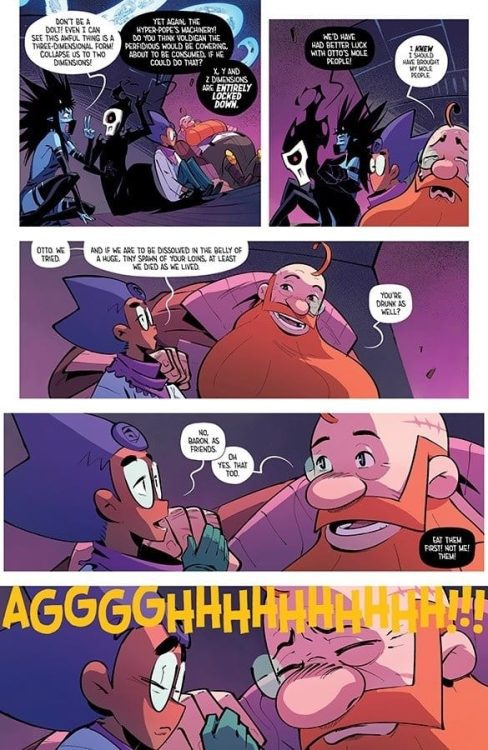
Drunk, or friends? Why not both?
Conclusion
Ludocrats #4 is every bit as crazy and chaotic as it’s forefathers, if not more so. The series is getting close to the end, and this is the issue that is set up for that explosive moment, which might end up being more literal than not.
It’s been a fun and sometimes silly ride thus far, with the characters forcing their way through this world with a refreshing amount of boldness (and lack of shame). It’s undoubtedly one of the most unique series out there.
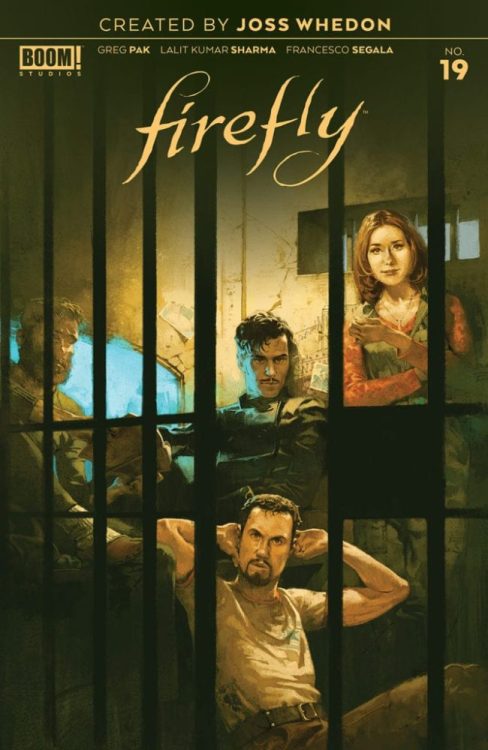
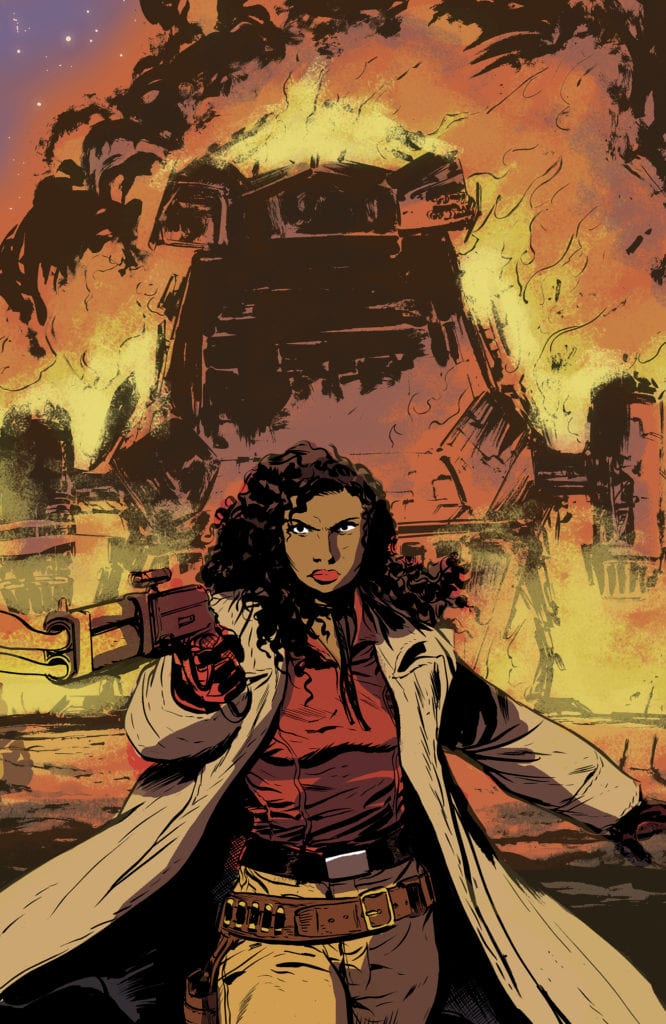
The cover of Firefly #19 shows a few fan favorites, once again in jail.
FIREFLY #19, available now from Boom! Studios continues the story of Sheriff Malcolm Reynolds. Once the captain of Serenity, now the Sheriff of a small moon in desperate need of help. It’s not a position fans ever expected to see this character in, that’s for sure.
Once upon a time, Malcolm Reynolds ran a crew, all as loyal as can be. Well, they were mostly loyal. Now that crew has been spread throughout the stars, and Mal has taken up a new job in life. It’s perhaps the least likely job ever for this particular character.
He’s now the sheriff of a moon, and he’s doing his best to resist those higher up in the food chain, though this time he’s doing it from the inside. Is this where the series would have eventually ended up, had Firefly never been canceled? It’s hard to know.
It’s obvious that the series has taken a stronger focus onto Malcolm Reynolds. It felt like a temporary move at first, but with each issue, that sensation seems to be drifting away. All while leaving fans missing their favorite (and noticeably absent) characters.
Where are Walsh, Zoe, Shepherd Book, River, and Simon? While the series has told fans were Kaylee, Jayne, and Inara are, the rest of the crew seem to have disappeared from the universe altogether. It’s quite a depressing thought.
Zoe is front and center on this variant cover for Firefly #19.
The Writing
Firefly #19 is one of those issues that will leave fans scratching their heads. Just what exactly is Mal up to? Are we still seeing the symptoms of a longer game, or has our favorite captain finally lost his way?
Greg Pak is still at the helm of this project, providing a look at what must be an alternative version of the world and characters we’ve come to love. Set after the events of Serenity, many changes have been formed here are there.
At first, it was tempting to try and guess how this plot would wrap back around upon itself, how it would bring the crew back together and make them stronger than ever. That temptation has decreased over the last few issues.
There’s still this sense of lingering curiosity, but the hope is dwindling. It’s hard not to miss beloved characters, especially after all this time (and all of the changes they’ve faced).
On the bright side, this series hasn’t been afraid to take risks. There have been plenty of those, especially in terms of character development. This has forced fans to take a step back from their assumptions and expectations, and simply enjoy the show.
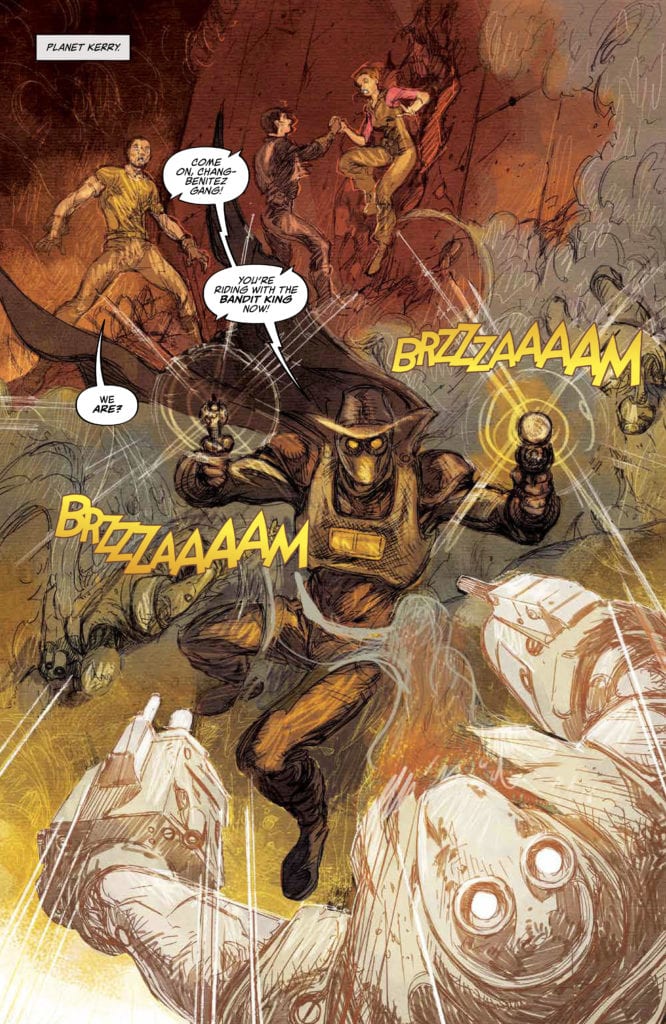
The Bandit King strikes again!
The Art
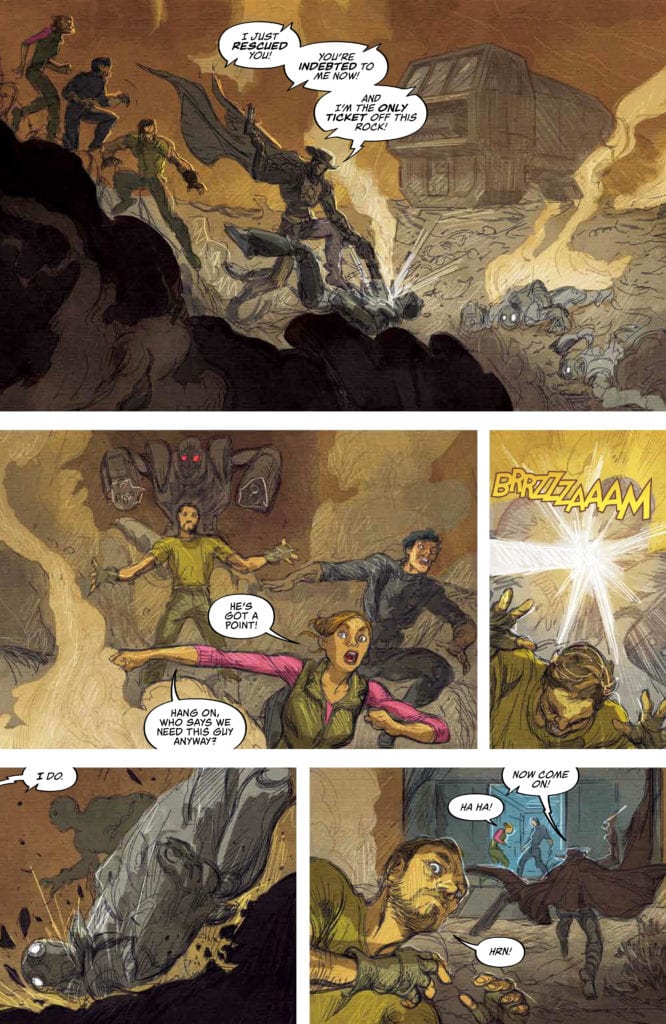
One of the biggest highlights of Firefly #19 is, without a doubt, the artwork found within its pages. The series has taken on a heavily stylized look, but it’s something that suits the aesthetic of the world quite nicely.
Lalit Kumar Sharma is the leading artist for this issue. He’s the one responsible for all the character designs – both for new characters and for the changes made to old characters. All while providing a rough universe for them to reside in. Throw in more than one action sequence, and this issue has a visually compelling base to work with.
Francesco Segala provided the colors, taking Sharma’s work to a whole new level. It truly does read as a Western set in space, with the colors of both genres merging in unique (but pleasing) ways. The starry backdrops are a treasure and make the series worth checking out.
Jim Campbell is the artist responsible for the lettering, and as always, he did a brilliant job here. Carefully placed letters lead from one panel to the next, telling their own story along the way.
He does, indeed, have a good point.
Conclusion
Firefly #19 may be carrying on in a world many have come to love, yet it also feels so different from that original series. It has truly evolved with time, turning into something unique to the comic book industry.
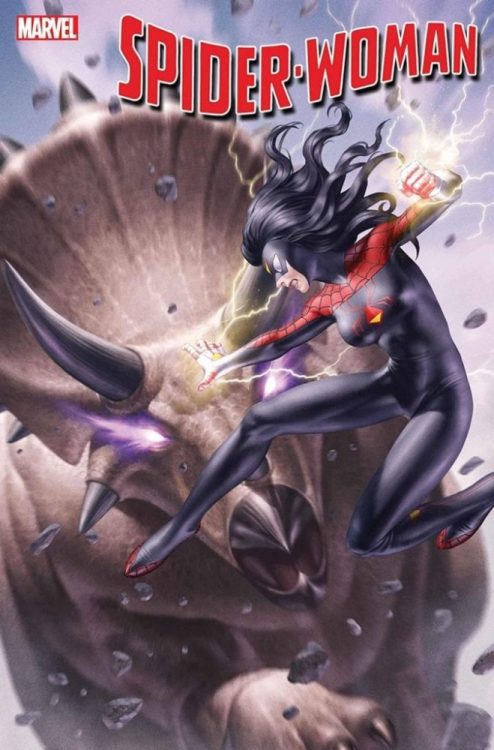
Spider-Woman #3 is about to send Jessica Drew on a whole new adventure.
SPIDER-WOMAN #3, available this Wednesday from Marvel Comics, throws Jessica Drew back into the fray. Her latest series has given her more than ever to contend with, including a brand new suit.
Jessica Drew, aka Spider-Woman, is back with her own series, and the stakes have never been so high. At least, not so high and so personal. She’s been backed into a corner, and we all know how well that is going to go over.
Spider-Woman #3 continues the latest adventure for Jessica Drew. Sometimes is horribly wrong with her – and now she’s on a race against time (and her body) in order to set things right. This has brought about its own challenges, as one might expect.
Even with these complications, it has been a delight to see Jessica Drew nabbing her own series once again. While the occasional appearance in events and other series (mostly Captain Marvel), has been nice, this feels so much more real.
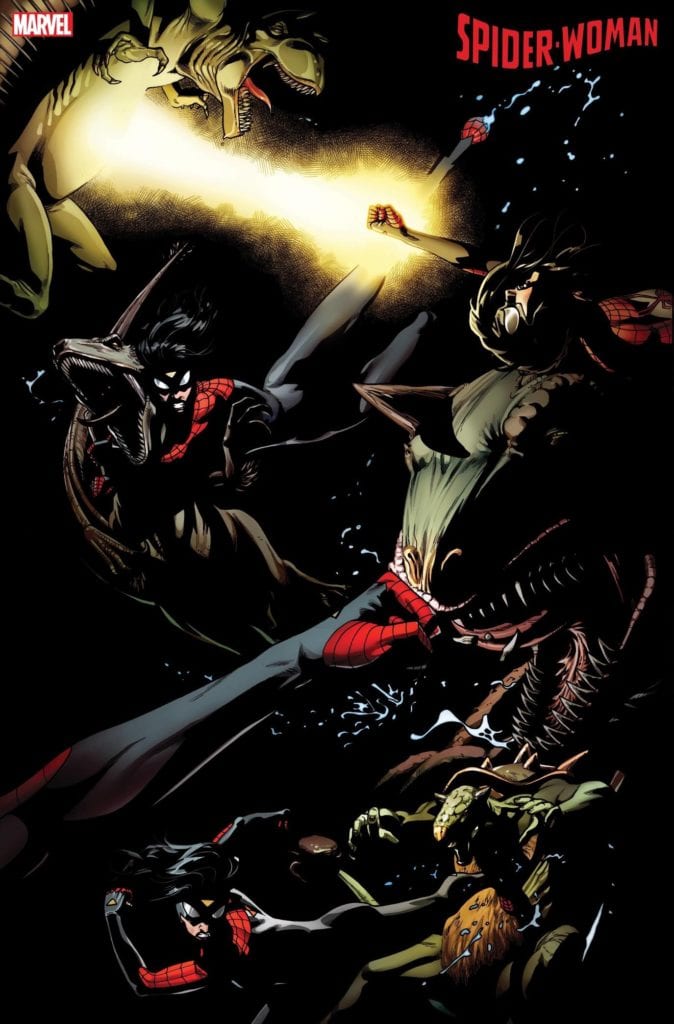
The darkness before the storm?
The Writing
This latest Jessica Drew series has already been so full of twists and turns – and it’s only a few issues in. Don’t worry, Spider-Woman #3 has no intention of breaking that streak. Written by Karla Pacheco, this is an issue full of action and more than a few climactic moments.
This series is simultaneously portraying Jessica at her best and at her worst. She’s fighting to stay alive for the people she loves, all while struggling against something out of her control. It’s a fine balance, but oddly enough, it all just makes her character feel more human.
A human who has all the right in the world to be feeling extremely angry at the moment. She’s been put through hell and back. Sure, it may all have been done for good reasons, but that hardly changes the fact, now does it?
This issue is full of that anger, to an almost satisfying level. Yet even that isn’t enough to stop the revelations heading Jessica’s way. Which naturally results in a bit of a cliffhanger for the next issue. Who’s placing bets of Jessica starting another fight?
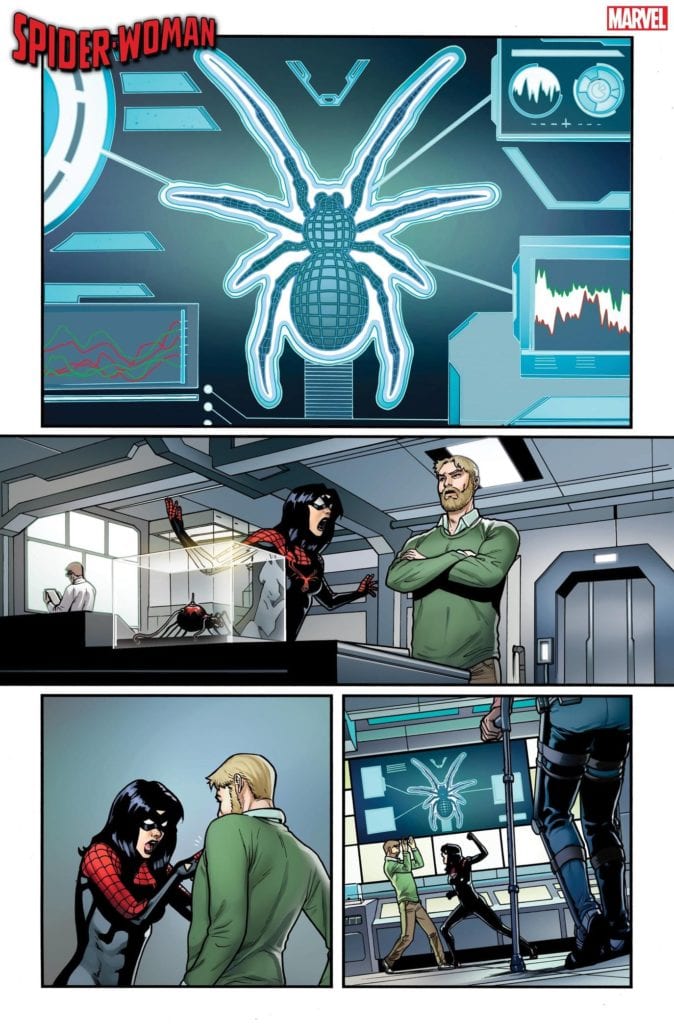
Running parallel to Jessica’s scenes are some moments that are, quite frankly, hilarious. Roger and Gerry are a hilarious pair, though admittedly, Roger is hard-pressed to keep up with that child. It’s a moment of fresh air, before diving back into this tense adventure.
To be fair, she’s got a good reason to be angry.
The Art
Spider-Woman #3 features some bold artwork, as it should. Jessica Drew’s story is dark and complex. The artwork supports that, all while providing an issue full of action, and even a chuckle-worthy moment or two.
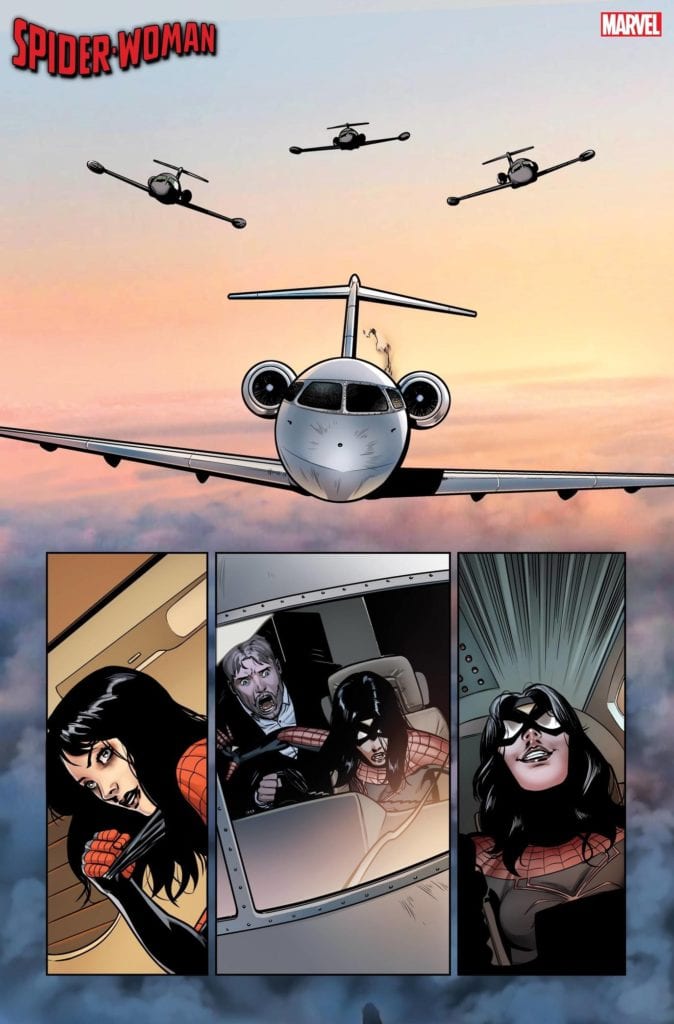
Pere Perez was in charge of this issue, providing a broad range of scenes, emotions, and events. Everything from Jessica’s battles, to her emotional (read: extremely angry and ticked off) reactions, as well as everything in between. The contrast between certain scenes was impossible to avoid, and did an excellent job of highlighting her emotional/mental state, and how inaccurate her assumptions are.
Frank D’Armata provided the colors for this issue, bringing the art to life in a bold way. Literally. The colors are vibrant, with only one exception. It was clever to have the scene portraying other characters appear a bit more muted, almost like a flashback. It made it stand out, all while hinting at more.
VC’s Travis Lanham did the lettering, and it was so satisfying here. Thanks to his work, you can really feel it when Jessica lets loose on an enemy. There’s a real sense of impact, not to mention that at times one can almost hear her anger seeping off the pages.
She looks so alive, ironic since she’s fighting to stay alive.
Conclusion
Spider-Woman #3 threw some serious curveballs our way, and while it did leave a bit of a cliffhanger, it’s an experience worth reading. Her journey is full of anger, and rightly so. Yet all of that leaves us wondering: how’s she going to react to this latest twist?
The enemy refuses to stay down on this cover of Once & Future #10.
ONCE & FUTURE #10, available Wednesday from Boom! Studios continue Duncan’s journey as he learns to fight things that go bump in the night. Unfortunately, things look like they’re going to get worse before they get better.
Duncan has only been a hunter for a short period of time. Yet in that time, he’s already faced a king of legend and lived to tell the tale about it. Now he’s about to come up against another legend of old. What are the odds that he’ll get lucky twice?
Once & Future #10 brings fans back to a world of quests, lore, and violence. Only, in this case, the legends are not as magnanimous as they would have had us believe. No, they’re much darker, having had plenty of time to become warped and twisted.
The panic that comes with trying to get somewhere in time.
The Writing
The tale of one family’s battles against creatures of lore continues in Once & Future #10. Written by Kieron Gillen, this issue is tense and absolutely full of battles to stay alive. And to save the day, of course.
Once & Future #10 doesn’t hesitate to throw readers into an anxiety-inducing scene. It makes sense, given the last issue ended in a bit of a cliffhanger. Though the suspense seems to go up a few octaves before the revelation fully hit home.
The tension seemed to grow with each passing page until connections were finally forged. That’s when it became clear how bad things were. Oddly enough, it was almost a relief, since at least now we know. The unknown is always worse, as evidenced by what readers will experience here.
The series of events leading up to the action was tense, making that climactic moment feel larger than life. Or perhaps not, since there really isn’t a struggle larger than the one to stay alive. It’s a tone that was played to perfection here, all while once again setting up for something more.
The constant throwbacks to lore and legends have been a delight, especially towards the end of this particular issue. Once again, pointing towards the fact that this is not a problem that is going to be easily pushed aside.
A real-life moment within the comic book world!
The Art
Once & Future #10 is full of bold colors, dramatic fights, and even more terrifying creatures. In short, it’s entirely at home with the rest of this series. Dan Mora (art), Tamra Bonvillain (colors), and Ed Dukeshire (letters) have worked together to bring this issue to life, and it was well worth the effort.
The juxtaposition between the build-up scenes cannot be ignored. On the one hand, there’s Duncan’s panic expressions and actions to get somewhere and fast. Then there’s Gran, enjoying a rare evening off. It set the tone for what was to come.
What followed was every bit as daunting as one could expect, after such a build-up. It was a monster of legendary proportions – literally. Yet the artistic team was up for the task, portraying unexpected twists in the action.
The colors went a long way in setting the otherworldly feel to this issue, as with the rest of the series. One can see how magic and legend could seep back into the world when it’s full of such brilliant hues.
There’s more than one way to travel, apparently.
Conclusion
There are times when the wait between issues is simply unbearable. That is going to be the case now, following Once & Future #10. The cliffhanger alone will be enough to leave readers eager to see how Duncan and his Gran are going to get out of this mess.