Home Blog Page 264

Review: STAR TREK HELL’S MIRROR Reunites Kirk With His Greatest Foe

Star Trek Hell's Mirror
Star Trek Hell's Mirror Credit: IDW Publishing

The Mirror Universe, Star Trek’s parallel dimension, is as much as a part of the geek zeitgeist as the series itself. Over the years each series has ventured into the alternative universe which first appeared in The Original Series episode Mirror, Mirror in 1967. The concept of an ‘evil’ dimension where the regular cast have become compromised by disturbing philosophies is a popular narrative featured in a number of different T.V. Shows. Series such as Doctor Who and Buffy The Vampire Slayer have both used the trope and the comedy show Community made it an ongoing part of their second and third seasons.

In Star Trek, the Mirror Universe has touched almost every aspect of the franchise. The first series of Star Trek: Discovery used crossing over a major part of the plot, and a number of comic writers and artists have also played in the sandbox of black leather and goatee beards.

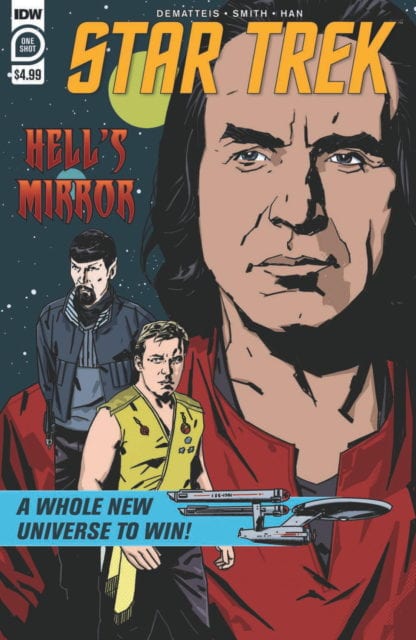
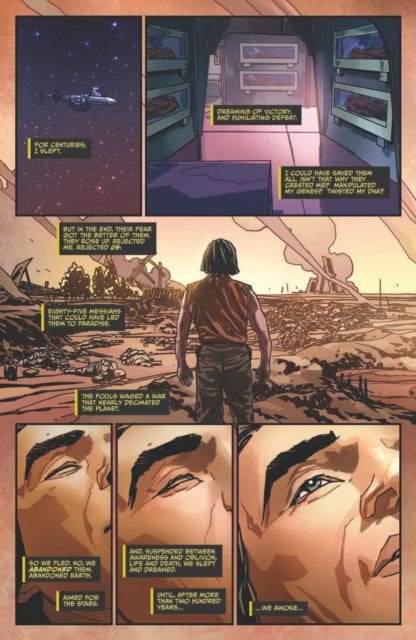
The latest one shot from IDW Publishing, Star Trek Hell’s Mirror, features the regular cast of the original series as seen in the first crossover story. It also includes possibly one of the franchise’s most popular villains: Khan Noonien Singh.
Star Trek Hell’s Mirror Credit: IDW Publishing

Crossing Over

J.M. DeMatteis will be a recognisable name to comic book readers. He has an impressive history writing for Marvel and DC as well as a slate of comics for smaller publishers. He also wrote the final issue of Marvel’s original Star Trek comic, published in 1982, so his return to the franchise is an exciting one.

The story is simple: DeMatteis reintroduces Khan to the reader through an opening monologue, although some prior knowledge of the character and the Mirror Universe at large is required. Going into this blind will leave you stumbling in the dark for a while, trying to reconcile the characters with what you already know about them. Having said that, the chances that this comic is picked up by anyone who isn’t already closely familiar with Star Trek history is very slim.

After the reintroduction, Khan’s journey takes him across the Terran Empire, inciting rebellion and behaving as you might expect, except there is a twist. In this universe Khan is the hero, a seeker of peace and freedom for all. DeMatteis tells the story from Khan’s point of view allowing the reader to get close to the character, with the regular Star Trek cast playing second fiddle.

DeMatteis picks out elements of the original Mirror, Mirror episode and the second Star Trek movie, recreating them in the story with a subtle twist. This roots the narrative in a world the reader will recognise but also highlights the difference between the Federation and the Terran Empire. It is clear from the narration by Khan and the actions on the page that this is a universe fuelled by hatred and anger.
Star Trek Hell’s Mirror Credit: IDW Publishing

Mirror Image

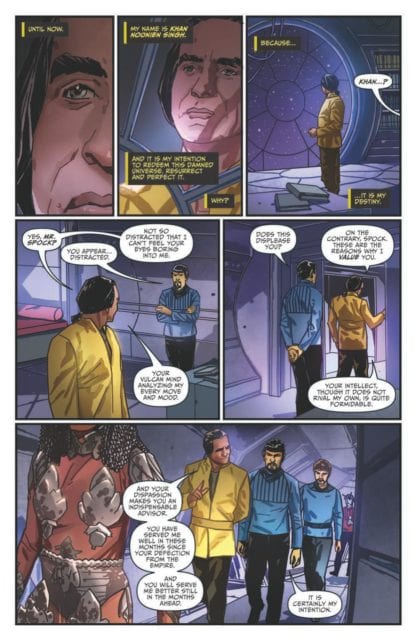
Artist, Matthew Dow Smith, renders the characters with thin, black lines, focusing on outlines while the detail is filled in by colorist Candice Han. This is a very effective style for the comic and adds depth to the page. The shading allows for a realistic image and brings out the emotion of the characters.

Han’s coloring also makes the characters easy to follow on the page. Each of the main cast has a slightly different uniform with a varying degree of brightness. This is important because some of the panels are laden with speech balloons covering up so much of the image. This is not a fault of the lettering by Neil Uyetake but a problem with an over-written script. The text on the page needed to be edited or the panel layouts should have been altered. On a number of pages, the text heavy script is not a problem, the opening of the comic is testament to this, but other pages are weighed down by exposition and flocks of speech balloons.

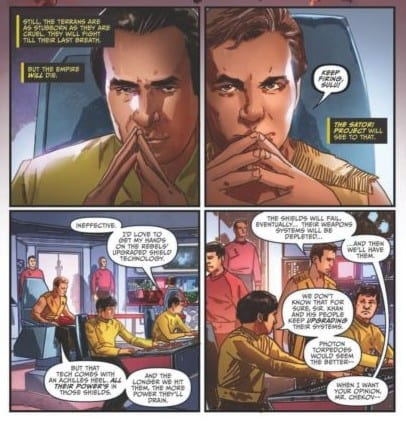
This is a shame because the artwork itself is wonderful. Smith draws an astonishing background that sets the scene perfectly. At no point throughout the comic are you in any doubt that this is an alternative universe or the form this dystopian world takes. The atmosphere on each page is as oppressive as the Terran Empire itself with the characters fighting their way through their lives. Smith also places panels side by side to create exciting comparisons between characters and situations. This is most notable when comparing the two leads, Kirk and Khan.

Smith uses a very standard set of viewpoints for the reader to see the action. This mix of long shot to body shot to close up relates to the era that the Original Star Trek hails from. The look of the series and the spin off movies is captured by Smith who only employs low or high angles to emphasise a major moment in the story.
Star Trek Hell’s Mirror Credit: IDW Publishing

Conclusion

The purpose of an alternate universe is to illustrate something about the central characters of the story. By portraying an ‘evil’, emotional Spock, it gives the audience a greater insight into the Spock we already know. Hell’s Mirror fails to do this, instead relies on the simple premise of the characters being opposite versions of themselves. The character of Khan isn’t grown by his appearance here because there is no comparison between the original and the doppelganger. We are given a fully realised character but not shown how he relates to the character we already know.

The assumption made in this comic is that because everyone else is playing against type, then Khan would do so as well. The main aim of Hell’s Mirror seems to be to retell The Wrath of Khan with the central roles reversed: Kirk is the aggressor and Khan the diplomat. This makes for a fun read, and this comic is a mountain of fun, but it feels like a missed opportunity. There was the chance here to delve into the mirror universe and create a unique take on the characters, giving the readers something truly unexpected. Unfortunately, this just isn’t the case and Hell’s Mirror is nothing more than a single idea stretched to fill 24 pages of comic.

Khan is a fascinating and fantastic character and deserves more page/screen time but there are much better stories out there with him in. This isn’t a bad rendition of the character, not like the Benedict Cumberbatch take in the movie Into Darkness, but the concept does have a greater potential than is present in Hell’s Mirror.
Monkeys Fighting Robots Youtube

Review: THE AMAZING SPIDER-MAN #47- An Event That Keeps On Giving

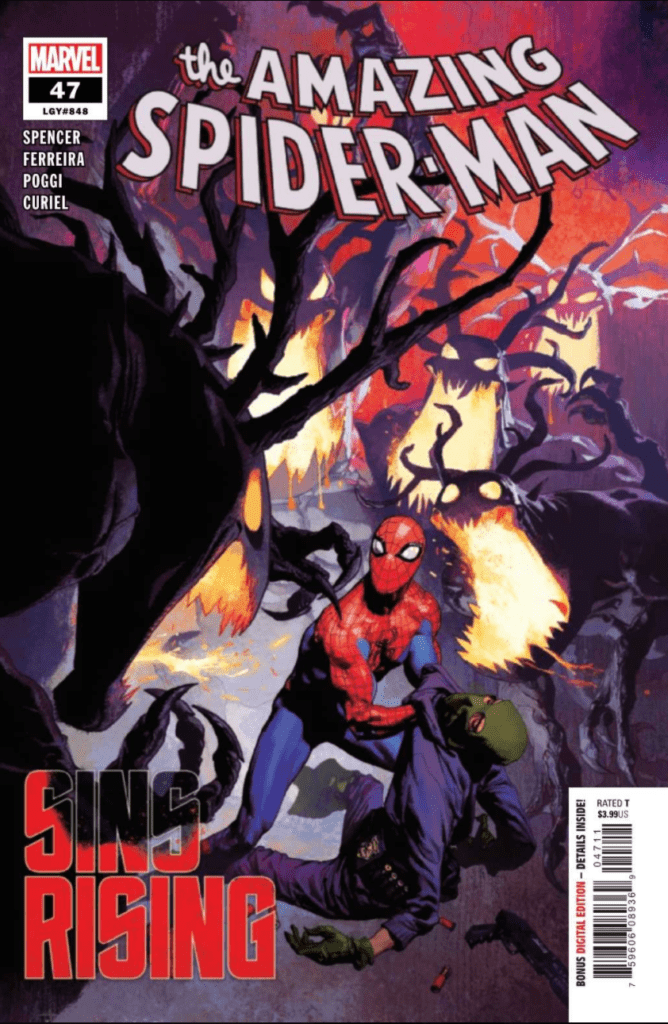
The Amazing Spider-Man #47 Cover

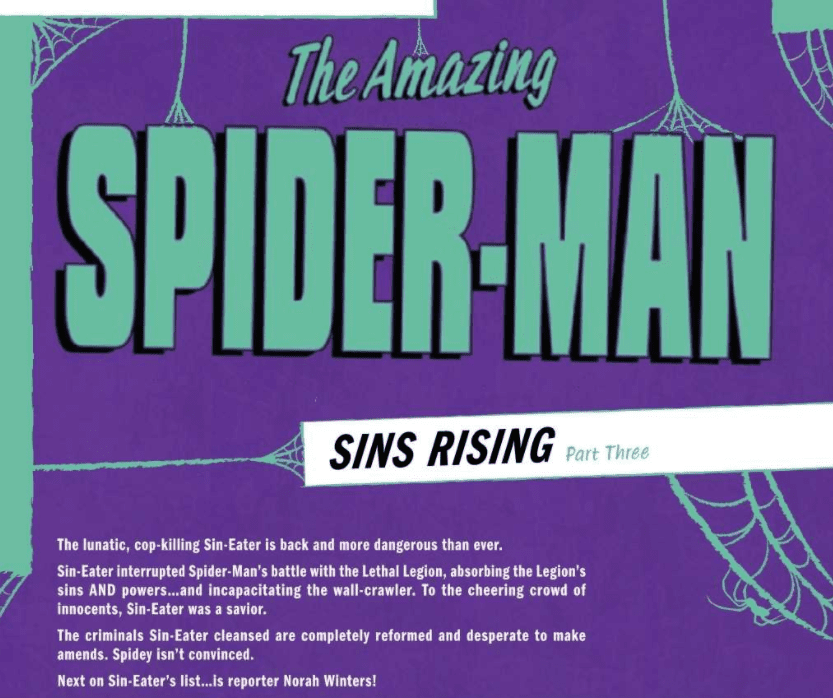
The Amazing Spider-Man #47, published by Marvel Comics, is the third part of the Sins Rising event and continues the outstanding quality of the arc.

The Amazing Spider-Man #47 Opening Credits

About the Book:
The Sin-Eater has been killing off villains of Spider-Man’s, only to have them come back to life in the morgue without their powers or urge to hurt others. Despite doing nothing wrong, Spider-Man does not trust the Sin-Eater and is doing everything he can to stop him.

The Amazing Spider-Man #47 Story

Nick Spencer, as always, does a phenomenal job of keeping the reader engaged with every page. The Sin-Eater’s motives and plans have not been entirely revealed, but each issue in this event we are given more and more, with enough information left to leave the reader curious enough about future issues. The Amazing Spider-Man #47 unveils another crucial step in the Sin-Eater’s plan that both fits the Sin-Eater character and is a new, unexpected twist. It makes the issue incredibly fun, while also creating excitement for what might result from the actions taken by the Sin-Eater in this issue.

Pencil and Inks example in The Amazing Spider-Man #47

What began in the previous issue is now having more profound effects in The Amazing Spider-Man #47, where Spider-Man wishes to stop the Sin-Eater for unfounded reasons. Yes, he was killing people, but they return to life eventually, now without the want to hurt anyone else. It seems like the perfect way to stop criminals. Spider-Man did have the fact that the villain Overdrive was in critical condition to help his argument, but we discover in this issue that it may be because of reasons other than the Sin-Eater. This leaves our hero with a belief centered on a hunch, which makes the public — and perhaps even the reader — doubt whether he is right. It is an incredibly exciting series of events that I cannot wait to see how it plays out.

Art

The Amazing Spider-Man #47 features many different scenes that appear only for a panel or two so that we can get a small slice of life for characters that we are not familiar with. These few panels that focus on many different locations allow for the pencils of Marcelo Ferreira and inks of Roberto Poggi to shine, as it allows for so many diverse characters to be brought onto panel that are living their everyday lives. The scenery and people are drawn beautifully and show off the high skill of Ferreira and Poggi.

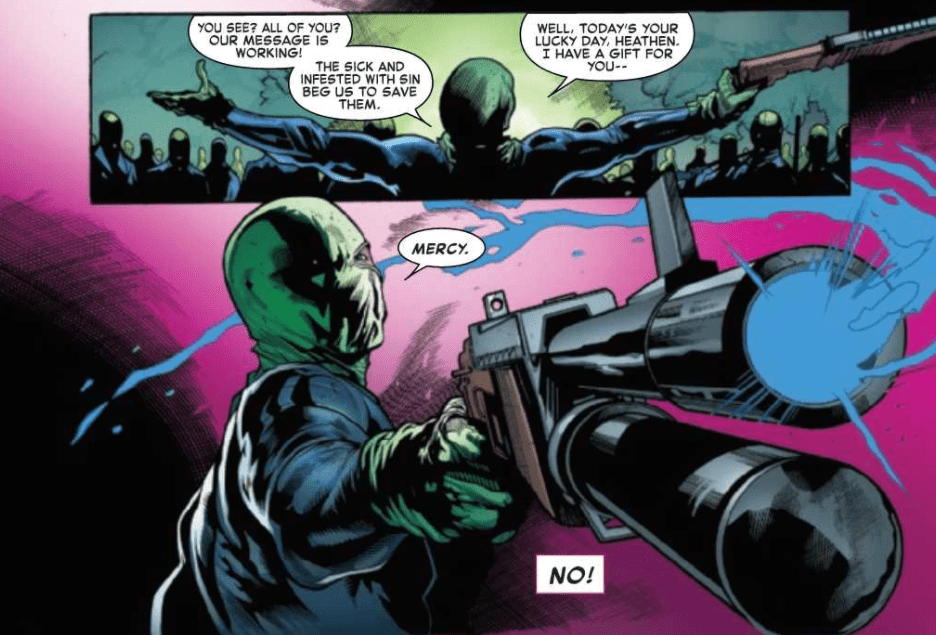
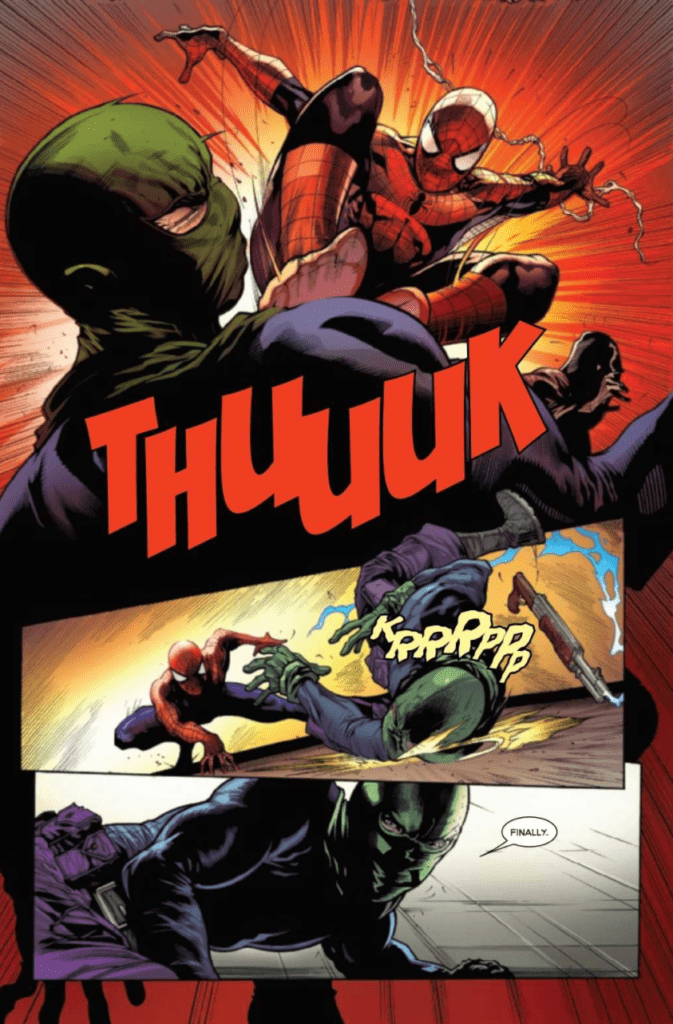
Later in the issue, we are graced with a direct confrontation between the Sin-Eater and Spider-Man that features a multitude of powers and weapons that the Sin-Eater had acquired from villains he had shot. The battle is beautiful, and the dynamic poses and figures that Ferreira and Poggi make help create a deeply memorable confrontation. The way characters from certain panels overlap the borders of other panels is another technique frequently used, and it effectively makes characters pop out more than they would have otherwise.

Stunning Lettering and Colors example in The Amazing Spider-Man #47

The colors of David Curiel in The Amazing Spider-Man #47 are also shown off by the many different scenes at the beginning of the issue. The different palettes of each panel highlight just how skilled he is, no matter the environment he is coloring for. There is a point in the issue that takes place at a morgue with poor lighting that limited the abilities of what Curiel could do, but shortly after, we are able to witness his vibrant colors and gorgeous shading again in a brilliant fight scene.

The lettering of this issue was outstanding. VC’s Joe Caramagna kills at every chance he is given, and The Amazing Spider-Man #47 allows him to shine like few other issues. Rarely are there enough opportunities for the letterer to stun you, but the fight scene later in the issue features quick exchanges of blows from a multitude of weapons, which Caramagna enhances with fonts of many different styles and colors. Towards the back of the book features some of the best lettering I have ever seen in an issue as the action unfolds.

Conclusion

The Amazing Spider-Man #47 is yet another fantastic issue in the Sins Rising events. The end of each issue leaves the reader satisfied with what they have been given and wanting to know how each of the elements of the story will be resolved. It is a riveting piece of writing that is complimented incredibly well by stunning line art, colors, and lettering.

Monkeys Fighting Robots Youtube

Review: IRON MAN 2020 #6 Brings It All Together

Iron Man

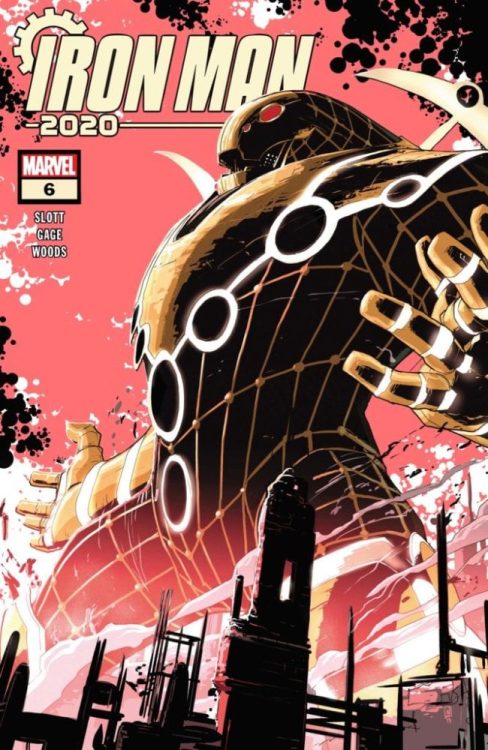
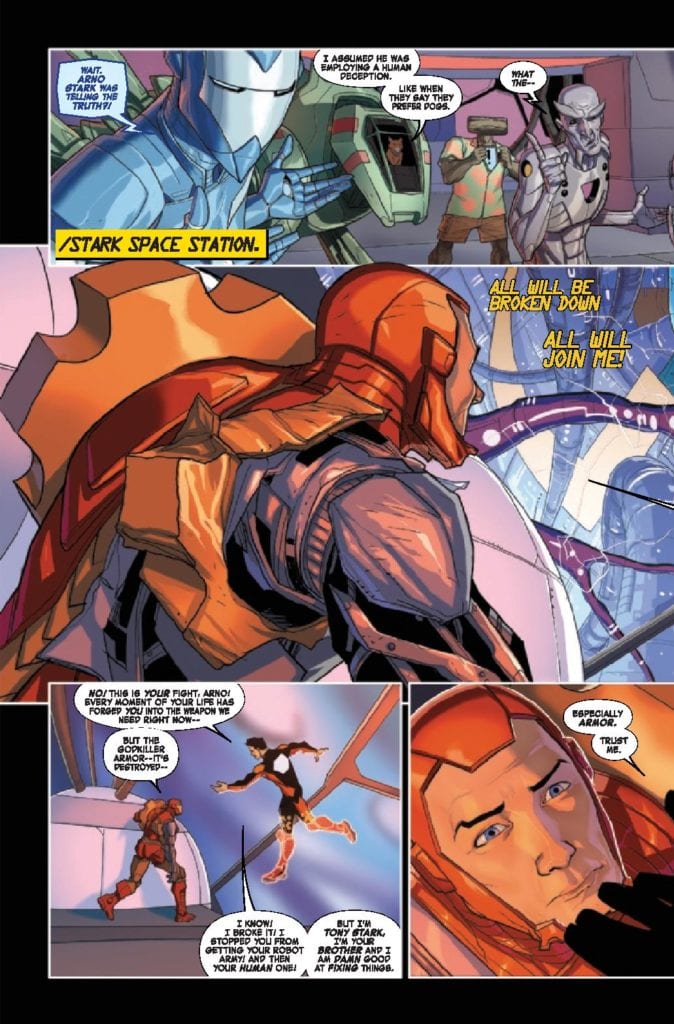
Iron Man 2020 #6 delivers an ending to the 2020 event thanks to Dan Slott, Christos Gage, Pete Woods, VC’s Joe Caramanga. After starting the year on a low point, Tony Stark is back with a new armor and finds him having to work with his brother Arno to defeat a much bigger threat. Will the two Starks be able to put aside their differences long enough to save the world?

Summary

Throw out the rest of your stupid, worthless flesh-bag calendars. 2020 is over, man! The moment Arno Stark has been preparing for is here: the end of all human and artificial life as we know it!

Iron Man

Writing

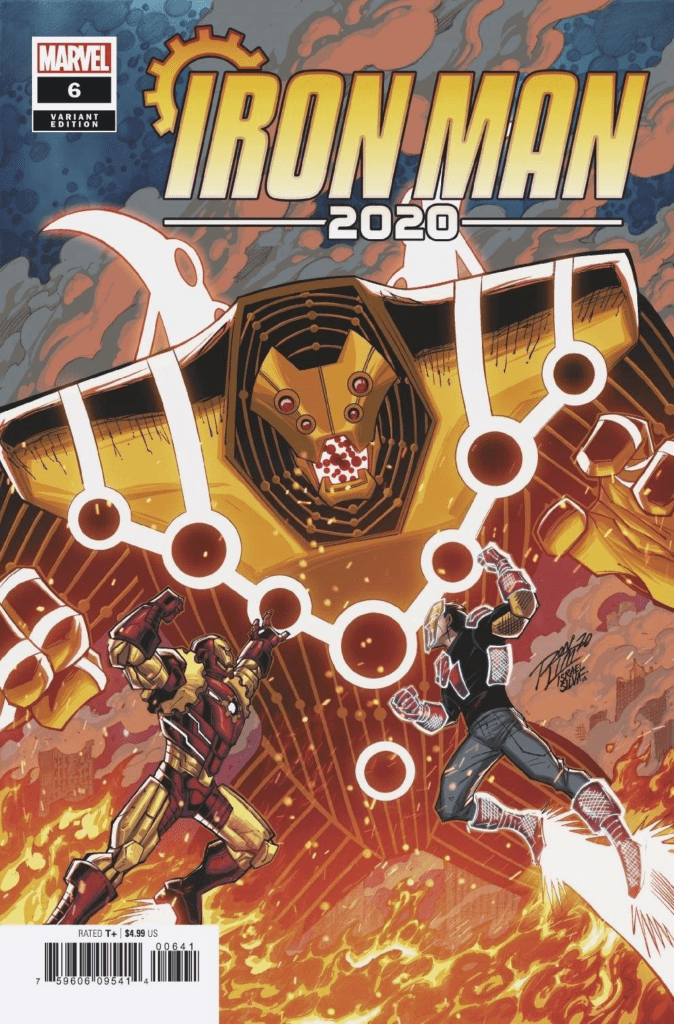
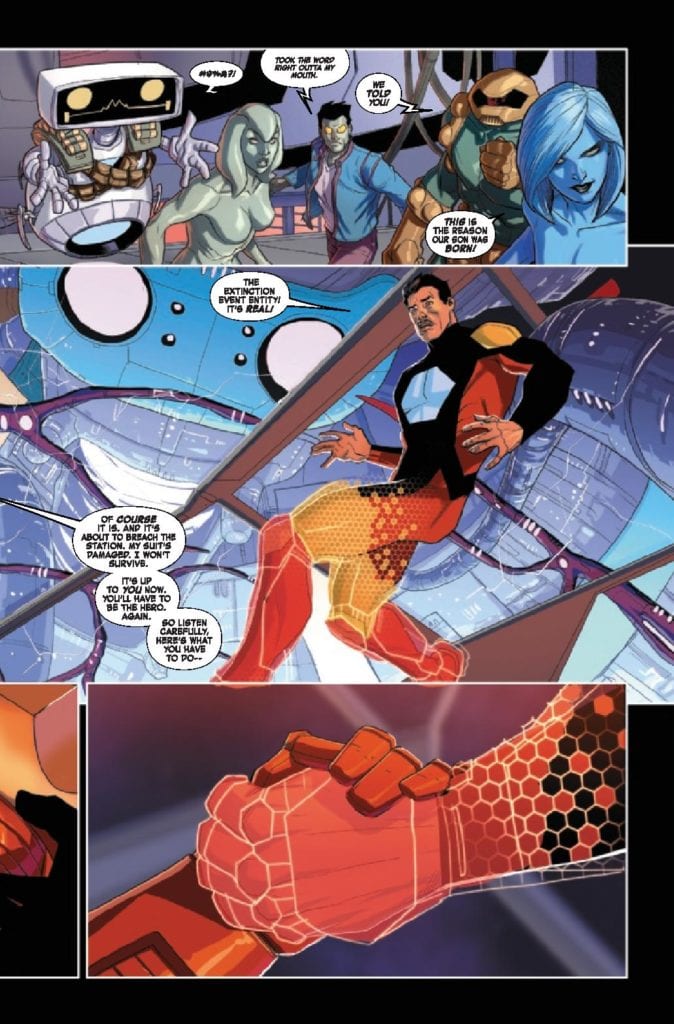
This issue marks the end of Dan Slott’s run on Iron Man and it truly feels like the closing of a chapter of the character’s history. Elements of both Tony Stark: Iron Man (which Slott wrote) and all of the 2020 events comics come into play in this issue. The fight against the Extinction Event Entity is massive and takes the efforts of Iron Man and his allies if they have any hopes of bringing it down.

The ending Dan Slott and Christos Gage deliver an ending many may not see coming or perhaps they will and they will feel unsatisfied with the way it wraps up. The bottom line is its a device ending which fans are either going to love or hate. Still, the way Arno was presented (as a borderline supervillain) there was little chance of him doing more with the armor than what was accomplished.

Iron Man

Artwork

The art by Pete Woods is fantastic and focuses on action scenes as the final battle plays out through the issue. Woods utilizes lots of two page spreads to showcase the scope of the battle as it plays out. To this end, the scale is incredible and allows the reader to experience the immense destruction as Tony and Arno work to takedown the Extinction Event Entity.

The Lettering by VC’s Joe Caramanga helps the audience to track the flow of the action as it plays out. The strategic placement of word bubbles allows for the reader to track the story especially with all of the two-page spreads which happen throughout the issue. Also, the little skull and crossbones asterisks will be missed which were used to censor the robots when they got to profane.

Iron Man

Conclusion

Iron Man 2020 #6 may seem like a quick wrap up to the 2020 event and has an ending many may not agree with. Still, after the delays and other downfalls of 2020, this issue is a course correction allowing Iron Man to have a better year than most. If there is one good thing to come out of such a chaotic year, its Iron Man 2020.

Monkeys Fighting Robots Youtube

MARVEL ACTION: CAPTAIN MARVEL – A.I.M. SMALL: For Big Results

Marvel Action: Captain Marvel A.I.M. Small

Marvel Action: Captain Marvel A.I.M. Small is the second trade in Marvel and IDW’s collaboration following Carol Danvers. Although on closer inspection, Sam Maggs makes this story illustrated by Sweeney Boo, colored by Brittany Peer, and lettered by Christa Miesner into a co-Unstoppable Wasp story.

Marvel Action: Captain Marvel A.I.M Small: Featuring The Unstoppable Wasp

Marvel Action: Captain Marvel, according to the reviews, ranks just behind the Spider-Man series in terms of acclaim. It’s pretty easy to see why. Captain Marvel puts in the time to enjoy the small things in life with her friends. Her driving lessons with Nadia Pym are just as exciting and nerve-racking as super-heroism. But of course, Maggs decides to use this time to explore Captain Marvel’s character through dynamics. Captain Marvel’s character usually involves trying to be the best possible version of herself. But she can be very stubborn and possess tunnel vision. Carol knows she’s powerful and leading thinking that as long as things go her way, nothing can go wrong. So Maggs’ forces the Captain to follow the Unstoppable Wasp’s lead.

After some MacGuffin forces Carol’s powers down less, they cause destruction, she and Nadia have to work together. This might be a little disappointing if people are coming in to expect Captain Marvel in action. Especially if half of the time, Nadia has more of the limelight. But this is a story about trusting someone you respect and letting go of preconceptions. All while trying not to force a situation to be too serious as Carol becomes a little more patient. Because despite Carol’s predicament, she’s far from helpless in the plot.

Art

Marvel Action: Captain Marvel A.I.M. Small retains the cartoony yet semi-realistic art of Sweeney Boo. It perfectly encapsulates the relatable conservations of Driver’s Ed and shrinks rays in the same world. The colors by Brittany Peer provide just enough contrast to highlight the settings while the best use is in the Wasp suit wings. The high-speed illusionary effects have a perfect sheen to them. Christa Miesner tops everything off with some word balloons and captions that, for the most part, are linear. Even if they do occasionally scatter about and confuse some of the reader’s direction of choice. Like do you begin with a caption with a timer first, then the word balloon, or the caption next to it?

Have A Little Fun With Marvel Action: Captain Marvel A.I.M. Small

Marvel Action: Captain Marvel A.I.M. Small may be more along the lines of a Marvel Team-Up than a Captain Marvel story, but it brings a nice dynamic. Along with the down-to-earth two-way mentoring is a romp that requires no overarching story that takes too long. Just a silly piece that goes on for as long as it has to.


Monkeys Fighting Robots Youtube

Review: THOR #6 – Herald of None

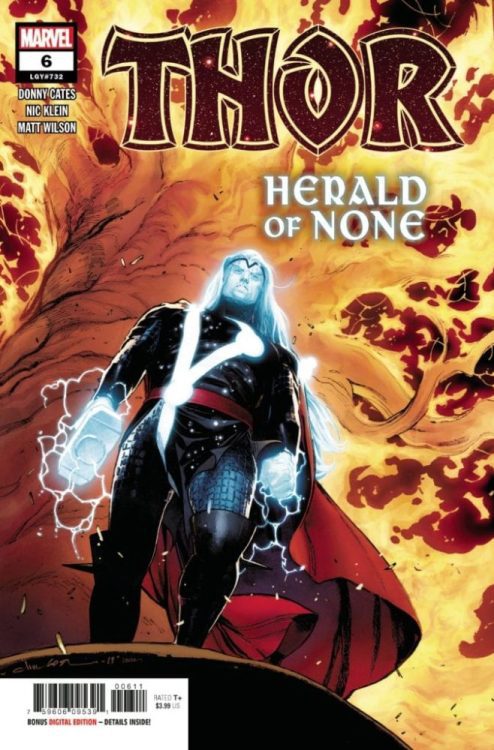
On August 19, Marvel Comics released Thor #6. Writer Donny Cates, artist Nic Klein, colorist Matt Wilson, and letterer VC’s Joe Sabino bring readers the sixth and final part of the “Devourer King” arc.

If there was any doubt that Thor is the strongest Avenger, this issue puts the matter to rest. CBR predicted a year ago that the Silver Surfer (is he the Black Surfer now?) would show up in Cates’s Thor, although probably not in the way the writer anticipated. “Norrin” shows up to console Thor and hear the tale of Galactus’s fate.

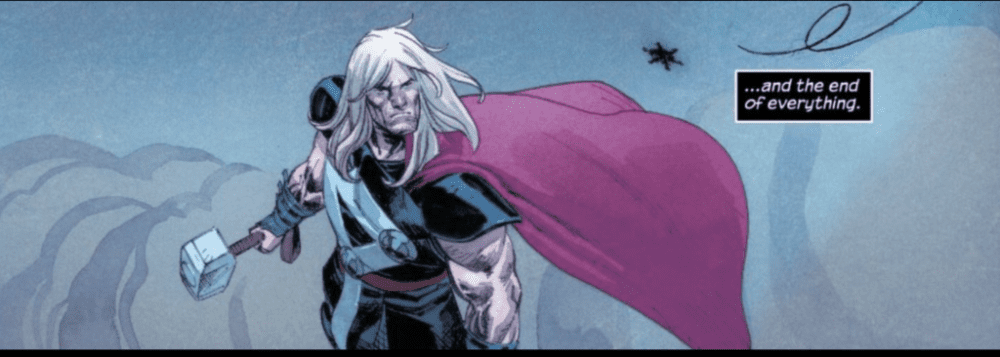
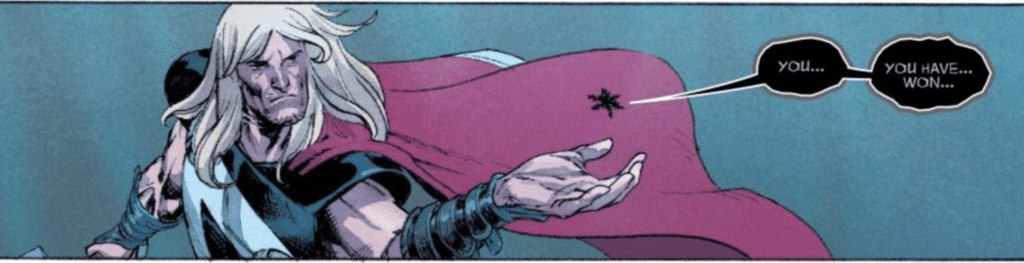
Telling Norrin Galactus’s fate and the defeat of the Black Winter (which may have been dispatched a bit too easy given how much the threat was built up), Thor reveals that the Black Winter, in its final moments, revealed Thor’s future to him.

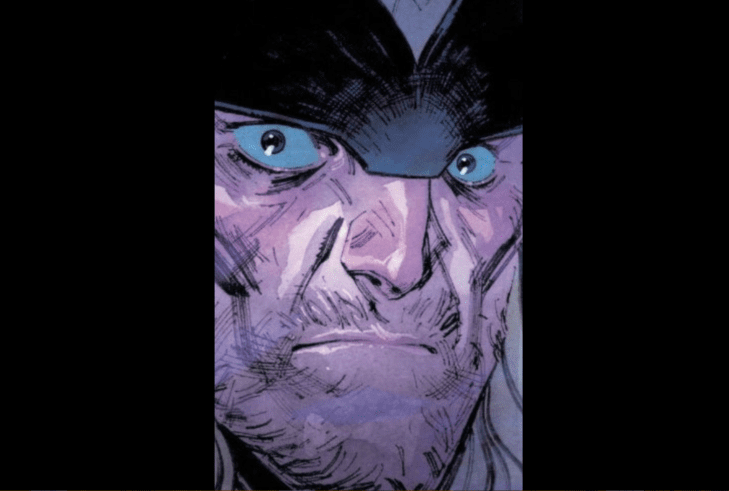
Klein does exceptional work here, capturing Thor’s terror as he recalls the image that the Black Winter revealed to him.


The transition from Thor, drunk, depressed, and trying to forget, to Thor fully remembering what he saw is excellently and leaves quite an impact on the reader.

This issue is, of course, complemented by Matt Wilson’s colors, which, along with Sabino’s letters, construct a very compelling scene once the Black Winter is defeated and shows Thor is future.

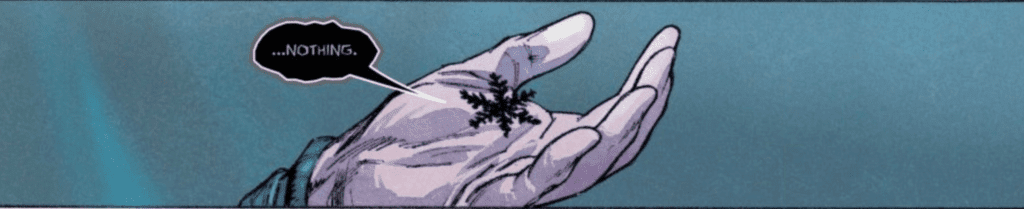
The lone, falling black snowflake is a beautiful touch, particularly in the first panel where it is drawn and colored with a “smoky” look, which then crumples into dust in Thor’s hand, but not before the Black Winter gives him an ominous warning, lettered by Sabino, which complements the dark foreboding of this scene.

Conclusion

As foreboding as the Black Winter was, Cates and company tease greater horrors ahead for the King of Asgard, horrors that spell trouble not only for Thor and Asgard but the rest of the Marvel Universe as well.

What did you think of Thor #6? Tell us in the comments below!

Monkeys Fighting Robots Youtube

BOMB QUEEN: TRUMP CARD #1 – Satire At Its Most Absurd

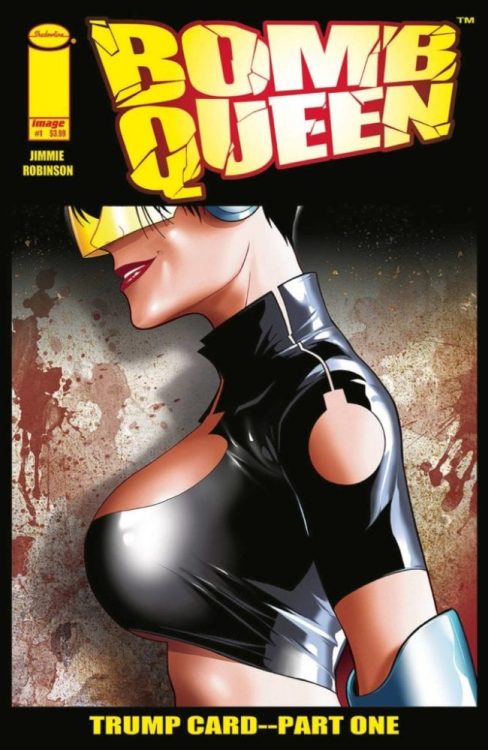
Bomb Queen: Trump Card #1 Cover

Bomb Queen: Trump Card #1 published this week by Image Comics’ Shadowline imprint under the pen of Jimmie Robinson. Returning in a time when satire is practically a necessity, the titular character wastes no time in making readers laugh at their impending doom.

Background

Bomb Queen follows the titular supervillain, a vile, hedonistic, psychopath with a tactical mind, gadgets, and explosive superpowers. In her initial appearances, she is the despot of New Port City. Under the Queen’s rule serves, the city is a haven for criminals thanks to anti-superhero laws, among other things. Murderers, child molesters, even hate groups that would kill each other if they were anywhere else thrive in New Port. This brings most of the crime to one spot, which ironically benefits the US more than any superhero could.

The series originally begins as a satire of superhero fiction by playing up the absurdities. No matter how sacred or wicked the subject, the Queen would make them all look stupid. Later arcs put a more significant deal of emphasis on political satire; the most infamous is putting then-President Obama through the wringer. Even that’s just icing on the cake when the Queen destroys New Port City to go global. So how does Bomb Queen: Trump Card #1 fit in?

Bomb Queen: Trump Card #1 Expose

Robinson places Bomb Queen: Trump Card #1 between the sixth and seventh arcs of the original series. This allows Robinson to pull off a retcon without overwriting anything and utilize his character during her political commentary phase. It’s a smart move that uses in-continuity timing for satire. The lack of criminal haven, New Port City, shoehorns events like school shootings and mass riots to utilize how the Queen’s actions affect her world. Something that only gets touched upon in the original runs.


Bomb Queen: Trump Card #1 utilizes some exposition for newcomers through characters from previous arcs like White Knight. This can either drive people away or get them intrigued. Because who wants to hear people drone on without any action? But one of the more creative uses of exposition comes in a news report about Bomb Queen running against Trump. In addition to the newspeople making comments, there are complimentary reports in a rolling bar. It details reports like plastic in oceans that are in real news reports and a streaming service about school shootings. Considering the station has the not subtle name of “Fake News Network” (FNN), it says a lot of things. Not how much of this stuff is true, but how much influence the Queen has.

Art

Robinson certainly wastes nothing in all of his creative duties. After this interview, he features a 15-panel page, not unlike a recent issue of Savage Dragon. In it, there is a struggle to find equal footing in opinions on Bomb Queen. Some people hate her guts for personal reasons they wear on their faces, sometimes literally with fantastic detail on scars. The neutral ones look like they don’t have a care in the world despite the news. The ones for her meanwhile either have no idea what they’re getting into (hence blank backgrounds) or give reasons that benefit them personally (with actual backgrounds).

Bomb Queen: Trump Card #1 also goes headfirst into superhero action whenever it wants to. Robinson even uses the Queen’s color scheme to demonstrate she’s always the one in control. Like when she quickly knocks the Superman-Esque White Knight to the ground. Despite having a similar white and red coloring, the presence of her skin tone dominates their encounter. That doesn’t seem to bother her or Ramsay as her short brawl with a superhero team that probably parodies a controversial Marvel team attests to. The more dull looking costumes of “Blaque Shade” and “Hashtagger” get decorated with blood and explosions for contrast. Even “Mecha Fetus'” captions in relation to Bomb Queen show a humorous depiction of how boned this “Z-Gen Squad” is by displaying RPG stats. Whether a reader finds any of this funny or horrendous, however, is up to their taste.

Can You Tolerate Bomb Queen: Trump Card #1?

Bomb Queen’s return is undoubtedly aiming back at fans of the older series and for some social commentary to get new ones. The dark humor can be subjective, however, and not everyone will be on board with this series. Yet it’s this self-awareness of superhero fiction and social satire that drives the plot forward in an entertaining way. Once a reader gets past anything they don’t like, such as exposition, they might be able to laugh at the electoral situation close to home rather than despair.

What do you all think? Is Bomb Queen: Trump Card #1 the beginning of a decent Trump Era satire? Or is it just Bad Girl trash?

Monkeys Fighting Robots Youtube

Review: WYND #3 Assembles The Fellowship

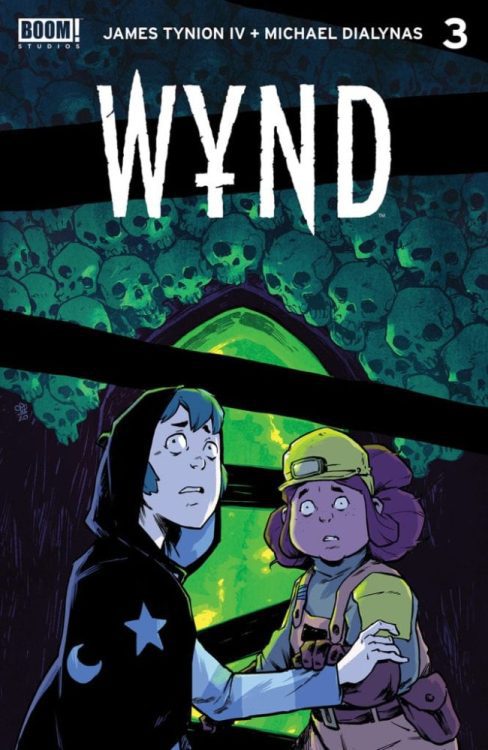
Wynd #3, Dialynas cover

WYND #3, available from BOOM! Studios on August 26, brings Wynd, Oakley, Thorn, and the Prince together for the first time, fleeing toward separate destinies. Written by Jame Tynion IV and drawn by Michael Dialynas, this latest installment picks up immediately after issue #2 (read our review here), fills you in on some history, and puts the Bandaged Man squarely on Wynd’s trail.

Cover Art

Dialynas’ cover is a great setup for what’s to come. Wynd and Oakley look on in fear as someone comes after them in Pipetown’s tunnels. The green glow gives you a hint that something “weird” is happening down below, in more ways than one.

Writing

Now we’re cooking. One of the minor story problems with the previous issues was lack of context. The reader naturally would ask, “are the magical woods really dangerous?” This issue not only gives you a whimsical retelling of how the kingdoms came to be but answers the question about magical creatures in a definitive way. That all assumes you take the narrator’s word for it. Time will tell.

There’s a lot of rushing around and escaping as the group of protagonists are finally forced together by fate. You can’t help but see some similarities to The Lord Of The Rings, but the collision wasn’t forced or heavy-handed in any way. Tynion does an excellent job wrapping the setup in harried chase scenes and (possibly) a few sacrificial deaths that mean something. This is a great issue when it comes to both action and heart.

Pencils/Inks

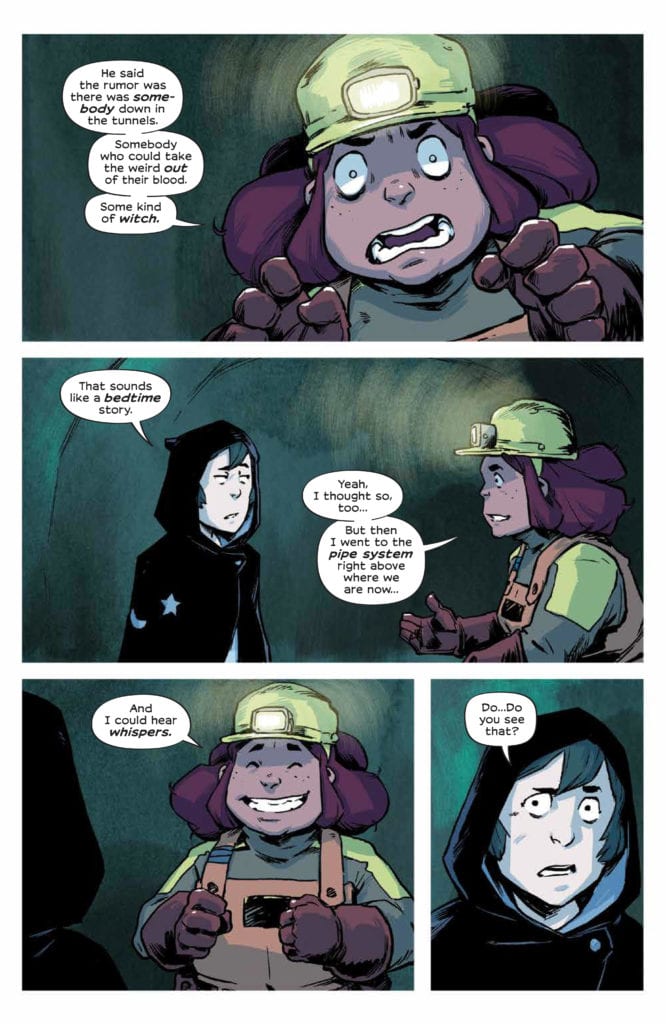
Dialynas’ drawing style compliments and enhances Tynion’s story with a treasure trove of facial expressions, especially with the eyes. This chapter in the arc runs the emotional gauntlet from grief to surprise to skepticism to fear of embarrassment. It’s all done through Dialynas’ artwork, where sometimes no dialog is necessary. It’s a joy to read when an artist can pull off such a full range of emotion without the aid of narration or exposition.

Wynd #3, art sample

Also, it was a pleasant change to finally see some of the “infected” peoples of the wood when they’ve only been talked about up to this point. Dialynas’ renderings of the weird folk are more reminiscent of refugees in a leper colony rather than a pack of dangerous monsters. It’s Dialynas’ designs that, again, help the reader feel through the artwork.

Coloring

Likewise, Dialynas’ coloring work brings a new element to the issue – green. Lots and lots of green. The infected are made so by the magical woods, and so, there is a heavy amount of vegetable growth in the afflicted. In a town characterized by its earth tones and rust, the green on the infected stands out in a way that leads you to suspect the infection may not be entirely malignant.

Lettering

Aditya Bidikar’s lettering has a little room to show some range in this issue. Not only do you have the dialog from Wynd and the rest of the established characters, but you also have an invisible narrator telling the story of the world and the mysterious guide with an inhuman voice in the underground tunnels. Bidikar takes full advantage of these different voices to letter flawlessly and add visual interest.

Conclusion

WYND #4, available from BOOM! Studios on August 26, is an emotional roller coaster, filled with suspense, excitement and a touch of grief. The writing fills in some of the missing gaps from the prior issue in a satisfying way, and the artwork is consistently great. I’m anxious to see where the fellowship goes from here.

Monkeys Fighting Robots Youtube

Review: EXCALIBUR #11 – The Love of a Mother

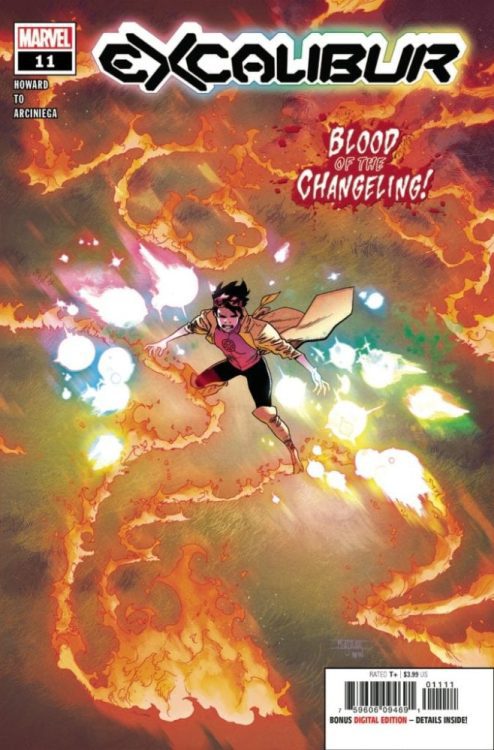
Marvel Comics Released Excaliber #11 on August 19. Writer Tini Howard, artist Marcus To, colorist Erick Arciniega, and VC’s Ariana Maher return us to the events at the end of Excalibur #9 in what is quickly becoming a complex plot to follow in the lead up to X of Swords.

Before issue #10 introduced readers to a pocket reality, issue #3 left off with Excalibur’s attempt to arrive at the Starlight Citadel, which resulted in an injured Shogo. Shogo and Jubilee begin this issue detained by people of the Green, those who live outside of the Citadel.

Howard, along with To and Ariciniega does a fantastic job of conveying Jubilee’s grief over her injured son, whose injuries are conveyed by one of the characters in horrifying terms as being so big in his dragon form that his body could fall apart if he goes through a Krakoan gate and transforms back into a baby.

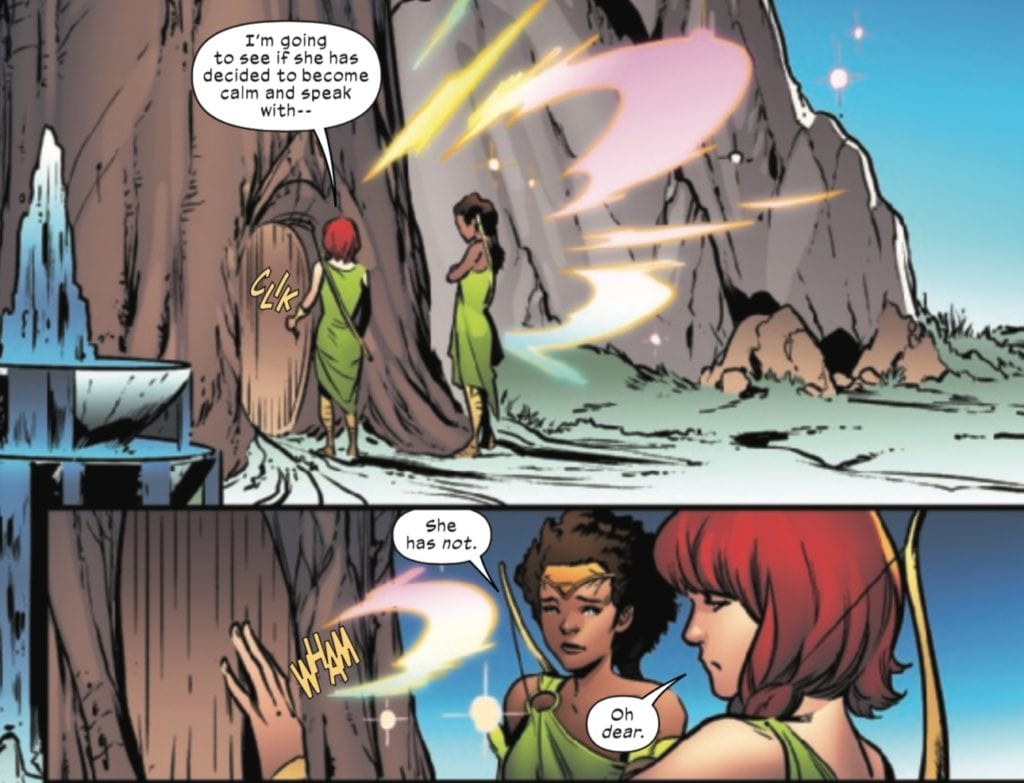
These scenes with Jubilee are full of heart, but not deprived of wit. The art team, along with letterer Maher, convey the desperate grief of Jubilee and her misplaced rage at her captors, whether through the bright colors expressing Jubilee’s power, or the “wham” indicating a fight-ready Jubilee!

This scene captures the way that the entire team for this issue comes together to produce some subtle character moments in this issue.

Excalibur does make it into the Starlight Citadel, where Betsy informs Lady Satyrne that she’ll have to get used to working with her instead of her brother because Betsy “is the only Captain Britain you’ve got.” This scene could very well be meant to be ironic, given that in the pocket reality, more Captain Britains have been created.

Meanwhile, Apocalypse’s plan for a mutant presence in Otherworld comes into focus as he seeks a stone of power that everyone’s favorite Cajun pickpockets from the Starlight Citadel.

One might be forgiven for having a hard time tracking the plot of the Excalibur series from issue to issue. Howard and co. are creating an increasingly complex tale, complete with alternate realities, secret plots, and hints of a war to come. This is all heading towards X of Swords, with the next issue serving as a prelude to this next big X-event.

Monkeys Fighting Robots Youtube

Review: ENGINEWARD #2 Brings History Into Focus

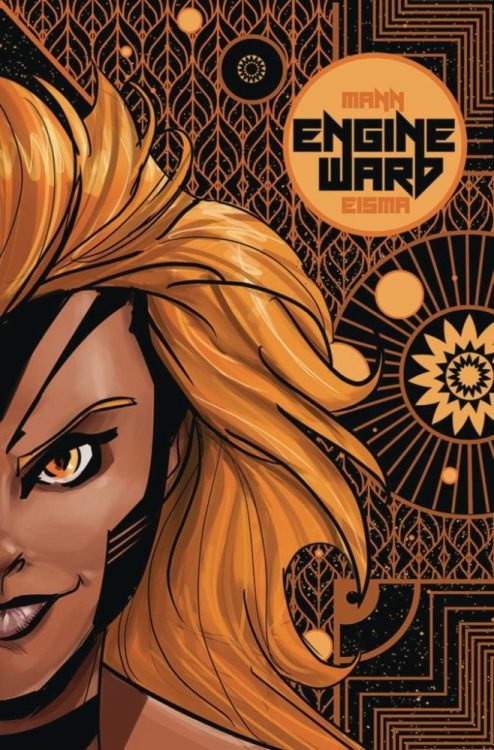
Engineward #2, Hickman cover

ENGINEWARD #2, available from Vault Comics on August 26th, peels back the layers on the colony’s history and confirms the gods are not as godly as they appear. Written by George Mann and drawn by Joe Eisma, the town’s tensions run high due to Jarvix’s death, mysterious disappearances of the townsfolk, and the escalating water shortage, ending in a game-changing cliffhanger.

Cover Art

Jen Hickman’s cover falls right in line with the art from the first issue (you can read our review here). Leo gives the reader a look of arrogance and malice with the slight lift of a single eyebrow. Per zodiac tradition, Leo’s love the spotlight, and this cover pulls off that conceited look in spades.

Writing

Mann’s story is definitely more focused and more forthcoming than the first issue. The ghoulem’s head starts blurting out bits of information like puzzle pieces falling into place. It’s not long before the past of the colony, and hope for its future becomes clear. Mann also lays out the corruption of the gods in a very subtle way that establishes the threat Joss and the others will soon face. This entire issue is a trail of satisfying breadcrumbs that sets up the next chapter brilliantly.

Pencils/Inks

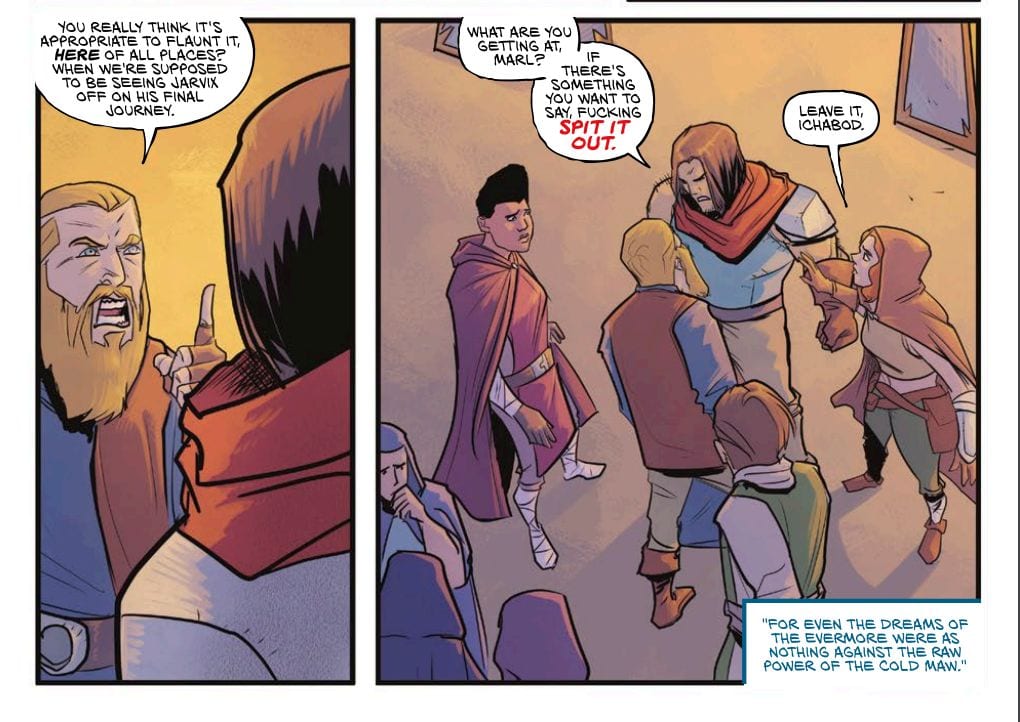
Eisma’s art casts the entire town in a pall of sand, dust, and dry heat. The extended drought put the whole town on edge, and you can feel the tension in every interaction. The townsfolk are irritable after Jarvix’s death, and the water shortage adds layers of tension on top of their grief. Every scene that Eisma draws captures impatient anger on the faces of the characters. You can practically feel their irritation and short temper with every panel. That’s great acting through art by Eisma.

Engineward #2, art sample

Coloring

Michael Garland’s coloring gets high marks for the excellent use of shading for different light sources. The lamplight used in Jarvix’s “funeral” cast a warm glow on the characters in a very natural way. Leo’s stage appearance is bright and theatrical, consistent with her personality. And the dinginess of Joss’s workshop is appropriately shadowed to reflect her mood.

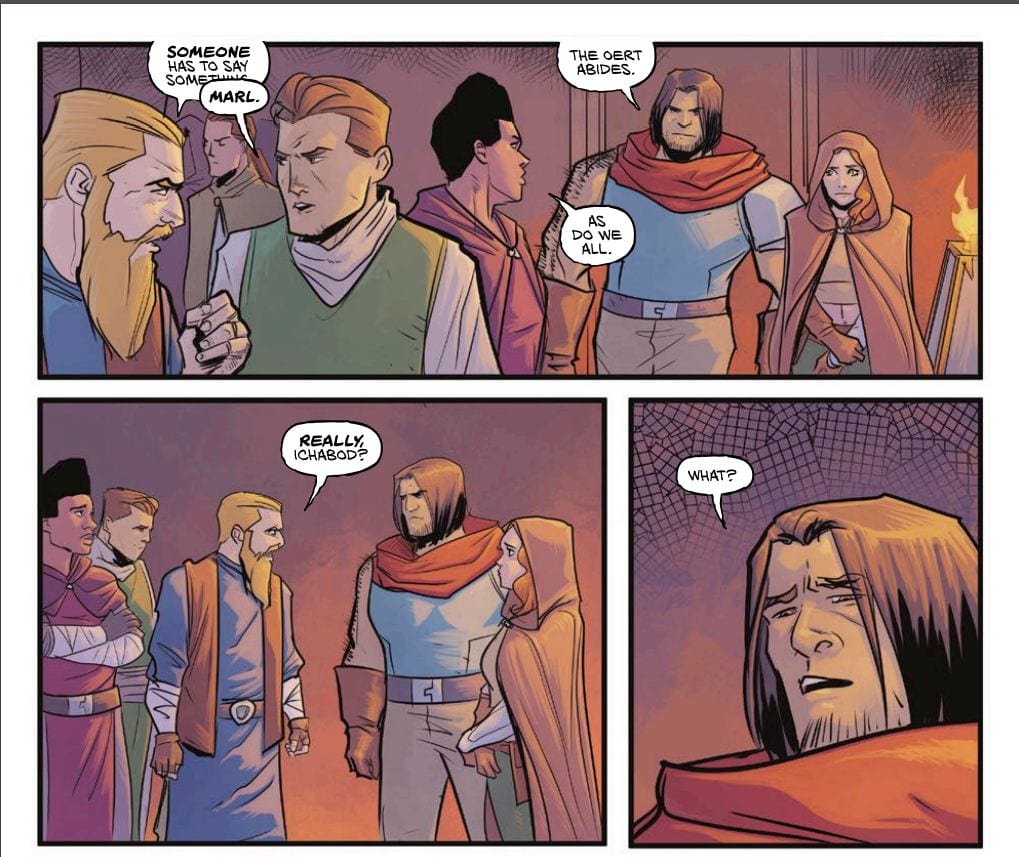
Engineward #2, coloring sample

Lettering

Hassan Otsmane-Elhaou’s lettering work is the highlight of the issue for one particular design choice. Leo’s speech is portrayed through the use of flourishing script over parchment paper as a word balloon. It’s unique. It amplifies Leo’s position as a self-proclaimed god, and it’s striking on the page. Brilliant creative choice by Otsmane-Elhaou.

Conclusion

ENGINEWARD #2, available from Vault Comics on August 26th, satisfies your story curiosity with well-placed breadcrumbs, and the team’s artwork is solid on all fronts. The revealed quest promises an exciting next issue.

Monkeys Fighting Robots Youtube

How the Tables Have Turned in DOCTOR APHRA #3

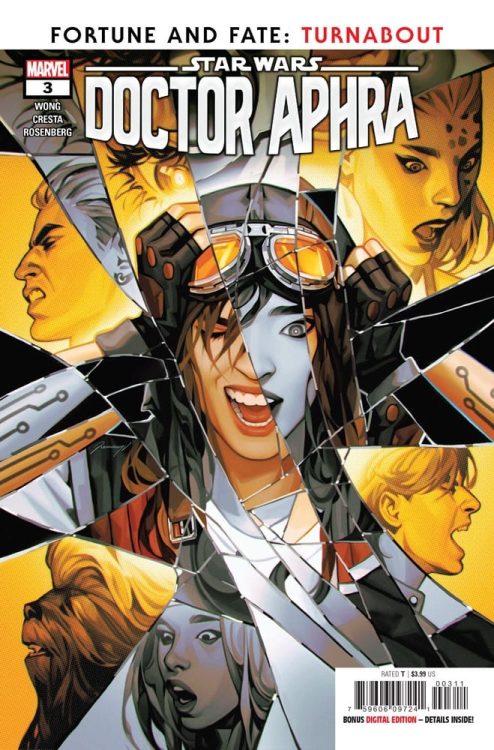
She's getting ready for some action in Doctor Aphra #3.

DOCTOR APHRA #3, available this Wednesday from Marvel Comics, once again dives back into the latest adventure for Doctor Aphra. She’s back, and she’s already working on a new scheme or two. Naturally.

***SPOILER WARNING***

spoilers ahead

There’s no arguing about Doctor Aphra’s character. While she has had her redeeming moments, nobody would mistake her for a good person. Even the dramatic decision she made at the end of her last series was not enough to save her reputation. Not in this ‘verse.

So really, it’s no surprise that she’s once again working on a heist, alongside people with whom she has a decent amount of history. Regardless of that history, it’s pretty clear that Aphra had always planned on betraying them. It’s sort of what she does.

She’s getting ready for some action in Doctor Aphra #3.

The Writing

Doctor Aphra #3 brings with it plenty of drama, much of which is shockingly satisfying, even while still being pretty surprising. That’s Aphra in a nutshell, providing plenty of surprises, alongside a few archaeological facts.

Alyssa Wong wrote a compelling issue here, one that is full of twists and turns. Ironically, the most surprising parts of this issue don’t come from Aphra herself – which in itself is pretty surprising. She’s using the one pulling the fast tricks.

Yet it also feels appropriate, given how many players are currently on the field – and how aware of Aphra they are. As the issue was quick to remind us, Aphra has garnered herself a reputation, and eventually, people are going to start preparing for that.

Still, this is an issue full of action, as well as a few moments, allowing for character development. It’s intriguing, especially as it sets the scene for a bigger confrontation in the next issue. Aphra really doesn’t know how to do anything on a smaller scale, does she?

Not as dead as we thought.

The Art

The artwork in Doctor Aphra #3 is where the series really shines. Her sass has never been more evident, though her reactions to other events are certainly memorable. All put together; this issue is stunning.

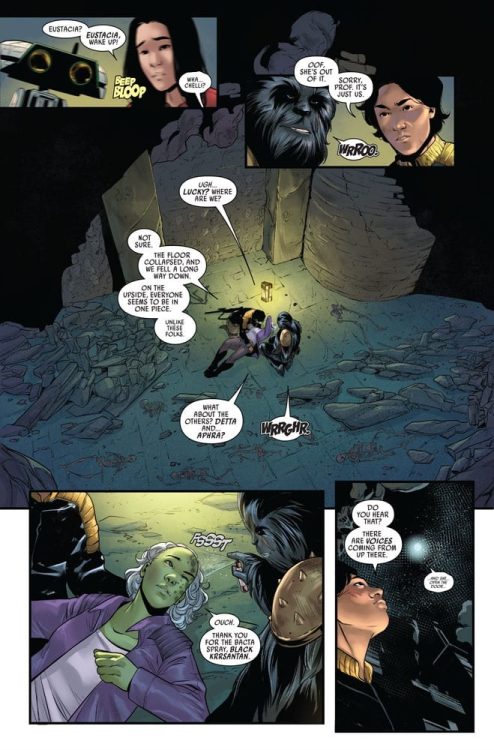
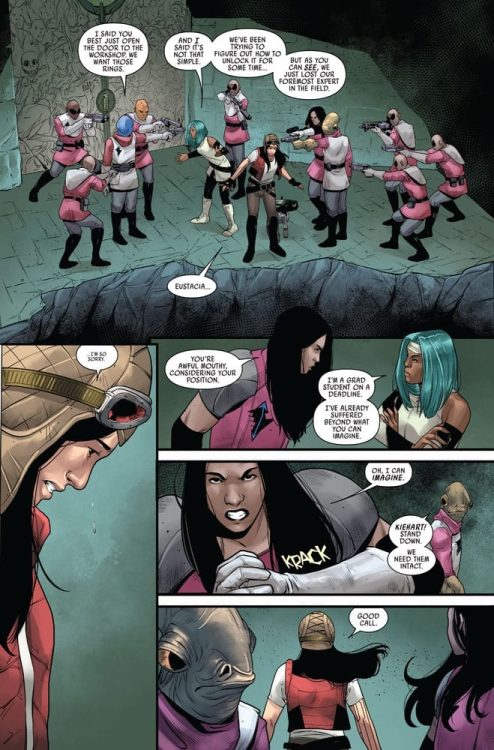
Marika Cresta was the lead artist for this issue, providing those classic expressions, while also throwing in a bit of action. Most notably, however, is the background itself. The characters were looking for ancient history, and they found it. Every panel in this issue feels old and somehow manages to draw the eye in.

Rachelle Rosenberg provided the colors, which are truly divine. Some characters stand out among the rest, from those that are newly introduced, to those making a reappearance (looking at you, Black Krrsantan)

Finally, VC’s Joe Caramagna provided the lettering, which is the icing on the cake as far as this issue is concerned. The lettering helped to lead the eye around this ancient building, making sure that every little detail was made note of.

That’s cold, Aphra.

Conclusion

Doctor Aphra #3 brought with it everything that fans could have hoped for. Action, adventure, and more than one case of double-crossing. It’s basically the usual for this character, and thus it really does feel like her adventures are back into full swing.

Monkeys Fighting Robots Youtube