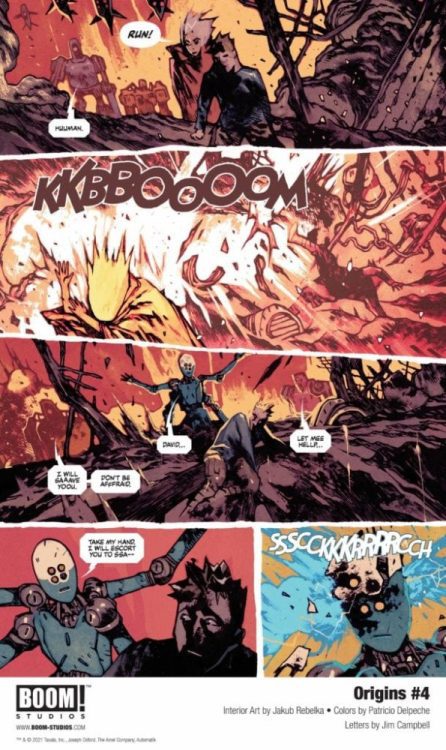
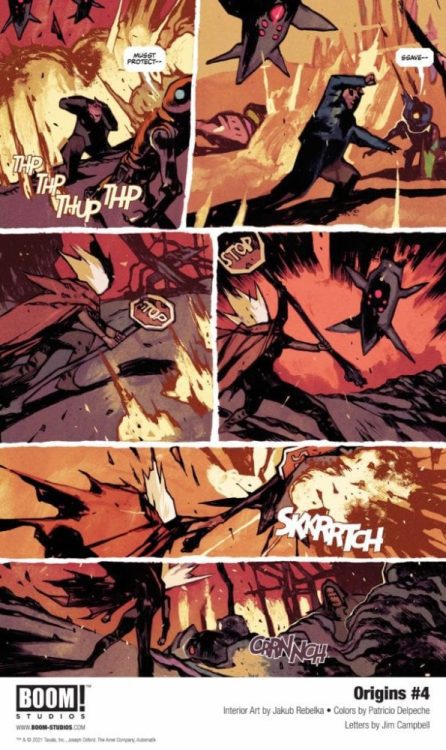
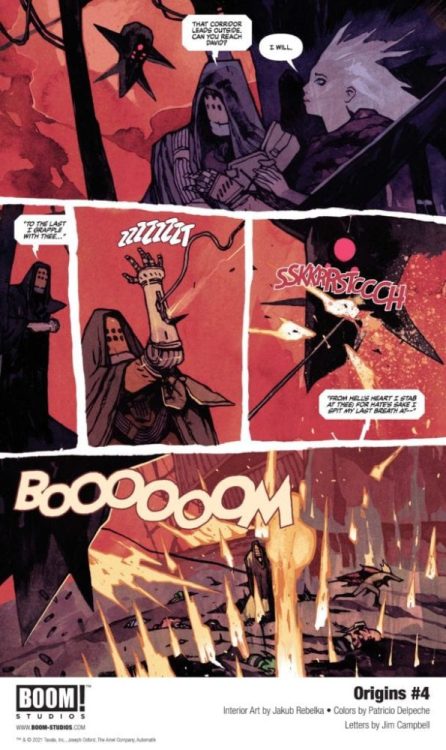
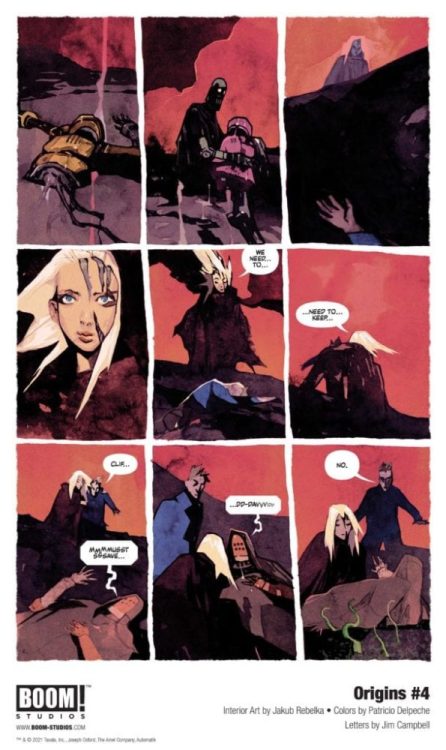
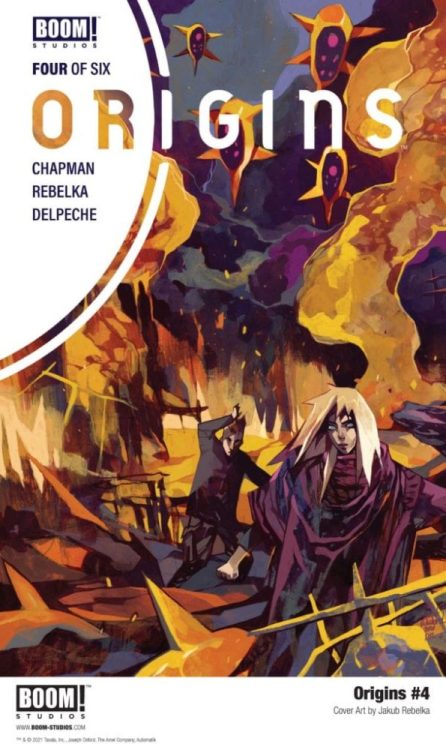
ORIGINS #4 hits your local comic book shop on February 10, but thanks to Boom! Studios, Monkeys Fighting Robots has an exclusive five-page first look for our readers.
The book is written by Clay McLeod Chapman, with art by Jakub Rebelka, Patricio Delpeche drops the color, and you will read Jim Campbell’s letter work. Rebelka’s panel design adds to the story’s desperation; it is like the comic is getting ripped apart.
About ORIGINS #4: When the Network discovers David and Chloe’s refuge, they’re forced to make a devastating sacrifice to escape. To continue into the desolate frozen wastelands towards David’s lab, they’ll need the help of their new-found allies if they want to survive.
Enjoy The Preview Below:
Digital copies can be purchased from content providers, including ComiXology, iBooks, Google Play, and Madefire.
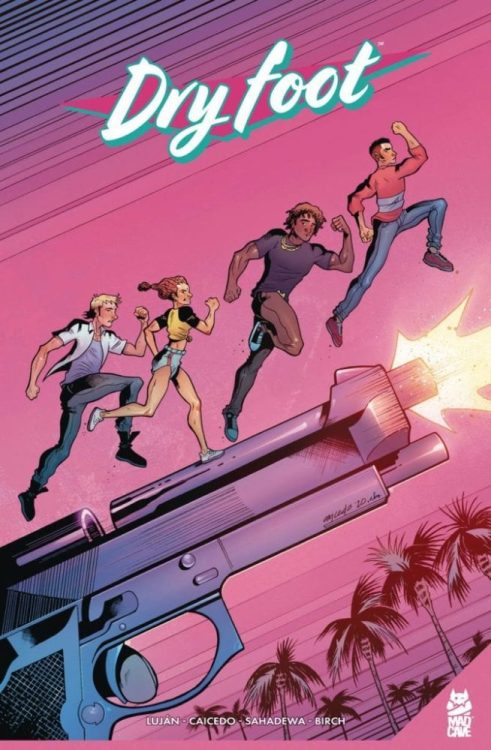
The trade for Dry Foot out from Mad Cave Studios on February 24 collects the four-issue mini-series. Standing in contrast to the nostalgic decade of the 1980s, writer Jarred Luján depicts the struggles of Miami’s Latinx community. Joining him is artist Orlando Caicedo coming out of the Webtoon format to display his dynamic action sequences. Backing them up are colorist Warnia Sahadewa and letterer Justin Birch.
The Kids Get A Dry Foot
Luján gives each cast member reasons and motivations for their actions in Dry Foot. They are all in some way affected by Cuban Miami of the 80s, even if it’s not explicitly stated. The Pretty Boy of the group Fabian might be a flirt, but it’s a defense mechanism against his bleak home life. His mom is a drug addict and has a history of abusive boyfriends. From an early age, becoming a pickpocket was his way of surviving.
Then there’s the driving character of Dry Foot, Diego. Diego, among all of his friends, fears the possibility of falling into organized crime. How would the reader react to seeing their community members getting into gang wars and police shootouts? Diego’s only escape is his friends and the movies he enjoys, like Indiana Jones. Dry Foot brings a new perspective on the setting of the 80s; pop culture can be genuinely entertaining like in Hexagon, but for some people, it’s only an escape from reality. When Diego and his friends try out their heist in the style of Indiana Jones, things turn out badly.
The above is not even because of reality setting in for its own sake. It’s a natural character-driven reaction from another cast member, Angel considering his own home life. The setting of Cuban Miami showcases yet again by showing how family members can drive people towards ruin. Angel’s brother is a gang member and provides for his family’s survival. It’s all a genuine tragedy considering how much effort Luján takes to have the reader fall in love with all of these characters in such a short time.
Art of Dry Foot
Caicedo provides his distinctive style of dynamic action to Dry Foot. The panels and character movements have a strong sense of weight and urgency. Take a flashback when Fabian has to pull Diego back from when a police car almost hits him. It’s a big moment that the reader and Diego remember when it comes to who to trust.
Sahadewa provides the series with a number of lighting effects. This includes but not limited to colored lights evoking the neon signs of the 80s. Whenever there are lights on display, it’s an indicator of a big climactic moment. Like when a car suddenly bursts into a room.
Finally, lettering by Birch guides readers across every point of interest in Dry Foot. Every word balloon or SFX is practically an extension of actions on the page. This provides just the right amount of pacing for the reader to get through.
A Short But Sweet Ride
Dry Foot might require a little background knowledge to fully appreciate since it goes so fast. That doesn’t mean that the decisions made by the characters don’t have weight to them. Luján along with his creative team crafts a gripping narrative that takes a familiar 80s and puts them under a new lens. After all of the series that come in reaction to Stranger Things, it’s nice to see something urgent and down-to-earth. That’s what makes rereading this series such a splendor, looking at something familiar with a new context.
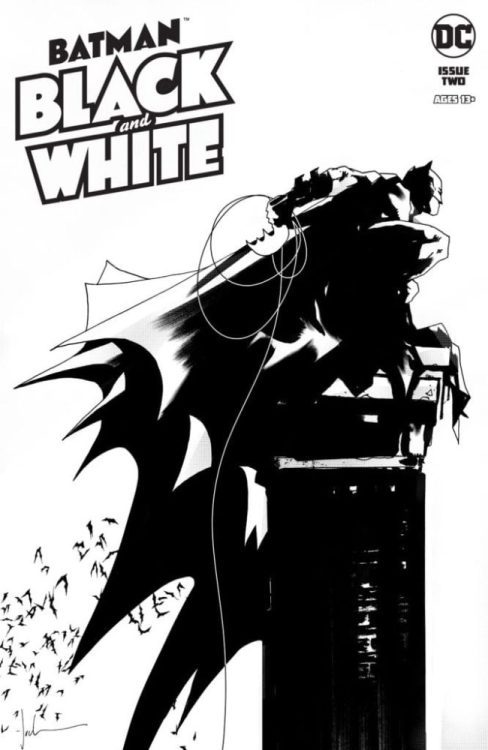
DC Comics’ Batman: Black and White #2 is absolutely fantastic. That’s because this anthology issue carefully bites off only what it can chew. Each story, by these brilliant creative teams, is incredibly simple. No need for exposition dumps, very few splashy fight scenes and even fewer twists. These are Batman stories at their best: quiet, methodical and mysterious. Just like the Dark Detective himself.
“The Unjust Judge”
Writing: 4/5
Art: 4.5/5
Lettering: 4/5
Written by Tom King, with art by Mitch Gerads and letters by Clayton Cowles, “The Unjust Judge” deals with faith and hard work. King brings Batman’s insecurities to the surface. He’s a man who wants to save everyone, and every failure rips him to pieces. Gerads will break your heart in this story. Batman’s face as he rails against his own failure, which gives way to overflowing grief, is devastating. And Cowles shows the relationship between Bruce and this man he’s trying to save. At first Bruce’s words come down towards the man, as though he’s more in control. But later, Cowles shows how they’re now on the same level, their words reaching upwards together. And with a brief panel, the man’s words stretch downwards, showing a shift in the dynamic and an acceptance of the situation.
“All Cats are Grey”
Writing: 4/5
Art: 4.5/5
Written and drawn by Sophia Campbell, “All Cats are Grey” is the epitome of simple storytelling. Campbell uses no dialogue, no captions. Instead, we take everything from pictorial cues. It’s experimental but incredibly down to earth. Campbell shows in black and white, and ironically very little grey, a chase scene between Batman and Catwoman. It’s fun and fresh.
“The Spill”
Writing: 3.5/5
Art: 5/5
Lettering: 3.5/5
Written by Corrina Bechko and Gabriel Hardman, with Hardman on art and Troy Peteri on letters, “The Spill” is a story about Gotham in the rain. We see Batman as we rarely see him: helpless. Bechko and Hardman show us Batman’s panic through his inner monologue, and perhaps they tell us just a tad bit more than we need to know. But as Joker comes on the scene, Batman’s mind quiets. It’s as though he’s suddenly in a position he’s familiar with. Hardman echoes the chaos of each moment on the page. Panels within panels quicken the script to emulate Batman’s panic. Peteri amps up the drama with big sound effects. But Peteri doesn’t let the sound effect get in the way of the action, hollowing out the sound of waves so we can see the water engulfing everyone. It’s a Joker/Batman story that feels familiar and new at the same time.
“Batman: Dual”
Writing: 3.5/5
Art: 4/5
Lettering: 4/5
“Batman: Dual,” written by Dustin Weaver, with art also by Weaver and letters by Todd Klein, is a high stakes supernatural mystery. Weaver creates a tense, intriguing plot. Batman follows an impostor, dressed in him but in white. Weaver’s use of poetic language to describe the chase gives this story the epic and dreamlike feeling it needs. Weaver occasionally wanders into the territory of overexplaining, but it makes sense. Batman is deeply confused and it’s almost as though he’s explaining events to himself, to figure it out. His art is detailed and often terrifying. Klein’s lettering is constantly changing. The cursive of Batman’s thoughts gives this story a mythic element. And Klein’s breaking up of dialogue and captions navigates the reader through what could otherwise be confusing pages.
“The Batman: The Devil is in the Detail”
Writing: 5/5
Art: 5/5
Lettering: 5/5
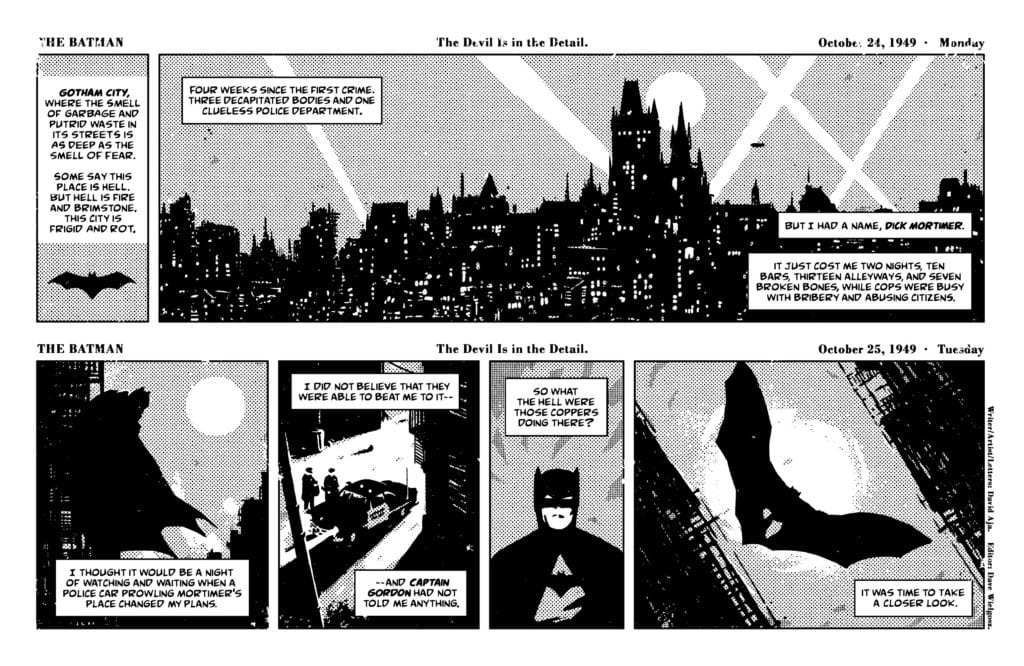
It seems each issue of Batman: Black and White has a perfect story. Last issue’s was a story by G. Willow Wilson, Greg Smallwood and Clem Robins. This issue’s is “The Devil is in the Details” with David Aja on writing, art and letters. Aja writes this short story like an old newspaper strip. He even dates each row and writes “Back on Monday!” at the end of those that “came out” on Saturday. He writes in a 1940’s tone, with Batman explaining each step of the plot for the reader. But he rises above the era, setting the story apart from mere plagiarism. For two days in a row, Aja writes nothing more than a Latin prayer.
His art uses Ben-Day dots to create the texture of an old newspaper. Some corners have streaks of white, mimicking a fault in the printing. And the art is so simple. Aja zooms us in on a hand with a gun or the side of a hooded face. His lettering shines with captions that take up a whole panel on their own. It’s a fantastic recreation of the old style. Everything about it screams a love of comics. Aja’s subtle writing, somehow not sacrificed by intense use of exposition, his minimalist art and his passion for the medium all make this a perfect Batman story. One for the history books, especially since it has the look that it’s from one in the first place.
DC Comics’ Batman: Black and White #2 is even more fun than the last issue. Every story is beautifully simple. Pick it up, out from DC Comics January 26th, at a comic shop near you!
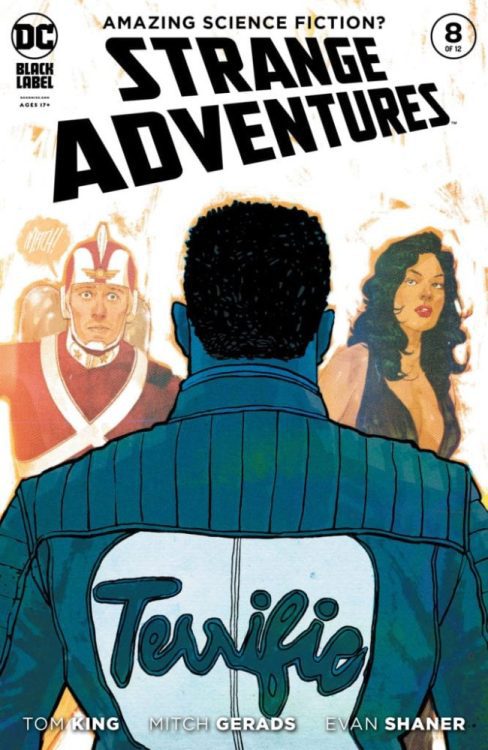
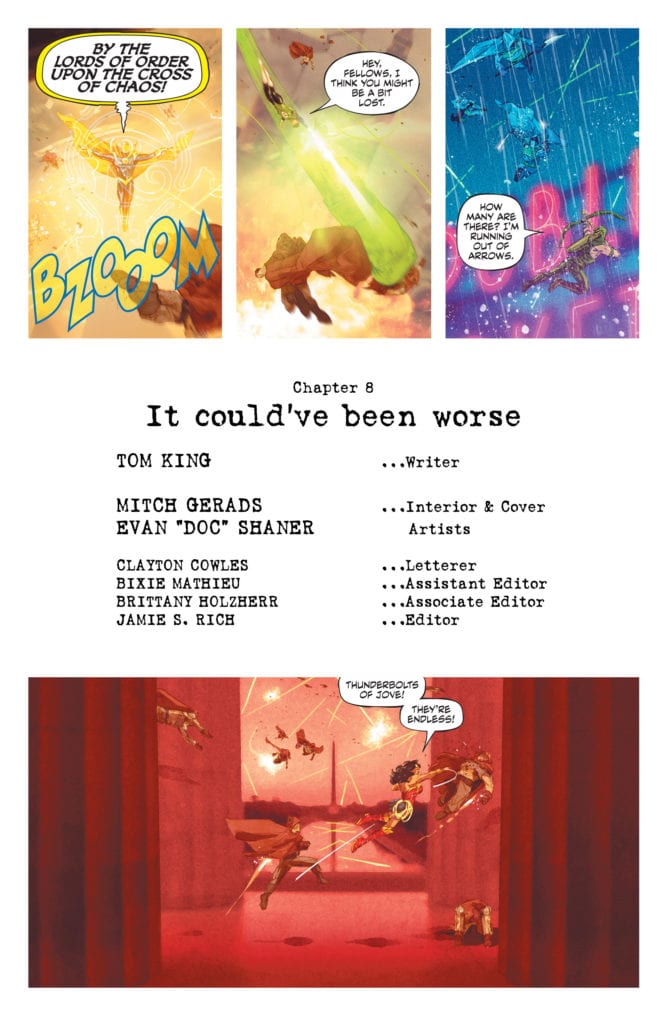
DC Comics’ Strange Adventures continues to show the complicated mess of war. Much like Edwin Starr, writer Tom King, artists Mitch Gerads and Evan “Doc” Shaner, and letterer Clayton Cowles, don’t think war is good for much. Just as in my last review, I’m no longer reviewing each storyline of Strange Adventures individually. Strange Adventures #8delivers a script full of important beats and these storylines continue to meld into one tantalizing tennis match.
Writing
King was once writing two stories. At least, each storyline didn’t have huge parallels that were clear on a first read. King was writing about different eras, writing in different tones. Now, with the Pykkt war raging in both storylines, on Rann and on Earth, King presents us with some very similar events. On Rann, Sardath has captured a Pykkt warrior. On Earth, Mr. Terrific has done the same. And suddenly, we’re seeing the differences in our characters highlighted. When Adam Strange is called in to question the warrior, we see the contrast between him and Terrific. But King also shows the similarities. Terrific is meant to be the morally superior character, the one investigating Adam. We’re left wondering if war has made Adam cruel, but we’re also wondering if it’s currently doing the same to Michael Holt.
Art
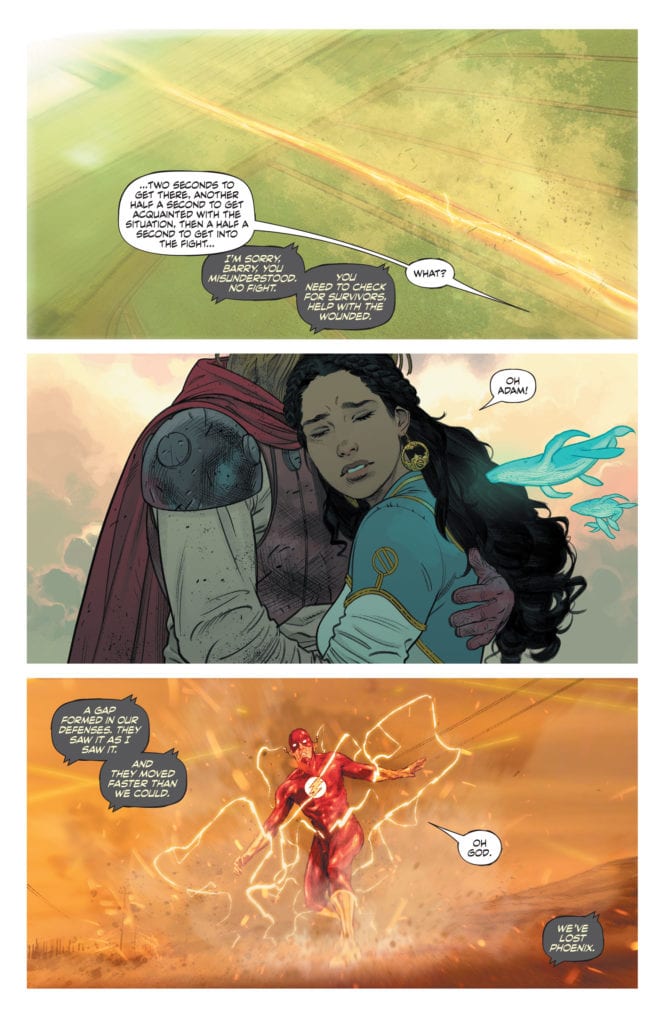
Gerads does a wonderful job of showing both the immensity of war and how up close and personal it can become. At times, he shows us scenes of characters standing in wreckage. These heroes, larger than life to us, look like dots on the page. They’re overwhelmed by the destruction. But later, we see the punching, the stabbing and choking of war in close quarters. We see the expressions on the faces of those causing violence and those receiving it. We see the humanity that’s at stake.
Meanwhile, Shaner mostly shows us the delicate nature of peace. Everything is quite up close and personal with Shaner’s art. Adam and Alanna hugging, the look on Adam’s face as she washes him, the anger in their eyes as they fight. But Adam is among family. His fists should be lowered, his smile should be broad. Instead, his eyes are haunted. Shaner shows us that just because someone might have gotten out of a war alive, doesn’t mean they’re not dying on the inside.
Coloring
Both Shaner and Gerads use lots of reds, blues and yellows. It’s not lost on them that red and blue is often associated with America. They’re writing about characters who see themselves as above the law. Their way is the right way, simply because. Yet the yellow is the equalizing factor. It’s the fire of destruction. As the Flash looks over a decimated landscape, the sky is yellow as the ash catches the glow of the flames. But in Shaner’s storyline, the yellow isn’t fire or destruction. At least not overtly. The yellow is found in Adam’s hair and beard, and on his daughter’s shirt, even his gloves. It begs the question, what more destruction is Adam going to bring about? And what part will his daughter play?
Lettering
Cowles perfectly creates a sense of pace in this issue. When Alanna begins to talk to Adam about how the war is affecting them, Adam’s response is long winded. He goes into a speech that feels evasive. “I’m fine,” Cowles places in a tier below. It gives the moment space to breathe, to really highlight that it’s a lie. But it’s still tacked on to a long speech, like he’s trying to hide it among other words. And when Terrific fights a Pykkt warrior, Cowles uses the same method to show how capable Holt is. He’s talking throughout the fight, and he’s taking the time to give his dialogue rhythm and pacing. It’s nonchalant, while he’s fighting for his life. That’s because Michael Holt knows exactly who’s going to win.
DC Comics’ Strange Adventures is going stronger than ever. With four issues to go, this series is upping the stakes to reach its conclusion. It’s a subtle meditation on the power that war has over our humanity and our will to live. But it’s also about how fighting for your life can leave you haunted and empty. Pick up this fantastic new issue of Strange Adventures, out from DC Comics January 26th, at a comic shop near you!
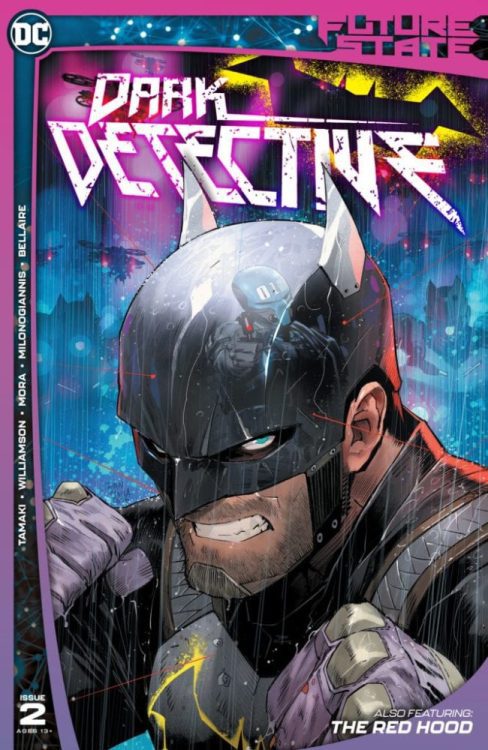
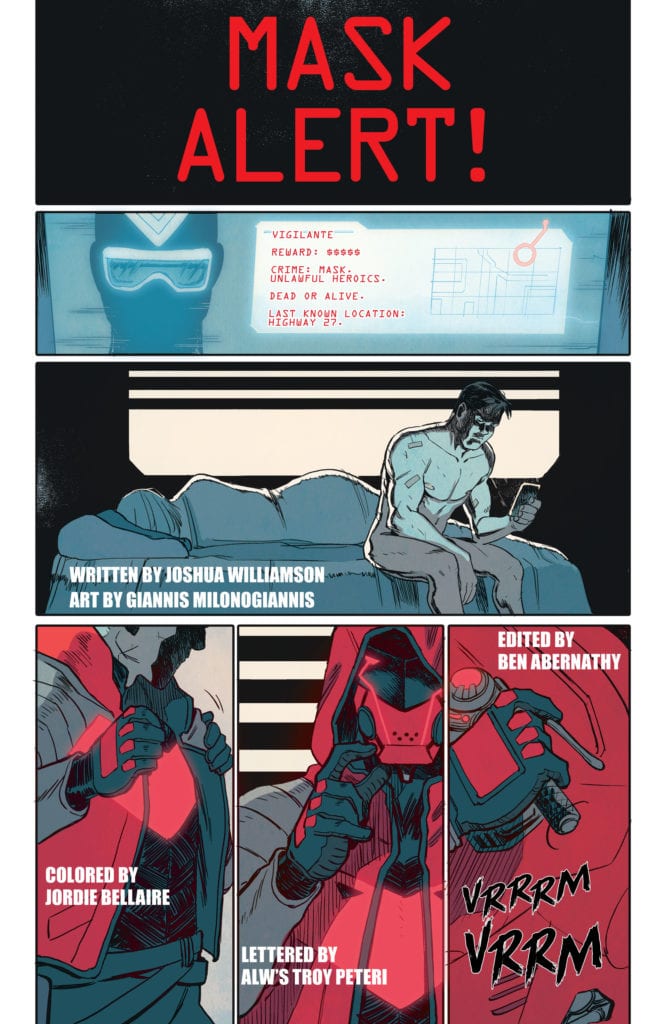
DC Comics’ Future State: Dark Detective #2 is a double feature, starring Bruce Wayne and Red Hood as lead characters. Mariko Tamaki writes the first story, “A Sign,” with Dan Mora on art, Jordie Bellaire on colors and Aditya Bidikar on letters. This is part two of a story following a “dead” Bruce Wayne, hiding from the many eyes of the Magistrate. “Mask Alert!” is written by Joshua Williamson, with art by Giannis Milonogiannis, colors by Jordie Bellaire and letters by ALW’s Troy Peteri. “Mask Alert!” shows us that Red Hood seems to be working for the Magistrate, hunting masks. Both stories show the chaos and mayhem of Gotham under a new leader.
Bruce Wayne in “A Sign”
Writing
Tamaki takes a very interesting route in this issue. She explores our fear of technology and being controlled. Bruce, in this chapter, lives with a conspiracy theorist named Noah. The man has his water brought in in bottles, for fear of mind controlling nanobots. And while we may look down our noses at a character like Noah, he’s not so different from a certain Bat. In fact, as the story progresses, Bruce becomes more and more empathetic to Noah. He even wonders if Noah might be onto something. So, while this issue is about conspiracy and fear, it explores it from a human angle. It shows how we all get a little scared when we don’t feel in control. In a moment in history where conspiracy and fear are proving to be destructive and immune to reason, Tamaki takes a step back and tries to understand instead of condemn.
Art
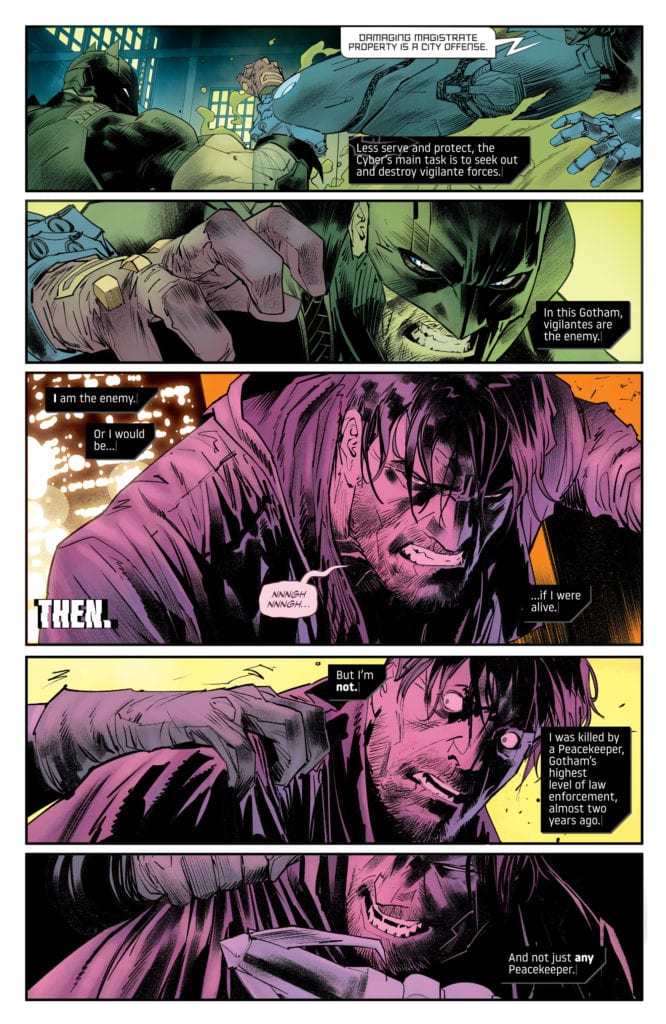
Mora continues to create a visual essay of chaos and order. We see Bruce, garbed in his new Batman suit, fighting one of the Magistrate’s “Cybers.” The next image is Bruce Wayne in civilian clothing, with the exact same expression. But Mora is showing us the difference between these situations. Because the next image we see of Bruce is unfamiliar. He’s wide eyed and panicked. You could almost call him feral. And as he sinks into the Gotham river, his face is equally unfamiliar. A look of resignation and disappointment. The Magistrate’s rule is that of an unflinching machine. So Mora pushes Bruce to be different than usual. He pushes him to emote, instead of being the stern Batman that we know. It actually creates distance between this Bruce and the Bruce of the past. And it makes it that much easier to side with him. It’s a human, desperate and panicked, versus a corporate machine. If this were any other version of Bruce Wayne, it would have been harder to see the difference.
Coloring
All of Bellaire’s most beautiful scenes also happen to the most dangerous. As Bruce runs for his life from a Peacekeeper, one of the Magistrate’s goons, Bellaire makes the scene look stunning. The bright yellow lights in the background, Bruce’s pink hued and panicked face in the foreground. And as Bruce falls into the Gotham river, the light of the neon signs filter through the water to turn the whole panel into a brilliant pink. It’s juxtaposed by scenes of Bruce investigating at night. The pale blues and greens are still beautiful, but monochromatic by comparison. Then, running from soldiers, the page comes alive again. Bellaire has the red light of Bruce’s motorbike look like a streak across the panel, following his movements. And the chase through the streets is colored by the dots and bars of yellow, red and blue lights of Gotham at night. Bellaire is lulling us into a sleep, then waking us up with bright colors like an alarm going off.
Lettering
Bidikar doesn’t just letter a work. No, Bidikar makes their lettering as much a work of art as every other aspect of this issue. The spacing, the fonts, the size, everything works together so you can hear every word clearly. At one point, Noah’s daughter comes to visit and is ticked off by someone taking a picture of the house. She yells at the woman with the camera and tells her not to get on her last nerve. The words “My,” “Last,” and “Nerve” are each given their own tier of the word balloon, getting bigger as they go. You can hear the anger rising in her voice. And as Noah has a melt down, Bidikar does something similar. His first line of dialogue is small, but still full of feeling through a brilliant use of bold. And then he yells again, this word balloon has bigger font and a jagged edge. His final line has font three times the size of his first. Bidikar carefully shows what it’s like to have panic sink in.
Red Hood in “Mask Alert!”
Writing
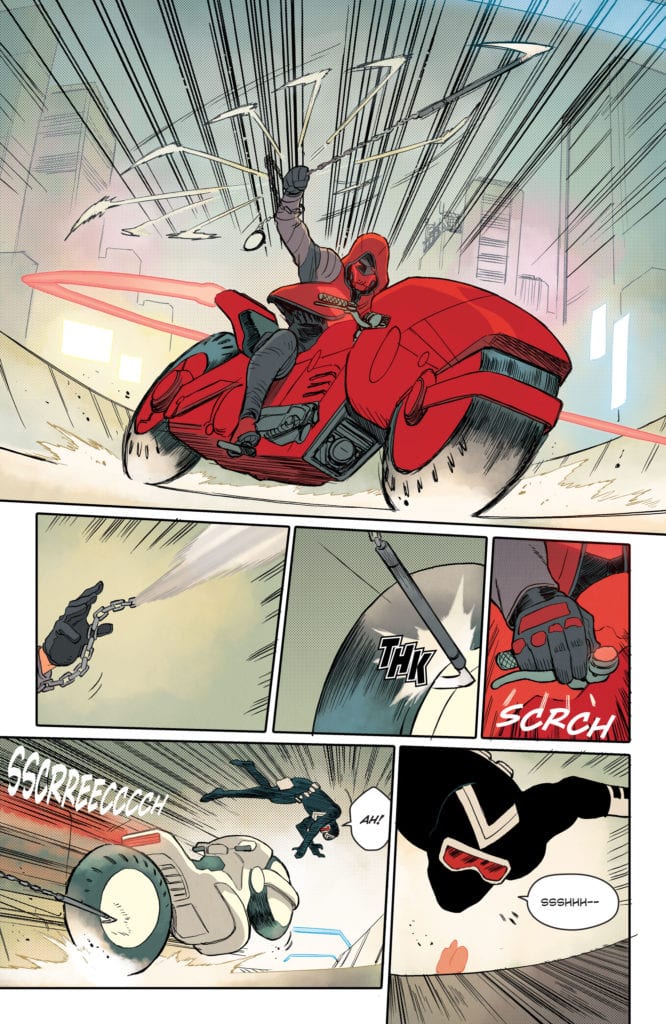
Williamson’s script works best when it leans on the art. He sets the scene brilliantly with nearly silent pages. Red Hood and Vigilante in a motorbike chase, or Red Hood following clues through a dilapidated neighborhood. These moments are clear and strong. Occasionally, Williamson writes the kind of thing that just wouldn’t be said. Officers at the precinct comment a little more on their day to day activities than you’d expect, considering they are in fact day to day. Jason is often piecing the plot together out loud. And when Ravager arrives on the scene, she comments a little too much on their dynamic. Some of it actually works. Ravager is the type of character to hold a conversation with herself if Jason won’t join in. But there are a few too many times it feels more like the writer trying to communicate plot than two people having a conversation.
Art
Milonogiannis’ art is definitely the highlight of this story. It won’t work for everyone. It’s a very cartoony style, especially for a Red Hood story. But that’s part of what makes it work. The playful, even funny, visuals helps cut through the seriousness that often surrounds Jason Todd. In fact, much of this story reads like Jason is wishing everyone would take him seriously, but they won’t. That’s especially true of Ravager. Milonogiannis presents moments of gore and violence with levity. Someone is sliced in half by Ravager who has a smile on her face. It’s perfect for her. She was raised to be a killer, so nothing fazes her. Milonogiannis makes the story incredibly fun.
Coloring
Bellaire’s coloring brings what’s important to the forefront. Characters are colored in deep reds, oranges and blues, while the backgrounds are pale and grey. Except when Ravager shows up. The background goes from grey to a beautiful purple. There are floating dots of pink and blue. As much as Jason tries to ignore her, Bellaire shows us there’s something between them. An energy that lights up the room. And as the backgrounds revert back to their greys and blues, Bellaire is reminding us these are characters that can leave this world behind. They don’t have to be trapped here in a bleak environment. It’s Jason who’s stuck in a cage of his own design.
Lettering
Peteri is quite experimental in this story. Most of the experiments really work, some fall short. Whenever a character swears in this story, Peteri places a “#@*!” on top of a black background. It’s definitely eye-catching and different, but placed in larger texts it looks a little odd and distracting. But Peteri does some other things that really work. When Ravager is asking Jason question after question, he finally responds, begrudgingly. His word balloon has some slightly flattened edges to it. It’s a visual representation of his disdain. The same thing happens when he says a villain’s name. Peteri brilliantly shows us moments where Jason’s rage bubbles to the surface.
DC Comics’ Future State: Dark Detective #2 shows the chaos of Gotham under the Magistrate. And it does so on both sides of the aisle. Whether you’re working for or against the Magistrate, your life is in the crapper. Pick up this great new issue, out from DC Comics January 26th, at a comic shop near you!
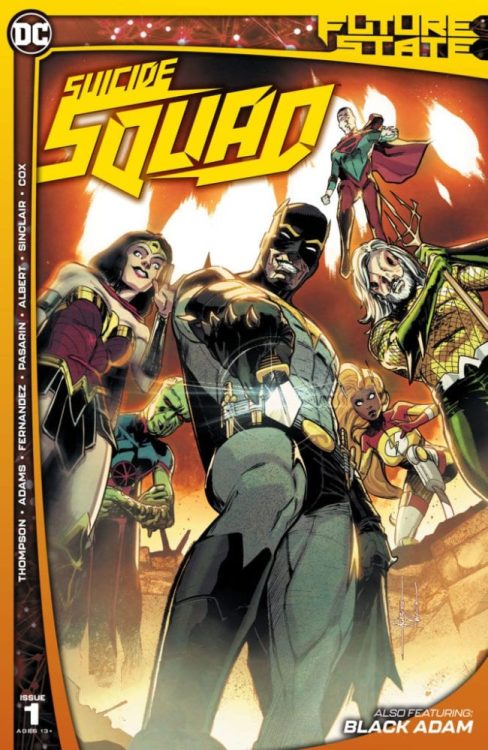
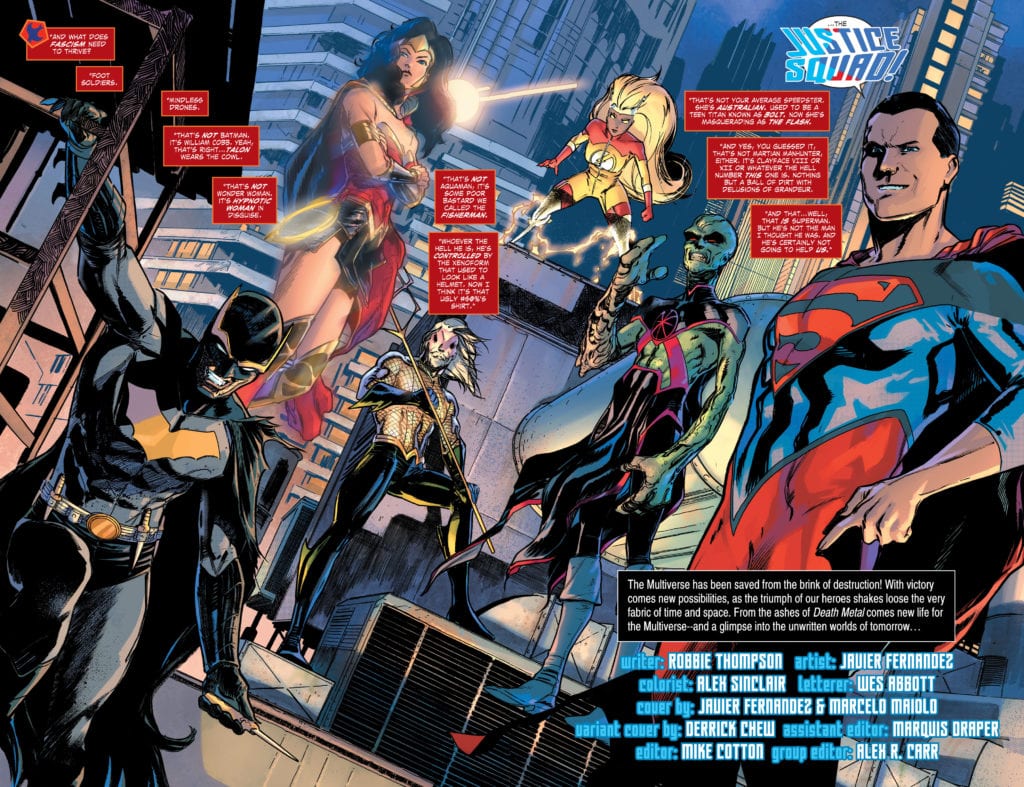
Writer Robbie Thompson, artist Javier Fernandez, colorist Alex Sinclair and letterer Wes Abbott get the party started in DC Comics’ Future State: Suicide Squad #1. Future: State Suicide Squad is this creative team’s excuse to bring all the deep-cut characters we want to see out of the woodwork! Even the big players we’ve seen before, like Brainiac and Sinestro, aren’t quite how we remember them. And writer Jeremy Adams, penciller Fernando Pasarin, inker Oclair Albert, colorist Jeromy Cox and letterer Wes Abbott bring about their own terrifying future in the second part of this double feature, DC Comics’ Future State: Black Adam #1. Both stories enjoy plunging the reader into mystery and keep us guessing what’s going to happen next.
Future State: Suicide Squad #1
Writing
Thompson does a fantastic job of keeping readers confused. It’s an exciting confusion, one that peaks your interest and gets you on the edge of your seat. The great thing about DC Comics’ Future State, is that it skips any number of years to get to the stories we’re seeing. Thompson has us worried about what’s happened to get us to the future he presents. We find ourselves rooting for Brainiac and scared of Superman. Thompson provides what information we need to connect some dots through captions. Occasionally, characters like the Flash walk us through more than we need. But these moments are brief and Thompson saves the biggest, most jaw-dropping revelations for last.
Art
Fernandez’s art somehow manages to be both dark and fun at the same time. In fact, he moves past a lot of the violence and darkness in a way that accentuates it. Fernandez creates a sterile environment. The violence is happening, but it’s minimized and glossed over. This is an atmosphere that’s used to gore, so Fernandez doesn’t make bloody moments look like they’re worth noting. One character’s hand being severed happens small, almost bloodlessly on the page. And as they plummet to the ground, we get even less of a sense of the gore. The scene quickly gives way to a smiling enemy, standing over them. Only once do we focus in on blood pooling on the ground. But it’s momentary, and the next image is that of our “heroes,” looking ready for action. Every bloody moment is actually underlined by the very fact that Fernandez practically ignores it.
Coloring
A lot of Sinclair’s colors seem somewhat muted. There are moments of brilliance though. Sinestro’s aura is eye catching in its brightness. Brainiac’s skin is a fantastic green, and the panels all over the page with Brainiac’s coding are a deep purple. Sinclair seems to be showing us that these aren’t the characters as we’ve known them. They’re not the brooding villains, they’re the bright heroes. The Justice Squad, on the other hand, may look like our heroes, but their coloring is slightly dulled. The only scenes with them that have bright colors are the moments they’re being pulled into line by their ring leader. She can push them around with flashes of light and the push of a button. Sinclair is showing us the power of each character. Some, given the opportunity, have the power to change the world, others have the power to control everything. The Justice Squad, however, only has the power to follow orders.
Lettering
When Amanda Waller makes her appearance, she flexes her power. Every speech she has, every line, takes up as much space as possible. Abbott stretches small paragraphs into five word balloons. Some of the word balloons have as few as a single word, separated from the rest of the dialogue. Waller has everyone’s attention and she loves it. Other characters talk quietly in her presence. Their font is small and grey. She commands a room and no one dares to try and challenge her authority.
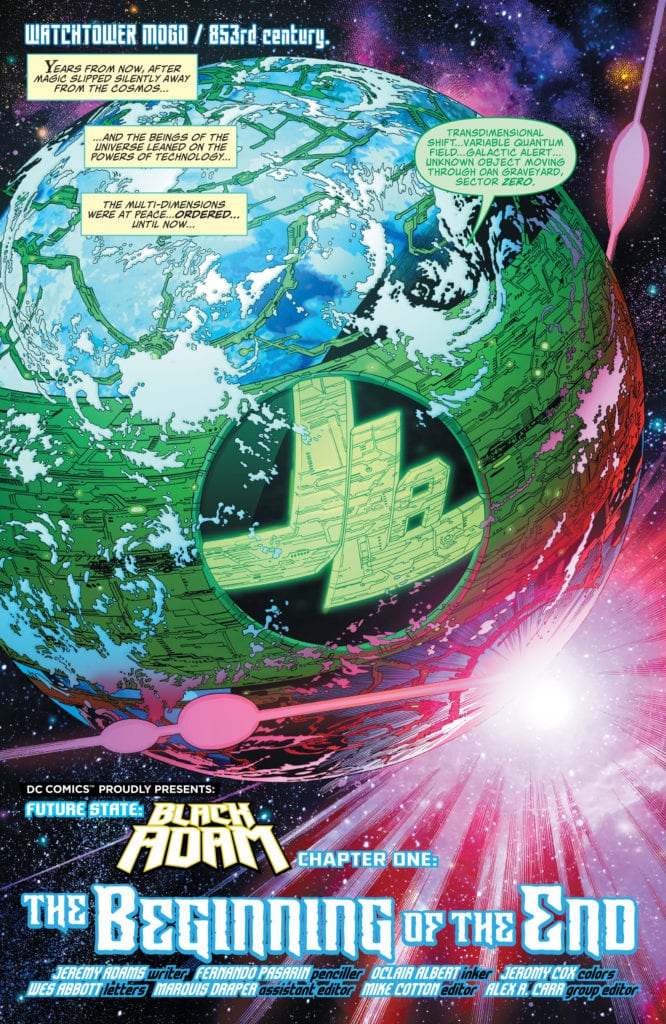
Future State: Black Adam #1
Writing
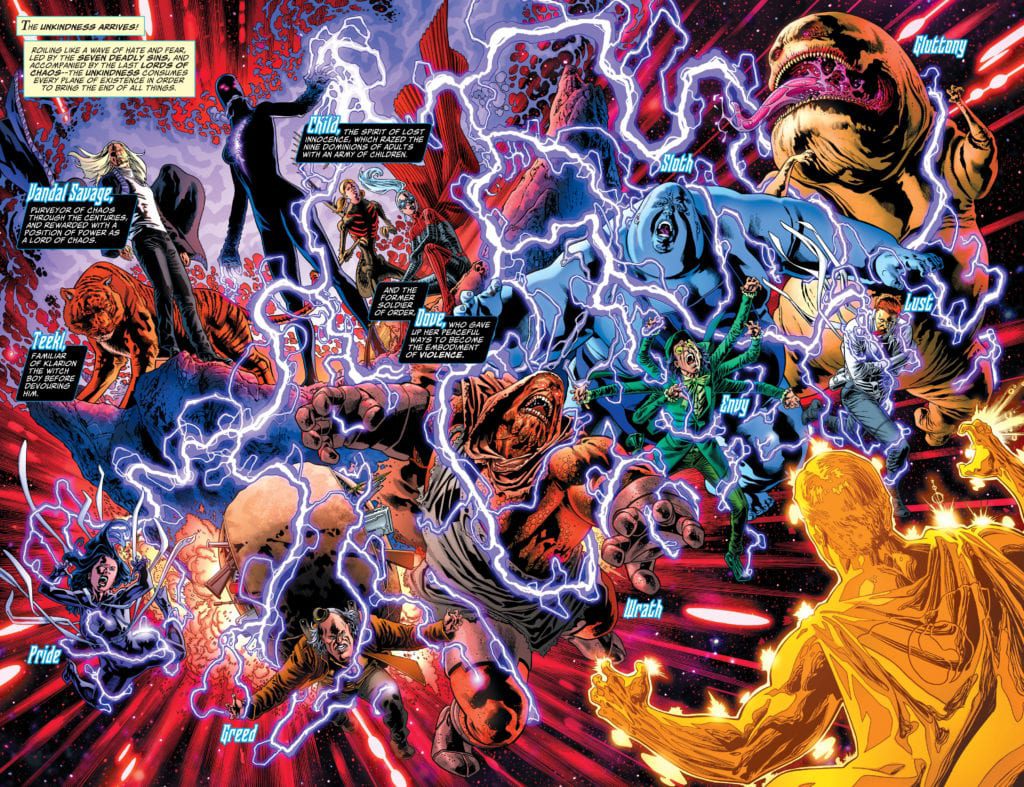
Adams’ tone in Black Adam is almost scriptural. He uses phrases like “to bring the end of all things.” It’s poetic language that treats the story like an epic. When introducing characters, Adams’ uses title cards with brief descriptions. Even this reads almost like a genealogy from the Bible. Adams uses this approach to communicate the seriousness of the situation. Everything is ending, the universe is dying. At times, Adams does allow his story to take itself a little too seriously though. The melodrama of it all occasionally makes the stakes seem too big to process. But Adams actually works against this in the final page. He introduces one last character to help bring everything a little more down to earth.
Art
Pasarin and Albert certainly follow Adams epic style. Every moment is large and earth shattering. Black Adam’s face is often full of terror and his enemies’ eyes show unadulterated evil. Pasarin and Albert keep things amped up. There aren’t many lulls between the splashy entrances and the fist fights. It also gets to be a little much at times. But Pasarin and Albert still make it look incredible. Our introduction to the Unkindness, a league of futuristic villains, is spectacular. And just like the final page brings Adams’ writing down to earth, it brings some needed levity and nonchalance to Pasarin and Albert’s art.
Coloring
Cox highlights what’s at stake with his coloring. While the Unkindness is certainly flashy, they’re still somewhat monochromatic. They each have a purple hue. But the worlds that the Unkindness are decimating are full of color and life. And Cox shows what Black Adam must leave behind if he’s to help save the universe. The world he lives on is green, with pockets of gorgeous reds, blues and yellows. It’s a paradise. And when the Unkindness’s chaos arrives, the panels are drained of color. Everything is grey and dull. Cox uses his coloring to show the immense influence the Unkindness has.
Lettering
Abbott uses the placement of word balloons to show how a character is feeling in the moment. This is especially noticeable with Wonder Woman. When she’s facing a cataclysmic event, her dialogue goes upwards towards the top of the panel. It has a feeling of confidence. The heroes might be facing great odds, but that’s something she’s familiar with. But when she has to tell the rest of the team private details about her life, her word balloons sink to the bottom of every panel. It shows her fear. And later, as she speaks quietly to Black Adam, her words stretch downwards again, but only slightly. This small shift of placement makes the moment feel gentle instead of scared. Through word placement, Abbott shows us how some characters feel more frightened of vulnerability than they do of supervillains.
DC Comics’ two-parter Future State: Suicide Squad #1 takes advantage of what readers don’t know. These creative teams use the years we don’t know about to plunge us into chaos and intrigue. Pick up Future State: Suicide Squad #1, out from DC Comics January 26th, at a comic shop near you!
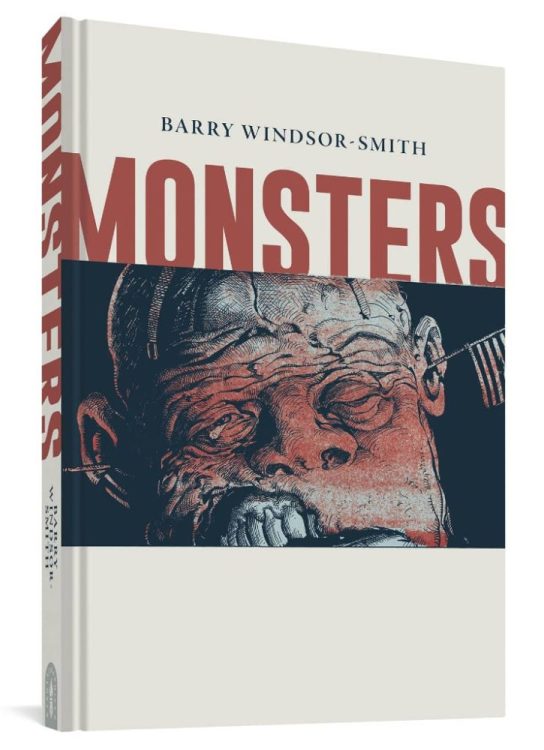
On April 13, 2021, publisher Fantagraphics is due to release Monsters, which, in their own words, is ‘the most anticipated graphic novel in recent comics history!’ Running at a mammoth 360 pages, the black and white comic book by the award-winning British illustrator Barry Windsor-Smith is a visual spectacle and demands attention. The cover alone, with its crisp design containing the image of a distressed ‘monster,’ sparks intrigue and promises a complex, disturbing tale.
Windsor-Smith made a name for himself in the 1970s, working for Marvel and winning several awards for his artwork in The Savage Sword of Conan. He also worked on some of the more feral superheroes and mutants, including the Wolverine origin story, Weapon X, where he had both writing and art duties. His latest opus has been a work in progress for over 35 years, and the final product carries the weight of that commitment, physically and metaphorically. Monsters weaves a web of horror and drama and reflects comics’ history within its modern gothic tale.
Monsters Credit: Fantagraphics Books
An Unfolding Horror
In the 1960s, the young Bobby Bailey attempts to enlist in the US Army, but his credentials aren’t up to scratch. His recruiting office, Sergeant McFarland, believes that he may know a part of the military where Bobby may fit in. And so begins a journey of horror, genetic mutilation, grief, and regret. Bailey and McFarland’s lives are destined to be linked, and the Sergeant’s moment of weakness at the beginning of the story leads them down a path of destruction.
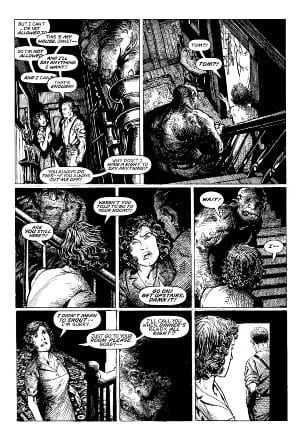
The book’s tone is set within the opening pages where Bobby, as a child, is attacked and scarred by an overpowering monster of a man. Windsor-Smith crams the panels with tension, and raw terror as Bobby’s mother rushes to protect her son. The twisted depiction of the abusive father towers over the frightened mother and her unconscious son. It is impossible to escape from the situation, and the reader is drawn into the heavy line work and dark shadows. Almost incomprehensible text fills the monster’s speech balloons, which contrasts the clear, overly large text Windsor-Smith uses for Bobby’s mother. Within the first two opening double pages, Windsor-Smith expresses his mission statement for Monsters, and it leaves you reeling as you tentatively begin following Bobby’s journey through life.
Monsters combines gothic horror with comic book tropes to produce a melting pot of twisted drama, moral dilemmas, and unrelenting brilliance from the opening onwards. There is a powerful Frankenstein influence that has been combined with a Captain America style origin story. This is a merging of cultures and genres that crosses oceans, time, and mediums. Old British sensibilities have been grafted onto classic American pulp fictions to create something modern and inspirational. The narrative is the tour-de-force that Fantagraphics promise, and it will move you on several emotional levels.
Monsters Credit: Fantagraphics Books
Capturing the Monsters
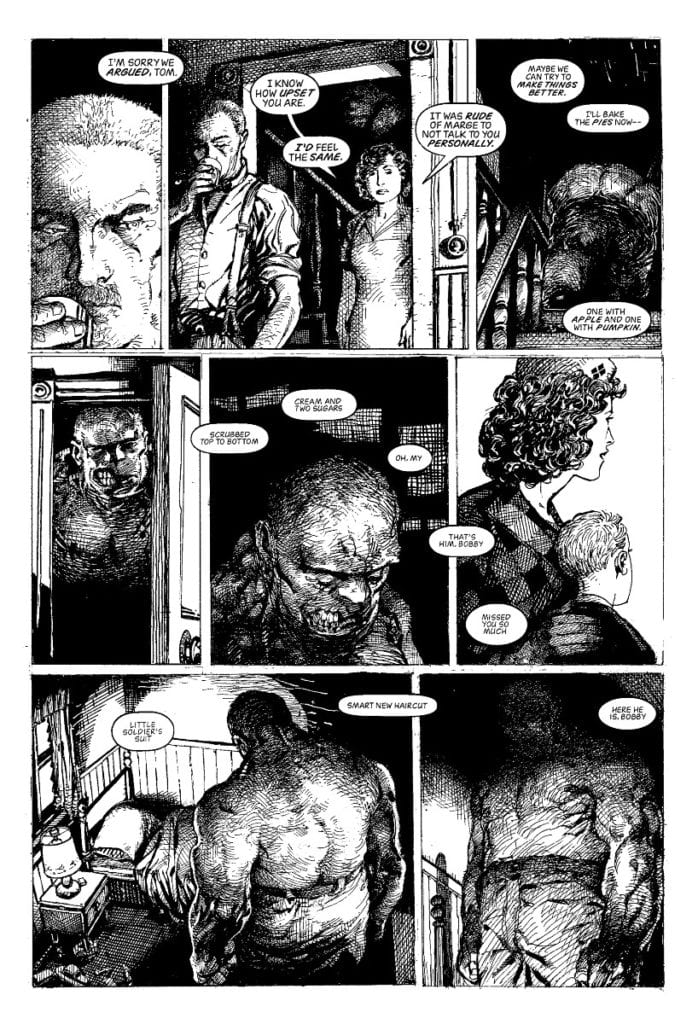
Each page is packed with detail, and the panels are covered with meticulous linework that summons the scenery and characters from the whiteness beneath. Windsor-Smith’s shading is produced through heavy hatching that reflects the layers of narrative the creator has brought to the book. You can almost see the building blocks of the story, but just as you start to become familiar with the style, Windsor-Smith pulls the rug visually by breaking the panel frames or reducing the backgrounds to pitch black.
The character work deserves special attention and not just because this book relies heavily on the emotional connections between the cast. Windsor-Smith uses subtle gestures and specific props to heighten personalities. Characters fiddle with their spectacles like a nervous Peter Cushing in the scene of a Hammer Horror film, and tiny American flags are thrust into distorted bodies as an affront to military leadership hierarchy. These details make each page irresistible and slow the pace right down, building the atmosphere.
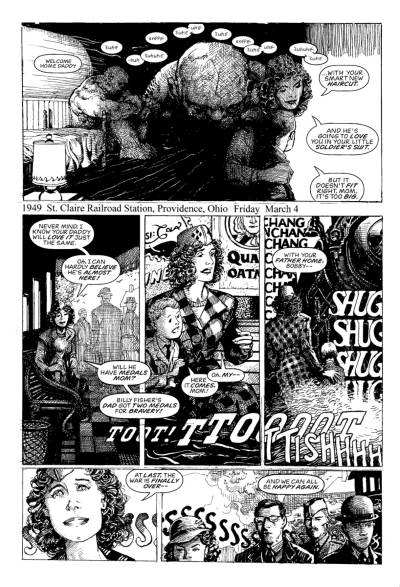
That’s not to say that there aren’t moments of dynamism and heart-thumping excitement. The action sequences are full of detail, but the emphasis is on movement and urgency. A car chase scene is a high octane affair where the page layouts open up with fewer, disorganized panels. Monsters manages to flip from speech heavy emotional drama to conflict heavy action on a page’s turn without breaking the narrative flow. The only drawback of this is that it is difficult to find a place to take a break while reading.
Monsters Credit: Fantagraphics Books
Conclusion
The sheer scale of Monsters makes it impossible to cover everything that is going on in the storytelling. There is just so much to unpack. Whether you are familiar with Windsor-Smith’s work or not, everyone will get something out of this book. The story, the characterization, the spectacular artwork, and even the cultural commentary all add layers for the reader to dissect like an uncontrollable Doctor Frankenstein trying to find the secret of life. It is an engrossing work of art that is beautiful and horrific in equal measures. Windsor-Smith even manages to breathe life into tired comic book cliches so that they seem fresh upon the page.
When this book hits the shelves, it may come with a $39.99 price tag, but Monsters is worth every penny. This deserves a place of honor next to the Collected Sandman, Asterios Polyp, EC Library collection, or whatever your most cherished books may be.
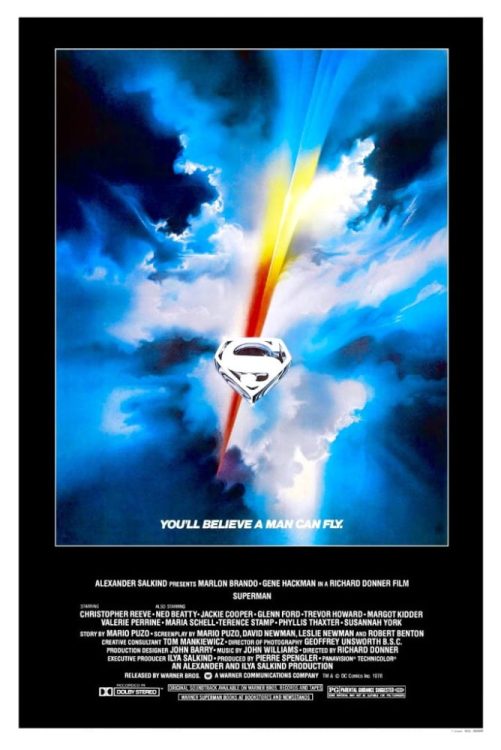
In 1978 the world was made to believe a man could fly.
Richard Donner brought the iconic American superhero, Superman, to the big screen and created a new movie genre that has since taken over the summer blockbuster. However, the translation from Comic Book to Cinema screen wasn’t a straightforward process and was just one element of an ongoing transmedia project.
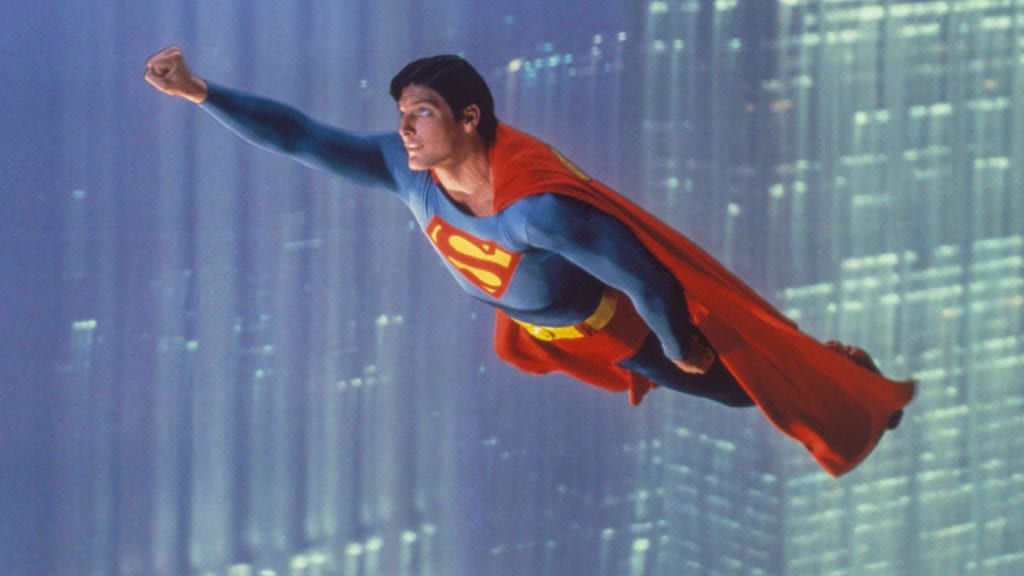
Christopher Reeve’s Proves a Man Can Fly
From Page to Screen
Superman wasn’t the first superhero to appear on the big screen. In fact, several superheroes, Superman among them, had already appeared in cinemas throughout the early half of the 20th century. Superheroes were popular in print, and Hollywood was quick to snap up the properties and entice children with film serials that were shown every week on the big screen. Some characters proved to be popular, and it turned out that the superhero story fitted perfectly into the serial format.
Donner’s version of Superman was the first big-budget outing for any superhero, and translating the character’s serial, and often inconsistent, history to the big screen was to prove one of the most important aspects of its success. The film did such a good job telling the story that the film’s version of Superman’s origin is still seen as the defining one. Donner took aspects of the comic books and reimaged the character to sell to a new audience. It could be argued that the film was not aimed at the readers of the comic but at this new cinema audience, and Donner’s treatment of the character reflects this. The defining characteristics of Superman, and alter ego Clark Kent, were extracted and these formed the basis for the new origin story. In constructing the film’s plot, Donner and writer Mario Puzo reduced the character to the bare essentials. The visual reduction necessary in the art of comic book production became a narrative necessity for the movie, so it to appeal to a large audience.
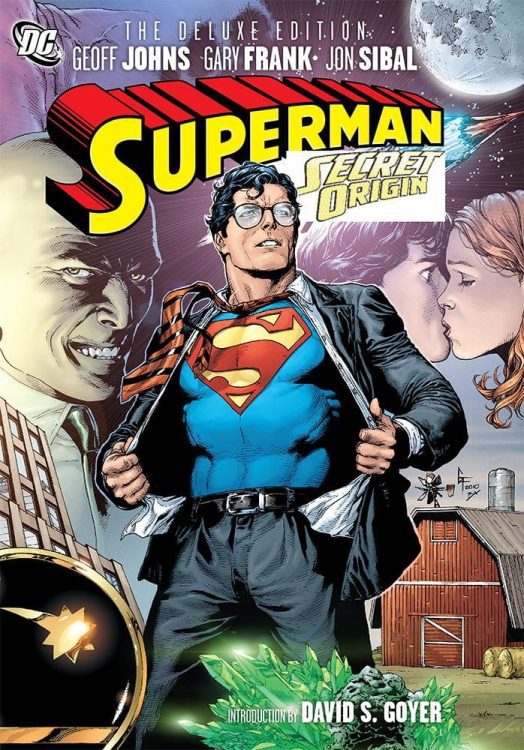
Superman Secret Origin Cover Credit: DC Comics
Revisiting the Origins, Again.
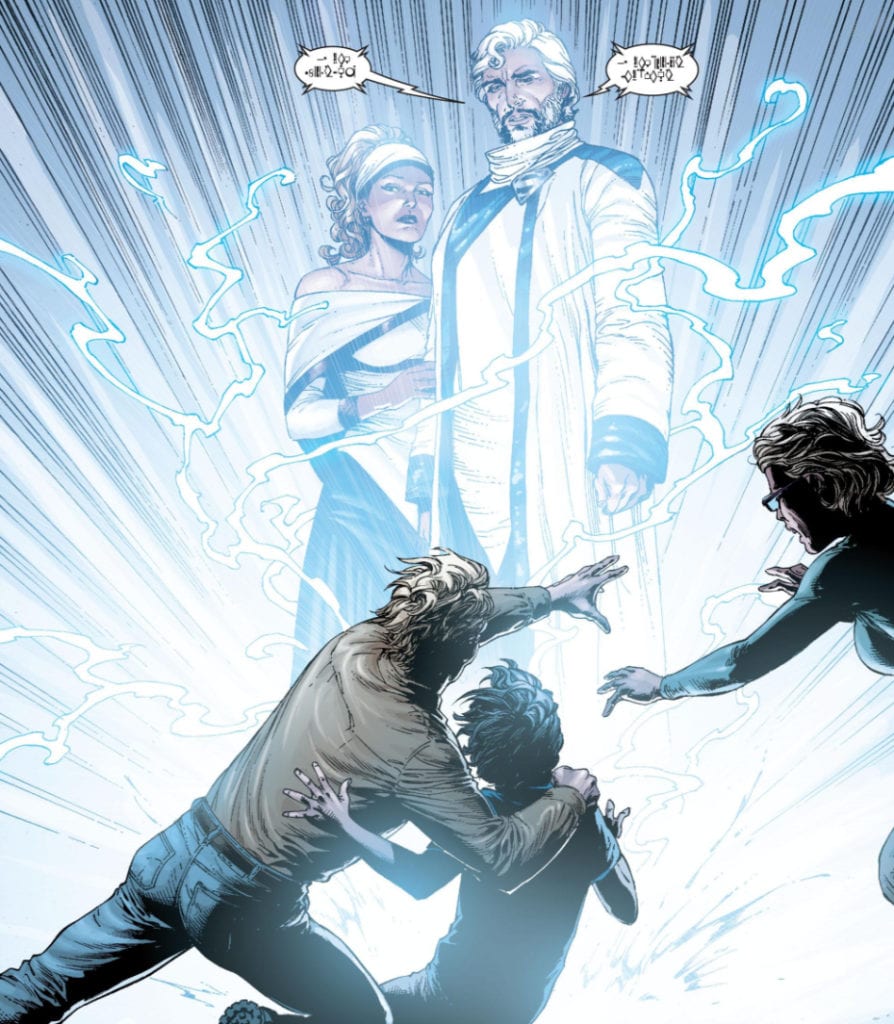
Years later, Geoff Johns would be faced with retelling Superman’s origin story after the events of DC’s line-wide Infinite Crisis storyline. When reading Superman Secret Origin #1, illustrated by Gary Frank, you are instantly reminded of the 1978 movie. Although Kal-El’s initial transition from Krypton to Earth is absent, a number of the set pieces in the comic mirror the early scenes in the movie. A scene involving the throwing of an American Football; the introduction of Ma and Pa Kent; a sequence with a thrasher; all have duplicate sequences in Donner’s movie, but they have been altered to fit Johns’ new, updated narrative. He invokes the movie’s nostalgia, giving the fans what they want, but he also subverts the narrative to situate the characters in the ‘new world’ after the DC Crisis storyline.
The 1978 movie took the noblest aspects of the character from over four decades of comics and condensed them into a single story to highlight the attributes that mattered. In Johns’ reworking of Superman’s origin in 2009, he reverses this reduction, fleshing out the character. Using recognizable scenes, he can enhance aspects of the character that the readers are already familiar with. It’s a case of ‘re-show and tell.’
The changes that each writer makes are reflective of the time periods in which they worked. The movie is seen as a reflection of innocence, a simple breakdown of an all American hero. Donner’s Superman is the ultimate boy scout trying to fit in and do the right thing. He listens to his adoptive father’s advice, even though this makes him an outsider to his immediate peer group. He learns restraint and control and grows up to be charming and the epitome of ‘goodness.’ The teenage Clark is the type of child that American society wanted, the opposite of the juvenile delinquents that were supposedly created by reading comics in the 1950s.
Johns’ story comes after a long history of ‘darkness’ enveloping the superhero genre. Characters like Spider-Man made teenage angst popular in the comics. Towards the late 1980s, Alan Moore and Frank Miller thrust superheroes into the darkest depths, giving the genre an uncomfortable autopsy. The landscape had changed, and Johns acknowledges this with his take on the Superman origin. He takes the character-building moments from Donner’s movie and twists them to create a different tone and a much more angst-ridden Clark Kent. This Clark is more in line with modern sensibilities and the experiences of modern teenagers. Years of darkness within comic book plots, and teenage coming of age movies, have altered the narrative playing field, and Johns used remnants of the past to make the story relevant to a modern audience. He attempts to pacify the long time readers while attracting a new audience.
Superman Secret Origin Credit: DC Comics
Conclusion
Over the years, from his first appearance in comic strips, through radio and television, and back into the latest iteration of the character in DC’s monthly floppies, the mythology of Superman has grown beyond the boundaries of his own stories. Superman has become a part of popular culture, reaching audiences who have never read a superhero comic. Each retelling reinforces aspects of the myth but also introduces new elements. Like any legend, there is no longer any ‘true’ Superman origin, merely an accumulation of ideas and concepts drawn from multiple sources. Each new writer/artist/director picks and chooses the elements that best suit the story they tell in the medium they are telling it. It is impossible to pick one comic or one film that is the starting point of the legend: Superman lives through them all, a transmedia character in a multi-narrative universe.
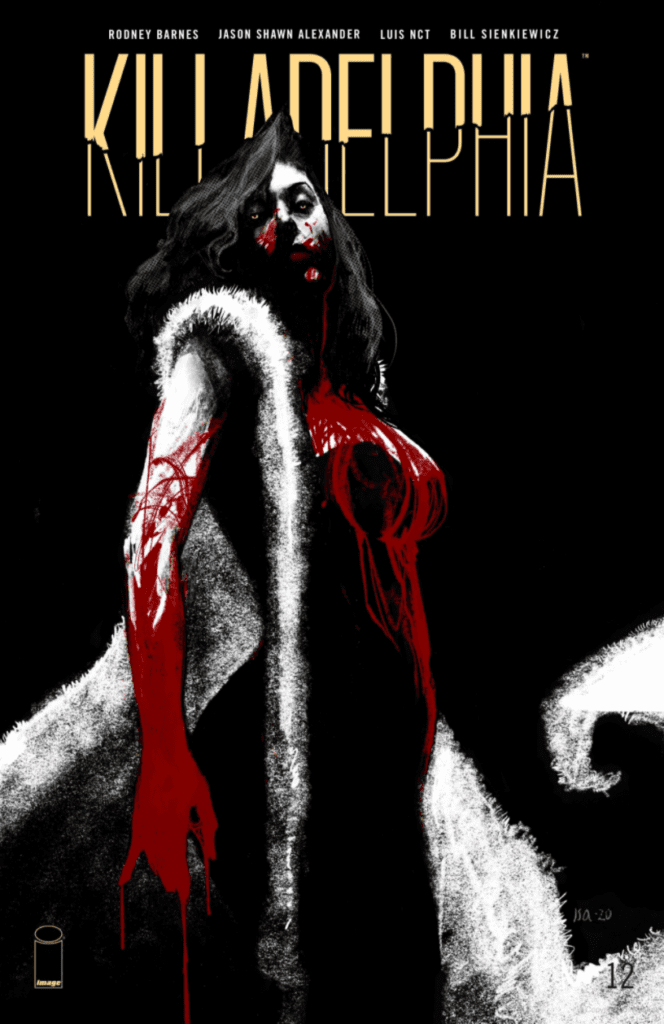
Killadelphia #12, on sale now from Image Comics, features some of the darkest and most interesting art the series has seen so far, and the story is full of twists and turns to shock the reader thoroughly.
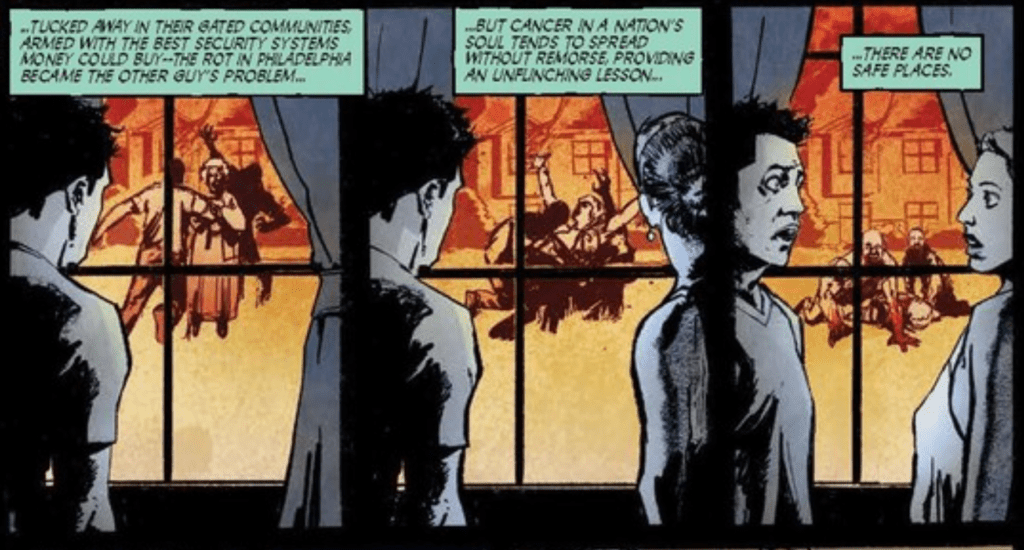
It doesn’t matter what kind of emotions Rodney Barnes is trying to provoke in Killadelphia #12; he always nails it on the head. It could be a tender moment between people visiting loved ones who have passed on, or a horrifying sequence of grotesque violence; either way, Barnes can inspire emotions in the reader. This issue also provides one of the craziest twists we have seen for a long while, which ends this second arc with a bang. It’s sure to have readers dying to get their hands on the next issue.
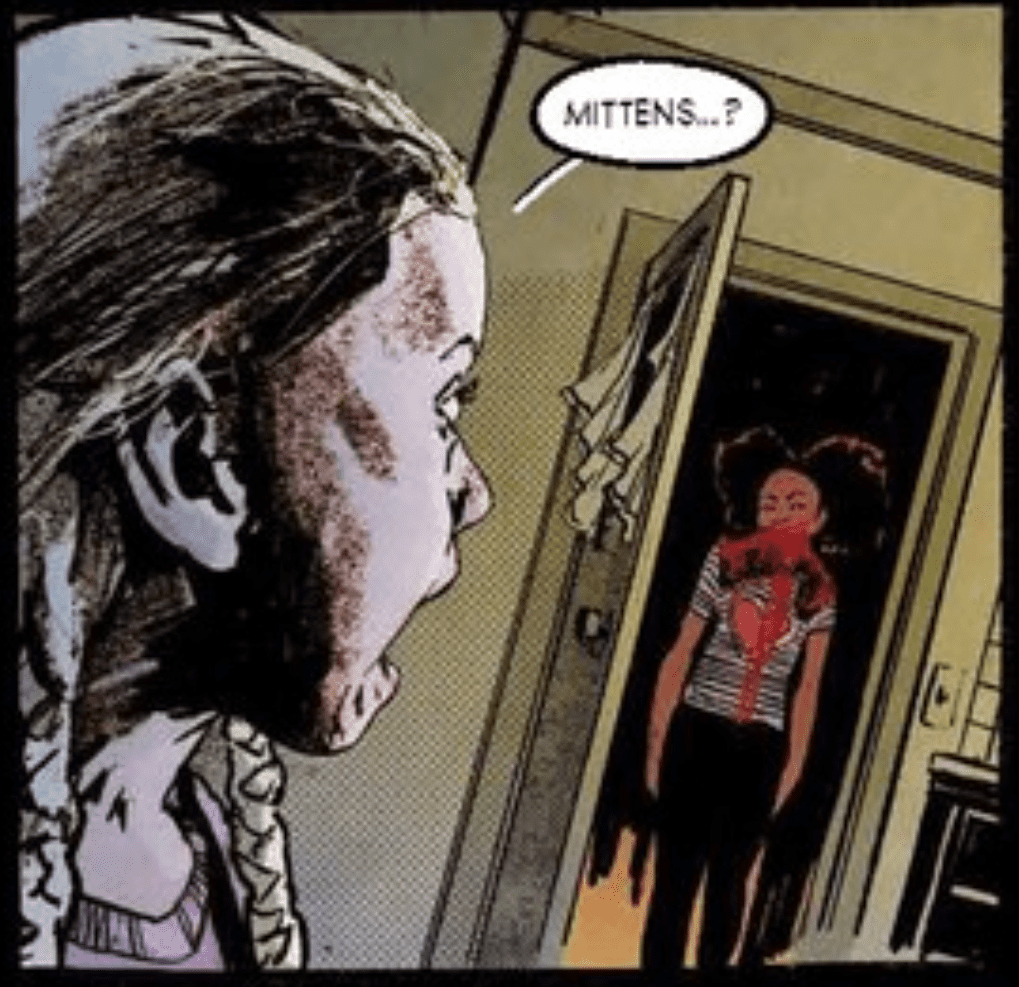
I have nothing negative to say about Jason Shawn Alexander’s art in Killadelphia #12. It is jaw-dropping. As always, his faces are remarkably realistic, as if each one of his drawings has a soul. Even better is when he decides to draw a body whose soul has left it, and we are left with haunting imagery that brings this issue to the next level. Another brilliant part of this issue was how Alexander showed some of his best work with disturbing macabre art that is sure to chill readers’ spines. Every single page was a pleasure to gaze upon, and I cannot sing enough praises about Alexander’s work in this issue.
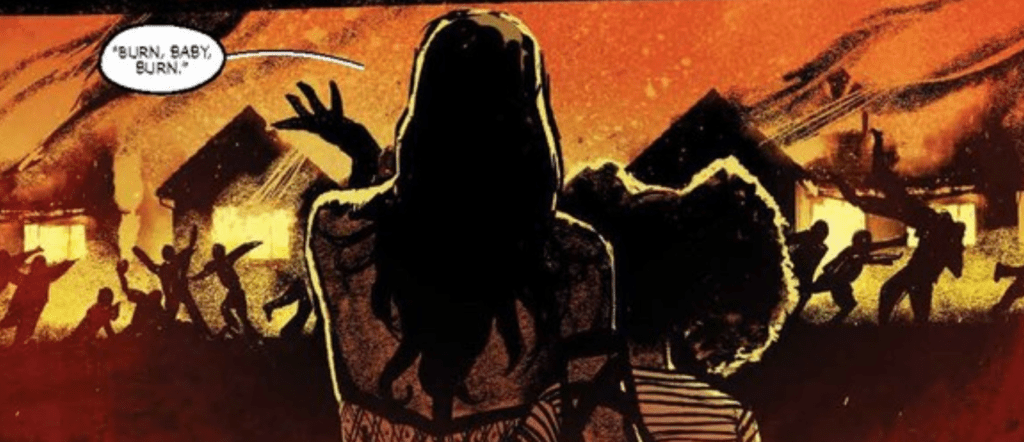
Luis NCT’s colors in Killadelphia #12 perfectly complement Alexander’s art and adds lots of energy to the issue. His bloodshed is particularly notable, as he always finds a way for it to pop out against the colors behind it, which results in some delightfully horrifying panels. NCT also does some marvelous work in choosing a palette that reflects the tone. The backgrounds might frequently be red to accent a scene full of violence, or they might be calming colors for moments in the afterlife. Either way, NCT does a stunning job of making sure the colors reflect the emotions that the story is trying to get across.
Marshall Dillon uses a variety of lettering techniques that allow Killadelphia #12 to be more immersive. He has dialogue extend past the borders of a speech bubble, which clarifies that a character is yelling. He gives some characters a uniquely colored font for their dialogue, highlighting that the characters are inhuman. Dillon also will change the color of a font to show that a character is screaming out and is overcome with emotions, which is a subtle yet effective way to carry that out. Dillon accomplishes everything he sets out to do, allowing the issue to flow seamlessly and to pack a harder punch on several occasions.
Killadelphia #12 is a mind-blowing issue that any fan of the series would hate to miss. It has an engaging story throughout its entirety, there is plenty of the violence we love, and Alexander can shine with macabre art that knocks it out of the park. All of it is extraordinarily beautiful, and the colors of NCT and the lettering of Dillon polish it off to create an unforgettable issue.
WandaVision has moved forward to the 1970s with Wanda and Vision continuing to live the suburban dream with the arrival of a child.
“Now in Color” picks up where “Don’t Turn That Dial” left off: Wanda is suddenly four months pregnant and turned the world of the suburbs from the black-and-white ‘60s to the colorful ‘70s. Wanda experiences the quickest pregnancy in history but giving birth makes her powers go haywire.
“Now in Color” apes the cheery sitcoms of the ‘70s, particularly The Brady Bunch and The Partridge Family to a lesser extend (at least to me as a Brit), The Good Life. It was wonderfully upbeat as Wanda and Vision prepare to have a family life.
The comedic setup of the episode was Wanda’s accelerated pregnancy and the need to hide it from the pregnancy from the neighbors. However, her powers work against her when she has contractions. They suddenly change her coat or bring a painting to life. Hiding something is a common trait in sitcoms, but due to Wanda’s superpowers it made WandaVision similar to the ‘90s version of Sabrina the Teenage Witch.
The drama of the episode came after Wanda gave birth. Wanda makes a reference to the fact she was a twin and Geraldine reminds Wanda of the events in Avengers: Age of Ultron. Besides being a nice callback, it also shows the amount of pain Wanda has suffered. Wanda has been experimented on by Hydra, used by Ultron, lost her brother and her life partner, been killed and accidentally killed people at the beginning of Captain America: Civil War.
Wanda was willing to do anything to protect the world. This was shown with Geraldine’s punishment and the reveal that SWORD has surrounded a wall of static. The other action Wanda did was when Vision starts to question the strangeness of the world Wanda reversed time. The third episode has reduced the ambiguity that Wanda hasn’t been manipulated.
Whilst Wanda tried to prevent Vision from asking questions and finding out what’s happening, it doesn’t stop him. After Wanda gave birth Vision talked to the neighbors about Geraldine, at the same time as Wanda questions Geraldine’s identity. The question that remains is the identity of the residents – were they also creations of Wanda’s mind, or were they ordinary people who got caught up within Wanda’s illusion? If it’s the latter would it cause the residents a moral dilemma on whether they should go back to the real world? It was a similar issue to what happened in the “House of M” comics because many characters got to live a false dream and questioned whether they should leave it.
A final point which is a minor one is I enjoy Vision using Britishisms like ‘leg it.’
“Now in Color” does keep the intrigue that was established in the previous episodes. The humor was appropriately silly and far-fetched and the dark twist was well executed.