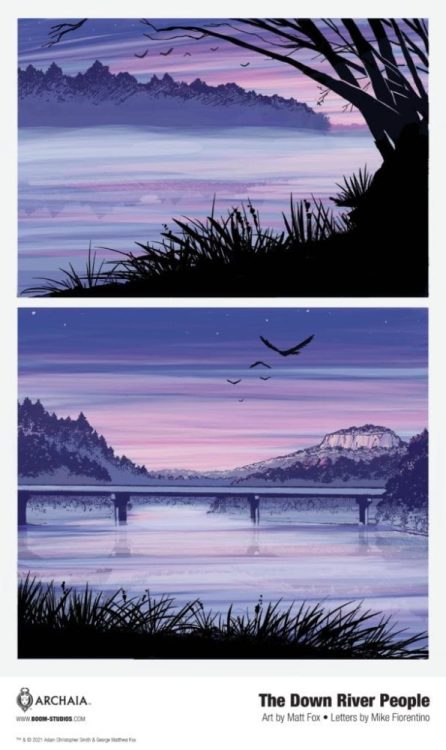
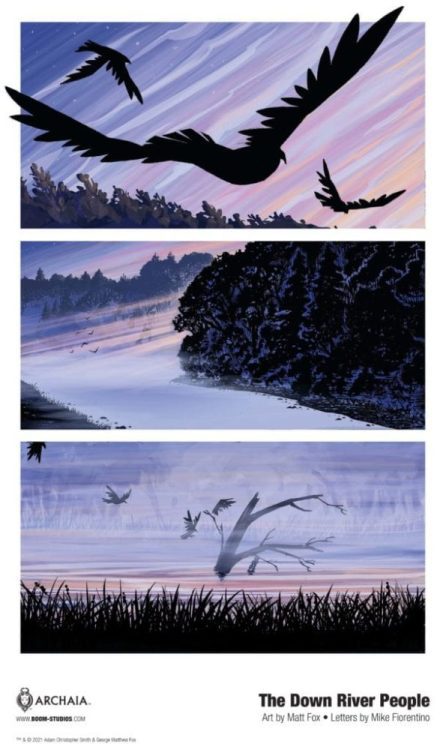
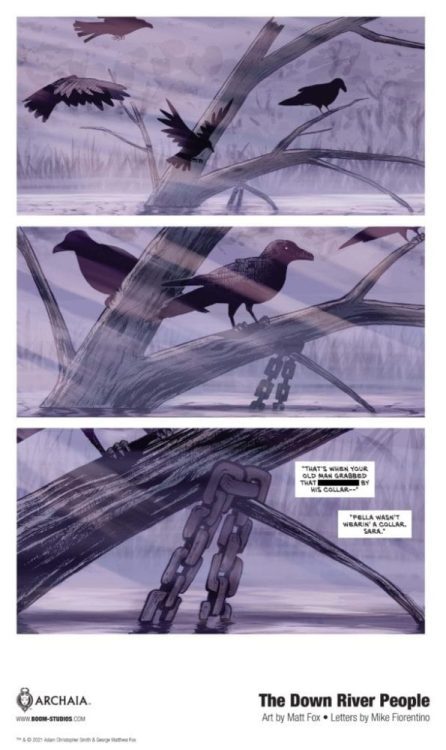
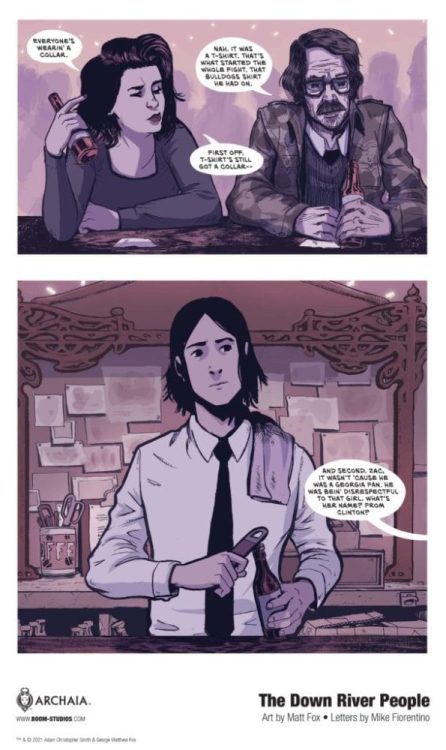
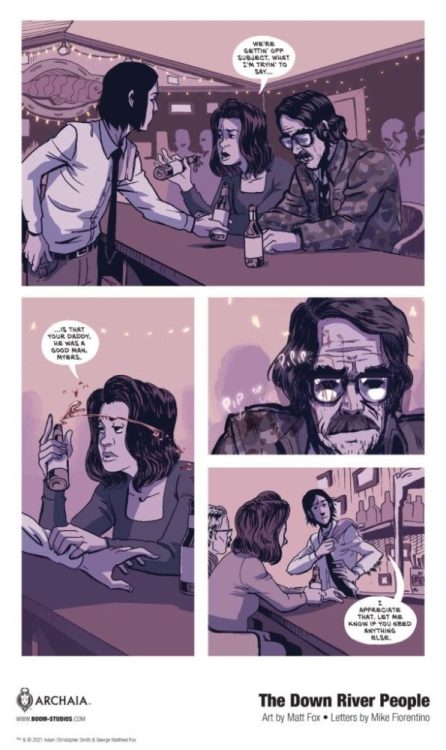
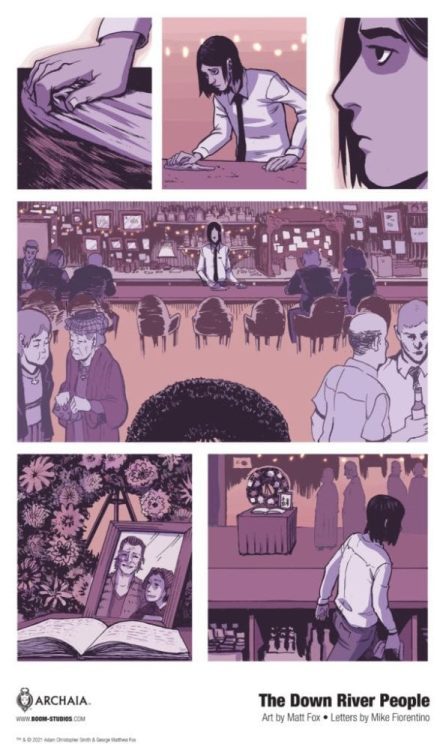
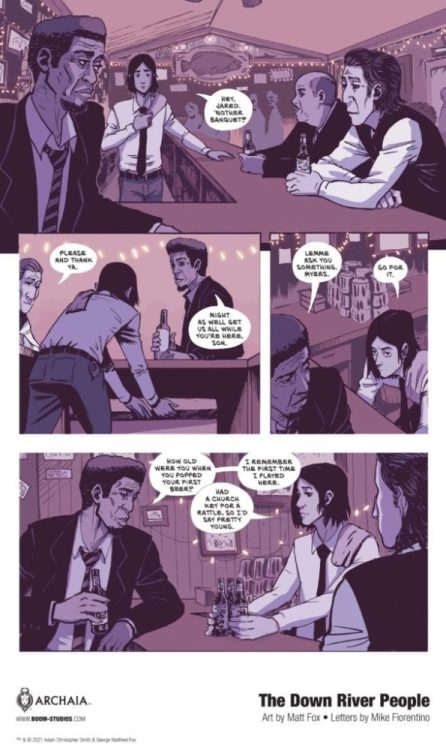
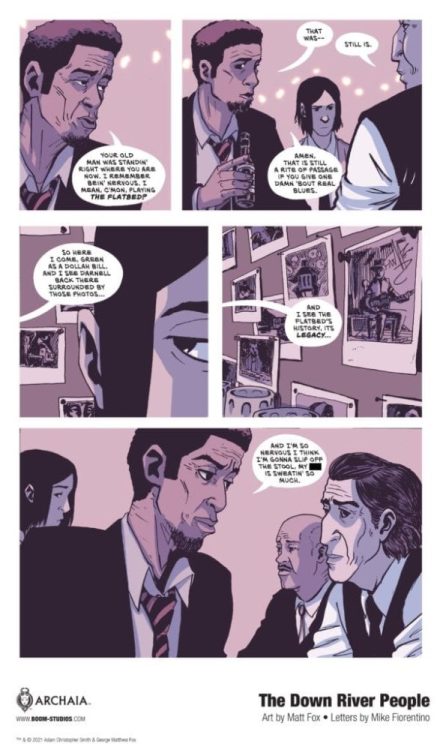
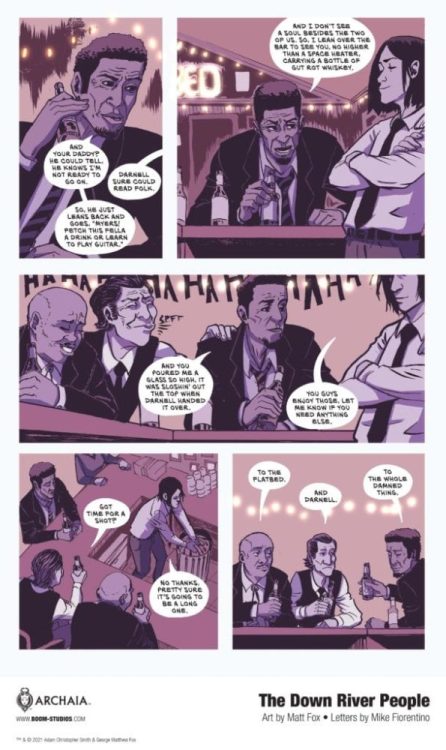
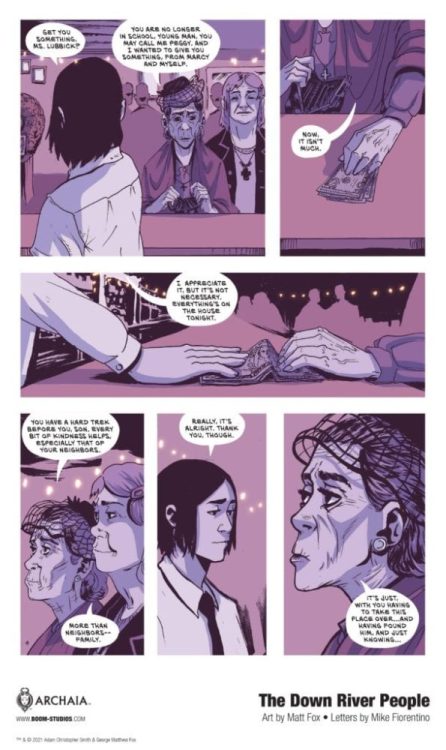
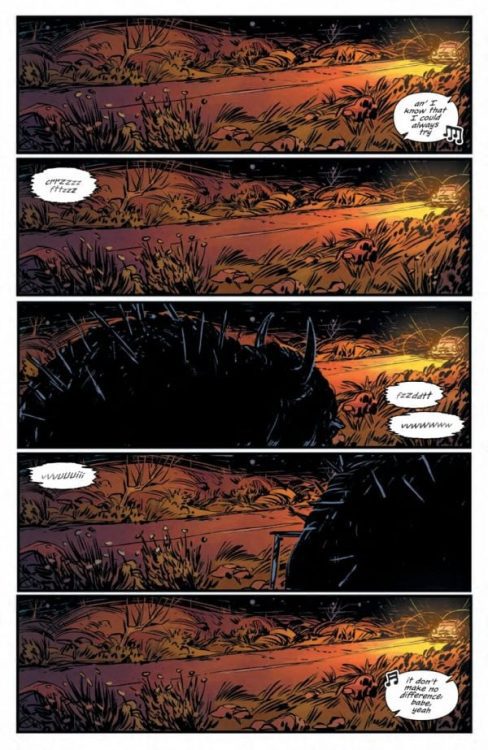
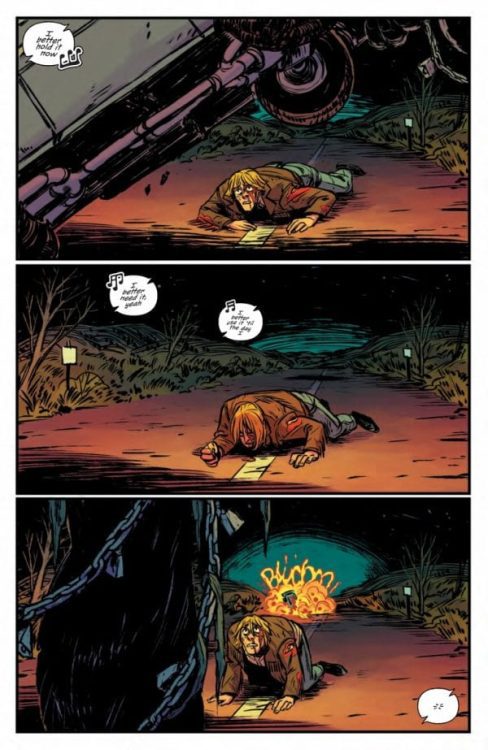
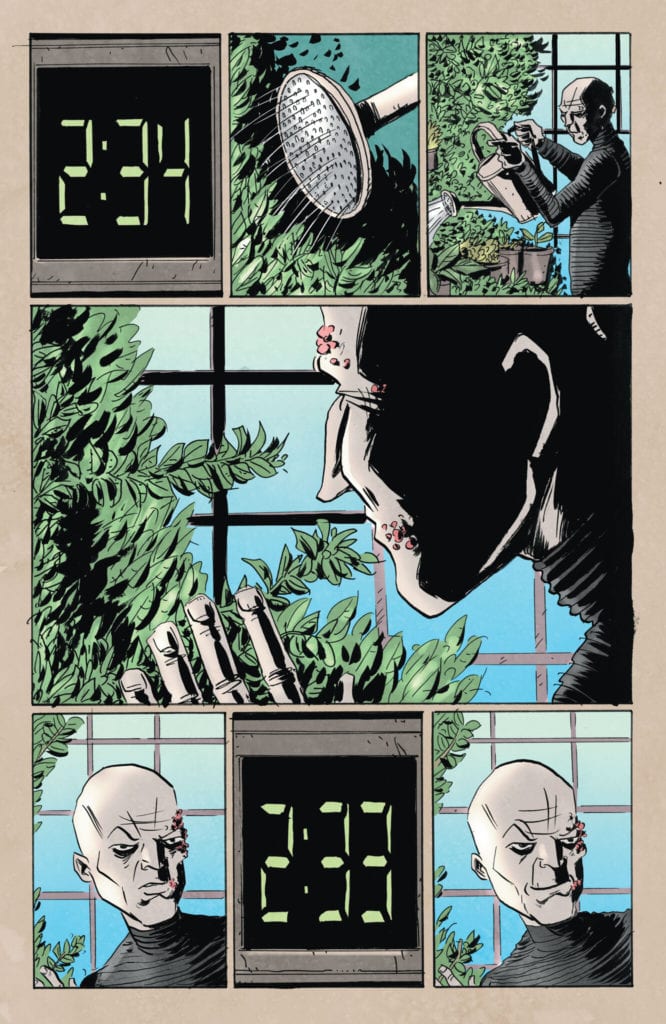
THE DOWN RIVER PEOPLE hits your local comic book shop on May 26, but thanks to BOOM! Studios!, Monkeys Fighting Robots has an exclusive 10-page page preview for our readers.
The original graphic novel is by writer Adam Smith and artist Matthew Fox, the creative team of the Eisner and Harvey Award-nominated Long Walk to Valhalla.
About THE DOWN RIVER PEOPLE: Myers Carpenter is a bootlegger who just inherited his family’s bar, The Flatbed. Unsure of whether or not he wants to keep the famous speakeasy, Myers is forced to find a new booze supplier when he burns his bridges at his longtime source in Mississippi. The only option he can turn to is his estranged mother, now running a fishing lodge for the wealthy, and a half-sister he knew nothing about.
As Myers becomes more entangled in the lives of his newfound family, he begins to learn the secrets of the fishing lodge and the sinister cult thriving just under the surface of wealth and opulence.
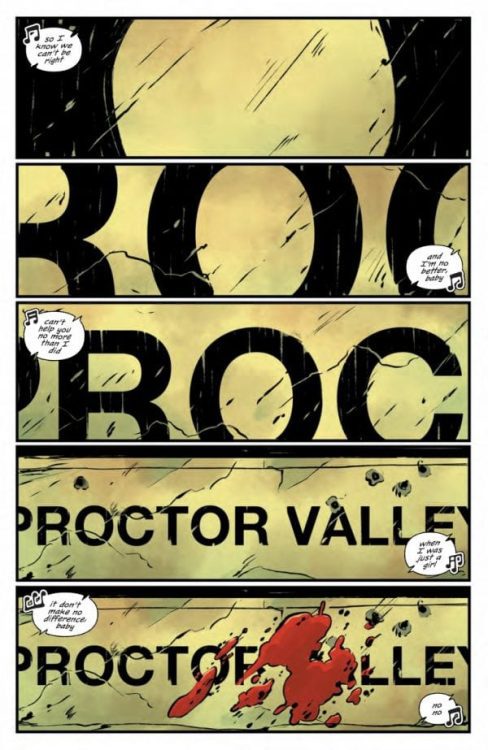
From comics auteur and legend Grant Morrison and Alex Child, along with artists Naomi Franquiz and Tamra Bonvillain, comes a time capsule of a horror story in Proctor Valley Road #1. This story uses familiar tropes and devices to weave a unique and entertaining opening chapter, full of cultural conflict and fun, scary sequences. With a clever script and stellar story-fitting visuals, this is a promising start to what could go on to be a wonderfully entertaining and witty horror romp through 1970 California.
“August, Rylee, Cora & Jennie have organized a “Spook Tour” with their classmates on the most haunted, demon-infested stretch of road in America to fund attending the concert of their dreams. When their visit turns deadly, these four friends race to rescue the missing students… before the town tears them limb from limb.”
Writing & Plot
In all the years that Morrison has been gracing the comics medium with his vision, it’s rare that we’ve ever gotten a pure horror experience out of him. Sure some of his work on Animal Man, The Invisibles, and Swamp Thing reached into the realms of horror, typically of the existential or cosmic variety. His Image series The Nameless is probably the most outright horror experience we’ve gotten from the Scottish legend, but even then, it’s more conceptual. Proctor Valley Road #1 is a first for the comics icon, as this is a classic all-American traditional scary campfire tale brand of horror story. With the help of writer Child, the pair construct a setting and group of characters that feel real in a time and space that we all know about in both history and pop culture. The turbulence of Vietnam-era late 60’s/early 70’s America is the backdrop for this comic, and the experiences of the characters ground this story in something tangible. I’ve said before in my other horror comic reviews that the best examples of the genre know how to plant their stories firmly in a realistic situation with believable characters, therefore upping the stakes of the terror the cast experiences. The other big element that grounds both the characters and the audience in the story is the fact that the main cast are all teenagers and young adults, and they are written as such. They all have different personalities, none of which feels like a cliché, and they have difficulty grappling with the reality of their world – as teenagers often do. There’s an air of arrogance and self-imposed invulnerability to a few of the leads. It’s what makes this comic very reminiscent of stories like The Monster Squad or The Goonies, which obviously inspired this book. The other societal elements made by this time period, such as notions of patriotism, racism, and draft-dodging, make their presences known but don’t weigh heavily on the minds of the cast. The horror and slice of life bits trade focus with enough frequency that the comic is able to build its world and characters to a point where everything feels real, while the looming supernatural threat leers in the background. This is a superbly well-written comic, and I can’t wait to see where the story goes next.
Art Direction
Proctor Valley Road #1 is graced by the talents of Franquiz on pencils, which I have previously praised for her work on Tales From Harrow County. In this comic, much like that other outstanding horror series, Franquiz’s soft lines, thoughtful details, and varied designs bring this world to life in fitting fashion for the story being told here. Franquiz designs this middle-of-nowhere Californian desert town in the late ’60s with an eye that makes the setting feel tangible and reminds the reader that this was indeed a real-time and place. Her character designs are highly varied in terms of facial animations and even body types, the latter of which is not often seen in comics even now. If this comic were to have all of its dialogue stripped away, we would still have a good idea of each character’s personality just based on how they are animated. The small bits of horror and monster design we get here are also inventive and spooky and teased to the point that makes me want more and more in the next issue. The colors from Tamra Bonvillain are very deep and moody, and they sell this visual aesthetic that is reminiscent of classic 60’s and 70’s horror films. Every panel has a sort of sunset and dust-cast overtone to all of its many shades, and it genuinely looks like that period of film cinematography. The letters from Jim Campbell are a neat, contemporary font that is fitting and easy to read, with really solid effect lettering as well. This is a comic with a visual style perfectly in tune with the story that is being presented.
Proctor Valley Road #1 is a grounded first chapter in this horror comic that feels awfully familiar but still presents enough intrigue and depth to itself to be interesting and fun. Morrison and Child’s script is insightful and intelligent, taking advantage of the place and time the story is set in while very slowly tackling the supernatural terror lurking in the background. Franquiz and Bonvillain’s visuals are pitch-perfect, offering stellar character art and rich, dark tones that are perfect for this desert-set horror story. Be sure to grab this opening issue when it hits stands on March 10!
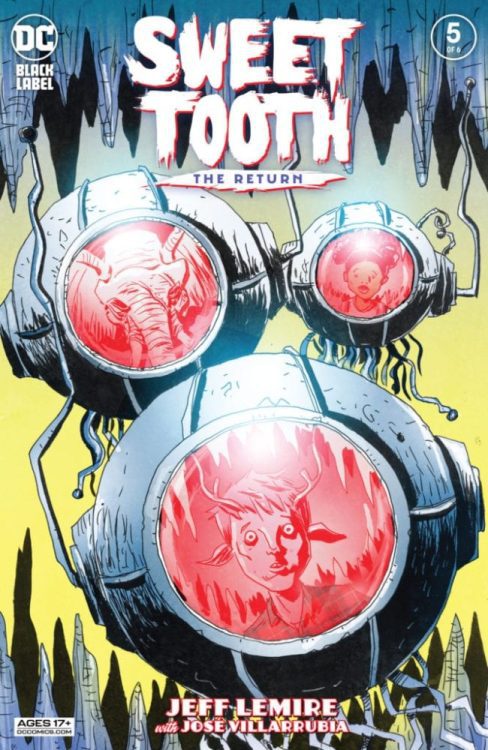
Creator Jeff Lemire and colorist Jose Villarrubia return with the second-to-last chapter of their sequel mini-series in Sweet Tooth: The Return: #5. This issue uncovers the endgame plan of our scum of a villain while also setting the path and emotional stakes for the main cast, making us root and fear for them in equal distressing amounts. With poignant writing and once again charmingly perfect visuals, this issue may be the best in this excellent mini-series thus far.
“The clock is tick-tick-ticking down. Soon all the nasty hybrid beasts that roam the Earth will get sick and die. And it’s all thanks to our beloved Father and his incredible science virus! He’s doing it for all of you because Father loves you very much, and soon you and all his other very good, special friends will get to walk upon the desiccated corpses of the villainous creatures that took our home from us! What a joyous time that will be! What’s that? Oh my! It’s almost time! Let’s pack our bags, brush our teeth, and remember to never lie to Father! Because lying is what a hybrid would do, and you’re much better than one of them, right?”
Writing & Plot
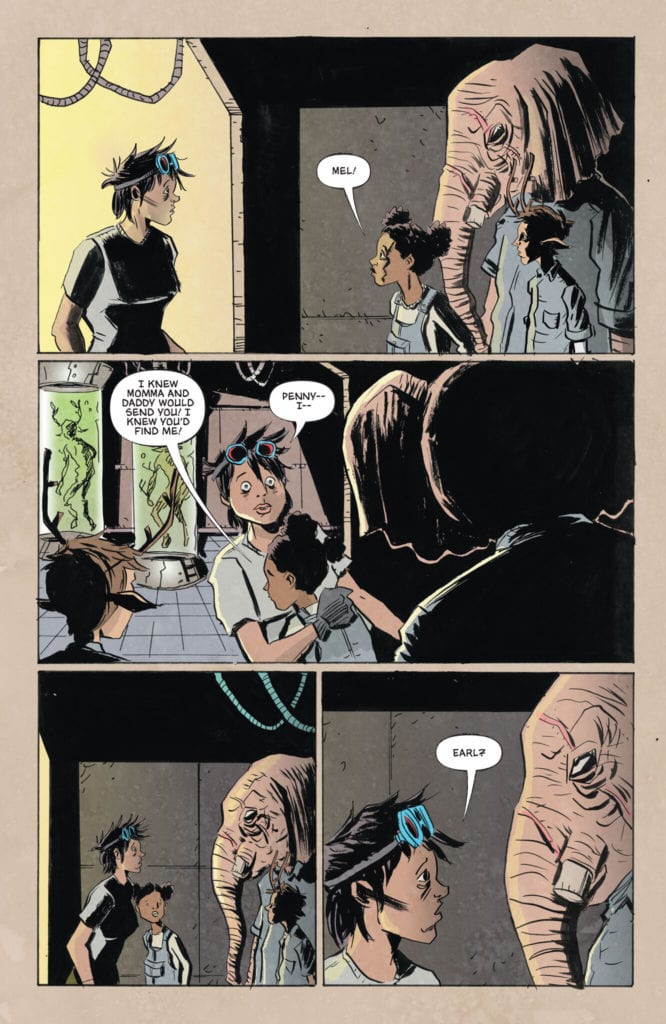
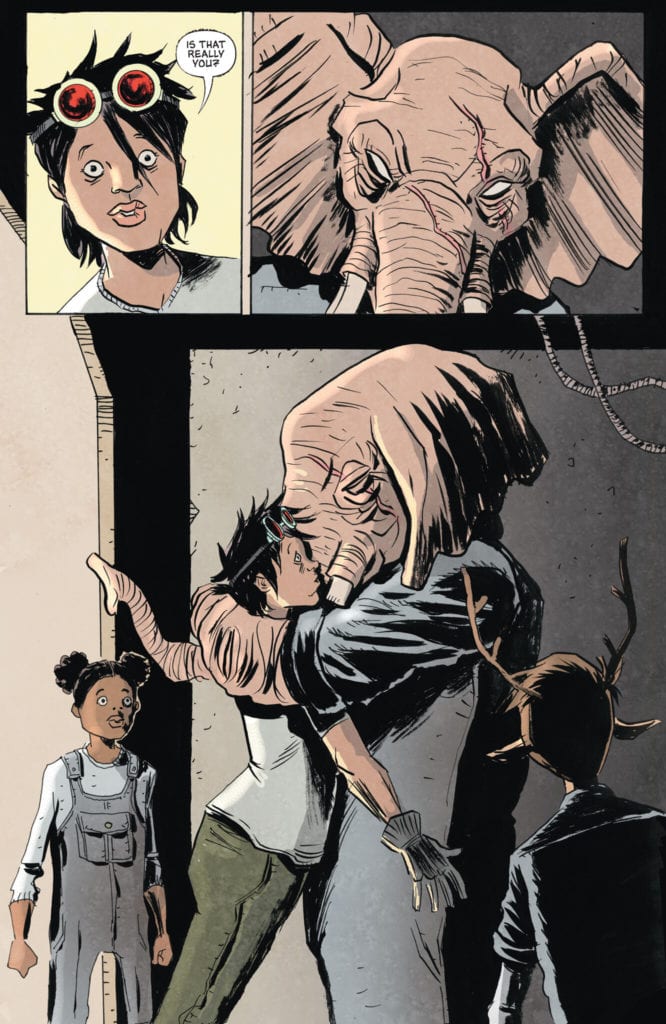
Lemire’s writing here in Sweet Tooth: the Return #5 offers more of his trademark “less is more” dialogue style combined with his ability to deliver exposition in a way that is still entertaining. This issue focuses on sharpening each character’s motivations and raising the stakes for everyone involved, both hero and villain, before setting off on the series finale. As usual, the best parts of this book are the moments of quiet introspection and one-on-one character conversation between “The Boy” and other characters. This time around, it’s him and our favorite elephant hybrid Earl. There’s something so endlessly charming about how Lemire presents The Boy/Gus’s dialogue, and therefore much of his personality, that every time he’s speaking on the panel I can’t help but love the character. His ever-present optimism and caring for others never comes across as corny or naïve, but rather the exact thing both the other characters and we as readers need to hear. Lemire has always had a perfect ear for naturalistic dialogue and matching dialogue styles differently among a wide range of characters. Even the villainous Father’s monologue about his evil master plan doesn’t bog down the story. There are no wasted words or narration, as every exchange in this comic has weight and is a pleasure to read.
Art Direction
Lemire’s signature art style once again graces the pages of Sweet Tooth: The Return #5, and once again, I wouldn’t have it any other way. The emotion that he can draw into every character despite his simplistic and rough-hewn visual style will never cease to amaze me. His panel direction is often contemplative and thoughtfully paced, in a manner that can only be achieved by someone matching their art to their own words. Hell, if I didn’t love Dean Ormston so much I’d say that Lemire should be the one drawing Black Hammer as well as writing it (he could do it too). The charming detail of Lemire’s pencils is filled with color by Jose Villarrubia, who has brilliantly offered his work in this world ever since the original comic. His watercolor-esque tones give every surface a variety of shades, and his work gets really interesting when reality and the world of dreams and visions get blurred. This is a visually perfect comic for the story, with an eclectic style that probably isn’t for everyone but has an endless amount of charm for those who can appreciate it.
Sweet Tooth: The Return #5 is a climactic chapter that sets up this story’s end by endearing us to the main cast even more than we thought possible just before this story reaches its final issue. Lemire’s signature style of storytelling gives us a comic laden with information that manages to be entertaining to read and is dotted by truly heartfelt character moments and a brutal cliffhanger. His ever-charming visuals, with the help of colorist Jose Villarrubia, set the perfect storytelling tone and style for this book and are absolutely perfect for what is being told here. Be sure to grab this second-to-last issue of this excellent mini-series on March 9!
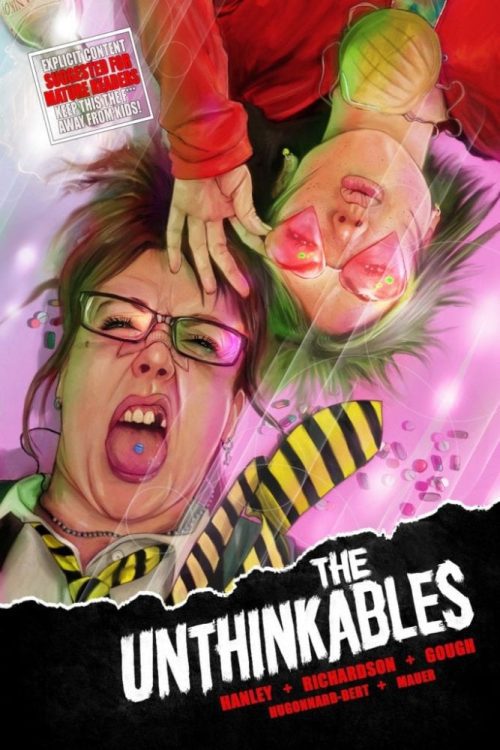
The Unthinkables #1 is the beginning of Unlikely Heroes Studios‘ newest series. After its digital release on January 6, 2021, the series’ physical edition is also available on Unlikely Heroes Studios’ website. Writer Paul Hanley crafted this black comedy, supervillain draft ensemble in a tribute to UH Studios’ late co-founder Zack Dolan. Penciler and co-inker Ian Richardson, co-inker Julien Hugonnard-Bert, colorist Simon Gough, and letterer Thomas Mauer bring Hanley’s vision to life. Kate Colors and Matt Krotzer respectively contribute additional colors and letters to the book.
Whichever format one chooses, buyers will not be disappointed. The book will make readers laugh with its odd comedy and gasp at its perilous plot. From start to finish, this book is a lot of fun.
The Unthinkables #1: Meta Dramedy
In this new series, Hanley shares his tribute to Dolan by hitting similar beats to the late co-founder’s series Super!. Over-the-top characters decorate The Unthinkables #1 from the first page to the last. Seeing a Superman pastiche get to say clichés with his super breath in space is a bizarre, fitting parallel to Super!.
The Superman pastiche’s surprising death adds some unexpected gravity to the story and meta-commentary. The silence on the page after this development is deafening, as it signals the hero’s death better than any narration ever could. It wouldn’t be an exaggeration to compare this scene to UH Studios’ reaction to Dolan’s death in 2019.
In ‘The Unthinkables #1, The Suicide Squad meets The Boys in a wild mash-up.
With all of the good guys down and defeated, the Earth’s government takes a page out of the Suicide Squad’s playbook and recruits supervillains instead. This mission is filled with desperation, as each recruitment is more visibly dangerous than the last. If this stress is what UH felt after Dolan’s death, it shows. The company’s experience facing this tragedy echoes the story, where the UN tries to get a giant fish kaiju under control.
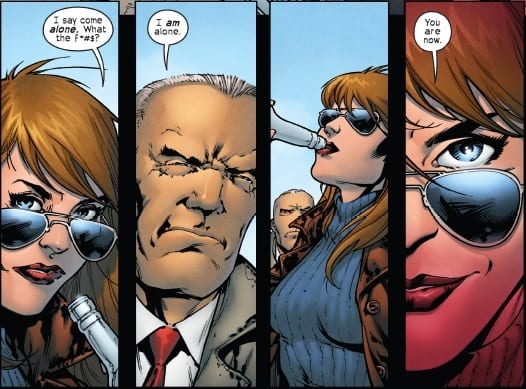
Most recruits, like the drunken poster child Riotgirl, are nothing the UN can’t handle; then there’s the team’s lead tactician, Bloody Mary. As an experienced ex-KGB spy that evaded counterintelligence for decades, she’s always a step ahead. She takes out a UN sniper as if she was fully anticipating his actions. With all the action coming off-screen, Bloody Mary is the most uneasy supervillain to be around, as she makes the reader feel like something bad is about to happen. With the blatant similarity to the Suicide Squad, you can’t help but think that this situation will get worse before it gets better.
The Art Is A Riot!
The pages of The Unthinkables #1 feature art by a team that’s giving it their all. Richardson, as the penciler and co-inker, gives each character a design to match their distinct personalities. The White Devil’s costume change from his cowboy-like attire to his origami style costume is a huge display of showmanship. In juxtaposition with his earlier cuff trick, this shift shows off his sneaky mind and his wacky capabilities.
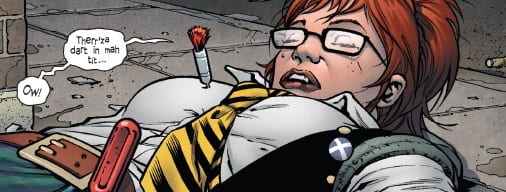
Look at Riotgirl; at first glance, she looks like a rebellious schoolgirl. But this appearance is deceiving, as her psionic abilities make her a powerhouse on a team that’s full of people with remarkable powers.
Riotgirl’s red hair makes her stand out every time she’s on the page.
Hugonnard-Bert’s influence as a co-inker is clear, as the fact the talking characters have bolder outlines demonstrates their importance to the narrative in each scene.
The colors by Gough give each of these characteristics enough room to stand out, too. Riotgirl’s red hair naturally draws the reader’s eye, and the accessories on her uniform, like the four-leaf clover and Scottish flag buttons, serve as ways for readers to identify her.
Finally, the lettering by Mauer and Krotzer gives every voice a reverberating feel. The screeching sound effects of White Devil’s origami pterodactyl stunt feels sudden and unexpected. Meanwhile, every conversation has a pulpy touch in how it is presented. A UN officer getting kicked in the crotch by Riotgirl before he finishes making fun of her name makes the reader chuckle. These are just a few ways that the lettering adds to the story.
The Unthinkables #1 Earns Its Name
The Unthinkables #1 is a hilarious action-comedy that’s flying under the radar. The book’s worst downside is that readers will have to wait awhile for the next issue. For now, readers can find the first volume on digital platforms like the company’s store, Comixology, DriveThru Comics, and Global Comix, and the physical copy is also available.
What do you all think? Is this the start of something that will keep your interests?
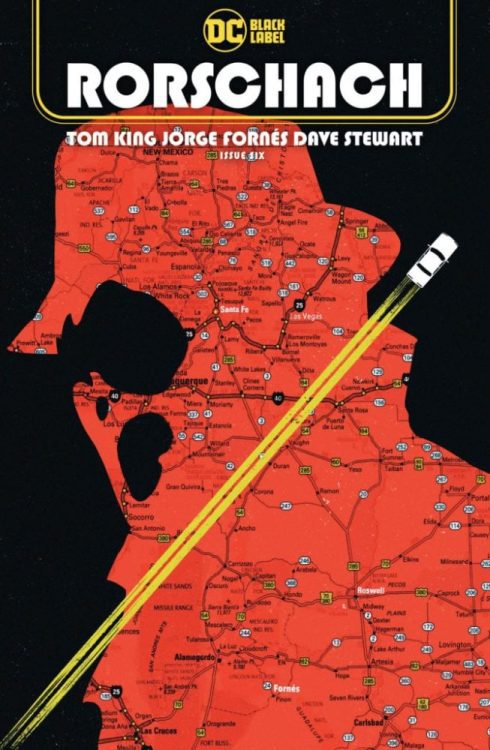
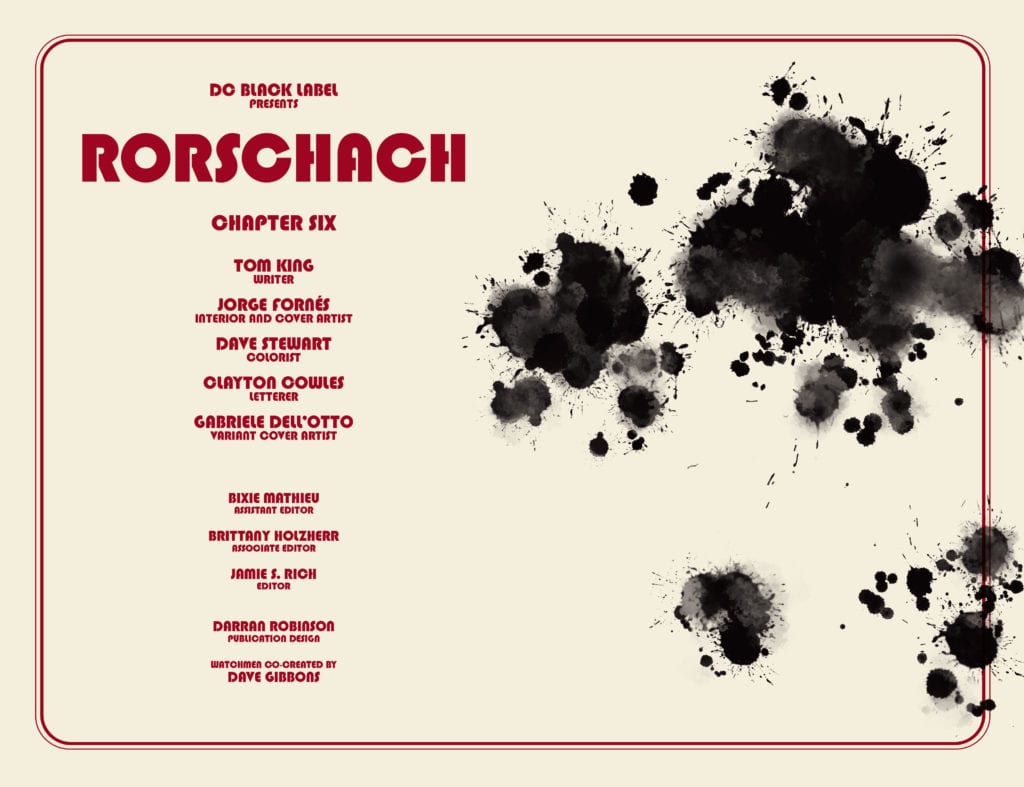
There’s a comfort to be found in a well told story. When you know you’re in the hands of a creator who knows their craft, you can relax. You know they’ll hit all the right beats, you know their conclusion will be satisfying. But there’s a safety in those stories too. We don’t read those stories on the edge of our seats. It’s only when stories go off the reservation that our hearts rise to our throats. We nervously worry, because with big risks can come big disappointments. Or big payoffs. Writer Tom King, artist Jorge Fornes, colorist Dave Stewart, and letterer Clayton Cowles’ Rorschach #6is a risky story, and it’s damn beautiful.
Writing
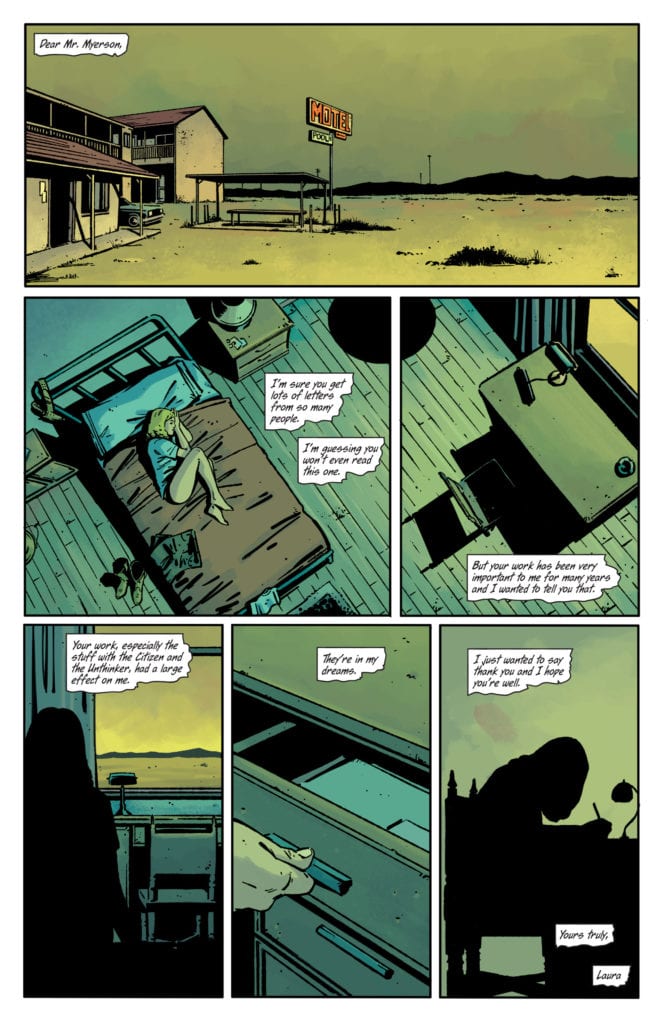
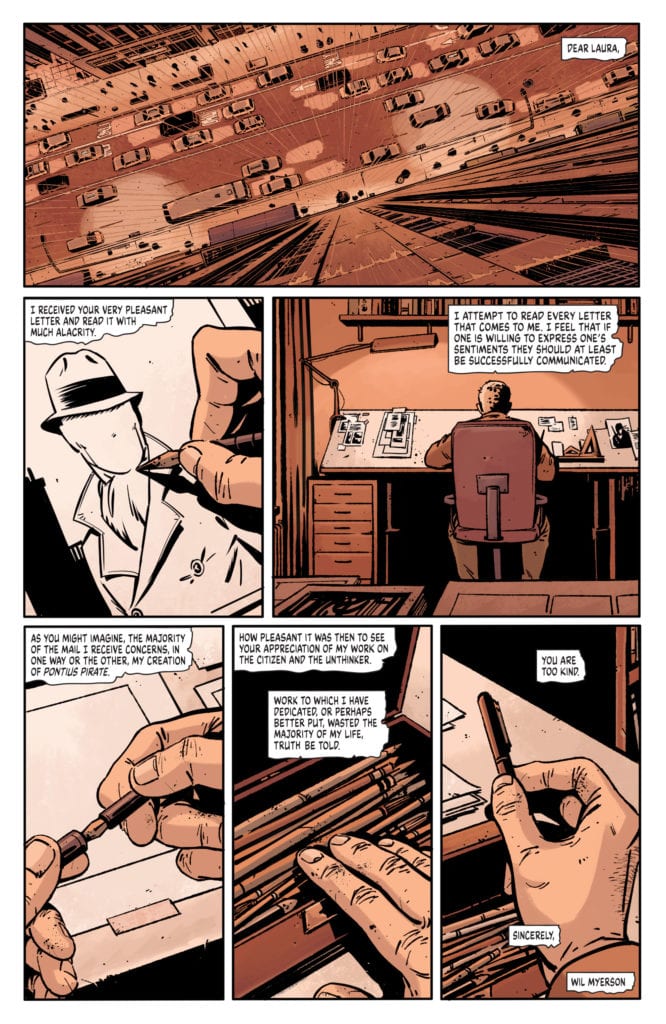
King’s script isn’t full of splashy comic book mayhem. It’s just a simple letter correspondence between The Kid and Rorschach. Laura, The Kid, is a 19 year old girl. She writes to Wil Myerson, an aging comic book writer who has been revealed to be this title’s Rorschach, to talk to him about his work. It’s easy to forget that King wrote Laura’s letters. They’re awkward, clunky, and full of angst. When Myerson responds, he does so in the polished tone of a professional writer.
But as the correspondence goes on, each writer begins to influence the other. Laura stumbles through heartfelt summaries of her life and Myerson philosophizes about his time on earth. But soon, Laura is philosophizing and Myerson is confessing his many disappointments in himself. It’s a stunning script, full of relatable lines that feel so organic to the characters. After this issue, we can finally understand this mysterious duo. And it’s hard not to see ourselves in them, despite their many misdeeds.
Art
Fornes teaches us why these two have such a strong connection. His depictions of Laura mirror his depictions of Myerson, and vice versa. These are truly kindred spirits. When Laura talks about a time she was sitting in a church and she had a vision, Fornes leaves us with one final panel of her looking up at the vision with a smile on her face. So, when Myerson recounts a similar story, Fornes repeats this. We see Myerson as a little boy, looking up at the monster he’s imagining, with a gentle smile. But the two face each other. Laura is looking off of her page into the next and Myerson faces the page that came before. It’s as though Laura and Myerson are looking at each other, through the panels that are between them. These aren’t two separate moments, but one that they’re sharing, across space and time.
Coloring
There’s a kind of color coding Stewart uses in this issue. He presents scenes featuring different characters in particular hues. Laura’s memories are yellow. Myerson’s memories are red. The modern day scenes are often shown in a blue or purple hue. When Laura and Myerson finally meet, the scene settles into a bright orange. We see how these two are affecting each other’s whole world. Myerson’s outlook is being brightened by Laura, and she’s beginning to understand the bloody undertones of life. And in the final page, the blank card stock between the last scene and the back cover, Stewart does something subtle but brilliant. The page looks like it’s stained by blood. But it’s old blood that landed unevenly. So, the page is covered in the deep reds and pale yellows of dried blood. It’s one final reminder of where Laura and Myerson’s story is headed.
Lettering
It’s through Cowles’ alignment of captions on the page that so much of each letter’s tone is conveyed. When Laura first writes a letter to Myerson, the captions are scattered about. She seems sheepish and maybe a little panicked. And when Myerson responds, it’s just a little bit tidier. He seems to be laid back in his response, just as are eyes can almost lazily scan the page and take it all in.
When Laura responds, the captions all line up on one side of the page. It’s professional, careful, and it’s suddenly aware of the fact that Myerson is actually going to read it. This goes on throughout the issue. There are moments where captions overlap each other, like Laura or Myerson are itching to communicate that next line, and there are captions that have huge gaps between them, like they feel pained by the fact that they have to say goodbye. Cowles sets the roadmap for Laura and Myerson’s relationship and seamlessly shows us how the two grow together.
There’s so much to say about DC Comics’ Rorschach #6. It’s a script that feels real and true to life. This creative team isn’t playing by the rules anymore. They’re going to tell a story that might scare us. It’s not a story that’s full of heroes and villains. It’s a story that’s dominated by human beings, in all their dangerous glory. We come to see and even understand where even the most extreme characters are coming from. Pick up Rorschach #6, out from DC Comics, at a comic shop near you! It’s a must read!
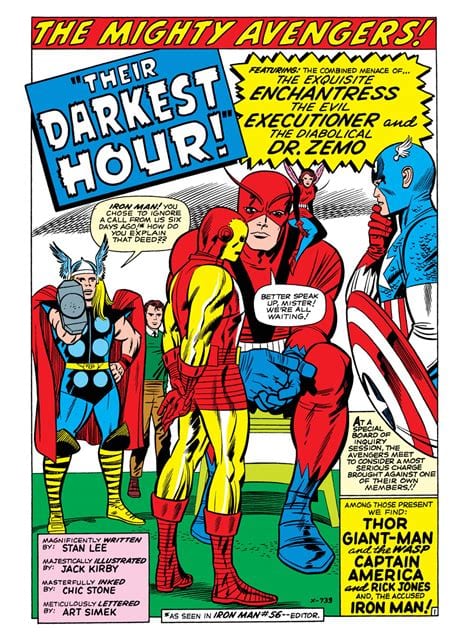
Going back to basics has always been an entertainment franchise’s go to method of reigniting interest. Unfortunately, this method of soft reboots is starting to show its flaws in recent Iron Man comics. By highlighting Tony Stark’s roots from the 60s, readers see how repeating past successes can be very limiting. Because characters like Iron Man only become popular after a number of developments.
The Man in the Iron
This run is going back to basics without context.
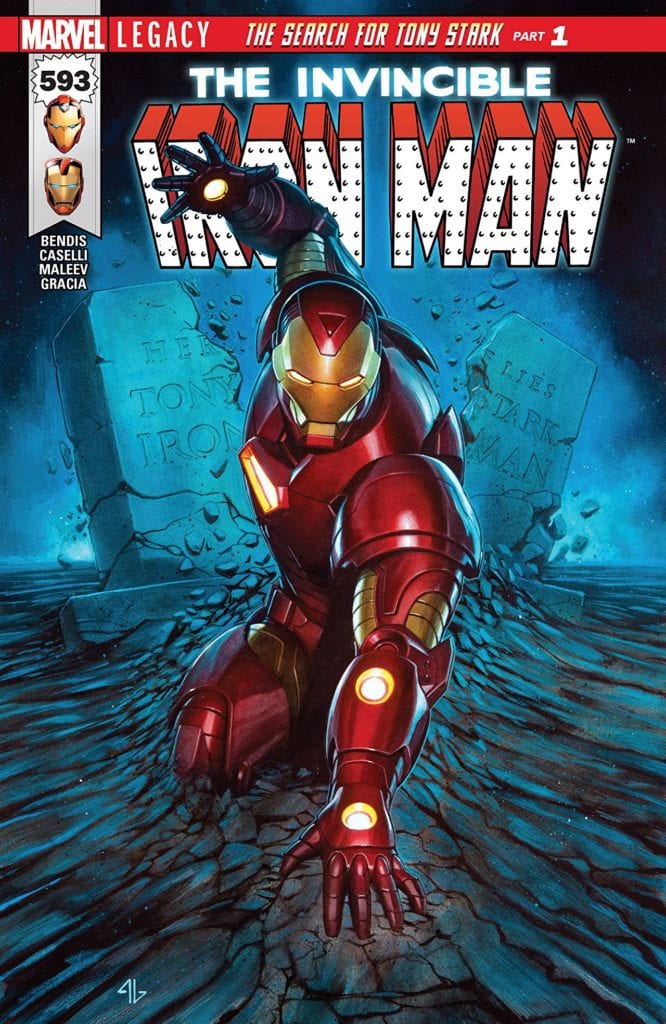
Let’s look at Iron Man. It should be no secret that everyone finds this character familiar. This is, in no small part, thanks to the MCU movies with Robert Downey Jr. The problem is, starting in 2012, the comic franchise becomes full of hits and misses. So far, the only exception is the Christopher Cantwell series which bills itself as back to basics. After a rough start, the fourth issue and onwards got great review scores. It seems to have something to do with Cantwell’s commentary on the back to basics trope.
The Problem With Iron Man
Going back to basics has always been about driving up interest with nostalgia. The problem with applying this to the comic book Iron Man is that despite his popularity, he wasn’t designed to be a very likable character.
In an interview with Stan Lee for the Iron Man movie release on DVD, he admits he created Tony Stark as someone people would love to hate. Iron Man is a playboy billionaire who profits by selling weapons. Unlike Bruce Wayne, who serves as a masquerade for Batman to help people, Iron Man is just Tony’s way of securing his assets from government powers like SHIELD. No one’s going to use Stark technology without his consent or royalties.
Time To Stop Playing Karaoke
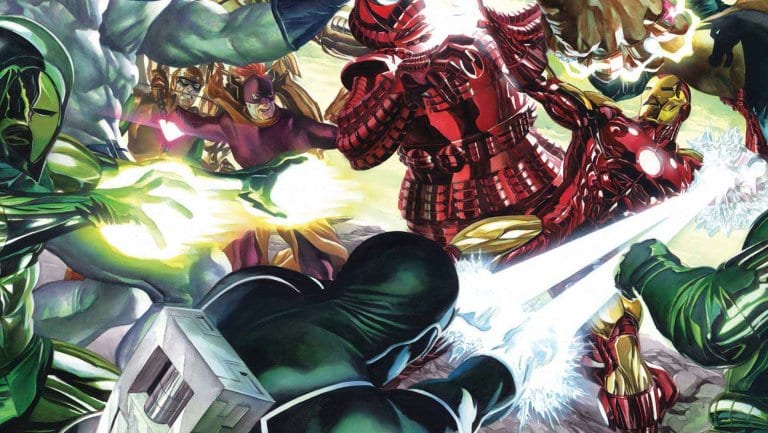
Some of the suits look terrible.
Going back to basics might be a good idea for entertainment after so much absurdity, but it doesn’t work on characters like Iron Man. Because at his most basic, Tony Stark is a caricature of corporate profiteers. The guy builds more million dollar flying suits than he knows what to do with. In all honesty, with real billionaires regularly making the news, Tony the eccentric rich guy is irrelevant.
Can’t get anymore basic than sales gimmicks.
Which is why Cantwell’s series goes out of its way to change course by the fourth issue. After acknowledging his self-pity and ego amid a mid-life crisis, Tony regains his confidence after seeing his friends, like Rhodey, in danger. When dealing with somebody as powerful and intelligent as Avengers enemy Korvac, it brings out a favorable Iron Man trait. Tony Stark has always been a futurist, which is something that drives him both as a scientist and as a tactician. It’s what allows him to stay ahead of opponents, even the ones he acknowledges are smarter than him… like one of his own suits.
Don’t Look Back Shellhead!
Going back to basics might work for characters and franchises that get too absurd for their own good. For characters like Iron Man… not so much. The Iron Man comics hit their highs by dealing with Cold War themes that eventually fade away. Besides, does anyone really want to see a recovering alcoholic going through addiction all over again? I certainly don’t.
What do you all think? Did Cantwell plan for this tackling of soft reboots, or was this just a quick realization?
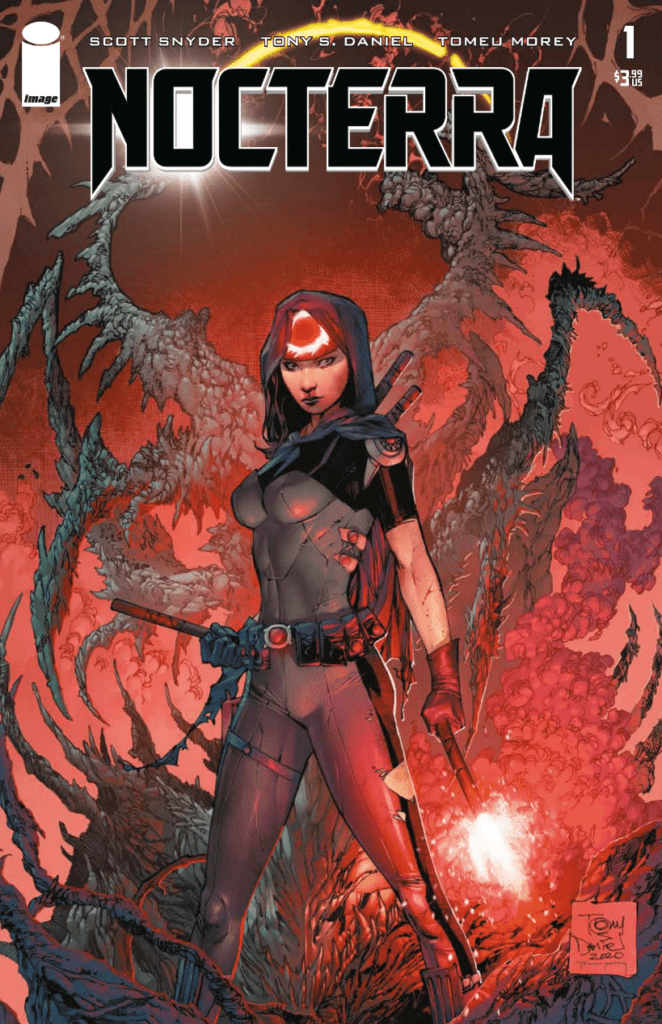
Nocterra #1 out now from Image Comics is an exciting introduction to the insane new dystopia that the series is set that still leaves much to uncover.
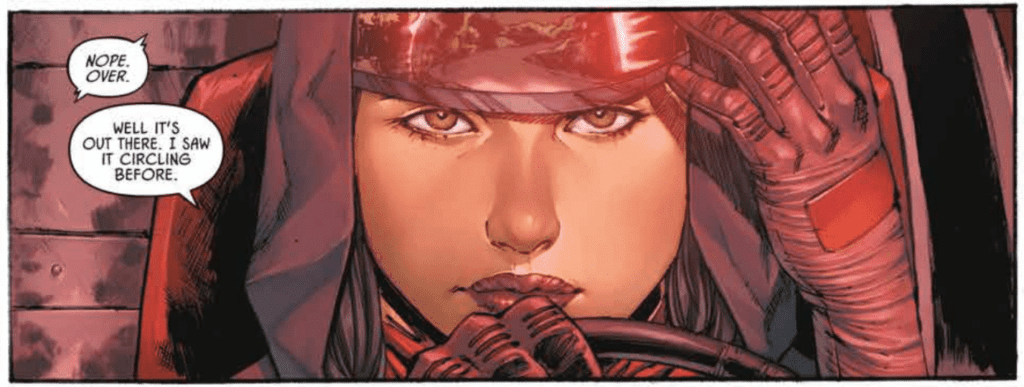
Scott Snyder does a brilliant job of introducing the reader to a new world in Nocterra #1. The issue begins with a flashback to when the entire world was bathed in everlasting darkness. We then get to see the present day, ten years later, where we are introduced to our main character, Val Riggs, who transports people between outposts in this nightmarish dystopia. Through the use of captions, Val introduces us to the monsters that live in this new world and explains many of the significant changes that have occurred since the darkness began. Snyder’s choice to reveal all of this information so early in the issue prevents the reader from being so confused that they can’t enjoy the story, but it also doesn’t reveal so much that the world is devoid of mystery. For example, we have yet to find out what caused the world to become dark and have yet to see every type of monster that inhabits this new world. There’s plenty of this dystopia left to explore, and this first issue does an incredible job of exciting the readers for what lies ahead.
Tony S. Daniel’s art style fits perfectly with a comic book such as Nocterra #1. His forms are so dynamic that they bring action scenes to an entirely new level. Other techniques such as dramatic angles and overlapping panel borders also help to immerse the reader into the issue and make for some captivating action sequences. Daniel also fills the issue with stunning character designs. The monsters are genuinely creepy and make you look forward to the other versions of them you will get to see down the line. The series’s main character clearly has a striking costume, but it is also worth noting the other fashion of background characters. Each is wearing something cool and unique, such as one character wearing a squid over his head, and this attention to the styles of background characters helps cement the cool dystopian aesthetic of the series.
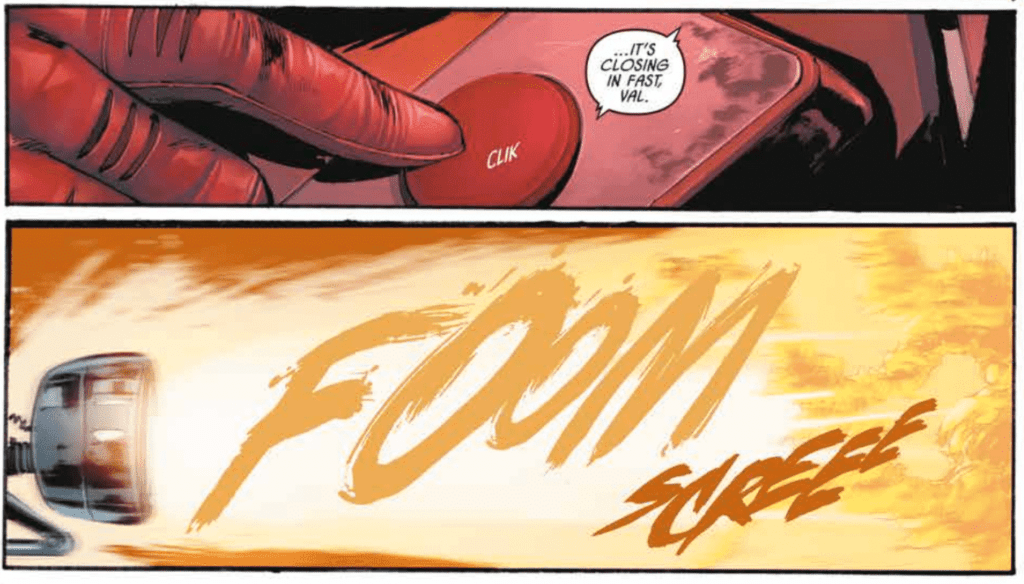
Nocterra #1‘s coloring is unique because the world is entirely devoid of natural light except for in a few flashbacks. Tomeu Morey does a spectacular job of portraying this, whether through harsh lighting in poorly lit rooms or a golden hue given off by a well-lit outpost. We also get to experience some gorgeous lighting during scenes outside of civilization, where the only light comes from flares or lights strung on a truck. The red of the flare’s light and the truck’s blue result in an exciting color combination that you don’t often get to see, and I look forward to scenes like this in future issues.
AndWorld Design utilizes some classic lettering techniques in Nocterra #1 that fit phenomenally with the story and art. Whether that be by a caption overlapping a panel’s border to make it stand out or dialogue stretching past the edges of a speech bubble to show a character is in anguish, AndWorld Design knows how to tailor lettering to fit the story. There is also a character whose speech bubbles have an inverted color scheme, which beautifully compliments his design.
Nocterra #1 is a splendid introduction to an exciting new dystopia with so much left to be uncovered. The issue provided some thrilling action and set up an epic journey to follow.
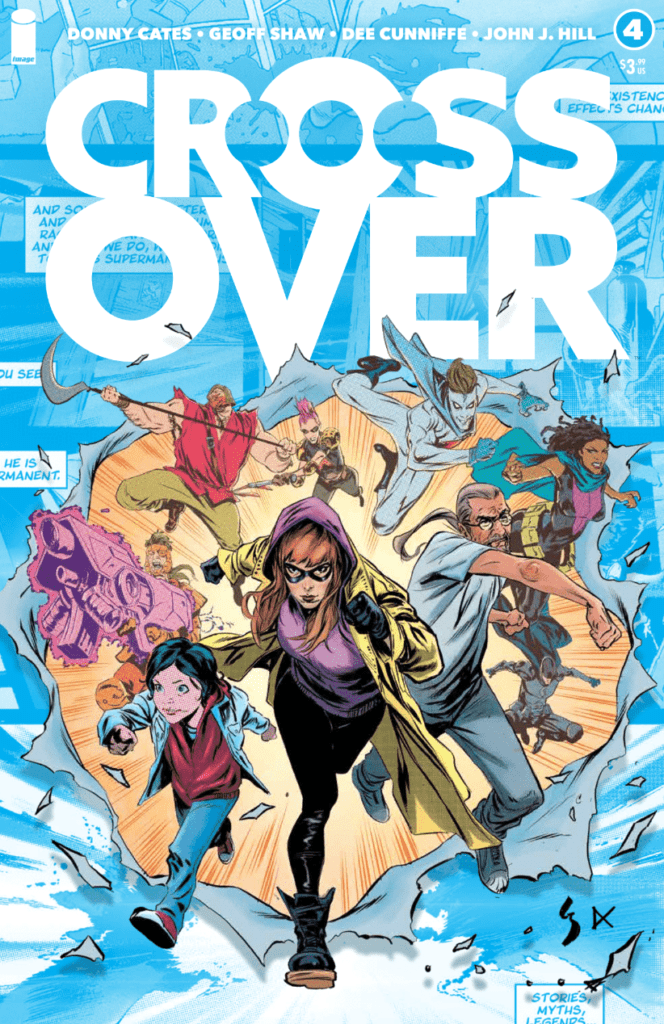
Crossover #4, out now from Image Comics, is a bombastic issue with such a gripping ending that will leave you with a need to continue following the series.
Donny Cates does a lot of things to keep this series’ story exciting, and Crossover #4 is where everything really starts to pick up. The issue continues to feature an incredibly nonchalant narrator, who will do things such as interrupt a scene, misremember the sequence of events, or have a character’s dialogue alter what they were in the middle of saying. This peculiar narration style is quite comedic and makes reading exposition a more entertaining experience. Another aspect of what makes this issue so notable is its ending — or should I say endings? I wouldn’t dare spoil such an exciting reveal, but rest assured, Crossover #4 is worth purchasing to see the insane new path the story will be taking.
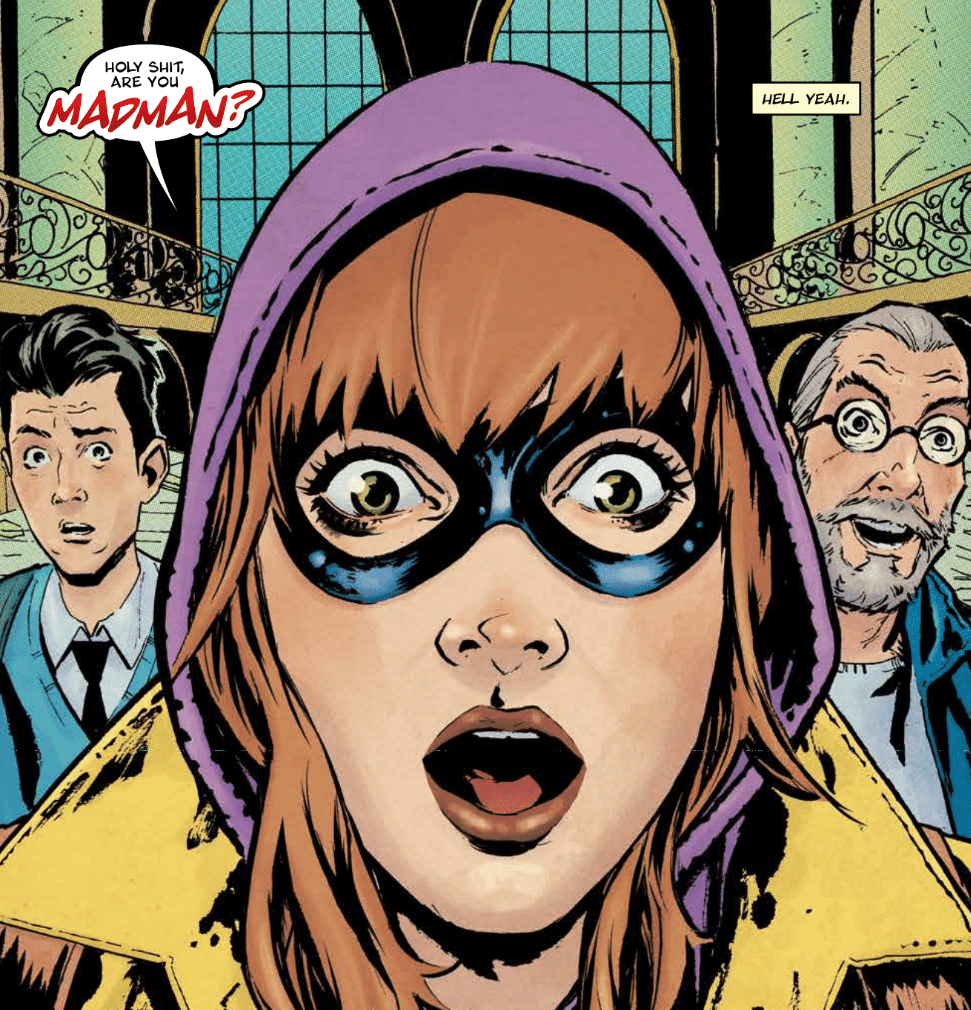
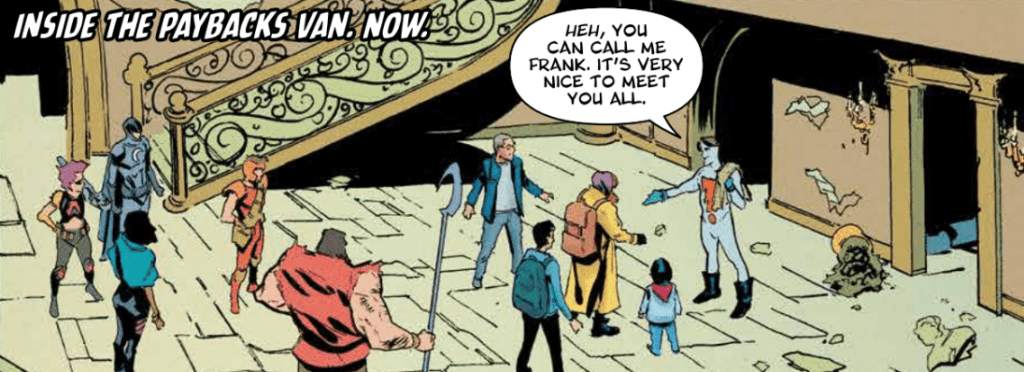
Geoff Shaw’s contrasts between comic book characters and the characters from the real world are astounding. The comic book characters have an idealistic physique and a naturally heroic attitude that distinctly sets them apart from the real-world characters, who have various statures and physiques. For almost all characters in Crossover #4, it would be easy to tell which characters belonged to which world even without the dotted design placed on the comic book characters. The issue also features a brilliant double splash page of Madman in combat. It shows multiple actions at once and is a fun moment with a classic comic book feel.
Crossover #4 wouldn’t be nearly as enjoyable without Dee Cunniffe’s colors. He does such a phenomenal job at giving the comic book characters a classic feel and the real world a grim one. The contrast of the colorful comic book characters against the bleak background creates a unique style that helps the book stand out.
John J. Hill makes the dialogue of Crossover #4 pop. Whether that be through applying emphasis to specific words or giving a unique font to essential characters and items when they first appear, Hill makes sure that the reader clearly comprehends critical moments in the dialogue. Hills also gives some sound effects a color that heavily contrasts with a scene’s background, which adds energy to the moment.
Crossover #4 may be the best issue in the series yet, and it paves the way for many exciting things to follow. The art and colors work together to make a fun and unique style for the comic book characters interacting in the real world, and the lettering assists the story so that it can flow uninterrupted. This is one issue you do not want to miss.
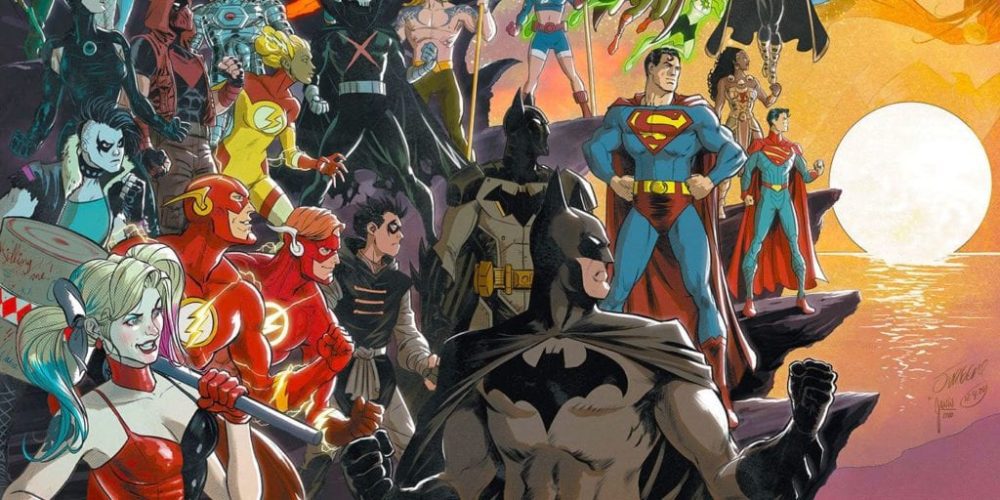
Though DC Comics has launched several line-wide reboots, the premiere of its latest initiative in Infinite Frontier #0 has successfully excited even the most jaded comic fans. It’s a book filled with the promise of a brighter tomorrow. Possibilities jump off of every page, and many readers, from long-time followers to casual fans and everyone in between, can’t wait to see what happens next. This debut issue is the perfect comic for the world right now, both the one within the pages of the book and the real one we’re all living in.
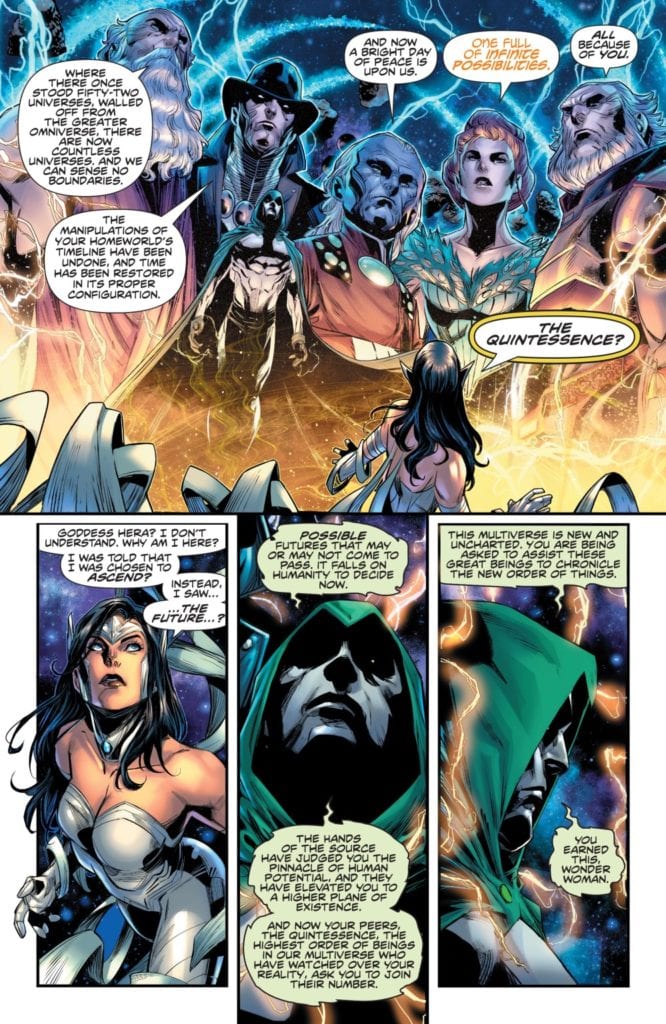
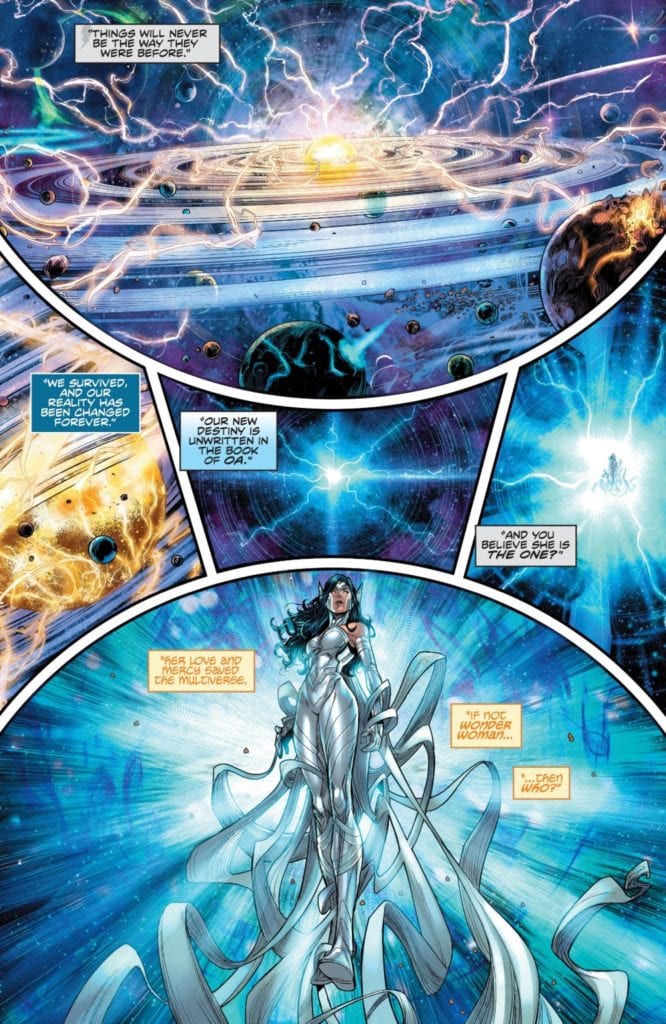
The buzz generated by Infinite Frontier #0 is genuinely remarkable. The main story, written by acclaimed scribes Joshua Williamson, James Tynion IV, and Scott Snyder, turns DC on its head by revealing that the universe is limitless. Even on page one, the reader learns that the destiny our beloved heroes face is unwritten. Truly, anything is possible in this new world order. This monumental change is a stark departure from the DC Universe fans had become accustomed to.
Whereas the multiverse was once contained within somewhat loose boundaries, even after the Source Wall broke, the stories that DC can tell are now infinite. Throughout this highly anticipated issue, Wonder Woman acts as a tour guide, and she shows the reader just a small sample size of what’s to come. From Black Adam’s return to the devastating attack on Arkham Asylum, the core trio of writers present a new status quo that’s exhilarating.
Every step of the way, Infinite Frontier #0 is full of hope and possibility.
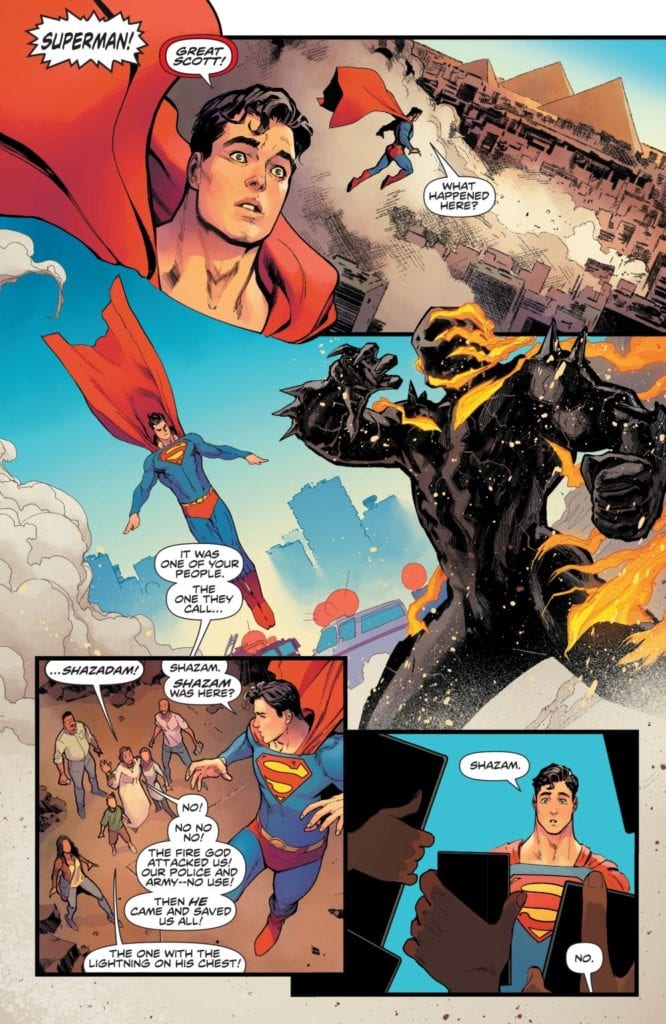
The artwork also reflects the optimism that’s evident throughout the entire story. Dire events like Dark Nights: Death Metal were appropriately dreary, but this tone quickly pervaded the majority of the DCU. Thankfully, Infinite Frontier #0 is filled with bright, joyful colors that make it impossible not to smile. This effect is especially apparent during the second Superman snippet, written by Phillip Kennedy Johnson, illustrated by Jamal Igle, and colored by Hi-Fi.
Other excerpts are also good examples, but it’s fitting that Superman, in this case, Jon Kent, is an embodiment of this renewed hope. Sure, the scene might require striking colors to capture the galactic nature of extraterrestrial threats. But even when Kent is flying by the iconic Daily Planet globe, there’s something powerful about the dazzling, electric blue sky in the background. It’s a new dawn, it’s a new day, and DC fans should definitely feel good by the time they’re done reading Infinite Frontier #0.
Superman embodies the optimism seen in Infinite Frontier #0.
At one point, it’s a story about romance and finding your way back to the ones you love. Williams Green Arrow & Black Canary portion of the book reunites one of DC’s most recognizable couples. This section, illustrated by Alex Maleev and colored by Jordie Bellaire, shows that Oliver Queen and Dinah Lance are back together. The reader gets to see an intimate moment for the couple, and the scene does just enough to warm the fans’ hearts and lure them in for the next chapter.
Infinite Frontier#0 makes several statements, and one profound scene stands above the rest. In the Green Lantern: Alan Scott teaser, the legendary hero bravely comes out to his children, Ophidian and Jade, and they warmly embrace their father. Scott explained how he felt compelled to reveal his true self ahead of his new mission as the sentinel of the world.
Tynion IV punctuates the emotional moment with a poetic description of Scott’s actions, stated by both the Green Lantern and his son. “No fear,” they both say, a moment that beautifully captures Scott’s bravery and pairs it with his duty as a Green Lantern, a line of heroes who are known for their courage and their ability to overcome fear.
This excerpt about Scott takes Infinite Frontier #0 to another level, as it tells the reader that this book is very much a reflection of, and maybe even a proclamation about, the modern world. Scott’s valor and the touching response he receives from his children speaks to the acceptance and understanding that this world needs right now.
Infinite Frontier #0, shows how heroes can write their own destinies
From there, it’s easy to reflect on this book’s numerous connections to the real world. First, it’s refreshing to see an extensive gathering of DC’s heroes. In some ways, the book reads like a family reunion, an experience that makes the reader think of the distance that’s caused by life during a pandemic.
Countless people have been separated from their loved ones due to travel restrictions. Watching these characters come together, even indirectly, is a welcome change of pace because it adds a timely example of comics’ ability to be an escape. Reading this reunion unfold on the page makes the reader hope for a world where everyone can reconnect with their loved ones.
As nice as that is, perhaps the leading reason why this book is so profound can be seen in its metaphorical meaning. For roughly a year now, the world has been trapped in COVID-19 mode. The pandemic has dominated nearly every facet of life, from responsibilities like school and work to freedoms like dinner dates and concerts. Life before COVID-19 has become a distant memory, and life has felt like a perpetual cycle of fear, restriction, and despair.
For months, the pandemic has rewritten the story of day-to-day existence. Across the globe, people are locked into this new way of living. It can be hard to find hope for the future when, more often than not, COVID-19 has cursed the world to suffer that aforementioned vicious cycle.
But that’s where Infinite Frontier #0 comes in. Enough doom and gloom. Yes, this book is actually about how incredible heroes can now experience an immeasurable variety of new possibilities and destinies. But the issue serves as an eye-opening reminder about the nature of real life. While the pandemic will continue to hinder life as we know it, people have the chance to write their own stories every day.
Life is whatever you make of it. One can choose to get bogged down in the anguish that’s often associated with the pandemic. On the other hand, one has the opportunity to rise above, make the most of it and follow their dreams, whatever they are.
That’s the heart of the story in Infinite Frontier #0, as it shows the reader how everyone can be their own hero.
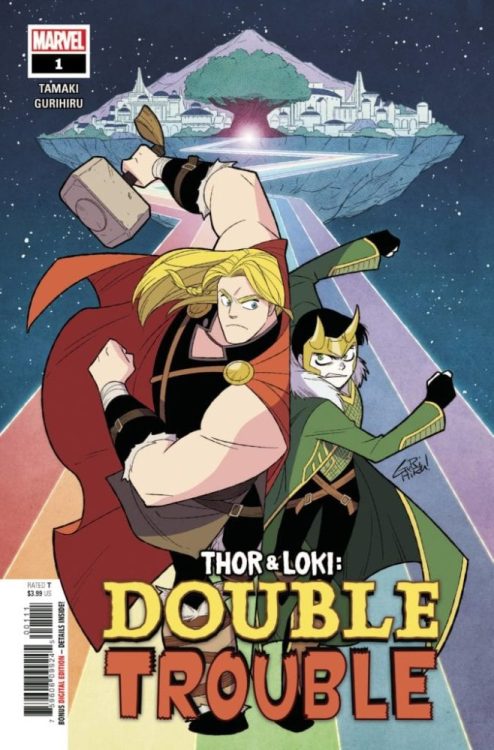
Thor and Loki: Double Trouble #1 is out on March 10 from Marvel Comics. Writer Mariko Tamaki depicts the titular Asgardian brothers’ intense rivalry with teenage levity. To bring that feeling of levity in cartoonish full is artist duo Gurihiru. Finally, VC’s Ariana Mahler as letterer makes every word on display have a sense of ironic weight to them.
Thor and Loki: Double Trouble #1 Summary
Tamaki gives a quirky take on Thor and Loki’s relationship. These two foster brothers have always been bitter rivals, so going into their teenage years is a nice change of pace. Rather than rehash the usual cat and mouse game, Thor and Loki: Double Trouble #1 plays everything for laughs. Being teenagers allow the brothers’ attitudes to be a little more bearable and funny. Because who really wants to watch two adults get into one another’s business… again? Teens can allow suspension of disbelief a little easier, especially when depictions like these show humanizing flaws.
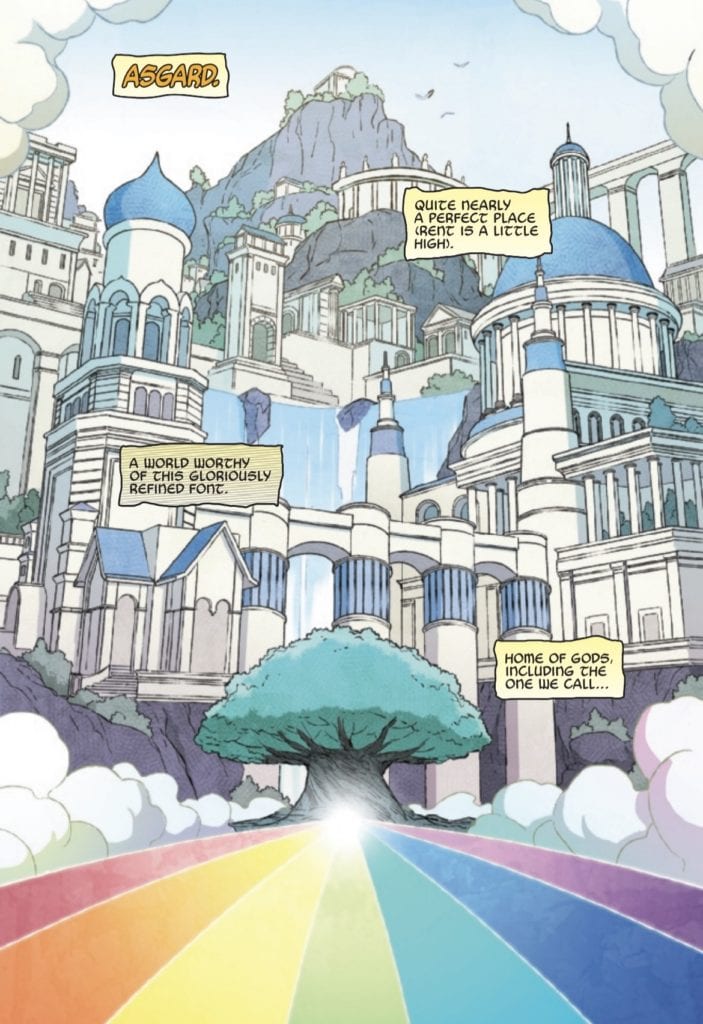
There’s a balance of being self-aware and self-conscious about the setting and characters. Introductions to Asgard make it out to be this practical paradise that prides itself on the classical font Asgardians in several series make use of. Thor likes to show off in his belief of being the strongest Asgardian. At the same time, Loki is always ready to play Thor’s ego against him so Loki can feed his own ego. Despite all of the legends and myths surrounding Asgard, the people living in it, including these brothers, are still people.
Hijinks Of Legend
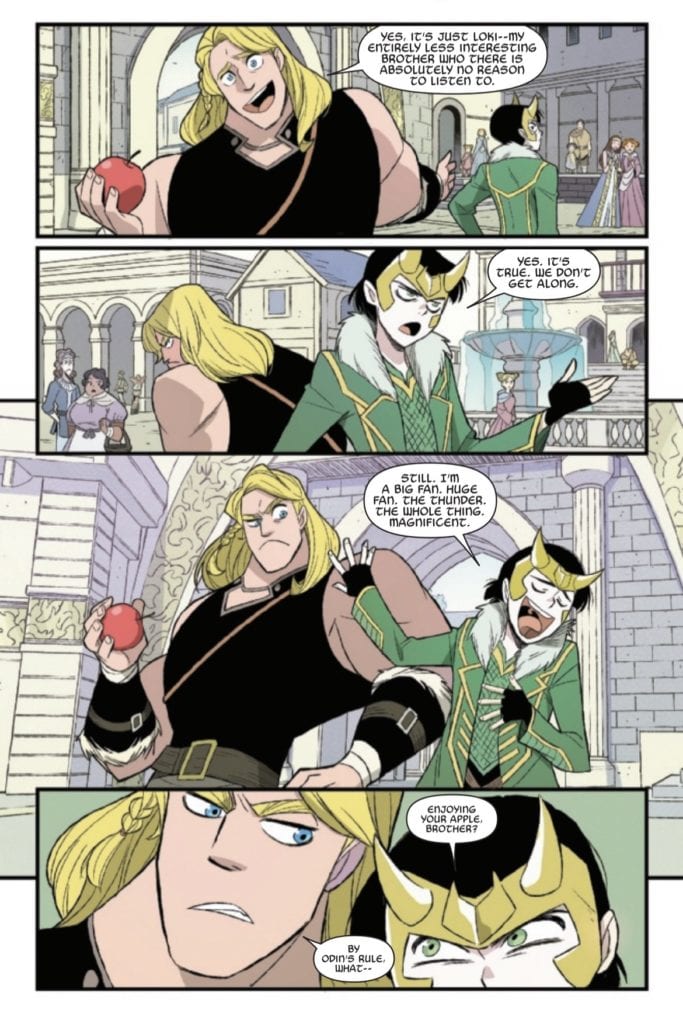
Gurihiru never strays away from depicting characters in humorous ways. Thor’s large frame and straightened facial features often make him look like the most notable person in view. Using Mjolnir and lifting a statue over his head is certainly a way to get the reader’s attention. To counteract his brother’s showboating, the lankier and round facial featured Loki often appears in Thor’s background. That is until the use of his magic and trickery has Loki steal the spotlight only to give it back to Thor to make him look bad. Annoy him enough by stealing an apple as a horse, Thor’s ready to attack.
The lettering by Mahler never misses a beat in its presentation. Steady guidance through captions introduces the setting until a big introduction to Thor in bold letters. That’s a sequence that lines up perfectly with Thor’s character. So with Loki lacking any announcers, he has to do it himself. So what better way to steal Thor’s thunder than with a few slow-clap SFX as his introduction? His word balloons directly cutting off Thor only adds to this character dynamic.
Relax With Thor and Loki: Double Trouble #1
Thor and Loki: Double Trouble #1 begins a series that will be a good pass time between all the bigger releases. Instead of big world-ending events, it’s nice to see Thor and Loki’s sibling rivalry with cartoonish flair. Heck being teenagers means they can get away with it without making themselves look too stupid.