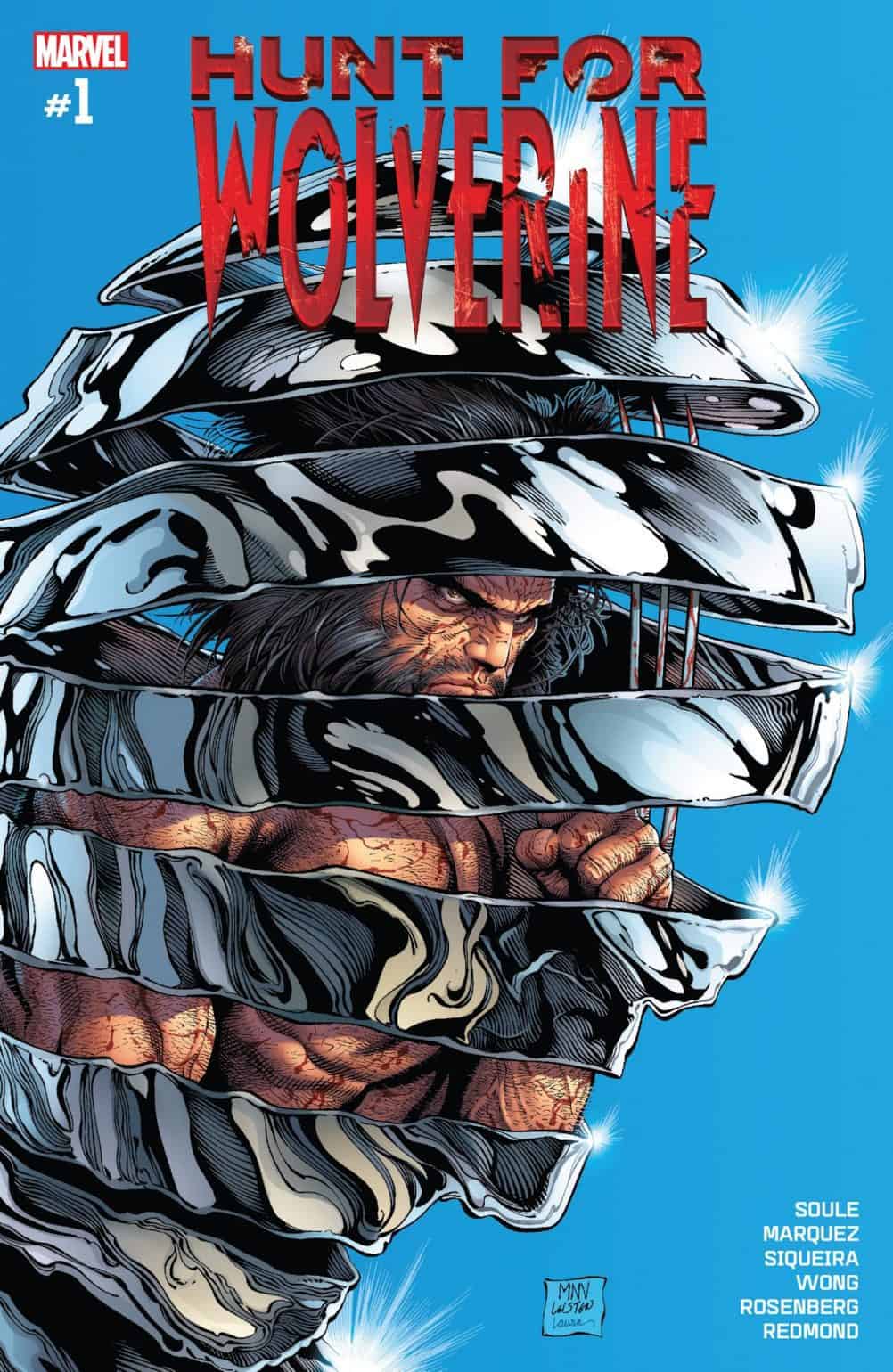
Logan, our original Wolverine, had been dead since 2014 before being resurrected in the Marvel Legacy #1 primer issue. Death Of Wolverine was a big deal. It was a really powerful and fitting end to one of Marvel’s most popular characters. Now Hunt For Wolverine begins and tries to bring back our favorite Canadian mutant in an equally effective fashion.
***SPOILERS LIE AHEAD***
Writer Charles Soule assembles a mighty fine team of David Marquez, Rachelle Rosenberg, Paulo Siquiera, Walden Wong, and Ruth Redmond to help him tell these two stories that kick-off our search for Wolverine.
Since his official Marvel Legacy return, we’ve seen Logan appear in the “Where’s Wolverine?” after-credit pages across Marvel’s line of comics. This first issue doesn’t give us much actual Wolverine-time. Charles Soule first tells us what shady secrets the X-Men leaders were keeping about their departed ally. It wouldn’t be a crucial X-Men story without scandalous secrets coming back to bite them in the ass!
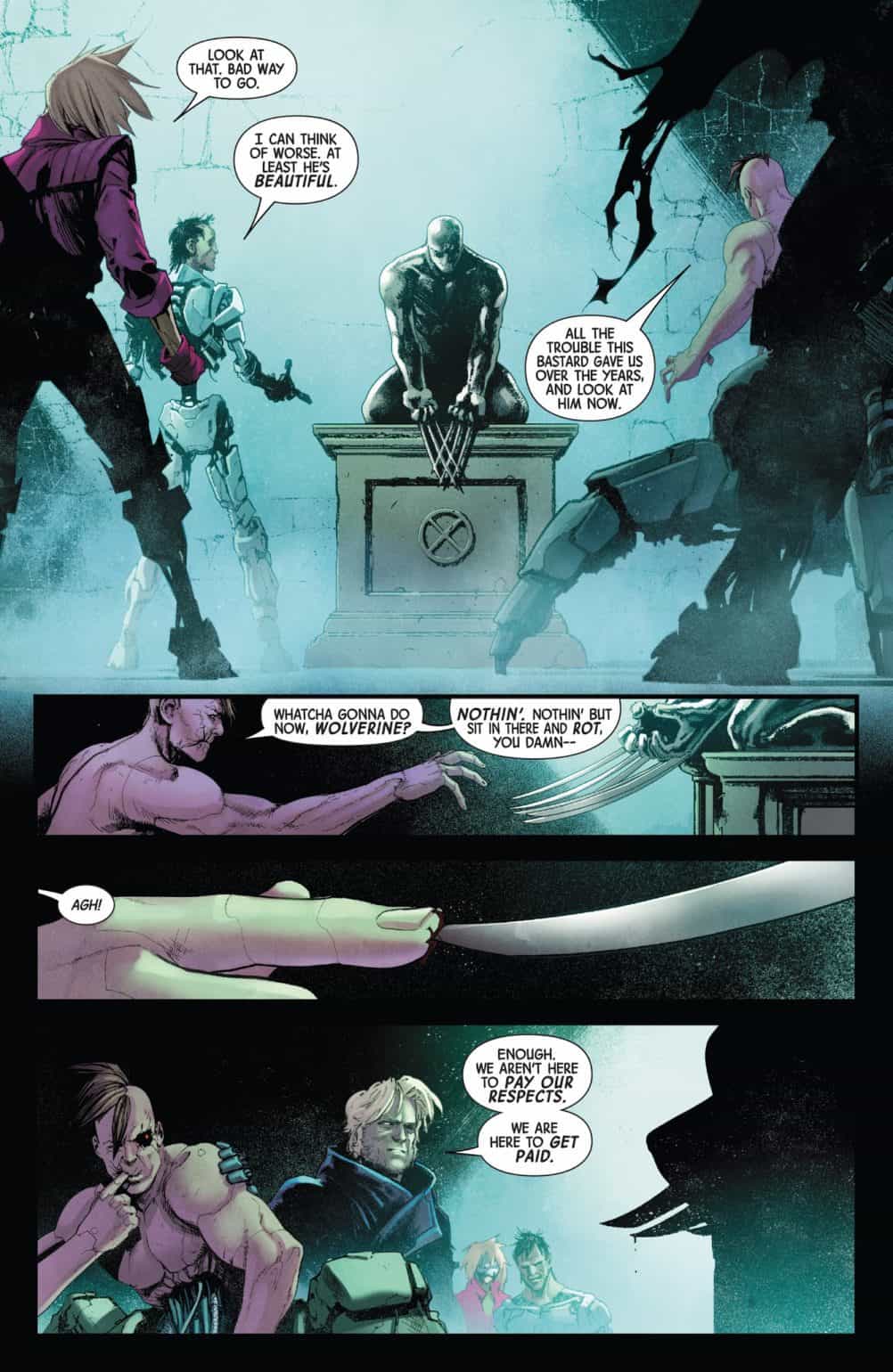
Soule cleverly tells a story within in the cracks of continuity. These two tales avoid feeling like cheap retcons and instead add more color and understanding to pivotal moments like young Jean Grey welcoming back a vacant adamantium Wolverine statue. A scheme by The Reavers forcing things to go public, and jump-start this search, was a delightful choice.
This may not be Soule’s strongest effort, but he’s by no means phoning this one in. Hunt For Wolverine #1 lets us all know that bringing our Logan back is a big deal that will be handled delicately. Charles Soule is a name you can trust pretty much any time you see it on a comic book cover, especially a Marvel one.
The involvement of teen Jean and Tony Stark is a bit confusing as far as the timeline is concerned, even for a weekly Marvel die-hard. There’s additional frustration in the fact that this story will be told across a number of differently titled one-shot issues. It almost seems like a conscious effort to confuse readers trying to jump back in on X-Men comics.
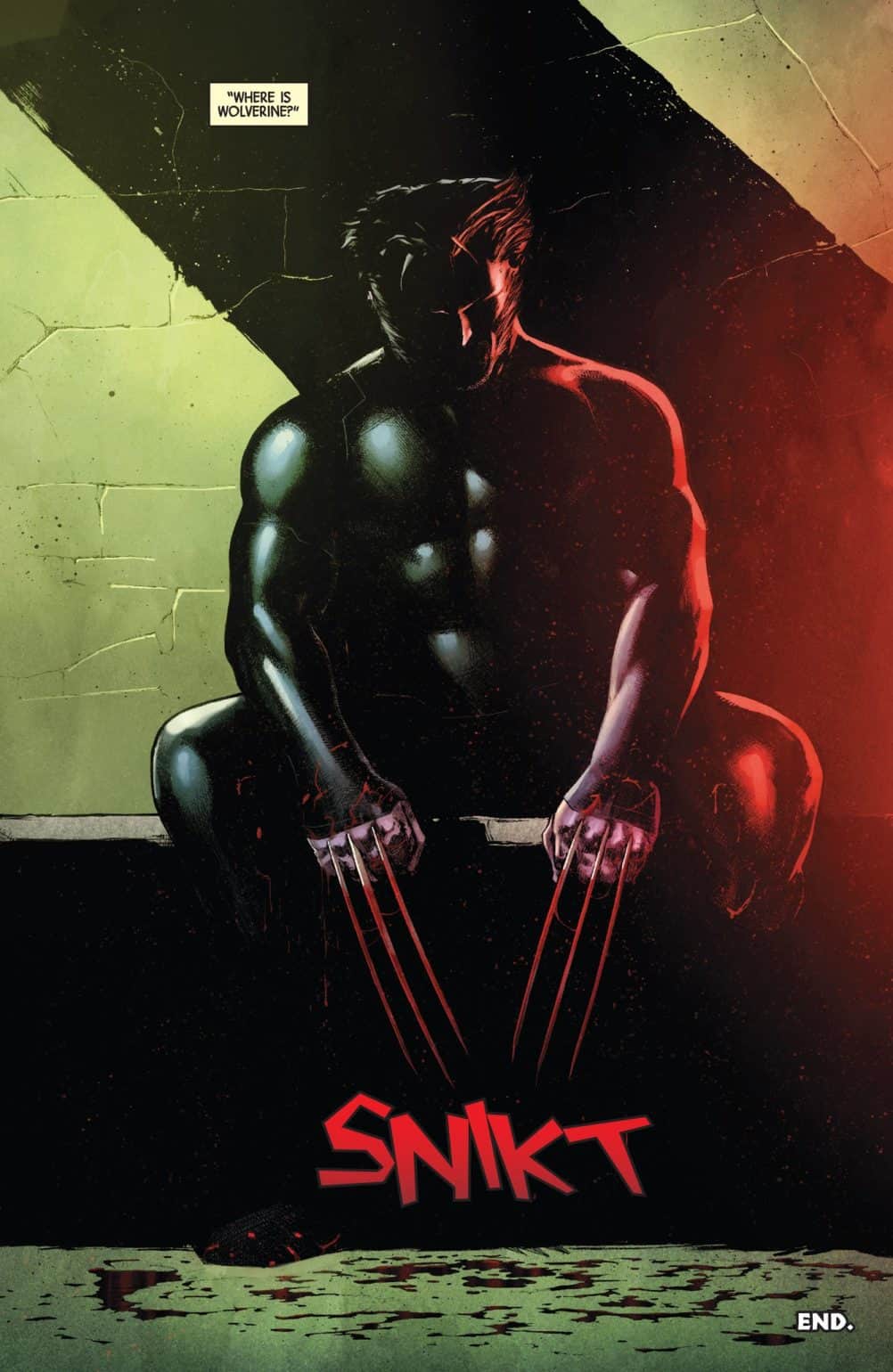
Both stories are illustrated wonderfully by their respective art teams. The Reavers look great, in all their broken-down and rusted glory. There’s a strong cinematic feel to these layouts and panel composition. It reads like the opening sequence to a sci-fi/martial arts epic, which is exactly the tone one would expect from an event centered around Wolverine.
We leave this issue with way more questions than when we came in. The good news is these mysteries are interesting and Logan seems to be in good hands. The bad news is that you’ll have to be a little more alert and aware in making sure you don’t miss any chapters in this story.
Playoff fever was in full force on April 25th, but a very different kind of highly anticipated television event was also airing. The Handmaid’s Tale season 2 premiere had the NBA and the NHL — as well as the MLB and MLS in non-playoff action — to compete with.
Of course, The Handmaid’s Tale attracts a typically different demographic from that of playoff hockey and basketball, but that doesn’t make it any easier to wrench the remote out of one’s playoff-enthused family member or roommate to watch two hours of depressing television about the patriarchy’s inevitable destruction of the American dream.
That’s not to say that the season 2 premiere was bad — it was amazing — but it was undeniably depressing…even more depressing than watching the Leafs lose to the Bruins. And, speaking of Boston sports teams, this double-feature premiere made some serious nods to another Boston team and their storied home field.
The Handmaid’s Tale Season 2 Premiere: Part I, June – The Home of the Green Monster
Picking up exactly where season one ended, we see Offred in the back of a van. She and the other handmaids who refused to stone Janine to death in last season’s finale “Night” have been rounded up and taken to Fenway Park.
The handmaids, corralled by riot police and vicious-looking barking dogs, are shoved onto the famous field to see their destination, a huge gallows with a noose for each handmaid. Lit up by the dilapidated stadium’s still-working lights, the gallows looks both horrifying and spectacular, as if it’s the center of some twisted circus.
The Handmaid’s Tale Season 2 Premiere: Part I, June – “And the Lord sayeth, ‘Perform perverted theatrics that make them piss themselves with fear!’”
As hooded executioners put the ropes around each of the handmaids’ throats, the young women sob and, understandably, Ofrobert loses control of her bladder. The handmaids’ fear is misplaced though: the whole ordeal is just a perverted bit of theatrics. Aunt Lydia ambles into view spouting her usual rhetoric about His mercy and greatness. The handmaids are spared, but there will be consequences for their lack of faith.
Later, during an ironic punishment wherein the handmaids must kneel in the rain while holding stones, a fellow aunt mentions something to Aunt Lydia. Aunt Lydia exclaims that Offred has been keeping a secret: she is pregnant — Nick is secretly the father, not Commander Fred — and thus exempt from the punishments the other handmaids must endure.
The Handmaid’s Tale Season 2 Premiere: Part I, June – The Price of Defiance
Aunt Lydia escorts Offred into a dining hall and sets a healthy meal before her. A typically defiant Offred refuses to eat, so Aunt Lydia walks Offred to a locked room. Upon entering, they see a chained pregnant woman, Ofwyatt, whose bonds only allow her to walk around her unlit cell and lie down.
Aunt Lydia explains that Ofwyatt endangered her unborn baby by drinking drain cleaner, a pronounced chemical burn around Ofwyatt’s lips confirming Aunt Lydia’s story. Seeing the stark cost of defiance, Offred acquiesces to eat.
The Handmaid’s Tale Season 2 Premiere: Part I, June – “Everyone, let’s give Ofrobert a hand!”
The rest of the handmaids are lined up in front of Offred. After some cajoling, the young women form two straight lines, and Aunt Lydia retires to the kitchen. Aunt Lydia instructs Ofrobert to come to her, but when Ofrobert enters the kitchen the handmaid starts screaming. The aunts grab hold of her and maneuver her toward the stove where they handcuff her to a gas element. Ofrobert screams in protest and pulls her hand away from the flame, but there’s no use. The camera cuts to Offred placidly sipping her soup as Ofwyatt screams in pain.
The Handmaid’s Tale Season 2 Premiere: Part I, June – “Why, I remember a day when women could actually own property!”
Both “June” and “Unwomen” featured a number of flashbacks to the days just prior to the establishment of the Gilead regime. “June,” unsurprisingly, featured flashbacks that involve June’s (Offred’s) experience, and “Unwomen” focuses on Emily’s (Ofglen’s) experience.
Viewers see June and Luke making plans to have another child before each head out for work in the morning. After a lot of smooching and carrying on, June eventually manages to leave with their daughter Hannah. Later in the day we see June caught in a daydream. Her colleague interrupts her reverie to inform her that her phone has been going off. The caller turns out to be Hannah’s school, and when June calls back she finds out that Hannah has been sent to the hospital with a fever.
The Handmaid’s Tale Season 2 Premiere: Part I, June – “Hellllllooo, nurse!”
When June arrives at the hospital, she finds a nurse looking after Hannah. The nurse turns out to be a touch judgemental about the double-income lifestyle that June and Luke have been leading. Implying quite heavily that June and Luke are bad parents, the terrible nurse also keeps calling June “Mrs. Bankole” even though June informs her that her name is actually “June Osbourne.”
The awkward interaction over, June and Hannah return home to find Luke worrying over the news. As June lies in bed trying to soothe her feverish daughter, the news reports that martial law has been declared in the US following dual terrorist attacks at the US House of Representatives and the White House. A number of congresspeople are dead and there is no indication as to what has happened to the executive branch.
The Handmaid’s Tale Season 2 Premiere: Part I, June – From the Back of One Truck To the Back of Another
Back in the present during a pregnancy checkup, Selena and Cmdr. Fred come to see how “their baby” is progressing. Selena and Offred exchange some harsh words, but Offred is able to deflect Selena by warning her that getting upset is bad for the baby. The examination reveals that the foetus is progressing normally. Selena and Fred, happy with their investment, leave the room, but after they’re gone the obstetrician calls Offred “June” as he makes his own exit.
Thinking this interaction a bit odd, Offred doesn’t make too much of it until she puts on her boots and finds a key inside one of them. The key sports a small red sticker, and before anyone has an opportunity to stop her, June uses the key to unlock the examination room. Strategically placed red stickers show Offred the right passages to take, and she manages to get inside the back of a freezer truck just before it closes its door and pulls away from the building.
The Handmaid’s Tale Season 2 Premiere: Part I, June – June van Gogh
Enduring a cold ride with a bunch of hanging pig corpses, the truck carrying Offred eventually arrives at its destination. The driver hurries her inside what appears to be a factory and she sees a very welcome face. Nick is waiting there for her, and after a touching embrace he instructs her to change out of her handmaid uniform and cut her hair
Offred does so with zeal, electing to also burn her uniform and hair in a nearby incinerator. With her old life going up in flames, she takes the pair of scissors she used to cut her hair and removes the final indication of her former role as handmaid, her earring tag. In two agonizing snips, June — Offred no longer — cuts off the offending jewelry along with the top half of her ear.
The epitome of defiance — what would Aunt Lydia think? — June stands silently in front of her burning uniform, blood flowing down her neck, as her inner monologue recounts her biographical information: “My name is June Osbourne. I am from Brooklyn, Massachusetts. I am 34 years old. I stand 5’3″ in bare feet. I weigh 120 pounds. I have viable ovaries. I am five weeks pregnant. I am free.”
The Handmaid’s Tale Season 2 Premiere: Part I, June – Final Thoughts
As a reintroduction to the show, this episode knocked it out of Fenway Park. Along with the deft setting work that ensures that viewers know where June is during the majority of the episode, the disturbing and artistic imagery throughout “June” lived up well to the established hype surrounding the first season.
It’s not just the art direction that makes this show so worthwhile, though. The writing is, for the most part, very well done. Anyone familiar with Atwood’s writing style will find several lines indicative of the Canadian literary juggernaut’s influence, so it’s good to know that the producers of the show continue to seek her input even though the events of this season take place after the end of Atwood’s original novel.
The good writing finds good company in the caliber of acting on display in The Handmaid’s Tale. Elizabeth Moss is excellent as Offred — er, June — and Ann Dowd is amazing as the despicable Aunt Lydia.
And, speaking of great performances, there were a few on display in Part II of the season 2 premiere. Check out my thoughts on Part II, entitled “Unwomen,” including my take on the dreaded colonies.
Garth Ennis, the mastermind behind Preacher and Hellblazer, unleashes his third book with AfterShock Comics called A Walk Through Hell and illuminating the path the masterwork of a great creative team.
AfterShock is quickly carving a nice place for itself with a catalog filled with fresh, new stories. Garth Ennis is a longtime writer at the top of his game who cranks out stories that are richly layered, scary, funny, and sometimes everything in between. The point is, Ennis and AfterShock both do great work and together they’ve already published Jimmy’s Bastards and Dreaming Eagles. Now, Publisher and Creator come together again for a comic that’s a little bit X-Files, a heavy dose of gritty cop drama, and a whole lot of horror.
“Later, they would come to agree that it was
actually the least awful thing to happen.”
– A Walk Through Hell by Garth Ennis
WRITING
Garth Ennis is a master at crafting a story, and he’s not shy about taking his time. Additionally, he’s not scared of challenging readers and asking that he or she read the book a few times. A Walk Through Hell, much like Ennis’ Preacher or even his run with The Punisher, is thick with layers that contribute to the mood and presence of the greater story.
So, what is A Walk Through Hell about? The story here is about two FBI agents, each with personal demons, who are on a new case. A routine, borderline boring assignment drives Special Agents Shaw and McGregor forward. For Shaw, she welcomes the boring. McGregor seems more pragmatic, proud to do the work even if it’s “boring.”
Early on, Ennis makes the presence of social media known. It quickly grounds the story. The rocks being thrown back and forth between anonymous people, like unseen phantoms, politicizing the incident adds an ugly edge. A slight stroke of blue around the social media text balloons is a not-so-subtle nod to Twitter which has a reputation as the place where venom spews. This realism within the first few pages make all the horrors that much more intense.
ART
Goran Sudzuka paints the pictures here, and they are marvelous. Matching the tone of Ennis’ words, the artwork, and colors from Ive Svorcina, envelope the reader in the world. At two points, the creative team uses color to represent sound. It’s so subtly done that you’ll want to read it again to relish and appreciate what the creative team does in these moments. In both instances, the colors play as sound and it’s utilized in a way that conveys even more horror than simply showing the gore or using big, impressive fonts. Additionally, the effect these points have on the story only adds to the impact and further highlights the combination of sight, sound, writing, and art. The use of bright colors to convey violence plays as if it’s meant to be the street lights illuminating the horrors along the walk through hell.
CONCLUSION
The simple conclusion here is that A Walk Through Hell is a must-read for fans of Garth Ennis or fans of dense, subtle, and challenging sequential stories. The first issue establishes the tone, characters and the type of horror that Ennis is using to unnerve readers. The end sequence is a masterclass in how to end a first issue; from writing to execution. Not a panel nor a page is wasted here and readers of great comics should waste no time reading this book.
In the first ever episode of Kieran’s Movie Space, Kieran sits down and reviews the highly-anticipated new instalment of the Marvel Cinematic Universe, Avengers: Infinity War. Have The Russo Brothers and Marvel Studios managed to balance the many, many characters? Is Thanos as terrifying as we all hoped? Find out by listening to the review below!
Kieran’s Movie Space is an insightful, fun and reliable new podcast for fans of all things cinema. Host Kieran McLean delivers in-depth reviews of the latest movie releases, from small indie movies to massive blockbusters.
Listen to Kieran’s review of Avengers: Infinity Warbelow:
Make sure you hit the like button, subscribe and review the podcast! Alternatively, you can subscribe to the Monkeys Fighting Robots newsletter to be notified when new episodes are available, plus amazing content!
Avengers: Infinity War stars Robert Downey Jr., Chris Hemsworth, Chris Evans, Chris Pratt, Josh Brolin, Elizabeth Olsen, Tom Holland, Scarlett Johansson, Pom Klementieff, Sebastian Stan, Zoe Saldana, Tom Hiddleston, Chadwick Boseman, Idris Elba, Paul Bettany, Mark Ruffalo, Anthony Mackie and Don Cheadle.
“An unprecedented cinematic journey ten years in the making and spanning the entire Marvel Cinematic Universe. Marvel Studios’ ‘Avengers: Infinity War’ brings to the screen the ultimate, deadliest showdown of all time. The Avengers and their allies must be willing to sacrifice all in an attempt to defeat the powerful Thanos.”
Marvel’s Avengers: Infinity War is finally here and with a mind-blowing budget, too many heroes to count and ten-years worth of teasing, it’s safe to say that this is the biggest and most daring Marvel movie yet. Having just seen the film at a midnight screening, I can say that I’m genuinely blown away by Avengers: Infinity War and without spoiling anything, I’ll state that my favourite aspect of this mega-movie is the characters. The Russo Brothers have done the impossible and given each of the many, many characters a purpose and every character gets a moment (at the very least) to shine. Of course, I do have my favourites, which is why I’ve gone ahead and ranked by top five Avengers: Infinity War characters.
Check out my ranking below:
5SCARLET WITCH
Possibly the most surprising character in Avengers: Infinity War is Elizabeth Olsen’s Scarlet Witch. Since her introduction in Avengers: Age Of Ultron, Scarlet Witch has been criminally underused in the Marvel Cinematic Universe, so it was fantastic to see the Russo Brothers finally give the hero something important to do.
To say more than that would put us very close to spoiler territory, so I’ll just say that I’m more enthusiastic than ever about Scarlet Witch as a character and her role in the Marvel Cinematic Universe.
4GAMORA
Although Zoe Saldana’s Gamora is a core member of the Guardians of the Galaxy, we’ve never spent much time with her as an individual character. With Avengers: Infinity War, the Russo Brothers take the time to explore Gamora as a character and delve into her history with adoptive daddy, Thanos.
Gamora’s adventure ties directly into the central storyline in Avengers: Infinity War, so that’s all I’m comfortable discussing at the moment but have faith that Gamora has a very impressive and gratifying arc in Avengers: Infinity War.
3DOCTOR STRANGE
It’s been a while since we’ve seen Benedict Cumberbatch in action as Doctor Strange but don’t worry, he’s back and better than ever in Avengers: Infinity War.
Being the bearer of an Infinity Stone (time), Doctor Strange has a fairly significant role in the latest Avengers movie, and it’s awesome to finally see the world of magic and sorcery meet the already bonkers Avengers universe.
2THOR
After his mind-blowing and hilarious re-introduction in Taika Waititi’s Thor: Ragnarok, Chris Hemsworth’s Thor continues to be the most entertaining and layered hero in the entire Marvel Cinematic Universe.
Avengers: Infinity War sends Thor on an incredibly emotional and character-defining adventure, but the God of Thunder’s unique sense of humour and dazzling charm is very much still intact and dare I say, stronger than ever.
1THANOS
While films set within the Marvel Cinematic Universe are generally received positively, it’s a common complaint from both critics and fans that Marvel villains are often disappointing. With that said, the MCU just delivered one of the greatest movie villains of all-time with Josh Brolin’s Thanos.
The best villains are the ones that think they’re the hero of the story. They might do bad things and hurt people, but in their own minds, they’re doing what’s necessary and what’s right. Thanos absolutely belongs in that category and is undoubtedly the darkest and most compelling Marvel villain of all-time.
Well, there you have it! Believe it or not, this ranking is very different to the one I was expecting to write. If I’m honest, I assumed I’d be writing about the “classic” Marvel heroes like Captain America and Iron Man, but in a film that has a surprise around every corner, it’s not so shocking to discover that I’ve walked away with a new set of favourite characters.
Thanks for checking out this ranking of my top five Avengers: Infinity Warcharacters. I’m sure your lists differ massively from mine, so as soon as you’ve seen the movie and made up your mind, I’d love to know how you’d rank this ridiculous number of characters.
Looking for a spoiler-free review of Avengers: Infinity War? Check out the first episode of Kieran’s Movie Space in the player below:
Lynne Ramsay’s You Were Never Really Here is a delicious dark dose of originality accented by a narrative rife with violence, loneliness, and trauma.
While Ramsay’s directorial resume is far from lengthy (You Were Never Really Here is the director’s fourth feature film in 20 years), the award-winning director is very consistent with the tone of her projects. She seeks to take the audience on a dark and twisted journey into portions of our souls we dare not mention. How does trauma shape a man? Can your pain be eased by inflicting it on others?
Joe (Joaquin Phoenix) is a man who is shrouded in mystery. It’s strongly hinted that he has a military background, but it is never fully confirmed. At first, Joe’s motives are unclear, but as the narrative unfolds, it becomes crystal clear. To make money, he does odd jobs for an investigative firm and only seems to take on the darkest of cases (usually recovering a kidnapped victim). At various times, we are treated to flashbacks of Phoenix’s character trekking through shipping bins full of underaged children being sold on the black market. His sense of what’s right is driven by ridding the world of brutality. The cases he takes on seem predictable, and his methods for reaching a desirable outcome are often barbaric. However, what happens when Joe is faced with a case that takes an unexpected turn?
The action sequences in the film are white-hot. Cinematographer Thomas Townend is a big reason why, as he used camera angles to create the illusion of seeing things through the eyes of Joe and his attackers. There is something bone-chilling about seeing Joe’s perspective as he creeps up on these kidnappers and bludgeons them with a hammer. Townend is effective in his use of close-ups which allows us to see the pain tormenting our hero.
Phoenix’s portrayal of Joe is mesmerizing, and little of it had to do with the gory brand of justice he exacts on others. What everyone has to realize is You Were Really Never Here isn’t some knock-off Death Wish; it’s a film about the effects of trauma. Joe’s soul has been crushed due to the horrors he witnessed as a soldier. The only way out of the darkness which surrounds his life is to try and help others.
The pacing of You Were Never Really Here is spot-on. Ramsay’s adaptation remains faithful to the source material yet allows the filmmaker some artistic license. The most critical portion of the film deals with the impact of trauma on one’s psyche, and that indeed isn’t lost in translation. Had they tried to embellish any portion of the source material, it would have made the storyline appear generic.
You Were Really Never Here has a hypnotic flow to it which lulls audiences into feeling safe, and it’s at that moment Ramsay rips your heart out, leaving the audience feeling emotionally scarred. Overall, this is a fantastic film which defies any labels and blazes its own path. With all the hoopla surrounding Avengers: Infinity War, it would be a great time to see one of the best releases of the year (so far).
Avengers: Infinity Waris finally heading to theaters, and since the film basically kicks off the grand finale of the first decade of the Marvel Cinematic Universe, it shouldn’t be much of a surprise that fans who have rewatched the previous 18 installments religiously will get the most out of Anthony and Joe Russo’s latest superheroic epic. Of course, with the film’s release upon us, not all moviegoers will be able to spend 36 hours watching every single film Marvel Studios has released since 2008.
So, if you’re one of those looking for a shorter route to the battle against Thanos, we’ve narrowed down the must-watch chapters of the MCU to just five entries. Since Infinity War is an Avengers film through and through, we’re focusing mostly on the team dynamic at play as well as the background information and direct lead-up to Thanos’ arrival on Earth.
The Avengers (2012)
Sure, you’re missing out on the individual introductions of Iron Man, Captain America, Thor and Hulk if you jump straight to this film. But seeing as the ensemble is key to Infinity War, Joss Whedon’s The Avengers does an admirable job providing the Cliff’s Notes version of what you need to know about each of Earth’s Mightiest Heroes. In addition, the Battle of New York is an essential part of Thanos’ efforts to emerge victorious, as he is famously revealed as the Big Bad in the mid-credits scene. This is the film that first established Thanos as a threat, after all, and that history very much comes into play in Infinity War.
Guardians of the Galaxy (2014)
James Gunn’s film is the first time viewers see Thanos since his brief Avengers appearance, but more than that, Guardians of the Galaxy provides the backstory for Gamora and Nebula, two of Thanos’ children. Those two — and the Guardians in general — play very important roles in Infinity War. So, without at least basic knowledge of who the Guardians are and their beef with Thanos, you’ll be missing out on much of the emotional impact when Star-Lord and company join the fight. If you have time, try to squeeze in Guardians of the Galaxy, Vol. 2 as the sixth film you watch, since it develops Gamora’s key relationships with both Star-Lord and Nebula.
Avengers: Age of Ultron (2015)
As the sequel to Whedon’s original Avengers, Age of Ultron is an easy one to include on our list. Providing follow-up on the Tesseract and Loki’s staff, the film marks the first time the Avengers learn about the Infinity Stones. Moreover, it also introduces key figures like Vision and Scarlet Witch and even features Thanos’ second mid-credits appearance, this time directly leading into his quest to complete the Infinity Gauntlet himself. Age of Ultron‘s central plot may feel disconnected from that of Infinity War, but it does a lot of work developing the character relationships and plot points that become integral to Infinity War.
Captain America: Civil War (2016)
Its title may say Captain America, but Civil War still plays basically like Avengers 3. Without this film in your memory banks, you’ll be completely lost at the state the various Avengers are in by the time Infinity War rolls around. The Sokovia Accords and the resulting division of Iron Man and Captain America might seem inconsequential against Thanos’ intergalactic threat, but the Russos’ second Marvel Studios feature — following Captain America: The Winter Soldier — is a true stage-setter for the status quo of the MCU. Furthermore, it introduces Black Panther and Spider-Man into the fold, both of whom have major roles in Infinity War.
Thor: Ragnarok (2017)
At face value, the revelation of Thor’s sister, Hela, and the titular Asgardian apocalypse don’t have much to do with Thanos or Infinity War, but Thor: Ragnarok remains the missing chapter of the Avengers saga in other ways. Taika Waititi’s film acts very much as a counterpart to Captain America: Civil War, revealing what Thor and Hulk have been up to following Avengers: Age of Ultron. In fact, both characters’ arcs — Thor is particularly prominent in Infinity War — are smoothly carried over into the new Avengers film, and Ragnarok‘s finale even leads directly into its opening sequence. So definitely fire this one up before you head to the theater.
How much of the Marvel Cinematic Universe have you had the chance to revisit prior to Avengers: Infinity War? Let us know how you’ve prepared for Thanos’ arrival below!
Last week’s episode of The Expanse, entitled “IFF” (Identification, Friend or Foe), kept the stakes and adrenaline levels high. Allowing viewers a couple brief intervals in which to take breaths in a way that was much like the season premiere, ongoing threats of grisly death pervaded the majority of each separate narrative.
The Expanse Season 3, Episode 2: IFF – Anna & Esteban’s Reign of Terror
Speaking of separate narratives, a new development in Secretary-General Sorrento-Gillis’s provided some background information on him and the instrument in his rise to power, speech-writer turned doctor/Methodist pastor Anna Volovodov.
Seeking to bring Volovodov back into the fold, Sorrento-Gillis asks her to once again provide her speech-writing talents to massage his government’s message of interplanetary war. Volovodov agrees but demands a year’s funding for her clinic in return. A small price to pay in return for a war-hungry populace, Sorrento-Gillis agrees to Volovodov’s terms, and the deal is complete. The rekindled partnership, along with Volovodov’s call for restraint, frustrates Under-Secretary Errinwright.
The Expanse Season 3, Episode 2: IFF – “Io, Io, it’s off to work we go…”
Dr. Strickland has his hands full on Io when Pierre Mao visits. Mao is considering shutting down the project, claiming that there’s no way to control the protomolecule. Strickland, though, convinces Mao of the sustainability of the project by telling him that the children from Ganymede, Prax’s daughter Mei among them, are able to harness the protomolecule because of a genetic disorder that only they suffer from.
Mei sees first-hand how protomolecule treatments have been affecting her friend whose arm fluoresces with blue light at his own command.
The Expanse Season 3, Episode 2: IFF – The Marine & The Diplomat
Rocketing away from the debris of Mao’s space-yacht, Draper and Avasarala must push their bodies to their limits to keep the Razorback out of range of Errinwright’s ship. Employing any and all tricks up her sleeve to keep Avasarala alive, Draper eventually runs out of options and sends a Martian distress call to anyone who will respond. Both know that whomever responds to the call may also be hostile, but with the UN ship closing in options are limited.
The Expanse Season 3, Episode 2: IFF – Pinus Contorta to the Rescue
Currently en route to Io, Holden and the crew of the newly christened Pinus Contorta receive a Martian distress call — one guess who it’s from. Holden and Amos vote to ignore the signal, choosing instead to keep their course for Io, Holden being more concerned with finding Prax’s daughter than investigating.
However, both Alex and Naomi want to investigate so Prax must act as tie-breaker. Surprisingly, Prax makes the call to investigate the distress signal rather than pushing onto Io and possibly news of his daughter.
The daring rescue goes off with only one small hitch: an unsecured locker pops open during maneuvers and sends tools and weapons flying all over the ship. One rogue tool knocks Prax’s oxygen hose loose so Amos, showing some serious Zero-G acrobatic skill, makes his way over to Prax and hooks him back up. He also manages to catch what looks like a power drill right before it buries itself in Prax’s face. A very thankful Prax admits to Amos that he’s scared of what they might come across on Io, but Amos instructs the beleaguered botanist that he shouldn’t give up yet.
While Amos and Prax work on repairing damage to the ship, Alex, Amos, and Holden go to find out who is aboard the Razorback and why they’re running from the UN. But, rather than finding answers, Holden and the crew have even more questions when they find a Martian Marine protecting a nearly dead UN Under-Secretary. All in a day’s work for the crew of the Pinus Contorta.
The Expanse Season 3, Episode 2: IFF – Final Thoughts
It’s always satisfying to see two plot lines converge. In addition to providing the script with a little breathing room between cuts, these convergences allow for interesting combinations of characters.
I don’t think for a second that Avasarala or Draper will be to keen on flying to Io. Instead, the diplomat and her unlikely bodyguard will probably want to return to Earth so that they can work to expose Errinwright as a traitor and conspirator. This disagreement could very well lead to some sparks between the two A-type alphas aboard the Pinus Contorta, Holden and Avasarala.
Whatever the Pinus Contorta’s democratic system comes up with, I hope that Mei isn’t left too long on Io. Both Prax and his science-experiment daughter could use a win, and a happy reunion would be a welcome change of pace from the regular cynicism on display in The Expanse.
This issue is full of heart-warming, character-driven moments in the aftermath of the recent Flash arc.
Things have been rough for Wally West since he made his return two years ago. He has faced old foes, lost former love interests, and all the while trying to find his place again. Recently he joined his fellow Flashes in taking down Gorilla Grodd before he could destroy Central City. The heroes were victorious, but the city was ravaged. As they pick up the pieces, what will happen next for DC’s Speedster family, including Wally?
**Some Spoilers Below**
Story:
As the city cleans up after Geoff’s attack, there are paths laid out for each Flash to follow. As Negative Flash turns herself in to be rehabilitated, Godspeed is whisked away and offered redemption for his crimes. Avery Ho, the Flash of China, offers Kid Flash to team up more often in her city. After he declines, there is a surprise guest character that gives him a new position on a team. The most intriguing stories, however, follow Barry, as he seeks to win Iris West back, and Wally, who tries to connect with his aunt again.
This issue accomplishes two critical aspects as the series moves forward. First, it caps off every speedster introduced in the story so far in promising ways. Each of these small stories develops every character in a unique way. Whether it be a redemption arc or going off to another team book, each character has excellent development that promises an exciting future.
The second aspect is that this issue perfectly sets up the coming Flash War arc. Not in the sense of plot, but in character development. By the end of this issue, readers will connect to one of, if not both, Flashes as the story humanizes them. This issue shows why both characters are good enough to be the fastest man alive, but only one will own the title at the end of the next arc.
Art:
As mentioned before, this story humanizes the characters well. Thanks to the masterful art team, it takes it a step further. Christian Duce’s illustrates the characters in more realistic ways than the rest of the series, which is perfect for this kind of story. The characters are written with feeling with this style of illustration matching well. Christian Guerrero is the colorist of the issue, and he seals the realistic feel with his expert work. He finds a perfect balance between having it vibrant enough to feel alive, but not enough to look cartoony. This team did a fantastic job, and I hope to see their work again soon.
Conclusion:
This is a fantastic issue for the transition between the arcs. Every character is developed nicely, just enough to set up future stories. The art keeps this development grounded as well as giving the reader something beautiful to behold. Even if you haven’t been reading the series thus far, I still recommend giving it a look. You won’t be disappointed.
Hit-Girl #3 is the most action-packed issue yet in this fabulously frantic and joyously violent Image Comics’ series by Mark Millar, Ricardo Lopez Ortiz, Sunny Gho, and Melina Mikulic.
Hit-Girl #3 Written by: Mark Millar Art by: Ricardo Lopez Ortiz Colors by: Sunny Gho Lettered & Designed by: Melina Mikulic
Hit-Girl Created by Mark Millar and John Romita Jr.
HIT-GIRL IS BACK, and the body count is rising. Our violent adolescent superhero is slaughtering the city’s bad guys, using a top hitman as her weapon. Yet, amid the blood, the gang fights, and assassinations, there is a grieving mother desperate for vengeance—a mother that will stop at nothing to get justice for her son.
Writing
Hit-Girl #3 is the most action-packed chapter yet in Mindy’s latest adventure. With her true plan revealed, Hit-Girl finds her self finally facing off with Mano, her recent reluctant partner, and a notorious hitman himself. Mano’s betrayal is not a surprise, especially since Mindy was eventually going to kill him. But it happens suddenly enough that it still catches us by surprise. One of writer Millar’s talents is his ability to take stories in shocking new directions with the narrative, and that moment here allows the issue to showcase what is essentially one long action scene. It’s the comic book equivalent of a long, unbroken John Woo scene. It’s fucking fantastic and so much fun.
Art
The art team creates pages that fly. This particular chapter has to move fast, and the energy in the layouts and panels matches the speed of the narrative. Lopez Ortiz and Gho are also able to illustrate violence with an attitude that makes more fun and less disturbing. The slight cartoonish nature of the art is also a key factor.
Conclusion
Hit-Girl is once again a fun, fast and frantic read that has a very specific attitude. If you are a fan, this is fantastic. If not, this series just might turn you into one. Take a shot at Hit-Girl, she shoots back!