Home Blog Page 449

Review: AQUAMAN #49 Reveals How Arthur Curry “Died”

Monkeys Fighting Robots

Arthur Curry, a.k.a. Aquaman, met the powerful oceanic deity known as Mother Shark last issue and continues to probe her for answers to his past. The hero desperately needs to know how he died after the events of DC’s Drowned Earth event. Fortunately, Mother Shark is ready to answer this query but with a warning that the memory could leave him devastated.

An Aquatic Love Story Gone Wrong

Kelly Sue DeConnick dives into the second part of AQUAMAN’S Mother Shark storyline by featuring a deep conversation between the deity and our hero. Mother Shark begins by posing an important question: Out of all the poor souls who’ve lost their lives at sea, why did she save him? This gives Arthur great pause as he recollects the most memorable moments in his life, but each memory comes back to one person: Mera.
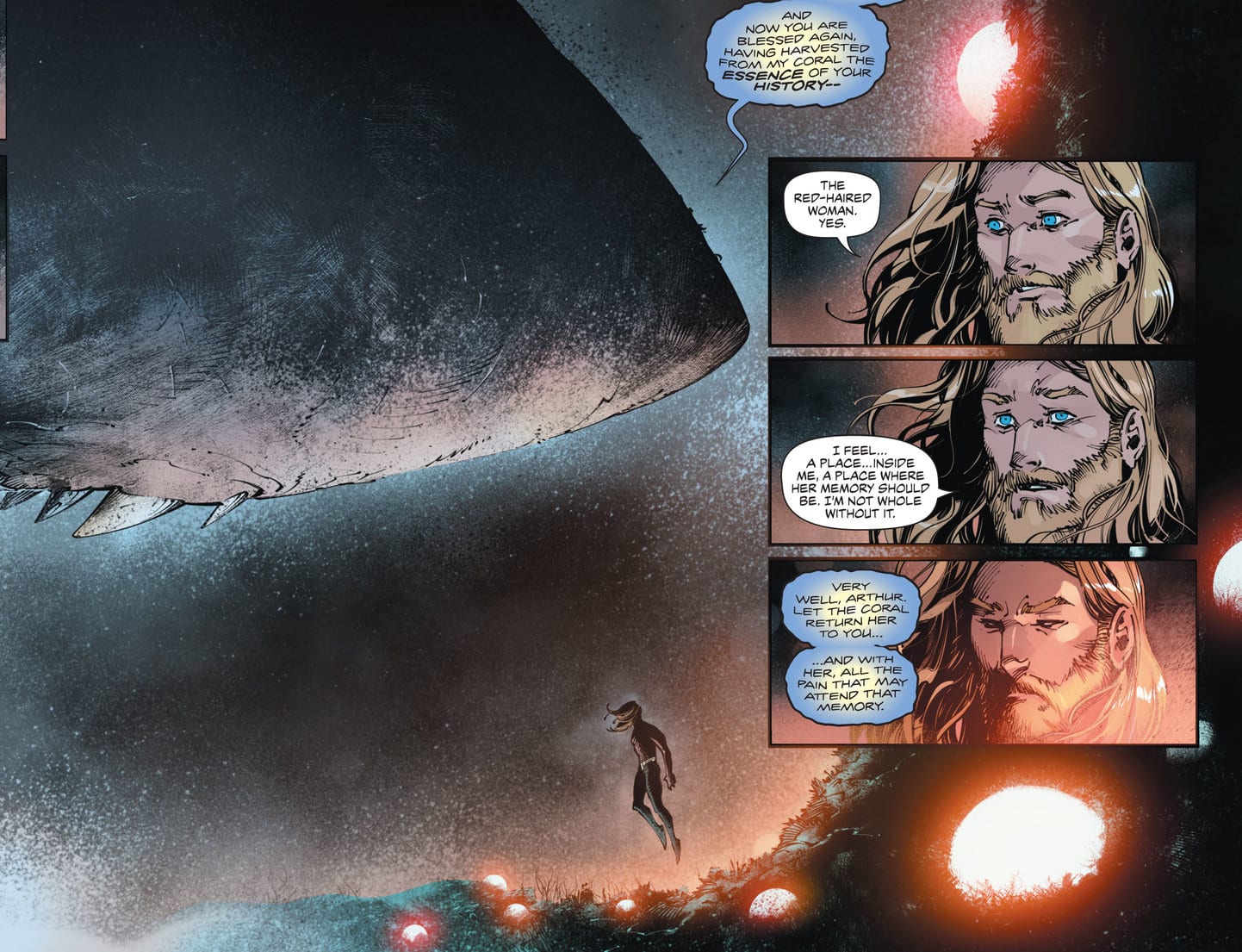
Mother Shark speaks with Arthur about Mera

It is here readers get to relive some of the most intimate moments between the couple, experiencing the highs and lows of their relationship. One feels the pangs of loss as Arthur slowly realizes that the love of his life was somehow involved in his death.

DeConnick continues prying open these forgotten memories throughout the issue and eventually reveals the sequence of events leading to Arthur’s supposed death. It’s exciting to read a story that starts slow and smoothly builds up to the secret’s unveiling. This is definitely a story AQUAMAN readers will not want to miss.

Breathtaking Artwork

Viktor Bogdanovic’s penciling and inking, coupled with Daniel Henriques, Jonathan Glapion, and Ryan Winn’s additional ink work, provide incredible details to the underwater world, whether it be the Atlantean throne room or the depictions of Arthur’s classic superhero suit. And with Sunny Gho’s coloring readers are able to feel fully immersed in this aquatic landscape.

Clayton Cowles’ letters continue to prove worthy of this comic, especially the bubble-like styling he applies to Mother Shark’s speech balloons.

Mera, the Queen of Atlantis

The Comic Cover Art

Robson Rocha, Alex Sinclair, and Henriques’ main cover artwork features a skeletal version of Arthur kissing Mera on their wedding day, alluding to the death the hero recalls throughout this issue. Josh Middleton’s variant edition adds more life to Arthur as he swims across waves in triumphal fashion.

Conclusion

AQUAMAN #49 delivers on the answers the series promised readers many issues ago. But this reveal was well-worth the wait. We’re excited to see what Arthur does with his newly restored memories.

What did you think about Arthur’s death mystery reveal? Let us know in the comments below!

Monkeys Fighting Robots Youtube

Review: BATMAN #73 May Forever Change Batman’s Motivation

Monkeys Fighting Robots

Following Bruce’s encounter with Bane in our last issue, Batman #73 sees the two Batmen roaming the desert, cowboy-style. Thomas’s ultimate goal, his reason for working alongside Bane, is simply to get Bruce out of the super game. How he plans to do it, though, is the matter at hand. The shock reveal in the issue’s last pages seems to pull it together.

The Writing

Tom King’s writing on Batman is marked by obscured, seemingly surreal sequences that eventually come into focus after the fact. He lets the mood foment as events occur, then applies context to give the narrative shape. Batman #73 is no exception to this approach.

We open with an unconscious Bruce Wayne being driven through the desert on horseback by his father. The horse drags a coffin behind it, and all the while, we have Thomas Wayne ceaselessly delivering the lines to the folk tune Home on the Range. The book seems fairly inscrutable for its first two-thirds, but snaps into focus with information revealed toward the book’s end.

Thomas’s use of the song seems to harken to a desire for escape and simplicity. He wants a kind of return to innocence, the significance of which becomes clear with the reveal in the last three pages.

It’s hard to issue a solid verdict here. The writing is strong and consistent, based on the approach laid out above. That said, Batman #73 will likely be a polarizing issue among longtime fans. The issue resolves some questions, such as key elements of Thomas Wayne’s motivation. But, for every issue resolved, more come about; namely, as it pertains to the book’s ending: “if this were always an option, why is it only coming up now?”

Tom King said what he’s doing with Batman is “going to change the character for a generation, or maybe more. Maybe forever.” If this issue is an indicator of where we’re headed, that’s entirely possible. We’re yet to see whether it will pay off.

Batman #73

Batman #73

The Artwork

Mikel Janin turns in another strong showing for Batman #73. The book’s first half is full of heavy silences and sparse dialogue, and Janin captures this well. We feel the space as Bruce and Thomas wander the desert. Dramatic shots of Thomas riding on horseback while dragging a coffin behind him pay homage to Django and other spaghetti westerns. It lends itself well to the ambiance and atmosphere of the issue.

The book splits its time between wide, painterly illustrations and tight, regularly-spaced, close-cropped panels. The work feels cohesive throughout, though, and flows nicely.

Jordie Belleaire bathes Janin’s illustrations in earthy tones. Reds, oranges, and browns are the dominant tones through most of Batman #73. Only occasionally does the artist break this scheme, opting for ethereal evening greens and lavender sunrises. It’s not always naturalistic, but rather a skilled impression of the time of day.

Final Thoughts

Batman #73 is likely to be another polarizing issue among fans. If Thomas is to be believed—and based on King’s statements, he is—these next issues could change Batman forever. I won’t give spoilers, but it threatens to essentially strip away Batman’s raison d’etre. We’ll have to wait and see what the consequences may be.

Monkeys Fighting Robots Youtube

INTERVIEW: Composer Kurt Farquhar Puts The Rhythm Into American Soul on BET

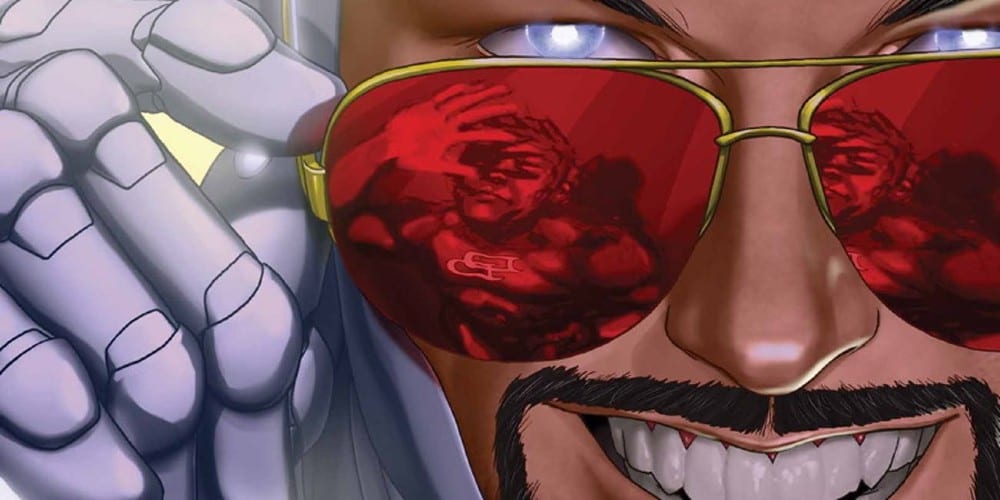
Iron Man

Award-winning composer Kurt Farquhar brings 70s vibes to modern TV to score American Soul, a BET series that looks at the rise of Soul Train the long-lived music-dance television show. 

Soul Train ran for 35 years and featured some of the most amazing musical talents during its run. American Soul is c0-produced by Anthony Cornelius, the son of Soul Train’s creator and long-time host Don Cornelius. Of course, this is a dramatized version of it all, but it features musical stars just the same with the likes of Kelly Rowland playing Gladys Knight, Michelle Williams playing Diana Ross, and Wayne Brady playing Little Richard.

PopAxiom got on the dance floor with Kurt Farquhar to talk about making music for shows like Black Lightning and The Neighborhood and putting the rhythm into American Soul.

Symphony To Soul

Kurt began playing music “very, very young, around the age of four,” and his mother encouraged him to “play guitar.” However, Kurt, “Didn’t take to it.” Flash-forward, a few decades and Kurt, can now play 20 instruments, but “… I still can’t play guitar.”

“Oddly enough, I write for guitar really well. Just can’t play it though.”

Despite lacking the skills for the guitar, Kurt says, “I was very much a rock and roller when I was a kid. A lot of Hendrix and Jethro Tull.”

Kurt wrote his first symphony at age 12, so there was little doubt music would be his professional life. “I thought that the word composer was snooty. It took a few years of doing scores for TV shows before I called myself a composer. Other people are composers,” Kurt thought, “I look at James Newton Howard, one of my favorite composers ever, that’s a composer.”

While working in TV, Kurt also worked with musicians like the Pointer Sisters, Natalie Cole, and Lionel Richie. More gigs came in from both ends, and something had to give. Unsure which way to go, Kurt called his brother, writer Ralph Farquhar, who said, “What’s going to pay the bills?” Kurt quickly replied, “… the TV stuff.” Ralph hung up. ‘Nuff said.

Like the hero in a story destined to accept his place in the grand scheme, Kurt embraced the word composer. “To go from Sister, Sister, to Moesha, and King of Queens to Black Lightning, The Neighborhood, and American Soul … it’s pretty humbling at times.”

kelly rowland-american soul-BET

About American Soul

American Soul premiered on BET on February 19th, 2019 and the network already renewed the series for a second season. “I’m from Chicago, so I have a personal connection with the show.”

American Soul is based on a legacy that’s rich with incredible music that appeared through the 30+ years of Soul Train. “The key to doing the show was for it to sound ‘retro’ but not ‘old.’”

Kurt’s score was going to live alongside classic hit songs plucked by Music Supervisor Ashley Neumeister and original songs written by Kenny “Babyface” Edmonds. “I wanted the score to feel like it was inhabiting the same world. Some of the mysterious or sinister scenes feel like a 70s cop show. I took that vibe from the 70s and made it slightly newer.”

“I’m proud of the sound. It’s not like anything else on TV.”

Soul Train started in Chicago, and American Soul begins as the show makes its move to Los Angeles and prominent national exposure. Kurt explains, “I wanted a lot of live musicians. So, I brought in a lot of really amazing Chicago musicians like guitarist Keith Henderson, Ray Fuller, and Daryl Jones.”

Wrapping Up

Kurt’s musical influences run the gamut of what’s out there. But he joyfully confesses, “I do love country western a little more than everything else. True story.”

What’s next? “I’m working on Games People Play on BET. It’s an exciting show. I also worked on a show premiering on Own [Oprah’s network] starring Michael White and Robin Givens.”

Thanks to Kurt Farquhar and Rhapsody PR for making this interview possible.

Want to read more interviews like this? Click Here

Monkeys Fighting Robots Youtube

Review: JUSTICE LEAGUE #26 Returns to the House of Heroes

Monkeys Fighting Robots

Previously, on Justice League, the team successfully defeated the World Forger and the elder versions of the heroes from bringing their “perfect” society to the prime universe. In the aftermath, Superman pleaded with the World Forger to help them defeat his mother, Perpetua, and prevent the destruction of the Source Wall to save the entire Multiverse. He agreed, and when the League returned to their home, discovered that Lex Luthor televised a message to the citizens of Earth – that the Justice League is to blame for the death of the Source Wall, and that the only way to save it, and themselves, is to unleash their inner DOOM.

And so, the universally praised “Sixth Dimension” story has come to a close, and the “Year of the Villain” has officially began. The great minds behind the last few issues – Scott Snyder and Jorge Jimenez – take a brief reprieve from Justice League, handing the keys to Snyder’s former padawan James Tynion IV and Javier Fernandez. Both have done impressive work in and out of Justice League. But the work that was done in “Sixth Dimension” was consistently fantastic, and pretty difficult to top. How did Tynion and Fernandez fair in the first part of the “Apex Predator” story? Read on to find out…

** Some Spoilers Below **

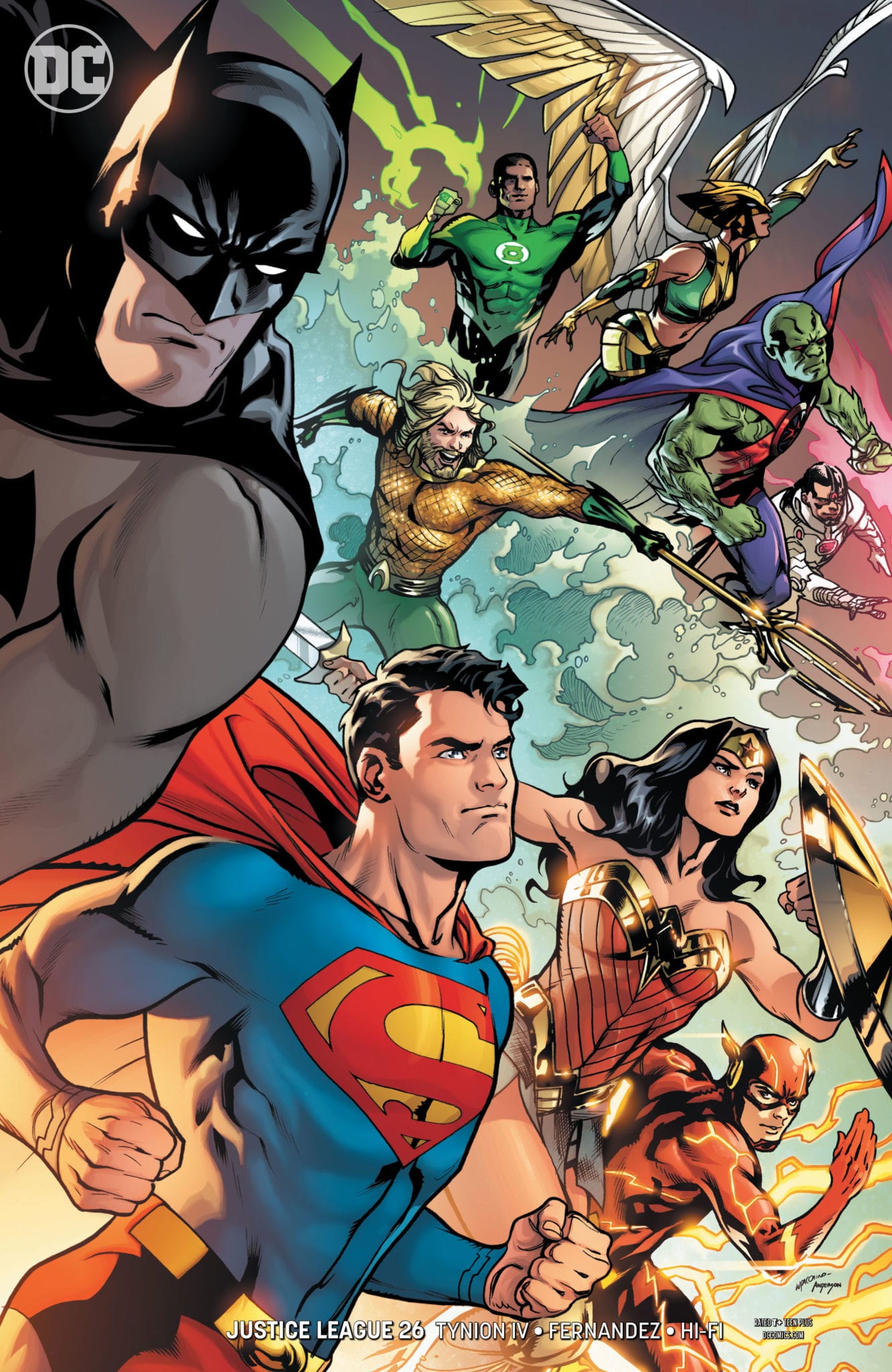
Justice League #26 Cover

Story

After being off-planet for so long, the Justice League must try to pick up the pieces of their lives—but Lex Luthor has other plans. If he has his way, he’ll show all of humanity that the Justice League will never be there in the world’s time of need!

James Tynion IV is a much more verbose writer than Snyder. Sometimes, those words have felt somewhat overwhelming, especially when trying to weave in so much plot and worldbuilding and character development. In this one issue, he is charged with wrapping up “Sixth Dimension,” set up “Apex Predator,” continue “Year of the Villain,” and further escalate to what feels like another Crisis- level event. That’s a lot of moving pieces.

And yet, Tynion succeeds in weaving the aforementioned into a solid, 20-page issue of Justice League. He does so by splitting the weight of all that story into three different threads. We have J’onn J’onnz, who searches for a cloaked man that people are using as the embodiment of fear mongering across America in the aftermath of Lex Luthor’s villainous call to action. Tynion characterizes J’onnz as a steadfast, yet somewhat paranoid detective as he hunts for the cloaked man.

Meanwhile, the bulk of the prime League-ers venture to the House of Heroes – the pandimensional Watchtower as first seen in Grant Morrison’s The Multiversity way back in 2014 – to recruit their doppelgangers in the effort to fix the Source Wall and stop Perpetua. Readers will get a kick of seeing these heroes from across the Multiverse pop up in the main continuity. Here, we get some lighthearted exchanges between Barry Allen and John Stewart, but the sequence is missing what feels like a great opportunity for characters to interact with their multiversal counterparts.

Finally, Hawkgirl leads the charge in the Hall of Justice, searching for The Legion of Doom. A number of familiar faces have answered the call, including the Metal Men, the Teen Titans, and… Rorschach. There’s also a brief bit featuring Starman, who is looking for aide across time to mend the Source Wall, which is also the wellspring of his power. This is a hero that has been wholly underutilized since popping up in Justice League way back in November 2018. He seems to have the strongest connection to the Source Wall, yet only appears in one or two pages per issue. Hopefully, they are sowing the seeds for something big involving Starman.

Justice League #26 Page

Art

Artist Javier Fernandez brings a classic, pulpy style to Justice League #26. It’s darker and heavily shaded, giving the book this ominous feeling that doom is looming overhead. While the bright, energetic styling Jorge Jimenez is missed, Fernandez still manages to capture the robust imagery we have come to know and love in this current run of Justice League.

The scenes in the Hall of Heroes and Hall of Justice are fun in that we get to see a wide array of heroes from other teams and other universes. It would have been great if Fernandez had more fun with the multiverse heroes, giving them a more unique look as if plucked from their respective books with the artists styles in tact. There double page spread featuring the heroes from multiple earth’s is a substantial achievement, and something to admire. However, it still felt as if something was missing from it. There should have been a little more depth and detail to help give this image the magnitude it deserves.

Conclusion

Though it isn’t as exciting as anything from the “Sixth Dimension” story, Justice League #26 is an admirable entry in this series, easily setting up its new arc, while also adding crucial bits to the “Year of the Villain” event.

What did you think of Justice League #26? Let us know in the comments!

Justice League #26 Variant Cover

Monkeys Fighting Robots Youtube

Review: SUPERMAN YEAR ONE #1 Chronicles the Wonderful Life of Clark Kent

Monkeys Fighting Robots

The Life and Times of a Growing Superman

In February of 1987, DC put out the first issue of Batman Year One by Frank Miller. It followed the story of Bruce Wayne and James Gordon as they come back to Gotham and begin working to make it a better place, as a cop and as Batman. It’s an iconic story and continued the already growing popularity of Frank Miller.

Thirty-two years later, Frank Miller comes back with another Year One story for DC’s Black Label line of comics. This time around it will be centered on Superman, a choice which is surprising to this reviewer, as Miller has made the Man of Steel an antagonist on more than one occasion. Will Miller catch me off guard and deliver a story worthy of Superman?

Superman Year One Cover

**Some Spoilers Below**


Story:

We open the story as most Superman origins do: On a dying Krypton. After an emotional opening that describes Clark as semi-aware of what’s happening, he ends up on Earth and is found by Johnathan Kent. The Kents adopt him and raise him as his own, taking the emergence of his powers in stride. Soon it’s time for Clark to go to High School where he faces off against his first villains: Bullies. He tries his best to keep them off the back of him and his friends, but Clark isn’t fully Superman yet. Thankfully there is a light in the school that brings him happiness: Lana Lang.

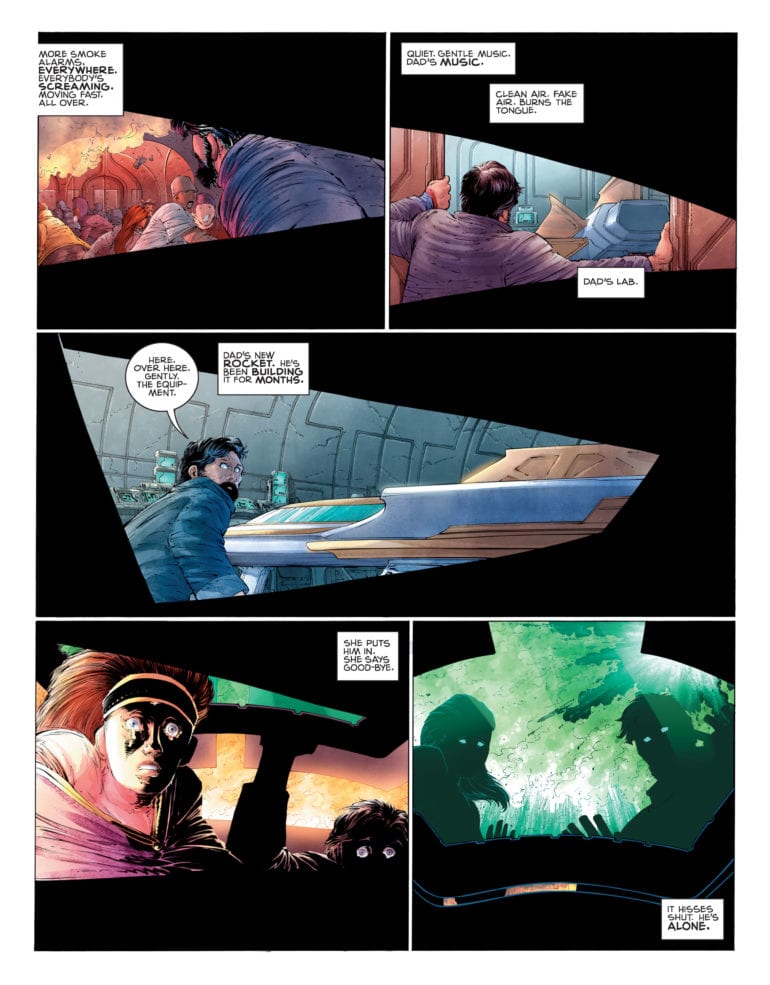
Superman Year one 1 p1

Now there are going to be people who will hate the lack of actual Superman in this book but that kind of makes it better. We keep the story grounded and more personal as we watch Clark grow up. Moments such as the narrator describing Clark needing to be soft in his throws while playing catch with father make the story feel real. This is less of a Superman tale and more of a coming of age story for Clark Kent. Every kid has felt like an outcast as he appears in the book and that’s what truly makes the character relatable.

We still have moments of Superman within this book. Moments of flying, pushing bullies, and lifting large objects. That being said, most of it is off-panel, leaving those hoping for action left wanting. By the end of the story, Clark has head out into the world which promises for plenty of action. This lack of action doesn’t detract from the story, so it can only get better from here.

Superman Year one 1 p2

Art:

The art of this book is done by the famous(or infamous depending on your point of view) artist, John Romita Jr. He does a fantastic job keeping a grounded look for this story, allowing the readers to relate more to this story. The colors and linework of Clarks decision to leave is just breathtaking. I’m not surprised they used it for previews. The only part of the issue I thought could have been better was Krypton. It’s not that it wasn’t bad, it was just nothing new. Other than that, we have one great looking Superman book on our hands.

Conclusion:

Overall, I was surprised by how much I loved this first issue. I was going in expecting this gritty retelling of the Superman origin and instead find a more down to earth tale. I loved seeing these simple moments in Clark’s life; it makes the character feel more human than most incarnations. The art helps capture that feel as well with grounded designs yet bright colorwork. The first year of Superman has begun, and I can’t wait to see what Miller and Romita have in store for us. Go pick this up today.


Monkeys Fighting Robots Youtube

DAREDEVIL #7 – Hell’s Kitchen Evolves

Monkeys Fighting Robots

Chip Zdarsky’s stellar DAREDEVIL run continues with issue #7. Matt Murdock, now retired, has a copycat running around to deal with.

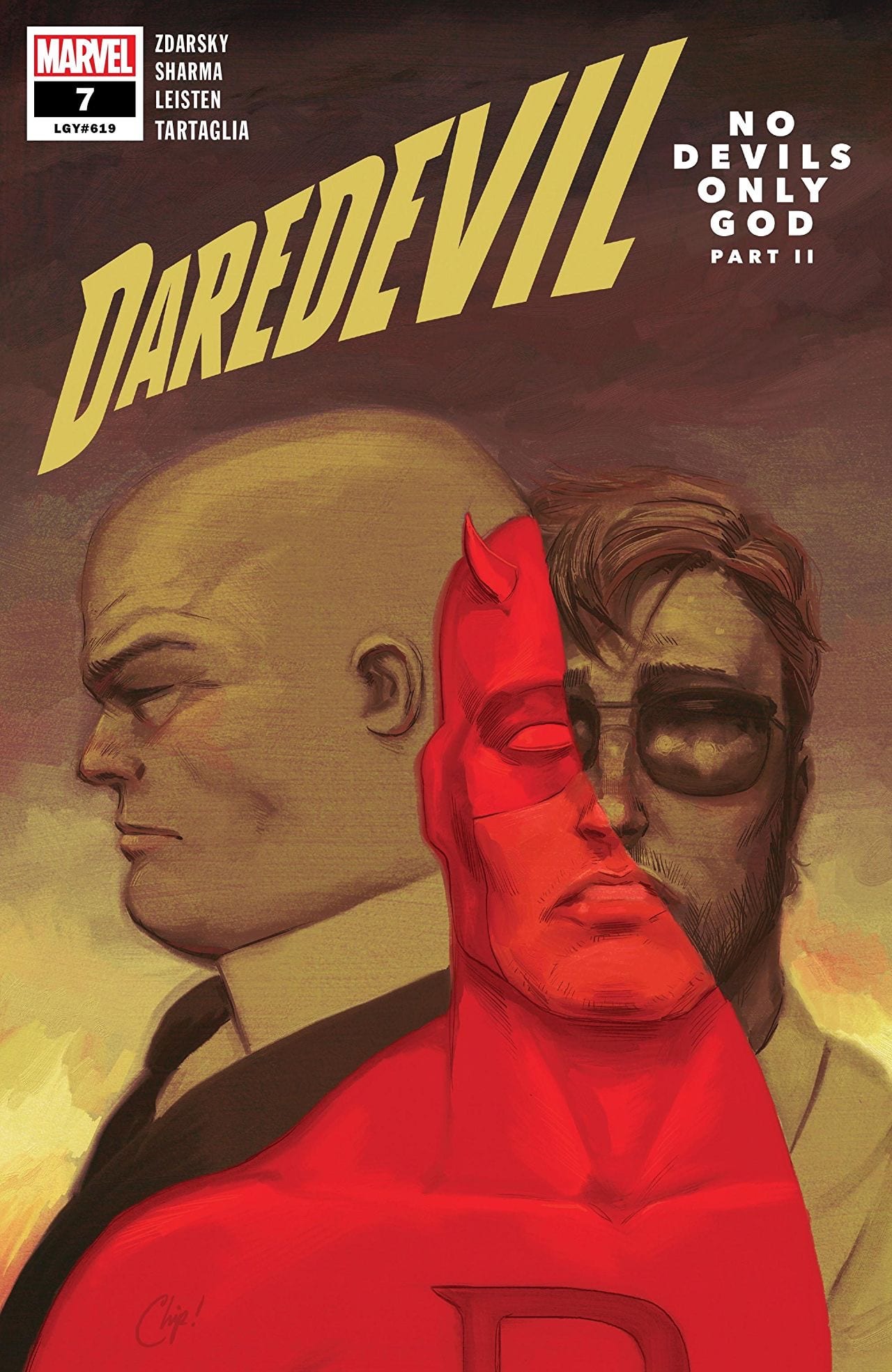
DAREDEVIL 7 CVR

***SPOILERS LIE AHEAD***


Matt Murdock is living the closest thing to regular life as he can. He’s focused on his day job, his friendships, and a potential librarian love interest. Detective Cole is recovering, both mentally and physically, before returning to duty. Kingpin reveals he is stepping away from his criminal empire.

In all of Marvel’s many superheroes, Daredevil might be the one that’s most entertaining away from the vigilantism. His struggles with religion, blindness, relationships, and profession are compelling more often than not.

It’s no different with Chip Zdarsky behind the wheel, he knows exactly what buttons to push in order to extract the right drama from Matt Murdock and his supporting cast. The themes in Daredevil #7 are far from new, but Zdarsky gives them a fresh spin, taking full advantage of the current landscape Hell’s Kitchen finds itself in.

Daredevil #7 is very much about transitions and development, Zdarsky is moving the pieces on the narrative board but without halting the pace. Kingpin’s announcement was every bit the shocker it needed to be, he’ll be very interesting to follow going forward–especially when Horn Head inevitably comes back.

The citizen-Daredevil subplot and Detective Cole’s role, now release from the hospital, should make for a highly entertaining conflict. Chip Zdarsky has this book loaded with threads that are all worth pulling on.

Matt coming face-to-face with the brother of Daredevil’s victim was a powerfully executed scene. The heartbeat text getting bigger and bigger as he seeks relief in the bathroom. Not having Matt’s eyes to use forces the creative team to share his emotions and distress in more creative ways.

The final page of this issue is absolutely dynamite, another brilliant use of text. Murdock can’t help but contribute in any way to protecting the city. He is now the city’s ears, reporting any crimes that come across his heightened sense of hearing. It’s a fantastic character moment to end the issue on.

Full marks to the creative team of Lalit Kumar Sharma (pencils), Jay Leisten (inks), Java Tartaglia (colors), and Clayton Cowles (letters). The only knock against the art is the piss-poor size of Hammerhead’s one recognizable feature–his head.

Daredevil continues to be one of the best books Marvel is putting out. It doesn’t rely on over-the-top superhero action or even much comedy. Zdarsky is delivering a compelling story and continuing to show that he’s a superstar talent.

Monkeys Fighting Robots Youtube

GUARDIANS OF THE GALAXY #6 – Dealing With Hype & Expectations

Monkeys Fighting Robots

Donny Cates and Geoff Shaw’s first GUARDIANS OF THE GALAXY arc comes to an end. “The Final Gauntlet” concludes with chapter six, our heroes try to stop Thanos from being reborn.

GUARDIANS OF THE GALAXY 6 CVR

***SPOILERS LIE AHEAD***


Donny Cates has been on fire in the world of comics for the better part of two years. This Guardians Of The Galaxy run however has been one of his weaker titles so far. The biggest thing keeping this book from being great is the team dynamic. That continues here.

One of the big selling points of this series was Cosmic Ghost Rider being apart of the team, which we’re still waiting for. The lineup we’ve been given is stellar, bringing Moondragon and Phyla-Vell back was a wise decision. These two have yet to make an impact or really be given any time to shine.

This Guardians team had us all salivating when it was announced to be the next series by the hottest writer in comics. It hasn’t lived up to it’s potential yet, not by a long shot. Donny is a very talented creator, but perhaps team dynamics and not among his strengths yet.

It’s not just the hero side of the equation either. This story is loaded with classic cosmic characters across the board. These issues of Guardians Of The Galaxy have been about throwing all these fan-favorite characters together for the sake of how cool they all are rather than giving them a compelling reason for being together.

What is the point of assembling this all-star cast of cosmic players if the story is still going revolve around Star-Lord and Gamora? The premise of this tale was interesting enough but became less and less about the race to stop Thanos and more about Quill’s relationship with Gamora. The other members of this team deserve more than being props.

There are a few moments of charm, like Eros’ final words about how “frustratingly obvious” it was for him to be the vessel for Thanos’ return.

This is by no means a horrible Guardians Of The Galaxy run, we’ve seen how bad it can get plenty of times since the famous Abnett & Lanning run (Bendis run, I’m looking at you). It’s not an awful comic book it just hasn’t been able to deliver the quality content that we should expect from this team with these characters yet.

Donny Cates may not have delivered yet but that hasn’t effected Geoff Shaw one bit. Guardians Of The Galaxy #6 is another beautiful looking book. We aren’t getting a compelling reason for this team to be together but goddamn are they gorgeous to look at.

Beta Ray Bill has never looked better than this version from Geoff Shaw. The scene where the black hole cannon is fired and the station collapses on itself is stunning. Our cosmic landscape is breathtaking and fleshed out at every turn.

Colorist David Curiel gives these pages a ton of life with the blend of cosmic colors. Each and every character and setting fill your eyes with an ocean of beauty. Visually the book has hit the marks set by our expectations.

By the end of the issue, the extra members of the team disperse and we’re left with the core of Groot, Quill, Gamora, Beta Ray Bill, Phyla-Vell, and Moondragon. While not the team we were promised at the start, this is probably a good sign for what’s to come.

With a smaller roster to juggle, Cates might finally be able to dig into these characters and give them a similar treatment to that of his other comic books. Even if we’re immediately jumping into a story about Rocket rather than take a moment to explore the rest of the team, we should be heading in a better direction.

Monkeys Fighting Robots Youtube

Review: PSI-LORDS #1 Revives An Action-Packed Sci-Fi Series

Monkeys Fighting Robots

Valiant Entertainment’s new series, PSI-LORDS, is a highly-anticipated science fiction line focusing on four astronauts trapped in a cosmic prison. The story will follow the mythology brought to life in the Psi-Lords’ 1994 appearance in Rai and the Future Force #21, as well as their own series’ short run from 1994-1995.

It’s clear these humans are more than meets the eye, but what is their connection to the legendary god-like Psi-Lords? And how did they come to be imprisoned?

Story

Fred Van Lente’s story begins by introducing us to four people of diverse backgrounds: Beacon the intellectual, Artisan the maker, Hazard the rager, and Tank the solider. Each of these unique personalities comes from an astronautical background of some kind and have little to no recollection of how they were imprisoned. Fortunately (or unfortunately) for them, a mysterious man named Scion guides them by whispering telepathic messages into their minds. He reveals their only hope lies with him.

Tank meets Scion

Van Lente does an incredible job of showing each character’s unique reaction to their predicaments. Aside from the natural disorientation any person would be experiencing, we see the various emotional reactions of each protagonist. Beacon’s cold aloofness, Artisan’s cool confidence, Hazard’s anger, and Tank’s rock hard determination allow for readers to easily imagine themselves as one or all of them.

We’re taken on a fast-paced prison break with the protagonists as they explore the compound they’re trapped in. We get to see each character bring a set of unique powers to life in brilliant displays, surprising them as much as us. But the real climax arrives when the newborn super beings realize where they’re being held and who’s holding them.

Beacon realizes her new powers

Art

Artist Renato Guedes is more than up to the task of combining elements of sci-fi art with those of a prison compound. His penciling adds impressive detail to the alien contraptions surrounding the prisoners’ cells that are enhanced by the dreary shades readers would expect inside a prison. In addition, letterer Dave Sharpe uses all the tools in his wheelhouse to make Scion’s voice come alive in the reader’s minds as much as the protagonists’.

The Comic Covers

ROD REIS main cover for PSI-LORDS #1

Rod Reis’ main cover features a colorful depiction of each protagonist on a galactic background, giving readers an inside look at the story to come. Jonboy Meyers’ variant cover also features these characters but gives them more personality. We can clearly see each hero’s expression as they explore their newfound powers.

Alan Quah and Komikaki Studio’s variant cover follow’s suit with the previously mentioned covers, but leans more into each character’s personality by featuring them in a variety of dramatic poses. Marco Rudy’s cosmic variant cover also hones in on the group, but gives them beautiful cosmic trails of stardust as the name suggests.

Last but not least is Paulina Ganucheau’s pre-order edition cover. Instead of depicting all four of the story’s main characters, Gaunucheau focuses solely on the intriguing Hazard, which may allude to her upcoming importance in the story.

Conclusion

PSI-LORDS #1 is a thrilling sci-fi epic that is destined for greatness. Valiant’s creative team was wise to revive this important series and we can expect big things in the coming issues.

What did you think of Valiant’s decision to dive back into their Psi-Lords mythos? Let us know in the comments below!

Monkeys Fighting Robots Youtube

Review: MILES MORALES: SPIDER-MAN #7 Features The Best Parts of INTO THE SPIDER-VERSE

Monkeys Fighting Robots

If you liked Spider-Man: Into The Spider-Verse, you’ll probably enjoy Miles Morales: Spider-Man #7. Both stories focus on Miles Morales’ attempt to balance his personal life with his adventures as a superhero.

Miles Morales: Spider-Man #7
Like Into The Spider-Verse, Miles Morales: Spider-Man #7 focuses on the relationship between Miles an this uncle Aaron.

Miles Morales: Spider-Man #7

Writer: Saladin Ahmed

Pencils: Ron Ackins

Artists: Dexter Vines (inks and PP. 1-5,) Alitha E Martinez (PP. 6-10,) Vanesa R. Del Ray (PP. 11-16) and Javier Garrón (PP. 16-20)

Colorists: David Curriel & Erick Arciniega

Letter: VC’s Cory Petit

The success of Into The Spider-Verse makes it difficult to evaluate any story featuring Miles Morales. It’s especially easy to compare issues of Miles’ new solo series, written by Saladin Ahmed, to the fan-favorite film. After all, the first installment of Miles Morales: Spider-Man and the movie were only released four days apart. Every time Ahmed does something well, praising him for borrowing from the film is the natural response. As the series continues, the shadow of Spider-Verse will likely fade. But, for now, the work of directors Bob Persichetti, Peter Ramsey, and Rodney Rothman clearly influences Ahmed’s take on the titular character.

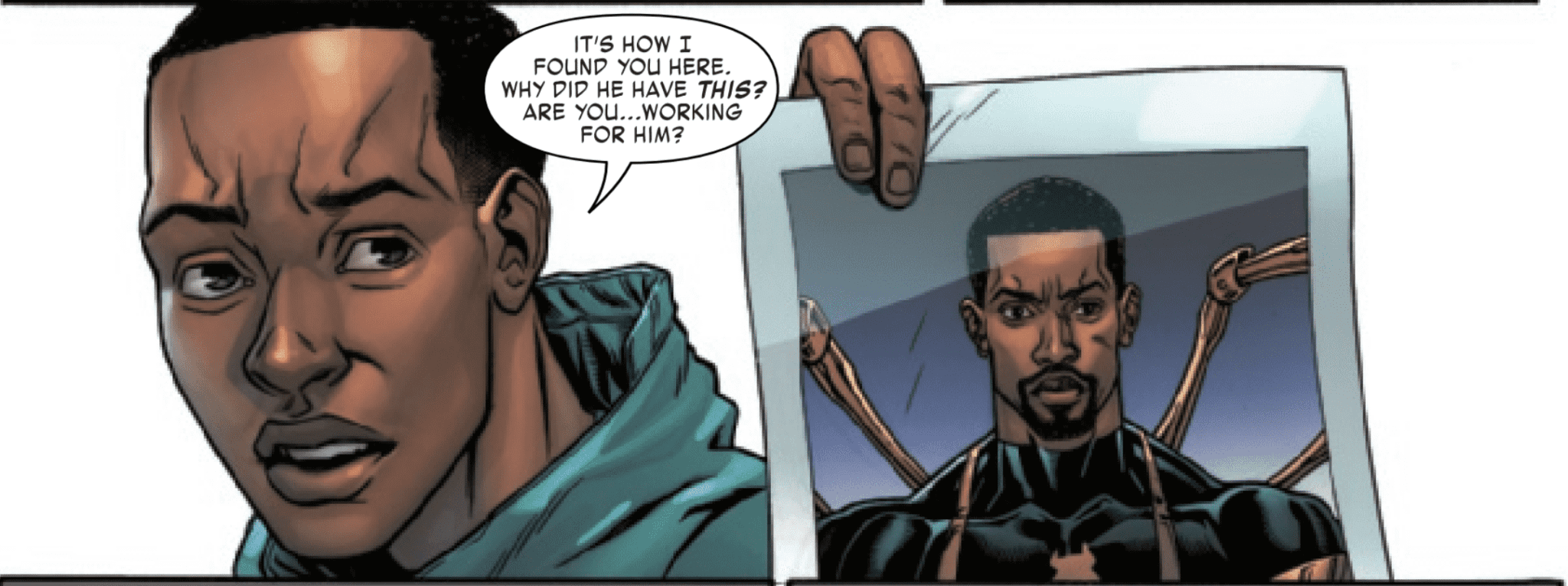
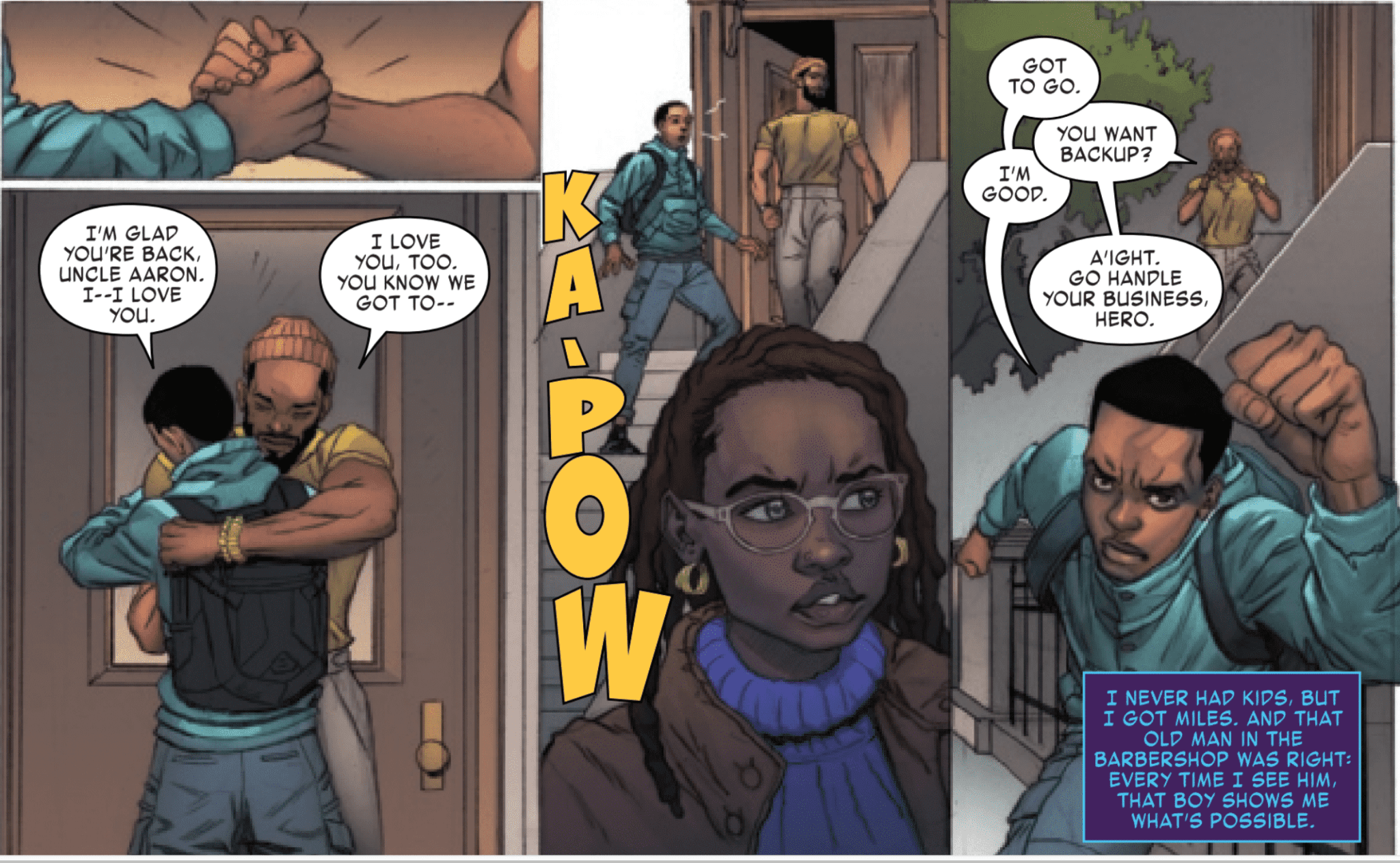
Miles Morales: Spider-Man #7 is no exception. From the importance of the dynamic between Miles and his uncle Aaron Davis to the focus on Miles’ relationships with his parents, this comic feels like a continuation of the film. The issue begins with a reunion between Miles and his uncle and, despite some tension caused by Aaron’s past as a criminal, the scene consistently features heartwarming moments. Using narration from Aaron’s perspective, Ahmed wisely shifts the focus away from Miles. Most readers already know how the young hero feels about his uncle. By turning the spotlight on Aaron and his internal thoughts, the reader gains a more complete understanding of the relationship.

Miles Morales: Spider-Man #7
Aaron is proud of Miles and his love for his nephew is tangible.

Every exchange between Miles and Aaron is intricately layered. For a moment, Ahmed delves into the sociopolitical issues surrounding a young multiethnic hero and a black man whose life choices had turned him into a career criminal. Though Davis has opted for the straight and narrow, he’s somewhat jaded about life in modern America. When Miles tells his uncle that Tombstone is going to prison, Aaron retorts, “Congratulations. Another black man going to prison. Must be Tuesday.” With just one line, Ahmed shifts the scene into a higher gear. Later on, Aaron narrates, “my nephew cares so much about right and wrong. He really thinks he can fix all this…garbage around us.” As with the aforementioned line, Aaron touches on a significant real-world issue. It would have been powerful to see Ahmed extensively explore the criminal justice system or the challenges faced by black men in modern America. But, with the limited space of a single issue, he didn’t have time to do so here. Still, these moments offer fertile ground for future development.

Miles Morales: Spider-Man #7
Using narration from diverse POVs, Ahmed shifts the focus away from Miles while painting a holistic picture of his life.

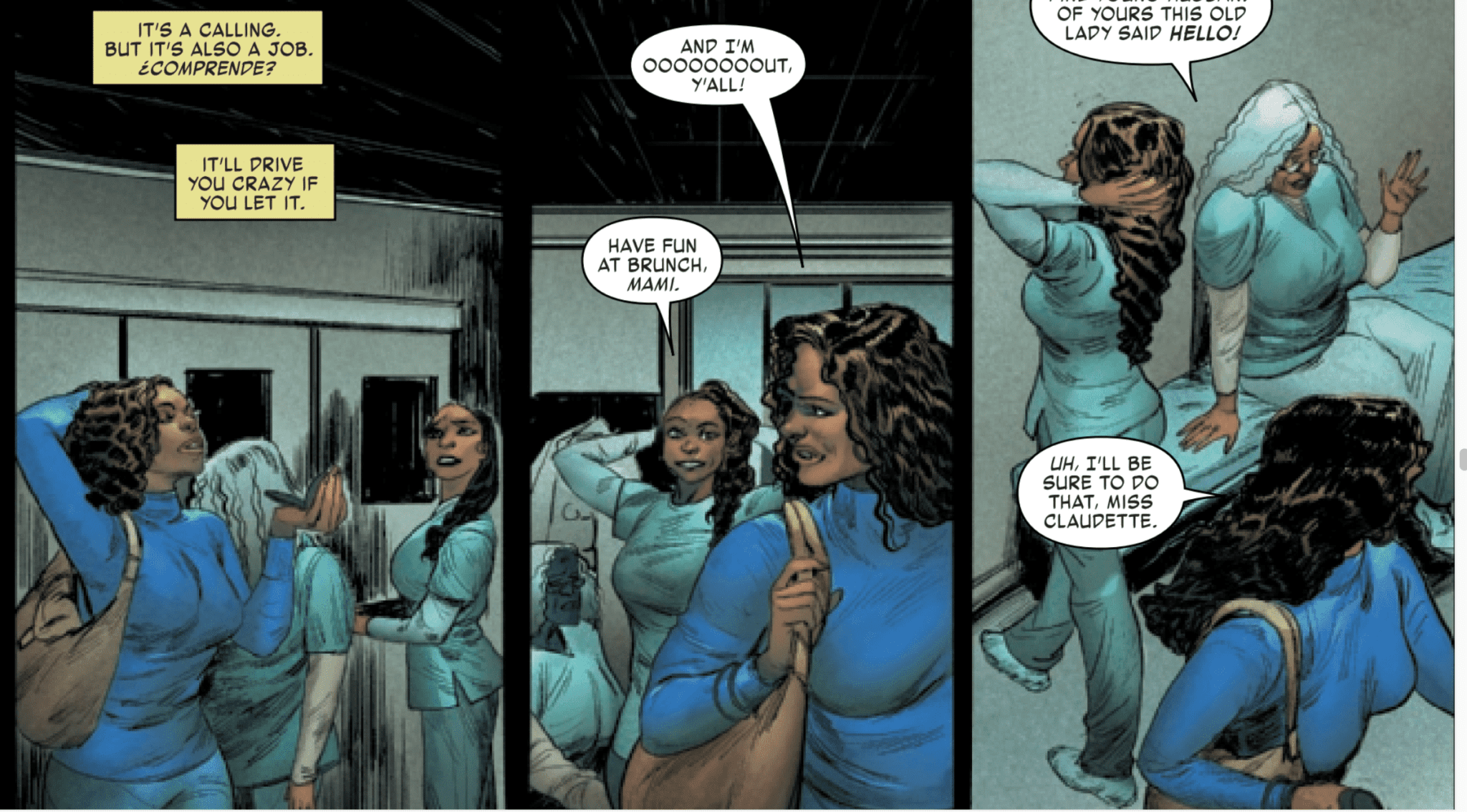
Ahmed doubles down on his usage of various narrators when he shifts to the perspective of Miles’ mom, Rio Morales. As a nurse, Rio understands the weight of the responsibility that comes with helping people. Subsequently, by having Rio narrate while she works, Ahmed still provides a glimpse into Miles’ subconscious. When describing her workalike, Rio says, “it’s a calling. But it’s also a job….It’ll drive you crazy if you let it.” It’s a safe bet that many superheroes feel that way, too. Hopefully, Ahmed will dive further into the similarities between Miles’ and Rio’s jobs as, respectively, Spider-Man and a nurse. If not, he succinctly compares the two heroes and their feelings about the pressures they face.

Miles Morales: Spider-Man #7
Miles Morales: Spider-Man #7 features four artists, which divides the issue into distinct parts.

Unlike other issues of this series, a committee of artists tells the visual story in the latest installment. Though it’s a standard length comic book, Miles Morales: Spider-Man #7 features four artists, who are each responsible for five pages. Whether the reader likes this style depends on their artistic preferences. On one hand, dividing the issue evenly makes each section feel like a vignette. Each illustrator’s contribution feels like an individual component with a distinct flavor.

Martinez’ excerpt looks like a standard Marvel comic, which pairs well with the story on the page; Miles and Bombshell fight a killer drone and bright colors, both on the heroes’ costumes and in the drone’s lasts, separates the scene from the other grounded parts of the issue. In Del Ray’s snippet, bright colors are fairly absent in the dreary hospital setting.  Garrón, typically the primary artist for the series, illustrates the last few pages. Here, using cool colors and visual distortion effects to accentuate the sci-fi elements of the plot. A robot attacks Miles and, using a shiny aura, Garrón makes the mysterious antagonist look like Doctor Manhattan. The visual effects and the ease with which he defeats Miles,  immediately establish the robot as a legitimate threat. Garrón takes a typical evil robot and turns it into an intriguing villain.

While some readers might appreciate this style, others will criticize the disjointed feel of the issue; each section is notably disparate from its predecessor. As a result, flipping through Miles Morales: Spider-Man #7 can feel like a jarring reading experience.

Miles Morales: Spider-Man #7
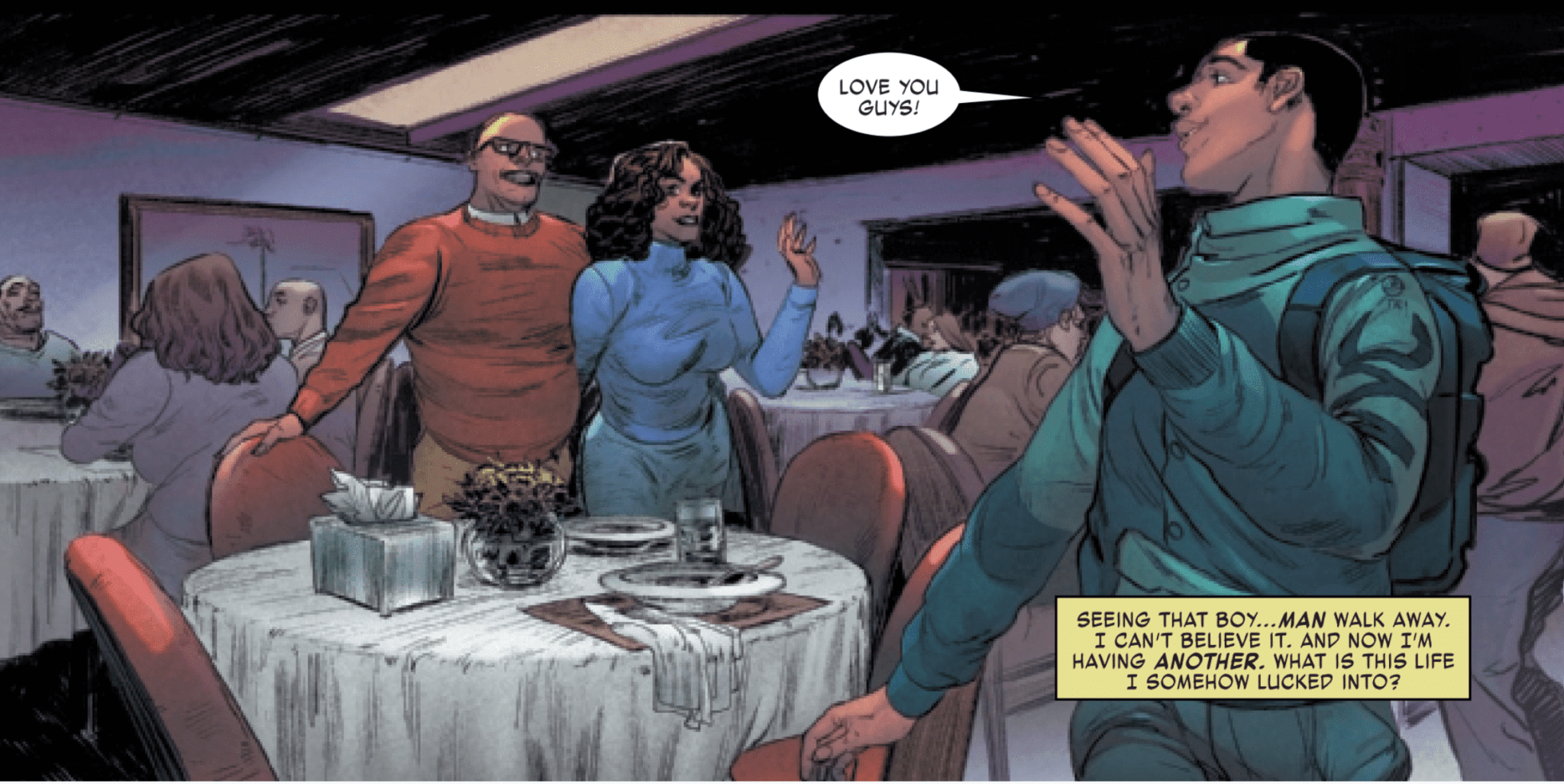
We love you too, Miles.

The influence of Into The Spider-Verse is undeniable in Miles Morales: Spider-Man #7. In several ways, Ahmed expands on the movie’s strengths. The latest installment of this series kicks off a new arc and Spider-Fans should be excited to see how Ahmed’s vision for the titular character continues to become clear. Where do you want to see him go with the series?

Monkeys Fighting Robots Youtube

Review: Tragedy And Sex Fill The Pages Of FAITHLESS #3

Monkeys Fighting Robots

The mundane begins to mingle with the magical and leads to a tragedy in the latest issue of Faithless from BOOM! Studios. The continuing story features eroticism and horror in equal measures with strong adult content throughout.

Tragedy And Sex Fill The Pages Of FAITHLESS #3
Faithless #3 Credit: BOOM! Studios

Writing/Story

As Faith’s magical ability begins to emerge, her life starts spiral out of her control. At first in wondrous ways but there is always a price to pay.

Brian Azzarello slowly builds the pace in the latest issue of Faithless by concentrating on the ordinary things in the character’s lives. Faith and Poppy’s conversation may be about magic but the naturalistic tone in the speech gives the impression it could be about anything. Poppy getting dressed, packing her bag, showing concern for her cat; it all has a relaxed, normality about it.

This is continued through the short scenes of Aya at home, relaxing. Azzarello keeps the atmosphere light and cheeky, lulling the reader into a false sense of security. This allows the shocks and the weirdness to become more prevalent. The story packs a punch with surprises that will leave the reader stunned.

Faith’s descent becomes all-encompassing and Azzarello is able to drag the reader down with her. His constant focus on the little things, the details in the character’s lives, makes the comic more believable and, in turn, the reader can accept the character’s decisions. There is a naturalistic flow through the speech and actions making Faithless a highly emotional read.

Tragedy And Sex Fill The Pages Of FAITHLESS #3
Faithless #3 Credit: BOOM! Studios

Art

The emotional impact would not be so strong without Maria Llovet’s beautiful art work. She brings a softness to the world of Faithless that acts as a comforter for the reader. Llovet’s line work is fluid and free giving the scenery a used and loved feel. The characters inhabit the sets and the backgrounds are as much a part of the scene as the foregrounds.

The character work is equally impressive with subtle gestures humanising the complex characters within the story. There are some wonderfully choreographed scenes containing interactions between several characters. The contrast between these scenes inform the reader about conflicting personalities and the influence that one character has on another.

Llovet understands the complexities of movement and emotional reactions and she weaves this in to the fabric of Faithless.  She creates scenes of shock, sadness, and eroticism, with seeming ease and takes the reader on an emotional journey.

AndWorld Design provides the link between Azzarello’s script and Llovet’s art work. The free hand lettering bridges the gap between the emotional visuals and the steady beats of the story. Elements of the story are given emphasis by the careful placement of the speech balloons. In some moments the punchline of a joke only works because of how speech is placed and presented in the panel.

Tragedy And Sex Fill The Pages Of FAITHLESS #3
Faithless #3 Credit: BOOM! Studios

Conclusion

The attention to detail and the focus on characterisation makes Faithless a spectacular read. The content is clearly adult in nature and at no point does the comic become about the nudity or sex; that is just another element of this world. In fact, the opening sequence of this issue is so naturalist, so obsessed with the everyday relationship between the Faith and Poppy, that the nudity becomes a part of the character building. These two characters have barely met yet they are comfortable with each other.

It is a testament to the story telling abilities of Azzarello, Llovet, and AndWorld Design that this comic is such a powerful, emotional roller-coaster of a ride. The reader is there with Faith through each high and low. As Faithless continues, shifting from reality to a place of magic, the reader is pulled 100% along with it having already committed, like Faith, to this emerging new world.

A spectacular read from start to finish with some of the most gorgeous art work gracing the pages of any comic being published today.

Monkeys Fighting Robots Youtube