Second Coming, the new book by Mark Russell,is going to offend a lot of people. The concept alone had rattled some cages when it was announced last year, forcing DC Comics to cancel the series less than a month before it was scheduled to be released through their Vertigo imprint (RIP). Thankfully, newcomer publishing house AHOY Comics scooped the book up shortly thereafter.
If you were curious as to how Second Coming came to fruition, as well as learning more about the controversy surrounding the book, you can read the Monkeys Fighting Robots interview with writer Mark Russell. But without delving further into the preemptive hate that this book received, does Second Coming #1 deliver from a comic book storytelling perspective? In short – hell yes.
** Spoilers Below **
Story
Second Coming follows Jesus Christ as he returns to Earth and discovers that his teachings have been distorted. To rediscover his inner messiah, Jesus becomes roommates with humanity’s superhero savior, Sun-Man, the Last Son of Krispex.
One’s a superpowered hero from another planet. One’s the righteous son of God sent to Earth. Can you smell the divine comedy that ensues? Actually, the pairing of Jesus and Sun-Man doesn’t actually happen until about two-thirds of the way through the first issue of Second Coming.
In the beginning, rather, writer Mark Russell takes readers through his brief and crude bible lesson. Russell really doesn’t hold back on any punches, particularly with his not-so-subtle interpretation of the sacred fruit from the Garden of Eden. His take on God might ruffle a few feathers. The Almighty is a wise-cracking, wine-swilling, loud-mouthed, somewhat selfish deity who has lost his faith in humanity. This is a great counterbalance to Jesus Christ, who is presented as kind and optimistic, looking for a way to bring mankind back in the good graces of his father.
When God wants to “toughen up” his son, he sends him to Sun-Man. This faux-Superman is, in classic biblical fashion, unable to have a child with his human wife. Sun-Man also has a knack for kicking ass first, asking questions later. This offers a unique dynamic between the super hero and super son, who offer opposing views on how criminals should be dealt with. If the first issue of Second Coming is any indicator, Russell’s exploration of the duo’s relationship, along with his hilarious observational comedy, will make this book one of the most important series on shelves today.
Art
There were two slightly different styles of artistry in Second Coming to offer a distinctness between the biblical era scenes on heaven and earth, and the scenes in the modern world. Artist Richard Pace uses a rougher, etched style for the biblical times, as if scratched onto a cave wall thousands of years ago. Leonard Kirk stepped in as the finisher on the modern scenes, which give off a much more traditional, comic book feel. Colorist Andy Troy offered a vibrant, bright palette, reminiscent of something right out of Action Comics. It’s a nice contrast to Pace’s darker, oil painting style.
Conclusion
There is so much humor packed in its pages, but the true spirit of Second Coming is within the moral dilemma presented, a profound message that will ring true for anyone of any background.
What did you think of Second Coming #1? Let us know in the comments!
Continuing The House of El: United crossover, Supergirl, Krypto, and Jon throw down with a genocidal maniac only to discover they have a much larger fight on their hands.
After a quick summoning up by Jon for those who might not be up to speed, the supers fly into the palace of Gandelo to bring her to justice. Despite the over whelming odds and unknown strength of the villain, writer Marc Andreyko opens up this issue of Supergirl with witty banter and gives the heroes a sense of confidence which is picked up in the art work.
Supergirl #32 Credit: DC Comics
This entire issue is mostly a fight sequence between Supergirl and two adversaries with an occasional added bonus thrown in, such as Jon and Krypto. The first half is a pretty light affair with Kara’s over confidence leading her mouth first into battle. Andreyko fills the script with quips and witticisms coming from both sides of the battle. Gandelo gives as good as she gets.
The humour is well placed and gives the opening of the comic a jovial atmosphere which is a pleasant change in superhero comics. One of the highlights of reading Supergirl is that it doesn’t get bogged down in darkness; even in the most difficult times there is time for light relief. Andreyko understands this and uses it to pace this issue. At first the fight bounces along from punch to punch and quip to quip. However, it all takes a darker tone when the true villain enters the scene.
Everything from the script to Kevin Maguire’s art to the lettering changes midway through the comic and Andreyko introduces a real threat into Supergirl’s life. Maguire gives the action a heavy, violent feel with dramatic points of view and exciting choreography. This change of pace is a real jolt to the reader and adds to the overall reading experience. It is in these moments where Tom Napolitano’s lettering really shines. He has a knack of capturing the essence of the character within his speech balloons and font choices. There is clear definition between the characters even if it does appear a touch heavy handed in places.
Supergirl #32 Credit: DC Comics
The coloring is bold throughout with Fco Plascencia contrasting the heroes against the villains. Supergirl’s bright outfit stands out in the panels giving each page a natural flow of vision. Z’ndr’s coloring is the most intriguing as the tones used for his skin and clothing falls somewhere between the brightness of Kara and the coldness of the villains. Whose side is he on? At this point in the story Kara is unsure and this hesitation is reflected in a visual manner.
Issue 32 of Supergirl is an adventurous battle sequence that is beautifully paced by Andreyko. While the action itself is not necessarily original, the witty banter and the shifting tone lifts the narrative above a standard superhero punch up.
There are also some outstanding moments in this issue. A page of stacked panels which feature a surprising twist worthy of The Walking Dead or something written by Joss Whedon. Great character interactions, especially between Kara and Jon. And, of course, a ridiculously designed alien purely for comic relief.
DC comic’s Supergirl #32 is an exciting romp with a kick in its tail. It has also set up the conclusion of this current story arc in a wonderful fashion.
The creative storytelling talents of Critical Role‘s Matthew Mercer are breaking into the comic book medium. Using his carefully crafted narrative as a springboard, the creators behind CRITICAL ROLE: VOX MACHINA ORIGINS II #1 bring readers into the campaign. This initial issue focuses on a Goliath named Grog whose battle prowess is only outclassed by his love for fighting. But the lovable giant begins to worry his companions after a sudden vision leaves him acting strangely.
Story
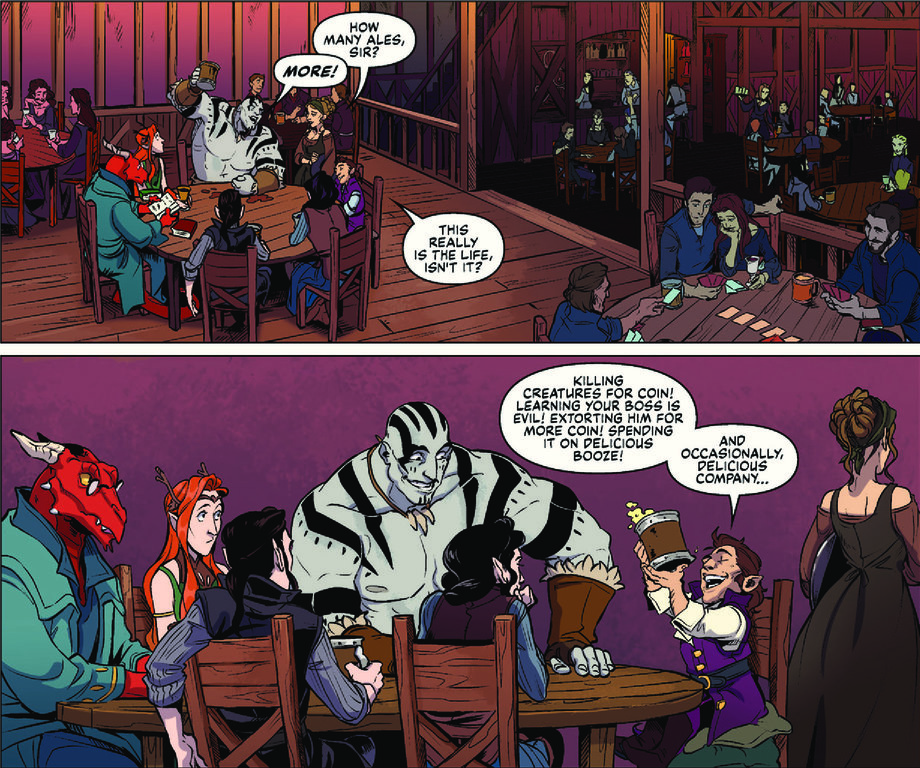
Fans of the popular Critical Role web series will find this issue bursting with the same energy as the web series. Jody Houser’s characters come to life with engaging dialogue and relationships few writers can channel so well. Beginning with an epic fight between the campaign members and a gigantic monster, Houser beautifully showcases the comradery between everyone facing the threat. This is soon carried over to an enjoyable meal at a nearby pub.
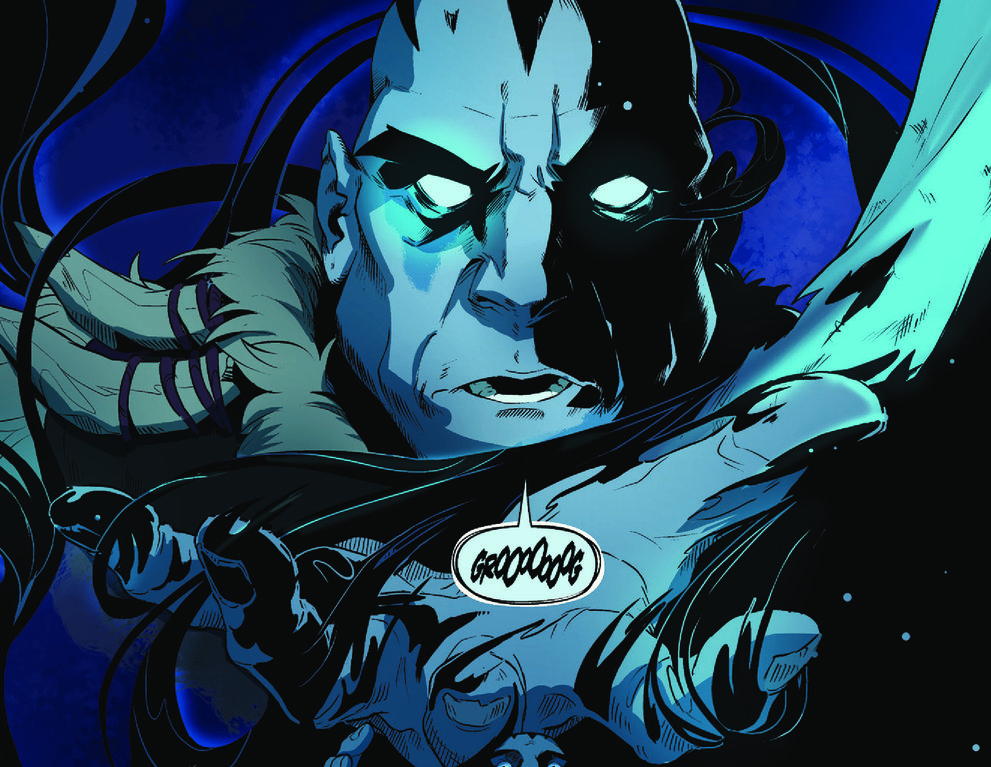
However, things take a turn for the worse when Grog experiences a vision of his father, leaving him seemingly comatose. Then, after initial reactions of surprise from his companions, he abruptly leaves their inn in the middle of the night.
With Grog missing, the team bands together to establish a plan of action. Readers and fans are thrown into the team’s adventures and feel as if they’re a part of Vox Machina’s party themselves. The dynamic dialogue exemplifies the intriguing character dynamics originally outlined by Mercer in the original campaign. It’s clear fans of the series, Dungeons & Dragons players, and casual comic book readers alike will find this issue quite enjoyable.
Art
Olivia Sampson’s penciling and Msassyk’s coloring both achieve the perfect balance between complexity and simplicity. The character and setting illustrations contain intricate details to immerse readers in the fantastic world of Dungeons & Dragons. At the same time, the colors are rich and full, reflecting the beautiful simplicity often found in comic book artwork.
In addition to the fantastic art, Ariana Maher’s lettering achieves greatest by capturing the dynamic character voices with fully realized fonts.
The Comic Cover
Fiona Staples’ covert artwork features Grog in a cautious yet vigilant battle pose to give readers a taste of the story’s focus character.
Conclusion
CRITICAL ROLE: VOX MACHINA ORIGINS II #1 is an awesome tale of friendship, adventure, and mystery. Fans of the online series will be greatly pleased with this comic adaptation of their first campaign.
What did you think of this Critical Role comic adaptation? Let us know in the comments below!
Bruce and Thomas Wayne finally reach the Nain Pit in Batman #74, putting them just steps from finally reuniting their family. What’s not clear at first, though, is whether Bruce will really go along with his father’s plan.
The Writing
The writing of the book follows more of King’s trademark style of laying seemingly-unrelated or abstract story elements on the board, only to snap them into context by the story’s end.
Much of Batman #74 is occupied by the Waynes’ discussing memories of a children’s book as they wander the desert. It’s unclear what their point is until the issue’s climax, when it’s used to make a poignant observation about their divergent outlooks. Thomas says he wanted to take the book away from a young Bruce to protect him. Bruce’s response, though, casts it in a very different light. Bruce’s need to be the Batman isn’t a compulsion or addiction; it’s not even his need to avenge his parents. Rather, it’s fueled by his endless optimism.
For Thomas, it’s not just about “helping” Bruce, though. Flashpoint Batman is motivated as much by that as he is by his own desperate desire to recover his family. There’s a degree of self-interest in Thomas’s plan, revealing it is less than the altruistic move he claims. It’s about control; he says he wants Bruce to be his own man, but his actions demonstrate the opposite desire.
Intriguing as the story is from an analytical perspective, there are a few narrative elements that cause problems. Namely, two men riding through the desert talking about a children’s book isn’t the most compelling storytelling. Also, despite speculation about the Nain Pit’s nature, King doesn’t go into detail about what the Pit actually does. It’s possible this could come up later in the story. For now, though, it’s left dangling as an unresolved—and thus underdeveloped—question within the narrative.
Simply put: Batman #74 has great ideas, though it’s not the most thrilling read.
The Artwork
Artist Mikel Janin’s work really shines in this issue. He manages to present a lot of interesting images throughout Batman #74, while at the same time focusing the reader’s eye on the center of each panel; a pattern he only occasionally breaks. He combines that technique with a lot of repetition in layout and visual motifs. The results are illustrations that feel dynamic and engaging, but which flow perfectly from one panel to the next.
Janin manages to convey the emotional weight of the situation well through simple, sometimes barely noticeable shifts in posture, expression or body language. It’s an excellent showing all around.
Of course, Jordie Bellaire’s color work on Batman #74 plays a considerable role in bringing Janin’s illustrations to life. She bathes individual sequences in dominant hues; blinding yellows in the desert, rich blues in the night, and fiery red in the illuminated pit. It’s really a treat to take in.
Final Thoughts
Despite some shortcomings, there is more to enjoy in Batman #74 than to complain about. It’s another solid issue in King’s run, and sets us up for the upcoming climax in the City of Bane arc.
Writer Greg Pak and artist Phil Noto take over as the new creative team in STAR WARS #68.
***SPOILERS LIE AHEAD***
Previously Greg Pak had been doing the Star Wars: Age Of Rebellion one-shots, serving as a nice sampler of what to expect from his take on the Star Wars universe.
Greg Park must’ve written the crawl and then told there needs to be a summary of the never-ending Shu-Torun story first. The first page is written exactly like a Star Wars crawl right after you read the actual crawl. Not a nitpick, just an observation.
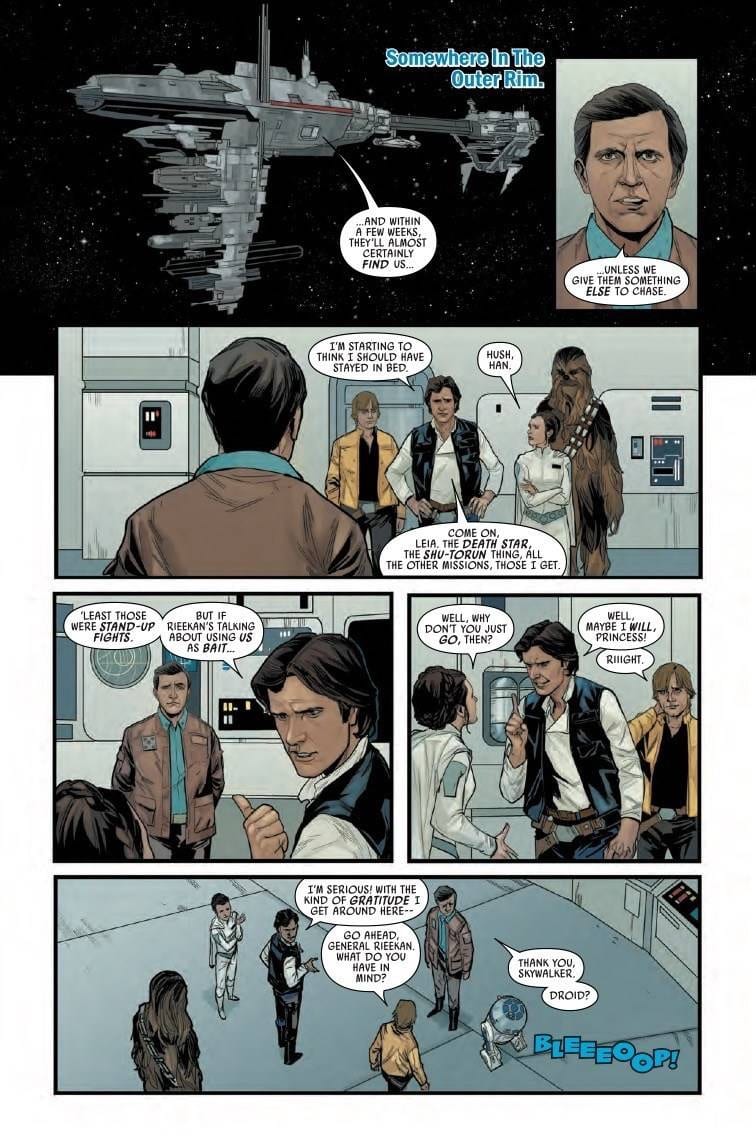
Our heroes are split up into small teams in order to carry out specific missions against the Empire. They’re pretty much the same pairings from The Empire Strikes Back. Greg Pak wastes no time diving into the action at hand.
The effectiveness of Chewbacca and C-3PO’s scenes together is telltale sign that Pak is more than comfortable in the Star Wars universe. Their scenes are funny and enjoyable despite one being a pain in the ass protocol droid spewing exposition and the other speaking only in reactionary roars.
The panel of Luke and R2-D2 staring off into a sunset, with Luke’s sarcastic line about spending his life getting off a desert planet inspires one to smile or at least smirk.
Chewie & 3PO’s moral conundrum is no shocker, but still effective when done right. Han and Leia’s smuggler disguises are the worst Star Wars cosplay ever. Leia’s past lover is a great way to flip the Han/Sana scenario from Jason Aaron’s run.
Greg Pak’s first issue on the big ongoing series isn’t as surgical as his one-shots, but it’s a solid start. This isn’t an explosive or bold introduction, however it does serve as a smooth transition into a new creative voice and vision.
Fans who have been reading Marvel’s relaunch of the Star Wars comics from the start can rejoice with the employment of Phil Noto. Gone are the photo-realistic art travesties, in comes a perfect balance of lifelike and comic book.
Noto was a fantastic choice to illustrate Pak’s scripts. Not only are his characters recognizable without being traced, but his ships and environments are worth the exploration of your eyes. Noto’s art is a breath of fresh air into the main Star Wars series.
A successful Star Wars series requires the creative team to take us to new places and old while operating within the cracks and shadows of the films. That being said, Greg Pak and Phil Noto make a great pair to usher us into this new era of Star Wars.
Star Wars #68 is both a breath of fresh air for longtime readers and a great jumping-on point for those who bailed on the awful artwork of previous teams.
In Venom #16, Donny Cates puts a fresh spin on Eddie Brock’s struggle to control the monster within.
Venom continues to haunt Eddie Brock.
Venom #16
Writer: Donny Cates
Artist: Juan Gedeon
Color Artist: Jesus Aburtov
Letterer: VC”s Clayton Cowles
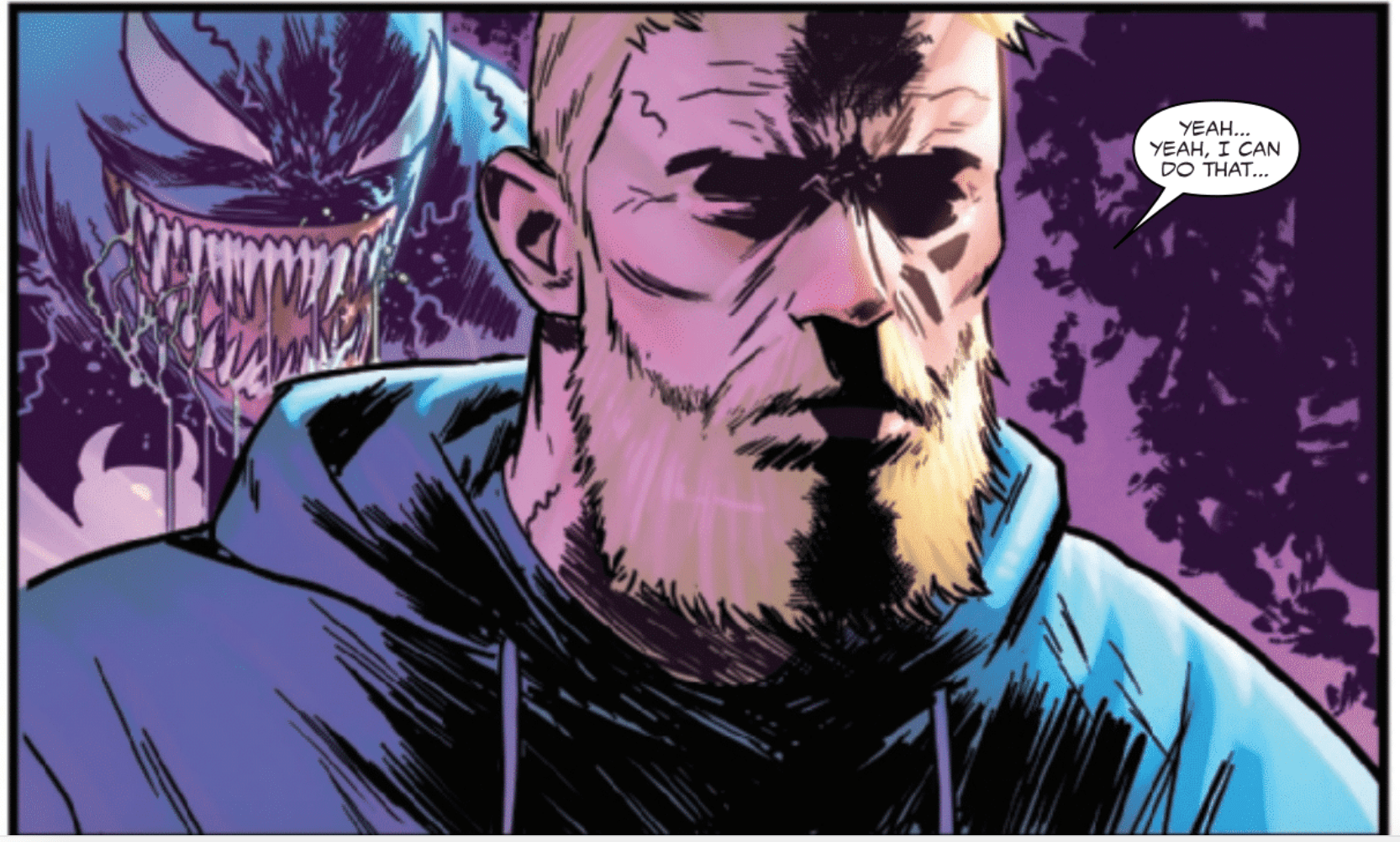
At first glance, Venom #16 might feel like a typical story featuring Eddie Brock and his famous symbiote. All the usual dynamics are present; Brock struggles to balance his humanity with the monstrosity inside him, he beats up some goons and he even discovers that Carnage is back. (Writer Donny Cates smoothly sets up the upcoming Absolute Carnage event here.) But none of these elements are the hook of the issue; that can be found in the fresh way Cates captures this conflict between man and monster.
Panels like this make it seem like Brock is Venom again but there’s more to it than meets the eye.
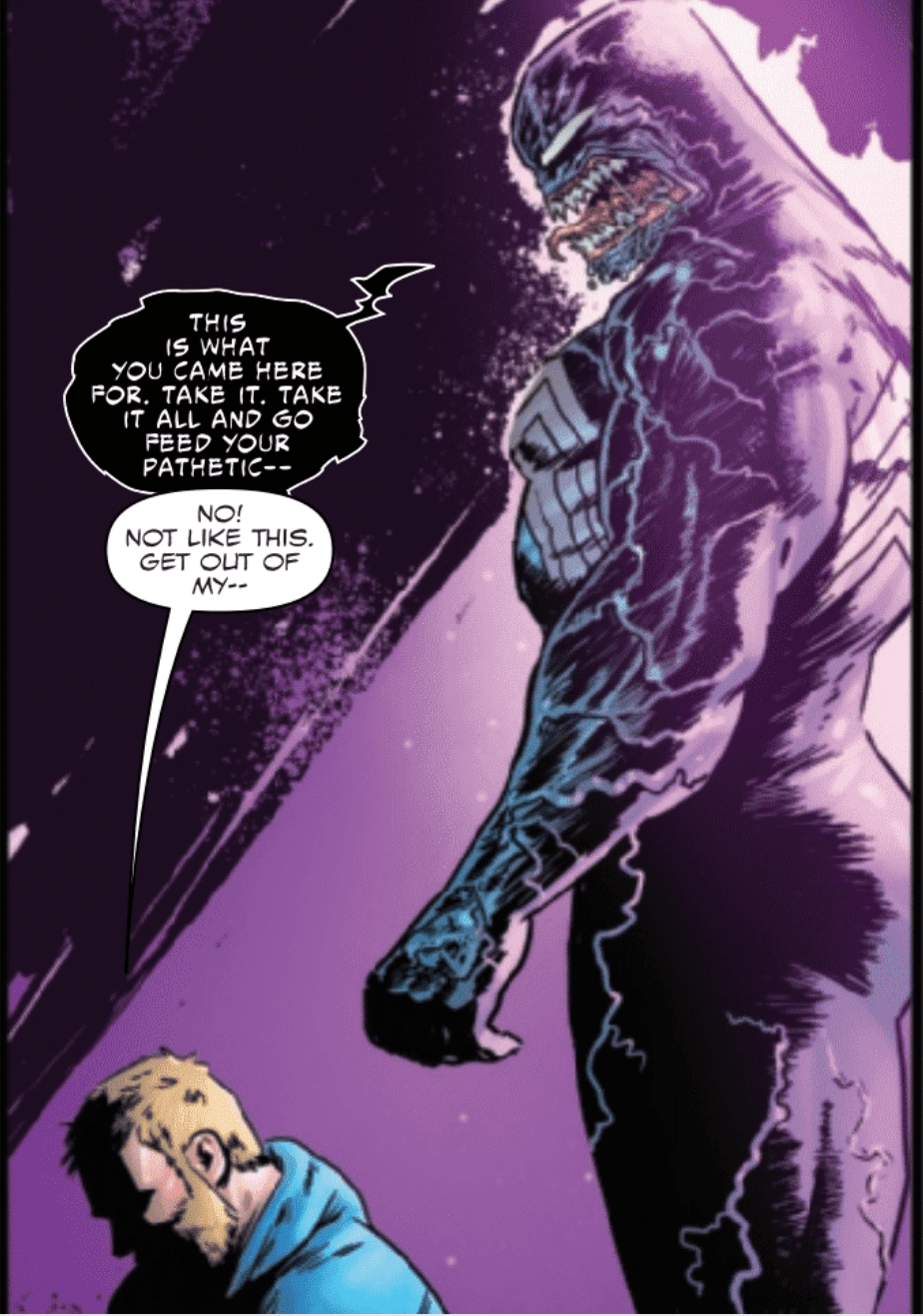
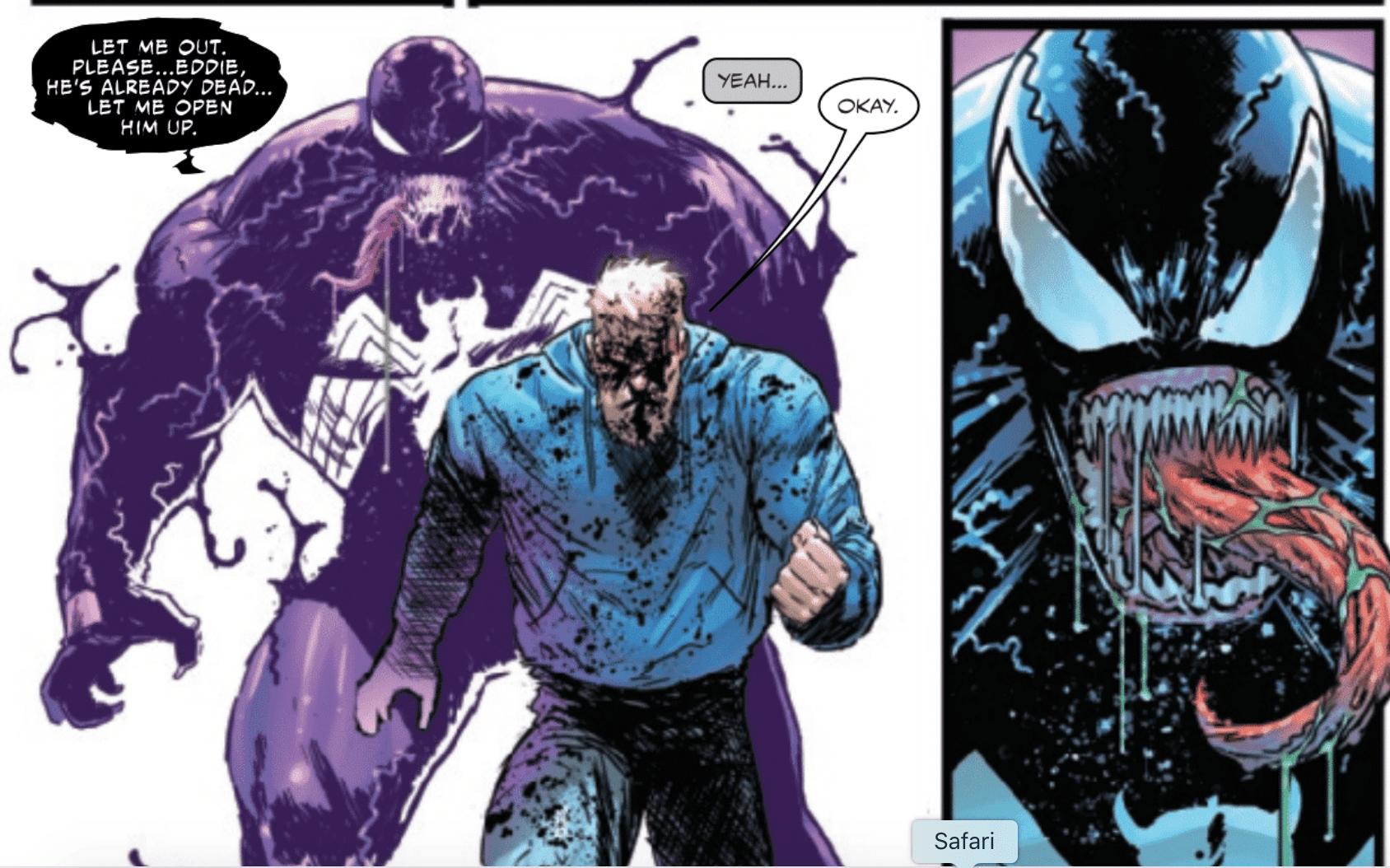
Brock winds up at a bloody crime scene and, seemingly, he suits up as Venom to protect himself. A number of clues make the transformation seem legitimate. Artist Juan Gedeon draws Venom, rather than Brock, throughout the anti-hero’s time at the scene. Plus, letterer VC’s Clayton Cowles uses gray blocks to denote Brock’s speech and black blocks to signal that of his “other.” A number of panels clearly show Venom brutalizing some brainwashed goons. But Cates slowly reveals that Brock might not be wearing the symbiote after all.
This panel, like others, shows the symbiote as a metaphorical devil on Brock’s shoulder.
Frankly, the reader experiences a “eureka moment” when it’s clear that Brock has maintained his human form for the majority of the issue. However, he still battles his inner demons on almost every page. Cates consistently focuses on Brock’s attempts to escape his past and the symbiote acts as a classic example of a character’s demons continuing to haunt them. The symbiote prevents Brock from getting rehired at the Daily Globe and it also interferes in his quest to be a good father to his son Dylan. Though the famous black goo and the consequences of its actions stubbornly cling to Brock, he keeps trying to live in the present. Unfortunately, he discovers that, sometimes, despite one’s best efforts, it’s impossible to leave your demons behind.
Cates, Gedeon, Cowles and color artist Jesus Aburtov all team together to play mind games with the reader. When one flips through Venom #16, they shouldn’t be mad at the creative team for this deception; instead, one should applaud this masterful manipulation. The reader is led to believe that Brock is magically Venom again and the team slowly peels back the curtain to show what’s really going on.
Brock eventually gives into temptation and lets his monster out, which makes the creative team’s deception even more effective.
Of course, the other shoe eventually drops; Brock chooses to give into his base desires to ensure his own survival. He unleashes Venom and the moment showcases Aburtov’s contribution to the issue. The symbiote evolves from a dark purple shade, which is consistent with its appearance in a few nightmare sequences throughout the issue, to its classic black look. This subtle adjustment makes Venom’s jump from Brock’s subconscious to the real world even more impactful. Aburtov also deserves recognition for his portrayal of the War of the Realms; many other artists used bright colors to demonstrate the fantastic nature of the event but Aburtov employed harsh reds and oranges to show the brutal, hellish side of the conflict. With these small choices, Aburtov significantly augmented the quality of this issue’s art, which was already impressive.
What’d you think of Cates’ characterization of Brock’s battle with his inner monster in Venom #16? How do you think it’ll continue to progress?
AMAZING SPIDER-MAN #25 kicks off year two of Spencer & Ottley’s run with a 60 page extravaganza!
***SPOILERS LIE AHEAD***
These over-sized issues can end up being bloated primer issues setting up the next few story arcs. While it’s definitely a primer issue, there’s no bloat. Nick Spencer intertwines all these future story teases into a cohesive, collective read.
Our story still jumps all over the place, but it doesn’t feel like a glorified solicitation. The second year of this fantastic run will continue the old school comic book craft and heavy use of mystery going forward.
Writer Nick Spencer has shown he knows how and when to challenge Peter Parker. If this issue is any indication, we’re to get no shortage of that in the coming issues. Amazing Spider-Man is back to being one of the top ongoing superhero comic books.
The Syndicate emerging, and recruiting Electro, is promising given the collection of characters. Spencer always thrives with lower-tier villains and giving them new life. A collection of evil ladies for Spidey to face-off against should be entertaining.
MJ’s return to the acting world and her heroics on the way there were truly satisfying. Her journey should firmly supplant her as a co-lead character more than just a girlfriend decoration like we’ve seen a few times in Spidey’s long history.
We get a satisfying conclusion to the Conners family after the events of “HUNTED.” Peter refuses to give up on Curt and his family, it’s a touching epilogue to their story.
We see Peter return to classes where his professor’s monologue about human’s brilliantly violent nature and it’s responsibility when it comes to science was wonderfully executed. This issue had something to say while also achieving supreme comic book crafting.
Getting back to JJJ and Peter’s relationship from Zdarksy’s run and the Die Chromator scene “Team-Up” Spencer finally checks in on JJJ and Spidey’s relationship that Chip Zdarsky set-up in his Spectacular run. The two have been one of the brightest shining spots across all of Spidey’s line of comics in recent years. To finally get Spencer’s take on the bromance looks to be witty and hilarious.
Still no reveal on who Kindred really is, but it keeps getting saucier the more we see. Nick Spencer has been inching towards a truly epic showdown for a year now. Kindred is clearly somebody who was close to Peter as he now promises to make things personal (and maybe even clean up the number of Spider-People swinging around).
Amazing Spider-Man #25 delivers on both fronts. As an issue of the series, it gives closure on specific threads while introducing entirely new ones. Our cast of characters are all heading into interesting territory. Spencer makes this a book about much more than increasing drama for Spider-Man, everyone is involved and getting their proper amount of development.
As far as primer issues go, this is actually a cohesive story on multiple fronts rather than a cut & paste jump around with every page turn. The collection of artists delivering Spencer’s script are seamlessly transitioned between. Each of them is given a fitting chunk to work with.
Ryan Ottley’s art is at the core of this series but the artists that come in to take the wheel for a while in between his issues have all done spectacular work. As the great Humberto Ramos leaves his ASM duties behind, all-star Patrick Gleason comes in. We get to see them both here alongside Ottley.
The sixty-page comic book Amazing Spider-Man #25 is both a successful bridge from one batch of narrative to the next and an accessible jumping-on point for new readers. There’s plenty of comedy, heart, action, and romance.
Writer Justin Jordan and artist Rebekah Isaacs open a familiar fantasy story with Reaver #1, the first chapter of their new series from Image Comics.
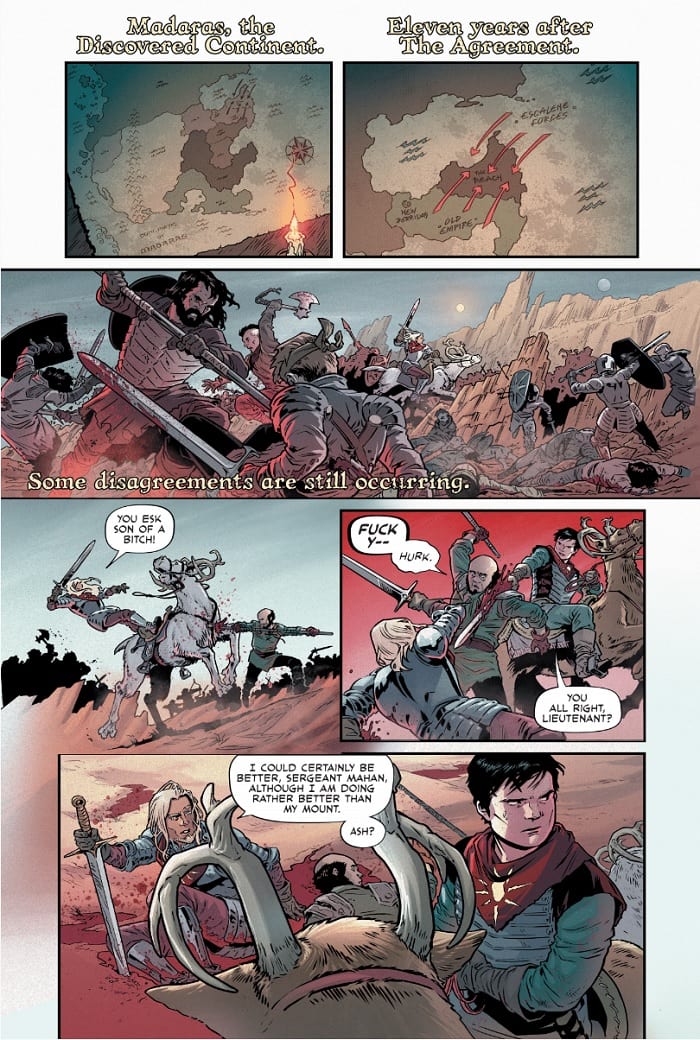
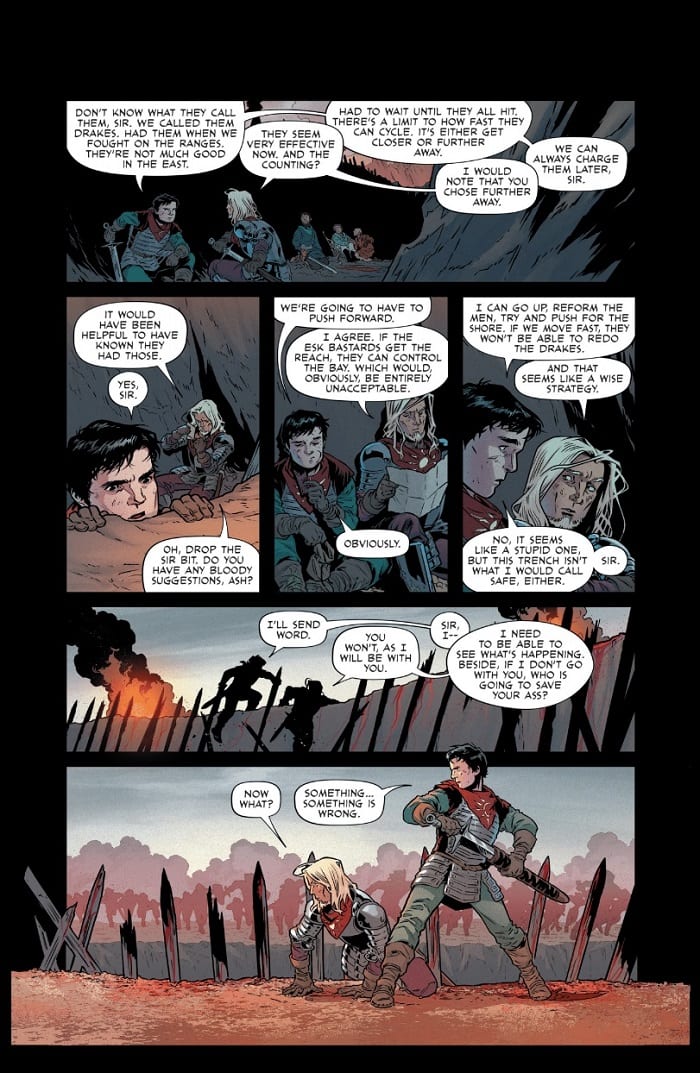
After disgracing himself on the battle field, Ash Mahan is recruited for a suicide mission. He’s not alone, though; he’s partnered with The Empire’s most loathed and dangerous criminals to carry out the job.
The Writing
Reaver #1 is a solid introduction to the story on Jordan’s part. He lays out an interesting concept for his world; two centuries after settlers’ arrival on this continent, they’re still fighting for dominance. We have The Empire who, in a rare twist, are presented as our protagonists. Against them are various rebel factions, some of whom have access to sinister arcane abilities.
The book certainly embraces the tropes of fantasy. Our party features a disgraced warrior, a wildling rogue, a berserker, a sorcerer…the gang’s all here. It’s a dirty half-dozen of D&D character archetypes. The characters are fun in their respective ways, and the unique story elements, specifically regarding the political balance on the continent and the nature of the magic in the story are engaging. That said, it’s not without flaws.
Embracing genre tropes isn’t a bad thing, so long as a storyteller can use them in a manner that provides a unique twist on the formula. It’s not clear that’s at play in Reaver #1, though. A lot of the plot and characterization feel like warmed-over elements we’ve seen a thousand times before.
In addition, the first quarter of the book is rather unnecessary backstory. We’re told Mahan is under arrest for cowardice, which is really enough. We don’t need to see this to get the character’s motivation; in fact, it may have been better to keep this information to reveal later in the story. For now, it would have been better to just get us right into the narrative. Because we spend so much time on this material in the first pages, we’re left uncertain of the story’s real focal point until about the halfway mark.
The Artwork
Rebekah Isaacs’s artwork in Reaver #1 is richly-detailed. She sticks to the fundamentals, never really adventuring into any groundbreaking visual work. That said, her character designs allow for a considerable degree of expressiveness.
Isaacs tends to frame her illustrations closely around her characters. Her use of setting and background is limited, choosing instead to rely on the strength of her character designs. It’s a gamble to take this approach in a fantasy world, but fortunately, it largely pays off. Her figures are emotive, and consistently hit the story beats and tone. That said, the way she lays out each panel is very dynamic…almost to a fault.
There’s a great deal of contrast of motion going on, to the point that the reader’s eye doesn’t often flow easily across the page. This works in the first quarter of Reaver #1 to sell the chaos of battle, but not as much during the slower, expository segments. There isn’t a lot of clearly-discernable intent motivating the choices in how she lays out the page.
Colorist Alex Guimarães employs a palette reliant on a lot of browns and greens, adhering to a mostly naturalistic look. It’s solid at first glance, and gains even more dimension with a closer look at the textures present in walls and other surfaces.
Final Thoughts
Reaver #1 is a respectable start to the new series. If the idea of Suicide Squad meets Dungeons and Dragons appeals to you, this should scratch the itch. Pick it up at your local comic book shop.
Second Coming #1 is out this Wednesday from Ahoy Comics, and Monkeys Fighting Robots got the chance to speak with writer Mark Russell about his thought process behind the series and what fans should expect.
The series is by Russell and artist Richard Pace, with finishes by Leonard Kirk and colors by Andy Troy on the scenes set on present-day Earth. Rob Steen letters the book. The main cover is by Amanda Conner and Paul Mounts.
As the name suggests, this is a story about the second coming of Jesus Christ, who returns to Earth in the present-day and moves in with the world’s greatest superhero, Sunstar (who strongly resembles a very famous character we’ll call “Blooperman”). Upon returning, the son of God is taken back at how the world has twisted his gospel into something “as un-Christlike as one can possibly imagine.”
Cover A by Amanda Conner and Paul Mounts.
DC Comics was originally slated to release Second Coming under its Vertigo imprint, but dropped the title earlier this year following some controversy. Luckily, Russell and Pace retained the rights to the property, and Ahoy Comics picked it up for publication soon after the cancelation.
Read on for our interview with Russell about Second Coming, the transition to Ahoy, his writing as a whole, and more!
Monkeys Fighting Robots: A lot of people heard the premise for Second Coming and immediately labeled it as “blasphemous.” But after reading it, it actually feels like you’re celebrating Jesus’ message of peace, love, and forgiveness, not mocking it. If anything, I’d say it’s more blasphemous of superhero comics, saying that these characters we idolize have been solving problems the wrong way for their entire existence. Would you agree?
Mark Russell: Yeah, I think that’s about the gist of it. It’s about rediscovering empathy, not as some sappy ideal or something we reserve for our private lives, but as a necessary ingredient for solving the very real problems of the world. For example, the global refugee crisis is not a problem that can be solved by super-strength or seeing through walls, but only with empathy and genuine concern for people we may not even know. And attempts to address these problems with force only make them worse, as can be seen by the situation on our southern border. The superhero solution of just overpowering the forces of evil (which is also sometimes necessary) only really works for a very limited set of problems. It’s about broadening our understanding of what really constitutes power.
MFR: What’s your history with religion? Were you raised in a religious household/environment, and how did your background influence Second Coming?
Russell: I was raised in what would today be considered a pretty average evangelical church. Which is to say, a church that had demoted Christ from spiritual leader to team mascot. The first comics I ever read were Chick tracts which combined right wing conspiracy theories about Catholics and Freemasons with detailed and often gleeful explanations of why everyone else was going to hell. What little of Christ’s empathy and kindness was left was reserved for other people in the church. I think people often use kindness and good deeds for people like them to buffer themselves from questions of conscience about their inhumanity toward people who aren’t. But ultimately, as Christ points out in the parable of the Good Samaritan, everyone is our neighbor. This is a big theme in Second Coming. How far modern Christianity has drifted from Christ.
Jesus Christ straight chillin’ in Heaven in SECOND COMING.
MFR: What did you learn about comics from a business perspective amidst Second Coming’s shift from DC to Ahoy? What was your positive takeaway from the experience?
Russell: The industry is always in flux. The corporate landscape shifts under our feet in ways we can’t really foresee and the market is always in motion so doing work you believe in is really the only stability you can count on. There’s no point in chasing trends or trying to catch lightning in a bottle because the market will have moved on to something else by the time your project hits the shelves. So just do work that matters to you and that will be relevant to you for years to come so when the rug is pulled out from under you, you can bide your time and eventually find a home with other people who believe in the work the same way you do.
MFR: Has the move to Ahoy allowed you to take the story to new places that you wouldn’t have been able to previously? What kind of changes were made to Second Coming following the transition?
Russell: For one, we were allowed to expand the first issue from twenty-two to thirty pages, which was huge. It allowed us to tell a more complete story and really give people a stronger sense of what this series is all about right off the bat. Which I think was really important given how much the narrative had already been set by pundits and people who hadn’t even read it. Also, it allowed us to bring Leonard Kirk on board as a finishing artist and both Richard and I are very happy with the impact he’s had on the look of the series.
MFR: Can you speak at all about your depiction of God in the story? He had me cracking up from the first page, when he appears as a terrifying, disembodied giant head screaming at Adam and Eve not to be afraid. The idea of God as an angry, spiteful deity isn’t new, but your version of God does feel flawed in a very real, relatable way.
Russell: God is depicted differently in the Bible depending on who’s doing the writing, but the Jahwist depiction of God resonates the most with me. It sees God as being a lot like us, but all-powerful. Which, yes, is a terrifying thought. This is the God who gets angry enough to flood the Earth, but then sort of feels bad about it afterwards, who makes impetuous bets with Satan, that sort of thing. And it’s not that God is spiteful, per se, but that he’s capable of great emotion. This is the God I wanted to use as the backdrop to Christ’s mission. A God that created the human race, but then got so frustrated and heartbroken that he abandoned them. Which is much the way that Jeremiah and other prophets describe what happened. It’s how they explain the Babylonian captivity and, in my story, it’s what opens the way for Christ to come to Earth and try his hand at the family business.
MFR: Why was Richard Pace the right person to tell this story with? His art feels very biblical, especially in the flashback scenes with the muted color palette.
Russell: Richard is really great with both the epic sweep of events dealing with superheroes and gods, but also very adept at capturing the intimate emotions of characters in their facial expressions and body language, the latter being the most important thing I look for in an artist.
Cover B by Richard Pace.
MFR: Your comics are often supercharged with social/political/economic themes, but they always feel naturally woven into the story. How do you approach inserting these ideas into your comics without coming off as “preachy?”
Russell: I think if a writer genuinely cares about the characters they’re writing and the messages come organically out of the characters’ lives and struggles, the fact that there are bigger themes and messages at play doesn’t feel preachy. By having compassion for what these characters are going through in their own albeit fictional world, we allow ourselves to expand our own.
MFR: And what comes first in your process: the story idea, or the message that you hope to get across?
Russell: It varies. Sometimes, I get a story idea and it’s not until I’m almost done writing that I figure out what it is I’m actually trying to say with the story. Other times, there’s something I really want to say and I have to work at coming up with an elegant metaphor for my point and once I have it, elegant or not, the metaphor is what drives the story.
MFR: Why are comics the way you’ve chosen to get your messages out into the world? What speaks to you about them compared to other mediums?
Russell: You can get away with more in comics because the financial stakes are lower. You don’t have a team of executives constantly looking over your shoulder or focus-grouping your work the way you would if you were doing a TV series or movie. And the fact that it’s a monthly medium means that you get to tell a lot of different stories within the same title and if one falls flat, you get a another chance a month later. Comics allows me to simultaneously spend my days performing thought experiments on the biggest problems in the world and my deepest personal fears.
MFR: And finally, can you give readers a taste of what’s to come in Second Coming? The world’s changed a lot since Jesus first tried to spread his message. Between the development of nuclear weapons, the internet, and a couple of thousand years’ worth of other advancements, things have gotten significantly more complicated. Is Jesus going to have to address these hurdles?
Russell: Yes, but the first big hurdle to Jesus is having to fix just how wrong the world has gotten his message. So, of course, this runs him afoul of the mega-churches and institutionalized religions. Sunstar and his girlfriend are trying to adopt, but run into problems because, technically, he isn’t a human being. And we get to see Heaven’s food court.
Thanks again to Mark Russell for taking the time to talk with us!
Last week, the Popcorn Frights Film Festival announced its first wave of indie horror coming this year. Haunt, a new horror film from the writers of A Quiet Place was the highlight of the first announcement. Now comes the second wave of announcements of even more horror movies coming to the festival.
Promoters Igor Shteyrenberg and Marc Ferman featured The Gravedigger in this wave of announcements. The film is the world premiere of South Florida-based filmmaker Erynn Dalton’s directorial debut. Other announcements include films from Blumhouse and Keola Racela and the Homegrown series which features the best horror shorts from Florida-based filmmakers.
Set in the late 1700s, in one of Bavaria’s forgotten cemeteries, a lone gravedigger discovers a hideously scarred man hiding in a fresh grave. What the gravedigger doesn’t know is that the man is none other than the monster created by a mad doctor. What the scarred man doesn’t know is the gravedigger’s hand in his creation. And what neither men know is that they are hunted by their shared past.
Popcorn Frights Wave Two Announcements
Infección
Venezuelan writer, director, and producer Flavio Pedota presents a ferocious new nightmare that turns the zombie canon into a broad streak of social satire. A new rabies virus creates an epidemic outbreak and in the midst of chaos, a father tries to save his son from contagion.
Artik
From director Tom Botchii Skowronski comes a comic book obsessed serial killer who teaches his son how to get away with a series of brutal murders until the boy befriends a mysterious man who threatens to expose the family’s horrifying secret.
Itsy Bitsy
Based on the centuries-old poem, a family moves into a secluded mansion where they soon find themselves being targeted by an entity taking the form of a giant spider. Director Micah Gallo, who previously worked on films like Frozen (visual effects) and Hatchet, makes his feature directorial debut here.
Porno
From director Keola Racela (Sugar), comes the story of five teen employees at the local movie theater in a small Christian town who discovers a mysterious old film hidden in its basement that unleashes an alluring succubus that gives them a sex education…written in blood. Read our interview with composer Carla Patullo.
The Unthinkable
From the Swedish film collective, Crazy Pictures (Poetry for Fishes) comes their first feature film known as Den blomstertid nu kommer or The Unthinkable. In the film, Sweden faces a mysterious attack while a young man tries to reunite with his
The Girl On The Third Floor
The feature film stars former wrestler, mixed martial artist, and comic book writer Phillip Jack Brooks otherwise known as CM Punk. The story follows Don Koch, who tries to renovate a rundown mansion with a sordid history for his growing family. But Don soon learns that the house has other plans.
Bloodline
From Blumhouse, Bloodline stars Seann William Scott as Evan, a man who values family above all else, and anyone who gets between him, his wife, or newborn son, learns that the hard way. But when it comes to violent tendencies, it seems the apple doesn’t fall far from the tree.
Z
From director Brandon Christensen who previously presented his film Still/Born at the Popcorn Frights Festival, returns. An eight-year-old’s imaginary friend terrorizes a family.
HOMEGROWN
A Doll For Edgar from director Anthony Dones
Born in the swampy nightmares of Florida, Homegrown is where Popcorn Frights highlights filmmakers based in Florida. This year includes the world premieres of A Doll For Edgar (from my friend Anthony Dones), Always Listening, The Final Girl Returns, and the Road Warrior-inspired The Limits. Making the US premieres is a horror-thriller from Jon Rhoads & Michael Marrero’s (Popcorn Frights 2017 Best Short award-winners), Call For A Good Time. The Miami-based Borscht Corp productions Spirit No. 1 and Valerio’s Day Out, Terror Road, and Fever are also part of the Homegrown screening.
Popcorn Frights begins August 8th and runs through the 16th. Make your way to Ft. Lauderdale to join in the fun.
Are you excited by the films in the second wave of announcements from the Popcorn Fights Film Festival?