Home Blog Page 432

How GIANT DAYS #53 Prepares for the Series Finale

Monkeys Fighting Robots

GIANT DAYS #53 from Boom! Studios hits your local comic book store on August 7, and the issue brings us ever closer to that sad moment; the finale of the series. But at least it’s wrapping up all the important plots.

Giant Days #53 has arguably one of the best covers yet.

***SPOILER WARNING***

In case you haven’t heard the news, Giant Days #55 will be the last issue of the series. John Allison made that announcement a few months ago. But it’s only starting to truly sink in now, as we’re nearing the final moments.

Up until Giant #53, it was pretty easy to stick our heads in the sand and pretend the series would just continue forever – following Esther, Suzie, and Daisy until they were old and gray. Unfortunately, this issue really brought the truth home.

On the bright side, they’re wrapping up the series in the right way. And since there’s nothing worse than a series that just drops off (or ends horribly), we’re willing to settle for this.

Daisy doing what she does best…stress and worry.

John Allison did an excellent job of balancing two competing elements in this issue. On the one hand, he’s got to lead the series towards its inevitable conclusion (the graduation of Esther and Daisy). On the other hand, he’s got to keep the tone and theme the same. That means new elements have to be brought in, while other plots are tied up in a nice little bow.

But you know what? It actually worked out really well here. The issue focused predominantly on Daisy (recall, most issues will have a slight bend towards one of the three main characters). Out of the three, Daisy is the most ambitious, but also the least settled when it comes to her future. So some extra time spent on her was appreciated.

Of course, this is Giant Days we’re talking about. So nothing went perfectly for Daisy. And let’s be honest…Daisy is pretty talented at getting herself all wound up over things the average person would ignore. That’s what gives her so much of her charm.

Taking Daisy’s anxiety and distracting her from the impending graduation was a brilliant move on Allison’s part. It felt organic to the series – because Daisy is at her best when stressing out about fixing or stopping things. But it also didn’t deny or hide from the fact that her graduation was still happening.

Our three leading ladies sassy away.

Max Sarin is responsible for the line art in this issue, as well as the amazing cover. Seriously, this cover is exactly what the fans needed to see right now. It may not have fit the main plot if this issue perfectly, though it did fit the running theme of the series as a whole.

Sarin was able to capture our three leads in all of their glory – and throw a few unexpected twists our way. It was oddly refreshing to see the new looks revealed in this issue, even if they were only temporary (presumably).

Whitney Cogar’s colors complemented Sarin’s artwork, as well as the tone of the series. She used bright and bold colors as needed, a fact she balanced out with muted colors as needed. In short, it was the iconic color palette of Giant Days.

It’s not every day that the letterer gets to shine, but Jim Campbell had a few moments here to truly blend the words with the artwork provided. And he did not waste them. This did help with the impact of those moments, naturally.

Random chicken???

Fans will be sad to see the series go. But if Giant Days #53 is any indication for the following two issues, it seems safe to assume that they’re going to do justice to the series. But until that moment actually arrives, let’s just enjoy what we have left.

Monkeys Fighting Robots Youtube

Review: DIE #6 – A Blast From the Past

Monkeys Fighting Robots

DIE #6 from Image Comics hits your local comic book store on August 7, and the issue is another visually stunning and mind-bending chapter from Kieron Gillen and Stephanie Hans.

First of all, this book’s interior pages are among the best in current comics and maybe even all time. Stephanie Hans is killing it every issue. She’s helped visualize a fantasy world so beautiful that even the death and destruction is gorgeous.

Clayton Cowles is a go-to letterer in every sense. Every comic reader recognizes the name even if they don’t show the man the respect he deserves. Unfortunately, if you’re an amazing letterer, your work blends in so well it’s almost unnoticeable. That is exactly what you get here. His style works so well with the art that it seems part of it, not an addition to it. Everything is easily readable, even while using some color combinations most people would never consider.

Gillen has changed the game of fantasy world-building. A couple of months ago I started a D&D campaign with some friends from work. It has definitely given me more appreciation for this story, but upon learning that Gillen had created actual rules and character sheets for this story, I was blown away. I already thought many of these character ideas were amazingly horrific and cruel.

The treasured two that I wanted to homebrew for our campaign were the Grief/Joy knights and the Fallen. After a few minutes searching online I had the handout file open on my computer, only to later discover the link is just at the end of #6 in the second essay. Of course, I go right to the knight, and to my absolute delight, the knight character is far more diverse than I ever thought. There are many more emotions than just grief and joy that your character could draw power from.

This is the new Game of Thrones so, for the love of God, please don’t let this end as badly as GoT did. There has always been mystery shrouding the world of DIE and issue #6 sheds some light. Many ingredients of this book I utterly love, but my favorite is the reality of it. This is still a story about a group of people playing a game that sucked them into this world, spat out, and then sucked back in years later. Gillen gives us so much to think about with this issue.

WARNING: SPOILERS FOLLOW

The Grandmaster and creator of DIE has been murdered and is now being kept with them as one of the Fallen. He opens himself up for one single question and without hesitation, Ash asks “You made Die. How?” and brings up a question I hadn’t considered at this point. How did a six-teen year old learn what was necessary to create this world? Of course, Sol doesn’t answer, but I love that this issue pulls real life and reality back into this story.

I thought this would just be a story of them escaping the world again while using flashbacks to explain what happened the first time. I couldn’t have been more wrong. Not only should we get that story, but this keeps the conflict going and interesting even after they eventually break free from DIE. Sol is the Grandmaster and the creator, but who pulls his strings? Who gave him this ability or showed him how to accomplish this? If he did all of this himself… how?

Another particular detail I find fascinating, and I often find myself forgetful, is that Ash is a male in reality, so with the reveal on the last page. I am so very intrigued how that was handled emotionally for the character. So much of this issue leaves me wanting more and more from this universe.

DIE #6 solidified my interest in this series, now that Gillen has me worrying about the person pulling the strings, whoever gave Sol this power, the ultimate threat. At this point, Sol still seems like a kid that just wants to play a game with his friends, but as Gillen has proven time and time again, we will be guessing up until the last few panels of this story. This issue has locked me in for the long haul.

Who’s starting the petition for a Gillen/Hickman collaboration? Where do I sign?

What did you think of the issue? Have you tried to play the RPG? Let us know in the comments.

Monkeys Fighting Robots Youtube

HOUSE OF X #2 – Changing X-Men History

Monkeys Fighting Robots

HOUSE OF X #2 focuses on one Moira MacTaggert, altering the character’s entire history in a highly ambitious manner. Hickman’s vision for the X-Men is no joke, this is the book fans have been begging for years for.

HOUSE OF X 2 CVR
MOIRA AT THE CENTER OF EVERYTHING

***SPOILERS LIE AHEAD***


Nobody was expecting an entire issue focusing on Moira MacTaggert, ally to the X-Men since 1975 (Uncanny X-Men #96). I’m willing to bet nobody was expecting an issue all about Moira to be so enthralling either.

Jonathan Hickman completely rewrites the history of Moira, making her a secret mutant. Her ability is a fascinating and tragic one, reincarnation. She’s lived many lives, completely self aware of her previous experiences.

House Of X #2 shows us her experience throughout many different reincarnations and how she’s approached the existence of mutants from every possible angle. This was an ingenious move by Hickman to explore and exhaust so many possible solutions and paths for mutants to take as they try to find their way in the world.

What this does is double-down on his vision, making it permanent. Moira has lived her many lives and seen them all destroyed one way or another by either opposing mutants or fighting for their survival.

OH HEY PYRO

This means the rabbit hole we are currently following Charles Xavier down is no band-aid solution or extremist idea. There will be no new antagonist to come in a year from now and convince Xavier that his vision is flawed.

This is no marketing ploy or empty promise of status-quo change. Dawn Of X is the real deal, the X-Men are changed forever.

Hickman’s vision is bold and ambitious with seemingly no restrictions on what he’s allowed to do with these characters. This is exactly what we X-Men fans have been praying for over the last decade.

House Of X #2 does a wonderful job of taking readers on a journey through the tortured life of Moira MacTaggert. Her mutant ability and it’s been applied firmly cements her as a pillar in the X-Men community. She’s no longer just an ally or lover to Charles, she’s the foundation for this new era of X-Men comics.

The story being told here is executed perfectly. From the layouts to the structure of the story itself. X-Men comics can get very convoluted, especially when time is involved, but that’s not the case here. This is an extremely creative and ambitious narrative that’s told in an easily digestible way.

SURVIVAL OF THE ILLEST

Artist Pepe Larraz and colorist Marte Gracia deliver another stellar issue of dynamic comic book storytelling. The emotional weight of this issue, and the tole it takes on Moira, is felt through the art.

Larraz handles a Hickman script like no other and keeps readers in his pocket the entire time. The warmth and immediacy of Gracia’s coloring make the many transitions throughout read beautifully. Moira’s Apocalypse look is a major highlight for how striking and shocking it is to actually lay eyes on.

There’s a lot to absorb and analyze with every issue of Hickman’s X-Men story so far, but with the talented artists he’s enlisted there’s nothing he can’t do. House Of X  #2 proves to readers that this creative team isn’t afraid to do what they need to do to bring their bold new vision to life.

Monkeys Fighting Robots Youtube

Review: NO ONE LEFT TO FIGHT #2 – A Tribute To A Classic Done Perfectly

Monkeys Fighting Robots

No One Left To Fight #2 from Dark Horse Comics hits your local comic book shop August 7, and the second issue is a sensational entry that gives this Dragon Ball tribute an almost tacky 80’s tone and it works beautifully. Writer Aubrey Sitterson, artist Fico Ossio, and letterer Taylor Esposito do more than simply pay admiration to one of the most popular and prevalent Manga and Anime of all time, they improve upon it by showing the downfalls of constantly training to be the best as well as hinting at some time-travel in the near future.

No One Left To Fight #2 begins with a character named Billy Von Katz of the band Billy & The Katz-tones giving a re-cap of the last chapter and he looks exactly like you’d expect he would. Billy Von Katz is an electric blue cat creature that shreds an electric guitar with a glowing red eye at the top. If that is not the best tone-setting introduction in a comic, I really don’t know what is.

After that, the comic picks up with Vâle and Timór mid-battle and Krysta breaking them up. After this brief altercation, the trio leaves to go meet their teacher before reaching the place where the Vâle’s final and most famous battle took place.

Sitterson’s script is unsuspectingly amazing. The dialogue is emotional yet precise with characters getting to the point without saying very much at all. When Timór is clearly feeling jealous of Vâle while he receives all the attention from the public, Krysta is seen placing a hand on his shoulder and thank him for taking part in this journey and acknowledging how difficult it must be for him. In this short three-panel exchange, Timór distances himself from the cold emotionless character archetype he is cut from, allowing him to be more of a developed character.

After getting Billy Von Katz’s re-cap, I did not expect to have an emotional scene in this chapter but Sitterson’s script proved me wrong by addressing one of my main problems with Dragon Ball Z’s hero Goku and other characters similarly designed. If all these characters do is train physically wouldn’t they be lacking in some other aspect; especially Goku, where the running joke is how socially and mentally underdeveloped he is. But Mistress Harga shows remorse over pushing Vâle so hard acknowledging how much she stifled his development in other aspects.

This lack of social comfortably and awareness is heightened by the presence of Winda, who trained with Vâle, Timór, and Krysta as a child but has since grown into a woman. Vâle continues to see her as a child despite her obvious infatuation for him as well as Harga insisting how good of a couple they would make. In the final scene when Winda makes her intentions with Vâle clear, the level of discomfort he is in is apparent. Whether it is because he still sees her as a child (which is fair and understandable) or other due to other circumstances remains to be seen. But Ossio depicts her as a young woman.

Vale and Crew Find Mistress Harga
Giant Mushrooms and Flying Cars, What a Trip.

Ossio’s art is the perfect companion to Sitterson’s script. The colors are neon and vibrant and fit into the late 80’s tone of the story. The action is kinetic and explosive and the character designs are top-notch. However, the aspect that Ossio captures exceptionally well is the world.

The world of No One Left To Fight looks like a blend of Borderlands’ wasteland scavenger aesthetic and the whimsical playfulness of a Miyazaki film. When Vâle and crew arrive at Mistress Harga’s house, I immediately was reminded of Howl’s Moving Castle’s eponymous Castle, except more mushroom-y and stationary.

It does seem that Ossio may be trying to make some statement comparing Vâle as a reluctant world-saving hero to Christ, and the scene where Vâle is met by all the townspeople make that apparent. But Ossio doesn’t do anything similar after that. This could be a wasted opportunity as there could be some room for religious sub-text, especially when Ossio is so adept at portraying these images.

No One Left To Fight #2 is a perfect example of how to do homage well. Sitterson, Ossio, and Esposito wear their inspirations on their sleeves but blend them together to make a story exceedingly fun, touching, and unique.

Monkeys Fighting Robots Youtube

FUTURE FOUNDATION #1 – Powers Siblings Join The Team

Monkeys Fighting Robots

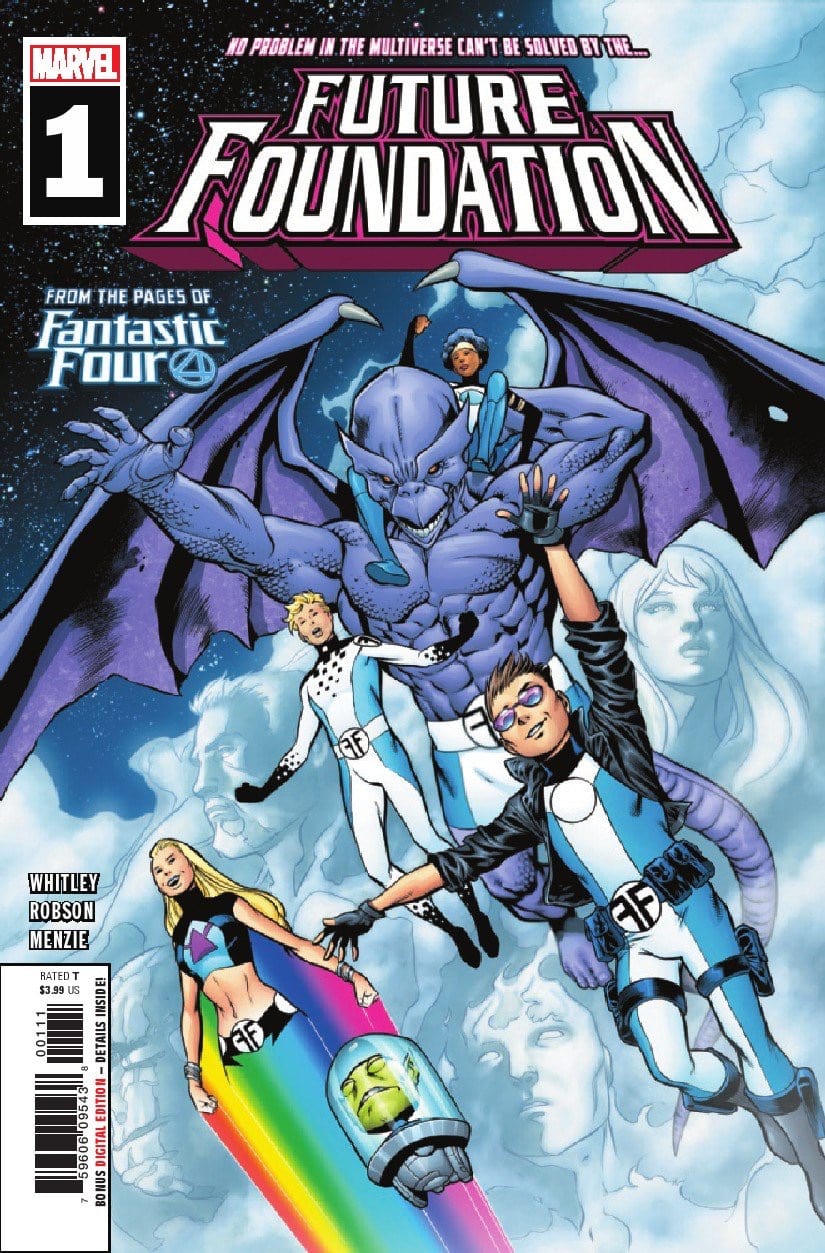
Spinning out of the pages of FANTASTIC FOUR this week is the newest incarnation of FUTURE FOUNDATION. There’s plenty of juicy sci-fi plotting in this debut issue, but not without some visual growing pains.

FF 1 CVR
NOW WITH RAINBOWS!

***SPOILERS LIE AHEAD***


Alex and Julie Powers (from Power Pack) join the Future Foundation in leadership roles. They, along with the usual suspects, are joined by Yondu to execute a prison break. The mission statement of Future Foundation is to scour the multiverse for pieces of their friend, Molecule Man.

Written by Jeremy Whitley, the plot of Future Foundation #1 has more in common with an issue of Guardians Of The Galaxy than the FF we’re used to–and not just because Yondu is hanging around. Not having the Richards kids along this time could’ve been a major detriment to the book but Whitley slots the Powers siblings in to soften the blow.

Bentley-23 stands out as the arrogant MVP of the group, carrying over from the time we spent with these characters before. Onome looks to be a match for Bentley in the area of scene stealing. Leech is adorable.

The Moloids and Dragon Man don’t get as much face time as the Powers siblings, which may not be appreciated by fans of the FF. Alex and Julie Powers are interesting characters, Whitley seems to have a handle on them both.

THE COSMIC AMAZING BAG MAN

There’s a handful of fun sci-fi and engineering moments from this group of young geniuses, but not much on the action side. However, a case of mistaken identity leads the young heroes into the path of alternate dimension Reed Richards–which is a wonderful antagonist choice.

The Maker is one of Marvel’s most underrated villains. The evil Mr. Fantastic, leftover from the Ultimate Universe, elevates every story he’s used in. Facing off against a think tank handpicked by the 616’s Reed Richards is very exciting.

If a theme had to be plucked from Future Foundation #1, it would probably be that of growth. These are characters taking a step forward on their own. Both the new leadership and remaining undergrads from FF should be coming into their own without the Richards family holding their hands–further solidifying The Maker as the perfect adversary.

Will Robson is our illustrator (and 1/2 of ink duties), Greg Menzie our colorist, with Daniele Orlandini providing the other half of the inks.

While the cartoon approach to the art’s tone is accomplishing what it set out to, it definitely takes away any edge this sci-fi adventure could have. The light tone and bubble-gum appeal may work for some but also be a deterrent for those coming into Future Foundation from Fantastic Four.

IN SPACE, EVERYONE CAN SEE YOU HAVE HORSE HOOF FEET

The team’s costume designs are a bit busy. The sleek and simple design of the previous incarnation (Hickman’s FF), was iconic. Future Foundation‘s branding aesthetic takes a hit with the addition of the Powers siblings.

All of the aliens and creatures look stupendous, the art style suits them very well. Leech, the Moloids, and the Uhari are all both adorable and interesting. It’s the humans that readers may have a hard time adjusting to.

The Maker’s final page reveal doesn’t hit as hard as it should due to the art. The cartoon style sucks away the character’s menace and gives him too much of a youthful appearance.

All-in-all, Future Foundation #1 starts us off with a script worthy of exploration. Coming straight from Fantastic Four, readers will have some growing pains but should be able to enjoy themselves. The cliffhanger hook promises a showdown Fantastic Four fans aren’t going to want to miss.

Monkeys Fighting Robots Youtube

Review: DICK TRACY FOREVER #4 Storms Blindly Into The Future

Monkeys Fighting Robots

Crime still plagues the streets as Michael Avon Oeming takes readers into the future with IDW’s Dick Tracy Forever this week. Future Tech, classic crime fighting, and plot twists abound in this final issue of the great detective’s adventures.

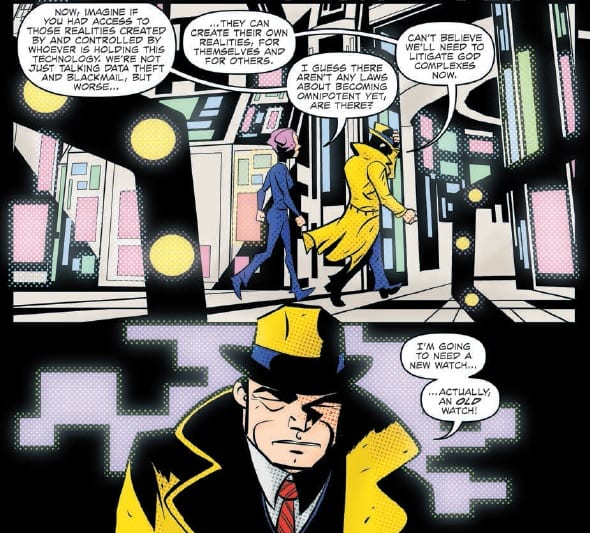
The last issue of Dick Tracy Forever ended on a jaw dropping reveal: Tracy awoke from a Matrix like simulation to find himself in 2031, surrounded by a cast of familiar faces. This issue picks up directly from that reveal, after a brief recap of the main characters and how they have changed physically over time.

DICK TRACY FOREVER #4 Storms Blindly Into The Future
Dick Tracy Forever #4 Credit: IDW Publishing

Forcing Tracy Into The Future

Tracy is suffering from a form of technological jet lag which allows the rest of the cast to bring him up to speed on their current case. As the nature of the crime is revealed, so are the emotional lessons that Tracy has learned on his mind boggling journey.

Oeming’s script is heavy handed in the opening pages of this issue, hammering home Tracy’s views on family and the Law. Philosophical questions about the nature of life and God are raised but dealt with curtly by Tracy’s brisk manner. In some places it feels like these ideas are brushed away too quickly despite being the heart of the story Oeming is telling.

There is a feeling that the story is rushed with a desperate need to include all of the references that Oeming wants to get in before the end. He has to pay homage to so many characters and elements from the original comic strip that the narrative focus is lost. Jammed within the references and future technology are some wonderful scenes that are very Dick Tracy in style. These are the moments that shine in this comic and go to show what Oeming could achieve if given more time to establish his stories.

DICK TRACY FOREVER #4 Storms Blindly Into The Future
Dick Tracy Forever #4 Credit: IDW Publishing

Future Art

Just like Chester Gould’s original strip in the 1960’s, part of the charm of Dick Tracy is lost when too many science fiction elements are added. Gould began to lose his way with the introduction of Moon based continuities and the serial drifted away from the police investigation to Flash Gordon style adventure. In this issue of Dick Tracy Forever, the influence of alternative realities and super computers have diluted the interesting and unique features of a Tracy story. It is kind of fun, like a novelty, throw away comic, but is not as compelling as the first couple of issues, or the original strips.

Oeming’s artwork is still as bold and brash as previous issues. There are moments where he appears to be channelling Frank Miller’s Sin City in stlye with heavy black lines and panels drowned in shadows. At other times, the characters look like they have escaped from Futurarama. The mix of comedic and serious panels makes some of the transitions awkward and the panels appear cramped especially with the amount of speech Oeming gives the characters.

DICK TRACY FOREVER #4 Storms Blindly Into The Future
Dick Tracy Forever #4 Credit: IDW Publishing

Shawn Lee does an impressive job of placing the speech balloons around the action in the panels and manages to give the lettering some character. The use of different shaped speech balloon’s help greatly in this, unfortunately Lee cannot disguise the vast amount of text filling each page. Speech heavy scripts can work, and a character like Dick Tracy lends himself to such comics, however the contrast with the mad cap science fiction narrative is an uncomfortable juxtaposition in places.

The use of bold, flat colors is a prime example of something that works for part of the comic but causes problems at other times. Taki Soma’s blocks of color are striking on some pages, making the character’s pop from the page. But when the same approach is applied to the backgrounds, the overall effect is too much and the emphasis is not strong enough.

Conclusion

Dick Tracy Forever is a fun science fiction comic but the heavy handed script doesn’t allow the reader to become engrossed in the story. The constant references and busy panels act as a barrier for the reader so a lot of the beauty and commentary is lost. This final issue is a disappointment because Oeming has already proven he can tell a good Dick Tracy story.


Monkeys Fighting Robots Youtube

Review: ABSOLUTE CARNAGE #1 Raises The Bar For Crossover Events

Monkeys Fighting Robots

With the release of Absolute Carnage #1 (on sale August 7th,) Marvel Comics brilliantly dives into the deep end with the introduction to its latest expansive crossover. From the first page, the creative team of Donny Cates and Ryan Stegman exceed expectations in their delivery of an opening salvo to this ambitious comic event.

Absolute Carnage #1

Writer: Donny Cates

Penciler: Ryan Stegman

Inker: JP Mayer

Color Artist: Frank Martin

Letterer: VC’s Clayton Cowles

Absolute Carnage #1
Absolute Carnage #1 is a wild ride from the first line.

Not Your Typical Opener

Enough with the slow-burn mysteries. We’re all tired of those event stories that never take it to the next gear. But, other than War of the Realms, most recent crossovers have suffered from that flaw. Thankfully, whether you like the story itself or not, there arew few, if any, dull moments in Absolute Carnage #1. The issue is packed with plot development and, though chaos is sure to throw fans for a loop, there’s a clear narrative direction for the event by the end of the issue.

Naturally, some page space is devoted to exposition; expecting non-Venom readers to easily follow along with the character’s complex mythos would be a tall task, so writer Donny Cates succinctly summarizes some of the major plot points from Eddie Brock’s solo series. With a comic with over 60 pages of story, taking some time to provide readers with a crash course on the main protagonist benefits the overall plot because it offers us a chance to breathe.

Most crossovers wait until the third or fourth issue to hit the accelerator. Not Absolute Carnage.In this opening installment, Cates mixes together an army of symbiote-covered inmates, a substantial Spider-Man cameo, a maniacally homicidal Norman Osborn and more. Plus, the writer doesn’t pull any punches when he reveals that this story will impact the entire Marvel Universe. Brock reveals that Carnage is targeting anyone who has ever worn a symbiote. As Spidey wisely points out, “that’s a long list.” Cates recognizes the long line of Venom-based crossovers and symbiote-centric events and clearly hopes to surpass them all.

As Intricate As A Spider’s Web 

Absolute Carnage #1
Absolute Carnage #1 is an accessible crossover story but it also incorporates a number of elements from Cates’ Venom.

Though Absolute Carnage #1 works as a general Marvel story, it’s also the culmination of over a year’s worth of storytelling. The issue organically progresses Cates’ stories in Venom and other related miniseries because it ties in a number of important characters and plot points. First, the Maker, or Ultimate Reed Richards, plays an influential role in the story. Ironically, the Venom villain has the power to help the heroes win this war but it’s unclear whether he’ll help his foe in the long run. Then, Cates brings in the Grendel, the dragon that Brock fought earlier in his solo series. Combined with a brief mention of Rex Strickland and the inclusion of Brock’s complicated relationship with his son Dylan, these elements clearly showcase Cates’ fingerprints in the story. For fans who have been reading Venom from the beginning will likely appreciate these references while other readers might feel encouraged to start catching up on the series.

Those Facial Expressions Though

Absolute Carnage #1`
Ryan Stegman conveys powerful emotions in his facial expressions, which elevate the story to new heights.

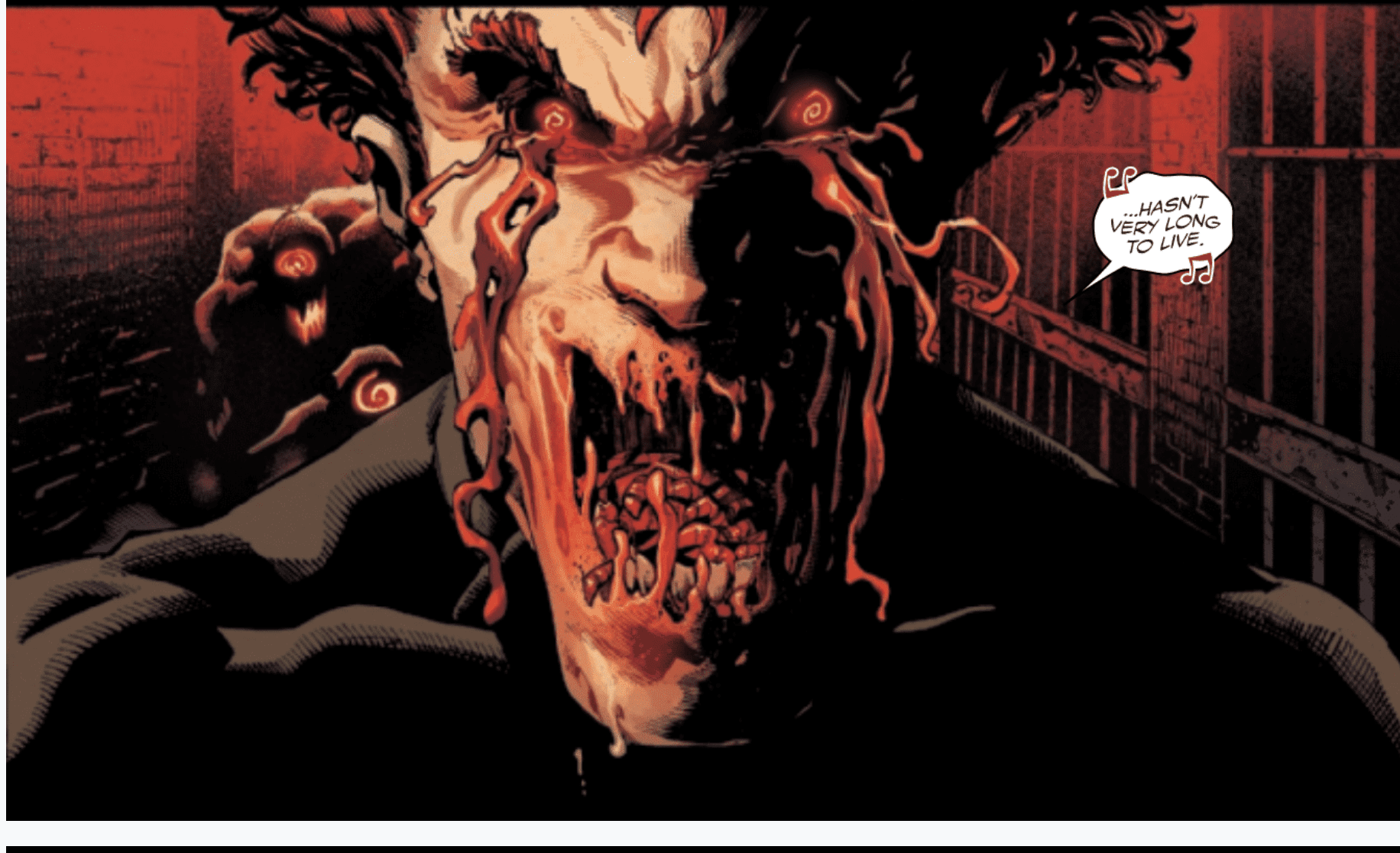
Throughout Absolute Carnage #1, Ryan Stegman’s art makes the reader stop and stare. The setting of a fiery hellscape in a New York City subway station, the perspective of Carnage’s towering god-like frame over Venom or the gory horror movie-like bit where Norman Osborn rips his gooey chest open are just a few examples of Stegman’s art working wonderfully with the story. But above all else, Stegman’s facial expressions carry the issue.

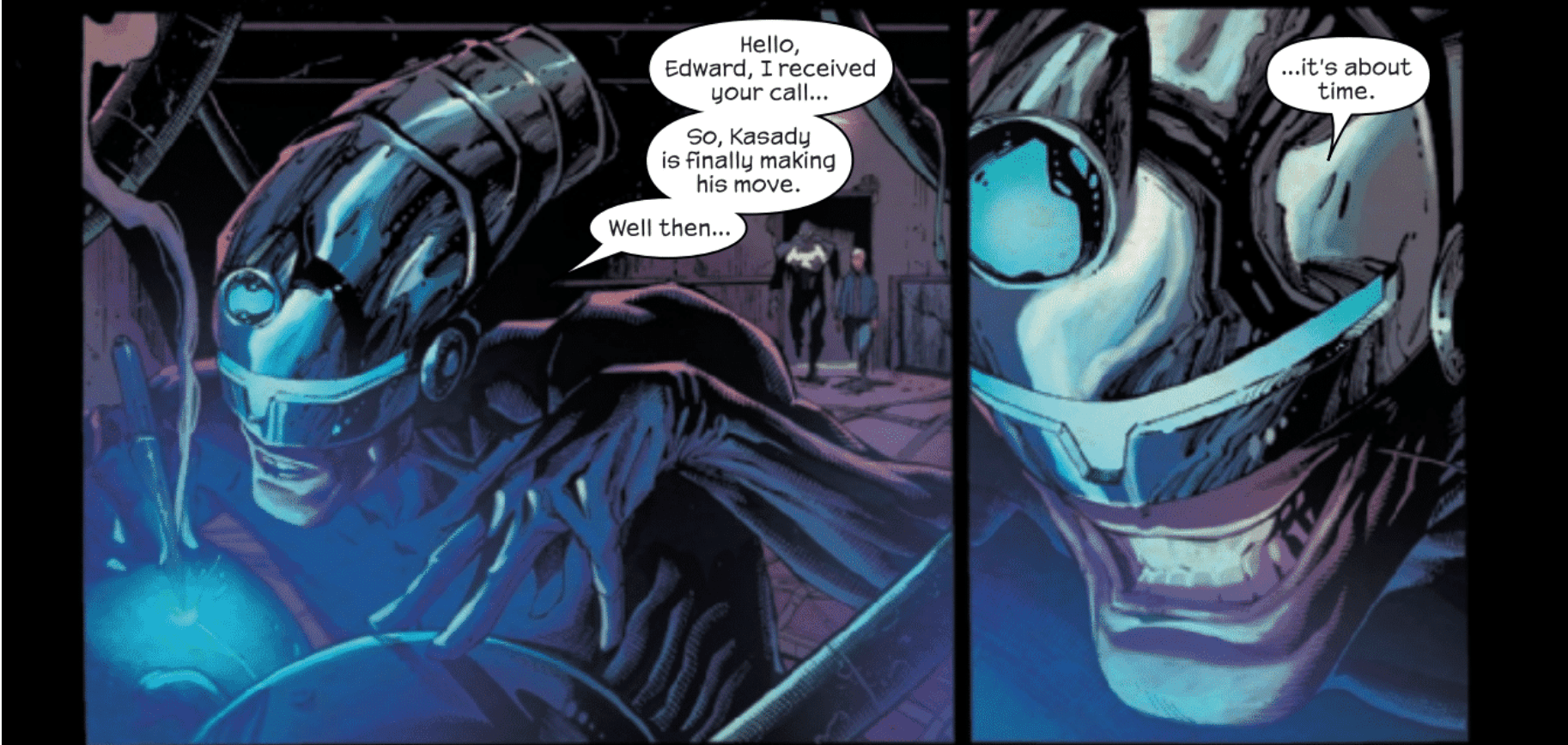
Whether it’s Brock’s desperate hatred of Carnage, Cletus Kasady’s Joker-like grin or the depravity in Norman Osborn’s eyes, Stegman powerfully shows the reader what the characters are feeling. As a result, time and again, the heroes and the villains seem like real people despite the nightmarish plot elements.

Absolute Carnage #1
The impact of Stegman’s facial expressions can’t be overstated.

In most cases, JP Mayer’s inks and Frank Martin’s colors make the facial expressions, and the overall art, even more impressive. Their usage of dark red blurs the lines between blood and Carnage’s symbiote when Norman Osborn, infected with the vile goo, appears. When Eddie Brock tries to kill Carnage early on, Meyer and Martin subtly show tears brewing in Brock’s eyes. These skillful touches make the art even more eye-opening. Letter Clayton Cowles also complements the story; using distinct blacks, grays and reds, he gives each main symbiote (and host) an individual voice. This effect is particularly notable when Brock talks to his symbiote. These small artistic choices combine to breathe the story to life.

Absolute Carnage #1 knocked it out of the park. It’s hard to think of any hypothetical substantial improvements for this issue. It’s too early to give a definitive verdict on the series but, as of today, it’s clear Marvel’s newest event is another winner.

What’d you think of Absolute Carnage #1? Where do you hope to see the story go from here?

Monkeys Fighting Robots Youtube

Review: SPACE BANDITS #2 Offers Intensely-Entertaining Sci-Fi Prison Drama

Monkeys Fighting Robots

There’s no foundation for a friendship quite like a mutual desire for revenge.

In Space Bandits #2, we see Cody adjust to life on The Crustacean. Thena, for her part, offers advice to help her get by and stay out of trouble. Their relative adjustment doesn’t mean they’ve forgotten their mission, though. Cody seems convinced that the prize fight is her best way out, but Thena has another plan in mind.

The Writing

Our first issue was like the introduction to a classic western, providing the preamble and laying out the betrayals that motivate the plot. Here, the story develops into more of a prison yard drama-meets-jailbreak story.

It’s been two years since Thena was first sent to The Crust, and with her knowledge of the politics and manners of the place, she does her best to help Cody adjust. We don’t have much of a sense of genuine friendship between the two at this phase of the narrative, though. Instead, they feel like convenient allies, meaning there’s not much pathos built through their interactions. In truth, there’s more sentiment devoted to Thena’s relationship with Cosmo the lizard, than with Cody. Still, their interactions are humorous, and ultimately drive the narrative forward well. They bond over their shared desires for revenge, and that’s enough for now.

Speaking of driving the narrative, the story in Space Bandits #2 moves at lightning pace. Only ten pages elapse between the point at which we learn Thena may have a plan, and the point at which they execute it. The story carries momentum without feeling overly-rushed. What this issue may lack in character development, it largely makes up for with compelling action.

The only real complaint is that there is so much going on, some ideas seem to get a little buried. For instance, Millar notes that the governor streams the bloodsport in The Crustacean throughout the galaxy as a form of entertainment, making a fortune off the slaughter. This could be an interesting avenue for the plot, lending poignant critique of the prison-industrial complex, but it doesn’t seem to come up again. Similarly, the politics within the prison are alluded to, but are primarily used as a plot device to aid Thena and Cody in their escape attempt.

Regardless, the writing is snappy, engaging, and very satisfying.

Space Bandits #2

Space Bandits #2 Space Bandits #2

The Artwork

You could pull any panel from the book, blow it up and hang it on the wall as a piece of cyberpunk artwork. Great as it is in isolation, Artist Matteo Scalera doesn’t overlook the need to match the energy of the storytelling.

The visuals in Space Bandits #2 carry a tremendous amount of momentum from one panel to the next. The work is rich, stylized, and sizzles with energy. The final product remains very coherent, though; the reader never feels lost or unsure of what’s conveyed in any given panel.

Scalera has a real knack for visual narratives. It’s not easy to portray alien worlds in a compelling and unique way, while still remaining familiar enough to make the story coherent. His work in Space Bandits #2 achieves this delicate balance, though. Figures as abstract as a three-dimensional, sentient algorithm feel rooted in this world alongside their human parallels.

Scalera conveys a lot of context and meaning through facial expressions. A subtle raising or lowering of an eyebrow illustrates a complex set of emotions. To achieve such expression with such subtle shifts in expression is a sign of a highly-skilled artist at work.

Colorist Marcelo Maiolo’s work plays a key role as well. He employs a bright, ambitious color palette; lots of reds and oranges to match the emotional tone of the book.

Final Thoughts

Space Bandits #2 continues on the strong trajectory set by our first issue in the series. I expect great things yet to come from this book. Get it August 7 at your local comic book shop.

Monkeys Fighting Robots Youtube

Review: DESCENDENT #4 Successfully Melds Humour And Intrigue

Monkeys Fighting Robots

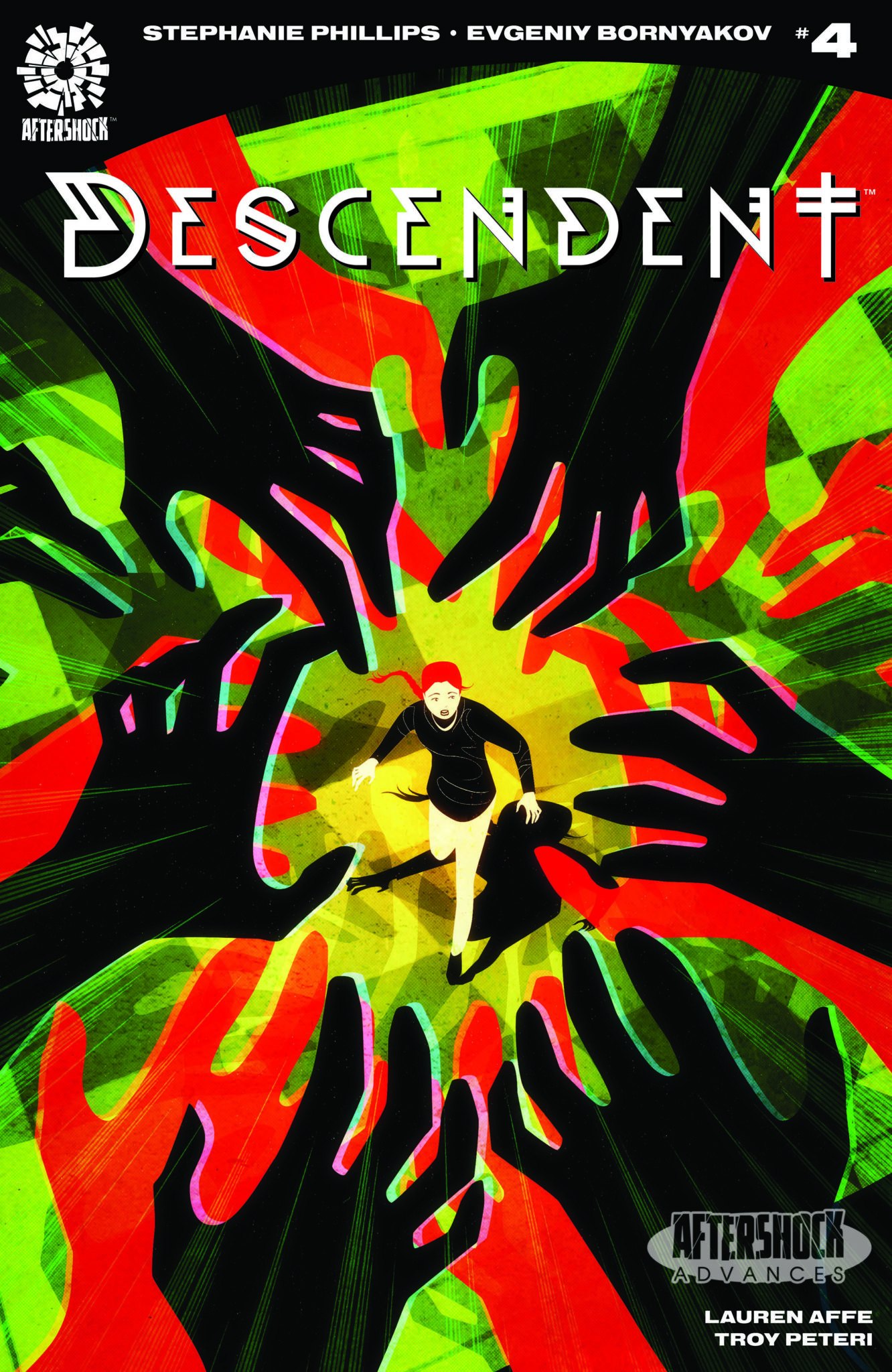
This week Stephanie Phillips breaks open the conspiracy at the heart of her comic from AfterShock Comics, Descendent, and introduces the horror behind the scenes.

This chapter of the story may be called ‘Worst. Stakeout.Ever’ but that does not ring true for the reader. Descendent issue 4 is packed with action and suspense, and as the narrative unravels the true horror shows it’s face.

DESCENDENT #4 Successfully Melds Humour And Intrigue
Descendent #4 Credit: AfterShock Comic

Descendent Story

Stephanie Phillips proves in this issue how clever she is at building stories. Not only does she start to tie together the various plot threads from previous issues into a coherent whole but the narrative structure in this single issue is captivating. She flicks between scenes and time periods in order to produce the greatest impact, building the tension on every page.

The opening leaves a cliff-hanger which gets resolved later on but that sense of dread prevails over everything else, even the comedic moments. And this is Phillips strength; she is able to keep the prevailing atmosphere alive while indulging in some character development. The growing relationship between David, Amanda, and Jo is a delight to read. Phillips has created three very different characters who have been forced to work together and the way they interact gives the comic it’s entertainment value.

Each of the central cast have very distinctive voices which can be heard through their speech. David provides the much needed comedy that holds the rest of the story together. By making the reader identify and become attached to David, and through him Amanda and Jo, Phillips is making it easier to introduce the more outlandish aspects of the plot. As a reader you are sold on the story through these great characters.

DESCENDENT #4 Successfully Melds Humour And Intrigue
Descendent #4 Credit: AfterShock Comic

Descendent Art

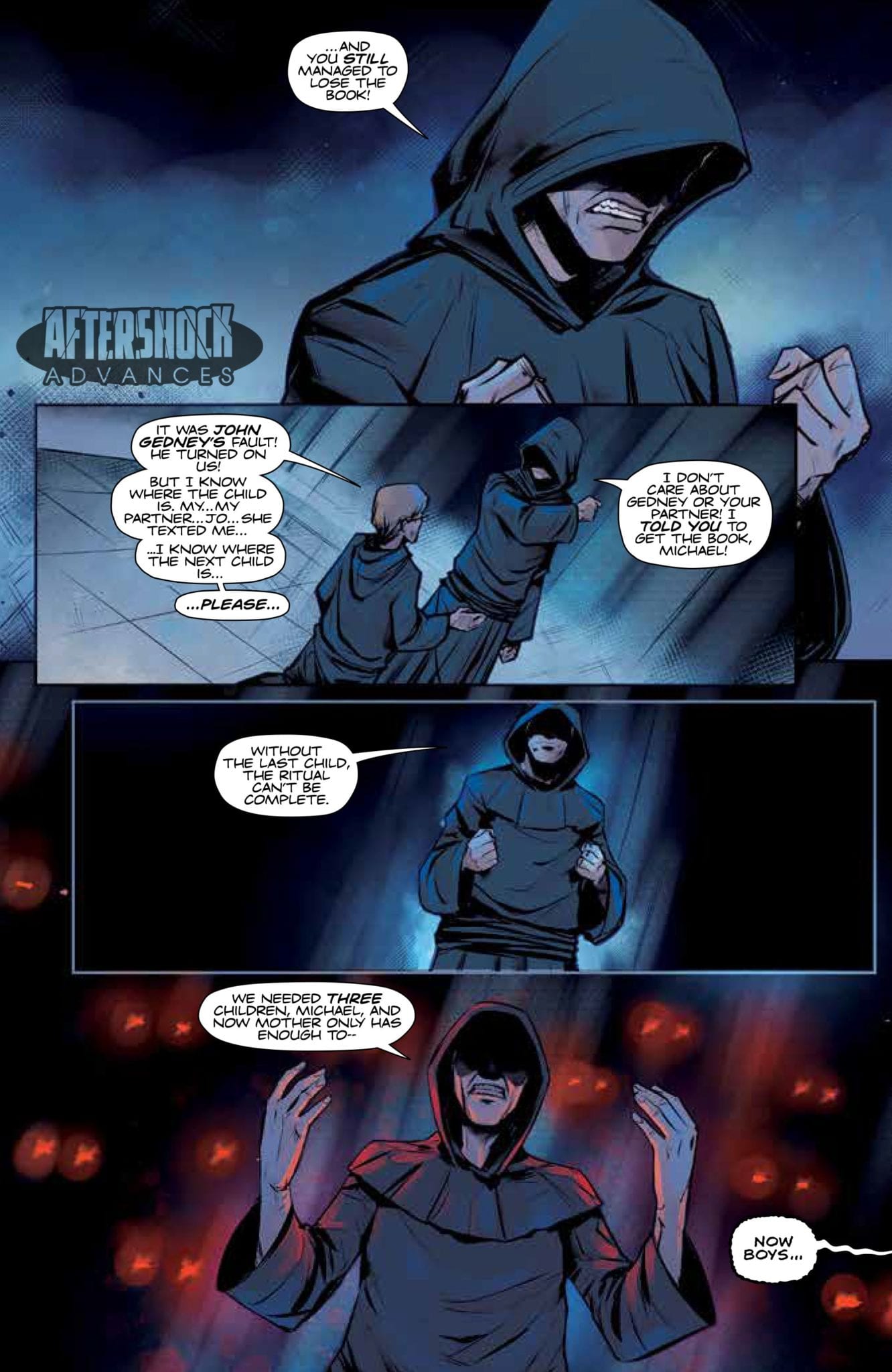
The plot moves at quite a pace in this issue. The conspiracy is opening up, David and Co have an idea of what is happening, and the villain behind it all has finally shown her face. To illustrate the fact that the plot is now moving at breakneck speed, Evgeniy Bornyakov has injected a healthy dose of energy into the artwork.

The opening scene is a wonderful establishing page. The fear and desperation of the running girl is clear and the panels build up on top of each other to highlight the growing urgency of the situation. Bornyakov zooms in on each panel, distorting the elapsed time and putting the reader into the centre of the action. He then continues to do this throughout this issue.

His composition and framing brings out the very best of the character’s interactions and the bound that is growing between them. In contrast the villains of the piece have a distance between them that is only crossed with acts of violence.

The contrast between the two sets of characters becomes more vivid thanks to Lauren Affe’s coloring. David and Co have a warm, light color pallet for their opening scene which makes it stand out from the surrounding action. There are cold blues and imposing shadows for Sarah Gedney’s introduction and striking reds and oranges added for the Cult’s meeting.  This juxtaposition of coloring tells the reader everything they need to know about these people and their situations.

The lettering provided by Troy Peteri helps to pace the story across the pages and acts as a focal point to lead the reader across the page. The small sound effects stand out from the action creating a definitive impression of sound. They add weight to the actions because of the stark contrast to the images behind them.

DESCENDENT #4 Successfully Melds Humour And Intrigue
Descendent #4 Credit: AfterShock Comic

Conclusion

There are some inconsistencies with the balloon placements, especially where they butt or break the boarders of the panels. There are also some questionable panels where the energy of the image isn’t quite captured by Bornyakov’s art. However, the strong narrative and superb character work rides over these small flaws to produce a more than satisfying chapter in the series.

Descendent #4 is an intelligent comic that stands as a single issue but also reflects on what has come before. The art work for the most part is captivating and draws the reader into the story. The cliff-hanger ending for this issue is a real show stealer and, no matter what faults you may have found earlier in the issue, the final splash page is a guarantee that you will be back next month.

Monkeys Fighting Robots Youtube

Advanced Review: A War On Magic Is Waged In TOMMY GUN WIZARDS #1

Monkeys Fighting Robots

On August 28th Dark Horse Comics invites you to the Windy City for a dance, a drink, and perhaps a magical battle with the local mobsters. This is Tommy Gun Wizards and it is about to rewrite everything you know about Elliot Ness and the Untouchables.

Chicago, 1931 and the speakeasies are packed with revellers out for some fun and maybe something extra: a touch of magic. In this alternative world, the 20th century party city is awash with a new drug that imbues the taker with magical abilities. In small doses it can help the user bulk up without the working out, spend an evening invisible, or just relax in a bath of infinitely warm water. However, like all drugs, addiction and overdose are real dangers and, take too much, the user can become a ‘boiler’: a danger to themselves and everyone around them.

This is the world created by Christian Ward who has passed over art duties to Sami Kivela so that he can concentrate purely on writing. Ward has drawn historical figures into an alternative reality where Magic has replaced Alcohol as the reason for prohibition in one of the most infamous periods of American history. The influence of great movies such as the 1987 classic The Untouchables is obvious but Ward has added a new spin to the gangster genre. He has moulded fantasy and science-fiction with history to produce something that is not only entertaining but also plausible: like George R R Martin’s superhero inspired Wild Card series of books.

A War On Magic Is Waged In TOMMY GUN WIZARDS #1
Tommy Gun Wizards #1 Credit: Dark Horse Comics

Creating The Chicago Scene

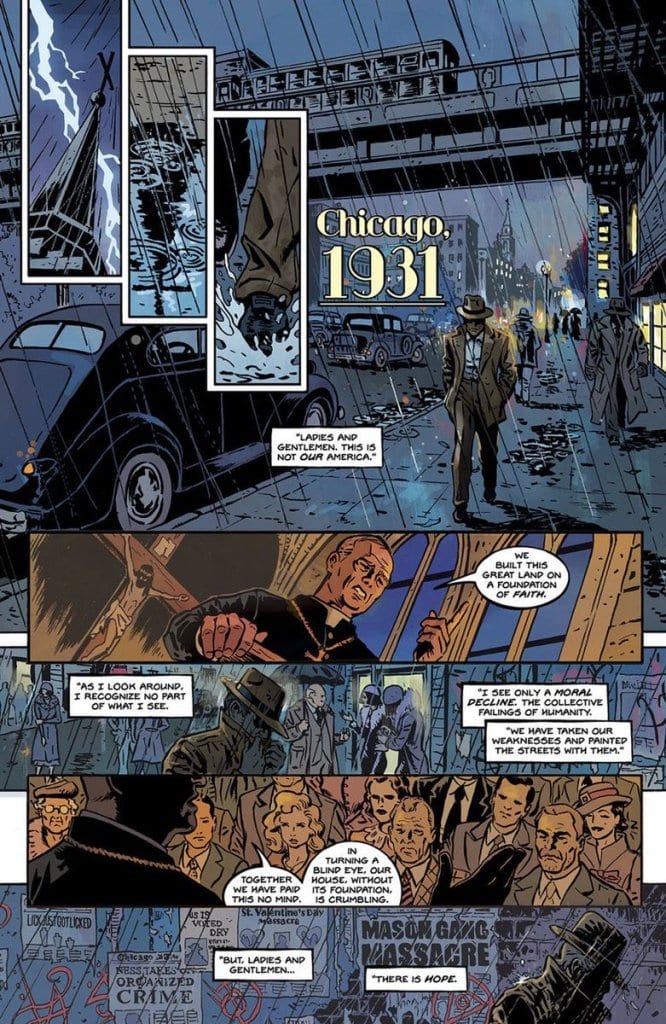
Chicago is a city of conflicting moods, a tone captured from the very beginning. Kivela’s art work focuses on one character as he walks through the street. This character is the readers entrance into Tommy Gun Wizards and we follow him through the streets of cold, huddled extras surrounded by news print posters of crime stories and murder. This walk through the rain is broken by panels of religious preaching, a cliché of gangster movies maybe but also an important aspect for the story.

The priest’s words set the scene, giving the reader a lot of information about the world that they are entering. The priests first words are “Ladies and gentlemen this is not our America,” the emphasis in the lettering by Hassan Otsmane-Elhaou is on the word ‘our’. This is a truth and is spoken directly to the reader. The world is familiar but also very different.

A War On Magic Is Waged In TOMMY GUN WIZARDS #1
Tommy Gun Wizards #1 Credit: Dark Horse Comics

Laying Out The Tommy Guns

Kivela’s art work is extremely detailed with panels of packed images. There are a number of crowd scenes populated with an array of extras which constantly reminds the reader about the size of the city and the scope of the story. However, Kivela also knows when to reign in the backgrounds, simplifying them or dropping them altogether to focus attention onto a single figure.

The layouts also emphasis the action within the panels either by bleeding to the edge of the page to have a more dramatic punch or by limiting the number of panels on the page and leaving large areas of white.

On one page, for example, the panels taper in size towards the bottom of the page, ending in a single square panel featuring a small glass and hand. The speech informs the reader that the glass contains ‘Lick’ the source of the magic in Tommy Gun Wizards. This is a pivotal point in the comic as it is the reader’s introduction to the magical element and the source of difference between the real world and Wards’ creation. To mark its importance, the page draws the reader directly to it and leaves it standing alone on a tier, surrounded by white space.

This is a prime example of the precision storytelling that is evident throughout Tommy Gun Wizards. Each of the creators works together to create the relevant ambience or focus for each page. The characters are built from the script and the acting that Kivela draws out of them. The mood is set by the composition and the coloring, here handled by Ward and Dee Cunniffe. The tone of a page is often set on the establishing first panel with the coloring of that panel feeding through the rest of the page. Action sequences are distinctively red where as heavy conversational, bureaucratic scenes have a much more subdued brown/yellow coloring.

A War On Magic Is Waged In TOMMY GUN WIZARDS #1
Tommy Gun Wizards #1 Credit: Dark Horse Comics

Speaking Easy

Just like Jonathan Ross’ first venture into comics with Turf in 2010, Tommy Gun Wizards packs a lot into a single issue. There is a lot of speech for Otsmane-Elhaou to fit into the panels but, as a master of balloon placement, this is not a problem for him. During a press conference the speech hangs heavy in the air as it is the most important aspect of the scene whereas in action sequences the speech draws the reader around the panels to allow for the most exciting reading.

There is even a back-up strip written and illustrated by Christian Ward. This will, over the coming months, give the reader some background to the magical element and why the world is so different. This part of the comic is more science-fiction. It looks and feels like a spin off from the Invisible Kingdom, another superb comic Ward works on. The backup story adds new elements to the overall story and gives it an extra edge.

Tommy Gun Wizards is a mix of genre, inspired by the very best gangster stories but pulling in so much more. It’s larger than life in places, especially as the story gets going, but the characters are rooted in a world the reader can understand and empathise with. And there are some great characters in this comic. The villainous Candice is a brilliant creation and beautifully designed.

This comic powers through the story barely allowing the reader to get adjusted to this reality but the strength of the storytelling grabs hold of you and doesn’t let go. This is without question a must for fans of gangster stories. It is also for fans of fantasy, science fiction, horror, and good all-round comic book storytelling.

A War On Magic Is Waged In TOMMY GUN WIZARDS #1
Tommy Gun Wizards #1 Alternative Cover by Declan Shalvey
Monkeys Fighting Robots Youtube