GIDEON FALLS is the most inventive and striking story happening in horror. This week, issue #16 takes a turn into a whole new world for our cast of characters.
SORRENTINO IS A FORCE OF NATURE
***SPOILERS LIE AHEAD***
Things just got a whole lot more complicated for our friend Norton Sinclair. Gideon Falls #16 reveals that Norton is really Daniel Sutton, who is the young boy in the opening that falls from the tree and sees the black barn. His father was the doctor obsessed with the black barn mystery and sister to the Gideon Falls sheriff.
This issue is an anxiety attack that readers experience along with Norton. It’s a deja-vu trip that takes a turn for the worst. The work that artist Andrea Sorrentino, colorist Dave Stewart, and letters/designer Steve Wands are doing is an absolute triumph for horror storytelling.
There are multiple moments in Gideon Falls #16 that are terrifying and dreadful. This art team has a way of giving the reader that drip of anxiety and panic down the back of their skull that you get when you’ve stepped into somewhere you’re not supposed to be.
Everything about Gideon Falls is striking and iconic. The terrifying images presented in these issues are hard to shake from your head. There’s a palpable sense of dread that washes over readers anytime the story calls for it. Stewart’s bold coloring sends shivers down your spine and grabs your attention every time it needs to.
Gideon Falls #16 is chock full of twists and turns that are hard for our main protagonist to swallow. It’s a disoriented mess of overwhelming curve balls that’s scripted and presented in such a smooth manner. The way this creative team is able to deliver this complex story in this easy digestible format is impressive.
HEAD LIKE A HAUNTED HOUSE
Not only does Norton get smacked in the face with information about who he really is, he’s reunited with his father at the exact moment the “Laughing Man” uses the old man’s body as a doorway into our world. This issue sets up the next chapter of Gideon Falls in a big way. We’re in a whole new world now.
Our main cast is split up and completely disoriented at the worst possible time. The way this story has unfolded is an absolute masterpiece for both comic books and the horror genre at large. Gideon Falls isn’t just important to the comic book medium, but all of horror–especially with a television show on the way.
Jeff Lemire has developed these characters and this narrative at the perfect pace. The chemistry he has with this art team is astounding. They are operating on another level of storytelling. As strong a writer as Lemire is, he almost takes a backseat to the visuals that Sorrentino provides.
The sixteenth chapter takes us in a new direction for the start of the next arc. One loaded with dread and terror that will surely continue to take readers on a horrifying journey right along with this strong cast of characters.
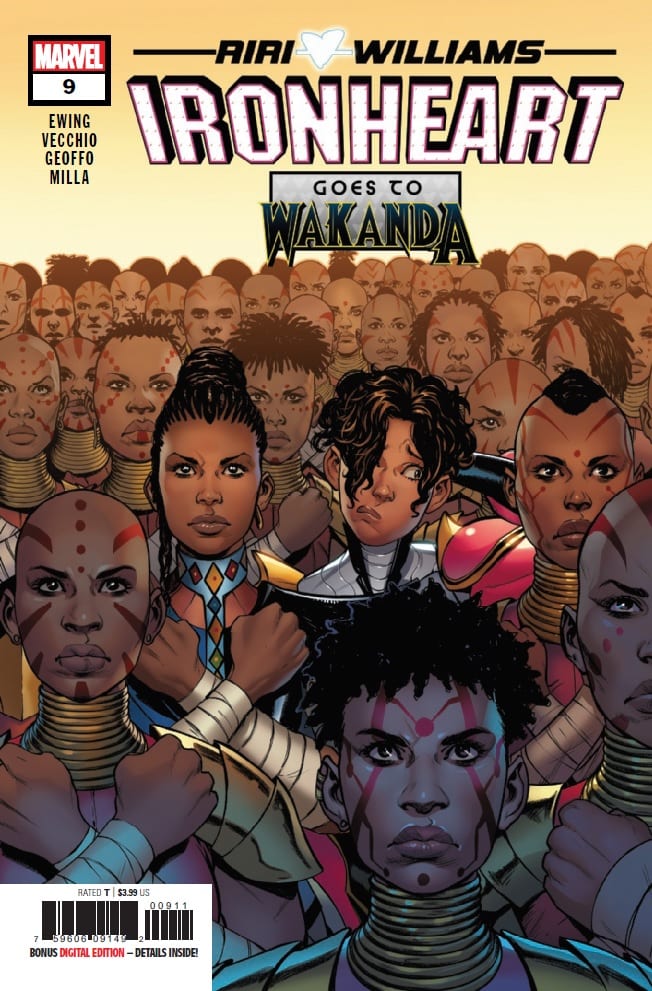
IRONHEART #9, out this week from Marvel Comics brings together two unique characters; both are loved and both are insanely talented in the world of tech. The real question is, how exactly will these two dominant personalities get along?
An iconic and amusing cover if ever there was one.
***SPOILER WARNING***
Riri Williams is a tech genius. Nobody is going to argue that point, not around here. But she’s still had a bit of a tough life, and trying to balance life with being a hero is never easy. Lately, Ironheart has been on the hunt for a group of villains known as the Ten Rings – and it’s taken her to an unexpected place.
Ironheart #8 brought in an unexpected cameo out of Doctor Strange, and it would seem that the cameos are not over for Riri’s tale. This issue sees two major characters alongside several recognizable ones. You’d think that’d leave for a busy issue, but you’d be wrong.
Riri is rocking the iconic pink and gold lately.
Ironheart #9 brings back a classic icon to the tale; Tony Stark. It also gives Riri a chance to meet a contemporary of hers; Princess Shuri. Both interactions are a delight for fans, though naturally both go very differently from one another.
Crossovers can be tough. Sometimes they’ll be comical, but miss some of the vital elements that make our beloved characters who and what they are. This series managed to do justice to both named characters listed and overall made for a fun issue.
One highlight of this crossover was the chance given to Riri to see a life that is very different from her own, yet similar enough to truly strike a chord within her. The emotions expressed at these moments were subtle and understated and masked by Riri’s instant reflex to shield her feelings. It made for a very moving scene.
Our two Iron themed heroes on the same page? Yes, please!
The crossovers may have dominated the focus, but the plot moved forward along the way. Riri’s hunt is still active and has been made ever the clearer that she must find and stop the cause to this mess sooner rather than later.
Eve L. Ewing has done an amazing job writing this series so far. You can tell that she really enjoys the story she’s telling. She’s taking risks with the character, which is always appreciated, while also trying to stick to her roots. It’s a tough balance, but one that has been found nonetheless.
We have just as many questions about how Tony managed this one.
Supporting Ewing’s writing is the amazing artwork from Luciano Vecchio (pencils) and Matt Milla (coloring). Together they bring a sense of vibrancy to this world. This issue, in particular, was a standout one; thanks to the new world they were able to place Riri in.
The artists particularly excelled when it came to rendering Shuri and Wakanda – these elements were striking and iconic, in every way that they should always be. It made for a stark contrast to Riri’s vibrant colored technology that she carries with her always.
Credit should also be given to Geoffo for the layout in this issue, and you can see the extra attention given to the layout of some of these panels. And of course, VC’s Clayton Cowles once again knocked the lettering out of the park.
The reflection on Ironheart’s helmet truly does add to the scene.
Ironheart #9 took Riri out of her comfort zone, but in doing so gave her a chance to experience something new, while hopefully obtaining a new ally along the way. Combining these new interactions with the continuation of the plot was a good call – it kept the pace going steadily, while also holding our attention.
It is the year of Arthurian retellings, but ONCE & FUTURE #1 out this week from Boom! Studios is proving to be one of the most unique examples out there – full of twists and turns.
A striking cover for a new series.
***SPOILER WARNING***
Once & Future #1 is the start of a modernized tale of King Arthur – and it’s already looking like things are not going to go the way we expected. Set in the present day, Once & Future combines archeology with history, prophecies, and supernatural horror all in one neat package.
Early on in the process, writer Kieron Gillen expressed hope of finding a new way to bring the classic tale into the future. But, naturally, he wanted to do something that had never been done before. Considering Arthurian retellings are a dime a dozen, we can hardly fault him for the logic here.
But the real question on everyone’s minds is, did they succeed? After having read the first issue in the series – it certainly looks like they have. Once & Future is everything it promised; it has a strong basis in the supernatural while holding on to history through the use of character backstory and archeological hints.
If this image isn’t dramatic enough for you, we don’t know what is.
Once & Future #1 starts in a way that immediately grabs and holds the reader’s attention. This storytelling technique is a clever one but usually needs some further explaining later down the line. Something which our creators were happy to do, through the use of what we can only assume is one of the main characters of the series.
From there the series seems to bounce around a little bit, giving us time to get to know our main characters before tossing them into the thick of the plot. This also allowed for a moment of humor, and a chance to really see the dry wit underlying the series.
Being that this is the first issue, it’s no surprise that they spent most of the time on establishing the frameworks of the series. What is a pleasant surprise is how intriguing and fun they made the process. There was never a dull moment to be found in this issue, and instead, the conclusion left us eager for more.
The creative team for this project should be enough to grab many new fans.
The artistic team for this series is already proving to be a powerhouse. Dan Mora is the artist behind the scenes, providing the lines that are already creating such iconic moments. Meanwhile, Tamra Bonvillain provided the colors, and you can see her influence over the series. Finally, Ed Dukeshire came in for the lettering, and his work was both beautiful and understated, just like we hoped.
There was a lot to like about the art in this series. The color palette leans well towards the supernatural and the horror, while also supporting some of the lighter moods already shown. This isn’t an easy balance to achieve, but it was done effectively here.
The supernatural elements shown have been fascinating so far, leaving readers hoping for more. It’s ironic, in a sense. There was a statement about watching your obsession with monsters, only to present us with a monster worthy of studying. Was this an intentional mirror, or just a happy coincidence provided by talented artists?
And so our tale begins.
Once & Future #1 has managed to take a story told countless times and completely flip it on its head. The source material is still clearly recognizable – the characters themselves don’t shy from the subject at hand – yet it’s been altered to suit the needs of the story. And that is where this series shines.
Reading Black Hammer/ Justice League: Hammer of Justice #2 is a lot like watching someone play with their favorite toys. It is clear that writer Jeff Lemire has the utmost respect for this paradigmatic super team that his award-winning Black Hammer series has made a legacy of deconstructing. While it feels odd to see someone other than Dean Ormston and Dave Stewart draw and color Black Hammer’s stellar cast, artist Michael Walsh certainly puts forth a valiant effort. Black Hammer/ Justice League: Hammer of Justice #2 out this week, is definitely a slower chapter, but the revelations it is building up towards feeling seismic.
Black Hammer/ Justice League: Hammer of Justice #2 picks up initially 10 years after the events of the first chapter with the Justice League already settled into the town of Rockwood. Batman has a history with the local law enforcement as he has been previously cited for vigilantism, Wonder Woman is a schoolteacher, and Superman has settled into the role occupied by Abraham. Simultaneously, the Black Hammer crew is coping with the fact of dealing with Starro, being placed into this bizarre new world of Metropolis, and encountering the rest of the Justice League.
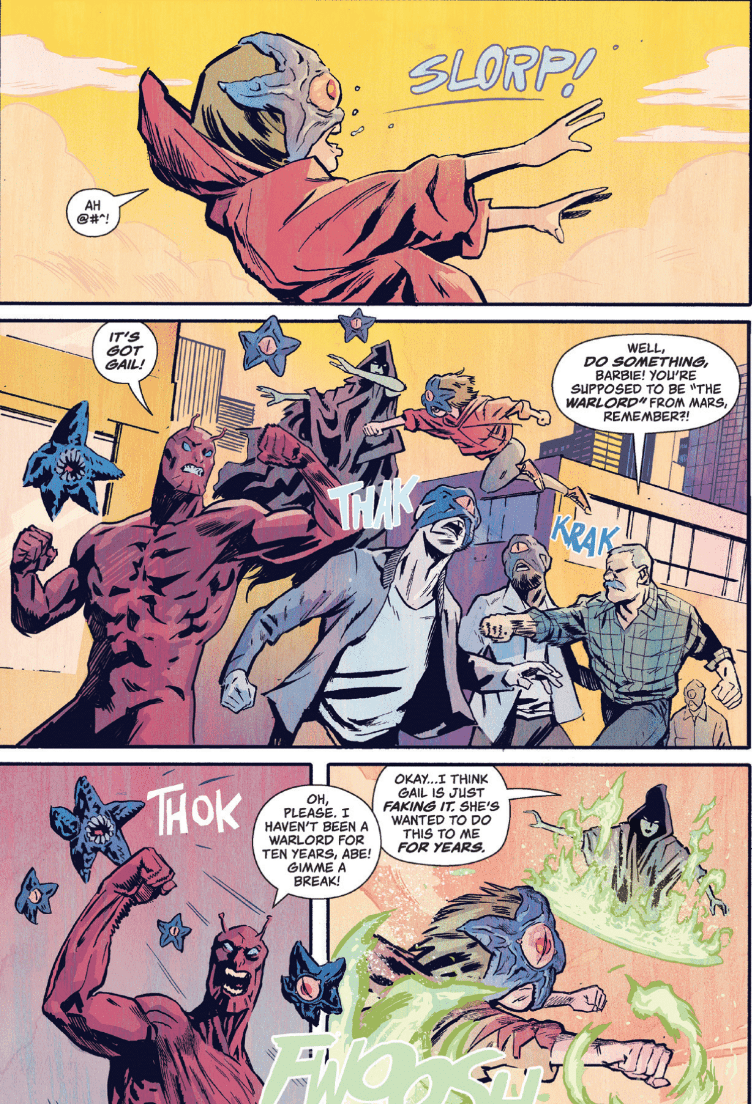
Lemire is clearly having a ball placing these two groups of characters in these new circumstances. The manner in which the police officer scolds Batman while he pulls him over, is a direct reflection of how ridiculous the situation is. Batman literally got pulled over for being a vigilante but not because he was pummeling the Joker instead he is investigating who was tipping cows. This light-hearted tone is also shown when Gail is potentially faking being controlled by Starro to take a swing at Madame Dragonfly and Gail’s realization that she cannot curse in this dimension.
Colonel Weird and Green Lantern’s storyline definitely seems to be the main branch for information, which is especially odd for Weird. Weird has always been the Knowing Observer who is reluctant to spill any coherent thoughts so learning how he processes information and seeing the Para-Zone is a nice look to see why he is this way. The introduction of the Bizarro Black Hammer Crew is also a nice touch.
Michael Walsh’s art is clearly inspired by Dean Ormston and Dave Stewart’s, but it definitely fails to live up to their lofty standards. Walsh’s depiction of Rockwood is really the only setting that stands out. Walsh drapes Rockwood in heavy shadows and makes clever use of setting that story around sunset/night time, adding to the lurking unease to it.
Golden Gail, First Class Actress
However, in daylight, the cracks are shown. And the main detraction is how certain panels have a surprising lack of detail, especially when it concerns to Aquaman and the Green Lantern Corps. I understand that the style isn’t as focused on the fine photo-realistic details of everything, but some panels are simply unfocused. For instance, when shown the entirety of the Green Lantern Corps, one is simply shown as a blue blob in the corner. Also when Green Lantern and Colonel Weird are in the Para-Zone, they point out a mystery man in pictures and he is almost undistinguishable due to the lack of focus.
It feels disingenuous to critique Black Hammer/Justice League: Hammer of Justice #2 too much as it combines two of the most well written and/or prominent super teams in creation. But something is simply not clicking the way it should. Lemire’s script is effective, punchy, and thoughtful. Walsh’s art and Nate Piekos’s letters are serviceable. But the combination of these two sensational entities is producing something just good enough, which is just a tad disappointing.
Debuting in Walmart exclusive Titans Giant #1, #2 this new Titans story is available to the Direct Market for the first time as Titans: Burning Rage #1. Written by DC Comics veteran Dan Jurgens, Titans: Burning Rage #1 is an easy starting point for those interested in this long-running team. Let’s call it Titans #1 for brevity’s sake.
Minor Spoilers Follow
Jurgens throws us straight into the action with a confused Beast Boy delivering pizza to his Titan teammates who seem to be absent from their T-shaped building. With a crackle of purple air Raven arrives to wisp the green hero to help the other Titans. Once on the scene of S.T.A.R. Labs Jurgens and team introduce us to one of our villains for Titans #1; The Disruptor. Wanting to amplify his power he breaks into S.T.A.R. Labs to steal an Amplifier, which name explains itself. Gotta love naming schemes.
Failing in his task due to the Titans effort Disruptor returns to H.I.V.E., now this is where that spoiler warning comes in. Back at base Robin playfully throws the container the Amplifier resides in at Beast Boy. First off, why would you throw something such as that? That alone makes no sense especially for someone trained by the likes of Batman. To make this scene worse the container is empty, meaning Disruptor was in fact able to steal it. Why didn’t Robin check it at the scene? If it was any Titan other than Robin that could be understandable, alas it’s not, making it seem out of character.
This is the only blemish in a well-written entry issue by Jurgens that seems to not take place in DC’s canon, making it more of a side story. This and the great team introduction page midway through makes Titans #1 a fantastic opportunity of being an entry point for anyone interested in the Teen Titans. Jurgens writes each character unique and true to his or her incarnations while sprinkling in elements for fans of the past, showing how well-versed and caring he is in this universe.
The line art by Scott Eaton and Wayne Faucher’s inking reflect this ease of excess for newcomers. With each character’s action being drawn fluidly making it easy on the reader’s eyes while drawing them towards the next element. The fighting doesn’t involve anything unique or groundbreaking but this works out for the better with each moment being clear and precise. This simplicity shines in the aforementioned Titans training page with a single page showing all characters in action then transitioning into smaller panels spotlighting each member’s powers and wonderfully lettered name/logo.
Jim Charalampidis’ colors fall in line with the theme of easy access with a palette that’s pleasant for the eyes. With no colors clashing with each other or overpowering another we get what is essentially a perfect balance of a color spectrum that isn’t too much at once.
Jurgens storytelling for Titan #1 blends effortlessly with Eaton and Faucher’s fluid action. These elements mixed in with Charalampidis colors make for a great first issue for long-term Titans fans and new alike. The only abnormality in the color department being Starfire’s hair color difference on the cover and inside the comic.
Side Note: It’s weird that DC calls it Titans: Burning Rage when the team themselves say Teen Titans. The main difference being the Titans usually are in their late teens, whereas the Teen Titans are just that; teens. But tomatoes potatoes, right?
Side Note 2:The T-Tower is one of the cooler comic bases. No, that’s not up for debate.
Memorable Quote:
“But when you keep me from my pizza, you’ve gotta pay.” – Beast Boy.
I’m going to side with you on that Beast Boy, don’t mess with another’s food or food time!
An emerging new Superhero Universe forms the backdrop for the adventures and drama in Omni #1 from international publisher, Humanoids. Writer Devin Grayson introduces the reader to this new world through the eyes of Mae Walters, friend and assistant to newly Ignited medical Doctor Cecelia Cobbina.
The comic opens with a quick introduction to the Humanoids shared superhero universe. Humanoids has been a powerhouse of European comic books with some extremely famous creators working for them. In more recent years they have started to make their presence known in the American market. With the hiring of Mark Waid and John Cassaday, to name just a few, Humanoids have launched their new universe of comics under the Ignited banner.
Ignited refers to an evolutionary jump that has created a number of super powered humans. Across the world people are transforming as their powers emerge. One such person is Cecelia Cobbina, the hero of Omni, a medical doctor who has been working in extreme conditions with the Doctors Without Boarders project.
Omni #1 Cover Art Credit: Humanoid Inc
Omni Present
In the first issue of Omni, Cobbina is travelling America trying to find out what has happened to her and, more importantly, WHY it has happened. With her on her journey is Mae who has a romantic notion about the superhero aspect of Cobbina’s life and this plays an important role in the storytelling.
Writer Devin Grayson has written a fair number of superhero comics for the Big 2 publishers and this is evident in this first issue. She structures the story around the sidekick and her take on the origin of the hero of the comic. Mae is writing a journal of her adventures and Greyson uses this storytelling technique to frame the action around the Origin of Cobbina’s powers. This allows the story to jump from past to present, introducing the readers to the characters while also building the plot in an exciting way.
This structure also allows Greyson to naturally include a lot of voice over exposition bringing the reader up to speed much quicker. Greyson moves the plot forward quickly, incorporating a fascinating origin story into the larger narrative.
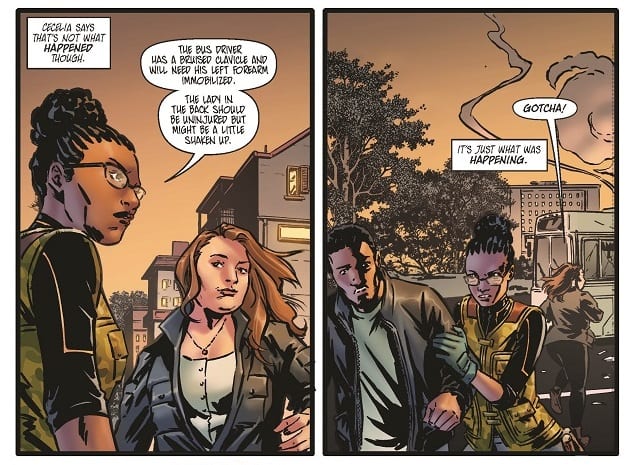
Cobbina’s power set revolves around super-fast analytical thinking which is not a typical power for a superhero comic. This allows for some creative thinking from the art team to truly show off Cobbina’s power. In the origin scene artist Alitha E Martinez creates a series of ghost like interpretations of Cobbina to represent the different aspects of her mind. Colorist Bryan Valenza gives each aspect a different color wash to give them an ethereal feel but also to create a link to the ‘voices’ inside Cobbina’s head.
The effect is completed by the lettering provided by A Larger World. They match the coloring of each aspect to the various caption boxes that float around the initial double page spread. This coloring is then carried forward to the rest of the comic meaning that panel space can be saved by not having to physically represent each voice. The overall effect is wonderful with the establishing scene and the follow up conversations building not only Cobbina’s character but also giving personalities to each of the voices.
Omni #1 Credit: Humanoid Inc
World Building
Unlike James Mcavoy’s character in Split, Cobbina’s multiple personalities all work together to read a situation and come up with a solution or action in super-fast time. She is like a one-person Council of Reeds but without the self-important, world destroying tendencies.
Omni is set in a realistic world and the art reflects this. Each scene has a strong physical location rendered beautifully by Martinez. The chaos of a battlefield surgery tent is depicted with as much importance as a quiet suburb porch conversation. Both of these have significance to the Cobbina and neither is given more weigh in the narrative.
There are some moments where the storytelling doesn’t work as well as others. There are a couple of scenes where it takes a minute to realise that it is a flashback, or part of Mae’s journal logs. And there are some awkward speech balloon placings resulting in a break in conversational pacing. However, the overall plot and visuals of the comic are engaging. The quick introduction at the beginning makes it easier for the reader to get straight into the comic without feeling that they have missed something and from there on, Omni carries itself brilliantly.
Omni #1 Credit: Humanoid Inc
Conclusion
Based on the quality of this comic it does make you want to check out other titles in the shared universe. The concept is a sound one, and is very reminiscent of the ending to the T.V. series The 4400. Omni isn’t a typical superhero comic but it does contain new ways of looking at the associated clichés, similar to Stronghold from AfterShock Comics.
If you are bored of the standard capes and cowls narratives from the Big 2 publishers and fancy something different, then Omni and the Ignition Universe is for you.
Recreating the magic of Star Trek: The Original Series while continuing to engaging old and new fans alike is no mean feat but IDW Publishing have found a team to do just that in Star Trek Year Five issue 4, which is out this week.
Completing the second story of the series, Brandon Easton reflects on the consequences of the Enterprise crews’ earlier visit to Sigma Iotia II. Captain Kirk and his crew are famous for bending the rules to suit their current needs but where does that leave the planets and aliens that they interact with? When the Enterprise warps away, what happens to those left behind?
In the second part of Easton’s story, the full extent of the damage done to Sigma Iotia II is realised and Kirk is forced to intervene further in the planets politics.
The issue opens with Spock running for President against the rich elite, backed by the Southern Continent who have been forsaken by the ruling classes. Meanwhile a space station orbiting the planet is falling apart due to lack of funding and will crash through the atmosphere at any moment. Bureaucracy has tied the hands of the planets officials and even Kirk is bound by Federation Law. But with a mutiny brewing on the Enterprise and Spock involving himself in current affairs, Captain Kirk is running out of options and running out of time.
Star Trek Year Five #4 Credit: IDW Publishing
Captains Log
This is without a shadow of doubt Star Trek: TOS. Easton has captured the tone of Gene Roddenberry’s original concept beautifully. The pacing of the story and the building of drama from the opening scene to the inevitable solution plays out exactly like one of the 1960’s episodes. The duel dilemma facing the crew allows Easton to keep all of the main cast in the story: an approach often used in the series.
The characters and their reactions to the situations they face are exactly as a fan of the show would expect. Easton understands the ins and outs of the Enterprise crew and what each is capable of: Spock’s unfaltering logic, Kirk’s reluctant rule breaking, and Scotty’s deductive reasoning. Each of the cast excel in their roles and every scene serves a purpose in the overriding plot.
Social commentary and moral questioning is evident throughout. The problems on the planet and the pent up rage felt by one of the crew members on the Enterprise are all relevant to a modern day audience. Some of the speeches given by the cast may come over as a little preachy, especially if you do not have the same politics as the creators, but for the most part the opinions fit with the characters and the world of Star Trek.
There is only one moment where Captain Kirk reflects verbally on the situation that breaks the reading experience. For a brief moment the writer’s voice takes over the character’s voice and the speech breaks the flow of the narrative. This is quickly recovered but, unfortunately, the moment is still there.
Star Trek Year Five #4 Credit: IDW Publishing
Rendering Year Five
The artwork for Year Five is outstanding. Martin Coccolo captures not only the physical appearances of the cast but also the emotional reactions of the characters. His facial work is excellent, giving the narrative it’s emotional weight. The layouts and constant shift from long shots to close ups capture the Original Series atmosphere.
There is a sense of the grandiose but done on a budget. Coccolo focuses on characters over scenery allowing an occasional long shot to establish the scene. There is a large cast, with extras on the planet as well as the Enterprise, and Coccolo gives each character their individuality; they stand differently, move differently, and all round act differently.
Star Trek Year Five is also surprisingly colourful, both in the script and in the visuals. Colorist Fran Gamboa is not afraid to splash the color around filling each page with a full world of visual delights. But he also affects the mood of a scene very effectively by draining some color out and focusing on another. Most notably is the scene in the engine room of the Enterprise where the dangerously high tensions are illustrated via the wave of red covering everything.
In such a conversation heavy script it is important to get the lettering right and Neil Uyetake has done an excellent job. With the speech balloons there is nothing outrageous or challenging but the text inside reflects the nuances of the character’s speech. There is a distinctive speech pattern for the central cast so that their personalities clash creating the dynamic relationships between the crew.
The sound effects also have an air of ‘made on a budget’ about them which adds to the overall charm on the comic. Each creator appears to go out of their way to make the reader think this is an episode from the 1960s.
Star Trek Year Five #4 Alternative Cover Credit: IDW Publishing
Conclusion
Fans can be difficult to please. What works in a franchise for one person may be the fly in the ointment for someone else. However, the creative team behind Star Trek Year Five has produced something that is as close to Original Series as anyone is likely to get and you can’t ask for more than that.
The characters, the plot, and everything about the design has that 1960’s feel about it in all the best possible ways. This is a joy to read, especially if you are a fan but the real beauty is that it stands alone in its own right. Fan or not, Star Trek Year Five looks good and reads better.
Mark Russell’s work on this series only grows more engrossing with time. It’s a powerhouse run thus far, and Red Sonja #7, out this week from Dynamite Entertainment, may well be the best issue yet.
Sonja finds herself alone after losing Kryon, her last remaining family member, in our last issue. As she demonstrates, though, Sonja’s not one to give in to despair. Instead, she decides to finally mount an attack on Dragan in an attempt to rescue the surviving Hyrkanian prisoners.
The Writing
With Red Sonja #7, Mark Russell delivers an engrossing story. There’s plenty of action contained in these concise, yet thoroughly-engaging pages. Beyond the surface, though, the narrative is crammed full of interesting and incredibly-compelling thematic elements to unpack.
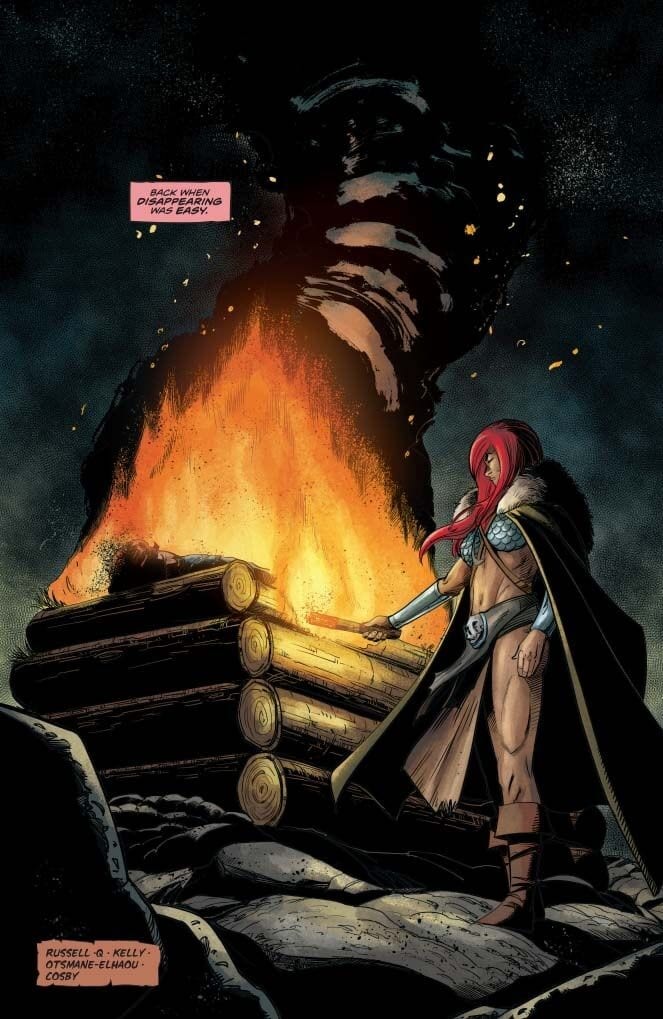
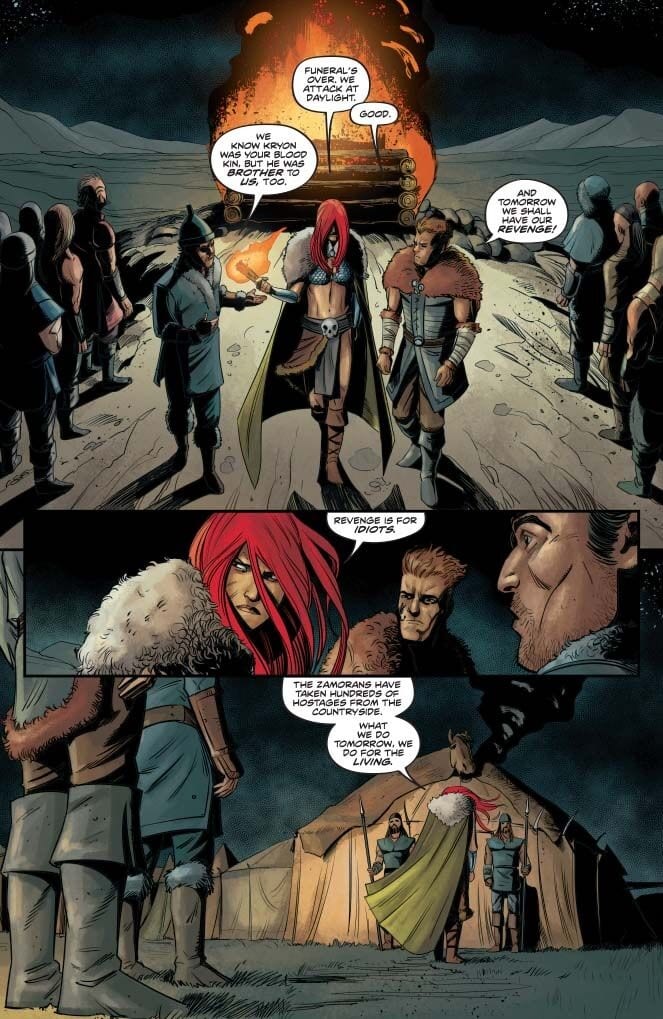
The book opens to Sonja reflecting on her childhood memories of Kryon, weaving grass shields as a childhood prank (an element that will come up again later). From here, we jump to Kryon’s funeral. Sonja wants to make one thing clear, though: despite her grief, revenge is not her aim. Rather, the primary focus is rescuing as many of her people as she can from Dragan’s sadism.
Sonja’s resolve is tested, though, when she has Dragan in her sights. Here, she’s forced to make a choice between seeking revenge and helping the living. The option she ultimately chooses says a great deal about her core character.
The highlight of Red Sonja #7—perhaps one of the most striking moments of the series thus far—comes toward the book’s end. Sonja’s advisor Cerkus delivers a monologue that is a surprisingly poignant critique of blind nationalism and empire. “Nations and empires are not a cult of personality,” he says, “but a symptom of humanity’s common psychosis. The need to find our worth in power.” It’s incredibly-well written, especially when cast alongside the action on the page. Dragan’s own guards foreshadow this theme earlier in the book, pondering Dragan’s circuitous motivation.
It’s intelligent and thought-provoking, without losing momentum. In Red Sonja #7, Russell proves himself to be a masterful storyteller.
The Artwork
Bob Q takes over art duties from Mirko Colak beginning with Red Sonja #7. His work is eye-catching right from the first page, opening on a pastoral scene of young Sonja and Kryon, before hard-cutting to the latter’s funeral. He does a great job of capturing mood, really embellishing the emotional pitch of these sequences.
The illustrations really shine, though, once we delve into the more action-packed pages in the book’s middle. The work is dynamic, constantly shifting perspective to reflect the chaos of battle. He employs some very deliberately-placed repetition, though, which works to nice effect.
While Colak’s work on the series’ first arc was very good overall, the artist did have some issues conveying expression. Bob Q, however, manages to provide some incredibly expressive and lively work. You feel the emotion on the page; the resolve, grief, and terror in characters’ faces comes across very clearly.
Final Thoughts
Red Sonja #7 is excellent from start to finish. This issue cements the current run of Red Sonja among the very best comics of 2019. Get it this week at your local comic book shop.
Gwenpool is back and she’s fighting for her series – and her life – in GWENPOOL STRIKES BACK #1, hitting your local comic shop on August 14 from Marvel Comics. In her usual fourth wall breaking ways, Gwen is very aware of the cost of losing the readers favor.
Gwenpool is back, and she’s fighting dirty to stay relevant.
***SPOILER WARNING***
Fans of Gwenpool are likely thrilled to hear that she’s gotten another series to her name. Granted, it’s only a five issue series, but we’ll take what we can get. New readers will potentially get a kick out of this series as well, though they may not appreciate all of the references made.
As per usual, Gwen is painfully aware of her status in the comic book world, courtesy of her limited abilities. This also means that she’s aware of what will happen if she stops appearing in comics. It’s more or less a death sentence for her, due to being fully ported into this realm.
Gwenpool Strikes Back #1 gives Gwen the chance she needs. A literal and figurative fight for relevancy in a world where comic books saturate the market. But if anybody can do what nobody else is trying, it’s Gwenpool.
Gasp! An internal monologue!
Leah Williams picked up where Christopher Hastings left off – with Gwen fighting to find a way to save her series (and her life). Williams perfectly captured all of the quirks that make Gwenpool so unique, while also acknowledging Gwen’s other appearances in team-ups (West Coast Avengers).
This issue is a lot of fun and a lot of fourth-wall breaking. It’s silly, it’s a little bit insane, and it’s full of referential humor. And let’s not forget that it’s got plenty of Gwen and her desperation to become something more.
Time for our little shark friend to explain everything.
Gwen has given up on trying to become a beloved character through normal means. It’s time to fight dirty. And that means getting some new powers of her own. Her ability to jump through comics is amazing – but as she noted within these pages, it’s frequently retconned in teams, thus reducing her chances. And Gwen needs all of the chance she can get.
Gwen’s attempts are clearly going to wrap up other Marvel characters in the process. As you can clearly tell from this cover, Spider-Man has already been pulled into her first attempt. And the cover for the next issue hints at the Fantastic Four being her next target.
Dancing makes all explanations better, right?
This series is already proving to stick true to the humor that made so many fall in love with Gwenpool and all of her antics. She’s steadily embracing what makes her different, and thus making her a few steps further from being the hero she originally wanted to be. But that’s okay.
That is…quite a photo Gwen.
The new artistic team is forging a new path with Gwenpool Strikes Back #1. Our leading lady and her abilities are still clear, but there’s more detail than previously seen in her series. Her edges are sharper, and more similar to her original appearance on Earth 616.
David Baldeon, Jesus Aburtov, and Joe Caramagna are the artists behind this issue. And it’s safe to say that they had fun working on this issue. Gwen’s antics are always somewhat comical, but in this instance, they’re further heightened by the brilliant artwork provided.
Some panels are more standout than others, but that was clearly done with intent. Such as that one page spread focused entirely on Gwen’s high school photograph. Yeesh. That’s pure Gwen right there.
In the next issue, nobody is safe.
Gwenpool Strikes Back #1 has already proven that this series will be everything fans could have hoped for – and then some. It takes the situation that Gwen is in seriously, and brings the fight for her character to a level not normally seen. That does make the series somewhat bittersweet, but it’s balanced out with the quirky humor and insane antics.
Marvel Comics’ Absolute Carnage: Separation Anxiety #1 (on sale August 14) is the most terrifying, unsettling comic you’ll read this year.
Sadie finds herself trapped in a genuine nightmare.
The War of the Realms was fantastic and, of course, frost giants are quite scary. But with this tie-in, writer Clay McCleod Chapman grabs you and increasingly shakes you to the core.
Absolute Carnage: Separation Anxiety #1
Writer: Clay McCleod Chapman
Artist: Brian Level
Color Artist: Jordan Boyd
Letterer: VC’s Travis Lanham
Family Matters
When the story opens by focusing on a dysfunctional family that’s otherwise ordinary, cynical readers might think, “These characters don’t matter; where are the symbiotes?” But McCleod Chapman succeeds where a number of tie-ins fall short because he makes these (mostly) ordinary people dynamic characters. Sadie and her family have the misfortune of coming into contact with a symbiote reminiscent of Venom. In many ways, though, the subsequent infection is a secondary plot. McCleod Chapman focuses his energy on Sadie’s family that’s rapidly fracturing.
For readers who grew up in broken homes, this story will deeply resonate. But everyone can appreciate the power of Sadie’s heartbreak because we all know someone whose experienced a toxic upbringing. From the first page to the finale, the reader roots for Sadie because she’s an innocent little girl in a remarkably challenging situation before the symbiote even arrives. She deserves so much better than the anguish she experiences on a daily basis.
One of the scariest parts of Separation Anxiety, like any good demonic possession movie, is the balance between the ordinary and the macabre. In this case, it comes in the contrast between the monstrous symbiote and Sadie’s stereotypical parents. For every time that the symbiote-infected parents try to infect Sadie and her brother Billy, they talk about how much they want to be together again. In the context of a family that’s about to irrevocably fall apart, this dichotomy is gripping. McCleod Chapman weaves Sadie’s wish to have a happy family throughout the story and the results are devastating. There are no happy endings here, which makes Separation Anxiety feel ironically realistic; any other ending would have felt forced and phony.
Texas Chainsaw Vibes
In the original Texas Chainsaw Massacre, the dinner scene is physically and emotionally uncomfortable to watch. In an issue packed with stunning visuals and horrifying plot elements, a similar sequence of events in Separation Anxiety deserves to be recognized because it’s hard to stomach.
This scene also showcases some of the best artwork in the comic. On their own, the story beats are gruesome. Sadie’s symbiote-infected mom kills a neighbor, who innocently checks on the family when he hears screams. Later, after the parents chase Sadie and her brother for a while, Sadie stumbles into her mom, who has prepared dinner for the family. But the main course is the dead neighbor himself. The reveal feels like it’s ripped right out of a horror movie.
Level contrasts some normal dinner food (rolls, meat and vegetables) with the neighbor’s charred body. His face looks like that of a zombie or even a mummy but he’s only been dead for a few hours. The choice to show such a rapid decomposition makes Sadie’s infected mom seem even more powerful because she’s the one who killed the guy. Most disturbingly, the mom is in her human form but her dead smile, combined with letterer VC’s Travis Lantham red speech bubble, makes it clear that Sadie’s mom is long gone. Altogether, it’s a chilling sight.
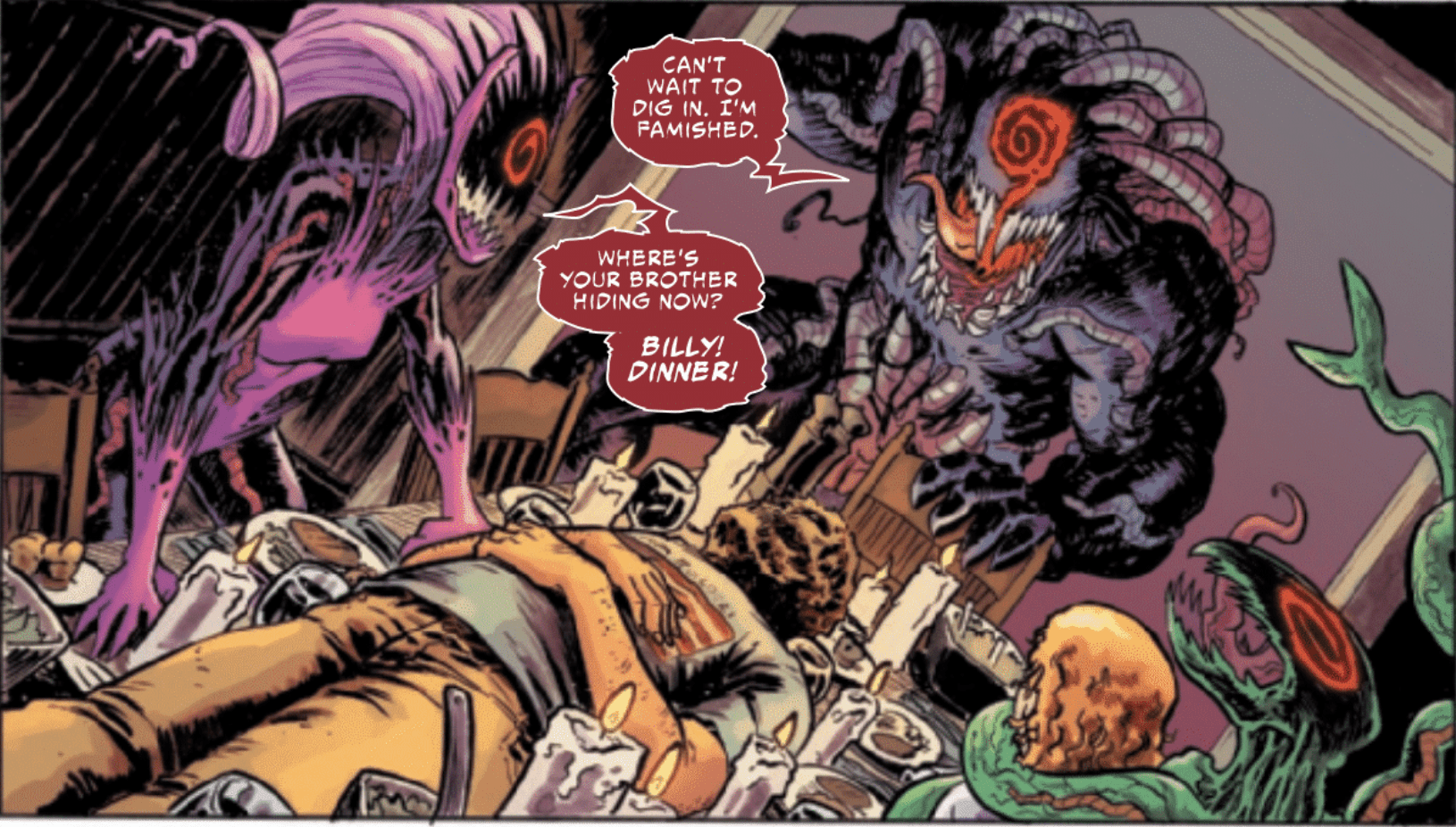
In one of the more shocking reveals, Sadie’s mom shows her daughter what’s for dinner.McCleod Chapman and artist Brian Level don’t leave anything to the imagination. They show the parents and the newly-infected Billy dining on the neighbor’s corpse. Here, the perspective shifts; the reader sees the body from a new angle that hides its eyes and teeth. As a result, the corpse looks even more mummified and it’s even more disturbing to see Sadie’s dad practically drooling over the body. The small artistic touch of having lit candles surround it makes the scene feel like a gruesome ceremony.
Sadie’s family prepares to dine on the neighbor’s corpse.
As if that wasn’t ghastly enough, the creative team continues to ratchet up the horror. The symbiote-infected family holds Sadie captive while they say grace before the horrid meal. The trio prays to Knull, the god of the symbiotes, before Level shows them munching away on the neighbor’s flesh. Level zooms in on these shots and color artist Jordan Boyd’s usage of browns and oranges shows the body’s decomposition. The image of Sadie, who’s trapped by the symbiote tentacles, crying out of wide-open eyes, drives home the scene’s frightening tone. In an uncomfortable combination, the monsters ravenously pick away at the body while they hold a typical weekday dinner discussion. (The dad asks his son, “Anything exciting happen at school today, bud?”) Throughout the issue, the creative team masterfully inverts the reader’s expectations at every turn and that’s particularly evident in this scene.
More than any other panel, this shot feels like a callback to the “Texas Chainsaw Massacre” dinner scene.
Tie-in comics for major events usually don’t fall in the “can’t miss” category. Most of the time, they don’t feature significant characters or meaningfully progress the overall story. Two of those statements might apply to Absolute Carnage: Separation Anxiety. You won’t see Spider-Man or Venom here and the event is just starting to unfold. But anyone thinks about skipping this issue would miss the best horror comic of the year. If you’re a fan of Marvel or if you like scary stories, read Separation Anxiety. Just don’t do it before bed because it’ll make it impossible to fall asleep.
What’d you think of Absolute Carnage: Separation Anxiety #1? Do you want to see more tie-ins like this?