Home Blog Page 395

A Journey Ends in STAR WARS ADVENTURES: RETURN TO VADER’S CASTLE #5

Monkeys Fighting Robots

STAR WARS ADVENTURES: RETURN TO VADER’S CASTLE #5, out this Wednesday from IDW, concludes that strange and eccentric tale of Thom Hudd and his journey within the infamous Vader’s Castle.

Vader is looking very menacing (and green0 on this cover.

***SPOILER WARNING***

Once again we find ourselves back in Vader’s Castle in Star Wars Adventures: Return to Vader’s Castle #5. Honestly, given how fascinating Vader’s Castle is, it’s really no surprise that so many series have popped up focusing on it.

However, all things must end. And that means that Thom Hudd has time for only one story left. Like the rest of the issues in this series, there is the main plot, but inside that, there’s always a short story being told. This time around, Hudd is the listener instead of the storyteller. But it’s still functionally similar.

What’s fascinating is the fact that this final tale is about Vader himself. Better yet – the story is set at Mustafar and Vader’s Castle. This is the moment fans have been waiting for.

Could it be? Is Hudd about to be saved?

Star Wars Adventures: Return to Vader’s Castle #5 has been an interesting series, on the whole. The original storytelling style allowed for multiple characters to get a chance to shine, all while being connected in some surprising ways.

Given that the series was based at least partially on Mustafar, we all knew that eventually, one of the stories told would have to be about Vader. And Cavan Scott lived up to the promise made there, with this final issue.

This tale fits in well, both with the other stories told and with what we know of Vader. It’s also a potent reminder for why one should never underestimate a man as determined and vicious as Vader. It just seems like a good rule to live by.

As for Hudd and the rest of the characters set in the real-time? Let’s just say that the story played out exactly as expected. So at least we know that the promise of the series was kept nice and safe.

Time for a distraction!

Star Wars Adventures: Return to Vader’s Castle #5 had a decent sized art team working on the project. Perhaps that’s the reason why it has such an iconic and vibrant look to it. The artwork doesn’t specifically match the movies or the other comics out there about Star Wars.

Francesco Francavilla and Charles Charles Paul Wilson III provided the pencils and inks for this issue. And Francavilla stepped up once again to also work on the coloring as well, alongside David Garcia Cruz. And as always, Andworld Design provided the lettering.

The colors in this issue are especially vibrant, but then again. This is Mustafar we’re talking about. If you can’t come up with an excuse to show off some amazing lava scenes, odds are you’ve done something wrong.

And so it begins…

Star Wars Adventures: Return to Vader’s Castle was a fun and creative take on a character and world fans have been obsessing about for years. It may not have been quite what fans expected, but it wasn’t afraid to have fun and never took itself too seriously. And thus, it made for a series of memorable moments.

Monkeys Fighting Robots Youtube

How Riri’s Heart Breaks in IRONHEART #11

Monkeys Fighting Robots

IRONHEART #11, out this Wednesday from Marvel Comics, is an emotional and dramatic issue. Riri Williams has been through a lot in her short life, and it’s becoming clear that her journey has only just begun.

Riri is looking justifiably terrified on this cover of Ironheart #11.

***SPOILER WARNING***

Ironheart #11 is a dramatic and thrilling issue. The teacup continues, bringing Ironheart, Shuri, Okoye, and Silhouette, making a powerful and dynamic force to be reckoned with. But all the girl power in the world isn’t enough to prevent an emotional blow from landing on Ironheart.

Fans of Ironheart, aka Riri Williams, are already well aware of everything Riri has gone through in her short time on this earth. It has understandably left her with some long-term issues that she has to work out. And it looks like this issue went a long way in adding something else to her list of things to deal with.

And so Riri’s tale continues. All thanks to this creative team.

The last issue of Ironheart ended on a bit of a cliffhanger. And while this issue started off with a slight detour through the past, it otherwise jumped right to answering all of our questions and concerns. So at least Eve L. Ewing didn’t leave us hanging.

Even though she certainly didn’t hesitate about throwing a gut punch in our (well, Riri’s) direction. To be fair, this is something that comic books have specialized in doing for years. So it was only a matter of time before Riri had a dramatic reveal of her own. But that’s not going to alter the amount of sympathy we’re feeling for her right now.

One of the best things about Riri Williams is how human she is. And that means she doesn’t hide her emotions. What she feels is shown on the surface. And that means when she has an emotional breakdown, you know it. Something is harrowing about seeing a character like Riri go through something such as this perhaps because it hits home just a little bit harder than normal.

Whatever the case, Ironheart #11 pulled off the gauntlet and issued a challenge. And now fans are left wondering how it’s all going to play out. Is this a fakeout? Or is it all disturbingly true? Either way, how is it going to affect Ironheart in the long run?

One thing we do know; they only have one issue to wrap this plot up. At least, if the ‘to be concluded’ at the end of this issue is anything to go by. Wrapping up this bundle of complexity in one issue is going to take some serious talent.

The first page of flashbacks.

Ironheart #11 featured some truly outstanding artwork. The fights, in particular, were memorable. As was the technology, but that’s basically a given with Ironheart’s series at this point. Our badass team of ladies look exactly that – badass and powerful even when Riri is having a moment.

Oddly enough, the weirdest part about this issue is surrounding the newly introduced antagonist. If he is who we’re being led to believe, the man hasn’t aged a day in what, fifteen years? That’s impressive. Or alarming. It could be that they’re intentionally hinting at something here. Or it could be something as simple as wanting to make the comparison an obvious one. Only time will tell.

Another iconic feature of this issue is the layout. There are dramatic cuts and angles all over, enhancing the tale even further. The credit for the layout goes to Geoffo. Meanwhile, Luciano Vecchio (pencils and inks), Matt Milla (colors), and VC’s Clayton Cowles (lettering) completed the overall look of this issue.

Notice anything between this page and the last page?

Ironheart #11 was an emotionally intense issue for Riri. And we can only imagine that it’s going to leave yet another scar on this young woman’s soul. But she’s strong, and thus we know she’ll get through it. In the meantime, we’re going to sit back and look forward to seeing how she gets herself (and her newly found friends) out of this situation.

Monkeys Fighting Robots Youtube

Review: WILD STRAWBERRIES AT THE WORLD’S END is a Great Pick

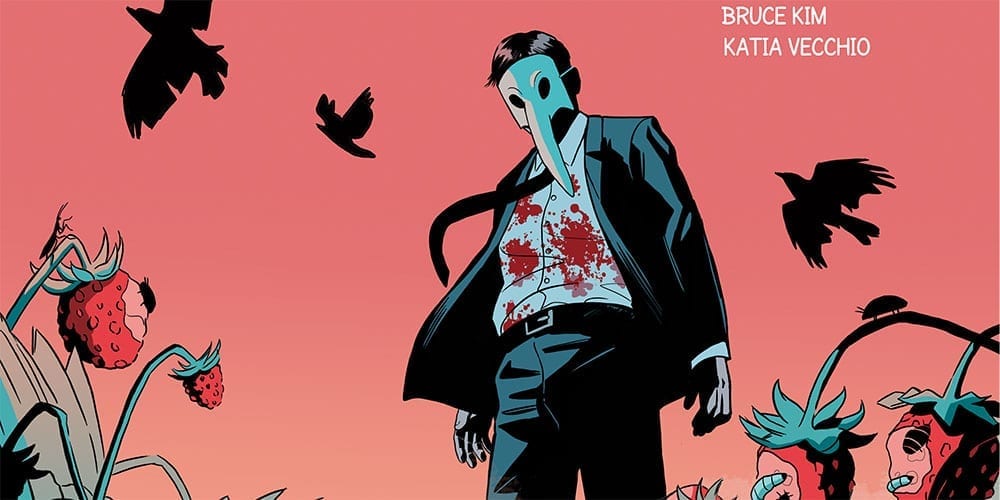
At a recent NYCC panel, horror comics legend Joe Hill spoke on the need for empathy in horror. If you don’t relate to the characters, he said, you won’t feel the fear that they do. A great example of this concept done right in independent comics is Bruce Kim and Katia Vecchio’s upcoming comic Wild Strawberries at the World’s End. You can read our review of the book below, and pick up your own copy Wednesday, November 6th.

Wild Strawberries at The World’s End, Cover, by Katia Vecchio

Wild Strawberries at the World’s End is a supernatural murder mystery set on the backdrop of a South Korean town in the late 1990s. When his childhood friend Ji-Ah is found dead, protagonist Te-Su must return to his hometown and, in doing so, the heartbreaking and horrifying past he left there. Te-Su begins to have suspicions that Ji-Ah’s death is not the suicide that the cops believe it to be, along with nightmares of masked cults and grotesque, evil entities. To make matters worse, Ji-Ah seems to have left something in his hometown for him to find, and those nightmares apparently don’t want to stay in his head.

THE WRITING

Writer Bruce Kim weaves a resonant, unnerving  in his foray into indie horror comics. Wild Strawberries at the World’s End is paced beautifully, with high strung tension even in the quieter moments of the plot. His characters are rich but not overly expositional, allowing the reader to focus on who they are in the moment rather than just hammering home what they’re pasts have been. That’s very impressive in a story that relies so heavily on flashbacks, but Kim handles it extraordinarily well. His less-is-more philosophy of crafting a story keeps the reader engaged as much as it keeps the events a mystery.

Actually, it’s in that mystery that Wild Strawberries at the World’s End keeps both its many strengths and few weaknesses. On the one hand, Kim’s tendency toward not answer questions is rewarding. There’s a horror beyond human perception going on in these pages, and his light narrative touch allows the reader to fill in the open spaces with whatever’s most nightmarish to them. At the same time, there are some points of this story with which it was a little difficult to track. Occasionally a character will make a choice that seems out of the blue, even though another read-through will reveal their motives. Actually, we recommend that you don’t stop your Wild Strawberries at the World’s End experience with one read-through. Not only will it sure up some of the unexplained elements of the plot, you’ll get to see even more mysterious things left out on purpose, heightening the story’s mystic and haunting nature.

THE ART

Still, that first read-through will demand your appreciation of this comic, and a lot of that comes from the fantastic imagery by Katia Vecchio. Vecchio handles everything you see on the pages of Wild Strawberries at the World’s End, from the pencils to the coloring to the lettering, and she absolutely kicks ass doing so. Vecchio knows, in the words of Neil Gaiman, “when to shout and when to whisper,” oscillating between quiet village scenes and striking cult-horror imagery. Wild Strawberries at the World’s End is a Night Gallery of spooky sights, and the plotting of the panels will have genuine chills running down your back when you see them.

Occasionally, Vecchio’s coloring gets a little distracting, mainly in the shadowy first moments of the book. But by the time Character gets back to his hometown, this issue’s completely resolved. And even if this minor hiccup is something you notice, Vecchio’s living pencils and smooth, well-places lettering makes up for it more than enough. Vecchio’s overall designs on this book make it well worth the cover price, contributing to the haunting vibe at its core. If Kim’s writing has you understanding the cosmic questions in this book, it’s Vecchio’s art that will have you begging for answers.

OVERALL THOUGHTS

Wild Strawberries at the World’s End is indie horror at its most personal. For as otherworldly and unfathomable as the supernatural elements are, the story is a deeply human one, built on the universal emotions of regret, fear, and loss. There are a myriad of reasons to support this indie book (not least of which is the sparkling potential in the creators’ talent), but the only reason you need to pick it up is this: Wild Strawberries at the World’s End will resonate with you. And as Joe Hill would tell you, that’s exactly what makes it great horror.

For more reviews like this, follow us on Twitter. And for all the best comic book reviews, discussion, and news, stay tuned to Monkeys Fighting Robots.

Monkeys Fighting Robots Youtube

Review: The End is Nigh in DCEASED #6

Monkeys Fighting Robots

This is it. The fate of the Earth—and the universe at large—comes down to the actions of our heroes in DCeased #6, out this week from DC Comics.

The infected Clark lays waste to the planet, leaving the remaining Justice League members to plot how to take him down and rescue as many survivors as possible. Readers will be left guessing right up until the last page how humanity could even hope to survive this apocalypse.

DCeased #6

The Writing

First, we have to note that when looking at the series in its entirety, we find that much of the storytelling throughout DCeased has been rather expository. Lois editorializes, while summarizing the action on the page to fit the story within a compact six issues.

At one point in DCeased #6, for instance, Lois says “We had to find a way to live with what we were doing. Or no one would live at all.” We don’t, however, see any of the heroes visibly struggle with that quandary. There’s little time spent in questioning their actions; everyone is all business, with no second guesses. While it makes for concise storytelling, it’s not exceptionally dynamic or complex. Some characters can feel rather flat as a result. That said, writer Tom Taylor managed to make this work through clever use of his framing device.

Telling the story primarily through Lois’s recollections was a gamble. However, the frame used throughout the book kept the reader grounded within one character’s point-of-view, allowing for reasonably intimate storytelling. It’s as if we’re reading the character’s diary, and that keeps us grounded in a story that could, otherwise, have felt overly-rushed and compacted.

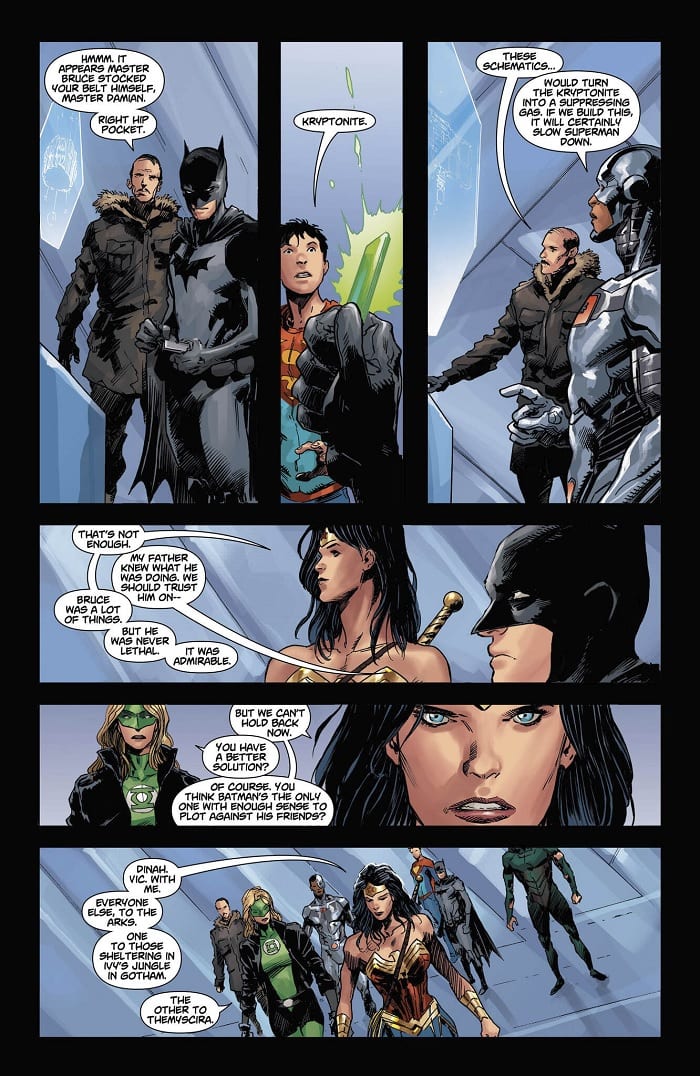
That’s not to say that there aren’t moments where other characters get the chance to emote, though. DCeased #6 offers a good balance of emotional tones, spanning considerable distance without clashing. Goodbyes between characters who know they’ll never meet again feel suitably heavy. Yet even in the darkest of times, there’s still room for humor. Early in DCeased #6, for example, it’s revealed that Bruce left Damian with takedown plans for all the members of the Justice League, echoing the JLA: Tower of Babel storyline. One member, however, is conspicuously left out of Bruce’s playbook, leading to a funny exchange.

In all, it’s an excellent showcase from Taylor. Without giving anything away, it’s safe saying that Lois’s final monologue could be interpreted in multiple ways, given how that last panel is composed. How one chooses to read it determines whether the book ultimately has a positive or negative ending.

DCeased #6

DCeased #6

The Artwork

DCeased #6 features some truly breathtaking art courtesy of Trevor Hairsine, Neil Edwards, and Stefano Gaudiano. The work’s strongest asset is its incredible detail; the creators meticulously illustrate even the smallest elements, down to blades of grass and distant background structures. It’s clear that a lot of careful and caring attention went into each page of this book.

For all the richness of the artwork, though, the images are not always the most cohesive from panel to panel. While pages hit the story beats well, the art can be almost overwhelming, leaving the eye unsure of where to focus.

To compensate, Hairsine and Edwards infuse each panel of DCeased #6 with as much energy as possible. Figures and objects jump off the page, while faces and body language are incredibly lively. As a whole, it’s some of the most dynamic visual storytelling of the year, propelling the reader through the book.

Colorist Rain Beredo had his work cut out with this incredible level of detail. However, the artist doesn’t back down from the challenge. The colors are crisp and varied, while matching the level of care present in the linework.

DCeased #6

Final Thoughts

I was somewhat skeptical of DCeased when I first heard about it. However, it’s proved to be one of the most surprisingly-engaging DC stories of the year, and DCeased #6 ends the run on a high note. Definitely recommended.

Monkeys Fighting Robots Youtube

Review: THE LITTLE MERMAID Is A Perfect Series For Young Readers

Monkeys Fighting Robots

Dark Horse Comics has partnered with Disney to produce a new line of comics featuring their classic titles including The Little Mermaid. Is an adaptation of a classic series everyone already knows unnecessary or is it a way of reaching a brand new demographic?

Summary

Experience the unforgettable tale of Disney’s The Little Mermaid through the first-person perspective of Ariel in this comic retelling.

The Little Mermaid

Writing

Thought the story is one many already know, there are always those who have yet to know the story of The Little Mermaid. This new comic series seems like a great way to reach a new demographic of readers by offering them a story and characters they recognize. Being able to give younger readers a book like this will help to keep their interest and help them to grow as readers.

Thought the story is familiar this doesn’t mean the writing by Cecil Castellucci is a simple transferring the film script to the comic. There is a shift in this comic to a first-person perspective allowing the reader to experience the internal dialogue of Ariel as she the adventure unfolds around her. This new viewpoint allows for a great way to look at the story from a familiar yet fresh look at the story. Castellucci does a fantastic job of capturing the character’s curiosity and mental struggle to find her place in the world.

Artwork

The artwork by Zulema Scotto Lavina finds a way to perfectly capture the look and style of the original film. Special attention is paid to Ariel’s facial expressions especially looks of longing and inquiry as she explores the wonders of the human world.

Thanks to the coloring work by Piky Hamilton the book has a very impressive aesthetic. The book takes place under the sea and it feels like it the entire time. Through the attention to detail colorwork employed the comic is able to obtain an atmosphere similar to the movie.

The lettering by Richard Starkings comes into sharp focus thanks to thought boxes containing Ariel’s internal dialogue. This new feature is what makes the book worth picking up. Seeing Ariel’s mental struggle as she fights against Urusela and struggles to obtain Prince Eric’s heart will be even more applying thanks to employing this new detail.

Conclusion

The new The Little Mermaid comic from Dark Horse comics offers a recognizable story but has enough new material to warrant checking out. Though its only the first issue, as long as the rest of the series plays out at the level of quality than fans will have nothing to worry about. This will be an ideal graphic novel to give to young readers when the collection is finally released.

Monkeys Fighting Robots Youtube

Review: FANTASTIC FOUR: GRAND DESIGN Crackles With Comic Book Joy

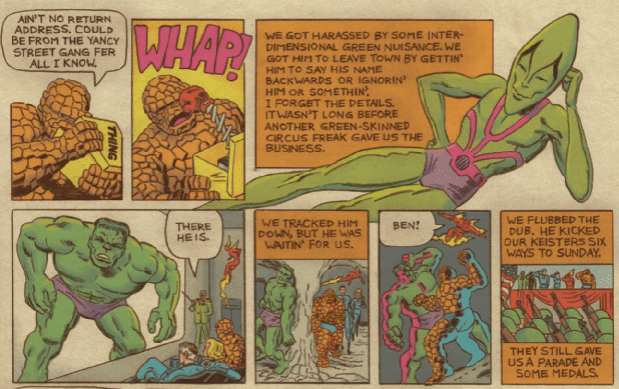
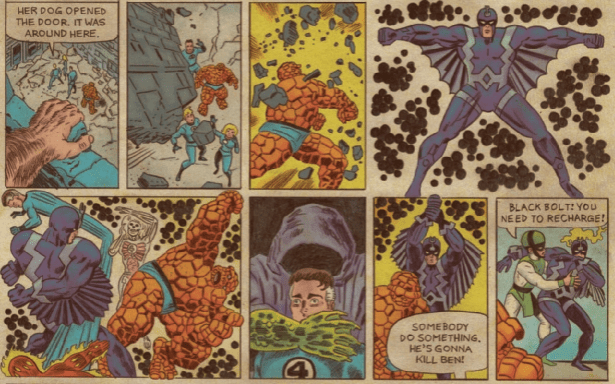
With Fantastic Four: Grand Design, indie comics sensation Tom Scioli brings his unique and idiosyncratic style to the very start of Marvel Universe in a book that is sure to be one of the year’s best pieces of sequential art.

From MarvelThe bestselling GRAND DESIGN franchise continues with Marvel’s First Family! Brought to you by critically-acclaimed cartoonist TOM SCIOLI (GODLAND, TRANSFORMERS VS. GI JOE) in the sole-authorship tradition made famous by ED PISKOR’S X-MEN: GRAND DESIGN trilogy! Join the Watcher and witness how it all began… Plus appearances by your faves: Doctor Doom! Black Panther! Namor! Galactus! Mole Man! The Inhumans!Fantastic Four: Grand Design

Fantastic Four: Grand Design #1
Written, Penciled, Inked, Colored and Lettered by: Tom Scioli

Story

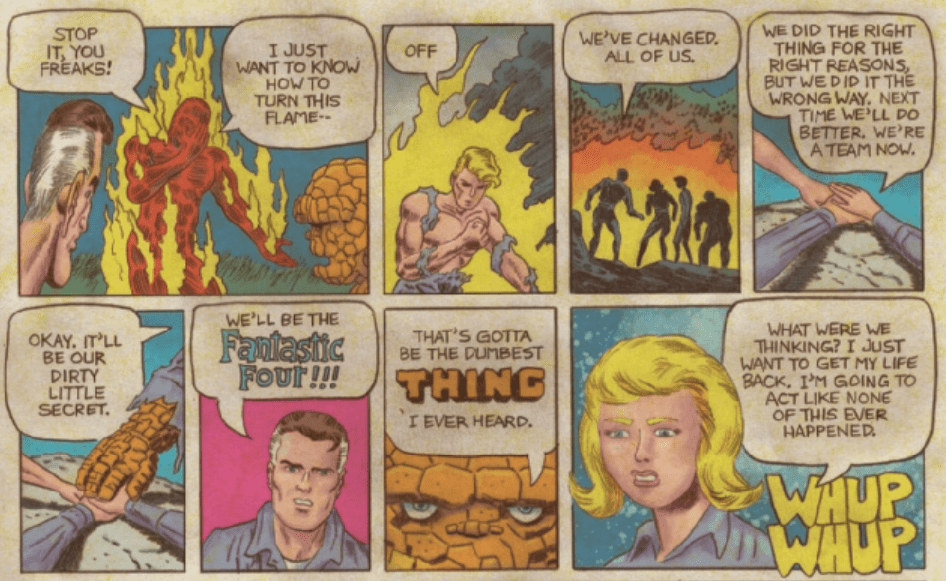
The story of the Fantastic Four has always been pivotal. Their popularity may wax and wane, but ask any comic fan or historian and they will tell you how important ‘Marvel’s First Family’ is to the MU. That makes it a great candidate for a Grand Design take. Scioli’s narrative (like Ed Piskor’s on X-Men: Grand Design) starts with Uatu the Watcher. Scioli then goes on to highlight all the important moments in both the FF’s origin and other early Marvel moments, seamlessly blending them together in a page by page narrative structure that echoes newspaper comic strips as much as it does Silver-Age comics. The structure actually accentuates how much plot was jammed into those early comics, Sciloi is able to capture that creative energy.Fantastic Four: Grand Design

We also have a grand cast of characters, with all the major players we expect (The FF, Dr. Doom, Black Panther, Namor, Hulk, Avengers, S.H.I.E.L.D. Mole Man, etc.) but we also get some more obscure roll calls (like the Impossible Man and Dragon Man).

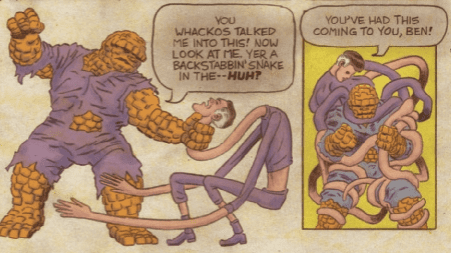
Sciloi also puts a magnifying glass on exactly how weird those early FF comics were; filled with odd characters, weird obsessions, crazy science, offbeat humor and intense melodrama. Scilo understands how creative and narrative energy both were a big part of what made those comics work and he embraces that, runs with it and knocks it out of the galaxy.


Art

Tom Sciloi is a sequential art master with a style completely his own. His linework in FF: Grand Design is like a fusion of indie comics, Kirby-era silver age energy and the look and feel of those great mini-comics that used to come with a ton of ’80s toys like He-Man (Sciloi has, in fact, worked in indie comics, done Kirby style stuff in Image’s Godland and had a great Go-Bots series from IDW; the pedigree is there).

And like in the narrative, Scoli, in the art, highlights the otherness of the FF. These are weirdo looking characters, strange situations and alien landscapes. Sciloi is reminding us how off-beat these characters really are, which is exactly what made them such a huge part of both the culture and counter-culture of the time.Fantastic Four: Grand Design

The layouts and panels are also marvelous. Most of the pages are composed of small, hand-drawn feeling panels. It looks and feels handmade in th4 best possible way.

There is also some great lettering at work, with tons of fonts, logos and styles on display.

Conclusion

Fantastic Four: Grand Design is the kind of comic book project we need more of. It crackles with energy, love and history. It’s a comic book for comic book fans made by an obsessive comic book fan. It’s a must-buy if you love this medium.


Marvel’s Fantastic Four: Grand Design is available now at your local comic book store.


Monkeys Fighting Robots Youtube

Time to Say Goodbye in GIANT DAYS: AS TIME GOES BY #1

Monkeys Fighting Robots

GIANT DAYS: AS TIME GOES BY #1 is out this Wednesday from Boom! Box and gives fans the chance to have an emotional goodbye with the characters we’ve come to know and love. This issue concludes that saga known as Giant Days.

Look at our adorable trio!

***SPOILER WARNING***

Giant Days: As Time Goes By #1 brings with it the conclusion to a much loved series. As such, it’s pretty much a given that this issue will be bittersweet. But it goes above and beyond with our expectations; giving us one final escapade before the door closes forever.

We all knew that Giant Days was set to end eventually. After all, Daisy, Esther, and Susan could only stay in school for so long (though Susan is still begrudgingly in school). In a way, it’s nice knowing that the creative team behind Giant Days didn’t decide to stretch the series for all it was worth. But it’s still sad to see this series go.

For many comic book readers, Giant Days was a revelation. It broke the mold for storytelling and changed our expectations for what makes a good graphic novel. And for that, we’ll be forever grateful.

This collection of photos is just the sweetest thing ever.

It would have been so easy to write an issue all about sappy goodbyes. Yet that wasn’t what this issue was about. Yes, it did give fans a chance to say goodbye. But it was also so much more than that as well.

After all, is it even a Giant Days story without at least one of our three leading ladies getting into some sort of dilemma? We think not! And thus, John Allison gave us one more escapade to enjoy. And yes, that did add to the bittersweet tally.

Look at how much Ester has changed!

Giant Days: As Time Goes By #1 is set a year after Daisy and Esther graduated. This gave us a chance to see what our girls have gotten up to post-graduation. Well, Esther and Daisy, that is. Though by all appearances, Susan has thrown herself into her future career as well.

Time changes people. We all know that. But how much change can occur to these three? That question – and many others are answered within these pages. Did you want to know what Ed looked like in his professional getup? What about McGraw, any idea what’s keeping him busy these days?

But more important than all of that is the message hidden within this story. Yes, it is the story of growing up. But it’s also a poignant reminder that we all need a support network. And that your friends aren’t always capable of reading minds – if you need help, don’t be ashamed to ask for help.

Of course, this issue also brought along a lot of the sass and drama we’ve come to love about this series. It wouldn’t have been the same without that touch. Or without Susan having at least one bout of anger (complete with fire bursting from her body). So while we had to say goodbye here, in many ways, it somehow felt like we were coming home at the same time.

We’re not loving the way this duo treats out Esther…

Giant Days: As Time Goes By #1 featured much of the charming artwork we’ve come to expect from the series. Max Sarin’s characters and their expressions are perhaps the highlights of this issue, with Esther going above and beyond (as usual) with emoting.

Whitney Cogar was the colorist for this project, and they also did a delightful job. Here the color palette is bright and happy – unless it called for something totally different. There were a few cut scenes and flashbacks in this issue, and they had a slightly different tone from the rest of the panels. This was smart, given that these moments usually only lasted a panel or two.

Jim Campbell’s lettering was the perfect final touch. And you can tell that he had a bit of fun with the sound effects. But frankly, so did we. So it’s all in good fun.

Aww! Look at how cute they are! Daisy deserves this happiness.

It’s hard to believe that this is the last issue for Giant Days. And yet, at the same time, it feels right. It’s always hard to see a series end. But it’s made a bit easier knowing that it was the proper ending for the series.

Monkeys Fighting Robots Youtube

Review: Politics, Betrayal and Gorillas in WONDER WOMAN ANNUAL #3

Monkeys Fighting Robots

Writer Steve Orlando teams up with artists V Ken Marion and Sandu Florea to create a safe but reaffirming comic about Wonder Woman’s values, as well as setting up some supporting character backstory for the future of Event Leviathan.

Helen Paul was rescued as a young girl by Diana Prince, a.k.a. Wonder Woman, when a terrorist attack killed her parents. She was then adopted and raised by a pair of retiring A.R.G.U.S. (Advanced Research Group Uniting Superhumans) agents, with a little help from the Amazon herself. When she came of age and learned the truth about who her adoptive parents were, she wanted to join the cause and became an A.R.G.U.S. agent herself. Her missions place her alongside fellow agents like Steve Trevor and her childhood mentor, Wonder Woman. One such mission takes the trio to Gorilla City to rescue a deep-cover agent from the terror of its new ruler, Grodd. Helen proves herself to be a quick-thinking and compassionate hero in her own right, doing her part to avert bloodshed. However, what will become of her when she learns the true secrets of her past?

Orlando’s writing on this issue is solid. This Annual delivers pretty standard fare for an uplifting and action-packed Wonder Woman tale, but it’s still plenty entertaining to read. Watching Diana break out her diplomacy skills right after kicking some baddies into the stratosphere will never get old. The Amazon Princess’ constant desire for peace and simultaneous willingness to fight has always been inspiring. Orlando also does well in making Helen Paul an interesting part of the story as it is partially played out through her eyes. The opening pages are largely from Helen’s perspective, and through this, the audience gets to see Wonder Woman through the eyes of an impressionable growing child. Helen also becomes a semi-engaging part of the Gorilla City sequence, mainly through her technical knowledge and how she uses that to bypass major problems. The dialogue here is snappy, and the pages flip by smoothly as the plot progresses along in a fun but predictable manner.

Unfortunately, the issue’s pacing comes to a bit of a halt on the final few pages. The execution of the Event Leviathan tie-in feels tacked on, as it’s delivered in a flurry of exposition before the final page plot-twist. The issue would have benefited from its exclusion. Also, while Helen Paul is an interesting new character and Orlando does a good job at making her and Diana’s connection feel important, it would have been nice to see her skills more on display during the Gorilla City story. As it is she has a couple of interesting moments, but not much beyond tech jargon and a bit of compassionate play-calling.

V Ken Marion’s pencils are pitch-perfect for the sort of mainstream superhero fare this Annual has. There’s an angular quality to the character drawings that fall under the Jim Lee umbrella of style, while still maintaining Marion’s aesthetic. The action is drawn beautifully, with plenty of kinetic energy that the audience can certainly enjoy without ever losing their place. Gorilla Grodd also looks appropriately menacing, proving that Marion is adept at drawing monstrous telepathic apes. His work is given depth by longtime artist Sandu Florea’s inks and brought to life by explosively vivid Hi-Fi digital colors. “Wonder Woman Annual #3” is undoubtedly a gorgeous comic to behold.

Pat Brosseau’s lettering accomplishes a neat distinction between spoken or narrative dialogue and Grodd’s telepathic speech. It’s a bit of a minor element, but it does add to the atmosphere and understanding that Wonder Woman and her team are dealing with beings who don’t talk like ordinary people. They are a race of telepathic gorillas, after all.

Despite being a bit derivative, “Wonder Woman Annual #3” is a fun adventure from the eyes of a young ally of the Amazon peacekeeper. There’s a nice bit of simple political drama that allows Orlando to show off the complexity of Diana’s character just the way Wonder Woman fans want. Despite the halt in the pacing on the last few pages leading into the Event Leviathan plot, the issue is saved by excellent visuals through an adventure in Gorilla City. Even if the crossover segment is flawed, the final page plot twist is undoubtedly going to be essential for the future of Bendis’ event. For Wonder Woman and Gorilla Grodd fans, this Annual would be a good one to have in your pull list at your local comic shop come October 30th.

Monkeys Fighting Robots Youtube

Review: BATMAN ANNUAL #4: Days in the Life of the Dark Knight

Monkeys Fighting Robots

Taking a break from the turbulence of “City of Bane” in the main series, writer Tom King and artist Jorge Fornes remind readers what makes the Caped Crusader so endearing.

Alfred Pennyworth, beloved caretaker of the Wayne family and assistant to the Batman, logs every night of the Dark Knight’s “activities” for almost two months. From chasing criminals on horseback to fighting dragons in the Gotham streets, Alfred makes a note of the actions and emotions guiding Batman through his endless crusade against crime.

No, seriously, Batman fights a dragon.

King’s writing of Alfred here as an emotionally invested observer is genuinely some of the most heartfelt work he’s accomplished in his Batman run. He fills his quiet, analytical writing style with Alfred’s full knowledge of specific events without ever getting bogged down in excess exposition. There’s also very little dialogue, as the entire issue is laid out as a series of journal entries. Despite this, King is able to run through nearly every possible emotion that can be had in a Batman comic, from absurd, silly humor to heartbreak. One story is an amusing tale of Batman in a boxing match, and another is a tale of Bruce Wayne’s abandoned first love. King puts the Bat-mythos through any and every set of circumstances, from the street-level to the cosmic, and comes away with one of his most spectacular pieces of writing to date.

See Batman box.

The best way to describe artist and frequent King-collaborator Fornes’ work here is as a mix of Silver Age style and David Mazzucchelli’s work on Year One. Fornes nails everything he draws here, from distinct character facial expressions to ambiguous cosmic entities. The fact that his style remains so consistent while drawing so many situations places him as one of the most impressive artists working today. He gets a little help from artist Mike Norton, who draws a few pages further into the issue. This addition is likely due to the last-minute change of plans this Annual underwent. Fortunately, his inclusion is almost unnoticeable in the best possible way. His work blends nearly seamlessly with Fornes’, to the point where the artist change would likely go unknown if it wasn’t credited in the issue.

What makes this issue visually pop and makes Norton and Fornes’ work blend together so well is undoubtedly Dave Stewart’s colors. His color palate has a slightly muted sensibility to it, making it reflect the Golden Age noir moments and the Silver Age spectacle that this issue pays tribute to. The more detective focused scenes are cast in moody grays and subtle blues, while the big cosmic and fantastical moments are bathed in light. The tone of the comic is further aided by Clayton Cowles’ lettering, which is done in semi-cursive to mimic Alfred’s handwriting. Not only is it believable, but it also accomplishes this neat combination of being distant but also intimate. This isn’t a conventional narrative, just a collection of stories from another person’s eyes. Every part of this issue works together to ensure this concept works, and it pays off in spades.

Cosmic entities are no match for a dude in a batsuit.

King stated that his final Annual would be his “thesis/last word on Batman.” With only a handful of issues left of his run, it’s easy to see why King is delivering such an impactful issue here. “Batman Annual #4” is one of the most emotionally satisfying issues of Batman ever created. King and the wildly talented art team deliver an issue that pays tribute to the World’s Greatest Detective by examining everything that makes the character so special, from the eyes of one of comic’s most beloved supporting characters. Stop by your local comic shop by October 30th and make sure this one is in your pull list.

Monkeys Fighting Robots Youtube

Review: THE LAST GOD #1 – High Art, Low Fantasy

Monkeys Fighting Robots

DC Comics tries its hand at high fantasy this Wednesday in the newest brutal Black Label title, THE LAST GOD #1.

Art by Riccardo Federici, Colors by Sunny Gho, Dean White

A World Built Upon Lies

The Last God #1 begins with an interesting concept; the tales told throughout the lands are lies. Opening on a brazen truth and not keeping it a mystery is different, as other comics would hold the secret over the readers head. But, this change in story telling is the only moment The Last God #1 stands apart form other fantasy stories.

Writer Phillip Kennedy Johnson gives a brief history of the battle that made Tyr who he is now while introducing the main characters. Little is said about each character, other than a quick explanation of their helping of Tyr. Transitioning into the present, Johnson introduced King Tyr, leader of Tyrgolad.

Johnson reveals more history of King Tyr and his lies through a gladiator battle and words from the queen. Through each ‘history’ lesson, the world never feels fleshed out nor the characters. Each moment that should be world-building feels empty, making you long for more. But, not in the fun fashion of learning about a world.

Giving away the ‘every tale is a lie’ was a huge gamble that could’ve paid off substantially if the rest of The Last God #1 tried to shake things up. Instead, no character feels unique, while the world never beckons you to come back. It seems more of time was spent on hyping up a pretty epic villain.

Art by Riccardo Federici, Colors by Sunny Gho, Dean White

High Fantasy, High Art

The Last God #1’s strongest aspect is Riccardo Federici’s art. Federici’s pencils remind you of the classic art of Heavy Metal. Carrying the brunt of the story is his ability to mix brutality of mature high fantasy, and realistic anatomy. Federici’s style is exactly what comes to mind when thinking of mature fantasy. His designs for the creatures and main villain are the highlight of the issue, as each time one graces the page you steer clear of them.

The colors by Sunny Gho and Dean White help portray the world and creatures of The Last God #1 in a realistic yet fantastic manner. The world seems brown and desert-like on the outer rims of the cities, while the inner parts of the towns are lush with life. The duo’s colors combine perfectly with Federici’s designs and art.

Throughout The Last God #1, Steve Wands’ dialogue bubbles look scratchy, as they appear drawn and imperfect. This mixed with the changing fonts works well.

Art by Riccardo Federici, Colors by Sunny Gho, Dean White

The last God Returns (Conclusion)

If The Last God #1 had a higher page count while taking its time it would’ve greatly benefited the organic feeling that was missing. Although the story doesn’t match the epic feeling of the art, further issues could help make the world feel like one you’d want to read more about.

Cover Story: The main cover by Kai Carpenter and variant cover by Riccardo Federici are amazingly beautiful. Both hit that mature fantasy vibe you’d find on Heavy Metal and buy for the cover alone.

Cover by Kai Carpenter
Cover by Riccardo Federici

Side Note: There are novel stories in the back of The Last God. Novels like these are usually in Fantasy stories, and are always nice ways to expand the story/world.

Dear Reader

What did you think of DC Comics Black Label’s foray into High Fantasy? Let us know below!

Monkeys Fighting Robots Youtube