Home Blog Page 337

Review: TRANSFORMERS #18 Deals With Calamity

Transformers

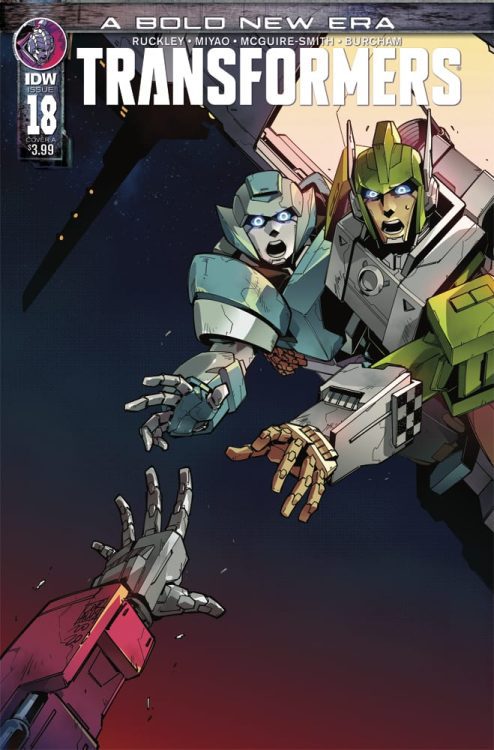
Characters struggle to survive in Transformers #18 by Brian Ruckley, Umi Miyao, Bethany McQuire-Smith, and Josh Burcham. Does this story of survival draw in the reader or it is a side story to a more pressing plot point?

Summary

“Run.” Calamity has befallen Cybertron. The only reasonable option for many bots is escape—leaving the planet in hopes of safety. Arcee and Greenlight need to get their mentee, Gauge, off-world to protect her, but first they’ll have to find a shuttle!

Transformers

Writing

It seems like an odd time to focus on a pure character-driven issue. A Titan is attacking the planet and will cause untold destruction. It might be more prevalent to focus on the bigger problems instead of setting up character arcs. Still, even though it feels like a major shift, this is the type of story where Brian Ruckley seems to shine.

The issue is a personal story between Arcee, Greenlight and Gauge. It shows off Arcee’s protective side as a mentor and how she is willing to charge straight into gunfire if it means getting a punch in when her young student is hurt. Showcasing how characters react to major changes in the world is the type of story Brian Ruckley pulls off with ease. Though it would be preferable to focus on the giant robot tearing up the planet, this story is still charming and sweet.

Transformers

Artwork

The art styles between Umi Miyao and Bethany McQuire-Smith blend very well to the point it’s hard to tell the difference between who does which pages. The pair’s focus on emotion through character actions this issue helped to show the attachment Greenlight and Arcee have to Gauge (again, the scene with Arcee walking through gunfire was beyond memorable). The facial expressions alone help to get the reader more invested in the emotion.

Josh Burcham increases the sense of catastrophe and destruction happening throughout the issue. As the city is in ruins and characters are panicking, the use of darker colors to show damage and a sense of action as the carnage plays out. The coloring also helps to advertise the anger Arcee experiences in the issue.

Transformers

The lettering by James Woods helps with the flow of the story from panel to panel. Between buildings crumbling and gunfights, the placement of word bubbles adds to helping to direct the reader’s eyes. This allows for a great sense of action as the story plays out.

Conclusion

Though it seems more like a distraction from the impending crisis of a Titan approaching, Transformers #18 is still a good story. It tells a more personal tale and shows the depth of Arcee is in this new series. Hopefully, more stories like this will emerge and help fans to get more emotionally invested.
Monkeys Fighting Robots Youtube

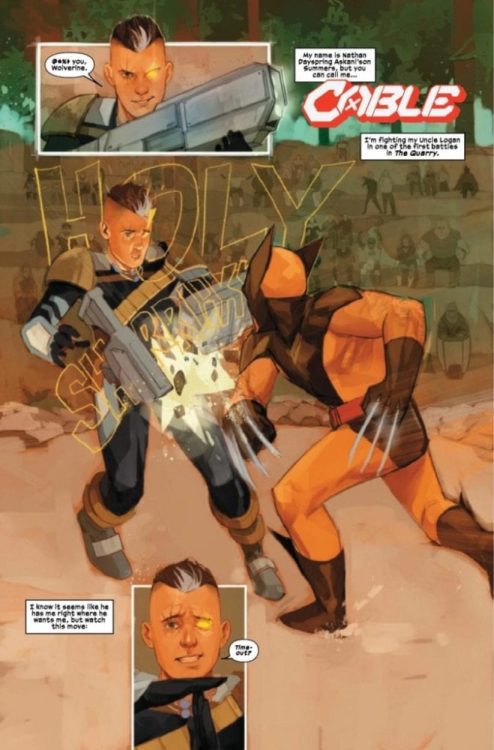
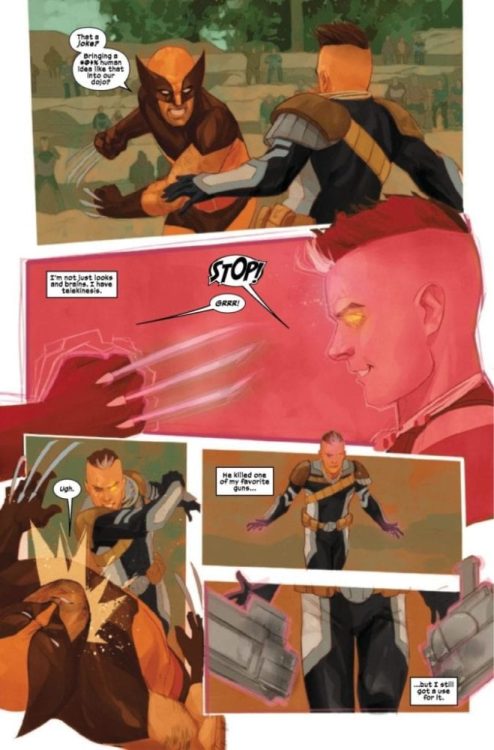
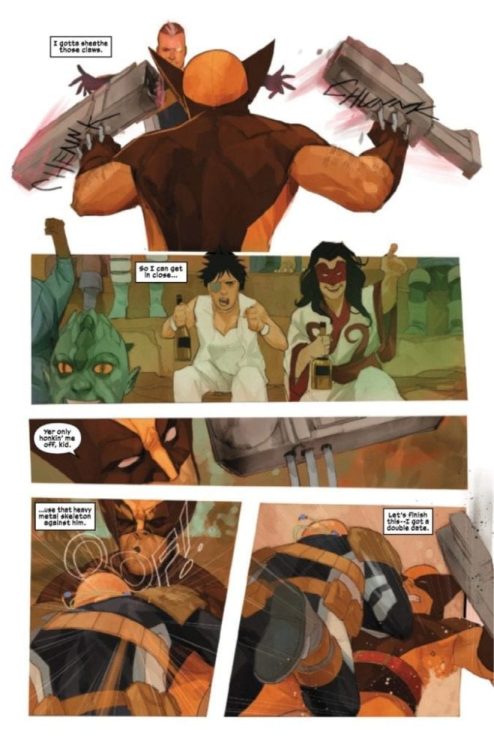
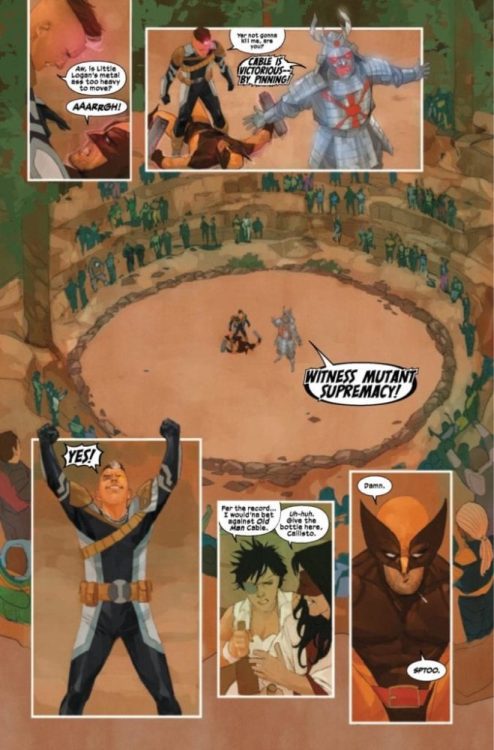
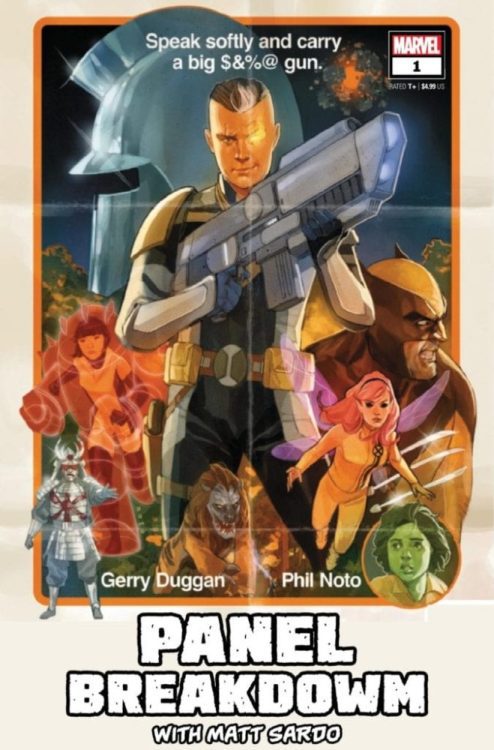
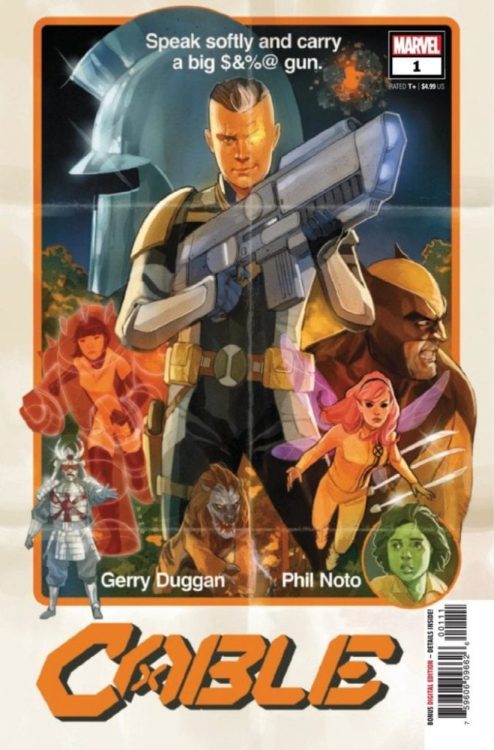
Panel Breakdown: CABLE #1 By Gerry Duggan, Phil Noto & Joe Sabino

Panel Breakdown: CABLE #1 By Gerry Duggan, Phil Noto & Joe Sabino

Welcome to PANEL BREAKDOWN, a weekly series where we take a look at our favorite panels of a comic book. This week we are talking about the new Marvel Comics series Cable #1 written by Gerry Duggan, with art by Phil Noto, and you will read Joe Sabino’s letters. Tom Muller is the designer on the issue.

This episode we focus on the relationship between Sabino’s letter work and Noto’s art.

About Cable #1:
THE DAWN OF REBELLION!
Cable was a grizzled old veteran of the wars to save the future… and he will be again. But for now, he’s a young mutant living in paradise leading a life of adventure! Nathan Summers, son of two of the most powerful mutants on Krakoa, has a destiny leading the youth of mutantkind in rebellion… so why not start now? Gerry Duggan (MARAUDERS, DEADPOOL) and Phil Noto (STAR WARS, POE DAMERON) bring us young Cable as we’ve never seen him before!


Are you picking up Cable #1 this Wednesday, or are you saving your cash for another book? Comment below with your thoughts.

Cable #1 Preview:

Cable #1 Side Notes:

Chris Claremont created the newborn infant Nathan Summers, the son of Jean Grey and Scott Summers. The character first appeared in Uncanny X-Men #201 from January 1986.

Louise Simonson and Rob Liefeld created Cable, the time-traveling adult version of Nathan. Cable’s first appearance was in The New Mutants #87 from March 1990.

Monkeys Fighting Robots Youtube

It’s Official: THREE JOKERS Coming From DC

three jokers

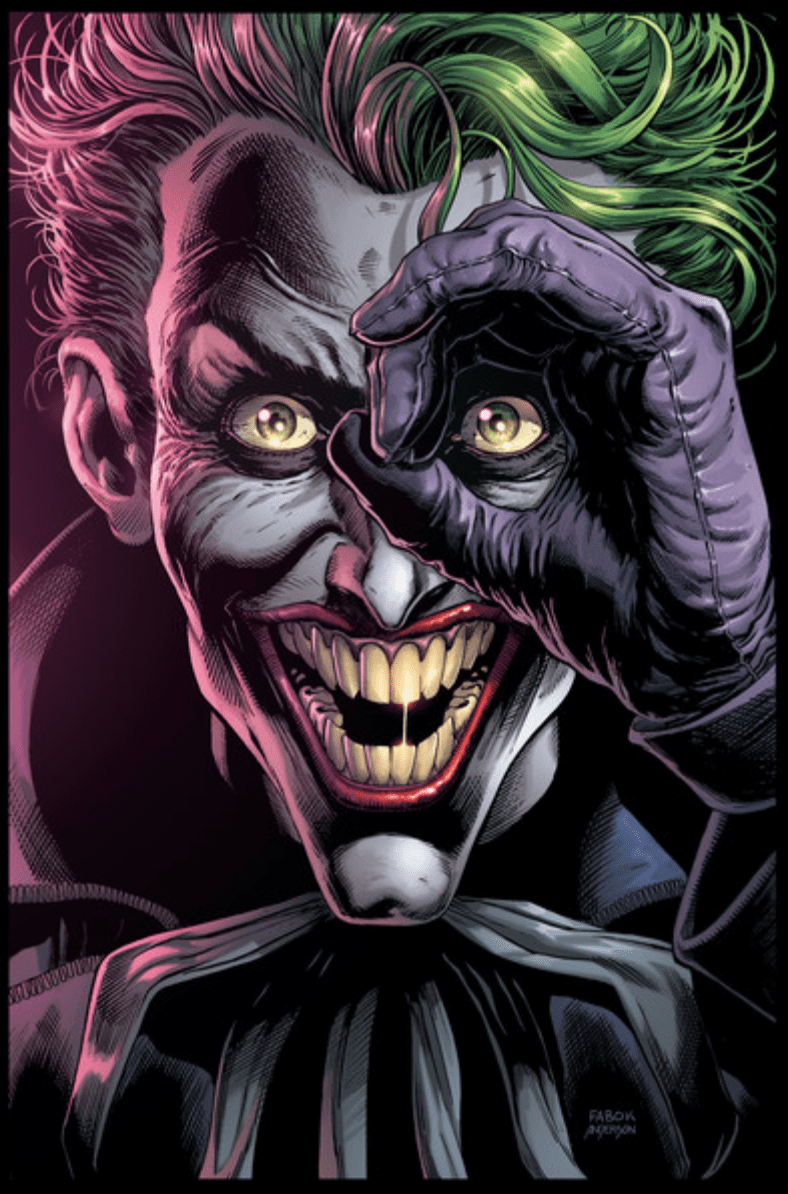
We’ve heard rumors of it happening for a while now. Artist Jason Fabok has posted teaser images on Twitter. Now, at last, it’s official: DC’s Three Jokers miniseries, by Fabok and Geoff Johns, arrives this summer.

three jokers

EW got the exclusive interview with the creative team. Check out some highlights below…

Johns on why this is his first go at writing the classic confrontation:

“The world doesn’t need just another Batman-Joker story. One of the reasons I’ve never done one before is because there are so many amazing ones, so I was only gonna do one if it was different and surprising and looked at the Joker and the meaning of the Joker and his effect on Batman and his family in a new way. We’re not introducing a multiverse of Jokers, we’re not out to change these characters forever, but we are turning over some rocks about these characters and their relationships.”

three jokers

On the impact for other Bat-family members:

“Barbara and Jason have gone through so much, as has Bruce, and it’s really focused on healing, on scars and wounds and what that does to somebody. If you suffer some trauma, you don’t just get over with it and move on with your life, it changes who you are. Sometimes it changes you for the better, sometimes it changes you for the worse. You can heal right, and you can heal wrong. That’s really what the book’s about: Healing right, healing wrong, and surviving.”

Fabok on the book’s artistic influences:

“Fans who have read The Killing Joke, you’re gonna see some familiar panels, you’re gonna see some familiar-looking things, like the Batcave…The Killing Joke has sat next to my desk for the last two years. I’ve been constantly referencing it, and even following a lot of the rules of how he laid out his panels in that book. I really want it to feel like it could be a spiritual sequel, at least artistically.”

Unlike Johns’ delay-plagued Doomsday Clock, the creators say all three issues of this series are complete and will be released on schedule. Click over to DC for some preview pages.

Three Jokers #1 is due in comic stores June 17.

Monkeys Fighting Robots Youtube

Review: TALES FROM HARROW COUNTY: DEATH’S CHOIR #4 is a Mournful Conclusion

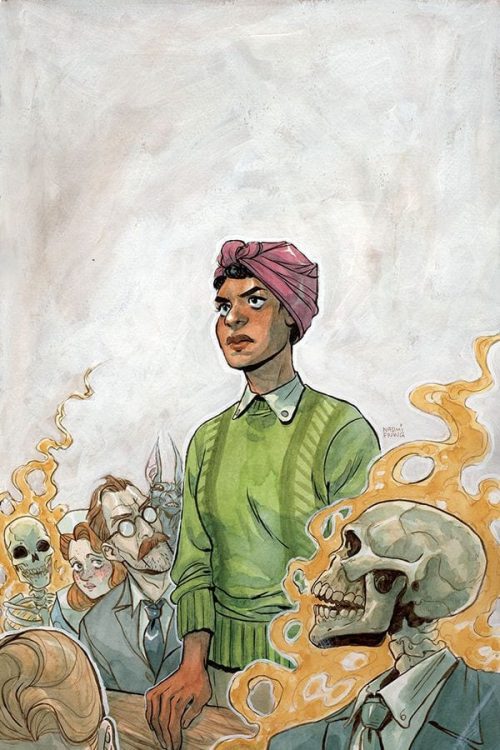
Cullen Bunn and Naomi Franquiz bring this story arc to a close with “Tales From Harrow County: Death’s Choir” #4. This bittersweet chapter reminds the audience and Hattie herself of the human element at the story’s core, while also paving the way for much more to come from this brilliant world.

“After taking care of the banshee, Bernice hunts down the source of recent disturbances discovers an old woman with a very personal motive behind raising the dead with a ghostly song–and a darker force manipulating it all.”

Writing & Plot

Writer and series creator Cullen Bunn opens this issue of “Tales From Harrow County” with a grim reminder of the time period in which the story takes place. The sorrowful reality of young men dying at war in faraway lands has been the narrative backdrop of this miniseries, and it’s a stark image with which this issue begins. The complex but relatable motivations of this issue’s “antagonist” make for a tragic revelation in this chapter. Bunn has shown through all of his work on Harrow County that he is a master of grounding the ethereal with the reality of human life. The choices Hattie has to make in favor of protecting Harrow over providing comfort to mourning families is a heartbreaking one, and one of the most memorable moments in this entire series. It’s also clear that Bunn isn’t quite finished with this quiet town full of spooks and magic either, as the ending is one sure to leave series fans clamoring for more (I know I am).

Art Direction

The visuals created by Naomi Franquiz for this final issue of “Tales From Harrow County: Death’s Choir” paint every bit of sorrow, loss, and hope that is put forth by Bunn’s writing in gorgeous detail. While the deep woods environment and miscreant haints look as fantastic as ever, but it’s the character art that truly shines here. All of the aforementioned heartbreak and tragedy is put into the characters’ faces with masterful detail, and it creates the other half of this issue’s contemplative whole. The visual direction Franquiz takes with the narrative as it winds around the feelings of character outside of just Hattie and the “antagonist” reminds the reader of the fact that Harrow County and its populace are a character in and of themselves. The art is what reminds the audience of the gravity of Hattie’s actions, just like Tyler Crook‘s art did for Emmy in the original series. Speaking of Crook, his lettering once again provides the tone in which the dialogue and narrative are read with his winding and bouncing fonts that shift from human to goblin and back again. While Harrow County’s narrative style is iconic in its own right, its artwork is where its legacy truly lies.

“Tales From Harrow County: Death’s Choir” #4 is a brilliant and nuanced end to this highly anticipated sequel series. The complexity of the conflict and its resolution makes for one of the most memorable moments in the entire series. Cullen Bunn and Naomi Franquiz have successfully carried on the legacy of the original comic, while also waving the notion that there is much more yet to come. Be sure to pick up this issue when it hits shelves on 3/11, or grab the collected trade paperback in July!


Monkeys Fighting Robots Youtube

Review: THE MAN WHO F#$%ED UP TIME #2 Is Fun But Offers Little Else

The Man Who F#$%ed Up Time #2
The Man Who F#$%ed Up Time #2 Credit: AfterShock Comics

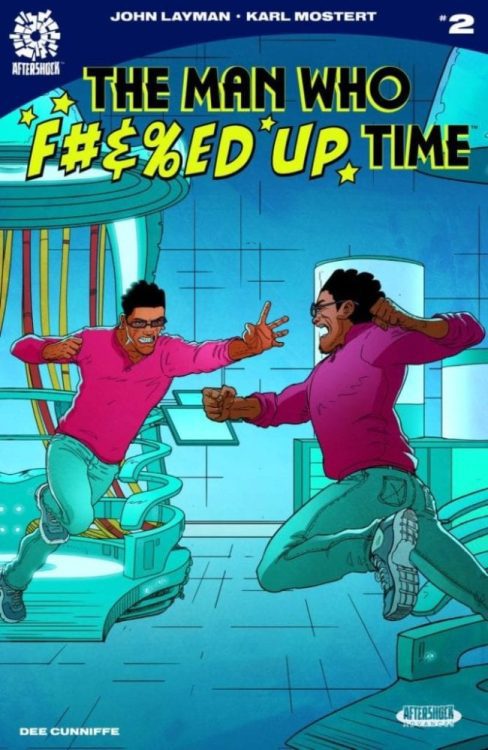
If it doesn’t rain, it pours; as Sean Bennett is about to discover in the second issue of The Man Who F#$%ed Up Time. Released by AfterShock Comics this week, the time altering adventure story mixes aspects of many great time travelling stories in an attempt to create something new and fresh.

Does it succeed? Is it a breath of fresh air for the genre like previous AfterShock title The Revisionist? Or is it a mess of contradictions and plot holes like a certain MCU movie?

The Man Who F#$%ed Up Time #2
The Man Who F#$%ed Up Time #2 Credit: AfterShock Comics

Telling The Time

This issue starts with the freaky cyborg future-police visiting Sean in his past to teach him a lesson in the present. Sean wakes believing it all to be a dream but soon learns it isn’t and the realisation of how much he has f#$%ed up hits him like a brick wall.

The opening ‘it was all a dream’ sequence is a way for John Layman to reintroduce the story to the reader. It builds to a large splash page to show off the effects of Sean’s time meddling. This is similar to a sequence in the last issue. From this point on it’s all a rush of action as Sean attempts to put right what he once did wrong, without the aid of a hologram* or anybody else.

There are elements of Bill and Ted’s Excellent Adventure in the plot but unfortunately none of the style or humour. As Sean goes through the events of the first issue, undoing his rash acts, he shows some initiative in getting his hands on the time travel machine but then all his decisions are dubious at best. This leaves the reader wondering what sort of person Sean Bennett really is.

Layman is more interested in the plot, in creating interactions with the Sean’s from different time periods, than he is in building up the central character. Sean’s development is slow and most of it is reactionary. He is driven by fear more than anything else. But at least he does have some personality, the extras in this time farce have virtually no character beyond their initial characteristic. No-one features for any length of time other than Sean, which results in him being surrounded by two dimensional people who have a cliched role to fill and nothing more.

This is a shame because it means that the reader does not engage fully with Sean’s dilemma. The altered universe becomes more interesting because there is so much to investigate and nothing, or no-one, of any consequence has been lost in the transition. Layman obviously loves the idea of mixing up eras to create an alien world and the world’s Sean ends up in are spectacular. It would be more interesting though if there was a sense of loss for the original time line. Back To The Future is gripping and exciting because Marty’s home is one worth saving.

The Man Who F#$%ed Up Time #2
The Man Who F#$%ed Up Time #2 Credit: AfterShock Comics

Art Of Time

The saving grace of The Man Who F#$%ed Up Time is the art work. Karl Mostert uses thin, detailed lines to etch out Sean’s travels. There is a great amount of detail in the panels and Sean especially has a real presence on the page.

The reading line through the panels is clear and precise, almost simple in its design. One of the things that helps this along are the clever page transitions Mostert uses. Sean Runs into the building at the bottom of one page and is still running, in exactly the same manner, in the centre of the top panel on the next page. The movement or eye line of the character leads the reader into the page turn so that the flow of the story is not broken.

The coloring is also detailed and descriptive. Bold and distinctive color choices highlight the central character, enhancing his presence on the page. Sean is recognisable instantly, even from a distance, because of the colors that Dee Cunniffe uses to identify him. Vary rarely does he clash with any other aspect in a panel.

Cunniffe makes the majority of the comic mundane in appearance by giving everything a realistic hue. The backgrounds of the science lab and the convenience store don’t pop with color, they are functional and expressive only in their ‘everyday-ness’. Where this changes is whenever the time machine is activated or there is something truly out of the ordinary on the page. In these moments Cunniffe bestows a vibrancy to the panel. He brings the moment to life, making it leap from the page and feel like it is part of a great science-fiction story.

Layman attempts to do this with his lettering. Occasionally he’ll change the expected shape of a speech balloon to make the text more important or noticeable. His placement of the speech runs parallel to the artwork, leading the reader through the page. Walking them from panel to panel like a child being led by the hand.

The Man Who F#$%ed Up Time #2
The Man Who F#$%ed Up Time #2 Credit: AfterShock Comics

Conclusion

Visually, The Man Who F#$%ed Up Time is a satisfying read with some interesting comic book ideas woven into it. Unfortunately, the plot and characters do not enhance it beyond artistic fascination.

One of my complaints about the Avengers: Endgame movie is that it mocked previous time travel movies and then proceeded to be one of the messiest, ill-thought out plots of the genre. It was entertaining but made little sense. The Man Who F#$%ed Up Time is similar. It draws from an expressive and creative well but then dilutes the final product before serving it up. This comic is lacking subtleties and nuances that would elevate it above mere entertainment.

The Man Who F#$%ed Up Time is fun and daft. As long as you don’t think too hard about it, you should find it enjoyable. However, I fear that it is going to be easily forgettable unless future issues bring something spectacular to the table.

*Quantum Leap Reference. You’ll get it or you won’t.

Monkeys Fighting Robots Youtube

Review: DEATH TO THE ARMY OF DARKNESS #2 – Fighting With Oneself

Dynamite’s Death to The Army of Darkness #2 continues to show how Team Ash may be one of the best teams out there, as they kick deadites’ asses this March 11th at your LCS.

If you’ve been buried in a grave and need a refresher of Death to The Army of Darkness #1, then check out our review of the chainsaw revving first issue.

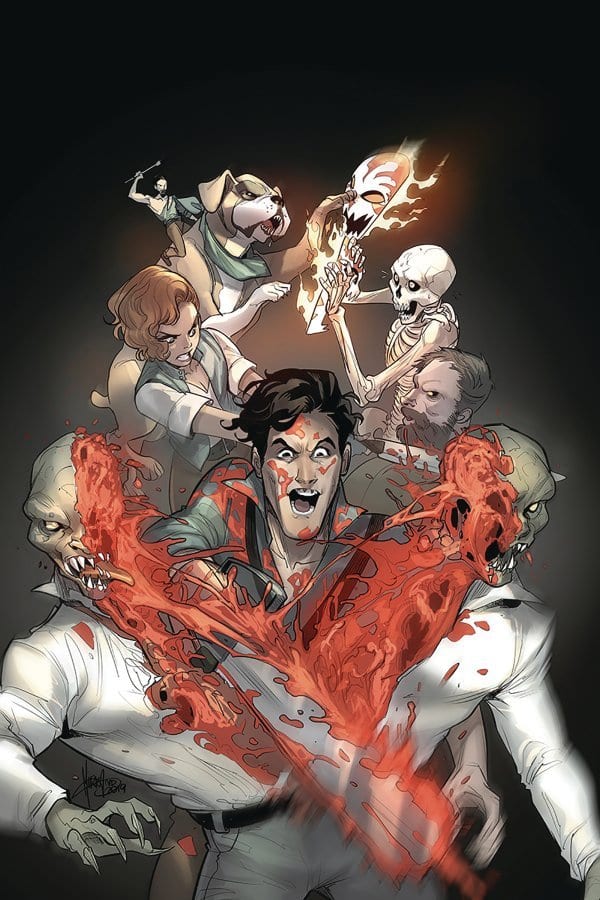
My favorite Variant Cover for Death to The Army of Darkness #2
Variant Cover by Juan Gedeon

MULTIPLE SHADES OF ASH

Ryan Parrott starts Death to The Army of Darkness #2 with a scene that fans of the Evil Dead series will recognize: Ash getting his ass handed to him on a platter. Who doesn’t love seeing Ash get knocked down to get right back up? Yet, this time Parrott has Team Ash backing him up against deadites. Nonetheless, the age-old question stands, “is multiple versions of Ash better then one full Ash?” Okay, that may not be the exact quote but the question remains, how is Team Ash?

In Parrott’s hands, Team Ash may be one of the Evil Dead’s best plot points. Death to The Army of Darkness #2 proves this with non-stop fun, humor, action, and Ash’s usual attitude towards things. Parrott absolutely nails every aspect of Ash with respect to the original, while building upon it. Within Death to The Army of Darkness #2, there are moments where you can see Bruce Campbell acting out to great effect. But, that’s not limited to Ash, as this is a team-up comic.

We learn that Team Ash was formed by the mistranslation of a singular word in the Necronomicon. Of course, this is something that would happen to Ash; nothing out of the usual. Yet, Team Ash is one of the best aspects of the series so far, especially with issue two where they are truly introduced. Each character takes a single characteristic from Ash. Intelligence, femininity, aggression, fear, and impulsivity. All of these combine to make one of the best teams out there

Always love Mirka Andolfo's work!
Variant cover by Mirka Andolfo

THE TEAM THAT SLAYS TOGETHER, LOOKS GOOD TOGETHER

In Death to The Army of Darkness #2, Jacob Edgar is able to flex more of his action-heavy muscles. And damn do those muscles look gorgeous. The first six pages continue the fight seen in the previous issue with each member taking on deadites in their own way. Edgar keeps the violence crisp, fast, clear, violent and comedic in the way it’s handled. Each panel during the fight is a blast to read, as he keeps the realism of his art intact, yet continues to make it cartoonish. That’s not all in that aspect though.

Ash’s Chainsaw takes the aggression aspect of Ash, and although it doesn’t speak much, Edgar makes it visual anytime it does. Instead of having the Chainsaw be static when it talks, Edgar adds a bend in its blade. Just because it can speak doesn’t mean it stops cutting people in two. Call that a transition to Kike J. Díaz’ fantastic color palette.

During the deadite-splitting-in-two panel, Díaz uses a singular yellow/orange background to help emphasize the moment. Seen in the foreground is Ash & Chainsaw behind the deadite splitting him in two with blood spraying everywhere. The background helps the blood’s red hit harder, making the scene have a more gore feeling. This mixing of color continues throughout in a few bloodier moments, keeping the above statement. These aren’t the only moments Díaz’ colors stand out, as they are captivating throughout, especially the fire scenes.

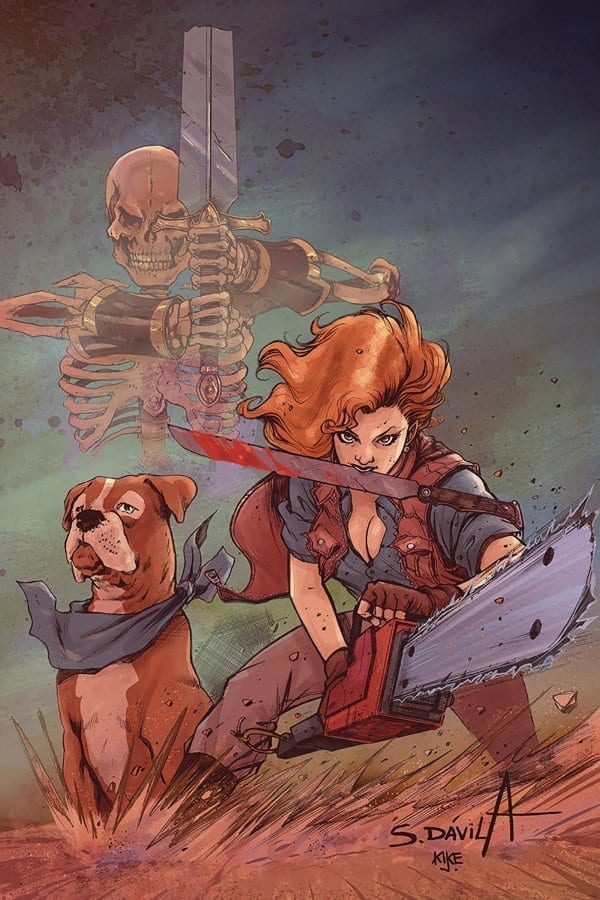
A very Conan esque cover.
Variant Cover by Sergio Fernandez Davila

THE LETTERS THAT GO VROOOOM

Another great moment in the chainsaw panel is Hassan Otsmane-Elhaou’s sound effect. Instead of simply having the VROOOOM effect linger on the top, Otsmane-Elhaou portrays it in a V movement the reads from left to right. This isn’t the only example of great lettering, as throughout Death to The Army of Darkness #2, Otsmane-Elhaou includes eye-popping sound effects. Otsmane-Elhaou also keeps the trend of making key words large and bold to help make the word bubble pop.

DEATH TO THE ARMY OF DARKNESS CONCLUSION

Everything about Death to The Army of Darkness #2 oozes love and appreciation that the team has for the film/TV series. If you’re hesitant to read it as it’s based on a franchise, don’t be. So far the series has been new reader friendly, while containing callbacks and other great moments that long time fans will love. Issue #2 proves that the first wasn’t just luck, but that the team knows exactly what they’re doing.

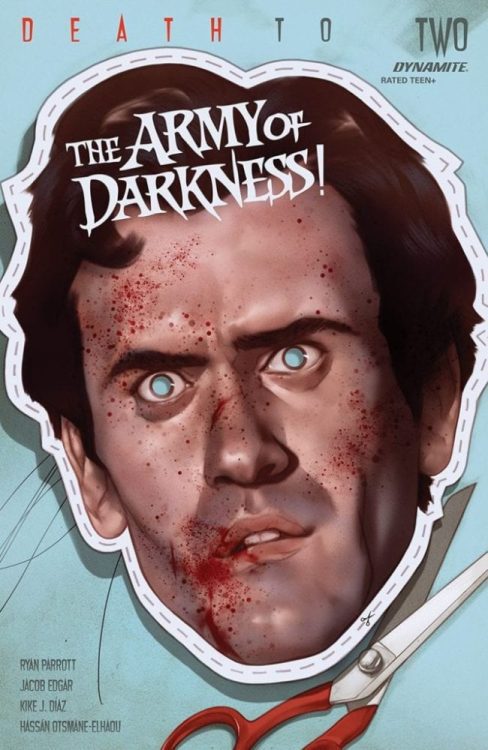
Cover Story: Having a wearable mask of Ash on the cover that (it seems) you can cut off is awesome! Now you need to buy two so you can cut one off.

Who doesn't want a face full of Ash? Death to The Army of Darkness #2 COVER
Cover by Ben Oliver

Memorable Quote: “Please tell me you’re not trying to make a move on yourself.” – Ashley Williams.

This moment had me laughing like crazy because I need it was only a matter of time before Ash tried this. Plus it nails his character perfectly. Ash and Team Ash had so many great banter moments.

Monkeys Fighting Robots Youtube

How DAREDEVIL: BORN AGAIN Changed My Concept Of What A Comic Could Be

DAREDEVIL: BORN AGAIN

Alan Moore and Frank Miller ushered the comic book world into a new age in 1986. Gone were any traces of the slapstick humor that still permeated from the wacky days of the Silver Age. Grit, dark shadows, and subverting the norms of the genre became, well, the new norm. Moore, whose Watchmen series at DC Comics remains quite possibly the most famous comic book storyline ever, and Miller, who was also revolutionizing capes and cowls at DC, were flipping the conventional wisdom applied to superheroes. There is, however, a more overlooked work of Miller’s from that year in “Daredevil: Born Again” with artist David Mazzucchelli at Marvel.

So often, the canonical superhero comic book stories have been limited to Watchmen and Batman tales over at the Distinguished Competition. There are The Dark Knight Returns and “Batman: Year One,” both of which are from Miller. The Dark Knight Returns is an iconic out-of-continuity series that focuses on an aging futuristic Bruce Wayne coming out of retirement, taking up the mantle of the Bat once again in protection of a crime-ridden Gotham City. It’s dark and dreary and bleak in the way few mainstream comics were beforehand.

“Batman: Year One” is a timeless origin story of the Caped Crusader, one that has appealed to readers of all generations and backgrounds for over thirty years. You can have no preconceived notion of Batman and still enjoy it. I’m sure it’ll still captivating audiences for the next three decades too.

Matt Murdock Kingpin

“Daredevil: Born Again” is so different, though. Miller had already completely reinvented the character in his seminal late-1970s run, creating classic characters like Bullseye and Elektra while also showcasing that Wilson Fisk was much more than a mere Spider-Man villain, he was a force to be reckoned with both physically and psychologically.

This wasn’t some dystopian version of Matt Murdock either. This was the real Matt Murdock who had been around for over thirty years, a man who had loved and lost and beaten to the brink of destruction countless times across hundreds of comic book issues. This was the real version of Karen Page too, as she struggles through drug addiction in a way no superhero comic had covered since the classic Green Lantern/Green Arrow volume from Dennis O’Neil, Neal Adams, and a whole host of other creators in the ’70s.

Frank Miller

Miller re-imagines a version of Bruce Wayne readers never knew existed in The Dark Knight Returns. Miller re-imagines a version of Matt Murdock, who readers had grown to care about for years and years in “Daredevil: Born Again.” That’s what separates the two for me. His Bruce Wayne is some totalitarian god machine. His Matt Murdock is still a blind Catholic lawyer from Hell’s Kitchen.

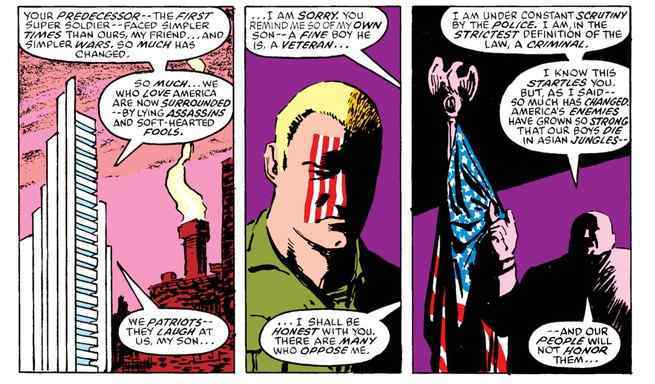
Miller widens the scope of his story in a manner similar to the way Moore does in Watchmen too. He hits on the themes of nationalism, patriotism, and the growing fear of nuclear holocaust with his creation of the character Nuke, a name that lacks any semblance of subtlety, and the inclusion of the red, white and blue shield-carrying Captain America.

As the Cold War was reaching its zenith, Miller was unafraid to have those real-world fears come to life in the panels of Daredevil. The fact that is an in-continuity story, not something that could’ve been spun as an alternate universe, only heightens that impact. This is part of the reality of the main 616 Marvel Universe. It’s just as much part of Daredevil’s history as Stick teaching him to harness his otherworldly gifts.

Born Again Frank Miller

I loved “Daredevil: Born Again” so much that I took it to an academic level. When I was a junior in college at the University of Pennsylvania, I took an English class on the comic book medium. When it came to writing our final term paper, I naturally gravitated to the work of Miller. We had covered The Dark Knight Returns as part of assigned reading, but there was obviously another of Miller’s stories from 1986 that I wanted to incorporate into my analysis as well. I compared the state of each superhero universe, the graphic displays of violence that were prominent in these stories, and how they both reflected the geopolitical climate of the Cold War in the mid-late 1980s.

Frank Miller changed how I viewed the Marvel Universe with his earliest Daredevil work, as I began to see that there was a more sinister layer afoot beyond the shiny exteriors of Captain America and Iron Man. He changed how I viewed superhero comics as a whole with “Daredevil: Born Again.” His stories with the Dark Knight will always remain his most prominent, but I will always hold a soft spot for his greatest tale about the Man Without Fear.

Monkeys Fighting Robots Youtube

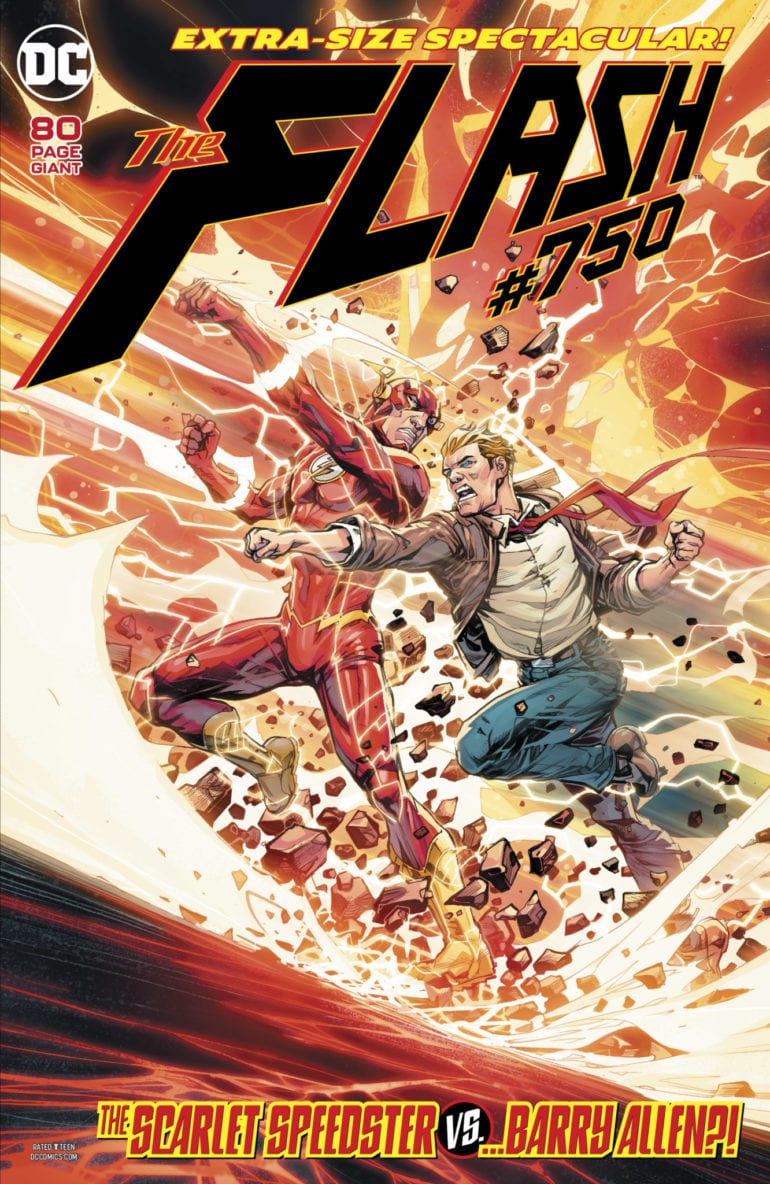
Review: THE FLASH #750 Celebrates the Character Through Stories

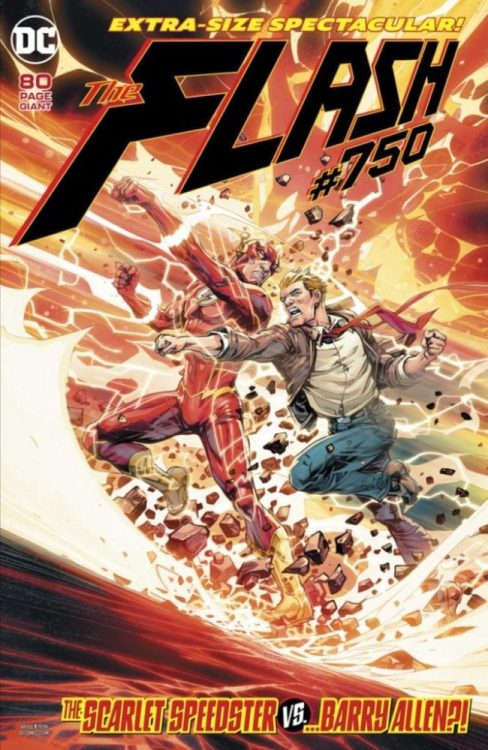
Flash 750 cover

The Flash Age Begins!

Eighty years ago, comics introduced the fastest man alive, The Flash. While it may not have started as Barry Allen, the Scarlet Speedster has been one of DC’s cornerstones in history. Now we reach issue 750, which might not be an accurate number, but still impressive nonetheless. It’s been an epic ride so far, but this run certainly has been a rough one.

The Flash has been at a crossroads since the end of Rogues’ Reign. His powers have grown out of control, and he nearly killed Captain Cold. After freeing the city from Cold, Barry meets with Pied Piper to help. While he can’t fix him, the ex-Rogue is able to stabilize Flash enough to allow him to continue being a hero. When Barry returns home, his future self arrives and warns him of the villain Paradox before disintegrating. Is the fastest man alive prepared for this new threat?

Flash 750 cover

**Some Spoilers Below**

Story:

The Flash Age begins with the citizens of Central city talking about their hero. From reformed criminals to students at school, it’s clear that Barry Allen’s heroic alter ego has made a change. These stories are being gathered by Iris, who wants to publish an article about the Flash. Barry, however, has been doubting himself as of late with all that has happened during Rogues Reign. Iris admits she made this story to remind him that he is the hope of the city and does so much for the people. Before he can get too comfortable, the pair are visited by Godspeed, who challenges Flash once more.

The Flash 750 p1

So there will be people who hate the opening chapter of The Flash Age due to its treading old ground. It recaps the past few arcs, including Flash War and The birth of the other Forces. Honestly, I forgot it was a part of it until the last three pages when Godspeed arrived with Paradox. Truth is this story felt more like a celebration of what made the character of Barry Allen enjoyable.  This shouldn’t be seen as a study of the series but a study of the character himself.

As for the other stories in the book, we have a mixed bag. While some were able to bring a smile to my face, others fell flat. One of the standouts was a Jay Garrick Flash tale. We see him face the Thinker before leaving us a tease of his return later this year. One of the mediocre ones come in the form of a Flash against Mirror Master story, full of references to the silver age. While it isn’t one of my personal favorite, the variety of stories will impress a wide range of readers.

The Flash 750 p2

Art:

With this issue being as massive as it is, we got a large array of art teams to help bring the tales to life. For The Flash Age, we have Rafa Sandoval returning, and he brings his A-Game. He had always done a spectacular job in working on the Scarlet Speedster and his powers, and here is no different. The brief battle between Godspeed and Flash is still plenty to excite as we head into the rest of the arc.

Other standout art teams are David Marquez and Alejandro Sanchez with their Jay Garrick story and Francis Manapul. Both stories have exceptional art with memorable moments that stay with readers days after reading it. Overall, it’s just a good looking comic!

Conclusion:

The Flash has just turned 80, and this comic does a pretty good job of honoring the character. There are stories for every type of reader. The main story isn’t perfect due to it mostly being a recap of the current series, but considering what this issue is, it fits. From the slow-paced character pieces to action-packed romps, this comic will bring delight to any fan of the fastest man alive.

Monkeys Fighting Robots Youtube

The Place To Bet – Vera And John Casino

Monkeys Fighting Robots

Many online gambling sites have been emerging recently to cater to the vast market of players who want to gamble. 

This is a natural turn of events. The use of smartphones has become an integral part of life for the majority of the human population. It is a means of connecting. 

And, most people now want to gamble from the comfort of their homes. To give the consumer what they would find a truly remarkable experience, Vera and John Casino is the place to check out.

As soon as you visit the site, the player is elevated to another platform which gives you a surreal feeling of actually being in a casino. 

The website design is lavish and posh creating an atmosphere of a grand casino where one can play any number of games from blackjack to baccarat, and from slots to roulette. 

It really is quite refreshing and liberating, as the player can be at ease at going around picking and choosing from a large number of gambling games – 700 games for the PC and 500 games for smartphones.

Then, to hook the players, Vera and John Casino gives what all gamblers love – freebies. There are welcome bonuses, no deposit bonuses, free spins, and free games.

To give you a clear idea of how royally the players are treated, you receive a $30 bonus for simply registering. And, that’s when the games truly begin. 

The welcome bonus is what comes next. Here, the player gets a bonus for making a deposit. The bonus is matched to the deposits up to $500. The second bonus is 25% of the deposit up to $ 250 and the third one is a 50% matching bonus up to $ 150.

These bonuses are not equivalent to cash though. And, can only be used once your cash. The bonus will be transferred as cash when the withdrawal conditions are met.

But, Vera and John Casino appeals to the hardcore players who love to gamble. That is to say, there are tournaments on the most popular games. New avatars and various achievements are awarded as the player frequent the site regularly.

Also, you can win coins as you keep playing. The more you play, the more coins you make. These coins can then be used in the online shop where players can purchase bonus cups, locked bonuses, and even free rounds.

How do players make deposits asap and begin to play? There are many sites that take payment only through Neteller, but not at Vera and John. They want to make things simple for their players so you can make deposits through credit cards, which is way quicker and hassle-free compared to other payment methods.

Vera and John Casino is an online gambling casino that is a user-friendly site – easy to use, understand and play. It is smartphone compatible and just as great to be used on your personal computer. 

So, gamblers and gamers alike, be prepared to have a world-class experience at berazyonn casino. It is truly an online casino to have fun and win big time.

Monkeys Fighting Robots Youtube

5 Brilliant Reasons for Auto Care

Monkeys Fighting Robots

The Introduction

It isn’t possible to function effectively in your everyday life without transport. And, if you seek to cut down on your daily transport expenses, get yourself a car.

But, everyone can’t put down so much cash in one go to get a car. Hence, there is now car financing.

However, many argue that car financing includes vehicle insurance that tends to raise the monthly premium paid. And, the obvious question asked is, why should we pay so much?

Well, there are umpteen reasons for you to get vehicle insurance. Read on to find out more.

Benefits for getting vehicle insurance

Safe From Accidents

Accidents happen all the time. There may be a time that your car gets hit even if you are standing at a traffic light. 

And, getting your car insured means that you are safe, from paying an enormous amount of money right out of your pocket when you do run into an accident.

Paying Less Even If You Do Get Into An Accidents

You may pay a small amount of monthly premium but that saves you from paying a huge amount at the time of the accident.

That is the biggest benefit – the small amount paid for coverage today covers you in the time of even a large accident in the future.

Prevents Devaluation Of Your Car

Some auto insurance policies provide cover for the devaluation of your car too. Naturally, it is something that you are required to pay for in the vehicle insurance policy, but the benefits far outweigh the costs incurred.

Gives You Peace Of Mind

The fact that your vehicle is insured, does give you peace of mind. Unforeseeable events are a part of life but taking security measures in advance does mitigate the losses. 

If, in the case of an accident, you know that your vehicle is insured and that it will not cause a severe financial constraint on you.

Safeguards You Against A Lawsuit

Even if you end up damaging someone’s property, having auto insurance means you will have help when others make a claim against you. This even includes legal defense.

Covers For Damages Even If It Is Not An Accident

It is not really necessary that your car can only get damaged in an accident. Auto insurance covers you for events such as fire, theft, and other eventualities such as damages caused by a run-in with an animal, or even a hailstorm.

The Conclusion

In other words, the best thing to do against the uncertainties of life is to take precautions. Auto or vehicle insurance helps you to do just that. 

And, the best thing it does is to provide people with a sense of security. You know that if you do run into an accident and damage your car or someone else’s car, your monthly budget won’t turn to nil. 

So, if you own a car or a van, look up the internet to find a good van insurance deal here.

Monkeys Fighting Robots Youtube