REAVER #9, available from Image Comics on July 1st, follows Breaker and Rekala as they’re “captured” by the town’s guards while on the hunt for Stagger. Justin Jordan’s story marks the turning point for Breaker as he comes to accept who (and what) he is, and Rekala kicks ass.
Cover Art
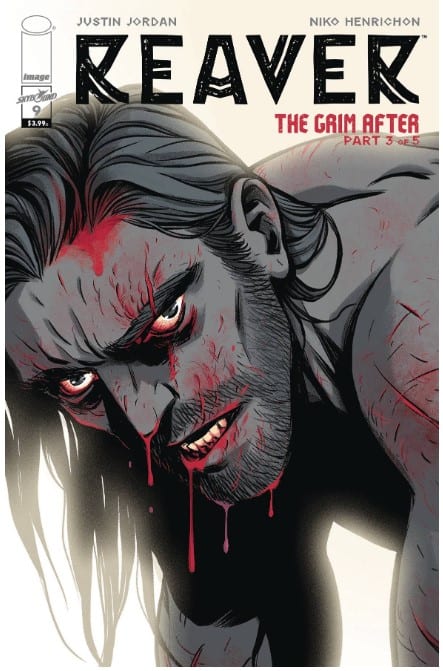
Becky Cloonan’s cover is a mild spoiler for the ending of the last issue (you can read our review here), zooming in on the face of a bloody and beaten Bren. Technically, it has almost nothing to do with this issue, but it does remind the reader of what’s at stake for Breaker and Rekala. Solid composition, intense facial emotion, and you could imagine this is what Breaker sees in his mind’s eye when he finally decides to let go of everything holding him back.
Writing
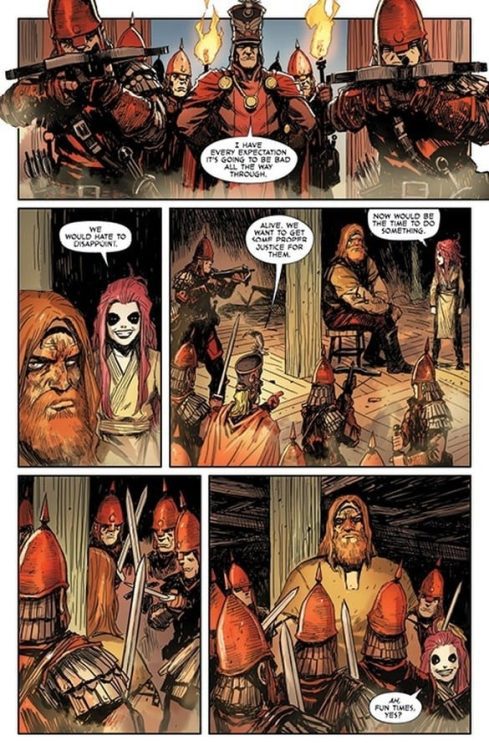
There’s not a lot of forward progress in this issue from Jordan’s story, but that’s perfectly okay. It’s more of a character piece, set inside a dungeon/prison that gives Breaker the means to come to terms with his past as a killing soldier. By embracing his past, Breaker decides to accept his role as a killer when it’s for something that matters instead of on command.
Conversely, Rekala is a lethal imp who revels in the chaos and the fighting. You’d think such a character would be erratically wild, but surprisingly, Rekala is probably the most clear-minded person in her entire group, almost to a fault. Her viciousness is matched only by her confidence, which makes her oddly charming in a Deadpool sort of way. Rekala is quickly becoming my favorite character discovery this year.
Again, there’s not a lot of story progress but a ton of character growth, and I’m intensely looking forward to what mayhem comes in the next issue.
Pencils/Inks
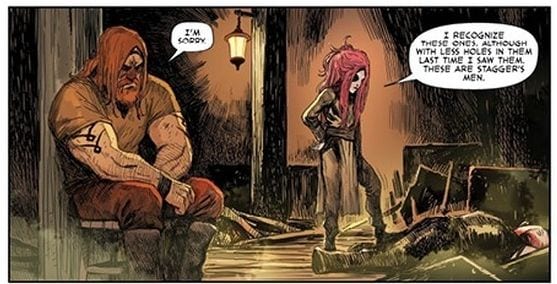
Niko Henrichon’s art remains consistently good from the previous issue. The rough lines used to scratch out the characters plays up the feeling of weary and worn warriors that have earned more than their fair share of scars. Breaker is a mountain of a man, but at no time does Henrichon play him up as nonsensically large. Likewise, Rekala’s impishly small frame stands out but doesn’t look impossibly out of place. Both characters are strong examples of designing unusual anatomy for effect but selling it through consistency from one panel and page to the next.
Equally notable about Henrichon’s art is the rough line art on the backgrounds and its effect on the story. Using that rough, chalk pencil-like line style on all the backgrounds gives the impression that every scene is carved in wood, which is thematically consistent with the time period and the setting of the story. You could imagine you’re flipping through pages made of woodcut art, adding to the atmosphere.
Coloring
Henrichon’s coloring adds to the woodcut art style by heavily playing up the yellows to immerse nearly every panel in torchlight. That color choice gives each setting a touch of warmth and life, and it provides a hue to the skin of every character that makes the whites of their eyes pop with intensity. Breaker and Rekala’s eyes have a keen intensity that’s brought out more so with the soft glow of the environment around them. Henrichon’s color choice seems simple and natural, but it’s executed well and adds to the intensity of the main characters in a subtle way.
Lettering
Clayton Cowles’ lettering is well placed for moving the reader’s eye along from panel to panel. There’s a lot of dialog in this issue, so Cowles wisely breaks up paragraphs into chunks and spreads them along the panel borders in the direction of the panel flow. It’s a common technique that’s executed well, and it keeps the reader’s eye moving, so you’re never bogged down with fits and starts—excellent pacing by Cowles.
Conclusion
REAVER #9, available from Image on July 1st, is a well-executed break in the story to build the main characters and set up their team dynamic for what promises to be a blowout conclusion. The art is rustic in ways that adds to the story’s setting, and Rekala is a hell of a lot of fun. I’m eagerly waiting to see what happens in the arc’s finale next issue.
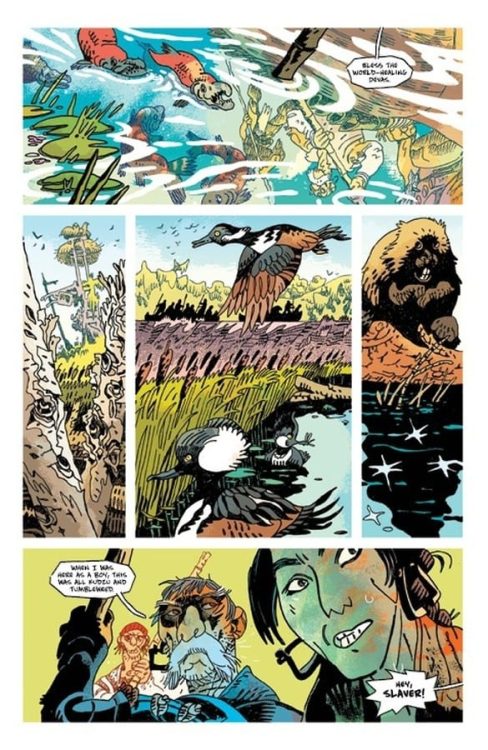
PROTECTOR #4, available from Image Comics on July 1st, follows Mari and her escorts on their way to the Fortress, dealing with insurrection and alien traps along the way. Simon Roy and Daniel Bensen’s story wrestles with primitive notions of myth and prophecy while confronted with alien technology advanced enough to be mistaken for magic.
Cover Art
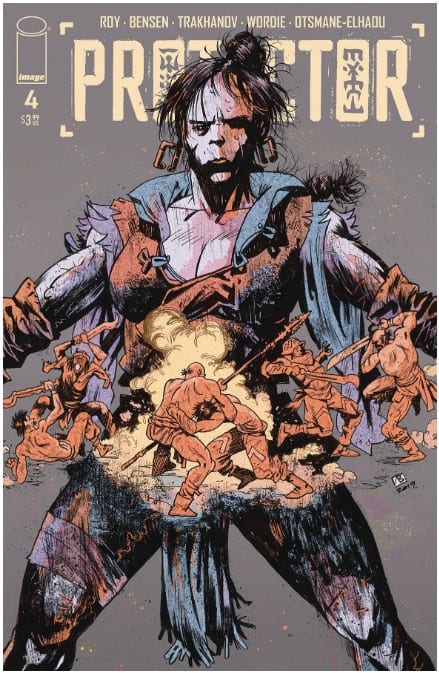
Vlad Legostaev’s cover work is gritty. The use of blues and greys give off a stone-like feel that matches the primitive setting for the story. Luo, the central figure on the cover, projects the serious demeanor of a warrior, which strongly matches her personality in the pages to come. I would be keenly interested in seeing what Legostaev could do with style when adapting a horror book along the lines of Frankenstein.
Writing
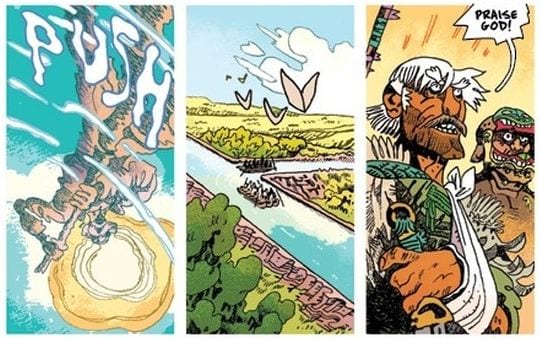
The story by Roy and Bensen is simple until it isn’t. Mari and her group are rafting through the rapidly evolving wilds of a terraformed Earth on their way to the Fortress. Luo, being the strong Hudsoni warrior firmly entrenched in believing what she can see and touch, questions Mari’s elevated status as the “Chosen One.” When the group encounters an alien satellite that tries to spirit Mari away, Luo seizes the opportunity, and chaos ensues.
The actions and dialog of Luo, Slaver, Mari are simple on the surface. Still, there’s a deeper meaning in this story about our deference to technology, that we largely don’t understand, for guidance and protection. The traditions of the old resist against quickly evolving changes of the new. That resistance, unaddressed, boils over in violent outbursts.
It sounds like this issue is a brilliantly deep and thought-provoking read, and it may be. Or, it could be a weird story that accidentally opens up the opportunity for the reader to consider ideas you hadn’t thought of before. Either way, it’s fun to dig deeper into this story when you read it more than once.
Pencils/Inks
Artyom Trakhanov’s art style is heavily stylized, and that’s putting it mildly. There’s no adherence to anything resembling consistency or anatomy. At times, it was difficult to understand what was going on in some panels. You could make the case that the art style (at least consistent with Trakhnov’s other works) looks like doodles in a junior high schooler’s composition notebook.
But here’s the critical difference.
Trakhnov’s work adds to layers of depth to the themes in the written story specifically because it looks primitive and amateurish. The common themes in the story of legends and prophecy clashing against new tech resemble, in a way, ancient drawings or cave paintings to emphasize the narration from the Hudsoni’s perspective. To be fair, Trakhnov’s art will not be everyone’s cup of tea, but I appreciate that it’s a good match for the type of story Roy and Bensen are telling.
Coloring
Jason Wordie’s coloring and Hassan Otsmane-Elhaou’s lettering save this issue from being just a weird oddity and turn the book into something more. How do you color in the lines when the lines have no rhyme or reason? How do you add texture and shading to a figure that makes no anatomical sense? Wordie answers these questions with pure, brilliant execution. The figures are shaded, sometimes with Mario Bava-esque tones, to emphasize the animalistic emotion in each scene. This is most apparent during the big battle towards the end of the issue, and Wordie takes drawings, that risk looking ridiculously cartoonish in black and white, and turns them into powerful punches of energy.
Lettering
Otsmane-Elhaou’s lettering takes the saving grace of Wordie’s coloring and bumps it up even further with amazing lettering technique. On its face, it’s silly to see sound effect lettering that spells out ‘STAB’ or ‘DRIP’ or ‘CHOMP,’ but again, this is an example of an expert letterer changing the typical into the atypical to marry the lettering style with the art and color. The sound effects are overly simplistic to the point of amateurish, by design to match the primitive perspective of the storytellers and the rough, raw style of the art. This is a stellar example of the letterer adopting a style that’s not his own in service of the overall aesthetic.
Conclusion
PROTECTOR #4, available from Image on July 1st, is a simple story that’s anything but in execution. Everything about this issue is rough, raw, primitive, and if you look deep enough, possibly very thought-provoking. It won’t be to everyone’s taste, and maybe that’s a good thing.
In an abrupt move, Stan Heidmann has vacated the position of President within Geppi Family Enterprises (GFE), the parent company of Diamond Distribution. Steve Geppi, Chairman & CEO of GFE and the public face of Diamond Distribution, has assumed the role of President left by Heidmann for the foreseeable future.
It’s unclear what prompted Heidmann’s sudden departure, but the press release issued by Diamond today indicates this change may be the first part of a comprehensive, strategic shift. The full transcript of the press release is provided below.
Does this bode well for Diamond Distribution? What other changes do you expect to see in the coming weeks? Let us know your thoughts in the Comments section, and please share this on social media using the links below.
A Message from Steve Geppi
(BALTIMORE, MD) — (July 1, 2020) —
Good Morning,
Today I am announcing an organizational change that will help us lean even further into the many opportunities to elevate our industry, our business and our brands in this fast-moving and evolving marketplace.
Effective immediately, I am reassuming the role of President, Geppi Family Enterprises (GFE), in addition to my position as Chairman & CEO. Stan Heidmann will be departing the organization. I thank him for his contributions and wish him all the best in his future endeavors.
As you know, I have a strong history of growing and leading this organization for several decades and I am energized about our next phase. I am supported by an exceptionally talented executive leadership team with deep expertise and an unwavering commitment to our industry as well as by the incredible teams they have built. I am proud and privileged to work with such amazing people.
Under my guidance, the executive leadership team will support a comprehensive strategic review to position the enterprise for future growth. I feel a tremendous responsibility to our employees and the industry, and I fully intend to set all Geppi Family Enterprise brands on a path for robust growth. I am confident we have the right leadership with talented teams in place and I see enormous opportunities for GFE.
You will be hearing more from me in the coming weeks as I am committed to keeping you all informed and involved. Be well, and I hope you find some time this holiday weekend to relax and recharge. Thank you for your continued support. I appreciate all you do.
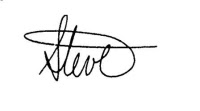
Steve Geppi
Chairman, President & CEO
Geppi Family Enterprises
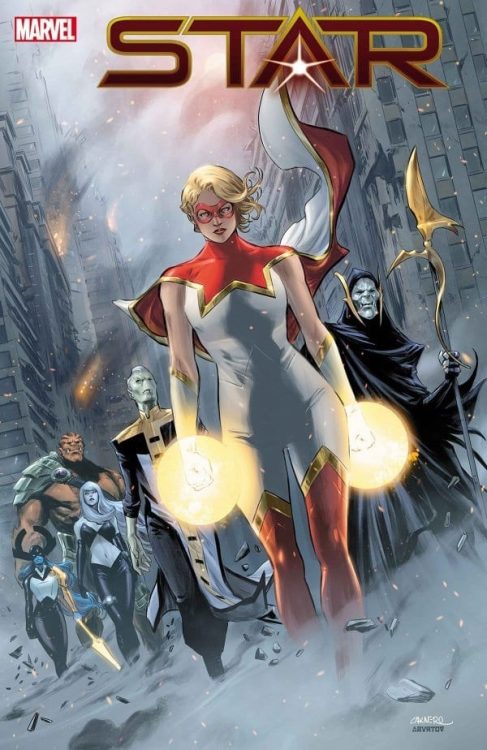
Ripley Ryan is no longer playing around on this cover of Star #5.
STAR #5, out this Wednesday from Marvel Comics, concludes the tale of Ripley Ryan – for now. The reporter-turned-villain is tired of having her narrative controlled, so she is taking things into her own hands.
Ripley Ryan is no longer playing around on this cover of Star #5.
***SPOILER WARNING***
It has been a wild ride. Fans of Captain Marvel first saw Ripley as a young reporter, one who worked for a small magazine and seemed happy to do her job. Then a villain entered her life, and thus Star was born. While it wasn’t quite that simple, fans still witnessed the entire progression over the course of just a couple of arcs.
The series concludes with Star #5 – yet it’s clear that her story is far from over. Even the ending of the issue discuses this making it obvious that Star will be making cameos in other Marvel issues. So be sure to keep your eye open for her in the near future!
The Writing
The conclusion to this series is every bit as entertaining and dramatic as the first four issues of the series. Kelly Thompson demands the reader’s attention in Star #5, as Star struggles to gain control of her abilities (granted to her by the bond she has with the Reality Stone).
That isn’t the only thing Star has struggled with over the course of the series. She’s suffering from PTSD, courtesy of her battle against Captain Marvel, she’s a victim turned aggressor, yet she can’t let go of the pain.
All of this is directly discussed within these pages, the duality of Star’s nature. It’s refreshingly open and honest while having a healthy dash of hope (thanks to Scarlet Witch for that). There’s something so human about that, even while seeing it pushed to the extreme.
Don’t worry, there’s also plenty of fighting to be found. As well as several hints for what is to come in the greater Marvel Universe. That alone makes this an issue you’re not going to want to skip out on.
No matter how you look at it, it’s going to be fascinating to see where Star ends up next. There’s no doubt that she’s going to find a way to influence the events around her. She would, even without access to the Reality Stone. After all, she’s come into her own over the course of this miniseries.
The Artwork
Star #5 had some brilliant artwork to backup all of that storytelling. Javier Pina and Filipe Andrade were the lead artists, working alongside Jesus Aburtov for colors, and VC’s Clayton Cowles for lettering.
The fight scenes are compelling. So much so that they’ll leave readers wishing for more. A promise that feels like it’ll be kept in future appearances of Star. Meanwhile, the emotions elicited via the artwork cannot be ignored. Star has a backstory filled with pain, and that pain radiates off the pages.
The colors felt so alive and vibrant. Star stands out on the pages, especially in contrast to those opposing her. There’s some irony to her color palette, but it actually works really nicely for her. It also ties into the conflict of her character.
One lovely decision about the color pallet – it was intentionally changed depending on the timeline. Any time a flashback occurred (and there were a couple of those moments) the colors became more muted. A quick and immediate way of making that transition clear.
The lettering is subtle, yet also effective in this issue. The careful placement of thoughts, text, and other text elements was exactly what Star’s narrative needed. There’s no clutter, yet there’s no avoiding her either.
All of these elements worked together to create something bold and perfect for Star’s determination and plight. It suited the character perfectly, from her weakest moments to her strongest.
In Conclusion
Star #5 is a conclusion that lives up to promises made to the fans. It’s consuming, spectacular, and will leave fans wanting more. Which is fortunate, because Star’s tale is not done. She is not the type of character to give up and walk away. Not now.
This issue is also going to prove to be relevant to the rest of the Marvel universe in some way as well. Placing any bets on what shes’ going to do next?
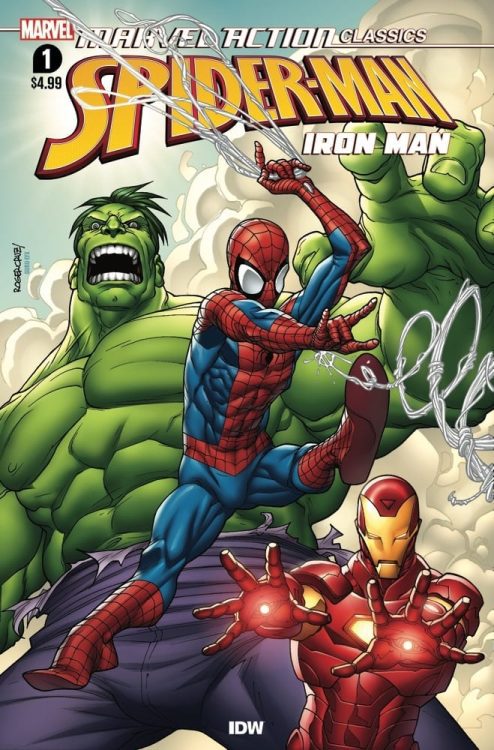
Iron Man, Hulk, and Spider-Man all play a role in Marvel Action Classics Avengers #1.
MARVEL ACTION CLASSICS: AVENGERS #1, available now from IDW is about to bring two entertaining and comical stories to the fans. Get ready for chaos and laughter, and just a few quirks along the way.
Iron Man, Hulk, and Spider-Man all play a role in Marvel Action Classics Avengers #1.
***SPOILER WARNING***
Marvel Action Classics: Avengers #1 is actually a reprinting of two different issues, put together into a nice collection. Marvel Adventures Super Heroes #1 (from 2008) and Marvel Adventures Superheroes #4.
Both issues involve some of our favorite Avengers heroes, mainly Hulk, Spider-Man, and of course, Iron Man. These adventures are honestly perfect for younger fans, as well as really any fan just looking for an excuse to laugh for a bit.
Best of Show
The first story in Marvel Action Classics: Avengers #1 is titled ‘Best of Show’, and it includes a guest appearance from an occasional Avenger. Hercules. While Hercules does make an appearance, most of the attention is focused on others from his mythos (think of the fluffy options).
What follows is a significant amount of insanity and a lot of entertainment. This is a lighthearted event, one perfect for animal lovers as well as Marvel loves. No worries: no puppies were harmed in the making of this issue.
Written by Paul Tobin, this story knows better than to take itself too seriously. Not only that, but it has a bit of fun with mythology humor and the like. Those jokes may go over the heads of any kids reading, but adults will certainly enjoy that extra level of entertainment.
Alvin Lee (pencils), Terry Pallot (Inks), Emily Warren (colors), and Nate Piekos (letters) were all involved for the artwork for this particular issue, and you can tell that they had a lot of fun with it. After all, how often do you get to showcase Hulk romping around with multiple headed dogs?
The images are bright, using bold colors as often as possible. Think class superhero color palette, and you’ve got a solid idea of what will be found here. The characters are expressive, yet intentionally pushed to an exaggerated level. All for the sake of fun! Which these heroes had a bit of (well, Hulk did, at least).
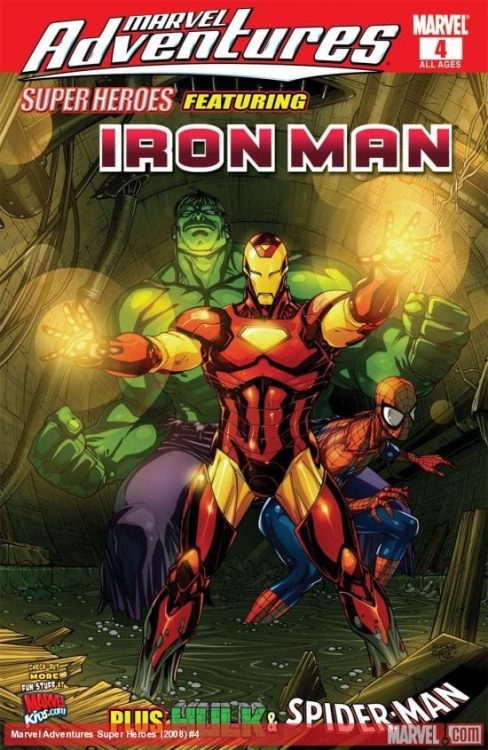
The issue also includes a story from Marvel Adventures Super Heroes Featuring Iron Man #4.
Klaw’s Good Ol’ Fashioned Country Revival
Next up in Marvel Action Classics: Avengers #1 is ‘Klaw’s Good Ol’ Fashioned Country Revival’ which is every bit as chaotic and quirky as you might expect, given that title. Yes, it does bring Klaw back to the forefront, and yes, it does have a country theme.
It turns out that sometimes villains just get sick of being beaten so often, so they give up and try something new. This whole plot actually ties in quite humorously with the joke found withing Avengers: Age of Ultron. You know, the whole joke about Klaw having a mixtape? Only, it gets a lot weirder.
On the bright side, it also discusses things like unintentional bias, giving people a chance, and jealously. All of which makes for a great lesson, for younger and older audiences alike. And it’s all wrapped up in a hilarious bow. Talk about a win-win.
Paul Tobin is the mind behind the script, so give them all the credit for the jokes and insanity that ensued. Alvin Lee (pencils), Terry Pallot (inks), Val Staples (colors), and Nate Piekos (letters) all put their heads together for the artistic side of things, and once again a lot of fun was had here.
The scenes are bold, larger than life (well, Hulk is always larger than life), and full of small details to catch your eye. Klaw and his crew look drastically different, but for good reasons. Meanwhile, the heroes are all in their iconic outfits and colors (something that is remarked upon).
The colors are once again bold and bright, making eye-candy for anybody looking for something vibrant and fun. Even the backdrops do their best to stay away from duller colors. Though the characters stand out the most, with their heavy use of primary colors.
All put together, that makes for a quick and entertaining read. One that will make you laugh – either out of amusement or at the absurdity of it all. Regardless of the reason, it will bring a smile (or an eye-roll) to your face.
Conclusion
Marvel Action Classics: Avengers #1 is such an offbeat and funny read, it almost feels like it came out of nowhere. It pulled in fan-favorites from the Avengers and gave them a chance to have a bit of fun together.
This issue is not one to read if you’re looking for something serious. But if you’re looking for something to brighten your mood? Give it a go, it’ll be worth it.
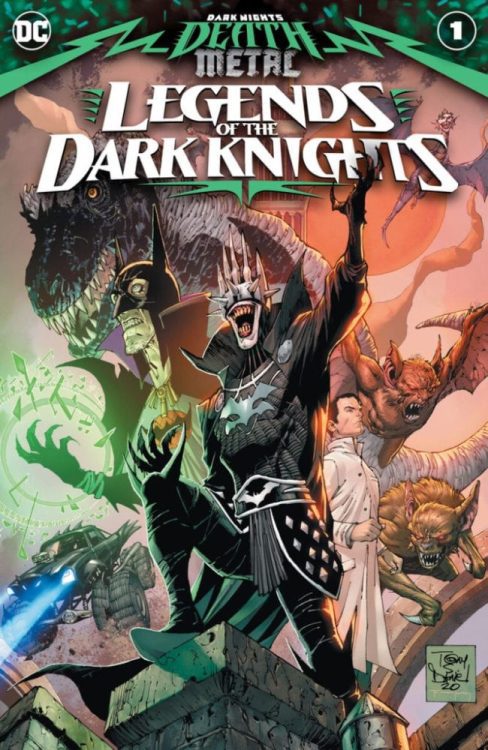
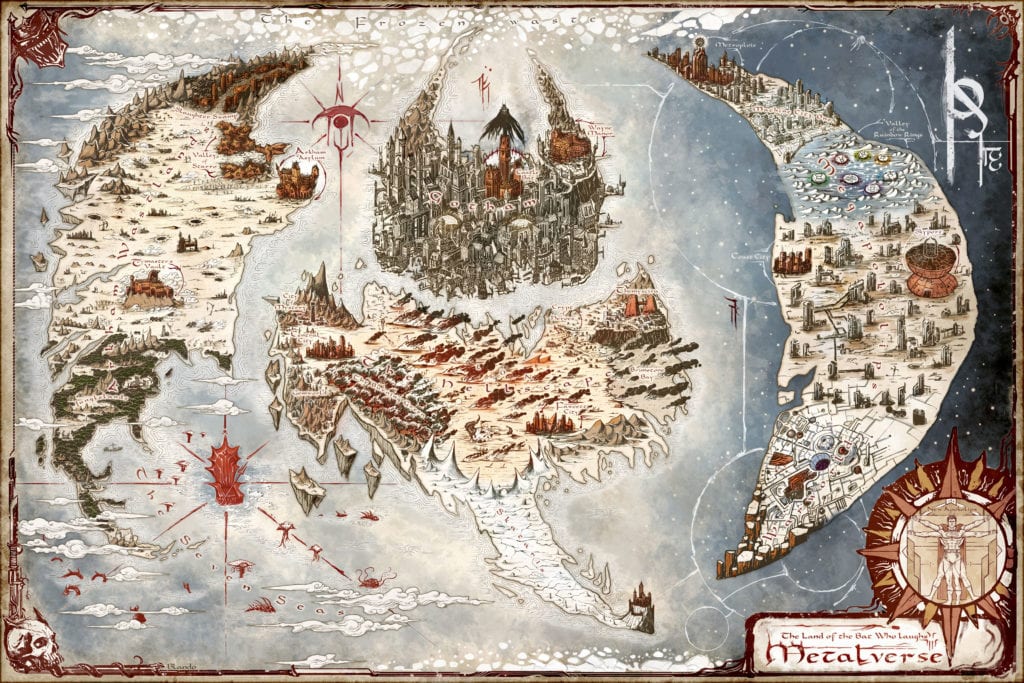
The Dark Nights: Death Metal hits keep coming from DC Comics. The publisher has released a new map (by artist Jared Blando) of the “Metalverse,” which ties in with the upcoming Death Metal Guidebook. How does this world differ from that of the regular DC Universe? Look for the clues and find out.
Check out the lay of the land below. You can also click over to the DC blog for a zoomable version.
Ahead of Dark Nights: Death Metal Guidebook, Explore the Metalverse!
Earth is turned upside down, shrouded in a realm of darkness after the Justice League’s defeat by the cosmic goddess Perpetua. Now the Batman Who Laughs and his army of Dark Knights rule the planet, wreaking havoc on humanity and raining destruction on the world.
Hover over the map of the Metalverse below to discover how the Batman Who Laughs has reshaped our world.
Corey Wallace is a former engineering student turned film and television composer whose work fills the sonic space in works that include NBC’s Siberia (now streaming on Tubi), the 2019 horror film Artik and award-winning animated shorts such as The Wishgranter and Dust Buddies to name a few. He also contributed to projects such as Blumhouse’s The First Purge and Marvel’s Agents of S.H.I.E.LD.
Artik made its world premiere at the Popcorn Frights in South Florida. It has since gone on to great success in the cinematic world. The film centers on a comic book obsessed serial killer who teaches his son how to get away with a series of brutal murders. However, things may unravel when the boy befriends a mysterious man.
PopAxiom took some time to speak with Corey about jazz, going from engineering to music-making, and the process of creating the sonic palette for Artik.
Trumpet & Jazz
Corey’s first “… musical step …” began with the trumpet. “I was playing the trumpet in a band … a lot of people start on piano, but I didn’t take piano lessons until college because it was a requirement …”
Corey, the student did well overall across the gamut of subjects but with minimal motivation. However, when it came to music, Corey says he “… became a nerd. I studied all the time and practiced all the time because I was fascinated by music theory and composition.”
In high school, Corey “… joined jazz combos … They allowed for members to make arrangements and create original music.”
Corey credits this time as a vital training ground for writing music. “On the technical side, writing jazz music is more straightforward than writing for symphonic orchestra. Essentially, you’re just writing some melody and chord changes and then letting the band fill in everything. That’s different than writing for a big band arrangement where you’re composing the notes for everyone to play.”
The freedom and experimentation of jazz were “… a great way to start writing music. That lead to writing more sophisticated stuff for jazz.”
No Berklee For You
For Corey, his love for creating music was undeniable. “I wanted to go to Berklee College of Music in Boston and study jazz performance. That was one of my dreams.”
However, the tragic truth comes to light. “But I was discouraged. I hate to put this stain on my parents’ record. They’ve always supported me. But this one time I came to them and said ‘I want to be a gigging jazz trumpet player,’ and they said it’s probably a better idea to go to school and get a degree and you can always make music on the side.”
Corey’s road of life steered toward another educational institution. “I ended up going to the University of Wisconsin … studying industrial engineering.”
Music Vs. Engineering
Not to be denied, Corey used a little advantage to satiate his music-creating cravings. Corey accrued enough credits to graduate sooner from the engineering program. Instead, he joined the school’s jazz band. “I would spend about a quarter of my time during the first semester working on music in addition to engineering.”
By his second semester, Corey was “… spending half my time on this music elective. At some point, it clicked. I’m spending so much time and energy on music because that’s what I love to do.”
By the end of his sophomore year, Corey decided to be a “… composition student full-time. By then it was too late for me to apply to the music school.”
Corey joined a study abroad program and ended up in “… Australia.” The journey kept him creating music, but he had to “… talk his way in …” since he arrived during their second semester. Corey had “… the same problem when I got back. I was accepted into the school, but I had already missed the first semester.”
Technological Leaps
Twenty-first-century technology includes digital libraries of sounds that make it generally easy to start composing. To emerging composers, he says, “You want to try and get your sound and do what you specifically want to do instead of what these pre-determined sounds are having you do.”
For ten years, Corey’s been making his own sounds. “It starts with recording things or taking old recordings and manipulating them in different ways using digital and analog techniques to turn something into something else. All of a sudden, you have a brand new sound to use. It’s a time-intensive project.”
Corey points to a scoring legend as an example. “If you look at a Hans Zimmer’s score, he’ll have like ten people in the music department in sample development. It’s a tedious process, but when you’re done, you have this palette of sounds.”
Corey jokes, “Now I have to score the movie.”
Imaginary Films
Creating sounds for a sonic palette doesn’t begin when Corey’s signed on to a new project. The composer devotes days off to recording and experimenting. “That’s the best way to do it. There’s a limited time when you’re on a movie. That’s not the time to start staring out the window. You have to jump right in. Do your homework and kind of score for imaginary films.”
Corey’s process includes a “… sounds diary. I date it, and a description of how I made the sound, what plug-ins I used or hardware I was using. It’s a technique-based diary. I put keywords and what kind of projects it might be good for so that it’s searchable. I can look for inspiration in there.”
About Artik
Corey’s connection to Artik came via a simple referral. “Artik came about because of The First Purge. [Director] Tom Botchii reached out to Kevin Lax [composer, The First Purge], who was unavailable and recommended me.”
The work for Artik was already underway before Corey. “Tom had a specific musical vision. When we got to talking, he was already working on the score with somebody else. Tom is a guitar player and played in experimental bands. He wanted this de-tuned, broken sound and wasn’t getting that. So that was one of our first conversations and how I would accomplish that.”
Corey was happy to let Tom know, “I’ve been working on these kinds of sounds for at least a decade. It was really exciting to do this.”
Typically discussions between composer and director include movie references. For Artik, the director referenced a specific aspect of a movie. “Tom referenced a trailer to the Joaquin Phoenix movie You Were Never Really Here. There’s a big hit in the middle of the trailer, and then the rest of the trailer has these dissonant sounds and big hits.”
Corey explains, “Tom wanted the movie and the music to feel like an 80-minute trailer. The first scene after the main titles is like a minute long and has like 32 cuts, so it hits in that minute. It’s emblematic of what he wanted. These dirty hits constantly.”
Creating the palette consisted of “… little plunks to giant metallic clanks. I just started forming this palette of hits.”
Wrapping Up
You won’t find many modern film composers who don’t love John Williams, and Corey is no different. He connects his early love for jazz to the legendary composer’s brilliance. “Jazz is essential to John Williams and the way he writes.”
In the hall of fame with Williams, Corey lists “Alan Silvestri, James Horner, Jerry Goldsmith, and Hans Zimmer. What they all have in common is this big, orchestral, blockbuster sound.”
Another prominent figure forming Corey’s creative DNA is Marco Beltrami. “When he was doing Scream, The Faculty, I, Robot, and Hellboy … that was impactful on me. I hadn’t heard scores like that before. It aligned with the kind of music I was writing in college. I wondered if there was a place for me in scoring with that sort of sound and I heard Marco and thought ‘Yes, there’s a place for me.’”
What movie would Corey love to score the remake? “NeverEnding Story. That was my favorite movie growing up. That music is so 80s, and I think you can do something great.”
Artik is available on-demand, so what’s next for Corey? “I’m pre-scoring Super-Cell from Jamie Winterstern, who is a photographer and an avid storm chaser. He’s making a movie based on that world.” We crack a few jokes about Twister and Sharknado. Corey asserts, “This ain’t your daddy’s tornado movie.”
Is Artik on your watch list?
Thanks to Corey Wallace and Impact24 PR
for making this interview possible.
Want to read more interviews like this? CLICK HERE.
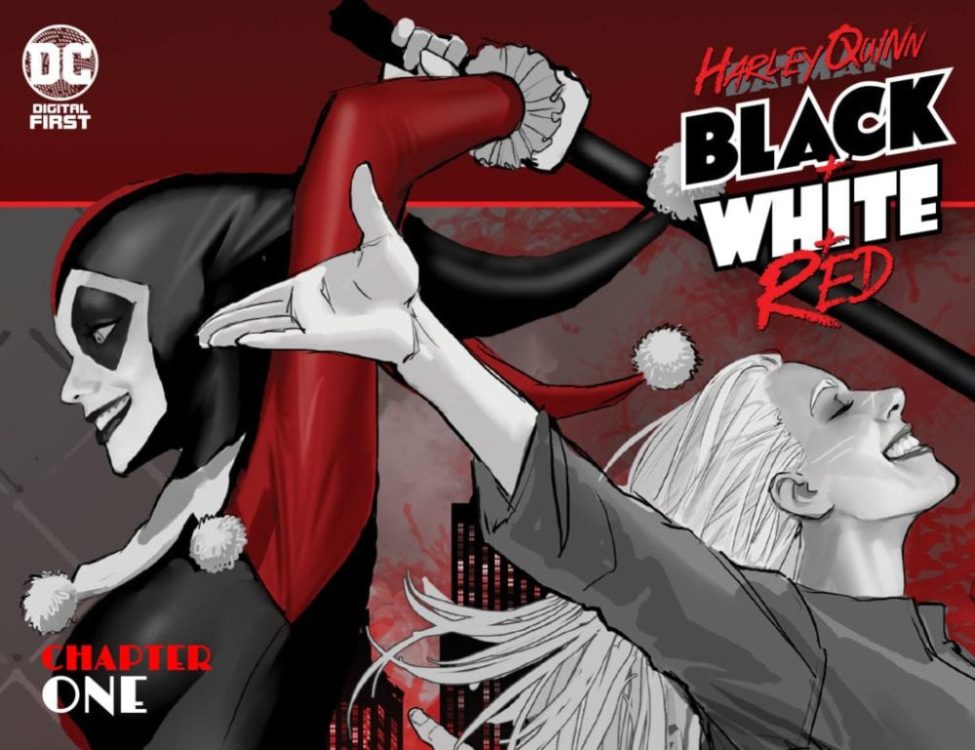
Harley Quinn: Black + White + Red is a new DC digital-first series that features the famous antihero depicted using only black, white, and red. The series will feature an all-star lineup of creator talent, and the first issue is sure to impress readers and leave them wanting more.
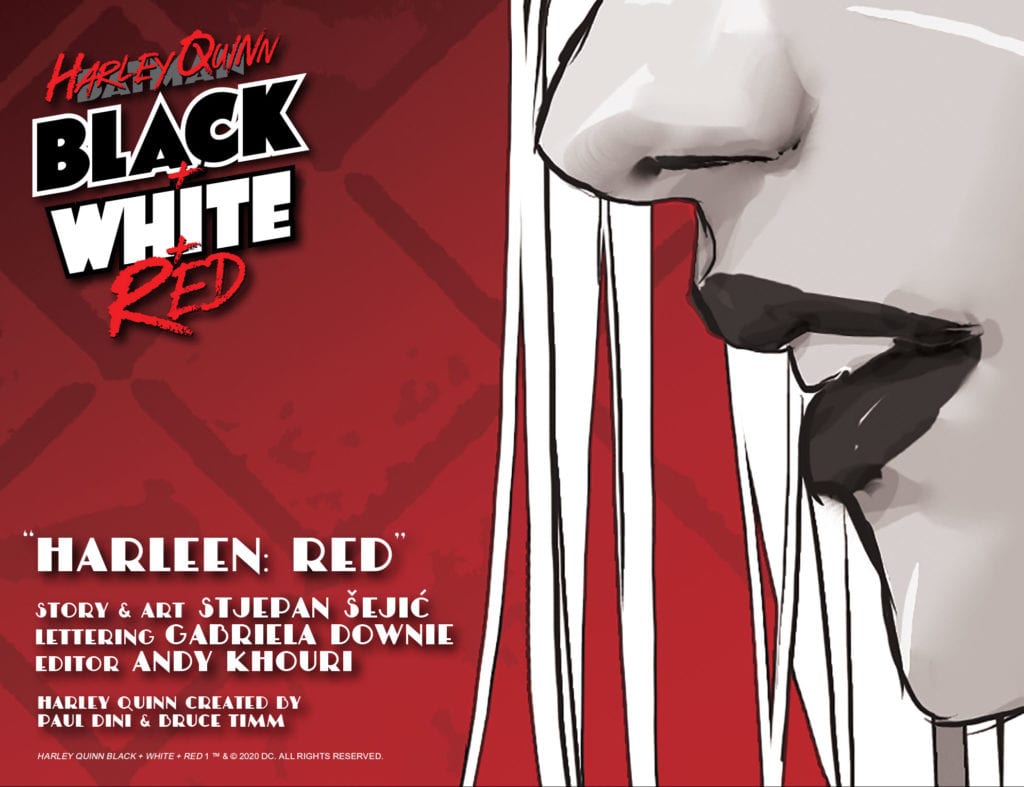
Written and illustrated by Stjepan Šejić, “Harleen: Red” is an astounding beginning to Harley Quinn: Black + White + Red, and is a great read. Anyone familiar with Harley Quinn as a character is sure to enjoy this story, and fans of Šejić’s Harleen limited series will love seeing that story continued.
“Harleen: Red” Story
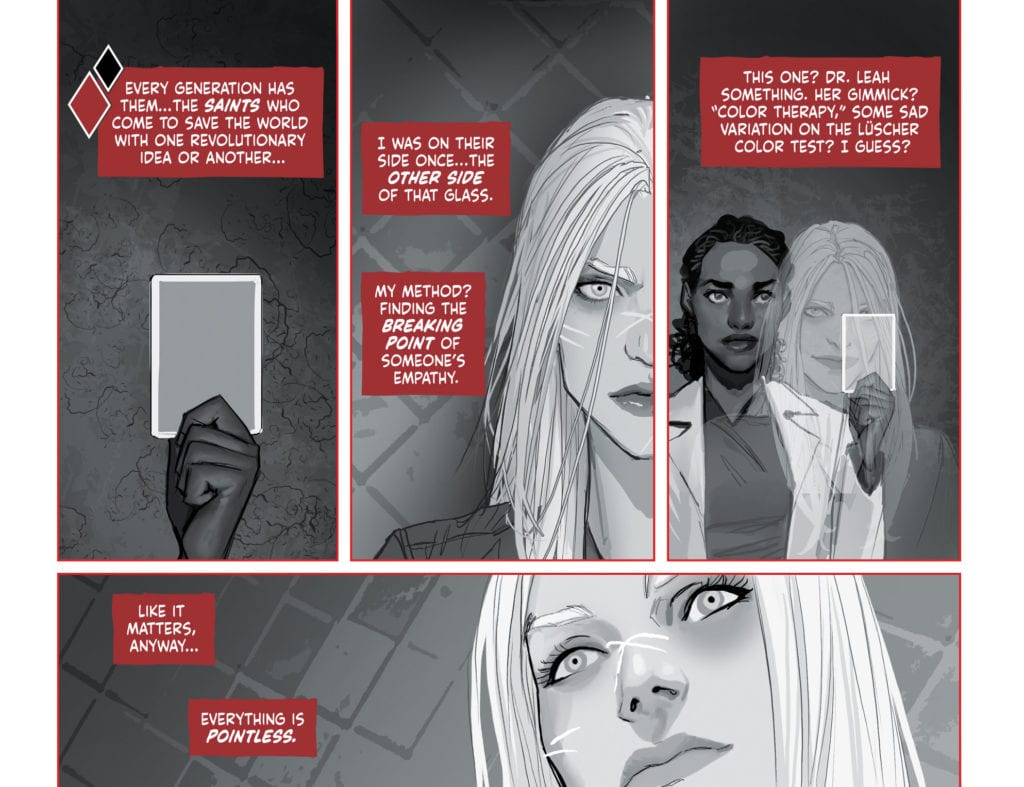
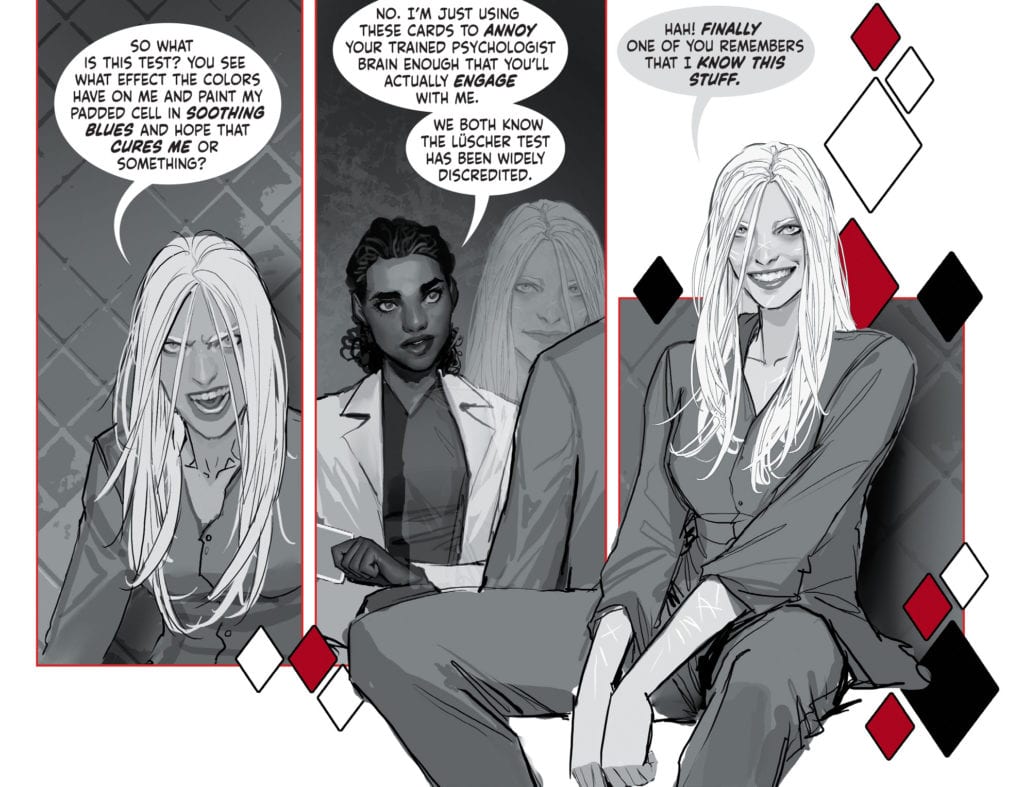
The first chapter of this new series is a continuation of the DC Black Label limited series Harleen, which depicted Harley Quinn’s descent into madness. “Harleen: Red” begins with Harley imprisoned in Arkham Asylum, running tests with a psychiatrist. This psychiatrist is performing a test involving colors, which we later discover is for a specific purpose. Harley continually calls out for the color “red” from her room, and no employee at Arkham understands the significance of this.
The story of “Harleen: Red” quickly engages readers from early on, and leaves them wondering what the significance of the color red could be. When this is finally revealed, the ending neatly wraps up the story and leaves the reader satisfied.
Art
The art in “Harleen: Red” is astonishing. Stjepan Šejić makes all of his characters have clear expressions, and his realistic art style is always a pleasure to look at. Šejić also frequently has characters going outside of panel borders, which can show how detached these characters are to the scenes around them, as well as provide visual diversity so that the pages look more appealing.
The color also plays a very important role in this story, and will most likely be heavily utilized in future stories in the series due to the limited color palette. Many techniques can be employed that are specific to the black and white medium, but by adding red Harley Quinn: Black + White + Red completely alters how stories can be told. Black and white causes the page to look completely unsaturated, so when red is used, it clearly stands out on the page. This is used effectively in “Harleen: Red” through the contrast of the cell at Arkham Asylum and Harley’s flashbacks to her times with the Joker. Red is used significantly less when focusing on Arkham, indicating that these scenes are more bland and insignificant to Harley.
In “Harleen: Red,” the meaning of the color red to Harley is discussed and attributed to things such as the color she and the Joker painted the town on their nights together. The color is also used as the border for many panels, causing them to pop out towards the reader significantly more than they would have. This is used to stress an importance on these panels, as well as show a rise in tension in various scenes.
Conclusion
Stjepan Šejić provides us with a riveting beginning to this new series. The use of the color red to make certain panels stand out is incredibly effective, and the story is precise and has a satisfying ending. “Harleen: Red” promises great things for Harley Quinn: Black + White + Red, and if the quality continues, the series will be one to remember.
ENGINEWARD #1, available on July 15th from Vault Comics, introduces a post-apocalyptic society where new gods rule over an increasingly barren world, one whose citizens struggle to survive against giant beasts, water shortages, and an uncertain future. It’s the latest sci-fi/fantasy series from George Mann and Joe Eisma.
Cover
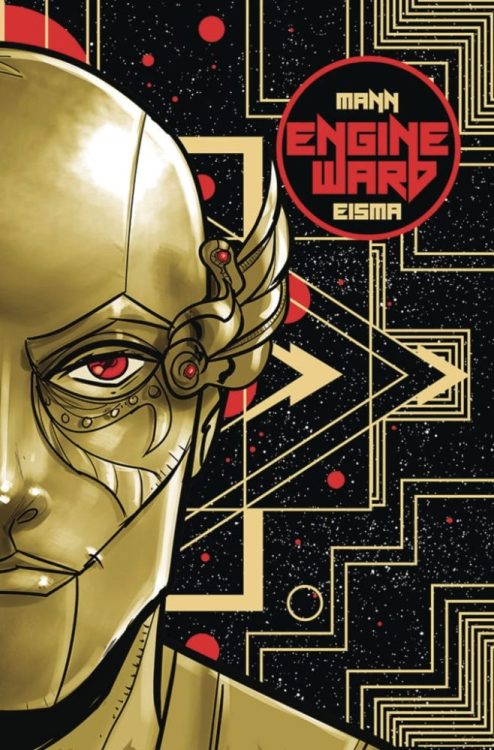
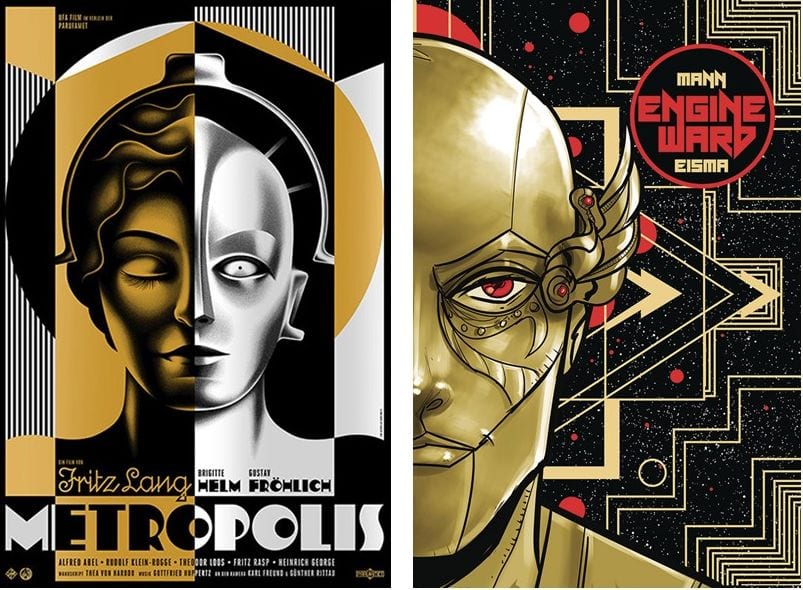
Joe Eisma’s cover art is both beautiful and familiar. It’s a portrait of Cancer, one of the new gods from the inaugural issue, but the background style and asymmetry of the shot hearken back to the art of Fritz Lang’s Metropolis (1927). Eisma’s art deco style in the background, coupled with the metallic face, seems at least inspired by the film’s poster. It will be interesting to see if the similarities are coincidental or if there’s a sly hint to the story’s future plot.
Writing
ENGINEWARD #1 is not a comic you read once, understand it perfectly, and then move on to something else. It takes multiple readings to get what’s going on with George Mann’s story. Mann’s narration makes references to ancient wars and civilizations that may or may not have existed in real life. To be frank, it’s not clear if ENGINEWARD takes place on Earth at all, future, or past.
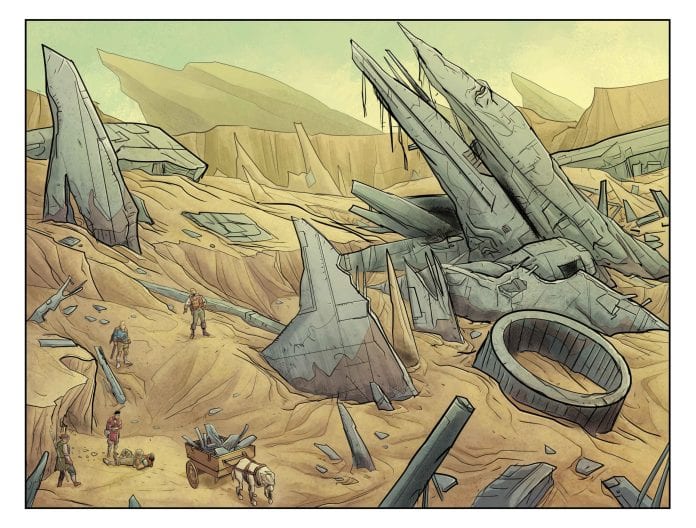
Without spoiling anything, denizens of a dying world are living under the (possibly) oppressive rule of zodiac-inspired gods. Water and resources are in short supply, and the population has to scavenge to survive. Mann’s creation feels a lot like The Road Warrior (1981) world wrapped in Pseudo-Greek mythology, so just like the cover art, it’s both original and familiar.
That wholly original mashup is why it takes multiple readings to get through. Mann packs in so many little nuggets of lore from disparate cultures, I found myself performing various Google searches to figure out the references. It may be unintentional, but the first issue was a solid read that turned into a fun Easter Egg hunt.
Pencils/Inks
Joe Eisma’s art is clean and bright. A story about future versions of zodiac gods needs to have a fresh take on the character designs, and it works really well here. When the gods are assembled around their council table, you can instantly tell which god represents their sign with ease. Eisma especially impresses by using cybernetic accessories to distinguish esoteric gods such as Gemini without resorting to shortcuts like tattoos or two-tone clothing.
It’s only the first issue, so it’s not quite clear how the characters align themselves in the context of the overall story, but there’s definitely an element of class struggle: the gods rule and the lowly mortals struggle. Eisma’s art plays up this dichotomy of class separation in the settings between the different groups. Joss’ town is as dry, dusty, and ramshackle as any shantytown you could possibly imagine. The buildings look held together with scraps of metal and good intentions.
In perfect contrast, the gods’ headquarters is gleaming and architecturally graceful, a reflection of the gods’ aristocracy and insistence on pristine perfection. Eisma’s rendering of two extreme settings provides another layer of conflict between the two groups. By the art of the settings alone, you can clearly see where the antagonists and protagonists are coming from culturally and how their differences set up the conflict to come. In many ways, the art aesthetically reminds me of a SyFy television series called Defiance. Recommend you check out that show if you get a chance.
Coloring
Michael Garland’s colors are bright and light, casting the entire book in a pall of unrelenting sunlight. The palette choice matches well with a world that’s parched and baking into oblivion. Garland’s choice of muted pallet also works to add to the dry atmosphere of a world suffering from water shortages. That said, it would work a little better if the colors weren’t quite so clean. This is a dry and dusty world, so you would expect to see the characters look a little more dirty and worn.
Lettering
Hassan Otsmane-Elhaou’s lettering is well-paced for a story that mostly hinges on exposition. As already pointed out, there’s plenty of lore nuggets peppered throughout the story, so it would be easy to miss a crucial point if the lettering didn’t emphasize the right word or if word bubbles were overstuffed into a wall of text. Otsmane-Elhaou’s lettering also makes good use of alternate font colors within the same word balloon (something you rarely see) to indicate changes in voice tone. Nice work by the Otsmane-Elhaou here.
Conclusion
ENGINEWARD #1, available on July 15th from Vault Comics, is a healthy blend of future dystopia with ancient myth. The story is both new and loaded with deep cuts that will keep you thinking long after you finish reading. Check it out.
Author’s Note: Local Comic Shops (LCS) are going through a tough time right now with the pandemic outbreak of COVID-19. Comics fans of every flavor that care about his or her LCS should try to do what they can. So, here’s my part:
If you’re in Northern Delaware, South East Pennsylvania, or Southern New Jersey area, please take a moment to visit Captain Blue Hen Comics in Newark, DE. Say ‘hi,’ pick up a book, order a book (they’re on Comichub.com), and let them know you support them.
If you’re nowhere near that area, please find YOUR LCS using Comic Shop Locator and lend your support.
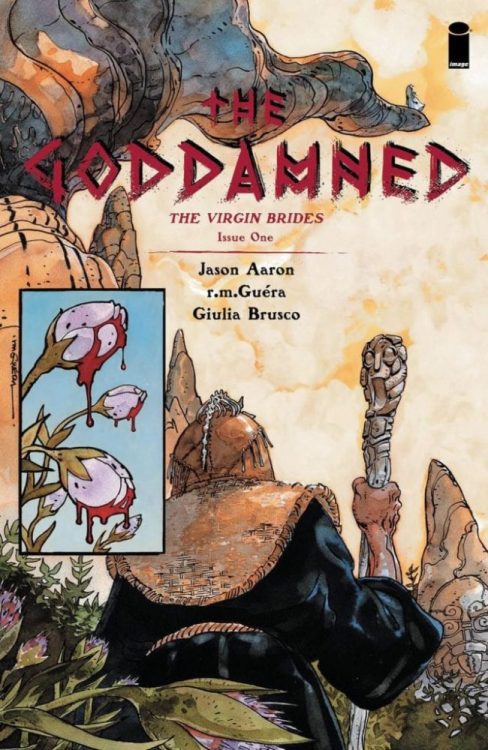
Writer Jason Aaron and artist R.M. Guera return with the sequel to their acclaimed mini-series “The Goddamned” with “The Goddamned: Virgin Brides” #1. Along with colorist Giulia Brusco and letters from Jared Fletcher, this first issue offers every bit of the unflinching brutality of its predecessor – while perhaps starting out a bit smarter. With an intense, gripping narrative and fantastic artwork, “Virgin Brides” #1 is a worthy pickup for both fans of the first series and newcomers.
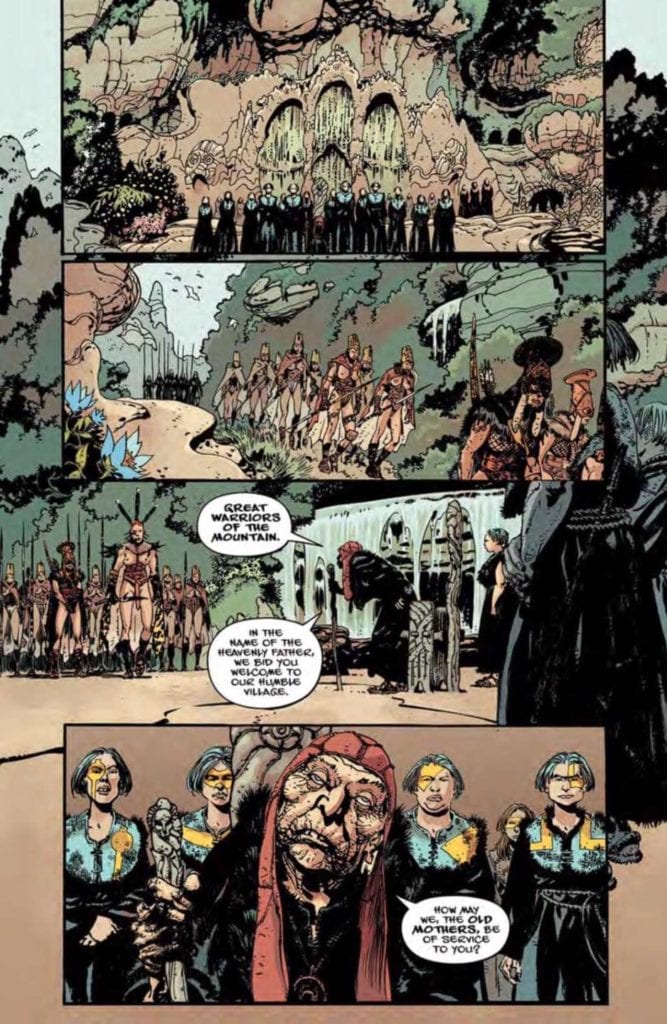
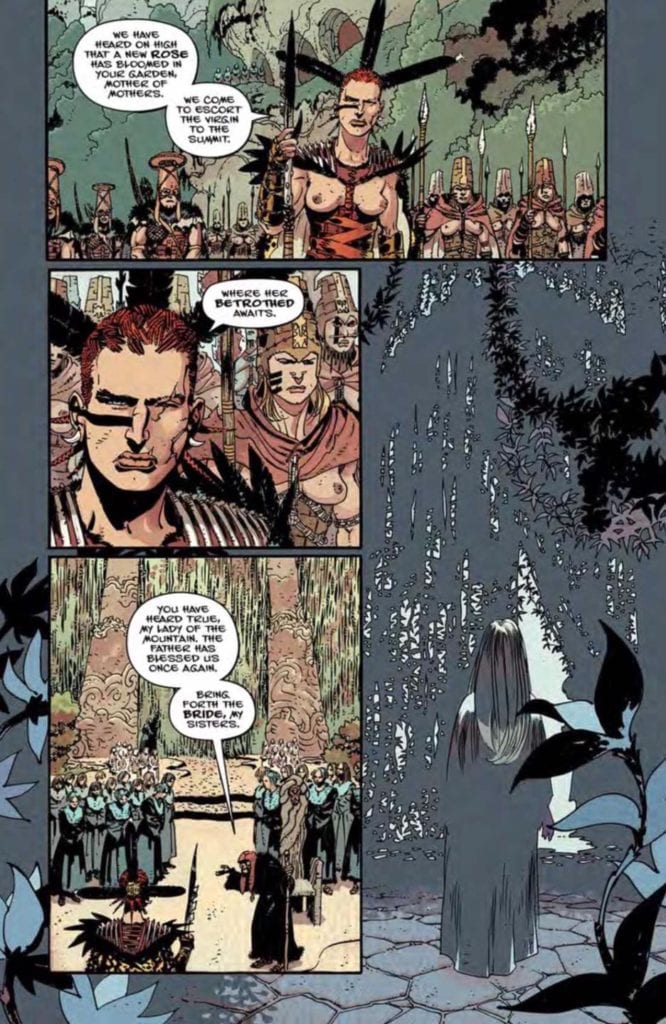
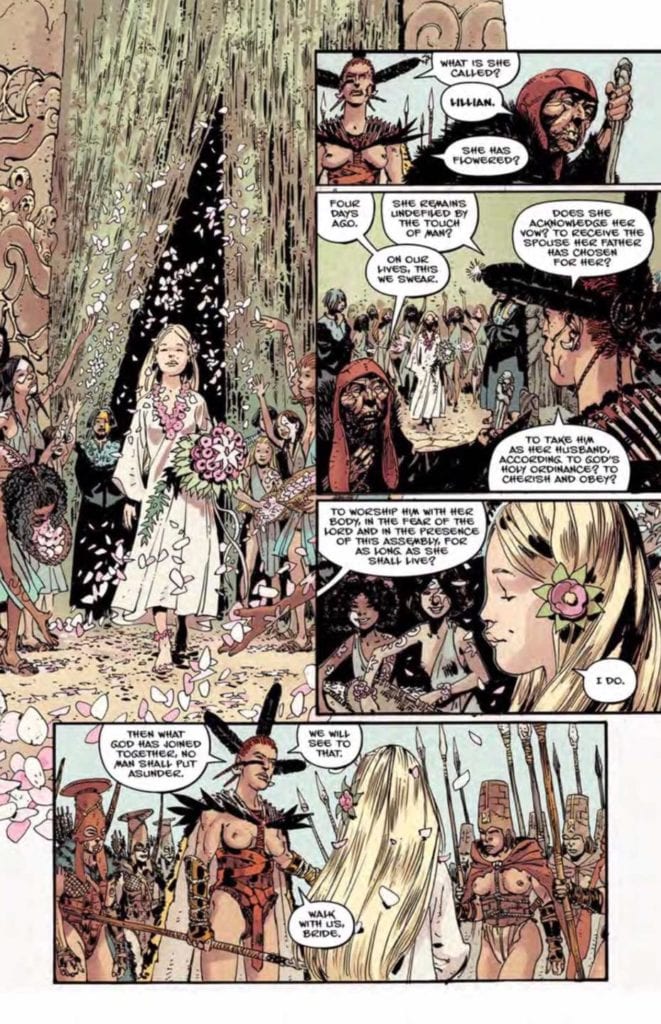
“…the sons of God came in unto the daughters of men. And they bore children to them…”In the time before the Great Flood, the world of man is a place of wanton violence and unbridled depravity. But hidden high atop a mountain, there is a very different sort of world. One without men. Here, the holy sisters at a secret nunnery live in paradise, a new Eden, rearing their flock of orphaned girls to embrace their future as blessed Brides of the Sons of God. But when Sharri and Jael, two girls on the cusp of flowering, uncover what it truly means to become a Bride, they realize there’s only one way to escape the bonds of matrimony: run like hell.
Writing & Plot
Jason Aaron ( Scalped, Thor) mixes a tight narrative voice with rough, stilted dialogue and a suspense-laden plot in “Goddamned: Virgin Brides” #1. The driving mystery surrounding what happens to the young brides at the top of their sacred mountain is handled with deft pacing and foreshadowing. Ev after all of the images of horror in dream sequences and characters quietly speculating, nothing can actually prepare you for what is really happening on that mountain. The overlying narrative voice offers vague but knowing words to amplify the suspense. It is also written in elegant prose as if a god of some kind of offering sage wisdom over the chaos happening on this earth. The character dialogue itself is likely where this comic may lose some people. Much like the original “Goddamned” series, the dialogue is spoken in haphazard phrasing and awkward swearing that can make for a rough reading experience. In Aaron’s defense, this could be a mixture of two things: the first being that the dialogue here is spoken chiefly by frightened preteen girls, and secondly that the dialogue can be seen as a rough translation of whatever language the characters are actually speaking. Remember that this story is pre-flood, so logically English wasn’t around yet. This could be overthinking the script, but it is something to keep in mind. It’s hard not to sympathize with these young girls who have no knowledge of the situation they’re in, and it’s here alongside the suspense that Aaron really hooks the audience. Even if the dialogue style turns you off, every other written aspect fires on all cylinders in this brutal and bloody script.
Art Direction
R.M. Guera‘s prior works with Aaron (“The Goddamned: Before the Flood” and Scalped) have already showcased his immense talent in working with the author. His talents are still on full display here in “The Goddamned: Virgin Brides” #1. His elaborate and immensely detailed pencils excel due to his varied linework. Both the human and environmental detail is crafted by a mixture of thick and thin pen lines, as well as small cuts and dashes to indicate wear and dimension. The vast and intricate landscape art is rife with tiny detail that actually makes the land itself look sinister. No two characters look alike either, with Guera using a vast array of physiques, facial features, outfits, and even hairstyles. His nightmarish creations are nothing to scoff at either, as they are most often grotesque perversions of things the characters – and ourselves, honestly – hold dear. His presentation of the plot’s monstrous twists are executed in slow panel-by-panel reveals that make the absolute most out of the comic’s horror. Guera’s pencils are brought into grimy existence with Giulia Brusco’s muddy color palette. The watercolor-esque tones are given an almost dust-covered aesthetic that matches the rocky and grim setting. No area of color within the linework is just a solid color either, as there’s a subtle variation in the shades that give objects and people dimension. Jared Fletcher’s letters use an unusual jagged font with frequent variation in bolds, italics, and style changes based on context and they are perfect for the dialogue and narration of this unrelenting story.
“The Goddamned: The Virgin Brides” #1 is an unsettling and grotesque start to this sequel-series. Instead of the wanton slaughter of “Before the Flood,” this issue focuses more on horror by way of perverting concepts considered almost sacred to reality. Jason Aaron’s script mixes taut pacing, elegant narrative voice, and gruff dialogue to build this comic’s reading experience. The visual work of artist R.M. Guera, colorist Giulia Brusco, and letterer Jared Fletcher craft this world and its narrative with immense detail and craft a perfect aesthetic for this pre-biblical nightmare story. If you were a fan of the first series or this kind of brutal read is up your alley, be sure to grab a copy from your local comic shop on 7/1!



 Steve Geppi