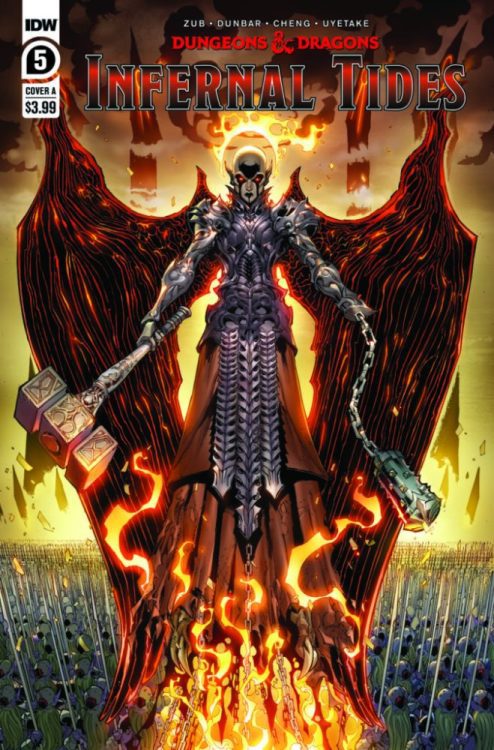
DUNGEONS & DRAGONS: INFERNAL TIDES #5, available in comic book stores on Wednesday, July 12th, concludes Jim Zub’s thrilling tale of paladins and hellfire. Our band of heroes is prepped and ready to take the fight to the minions of Zariel. Can they save Elturel in the midst of the Blood War?
Story
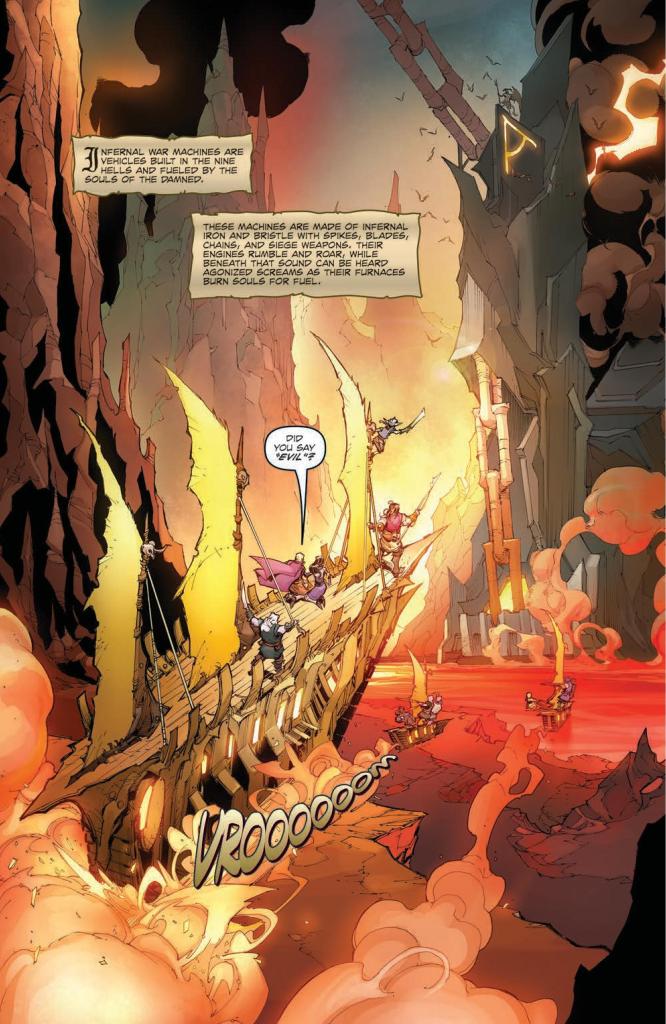
DUNGEONS & DRAGONS: INFERNAL TIDES #5 offers the fiery conclusion readers have been waiting for. The entire party comes together to raid Zariel’s stronghold, destroy the Infernal War Machines, and free the realm from her control.
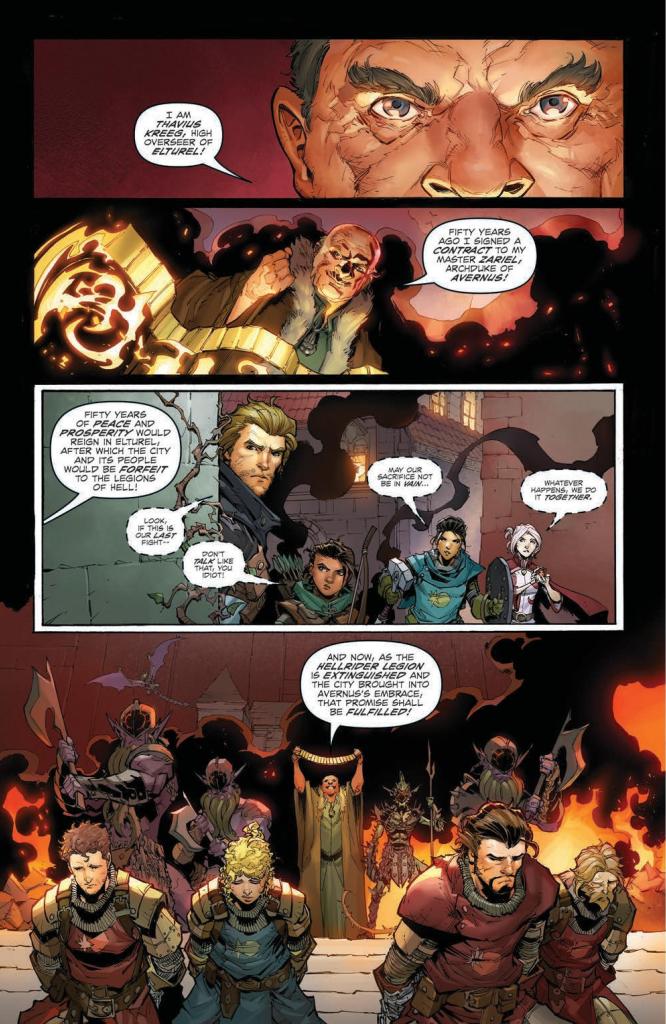
Unfortunately, taking down this imminent threat is more difficult than once though. After a brief scuffle, the band of heroes meet Thavius Kreeg, the High Overseer of Elturel. Rather than restoring order, he’s signed a literal pact with the devil in order to unleash the powers of Hell.
The party finds themselves at the mercy of Kreeg and his golden contract. And though they fight back, all hopes are extinguished when the former righteous Solar, Zariel (now archdevil), makes her appearance. Fortunately, paladin-in-training Aubree is ready to confront the hero-turned-villain. But instead of fighting swords, she plans on employing her words.
Aubree’s heartfelt dialogue with Zariel brings us back to our childhood, reminding us of those times our heroes failed us. Zub’s portrayal of this and other character interactions bring this issue to life.
Artwork
Max Dunbar’s penciling and ink work, Sebastian Cheng’s coloring, and Neil Uyetake’s lettering gave us illustrations that perfectly captured the thrills of this story. The panels depict the party’s unique fighting styles, employing solid red backdrops to help them stand out. We also loved how the lettering set the tone for this issue’s fantasy theme through the use of scroll-like word balloons.
Conclusion
DUNGEONS & DRAGONS: INFERNAL TIDES #5 is the satisfying conclusion we were waiting for. We’re excited to see more Dungeons & Dragons stories from Zub and team.
Were you satisfied with the conclusion to this series? Let us know in the comments below!
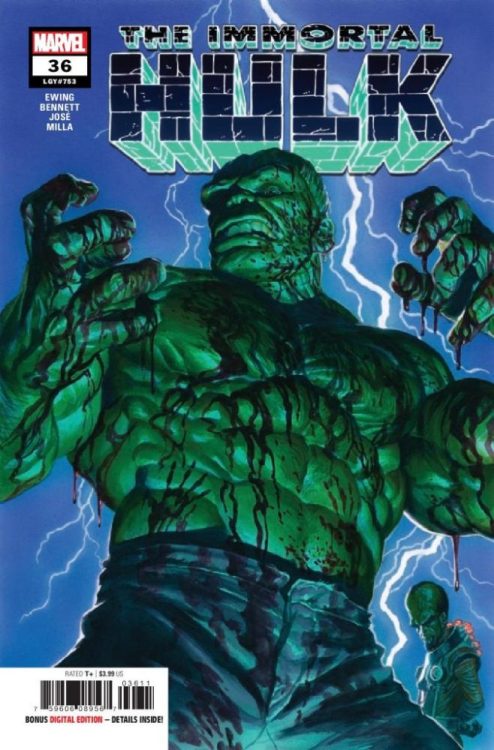
Bathed in blood and a monster once more. The Immortal Hulk #36 from Marvel Comics see’s Al Ewing make the big green hero both a victim and an aggressor. It’s a tale of tragedy and horror with no rest for the wicked or the divine.
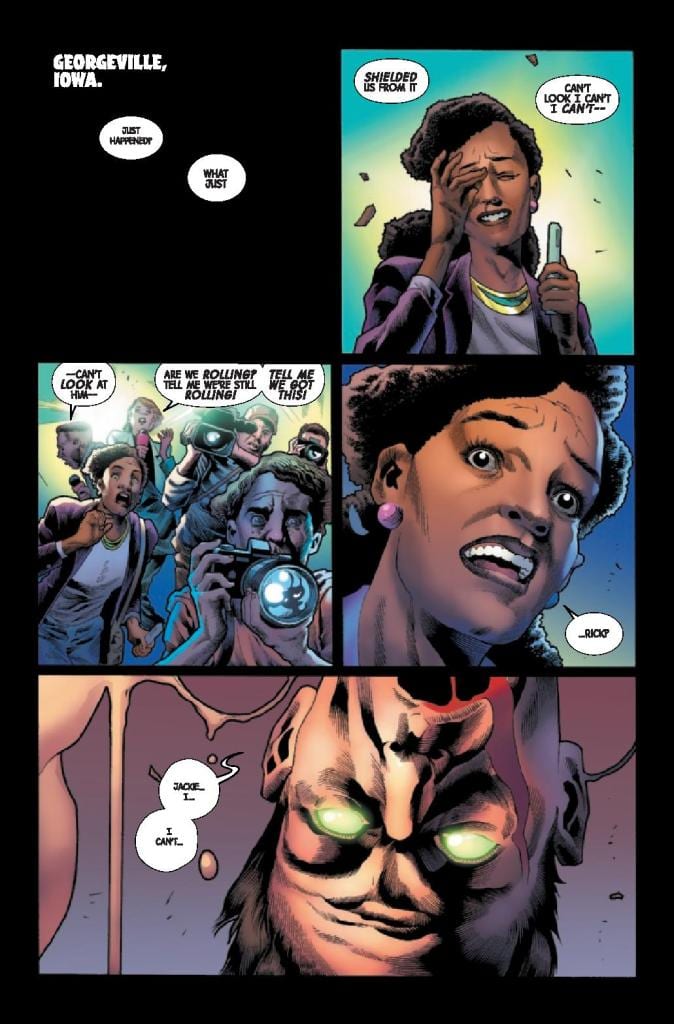
In Georgeville, Iowa Rick, in control of The Leader, forced the Hulk to explode. The massive Gamma Bomb explosion has devastating effects on the locale and a number of the populace. News reported Jackie McGee bares witness to the piles of rubble and bodies just as Gamma Flight enter the scene.
The Immortal Hulk #36 Credit: Marvel Comics
Outbursts and Mutations
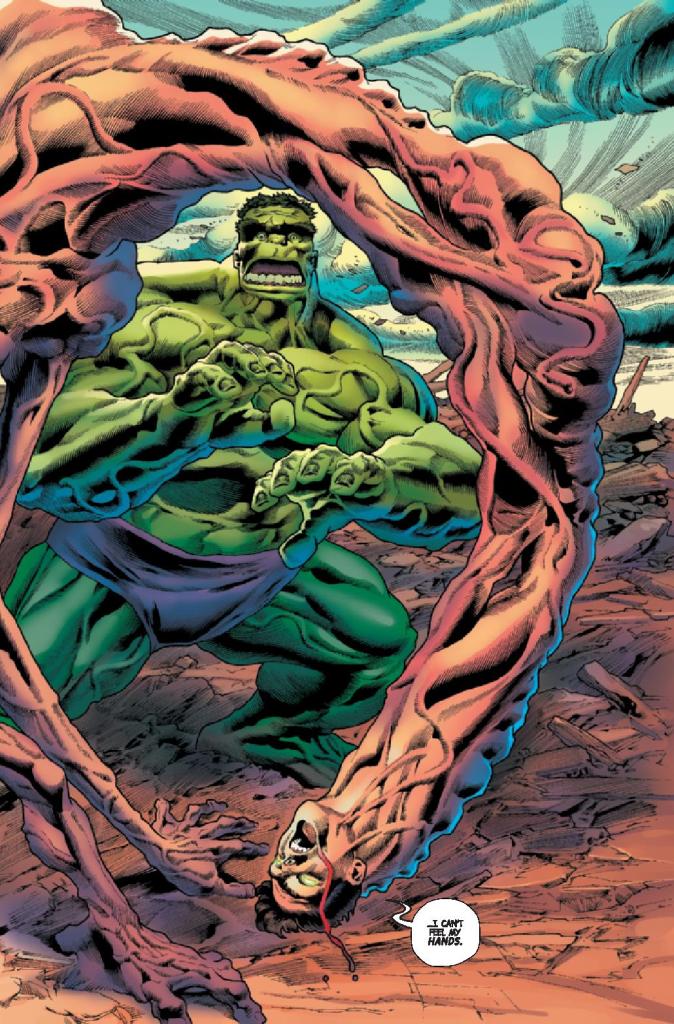
Al Ewing opens this issue with the devastating aftermath of Hulks explosion. The focus, however, is not on the destruction but the warped mutation of Rick. Played as a tragedy, the reactions from the cast to Rick’s deformity is at the heart of this issue. The Hulk, comically drawn by Joe Bennett and Ruy Jose, stares in shock at what he has done to his friend.
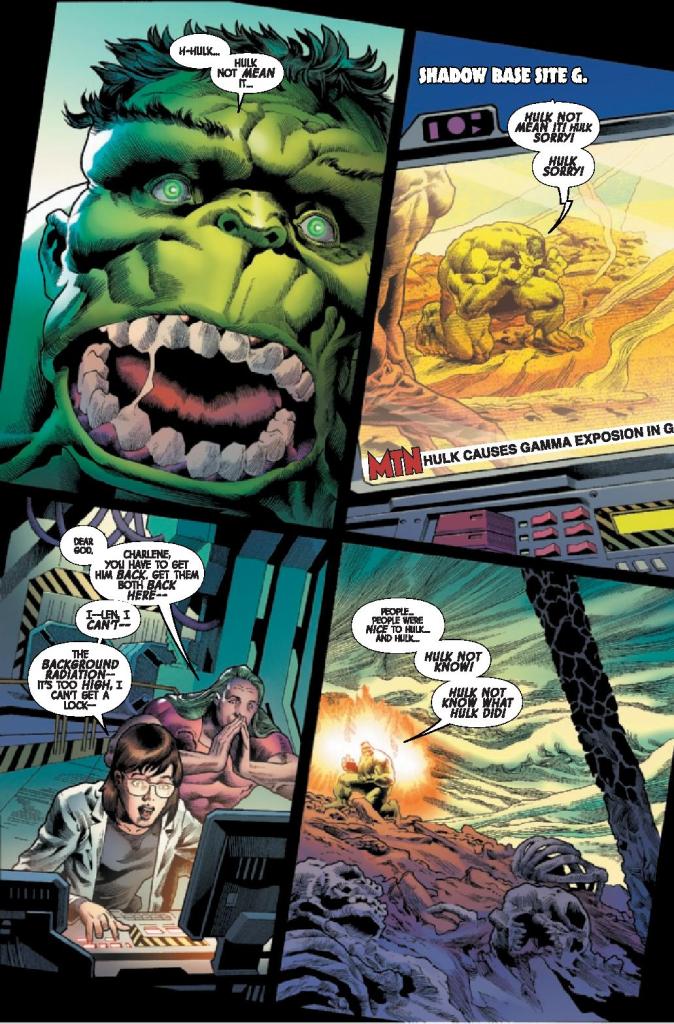
Ewing emphasises Hulks reaction, making it central to the other characters view of the destruction. It is important to know how distraught the Hulk is at this point and how he believes he has failed his friends. It is after all central to not only The Leaders plan but the character of the Hulk. There has always been a battle between Man and Monster, and being a protector makes the Hulk more human. To fail at that is to fail in his life.
Ewing then pours on the trauma by throwing Gamma Flight, with their weapons held high, into the mix. To add more conflict to the situation greatly destabilises the Hulk. But the real beauty of Ewing’s storytelling in this issue is that the Hulk going ballistic is only a diversion from a more disturbing threat emerging elsewhere.
The plot for this issue is fairly standard with the villain manipulating the hero into a situation where he will look like the villain. With the Hulk it adds a little more gravitas as it plays into the core of the character and the cost is greater. When the Hulk begins to lose control it has wider reaching consequences than, for example, Spider-Man losing his cool. Ewing knows this and is able to get that message across in the story.
The Immortal Hulk #36 Credit: Marvel Comics
Representation
For a straight forward story, such as the one in this issue of The Immortal Hulk, the ‘wow’ factor has to come from the art work. It should reach right of the page and slap you around the face. The requirement is dynamic fights and hard hitting emotional scenes. What the reader gets in this issue is, however, lacking.
The Immortal Hulk has become known for its horror elements over the last few years. The first issue of this run was a triumphant return to the horror genre, a fitting place for the Hulk to be. Unfortunately, the artwork in this issue doesn’t capture that vibe.
Joe Bennett’s pencils and Ruy Jose’s inks are highly detailed and capture the emotional aspect of the comic very well, especially in the human characters. The reaction panels with Jackie are superb and the reader really gets a sense of the scene unfolding in Iowa. The other, mutated or super powered, characters are less impressive, at least for a horror story. The Hulk is comical in appearance throughout with over the top facial expressions that make him over-dramatic.
Other than the grotesqueness of Rick’s mutation there is nothing especially horrific about anything in this issue, until the very end. It is enjoyable and there are a few moments that may take you by surprise but not make you scared, not shocked. The visuals are too bright, too run of the mill and standard superhero. That’s not to say the artwork isn’t good; the panel layouts are intriguing, especially with the tilted page frame to give the impression that everything is off kilter; the compositions are impressive and there is real energy in the fight sequences. It just doesn’t have that horror aesthetic required to make this a truly memorable issue.
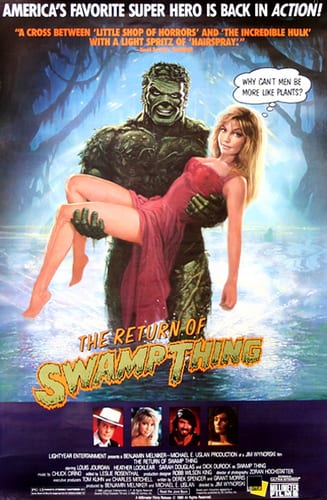
Return of the Swamp Thing Movie Poster
Confused Tone
Colorist Matt Milla gives everything in Iowa an Earthy feel which allows the Hulk to stand out on the page and in the action. There is a clear contrast between the panels featuring the Hulk and those that contain Gamma Flight. It is a competition between red and greens, fighting for dominance on the page.
This provides a satisfying reading experience but it again leans into the contradicting tone of the comic. On the one hand it has a horrific nature but much of this is being lost in almost comedic scenes. It’s like the movie The Return of the Swamp Thing. There is a blend of horror and comedy that just doesn’t mix well. This isn’t the Evil Dead II where you’ll laugh out loud before hiding in terror; it’s more of a puzzle, leaving you wondering what the intent was.
The only element of the comic that matches the mixed tone of the comic is the lettering. Some of the speech is wonderfully merged with the emotional reactions of the characters. Small text within large balloons illustrate moments of thoughtfulness or concern, whereas other balloons can’t contain the speech. Heavy, black letters break the border of the balloon and spill out into the panel, out of control like the character screaming them.
To counter this, a large portion of the text is more confusing with random emphasis on certain words. Trying to extrapolate the meaning of the bold text pulls you out of the comic, disrupting the momentum. It is as if the cast are a mix of seasoned actors and wooden, B-Movie extras.
The Immortal Hulk #36 Credit: Marvel Comics
Conclusion
If you have been reading The Immortal Hulkfor a while then this issue will fit neatly into your collection. It is not the pinnacle of recent months but is also not the worst superhero comic currently on the shelf.
If you’re new to the comic you’re going to have problems. Not following the story, that’s straight forward enough, but attempting to figure out exactly what this comic wants to be. On the one hand it’s horror but the presentation is so tongue in cheek. A number of the jokes don’t land, assuming they are supposed to be jokes in the first place.
If the aesthetic on the page was different, if the coloring included layered shadows and violent shades, then everything about the comic would change. It would horrify and the grotesques would make you cower away. Alternatively, if the violence was played down and a looser style brought to the pencils and inks, it would work as a tragic comedy.
Unfortunately, The Immortal Hulk #36 never quite finds the right balance and that detracts from the narrative and from the great storytelling happening across the pages.
I was lucky enough to get to talk to the immensely talented Katie Batchelor about her recently released graphic novel Her Name Is…Savage, a fantastic and action-packed spy-thriller from publishers Paper Movies and ComicMix. We got to discuss her adding to the 50-year-old legacy of Gil Kane, her creative freedom under smaller publishers, and the subversion of tropes within a male-dominated genre.
MFR: For any who may not know, His Name Is…Savage and the original character were the creation of Gil Kane back in the late ’60s. Was approaching this legacy with a new perspective and with a woman as the protagonist more of an exciting or intimidating challenge?
KB: Both. It was exciting to jump into the universe of such an iconic character and creator and launch a new world to modernize Gil Kane’s vision to be more relevant for current audiences – to make a new generation aware of his iconic work. But it was also intimidating in that Kane has a huge legacy and devoted fans. One of the many engaging aspects of Kane’s work is that it’s very accessible. That’s an aspect that the team took very much to heart, that HER NAME IS…SAVAGE be accessible to both avid fans and new readers.
Kane was very ahead of his time in that he viewed comics as cinematic back in the sixties, if not earlier. He referred to his action sequences as choreography. If you reread his Savage, they’re extraordinarily film-like. I love that cinematic choreography notion and wanted capture that epic feel and dynamic with HER NAME IS…SAVAGE to really lunge readers into an engaging adventure.
Having a female character as the lead was an amazing opportunity to create a resilient and enduring character, but also one that we can have fun with and who has a sarcastic sense of humor. Savage is a woman who defines herself — an empowering character to write and an empowering character for readers. Growing up, I always admired Wonder Woman who displayed such strength and tenacity, I was honored to be able to create a character in a similar vein, albeit without the powers.
MFR: It can be difficult to make major additions or changes to old stories with large publishers. Did having a smaller publisher like Paper Movies make a difference in how much freedom you were allowed in this project?
KB: Absolutely. Paper Movies is a creator-driven company, as is ComicMix, our fantastic co-publisher. We were fortunate to be surrounded by an amazing team who gave us the creative freedom to literally do whatever we wanted while also honoring Gil Kane’s legacy. The #1 goal was to create a badass, smart lead who could be as memorable, as tough, and as savvy as any other character you can find on the stands or in film or television.
HER NAME IS…SAVAGE can be read completely independent of Steven Grant’s recent relaunch of HIS NAME IS…SAVAGE (which is fantastic!) or Kane’s original. The character definitely forges her own path and you do not want to get in her way. We also had the added advantage of following in Grant’s modernization of HIS NAME IS…SAVAGE, so we have several Easter eggs and connections to that relaunch and Kane’s original – including a fun cameo from HIS NAME IS…SAVAGE.
MFR: What classic spy story tropes did you target to subvert (other than the obvious gender-swap of the protagonist) and how did you go about turning those tropes on their heads?
KB: Spy movies tend to be either realistic or fantasy. HER NAME IS…SAVAGE is escapism into a heightened yet grounded reality. It’s a world that doesn’t exist, but also isn’t too different from the world we live in. I didn’t want to be constrained to spy motifs like the CIA or MI6 – we wanted the flexibility to go bigger and grander just like Kane’s original.
Typically spy tropes have government agents as protagonists. Savage is not a government agent. A government agency might view Savage as working with them, but Savage views the agencies as working for her. They are a means to an end, not a job. She doesn’t trust government agencies. But Savage is someone so smart, so dangerous, and so competent, that the government is willing to work outside its own boundaries because they know she is that good.
In many spy stories, the spy wants to remain hidden or unknown from their targets or the ‘bad guys’. In Savage, she utilizes her fear-inducing reputation and immediately throws herself out in the open to become their target for her plan to ultimately succeed. The spycraft of Savage is the mental cat-and-mouse game. No one other than Savage herself knows her end goals. And her end goal is massive – literally a world changer. By the time readers finish the book, they’ll realize that not only is Savage the most dangerous person on the planet, she’s also the smartest.
MFR: Something I noticed in this story that separates itself from your usual action/espionage thriller is the more intimate and charitable motivations of Savage’s mission. Instead of a quest for vengeance or to stop a global plot, Savage is accomplishing a task with specific people she cares about in mind. Was this something you wanted for Savage as another way to differentiate this book from thenorm or was this the story you always wanted to tell regardless of “He” or “She” being Savage?
KB: I want women to feel empowered by Savage and root for her. The more female protagonists we can have, the better. Savage should also be relatable to everyone — with real flaws and complexity, as well as a sense of humor. This is the story about the most dangerous person on the planet – epic and with amazing set pieces. So Savage should be someone who women and men can really root for and say ‘that’s badass.’
The story starts with Savage in the last place one would expect a spy to be laying low – an orphanage – a seemingly humanitarian mission. But the reality is that the orphanage is a great cover, a very strategic location to implement her plan and draw out an untouchable enemy. Savage, for better or worse, doesn’t do anything by accident. Plans may change and the unexpected occurs, but her actions always have a purpose, always goal orientated. Even in the violent action scenes, it’s all about what’s the most efficient way for Savage to deliver her brand of justice.
Early in the story, another character recognizes that Savage is trying to ‘save everyone’. But Savage would never admit that. In her mind, she’s more trying to prevent collateral damage and eliminate those who would prey on the innocent – she wants to change the world and create a new system.
Savage wants to root out the untouchable headline grabbers – particularly those ‘bad guys’ that governments are too inept or afraid to go after themselves. Those that negatively impact real people and real events, but for whatever reason are protected via political clout, money, wealth, power, connections… Savage doesn’t trust authority to do its job. That’s where she comes in.
MFR: Men are often drawn to these dashing and badass hero archetypes such as Savage and James Bond as they are obviously a form of a male power fantasy. With the rise in seeing women star in these similar roles not just in Her Name Is…Savage but also with works such as Atomic Blonde, The Old Guard, and even calls for a woman as 007, do you think women get a similar rise out of such representation in the way men do? Or are the motivations and reactions around crafting and taking in such characters more socially driven?
KB: Empowerment, certainly. I hope all readers can imagine themselves or people they know in Savage’s role and identify with Savage on a personal level. Whether it’s a sense of empowerment or escapism or roller coaster ride, readers should get real satisfaction and entertainment — and motivate people to see someone in a spy role like this beyond stereotypes.
I hope Savage doesn’t conform to any preconceived notions. I want her to surprise and keep readers at the edge of their seats, and even make you laugh. She’s witty, brave, smart and tough – but also complex with real flaws.
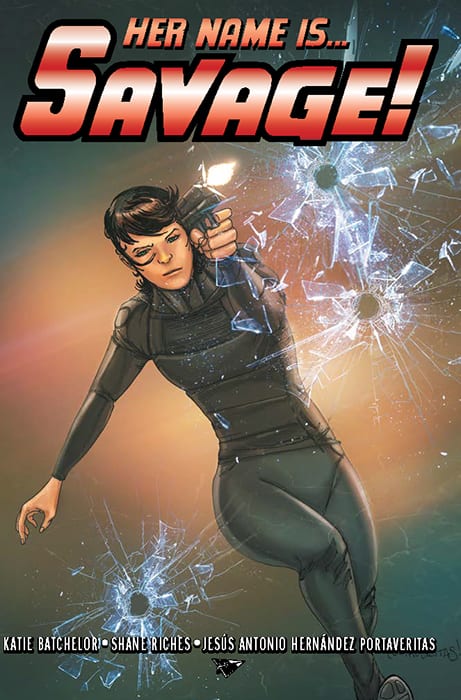
Growing up, I had an Eleanor Roosevelt quote on my wall: “Do one thing every day that scares you.” I’m a big fan of taking risks, diving off cliffs. Savage does that multiple times a day. I figurately dive off cliffs; she really does it. There’s a scene in the graphic novel where Savage literally crashes through glass. It’s not a ceiling and we didn’t intentionally write it as a metaphor, but it’s impactful – such a great visual that it became our cover. This powerful woman shooting out a glass wall and breaking boundaries.
There are certain traits associated with being feminine — being kind, being a humanitarian — but those should be human traits. So, Savage has a kindness in her that should be an attribute of all people. She’s multi-layered and multi-dimensional in that she wants good people in the world, wants kindness, and she herself is. But she also feels like she needs to use her unique abilities to achieve her results – whether you agree with that morally or not is up to the reader to decide.
“The most dangerous person on the planet lunges back into action with the expertise and ferocity that made her a covert legend — to hunt down a ruthless international syndicate hellbent on seeing her dead first. Her Name Is…Savage fuses the bone-breaking fury of the John Wick franchise with the cerebral intelligence of Homeland. Savage is a titan — unapologetic and ferocious — righteously consuming any depravity in her way. Challenging expectations. Defying limits. Walking straight into the inferno…”
Her Name Is…Savageis co-authored by Shane Riches and drawn by Jesus Antonio Hernandez Portaveritas, and is a standalone companion piece to both the original works by Gil Kane and Steven Grant’s His Name Is…Savage. Be sure to grab these and other fantastic graphic novels from publisher Paper Movies at their website!
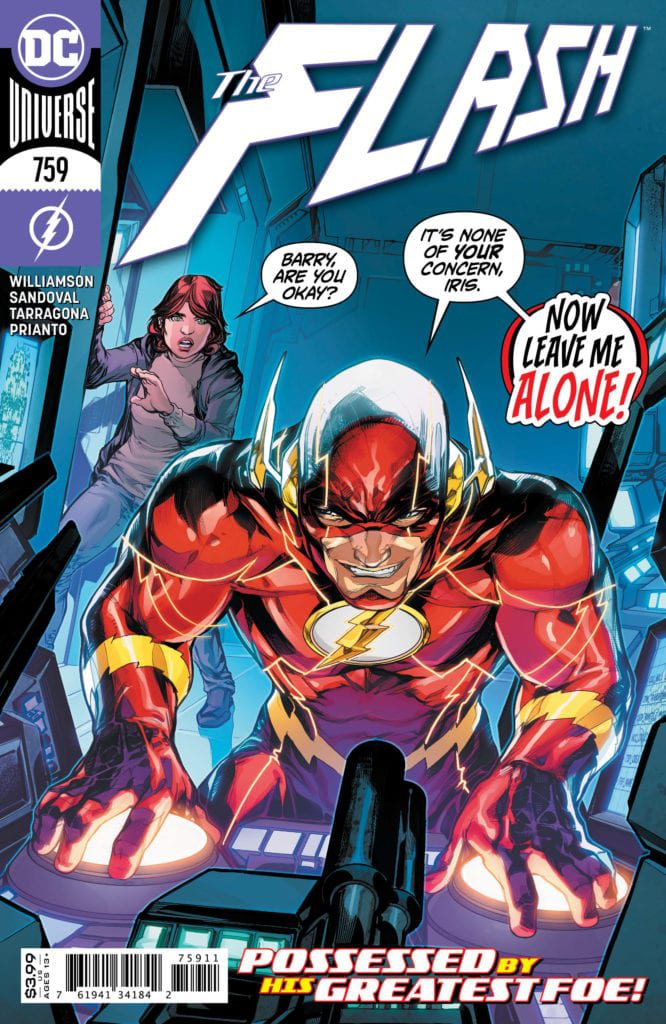
Barry Allen is gone, long live The Flash. After Barry finds the location of the Legion of Zoom, the supervillain team overpowers him. As each member takes their time providing the appropriate amount of pain, Eobard reveals his real plan: Take Barry’s Place. Using his speed phasing, Thawne becomes one with the Flash, taking over his body. This sends Barry to The Speed Force, where he reunites with Jesse Quick and Max Mercury. The problem is they want him dead as they have become zombies. As we enter the final arc for Williamson’s run, Barry and Thawne are in the most precarious position either has ever been in. Will either survive?
**Some Spoilers Below**
Story:
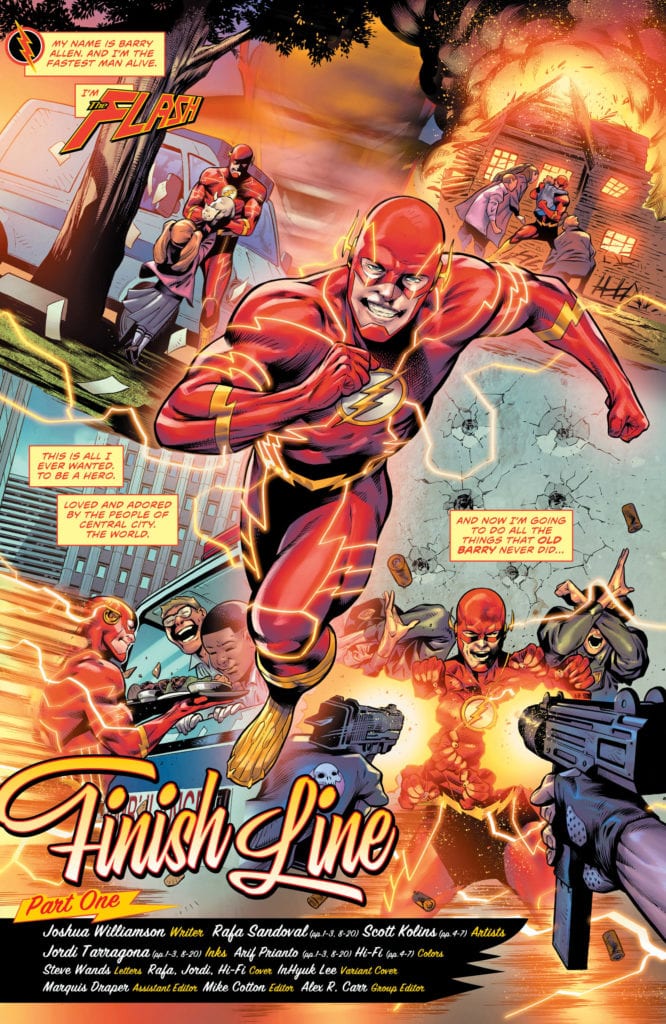
We open with Thawne playing the part of The Flash a bit too well. He does the heroic things Barry has done over the years, but more quickly and precisely. In between crimes, Thawne goes to find Impulse and offers a team-up. The speedster pair run back to Central City to find the Rogues robbing a bank. They dispatch them quickly, but Thawne becomes a bit brutal with Trickster. Despite looking like his grandfather, Impulse begins to question the identity of The Flash. Meanwhile, Barry is touched by the zombie speedsters, remembering who they are and return them to their original looks. Max tells Barry what has happened and proceeds to help him learn about the speed force.
This issue basically flew by at a breakneck speed, which can be seen as a good or bad thing. On the negative side, one could say that the suspense of the heroes not learning about the possession could have made for great storytelling. Something akin to Superior Spider-Man, where the heroes could have pieced it together over the course of the arc. This, however, is impossible due to how few issues we have left in the run. It’s just a missed opportunity that could have made a great build-up.
That being said, seeing the blocks of a Flash Family reunion being moved into place always puts a smile on my face. With Impulse trying to unite everyone against his fake grandfather, we get the team-up that’s been missing in the Flash series. This is the final story of Williamson’s run and if there is any aspect that has been covered well by him, it’s the Flash Family. With the return of Jesse, Max, Impulse, and one surprising return character, this arc will bring the run to an epic close.
Art:
We have two long time Flash illustrators covering the action in the real world and in the speed force. The Speed Force section is covered by Scott Kolins, whose style complements the creepy looks of the zombified speedsters. He also does well in honoring their original looks when changed back. Rafa Sandoval takes over the real world section and provides us with cool-looking action and subtle details that make our favorite speedster menacing. The best look in the book comes from Impulse attacking Thawne. Due to Rafa’s style, we can practically feel the high-speed kick to the face the speedster of the future delivers. Both artists are perfect for this final story and I can’t wait to see what else they have up their sleeves.
Conclusion:
While there could have been more built around taking Barry’s identity, this was still a great issue. All the pieces are set for this nailbiting conclusion to one of the longest creative runs of the Rebirth Era of DC. The art team is able to provide an excellent look for the two realities this story takes place in, as well as fantastic looking action. The Flash and Thawne will face off one last time, and this reviewer can’t wait to see it.
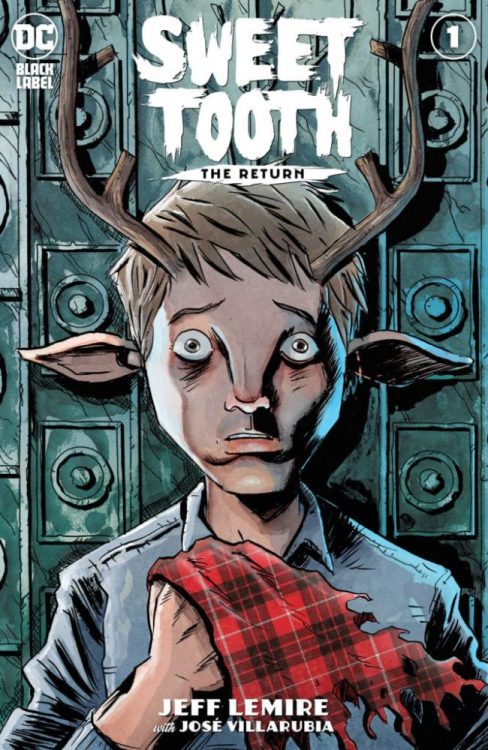
While it might sometimes feel like 2020 is nothing but dark news on the comics front, along comes Jeff Lemire with a beacon of light. DC Comics has announced a new Sweet Tooth miniseries by Lemire and colorist Jose Villarubia, arriving this November.
Here’s the official word:
SWEET TOOTH: THE RETURN A New Sweet Tooth Miniseries Debuts in November!
On November 3, acclaimed international bestseller Jeff Lemire and colorist José Villarubia reunite for a new six-issue post-apocalyptic fantasy miniseries featuring the bizarre, haunting, Sweet Tooth!
Once upon a time there was a little boy named Gus. He had antlers and lived with his father in a little cabin in the woods. Then his father died, and the big man with cold eyes took Gus away. Gus went on many great adventures, found friends, love, happiness, family, and acceptance.
Now, years later…it begins again. A young boy with antlers and deer-like feature wakes in a bizarre and completely foreign world where the last humans struggle to survive. They tell the boy he is special, he is chosen, and that he alone can lead them back to a world dominated by the oppressive Hybrids.
Sweet Tooth: The Return is no re-hash of the original series, but rather a bold re-imagining of the Sweet Tooth mythology; taking elements of the original series and remixing them into something familiar, but totally new. A divided world. A planet long ago past the point of devastation. And at the center of it all, a child who didn’t ask to be born into any of this, but who has no choice but to try and forge some life for himself. His visions and dreams may not be real at all…they may just be fiction. But they are hope. And sometimes hope is enough.
Acclaimed writer/artist Jeff Lemire returns with colorist José Villarubia to bring you the next chapter in the saga of DC’s acclaimed series Sweet Tooth!
Sweet Tooth: The Return #1, with a cover by creator Jeff Lemire and a card stock variant cover by Jim Lee, debuts November 3. New issues will ship monthly and the series will carry DC’s Black Label content descriptor, indicating content appropriate for readers 17+. For more information on this series and the World’s Greatest Super Heroes, visit the website at www.dccomics.com, or follow on social media @DCComics and @thedcnation.
AfterShock comics has announced a return to the world created in the critically acclaimed Undone By Blood comic. The new arc coming in 2021, entitled The Other Side Of Eden, will follow Silvano Luna Del Rio as he “sets out to take back from the country that took so much from him.”
Written by Lonnie Nadler and Zac Thompson and drawn by Sami Kivela, AfterShock describes the new arc as “a look at how the myth of the cowboy has permeated our culture, and remains ingrained in our narratives of violence and retribution.”
You can check out the newly released preview images from issue #1, and read all about the new arc from the creative team’s perspective in the full press release below.
Are you a fan of the Western comic genre? Let us know what you think about this new arc in the Comments section, and please share this post on social media using the links below.
UNDONE BY BLOOD or THE OTHER SIDE OF EDEN #1
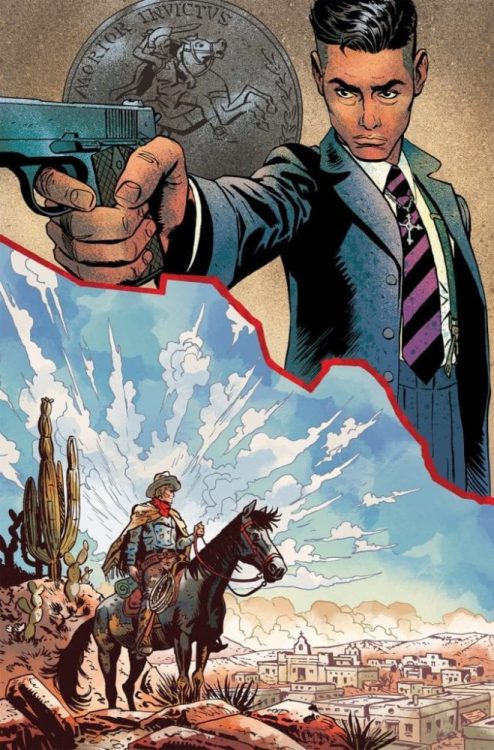
The early 1930’s, the height of the Great Depression and beginning of the Dust Bowl. Silvano Luna Del Rio works as a postman in Buttar, Texas. Reeling from a tragic past, with only a gun and a western novel to his name, Silvano sets out to take back from the country that took so much from him by robbing the first skyscraper West of Mississippi. But acts of retribution are never as simple as they seem.
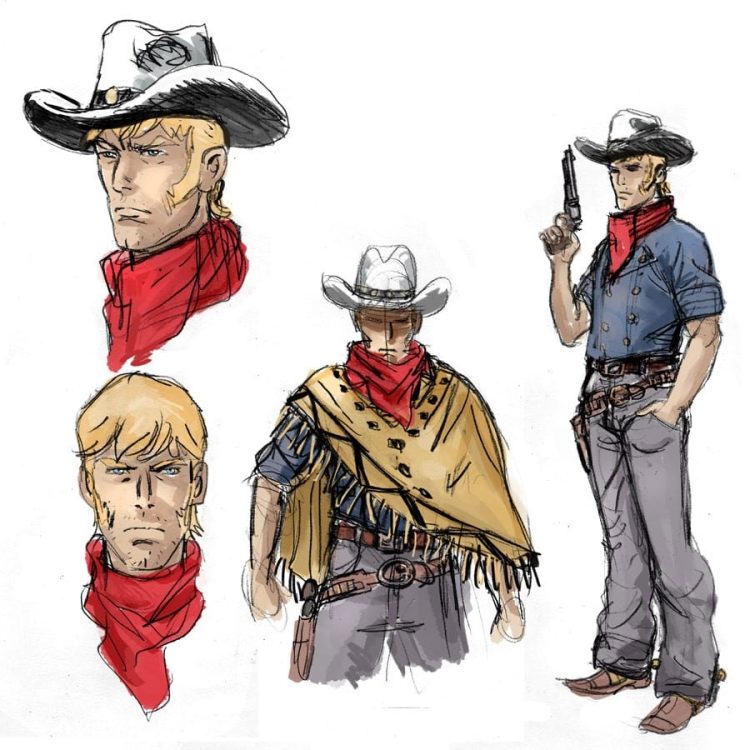
By Silvano’s side is an Old West novel featuring famed gunslinger Solomon Eaton. As both stories unfold simultaneously, in true Undone By Blood fashion the mythic Western informs choices in reality, for better or worse.
From the minds of Lonnie Nadler and Zac Thompson (The Dregs, X-Men) and artist Sami Kivela (Abbot, Tommy Gun Wizards) comes the next chapter of the neo-western that depicts the hard truths of seeking vengeance in the real world.
LONNIE NADLER ON SUMMING UP THE FIRST ARC OF UNDONE BY BLOOD:
“Undone by Blood is what we’ve been calling a meta Western – a look at how the myth of the cowboy has permeated our culture, and remains ingrained in our narratives of violence and retribution. The first arc told a tale of revenge that saw Ethel Grady Lane hunting down her family’s killer in 1971 in the bizarre town of Sweetheart, AZ. The only help she had on this journey came in the form of an old pulp Western novel starring the fictional famed gunslinger Solomon Eaton. As their narratives intertwined, Ethel learned the hard way that sometimes reality is a far cry from what fiction leads us to believe.”
WHAT CAN READERS EXPECT FROM THE SECOND ARC? (For both new and old readers of the series)?
LONNIE NADLER: “While Ethel’s story has come to an end, there are literally dozens of stories left for Solomon Eaton, as he’s the star of a popular series of Western novels in the world of Undone By Blood. And those novels have influenced a number of people over the course of history, for better or worse. So, in this second arc, Sol is back in a brand new tale and interwoven with that is the story of a young man in 1930s Texas who is out for a different kind of vengeance in the form of a wild heist. We’re keeping the same tone, so you can expect plenty of oddball characters and interruptions along the way. This is a perfect jumping on point as there’s no prerequisite knowledge required. Really, what we’re hoping to do here is bring the seasonal anthology format to comic books, in the same vein as Fargo and True Detective.”
ZAC THOMPSON: “Our protagonist in The Other Side of Eden, Silvano, is an employee of the United States Post Office Department. He’s one of the lucky few to have steady employment in a time of overwhelming struggle. Just like the first arc, we’re telling a story about a character who’s been ground down by life and is taking justice into his own hands in order to make things right. It’s a western set against the backdrop of widespread poverty and unemployment, where hardship and improvisation have become a way of life. Like the first arc, we’re shining a light on America’s past to reveal hard truths and tell a story about contemporary themes.”
ZAC THOMPSON’S FAVORITE UBB PAGE AND WHY:
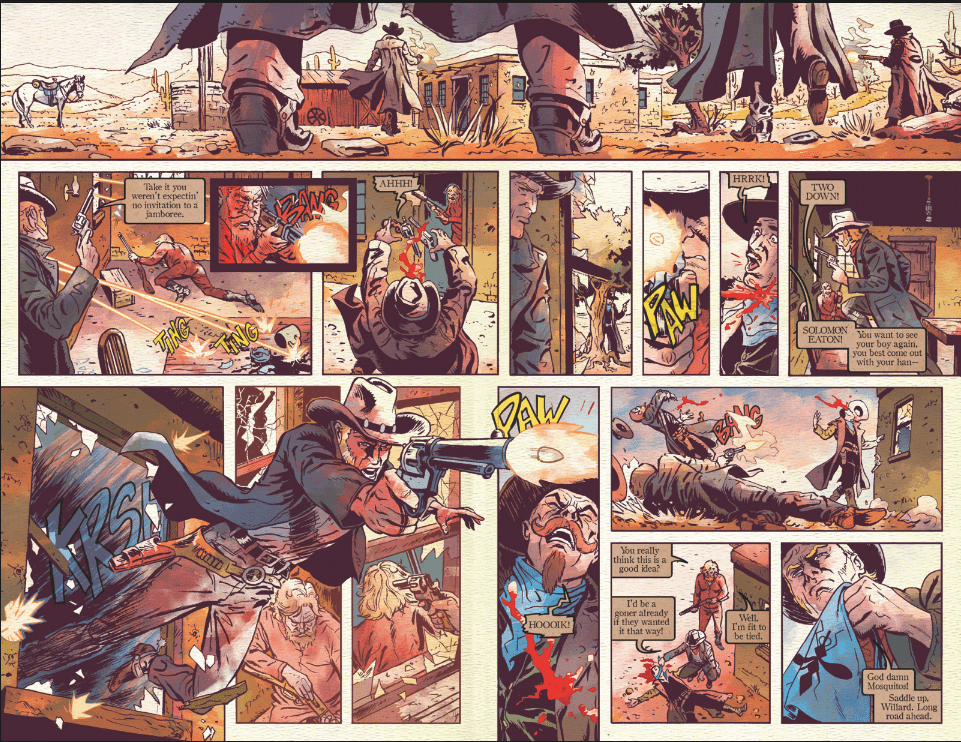
“Well, it’s only fitting that I highlight a page from Solomon’s story. This big bombastic moment is in direct contrast to Ethel’s quieter journey. This is the type of action she seeks and the glory that informs her quest for revenge. It’s a celebration of everything we love from the classics of the Western genre. Sami and Jason worked their magic together to create a huge frantic shootout where bullets are flying in every direction but the action is seamless and easy to follow as Solomon and Willard work like a well-oiled machine to destroy their attackers. It’s all capped off by Hassan’s phenomenal and exaggerated lettering that helps drive the cinematic feel at the heart of Sol’s story.”
LONNIE NADLER’S FAVORITE UBB PAGE AND WHY:
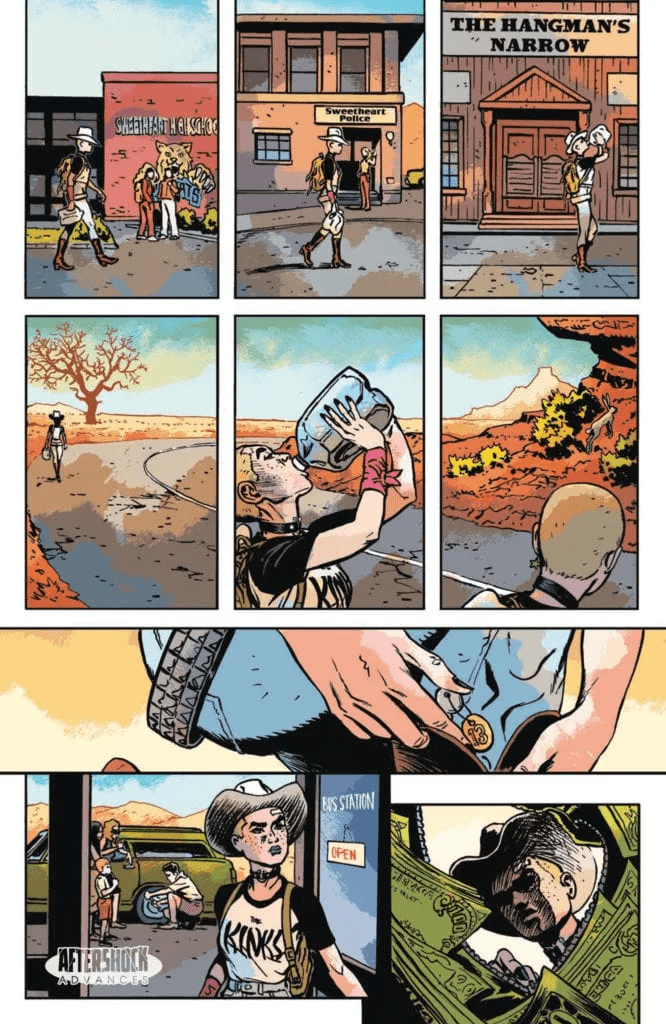
“My favorite page from the first arc comes in issue #4. While there are plenty of more showy pages that Sami and Jason worked their magic on, this is the one that I keep coming back to. Pacing is something very important to me as a storyteller and I find more and many contemporary comics forgo slow moments in favor of keeping the action full speed ahead. This simple silent page shows Ethel going about town as she kills time. There’s no glory. There’s no heroism. There’s nothing happening. And yet it tells us a lot about Ethel, her loneliness, and her attitude. In breaking up the page into thirds, almost a grid, it allows time to flow between panels, so we feel Ethel’s long walk. As a result, Sami and Jason captured a sense of reality that functions as a stark contrast to the action packed fiction of Solomon’s story, which really summarizes the whole book.”
Marvel Comics has released a preview of VENOM #28 from the upcoming storyline, Venom Beyond, available to retailers on September 16th.
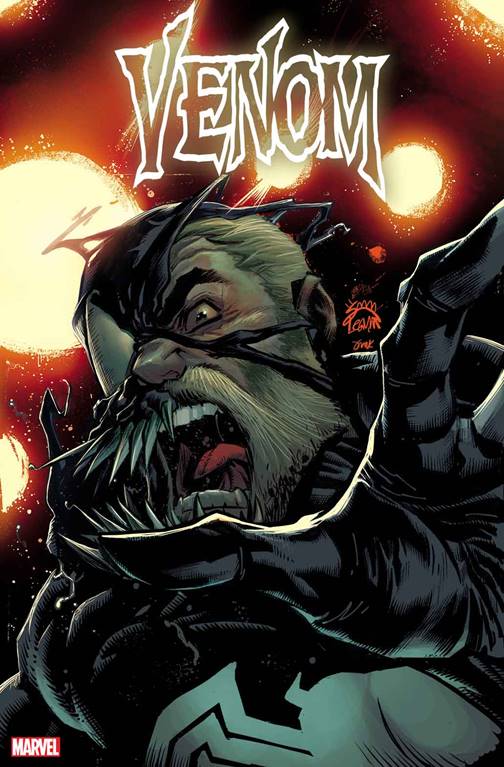
Donny Cates’ Venom run has been one of the bright spots for Marvel in a COVID-19 world, and that run looks to continue, culminating in the King In Black event due this December. You can check out the cover below as well as read Marvel’s press release.
Let us know what you think of the cover in the Comments section, and please share this post on social media using the links below.
EDDIE BROCK LASHES OUT ON RYAN STEGMAN’S VENOM #28 COVER!
New York, NY— August 11, 2020 — “Venom Beyond,” the latest mind-melting story in Donny Cates’ acclaimed run on VENOM continues in September with VENOM #28! With incredible art by Juan Gedeon, “Venom Beyond” finds Eddie Brock and his son, Dylan, trying to find their way in a dangerous new world. This monumental story is packed with monstrous new threats, mysterious new allies, and an eye-popping variant cover by regular VENOM artist, Ryan Stegman! Check out Ryan Stegman’s cover below and pick up VENOM #28 when it hits stands on September 16th.
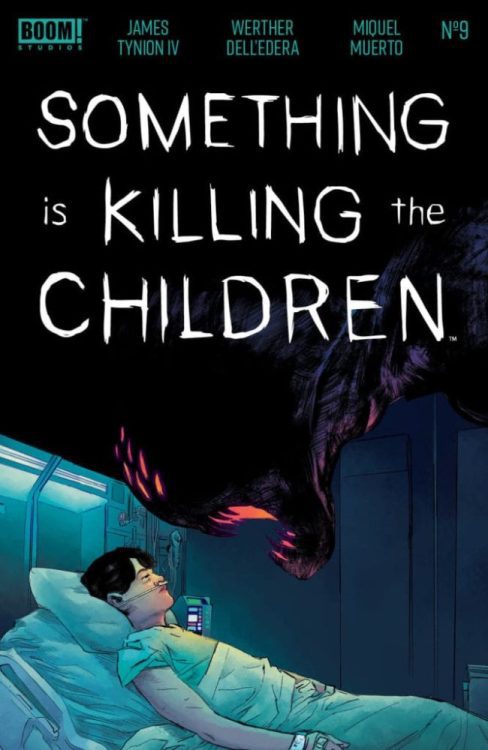
In Something Is Killing The Children #9 from BOOM! Studios, James Tynion IV’s writing gives the story a sense of helplessness that accompanies the dread from Werther Dell’Edera and Miquel Muerto’s art and the terror from Andworld Design’s lettering.
Recap
Continuing from the last issue, monster hunter Erica Slaughter needs help in slaying a monster nest. Unfortunately the only way to do that is through using a child as bait.
Something Is Killing The Children #9 On Helplessness
Despite Erica being the best chance at resolving the overall conflict, Tynion goes to show how vulnerable she is. Erica shares her backstory with her previous helper James in order to get his help as bait. What makes this so notable, however, is how Tynion avoids the Hero’s Journey formula. Despite Erica knowing how to fight the monsters and revealing their existence to others, this doesn’t really help anyone. She’s nobody’s mentor and she’s not some mythic figure who counteracts against the monsters; Erica, much like everyone, is just trying her best. If anything, Something Is Killing The Children #9 is a display of futility in the face of utter helplessness. Everyone is in the abyss at this point and nobody can change for the better, just try with all of their might.
Art
Werther Dell’Edera continues with providing the sense of dread with panels full of close-ups and claustrophobia. Just the panel work of pages get tighter as the panels contract after an initially large panel. Once the monsters appear, the tension explodes into a full splash page where monster circle characters with one having a fearful close-up.
The coloring by Miquel Muerto makes these tense moments feel absolutely horrifying. The black and other dark colors really bring out how uncomfortable some of the settings can be. The dark forest where the monsters dwell and a darker hospital room both feel dreadful. It’s also what makes the brighter colors that contrast everything so eye-catching. Bright red blood appears suddenly; brighter colors accompanying a hospital room to display intentions with clarity. All of it feels like a struggle for a state of equilibrium.
Lettering is by Andworld Design; each word balloon is contained within panels so the reader never gets misses the effects. In addition, the word balloons enhance the suffocating situations by taking up space in already tightening panels, especially when the font and outlines of the word balloons embolden once characters’ emotions heighten. But even those things pale in comparison to the dedicated wordmarks in red, which become more terrifying than the roaring they are meant to interpret. It’s as though a sense of detachment from the monsters is what kills the victims.
Tensions Rise in Something Is Killing The Children #9
Something Is Killing the Children #9 is yet another reason why this series has high marks. It’s story never misses a beat when it comes to its intense atmosphere where characters find ways to interact. Because, before the next conflict, you at least have to connect with the character otherwise you won’t connect with them. The artwork just makes this feeling all the more foreboding. And it doesn’t look it’s going to end anytime soon. No one’s quite out of the dark yet, and there’s more to come. So best make the journey in this issue before meeting the destination for the next issue.
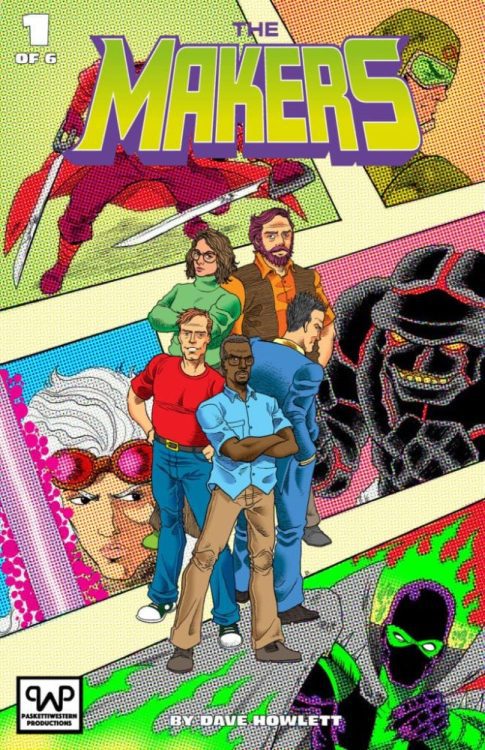
Paskettiwestern Productions’ The Makers could have just been a run-of-the-mill homage to comics. Instead, series writer, artist, colorist, and letterer Dave Howlett decides to go a step further. When most series would throw in a character or two that are clearly inspired by other works and call it a day, Howlett dives deep into the business and personalities behind the comic book industry.
Writing
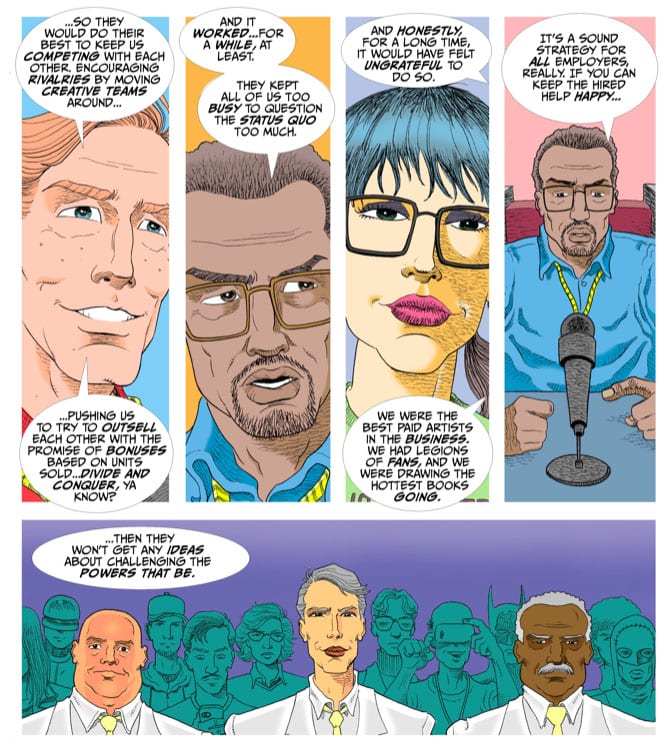
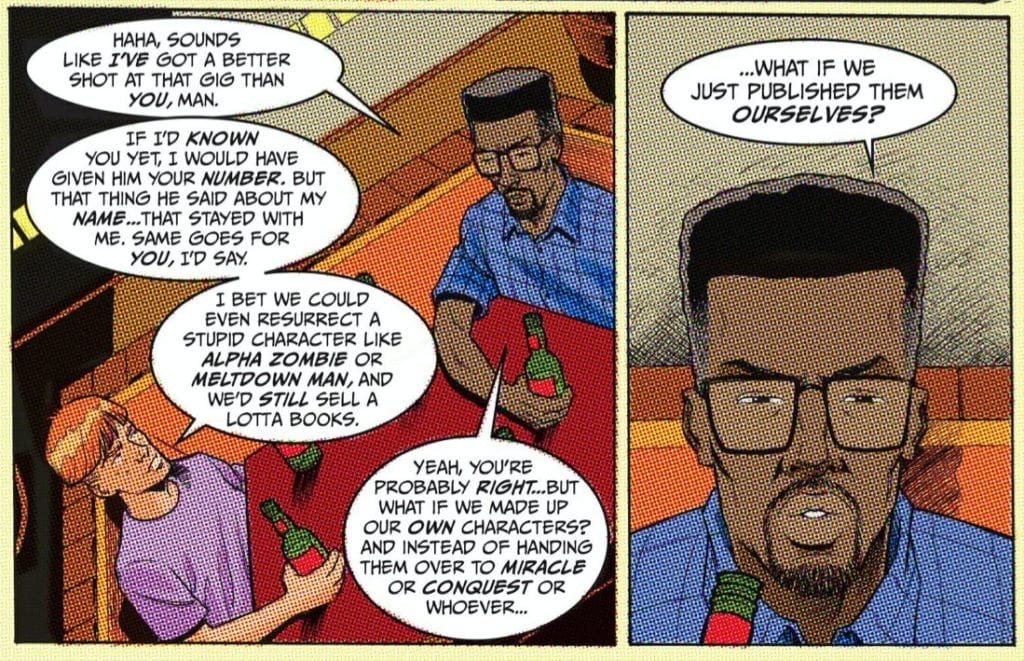
There’s no doubt Howlett loves comics. And his passion for the medium is clear on every page. Whether it’s his excited discussion of creator-ownership or his comics-within-comics that pay tribute to the classics, The Makers is full of enthusiasm. Yet, Howlett also isn’t afraid of shining a light on some of the dirty parts of the industry. His character “Amiable” Art Fine represents the big business tycoons that gladly profit off of an artist’s hard work, without giving artists their due. Though, it’s funny that this is what Art Fine represents because Howlett still makes the guy kind of likable. He’s a shyster you’d like to grab a drink with.
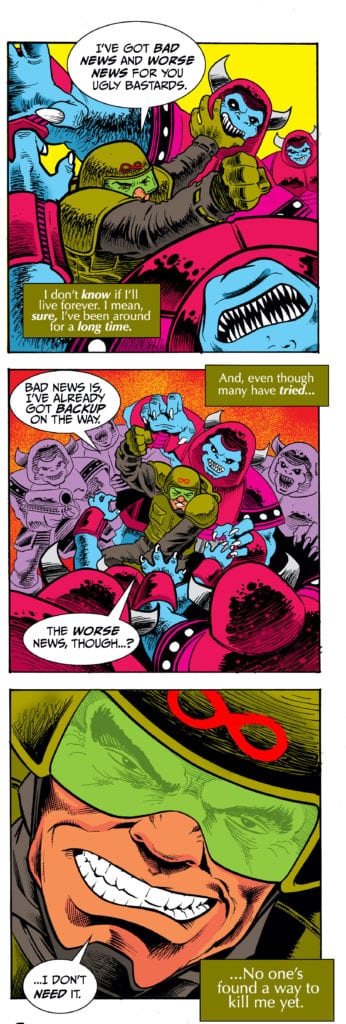
A whole other review could be written just about the comics-within-comics in The Makers. Howlett’s own version of Spawn, Captain America, The Fantastic Four only appear briefly, but they feel fleshed out and unique enough that you wish you could read the whole series in Howlett’s voice. It’s worth noting that half of these characters Howlett recreates are from the big industry he’s critiquing. In doing this, Howlett adds another layer to the discussion. He says, “Alright, there are problems with their business models and ethics, but that doesn’t mean they haven’t given us some of the characters we love the most.”
Art
When you read the first few pages of The Makers, you might assume you get Howlett’s art style. It’s a familiar one. Thin lines, lots of details, it has a grittiness to it. But Howlett refuses to be put in a box. Only a couple pages later, and you see pages with a completely different art style. Crisp, clean, thick lines that look like something out of the Silver Age. Every comic that makes an appearance in The Makers has its own style—a style you’ve seen in stories like it.
Howlett’s ability to tap into artistic tropes, while also celebrating their visual storytelling, is both exciting and astounding. It’s in his art, most of all, that we see Howlett’s love for the medium. This is a world he’s lived in for a long time, one he’s familiar with. We know this because, with every new comic he presents, his art feels familiar as the comics where Howlett first found these styles of storytelling.
Coloring
Howlett’s changing artistic style bleeds into his coloring. His modern-day scenes, set in the real world instead of the world of comics, are often washed out and a little grim. It’s here that we see these characters aren’t as put together as their press would suggest. They look pale, and like they’re trying to keep it together. But when we jump back to 1991, things seem more colorful. The Ben-Day dots that Howlett uses to color those scenes makes it feel like art is everywhere. It’s not just a day job for these artists; it’s a way of life.
And every new comic Howlett presents has a new color scheme that immediately fills us in on the world we’re presented with. Hellfire is colored with a funky green and purple, over a realistic background, showing us how out of place the character feels. Cinder’s comic is colored in undeniably 90’s fashion. Sergeant Infinity is full of red shadows, giving every scene a flair for the dramatic.
Lettering
Howlett’s lettering for this series is a play-by-play of old comics’ tropes, and it’s incredible. With the parody/homage comics he’s inserted into the plot, he has lots of fun. First, whenever a new character enters the fray, their name is written in a different font. It’s a little nod to when comics do that to advertise their other series, creating brand recognition. And of course, Howlett has fun playing lines from different scenes off of one another.
When Chuck Tolliver is chatting with Josh Armstrong, back in ’91, he says, “…But it’s just that, for me, the same old, same old seems to be somebody else’s same old, same old.” Howlett puts this word balloon in the right-hand bottom corner of the page, so when we jump back to the present day, it’s the last thing we’ve seen. And in the present day, right in the middle of the page, the first thing our eyes see, Tolliver’s looking out into space saying, “Well, that sure is different.” It’s a great joke that works because Howlett makes sure we see a one-word balloon after the other in quick succession.
If you love comics, then you’re Dave Howlett’s kind of person. His series, The Makers from Paskettiwestern Productions, is a celebration of comics like no other. It doesn’t just celebrate the surface level, it celebrates the nuts and bolts, and it has fun doing it. Get your online copy of The Makers (issues 1-3 are out now) here!
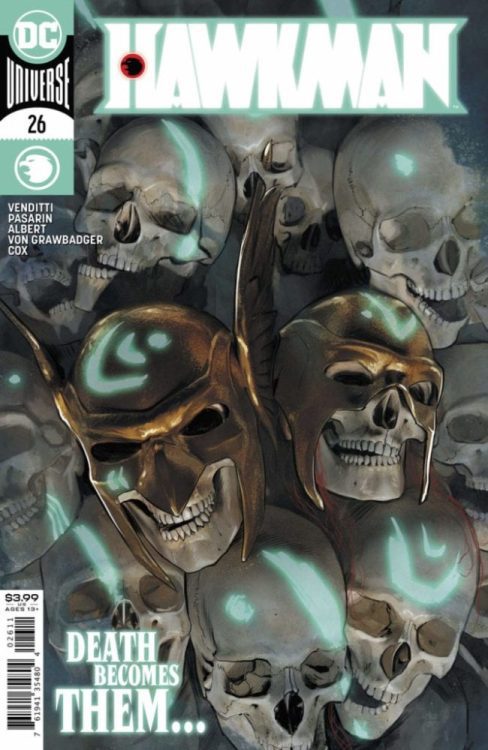
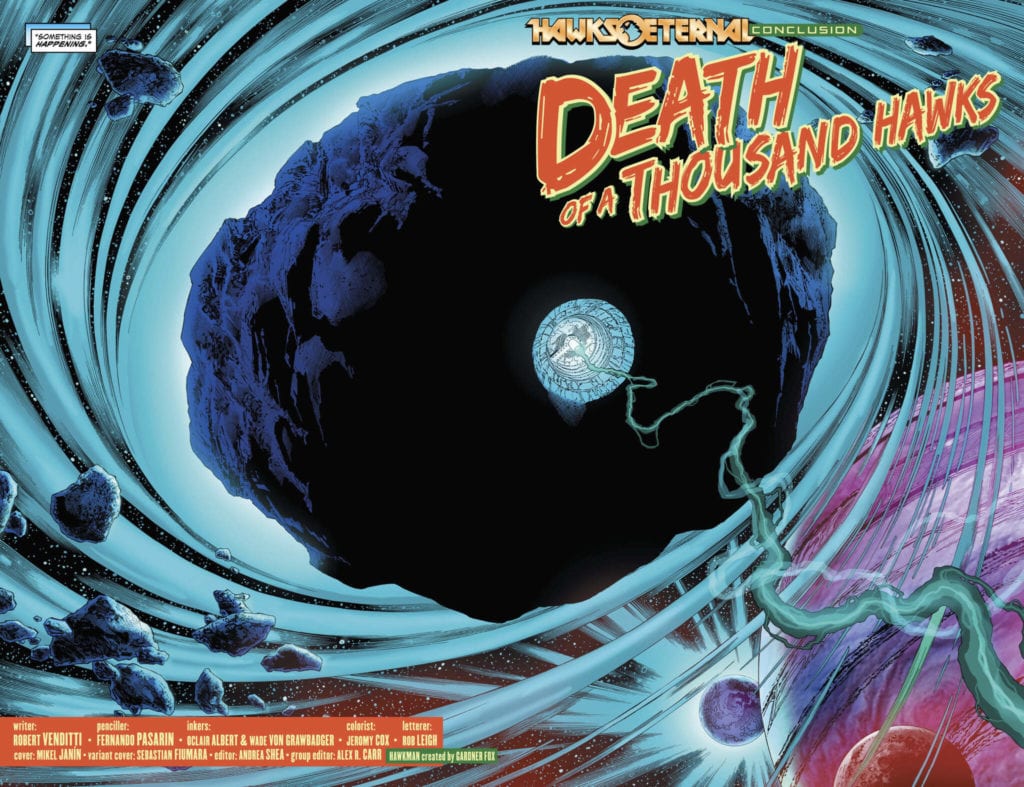
DC Comics’ Hawkman #26, written by Robert Venditti, with pencils by Fernando Pasarin, inks by Oclair Albert and Wade Von Grawbadger, colors by Jeromy Cox and letters by Rob Leigh, may have just redefined Hawkman for a generation. If the implications of this issue are taken seriously, not only will this series drastically change direction but so will the character of Hawkman. It’s an entertaining end to a 26-issue arc where this creative team lets loose. A few spoilery moments are referenced, so read this issue before diving in!
Writing
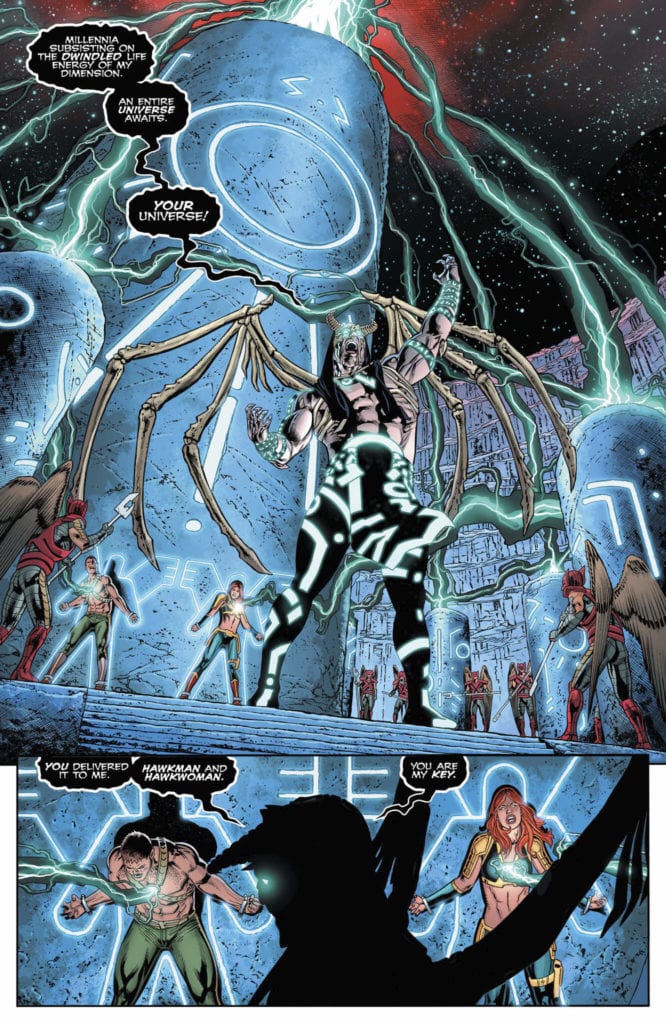
Venditti is playing a high stakes game in Hawkman #26. Shiera and Carter face their primordial enemy. It’s a fun issue that delivers on its stakes. Most big supervillain battles wouldn’t. But while this is a fun, high stakes shootout, it makes up a few rules on the fly. Venditti backs his characters up against the wall and then gives them an out that hasn’t already been established. It’s a little convenient for sure. That said, it’s in the final moments of this issue that the writing really shines. Venditti pulls together the plots of the last 26 issues in a way you wouldn’t think he’d ever do. The final pages give us hope that even big characters like Hawkman can be met with real stakes.
Art
Pasarin, Albert, and Von Grawbadger pull out all the stops in this issue. The pain, anger, and sadness on every face are intense. As Shiera and Carter fight off the Lord Beyond the Void, their rollercoaster of emotions is clear as day. But it’s actually in the more restrained moments that Pasarin, Albert, and Von Grawbadger do their best work. The Lord Beyond the Void is chilling, as he smiles casually. As the issue closes out, there are a few opportunities missed. When Shiera and Carter think they might die, their intensity detracts from the moment. Less is more. Just as when Atom thinks he may have lost his friends and tears stream down his face. Atom is feeling a little too much for us to empathize with. There’s so much emotion in the scene that we feel like we don’t need to add in our own. Atom is doing enough feeling for both of us.
Coloring
Cox makes this issue such a beautiful thing to look at. The deep blues of the Lord Beyond the Void’s temple feel cold and daunting. Carter and Shiera look lost in the sea. And as the Lord Beyond the Void rips the life force out of them, the fear they must be feeling can be seen in the yellow energy that’s being taken from them. This energy quickly becomes the source of their salvation, however, and red begins to filter into these scenes. The red of their strength, which, when mixed with the yellow, becomes the gold of their victory. In the final moments, we see Carter and Shiera taken to a mysterious place. It should feel scary and unwelcoming, I mean they’re walking on a bunch of skulls. But Cox makes it feel safe, even peaceful. The gentle coloration makes a potentially terrifying moment one of the most beautiful moments of this series so far.
Lettering
A big part of what makes this chapter feel so cut loose is Leigh’s lettering. From the title page, the big letters look like something off an old horror poster. Big, bright, they promise that this is going to be an adventure, and anything could happen. Throughout this issue, the lettering is constantly changing. Carter and Shiera whisper to each other in small lettering, while the Lord Beyond the Void yells at them in white lettering on a black background. When he’s struck by the Hawks, the “FWAKKAASSH” noise of them hitting him is behind his twisting body. The destruction takes the foreground, while also making the letters look like they’re piercing him. Leigh makes this issue so fun, but also allows for little whispers to get us leaning in to hear what’s being said. He really does it all in this issue.
DC Comics’ Hawkman #26 makes some big changes. It brings real stakes into the story of a man with a thousand lives. This creative team may not have created the perfect comic in this issue, but boy have they created a damn fun one! Pick up Hawkman #26, out from DC Comics August 11th, from your local comic book shop!




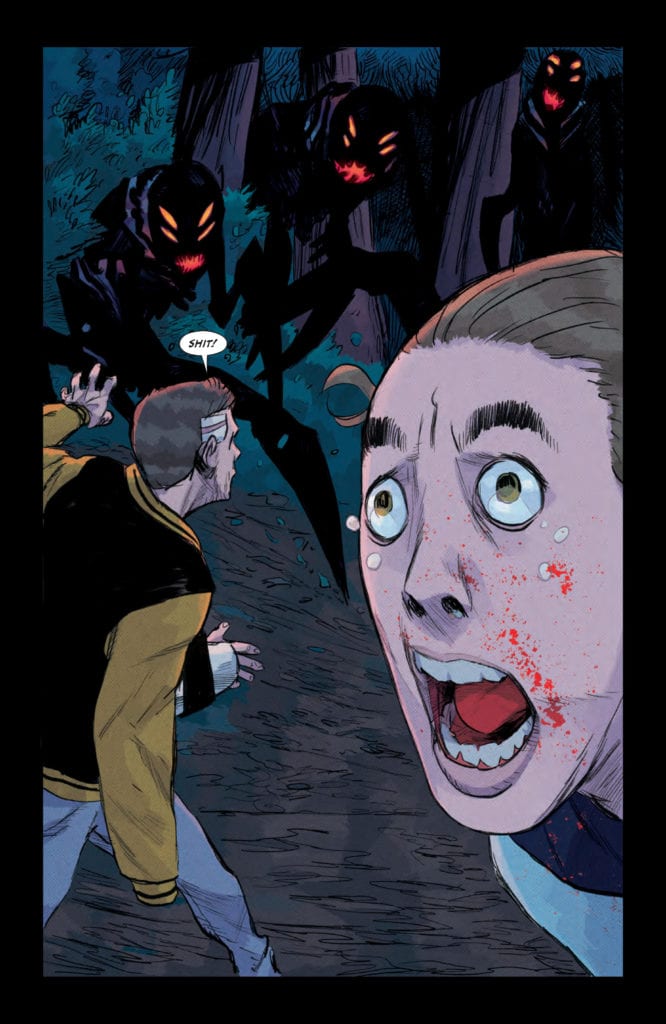 Werther Dell’Edera continues with providing the sense of dread with panels full of close-ups and claustrophobia. Just the panel work of pages get tighter as the panels contract after an initially large panel. Once the monsters appear, the tension explodes into a full splash page where monster circle characters with one having a fearful close-up.