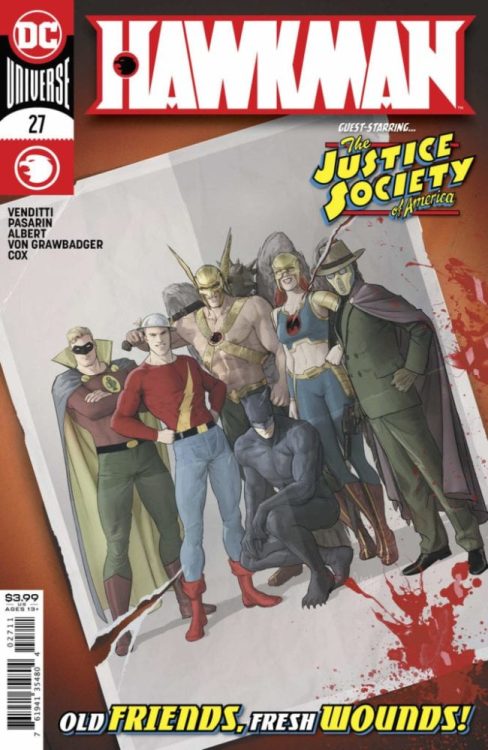
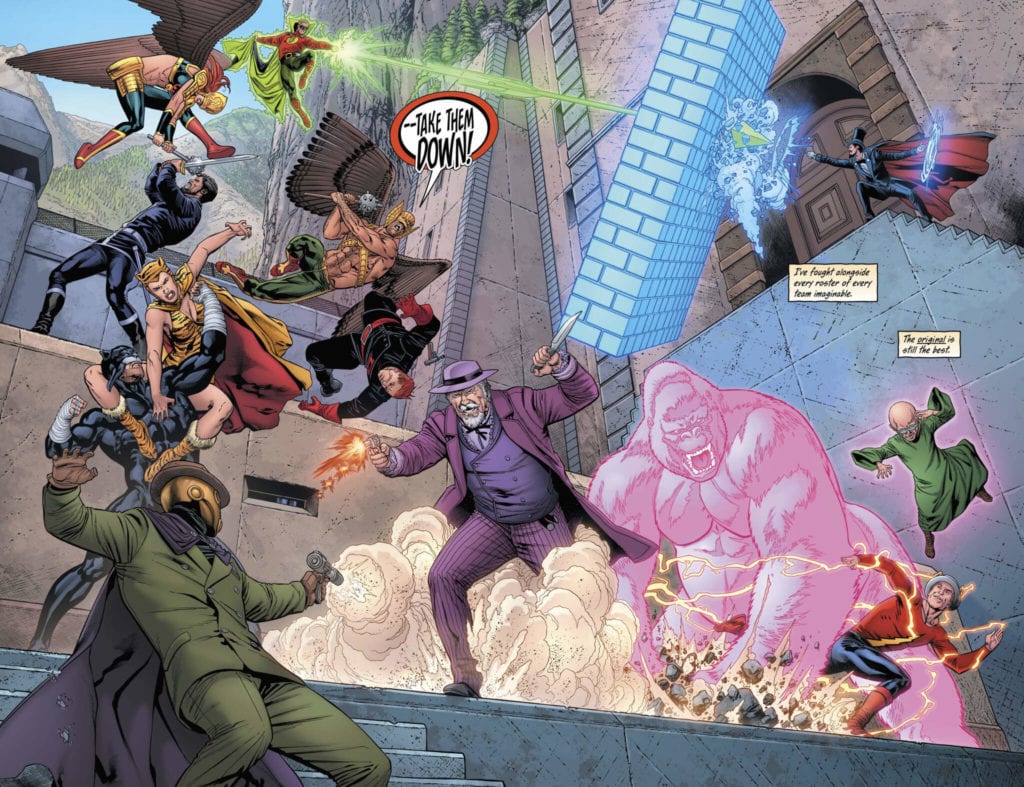
Venditti shines a light on all the things we love about old comics in Hawkman #27. We have all the classic DC characters of the 1940s, along with some truly cheesy repartee. Venditti centers most of the issue around a fight between the Justice and Injustice Societies. We get a moment, typical to Golden and Silver Age comics, where it looks like the villains have won. It’s closely followed by the heroes winning in a Deux Ex Machina moment, explained away by the simple fact that they knew the villains would act as they did. On their own, these are all elements of bad writing, but when recreating the feel of a Golden Age comic, it’s perfect. Venditti is reminding us of the days that these writing flaws were common, even charming. It takes a truly skilled writer to implement bad writing techniques well. Thank God Venditti is truly skilled.
Art
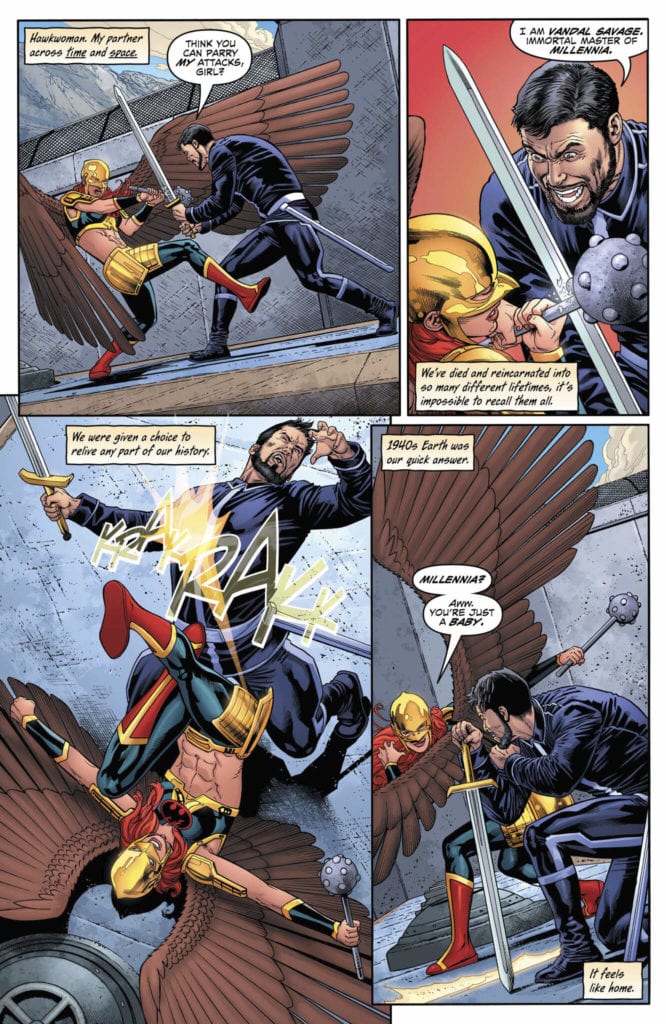
Pasarin, Albert, and Von Grawbadger pull out all stops to make this issue of Hawkman fun. As the heroes and villains fight, this team of artists is constantly playing around with the page layout. No two pages look alike. The layout is constantly changing to mimic the changes in the battle. The dynamic feel to the page makes it feel incredibly playful. Beyond that, Pasarin, Albert, and Von Grawbadger make sure there are lots of smiles in this fight. Vandal Savage smiles into the face of Hawkwoman, and Jay Garrick is constantly grinning as he zooms around Brain Wave. This is a simpler time. Pasarin, Albert, and Von Grawbadger lure us into the simplicity of it all by making sure the characters seem like they’re enjoying their fight.
Colors
Cox goes back to basics. He’s coloring a comic to look classic, so a lot of the colors are what you would expect. Hawkman is in a red panel, filled with rage. Separately, we see a scene set in a mysterious location, and the blue makes the scene feel foreboding. Red is danger or anger; blue is foreboding and melancholy. But Cox also uses his colors to make the page just look great. Sandman and the Gambler look like they coordinated before the fight. The Wizard’s blue projections wrap around the green objects Alan Scott is creating with his wring. Cox helps us feel the fun of the fight by creating a page that pops.
Lettering
Leigh letters his sound effects in a pretty simple style in this issue. Normally, Leigh’s sound effects in Hawkman are diverse. But in this issue, he keeps things uniform. Every sound tends to have the same font in a different color or size. Leigh is referencing old comics when sound effects were uniform and not even written in block letters. Every sound effect looked the same. But when Hawkman and Hawkwoman’s maces get rammed into each other, the resulting explosion makes a different sound. The letters are messy and look scribbled onto the page. With this, Leigh is telling us that these two, and the power they bring with them, are beyond this plane of existence. They aren’t quite like everyone else they know live with, and even the sounds they make look different on the page.
Hawkman #27, out from DC Comics September 8th, is a great way to jump back into the 40s. It has the charming simplicity of a comic from the Golden Age and the self-awareness of a modern work. This creative team has made a really fun issue; hopefully there will be more along these lines. Pick up DC Comics’ Hawkman #27 from a comic shop near you!
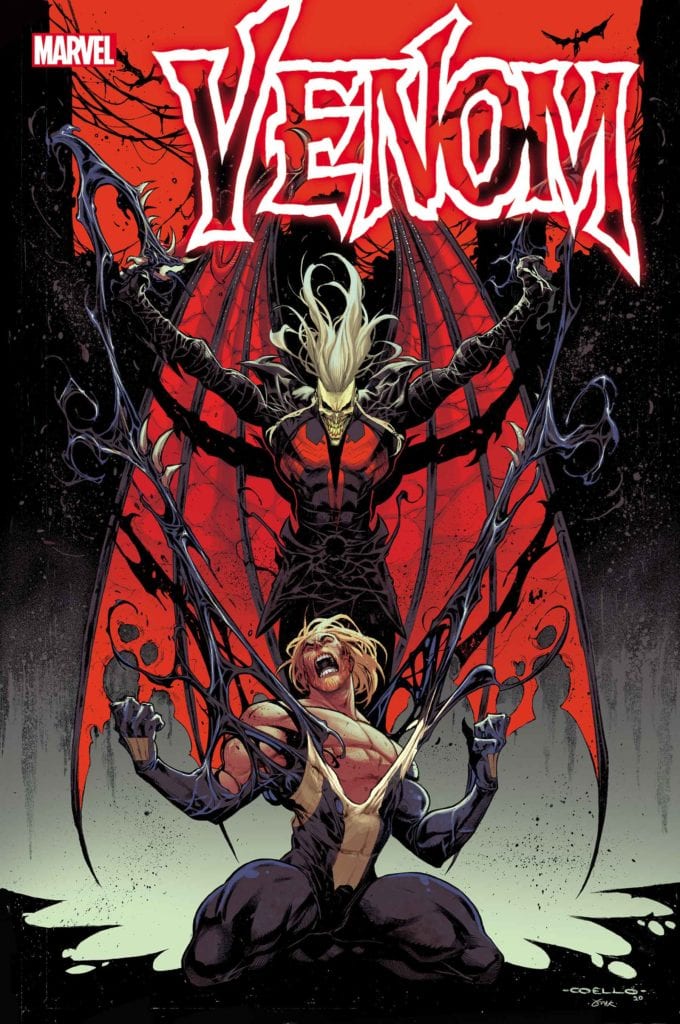
VENOM #31 hits your local comic book store this December, but thanks to Marvel Comics, Monkeys Fighting Robots has the privilege of revealing the cover and solicit text for you.
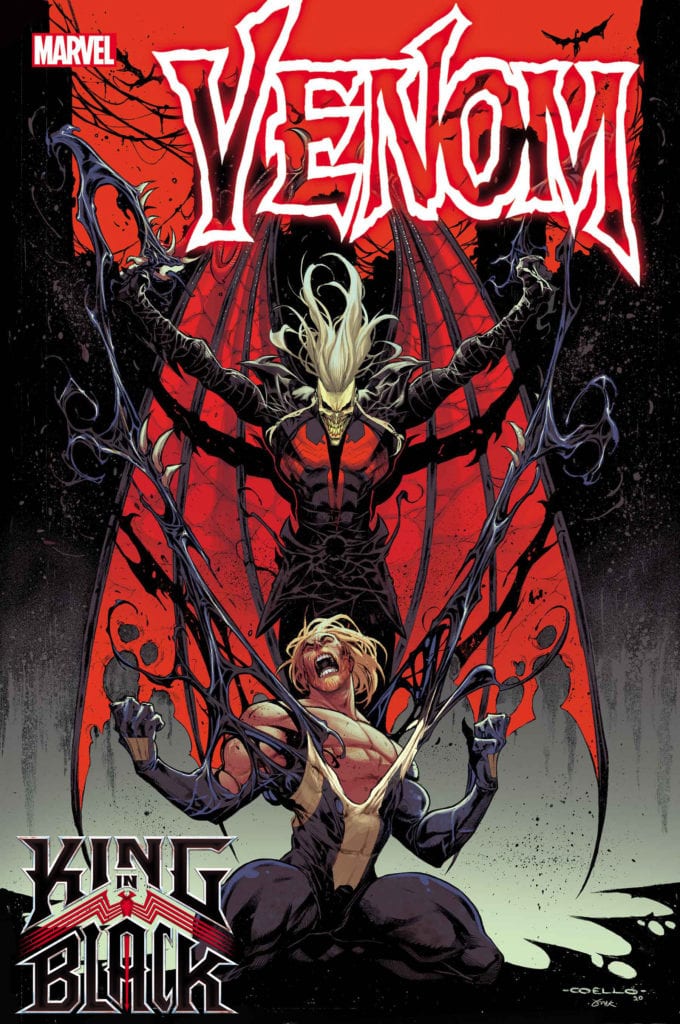
The comic is by writer Donny Cates and artist Iban Coello, with the cover by Coello and colorist Frank Martin.
About the issue: What happens to Eddie Brock when he finally comes face to face with the lord of the abyss, the KING IN BLACK: KNULL?
KING IN BLACK is what Cates, Ryan Stegman, and all of their collaborators have been building up to since the start of their run. From the first arc of VENOM through ABSOLUTE CARNAGE, everything has been leading to the arrival of Knull, King of the Symbiotes, on Earth.
Similar to ABSOLUTE CARNAGE, KING IN BLACK will be its own event mini-series with essential tie-ins in VENOM (and most likely additional titles).
Donny Cates on KING IN BLACK:
“As far as event books go, this is the coolest, darkest, most heavy metal, Cthulhu dark horror thing I’ve ever been able to do…I still can’t believe that Marvel is letting us go as dark and scary as we’re going.”
Ryan Stegman:
“One of the things I’m most proud of in this series… is the creation of the character Knull…We have some new designs that we’ll be unveiling throughout the series that are really cool and really creepy.”
Check out the VENOM #31 cover below:
And with the KING IN BLACK trade dress:
Are you excited for KING IN BLACK? How have you been liking VENOM? Sound off in the comments!
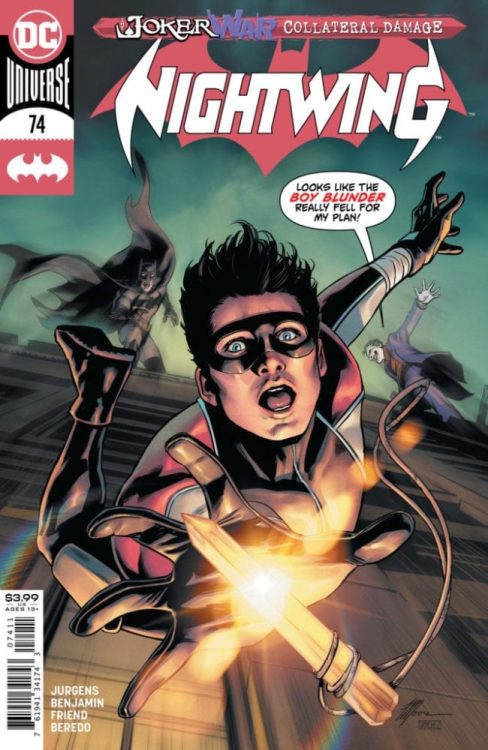
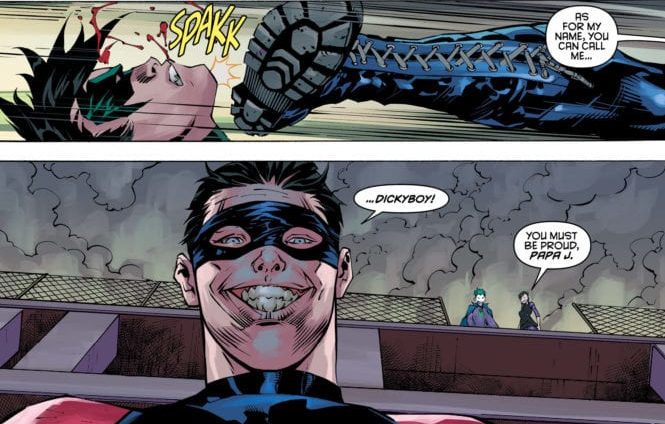
NIGHTWING #74, available in stores on Tuesday, September 8th, upends readers’ expectations just as its predecessors did in this arc. The Joker has seized complete mental control over our hero—dubbing him “Dickyboy”—and has sent him to terrorize the Bat-Family. Fortunately, it’s this very family that holds the key to Dick Grayson’s freedom. Readers will enjoy a thrilling clash between the two sides as the battle for the heart of Nightwing concludes.
Story
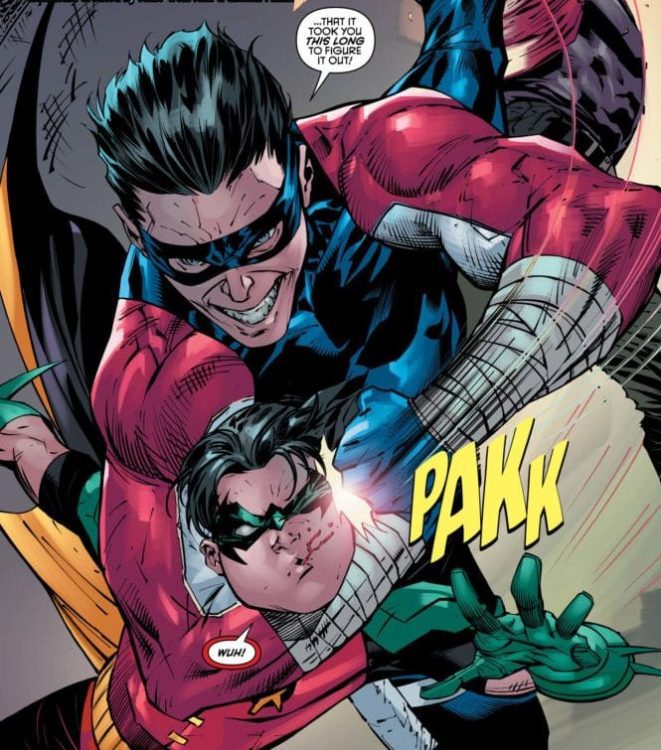
The scene is set; Bea, “Ric’s” love interest, arrives to find the Boy Wonder preparing to fight alongside Robin and the Red Hood. But then, in a move only surprisingly to his former teammates, Dick turns on them and immediately proceeds to pound their faces in.
However, the key panel that completes this moment shows the Joker literally weeping with pride over his new “son.” The madman simply cannot hide the fact that turning a family against each other brings him joy, and readers (ironically) love him for it. It’s comic characterization at its finest.
Readers soon learn shortly after that a bomb was also placed somewhere in Gotham City, leaving the heroes with another major threat to deal with. Bea, already at her wits’ end, feels hopeless. But like the sun bursting from behind the clouds on a stormy day, Batgirl swoops in to deliver a swift kick of justice.
The fight only gets more exciting from there with the special appearance of another notable member of the Bat-Family. Throughout this and the following scenes, writer Dan Jurgens demonstrates an ability to up the ante at the perfect pace.
Artwork
Ryan Benjamin’s penciling and and Richard Friend’s ink work is fantastic; the panel showing Dick’s reveal as “Dickyboy” to his former teammates embodies the Joker’s very essence. His entire expression, while on the surface “happy,” contains that unnameable menacing quality fans associate with the Clown Prince of Crime.
Rain Beredo’s coloring gives life to these and other impressive illustrations. Through a mix of darker shades and unnaturally bright hues, readers are kept fully engaged with the narrative. In addition, Andworld Design’s lettering tells the story in its own way through the use of bold fonts to emphasize Dickyboy (and the Joker’s) emphatic manner of speaking.
Conclusion
All in all, NIGHTWING #74 closes one door while opening five more. We are anxious to see what the future holds for this hero who’s mind has undergone so much trauma.
What do you think the Joker’s ultimate goal is? Let us know in the comments below!
The Thirteenth Doctor returns for a second season of Doctor Who. It was a season that managed to be an improvement over Series 11 and was still able to annoy fans.
The Doctor and her companions reunite for more adventures across time and space. Their journey sees them conflict with familiar foes, meet historical figures, and face environmental threats. The Doctor also has a long-running threat due to mystery involving the Timeless Child and The Lone Cyberman.
Series 11 was reviled by fans for numerous reasons. Many of the stories were tepid, there was too much emphasis on political stories, had no recurring villains and there was no season-long arc. It was the most boring and worst series in the modern era. Series 12 tried to rectify these issues. This season brought back elements from the Davies/Moffatt eras. There was a season-long arc and a mystery box. Series 12 also brought back The Master and the Cybermen as villains.
There was an improvement in the writing compared to the last season. “Nikola Tesla’s Night of Terror” and “The Haunting of Villa Diodati” were the best episode of the series. These two episodes were the historical episodes and they were two of the three episodes where Chris Chibnall wasn’t involved in the scripting. “Nikola Tesla’s Night of Terror” was a simple monster-of-the-week story that saw the Doctor team up with the famous inventor. “The Haunting of Villa Diodati” was a gothic horror episode that showed in Doctor Who fashion how Mary Shelley was inspired to write Frankenstein. Both films were entertaining adventures that combined history and sci-fi and were able to offer a little bit of education. Both episodes were written by first-time writers for the show and hopefully they will come back to write more episodes.
The worst episode in the series was “Orphan 55.” This episode saw The Doctor and her companions arrive on a luxury resort and find it’s infested with monsters. This episode had lots of issues like annoying characters, the Doctor acting out of character, and cheap-looking make-up and costumes. But the worst aspect of this episode was the forced environmental message. The reveal in that episode was the toxic planet was really Earth and it turned like that because climate change led to war. The environmental message was tacked on and there was an easy fix: climate change directly turned the planet into a toxic wasteland and mutating the inhabitants. At the end of the episode, The Doctor pretty much spoke to the audiences to change their ways or face oblivion. It was like an after-school special.
“Praxeus” was the other environmentally themed episode of the series. The writers there at least knew to directly link threat to the environmental message because in that episode plastic pollution led to the created a virus that risks the whole planet.
“Fugitive of the Judoon” was one of the most praised episodes of Series 12. It was an entertaining episode that had the feel of a Russell T. Davies/Steven Moffatt episode. It had big spectacle and world-building that audiences came to know and love. But it was a double-edged sword because that episode had a big reveal that changed the backstory of The Doctor. The season finale doubled down on this lore change that has annoyed fans because Chibnall decided to rewrite The Doctor’s history and didn’t understand the character or the show.
Series 12 had issues with consistency and underdeveloped concepts, like Series 11. “Can You Hear Me?” was a great example of this because it was an episode that featured god-like aliens that made two planets their playthings. It was an episode that had big ideas and I wanted to see more of this.
Inconsistency also plagued the characters. Jodie Whittaker’s Doctor was at her best when had her character headfirst so she can protect others and she had some weighty concerns like what happened to Gallifrey. However, at other times Whittaker seemed like she was told to be quirky and she even said her character was ‘socially awkward’ instead of acting that way. At times, The Doctor did have a disregard for non-human life which goes against the philosophy of the character.
Yaz as a companion improved a lot in this season. In Series 11 it felt like she was just tagging along with The Doctor, Ryan, and Graham. She had a lot more to do in this season, like evacuating civilians or going into a spaceship. “Can You Hear Me?” was a great character episode because it shows what drove Yaz. However, Yaz’s extra characterization came at the expense of Ryan and Graham. This was due to Ryan and Graham arcs have already been concluded: Ryan and Graham have overcome their grief and Ryan accepted Graham as his family. Graham still had the occasional moment because he feared his cancer can come back but Ryan felt the third wheel.
Series 12 did take advantage of the expanded Tardis group in some episodes. In “Spyfall” and “Praxeus” The Doctor was able to send her companions to other parts of the world to investigate something. But in “Fugitive of the Judoon” all three companions were sidelined from the main adventure.
This series does continue one of the better parts of Series 11, the high production values. There were lots of location shooting with South Africa and Tenerife being used as well as locations in England like Gloucester Cathedral and the West Usk Lighthouse. There was also excellent CGI for the show, especially spaceships.
Series 12 did learn from the mistakes of Series 11, episodes that will last in the mind. The season had some of the best historical episodes of the modern era, had high stakes, and attempts at characterization. But the season finale will annoy fans.
IFC Midnight have something special to offer yet again, and this time it features Will Wheaton as a creepy Mr. Rogers type character in Rent-A-Pal. IFC has carried 2020 when it comes to horror films, and this is just another successful addition. Also, Rent-A-Pal is the latest film to showcase the scary reality of caring for an aging parent with dementia, and how it can affect the individuals around them.
Rent-A-Pal is inspired by Rent-A-Friend, the old VHS tape for lonely individuals. After viewing that tape on my own, it makes this film much more unsettling. This is the directional debut for Jon Stevenson, and it’s a successful outing. Rent-A-Pal stars Will Wheaton, Amy Rutledge, Kathleen Brady, Adrian Egolf, and Brian Folkins. Written by Stevenson, the film is set in 1990 (Before Tinder) and follows David (Folkins), a lonely bachelor who is searching for an escape from taking care of his aging mother. While searching for love using a video dating service, he locates a tape called Rent-A-Pal.
Brian Folkins as David In Rent-A-Pal
This tape introduces David to Andy (Wheaton), the host of Rent-A-Pal, and the new source fulfilling David’s desire for company, compassion, and friendship. David is very caring towards his sickly mother, but it’s clear he wants a life of his own outside of dealing with her. He’s an introvert, a middle-aged geek, fumbles this video dating service, and his life is not the most attractive. His mother, Lucille (Brady), has dementia and constantly confuses David for her deceased husband. David’s life is so boring, but Stevenson has written a character for you to easily feel sorry for up until David goes insane.
Once David finds the Rent-A-Pal tape, you gradually become immersed in the odd interactions between these two. Andy isn’t real, but David replays the tape so much that he develops an unhealthy safe spot with the man on his television. Adding to that, it gets to the point where it seems like something supernatural is occurring. However, David is so immersed in this relationship with Andy that he has remembered all the words and times out his responses. Performance wise, this will definitely be a callback for Folkins if he stars in future films. He embodies the eccentric and desperate nature of David with ease, and makes you feel for the characters situation.
Amy Rutledge and Brian Folkins In Rent-A-Pal
Wheaton is great as our Rent-A-Pal, an overly caring, but weird presence that becomes David’s therapist per multiple re-watches. Rutledge stars as Lisa, David’s eventual date that goes well until it doesn’t. She perfectly captures this shy, down to earth nature and the chemistry between the three actors is so good. Stevenson does a solid job at getting you glued to the screen during the late-night chats between Andy and David. He sets it up in a way where you’re forced to experience this unhealthy descent into madness with David.
At its core, Rent-A-Pal is an extreme look at how too much of anything can have severe consequences. In this case, solitude has finally become an enemy for David because he is completely disconnected from reality by the end. The cinematography by Scott Park creates a visual example of just how disconnected David has become and adds a unique vibe to the films setting. However, the sudden shift from drama to horror does a feel slightly out of place. David is bonkers by the end, but his actions feel over the top.
Rent-A-Pal fumbles a bit in the end, but overall, this is a terrific directional debut by Stevenson. Wheaton shines in as our virtual friend, and this is a breakout performance from Folkins. This dramatic horror film could easily develop a cult following of sorts as the years go by.
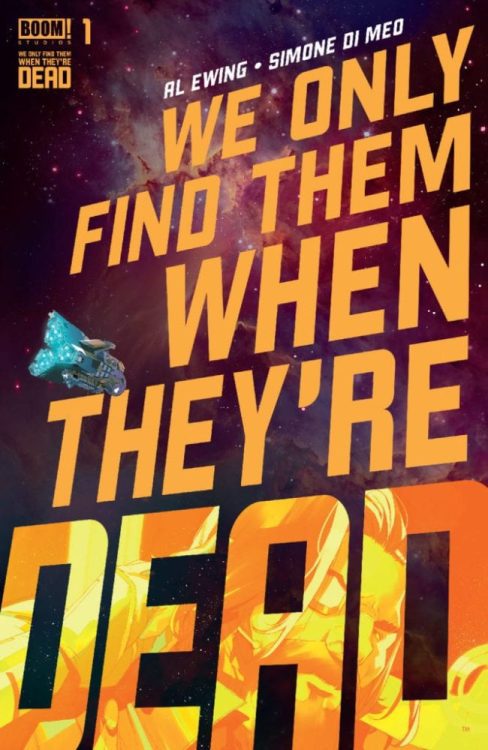
We Only Find Them When They’re Dead is a new science fiction series published by BOOM! Studios that tells a wondrous tale in a universe very unlike ours. Despite the difference in setting between the story and our own world, the characters are still relatable, and Al Ewing makes this happen through two very simple techniques.
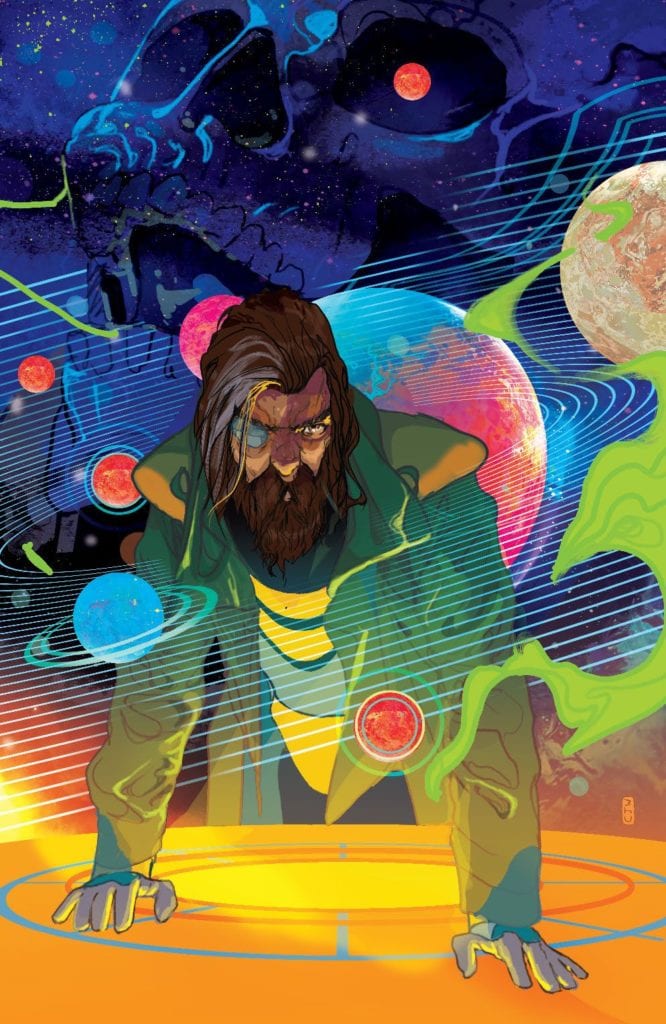
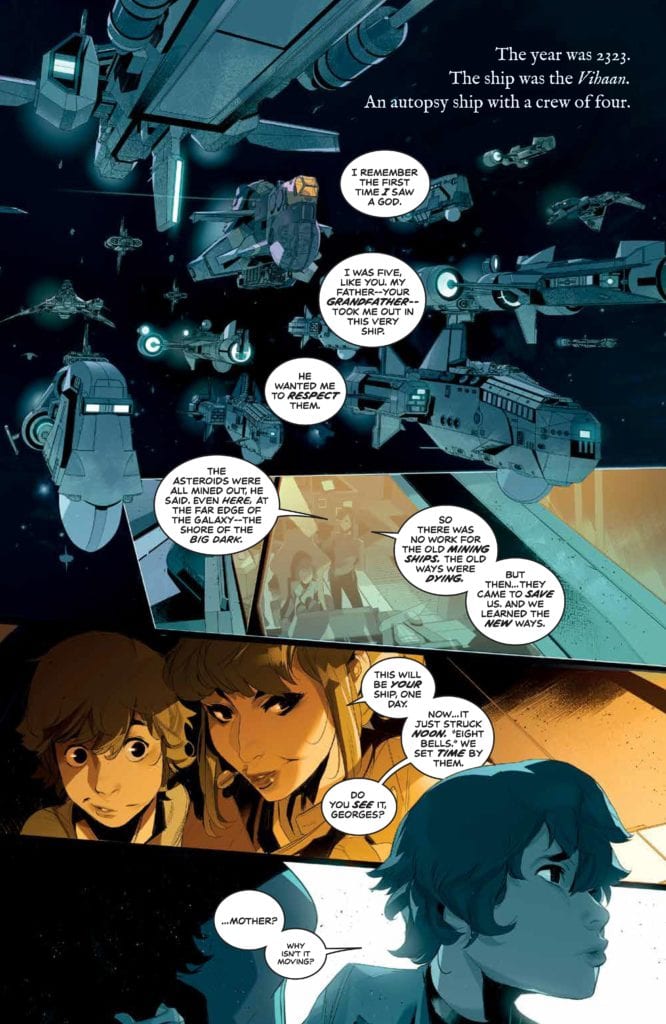
The writing of Al Ewing allows We Only Find Them When They’re Dead to have characters we relate to, but it would be a disservice to the book to neglect to mention the brilliant illustrations of Simone De Meo, the beautiful color assists of Mariasara Miotti, and the fantastic lettering of AndWorld Design. The first issue — out now — is gorgeous, and the fun cartoon-like feel of the art only adds to the adventurous nature of the main characters’ quest. The first issue is an incredibly fun journey into a world so imaginative and interesting that one would have a hard time not following the series after such an astonishing start.
In science fiction, not only are the creators allowed to flex their creative muscles as much as they would like, but the stakes in science fiction adventures can be higher than anything found in realistic fiction. This allows for some incredibly nerve-wracking scenarios, but this can be ruined without an emotional connection to the people that are in danger. Unfortunately, a significant error that many science fiction tales make is creating a group of characters that live such different lives that it is hard for anyone to relate to them. If their cultures and the way they express themselves are so different, it is challenging to develop an emotional attachment. There are many ways to circumvent this issue. If you go back and reexamine the science fiction movies, shows, books, or comic books that you like the most, you will almost surely see precautions taken by the writer that help make the characters relate to the audience. We Only Find Them When They’re Dead has Al Ewing responsible for making the characters able to empathize with, and he does this through character roles that we understand regardless of the time and through believable dialogue.
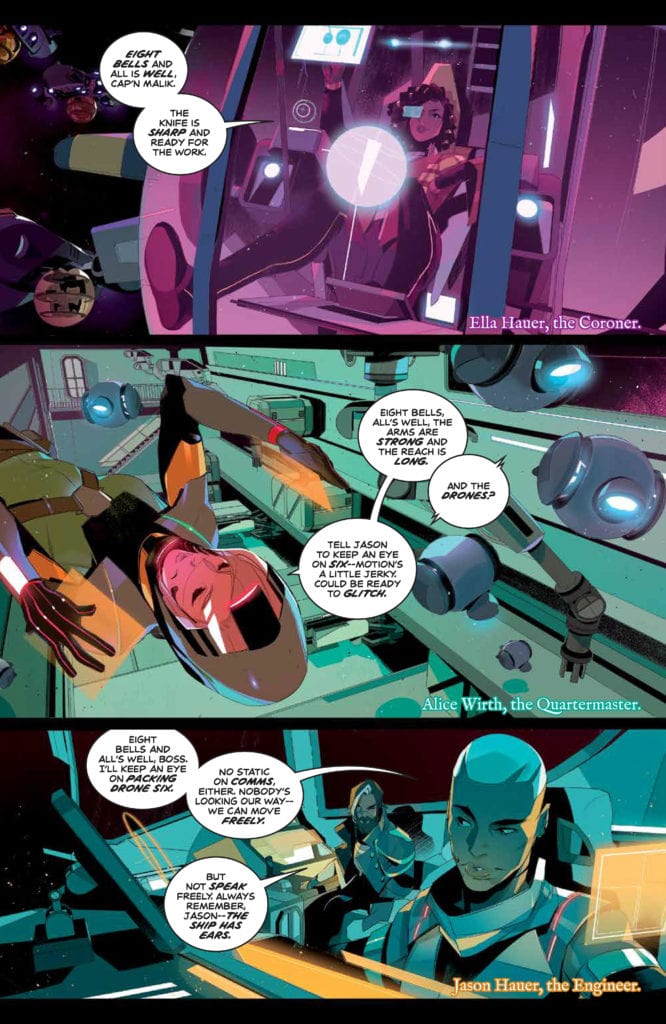
By giving the characters jobs and or roles that can be recognized regardless of the time they are set in, Al Ewing can make the characters of We Only Find Them When They’re Dead deeply relatable. This first issue features a slew of characters that all fall under the simple role of worker. Similar to the first Alien movie, the main cast of workers are performing highly futuristic tasks that may seem advanced to the reader, but are commonplace to the characters. Due to this, characters are relaxed as they perform their duties, and we can see that there is more to their personality than simply working. By having characters in this fantastic world fit a role that we are very familiar with, the characters remind us of construction workers, or oil rig operators, or any blue-collar people who operate complex machinery. This allows us to understand the characters more and thus become more emotionally invested in them.
We Only Find Them When They’re Dead #1 features some brilliant dialogue writing. The formal dialogue that a character has while speaking to a person of higher authority serves as a contrast to the casual dialogue they normally speak with. We see this with the captain of the autopsy ship, Georges Malik. While more formal than the other crew members, Georges still says things such as “Let’s get back to work, eh?” and “Oh, it’s quite simple, Jason.” We then also can see him speak more formally with someone from an escort ship — which seems to be some sort of law enforcement — which then highlights through contrast how relaxed he is around his crew. The rest of the crew have many lines of relaxed dialogue as they perform their duties, which — when paired with the casual body language — causes the cast of characters to seem more likable and relatable.
WE ONLY FIND THEM WHEN THEY’RE DEAD has an astonishing first issue with spectacular art and a story that quickly introduces us to relatable characters. The highly effective techniques used in the issue make it a deeply enjoyable read, as well as prove that Ewing knows what he is doing with this new science fiction saga. The art and lettering are wonderful complements, which can only mean that WE ONLY FIND THEM WHEN THEY’RE DEAD is sure to be an incredible reading experience for those willing to pick it up.
Are there other science fiction stories that you love the characters from? Let me know in the comments below!
Limbo is a new dark comedy film from Mark Young (Southern Gothic) about Jimmy, a murderer on trial and legendary actor Richard Riehle (Office Space, Star Trek) sits at the epicenter of the courtroom action that’s deciding on the fate of Jimmy’s eternal soul.
In the film, Lew Temple (Walker, Texas Ranger, The Walking Dead) plays Jimmy, a murderer, and maybe a good guy in awful circumstances. Jimmy’s on trial in Hell. Cassiel, played by Scottie Thompson (MacGyver, 12 Monkeys), is ready to defend Jimmy who she believes harbors some good. However, opposing that point of view is Lucian Charles Collier (Lords of Chaos) as Balthazar. In the middle of it all is Richard Riehle.
PopAxiom and Richard discussed the road to reaching 400+ IMDB credits, the roles he gets recognized for the most, and having fun in Limbo.
Enough Foolishness!
Richard Riehle grew up in Wisconsin. Being an actor wasn’t on the radar. “I was in my 4th year at college, and I couldn’t afford to stay any longer. A friend recommended I finish off my credits by taking speech and drama. So, I signed up for everything. I spent a semester living in the theatre basically, and I got my degree …”
After college, Richard “… ended up back in Wisconsin, unloading railroad ties. It was not the most pleasant way to spend a winter.”
A few professors encouraged Richard to head to grad school. Richard became part of the Notre Dame theatre community. “I was already doing all the technical stuff,” Richard says, “ but I auditioned and was cast for a new play.”
The play was the thesis of a young playwright. Richard explains, “… it was sort of a version of One Flew Over The Cuckoo’s Nest only it was set at Great Lakes Naval Hospital after the Korean war. An alcoholic sergeant was taking over the ward, and a nurse is trying to keep him in check.”
The play turned to a hit on campus “… people all over the school saw it. People started asking me about doing different roles, and suddenly I was doing all this acting.”
Richard needed more roles. “My advisor sent me to this theatre he used to work in outside of Detroit called Meadowbrook. I got some roles under my belt there.”
It’s said that all artists get a sense of “imposter syndrome” at some point in time. “I thought, ‘This is crazy. I barely have any training.’ But I decided to keep doing it until somebody says ‘Enough of this foolishness, get out there and make a living somewhere else.’ Knock on wood that no one’s said that so far.”
Boldly Going …
To date, Richard Riehle’s appeared on Star Trek as three different characters on three different series. The first was as Batai on the award-winning Next Generation episode “The Inner Light.” TV’s schedule back then didn’t “… give you much rehearsal time for working with other actors. While they would do changes on the set,” Richard says, “Patrick Stewart and I would take that time to talk about the characters.”
Richard next appeared on Star Trek: Voyager as Seamus, the lovable drunkard in two episodes centered around the holodeck town Fair Haven. “They had originally planned to use the holodeck town a few more times, but it never happened.”
During Star Trek: Enterprise, Richard returned to the 24th century as Dr. Jeremy Lucas in two more episodes. Richard explains his experience on Star Trek as simple as possible. “I loved working on Star Trek.”
About Limbo
Limbo is an indie film with a high comedy concept. How did Richard get the part of Philip? “It was interesting. I know the casting director. I’ve done several shows that she’s put me in. She said, ‘We’ve got this low budget film that’s interesting that you’d be great for. Can I send you the script?’”
Of course, Richard said yes and soon, “… read the script,” He says, “and it was so intriguing. The story of Limbo is great, but then to discover that it’s a sort of MacGuffin to what’s really going on.”
Richard’s character, he says, is, “ … so strange. He’s this minor demon there to do a stenographer job, and he’s having such a great time telling bad jokes and trying to lighten the mood.”
About writer-director Mark Young, Richard says, “… he’s terrific.”
Richard’s place in the Limbo story puts him at the center of supernatural courtroom drama. “It wasn’t until I started shooting that I realized I have this amazing front-row seat to all these actors taking their turn.”
Being An Actor
Actors come in all shapes and sizes, but also processes. Famously, Jim Carrey became Andy Kaufman 24/7 for Man on the Moon. Meanwhile, other actors turn characters off and on at will. For Richard, he says, “There are some roles that bleed over, and at the end of the day, I’d still have some of that energy.”
Richard continues, “I spent 20 some years doing theatre before any film or TV. When you’re doing the same show eight times a week and trying to keep it fresh, it’s much more technical, and you can’t live the character 24/7.”
For Richard, his process is simple to start. “I read scripts very carefully and figure out what’s trying to be said by the script. I look at the character and see what his purpose is in telling the story. Then I let myself be moved by the other actors and their characters.”
Aren’t You …
Richard’s in Star Trek, plays the unfortunate, but ultimately victorious Tom in Office Space, and strict father Walt Finnerty in Grounded For Life, among 100s of other memorable characters. Which one does he get recognized for most often? “… people do recognize me as Batai [from Star Trek]. The role I think I do get recognized for the most is Tom Smykowski from Office Space.”
Richard shares his experience of being recognized after having 400+ film and television roles. “I was doing a show in New York while I was in Grounded For Life. I noticed people recognizing me, and I found out that about 50 percent recognize me from Office Space. Another 10-15 percent would recognize me from whatever movie was playing on late night. Sometimes it was Joe Dirt or Jury Duty or The Fugitive. Immediately I knew what was on TV that week.”
Perhaps because he’s been in so many roles, Richard gets recognized for things he hasn’t done too. “Another 10 percent were sure that I was a teacher at their high school or worked at their local deli.”
Mainstream To Indie
It’s possible that Richard’s done it all as an actor. “I’ve done 15 Santas. I love doing it. One Christmas, I could be in Harold and Kumar as a bong-smoking Santa, and the next, it’s Santa with talking dogs.”
Richard’s gone from small stages to large ones and back again. Yet, he still looks for challenges. “That’s the interesting thing. About, oh, 15 years ago, I made a shift in the things that I was pursuing. Up until then, my agent would try to put me in bigger movies. When I see movies, I gravitate towards independent films because they’re usually fascinating ideas that someone spent a lot of time getting made. They have so much passion and energy to them.”
As one might expect, “It’s not cost-effective for agents to look at independent film,” Richard says, “But they got me auditions for three of them one summer. One was Palindromes by Todd Solondz; another was Mysterious Skin by Gregg Araki and Ken Park by Larry Clark.”
Richard earned some major indie movie cred. More importantly, he explains, “Each experience was 180 degrees different from the one before. Each of the characters was so totally the opposite of the others. They were all things I’d never done before. I said ‘This is what I want to be doing.’”
Wrapping Up
With such a long career and so many great actors, who does Richard hold dear as inspiration? “There’s a fellow by the name of Booth Colman who made a number of films. I did three or four plays with him back in Michigan, and it was amazing to watch him work. How he developed his character and how in the moment he was while performing. Murray Abraham, who I worked with in New York. It was incredible to work with him on stage and see him find new things to add to the role.”
Richard sends some love to his former sit-com family. “The whole gang from Ground For Life was wonderful.”
Limbo is out on a streaming service near you. So, what’s next? “It’s hard to say. There’s a movie called 30 Seconds In Hell, which they want to start shooting in September down in New Mexico. It’s sort of a re-telling of the gunfight at the OK Corral. They bring back all the dead participants from the fight, and they recreate who did what.”
Is Limbo on your watch list?
Thanks to Richard Riehle and October Coast
for making this interview possible.
Lonely Receiver #1 Cover Art Credit: AfterShock Comics
There are hundreds of comics released every month. Some have been going for years whereas others disappear into the night to be forgotten like a mid-series filler episode of Supergirl on CW. The ones that stand the test of time, that have a long run or become the much sought after comics, are the ones that have characters who resonate with the readers. These characters hit it off with the reader and instantly feel like a best friend, or old friend that you can’t escape. They are not always the nicest person in the world but have a depth of personality that makes them more relatable. After-all, no-one is perfect.
Most people who pick up a Marvel or DC superhero comic will most likely know something about the characters in the comic before they even open it up. Spider-Man, Batman, or even a lower tier character like Jessica Jones, tend to attract new readers from elsewhere; either movies, television shows, or other comics. Introductions are therefore slim, if present at all.
With new comics and brand new characters, it’s a different kettle of fish. The creators have to pull the reader into their world in the first few pages by presenting an exciting story, an intriguing world, and most importantly, a relatable central character. It’s not an easy task and one that faces all of the creators working with AfterShock Comics.
AfterShock’s brand revolves around new, exciting projects and they don’t have a backlog of characters to draw from. Instead the creators have to start from scratch and build the character in front of the reader, making sure that they have enough personality and intrigue to make the reader come back month after month. So, how do they do it? Let’s look at the first issue of Lonely Receiver to see how Zac Thompson and Jen Hickman literally build the character from the ground up.
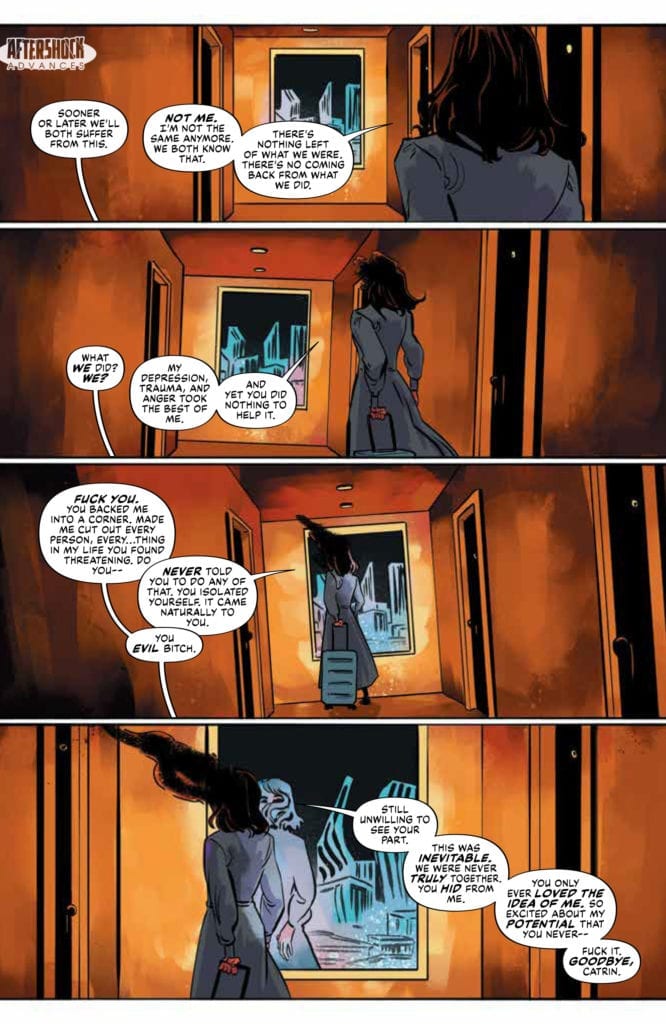
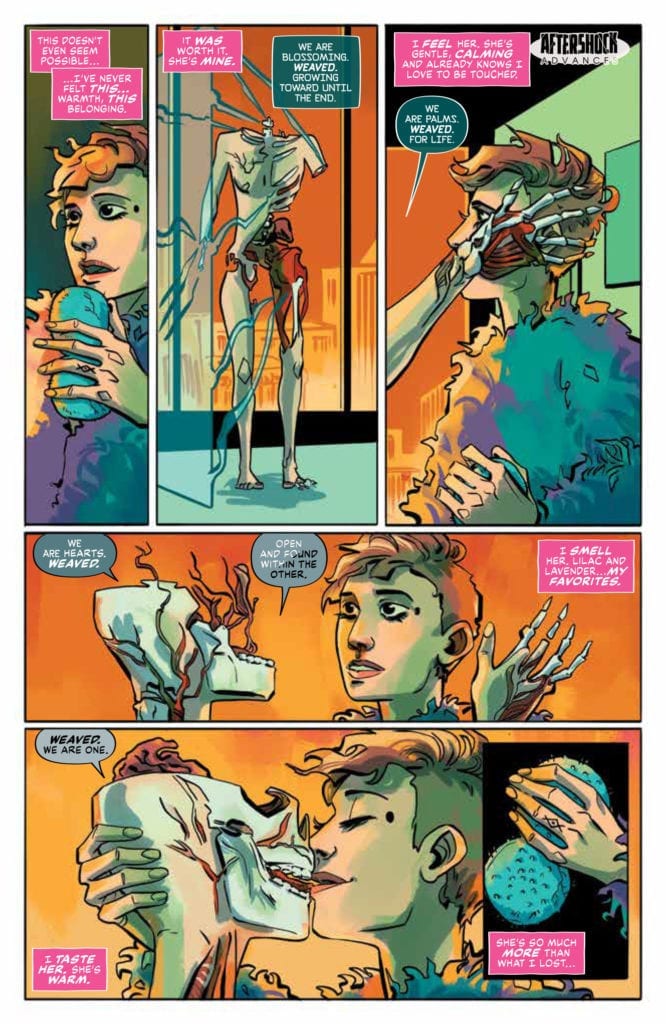
The story opens with a character leaving. As a reader we watch her walk away, arguing with another character who is out of shot. The placement of the word balloons, with their tails leading off the bottom of the panels, makes it feel like the argument is with us, the reader. Thompson’s deliberately non-specific script combined with Simon Bowland’s cleverly placed speech balloons change us from observer to active participant. Within the first page we have been brought into the story on a very personal level.
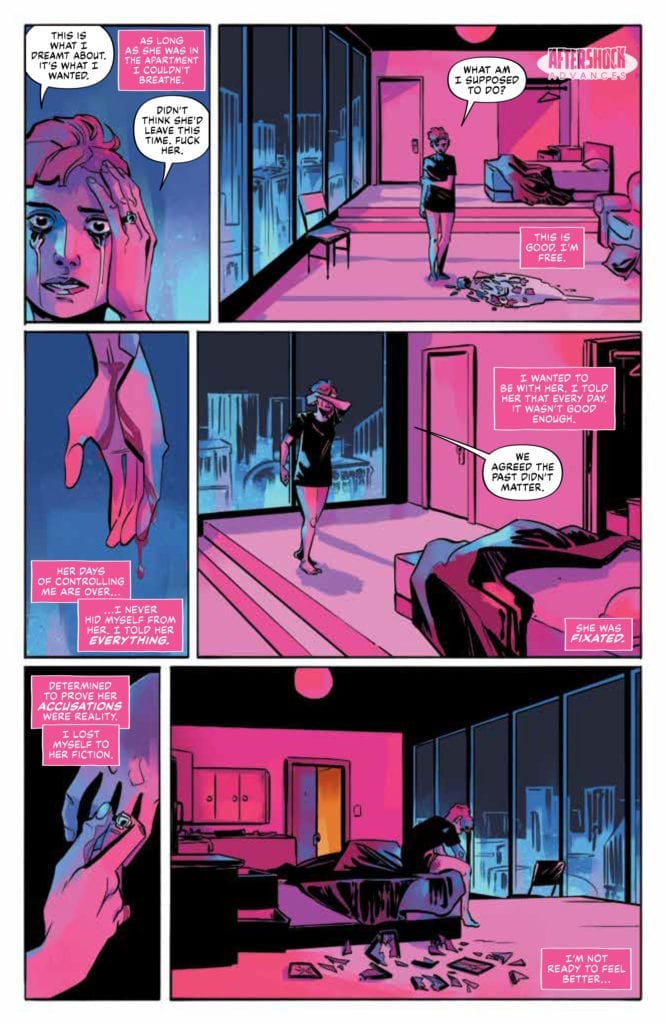
This means that when we turn the page and see our heroine for the first time, we already have a connection with her. We’ve been a part of her breakup and have been forced to share those difficult emotions with her. A page of grief follows, cementing the emotional bond between character and reader. Images of pain and loneliness accompany a voice-over of desperate defiance.
Artist, Jen Hickman, splits the second page into six panels. On the left, leading down the page, are close up images that represent the pain and loss that the character is going through: a tear streaked face, blood running from a cut wrist, and the removal of personal jewellery. On the right of the page, the larger panels represent the loneliness and space left by the breakup. Hickman uses long shots to show the vast, empty apartment. Catrin becomes lost in the space, surrounded by flat fields lacking any detail. Hickman washes the page in icy blues and cool pinks. The visual impression mirrors the narrative that Thompson has already forced the reader to endure.
The strong emotional context creates immediate empathy and is something that everyone can relate to on some level. Reader and character are bound by grief.
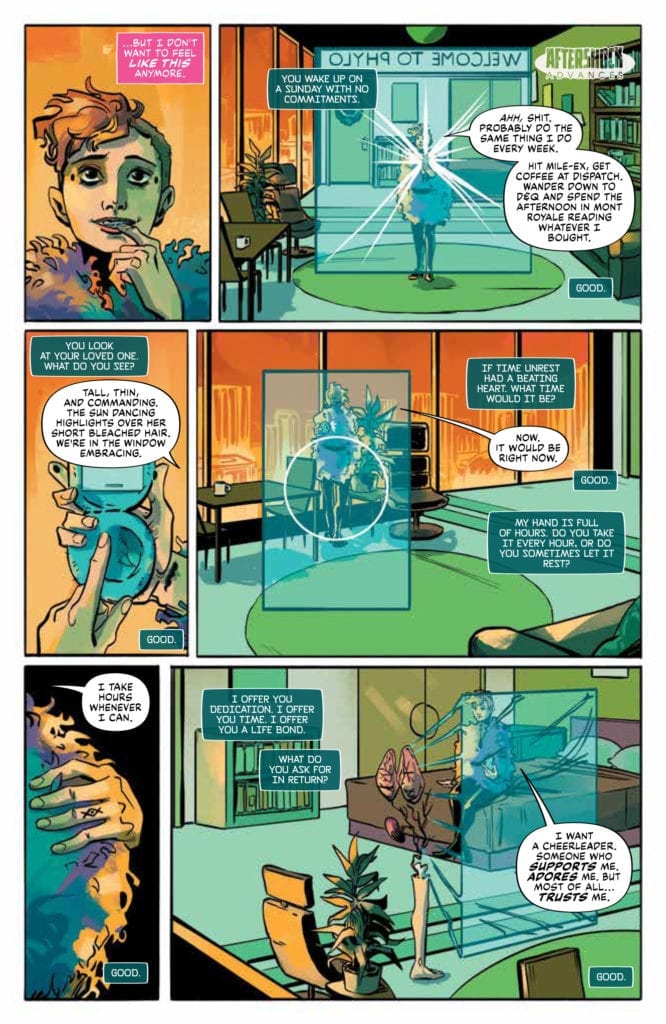
The second page turn gives the reader a different experience. The third page of the comic has a completely different feel, with a warming sensation smiling out from the first panel. Thompson introduces Catrin at her lowest and then builds her up, taking the reader along for the ride.
In order to enforce the turn around in emotions Hickman uses the exact same layout on page 3 as she did on the previous page, even copying the view points almost beat for beat. Only the final panel on the page has a different angle. At rock bottom Catrin was hunched, facing away from the reader, whereas at the start of her new life she sits upright, looking towards us.
The three left panels contrast the previous page, featuring the same close ups but with different emotional connotations. The first panel has a close up of Catrin, this time smiling with a hint of excitement. The second panel focuses on her hands, busy with her mobile phone. This shot serves two functions; firstly it draws the reader’s attention to the mobile device which becomes central to Catrin’s new obsession; and secondly it shows the scar on her wrist. The mark relates to the previous page and shows that Catrin is healing. Time has passed and she is moving on with her life. The third panel on the left again focuses on Catrin’s personal belongings, this time a fluffy coat that is wrapped around her. It is representative of her new life, symbolised by new objects of desire and obsession.
These two pages, identical in layout, show the reader Catrin at her worst and her best. The contrast in color and the comparable panels allow the audience to experience the characters life on a very personal level. For example, note the difference in backgrounds on between the pages in panels two, four and six. Page two is empty while page three is busy and bursting with life. Meanwhile, the overlaying speech relays further information about Catrin’s wants and desires. On page two the script focuses on Catrin’s loss, her past, whereas page three is full of her hopes and dreams.
Catrin is the central character but she needs a foil, another character who acts as a catalyst for the story. Enter Rhion. Rhion is a physical representation of the personality constructed by Catrin on her PHYLO X11 mobile phone. The interaction between Catrin and Rhion are central to the narrative and in order for the story to flow the reader has to understand their relationship. Thompson achieves this by focusing the majority of this issue on their time together. He gives the reader their entire relationship, every good and bad aspect, mental and physical interaction. By the end the audience feels as though they have experienced the relationship just as they experienced Catrin’s breakup on the first page.
For the experience to work, Rhion has to be as fully formed a character as Catrin. Thompson and Hickman have already proved they can create a character’s personality in two pages. With Rhion they go one step further. They literally show her being constructed from the inside out. As she is built to Catrin’s requirements, the creators again use voice-over to give the reader a deeper insight into the character’s personality.
We are also shown the transition from idea to reality through the speech balloons. Bowland changes the color of the font as Rhion’s construction is complete, switching from black to white. He also slowly changes the color of the balloon symbolising the transition from machine to person.
Page four starts and ends with a panel prominently featuring the mobile device in order to remind the reader where Rhion comes from. This is important because after the page turn, onto page five, Rhion is fully complete and the relationship between the two women appears like any other relationship. It is not until later in the issue that Rhion’s origin plays a part and by then the reader is completely committed to the character’s and their relationship.
Lonely Receiver is about the building and breaking of a relationship that includes a dramatic twist at the end. It is a science-fiction horror story that relies heavily on the reader’s connection to the central characters. For the narrative to be believable, and provide the shocking elements successfully, it is imperative that Thompson and Co. draw the audience into their world completely. They do this by making the reader connect instantly with their lead characters.
Across five pages, the creators build and portray the relationship between two fully formed characters in recognisable terms, despite the futuristic way that one of the characters is introduced. The opening pages bind reader and character together by being rich in personality and emotional symbolism. Lonely Receiver creates a narrative version of ‘love at first sight’. We instantly connect with Catrin and Rhion and not only do we become friends, but it feels like we have know them all our lives.
AfterShock Comics are not beholden to a particular genre, although they do favour mature and cerebral stories, but one element that unites their output is Strong Central Characters. Comics like Undone by Blood and Disaster Inc. are very different narratively but they succeed because of the characters that the writers and artists have created. Lonely Receiver by Zac Thompson, Jen Hickman, and Simon Bowland is a prime example of superb character building where the reader becomes emotionally attached to the central cast and, as a result, committed to the story.
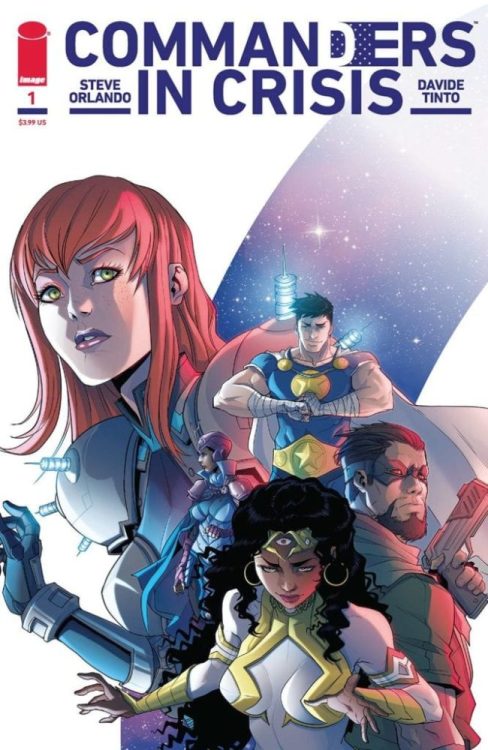
On October 14, Image Comics releases Commanders in Crisis #1 from superstar writer Steve Orlando and artist Davide Tinto. They are joined by colorist Francesca Carotenuto and letterer Fabio Amelia in a story that stretches from the streets of Philadelphia to the halls of power in D.C. to the very fabric of reality itself!
Writing
Orlando has given himself a gargantuan sized task in his first issue. He has to create brand new characters, make readers care about the characters, and establish the cosmology of the world. Commanders in Crisis #1 is pretty ambitious and plays off of past Crisis-tropes from DC Comics in a way that would read like parody if it wasn’t for the fact that Orlando and company seem to be using it to craft a relevant social message for our time. A message of hope, empathy, and the consequences of our present actions on the future.
While this first issue is a little heavy in exposition, which makes the dialogue a bit clunky at times, Orlando establishes the characters, his or her motivations, as well as their backgrounds, laying a clear groundwork for the series. If future issues can avoid being overly exposition-heavy, this has the potential to become a very solid series.
Another danger this series may face is being a bit “on the nose” with its moral and political messaging. If it can be nuanced without being preachy, this could be a very profound series.
Art & Colors
Co-creator Davide’s artistic powers are on display in this issue. Davide can capture the bombastic action in this issue, and there is a fair share of furious action. He is able to capture the movement and motions of the characters well in a very busy issue.
Davide also portrays the emotions of the characters well. Readers meet a lot of new characters in this issue, and it would be very easy for an artist to phone it in when it comes to the facial expressions of multiple characters, but Davide spares no details and draws characters whose faces exude personality.
Davide and Orlando have created characters with unique power sets, and Davide highlights his skills by drawing some very abstract sounding powers. He is, of course, joined in this endeavor by Carotenuto, whose colors assist in portraying the various characters’ abilities.
Carotenuto’s colors are bright and almost shiny in certain places, adding some shading and shadows that make this a lovely book to read.
Letters
Amelia’s letters are quite serviceable in this issue. The sound effects and intros for the characters are nicely stylized, particularly one character’s dialogue, which is uniquely colored when she uses her power. The dialogue is also easy to follow. As noted earlier, there is a lot of expositional dialogue in this issue, but Amelia’s letters never make any of the pages look overcrowded.
Conclusion
Fans of DC Comics crisis events should love Commanders in Crisis #1. It is a pastiche of DC’s crisis stories, which takes those concepts in some potentially unique directions. Morrison fans especially should love what Orlando, Davide, and company are doing in this issue. This story touches on the importance of hope, empathy, and the consequences of allowing those things to disappear from public discourse. I’ll definitely be checking out issue #2!
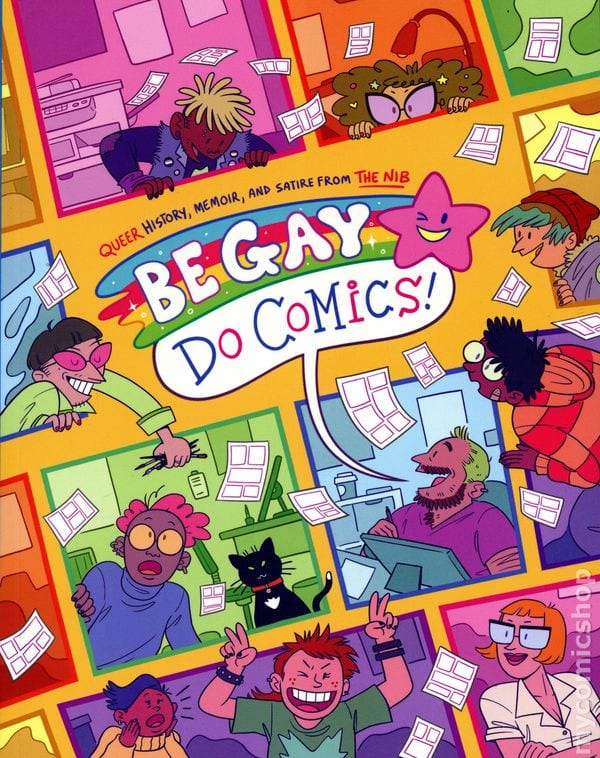
Available now, Be Gay, Do Comics, is the queer anthology you didn’t know you needed. A partnership between The Nib and IDW, the book features stories from forty different contributors, edited together by Matt Bors, Eleri Harris and Matt Lubchansky, Sarah Mirk, and Andy Warner.
Like many pieces of media released this year, this book unintentionally satisfies an emotional need. Because of COVID-19, Pride month didn’t happen as usual. Instead of the typical in-person fun, community-engaging celebrations, everything was relegated to socially-distant internet hangs. Be Gay, Do Comics brings the celebration to you, giving each individual the chance to learn history and empathize with personal stories from diverse creators.
The anthology’s artistic through-line is its cartoonish style, especially in the way people are drawn. Colors are bold and bright, and facial features are unrealistic. Choosing cartoon style over realism makes the book more accessible.
Dimensions
However, that doesn’t mean the stories themselves are cartoonish, two-dimensional narratives. Cartoon style seems to give the creator emotional distance from their personal narrative. This then allows them to capture the essential beats of their story.
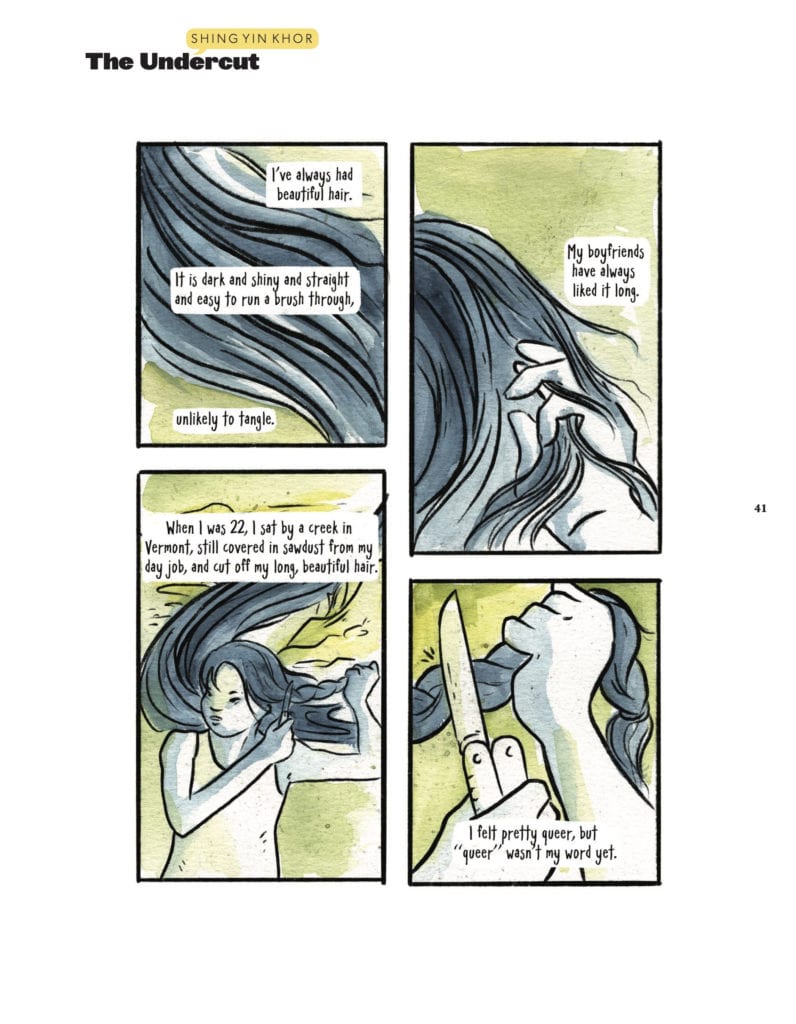
For example, in Shing Yin Khor’s story “The Undercut,” they combine a cartoon-like drawing of self with watercolor and poetic narration. The combination shows how we objectify ourselves, honing in on hair as a sign of identity. Lettering that looks like handwriting adds to the sense of intimacy and introspection the lyrical narration provides.
Shing Yin Khor tries a new haircut.
Moreover, the same principals apply to the historical stories. In the case of “The Wonderfully Queer World of Moomin” by Mady G, the style is borrowed from the Finnish “Moomin” comic strips by Tove Jansson. Pastel colors and the particular cartoon style of Jansson’s characters lend a sense of whimsy to the story.
Balancing whimsy and emotional intimacy through cartoonish art ensures the book’s accessibility. So we can all have respite and time to reflect on this stressful year. But for LGBTQIA folks, Be Gay, Do Comics hits differently given that queer folk’s increased risk of contracting COVID. If you weren’t satisfied with Pride this year, this book just might help you feel a little less alone.