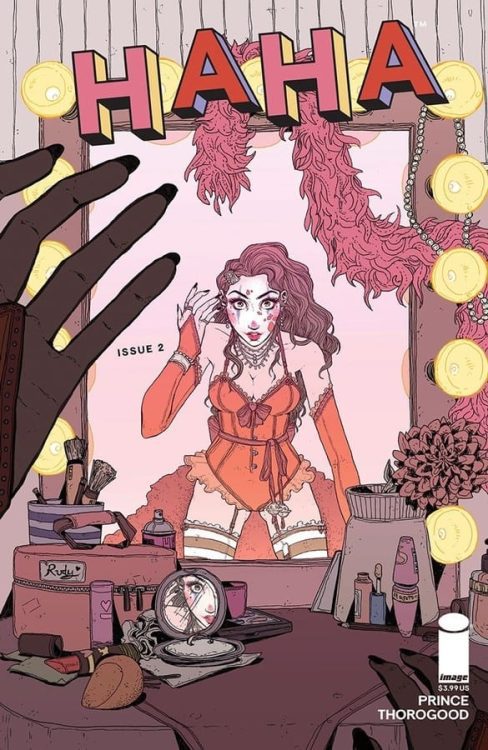
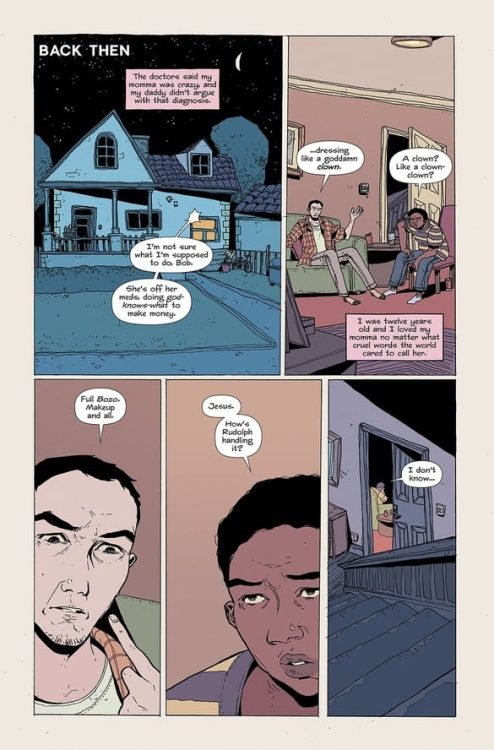
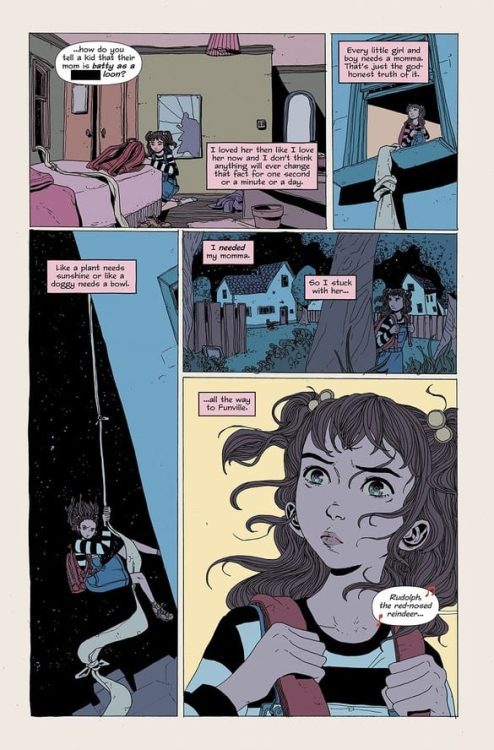
HAHA #2 hits comic book stores on Wednesday, February 17th, continuing W. Maxwell Prince’s take on clown life. This issue hones in on a performer named Rudolph—a young woman who seems less than enthusiastic about putting on a show. But as readers will learn, her present predicament is a direct result of another person’s experiences. Her identity has been forged by her mother’s life.
Story
Much like W. Maxwell Prince’s classic works, such as the Ice Cream Man series, each issue appears to be its own standalone story. This issue tells the story of Rudolph’s childhood and the way her life changed once her mother was deemed “crazy.”
But is dressing up as a clown and doing what makes one happy classify them as “crazy?” The issue doesn’t give a direct answer, but leaves the interpretation up to the reader. They’re able to live vicariously through Rudolph as they determine whether her mother is actually off her rocker or has tapped into something more.
One of the brilliant pieces of this issue shows itself when Rudolph’s mom reveals their destination: Funland. Readers will remember this as the amusement park from the previous issue worked as a clown. By choosing this setting, Prince connects this world to his other seemingly unrelated stories, which makes us wonder what unifying element could be tying them together.
Artwork
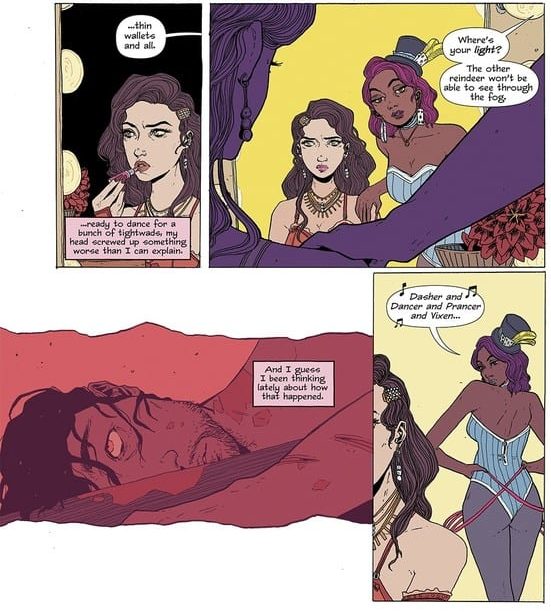
Zoe Thorogood’s penciling and ink work, Chris O’Halloran’s coloring, and Good Old Neon’s lettering worked well together in this issue. The characters and scenes appear to be drawn with slight squiggles in their outlines, adding to the slightly eerie nature of this story. These illustrations are fleshed out with traditional circus-esque colors to set the issue’s tone further. We also enjoyed the narration word balloons, which were colored pink to both go with the clown theme and represent the innocence of young Rudolph.
Conclusion
HAHA #2 is a sobering tale of the absurdities in life—both in its many obstacles and our own ways of fighting them. We’re excited to see how the next issue connects with Funland in its own way.
Do you see any other elements tying this story to the first issue? Let us know in the comments below!
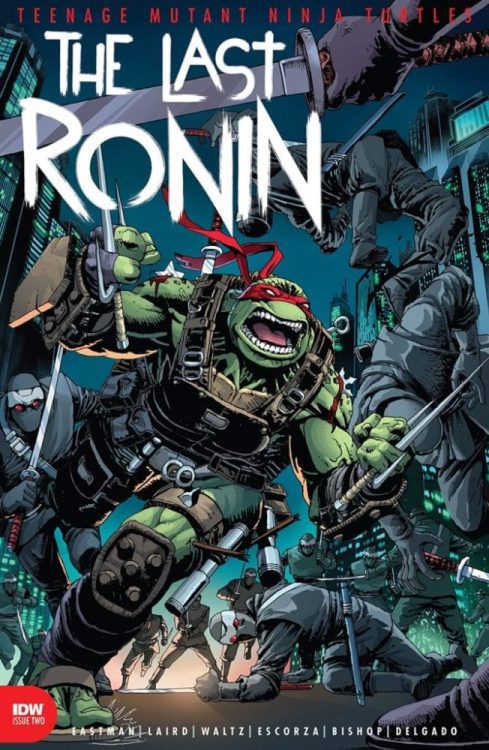
TEENAGE MUTANT NINJA TURTLES: THE LAST RONIN #2, the highly anticipated second installment of the ambitious series, hits stores on Wednesday, February 17th. Readers learned the ninja protagonist was in fact Michelangelo. But before we see what happened to his brothers, the seasoned warrior falls from a building while searching for the mysterious Hiroto. Mikey believed he was done for and attempted to die a warriors death, but someone saved him. And they may be connected to the legendary April O’Neil.
Story
An aged version of April awakes in her apartment in the first panels of this story. The reader watches as she experiences a vivid flashback of a night many years ago. In it the Foot Clan attacks Splinter and the turtles, leaving the elderly rat severely wounded.
The flashbacks soon shift to the present version of Mikey recovering in April’s home. He continues his conversation with his deceased brothers, which starts out quite peaceful. But a rage soon boils over in the ninja much like the heated tea kettle he set. It’s clear Mikey still struggles to forgive Raphael for his “hot-headedness.” His actions on the night of the Foot Clan’s attack were the last straw, and they’re laid out for readers in stunning detail.
Kevin Eastman, Peter Laird, and Tom Waltz’s narrative offers amazing characterization for Mikey. Rather than leaving readers wondering how he changed so much, they show us the life experiences, choices, and memories of his brothers that led him on a new path. What’s more, we learn what’s become of April and the mysterious figure who’s been assisting her.
Artwork
Eastman, Esau Escorza, and Isaac Escorza’s penciling and ink work did a fantastic job of crafting scenes of both the past and present versions of our protagonists. Penciled lines of age are present on both April and Mikey, while their flashback selves are drawn using smoother styles. Samuel Plata and Luis Antonio Delgado’s coloring work helped differentiate between the flashbacks and present reality by adding faint tannish tones to the memory scenes, generating a feeling of feeling of haziness due to their spot in the distant past. We also enjoyed Shawn Lee’s lettering, which shifts seamlessly between each character’s internal dialogue through varied word balloon colors.
Conclusion
TEENAGE MUTANT NINJA TURTLES: THE LAST RONIN #2 simultaneously answers many of our questions from issue #1 while posing an onslaught of new queries. We are anxious to learn more about what led to the present state of Mikey and April’s world.
Are you excited about Mikey’s reunion with April? Let us know in the comments below!
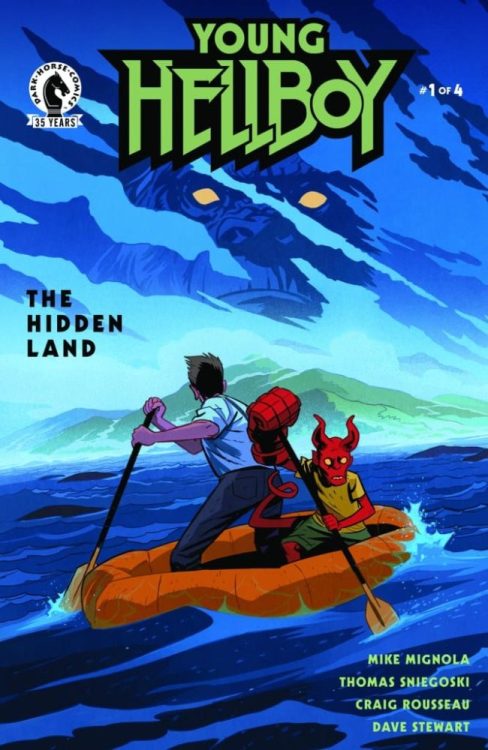
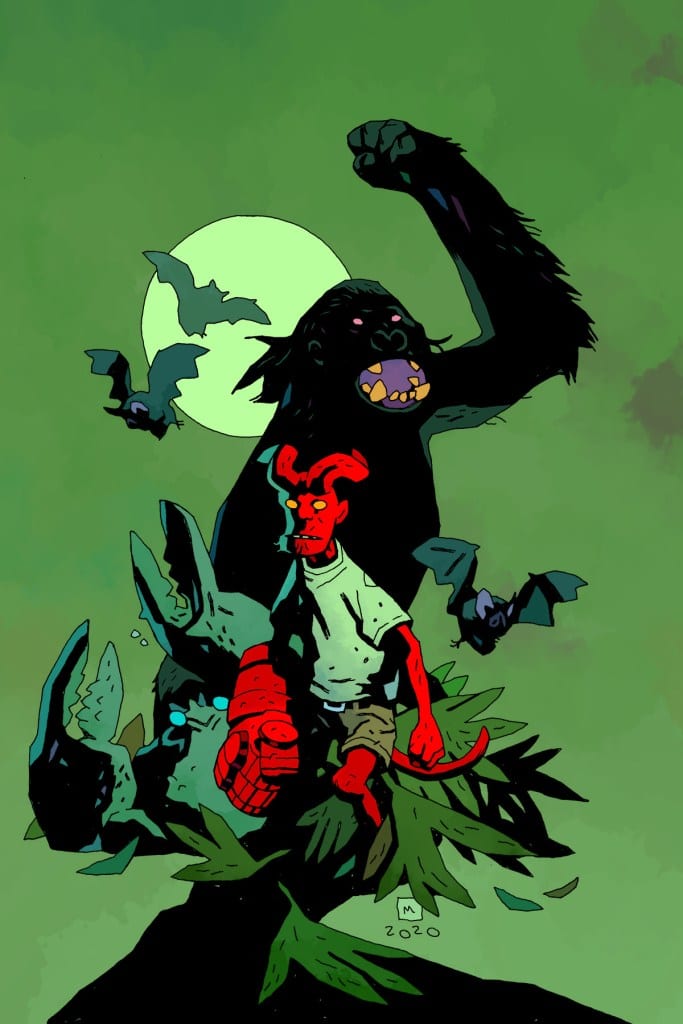
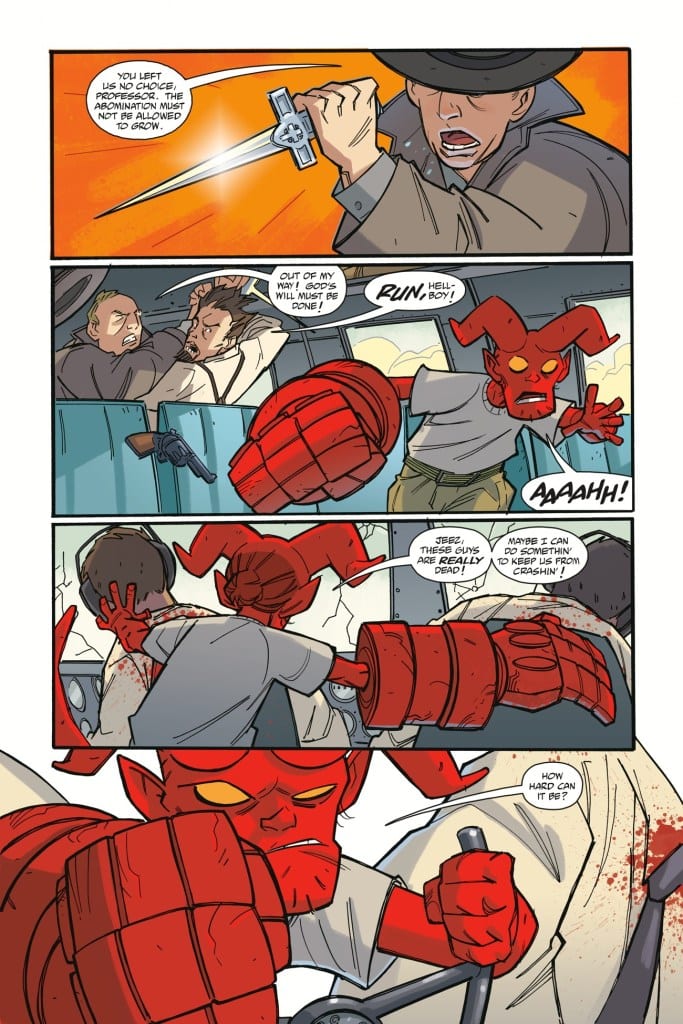
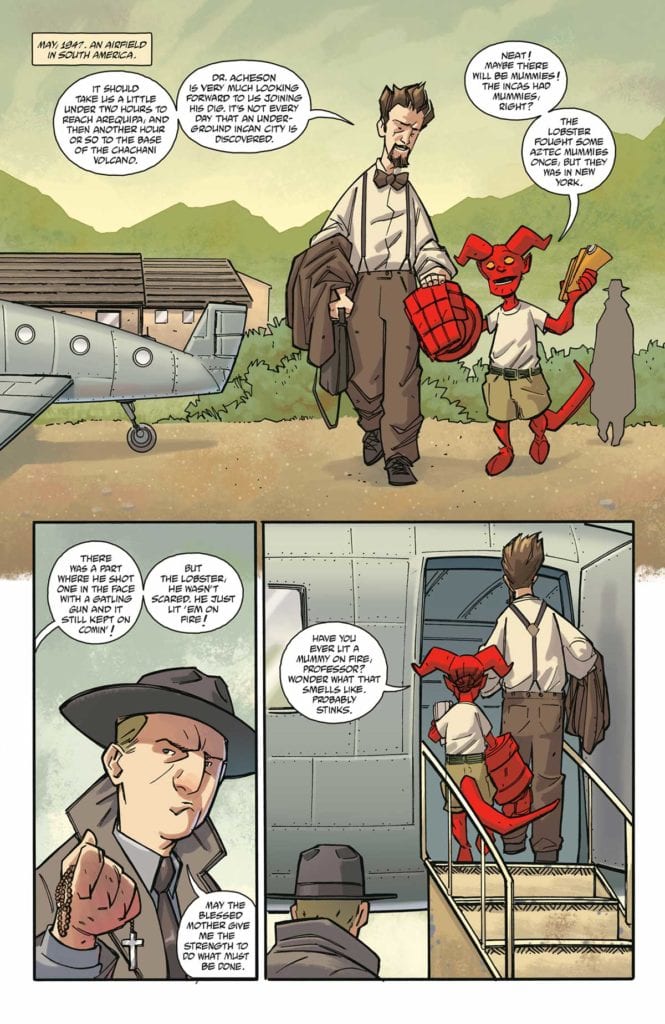
The Hellboy universe is already known for its wide array of adventure genres, from haunted house ghost stories to good ol’ Kaiju beat ’em ups. However, one thing I don’t think I’ve ever seen this series do is a classic Land of the Lost style prehistoric island tale. This is exactly what we get with “Young Hellboy: The Hidden Land” #1. This first of a four issue mini-series by writers Mike Mignola and Thomas Sniegoski, artist Craig Rosseau, colorist Dave Stewart, and letterer Clem Robins has all the making of a fun dinosaur and monster-filled adventure tale, but with the added twist of the Hellboy mythology and the complications that arise from his presence. With a tightly paced and sharp script, as well as great visual work, this is just the sort of Hellboy as a young lad story I didn’t know I needed.
“Stranded on a strange island after a mishap on their way to a South American dig site, Hellboy and Professor Bruttenholm are confronted by all manner of monsters! But even when the stranger who rescues them turns out to be one of Hellboy’s heroes, they aren’t as safe as they think they are!”
Writing & Plot
The script from Hellboy creator and vanguard of this universe Mike Mignola and his cowriter Thomas Sniegoski is one of simplicity, focused on being a fun adventure romp. The perspective of big Red when he was still just a inquisitive kid bugging his old man is a fun and refreshing take we don’t often get in the Hellboy universe. In fact, many of the interactions we get in Hellboy and the B.P.R.D. stories that involve young HB and his adoptive father Professor Bruttenholm are ones where the latter is too busy for his charge. Seeing the two together is a great thing on its own, and the environment that they are placed in is even more of a bonus. This comic is a big tribute to classic mysterious island adventure stories of old, which can trace their lineage back to early 20th century young boys’ novels and golden/silver age adventure comics. Crashing on a land full of oversized crabs, dinosaurs, and irritable apes is a classic trope familiar to the adventure genre, but one that never seems to go out of style. This comic offers up every one of those lovable tropes, but with the twists involved with Hellboy as a character and the world he inhabits. The dialogue is simplistic and fun, with most of it consisting of young HB asking tons of questions (as kids do) and making loud exclamations. This isn’t the kind of comic book that’s going tp blow you away, but it’s certainly fun enough to keep you engaged from start to finish, whether you’re a Hellboy fan or just someone who likes a good adventure.
Art Direction
The Hellboy universe is especially well-known for its uncanny artwork, mostly because of the signature style of the legendary Mike Mignola. Any book that comes out as a part of this universe has to in some way math the sort of strange and eerie aesthetic that this universe demands. What’s special about “Young Hellboy” #1 is how penciler Craig Rosseau and colorist Dave Stewart manage to achieve this effect while also creating an uncharacteristically bright adventure for this universe. Rosseau’s pencils utilize the same sort of thick and shadow-heavy style that resembles Mignola and other Hellboy artists, while still maintaining a kind of distance from those other works. The look of the characters and the monsters that arrive in this comic undoubtedly have that Mignola-esque look to them, but there’s a kind of youthful light that isn’t there in the other Hellboy and B.P.R.D. books…and not just because this is a young HB. Now, much of this is due to Dave Stewart’s choice of colors. Every surface in this comic is drenched in sunshine, and I can’t help but feel that a lot of that light comes from how Stewart chooses to demonstrate how our young Agent Hellboy affects the people around him and the story as a whole. The enjoyment we get out of reading this character, decades before the tumultuous events leading to the end of his story some 70 years later, is made into a visual experience by how bright and vivid this book is. The darkly saturated colors of the older Hellboy stories and that of the B.P.R.D. and other tales in this universe are directly juxtaposed to this youthful adventure comic. The lettering from Clem Robins shares its fonts with basically every other book in this universe,, including its sound effects. Would we really want it any other way, though?
“Young Hellboy: The Hidden Land” #1 is a delightful start to this adventure mini-series. Thomas Sniegoski, with help from universe creator Mike Mignola, puts together a stellar yet simple homage to lost island adventure stories of decades past, but with the twists that come with the inclusion of a young and energetic Hellboy. The visuals of Craing Rosseau and Dave Stewart blend in seamlessly with the overall aesthetic of the rest of the Hellboy Universe, but manage to have a brighter look due that matches this comic’s focus. Whether you’re a diehard Hellboy fan or a fan a good adventure stories, be sure to pick this issue up when it hits shelves on 2-17!
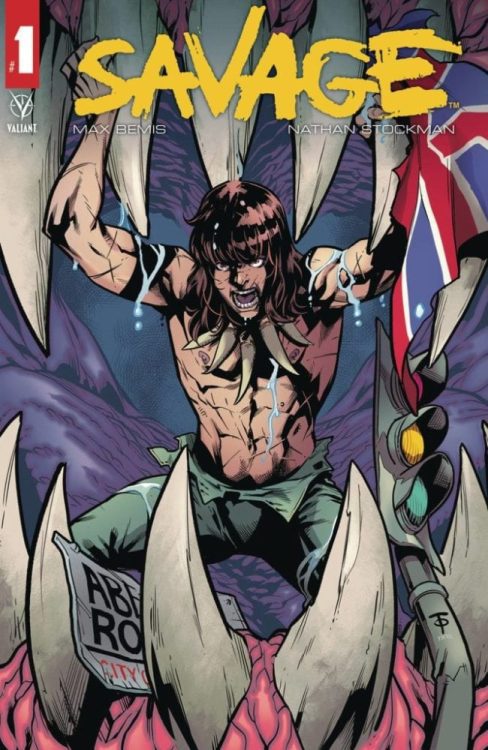
Savage #1 begins a new series from Valiant Entertainment on February 17. Continuing the adventures of the titular character, writer Max Bemis throws him into modern London as an influencer. Only for the art by Nathan Stockman to showcase how Savage’s wild movements are a commodification. A bunch of frustrations and pent-up energy explode onto the scene in this grand opener.
Background
Savage follows Kevin Sauvage Jr., son of wealthy British socialites, who crash land onto a mysterious island full of dinosaurs. After surviving the island and violent marauders, this modern-day Tarzan ends up in London under the care of his siblings.
Savage #1: Repurposing The Natural
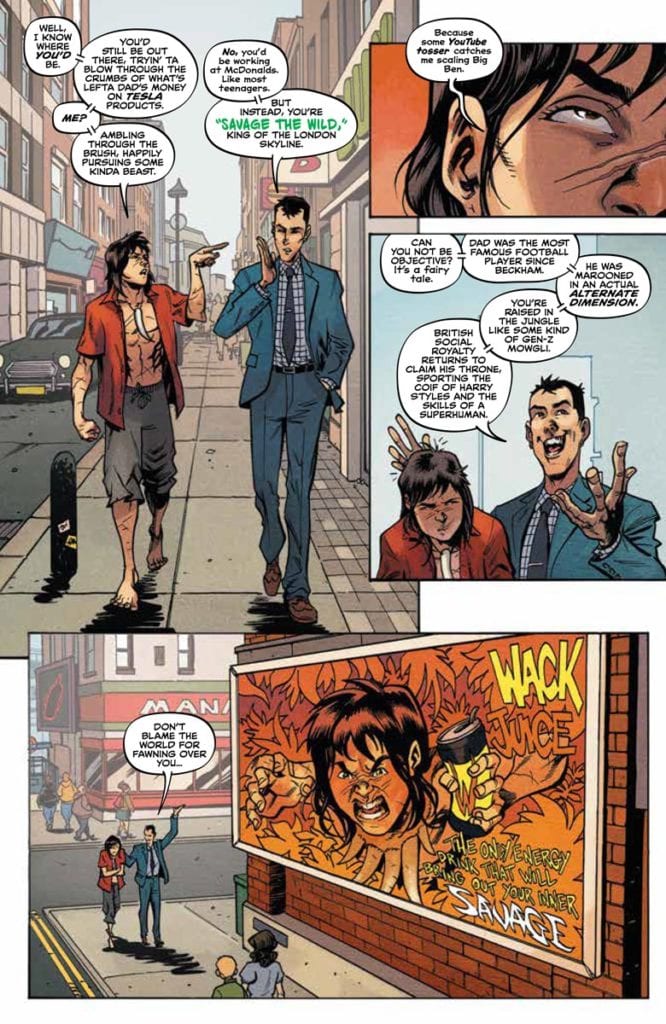
Savage #1 wastes no time by making a fish-out-of-water scenario for the hero. Bemis takes a modern approach by making Kevin an influencer. With Kevin’s opportunistic brother, Henry, wasting no time in publicizing/monetizing him, Kevin is everywhere.
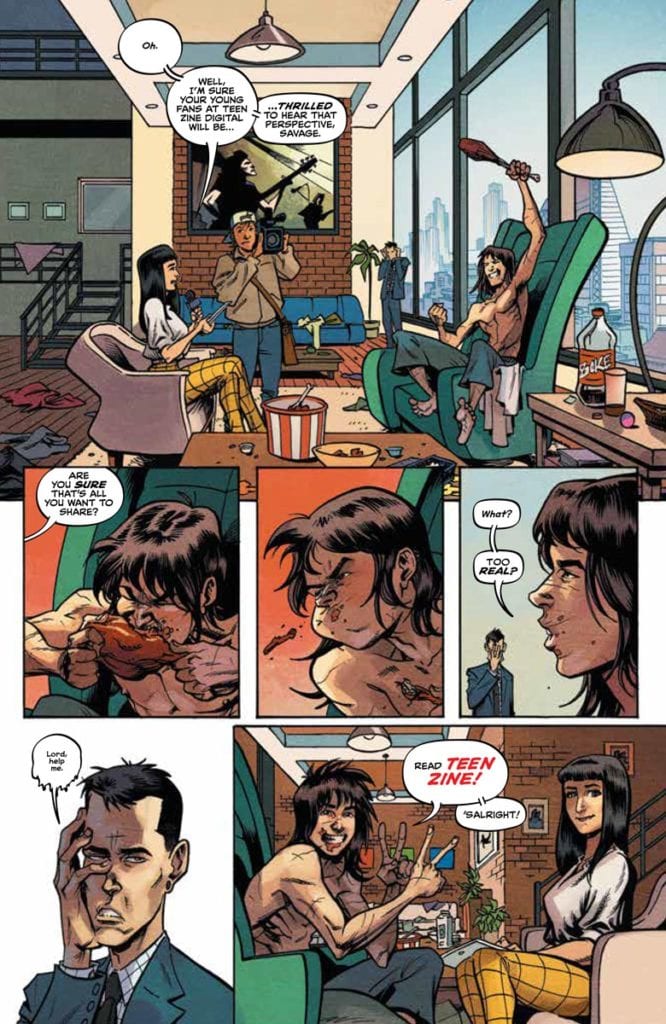
With real-life social media influencers being a topic of interest, this series goes into what makes them attention-worthy. Consumers always look for the most exotic and relatable mindsets because applying somebody’s out-of-box thinking to their everyday lives can be a welcome change. While nobody expects to face dinosaurs in their time, Savage’s thought process of keeping an active mind is universal with the right words. It is what makes Kevin aware of the wider implications of celebrity life in Savage #1. The phrases to say and the interactions with people like autographs are something Kevin understands; it just doesn’t satisfy him. Because by all accounts, Savage and the reader feel how inauthentic the ads are.
The Wild Instinct
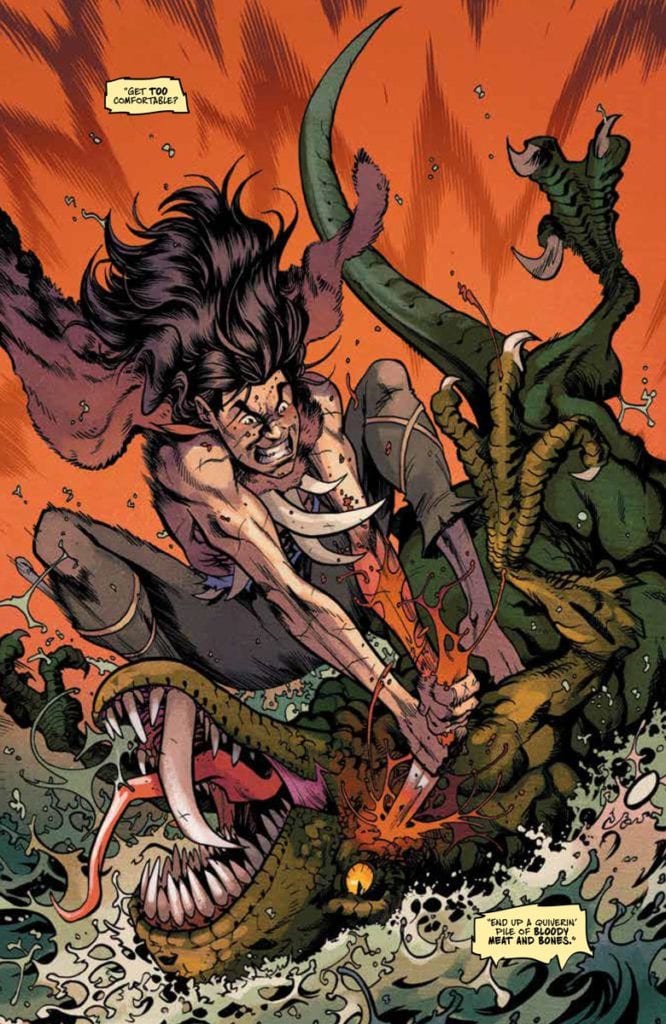
Stockman brings this feeling out in the body language of Savage. Throughout the first half of Savage #1, Kevin mentally struggles with his celebrity life. The orderly way feels too constraining on him, unlike when he explains his way of thinking with extended limb movements. It’s a feeling of authenticity that people try to recreate for advertising, but for Kevin, the attempts are just as scripted as everything else. So with the reader sharing this feeling of not seeing the real thing when these wild and exaggerated movements come out during a dinosaur attack, it’s a strong liberating sensation.
The colors by Tríona Farrell serve as a good foil for Savage’s mindset and desires. In most panels where he’s up close, there is a red background that displays Kevin’s aggression. So when dinosaurs are attacking London’s people, this red lightens to an orange color. Unlike before, this signifies that despite being able to go “Savage,” Kevin’s mindset is to protect people instead of taking his anger out on the dinosaurs. It’s what makes me want to root for him.
Letterer Hassan Otsmane-Elhaou emphasizes the difference between scripted dialogue and instinct in Savage #1. In many instances where people say things in a small font, it feels like a natural reaction. As one of the choreographers’ notes within a panel indirectly notes, there’s no emotion or boldness in what people are saying to the point of displaying that in bold words. When people speak in colored words, there is a real sense of emotion and passion that the reader will hook onto.
Follow/Subscribe To Savage #1
Savage #1 is only the beginning of Valiant’s newest character. The life of a feral social media influencer certainly looks enticing. But it’s how the reader can genuinely connect and relate to Kevin that makes him good as a character and influencer. Despite his frustrations with the modern world, he still has goodwill towards the people living in it. Because by all accounts, learning to live with these frustrations with an active mind is something people can use.
Cole Hauser (Yellowstone, Rogue) stars in The Last Champion, a film from director Glenn Withrow (DirtyDozen, ALF) about a disgraced former Olympian wrestler returning to his hometown forced to face his past and create a better future.
Hauser plays John Wright, a Greco-roman wrestler who reached the sport’s pinnacle when he made it to the Olympics. As a sports celebrity, John’s life came with a lot of scandals that pushed him to the depths of disgrace. When his mother dies, John returns home to pick up the pieces of her life and his own. The journey home will either break John or become a new path toward redemption.
PopAxiom spoke with the film’s cinematographer Richard Schaefer about making The Last Champion and more.
Supernatural
Cinematographers take a lot of pictures for a living, but Richard’s road to filmmaking “started by playing drums in the fifth grade and getting into music and bands by high school.”
“At the same time,” he explains, “I would buy a lot of sound equipment. In high school, I joined the theatre department doing lighting, sound, and building sets. I spent a lot of my time through high school doing rock and roll and theatre.”
Near the end of high school, Richard “was accepted into Chapman University, a film school.” But between the end of high school and the start of film school, Richard spent a summer on the road. “I went out with the Monsters of Rock tour with bands like Metallica, Scorpion, and Van Halen. I toured the east coast. It was an introduction to professional rock and roll and traveling and that world. This helped me realize I didn’t want to do this full-time, I wanted to find another way to express my creativity.”
By the start of college, Richard “wasn’t sure if I wanted to go more into film or more theatre. I love them both.”
“It dawned on me that a career in theatre tech meant sitting in a black box night after night,” Richard says, “while in film, you can go on location.”
“I’m technically wired,” Richard admits, “I’m a gear head. As a musician, blending art and tech was my forte.” The musician-turned-DP “found cinematography to be something supernatural that drew me in.”
About The Last Champion
Richard spends a lot of time setting up shots for commercials, and it was through that world that The Last Champion came to him. “I know producer Brian Gork from the commercial world. He said he had a project I might be interested in and sent me the script.”
Richard liked the script, and “a few days later, I met John and Glenn. We chatted a bit about the movie. I wasn’t signed on to the project, so I was hesitant to give my opinion, but a few times during that meeting, they looked at me and wanted my instinct on it.” Richard’s instincts proved to be on point. “A couple of days later, they asked me to be on the project.”
“It’s very much pacific-northwest, winter, snowy,” he says about the moody but picturesque The Last Champion. “I love David Fincher and cinematographer Jeff Cronenweth; those guys are some of my heroes. So, I thought Girl with the Dragon Tattoo and Gone Girl were blueprints, looks-wise.”
No matter the project, research, and inspiration lead to creating a language of references to share. “I studied the masters, pulled a lot of stills, and had discussions with Glenn, showing him references and the way they treated the snow and cold.”
“We didn’t quite have the same budget as those guys,” Richard jokes, “but we had enough to get it done.”
Director Glenn Withrow co-wrote the film with his daughter Ivy and wife Hallie, who also co-stars in the movie. “They had such depth to the character development. Cole Hauser put so much into it, too. He came in with so much backstory for who John is and where he’s been before the film.”
“I enjoyed working with him,” he says definitively about Cole Hauser. “There were times when it was just him and me driving around in a pickup truck with a camera on my shoulder. He’s a professional on set and a great off-set.”
“We shot about thirty days of principal photography,” Richard says of the film, which made the most of a modest budget. “Forty locations, and a cast of 50. Forty locations in 30 days, we were moving.”
Shooting Wrestling
The Last Champion revolves around the world of Greco-roman wrestling and features plenty of action in the ring. “I wrestled in high school for four years. We won the prep-school nationals three out of four years. Glenn was a wrestler. A lot of the actors wrestled. There were a lot of people making this movie that were very passionate about wrestling.”
“We were unforgiving about the quality of the wrestling,” he says with a bit of a laugh escaping. “These guys were rehearsing matches for two months prior to shooting. It was a lot of work. But there would be times where we’d be shooting, the day is long, and they do a take, but I just don’t believe it. They’re moving too slow.”
We’ve all seen sports movies where the actors aren’t truly competing, and there is a softness in the opposition. “If you were wrestling to win, you’d be chopping him in the neck harder; you’d be jerking him on the ground harder. We made the actors go 120 percent on everything because it was important to everyone that the wrestling look legitimate.”
Getting the wrestling right was one challenge, but so was shooting it for maximum effect. “I wanted to engage the viewer and put them in the match. So, I used a handheld with a wide lens, and I was in as close as I could without endangering the actors.” A key to getting it all right was preparation. “We’d do half-speed rehearsals to get the movements then picking up the speed while pushing in as close as we can.”
Between the wrestling action of The Last Champion, there is a lot of deep-diving into the characters powering this story. Richard contrasts shooting those scenes against the wrestling. “Dialogue scenes are very different. It’s a long lens; it’s pretty with a narrow depth of field and lots of BOCA focus. Soft lighting.”
How does Richard sell The Last Champion to a stranger? “John Wright, an Olympic wrestler from a small, Pacific Northwest town, was disgraced, lost his medals, and left town. It’s ten or fifteen years later, his mom’s passed, and he’s come back to sort out her business. In doing so, he has to reconcile with his past. The local high school finds itself in need of a wrestling coach. It’s a win-win situation where he can earn his dignity back, and the team can succeed.”
Wrapping Up
Richard mentioned David Fincher and Jeff Cronenweth as significant influences and added, “… Wes Anderson and definitely Roger Deakins.” Richard says another surprising influence “Even early Michael Bay stuff like the 1993 ‘Got Milk’ commercial. It blew my mind when I saw it and helped inspire me as a young filmmaker.”
“I’d love to do anything with Fincher,” he asserts, once again cementing how much he loves the legendary director. “I love his storytelling.”
The Last Champion is out on digital services. So, what’s next for Richard? “I’ve got a bunch of commercials brewing. There are a couple of film projects in early discussion, but nothing official yet.”
Is The Last Champion on your watch list?
Thanks to Richard Schaefer and Backlight PR
for making this interview possible.
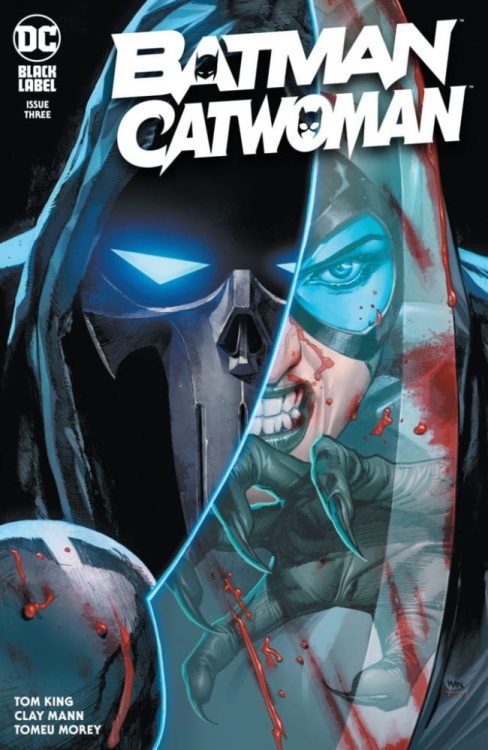
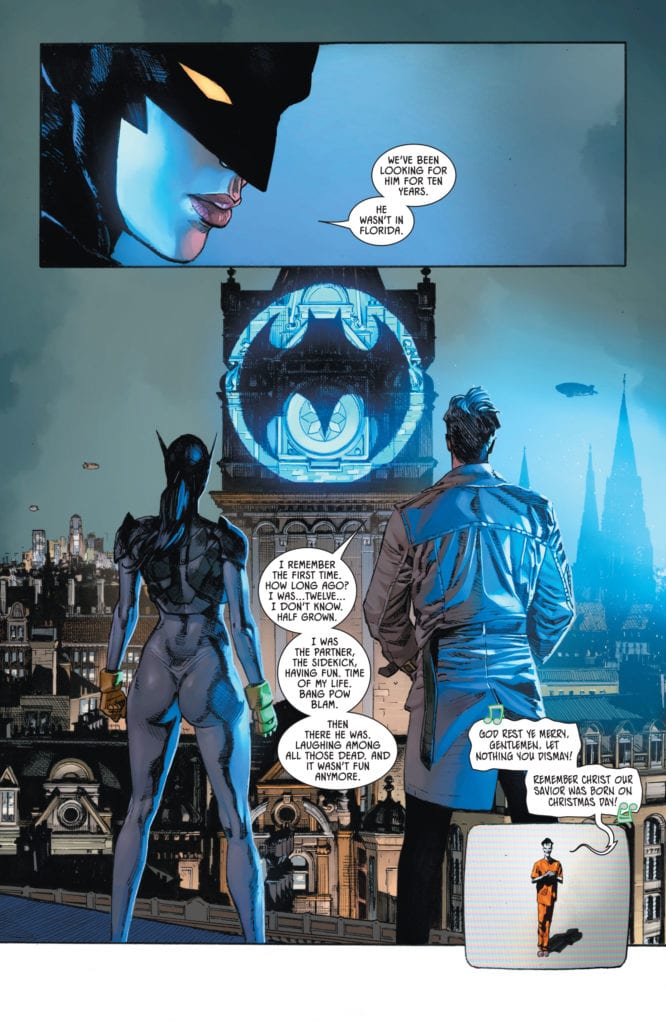
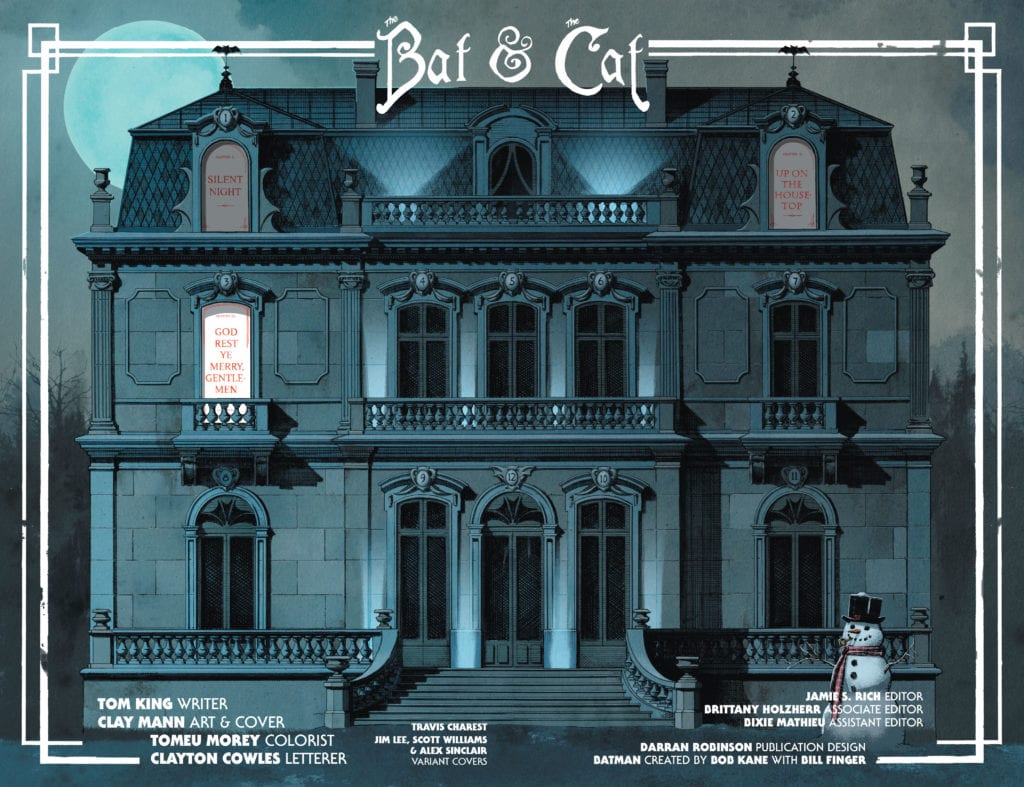
DC Comics’ Batman Catwoman #3includes the exciting addition of a fan favorite character, Helena Wayne. Helena, AKA Huntress, is the child of Selina and Bruce. But writer Tom King, artist Clay Mann, colorist Tomeu Morey, and letterer Clayton Cowles make us ask a simple question: whose daughter is she really? This isn’t to say she’s not biologically Selina and Bruce’s daughter. The creative team is instead making us look closely at the character to see who she takes after the most.
Writing
As is so often the case, King writes lines that are fantastically full of subtext. We follow Selina, both in the future and in the present day, as she deals with her growing connection to the Joker. In one timeline, Selina is trying to figure out how to keep Bruce in the dark. In bed with the “World’s Greatest Detective,” King has her evading and distracting Bruce like a pro. But with Helena on her tail, in the future timeline, things aren’t quite so clear. Sure, Selina is still evasive and full of distractions, but she’s no longer dealing with someone who has point blank questions for her. Instead, she’s dealing with her own daughter. A woman who may be just as underhanded and careful as her mother, with all the moral fortitude of her father. King turns Helena Wayne into a dangerous mix of her parents. A tireless righter of wrongs with all the subtlety of a thief in the night.
Art
Clay Mann is the king of subtlety in this chapter as well. Whenever he can pull back, leaving the details a little obscured, he does. We see a murder in an empty flat. Except all we actually see is a hand and blood streaks on the window, as the killer stands above their victim. At one point, Selina talks with the Joker. Mann depicts the Joker in a shadowy setting. All we see is his disembodied smile. Mann knows that we’ll be more frightened by what we can’t see than by what we can.
While Mann’s art is fantastic in this issue, it does occasionally feel a little oversexualized. In one of Selina’s fights, she’s in her underwear. Her pink top seems to come apart more and more with each passing panel. While it doesn’t detract from his other strengths, it’s a small moment that feels a little unnecessary.
Coloring
Morey makes moments of extreme tension look warm and inviting, and makes spooky moments look calm and serene. It’s a brilliant approach. Every moment is compounded by the fact that the colorist almost seems to be “ignoring the tone.” But Morey isn’t. Morey is playing against every moment. We can feel the tension in the room because the characters seem to be ignoring it. And when we’re witnessing a grizzly murder, we’re disturbed by how beautiful it all looks. Morey shows us the peacefulness in fights to the death and fear in intimacy. No moment looks like it “should.” Morey rises above clichés and delivers scenes that pack a devastating punch.
Lettering
Cowles does a fantastic job of making some of the dialogue feel calm or low effort. There’s something about a word balloon that goes downward from a character’s face that makes it feel nonchalant. It’s as though these words just fall out of their mouths. So when Helena and Selina talk at the dinner table, their tones seem quite different. Selina’s words extend above her head. She’s talking purposefully, deliberately. Helena responds without seeming emotionally invested. Each of her lines either hangs in the air, right next to her head, or stretches down below her. Her word balloons rarely touch the top of the panel. Then, finally, she acts like her father would. She asks a straight forward question. “Mother. Is everything all right?” Her words graze the top of the panel. It’s a simple, slight shift in the dynamic, but it’s in these subtleties that this creative team is telling their story.
DC Comics’ Batman Catwoman continues to humanize a mythos that feels huge. King, Mann, Morey and Cowles tell a story of heroism that is tainted by the grit of our day-to-day ethics. It’s not black and white, it’s not right and wrong: it’s complicated and messy. And with every new issue, it promises to get messier. Pick up Batman Catwoman #3, out from DC Comics February 16th, at a comic shop near you!
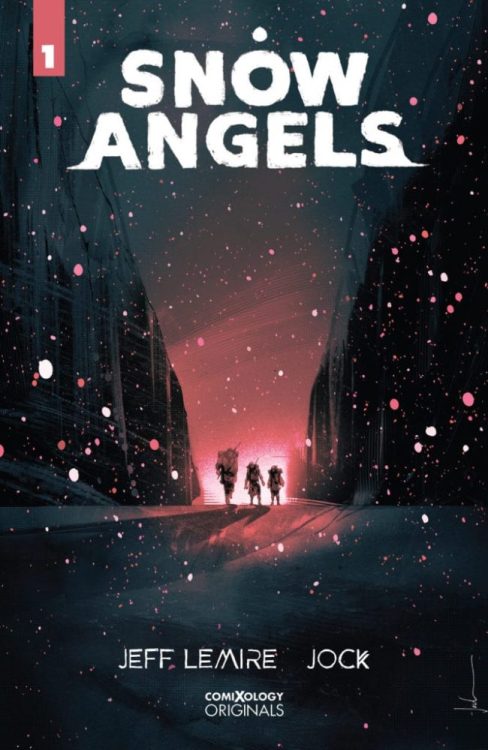
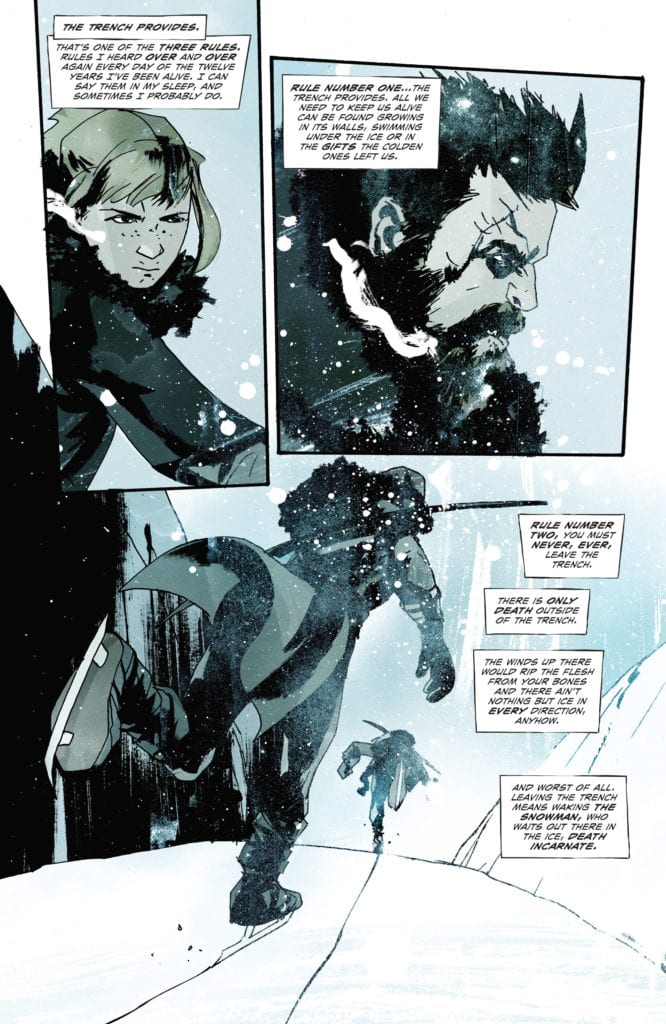
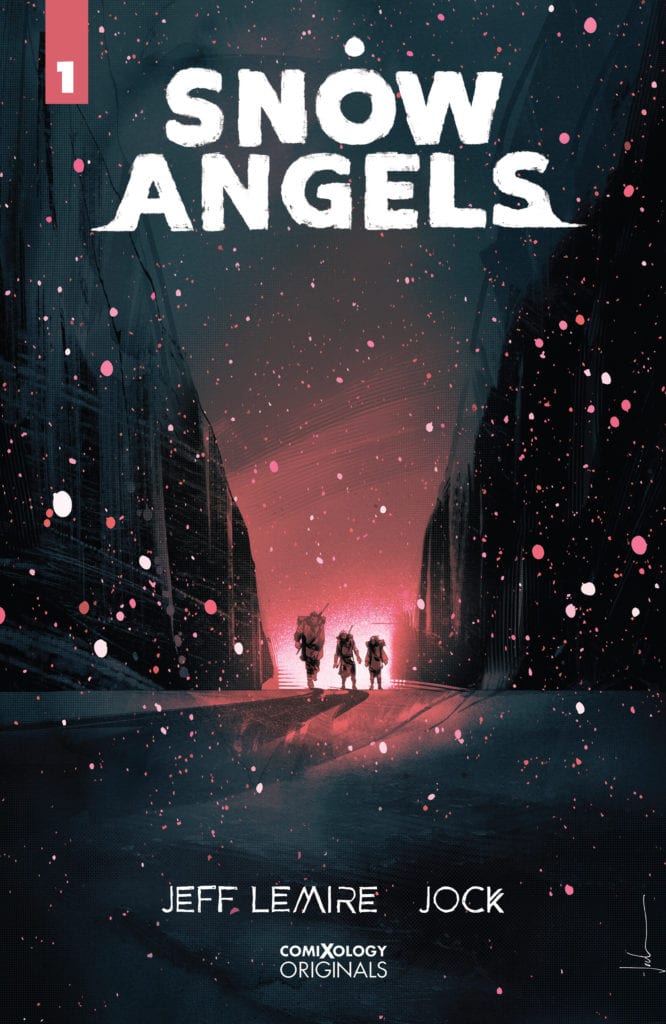
Snow Angels #1 by writer Jeff Lemire and artist Jock is out today from ComiXology Originals, and it’s a textbook case of how to hook readers with an intriguing opening chapter. Rounding out the creative team is veteran letterer Steve Wands.
The story is about Milliken and Mae Mae, two sisters growing up in a frozen tundra with their father. All they know is The Trench — a vast, literal trench carved into the icy earth. The Trenchfolk live by three simple testaments:
You must never leave The Trench.
The Trench provides.
The Trench is endless.
And they must adhere strictly to these rules, lest they fall prey to The Snowman who stalks outside their borders. But The Snowman is just a boogeyman story parents tell their kids…right?
Lemire excels at establishing mysterious new worlds that make you beg to know more. He’s done it in Sweet Tooth, in Black Hammer, in Descender, and he’s done it again in Snow Angels. By the end of the first issue, you’ll have a million questions about this world, its history, and all of the characters. Lemire gives you just enough one-off lines and little clues to pique your curiosity and ensure you’ll be back for future issues — and you will be back.
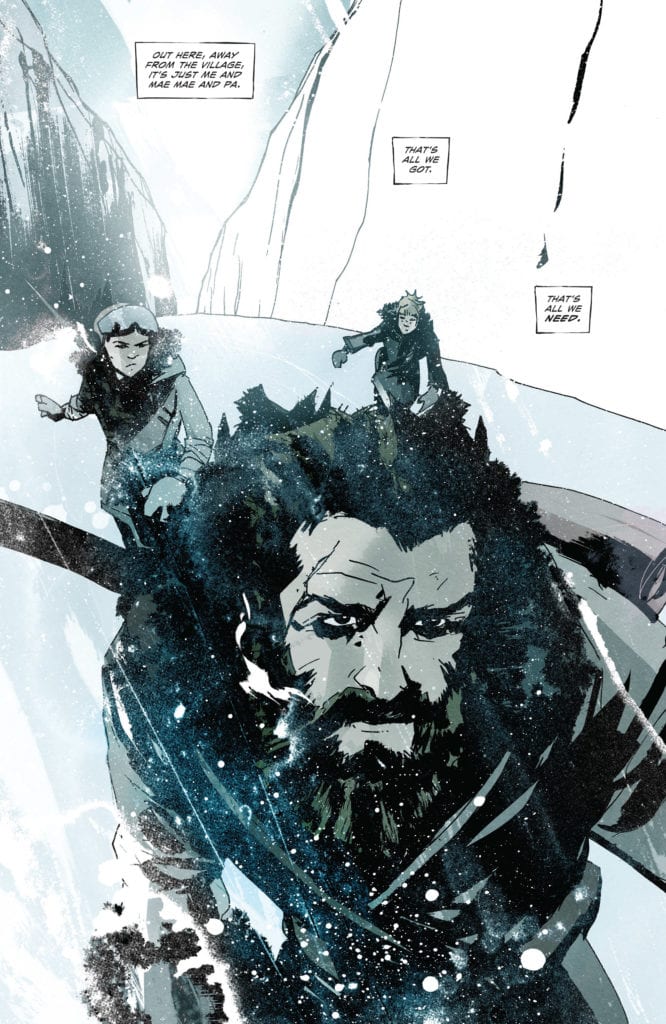
This is a world overcast by mystery and dread. A palpable sense of danger radiates off every page. Jock’s raw, edgy style is the perfect fit for Snow Angels. He uses a generally white color palette, but knows just where to throw in some dark shadows and bright reds to add tension. Certain hard-hitting moments hit even harder thanks to this contrast.
And yet, while Jock’s landscaping fills you with a sense of dread, his character work is something else entirely. Through close-ups and a heavy emphasis on eyes, Jock adds a ton of humanity and personality to Milli, Mae, and their father. You get a sense of who they are just by how they look at the world. The girls are spunky; they have some attitude. Their father is tough, hardened by this cold world, but there’s some fun and joy to him too. And in their eyes — the girls’ especially — there’s something else. I’m not sure if I would classify it as “hope” but there’s definitely something there that makes you care for them and feel concern for their safety. Through all their spunk and attitude, you can see that they’re still just young girls who are coming of age, and Jock manages to convey that all through their eyes.
Wands’ lettering flows seamlessly with Jock’s art. The font and sound effects emphasize the rough and gritty nature of this world. The white narration boxes blend in with the white backgrounds. What’s most impressive, though, is how Wands sets the pace for Snow Angels. There’s quite a bit of narration in this issue, and no small amount of dialogue, and yet reading it all feels like a breeze. There’s such a natural rhythm to this book, and that’s a credit to both Wands’ lettering and Jock’s layouts.
Honestly, with the talent behind this book, it hardly needed this review. It’s Jeff Lemire, Jock, and Steve Wands — their respective track records speak for themselves. If you like intriguing stories with lots of mystery and spunky young protagonists, check out Snow Angels #1 right now.
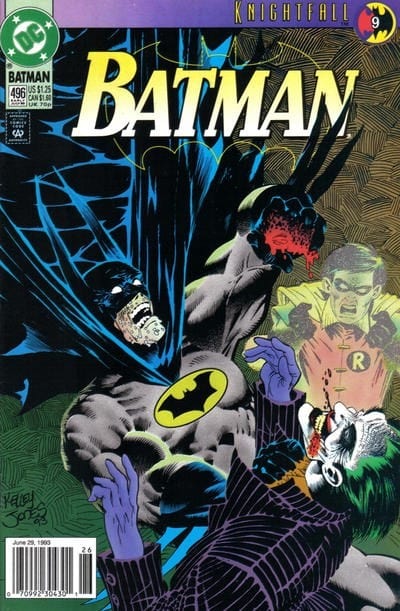
Jason Todd, the second Robin, was unceremoniously killed by a fan vote in 1988’s Batman: A Death in the Family. As a kid reading Batman in the 90s, one could read about how Batman was continually haunted by Jason’s death, as the cover for Batman #496 beautifully illustrates.
Then, in 2004, Jason Todd returned to plague Batman in Judd Winick’s famous “Under the Hood” story arc. Jason’s return had been teased in 2003 in Batman: Hush, in what turned out to be a fake out (which was later retconned to at least partially be the real Jason). The means of his return were explained in the most comic book-y way imaginable (just google “Superboy punches reality”). This was indeed the real deal.
The fake out return of Jason Todd in Hush, later revealed to only be “sort of” a fake out.
“Under the Hood” was a great Batman story (and probably one of the best DC animated adaptations). But after it was over, DC had a Jason Todd problem. While the initial story was powerful, addressing Batman’s regrets and insecurities, DC kept the character around long after his original narrative purpose had expired.
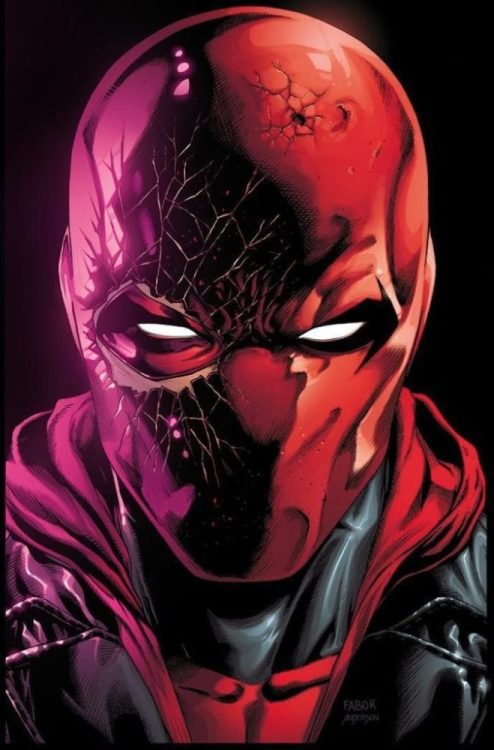
That isn’t to say that all of the stories involving Jason Todd were terrible. For a while Jason’s “arc” consisted of him trying to find his new identity in a world that had moved on and forgotten him. What we eventually find, however, is that DC has a problem with the Red Hood becoming a narrative cul de sac, as exemplified in Geoff Johns and Jason Fabok’s Batman: Three Jokers. Though that story ends with the Red Hood embarking on a journey of redemption (that DC seems to be ignoring), Grant Morrison already redeemed Jason and set him on a new narrative path back in Batman Inc.
Jason Searches for His Identity
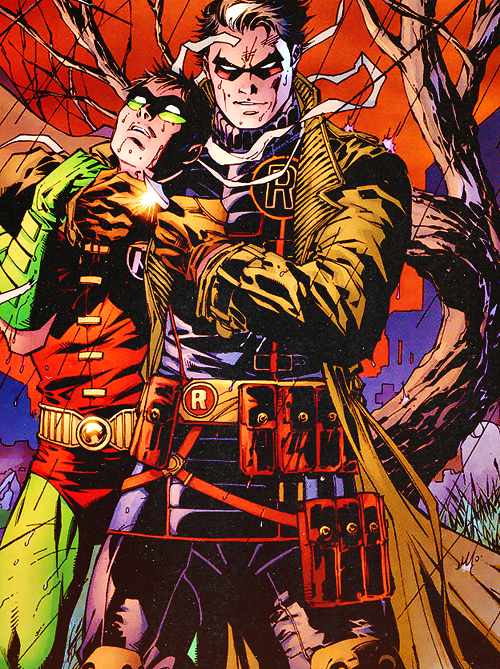
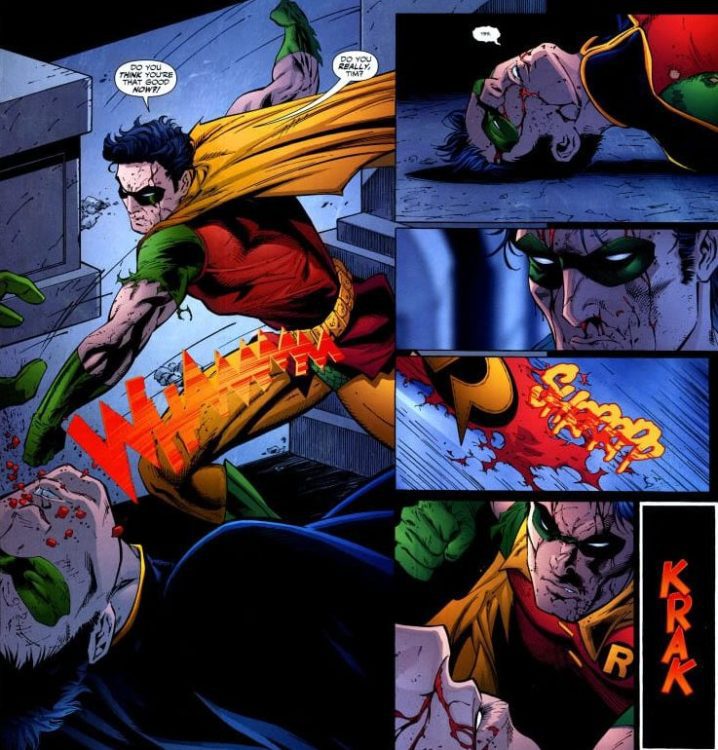
In Geoff Johns’ Teen Titans #29, Jason confronts Tim Drake at Titans Tower, taking off the Red Hood outfit to reveal an updated Robin outfit underneath. He fights Tim, all while jealously bemoaning that, despite being a Titan, he had been forgotten, yet Tim had been fully accepted and embraced.
Tim Drake will always be the best Robin!
Then, after Infinite Crisis and during the One Year Later story arc, Nightwing relocates to New York City, only to discover that there is another, more murderous Nightwing killing criminals. That second Nightwing’s identity? You guessed it: Jason Todd.
Todd eventually gives up the Nightwing mantle. He then gets shuffled off into a crazy multiverse adventure, Countdown to Final Crisis. This event not only holds the honor of being one of DC’s worst events, but it really shows that DC had no idea what to do with Jason. Still, it’s on this adventure that he temporarily adopts yet another identity besides the Red Hood, that of Red Robin. Again, this is only a temporary change.
Not too long afterward, Batman was believed dead at the end of Final Crisis. This led to Tony Daniel’s “Battle for the Cowl” storyline. This story saw Jason become a murderous Batman before being taken down by Nightwing, who assumes the mantle of Batman.
It was becoming clear that DC didn’t know what it was doing with the character. After he served his original purpose, he jumped from identity to identity, each time ending with a dead end and a new reinvention. Jason was beginning to stall.
Enter Grant Morrison
Dick and Jason come to blows again in Grant Morrison’s Batman and Robin. Jason returns to the mantle of the Red Hood, taking advantage of social media and marketing to become the new face of crimefighting in Gotham. He sets himself up as a rival to Batman and Robin. This marks one of the last times Jason is a direct antagonist of the Bat family.
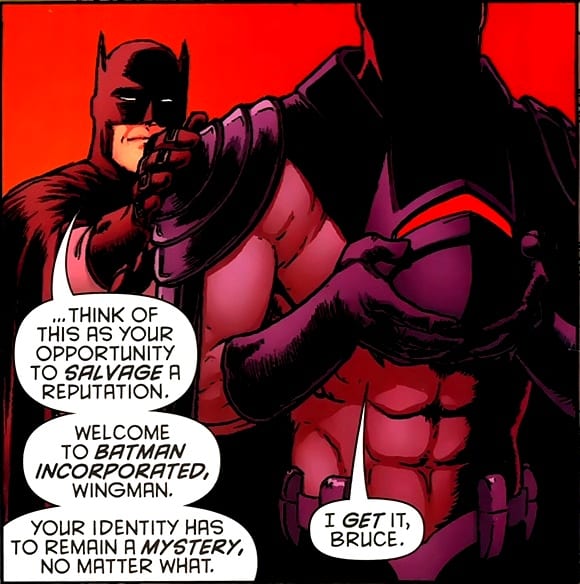
Jason is captured and eventually escapes imprisonment, but Morrison wasn’t done with him. Perhaps recognizing that Jason was heading for a narrative cul de sac, Morrison sets Jason up for a new status quo at the end of his Batman Incorporated run. Rather than allowing Jason to slide into narrative limbo and turn into a storytelling device with diminishing returns, Morrison sets the character on a new, hopeful path. Giving his second son a chance at redemption, Batman offers him membership in Batman Inc. under the identity of Wingman (an obscure Silver Age character that appeared earlier in Morrison’s Batman run who had broken bad).
Jason is given another chance as Wingman.
And then the New 52 happened. Well, actually, it had already happened. Keeping continuity straight between Red Hood’s status quo in the New 52 and his use by Morrison can be tough. It’s obvious that Morrison had specific plans for Jason at the end of their Batman run, allowing the character a chance at redemption; however, since Morrison was no longer driving the Bat-train at DC, this is a change that didn’t stick (this happens a lot with Morrison).
Instead, the Red Hood became an antihero member of the Batfamily. This is where the character really starts to spin his wheels from a narrative viewpoint. As an antagonist to the Batfamily, Jason’s story could be compelling. But as long as he remains the Red Hood, it’s really hard to take Jason in new directions since he lives in the liminal space between villain and redemption (but again, without a lot of clear narrative path). The character needs to remain a villain, or grow and heal.
Whatever Morrison’s intention for Jason’s future, DC ignored it and returned Jason to the identity of the Red Hood. Really, because the character had an ongoing title, Red Hood and the Outlaws (as a part of the New 52), he never really stopped being the Red Hood (Red Hood and theOutlaws #18 does acknowledge Jason’s time as Wingman, in a “thanks, but no thanks” sort of way).
Whatever growth Jason experiences thanks to Morrison is done away, although Jason is no longer a Batfamily antagonist. He’s just an anti-hero, with less relevance. He is able to somewhat reconcile with the Batfamily, but some members carry a distrust for him because of his past misdeeds. And the character just became…stale.
Geoff Johns seems to recognize this, having Jason confront his fear and hatred of the Joker. At the end of Johns and Fabok’s tale, Jason abandons the Red Hood identity (in order to be with Barbara Gordon. That’s out of left field).
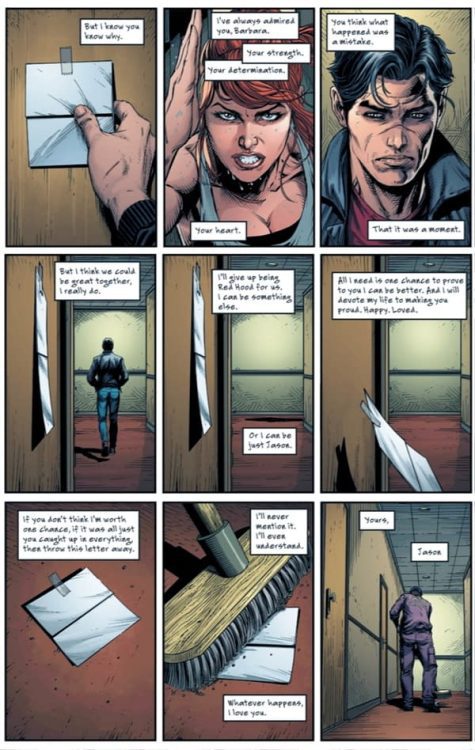
Really, I can’t emphasize enough how unearned this moment is. Barbara and Dick have always had a de facto on-off again dynamic, but Jason? It’s really hard to find support for something like this in the history of the two characters. I guess the point is that they bond over their shared trauma with the Joker.
But Johns, like Morrison before him, tries to move Jason’s character forward to prevent stagnation, even if it makes for an awkward storytelling choice.
The Red Hood worked as a Batfamily antagonist in “Under the Hood.” He even served as a decent nemesis or “violent twin” for Dick Grayson after that. He came to symbolize what happens when one of Batman’s proteges breaks bad. But as a Bat-themed antihero, the character stalls.
The narrative options for the Red Hood are clear: 1) return him to his status as a Batfamily antagonist, who strikes at the intimate heart of the Batfamily, 2) Let the character stall as an antihero, 3) let the character fully heal and find redemption, or 4) kill him off.
DC seems to prefer strategies 1 and 2, having given the Red Hood a new outfit and even making him an antagonist in Future State.
However, I think Johns recognizes that there is a story of redemption to be told with Jason. There is a future for him where he heals and moves on to better things. Too bad Morrison already beat Johns to it 7 years ago, and arguably, did it in a way that felt earned and wasn’t about being in a relationship with Barbara Gordon.
Don’t worry, though, Geoff. DC will probably ignore your idea, too.
Writer Thomas Sniegoski spoke with Monkeys Fighting Robots about his new series, Young Hellboy: The Hidden Land. Written by Sniegoski and Mike Mignola, with art by Craig Rousseau, colors by Dave Stewart, and letters by Clem Robins, Young Hellboy: The Hidden Land #1is a fun, pulpy adventure with a joyful tone. It follows Hellboy as a child, flying with Professor Bruttenholm on a project for the BPRD. But when the airplane crashes near an island full of giant mythical creatures, anything can happen!
MONKEYS FIGHTING ROBOTS: While Young Hellboy is clearly dealing with all the same characters from the Hellboy universe, something about it all seems brighter and full of fun. And it’s not just because Hellboy is younger. We’ve seen a young Hellboy before, just not quite as bright-eyed and swashbuckling. What were some of the ways you began to stake out a new tone for the character?
Thomas Sniegoski: Mike and I love when a plan comes together. That whole ‘brighter and fun’ feeling was purely intentional. We wanted this particular Hellboy mini-series to have a strong sense of fun, and adventure, very much like something out of the old 1930’s pulps, or those cool jungle movies that we all used to watch on Sunday afternoons. So yeah, we wanted this take on the character to feel ‘younger’ more full of life and excitement–very much like your typical 10 year old boy.
MFR: As big a role as Bruttenholm plays in Hellboy’s life, it feels like we don’t get to see much of the character. We definitely don’t get a lot of moments of the two interacting. It’s exciting to see so many pages featuring the professor. But clearly, somewhere down the line, they become much more distant. How would you like the dynamic that you show between them to affect how readers see the older versions of the characters?
Sniegoski: I think we always got a sense from the previous Hellboy stories that he and the Professor had a strong, father and son type relationship, but in Young Hellboy: The Hidden Land we wanted to actually show it. We wanted to show them interacting, show that they really do care a great deal for one another. I think our take on the Professor and Hellboy’s relationship in this mini just solidifies that they did indeed love each other, and consider themselves father and son. It was really kind of cool getting to write their relationship.
MFR: You introduce a new character to the Hellboy Universe: Scarlett Santiago, the Sky Devil! What were the inspirations for this character and do you hope to bring her back for more Hellboy appearances in the future?
Sniegoski: Scarlett was an absolute blast to write. She’s pure pulp adventurer… something right out of Thrilling Air Stories. And most definitely, we would LOVE to do more with her… especially since she’s got a little secret that’s exposed in our mini series that makes her even MORE interesting.
MFR: This feels like such a classic set up for an adventure: stranded on an island with giant mythical creatures. It’s King Kong style fun! What about this set up made you want it to be young Hellboy on the island, instead of showing one of his lost adult years?
Sniegoski: Mike and I thought that were was so much untapped potential for fun in this time period, as well as being some pretty serious formative years for our young hero. If you think about it, what better sort of an adventure could there be for him at this age. He’s still very young, still looking at the world around him with wonder. This kind of over the top adventure story is perfect for that sort of “Gee Whizz” attitude.
MFR: The last page takes us from being in a swashbuckling adventure that could be told just about anywhere, to being firmly rooted in the Hellboy mythos. It just goes to show how new and fresh this story feels. What was some of your process, trying to make sure enough established Hellboy-isms were sprinkled in, while telling a story that goes in a bold, new direction?
Sniegoski: Mike and I were bound and determined that this mini-series was going to be fun and exciting and filled with more cool crap than you could shake a stick at… but it also had to be, and feel like a Hellboy story, and there are certain types of things that need to be present for it to feel like a Hellboy story. There’s mood, a connection to an ancient past and all the funky legends that are connected to that nearly forgotten past, and most importantly–a sense of humor. Can’t be a Hellboy story without that weird sense of humor. So, we took all that stuff, threw it in a cauldron, gave it a good stir and BOOM! Young Hellboy: The Hidden Land! Personally, I think everybody involved did an amazing job. I’m very proud of this series.
Check out Dark Horse’s Young Hellboy: The Hidden Land #1, out on February 17th. It’s loads of fun, and as Sniegoski makes clear, it’s only going to get more fun!
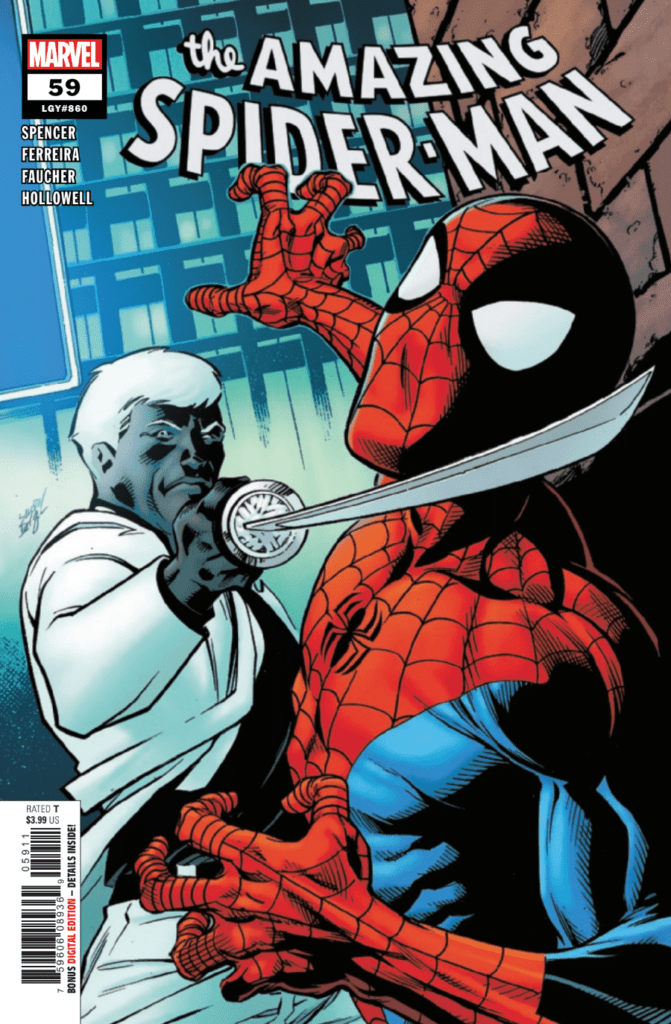
The Amazing Spider-Man #59, out now from Marvel Comics, is full of action and emotional moments that make the issue a wild ride.
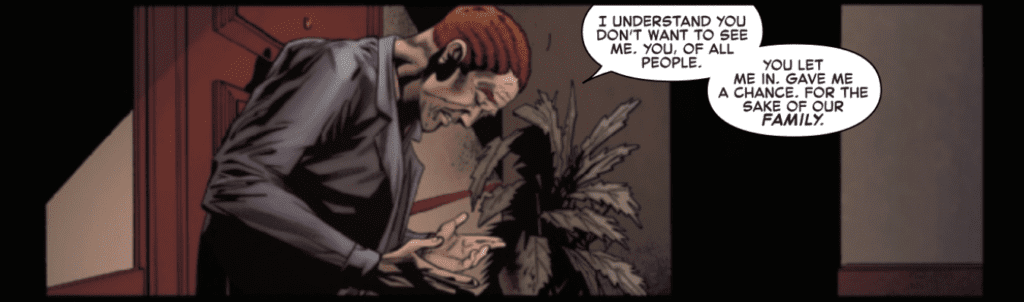
Nick Spencer fills The Amazing Spider-Man #59 with extraordinary dialogue. The issue features a lot of fighting but also continues the emotional moments of the previous issue. There are many private conversations with dialogue that comes directly from a character’s heart, and Spencer captures this perfectly. The issue also makes use of silent panels, which helps build the suspense of a scene. It feels like you’re holding your breath as the event you’ve been dreading occurs over the course of several completely silent panels.
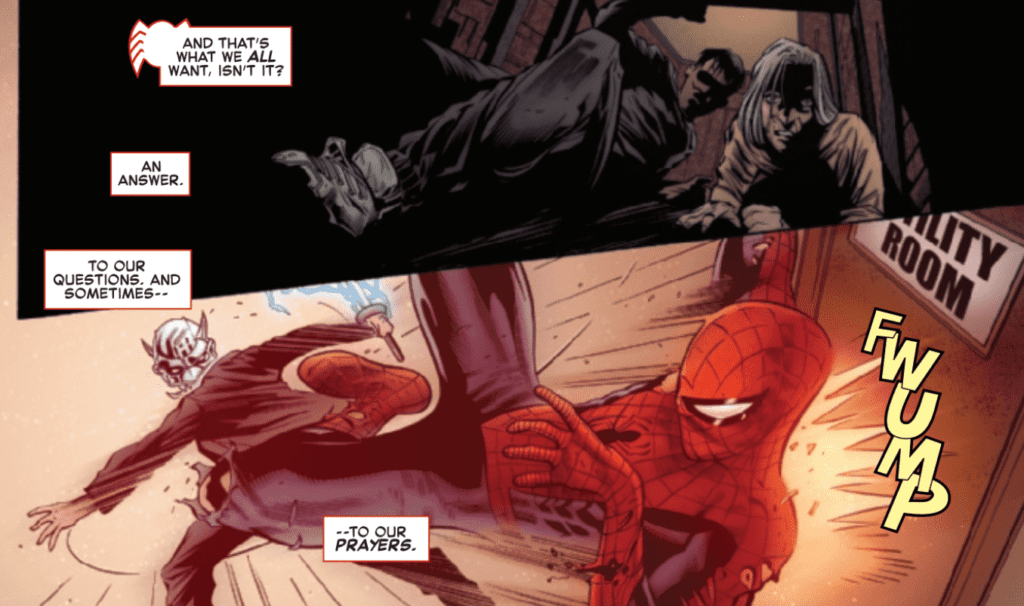
Marcelo Ferreira’s pencils and Wayne Faucher’s inks in The Amazing Spider-Man #59 are full of dynamism and create some impressive action scenes. During these action-heavy sequences, Ferreira and Faucher utilize action lines and motion blur to add energy to the panels, making them more visually exciting. Ferreira’s and Faucher’s ability to portray intense emotion is another notable part of this issue and assists the emotional scenes with drawing the reader in.
The Amazing Spider-Man #59 features the coloring talents of Morry Hollowell with Andrew Crossley, who do a fantastic job of having the palette reflect the tone. For the moments in the fight-heavy issue, Hollowell and Crossley use bright, single-colored backgrounds to add energy to the combat. When dealing with an emotional moment, calm gradients are used for backgrounds that allow tender moments to shine.
VC’s Joe Caramagna utilizes a wide selection of lettering techniques for The Amazing Spider-Man #59. He uses a bold and colorful font within a speech bubble to represent a character yelling. Caramagna thickens the border of some speech bubbles for emphasis. He even inverts the color scheme of speech bubbles for one character. The story flows uninterrupted and helps reflect the tone and volume of some characters’ lines. It is some wonderful work that makes the book a more enjoyable read.
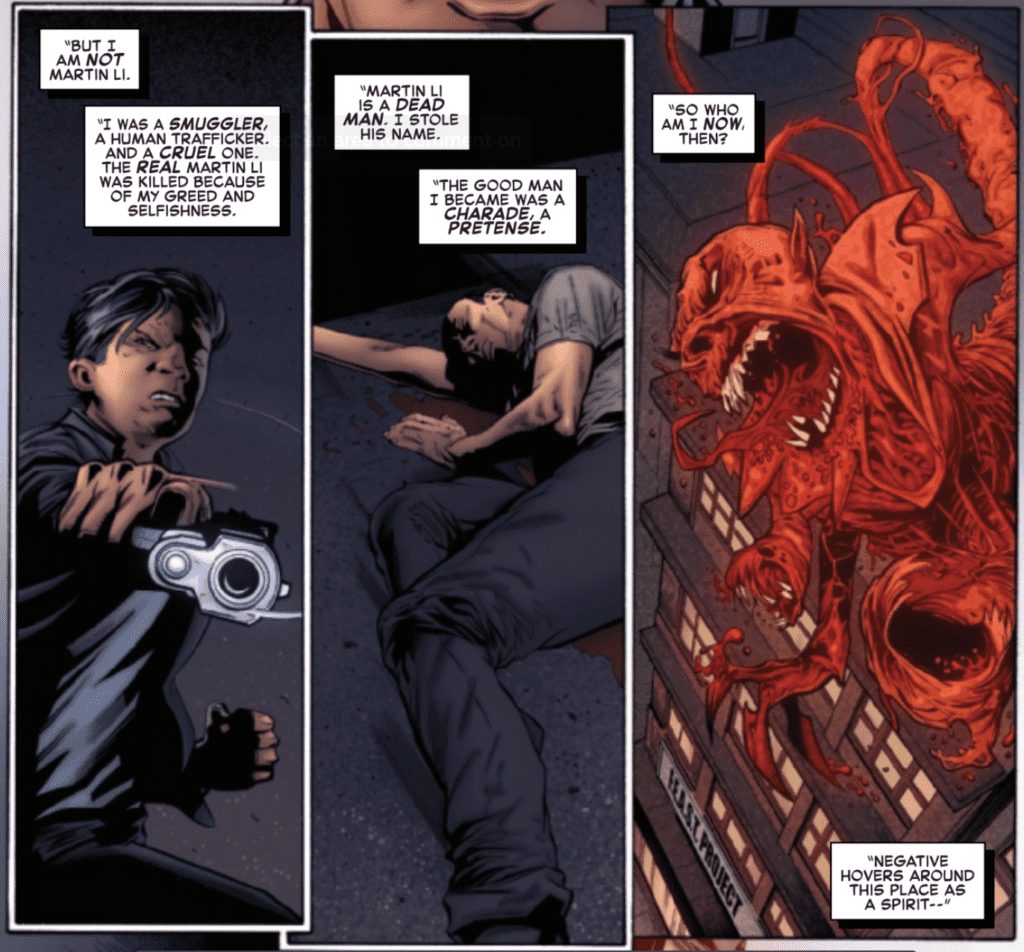
The Amazing Spider-Man #59 continues the showdown with Mr. Negatives goons, all the while having Spider-Man deal with the inner turmoil he has been facing since his encounter with Kindred. The dialogue is spectacular, the art is an excellent fit for the contents of the issue, and the coloring reflects the tones phenomenally. The lettering is the final polish that allows the story to continue without a hitch, and the result is an entertaining issue containing some touching moments.




 Savage #1 wastes no time by making a fish-out-of-water scenario for the hero. Bemis takes a modern approach by making Kevin an influencer. With Kevin’s opportunistic brother, Henry, wasting no time in publicizing/monetizing him, Kevin is everywhere.
 With real-life social media influencers being a topic of
  Stockman brings this feeling out in the body language of Savage. Throughout the first half of Savage #1, Kevin mentally struggles with his celebrity life. The orderly way feels too constraining on him, unlike when he explains his way of thinking with extended limb movements. It’s a feeling of authenticity that people try to recreate for advertising, but for Kevin, the attempts are just as scripted as everything else. So with the reader sharing this feeling of not seeing the real thing when these wild and exaggerated movements come out during a dinosaur attack, it’s a strong liberating sensation.


 Nick Spencer fills The Amazing Spider-Man #59 with extraordinary dialogue. The issue features a lot of fighting but also continues the emotional moments of the previous issue. There are many private conversations with dialogue that comes directly from a character’s heart, and Spencer captures this perfectly. The issue also makes use of silent panels, which helps build the suspense of a scene. It feels like you’re holding your breath as the event you’ve been dreading occurs over the course of several completely silent panels.