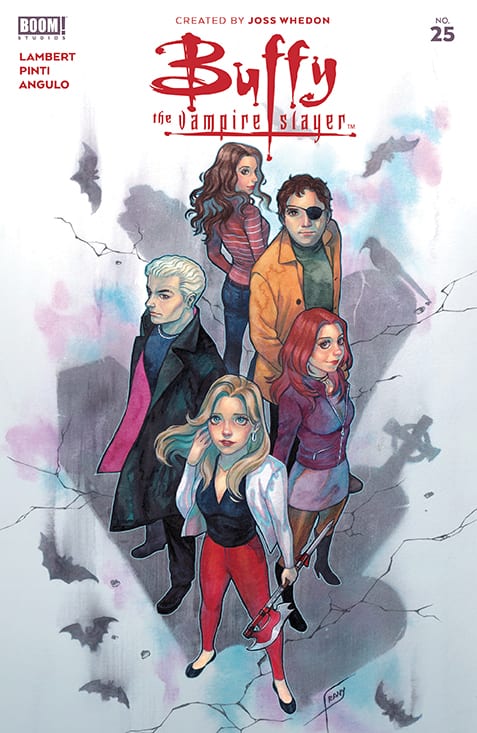
Buffyverse life is like a box of chocolates: you never know where or when an interdimensional portal will take you. Available now from Boom! Studios, Buffy the Vampire Slayer #25, takes us down a ’90s rabbit hole full of meta-references and a troubling time paradox. #25 is written by Buffy mainstay Jeremy Lambert and newcomer Valentina Pinti. Also returning are colorist Raul Angulo and letterer Ed Dukeshire.
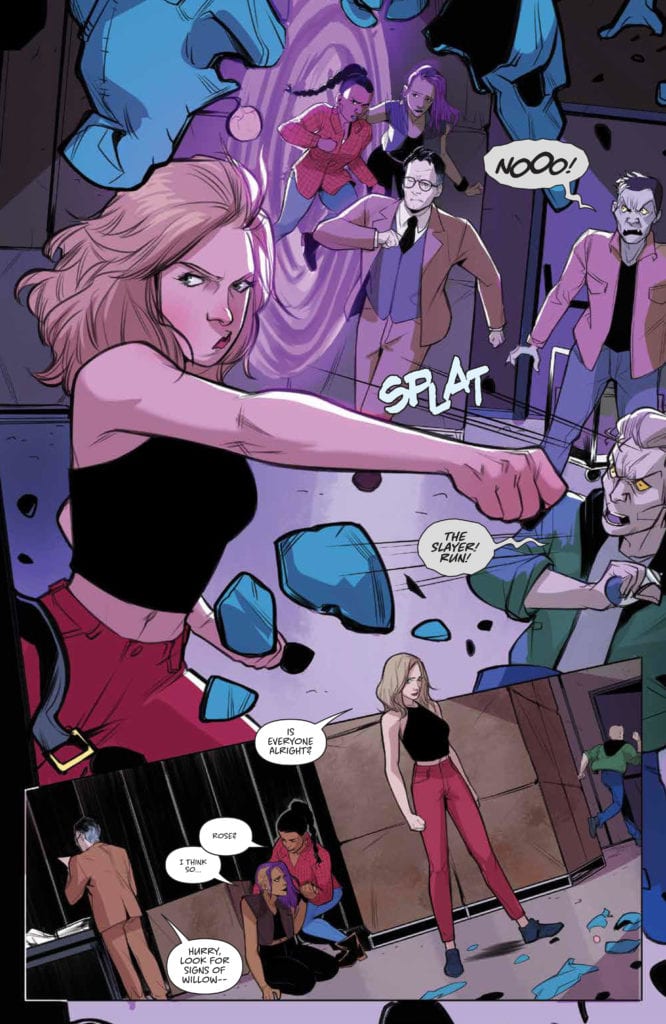
Previously on Buffy, the gang chased after Willow through a portal. It appeared to have dropped them into season three, episode six of the TV series. Now, in issue 25, the gang realizes they’ve entered another dimension of the multiverse—a ’90s dimension. With the group split up, Buffy, Giles, Kendra, and Rose have to find Willow without bumping into their ’90s-era multiverse counterparts. Anya acts as a guide to deal with this unintended consequence of her subterfuge.
The Scoobies wade through cameos and meta-references that’ll make even the seasoned fans’ heads spin. Despite this, Lambert’s story remains easy to follow. But I couldn’t help thinking of all the references as pandering to fans familiar with both the TV series and original Dark Horse Comics. All notions of pandering aside, fans exclusive to the Boom! Studios run will find this issue satisfying.
Buffyverse
Artistically, Pinti changes up the cartoonish style established by Ramon Bachs in previous issues. While the characters’ clothing copies costuming from the TV show, they resemble the real-life actors even less than before. Pinti also favors thinner, more delicate lines and uses none of Bachs’ inky blotches and cross-hatching. These choices give an overall naturalistic style to the issue, which is ironic considering they’re in a dimension of the multiverse.
OUT OF THE PORTAL, INTO THE ’90s.
Such irony contributes to the eerie atmosphere of the issue. This dimension is familiar, yet not quite the Sunnydale we know. Pinti’s ironic naturalism plus stark negative space instill a subtle sense of discomfort and confusion, putting the reader in the shoes of the Scooby Gang. Further, Angulo uses more gray, brown, and red than ever before. This color palette feels both naturalistic yet verges on noir in its lack of warmth and saturation.
It’s like suddenly the Scooby Gang has become the other Hanna-Barbera Scooby Gang in a dusty old cartoon local. But Angulo doesn’t completely abandon the familiar background colors purple and blue, choosing to restrict them to scenes involving Anya and the portal. As we’ve come to expect, these colors evoke magic and, in this issue, mark where magic power lies. In that respect, the stark deviation from previous issues is beguiling as much as it is jarring.
Worlds Apart
For the reader and the Scooby Gang, the dimension’s mystery is distractingly alluring. But they still have to find Xander. Maybe the portal was never the right path to him in the first place. When the gang makes it back to real Sunnydale, the other dimension leaves them with lingering confusion. Is a time paradox the newest obstacle on the way to reuniting with Xander?
The stakes just keep getting stranger and stranger. With the rifts in the Scooby Gang now stretching across the multiverse, it’s more difficult to see any togetherness in their future. But if Buffy the Vampire Slayer #25 proves anything, it’s that the integrity of Buffy and her friends has drastic cosmic implications. What’s next for the Xander recovery mission may not only be saving a soul but saving the universe.
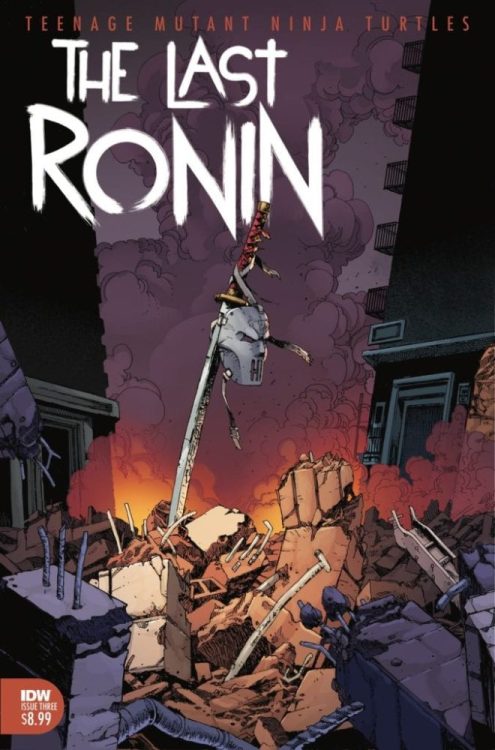
TEENAGE MUTANT NINJA TURTLES: THE LAST RONIN #3, available on Wednesday, May 26th, dives deeper into the mysterious circumstances surrounding Leonardo, Donatello and Raphael’s disappearance years ago. In the last issue Michelangelo stumbled across April, her daughter Casey Marie, and a host of other resistance fighters after attempting to infiltrate the new overlord’s base in New York City. But even teamed up, do our heroes have a chance of making a difference?
Story
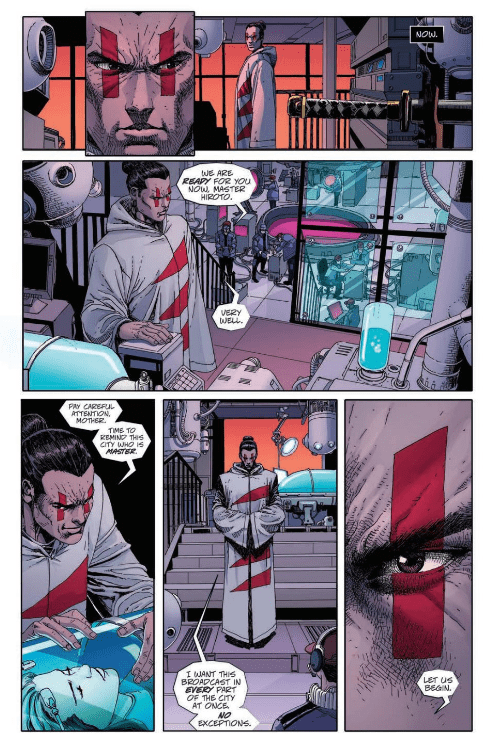
The story opens up with the New York City overlord Hiroto, son of Karai and grandson of the Shredder, addressing the people. Readers will remember the warrior waging all-out war on the resistance forces in the city, which now includes Mikey, April, and Casey Marie. Now Hiroto pledges to fight even harder against these “terrorists,” weeding out anyone who gets in the way.
Back underground, April shows Mikey the severed head of the robot Fugitoid. Immediately readers find themselves swept into the past where they learn more about the circumstances that led to his brothers’ deaths; somehow Fugitoid is at the center of it all.
This form of storytelling employed by Tom Waltz and Kevin Eastman introduces us to each new piece of information with perfect pacing. This keeps readers from being overwhelmed. But it also builds anticipation as we uncover each event that led to the present dystopia.
Artwork
The illustrations in this issue are fantastic. Esau and Isaac Escorza’s penciling and ink work provide readers will an incredible amount of detail, which helps bring this dystopian version of New York City to life. We also loved how Luis Antonio Delgado’s coloring added tannish tints to the flashback scenes to help distinguish between the two periods. In addition, Shawn Lee’s lettering boxes were placed well in each panel to avoid distracting readers from the other illustrations.
Conclusion
TEENAGE MUTANT NINJA TURTLES: THE LAST RONIN #3 reveals much of the backstory information readers have been waiting for. We can’t wait for the next installment!
What secrets do you hope to see revealed in the next issue? Let us know in the comments below!
Disney’s Cruella showcases a devilishly good time filled with over-the-top antics and phenomenal performances by its two leads. Admittedly, the film didn’t seem like it would offer much based on the trailers, but Cruella is a live-action adaptation Disney should be proud of. It’s clever, risky, features a fitting punk rock backdrop, and provides enough humor to lighten the mood a few times. Cruella manages to pull off a satisfying examination of one of Disney’s most iconic characters and how she came to exist.
The live-action adaptations from Disney always spark conversation and Cruella won’t be any different once audiences have seen it. It probably runs a little longer than it should, but its overstay isn’t an unpleasant one thanks to the effort put into making it. Creating a live-action origin story for Cruella de Vil, the eccentric fashionista from 101 Dalmatians turned out better than expected. The film was directed by Craig Gillespie and written by Dana Fox and Tony McNamara. Cruella stars Joel Fry, Paul Hauser, Emily Beechman, Kirby Howell-Baptiste, Emma Thompson, Mark Strong, and Emma Stone. Placed in the 1970s, Cruella centers on Estella de Vil (Stone), the soon-to-be eccentric fashion designer, and the path that leads to her becoming Cruella de Vil.
Cruella details the ambitious childhood of Estella before shifting into her chaotic, and fashion-centered adulthood. Fox and McNamara tell an engaging story that does seem held back at times since this is a Disney film. The darker aspects of this film could have been better portrayed, but the script still delivers strongly on the mature aspects of this story. Estella starts as a young drifter, being raised by her mother Catherine de Vil (Beecham) in London. She doesn’t fit in, has dreams of being a fashion designer, and gets into physical altercations at school. An unfortunate event happens, leaving Estella to come in contact with Jasper (Fry) and Horace (Hauser), friends who will eventually assist in her criminal activity. As an adult, Estella works for the Baroness von Hellman (Thompson), a renowned fashion legend, who shares many similarities to Estella. After discovering a connection between her past and the Baroness, a rivalry develops, and the Baroness plays a major role in Estella’s rise to popularity.
Themes of distinctiveness shine bright throughout this film, especially during the interactions between Estella and the Baroness. Fox and McNamara flesh out a character study that takes a deep look at this clever Disney villain while still keeping it family-friendly for the most part. The twists along the way are shocking, unexpected, and assists in bringing Estella’s self-discovery full circle. The screenplay does enough to help audiences understand Estella, feel sympathy for her, but doesn’t make her out to be a hero. There are no heroes in this story, which is probably why Cruella will be compared to The Joker. Stone’s portrayal of Cruella makes this character just as charming as ever, and likable when she isn’t committing crimes of course.
Stone brings the charisma, wit, and charm you’d expect from the Cruella de Vil character. It’s clear she is having fun in this role, she eats up the scenery with her energy, demands your attention, and sinks into the headspace of this deranged individual. Thompson marvelously compliments Stone’s energy, as stated by the Baroness herself. When these two share the screen, it’s amazing to watch their characters upstage the other antics. Gillespie’s direction wonderfully captures the film’s over-the-top style, award-worthy costume designs, creates an emotional thrill ride, and sets a consistent rebel tone from start to finish. Cruella arguably features Stone’s best performance to date, as she is very believable as this diabolical fashionista and this is a role she should revisit.
Cruella may be two hours too long, but what it packs in those two hours is not to be missed. The back and forth between Estella and the Baroness can grow stale, but the film keeps you invested in seeing how this story ends. Stone’s enchanting performance here steers this film in the right direction anytime it seems to be going off course, and perhaps a follow-up wouldn’t be met with immediate dismissal. In a list of live adaptations that continues to grow, Cruella is one of Disney’s most memorable outings to date.
A Quiet Place Part 2 pulls off a difficult task by surpassing the original film and becoming one of the best sequels in cinematic history. In an attempt to expand this unfamiliar world, the film increases the intensity, focuses more on character building, and morphs into a heart-pounding experience from start to finish. Coming at a time where the world is looking for a symbol of hope, A Quiet Place Part 2 restores faith in sequels that can rival the initial outing.
Survival is pushed to a new level in this film, as it begins on the first day these unidentified creatures arrived on earth. After filling in some gaps for audiences, we’re thrown back into the lives of the remaining members of the Abbott family. The creatures have forced them out of their home to seek anything that resembles safety. Despite previous uncertainty, John Krasinski returns to write and direct A Quiet Place Part 2, which was a smart decision on his part. The film stars Millicent Simmonds, Emily Blunt, Djimon Hounsou, Noah Jupe, Cillian Murphy, and John Krasinski, returning via flashbacks. A Quiet Place Part 2 follows Evelyn (Blunt), Regan (Simmonds), Marcus, and Evelyn’s newborn venturing out into a world they aren’t prepared to face. The creatures aren’t the only threats, but after coming in contact with Emmett (Murphy), an old friend of the family, Regan decides she is going to take a stand against these creatures.
Evelyn (Emily Blunt) and Marcus (Noah Jupe) brave the unknown in “A Quiet Place Part II.”
Krasinski’s return as Lee Abbott is a minor one, but he is felt throughout the film thanks to his daughter, Regan. Krasinki’s focus on Regan and her journey to share her discovery of high-frequency sounds posing a threat to the creatures with the world is the heart of this film. She spent most of the last film blaming herself for what happened to her brother, and all hope seemed lost to her. A Quiet Place Part 2 allows Regan to forgive herself, protect her family, become confident like her father, and she is determined to assist countless people in battling these creatures. Krasinski’s writing this time around is about developing these characters, creating more nerve-racking predicaments for them to escape, world expansion, and introducing the idea of other threats besides the creatures themselves.
These human threats are never fully understood once they make an appearance, but perhaps more will come in the future. The introduction of Emmett is rather dull, as many did expect this character to fill in Krasinski’s shoes, but that responsibility fell on Regan instead. Emmett is a friend of the family, who was present during the creature’s first attack, and it’s implied he was one of the others communicating to Lee in the last film. He has lost his family, just like Evelyn, who insists on him protecting Regan. Jumpscares and abrupt endings aside, Krasinski’s script plays out like a Steven Spielberg film from start to finish, and while not as emotional as its predecessor, A Quiet Place Part 2 amplifies every aspect of the first film in tremendous fashion.
Man on Island (Djimon Hounsou) braves the unknown in “A Quiet Place Part II.”
Blunt shines as Evelyn Abbott, the only surviving parent for her three children, who are terrified for the most part. The moments between Marcus and Evelyn are comforting to watch, as she helps her son maintain his composure after he suffers an unexpected accident early on in the film. A rather exaggerated depiction of just how difficult a mother’s job can be, and Blunt plays the role to perfection. Lee’s death seems to have lead to Marcus feeling helpless, but he and his sister find their strength to stand tall together. Jupe’s performance will make you feel every ounce of pain his character endures throughout this film, but you will also feel his confidence as well once he finds it. As mentioned above, Simmonds steals the show as Regan Abbott, the courageous daughter who will not let her father’s death be for nothing. Simmonds is the sense of hope viewers will want to latch on to while she navigates this highly dangerous world.
Murphy is a great addition, despite his character being underwhelming, he delivers a terrific performance as this heartbroken family man. Krasinski refuses to let audiences breathe during A Quiet Place Part 2, as there is not a single moment where you will not pay attention to every last movement these characters make. The intensity in this film is overwhelming at times but makes for an exciting theater experience still. Moments in the film showcase events happening simultaneously and Krasinski captures it all so well, the transitions are breathtaking to watch. Marco Beltrami’s score blares in all its glory, only adding to the nonstop dread that lingers throughout the film. Krasinski makes sure to keep the emotions high during each act of this film.
Regan (Millicent Simmonds) braves the unknown in “A Quiet Place Part II.”
A Quiet Place Part 2 leaves the door open to venture out further into this world. Blunt has revealed this is only the first sequel in a planned trilogy, so perhaps the next outing will answer many important questions. Krasinski’s monster-filled world raised the stakes in all the best ways, and it’s clear he enjoys using the horror genre to tell compelling stories. A Quiet Place Part 2 is the movie theaters were created for, and it was worth the wait.
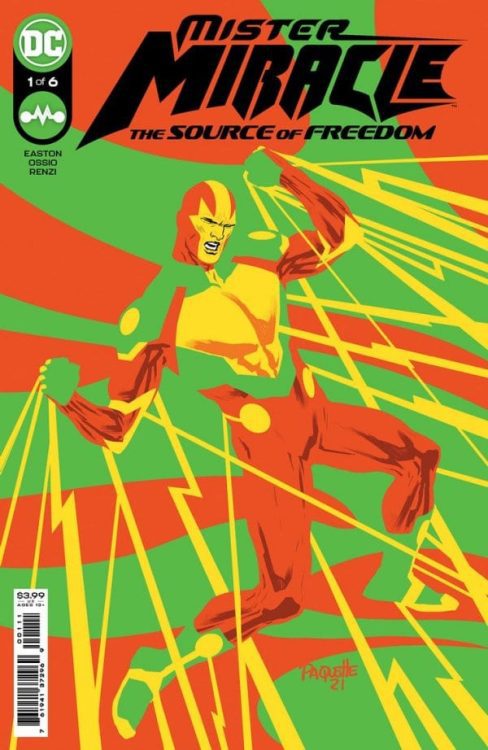
Writer Brandon Easton and artist Fico Ossio, along with colorist Rico Renzi and letterer Rob Leigh, bring us the return of Shiloh Norman in “Mister Miracle: The Source of Freedom” #1. Unfortunately, this return spawning out of DC’s Future State event is hampered by a script that tries to do too many things at once, coming off as overstuffed and hard to focus on. This is lifted up by some great work by the art team, making this issue a good looking but muddled debut.
“The Mister Miracle show used to be the hottest ticket in town, whether you caught him onstage escaping from perilous traps or spotted him on the streets of Metropolis taking out bad guys. What Shilo Norman forgot is the first rule of both showbiz and super-heroing: always leave them wanting more. Now it’s time to start showing the world what a miracle man can do. Showbiz/superhero rule #2: timing is everything. There’s a new performer in town who wants to knock Mister Miracle off his pedestal and stake a claim to his famous moniker! Can Shilo break free of this trap? (Why yes, that is a clue.)”
Writing & Plot
I’ll be completely honest and admit that I’m a bit biased against any Mister Miracle title that doesn’t star Scott Free as the man escaping from certain doom. It’s nothing against Shiloh Norman as a character, (I quite enjoyed his “Seven Soldiers” series under Grant Morrison), it’s just that I’m so attached to Free as this character. Now, with Free’s popularity at an all-time high after the success of Tom King and Mitch Gerard’s masterpiece, having a Mister Miracle title that stars a character many people may not recognize is a daunting task. This is why it’s so unfortunate that “The Source of Freedom” #1 stumbles in its attempt to bring Shiloh Norman back to the forefront following DC’s Future State event. This comic’s script has too many plots all happening at once, and none of them are really given enough time to breath. It feels like every other page there’s some major development involving something new popping up in Norman’s life, when we haven’t even figured out what the importance of the last conflict was. This issue is overstuffed with a romantic subplot, socio-political messaging, a cosmic threat, and Norman coming to terms with his identity as Mister Miracle and the problems he inherits with that identity. None of these plot elements really get much time to themselves. This being said, the most engaging part of this issue is Shiloh’s struggle with his secret identity as a black man and whether or not it’s his “responsibility” (as some would put it) to go public. The pages that focus on this struggle are the best part of this comic’s script, and I would have liked to see more of the issue tackle this struggle. Instead, we get a comic that struggles to find a focus and makes for a tangled reading experience.
Art Direction
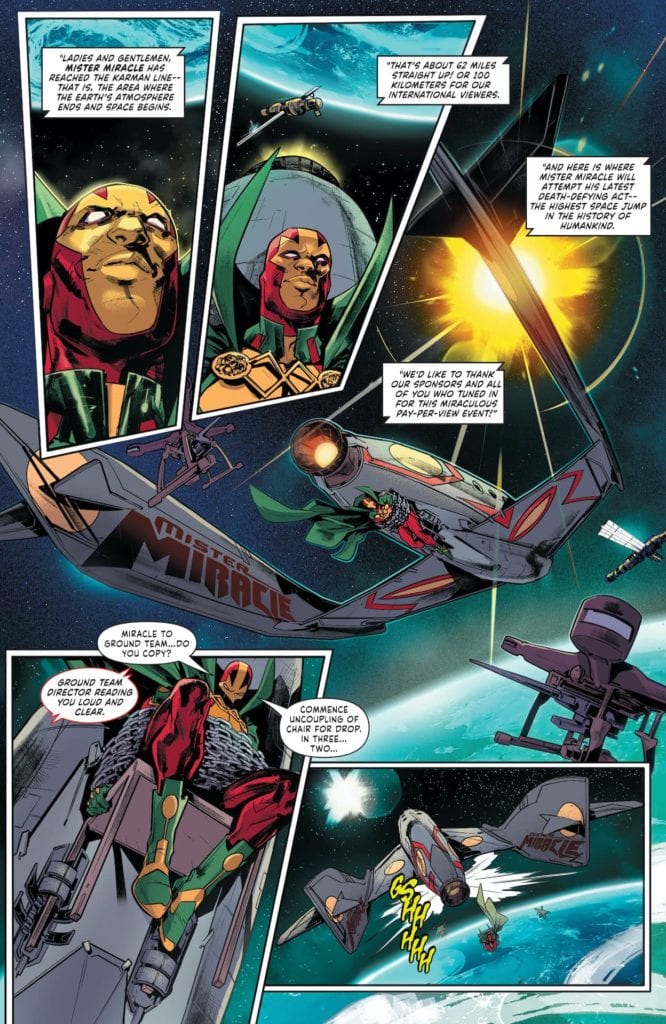
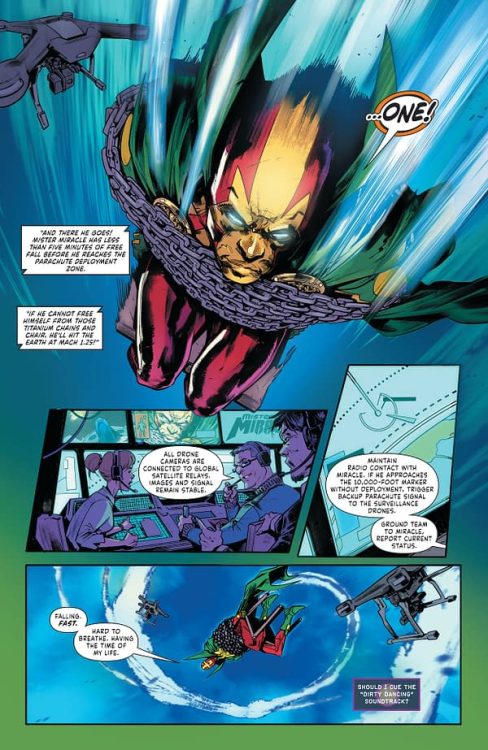
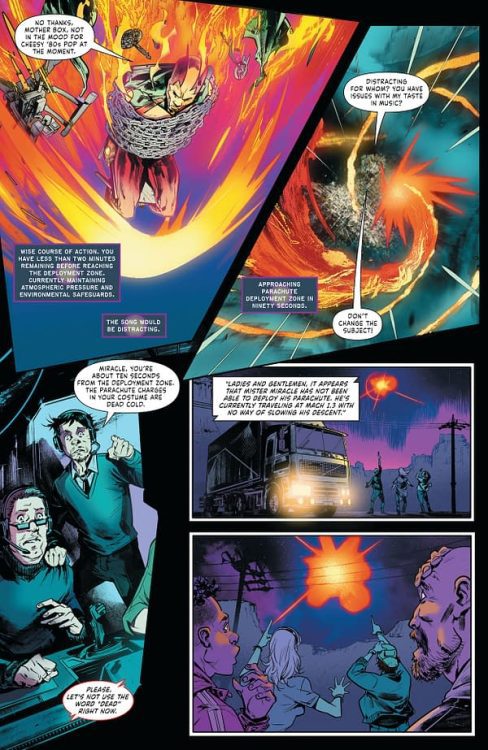
The saving grace in “Mister Miracle: The Source of Freedom” #1 comes in the form of Fico Ossio’s pencils and Rico Renzi’s colors. Ossio’s shadowy and stylized aesthetic is full of detail and kinetic energy. The way Ossio draws his characters in both their expressions and movements does a great job of placing us in the room (or falling from space in a ridiculous escape stunt) with the cast, and the emotions look and feel real throughout the book. The action and how it runs through the panels is full of forward motion and looks absolutely stunning. There is occasionally the sense that there is too much happening a once on a page, or that actions seem to be running together. I mainly attribute this to the script rather than the artist, however. Rico Renzi’s colors are saturated and complex, with tons of tonal variation and shadow. The Mister Miracle costume pops with a definition that makes it stand out the way such a look should stand out against the backdrop of a normal urban environment. Rob Leigh’s letters vary slightly with font changes and a clean look, but don’t do too much outside the basics. This is a sharp looking comic that manages to elevate a convoluted script into an enjoyable read.
“Mister Miracle: The Source of Freedom” #1 is a sharply drawn but hastily written debut comic for this reintroduction of Shiloh Norman as the Apokalips-born Houdini. Brandon Easton’s script manages a couple moments of engaging writing and solid dialogue, but it mostly fumbles as it tries handling too many problems at once and never allows the plot to breathe. The visuals from Fico Ossio and Rico Renzi are vivid and stylistically awesome, making for a killer looking comic with its own unique aesthetic. If you’re a fan of the underdog Mister Miracle identity and want to give this a shot, pick it up when it hits shelves on 5/25!
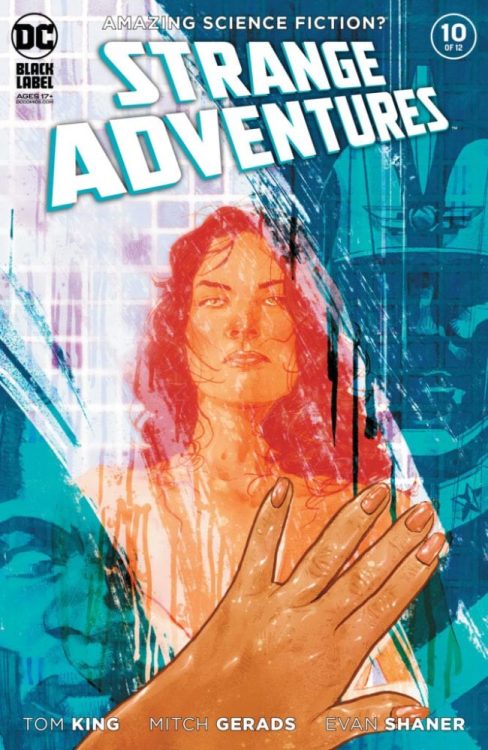
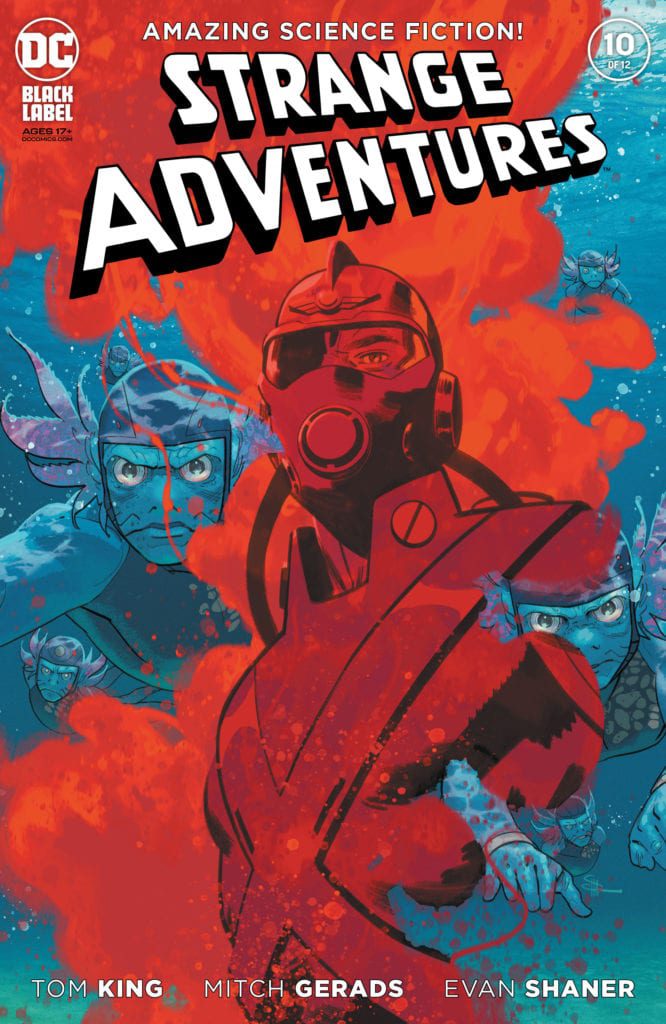
With DC Comics’ Strange Adventures #10, we get all the answers we’ve been looking for. Writer Tom King, artists Mitch Gerads and Evan “Doc” Shaner, and letterer Clayton Cowles, execute their big reveal. And boy, they sure do stick the landing!
Writing
King’s script has two sides to it, just like in every other issue of Strange Adventures. For parts of this issue, we follow Alanna Strange. She’s reading a letter from Michael Holt, Mr. Terrific. The letter is well written and intellectual. Its contents are brutal and devastating. But the other half of King’s script is the complete opposite. We follow Adam Strange during the Rann-Pyykt War. These scenes are casually brutal. Adam smiles as he shoots enemies through the head. He cracks jokes between war crimes. Both halves of this script do a phenomenal job of showing the human response to wartime. Some, like Michael Holt, must study it. They need to know why they fight on a philosophical level. Others, like Adam Strange, need to pretend they’re not fighting at all. It’s just a normal day to him, full of bloodshed.
Art
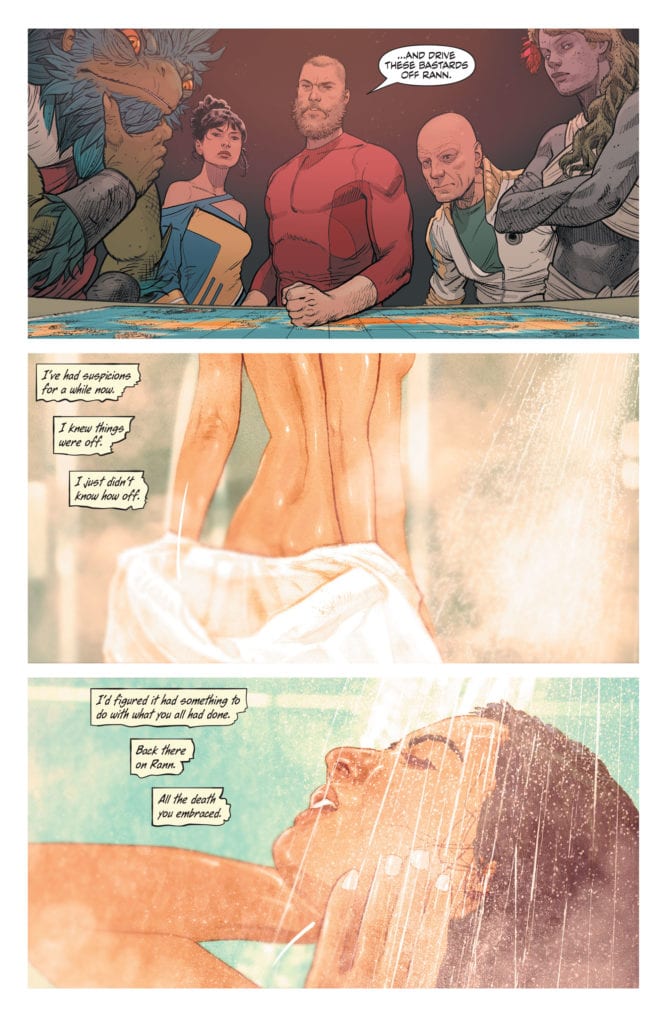
Gerads side of the comic focuses claustrophobically on Alanna Strange. We watch her go about her day. She looks glamorous and put together. Her face is unmoving. A mix of a smile and a look of determination. But at one point we see her sitting on the toilet, going through her phone. It’s a moment we feel like we shouldn’t be there for. But it’s clear this is a deliberate invasion of privacy. This is the one thing we’re seeing in Alanna’s day that isn’t rehearsed. And later, we see her take off her makeup. At first, it feels normal and part of her pre-planned day, until she has all of her makeup off. She glares at her own reflection. Gerads is showing us, in subtle interruptions to Alanna’s meticulously planned days, little moments of Alanna being human. He’s helping us understand Alanna at a time we need to understand her the most.
Meanwhile, Shaner’s pages are disturbingly comfortable with violence. Adam and Alanna often look full of happiness when they seem to be winning the war. But these moments of joy segue seamlessly into scenes of extreme violence. An action packed page of Adam charging into battle quickly leads to a panel of him executing Pyykt soldiers. Shaner’s pages once felt like a time capsule into the Silver Age. His characters looked happy and their trials were like something out of a movie. The consequences didn’t feel real. But now, Shaner is rubbing our noses in the consequences, but the smiles and the attitude of his characters hasn’t changed. It’s incredible. Shaner shows us vividly how normal the war has come to feel for Adam and Alanna as they grin through the carnage.
Coloring
Gerads pages often have a golden hue to them. It feels like you’re reading the comic through a glass of whisky. But he dials down the color palette slightly when Alanna is in the bathroom. When she’s applying her makeup, sitting on the toilet, or taking off her makeup, the colors feel less intense. It feels like she’s no longer putting on airs. These are the moments she is alone and has no one to perform for. Shaner’s color palette is consistently deep and full, with one exception. Right before the issue ends, we see Adam flying off on the right side of one of Shaner’s panels. He is uncolored, to the point that we can actually see some of the layers of Shaner’s penciling underneath. It’s as though the revelations of Holt’s letter are undoing parts of this fantasy the Stranges have created. The image that Adam has presented of his time in the war is quite literally being erased.
Lettering
When Cowles writes captions for Holt’s letter, he leads us down each page gently. We get three captions on one side of the page, one in the middle, and then three on the other. He guides our eyes carefully. It creates a sense of movement. But when we see Alanna taking off her makeup, the movement stops. All of Cowles’ captions are on the left of the page. For juxtaposition, when Alanna applies her makeup, which is shown in an almost identical way by Gerads, Cowles has captions on both sides of the page. So this is a clear difference. It suddenly feels static and unmoving.
The feeling the reader gets is almost one of whiplash. We’ve been gently following along and then we screech to a halt. It’s fantastic. Cowles snaps our attention back to the contents of the letter. And he makes us feel trapped in those captions. We no longer feel the range of movement we did before. And so, with that simple shift, Cowles highlights the importance of those final moments, and helps us see how Alanna must feel as she reads the same words.
DC Comics’ Strange Adventures is incredible. And with the bombs dropped in this issue, this creative team shows they can deliver on answers just as well as they delivered on mystery. Pick up Strange Adventures #10, out from DC Comics May 25th, at a comic shop near you!
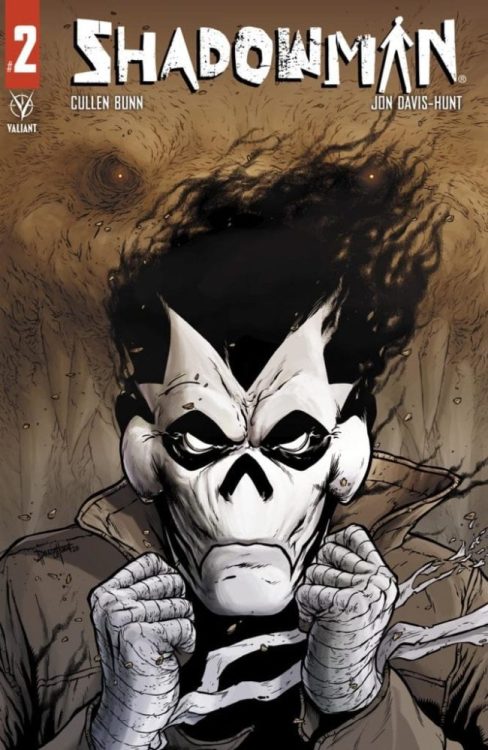
Shadowman #2 continues Valiant Entertainment’s tale of intrigue on May 26. Writer Cullen Bunn gives the titular character an attitude to match his suspenseful job. Artist Jon Davis-Hunt gives this issue a heavy dose of anticipation via illustrations. The feelings of intensity increase via Jordie Bellaire’s disorienting colors, and the lettering by Clayton Cowles provide sounds that beckon the reader onwards.
Shadowman #2 Folksy Horror
Shadowman #2 stands out by furthering a theme Bunn develops from the last issue. The people and demons Shadowman faces have a perverse drive for depraving acts. It’s as if some greater force pushes these people to normalize such macabre behavior for some direction in their lives. With Shadowman’s powers not allowing him to feel fear, the reader can’t help but feel it for him. Because with anger and disgust driving him, it feels like he is being exploited by a puppet master. As without the fear to hold back his worst impulses, Shadowman isn’t too different from his enemies.
Suspense Kills
Davis-Hunt illustrates Shadowman #2 with an air of suspense. Each scene has an action taking place with something sinister flourishing. For Shadowman, who sees between two worlds, this is almost a given. Frankly, it’s hard to determine if the empty town or the ghost inhabited side is scarier. The Deadside looks lively with the demons living in it and the complementary color schemes by Bellaire. Unlike the dusty brown town that spits out ghosts. This is to say nothing of how Shadowman’s color scheme and outlining stand out in both realities; it highlights his role as a balance keeper of the Deadside.
The lettering by Cowles demonstrates the power of the voices spoken by the characters. Depending on the situation and a character’s presence, their voices enhance the scenarios. Looking at one page, Baron Samedi says everything to know about Shadowman’s role in two panels and stylized word balloons. Unlike how Shadowman takes a longer time to process everything through his captions.
Don’t Wait For Shadowman #2
Shadowman #2 gets a firmer grip on the reader by diving into the titular character’s psyche. There are forces at work that the reader has to realize for Shadowman because it feels like he’s looking for his footing. Readers can only wait until the next development.
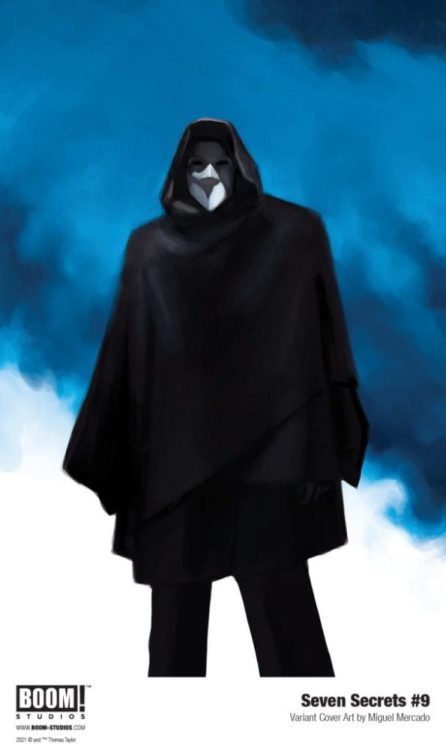
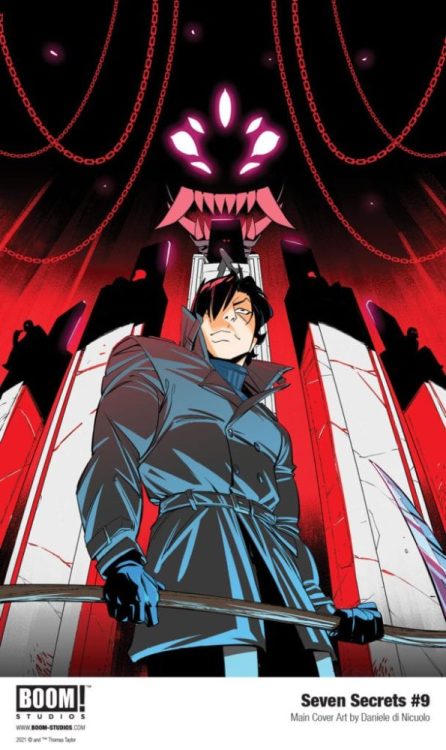
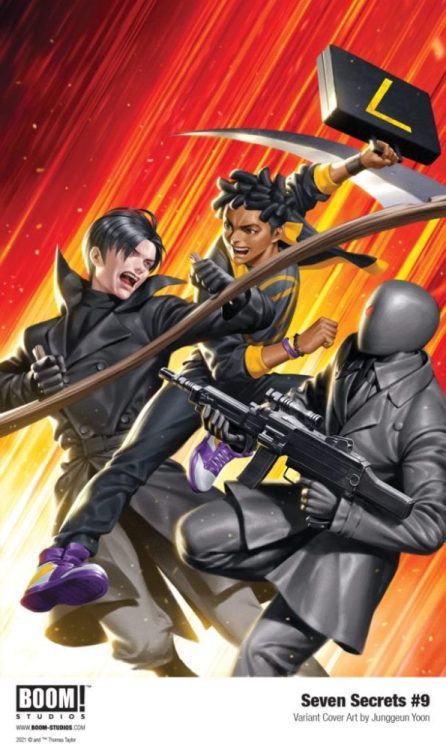
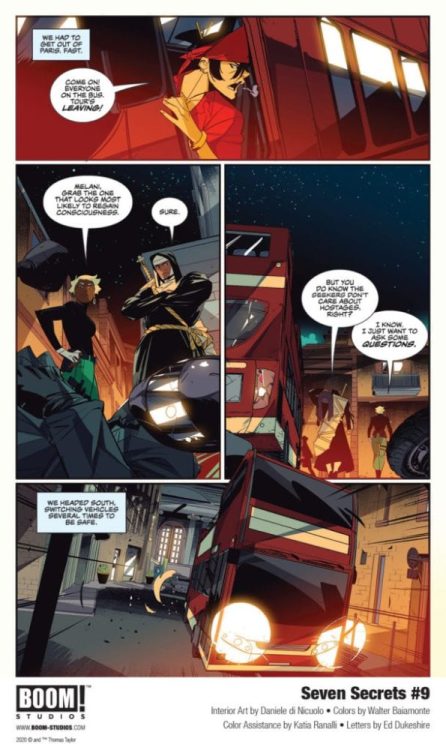
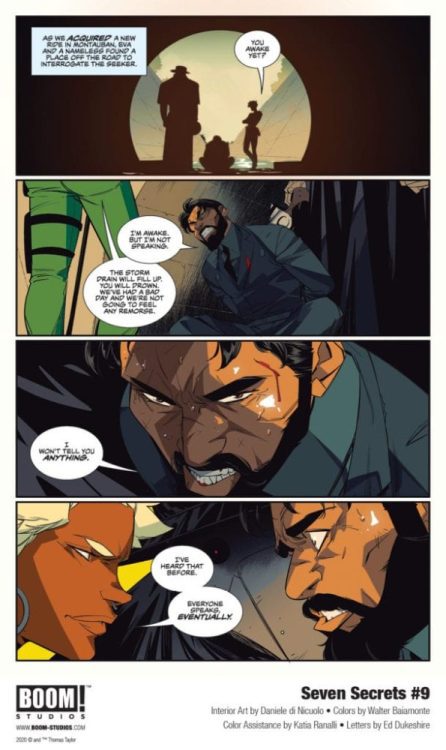
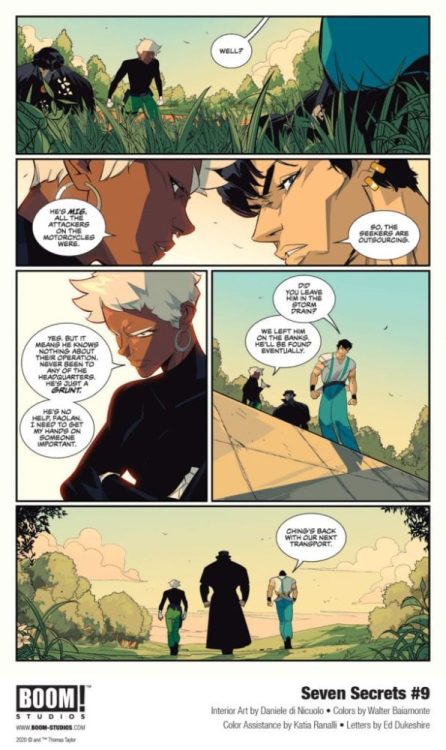
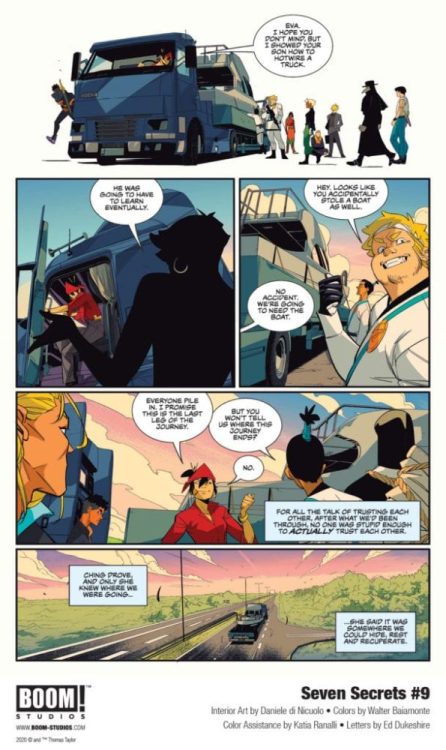
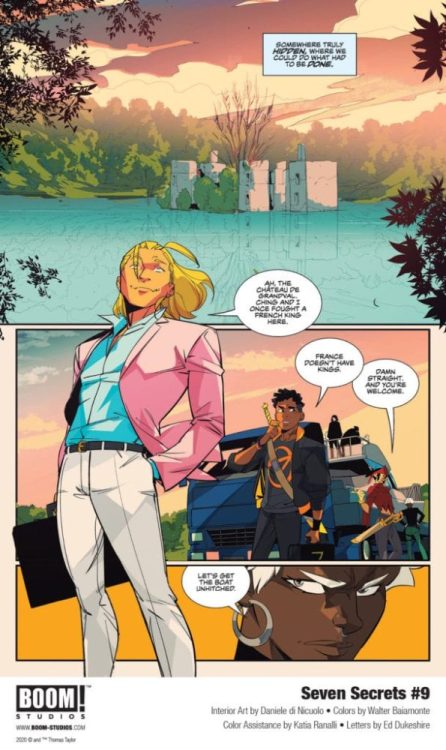
SEVEN SECRETS #9 hits your local comic book shop on June 16, but thanks to Boom! Studios, Monkeys Fighting Robots has an exclusive five-page preview for our readers. The book is written by Tom Taylor, with artist Daniele Di Nicuolo, colorist Walter Baiamonte, and letterer Ed Dukeshire.
About the issue: With the first secret revealed and the world now watching, how much longer will the Order’s members be able to remain hidden? Casper and the surviving Keepers and Holders retreat once more to a remote safe house, even as Amon and the Seekers close in on them. Can the Order survive with a mole in their midst?
SEVEN SECRETS #9 features main cover art by series artist Daniele di Nicuolo and variant cover art by acclaimed artists Junggeun Yoon and Miguel Mercado.
Even without being an avid comic book reader, many people can still recognize some ‘important’ comics. These will, more often than not, fall into the ‘First Appearance’ category, whether that relates to a character or a creator. Detective Comics #27, for example, with its iconic image of Batman swinging across the city, a criminal in his arms; or The Amazing Spider-Man #298 which contains the first appearance of Eddie Brock and Todd McFarlane’s first issue on art duties.
These types of comics are fan favorites and often become highly collectable because of the desire to own a part of history. However, some comics have historical significance for other reasons, due to their links with social or controversial events. These comics might not have as far reaching recognition as others, but their significance is just as important in the foundation of the industry.
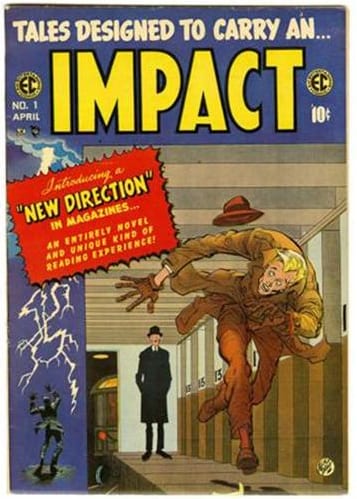
Take for example, Impact #1, published by EC Comics in April 1955. It might not be a comic most people are familiar with but the anthology contains a story by Bernie Krigstein, called Master Race. The strip is one of the most visually stunning and thematically important comics ever published. It is one of the first American comics to directly reference the holocaust.
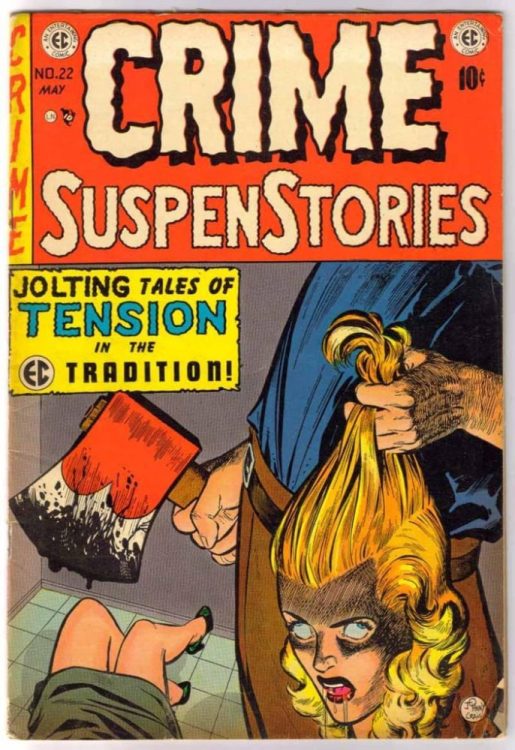
Another EC comic, Crime SuspenStories #22, holds a place in comic book history for a slightly different reason. Unlike Impact #1, the contents and creators of this comic are not of particular interest but what the comic was used for has cemented it as a significant and collectable publication.
Impact #1 Credit: EC Comics
Juvenile Delinquency
The early 1950’s was a prosperous time for the comic industry in America. There were a number of publishers putting out hundreds of titles, selling upwards of 26 million comics per month.
These were often widely available, sold on newsstands and in grocery stores all across America. Relatively cheap, with cover prices of 10 cents per comic, it was easy for young readers to get their favorite titles every month. Publishers like EC Comics were thriving, in part because of the range of comics that they released but also because of the content. Crime and horror comics were big business and EC Comics were dedicated to releasing the best titles they could.
Comics such as Tales From The Crypt and Weird Fantasy are infamous and have as much of a following today as they had back in the 1950’s. The creators who worked on the titles were often at the top of their game and no-one, from writer and artist to editor and publisher, were afraid to push the boundaries of the stories they told.
However, there was a storm brewing, one that would decimate the comic industry. Towards the end of the 1940’s not everyone was happy about the comics that were circulating around the country. There was a growing concern about the contents of some horror and crime comics and the detrimental effect that they were having on children. Organizations were beginning to question if the rise in juvenile delinquency could be tied with the spread of the cheap comics that were popular amongst the younger generation.
Two articles published in 1948 kicked off the organized backlash against comics. Both articles were written by Fredric Wertham who became famous for writing The Seduction of the Innocent, a publication that arguably did more damage to the image of comics than any other published work. The two articles led initially to the formation of the Association of Comics Magazine Publishers, which failed to regulate content and had almost no effect at the time.
This initial failure fueled Wertham’s mission to fight inappropriate content and led to the book mentioned above and a US Congressional hearing into the effect of comics on Juvenile Delinquency. The hearing did not go well for the industry, leading to the formation of the Comics Code Authority and ultimately the downfall of EC Comics.
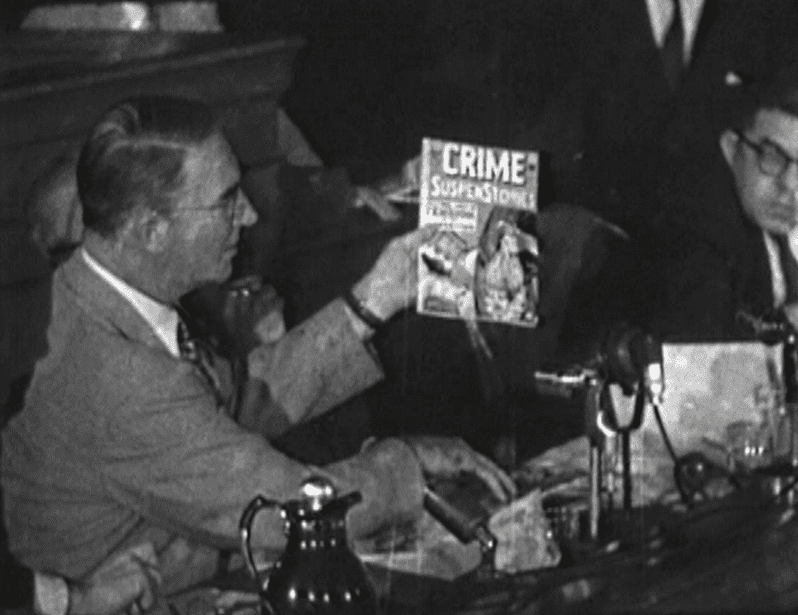
Subcommittee Hearings held in New York, 1954
Suspenseful Stories
So, what role did Crime SuspenStories #22 play in all of this?
When the 1954 Senate Subcommittee Hearings began in New York, it was clear from the outset that an element of scapegoating was taking place. Testimony was presented and the Committee asked questions of each witness, however the committee member’s were more inclined to ‘grill’ those arguing against the motion that comics were an unhealthy influence on the readers.
The first speaker on April 21 was Richard Clendenen, the executive director of the Senate Subcommittee To Investigate Juvenile Delinquency. He opened with a brief description of the comic publishing industry with some figures based on distribution and sales. He then went on to give some examples of the types of comics that the Subcommittee were concerned about. These comics included Black Magic Magazine, Mysterious Adventures, The Haunt of Fear, and Shock SuspenStories.
It was stated categorically in the opening statements that no-one wanted to infringe upon freedom of speech but content deemed unsuitable needed to be regulated. In the case of Crime SuspenStories #22, the committee barely got past the cover.
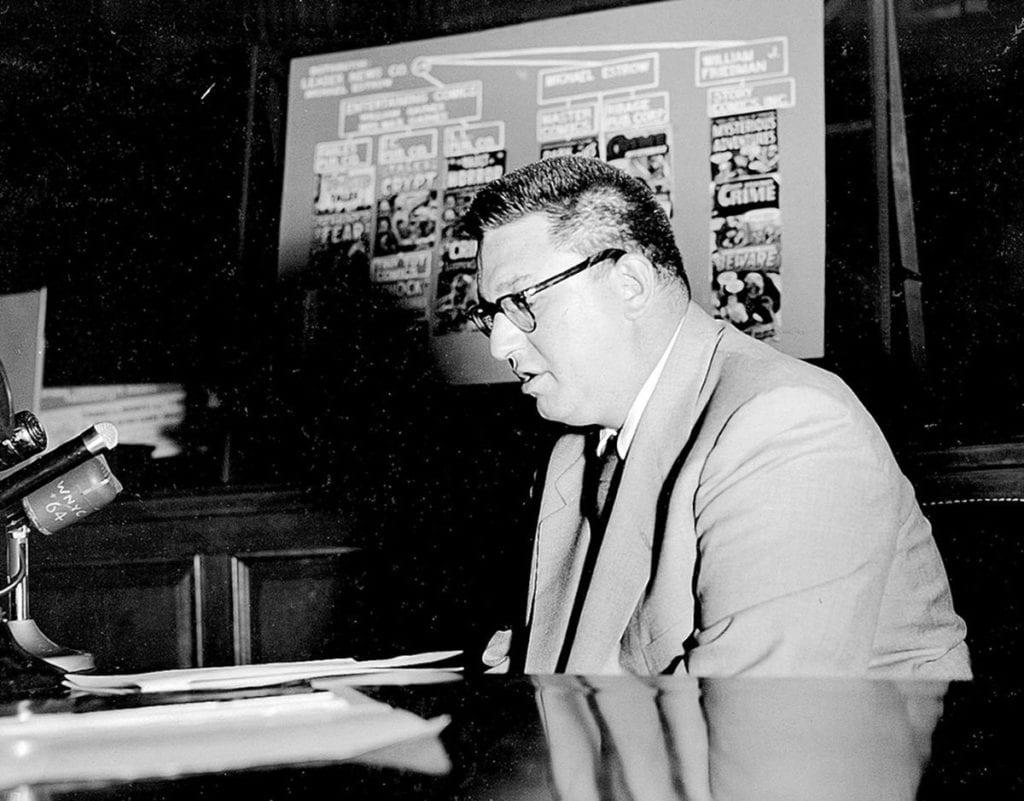
During the hearings William Gaines, EC Publisher and Co-Editor, voluntarily took a stand against the committee, despite recommendations to the contrary. His opening was defiant and bold. He was full of bravado, despite a lack of sleep and suffering from amphetamine withdrawal. Unfortunately for Gaines, the Committee had already heard Dr Wertham’s damnation of comics and their evil effects on the youth of America. As the publisher’s testimony continued he was drawn into lines of reasoning that would ultimately bring down the industry.
Chief Council Herbert Beaser asked the question, “Is there any limit you can think of that you would not put in a magazine because you thought a child should not see or read about it?”
Gaines replied by saying his limits were ‘the bounds of good taste’. It was at this point that Senator Estes Kefauver brought out a copy of Crime SuspenStories #22.
The cover of the comic shows the torso of a man, in one hand holding a bloody axe and the other a disembodied head of a woman. In the background a woman’s body lays on the floor, only her legs are visible. Senator Kefauver appears shocked by the comic he holds and asks Gaines if he considers it in good taste. Gaines’ reply is magnificent, in one respect, but completely damning in another. It is as if he is mocking the Committee and the Senator in an attempt to defend his art. Do you think the comic is in good taste?
Gaines: “Yes sir, I do, for the cover of a horror comic. A cover in bad taste, for example, might be defined as holding the head a little higher so that the neck could be seen dripping blood from it, and moving the body over a little further so that the neck of the body could be seen to be bloody.”
William Gaines giving evidence in 1954
Justifiable Self-Destruction
Gaines makes, in his eyes, valid points. In fact, these suggestions had been made to the artist, Johnny Craig, before the final artwork had been submitted. However, the exchange and the ‘horrific’ cover made national headlines and it was deemed that publishers were defending disturbing content that would warp a child’s mind. A single cover for a single comic spelled the end of crime and horror comics for an entire generation, toppling a hefty chunk of the industry with it. Fearing Government regulation, the comics industry backed down, created the Comics Code Authority, and set the bar for appropriateness too high for a large number of comics to reach.
One man’s belief in the work he published, and a single horror comic cover, changed the course of comic book history with ripples still being felt today. The next time someone asks you about an important comic book, remember Crime SuspenStories #22 and the massive change it brought to a multi-million dollar industry.
It is May 23, 2021, and if you are reading this, it means you have survived the apocalypse! I’m your host Matt Sardo, and boy did I have a week. Let’s talk about it.
Tom Taylor’s Nightwing run (79-80)
Zack Snyder’s Army of the Dead
North Hollywood is a fine French film about skateboarding. Disc Golf tournament recap Preparing for
Mare of Easttown
Kickstarter hump
Thanks for checking out the podcast, have a great week and let me know how you survived the past year.




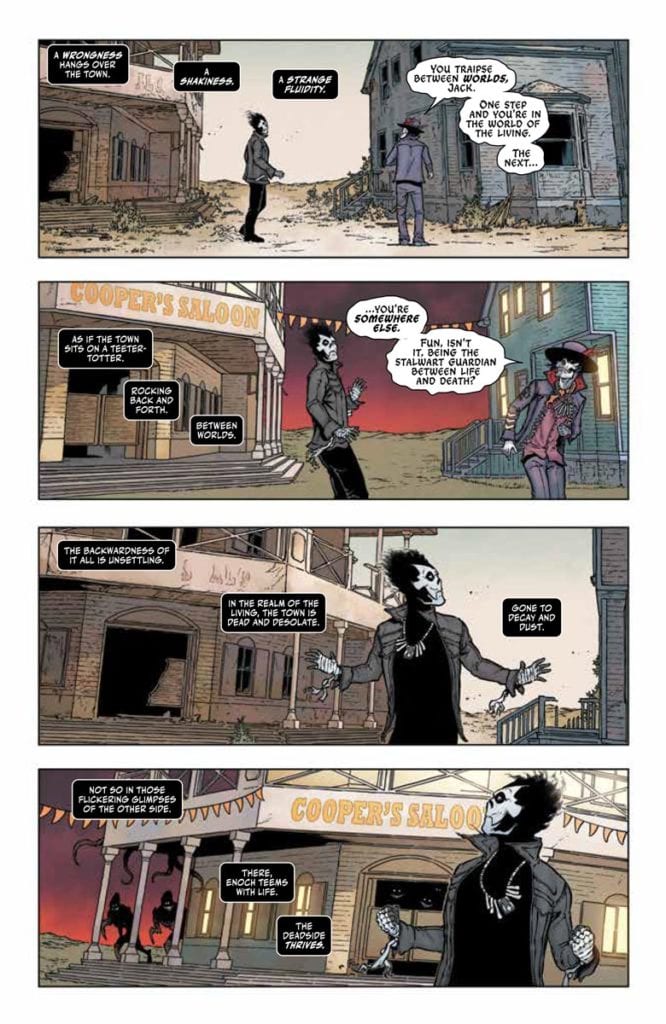 Davis-Hunt illustrates Shadowman #2 with an air of suspense. Each scene has an action taking place with something sinister flourishing. For Shadowman, who sees between two worlds, this is almost a given. Frankly, it’s hard to determine if the empty town or the ghost inhabited side is scarier. The Deadside looks lively with the demons living in it and the complementary color schemes by Bellaire. Unlike the dusty brown town that spits out ghosts. This is to say nothing of how Shadowman’s color scheme and outlining stand out in both realities; it highlights his role as a balance keeper of the Deadside.