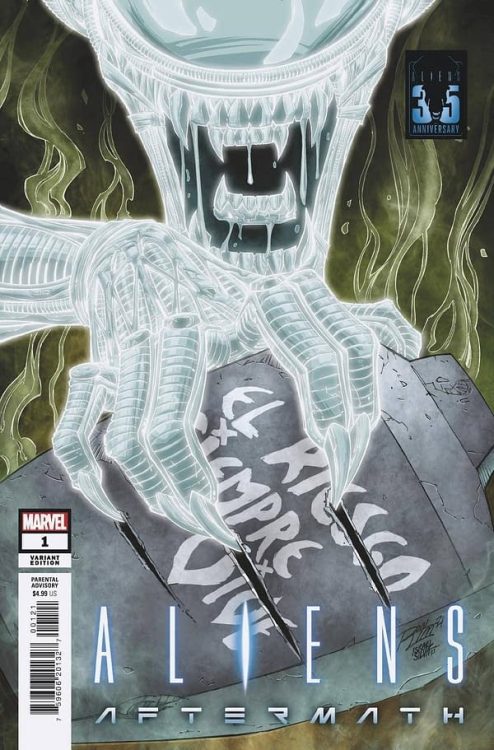
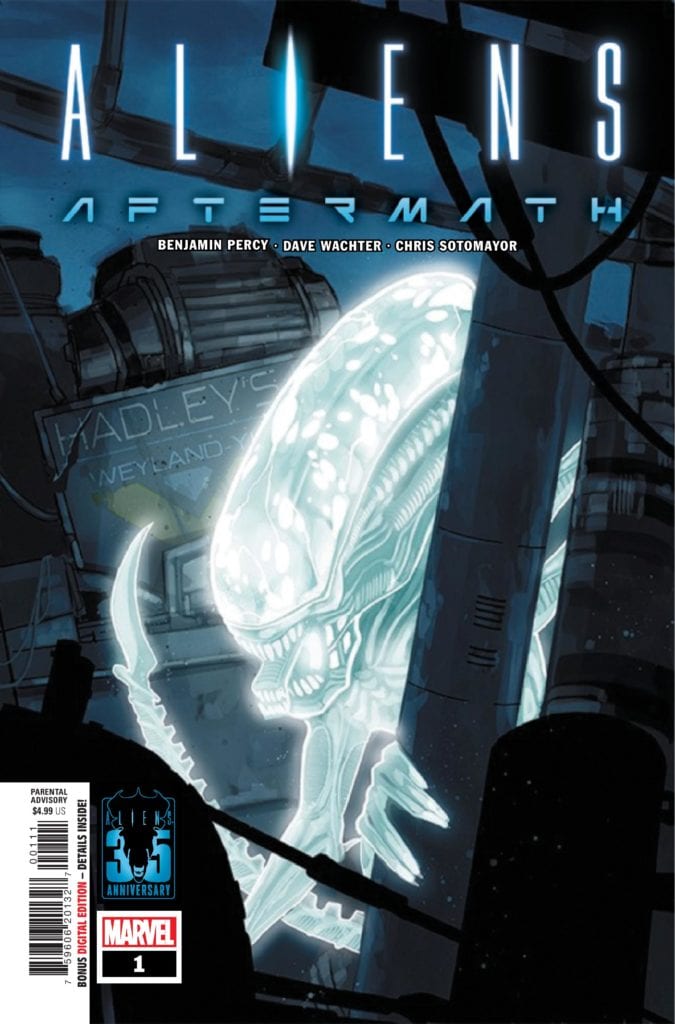
For the 35th Anniversary of the landmark film, writer Benjamin Percy and artist Dave Watcher have created Aliens: Aftermath #1. Along with colorist Chris Sotomayor and letterer Ariana Maher, this one-shot acts as a semi-solid follow-up to the 1986 film. However, with a flimsy script that focuses too much on concepts rather than characters and some solid but inconsistent art, this is an idea that should have stayed in the oven.
“It’s been 35 years since the tragedy of the Hadley’s Hope colony, but what happened to that ill-fated venture has been shrouded in mystery. A renegade crew of investigative journalists are heading towards the moon that Weyland-Yutani has wiped from all records, and they’ll bring back the truth even if it kills them…and what remains in that bombed out site will try to do just that.”
Writing & Plot
The script for Aliens: Aftermath #1 focuses too much on references and not enough on character or plot. In true Alien fashion, Ben Percy introduces us to a motely crew of misfit space travelers. He actually sets up an intriguing angle from page one. It’s common knowledge that Weyland-Yutani is the true ultimate villain in this franchise. The idea that there are open rebellions and protests against their actions is a welcome topic. At its core, Alien has always been about the callous greed of corporate profit outweighing the lives of human beings. Percy pays heed to this core concept in a manner that hasn’t been seen in this universe.
Unfortunately, this is where the inventive thinking ends. The entire cast of Aftermath is wholly disposable in the same manner as a low-budget slasher flick. In a random Alien one-shot, I would be okay with this. However, this is meant to be a direct sequel to the original Aliens film. A film that is a veritable masterwork of the genre. Among its many other points, Aliens works so well because its characters feel so believably human. What’s worse is that we’re meant to care about these characters because of their connection to the original Aliens cast.
Such A Thing As Too Much Fanservice
Percy’s script just doesn’t give its characters enough time to live up to that legacy. The atmosphere and pacing feel on par with the films, but the rest of the book can’t match up. The new form of xenomorph that shows up is a cool concept, but it’s introduced with no context. Percy throws in nods to Cameron’s film left and right, and while they’re sure to please diehards such as myself, they’re just bait. Outside of its solid political core, Aftermath does little to make itself worthy of the work it pays tribute to.
Art Direction
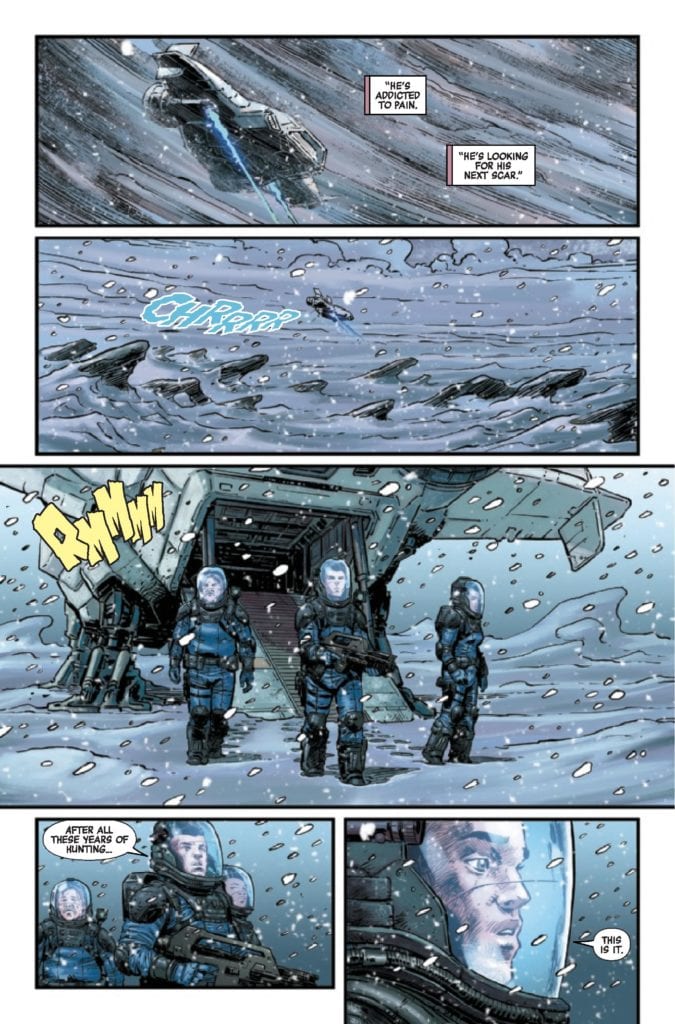
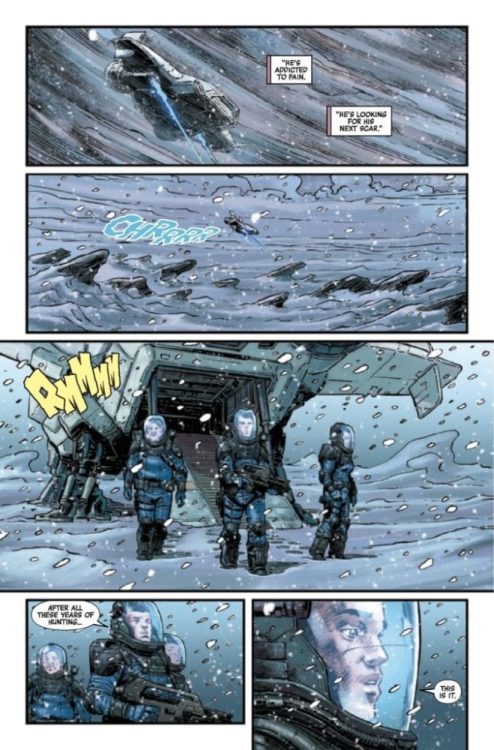
Keeping the aesthetic and design language of the Aliens universe intact is the top priority for an Aliens comic. Dave Watcher’s art crafts Aftermath’s aesthetic and does a solid job placing us in this familiar universe. The retro-futuristic technology and used future designs are spot-on. Watcher’s character work is solid, but admittedly a bit inconsistent. Facial animations and expressions can go from tight to looking a bit rushed. This is only a minor issue, but it is noticeable.
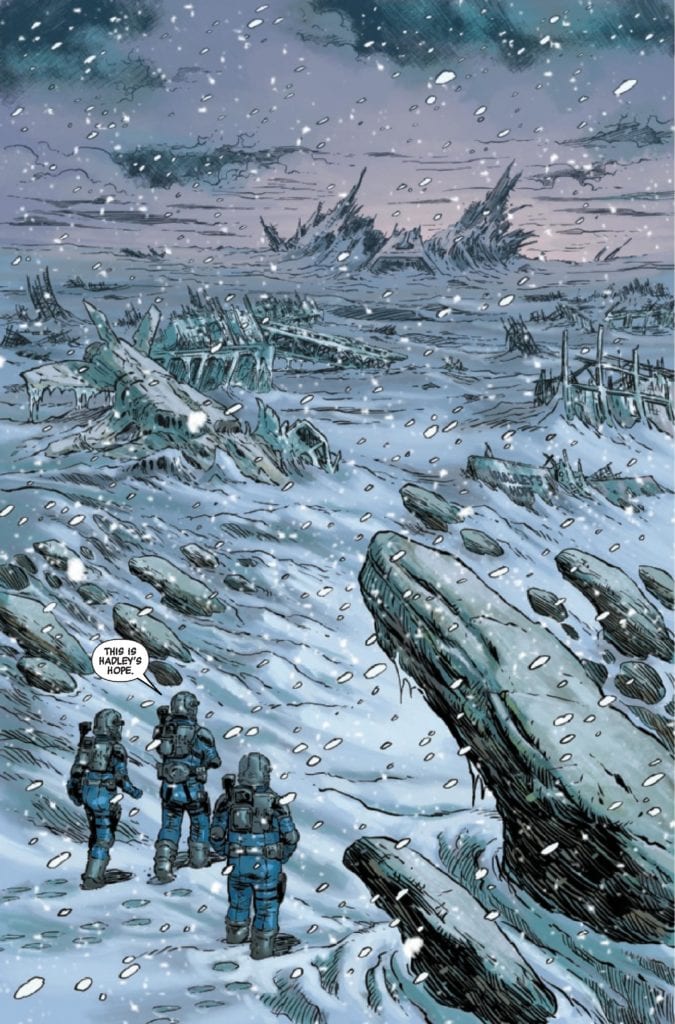
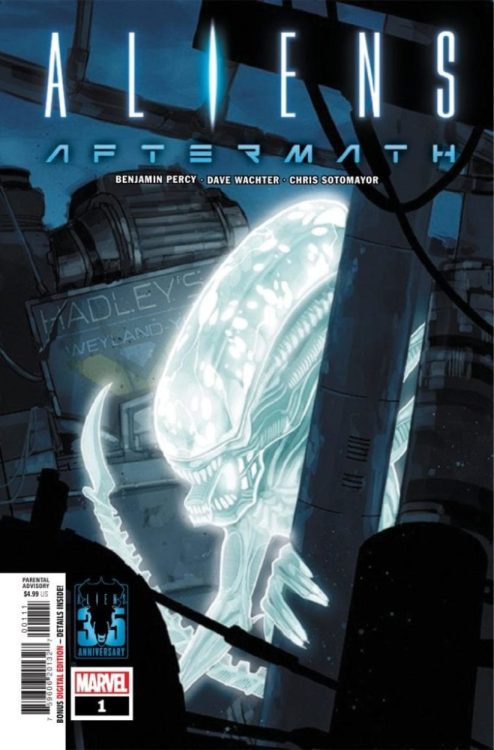
The design of the Alien itself is spot-on with Giger’s original, albeit with the new concept for this particular Xeno. Chris Sotomayor’s colors hit the dark and gritty visual spectrum that I’ve come to expect from alien comics in recent years. The rebel crew’s ship is worn by age, and the remains of Hadley’s Hope are marked by nuclear winter. Percy and Watcher’s new Xeno lights up the room (as you can see on the cover) thanks to Sotomayor’s work. Watcher’s panel direction uses some classic off-page tension-building moments to set up scares and twist reveals. These work to great affect, and it makes me wish this comic had more substance to its story. Ariana Maher’s lettering is solid work as well, with a clean modern font and great special effect work. I would have liked more variance in the dialogue fonts, but this is a minor nitpick.
Aftermath is a solid looking comic overall, with thick, shadowy pencils and atmosphere-building colors throughout.
Verdict
Aliens: Aftermath #1 is a loosely entertaining but unremarkable one-shot celebrating the anniversary of a masterpiece. Percy’s script keeps in line with the Alien political messaging remarkably well. However, thin characterizations and rushed pacing kill the rest of the story’s momentum. The visuals from Dave Watcher and Chris Sotomayor are nothing unexpected, but still very solid and present the Aliens atmosphere well. If you’re a massive fan of this franchise and Cameron’s acclaimed film, then you may want to pick this up when it hits shelves on 7-14.
Welcome to Self-Published Spotlight, a regular interview column where I will be highlighting self-published comics and the creators and small print publishers who make them.
I first came across Tony McMillen’s work via an interview in Wizerd: The Comix Megazine #1. The article also included an excerpt from Tony’s graphic novel, Serious Creatures. I immediately was floored by his art and wasted no time connecting with him online. So when Tony launched the Kickstarter campaign for his latest book, Attaboy, I reached out to talk to him about it. Check out the chat and then make sure to check out Tony’s work.
Monkeys Fighting Robots: So Tony, how are you today? Thanks for taking the time to talk! Tony McMillen: I’m doing good, glad to talk with you!
MFR: So I ask everybody this, what’s your comic book origin story, like how/why did you get into reading comics and then creating comics? Give us a brief history. TM:Summer of Batman ‘89 was inescapable, Tim Burton’s movie made it so Frank Miller’s Dark Knight Returns was in every bookstore, which meant that my now Batman obsessed 7-year-old self could convince my Aunt Susie to buy it for me. That comic made me a full-blown comic junkie.Now, I just get high on my own supply. My first comic written, drawn, lettered and colored by me is called Lumen and I self-published it about three years ago. The summer of the bat never ended for me.
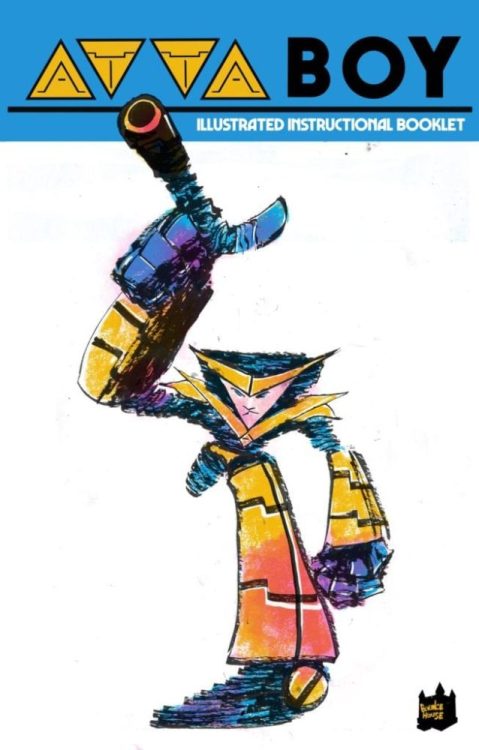
MFR: So to get all Hollywood (since I know you are a film fan!) what’s the logline/elevator pitch for Attaboy? TM:An oversized comic disguised as an instruction manual for a video game that may or may not have ever existed.
MFR: I know you have done multiple methods of publishing in the past. So why go with Kickstarter for Attaboy? TM: Kickstarter remains the best presale/promotional tool available for an indie comic book creator. I have had my novels published through traditional presses and sold my comics and graphic novels myself through my Etsy shop but I always make the biggest fuss and get the most readers through Kickstarter. So, with Attaboy, it was a no-brainer to go back to the platform.
MFR: How did the project originate? Like did you think of a character first or the concept? Because both are so vivid to me that either seems to have been able to be that press of a start button! TM: I’ve been thinking of the lost art of the video game manual for a long time. I was originally going to do my comic Lumen in that format but I hadn’t yet cracked the Konami code on how it could work narratively. At the same time, I started developing the idea of a little robot boy character, akin to Mega Man, or Astro Boy. There’s even an Attaboy t-shirt worn by Bobby Feckle, the main character of my last comic Serious Creaturesin issue 4 of that book. But it took me a long time to finally pair the character Attaboy with the video game manual framing device. And what finally brought it all together was the Mandela Effect notion of the book’s opening line, “There’s a video game from when I was a kid that no one else seems to remember.”
MFR: What made you go with an oversized format for the book? TM: Erik Larsen’s Herculian was the first treasury-sized book I really remember knocking me out with how much the size of a comic could impact the reader. Later on, Jesse Lonergan’s Hedra, the original newsprint version, furthered my interest in the bigger format because Lonergan really took advantage of all that extra real estate with massive, dense, yet playful panel grids. But I had no idea how to get a bigger book printed yet. But after finishing my comic series Serious Creatures I decided to do an art book titled Fairweather Fiends and out of the blue, I asked my printer if they could do something bigger than an average comic. They said, you’re in luck, we just got some new machines that can do it!So I made the artbook nearly vinyl record sized. The stage was then set for me to try and play with a larger size comic and see what that opened up for storytelling possibilities.
MFR: Do you have other physical details already planned? Like the cover, paper stock and binding? TM: I already have a good-looking proof, the paper stock will be matte, the cover glossy, perfect bound. Nothing too out of the ordinary; the book’s already a behemoth, no need to put polka dots on top of the stripes.
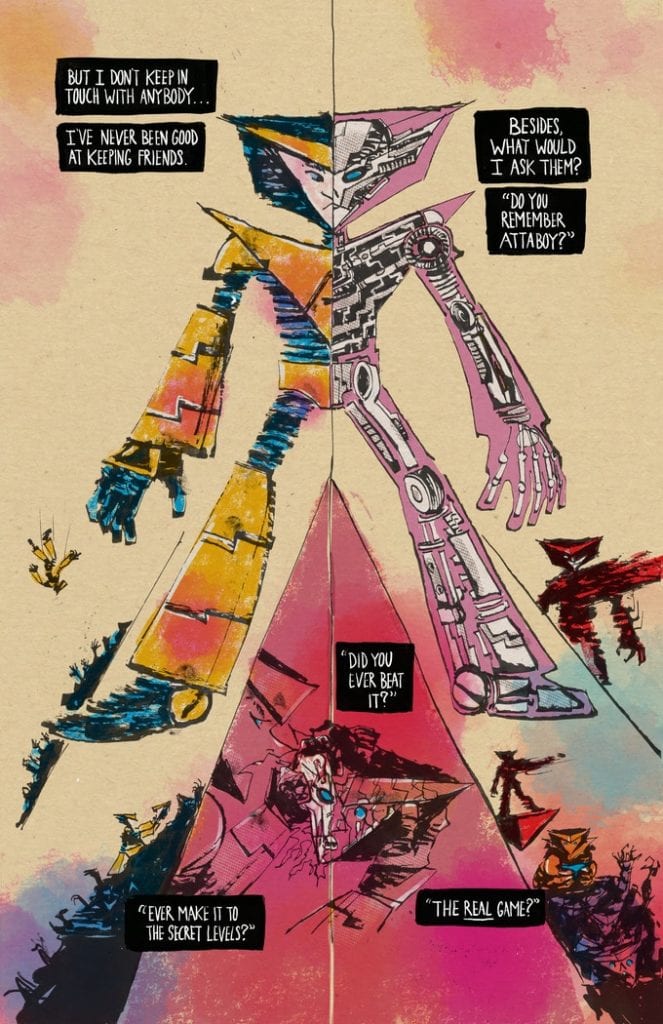
MFR: Attaboy gets very meta-fictional. Was that aspect something you always had in mind? Did anything in particular influence that aspect? TM: Stumbling upon the meta-fictional and personal elements of the story is what finally made the story start working for me. Basically, I was stuck with this concept of using the trappings of a video game manual as a way to tell a comic book story but I had no real story yet. When it dawned on me to start making a story about this forgotten video game and what the escapism of video games meant to me as a kid is when the gears started moving and Attaboy started moving with a life of its own. The two biggest influences for that sort of confessional approach wrapped in the iconography of fantasy and science fiction were Notes From the Shadowed Cityby Jeffrey Alan Love and Cankorby Matthew Allison. Both showed me how personal and autobiographical you could make a story about robots or monsters. The idea of a panel of a robot fighting some giant monster but the narration is all about my parents’ divorce and it all somehow works together; those books showed me how a creator could make that work.
MFR: I also sense a level of sadness and nostalgic longing in the story that I really connected with. Was this something you were striving for? Maybe it’s just something that I am just seeing?
TM: I am here to break your fucking heart! The sadness just kept creeping into the work. I’ve been reflecting on this sort of rekindled interest in estranged fathers and mothers in my work and I think it’s all from becoming a father myself two years ago. My first book Nefarious Twit was all about my anger and love for my parents but after that, I thought I had said what I wanted to say on the subject, and I seemed to move on with my next books and comics. But with Serious Creatures and now Attaboy all those feelings and new ones keep bubbling up. I think simple, superhero characters like Attaboy are good vehicles to explore the weirdness of childhood because they’re, of course, pillars from our childhood. Batman, Spider-Man, Link from Zelda; they’re all the imaginary friends who whisk you away from the mundane and sometimes anything but mundane trauma that can happen to a kid. They’re the keys to escape, so it’s only fitting that later in life they’re the keys back into that time period. And all the intense feelings that come with it.
MFR: As far as influences go, did you have any specific influences for Attaboy? I immediately see Mega Man in there. TM: Mega Man is the biggest, and without Astroboy, there’d be no Mega Man. But I have only a passing knowledge of Astro so Mega was my first boy robot. The originalLegend of Zelda’smanual is a work of art onto itself and I used to marvel at it as a kid; so that’s a huge influence of the structure of this comic. Jack Kirby’s Captain Victory, Kirby and Dave Cockrum’s character designs (I’ve been trying to figure out the magic of designing characters that stand the test of time) Michel Fiffe’sCopra is never far from my mind either.
MFR: The art is fascinating. What were the tools and mediums that you used? How was it physically created? TM: Thanks! I use a Pilot Parallel Pen, it’s a chisel tip pen that you can drag over paper to get a very thick, textured line. But you can also use the corner’s tip to get a fine line; it’s my one-stop shopping tool. I draw pretty much exclusively with that and a whiteout pen on Bristol board paper but then color the comic digitally using an iPad Pro and Procreate. I strive to make my colors appear as analogue as possible and end up using a lot of digital crayon and watercolor brushes.
MFR: This isn’t your first comic. But was there something new you did with Attaboy that you didn’t do with your other projects? A new process or approach?TM: The big leap forward on Attaboy is that it’s hand-lettered. I’ve used a font based on my own handwriting for previous projects but for this, I went the old-fashioned route…kinda. I hand-letteredit on my iPad Pro with my stylus, so if I made a mistake, or wanted to tweak the lettering size I could do so easily.
MFR: How long did it take you to have a fully finalized book? What was the timeline from beginning to end? TM: I think it was about 4 and a half months to make a 74-page book, top to bottom
MFR: Will the book be available anywhere after the Kickstarter campaign ends?TM: Oh yes! It will be available at my Etsy shop along with all my other comic work. https://www.etsy.com/shop/tonymcmillen
MFR: Are there any plans for more Attaboy? TM:I sorta love that little guy and really want to team him up with Esteban Vela, the masked hero from my adventure comic Lumen. I’ve been dreaming up a team book with Atta, Esteban, a new character named Beshemoth (think Big Barda meets Samus) and another new character called the Princess with the Parasol (think a goth Princess Peach from Super Mario). But I probably won’t get to making this book until after Serious Creatures Vol 2; so it might be a year or more until Atta returns.
MFR: Any final comments for our readers? TM: Attaboy is designed to be an event, like a concert, or a monster truck show…so, get your ticket, take the ride. Because, “You’ll pay for the whole seat, but you’ll only need….THE EDGE!”
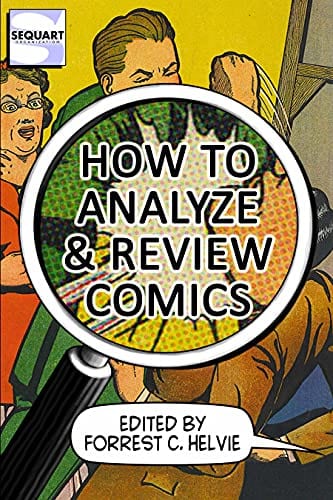
How To Analyze & Review Comics Cover Credit: Sequart
While discussing the links between film and comics in the new book How to Analyze and Review Comics, Jason Kahler notes that ‘film criticism has evolved over the course of over a century, and comic book criticism is still largely in its infancy,’ (pg 112). Despite the fact that comics have, even in their modern state, been around as long as cinema, the recognition and respect given to the latter artform has taken longer to be applied to comics. Although a number of scholars across the globe have taken an interest in the artform, Kahler’s statement is true. One of the main reasons for this, or perhaps a symptom caused by lack of interest, is the absence of recognized terminology. Literature, Theatre, and Cinema, have all adopted ways of talking about their artforms that, at this point, are excepted across the board, meanwhile you can still find people on Twitter engaged in the balloon/bubble argument when it comes to comics.
Academic writing on comics tends towards the adoption of other media terminology, as do many critics and online reviewers. This makes it simpler for the general public to consume because they are more familiar with these terms. A prime example of this is Hilary Chute’s early essays on Comics Studies where she attempts to pacify a mostly literary audience by discussing comics in literary terms*.
There is, however, a recent shift away from dual discipline approaches towards a singular Comics Studies field of study and a need for more consistency in the way people write about the format. This is where books like How to Analyze and Review Comics: A Handbook on Comics Criticism, published by Sequart, become useful tools.
Example of Original Stephen Sharar artwork Credit: Sequart
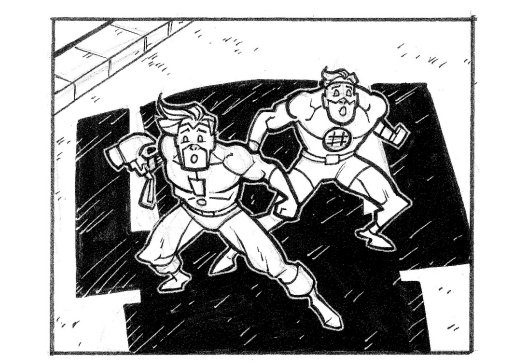
The book is edited by Forrest C Helvie, who has previously written a number of essays relating to a wide range of comics and comics issues, and includes contributions from writers that will be familiar to a number of people reading this. Sarah Cooke, Michael Moccio, Ryan K Lindsay, and Hassan Otsmane-Elhaou join others in covering an impressive range of subjects, from craft to terminology, and from history to theory. There is even an essay on podcasting and one on web-comics, a format that is changing the way comics are viewed and consumed. Each of the different writings has its own style and the author’s voice is more present in some than others. Take Kahler and Sharar’s Comics and Cameras chapter as an example: Kahler’s writing style is informal with a touch of humor that is accentuated by Sharar’s drawings. Instead of selecting images published elsewhere, the two create their own characters and out of context panels to help make their point. While being entertaining, it also allows them to express their ideas succinctly by creating specific examples to relate to.
Some of the topics in the book may seem like familiar territory but additional perspectives can help clarify and cement ideas. Scott McCloud’s seminal book** is a great starting point to understanding comics, but by itself it is not enough to build a complete lexicon of knowledge. Different voices, and even more modern takes on the form, are important, especially if the reader in question is critiquing other people’s work. It is not enough to simply read comics, you have to understand the structure and history behind them, recognize the cultural significance, and be able to see beyond the character, publisher, or creators names. As Becky Cloonan says in the book, ‘you have to be able to look beyond your own opinion. [..] Familiarize yourself with the language and syntax of art and comics, and it will boost your appreciation and understanding of the medium.’ (page 81)
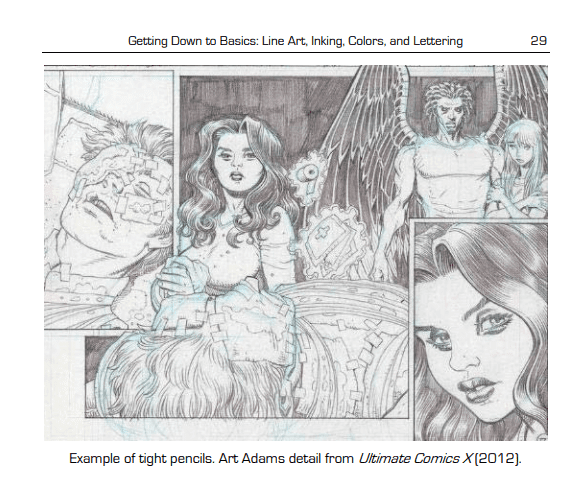
Use of Artwork Within How To Analyze And Review Comics Credit: Sequart
Some of the essays in this collection may be less appealing based on personal research and study topics or requirements, but this is the nature of anthology books. However, even where the topic may not be of immediate concern each essay has something to say about comics as a culture and an artform. There are subtle links between the different chapters that will make you hop around in the book in an attempt to relate the history of comics to artistic style and then to cultural relevance. Modern superhero comics did not simply spring into existence but are a product of society, technology, and artistic temperaments just like the growth of any artform, as David Lewis explains, ‘The latest comic book out in the shops comes after decades in the making, with the history, economics, politics, and personalities of a professional industry, not to mention a whole nation, informing it.’ (page 150)
Literature and Art are taught in schools and there are thousands of degree courses in media studies and Cinema. Theatre and Dance require a level of education to understand and appreciate and yet, comics are only just beginning to receive the same treatment. Books like How to Analyze and Review Comics can help that education and should be part of anyone’s library who is interested in studying or critiquing comics. Sequart has produced a book with a balanced selection of topics and a wonderful range of voices to discuss the various concerns of comics culture. Each chapter gives you enough insight into a particular field of discussion but will also lead you to further study and more books and journals. Too much information is never a bad thing, but sometimes it’s difficult to know where to start. In that respect, Sequart have you covered. If you have any interest in studying or writing about comics, How to Analyze and Review Comics is a must-have for your shelf.
*See Hillary Chute’s “Comics as Literature? Reading Graphic Narrative.” published in PMLA, vol. 123, no. 2, 2008, pp. 452–465.
** Scott McCloud’s Understanding Comics: The Invisible Art originally published by Tundra Publishing in 1993
Loki has reached its penultimate episode with ‘Journey Into Mystery’. It’s also the maddest 50 minutes in the Marvel Cinematic Universe.
At the end of ‘The Nexus Event,’ Loki had been pruned by Ravonna Renslayer. Instead of being killed, Loki has been sent to the end of the time which is inhabited by many different Lokis. Loki Prime has to find a way to get back to the TVA.
At the TVA Sylvie discovers the Time Keepers were really androids. Sylvie holds Renslayer hostage so she can find out who really runs the TVA and save Loki Prime.
I have compared Loki to Doctor Who and Rick and Morty. I am not the only one to make these comparisons: there have been many articles and videos that have declared Loki the American Doctor Who. The showrunner, Michael Waldron worked as a writer and producer on the hit animated show. ‘Journey Into Mystery’ used ideas from both shows.
The idea of Loki being sent to the end of time felt like it was from Doctor Who. In Series Three episode ‘Utopia’ the TARDIS took the Doctor and his companions to the end of the universe where the last remnants of humanity were building a spacecraft in desperation. There were also elements of the Series Six episode ‘The Doctor’s Wife’ because some Time Lords went into the void to avoid the Time War. Both these Doctor Who settings were a combination of post-apocalyptic wasteland and junkyard, and The Void in Loki can be described in the same way.
The Void was filled with ruined and decaying objects, from cars to buildings. It was the TVA’s trash heap. It made for an interesting setting. The Lokis that followed President Loki looked like they were put through a Mad Max filter.
The Rick and Morty element came from the episode being filled with different versions of Loki. The various Variants have already been shown in ‘The Variant’ and ‘Journey Into Mystery’ expanded on that. Rick and Morty had shown versions of their title characters and Loki had some fun with the alternative Lokis. There was Kid Loki (Jack Veal) who was the King of his small group of Lokis and Classic Loki (Richard E. Grant), a powerful illusionist who wore a comic book accurate costume. The most notable was Alligator Loki who was just an alligator that had a Loki helmet. It’s the type of absurdist humor that fills Rick and Morty. Alligator Loki has already gained a fanbase.
Due to the episode having numerous Lokis it allowed for some fun interactions. Characters have been warned throughout the series to never trust a Loki. President Loki betrayed other Lokis. Loki did get to have a heart-to-heart with Classic Loki. Classic Loki revealed that all he did was cause pain and misery and Loki Prime had a similar realization in the first episode. Classic Loki did get to showcase the full force of his powers in an epic way.
The other focus of the episode was the relationship between Loki Prime and Sylvie. They love each other and that was the most wonderfully Loki thing possible. The only romance Lokis can have is with themselves. Loki Prime did see Sylvie as important because she’s the only one capable of bringing down the TVA, whilst Sylvie feels she needs Loki Prime. She was willing to self-prune to save him.
Loki Prime also had a touching moment with Mobius. Mobius was the first person this version of Loki Prime was close to, so it was lovely that Loki Prime called him his friend.
‘Journey Into Mystery’ was a wonderfully insane episode because of all the crazy concepts that were introduced. It had a fair amount of character drama. The expectations for the finale are high.
Comics Auteur Jeremy Haun (The Beauty, The Red Mother) returns from the desolate wastes of Covid quarantine bearing haunting gifts. I got talk with him about his influences, his approach, and the collaborative effort that went into this outstanding project.
“HAUNTHOLOGY is a collection of short horror stories that examines all of the things we felt over the past year and a half during Covid. Each story stands on its own, but also connects to a bigger mythos within the book and my larger oeuvre,” Haun explains. “When the comics industry went ‘Pencils Down,’ leaving many comic writers and artists in professional limbo, I needed something to focus on. For me, that focus is telling stories. I decided to focus on one story—just a short feeling. That led to another. And another. The cumulative work is this anthology.”
MFR – The pandemic seemed to spawn a ton of great horror, including this collection. Had you always wanted to create a horror anthology like this, or did the idea hit you during lockdown?
JH – A bit of both. I’ve always been a huge fan of horror and weird fiction collections. HAUNTHOLOGY is exactly that.
Getting a collection of short stories from one creator is most common in prose. You’ll get get these brilliant, terrifying books from Laird Barron, Joe Hill, Nathan Ballingrud, or Stephen King. They’re perfect glimpses into worlds. I wanted to do that.
When Covid hit everything changed. Every project I had lined up– over a years worth of work, was put on hold. I was…well…lost. I needed something. I needed to create. This project came out of that.
The truth is, something like HAUNTHOLOGY always gets pushed to the back burner. There are always projects with hard deadlines that need done first. I took this brutal situation and said “I’m going to do this for me.”
It was a lifesaver.
MFR – The art and visuals in the book are brilliantly striking, from front to back. Did the images hit you before you wrote the words to go with them, or was it vice versa? Or even a combination of the two?
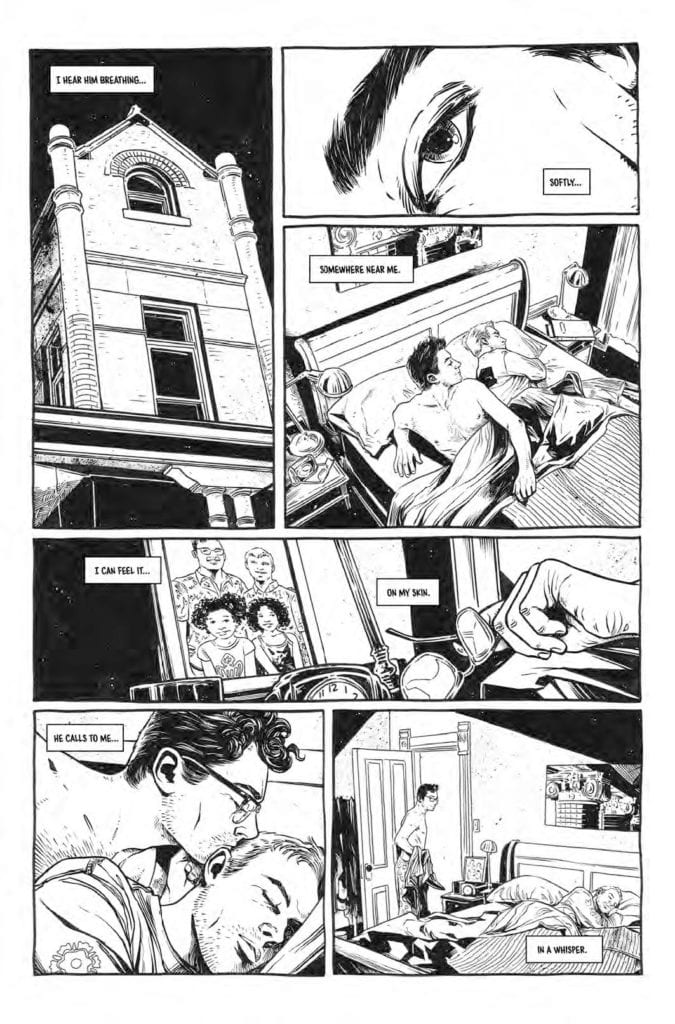
JH – It’s really a combination of the two. I tend to see everything like a film. The images are there running along with the dialogue.
I definitely experimented with my process on HAUNTHOLOGY. That’s really the nice thing about working on something just for yourself. You can do whatever.
I’ve been writing pretty steadily over the past five years or so. Even though I might not need to, I enjoy the practice of writing full scripts for comic stories. I wrote full script for almost all of the stories in this collection.
JH – How did you get Fonografiks and Joel Enos involved with this project, and how did they help shape it into its finished form?
I’ve worked with both Fonografiks and Joel several times. We all worked together on THE BEAUTY and it was such a fantastic experience.
There are always corners you can cut when making things. The LAST thing you want to skimp on is your design and editorial team.
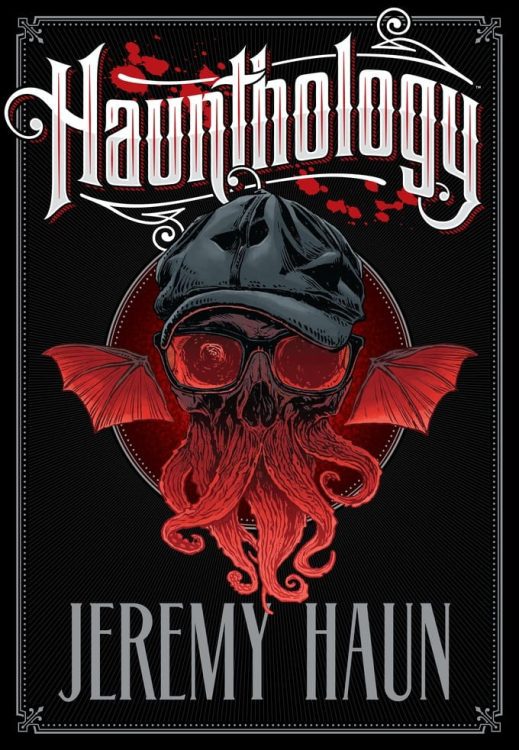
Fonografiks is absolutely, hands down one of the best designers working today. I tend to have a pretty clear vision of what I want to see on a project. They take that vison and make it a hundred times better. The first time I saw the cover and logo for HAUNTHOLOGY it felt like home.
Joel is just family at this point. He’s more than an editor. He’s someone that I can turn to for anything. He knows how to put a project together. He knows how to edit. He’s damned good at it. But it’s the extra human touch that he adds to a project that makes it…home.
MFR – Something people may not expect out of this anthology is just how funny (sometimes darkly) it is at points. Were the comedic moments something you wanted going in, or did they hit you as you were putting stories together?
JH – Life is just SO weird. I just can’t tell a story that doesn’t have a bit of humor in it. I always feel like the idea that a story should just be one thing is a real misstep.
This last year was a horror show. But there were also these beautiful and even hilarious moments in it. It’s important to acknowledge that.
I don’t think this project would exist if it wasn’t for a bit of humor. I want to unsettle you. I want to connect with you about all of the feelings of loss, loneliness, isolation, and fear we felt during 2020. But I also want to make you smile. Just a bit.
MFR – What stories, from any and all mediums, did you read/watch during the endless time vacuum that was 2020? How did they (or any other influences) make their way into your development of Haunthology?
JH – Oh, everything… Remember life when we were behind on all our reading and shows? My queue had hundreds of movies and shows I needed to watch. Nothing says “I guess I’ll go ahead and watch another full season this week” like a global pandemic.
I have to admit reading was hard for me for a while there. I’ve always been a veracious reader– novels– comics. The constant barrage of gloom messed with my focus in a way I’d never experienced before. It’s taken me a good while to get back to being about to sit down and focus enough to read.
I dove deep into the Mignolaverse, rereading HELLBOY and BPRD. I also started (and am working to finish) 20TH CENTURY BOYS. It’s absolutely fantastic.
Horror movies are an absolute staple around here. We pretty much watch everything. Now that my boys are a bit older, I’m going through and sharing so much of all that with them. It’s been fantastic showing my sixteen year old everything from HALLOWEEN to DONNIE DARKO.
Even with my love of horror, I needed a bit of a palette cleanser from time to time. We watched plenty of cartoons, PARKS AND REC (a perennial favorite rewatch), every STAR-WARS and Marvel show, and did a fantastic LORD OF THE RINGS marathon.
It’s amazing how things can influence you when you’re making things like this. I just try and be a sponge and take it all in.
MFR – This graphic novel draws on the event and the insecurities around living through the pandemic and the strange details of quarantine living. Are any of the stories here based on something you found yourself doing, or maybe saw from others?
JH – Oh, absolutely. HAUNTHOLOGY is a project that is very much about the past year living through Covid, quarantine, and general chaos. It was just important to me that while they were about all that…these weren’t stories about masks, the anxiety about trips to the store, or this virus.
I told stories about all of those feelings, but…with monsters and post apocalyptic landscapes.
Fairly early on in quarantine I was sleeping horribly. I think a lot of us were. I was getting concerned about it. I kept waking up at the exact same time to a strange noise– this droning in the distance. I’m not even quite sure it was real, to be honest. That made its way into several of the stories.
Each story deals with one aspect or another of live in Covidland. Even with that I was able to twist it all to be weird and even fun.
Many of these stories also connect back to my larger mythos– things that I’ve set up in THE BEAUTY, THE REALM, THE RED MOTHER, and 40 SECONDS. I think fans of my work are going to be presently surprised to see the little nods and bits of connective story tissue throughout HAUNTHOLOGY
HAUNTHOLOGY is a collection of short horror stories that examines all of the things we felt over the past year and a half during Covid. Each story stands on its own, but also connects to a bigger mythos within the book and my larger oeuvre,” Haun explains. “When the comics industry went ‘Pencils Down,’ leaving many comic writers and artists in professional limbo, I needed something to focus on. For me, that focus is telling stories. I decided to focus on one story—just a short feeling. That led to another. And another. The cumulative work is this anthology.”
Haun worked alongside designer Fonografiks (Saga, The Beauty) and editor Joel Enos to produce Haunthology, producing the sequential art equivalent of the chilling prose short story collections that inspired him in his youth.
“I’ve always loved collections of short stories,” Haun says. “They’re most common in prose—they’re more rare in comics. I wanted to do something that was all me– a comics version of what you’d see from Stephen King, Joe Hill, Clive Barker, Laird Barron, or Nathan Ballingrud.”
The Kickstarter for Haunthology is live! Back it to grab your own copy of this unique and enthralling collection!
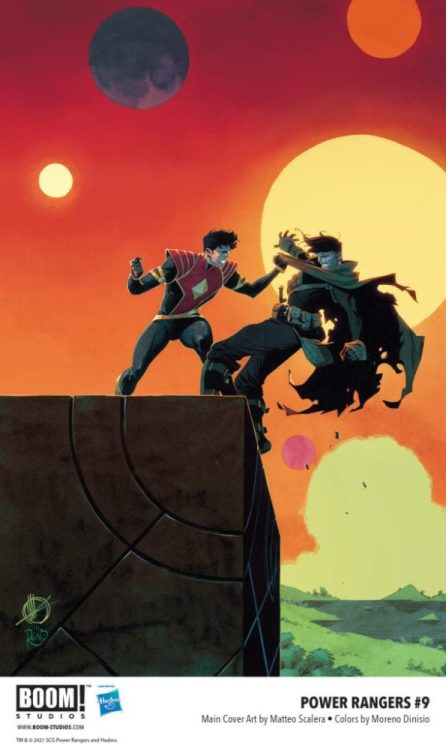
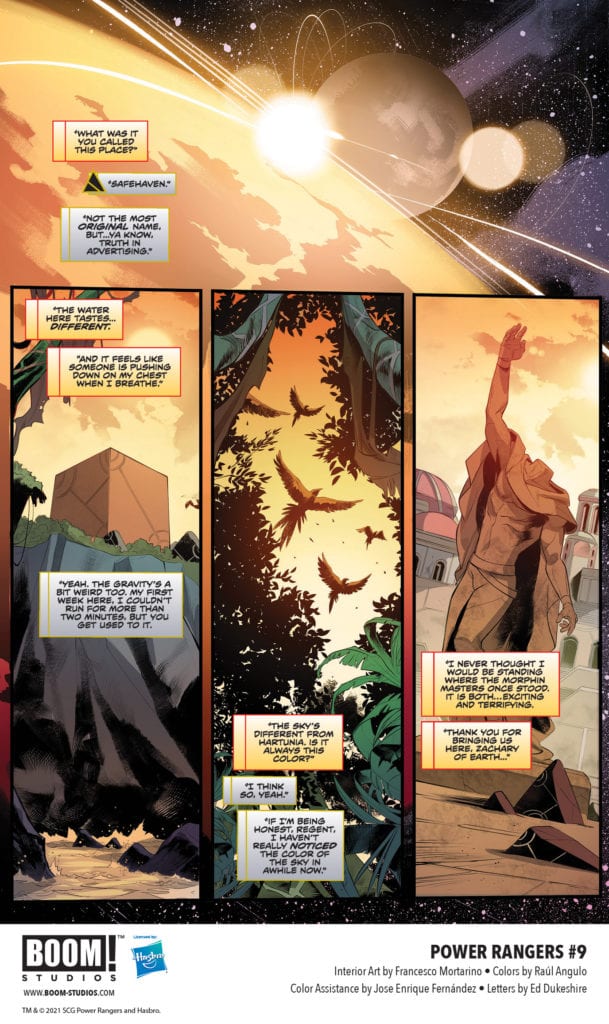
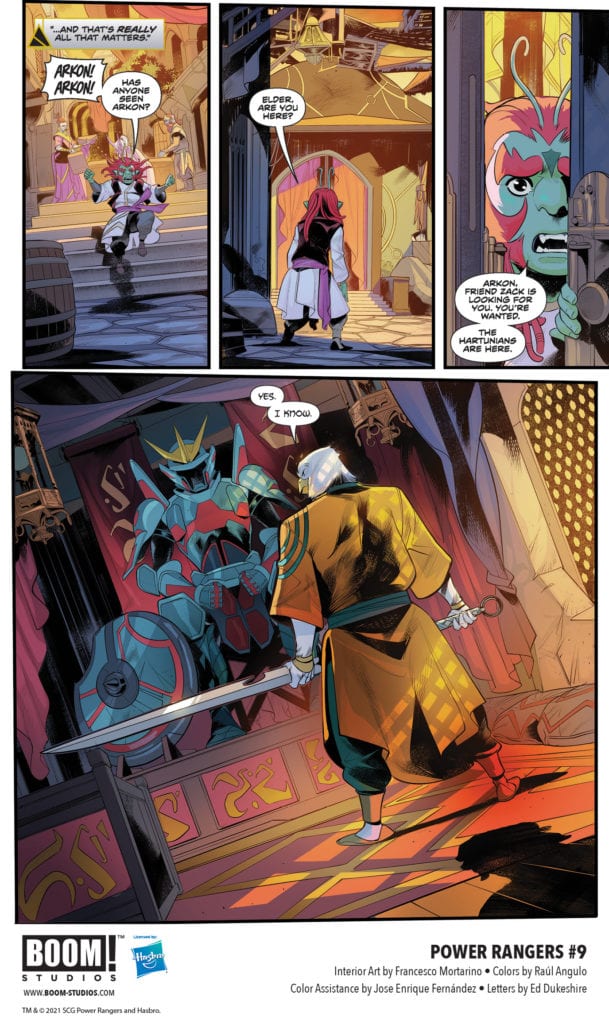
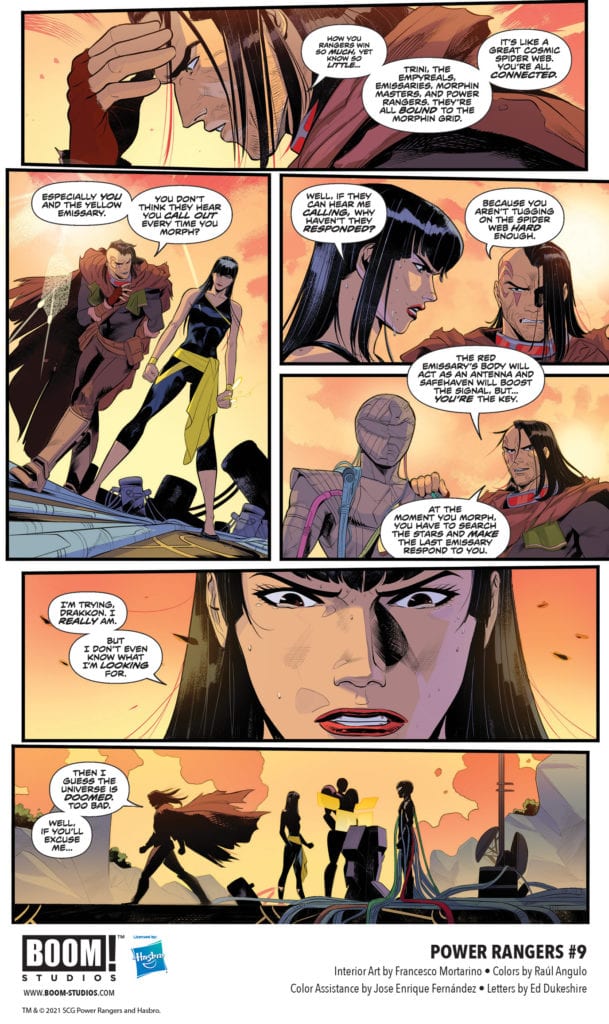
POWER RANGERS #9 hits your local comic book store July 21st, but thanks to BOOM! Studios, Monkeys Fighting Robots has an exclusive five-page preview for you.
About the issue: The Omega Rangers return to a Safehaven, but all is not well with the new arrivals. After a confrontation in the streets, can Zack help bring peace… or will a friend’s need for revenge against the Hartunians be too much for one Ranger?
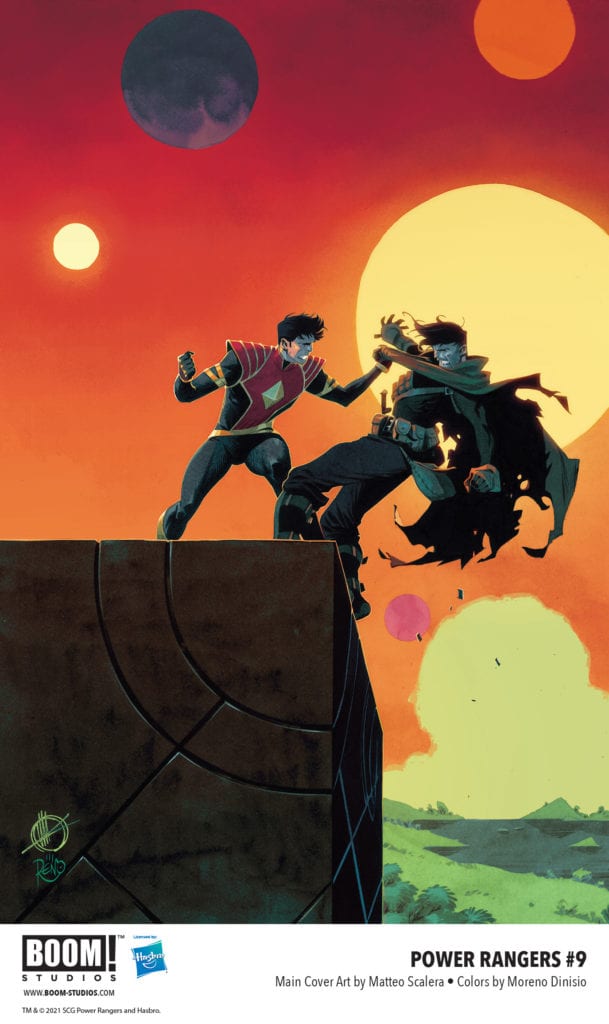
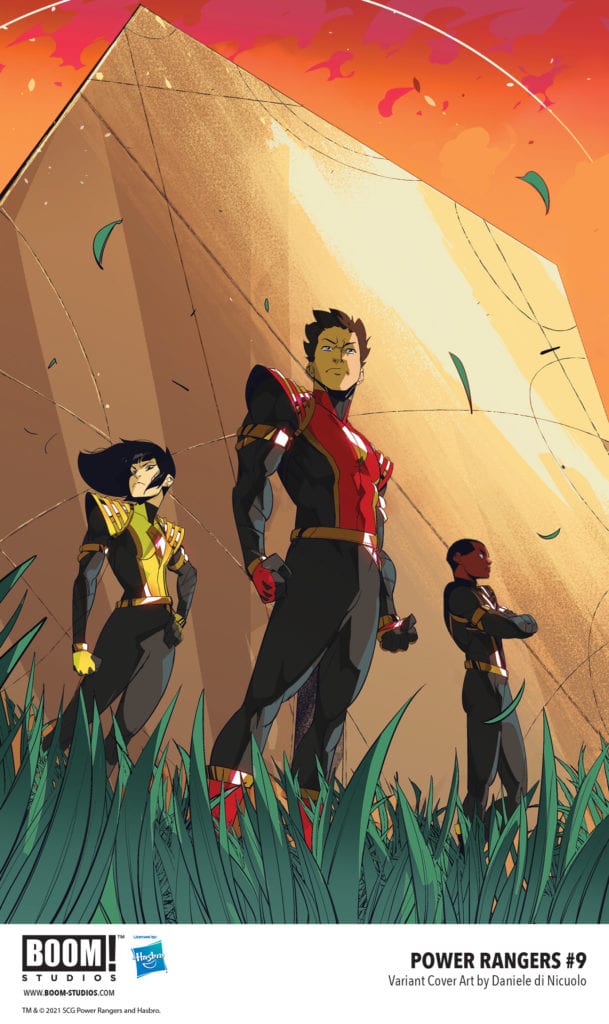
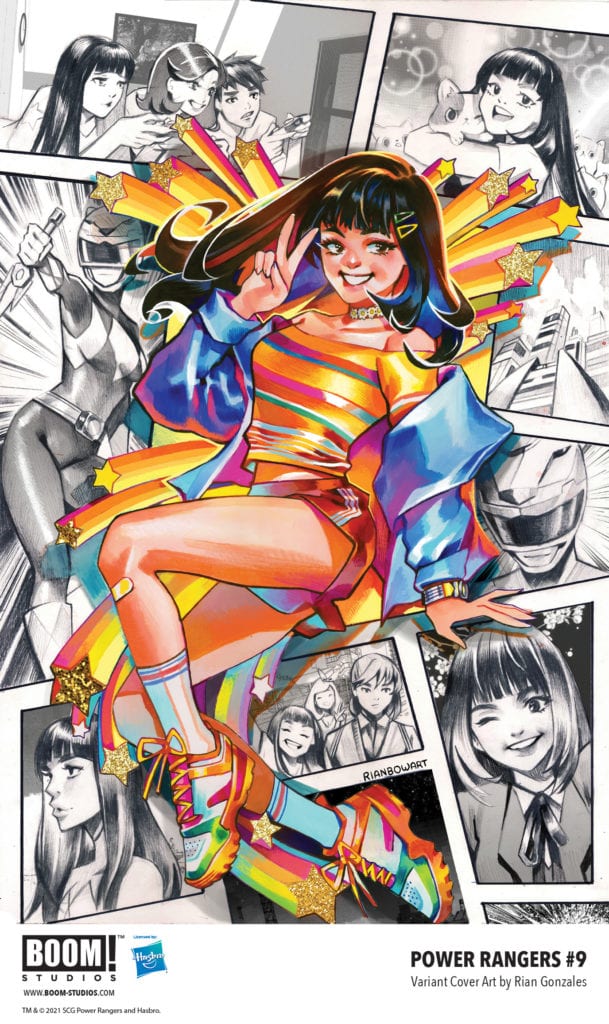
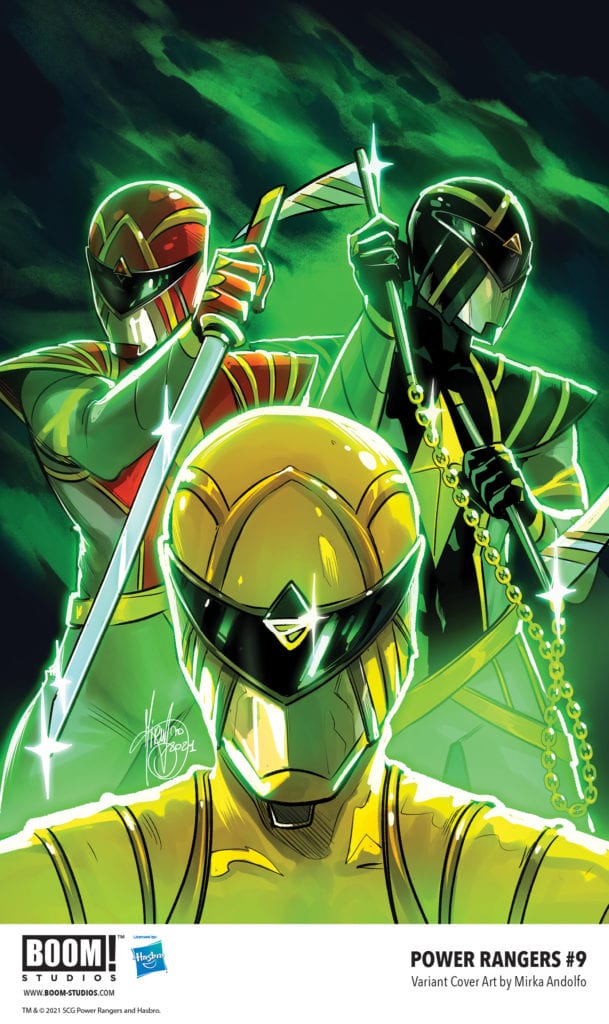
POWER RANGERS #9 is by writer Ryan Parrott and artists Francesco Mortarino & Moisés Hidalgo, with colors by Raúl Angulo with assistance by Jose Enrique Fernández, and letters by Ed Dukeshire. The main cover is by Matteo Scalera, with variant covers by Daniele Di Nicuolo, Ruan Gonzales, and Mirka Andolfo.
The series is running in conjunction with the MIGHTY MORPHIN series, also written by Parrott.
“Two New Series. Two New Teams. The Era of UNLIMITED POWER continues HERE—and only Lord Drakkon, their greatest enemy, can save the Power Rangers in July 2021!”
Check out the POWER RANGERS #9 preview below:
Are you reading POWER RANGERS? Sound off in the comments!
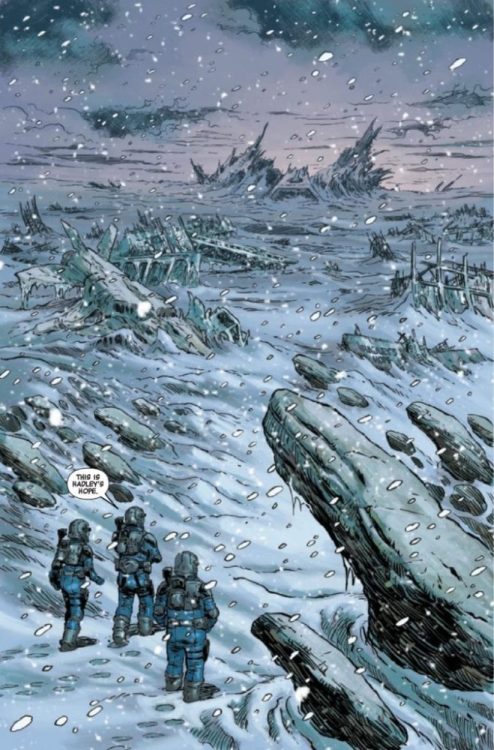
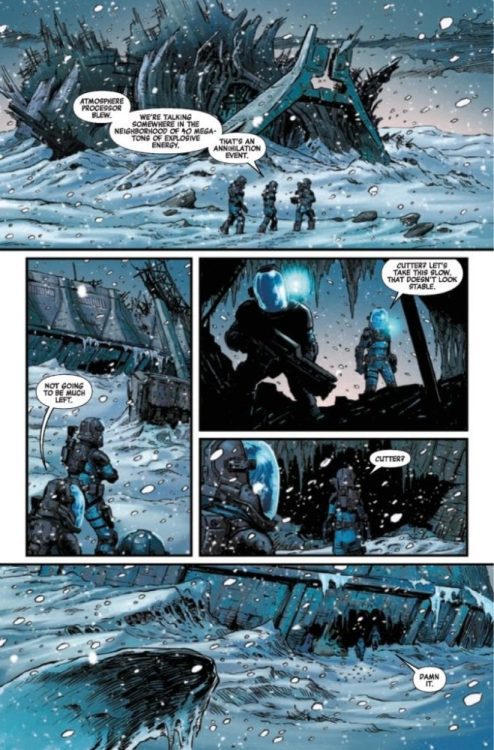
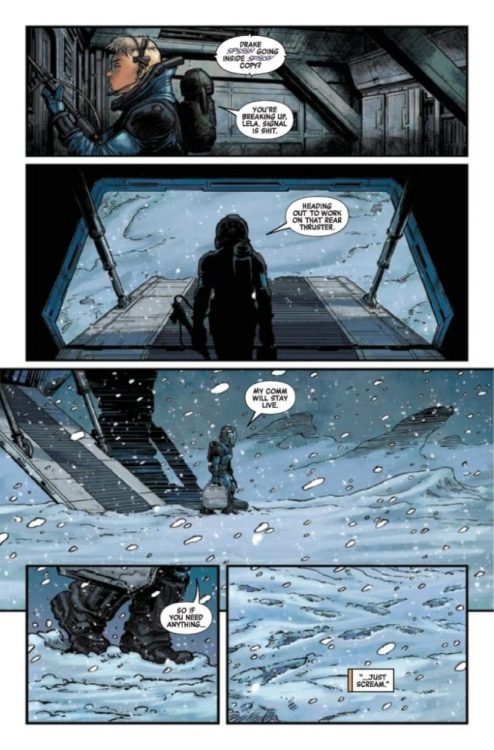
ALIENS AFTERMATH #1 hits your local comic book shop on July 14, but thanks to Marvel Comics, Monkeys Fighting Robots has an exclusive four-page preview for our readers.
The book is written by Ben Percy, with art by Dave Wachter, colors by Chris Sotomayor, and Phil Noto is the cover artist.
About the issue: FOR ALIENS’ 35TH ANNIVERSARY, A RETURN TO HADLEY’S HOPE!
It’s been 35 years since the tragedy of the Hadley’s Hope colony, but what happened to that ill-fated venture has been shrouded in mystery. A renegade crew of investigative journalists are heading towards the moon that Weyland-Yutani has wiped from all records, and they’ll bring back the truth even if it kills them…and what remains in that bombed-out site will try to do just that. Benjamin Percy and Dave Wachter imagine a terrifying possible future for LV-426 in this celebration of the 35th Anniversary of one of the most influential science fiction films of all time!
Ninjak #1 from Valiant Entertainment comes to comic stores on July 14 with a fresh new take on espionage stories. Joining writer Jeff Parker and letterer Dave Sharpe is cartoonist Javier Pulido. The unique art style of Pulido blends together with a story where a world these spies inhabit turns upside down.
Background
Ninjak, AKA Colin King, is the last of MI6’s Ninja Programme, after cutting ties with the corruption backing it. Since then, Colin King is making his way as a mercenary for hire.
Ninjak #1: Progressing Dynamics
Ninjak #1 has Parker get every character out of their comfort zones. With a plot of spies’ secrets being revealed, it takes a unique approach to show how drastic it is. With Pulido co-writing the story, the plot’s progress matches up with its layouts. Take for example the initial pages where the orderly conversation between two spies are interrupted. As a triangular panel barges into the page, it serves as a point where power is taken from MI6.
If that isn’t enough, the next page features a spread where the perspective shifts diagonally. In addition, the pages coloring changes from its initial red into mesmeric greens. All while the antagonist smiles at her victims who are in pain.
Lettering Layout
So with a setup like that, it’s going to require a hero who can keep up with this threat. Pulido decorates Ninjak #1 with SFX for eye-catching uses of tools, like a buzzsaw Ninjak takes from an opponent in the blink of an eye. While it’s cool to see how capable he is, Pulido also gives space for Sharpe to deliver exposition. The kind of exposition that reveal Ninjak is at disadvantage after his fallout with MI6.
Stick Around For Ninjak #1
Ninjak #1 features the kind of action people expect from its title character and more. There is a threat brewing that the reader dreads from simply tantalizing pictures. Because in this presentation, the feeling of safety is never a guarantee.
Welcome to Self-Published Spotlight, a regular interview column where I will be highlighting self-published comics and the creators and small print publishers who make them.
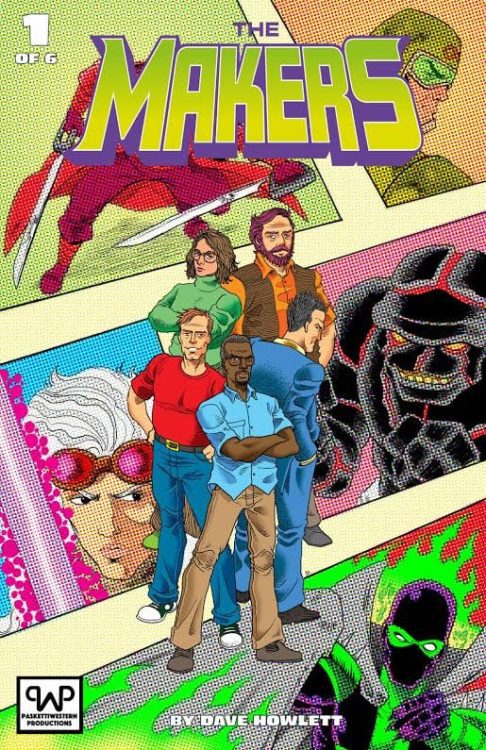
Dave Howlett’s THE MAKERS is one of the most joyful comic-reading experiences I have had in a while (and I am not the only one. Check out fellow MFR writer Zac Owens’ glowing review). Without saying much, THE MAKERS takes the origin of Image Comics and fictionalizes it…and then comes the Galaxy Quest-type twist! See, I bet that caught your attention!
I had the chance to shoot creator Dave Howlett some questions about his fantastic comic and he was gracious enough to answer them. So check out our chat below and make sure you get yourself a copy of THE MAKERS!
Monkeys Fighting Robots: First of all, thanks for taking the time to talk to us. How are you doing today? Working on anything? Dave Howlett: No problem! Doing all right, working on a commissioned piece that is very involved but in a way that suits me just fine.
MFR: So what’s your comic book origin story. How and why did you get into comics? DH: It’s a bit like the beginning of Goodfellas. “As far back as I can remember, I was always obsessed with comic books,” to paraphrase Henry Hill. My mom used to buy me those Spidey Super Stories comics that tied in with The Electric Company TV show when I was very young—which is a detail that tells you I’m now kinda old. But I don’t remember a time when I wasn’t obsessed with reading, and making comics.
MFR: Did you always want to create your own comics? Was there a specific moment or book that made you want to take that leap from fan to creator? DH: I don’t remember a specific moment, but the urge was always there. It just seemed like a very accessible creative outlet, unlike, say, learning to play an instrument, or being good at sports.
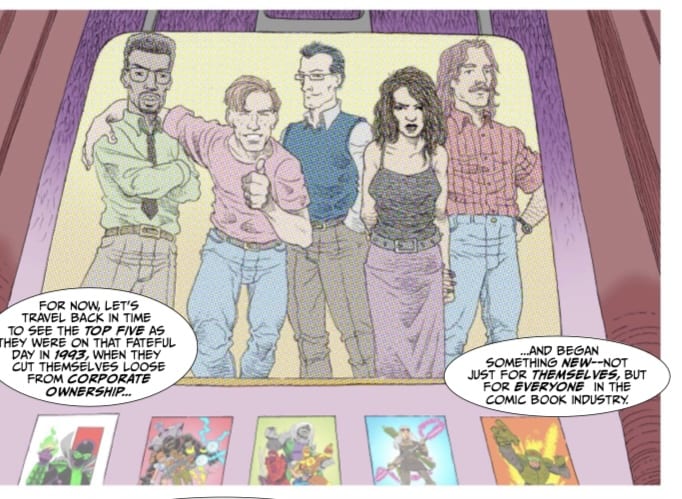
MFR: So for those who haven’t had the pleasure of reading The Makers, what’s your elevator pitch for the series? DH: A group of comic creators who were superstars In the 1990s reunite 25 years later for a convention appearance, only to find themselves whisked away on a cosmic adventure. It’s like a fictionalized version of the history of Image Comics, crossed with a reality-bending intergalactic quest.
MFR: Was that sci-fi element always part of the story, or was this more of a traditional attempt to tell the ‘Image Story’ at first? DH: At first it was going to be a more traditional 1990s period piece, but I thought I could jazz it up a bit and really explore the themes of creators and their creations, via a SF type approach. That type of story has always appealed to me, whether it’s in Frankenstein, or Preacher, or Star Trek: The Motion Picture.
MFR: Why do you think the ‘Image Comics’ story still interests people so much? It seems to really be resonating again for a lot of people in the comics community. DH: Part of it is nostalgia—the 90s are back!—but part of it also the fact that something like that couldn’t happen again. The market conditions, the conditions creators were working in, and the rock-star status the Image founders had achieved, will probably never be duplicated. So it was a once-in-a-lifetime kind of perfect storm, one that’s maybe hard to convey to anyone who wasn’t around for it. But I had to try!
MFR: Who was your favorite Image founding father? And is it still the same? Or did it change over time? DH: At the time it would have probably been either Todd McFarlane or Jim Lee, but now it’s definitely Erik Larsen. He’s the only one who truly committed to his book for life, and he’s still going strong today.
MFR: What about your favorite Image title/character? DH: Savage Dragon for sure. I had read some of it before, but a few years back I acquired most of the run for very cheap and decided to complete it…I think I only need 9 issues now? It’s pretty fascinating to watch Larsen’s style and interests evolve over the decades.
MFR: What kind of research did you do, as far as the more ‘realistic’ aspects of the story? DH: My research largely consisted of a pair of excellent documentaries—The Image Revolution, and the multi part SyFy doc So Much Damage. Sean Howe’s book Marvel Comics: The Untold Story filled in some gaps nicely regarding the Image founders’ split from Marvel, plus I was buying comics throughout that period, so I had a lot of memories of it to draw on.
MFR: Did any particular books or media help inspire this? I do get some Galaxy Quest vibes from the first issue and concept. This is a compliment because Galaxy Quest is one of my favorite movies! DH: I love Galaxy Quest! That’s in the mix for sure, along with Terry Gilliam’s Time Bandits, and the flashback/flash-forward structure is straight outta Lost.
MFR: Did you always envision it as a 6 issue mini-series? DH: I think so? Six issues made sense—five issues to individually spotlight the five Attitude Comics creators, and a final one to wrap up the story. I have a short attention span for my projects, so they’re always finite—I haven’t stumbled upon my own Savage Dragon yet, you know…something that I’d be happy to work on for the rest of my life. We’ll see.
MFR: Were you always gonna self-publish this? Did you ever maybe even think about pitching it to Image (laughs). DH: I actually did submit it to Image! I never heard back, which is not surprising. I’m not sure it’s quite up to their standards. But self-publishing means total control over the final product, so that appealed to me too.
MFR: The printing on The Makers is fantastic. It feels like an older comic. What made you want to go with newsprint? DH: Well, my friend and employer Calum Johnston, owner of Strange Adventures, was the one who wanted to go ahead and get it printed up, and he wanted to use a local printer who could do it up old school. Newsprint is of my era too, so that appealed to me. Modern comics are too slick! I just think the colour looks better on newsprint.
MFR: How did you create The Makers? Was this pencils and inks or digital? What was the creative process like? DH: Pencils and inks for the line art, digital for the letters and colours. The digital stuff is good to learn, but I personally prefer the look of hand-lettered comics, so I’ll probably switch to that for whatever I do next. As for colours, maybe a mix of old and new school? We will see.
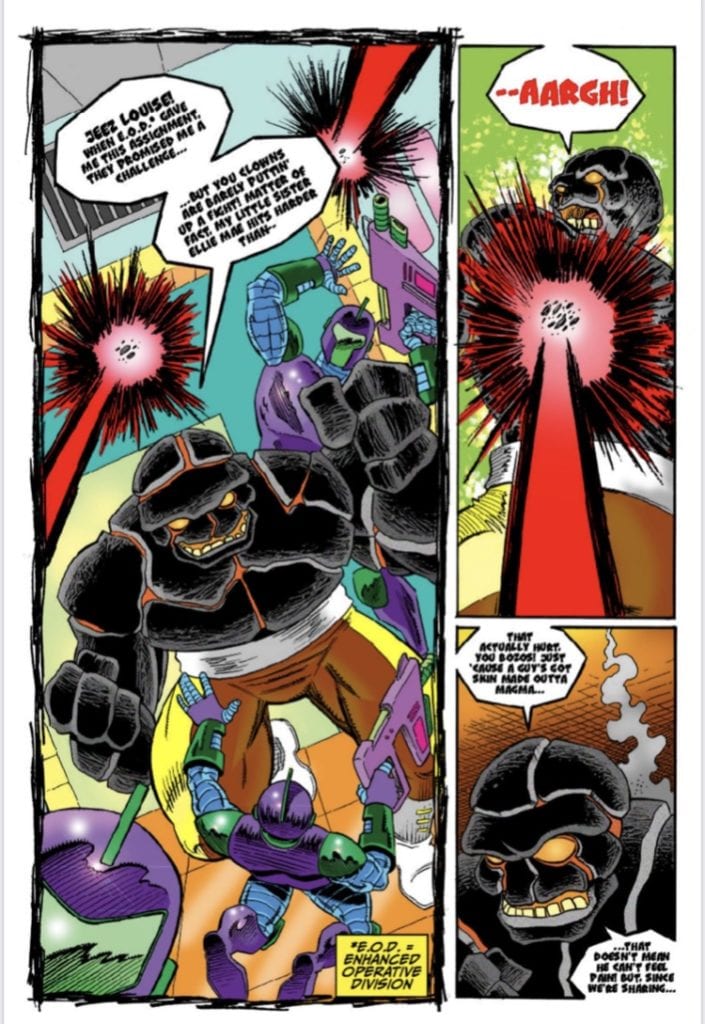
MFR: The Makers also has art from the ‘comics’ within the comic. What’s it like to use different styles in one book? DH: I like the conceit, but it’s a lot to keep track of! Some artists like Rick Veitch and Jim Rugg seem to be able to try on different styles like they were ball caps, but I find I struggle with it a lot more. The colouring has had to do a lot of the heavy lifting, but, you know…your reach should always exceed your grasp. I had to give it a shot.
MFR: I also love the fake ads and ‘Bullpen Bulletin’ type pages in the book. Was this a detail you wanted to include from the beginning? DH: Oh, most definitely. 1963 by Alan Moore, Rick Veitch, Steve Bissette, Dave Gibbons, and Don Simpson is one of my favourite series, and they really nailed the whole package with the fake ads, letters pages, Bullpen Bulletins-type stuff…each issue of The Makers has at least one sorta “artifact” page along those lines to try to immerse you in the world of it. I would have liked to have done a bunch, but there are only so many hours in the day, you know?
MFR: Have you or will you send this to any of the creators that influenced the story? DH: Probably not? We’ll see. I mean, they all definitely influenced a lot of aspects of the characters, but I don’t want to give anyone the impression that it’s 100% based on anyone real.
MFR: Is there a story beyond these 6 issues? or will this be it? DH: Nah, this is it for now. It’ll have a finite conclusion, and I don’t have any ideas for it beyond that. Honestly, it’s been such a big undertaking that I’m really itching to work on something different. But never say never!
MFR: love your Bob The Goon mini-comic. Any chance for more Bob stories? DH: At least one more idea! I’ve always had a fondness for the character, and the actor who plays him, Tracey Walter. He’s just one of those “that guy” type of character actors, who turns up in everything. He’s great in Repo Man. But then again, he’s always great. Poor Bob. So loyal to the Joker, and look where it got him.
MFR: What else are you working on? DH: I’m doing the art for a five-part series called The Last Paper Route that my pals Sean Jordan and Alex Kennedy wrote—it’s a comedic series about a couple of paperboys having misadventures in the 1990s. See? Something in the zeitgeist these days. Other than that, I’ve been trying to use Instagram for different types of comics and strips—there are some interesting possibilities there. I’ve done a bunch featuring a character called The Hashtag, who’s kind of like my take on faceless detective characters like The Question and Rorschach. He makes for good little one-panel comics. I’m still trying to figure out what my next long form series will be.
MFR: Where can people find you and your work? DH: My comics (including digital versions of the first four issues, and the print edition of issue one) are up for sale on Gumroad (https://gumroad.com/paskettiwestern), and I’m usually posting stuff on Instagram a lot (people can find me at @paskettiwestern). I have that handle on Twitter too but I don’t use it much, because that place is a bit of a…I don’t want to say hellscape, but I don’t know what else to call it.
MFR: I really loved the autobiography short ROASTED at the end of issue 1. Will there be more of this? DH: For sure! I have a three-pager going into the print edition of issue 2, and probably some more down the line. Like I said, I wish all the backup stuff could have been in-world type material, but I was getting stretched too thin so I thought I would just pilfer my archives (most of that stuff has been on my IG account in the past).
MFR: Any final comments for our readers? DH: Stay safe! Read more comics. And make more comics!
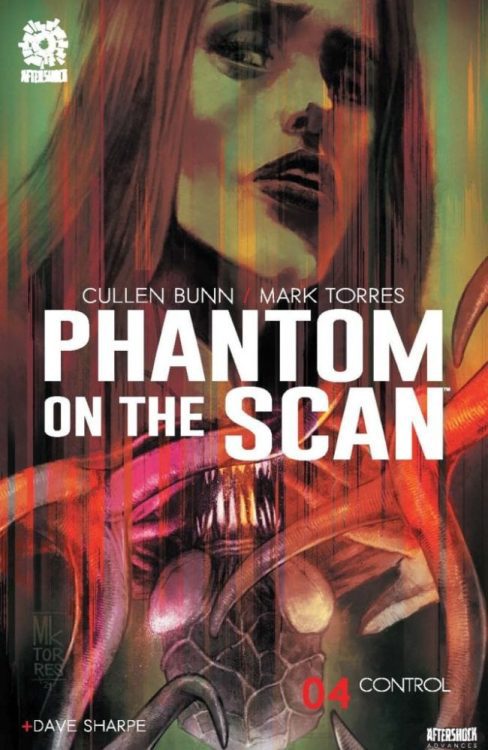
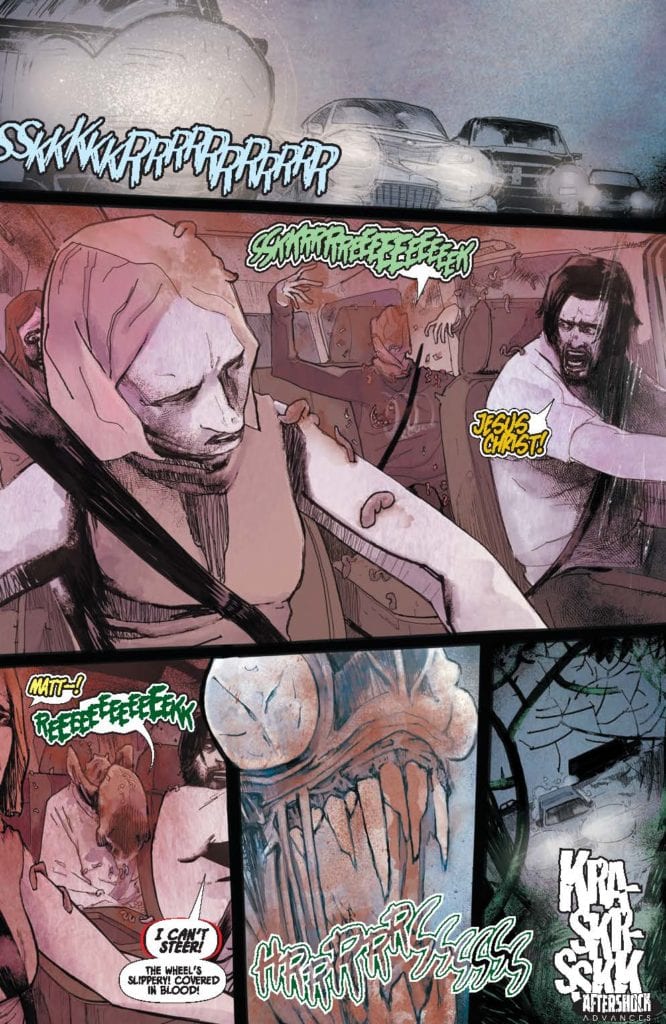
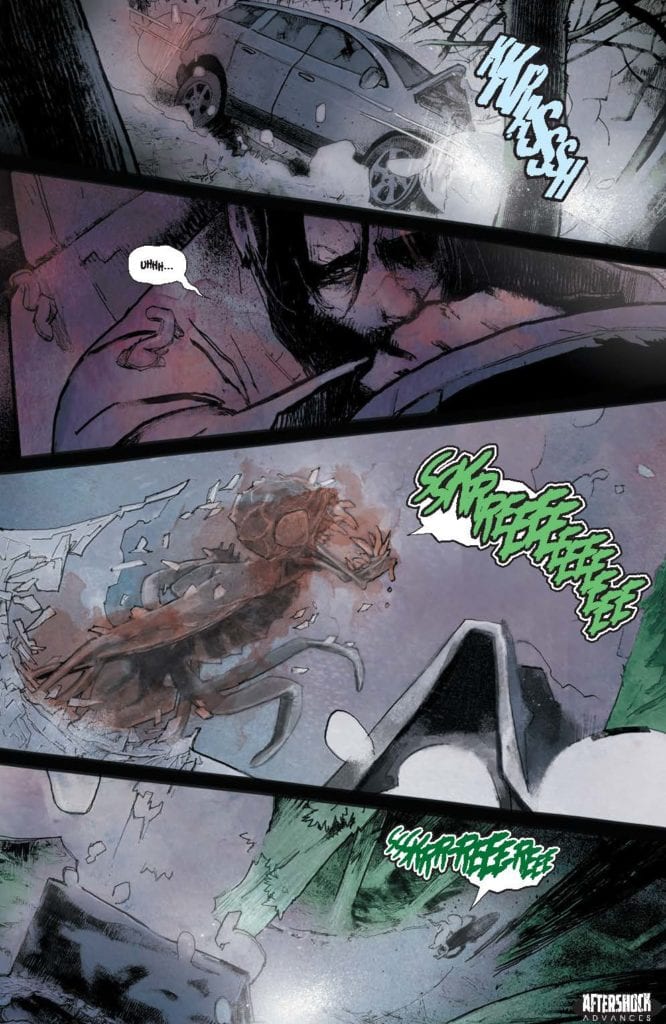
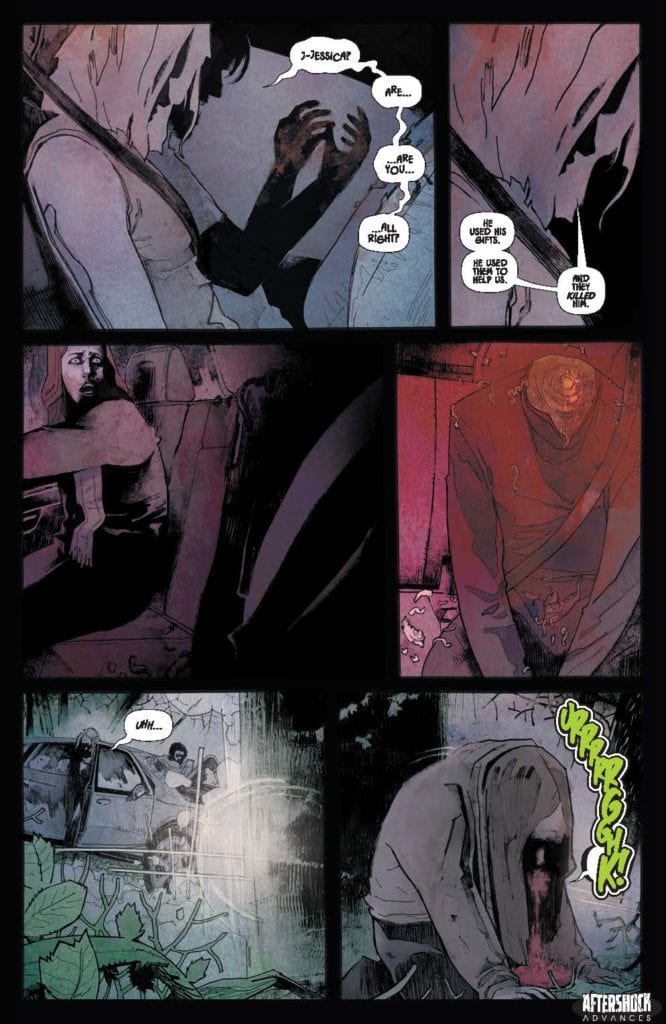
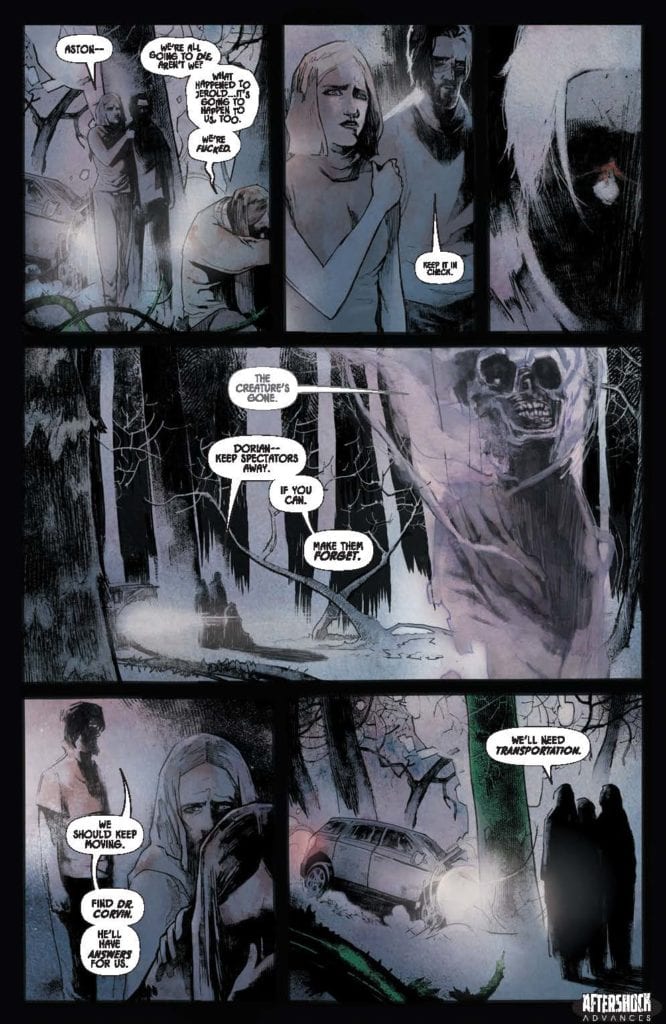
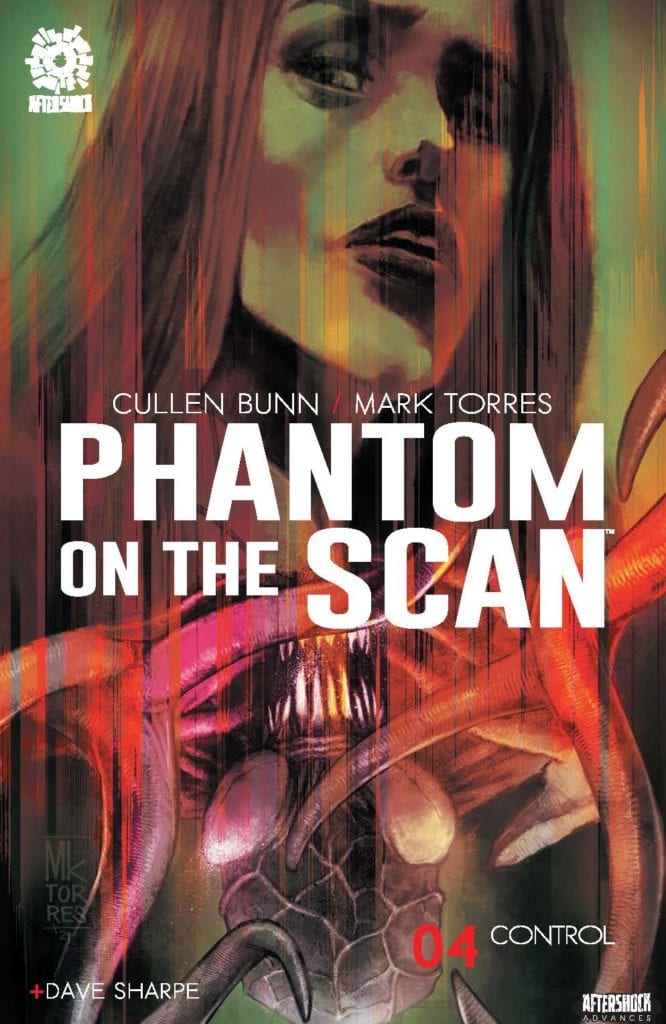
PHANTOM ON THE SCAN #4 hits your local comic book store July 28th, but thanks to AfterShock Comics, Monkeys Fighting Robots has an exclusive four-page preview for you.
About the issue: With the body count rising – with murderers from this world and from the astral plane in pursuit – a group of doomed psychics draws ever closer to the horrifying truth about the abilities that are slowly killing them. What awful secret is the mysterious Trellux Institute hiding?
PHANTOM ON THE SCAN #4 is by writer Cullen Bunn and artist Mark Torres, with letters by Dave Sharpe. The cover is by Torres.
Check out the PHANTOM ON THE SCAN #4 preview below:
Are you reading PHANTOM ON THE SCAN? Sound off in the comments!




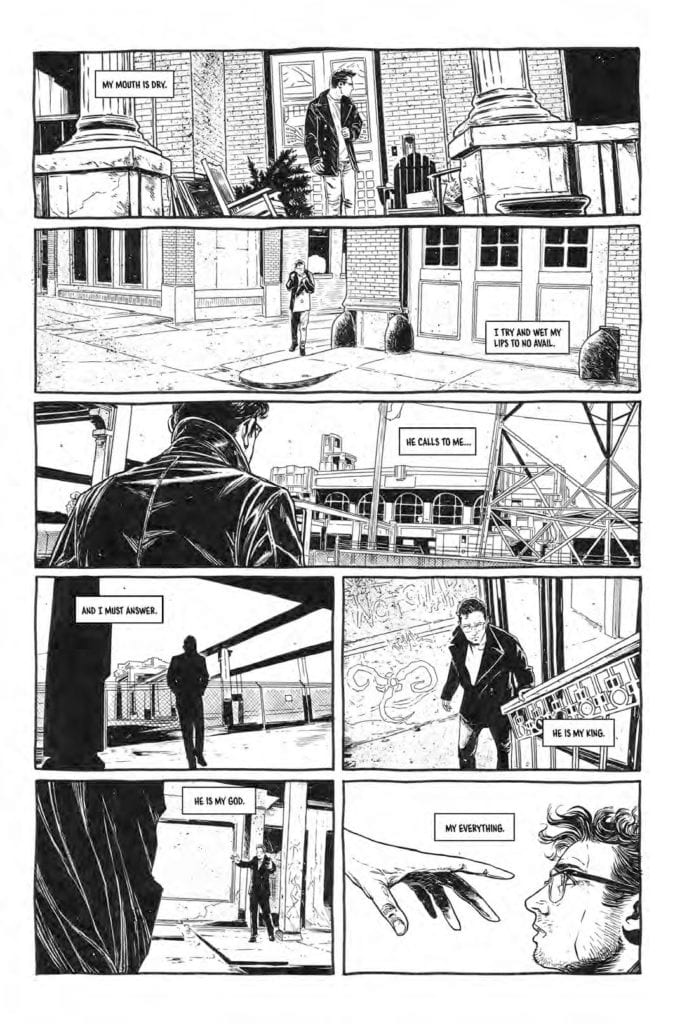
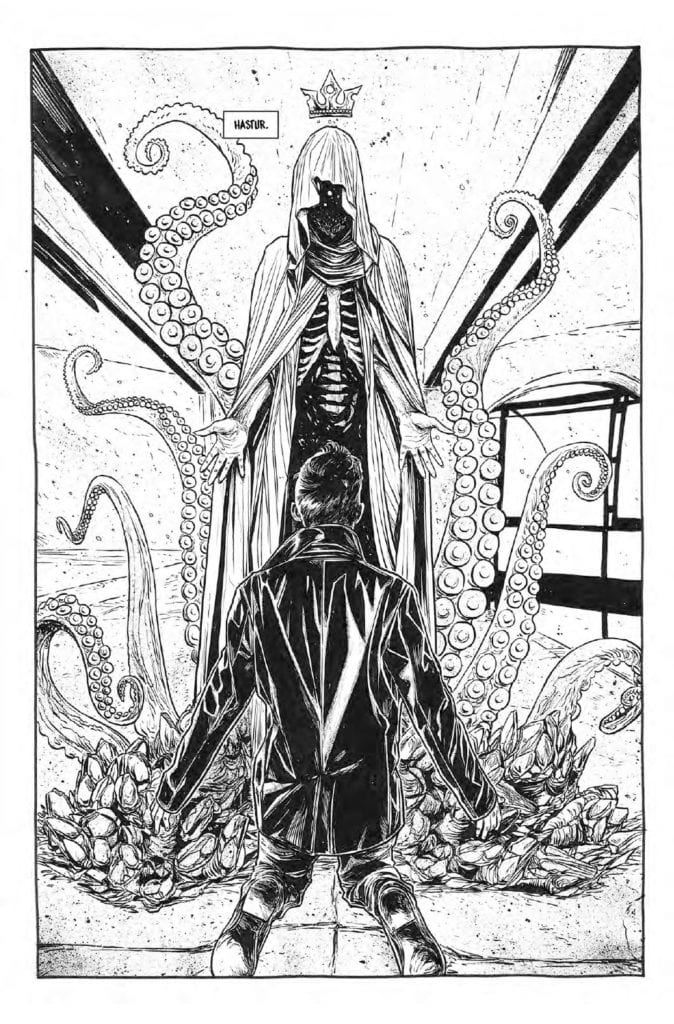


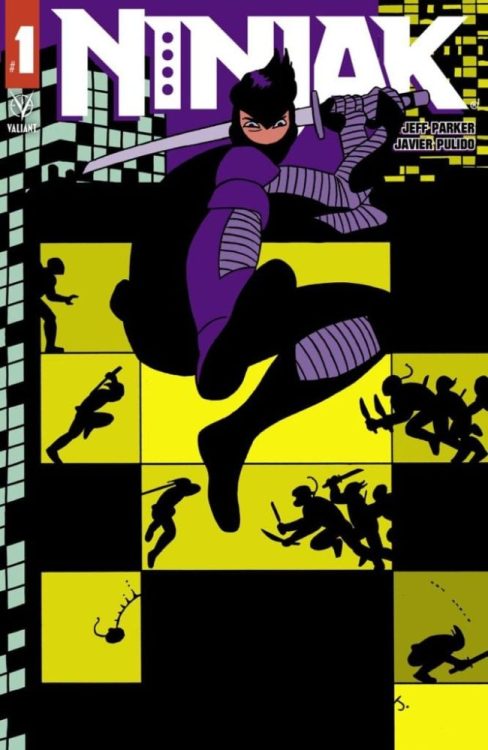
 Ninjak #1 has Parker get every character out of their comfort zones. With a plot of spies’ secrets being revealed, it takes a unique approach to show how drastic it is. With Pulido co-writing the story, the plot’s progress matches up with its layouts. Take for example the initial pages where the orderly conversation between two spies are interrupted. As a triangular panel barges into the page, it serves as a point where power is taken from MI6.
 If that isn’t enough, the next page features a spread where the perspective shifts diagonally. In addition, the pages coloring changes from its initial red into mesmeric greens. All while the antagonist smiles at her victims who are in pain.
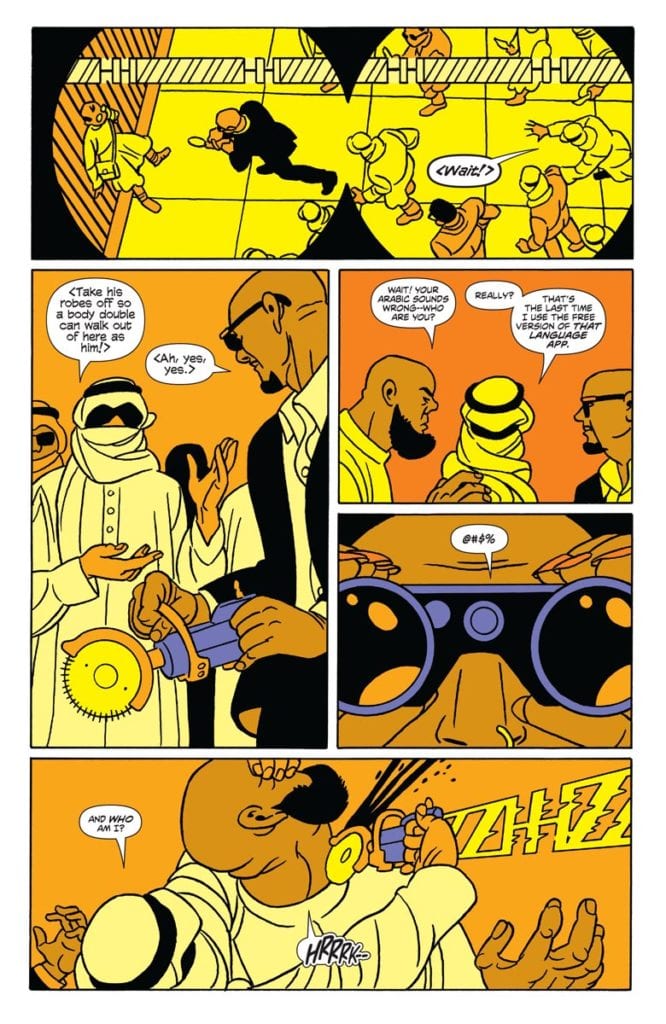 So with a setup like that, it’s going to require a hero who can keep up with this threat. Pulido decorates Ninjak #1 with SFX for eye-catching uses of tools, like a buzzsaw Ninjak takes from an opponent in the blink of an eye. While it’s cool to see how capable he is, Pulido also gives space for Sharpe to deliver exposition. The kind of exposition that reveal Ninjak is at disadvantage after his fallout with MI6.