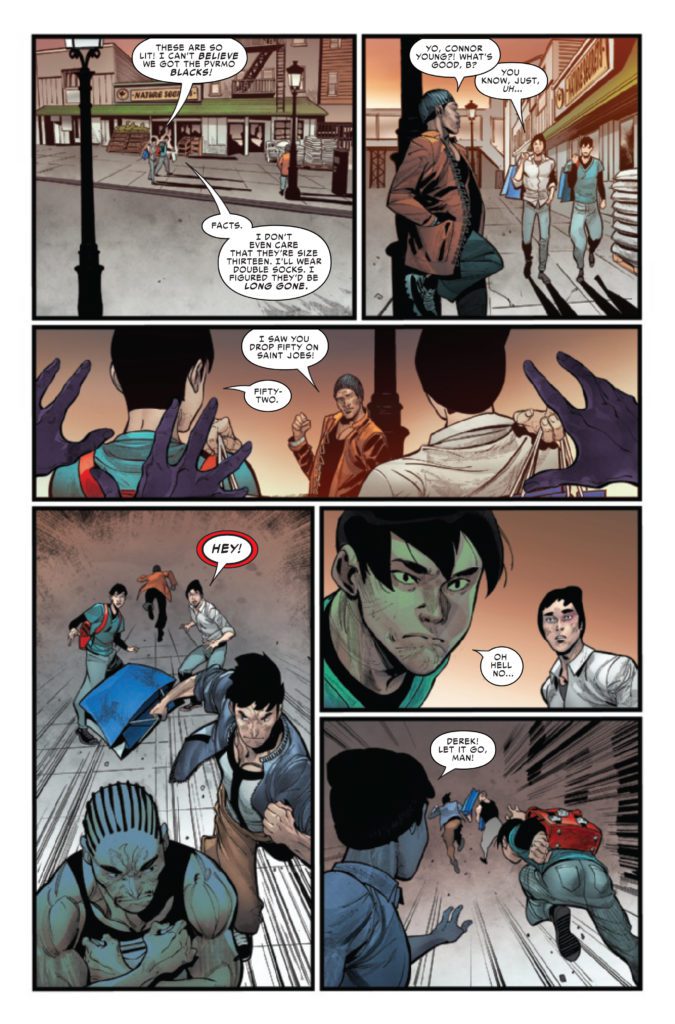
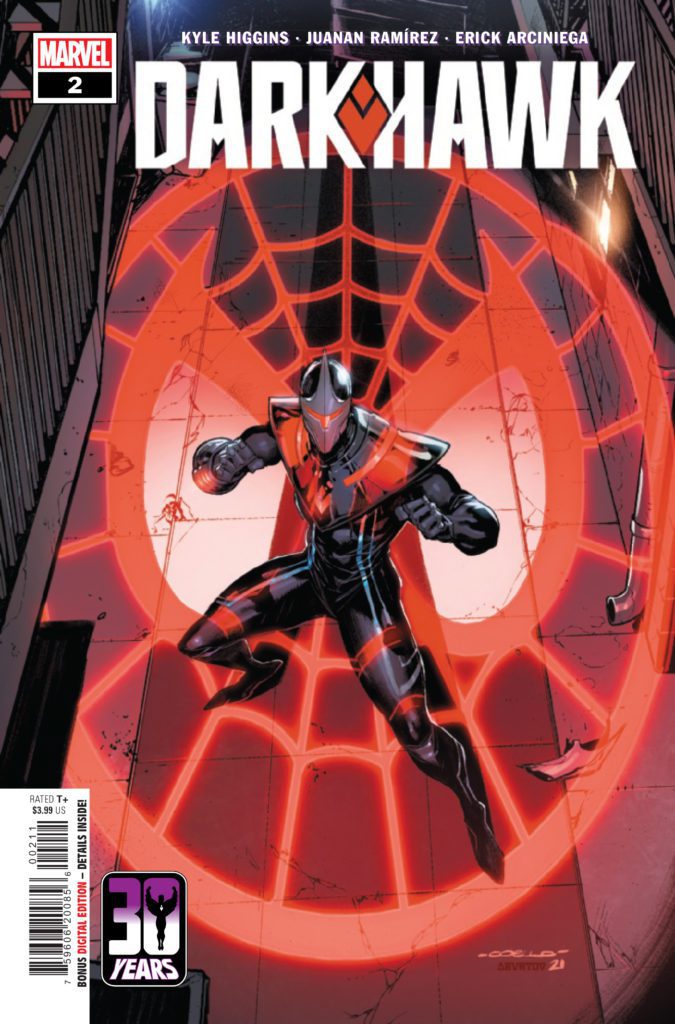
DARKHAWK #2 hits your local comic book store September 29th, but thanks to Marvel Comics, Monkeys Fighting Robots has an exclusive three-page preview for you.
About the issue: Connor Young: star point guard, recently diagnosed with MS and the new armored hero, DARKHAWK! But why was he chosen? Was it destiny? Fate? A cosmic coincidence? And what does it mean for his path forward? He’ll need to figure that out soon, before he has a run in with a certain web-slinger…
The issue is by writer Kyle Higgins and artist Juanan Ramírez, with colors by Erick Arciniega, and letters by Travis Lanham. The main cover is by Iban Coello and Jesus Aburtov.
Marvel is celebrating 30 years of Darkhawk. The character was created by Tom DeFalco and Mike Manley, and first appeared in Darkhawk #1 in 1991
Check out the DARKHAWK #2 preview below:
What’s your favorite Darkhawk story? Sound off in the comments!
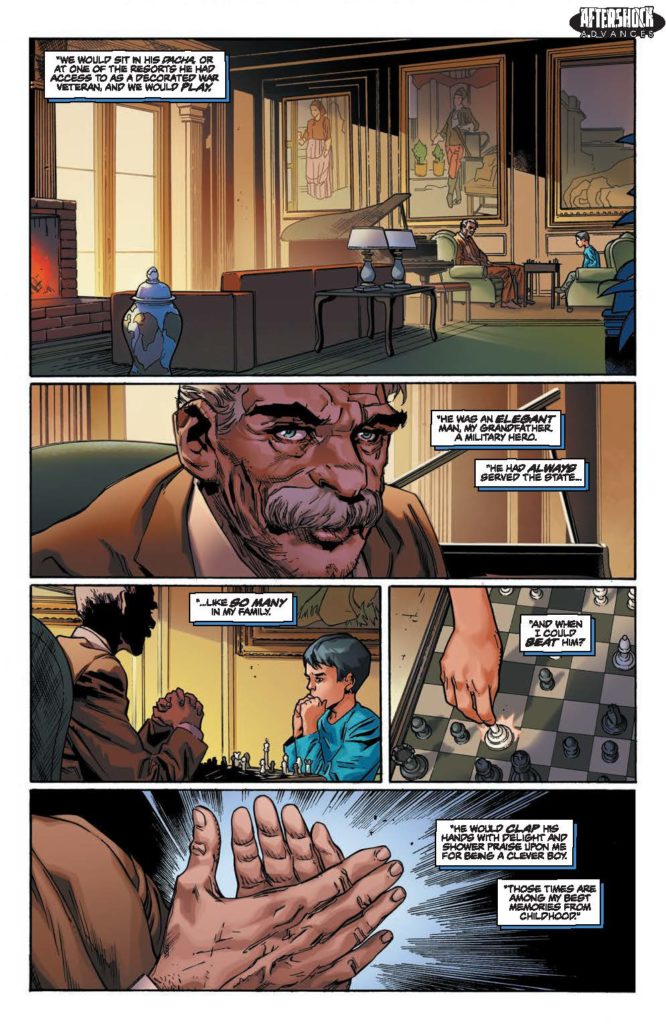
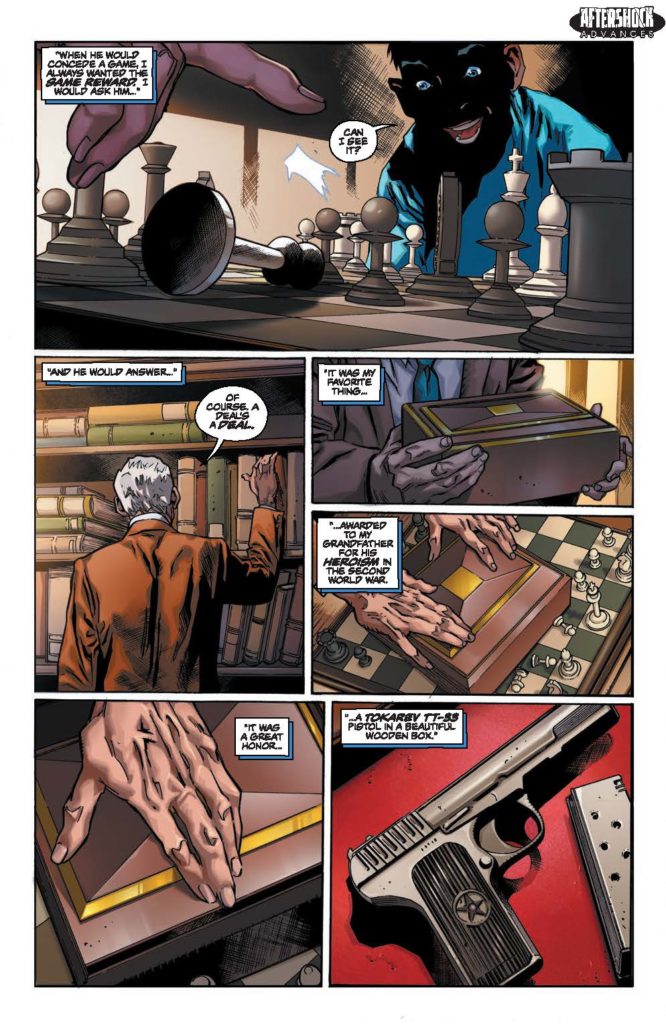
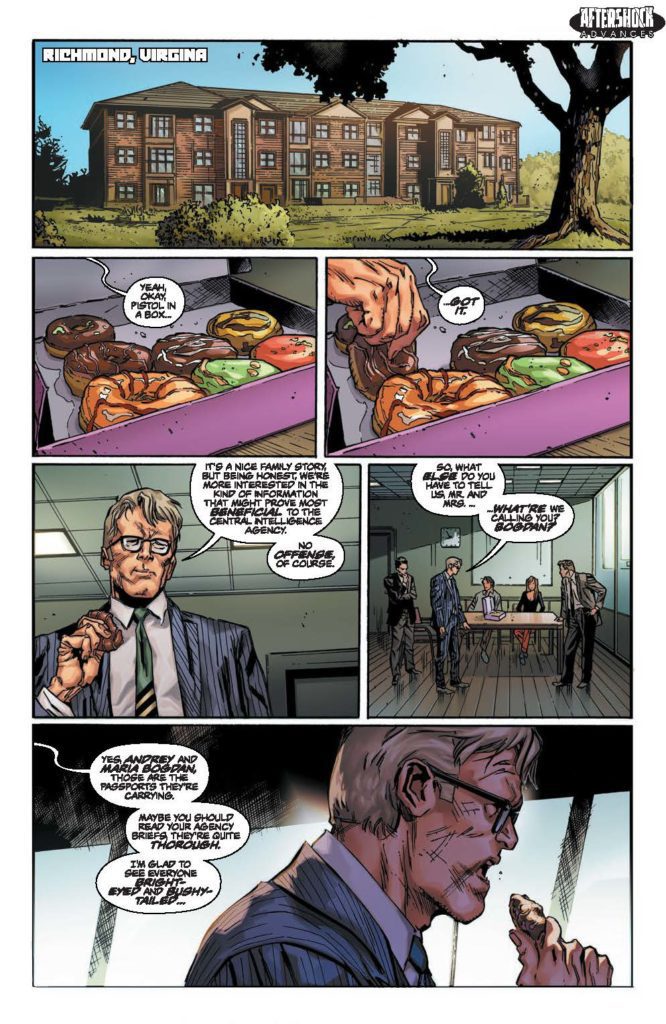
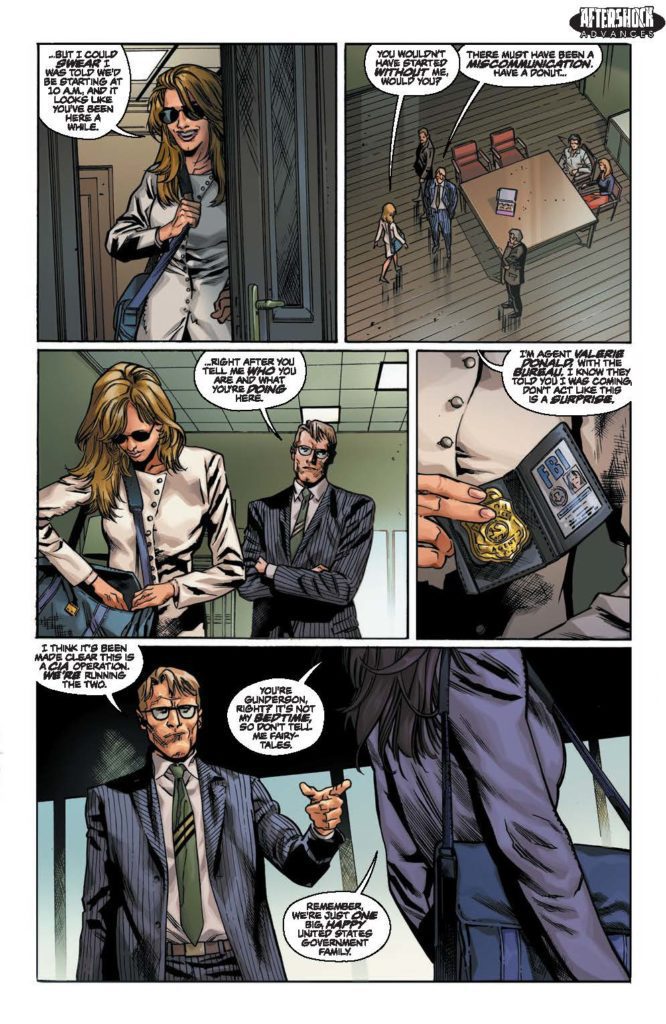
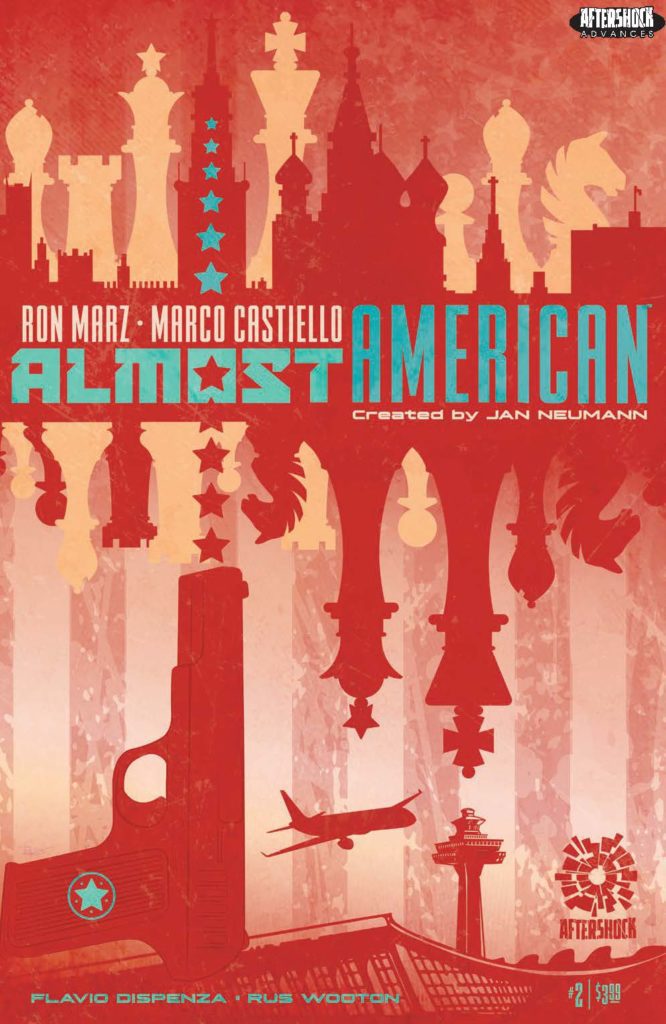
ALMOST AMERICAN #2 hits your local comic book store October 6th, but thanks to AfterShock Comics, Monkeys Fighting Robots has an exclusive four-page preview for you.
About the issue: Based on the real-life story of intelligence operative Jan Neumann, who fled his native Russia and found himself marooned along with his wife in America.
As the Neumanns adjust to being strangers in a strange land, trying to work with the FBI and CIA, a mysterious man from their past begins a deadly hunt for them. The true story is captured by acclaimed comics scribe Ron Marz (Green Lantern, Witchblade) and hot new artist Marco Castiello, working closely with the Neumanns. In the espionage world, truth is literally stranger than fiction!
The series is by writer Ron Marz and artist Marco Castiello, with colors by Flavio Dispenza, and letters by Rus Wooton. The cover and logo design is by Wooton.
Check out the ALMOST AMERICAN #2 preview below:
What’s your favorite AfterShock Comics title? Sound off in the comments!
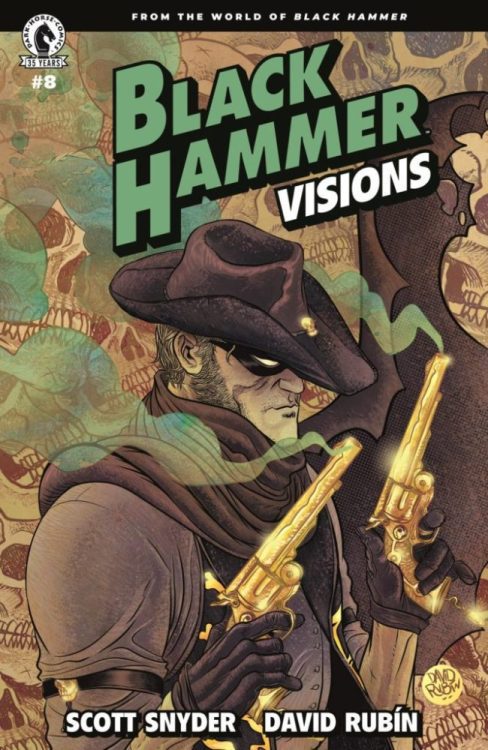
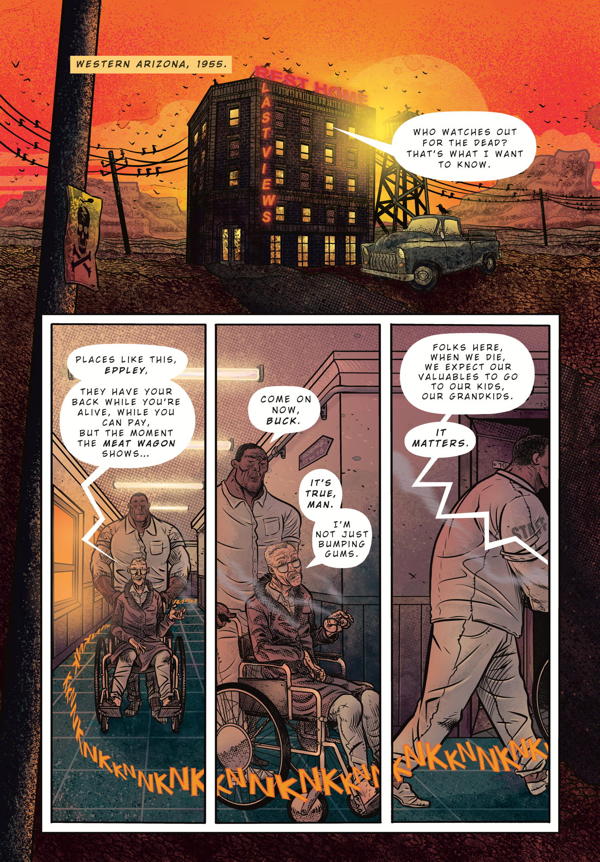
From page one of Dark Horse Comics’ Black Hammer: Visions #8, we witness a story that is laced with doom. Last Views Rest Home sits in a rocky landscape, with a beat up pickup truck, sagging power lines, and dozens of crows surrounding it. It’s 1955 in Arizona, and writer Scott Snyder and artist, colorist, and letterer David Rubín want us to know that this is a land of death. Black Hammer: Visions #8 is a darker chapter than we’ve seen before. And that’s exactly where this creative team shines.
Writing
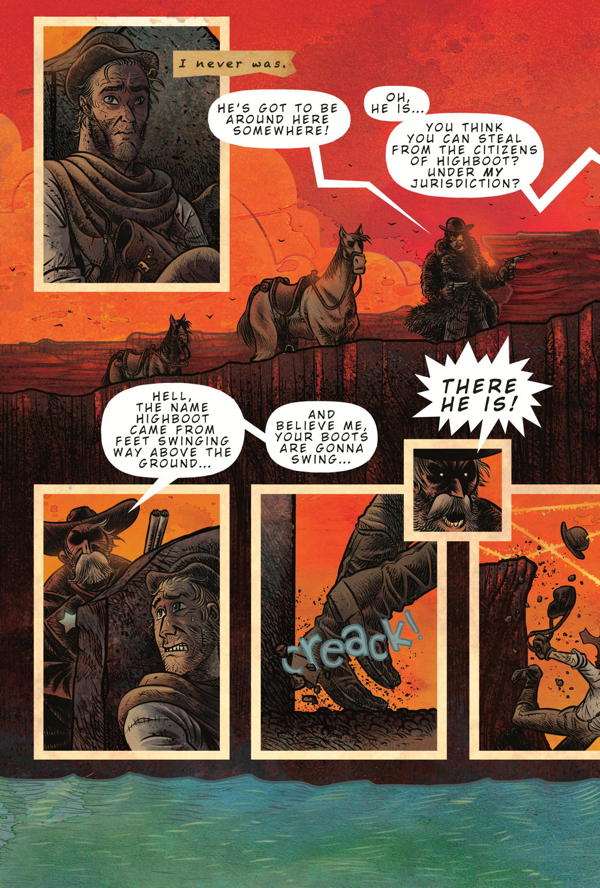
Snyder tells us a story about the Horseless Rider. From a graverobber, destined for the gallows, to an avenger of the dead, the Horseless Rider comes a long way in a short amount of time. But Snyder fits the information in well. In another issue, Snyder’s script would feel heavy-handed. Yet this is a typical ghost story. One where the rules are laid out clearly for the protagonist. “Don’t do this, or else.” So when he breaks those rules, the mystical fallout can ensue.
Snyder writes in a way that is joyfully predictable. He wants you to know where it’s going from the start. Each story beat gives you a moment to scream at the page, begging the rider to turn back while he still can. But it’s already set in stone.
Art
Rubín’s characters are vibrant and full of life, while his backgrounds are barren and dead. It’s a fantastic juxtaposition. These are characters who are fighting desperately to stay alive in this land of the dead. They sweat in front of lifeless linoleum. They wrestle and rage in dark, twisting forests. Every act these characters do is an act of rebellion against their mortality.
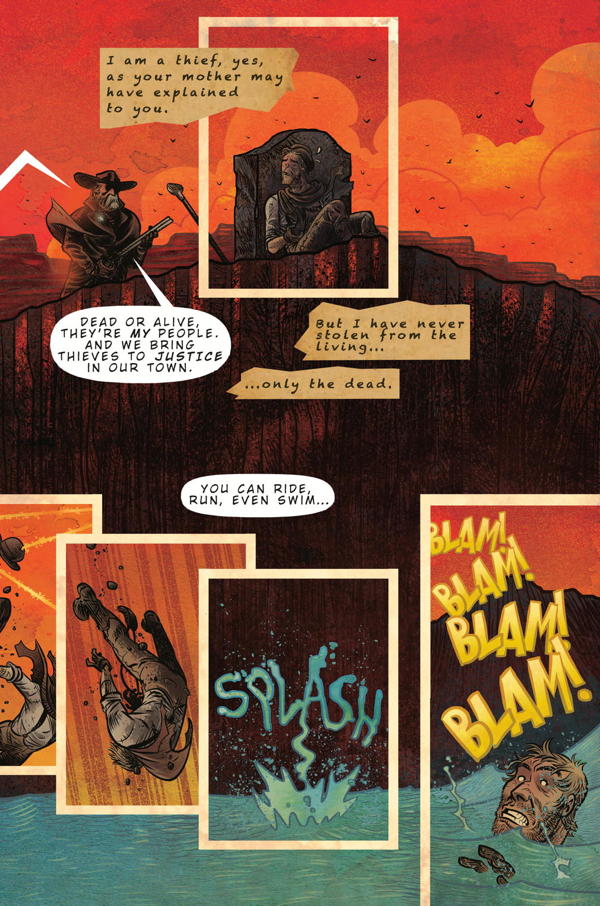
But it’s also Rubín’s page layouts that draw the reader in. He uses small panels to focus us in on little details. When one characters is caught hiding behind a headstone, the panels follow his dive off of a cliff and into a river. The sheriff’s angry face, noticing the graverobber, is in a small panel in the middle of the page. It’s front and center. Small, but a powerful force for setting things in motion.
Coloring
Death lurks in these pages. Rubín’s coloring makes a point of showing us that. When we see the orange and red sky over the old folks home, it’s the same sky as the one we see over the cemetery in the old West, two pages later. And as we follow the graverobber down the cliff and through a dark forest, the red in each scene intensifies. But we also see it in the story of our other protagonist, the old man in the rest home. A soft red glow is outside his window, almost guiding us into the next scene of the graverobber in the forest. Rubín manages to connect these storylines together seamlessly, while also giving them a color palette of their own.
Lettering
Rubín’s biggest struggle is his lettering. While his page layouts are dynamic and brilliant, his word balloon placement makes some of them hard to read. The order of dialogue isn’t always clear on the page, and some chunks of conversation feel like they have no rhythm or separation of story beats. Throughout the issue, Rubín shows a letter from the Horseless Rider to his boy. The lines from the letter show up as captions, pictured as pieces torn from a piece of paper that’s been browned with age. But one of these captions is actually the Horseless Rider addressing a character in the scene, yet it’s still shown like torn paper. The captions resume their way through the letter on the next page, with no reference to the interruption. It’s confusing and unclear, causing the reader to go back for a second try at figuring it out.
Yet Rubín’s sound effects are fantastic. The “CLOP! CLOP! CLOP!” of a horse walking through the woods is shown in small blue lettering on the bottom of a panel. The “M” in the “BLAM” of a gunshot actually traces the trajectory of the bullet. His sound effects work seamlessly into each scene, making every moment pop.
Snyder and Rubín are the right creative team for a story about the Horseless Rider. They tell us an old fashioned ghost story with plenty of style. Pick up Dark Horse’s Black Hammer: Visions #8, out from Dark Horse Comics September 22nd, at a comic shop near you!
Writer Sarah Gailey and artist Pius Bak return with another cutting chapter of satirical horror in Eat The Rich #2. Along with colors by Roman Titov and letters from Cardinal Rae, this issue digs into the heart of this story’s silly yet smart premise. With a painfully relevant message and great character art, this is shaping up to be one of the best class-conscious comics of the current era.
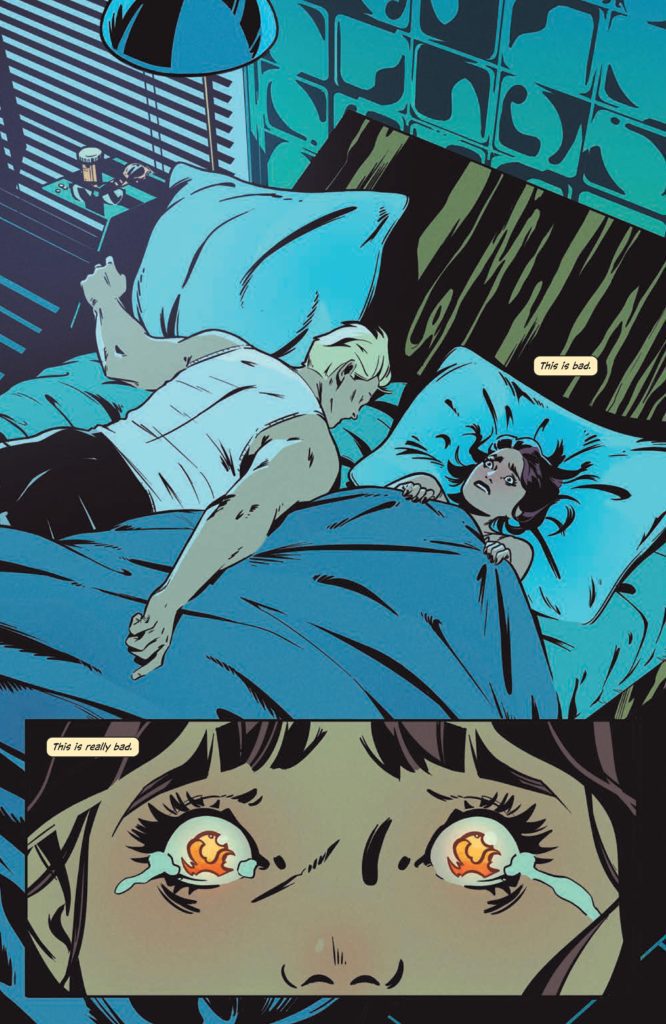
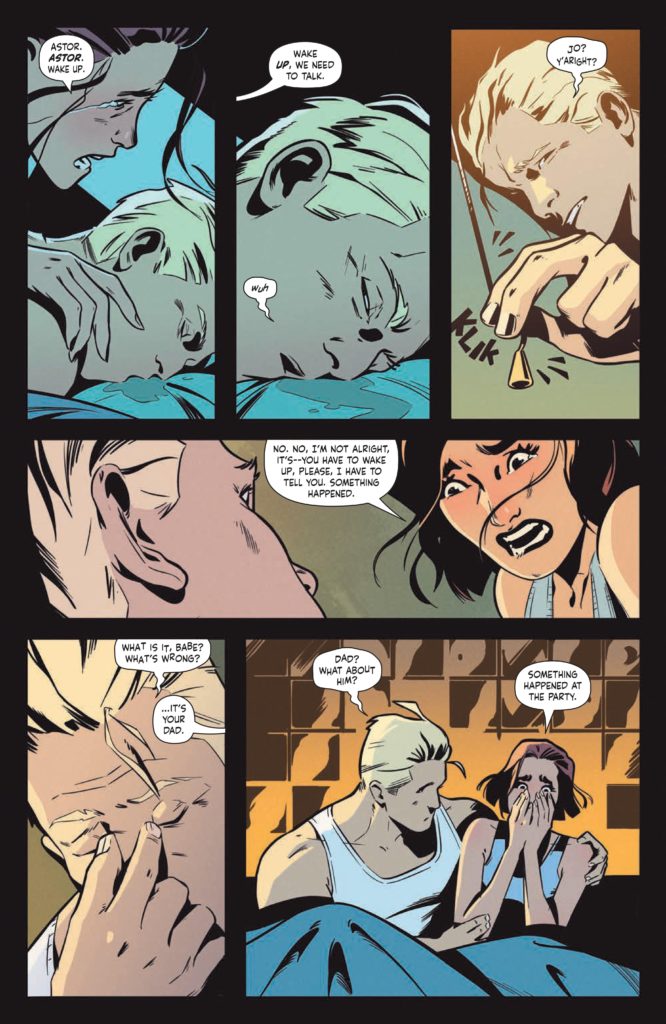
“Is Joey willing to pay with her life to uncover the gruesome secrets behind Crestfall Bluffs? Joey is beyond disturbed by what she has just witnessed, but when she confides in her boyfriend Astor, his reassurance about his family’s weird rituals and traditions only fuels her suspicions. As she digs further, what she finds produces more questions and danger than answers!”
Writing & Plot
What Sarah Gailey’s script for Eat The Rich #2 lacks in outright suspense it makes up for in twisted satire. Whereas the first issue offered a kind of Boots Riley-esque attitude, this one is more straight-forward thriller but with searing dialogue. The real heart of this comic comes from the aftermath of Joey’s discovery and a certain conversation she has in its wake. I obviously won’t talk spoilers, but this is the kind of brutally effective topical writing that makes a great socio-political comic. It’s satire at it’s most effective, when you honestly understand the victim’s decision to undergo her plight, then are horrified that you understand exactly why she would. It’s both hilarious and deeply, deeply disconcerting.
Gailey does fantastic work in creating relatable personal issues for each character. Despite the gruesome B-movie outer concept, Gailey put together a cast that makes you give a damn about what is happening. That’s how good horror works, of course. This being said I felt a couple of lines felt a bit awkward and out of place. Given their tone though, they could make sense in the story over the long run. Regardless, this is a wonderfully scripted comic with Gailey flexing their cleverness once more.
Art Direction
The visuals of Eat The Rich #3 are so full of personality and life thanks to Pius Bak’s art. His thin linework creates careful and detailed characterization into every moment on each panel. Joey’s nervous terror in the opening pages is palpable in the dark, claustrophobic-feeling room she and her boyfriend are in. Bak’s sense of scale when designing panels and rooms within panels is much of what creates tension within this comic. Just on the first few pages the shadows of Joey and Astor’s room seem to creep up on the frightened protagonist. However, when the panel shifts away from just Joey and opens up to include Astor, they temporarily retreat.
So much of the threat in this comic comes across as the house conspiring against them. On a lighter note, Bak’s facial animations are wonderfully spot-on. Watching Joey and whoever she’s speaking with exchange expressions and attitudes makes you feel like you’re in the room while you’re reading.
Coloring & Lettering
Roman Titov’s colors are a massive component of why this comic’s art style works so well. He utilizes a sort of washed out, vaguely pop-art color scheme that is semi-common among indie comics today. This isn’t a dig by any means, though. The almost flat colors add to the tongue-in-cheek satirical tone in a way, while also still allowing for shadows and darkness to highlight the comic’s horror aspects. The lettering from Cardinal Rae is simple and mostly straightforward but still mixes things up a bit. The clean modern font shifts and becomes bouncy and unclear during one scene to demonstrate how tired a character is at one point. This, and the other moments of changing bolds and italics, all work very well in establishing a reading experience. This is a stellar looking comic that matches its subject matter brilliantly well.
Verdict
Eat The Rich #2 is admittedly a less outright exciting issue than its predecessor, but it makes up for it with searing and saddening relevant satire. Sarah Gailey’s script balances sharp character focus with hilarious and depressing socio-political commentary. The visuals from Pius Bak and Roman Titov are thoughtfully directed and tonally spot-on. This is shaping up to be one of the best comic of its genre. Be sure to grab this issue when it hits shelves on 9/22!
Malignant has the potential to become a cult classic in the years to come since its initial release. It’s a modern Giallo horror film from a mastermind responsible for launching three major franchises. An outlandish concept that if executed by someone else it wouldn’t offer the same experience. Malignant is a gory treat that proves James Wan still has a lot to offer the horror genre. If it becomes a franchise, Wan may have created the next icon.
The resurgence of the slasher genre continues with this twisted concept from Wan. While prepping, Wan expressed his goal with this film was to deliver a fresh concept under his brand. Malignant certainly differs from his previous work, but his brilliant style shines through. Directed by James Wan and written by Adela Cooper. Malignant stars George Young, Michole Briana White, Ray Chase, Maddie Hasson, Jean Louisa Kelly, Jake Abel, Mckenna Grace, and Annabelle Wallis. The film follows Madison (Wallis), a woman with a troubled past who starts experiencing visions of people being murdered. The murders are linked to a person named Gabriel, someone from Madison’s past who is out for revenge.
Annabelle Wallis as Madison in James Wan’s Malignant
Madison is introduced as a woman trapped in an abusive relationship. A simple but effective aspect to get audiences invested in her. She’s had numerous miscarriages and was put up for adoption at a young age. Little time is wasted on establishing her as the final girl with a murky background. The film begins in the early ’90s but jumps to the present after a heart-pounding opening to introduce Gabriel. It’s clear Madison and Gabriel have a connection and most viewers will piece together the puzzle early on. However, Cooper and Wan have a more diabolical connection that makes it almost impossible to predict. Malignant does rely on cheap jump scares that aren’t some of Wan’s best. The scares keep you engaged, but lack build-up and are very predictable to spot.
Madison’s life takes a sinister turn after Gabriel’s crimes create legal trouble for her. It’s a typical law enforcement that believes the victim is secretly the killer scenario. Audiences know she’s innocent, but are made to doubt the events unfolding on screen. The way Wan executes this script makes for an exhilarating watch. He was channeling his time on Aquaman and Fast & Furious 7. Malignant’s mystery could have benefited from revealing certain material in a different order. Exposition dumping seemed to have become more important over trusting the audience. Audiences will witness the events and shortly after a character will provide in-depth details about what was on screen previously.
Annabelle Wallis as Madison in James Wan’s Malignant
Gabriel is a terrifying presence, so it’s disappointing that the way it unfolds weakens his mysterious nature. Madison is a likable protagonist but feels outshined by the supporting characters. Wallis’ performance is effective and she will have viewers feeling sorry for Madison, while also remaining just as intrigued by Gabriel as she is. During Madison’s hardship, her sister Sydney (Hasson) keeps her company. Their bond is at the heart of Malignant and creates an emotional edge once the film truly kicks in. Hasson’s performance as Wallis’ concerned little sister is heartwarming to witness. The chemistry between the two enhances Madison and Sydney’s growth throughout the film.
Wan keeps the audience’s blood boiling from the chaotic opening to the bonkers conclusion. Malignant is paced very fast for the majority of its runtime. This doesn’t take away from audiences getting enough time to grow attached to Madison. He captures some chilling shots, such as when Gabriel first appears inside Madison’s house. The lighting along with Joseph Bishara’s score creates a dreadful feeling during that scene. Wan’s signature zoom-in on terrifying objects is always a pleasure to see on screen. Malignant has its flaws, but Wan’s commitment to its concept is impressive. Bishara’s score feels like a character at times. Sure it may not complement every scene, but the music teleports you into the world of Malignant every time it plays.
Gabriel carrying Madison in James Wan’s Malignant
Malignant is Wan’s soon-to-be cult classic that many horror fans will love to revisit. It has a unique slasher equipped with the year’s best weapon used in a horror film. Stepping outside of the traditional haunted house films Wan had been doing has allowed him to create a fun film for the genre. Malignant isn’t a masterpiece, but the way it’s executed will have fans of the genre praising Wan for stepping out of his usual approach.
Midnight Mass is a chilling look at the demise of an isolated island through religious horror. Mike Flanagan returns with another compelling Netflix series centered on a misguided community. The emotional weight showcased in his Haunting series is present in Midnight Mass, but not on the same level. Flanagan takes audiences on a religious journey that leaves you feeling like you’ve endured a cathartic exercise. It’s a series that highlights how faith can be used to corrupt and manipulate.
Drawing inspiration from The Bible, the series raises important questions about faith, life, and redemption. Each used for sinister intentions unbeknownst to this island community. Midnight Mass had been in the works for a while. Flanagan has teased the project in his past works. Finally, the long-awaited dream comes to life, and fans will get to experience it later this week. Directed and written by Mike Flanagan, Midnight Mass stars Zach Gilford, Hamish Linklater, Annabeth Gish, Samantha Sloyan, Rahul Kohli, Robert Longstreet, and Kate Siegel. The series centers on Crockett Island, an isolated community that begins to experience unspeakable miracles after the arrival of a young priest, Father Paul (Linklater), and the return of a troubled man, Riley Flynn (Gilford). These miracles aren’t from God, and the community struggles to recognize this.
Riley Flynn, a recovering alcoholic who has been released from prison after serving a four-year sentence. He is the focus early on and returns to his family on Crockett Island. Wanting to start fresh, Riley’s homecoming isn’t well received. Crockett Island is a catholic community filled with many different age groups and an attachment to God. The community gathers at St. Patrick’s for services, but a few inhabitants suffer from old age, inability to walk, body aches, and other life hiccups. However, the arrival of Father Paul unlocks the miracles described in the text they cherish. A religious resurgence occurs, but Father Paul’s presence brings darkness to Crockett Island.
Flanagan is a genius when it comes to telling gripping stories about recovery and trauma. Midnight Mass doesn’t hit the same highs as his Haunting series, but still unpacks a thought-provoking look at religion being used against an entire community. Riley’s presence serves as a stumbling block for Father Paul because Riley is more of a rational person. He doesn’t fully commit to the existence of God because he wonders where was God when he committed the act that landed him in prison. His only ally outside of his family comes in the form of Erin Greene (Siegel). She returned to Crockett after leaving to pursue an acting career but instead endured an abusive relationship. She works as a school teacher in the community and serves as a symbol for Mary from The Bible.
Flanagan doesn’t seek to make Father Paul a villain, his faith has been exploited and he’s bringing the issues to Crockett Island. His intentions are for the best, but this is no work of God occurring across the community. Father Paul’s corruption from going outside his religious community speaks to how society can be used to manipulate one’s faith. Midnight Mass beautifully depicts how faith can be distorted to catapult one’s self. Father Paul creates a religious resurgence while withholding information about his motivations from his congregation. Joining forces with Bev Keane (Sloyan), a self-righteous resident that Father Paul believes can be used to his advantage. She believes God values her more than any other member at St. Patrick’s, so her faith was exploited by Paul early on.
Another stumbling block for Father Paul is Sheriff Hassan (Kohli), who moved to Crockett after a family tragedy, he follows islamic faith as well. His son Ali is exposed to views he doesn’t agree with, so this creates an issue during this religious resurgence. Riley’s struggles make him an interesting character to watch navigate through these miracles. He is haunted by his mistake, doesn’t believe in God, and part of him doesn’t think he deserves forgiveness. The core characters are compelling, which only enhances the emotions during some of their demises. Flanagan is no stranger to character depth, and the residents of Crockett Island will have audiences invested early on.
Midnight Mass is brought to life by the impeccable performances put on display. Gilford’s performance as Riley is a stoic one, but time spent with Erin unlocks his softer side. Riley’s redemption arc becomes an act of love, and Gilford’s portrayal makes the character likable. Siegel impresses as Erin Greene, the teacher with a past she isn’t ashamed to own. Her mistakes make her stronger and Siegel captures that inner confidence with ease. Flanagan keeps viewers on the edge, the tension rising with each new episode, and there’s this constant feeling of hopelessness. The series is a visual feast filled with haunting shots of Crockett Island that get amplified by The Newton Brothers’ bone-chilling score.
Midnight Mass delivers a thought-provoking journey that fans of Flanagan have come to expect. It’s an emotional rollercoaster about doubt, redemption, death, and faith that becomes increasingly terrifying as it progresses. A haunting but heartfelt examination of faith demolishing a community. Midnight Mass is a once-in-a-lifetime experience that will leave audiences floored.
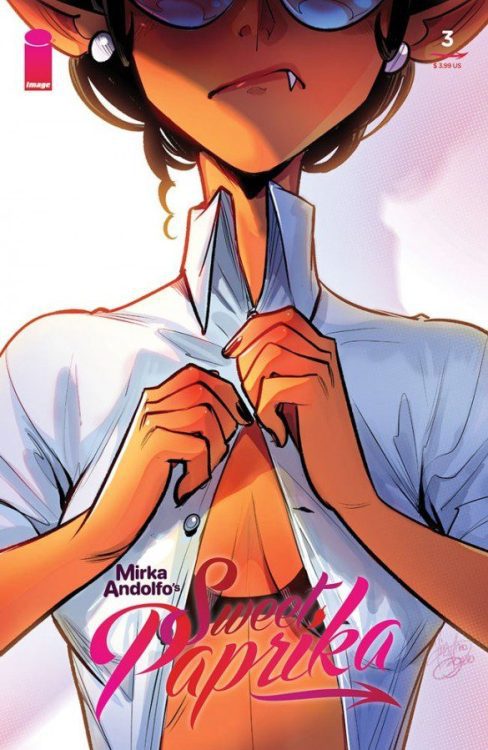
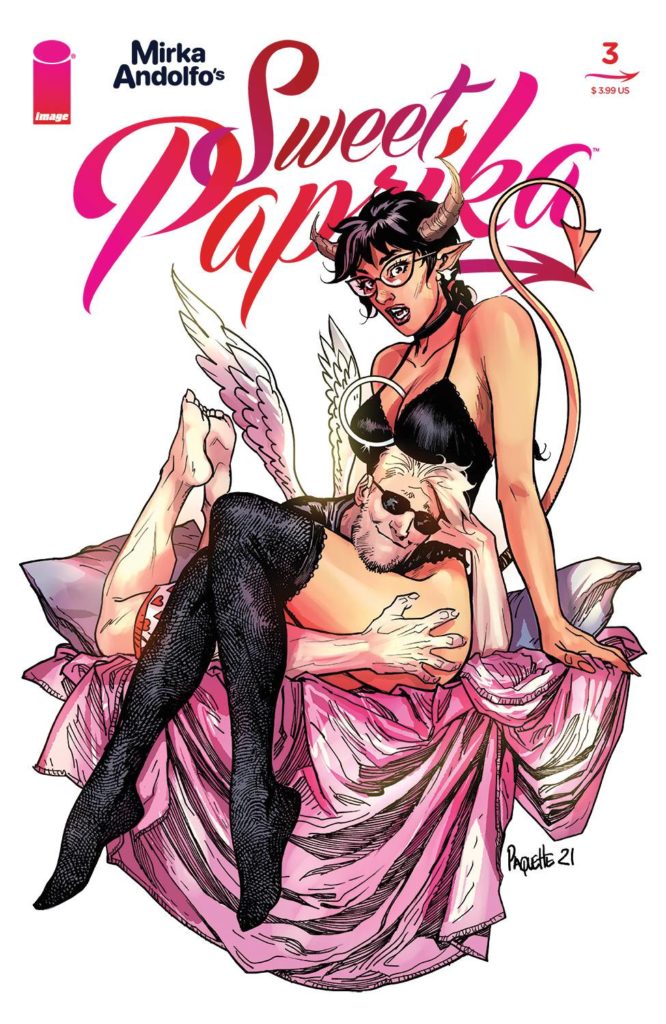
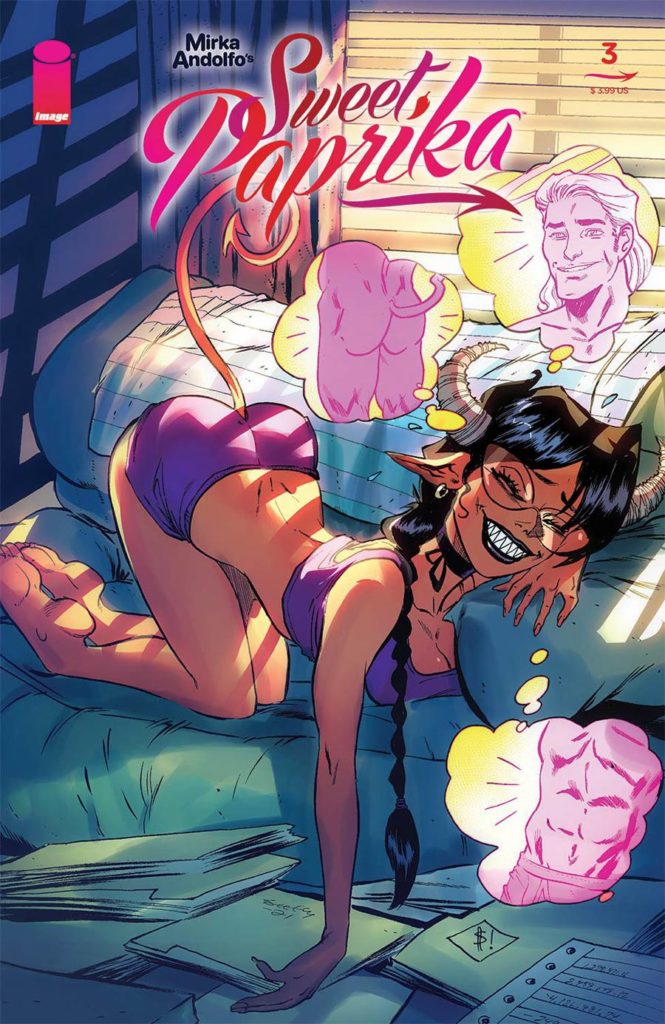
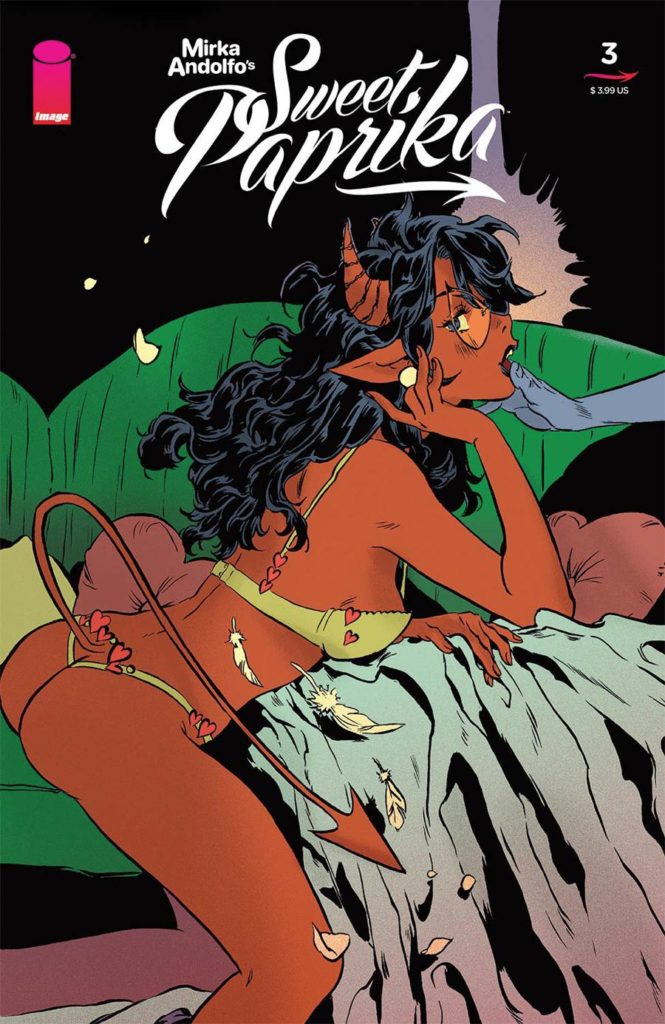
The immensely talented Mirka Andolfo (Unnatural, Deep Beyond) brings us another fantastic chapter with Sweep Paprika #3. With help from Simon Tessuto’s colors, Fabio Amelia’s letters, and localization from Steve Orlando, this issue offers more of Andolfo’s trademark humor, clever writing chops, and stunning visual work. Complete with a deviously funny final revelation, this comic is yet another great installment in this series.
“Paprika’s “forced fun” night doesn’t seem to be too bad, perhaps—but, in the end, not too great either. Come on, staying together for so long, for no real reason…how can people like it? Then, while her father seems to be recovered and healthy again, Paprika will have a nasty surprise…”
Writing & Plot
Mirka Andolfo’s writing for Sweet Paprika #3 continues to combine her trademark over-the-top humor and Paprika’s realistic emotional struggles. This issue sees our protagonist continuing to try and reconcile her internal struggles with relationships and issues with her father. This time however, it’s in a social situation with attractive men and lots of expensive alcohol. We get to witness more of Paprika’s worse parts – like the fact that she’s a wealthy work-zealot with a firing fetish – but also her at more vulnerable lows. At the same time we also get Dill not being an obnoxious playboy and instead being a kind, likeable person. This is the first interaction we get of these two where Paprika isn’t trying to rip his head off, and it’s genuinely sweet.
While Andolfo’s usual sexual humor and cartoony silliness are still here and fun as ever, the emotional bits are the huge surprise in this comic. The way Paprika shies away even from light flirting is relatable and genuinely thoughtful. The manner in which she fantasizes about sex but is then interrupted by her deep personal issues continues to be both hilarious yet insightful. The real plot highlight of the book is its ludicrous and hilarious end, which will no doubt mark the turning point for Paprika’s story.
Once again I have to give props to Steve Orlando’s localization. He does stellar work in taking Andolfo’s original writing and reapplying it to our reading sensibilities while maintaining everything she is telling us.
Art Direction
As always, Mirka Andolfo’s art absolutely shines in Sweet Paprika #3. Her animation and details are rife with personality and perfectly craft each scene’s tone. The manner in which her scenes flow both via her panel direction and penciling is so natural it’s almost easy to miss. Reading Paprika is a stellar reminder that comics are not necessarily a static visual medium. The way characters shift and move so seamlessly and break out of conventional panel direction is singular to Andolfo’s style. The fact that her work here is also receiving an animated adaptation makes only too much sense.
A massive portion of what makes Andolfo’s work pop here is the coloring from Simon Tessuto. His vivid visualizations of characters and settings match Andolfo’s vision by crafting a rich world of colors. Tessuto utilizes lighting in such a sharply detailed way that I’ve never seen matched in another comic. The opening scenes at a lavish party lit by chandeliers paint everything in a sort of gold-white light. Scenes decorated by stars and moonlight cast every surface in a proper blue tinge. Every emotional detail and feature is perfectly presented by Tessuto’s work inside Andolfo’s lines.
The lettering from Fabio Amelia is an active visual piece to this puzzle as well. The expressive font style is constantly shifting and changing size and shape to perfectly suit the tone of what’s happening in the panel. The entire visual experience of this chapter of Paprika is brilliant.
Verdict
Sweet Paprika #3 is more of the sexy hilarity and genuine character storytelling we expect from this series. Andolfo keeps up the over-the-top erotic comedy hijinks while digging deeper into Paprika’s debilitating internal traumas. Her beautifully animated pencils, with help from Simon Tessuto’s vivid colors, are stunning in every way. Be sure to grab this newest chapter when in hits shelves on 9/22!
A Righteous Thirst For Vengeance #1 Credit:Image Comics
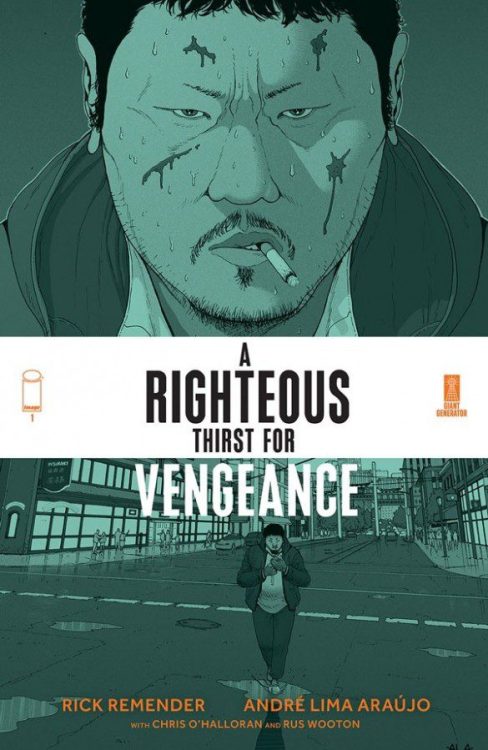
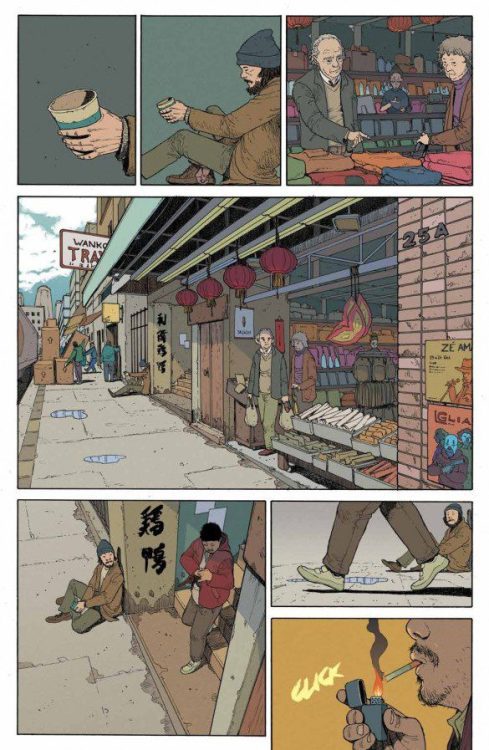
On October 6th, the first issue of A Righteous Thirst For Vengeance from Image Comics will make its way into the world. It is a tale of contract killers and innocent men told by Rick Remender and Andre Lima Araujo. A modern crime thriller packed with mystery and violence, and yet the first issue is more measured and subtle than expected.
It’s about a man catching a bus.
A Righteous Thirst For Vengeance #1 Credit:Image Comics
Keep It Simple
In 1998, a friend recommended a film to me by saying “If you’re going to watch a woman run across Berlin for 90 minutes, then you have to watch Run Lola Run.” Tom Tykwer’s film is about split second decisions and examines cause and effect across multiple realities. It is so much more than the surface presents. Run Lola Run is a movie worth watching, even if you want more than 90 minutes of a woman running across Belin.
A Righteous Thirst For Vengeance is a comic about a man taking a bus out of the city and into the sticks and, just like Run Lola Run, it is also so much more than that. It is the perfect example of the journey being more important than the destination. And between them, Remender and Araujo present one of the most fascinating bus trips I’ve ever read in comics.
The plot is straightforward and very little is actually explained in this opening issue. The reader follows the journey of a man who, we are told in the solicit, “stumbles upon a dark-web contract assassin’s vicious plot to kill an innocent target.” However, in this mostly silent first issue, Remender is just setting the scene for an intriguing crime mystery story, and there is very little to link the comic to the violence promised. Instead, the excitement here is in the detail, the small interactions between strangers who meet in passing, and the layering of tiny events that lead to the comic’s shock moments. This building of the narrative, with seemingly unimportant moments highlighted as if they were the central plot, makes for rich, enjoyable reading on par with Brubaker and Phillips’ Criminal.
A Righteous Thirst For Vengeance #1 Credit:Image Comics
The Art of Silence
The art work by Araujo is superb, and creates fascinating story beats in a mundane world. The emotions of the characters are brought out through nuanced body language and detailed facial expressions. There is an interesting interplay between the landscape and the characters, with one reflecting the mood of the other. Despite the lack of dialogue, Araujo is able to represent a complex central character and create an intriguing story out of a simple bus journey.
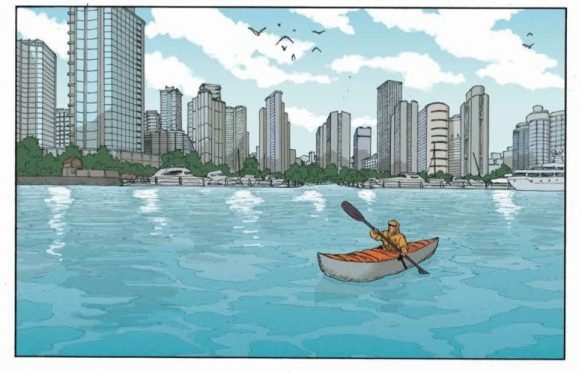
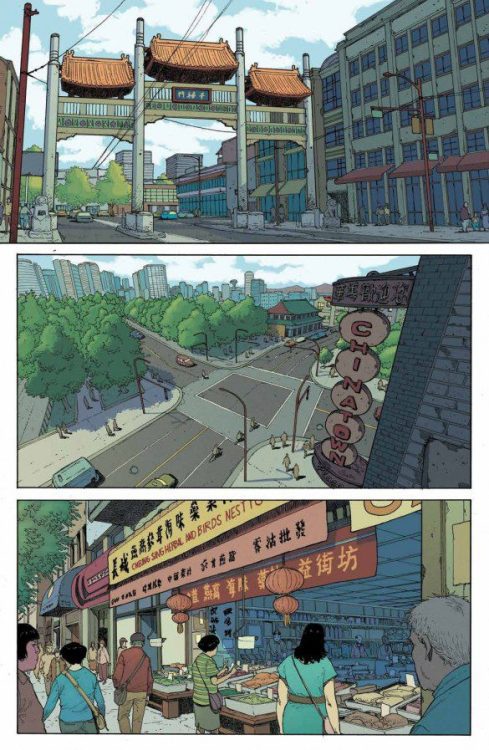
Chris O’Halloran does a wonderful job on coloring duties building the tension through a shifting color palette throughout the comic. The dampened blue tones of the opening pages shift in tone as the reader follows Sonny into different locations and circumstances. The artificial brightness of a grocery store produces a sudden overwhelming moment in the comic, as if the creators are giving the readers a shake. It’s like the moment in a film where the music shifts gears and volume to make the viewers sit up. From this point onwards you become more aware of the surroundings, especially the change of color palette from page to page.
Rus Wooton has little to do due to the silence dominating much of this comic, but what he does provide fits perfectly with the rest of the artwork. There is a consistency across the sound effects with subtle placement and a softness to each sound implied by the design. An absence of bold dark colors and outlines to the sound effects allows them to sit within the artwork and not standout. You really get the sense of the sounds emanating from within the page. This is also true of the speech as the thin, clipped tails of the speech balloons do not impose themselves on the page. Each of the creators has picked up on the ordinariness of the central story and reflects that in their craft allowing the readers intrigue to pick out the important details of the plot and feed their own desires of excitement.
A Righteous Thirst For Vengeance #1 Credit:Image Comics
Conclusion
A Righteous Thirst For Vengeance is a deliberate slow build designed to acclimatize the reader to the world in which it is set instead of throwing out major plot points and dropping a cast of characters straight into bombastic action. The progression from page to page and moment to moment allows us to spend time with Sonny on a very personal level, even though his motivations are only hinted at. It is a triumph of storytelling and silently screams its brilliance across the pages. Superb artwork and clever page layouts make this a journey worth traveling and sets the bar high for future issues.
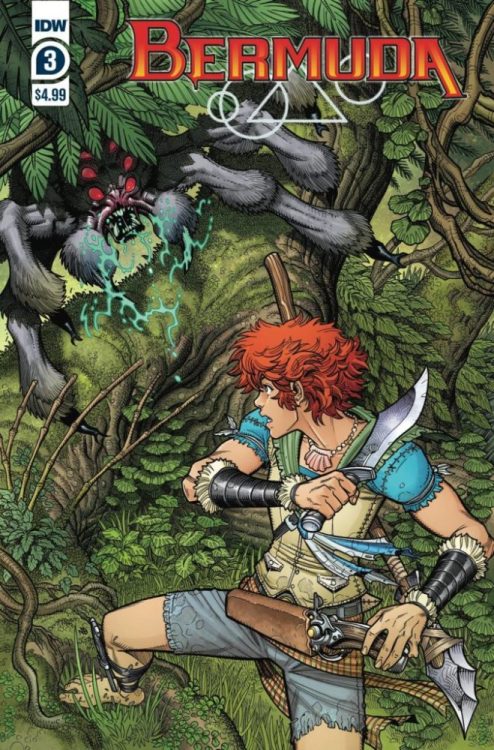
Bermuda #3, from IDW, comes to comic stores on September 15. Writer and letterer John Layman shows us the events of the issue through a supporting character, Doc Nakamura. Artist Nick Bradshaw and colorist Len O’Grady present the story through angles that highlight tension.
Backstory
Bermuda, the series titular protagonist, reluctantly helps a castaway look for his sister.
Bermuda #3: The Doc Nakamura Chapter
Layman makes Bermuda’s helper, Doc Nakamura, the main character of Bermuda #3. Here, Doc is not just a voice of reason, but somebody who has his own challenges and personality. While he looks at his life in the Navy with some nostalgia, he wants a life outside of it. He’s unlike his former captain and crew who held onto the hierarchy of the Navy so much that it practically became a religion to them.
Doc’s good nature and optimism serve as major highlights in Bermuda #3. Despite Captain Cutter’s subtly racist remark towards Nakamura, the Doc believes in the necessity of having him and the rest of the ocean men as allies. Because having an army against greater threats is a tremendous benefit.
Scaled Angle
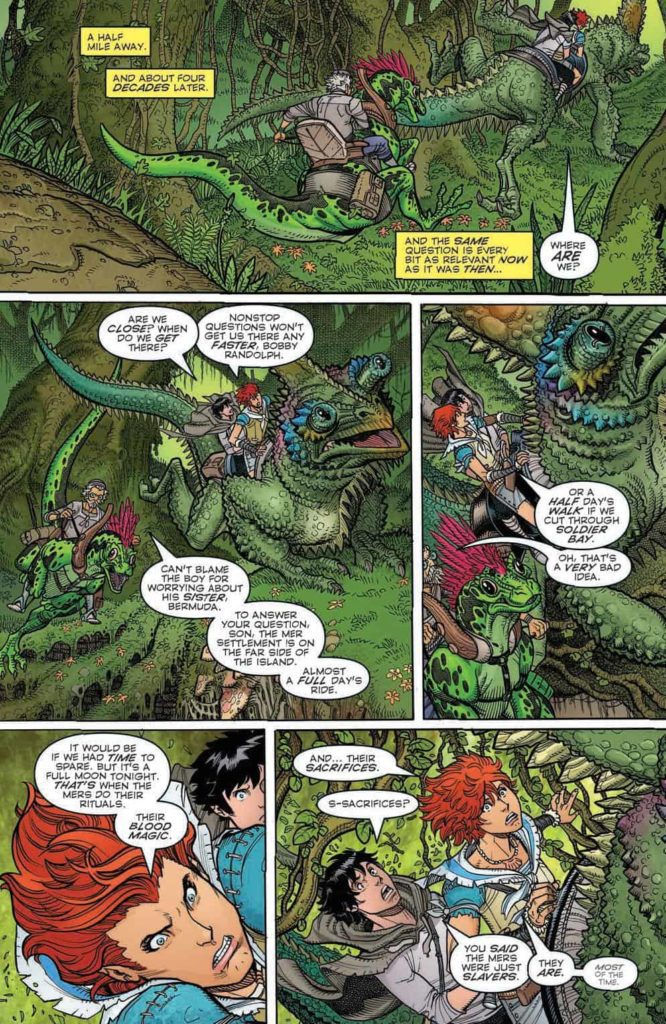
Bradshaw’s art in Bermuda #3 continues to showcase the Triangle’s magnificent dangers. The first pages feature a kraken overwhelming a submarine in different angles, only to seem like a smaller threat when compared to a massive megalodon. It serves as good foreshadowing of Bermuda and co.’s clash with the Ocean Men. It also represent the series’ ever increasing stakes.
Amid all of the excitement, it’s easy to lose sight of what’s happening. But maybe that’s because O’Grady takes the time to feature camouflage in Bermuda’s lizard mount and the Navy soldiers. Otherwise, the more eye-catching objects like giant spiders or Doc and the Ocean Men’s matching uniforms guide readers through the jungle. Not that it makes Layman’s lettering any less important. He takes the time to make dedicated shouts and sound effect designs.
Get Ready In Bermuda #3
Bermuda #3 makes Doc more than just a supporting character. Accompanying him is a strong sense of scale and danger that increases with every page. So, before the grand finale, this issue reminds us why we love these characters.
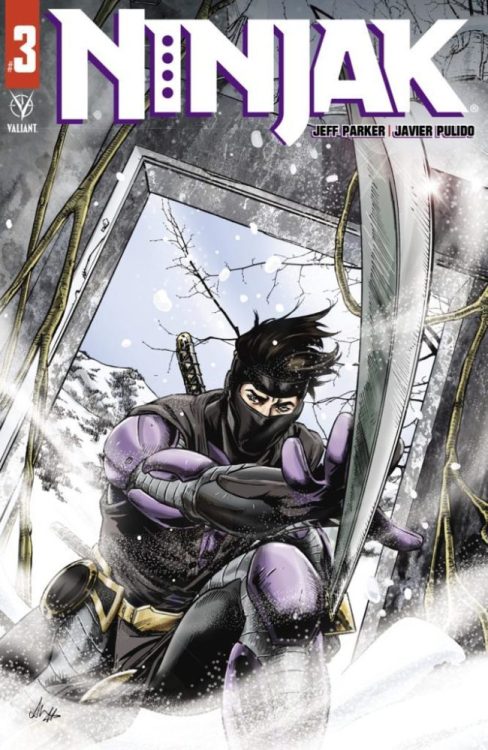
Ninjak #3, out from Valiant Entertainment on September 15th, slows the pace down. Writer Jeff Parker and cartoonist Javier Pulido display tell their story through dialogue that takes its time and emotionally intense illustrations.
Background
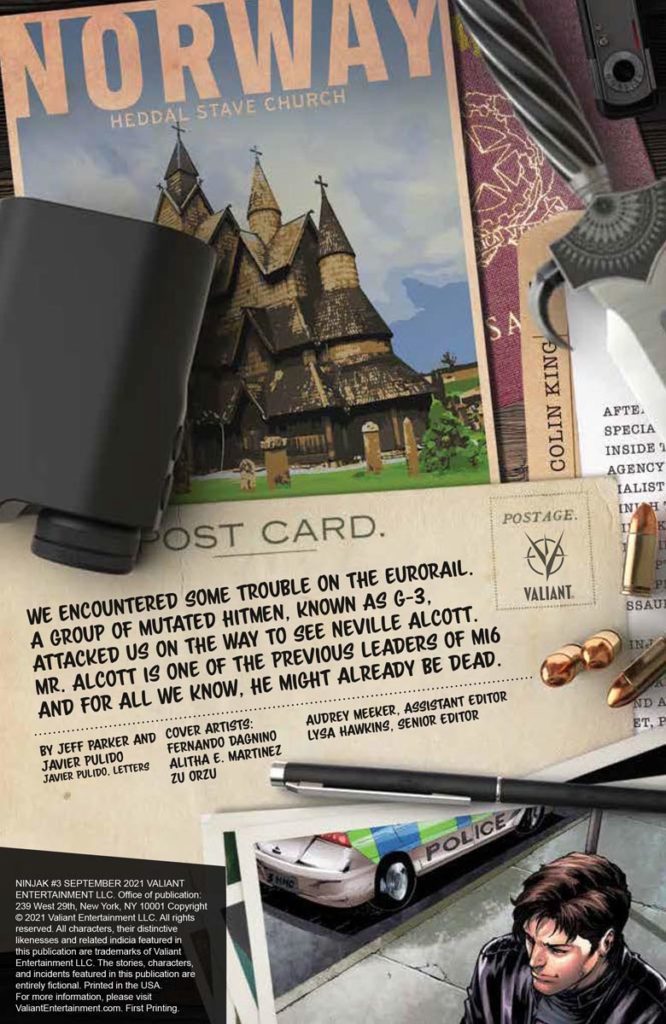
A mysterious group, led by a pair of siblings, have exposed all MI6 assets, including Colin King (Ninjak). With hitmen after him, Ninjak regroups to gather intel.
Ninjak #3 On Why Words Go So Slow
Parker’s story outline remains simple to allow the issue to go at its own pace. It is what allows Pulido to illustrate some smooth action sequences in Ninjak #3. A two page spread has Ninjak stylistically take out a group of men in just a few moves.
Some of the exposition-heavy parts of the issue feel slow and uninteresting. The characters talk about things that have already happened. The new information that they provide in this issue, however, they do brilliantly. When Ninjak comes across intel on the series antagonists, Daylight, Pulido’s illustrations, green coloring, and many caption boxes tell everyone how emotionally overwhelming Daylight’s backstory is.
But not everything in Pulido’s art adds to the story or is as interesting. A two page spread that has to be turned on its side feels very distracting. It interrupts the experience of reading the issue.
Ninjak #3: The Challenge of Context
Ninjak #3 might slow down its storytelling pace, but maybe that’s because delivering exposition is tough. Going over what already happened feels like a chore compared to Ninjak#3‘s strikingly vivid imagery. Especially since it makes the villains a little more sympathetic.












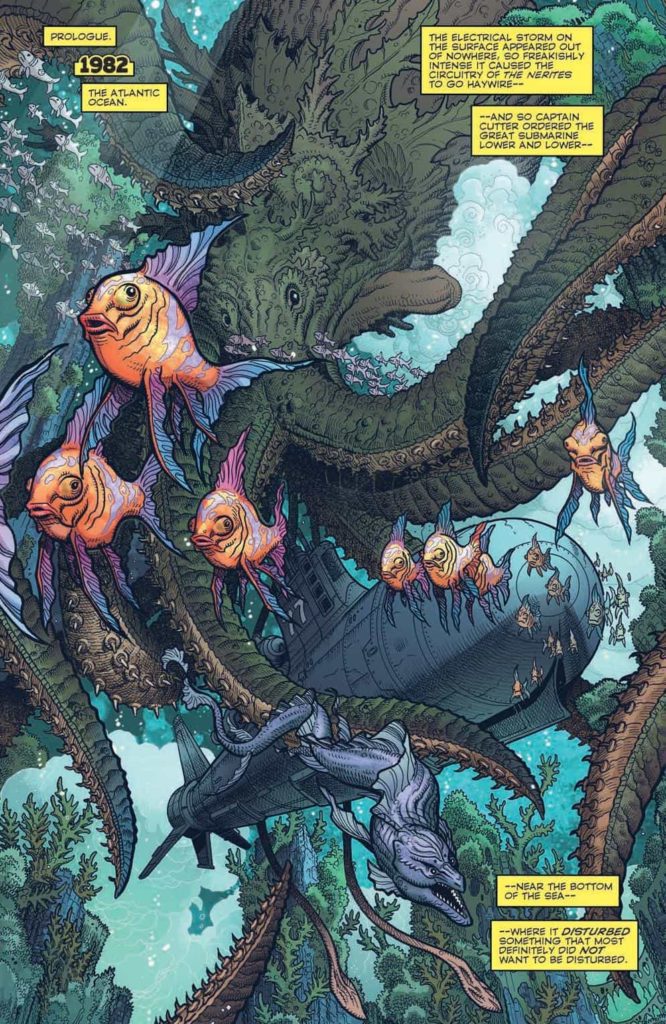 Bradshaw’s art in Bermuda #3 continues to showcase the Triangle’s magnificent dangers. The first pages feature a kraken overwhelming a submarine in different angles, only to seem like a smaller threat when compared to a massive megalodon. It serves as good foreshadowing of Bermuda and co.’s clash with the Ocean Men. It also represent the series’ ever increasing stakes.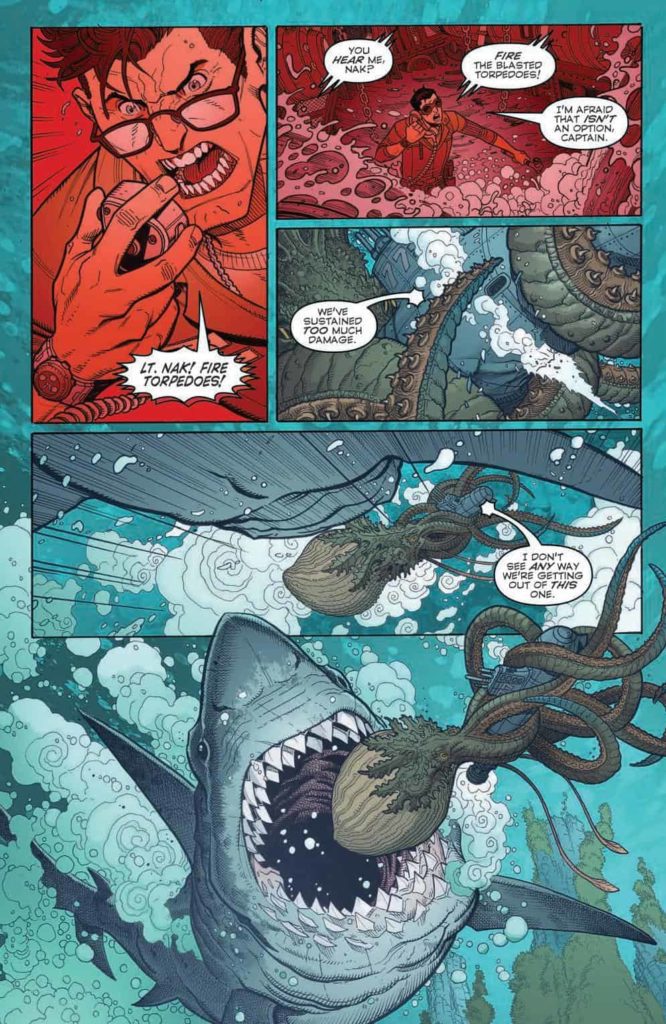
 A mysterious group, led by a pair of siblings, have
 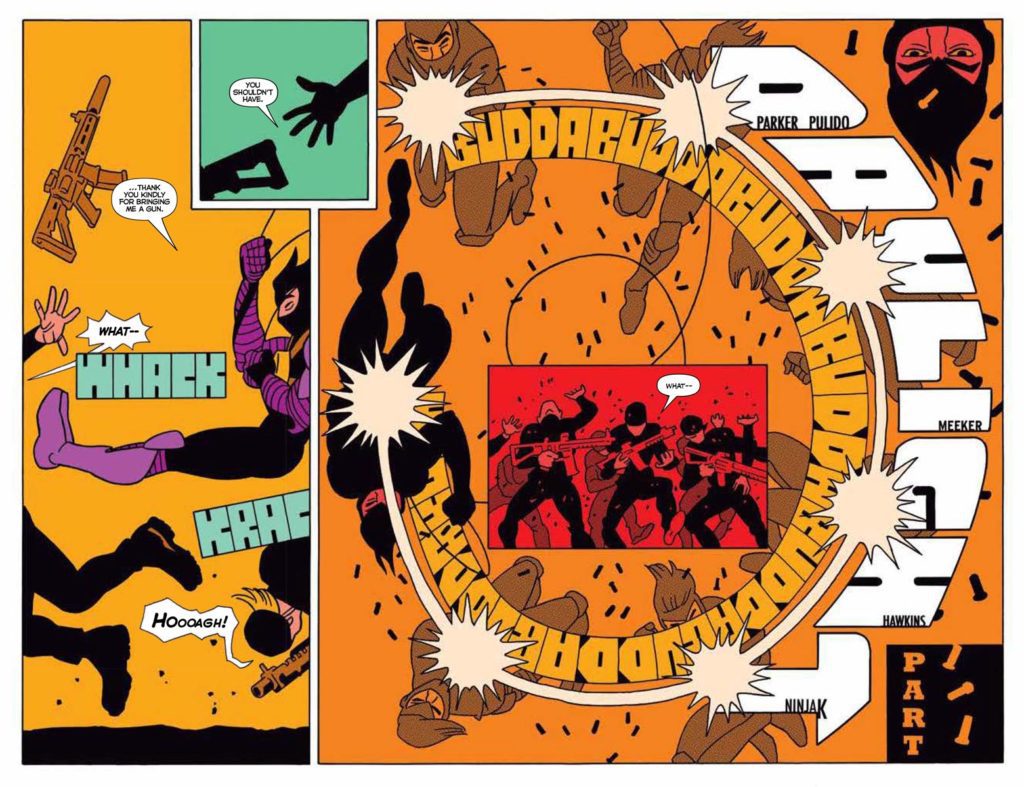 Parker’s story outline remains simple to allow the issue to go at its own pace. It is what allows Pulido to illustrate some smooth action sequences in Ninjak #3. A two page spread has Ninjak stylistically take out a group of men in just a few moves.