Home Blog Page 354

Box Office Flashback: February – Sweet Revenge, Ghostface Returns, And Tormented Dicaprio

Thirty years ago it was a former cop out for revenge. Ten years later, a horror film within a horror film. And ten years after that, a mind lost within itself.

One-hundred-plus years of film making provides a long, rich, and deep history to look back on. Retro reviews and analysis of old films are practically necessary full-time specialties. Month after month, films release, vying to make as much money and grab as much attention as possible. Some rise, some fall, but regardless of financial success, the lasting effect of a film in popular culture is unpredictable.

So, where does that leave past box office champs? Let’s take a look back ten, twenty, and thirty years ago at the biggest movies released in February.

1990 • Hard To Kill • 47.4 Million

hard to kill - steven segal

The early 90s belonged to the action movie star. The former cop or military vet, either betrayed or framed and out for revenge. Between 1988 and 1992, Steven Seagal (Under Siege) starred in five, hit action films. The second one, Hard to Kill, released on February 6th and wound up being the biggest money-maker released in the month.

After Hard To Kill, the silver medalist for the month was Madhouse, a comedy starring Kirstie Ally (Cheers) and John Laroquette (The Librarians). Madhouse is forgettable, but something of note is that it sports a zero percent rating on Rotten Tomatoes from a handful of votes. Stella, the third feature film based on the novel Stella Dallas and starring Bette Middler (Hocus Pocus), made 20 million against a reported budget of 19 million. Revenge starring Kevin Costner (Waterworld), one of many sexy thrillers of the time, came in fourth. It was just ahead of Italian film Cinema Paradiso which made back almost three times its budget.

2000 • Scream 3 • 89.1 Million

neve campbell-scream-horror

In 1996, Ghostface made its debut in the original Scream and quickly became part of the great pantheon of cinematic slashers. In 2000, the franchise released its third installment. Tormenting Neve Campbell (The Craft) was big business at this time as the film went on to moderate success. However, the franchise went to sleep for a bit before a fourth movie, and a TV show revitalized things. For a little while, anyway.

After Scream 3, the second-place winner is Snow Day, a comedy starring Mark Webber (Scott Pilgrim), Chris Elliot (Schitt’s Creek), and Chevy Chase (Community). The film scooped up 60 million at the box office and has since been forgotten. Matthew Perry (Friends) and Bruce Willis (Glass) teamed up in The Whole Nine Yards to take third place. The dark comedy film even spawned a sequel. The Tigger Movie took fourth place, beating out The Beach starring Leonardo Dicaprio and directed by future Oscar-winner Danny Boyle.

2010 • Shutter Island • 128 Million

shutter island-leonardo dicaprio-film-horror

Ten years after The Beach, Dicaprio starred in Shutter Island from director Martin Scorsese, which took the box office title for the month. February’s slow shift into releasing box office hits continued as Shutter Island and the second-place finisher, Valentine’s Day, finished with more than 100 million at the domestic box office. Valentine’s Day, directed by legend Garry Marshall features a star-studded ensemble cast with Jessica Alba, Jaimie Foxx, Topher Grace, Anne Hathaway, Ashton Kutcher, Queen Latifah and more! The film also includes Taylor Swift’s film debut.

Percy Jackson and the Olympians: The Lightning Thief , the first film in the franchise, took third place with nearly 90 million. Right on its heels was Dear John, a romantic drama starring Amanda Seyfried (Big Love) and Channing Tatum (Magic Mike). The Wolfman with Benecio DelToro (The Last Jedi) completes the top five money-makers for the month.

February 2020

February film releases have continued to evolve into higher-profile premieres. Two such notable films jump into the fray this month. First, it’s Birds of Prey, the spin-off from Suicide Squad focused on Harley Quinn and her gang of arse-kicking women. It’ll take on Sonic the Hedgehog, which was shamed in 2019 into re-doing its terrifying FX. Teeth? WTF were you thinking? Also in the mix is the horror film The Lodge.

My prediction …

There’s a lot of talk that Birds of Prey is not going to do well because of the bad taste left by Suicide Squad. However, SS made a butt-ton of money, and I think Birds of Prey will easily win the month. As much as Sonic will compete, Birds of Prey seems to have a better buzz overall and more money pumped into its marketing. The Lodge premiered at Sundance last month and received positive reviews so, maybe, just maybe, it’ll be a sleeper hit that takes the box office belt for February 2020.

Where to next? There’s so much more to read on PopAxiom.

Monkeys Fighting Robots Youtube

Predictions for the Mobile Gaming Industry

Predictions for the Mobile Gaming Industry

Mobile gaming is exactly what it says on the tin. It is any form of gaming that used a smartphone or other portable device game. The games are often downloads and apps, but can also be games from mobile-friendly sites such as the best online casinos. Yes, that means gamers logging into RoyalVegas CA and other popular casinos to play slots while on the move are also mobile gaming.

The mobile gaming industry is already buzzing due to the success of the gambling industry, stellar games, and apps – and the desire to break up the working day when the boss’s head is turned. With mobile gaming doing so well, where will it go next? Here are the best predictions for the mobile gaming industry in 2020 and beyond.

5G Will Make Mobile Gaming Better

5G is the next generation of wireless internet connection, and it will enhance the mobile gaming space significantly. 5G will eventually roll out across major cities and towns, giving everyone unbeatable download speeds and more. To provide some perspective, 5G is tipped to be around 1000% quicker than the current 4G network. What this means for mobile gaming is:

  • Better graphics
  • Developers have the freedom to make more detailed games
  • Easier accessibility when roaming through these so-called smart cities
  • Less buffering or interference

5G has already started making an appearance in some locations, but 2020 may be the year when it starts to expand even more.

In-App Purchases Will Become Cheaper

Another sound prediction is that cryptocurrency will be used in apps and downloaded games for the purpose of microtransactions. At current, players can buy small bonuses, weapons, or even a new hat for their avatars but have to hand over a small fee. When multiple payments are made, even small ones, the total cost of these purchased add up.

This fee grows even more due to bank handling fees and authorizations. Cryptocurrency can avoid the need for these because it is decentralized from a central authority, and miners are used to authenticate payments instead of card issuers or banks. The bottom line? Using cryptocurrencies for these micropayments or in-app purchases will save gamers money. And it could be much more available in the coming years.

Let Streaming Battle Commence!

With faster internet speeds through 5G, there is also an argument that streaming of mobile gaming may also take off. Many gamers choose to stream console gaming action through sites like YouTube and Twitch, but it is rarer to do with mobile games.

When faster internet speeds eventually land, this will give more currency to gamers who want to stream the games they play from mobile devices. Ultimately, this will create even more streaming channels for gamers in this niche of gaming – and simultaneously increase the exposure of mobile games.

The future looks bright, fast, cheaper, and entertaining for the mobile gaming world!

Monkeys Fighting Robots Youtube

Review: ADLER #1 Introduces a League of Extraordinary Women

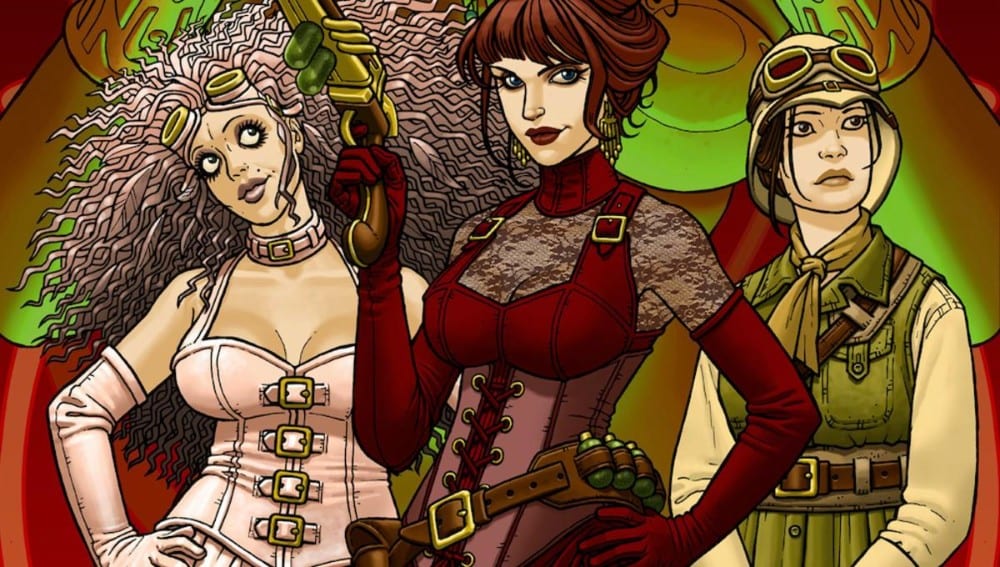
Adler #1 Character design
Adler #1 Credit: Titan Comics

In the spirit of The League of Extraordinary Gentlemen, Titan Comics new title Adler fuses a host of fictional and historical characters in an exciting adventure story. Set at the turn of the last century with an almost all female cast, creators Lavie Tidhar and Paul McCaffrey invite readers into a spectacular but dangerous world with a touch of the steampunk aesthetic. 

Following the adventures of Irene Adler, as told by her new companion Jane (surname rhymes with ‘air’), the set up is pure Sherlock Holmes. But does the comic manager to escape these well known roots? Is there more on offer then a simple female Holmes and Watson story?

Adler #1 Cover
Adler #1 Credit: Titan Comics

Telling the Tale

Lavie Tidhar is an awarding winning novelist, in fact he has been nominated or been the winner of an award every year in the last decade. He is also no stranger to mixing historical and fictional characters.  

The story starts by introducing the reader to Jane and her time in the Boer War. This comic’s tone is set in that opening sequence. It has a sense of adventure, a pioneering spirit, but is also brutal when dealing with violence. It is also just as brutal to the characters, dispensing with extra’s with little fanfare but extreme violence. 

Long before the titular character is introduced, Tidhar sets up the world where his characters live. This allows the reader to become immersed in the atmosphere before the plot begins. Each cast member is brought into Jane’s life naturally so that the reader meets them in the same circumstances as the character. Tidhar leads you through his version of London, pointing out people and places of interest as he goes.

This does mean that there are a few exchanges early on that have awkward dialogue. The conversation doesn’t flow as naturally as you would expect and reads like over rehearsed lines in a mediocre television drama. While these moments might give you a little insight into one of the characters it does little for the supporting cast.  The stereotypes of steampunk fiction are harshly contrasted with the tropes of romantic prose.

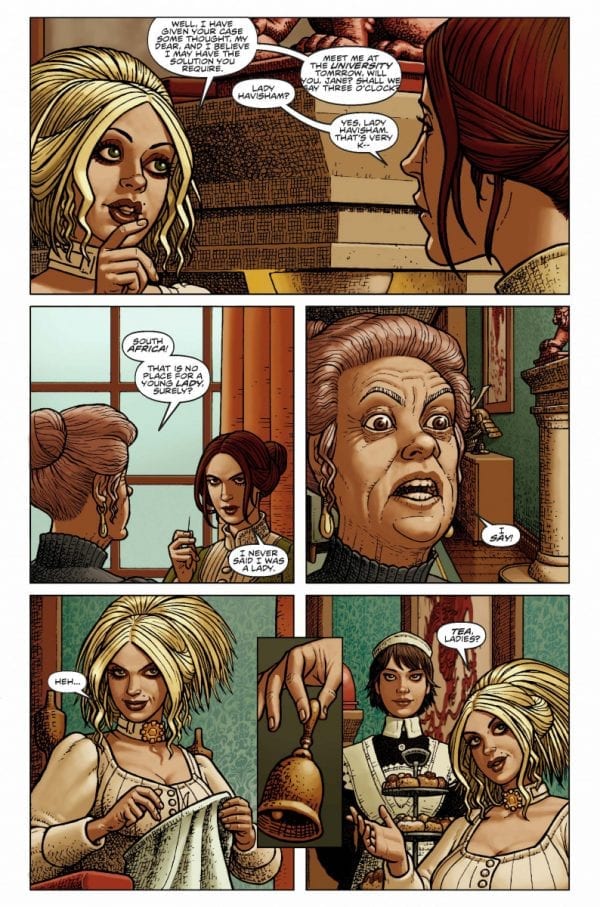
However, this is a minor criticism of Adler as the majority of the dialogue sparks with life and brings the characters to life in a fun, exciting way. The personalities are drawn from the speech giving the leading ladies distinct individuality, which is refreshing. Tidhar has crafted a group of fully rounded characters, each with their own strengths and flaws. 

This is especially exciting with an all female hero group. It is true that each character has a specific defining aspect but even within this first issue of Adler there are depths waiting to be explored. Tidhar has pushed his narrative beyond two dimensional characters representing a type and instead given the reader a team of characters for us to get to know.

Adler #1
Adler #1 Credit: Titan Comics

Art and Design

Paul McCaffrey has a singular style that suits this type of modern adventure. His layouts and panel transitions underline the fast pace within the narrative and owe as much to television dramas like Sherlock than to traditional comics. There is also a startling sense of energy to the artwork. The characters leap from the page, and even drinks around a table doesn’t feel static in any way. 

The design, especially with the leading women’s costumes, takes inspiration from the historical dress but then pushes it into fantastical realms. Elements of Steampunk filter through but there are also hints of other influences. It is sleek, and sexy, but most importantly everything fits with the characteristics of those wearing the clothes. For example, the eccentric Miss Havisham has attire that reflects her outgoing personality. She is like a Victorian version of Emma Frost.

McCaffrey’s coloring is also very detailed and bold. This fills the pages with a vast amount of information to take in, sometimes making pages seem busy. There is a lot going on and this can become distracting, especially if you want to take in as much as possible on the first read through. Once you have become accustomed to McCaffrey’s work, it becomes easier to read and by laying down his own colors, he is able to make the page entirely his. 

Another slight drawback of McCaffrey’s highly detailed style is that it does, on occasion, leave Simon Bowland with very little room to play with on the lettering side. When he has short speeches or interplay’s of dialogue, Bowland is able to produce a brilliant sense of back and forth between characters. He picks up on the fact pace of the narrative and reflects this in his balloon placement. There are, unfortunately, panels where large pieces of text sit heavily in single balloons because there is simply no-where else to put them. 

Bowland has a difficult job of deciding between bunching the speech into a single area or covering up McCaffrey’s great art work. It is a lose/lose situation for him but he makes up for it throughout the rest of the comic.

Adler #1
Adler #1 Credit: Titan Comics

Conclusion

If you are looking for adventure and a large dollop of sass, then Adler will be right up your street. Drawing on the tradition of League of Extraordinary Gentlemen, Tidhar brings together an exciting mix of fictional characters, with a few hints at others let to come. He also creates a wonderful comradery between the women, filling the script with as much humour as there is action.

The links with Sherlock Holmes are somewhat integral to the plot but don’t actually require any real background knowledge. The story is self contained and easily accessible. The artwork is enchanting with beautiful design work. There is a definite style which could, potentially, put some readers off but is more likely to attract readers. Like Titan Comics previous comic, Anno Dracula, Adler is a fun and playful historical-ish adventure story. 

Monkeys Fighting Robots Youtube

Review: Southern Running & Gunning in KILL WHITEY DONOVAN #3

Sydney Duncan and Natalie Barahona’s Civil-War era revenge story “Kill Whitey Donovan” reaches its third chapter with more intriguing backstory and narrow escapes. Despite the stellar dialogue and page-turning pacing, it’s tough not to see this issue as merely ‘issue #2.5″ rather than issue #3. Regardless, its mysterious plot and brilliant visuals maintain this as a highly entertaining comic.

As the third chapter of this thrilling journey unfolds, more history between Hattie and Anna is revealed–but the answers provide little comfort. Meanwhile, in the present, Tyson draws ever closer, while the distance to Donovan feels farther away than ever.

Writing & Plot

Sydney’s Duncan‘s script on “Kill Whitey Donovan” #3 once again walks the line between carefully constructed character drama and fast-paced action. She continually generates intrigue with the pieces of the backstory behind Anna and Hattie’s relationship in every issue. This issue focuses more on Anna and the fall of her “Southern-Belle” lifestyle at the hands of Donovan. The flashbacks are expertly presented and are full of mystery, making them stellar companion pieces to the frenetic action going on in the present plot. Duncan knows how to build menace from antagonistic characters, making the tension from page to page palpable. She also remains aware of how to let the art do the storytelling, as there are plenty of panels with no dialogue whatsoever.

If there’s a minor nitpick to be had with this issue, it’s that this doesn’t feel like a fully fleshed-out single issue, but rather an extension of the prior chapter. This sounds a bit absurd given that it is a continuous story, but the chain of events and ending just seem incomplete. The events here could have been rearranged (say the early stages had in issue #2 and the last page be an opener for #4) to make for a more even story. Regardless this is still a highly entertaining issue, even if it doesn’t feel as complete as its predecessors.

Art Direction

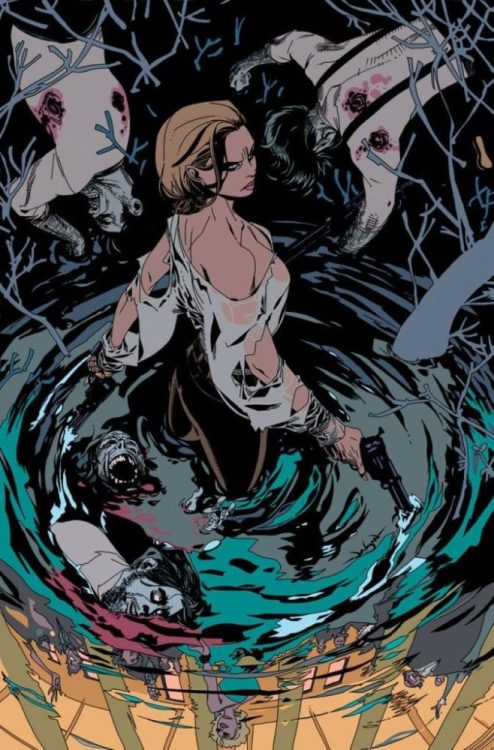
Natalie Barahona‘s gloomy yet elegant and detailed art reigns supreme yet again in “Kill Whitey Donovan” #3. While most of her art has been set in the dark woods and stormy humid Southern nights, she gets to flex her talents here in a ballroom scene. Once again her character details are spectacularly good, with a massive range of styles and expressions for characters both main and extra. The aesthetic remains menacing and dark, but there’s still the unique polish to the art as it glows under firelight or moonlight. The script allows Barahona to demonstrate her skill in crafting action sequences as well, allowing the art to tell just as much of the story as the dialogue does.

“Kill Whitey Donovan” #3 is a brisk and intense middle chapter in Sydney Duncan and Natalie Barahona’s mini-series. While it may come across as a bit too brisk, it still manages to engage the reader with a compelling backstory and fantastic artwork. “Kill Whitey Donovan” still proves to be a damn good read from month to month.

Monkeys Fighting Robots Youtube

WHY YOU NEED A GOOD DRAINAGE SYSTEM IN YOUR HOME

Monkeys Fighting Robots

Homes are ideal places to build your dreams, raise a family, retire to after a long tasking day at work, and fulfill other demands. Having a home means that you need to provide all that is needed to make such a place comfortable and safe; this includes having a good drainage system. With a proper drainage system in your home, you can be assured of prevented domestic accidents and health hazards. Also, waste materials can be easily disposed of through a drainage pipeline to the sewer. Having a good drainage system also helps curb unwanted floods. Excessive water can be transferred from the house and roads to the river. Your owns can be prevented from collapse by having a proper drainage system that steers clear flood from the ground level or foundation level.

How Does The Drainage System Function?

You may wonder how the drainage system functions, therefore, we will discuss this in detail. When it rains, the rainwater is collected through the house gutters to the drains in the residential area via the downpipes. The water in the residential drains is then transported to a nearby river. However, it is important to note that the residential drains can be linked to other drains, thereby forming a network through which water can be easily moved.

Why Do You Need To Have A Good Drainage System?

There are several benefits that come with having a good drainage system in your home.

To Avoid Water Accumulation:

Having a well laid-out drainage system helps prevent floodwater from accumulating within your residential home. This implies that you do not need to worry about flooding. Your house will be free from wastewater that gets stored up within your building as they are channeled through the residential drains.

It Prevents Soil Erosion:

When a house is equipped with a proper drainage system, soil erosion will be curbed in the process because there will not be leftovers of water on the soil, which in turn won’t get muddy. Drainage system helps avoid soil degradation which most times lead to soil erosion. That way it saves you from the stress of maintaining the soil constantly.

Furthermore, you will not need to be bothered about coming in contact with bacteria bred as a result of muddy soil. You can do a routine checkup on the state of your drainage system by employing the services of a professional plumber. Inspections should be carried out for any sign of blockages which can lead to water storage.

The Adverse Result Of Not Having A Drainage System In One’s Environment

  • The lack of drainage system can lead to the flooding of one’s environment during a heavy downpour, resulting in several roadblocks.
  • It can lead to water pollution and water scarcity in a worst-case scenario.
  • Having a good drainage system not only helps dispose of water but also stores it. Without a drainage system, water can’t be stored.
  • The absence of a drainage system can make it difficult to fill the water gap in groundwater resources.

Having gone through this mind-opening article on the need to have a proper drainage system in your environment, it is time for you to make your home and environment a better place. You can utilize your drainage system for storing excess water and even channel it towards your agricultural projects. If you wish to know more about how to go about this, please check out this link: click here

Monkeys Fighting Robots Youtube

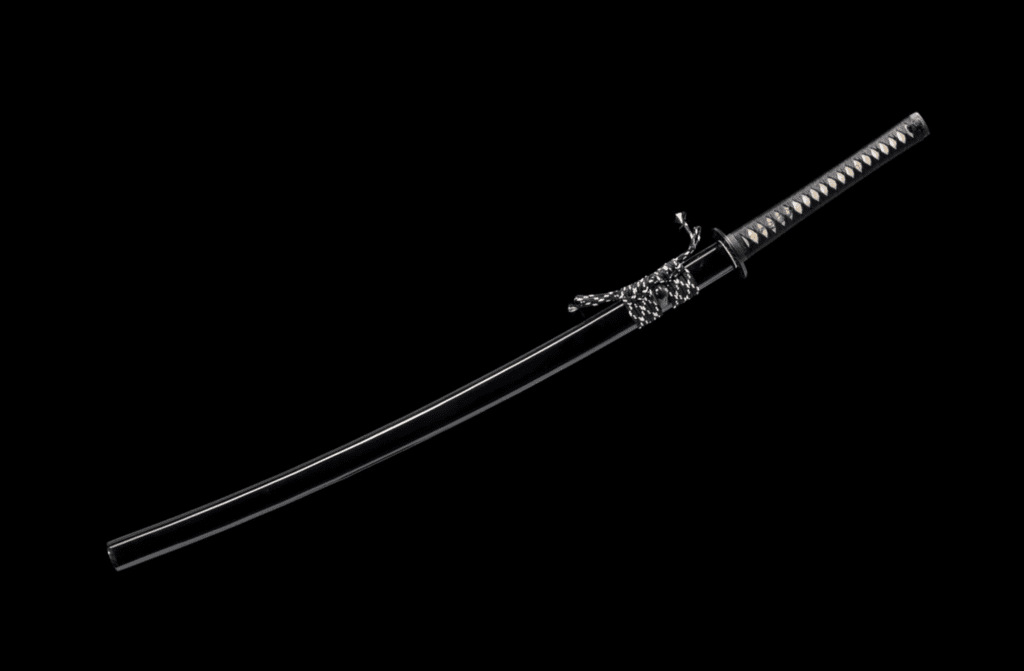
THE FIVE TYPES OF SAMURAI SWORDS

THE FIVE TYPES OF SAMURAI SWORDS

An ancient elite class of men, the chosen few, only the best of the best had the honor to be called a Samurai in medieval Japan. They made up the ruling class of the military and later rose to be the highest class in the Japanese hierarchy. These Samurai warriors were equipped with a range of weapons such as spears and guns, bows and arrows, but their main weapon and symbol was the sword. There are five main streams of the samurai sword, namely Katana, Wakizashi, Tanto, Nodachi and Tachi swords. 

  • Katana

The most iconic and well known of all the Samurai swords; the katana is distinguished by its long blade and handle that is made to accommodate two hands and strike from a large distance. It has a curved, slender, single-edged blade with a circular or squared guard. The katana has a set of dimensions that separate it from other samurai swords. A traditional katana will measure 3 to 4 feet in total length, with the hilt taking up one-fourth of the total and a characteristic curvature of more or less than 1 inch. 

  • Wakizashi

The Wakizashi is similar to the katana but shorter in length. The average Wakizashi is about 50 cm long and was usually worn together with the katana by the Samurai of feudal Japan. When worn together the pair of swords was called daishō, which translates to “large and small”.  This sword acted like a side weapon and was worn by the Samurai at all times. 

  • Tanto

The Tanto, although not technically qualifying in the category of swords, is the traditional Japanese dagger. It can have a single or double edge. It acts like a Wakizashi and is worn at all times. The main purpose of a Tanto is to be used as a stabbing instrument but having a pretty sharp edge, it can be used to slice and cut. The Tanto has become more ornate over the years and towards the end of the Samurai era, they were mostly used as decorative pieces, and still are mostly used in decorations to this date.  

  • Nodachi

Nodachi approximately translates to “field sword” or “great sword”. They are larger and longer than a typical katana. They were typically used as weapons for foot soldiers and were effective against cavalry and open field encounters. They are not very effective in close range or constricted space.

  • Tachi

The sword is the predecessor to the Katana; the Tachi is a Japanese sword that is more curved and longer than a katana. Having an average length of 75 cm. It was primarily made for Samurais on horseback where they needed more length and curvature to effectively charge on foot soldiers. 

While all of these are types of the bladed weapons used by the noble Japanese warriors, each and every one has its unique characteristics and uses. It would be unfair to ignore all the different types of swords, just to popularize one over the others. A wider approach is needed to recognize the skill and genius of the Japanese Samurai and craftsman.

Monkeys Fighting Robots Youtube

Kickstarter Review: JUPITER JET AND THE FORGOTTEN RADIO

jupiter jet 2 review

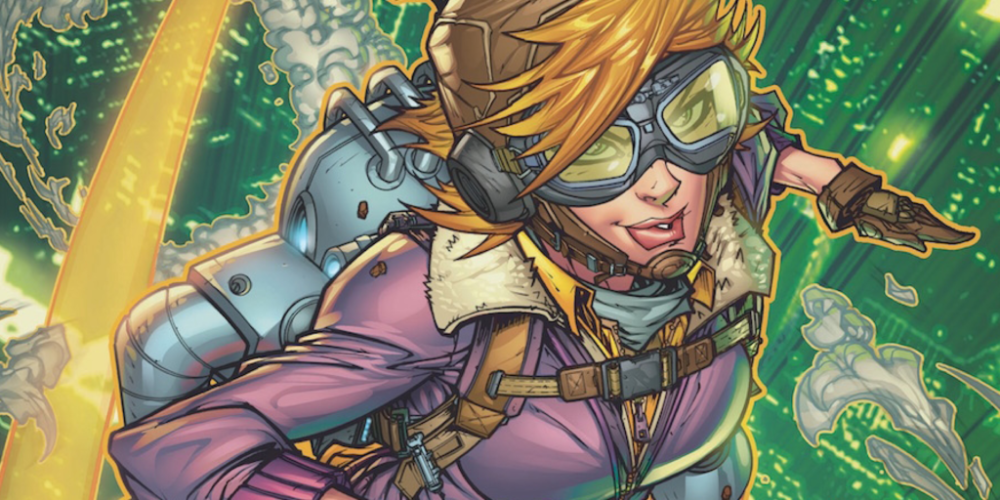
Written by internet personalities Jason Inman and Ashley Victoria Robinson, with artwork by Ben Matsuya, colors by Mara Jayne Carpenter (volume one), and letters by Taylor Esposito, Jupiter Jet is the story of Jacqueline “Jacky” Johnson, a sixteen-year-old girl who rides the sky on an experimental jet pack that she discovered in her dead father’s workshop and does what any other teenage girl would do – steal from the rich and give to the poor while keeping her neighborhood safe! 

Now, the creative team (with new colorist Elizabeth Kramer!) is back with a second Jupiter Jet adventure, taking the character and story to new heights in a mold that hearkens back to the golden age of comic books. 

Story 

Jupiter Jet and The Forgotten Radio tells the story of a girl confronting what it is to be a young woman while saving her planet from a dangerous interplanetary threat. 

Jupiter Jet is clearly written by people with a great love for comic books. The duo of Jason Inman and Ashley Victoria Robinson manage to craft a wholly enjoyable superhero adventure, while tugging on just the right amount of nostalgia strings. It’s a truly fun throwback to pulp science fiction heroes like The Rocketeer and Buck Rogers.  

There’s a lot of love put into the character development. The first adventure follows Jacky as a relative newcomer to the whole heroics thing. She’s still learning how to use her jet pack, and is even a little clumsy. The first part of the second volume picks up after the exciting twist of a conclusion where Jupiter Jet Volume One left off. The writing feels much more mature than in the previous story, which seems to be intentional, as the titular hero has grown as well since we last saw her. But that’s not to say this book isn’t filled with fun, adventure, and even more surprises, because it most definitely is. 

Art 

Ben Matsuya has also shown considerable growth in his artwork from Jupiter Jet Volume 1 to Volume 2. The first volume is packed with character expressions akin to a Disney animation. In Jupiter Jet and the Forgotten Radio, the style is more modern and conservative.

Meanwhile, the first volume features vibrant colors by Mara Jayne Carpenter, while the sequel’s colors by Elizabeth Kramer are noticeably muted. This shift in style is an intriguing choice, as if Matsuya and Kramer are taking the readers on a journey through the various eras of the comic book medium.

The lettering by Taylor Esposito is everything you’d expect in a classic sci-fi comic book. Specific words are in bold, or in a larger size, making it all too easy to get a sense of the characters’ inflections in their dialogue.

jupiter jet exclusive page

Conclusion 

Jupiter Jet is an absolute fun ride, with endearing characters, and a story that is filled with humor, heroism, adventure, and exciting twists. 

Catch up with the adventure of Jupiter Jet by purchasing the first volume on Amazon or comiXology. Then, you can get a copy of Jupiter Jet and the Forgotten Radio by supporting the Kickstarter campaign.  

Monkeys Fighting Robots Youtube

Review: I SEE YOU Offers An Unpredictable Treat

Twist and turns are one thing but I See You offers so many that you may lose count while watching. This isn’t a case where the twists are wildly illogical, but plenty of them leave things open for discussion once the credits roll. Even the marketing for the film is a twist because I See You is by no means a horror film, but rather a high tensed thriller revolving around a divided family. So many things in the trailer are misleading and it just makes the film that much more shocking as you watch everything unfold.

Directed by Adam Randall, I See You stars Jon Tenney, Libe Barer, Owen Teague, Judah Lewis, and Helen Hunt. After a series of strange disappearances in a small town, a detective on the case and his family find themselves at the center of it all. That brief summary of my own is all I want to disclose because saying more might give some big elements away. The film was written by Devon Graye and he gets a little carried away with the narrative contortions but I See You is still very impressive.

Helen Hunt as Jackie Harper in I SEE YOU

The performances in this film are great from everyone involved, Tenney and Teague are the two standouts. In order to avoid giving away too much, we will not go into detail on what exactly made them shine from the rest, but these two deliver in several ways. Hunt does her best in her role, but her character becomes irrelevant in the grand scheme of things once the narrative is flipped. The acting alone will keep viewers glued to the screen, and throughout all the many twists and turns the characters keep you interested.

As mentioned above, the writing relies heavily on twist after twist once the intensity picks up towards the end of the film. I See You centers on the Harper’s, a family slowly being torn apart by the recent infidelity of Jackie Harper (Hunt). Greg (Tenney), her husband, is a detective working on the case of missing people and the case makes its way into his home own home. Take from that what you will but this is a film that is more effective the less you know going in. Character development isn’t really here for everyone, but I’d say the characters that matter the most are explored enough throughout. The script is a mix of cliches, twists, and more twists that you can’t see coming. There’s a point in the film where it shifts and rewinds the entire story to fill in a new perspective that gets introduced. That narrative switch can drag a bit, but it makes the final act much more fulfilling.

John Tenney as Greg Harper in I SEE YOU

Randall’s directs the film very well, the interior panning of the house creates a chilling sense that the Harper’s aren’t alone right from the beginning. This is only his second outing after directing iBoy for Netflix. Randall’s camerawork here makes the demise of a privileged family with secrets very satisfying. The cinematography by Philipp Blaubach is an amazing compliment to Randall’s direction and it is very rich. Randall creates a sense of foul play early on and meticulously builds the tension up to an ending that you definitely won’t see coming. Adding to that, I See You has a memorable score that amplifies the film with each new revelation. It complements the film very well and honestly, makes certain scenes more dramatic than they should have been.

While this is a solid thriller overall, I See You loses a little steam when you realize that amongst all these twists are several plot holes that just can’t be ignored. Many will also argue that the film feels like it cheats a bit with the way it plays out. In other words, I See You has a lot working for it because of the way it is edited. A lot of the film is told out of order, so that explains why it is impossible to guess what will happen. Despite that and some near awful dialogue, the performances, story progression, score, direction, and tense atmosphere make I See You worth checking out.


Monkeys Fighting Robots Youtube

Review: Settling an Old Score in DETECTIVE COMICS ANNUAL #3

The death of Alfred Pennyworth is an event likely to haunt the comics landscape for years to come. For instance, Detective Comics Annual #3, out this week from DC Comics, offers another story centered on the loss of Bruce Wayne’s beloved father figure. This time, though, the focus is less on Bruce’s reaction to Alfred’s death. Instead, the issue centers on the events of Alfred’s life prior the Batman’s birth.

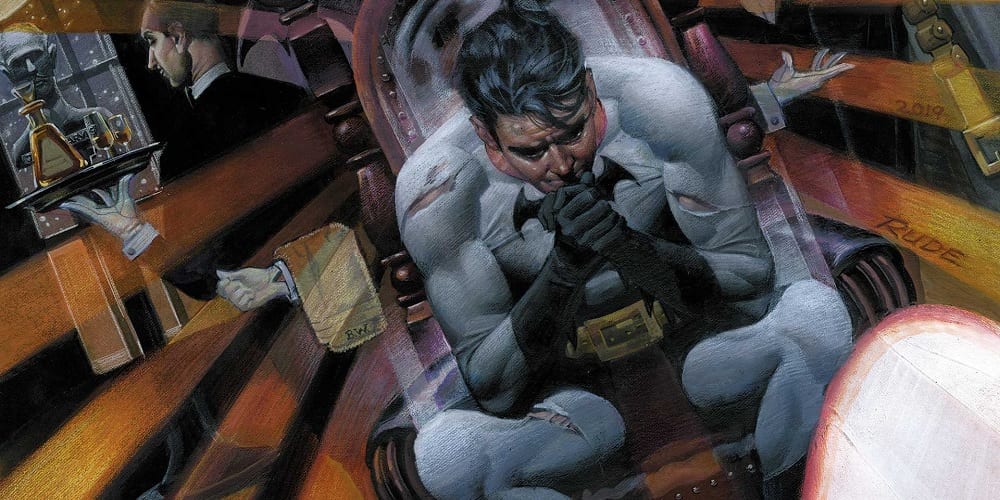
Bruce’s evening takes an unexpected twist when he finds a woman named Marigold Sinclair resting in his chair. Explaining that she was Alfred’s former partner in British Intelligence, Sinclair asks Bruce to help her settle an old score against another former ally who defected to the Soviets.

DC Annual 3 Page 1

The Writing

Detective Comics Annual #3 offers two Batman stories. The book’s first tale, Who Dares, Wins, begins with a flashback delving into Alfred’s past as a spy for MI-6. From there, the book jumps to the present. We see Bruce recruited to complete an old mission—a score Alfred never settled—for which Bruce can finally provide resolution and, in the process, perhaps find closure over his own loss.

Who Dares, Wins isn’t a bad read, but it generally feels like the weaker of the two stories. First, I’m not entirely convinced by Marigold’s motivation; why, after all this time, track down a Soviet double-agent, decades after the Cold War’s end? It’s understood that this was a specifically sensitive case for Alfred. However, writer Peter J. Tomasi doesn’t fully connect the dots as to why tracking down this spy is the best means of honoring the man. As a result, the emotional crux simply doesn’t resonate.

The main story in Detective Comics Annual #3 feels flat overall. Batman’s foe doesn’t really provide much of a challenge, and while Tomasi goes for a bit of poignancy at the end, it doesn’t really land because we aren’t very invested in Sinclair’s mission. There’s not much dynamism to the story that can capture the reader’s interest.

The second story, The Week, is a quieter and more pensive narrative. It’s told through the frame of a letter from Alfred to Marigold sent at the beginning of Bruce’s career as Batman. Although it’s a brief vignette, it ultimately feels like the stronger of the two stories in Detective Comics Annual #3.

We see the emotional toll that Bruce’s decision to become Batman takes on Alfred. The story also underscores just how vital to Batman’s operations Alfred is, and always has been. By the story’s end, the reader feels Alfred’s absence in a way that Who Dares, Wins didn’t fully convey.

DC Annual 3 Page 2

DC Annual 3 Page 3

The Artwork

Sumit Kumar provides artwork for Who Dares, Wins. Kumar’s visuals provide a sense of elegance to the work with well-detailed designs and backgrounds fleshing out the world seen in Detective Comics Annual #3.

Kumar’s illustrations accentuate the dynamics of the story, lending it more weight and tension. There’s a cinematic feel to the compositions, with lots of interesting approaches to framing the action. It’s actiony, yet poised and refined, as a good spy thriller should be.

The colors by Romulo Fajardo Jr. complement Kumar’s work well. The artist embraces a diverse range of colors; the tones themselves are varied, but key themes provide cohesion to the book.

Eduardo Risso supplies both inks and colors for The Week, and goes in a completely different direction. Risso embraces a rougher, more stylized, aesthetic; there are points at which it almost resembles traced or rotoscoped animation. It’s an interesting approach, and one that may not appeal to all readers. I, however, find the style rather intriguing and pleasing to the eye.

Risso bathes his pages of Detective Comics Annual #3 in unnatural, almost psychedelic hues. Each page is dominated by a different color: lime, cool greenish-blue, pinkish-purples, etc. Again, while maybe not for every reader, the style works alongside Risso’s illustrations.

Detective Comics Annual 3 Page 4

Final Thoughts

Detective Comics Annual #3 doesn’t quite stick the landing as a tribute to the late Mr. Pennyworth. It’s not a bad read, though, and could be worth picking up if the premise strikes your fancy.

Monkeys Fighting Robots Youtube

Review: The Motives of a Madman in THE BUTCHER OF PARIS #3

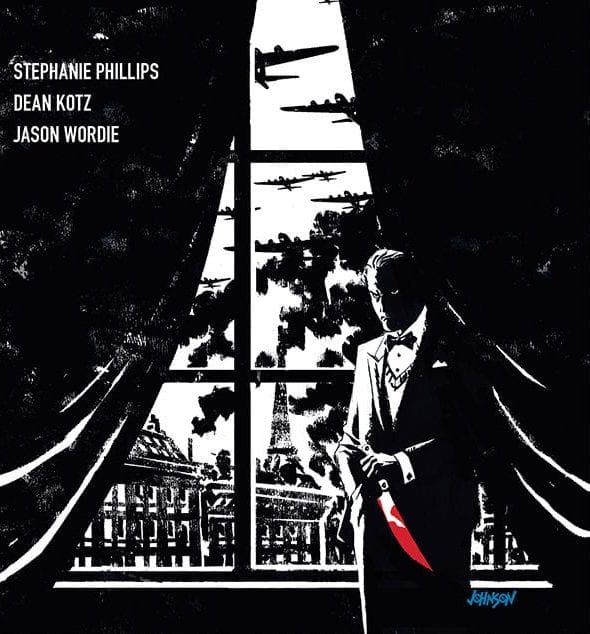
Writer Stephanie Phillips returns with artist Dean Kotz in the third issue of historical-thriller “The Butcher of Paris.” This issue features more of the tight pacing and succinct dialogue in both the investigative and political discussions, while also ending on an intense cliffhanger that makes the wait for issue four murder in its own right.

Pieces of Dr. Marcel Petiot’s past are slowly exposed-revealing harrowing events and actions that peer into the mind of a madman. As the detectives begin an intense interrogation with the killer’s wife, the Nazi occupation progresses-and the fate of Paris is determined.

Writing & Plot

Stephanie Phillips’ scripts on “Butcher of Paris” are a consistent blend of crime procedural, political discussion and thriller. This trend continues here in stellar fashion. There’s a neat transition from an intriguing flashback to an interrogation sequence, and from there to a ballroom discussion of the Nazi’s waning power against the allies. It’s wildly impressive how no plot point ever seems out of place. The story’s direction remains clear and suspenseful, with the threat of Nazi occupation playing partial focus to the serial killer plot. Much of this tight plotting is due to Phillips’ ear for great dialogue. It manages to be both intelligent and naturalistic, even when wide swaths of words are being thrown around. This is a necessity in a story like this dealing with a cast of detectives and military officers, and also because there is no overhead narration. Every bit of storytelling is done through the art and the discussions between characters. What’s more, this issue ends with a brilliant (if not completely original) final scene that will drive tons of momentum into the next issue.

Art Direction

Speaking of art, Dean Kotz returns to lend his signature vision to “The Butcher of Paris,” and its a signature that just seems perfect for this kind of story. Again, there’s a sort of European graphic novel approach to his pencils that grounds it in reality while also elevating it artistically. Human characters are distinctly designed for familiarity. Facial expressions are carefully drawn, especially in the more subtle moments where every detail counts. The environment of 1940’s Paris is a mixture of realistically beautiful and appropriately haunting in the darker moments. The colors by Jason Wordie add unique hues to the atmosphere of the so-called “City of Lights.” There’s a sort of oxidization and rust aesthetic brought to the panels that somehow works with the tone of the story. Once again, this is a fantastic looking book with a completely appropriate style.

“The Butcher of Paris” #3 is yet another intelligent and entertaining chapter in this comic mini-series. Stephanie Phillips’ script is yet again full of intrigue both political and procedural. Dean Kotz and Jason Wordie’s artistic vision brings the city of Paris to a menacing life in this historical thriller. This is without a doubt one of the most engaging comic series currently running, and a must-read for any fans of this blend of genres.

Monkeys Fighting Robots Youtube