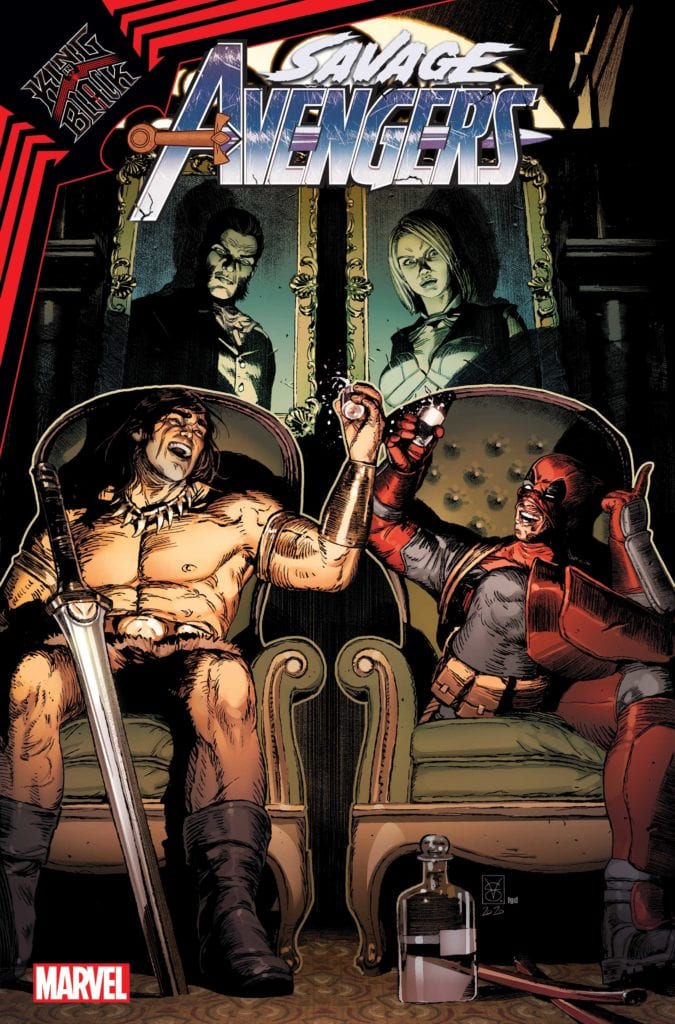
Marvel Comics sent over the cover to SAVAGE AVENGERS #18 today, and it started the conversation of which Marvel character would you like to have a drink with? After checking out VALERIO GIANGIORDANO’s cover below, comment with your thoughts on your drinking buddy.
SAVAGE AVENGERS #18, a King in Black tie-in issue, hits your local comic book shop in February 2021. The book is written by GERRY DUGGAN, with art by KEV WALKER. About the issue:THROUGH HELLFIRE AND…DEADPOOL? Conan, Deadpool, and the Night Flyer escape Riker’s in the endless night during the reign of the King in Black. What crazy heist will ruin Deadpool’s 30th anniversary? Here’s a hint: It involves the Hellfire Club!
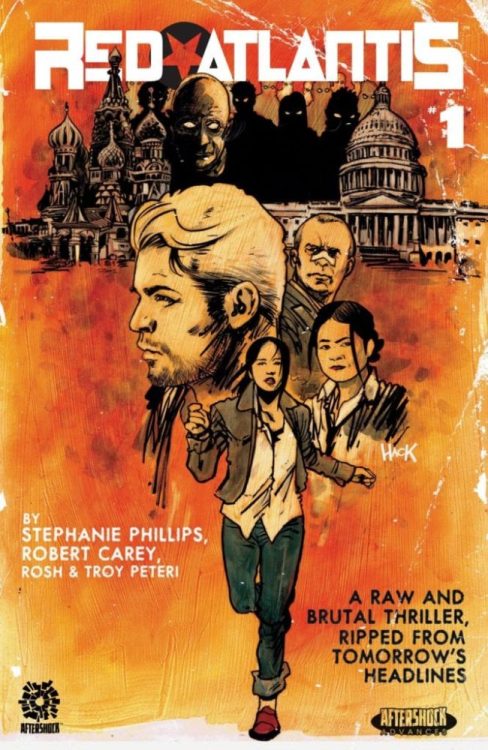
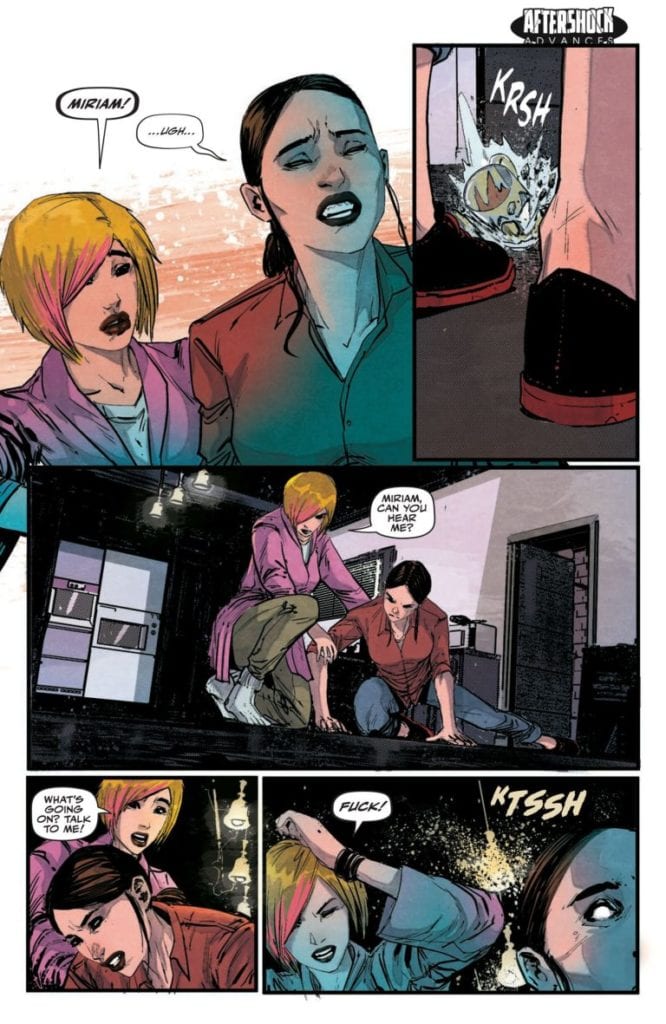
Writer Stephaine Phillips (The Butcher of Paris) and artist Robert Carey (Power Rangers), in collaboration with story creator Janosh Neumann, bring readers the first issue of political-espionage thriller “Red Atlantis.” With colors from Rosh and letters by Troy Peteri, this opening chapter offers an engaging and unexpected opening sequence with solid art, but never does enough to separate itself from its genre contemporaries.
“A series of unexplained, violent crimes on Election Day around the U.S. leads the FBI to zero in on a covert group of Russian terrorists. When a Texas journalism student named Miriam accidentally finds herself mixed up in the investigation, her life will never be the same. With political espionage, treason and even mind control, can she clear her name and stop the U.S. from entering into a new Cold War?”
Writing & Plot
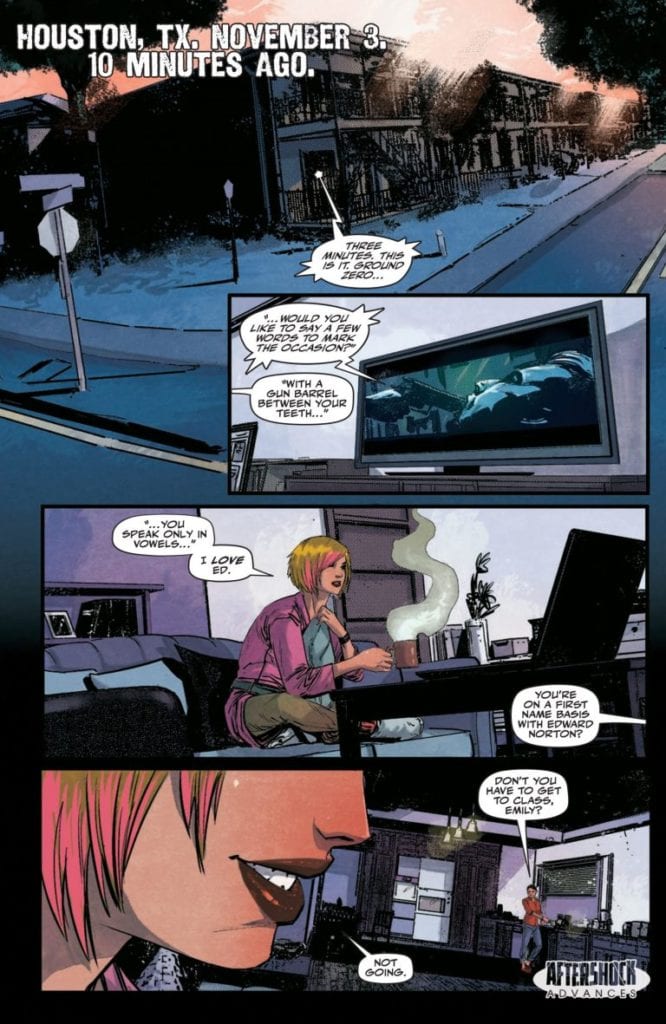
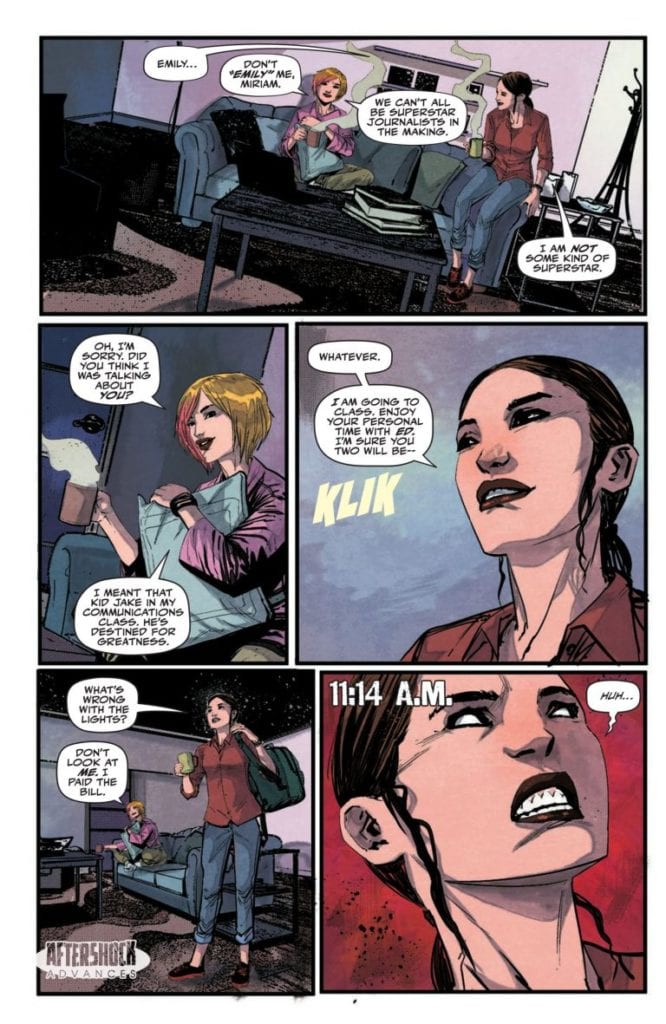
Writer Stephanie Phillips takes the story and concept created by Janosh Neumann and puts together a script for “Red Atlantis” #1 that is sharp, entertaining, and expertly paced. The jarring and prutal opening events immediately pique the reader’s interest with the desire to know what the hell just happened. This opening comic feels like it carries a ton of momentum through each page, and part of this has to do with how natural all the character introductions and their dialogue feels. From the detectives to the local cops and to the average people caught in the middle of this story’s strange tragedy, this really does feel like a procedural/ political thriller. This is where I noticed this comic’s problem, however. I realized after reading this issue, and then re-reading it, that I didn’t really care much about the characters or the larger plot. This comic feels good to read because it’s competently written, but every element in it feels like something that has been done dozens of times over by now. It’s not that the script necessarily has tons of forward momentum, rather that the plot is like a ball on a downward hill. The script is so competently put together that it is almost naturally entertaining in a sort of predictably bland way. It reminds me of a network precedural drama – completely entertaining, but utterly forgettable. This may be just a first issue problem where the characters and plot will become more realized as the story continues, but as it is this is again a well-written but derivative attempt at a modern political thriller.
Art Direction
The visuals in “Red Atlantis” #1 are realized by artist Robert Carey, who uses a careful eye for character detail and excellent directing to create a solid comic in terms of artwork. Every one of Carey’s characters have their own distinct body language and facial animations, with an outstanding amount of detail. There are flaws and imperfections in every person’s face that make them seem fully realized as human beings. Carey’s random detail-work is also extremely impressive. There’s a panel where Carey draws a person holding a handkerchief, and you can actually see the person’s finger outlined under the cloth. That’s a tiny minor detail that isn’t very common in comics. The visual direction is a large reason why the comic’s pacing feels so solid, as Carey keeps the panel flow and character focus feeling very natural. It’s nothing that hasn’t been done in thousands of other comics, but it’s still very competent. The colors from Rosh are really outstanding here, offering nuanced color gradients and smoky effects on every panel. Rosh’s work gives every page a kind of dimension that works hand in hand with Carey’s detailed pencils to craft a very high-quality visual experience. The lettering from Troy Peteri (who also lettered Phillips’s The Butcher of Paris) is smooth and modern, using an innocuous and clean font that effectively conveys the dialogue and narrative while sort of just staying out of the way. Overall the visuals of this comic make the experience worth picking up a copy on their own.
“Red Atlantis” #1 is an entertaining and very competently made comic that fails to make itself stand out in the genre of political conspiracy thrillers. The script is full of solid dialogue and intrigue premises, but it suffers in terms of making the audience care about anything going on. The visual work is honestly stellar however, and makes this opening chapter worth the price of admission on its own. If this sort of procedural conspiracy thriller is your idea of a good time, then grab a copy from your local comic shop today!
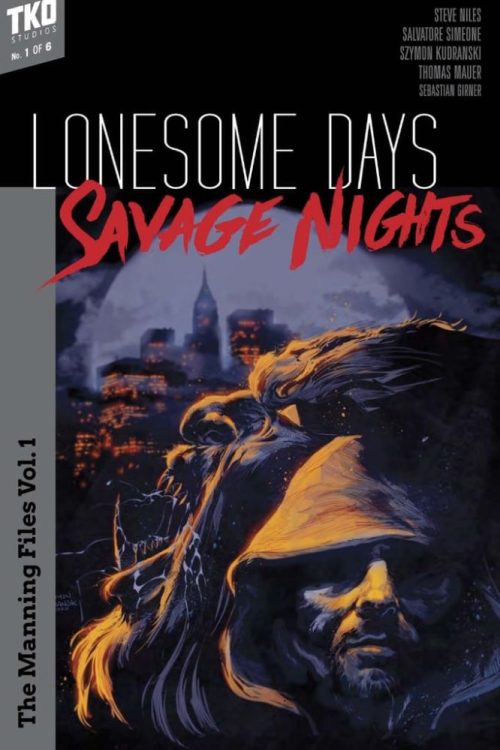
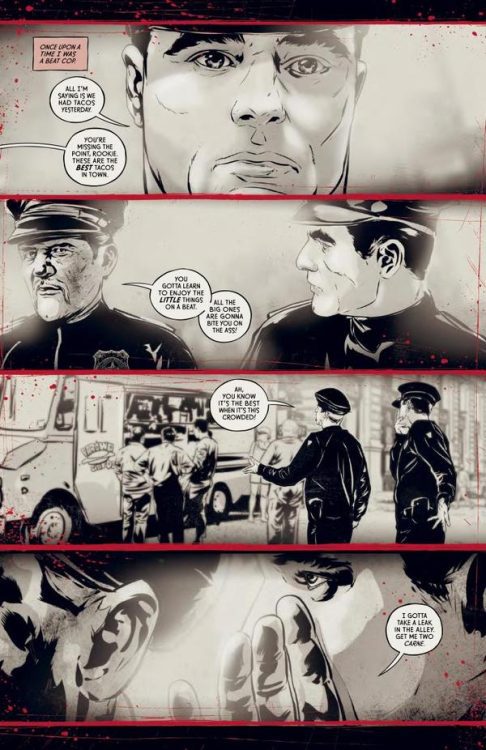
Merging genres is commonplace in Comics, and some groupings are better suited than others. This is abundantly clear in TKO Studios’Lonesome Days Savage Nights written by master of horror Steve Niles and, co-founder of TKO Studios, Salvatore Simeone. The new hard-boiled horror comic crawls through the filthy streets, meting out its own form of justice in a thinly veiled metaphor for Intermittent Explosive Disorder.
Part An American Werewolf in London, part The Crow,Lonesome Days Savage Nights is a dark exploration of a man’s soul as he tries to come to terms with the pain in his life. This is achieved through the use of a classic monster of rage, the werewolf, and the setting of the story. Niles and Simeone take aspects of Noir fiction, elements of horror, and mix them with a healthy portion of comic tropes.
“This damned burg’s getting me. If I don’t get away soon I’ll be going blood-simple” Dashiell Hammett – Red Harvest
Lonesome Days Savage Nights Credit: TKO Studios
Dual Character
The premise for Lonesome Days Savage Nights is a simple one, in the same way any private eye, pulp fiction narrative is simple. There is always a straightforward crime to be solved that leads the protagonist down a labyrinth of unfortunate events and to a party of unscrupulous people. The twist with Niles/Simeone’s concept is that their central character also happens to be a werewolf. Stu is an ex-police officer who has set himself up as a private detective in a style familiar to readers of Marvel’s Alias. The jobs aren’t pretty or pleasant but they pay the bills and distract Stu from himself.
The werewolf angle is introduced in a way reminiscent of the Angel television series, as if the beast is an advantage to the investigative nature of Stu’s life but quickly it becomes apparent that it is a constant battle. The bouts of anger and constant suppressive drinking marks Stu out to be a man desperate for help. In the story his anchor is Audrey. She has a calming effect on Stu, allowing him to control the beast inside and focus the rage into his work only when he needs to. But this is a tragedy; a story packed with unfortunate events and it is clear almost from the beginning that in the war to control his inner self, Stu isn’t going to be the victor.
Stu’s tale of horror, from his attack by a werewolf as a police officer to the tragic events in the opening chapter of the comic, is a litany of classic horror motifs submerged in a noir style. The writers give Stu a pessimistic voice so that the reader is constantly aware of the characters woes and depression. Stu’s inability to accept himself and his situation is paramount to the story. He drinks to escape but is also aware that it weakens his control over the animal inside. He is in constant battle with himself and Niles/Simeone layer the narrative with this conflict.
Lonesome Days Savage Nights Credit: TKO Studios
The Darkness in the Gutter
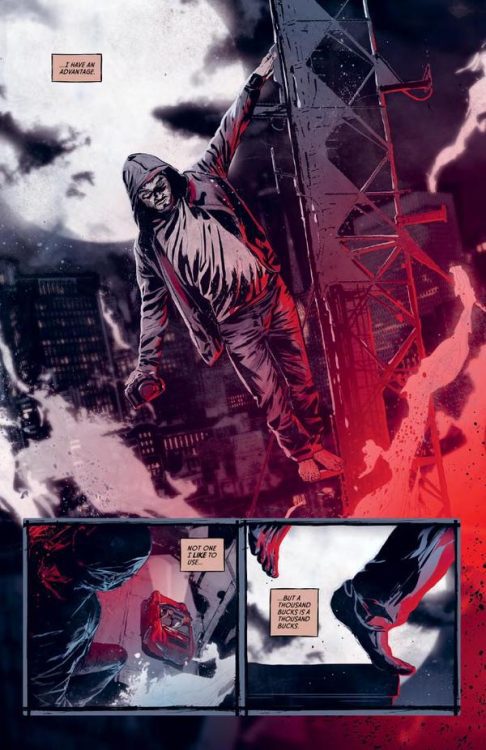
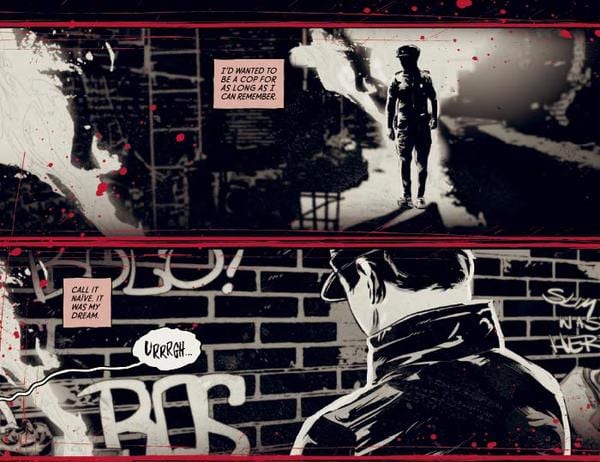
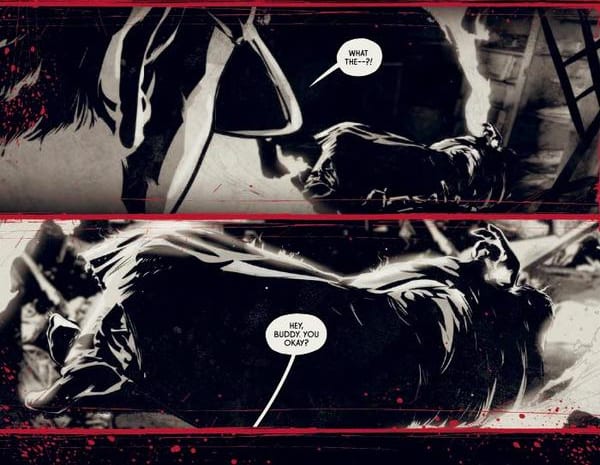
The fight doesn’t remain in the narrative, but instead drains out into the artwork. Szymon Kudranski’s style is very visceral with emotional character renderings and heightened expressions. The line work is extremely detailed but also cast in oceans of shadow, forcing the reader to peer closer and closer to the page to glean as much information as possible. This, by its very nature, brings the reader into the comic, both physically and emotionally. Kudranski traps you with his artwork and brings you down to the same level as the protagonists.
It becomes impossible to escape from the sounds and smells of the streets and filthy apartment blocks. The colors in the printed version are murkier than the smoother, cleaner version you can sample online. This adds an extra level of texture to the images and the readers experience. You can’t help but get your hands dirty by holding the book, with your fingers unavoidably slipping into the images as they bleed to the edge of the page. Even the lettering by Thomas Mauer has a grittiness to it with Stu’s internal monologue encased in liver pink colored caption boxes, and the whites of the speech balloons somehow lose their intensity, as if they are being invaded by the shadows in the panels.
There are two outstanding visual elements to Lonesome Days Savage Nights. The first is the sound effects which are torn from the page. Their integration into the artwork is seamless and yet they tear themselves away from the action to resonate with the reader. You may not hear these guttural snarls and blood curdling screams but you definitely feel them.
The second aspect is the form of the panels themselves and the treatment of the borders/gutters. Throughout Kudranski rips into and splatters the gutter, breaking the frames of the panels and bleeding the images into each other. This constantly shifting border style is representative of Stu’s inconsistent state of both body and mind. The violence of his change from man to wolf and the frustration he feels at his life is reflected through the comics form, often more successfully than some of the textual narrative.
Lonesome Days Savage Nights Credit: TKO Studios
Conclusion
Lonesome Days Savage Nights is, on the surface, a classic monster movie and can be enjoyed simply for it’s violent revenge story. However, dig a little deeper and you get a story of mental instability. The central character is dealing with a violent rage he can barely control. There are moments of stability and moments of fracture and anger where he strikes out. The physical trauma Stu experienced as a police officer has left him psychologically scarred and his coping mechanisms, or lack thereof, are the main thrust of this narrative.
There are problems with this book, mainly to do with overused tropes. The first chapters plot is formulaic and doesn’t offer many surprises after the beautiful transition spread on the second and third pages. The influences from other media are sometimes too obvious, causing friction to the reading experience. For example, one of the characters is a merging of Jack Goodman from An American Werewolf in London and the guiding Crow from J O’Barr’s The Crow. The merging is obvious and acknowledging this for a moment pulls you away from the story.
Lonesome Days Savage Nights Credit: TKO Studios
Once you have escaped from the cliches of the plot early in the comic, Lonesome Days Savage Nights is an engrossing tale of internal violence and repressive anger. The over familiar elements slink into the background as the fast paced narrative drags you through grimy streets and broken lives. Kudranski’s artwork, complemented by Mauer’s lettering, is engaging and emotive throughout. The design of the layouts and the attention given to the comics form is as impressive as the images themselves.
TKO Studios have some exciting creators on their roster, and Lonesome Days Savage Nights is a prime example of the brilliance that they can achieve.
Available in either Graphic Novel format or a collection of six, individual issues, Lonesome Days Savage Nights is waiting to draw you in and rip you apart.
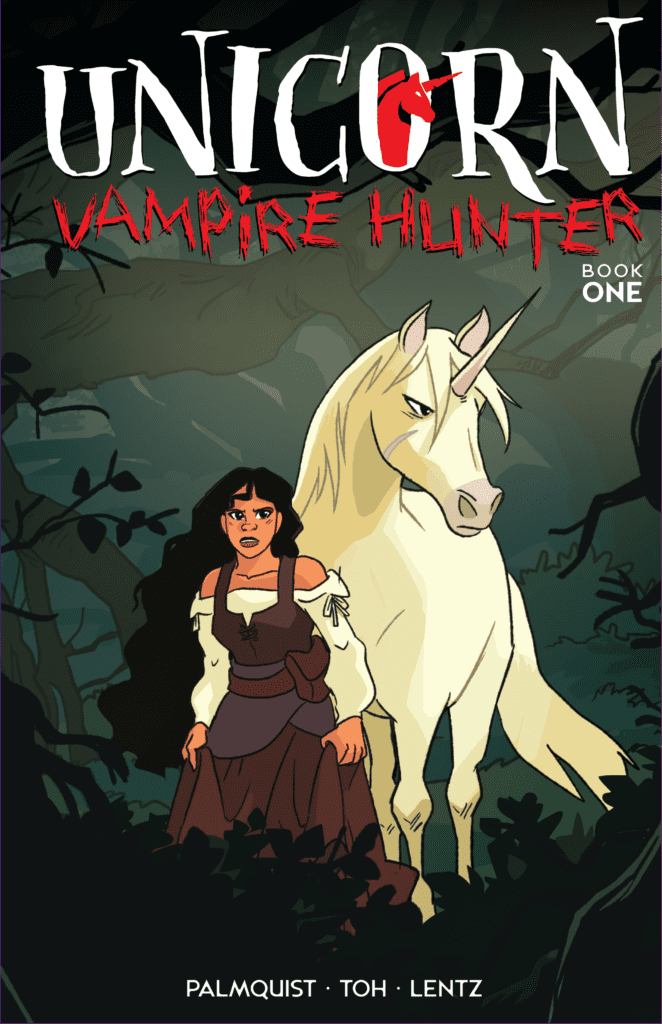
Yes – Unicorn: Vampire Hunter – the title to this fantasy comic book series comes across as a little frothy. It kind of sounds like the creator threw darts at a board of random nouns and this is what stuck. But don’t be deceived, dear reader. If you give this book a chance, you will find a well-crafted concoction of fairy-tale concepts, mixed with heart and magical action.
Written by Caleb Palmquist, with illustration by Daryl Toh and letters by Dave Lentz, Unicorn: Vampire Hunter #1 is wrapping up a successful campaign on Kickstarter, which you can still help support.
Story
There is one thing vampires fear more than anything else…
…and it’s not the sun. Everyone knows that wooden stakes and holy water kill vampires, but not many people know that the best weapon against a vampire is a unicorn’s horn.
Unicorn: Vampire Hunter is a fantasy adventure comic about a curious young woman, a wise old wizard, and a unicorn with a penchant for killing vampires. It is a heartfelt story about friendship, love, and finding purpose in an unpredictable world.
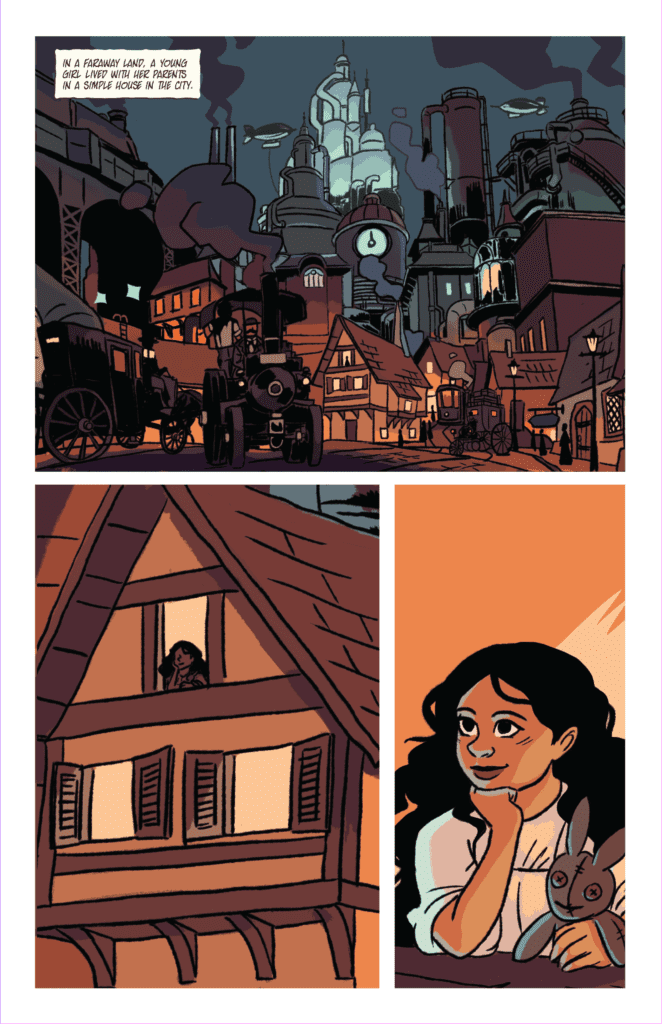
“In a faraway land…” is how writer Caleb Palmquist starts off this tale of a vampire-hunting Unicorn, setting the whimsical storybook tone quite succinctly. Palmquist expertly crafts this unique world — part medieval fairytale, part steampunk fantasy. It’s an easy book to consume, perfect for both kids and kids at heart. Palmquist manages to craft a wholly enjoyable fantasy adventure, while tugging on just the right amount of Disney-esque nostalgia strings.
Art
Artist Daryl Toh brings a robust and whimsical quality to the artwork. It really shows in the character designs. Character expressions akin to a Disney animation pack this first issue. This really helps with the charming nature of the book. Toh has also developed a landscape that is engaging and vibrant. The detail of the world drawn behind the characters is unique and filled with such soul.
Conclusion
Don’t let the silly title mislead you — Unicorn: Vampire Hunter #1 is a stellar introduction to this fantasy comic series, filled with real emotion, an interesting premise, and vibrant visuals.
You can support Palmquist, Toh, and Unicorn: Vampire Hunter by supporting the book on Kickstarter. You can also learn more by following their Facebook page, and visiting their website.
Available now from Dark Horse, Cyberpunk 2077: Trauma Team #3 is the second-to-last issue in the limited series. The creative team of writer Cullen Bunn and illustrator Miguel Valderrama with colorist Jason Wordie and letterer Frank Cvetkovic keep the readers on their toes.
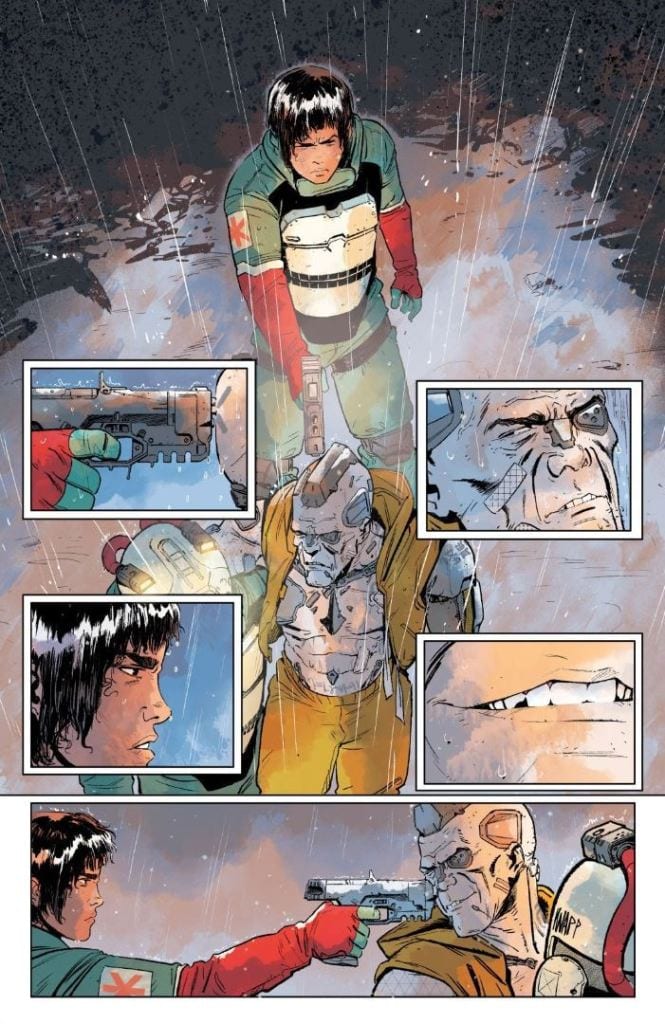
Issue three picks up from the final cliffhanger moment of the previous issue. Nadia’s gun is pressed to the back of the client’s head. But, after a tense struggle, the team leader, Stratter, stops Nadia from killing the man. Valderrama uses inset panels and close-ups on the weapon seemingly to stretch time, to convey the weight of Nadia’s actions. We want Nadia to pull the trigger and blow that smug smile off this murderer’s face. But we can’t have that satisfaction because Nadia can’t stoop to his level. She isn’t a murderer; she’s a medic.
NADIA HESITATES TO TAKE REVENGE.
So far, Bunn has given small hints to Nadia’s past and her character. We know she’s traumatized, and we know she’d do anything to save her team. However, her reason for staying in this job has caused her so much pain wasn’t clear until this issue. In one of the most intimate scenes of the entire series, Bunn wrote an interaction between Nadia and a young girl, showing just how compassionate and dedicated the protagonist is to her job.
No Way Out
As the team made their way out of the building, another team member, Knapp, gets gunned down. To treat him, Nadia, Stratter, and the client enter an apartment. A mother and daughter occupy the apartment, and the mother asks Nadia to help her sick daughter in the middle of working on Knapp. In the time it takes for Nadia to consider helping the girl, Knapp dies. Stratter blames Nadia for this and argues with her over treating the girl. To stop their arguing, the client offers to “do their job for them” and handle the armed mob outside the door.
In the midst of the client’s carnage, Nadia stands her ground with Stratter and treats the girl. She gives the mother antibiotics and sweet reassurance. She touches the girl’s face and smiles. Here, colorist Wordie contrasts the dark red of the client’s rampage with light blue and warm yellow, providing a reprieve from the death and violence. This is when we get the sense that Nadia is more interested in this side of being a medic and that she will do anything to save a life. This isn’t just some job for her.
If we weren’t invested in Nadia’s story before, we are now. Bunn and his team have delivered a slow burn of a series rooted in the psychology of a memorable heroine. But the mission continues. The team still has to get out of the building, and they may not make it out alive. Could the client turn on them? Whatever happens, the stakes are high going into the final issue.
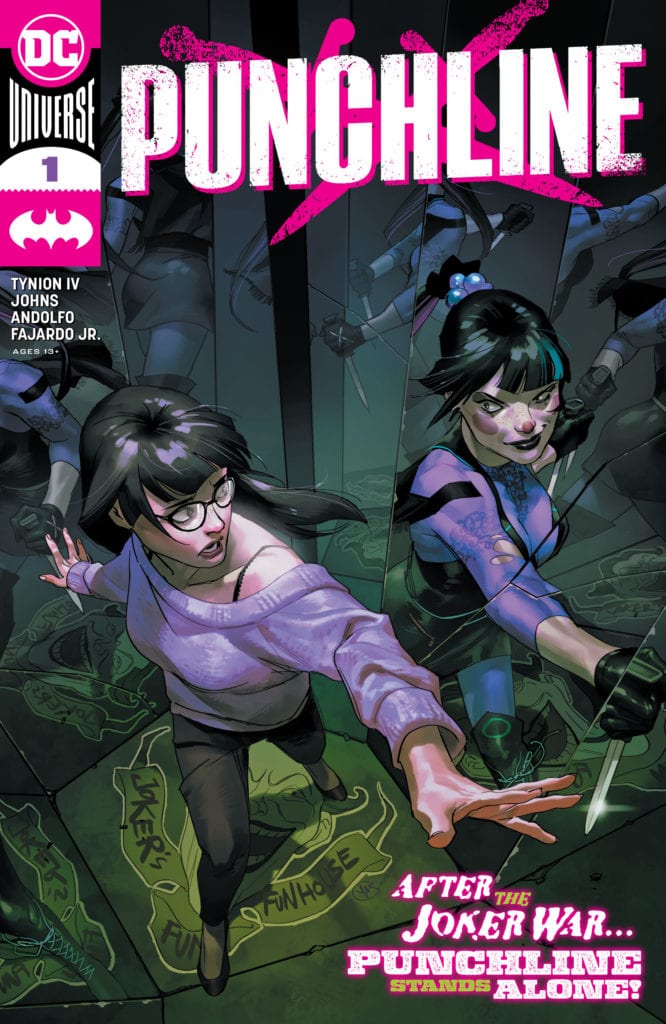
When James Tynion IV started his run of Batman, he introduced the character of Punchline to the world. Joker’s new right-hand woman would play a major role in the Joker War story, from being Joker’s middleman to the villainous bank brokers to concocting a new Joker toxin. In the real world, this character has also gained popularity for her design and attitude. With the war behind us, the clown princess of crime is heading to trial, but under her true identity. She proceeds to make dozens of videos proclaiming her innocence and posts them online. This couldn’t possibly swing the public in her favor, would it?
*Some Spoilers Below*
Story:
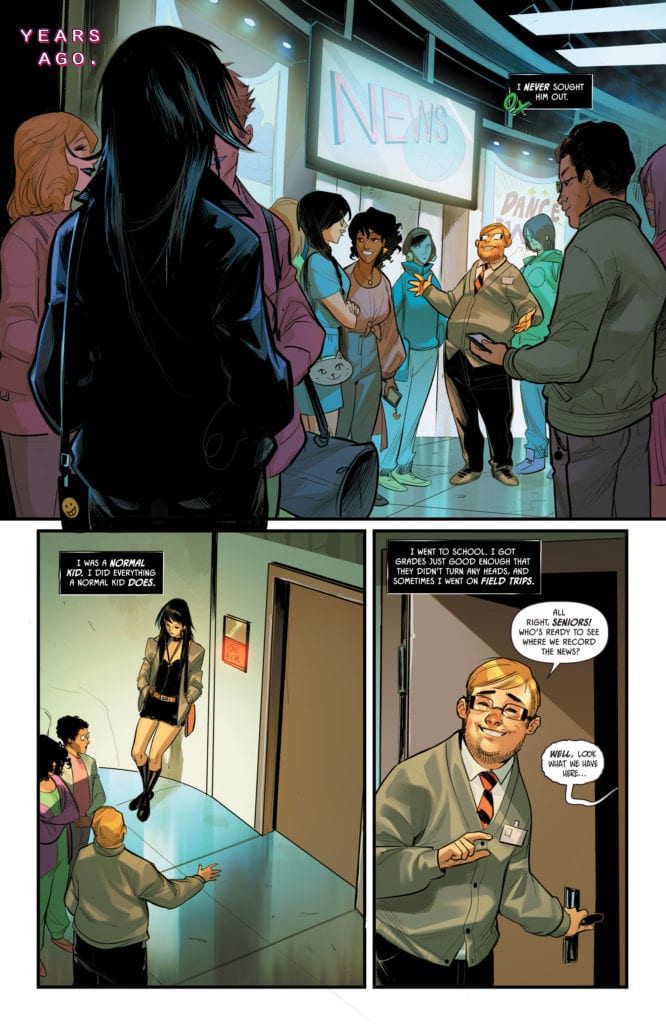
We open with Punchline revealed to be Alexis Kaye, stating to the court that she is innocent. After getting approved by Leslie Thompkins, the trial is pushed forward, with Kaye defending herself. This causes a schism between the youth of Gotham and other Gothamites as she uses social media to promote her innocence. One such example is the Row siblings, Cullen and his sister Harper, also known as Bluebird. While Harper understands and believes Punchline must be charged, Cullen begins to change gears when finding Alexis’ old blog. From there, the tale of how a senior in college met the Clown Prince and began.
Punchline isn’t innocent. We learn that not only did she descend into the madness, but she is pulling strings to manipulate Gotham. The argument between Harper and Cullen should be the heart of this issue. The pair butt heads of whether Punchline is guilty or not. It’s actually a surprisingly topical comic, showing how a person could abuse social media. If it wasn’t for the fact that we see Punchline’s origin, this could have been a great issue to have the fans debate.
Unfortunately, we do see the truth, and it ruins the potential. Punchline’s actual origin is in the same vein as Harley Quinn, being twisted due to trauma caused by Joker. However, the main difference is that she searched for the Joker and demanded to be treated as an equal by stabbing him. The difference between Harley and Punchline had to be clear, or else it could lose readers, but to get that difference out, Johns and Tynion IV lost the opportunity to make a story that people could debate about.
Art:
Mirka Andolfo is the artist behind this issue, and she does a great job. The way she frames Punchline during the flashbacks gives off an unhinged feel. The panels start off being straight, but slowly over time, the angles become more apparent until she kills a rat. By that point, Mirka cements her style and delivers a great look for Punchline and the other characters of Gotham. When the story picks back up, hopefully, Mirka returns to bring it to life.
Conclusion:
Overall, despite a very cool look and topical subject matter, the writers don’t take a chance to invest in the latter. Comics are a great platform to take a stance on societal topics, and while they touch on it here, it could have been done better. This issue was designed to have us understand who Punchline is, and it did succeed in that. This comic does deserve some praise, but it isn’t essential for reading.
X of Swords has relied on several twists and unreliable narrators in its telling.
First, Summoner misled Apocalypse and the X-Men about his intentions and the fate of Arakko. Then Apocalypse’s children, the original horsemen, claimed that their mother Genesis, Apocalypse’s wife, had been killed, which readers then discovered was not true at the end of X of Swords – Stasis #1.
With each new telling of Arakko’s history, parts of the story that have been told have been misleading. With X-Men #14, Genesis provides us with the whole story, about her ongoing battle with the Amenthi forces, about her defeat of Annihilation, and about the Amenthi helm that drives her to conquer Krakoa.
One detail we learn from Genesis’s account is that Amenth has bred mutants with their own demonic forces (a possible allusion to the chimeras that House of/Powers of X pointed to?) from which has emerged a group of Amenthi Summoners who work with their Arakko Summoner fellows to build and man prisons for mutants in Arakko. Even though the Amenthi Summoners are products of demonic breeding, the prose page reveals that the Arakko Summoners may be the more insidious. As the text says, “the latter [reveal] the corruptive nature of that station and their undying allegiance not to the Golden Helm or the mutant state, but to the expansion of their own power and twisted religion.”
One is reminded of the Black Swans who appeared in Hickman’s Avengers run, the followers of a religion of destruction, whose own agenda often made them an untrustworthy ally to hero and villain alike. Religion, myth, and creation/apocalypse are big parts of Hickman’s writing, and the Summoners appear to be a “return to the well” thematically for him. I wouldn’t be surprised if the Summoners play a role throughout the remainder of Hickman’s run on the X-titles.
To that end, X of Swords will more than likely end with the reuniting of Krakoa and Arakko, with the mutants of Arakko, including the Summoners, being integrated into the life of Krakoa, changing it forever. There is some indication of this reunion in the prophecy of Idyll, the last late prophet of Arakko: “Only under the black moon will the two become one. A white light will judge them, and a red land will see them split forever.”
Whatever the black moon is, it probably refers to the islands’ merging after the “white light” judges them (probably Saturnyne). However, there is some foreboding here, with the promise that “a red land will see them split forever.”
Who are the two that become one? What exactly is split forever?
We will probably have to wait until the end of X of Swords to find out.
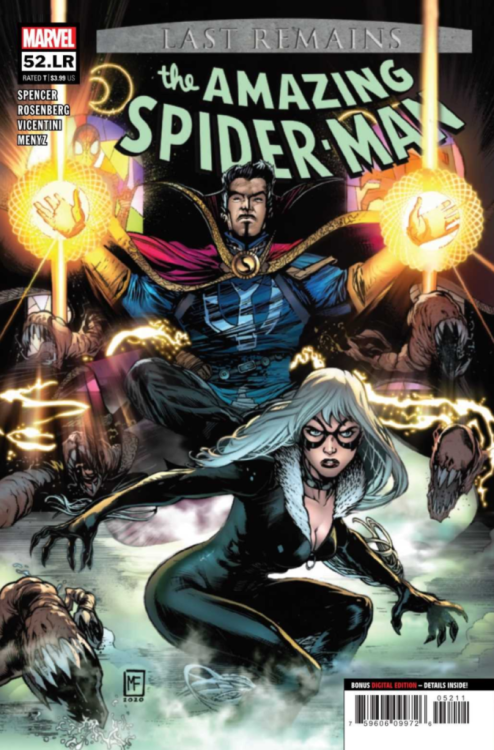
The Amazing Spider-Man #52.LR, out now from Marvel Comics, is an enthralling issue full of many evenly balanced storylines and gorgeous art.
About the Book:
Doctor Strange and Black Cat are on a magical quest to save Spider-Man’s soul, and they need the help of the recently unpossessed spider-powered friends of Peter. Simultaneously, Norman Osborn, now cleansed of sin, needs to convince Mary Jane to help him talk down the demonic villain Kindred, whose identity we now know to be Harry Osborn. As they attempt to do good, the Sin-Eater and his cronies enact a plan to return them to their previous level of power: by taking it from the fearsome Morlun.
The Amazing Spider-Man #52.LR Story
Matthew Rosenberg and Nick Spencer do it again in The Amazing Spider-Man #52.LR, where three separate storylines are well-balanced in a single issue. The stories themselves are deeply engaging. Each set of characters perform actions that are surprising and hard to predict for the reader but are still are the next logical steps of their journeys. This provides for believable yet enjoyable stories. The best part of the issue’s story lies in how the scenes are laid out. Spencer and Rosenberg do a phenomenal job of juggling each of the storylines. They never dwell on one scene for too long or little, and whenever a scene consists mostly of dialogue and little action, it is followed by an intense, visually exciting scene. This fantastic setup of the issue causes it never to have a dull moment and makes it a delightful read.
Art
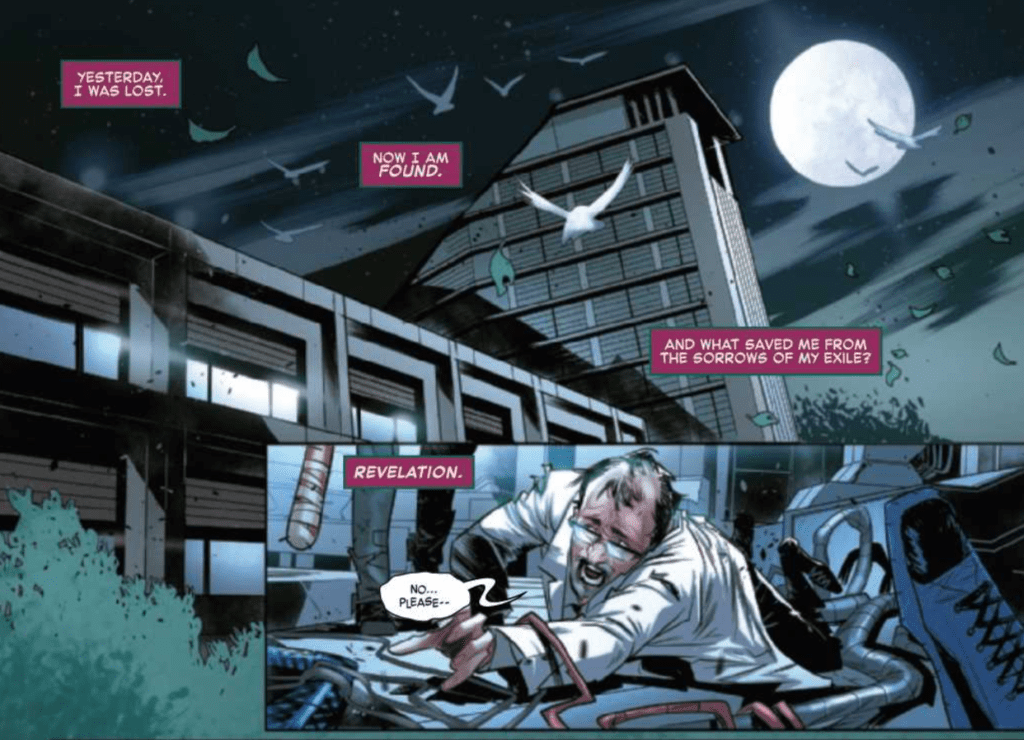
Federico Vicentini provides some stunning art in The Amazing Spider-Man #52.LR. It is evident from the incredible amount of detail in every panel that Vicentini put lots of effort into the issue, and it pays off by making the world feel more real. The debris that can be seen flying through the air in one panel is particularly notable and shows just how talented and dedicated Vicentini is. Another remarkable aspect of Vicentini’s art is his wonderfully expressive faces. This is very important, especially for the dialogue-heavy scenes of the issue. Without any visually gripping action in a scene, facial expressions need to be superb, and this issue certainly delivers on that.
The colors of Marcio Menyz and Erick Arciniega give life to The Amazing Spider-Man #52.LR. There is an admirably broad color palette that shifts for each scene to reflect the tone. There is an impressive tint to panels that are flashbacks. This tint allows the reader to distinguish that a panel is a flashback but does not overpower its colors. Menyz and Arciniega also use the technique of having a bright, single-colored background for panels where the action needs to be emphasized. This is a highly effective technique that provides an extra punch at the right moments in the story.
The Amazing Spider-Man #52.LR features some brilliant lettering thanks to the work of VC’s Ariana Maher. Throughout the issue, there are many sound effects with large bold fonts, and the issue features a different style of lettering for nearly every case of this. Some of the fonts used are not common in mainstream comic books but still fit nicely with the rest of the story and are a refreshing new choice. Maher does an incredible job of keeping the lettering interesting, and there is never a single stale moment.
Conclusion
The Amazing Spider-Man #52.LR is another excellent issue to go along with the current Amazing Spider-Man issues. It is great to focus on secondary characters’ actions, and each LR issue gets more and more exciting. Spencer and Rosenberg weave together the many storylines perfectly, and the art and colors tell the story beautifully. Not to mention the lettering of Maher, which adds an incredible amount of depth to the story. This issue is a gripping read and is a wonderful companion to the recent The Amazing Spider-Man books.
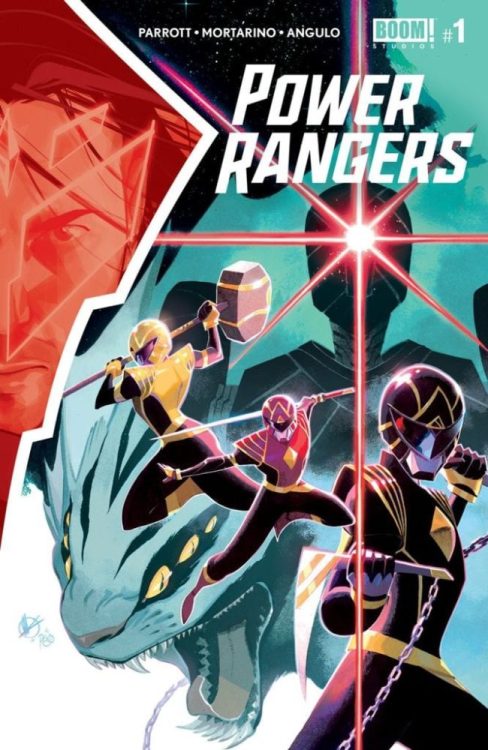
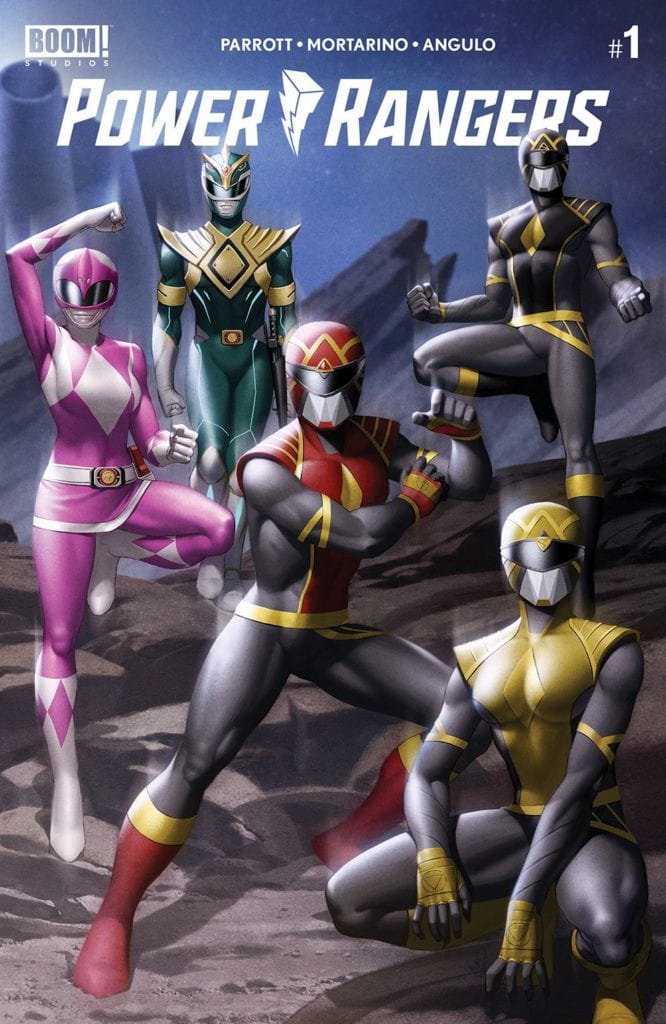
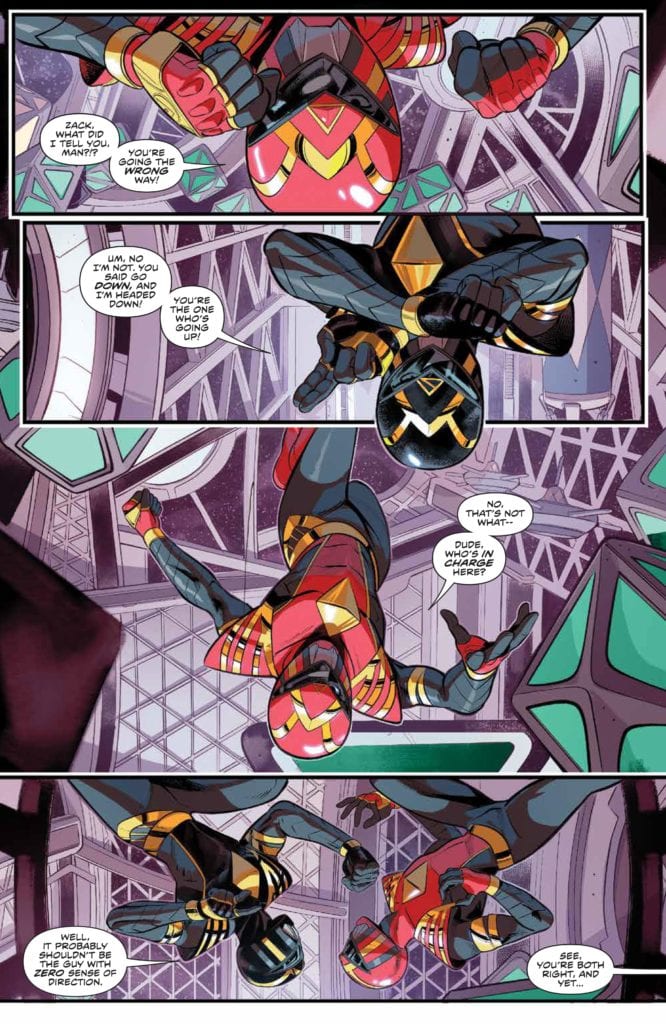
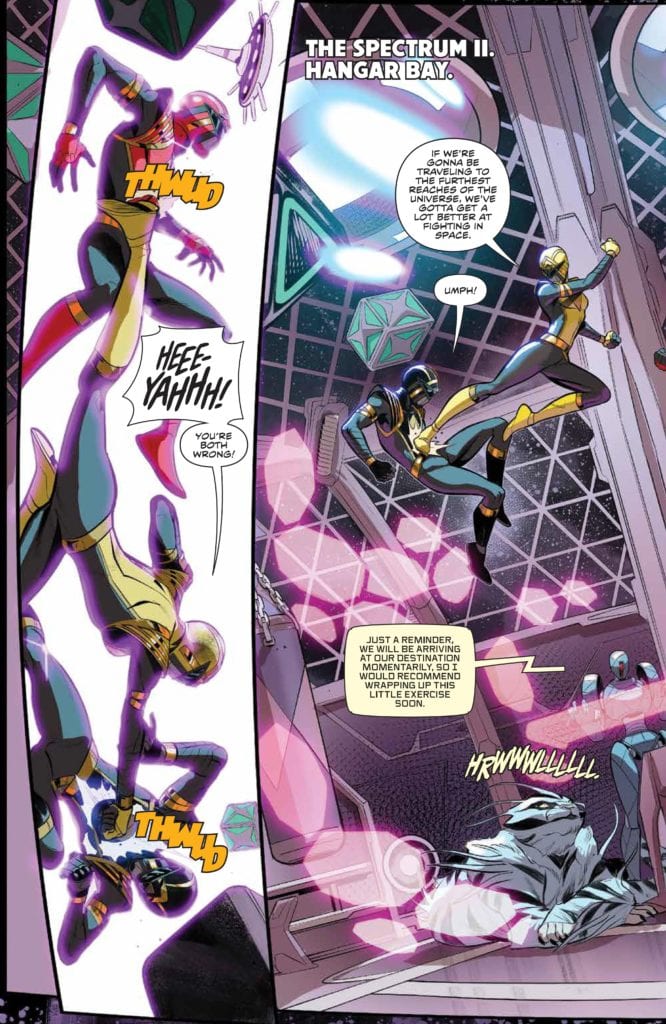
Power Rangers #1 out this week from Boom Studios brings the other side of the new direction for comics. While Mighty Morphin focuses on the team on Earth, Power Rangers will focus on the Omega Rangers as they explore the cosmos. The action comes together thanks to Ryan Parrott (writer), Francesco Mortarino (line art), Raul Angulo (colorwork), and Ed Dukeshire (lettering).
POWER RANGERS #1 reveals a new cosmic threat that only the original Power Rangers, now known as the Omega Rangers – Jason, Trini and Zack – can hope to defeat!
Writing
With Ryan Parrott writing both of the new Power Ranger series, one of the common traps could be both books telling a similar story. Instead, Parrott makes sure to point out each series will have its own unique mission or mystery. With Mighty Morphin it will focus on the identity of the new Green Ranger. Power Rangers meanwhile explores the mystery of the Empyreal and where they come from.
The issue reintroduces the characters of Jason, Trini, and Zack and calls out how the comic series has diverted from the original show. There even is a joke poking fun at the “Peace Conference in Switzerland” where the characters disappeared to in the show’s continuity. As the Omega Rangers, the trio will do whatever it takes to stop the Empyreal from harming anyone else.
Artwork
The artwork by Francesco Mortarino focuses heavily on body language. This comes in to play heavily as the cast visit Drakkon in his cell. All of the characters convey a mixture of tense, angry, and frustrated without a single word bubble needed.
The colorwork by Raul Angulo helps to make the visual effects feel alive. From the holograms to the robots and alien creatures the use of color gives the science fiction elements an otherworldly feel. This comes into play heavily later during the last few pages of the comic.
The lettering work by Ed Dukeshire helps to move the story along. Thanks to the change in panel layouts from page to page the lettering acts as a guidepost helping to direct the reader through the issue. Special care is paid to ensure the sound effects don’t distract the reader.
Conclusion
Power Rangers #1 is the other side of the power coin for the new direction the franchise is taking. The amount of action and drama contained in both series is more than enough to keep the readers engaged. Fans of the franchise should make sure to check it out because the internet will be talking about what happens moving forward.
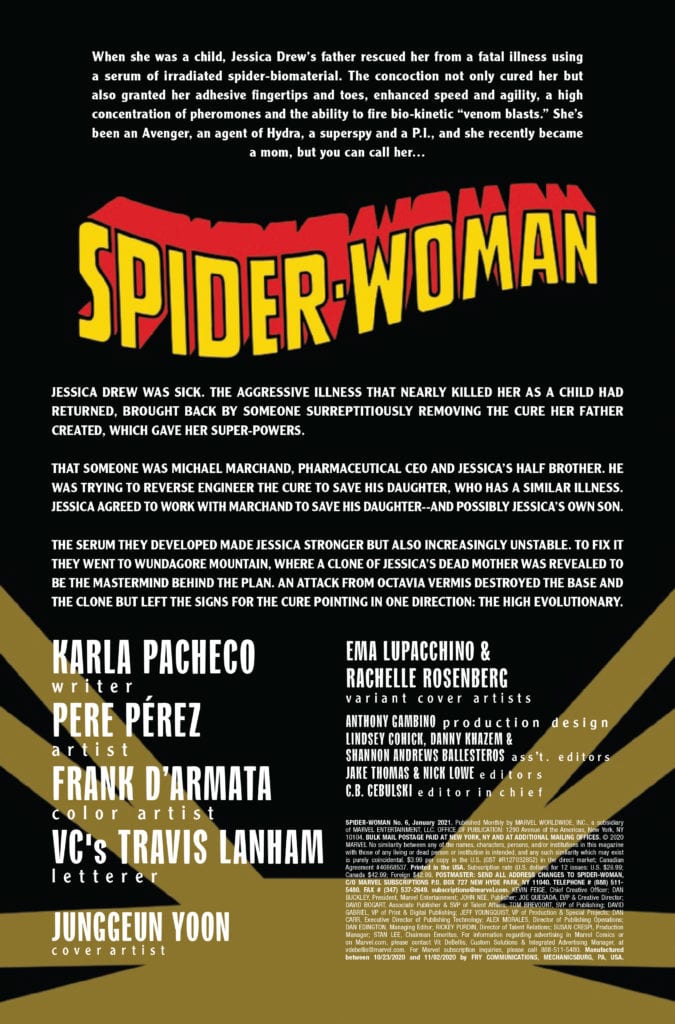
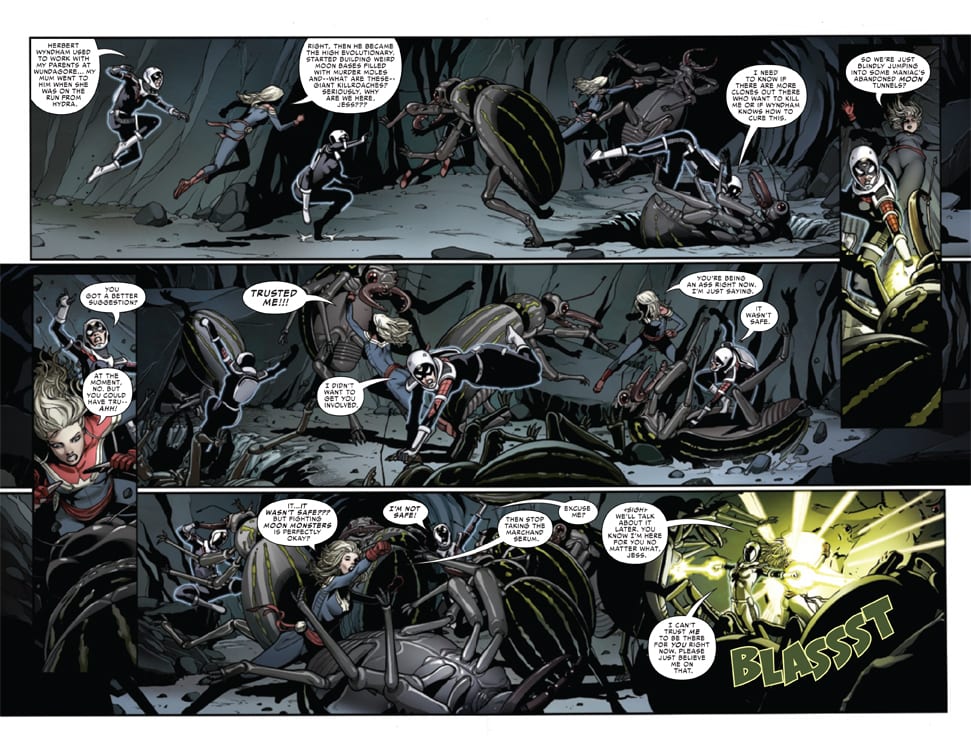
SPIDER-WOMAN #6 hits your local comic book store November 18th, but thanks to Marvel Comics, Monkeys Fighting Robots has an exclusive four-page preview for you.
About the issue: ROAD TRIP…TO SPACE!
After learning some startling secrets about her family, Jess goes on a mission to find the one person who might know more…the High Evolutionary! But to do that, she’s going to have to go into space. And to do that, she’s going to need her good friend…
CAPTAIN MARVEL TEAM-UP TIME!!!
SPIDER-WOMAN #6 is by writer Karla Pacheco and artist Pere Pérez, with colors by Frank D’Armata, and letters by Travis Lanham. The cover is by Junggeun Yoon.
Jessica Drew was created by Archie Goodwin and Marie Severin. She is expected to co-star alongside other versions of Spider-Woman in an upcoming spin-off to Into the Spider-Verse.
Check out the SPIDER-WOMAN #6 preview below:
Are you reading SPIDER-WOMAN? Sound off in the comments!