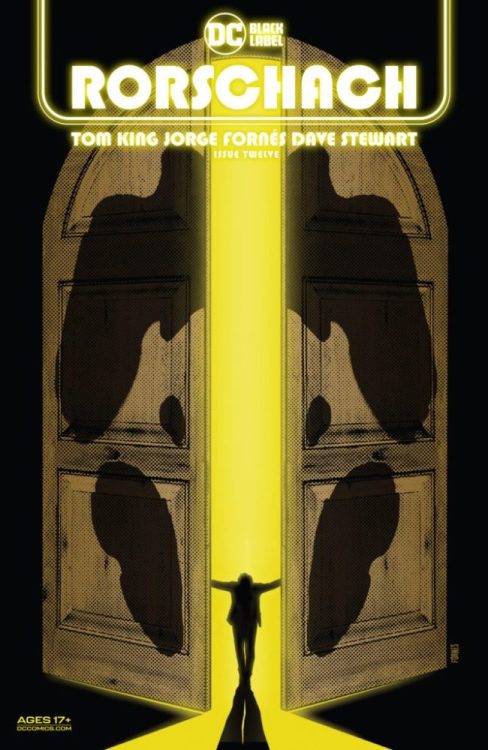
DC Comics’ Rorschach is complicated and subtle. It’s about politics, greed, purpose, and insanity. But every commentary the series is making is also deliberately muddied by the humanity of the characters. Writer Tom King, artist Jorge Fornes, colorist Dave Stewart and letterer Clayton Cowles aren’t dishing out life lessons in this finale. Rorschach #12 isn’t about answers. It’s about being lost and finding some kind of purpose, whether good or bad.
Writing
King doesn’t seem to have an overarching commentary in this series. There are themes of radicalization and the danger of conspiracies. But King’s conspiracy theorists aren’t the big bad guys. They’re dangerous, sure, but the people they’re fighting are just as awful. In Rorschach, everyone is evil. Everyone is lost. There is a subtle beauty to the work of Wil Myerson (Rorschach) and Laura Cummings (The Kid). They may have been insane and tried to assassinate a political candidate, but they lived like the heroes of the old west. Yet their lives were violent and tragic. They caused pain and misery, driving the people they met into insanity.
As King closes this series out, he doesn’t give us a better way of seeing these two. We see yet another person who has been deeply affected by their lives. We see him make decisions that are as heinous as they are inspiring. But it all ends with a smirk. King seems to joyfully leave us in the lurch. He wants us to muddle through and make our own conclusions. His script is robust and wordy, but incredibly stingy when providing information. King fills these pages with speeches, lines from movies, and small talk. We are drowned in a sea of words, but King never tells us what to think. It places us right in the shoes of our protagonist: a man who has to sort through a barrage of information to find real clues. It’s a frustratingly beautiful end to the series that feels truly fitting.
Art
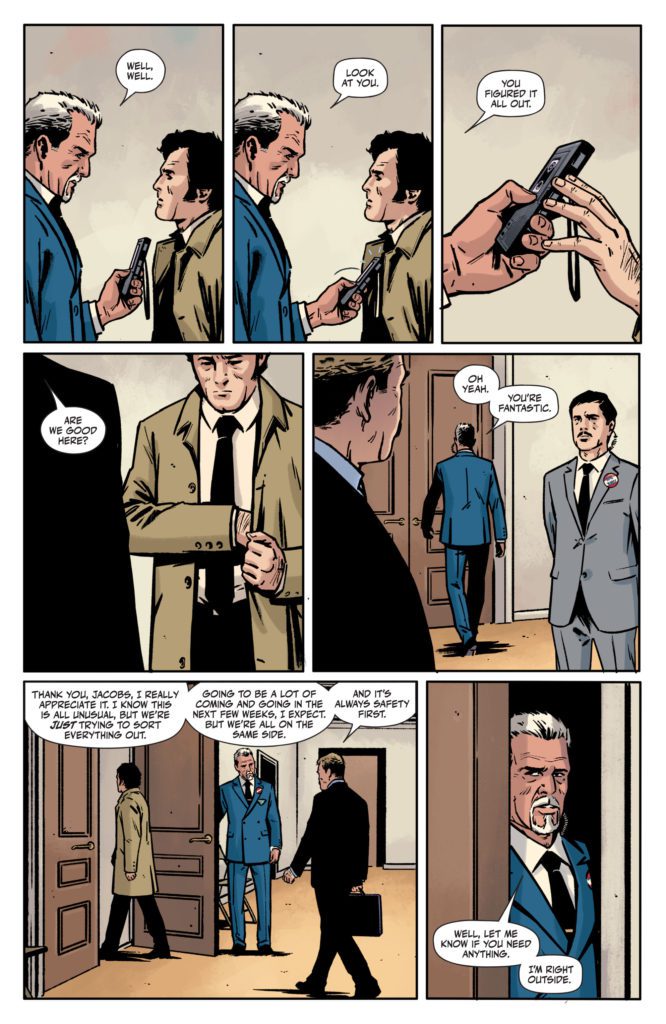
Fornes makes us feel as though we are seeing every moment. Characters move their arms or make different expressions from panel to panel, but rarely does the art move faster than that. We see our detective suit up in his coat and walk out the door. It takes an entire page. We see Turley inhale a cigarette and blow it out his nose. Fornes shows us time passing, but he does it slowly. By doing this, Fornes amps the tension up to 11. We know something is coming, we just don’t know what. Then, when the action of the issue has occurred, Fornes speeds things up. We see scenes from different angles, breezing from one location to the next. It’s the exhale after we’ve been holding our breath.
Coloring
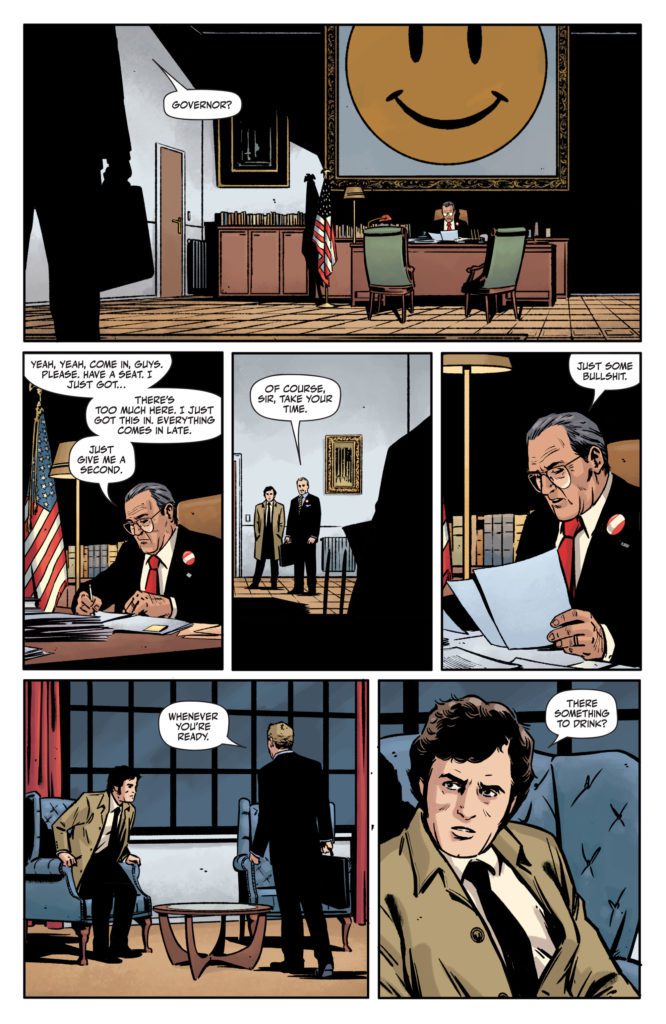
The inside of Turley’s office practically looks like an American flag. Whether it’s the dark blue sky out the window, or the red carpet and drapes, the whole place looks like July 4th. But it’s actually only the actual American flag and Turley’s tie that look bright. Every other red or blue looks a little muted. But Stewart still makes the whole scene feel lifeless. Even the bright colors of the tie and flag look artificial. It’s only after our protagonist has left the office that we see the warm color palette of the night air. It’s not in office buildings that our characters see beauty, but in the world outside.
Lettering
Cowles lettering ping pongs across the page. When Turley tries to look busy, it’s not his body that’s doing the movement, it’s his dialogue. His word balloon comes up on the left side of his face, then in the next panel it comes up on the right. Later, as we hear something happening off panel, Cowles uses height to tell us what kind of energy each piece of dialogue is colored by. The dialogue begins high on each panel, but by the end of the sequence the word balloons are at the bottom. We can see the situation deescalating, even if we can’t see what is happening.
DC Comics’ Rorschachis a series about terrorism, political greed, and the medium of comics. But this creative team doesn’t hold your hand through it or tell you what to think. They show you a story, and when it’s over they simply ask, “What do you see?” Rorschach #12 is out from DC Comics on the 14th of September at a comic shop near you. It is a brilliant and satisfying conclusion to this complex series.
Welcome to Self-Published Spotlight, a regular interview column where I will be highlighting self-published comics and the creators and small print publishers who make them.
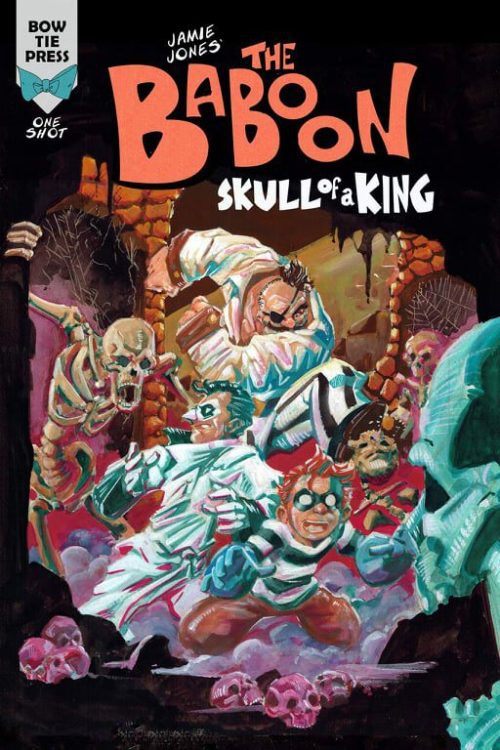
Jamie Jones entered my radar when he started drawing the weekly Monkeys Fighting Robots strip. After some searching, I discovered Jamie’s solo creation, The Baboon (a pulp adventurer along the lines of Indiana Jones, Doc Savage and even a little The Shadow) and loved it right away. So when I read that Jamie was doing a new Baboon one-shot, I was on board immediately. I quickly supported it on Kickstarter, then reached out to Jamie to ask him all about the book. Always gracious, Jamie answered all my questions and you can check them out below. And make sure you head over and supportThe Baboon: Skull of A King.
Monkeys Fighting Robots:First, Jamie, why don’t you catch us up on what you have been up to. It’s been roughly a year since we last spoke. When we chatted, The Baboon and Pink Lemonade Jamboree book you did with Nick Cagnetti had just come out. What’s been going on with you in the past year? Jamie Jones:Oh gosh, so much! I wrote and drew the second Baboon Comic, a 94 pager that I’ve been releasing first on Patreon. I bounced around the whole southeast crashing on friends’ couches for several months before officially moving from St. Pete, Fl to Savannah, Ga. I’ve been slowly adjusting to the change. I started a Twitch channel and now I launched a Kickstarter for a Babs one-shot.
MFR: Some of our readers may not be familiar with you and your work, so give us a quick rundown.
JJ: I’ve been doing the self-publishing game since I started making comics. First with Tres Dean and our sci-fi western book, DODGER. Those comics got me some gigs for some pro wrestlers and KICKING ICE (written by Stephaine Phillips). I then went off and made the Baboon 2 years ago, launched the first book on Kickstarter. I also did the ComiXology original book QUARTER KILLER with Vita Ayala and Danny Lore. I’ve been working on Baboon stuff since then. Oh and I do the Tales of MFR comic strip on this here website!
MFR: So let’s get into your latest book, The Baboon: Skull of a King. Give our readers the elevator pitch on the latest Baboon adventure. JJ:There’s a gem-encrusted skull of an ancient king that Babs and Monkey Bones go to recover from an ancient tomb. But, they are not alone. Enter The Baboon’s old rival, The Cyclops Barbarian. And the race to see who can get the skull first ensues.
MFR: What made you go with a one-shot floppy this time? JJ:I wanted to. haha. The beauty of the Baboon and how the book exists in my head is just a lot of one-shots really. One-shots of varying length. The books don’t have one long narrative tie. So when I was working on this story I knew it was going to be a “flash in the pan” kind of story and the single issue fit that.
MFR: Did you use any different approaches, tools or processes on this new book? JJ: Not really. This year I’ve been introducing more Papermate-flair pens into my drawing. But they were always kind of there. I used to draw with those pens all the time in school. Just doodling in the margins. I guess I’m chasing the joy of drawing again. And using tools that I used when I was younger is one of the ways I’m doing that. But, other than that, I’m still using my number 4 Silver Black Velvet brush dipped in Sumi ink.
MFR: This is, I believe, your fourth successful Kickstarter project. What’s it like working within that system now that you have experience? JJ:It gets easier each time. The hardest part is in the promotion. I’ve thought about hiring someone to help me out on that end. But, the constant push is very draining. Kickstarter has made the back end so much easier to use since my first campaign too. They keep updating, making it more user-friendly. Now it’s just another tool to help gauge interest in the product.
MFR: What is it you love about Kickstarter? Is there something about it you don’t like? JJ: Kickstarter is great for name recognition. People on the street know what’s up when you say you’re running one. The only thing I don’t like about Kickstarter, and I’ve said this so many times, is the integration of shipping costs on books in the total money you’ve earned for the project. I wish they would hold shipping payments in a different space so I could see the final total without the shipping. I think it would be more honest to the backers to show exactly how much has been collected for making the project.
MFR: Do you see yourself using Kickstarter exclusively going forward? Like would you ever work with a publisher? JJ:Kickstarter is a lot of work. I think in the next few years I’ll be making the move from Kickstarter to a more direct approach through a site that I run. Taking preorders and the like on my end. But, Kickstarter is so good for building that initial audience. As far as publishers go. I’d love to have a publisher. It’s just finding one that is willing and wanting to work with me on this book. I’ve been pretty uncompromising on the look and feel of The Baboon, which I have found, can be off-putting to publishers. I have found Publishers don’t really know what to do with a Pulp Action-Adventure “all ages” comic where people smoke and there’s no potty humor. But, readers get it. So, maybe down the line, I can do the Jeff Smith thing and just give a publisher a whole mess of comics for them to release.
MFR: You have been live streaming as you create on various platforms, especially Twitch. What is it about streaming while you draw that you like? Does it benefit the art? Does it affect how you work?
JJ: Twitch has become the thing for me. It’s great! I love the community over there. This is a great question that I wish I had a better answer for, but there is really no change in the art production. I sit, I turn my camera on, I start drawing. What Twitch does do, is let people into my insights while I draw or layout a page. Insights that if
I was not streaming, would still be said out loud as I talk to myself. So Twitch makes me a little less of a crazy person.
MFR: What else do you have going on? Anything you want to announce? JJ:I’ve got some stuff in pitch mode, which is fun and great. So maybe you’ll see some of that stuff, maybe you won’t. What I can say is The second Baboon book is going to be launching on Kickstarter early next year. And then, and I’m really excited for this, The Baboon Magazine. The magazine format is something I really love and I’ve always wanted to play around with it. I have no timeline for that yet though. It’s a lot of moving pieces.
MFR: And where can folks find your work?
JJ: I’m @artofjamiejones on all social media!
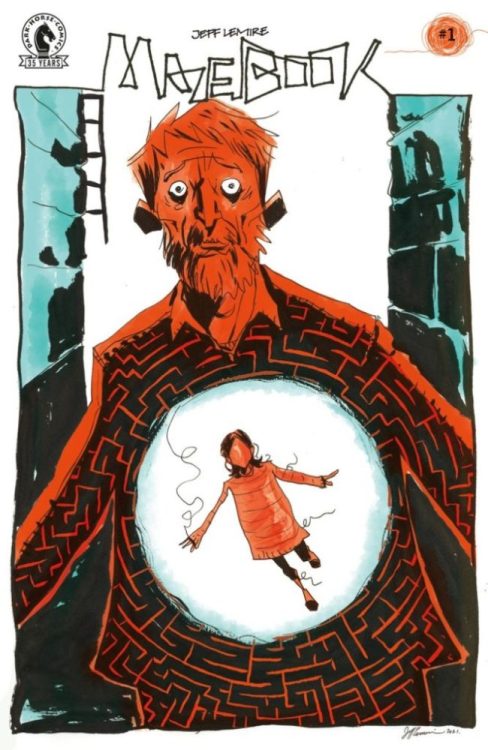
Acclaimed creator Jeff Lemire (Sweet Tooth, Black Hammer) begins a cerebral story of loss and grief in Mazebook #1. Featuring letters by Steve Wands, this first issue demonstrates the emotional devastation of loss and the hollowness it can create. With moving narration and Lemire’s signature expressive visuals, this is a painful yet enticing opening to this new mini-series.
“A lonely building inspector still grieving the loss of his puzzle-loving daughter receives a mysterious phone call one night from a girl claiming it’s her and that she’s trapped in the middle of a labyrinth. Convinced that this child is contacting him from beyond this world, he uses an unfinished maze from one of her journals and a map of the city to trace an intricate path through a different plane of reality on an intense and melancholy adventure to bring his daughter back home.”
Writing & Plot
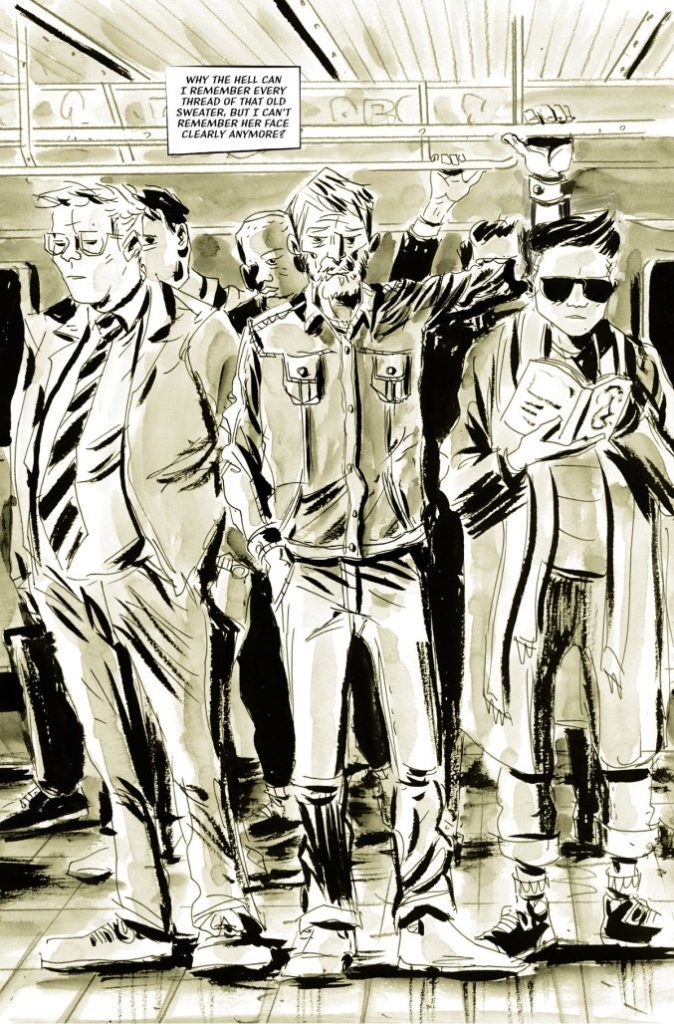
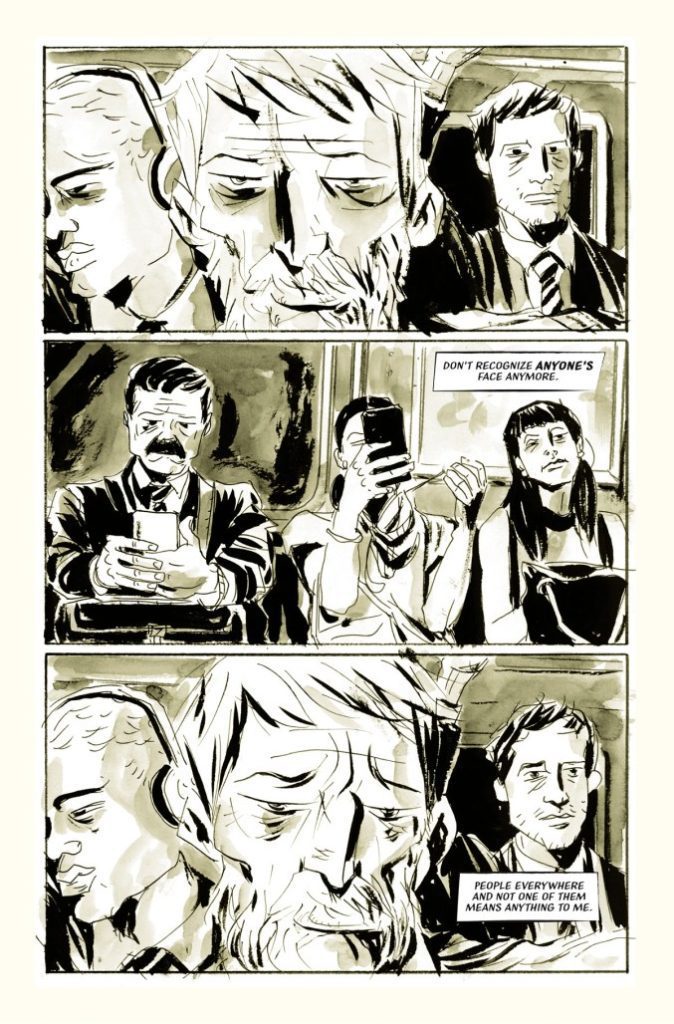
Jeff Lemire keeps his plot close to the chest for Mazebook #1. This first issue introduces us to our protagonist and the devastating effects loss and grief can have. Lemire demonstrates this man’s life as a lonely routine, with no social life. He spends all of his time on physical autopilot while his mind trails off on memories of his lost daughter. Lemire’s portrayal of this man’s grief is so effective because it’s so familiar. Any form of sadness can throw us down this same spiral for a period of time. However, here it has completely consumed every aspect of a man’s being. Lemire juxtaposes detailed narrative laced with mourning against the minimal, short dialogue given by the protagonist. His inner turmoil just further drives him away from forming any relationships with those outside of his routine. This makes for a deeply effective and painful read.
While there is of course a potentially supernatural thread here at the end, Lemire hides this part for most of the book to build the tension for the next issue. After this, I absolutely intend to be there to see it.
Art Direction
Jeff Lemire brings his signature unique art style to Mazebook #1. His rough-hewn, deceptively simple aesthetic provides immense detail to his characters. This especially goes for the main character. Lemire’s almost jagged linework creates an almost gaunt and tired visage for the protagonist. It also betrays the anguish going on inside his head. The panel direction and images Lemire uses are repetitive and detailed, increasing that feeling of never-ending isolated routine.
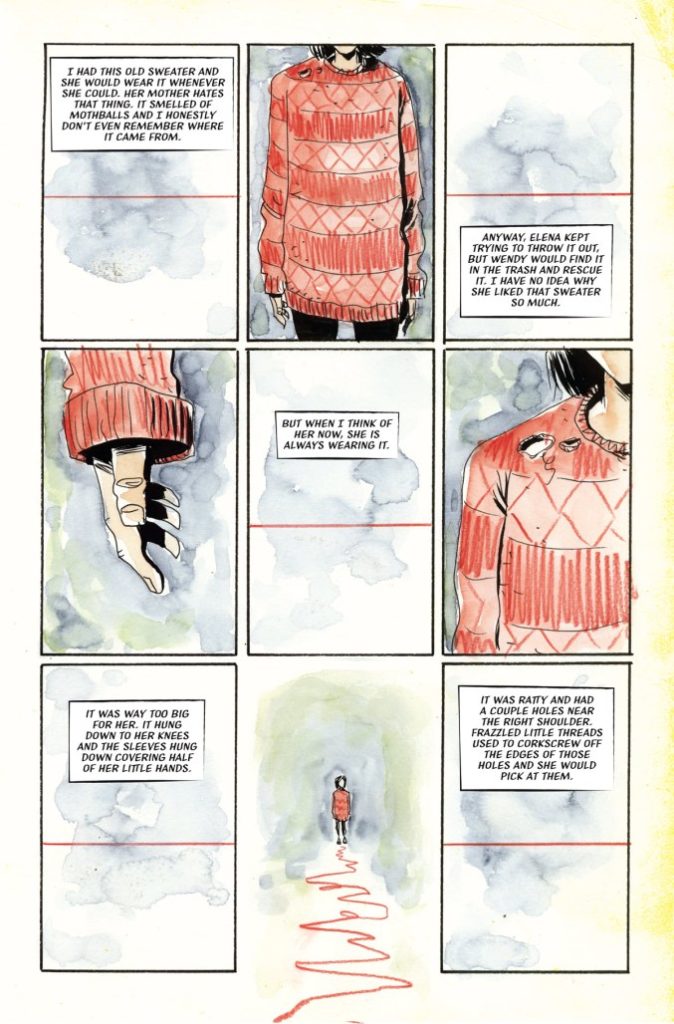
Almost the entire comic is bathed in this sort of sepia-toned color filter. This intentionally drains life from the world and characters to reflect the protagonist’s mindset. The only parts of the comic not like this are the scenes taking place in the protagonist’s head. Here there are a few more details fleshed out with color. Their inclusion actually makes the overall tone of the comic even more heartbreaking. The lettering from Steve Wands is not like any I’ve seen in anything but other Lemire comics. It’s a sort of thin, slanted font that is noticeably different from most other lettering styles. It captures the reading experience very well despite its subtlety. This is a brilliantly put-together comic from the visual end, a quality I would expect from a Lemire comic book.
Verdict
Mazebook #1 is an emotionally riveting and mysterious opening chapter. Lemire focuses on the emotional devastation of grief and how it ravages every aspect of a man’s life in an intensely sad yet relatable script. His visuals see him utilizing his unique style to show the wear on our protagonist and how bare his life has become just as his journey takes place. This is a brilliant and deep first issue, so be sure to grab it from your local comic shop today!
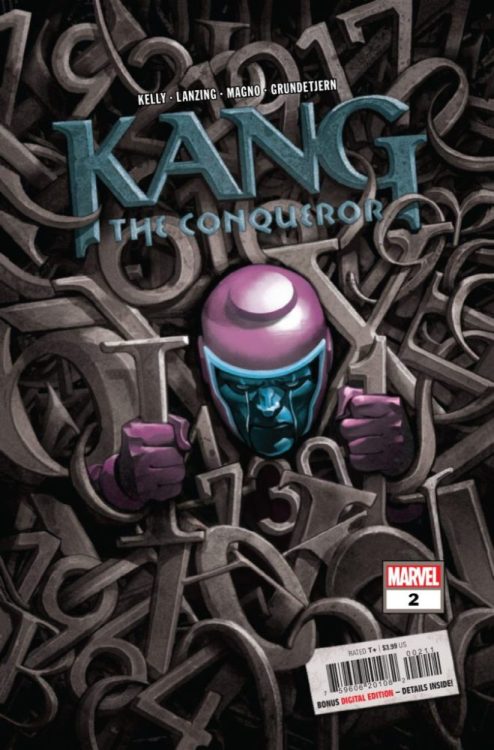
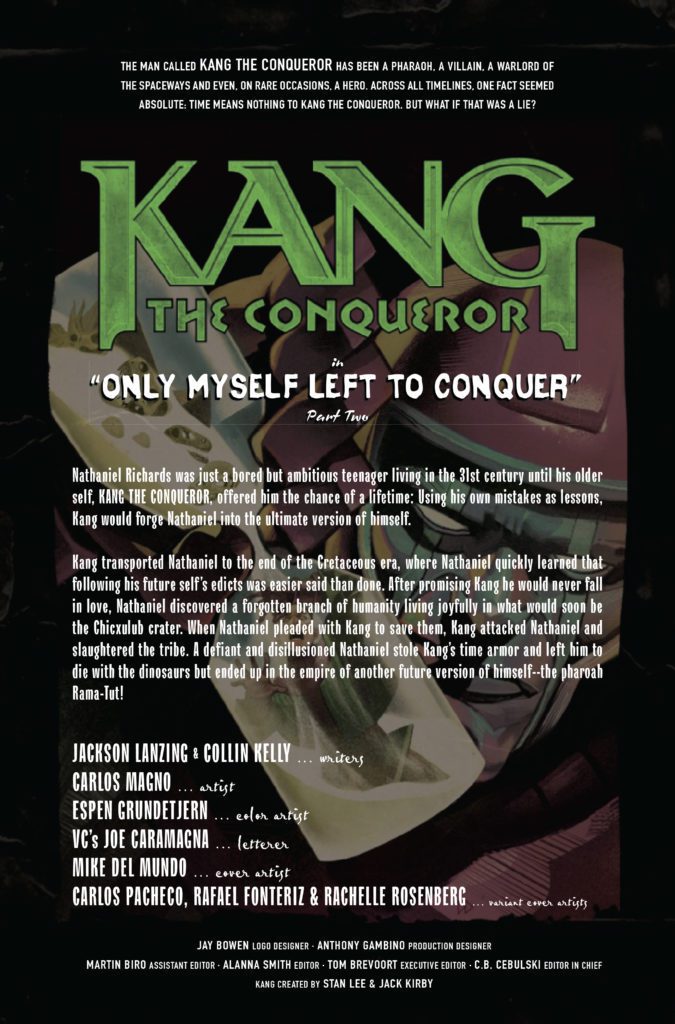
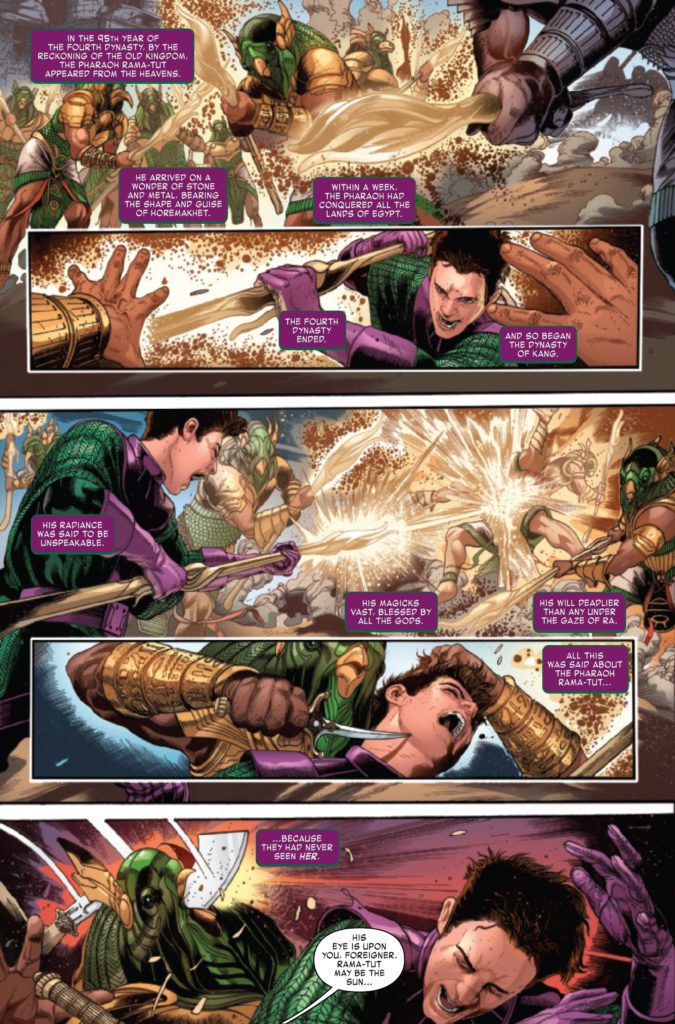
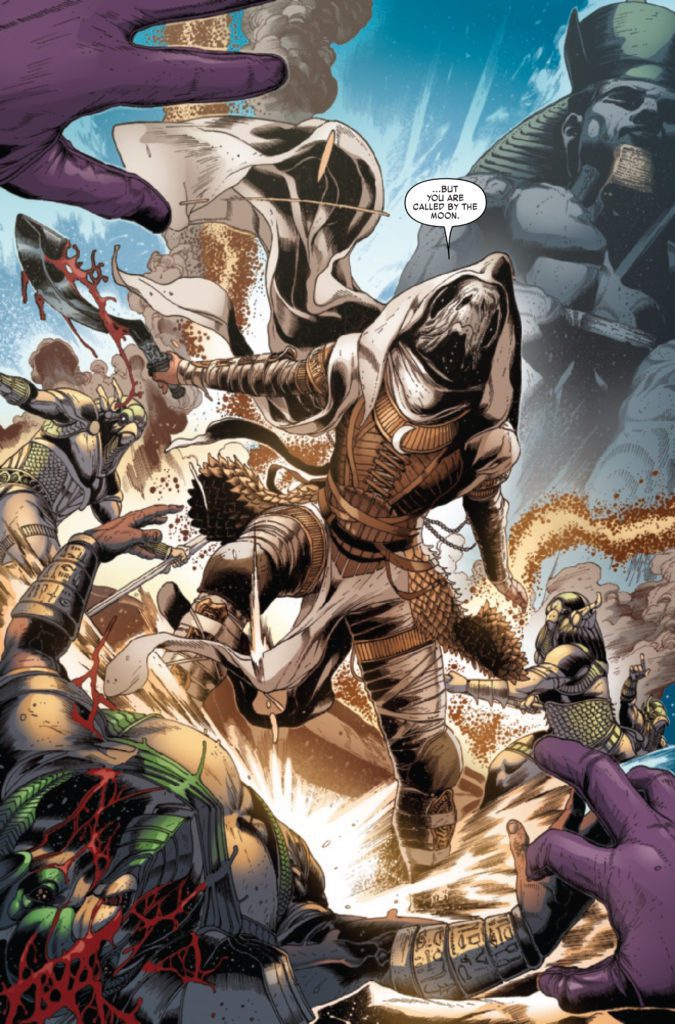
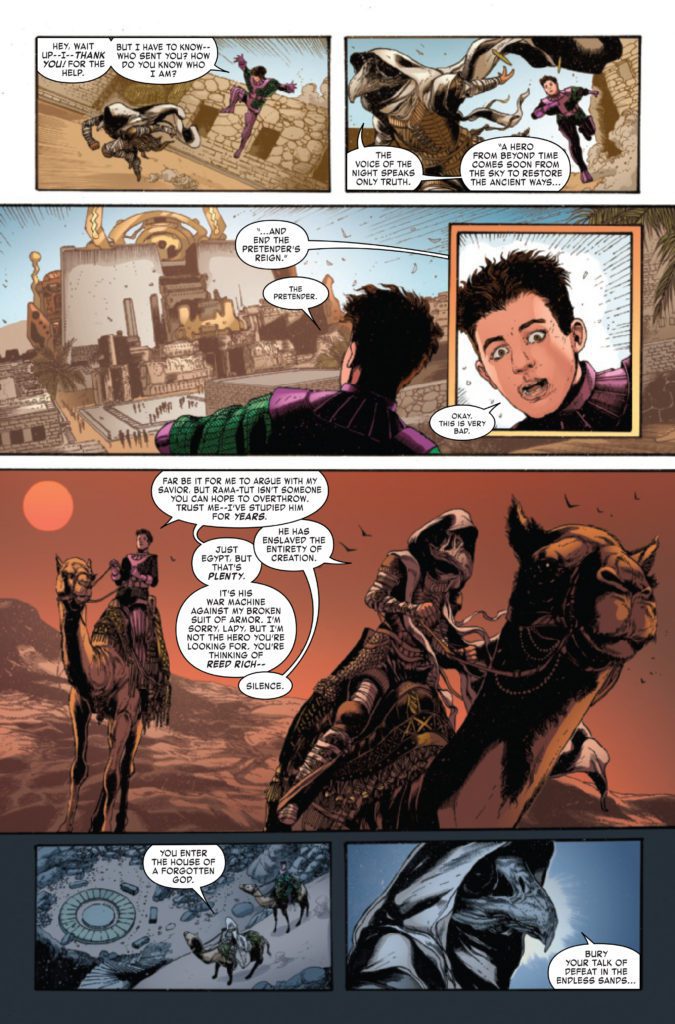
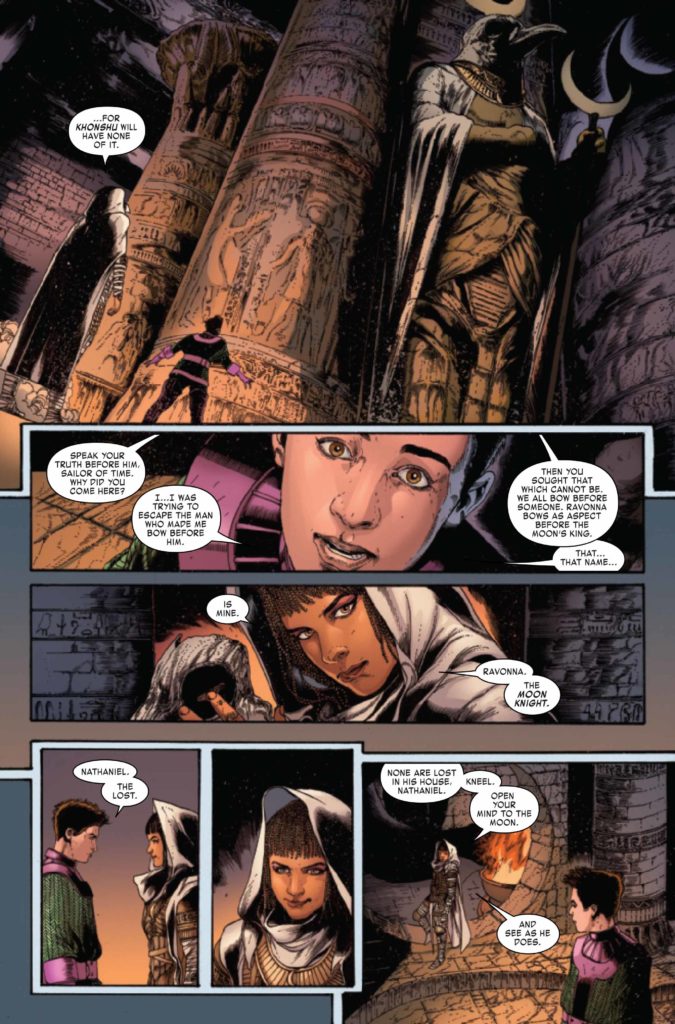
KANG THE CONQUEROR #2 (OF 5) hits your local comic book store September 15th, but thanks to Marvel Comics, Monkeys Fighting Robots has an exclusive four-page preview for you.
About the issue: A young, rebellious and idealistic Kang finds himself in Ancient Egypt, where an older version of himself is ruling with an iron fist as the pharaoh Rama-Tut. When the Moon Knight draws young Kang into a battle against his future self, tragedy strikes. But will it knock Nathaniel off the course of his destiny or lock him into one path forever?
The issue is by writers Jackson Lanzing & Collin Kelly, and artist Carlos Magno, with colors by Espen Grundetjern, and letters by Joe Caramagna. The main cover is by Mike Del Mundo.
Kang has been a major Marvel villain dating back to 1964. He is poised to be the next big bad of the Marvel Cinematic Universe, as played by Jonathan Majors. He first appeared in the season final of Loki, and is set to make his film debut in 2023’s Ant-Man and the Wasp: Quantumania (unless he makes a surprise appearance elsewhere first).
Check out the KANG THE CONQUEROR #2 preview below:
What Marvel Comics villain do you want to see get their own solo title? Sound off in the comments!
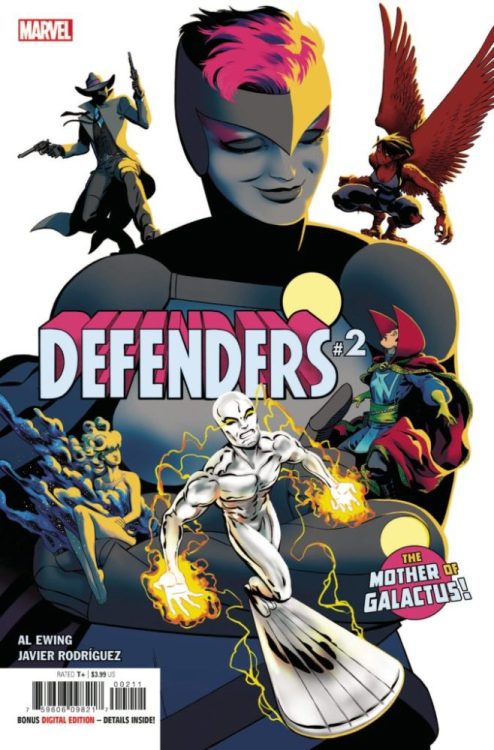
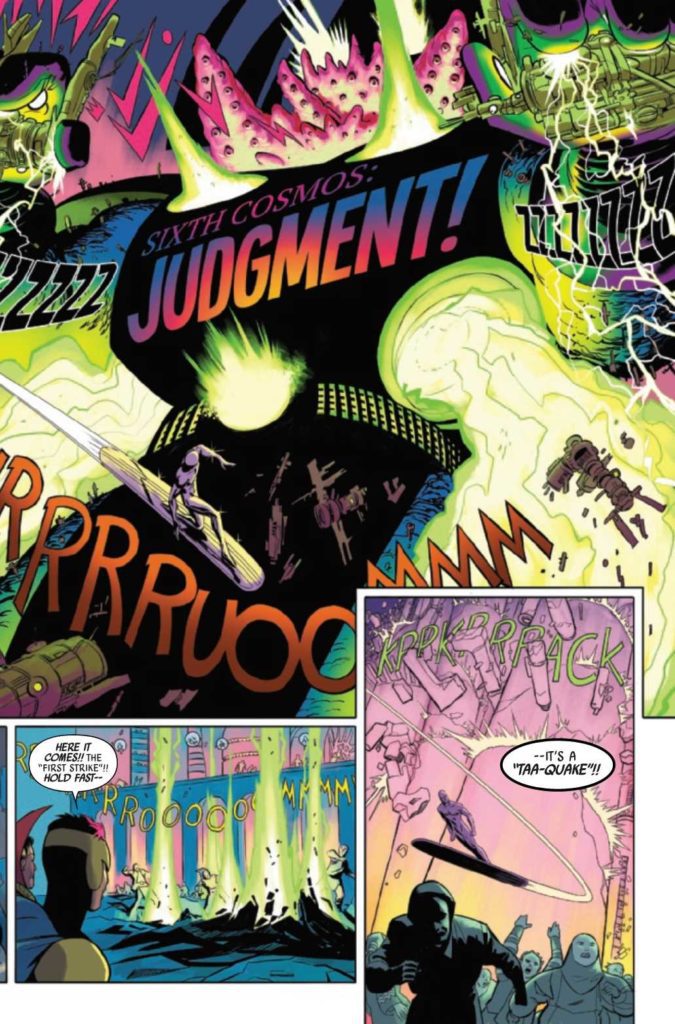
Defenders #2, out from Marvel Comics on September 8th, presents a high octane tribute to Jack Kirby. With writer Al Ewing and cartoonist Javier Rodriguez presenting a nonstop thrill ride, it’s hard not to get invested. Especially with the lettering of Joe Caramagna to guide readers.
Defenders #2: A Herald’s Epic
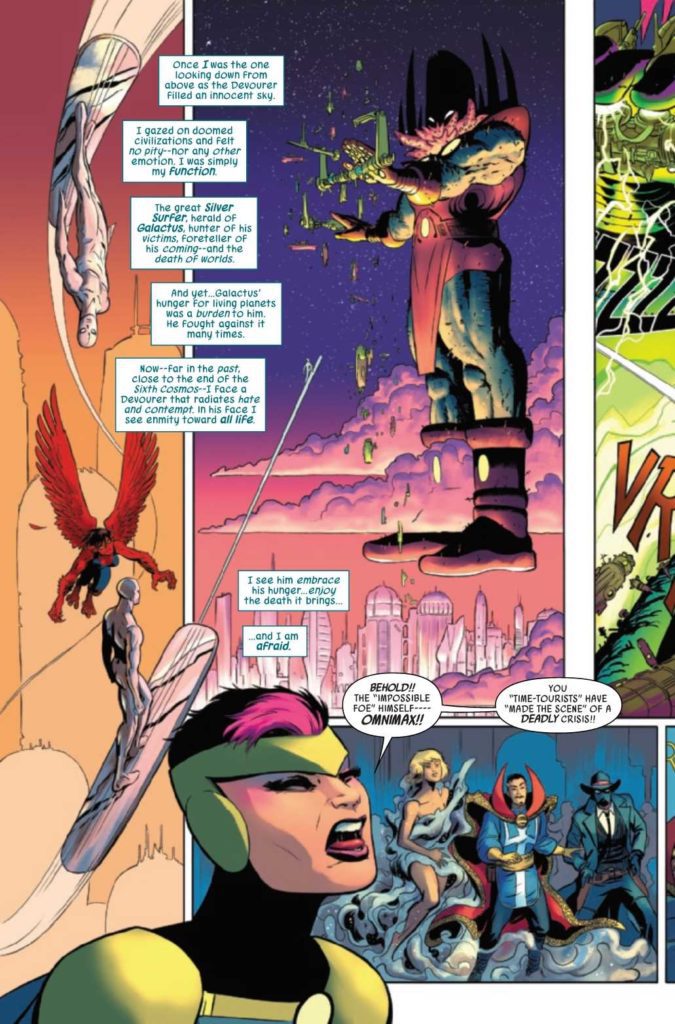
Ewing shows Defenders #2 through the Silver Surfer’s point of view. As a former herald of Galactus, Surfer knows the threat the team currently face. He accepts the absurdity of his current situation since it happens so regularly to him. It’s more than a little heartwarming seeing Silver Surfer comfort his future master as an infant, with a sense of appreciation for their history together.
The new characters of Taaia and Omnimax are a sight to behold as well. Taaia’s boisterous personality leaves quite a memorable impression. Aside from being the mother of Galactus, she seems to live a life of adventure in common with the Defenders. Then there’s Omnimax whose design by Rodriguez and presence combines Kirby-style machinery with a Cthulhu monster. Unlike Galactus, this monstrosity towering over everything with an obscured face genuinely looks indifferent to everything.
The Grand Cosmic Scale
Rodriguez’s cartooning presents many moving pieces in Defenders #2 converging into a single point. The wildly flying colors, shapes, and sound effects evoke the two-page spreads and collages of Kirby. Within mere moments, the reader gets an impression of threats and bursts of energy. Caramagna’s lettering guides us through the wild art.
Don’t Wait On Defenders #2
Defenders #2 gives cosmic Marvel an exciting depiction, worthy of Jack Kirby. New larger-than-life characters mingle with the cast as the plot develops. With many issues to come, readers are sure to want more of this series.
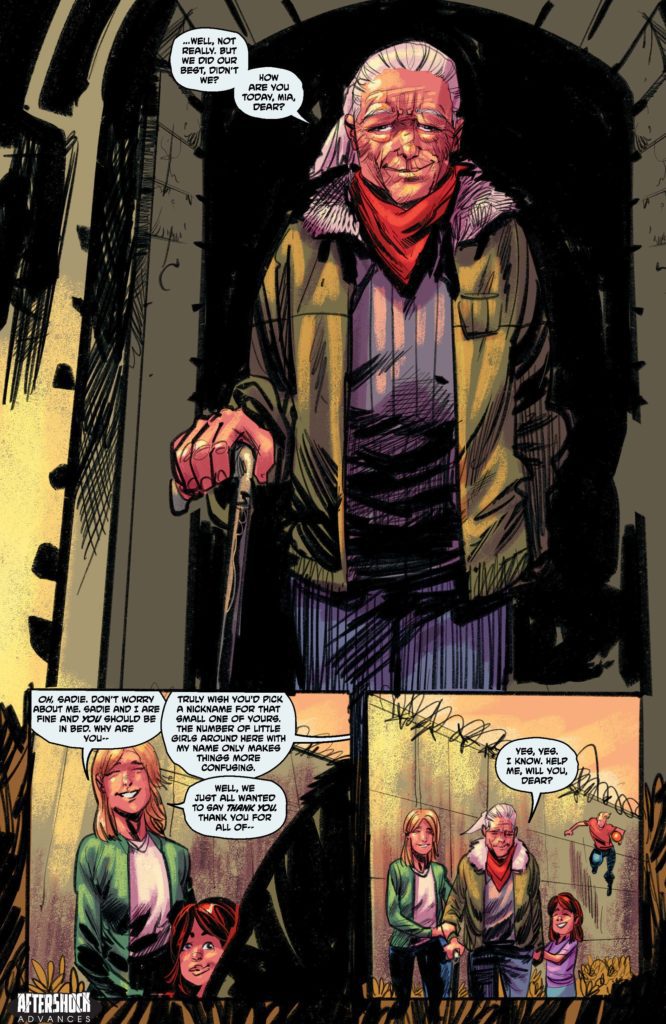
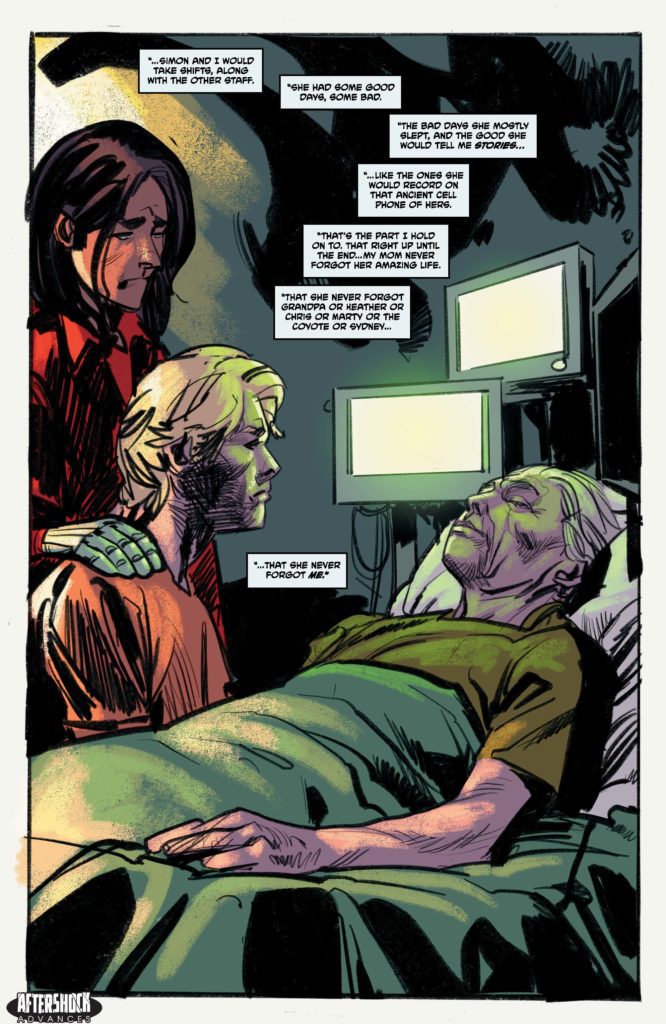
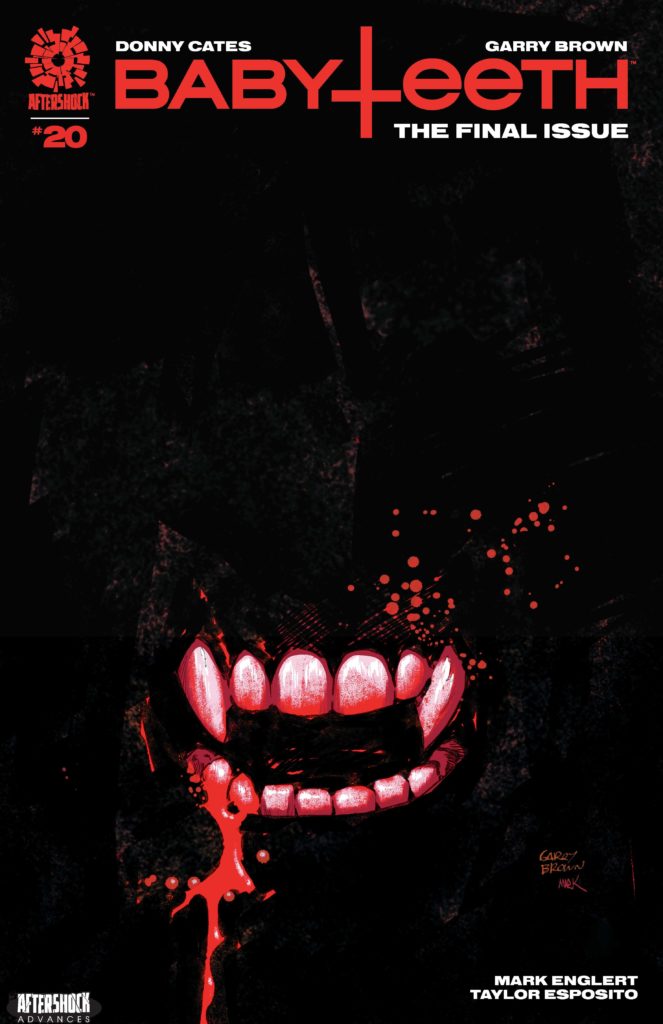
BABYTEETH #20 hits your local comic book store September 22nd, but thanks to AfterShock Comics, Monkeys Fighting Robots has an exclusive four-page preview for you.
About the issue: Everything ends. Sadie prepares her son to meet his maker. Can the apocalypse be called off?
Stay tuned for the exciting climax to BABYTEETH!
The series is by writer Donny Cates and artist Garry Brown, with colors by Mark Englert, and letters by Taylor Esposito. The cover is by Brown and Englert.
Issue #20 marks the series finale of BABYTEETH, which launched in 2017. It’s the story of Sadie Ritter, a teenage mother whose baby turns out to be the antichrist. Their journey is an epic quest full of action, hellfire, and demon raccoons. If you haven’t read it yet, we highly recommend you pick it up and read it in its entirety now that it’s concluding.
Check out the BABYTEETH #20 preview below:
Have you been reading BABYTEETH from the start? Sound off in the comments!
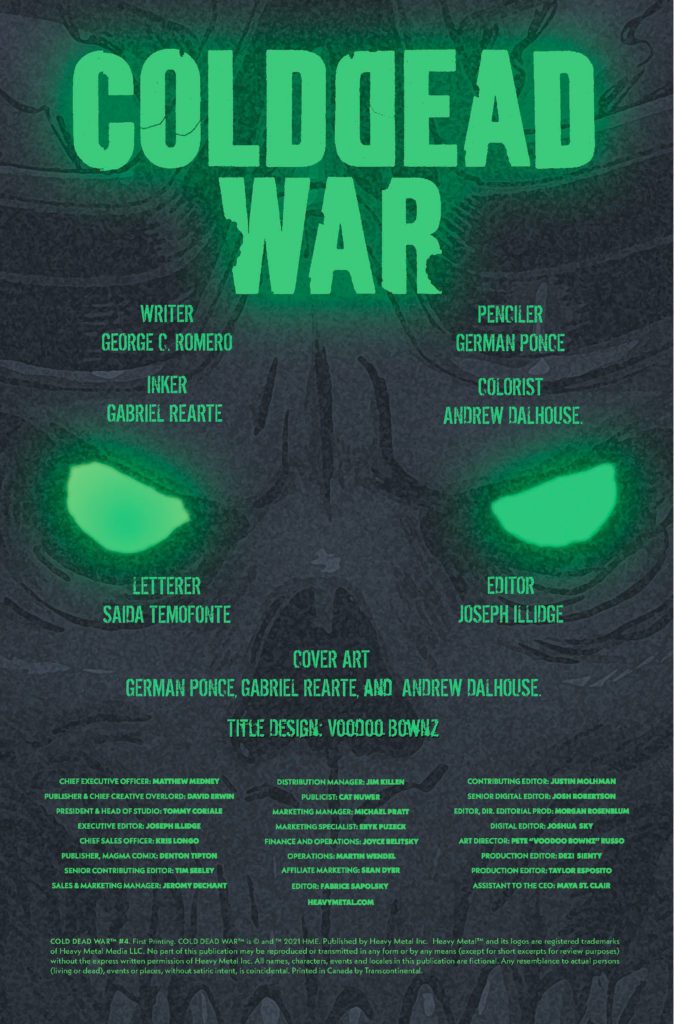
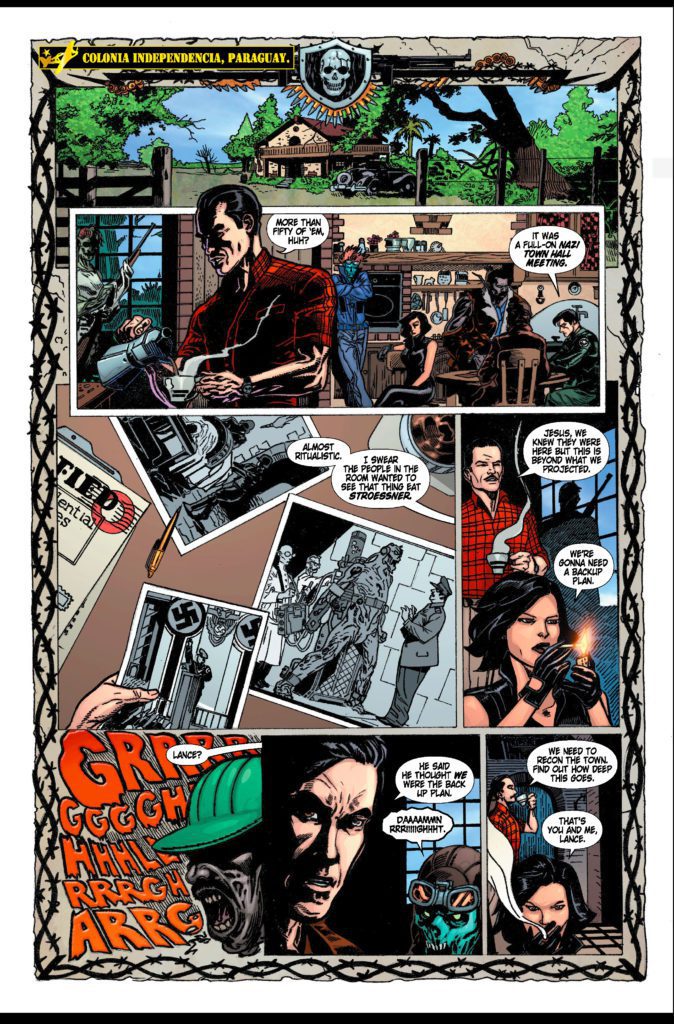
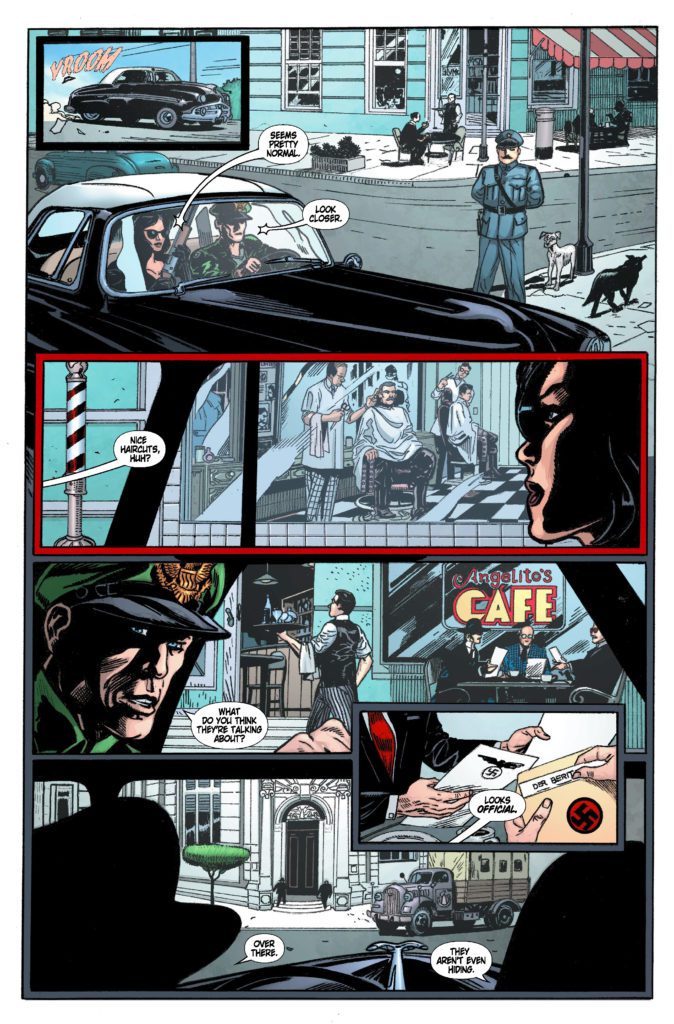
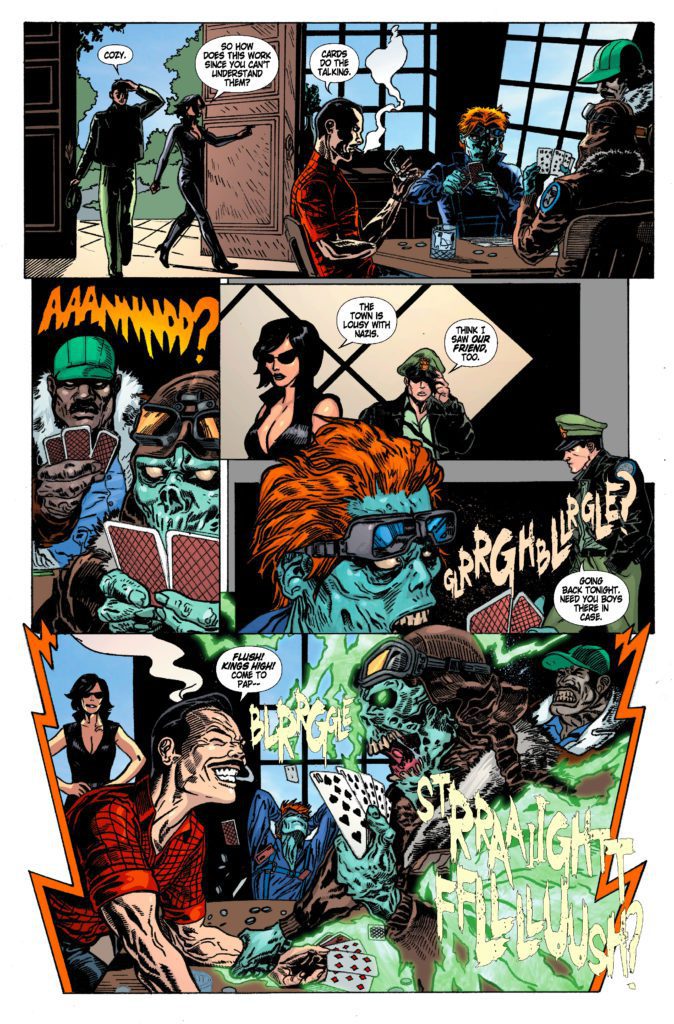
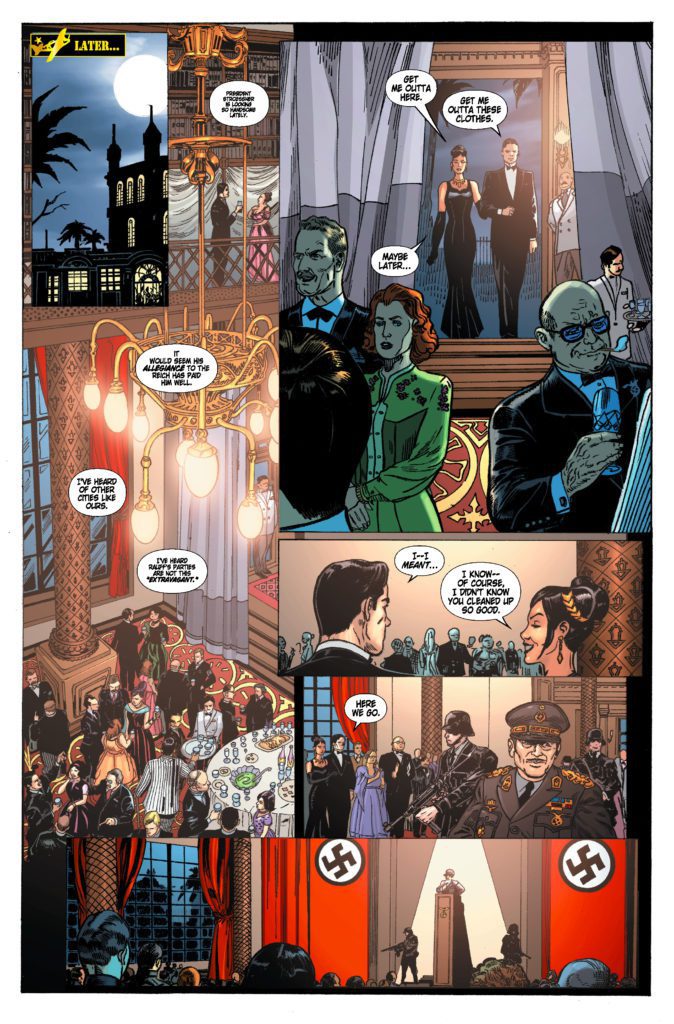
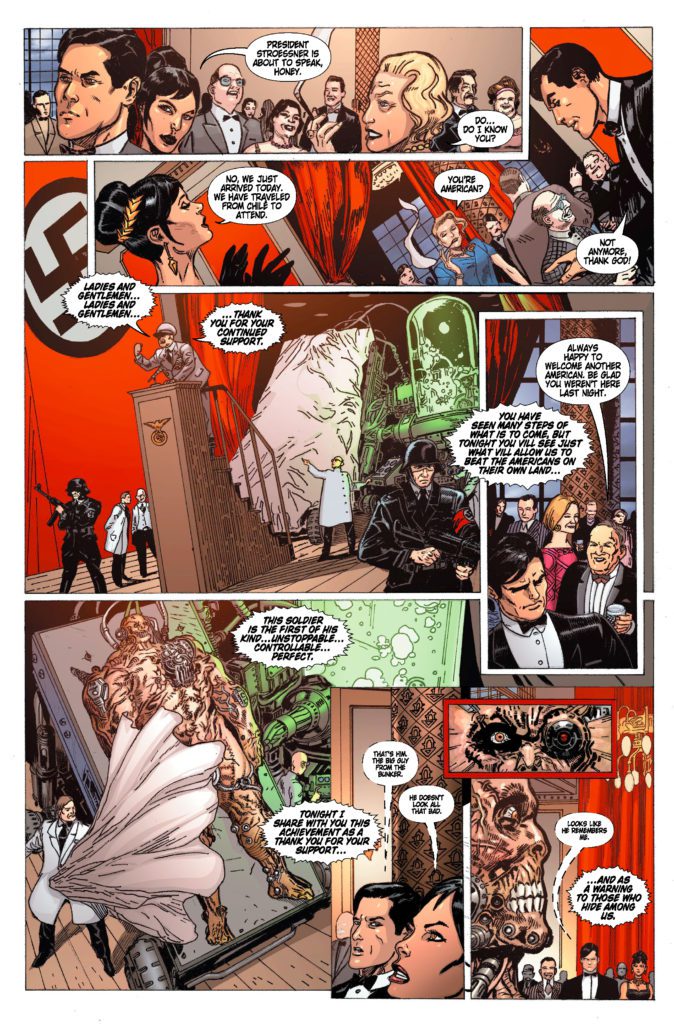
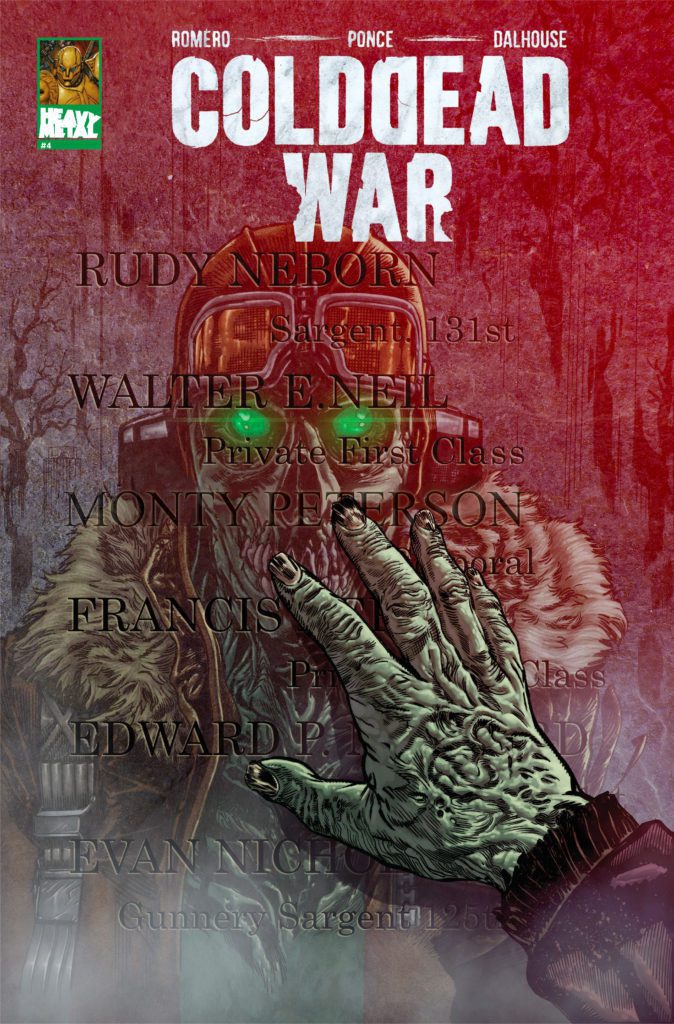
COLD DEAD WAR #4 is out September 22nd at your local comic shop, but thanks to Heavy Metal, Monkeys Fighting Robots has an exclusive six-page preview for you!
About the issue: It’s the last stand of The Cold Dead—America’s covert zombie pilot squad—as a mission to infiltrate a Nazi stronghold goes sideways, and nothing less than worldwide freedom and liberty are at stake. Live forever! Never say die!
COLD DEAD WAR #4 is written by filmmaker George C. Romero, with pencils by artist German Ponce, inks by Gabriel Rearte, colors by Andrew Dalhouse, and letters by Saida Temofonte. Romero is the son of George A. Romero, creator of Night of the Living Dead.
Check out the COLD DEAD WAR #4 preview below:
Are you reading COLD DEAD WAR? Sound off in the comments!
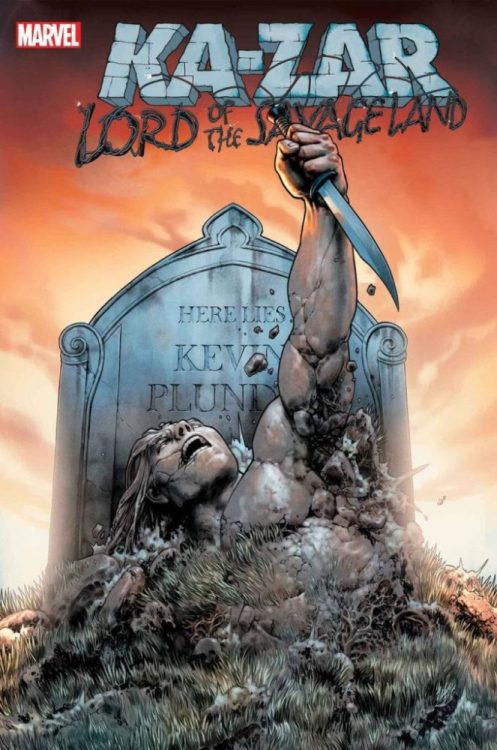
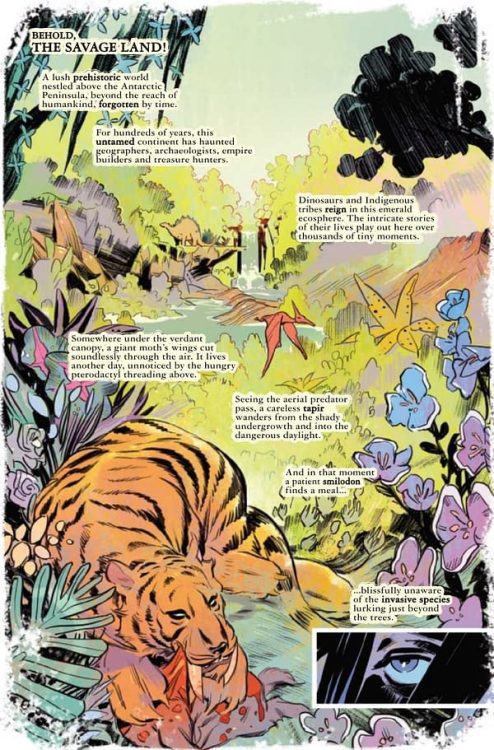
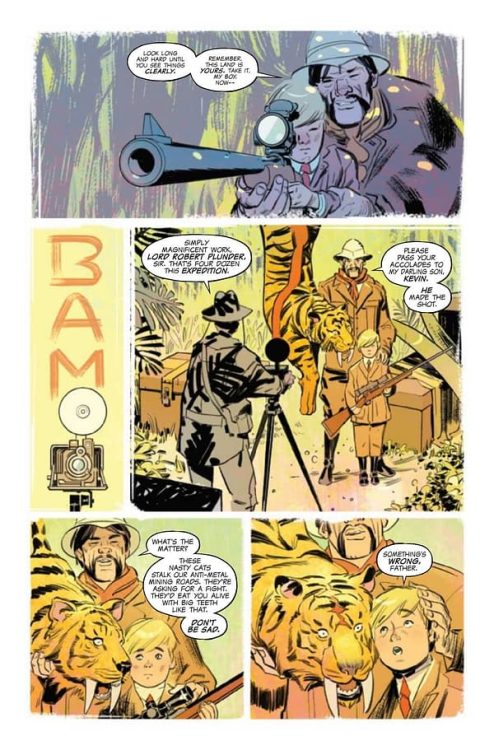
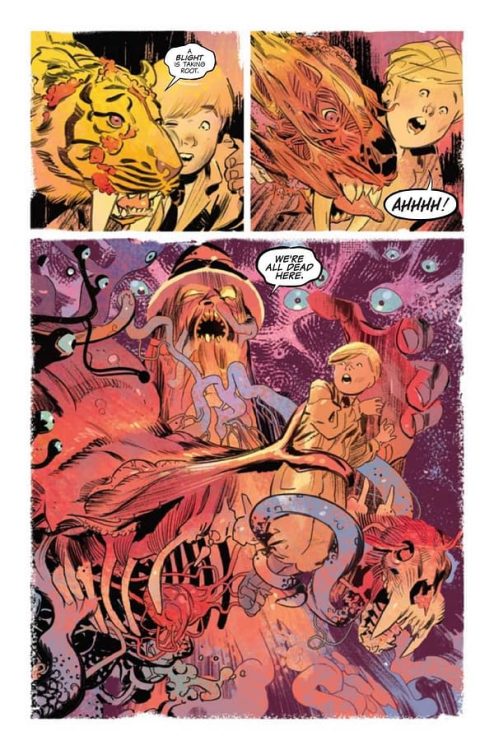
From writer Zac Thompson (Yondu, Undone By Blood) and artist German Garcia comes a return to Marvel’s land lost in time with Ka-Zar: Lord Of The Savage Land #1. This opening chapter reintroduces us to the lore and characters within this classic setting while mixing in some welcome new additions. With compelling character conflicts, phenomenal action, and stunning visuals, this will be the next Marvel series to keep an eye on.
“KA-ZAR IS BACK FROM THE DEAD — WITH A WHOLE NEW TERRIFYING SET OF POWERS! The alien Cotati murdered him. The Savage Land brought him back. Lord Plunder has returned — with a vastly new perspective! Now united with Shanna the She-Devil in a mystical merging of life energies, Ka-Zar has new abilities, new needs…and new enemies. An ancient evil has surfaced in the Savage Land — one that is rapidly reshaping the forgotten world and its inhabitants. Ka-Zar and Shanna must fight together to protect their home and family! But their son Matthew has plans of his own…”
Writing & Plot
Writer Zac Thompson presents us with this present-day prehistoric tale in smart fashion in Ka-Zar: Lord Of The Savage Land #1. Our titular character – a.k.a. Kevin Plunder, has recently returned from the dead and is rediscovering himself and his connection to the Savage Land. This is a smart move for those unfamiliar with the Ka-Zar character and this classic setting. Thompson maintains the classic Lee and Kirby sense of discovery and adventure alive, while introducing more contemporary writing elements.
This comic still retains some elements of the 30’s pulp adventures that Lee and Kirby were no doubt emulating. However, Thompson’s presentation of Ka-Zar and his new connection with the island is highly reminiscent of Swamp Thing’s self-discovery in those comics. This isn’t a negative, though. In fact it works well in placing ourselves in Ka-Zar’s perspective with how he’s discovering his abilities, and how he perceives the island and its inhabitants. It’s like having the audience character and the big hero in the same person – so you know, a Marvel comic. We even have the level-headed “mentor-esque” character in Plunder’s wife, Shanna the She-Devil.
The real point of conflict here – aside form the odd T-Rex attack – is Plunder’s relationship with his and Shanna’s son, Matthew. After all, injecting teenage angst into the mix makes for relatable plotlines in your prehistoric adventure story. The tension this particular problem builds will be exciting to watch unfold as the series progresses.
Art Direction
A comic taking place on a lush jungle island is going to need some heavyweight artistic talent to pull off the setting. Fortunately, German Garcia is up to the task for Ka-Zar: Lord Of The Savage Land #1. His soft yet expressive pencils provide immense detail for the sprawling landscape of this island that time forgot. His renderings of prehistoric animals from Smilodons to T-Rexes are unique and are sure to create a lasting impression. The way Garcia draws the main cast is noticeably distinct, and not just in basic design. Ka-Zar remains stern, yet noticeably distracted by his new abilities. Shanna appears constantly at-ease and comfortable in her understanding of the island. Matthew, in true moody teen fashion, appears consistently annoyed or wistful. There’s a classical pulpy feel to Garcia’s work that is unmistakable, and works perfectly for this comic.
Colors
Mat Lopes, one of the best colorists working today, blesses these pages with his work. As such, every panel is flush with life and vigor. He uses a less dense color palette than what you see from his work in The Dreaming. As such, there’s almost a hazy dreamlike quality to the beauty on the panels. The jungles and plains are filled with lush plant life and animals of all kinds. The greens and other, wilder colors make the backdrop of much of this comic. Lopes also utilizes the sky for much of his color work, with sunrises and starry nights providing reflective and tonally rich backdrops.
The lettering from Joe Caramagna is energetic and provides a major lift to the reading experience. His fonts are constantly shifting with the tone and action on the pages. His SFX lettering is fantastic as well, exploding off of the page with the rest of the action. This is a amazing looking comic book that lives up to the Jack Kirby legacy.
Verdict
Ka-Zar: Lord Of The Savage Land #1 is a triumphant return for this classic character. Writer Zac Thompson borrows ideas from in and out of the Marvel universe to tell a compelling and action-packed chapter of self-rediscovery and tension. The visuals from German Garcia and Mat Lopes are stunning and full of life and energy – much of which is trying to eat you. Be sure to grab this issue when it hits shelves on 9/8!
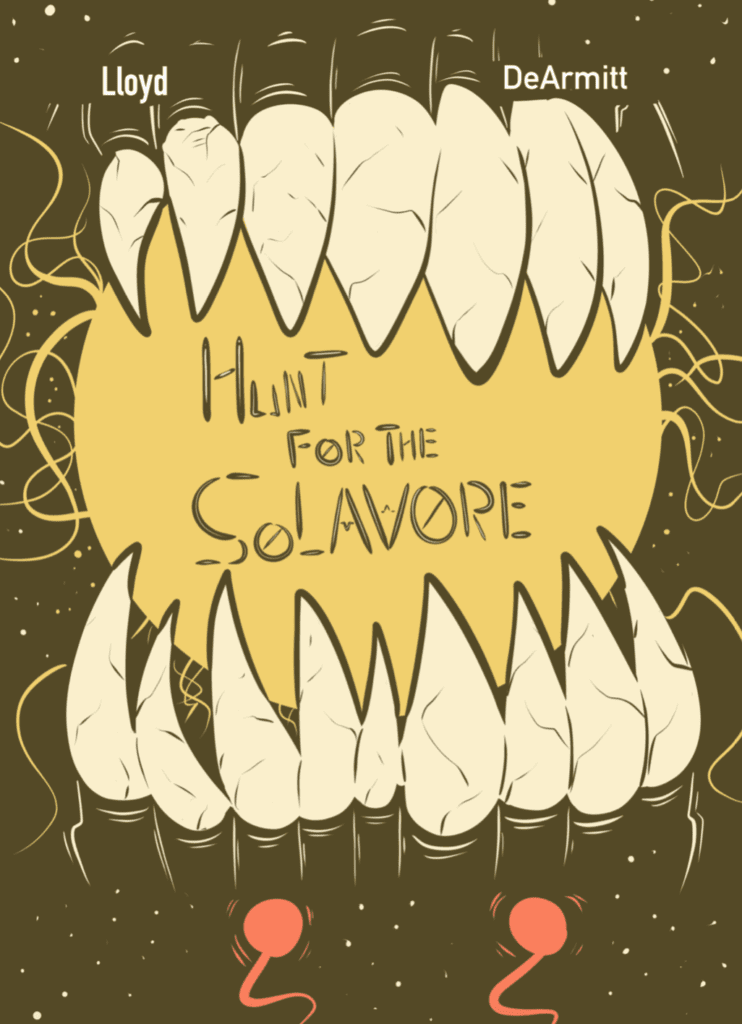
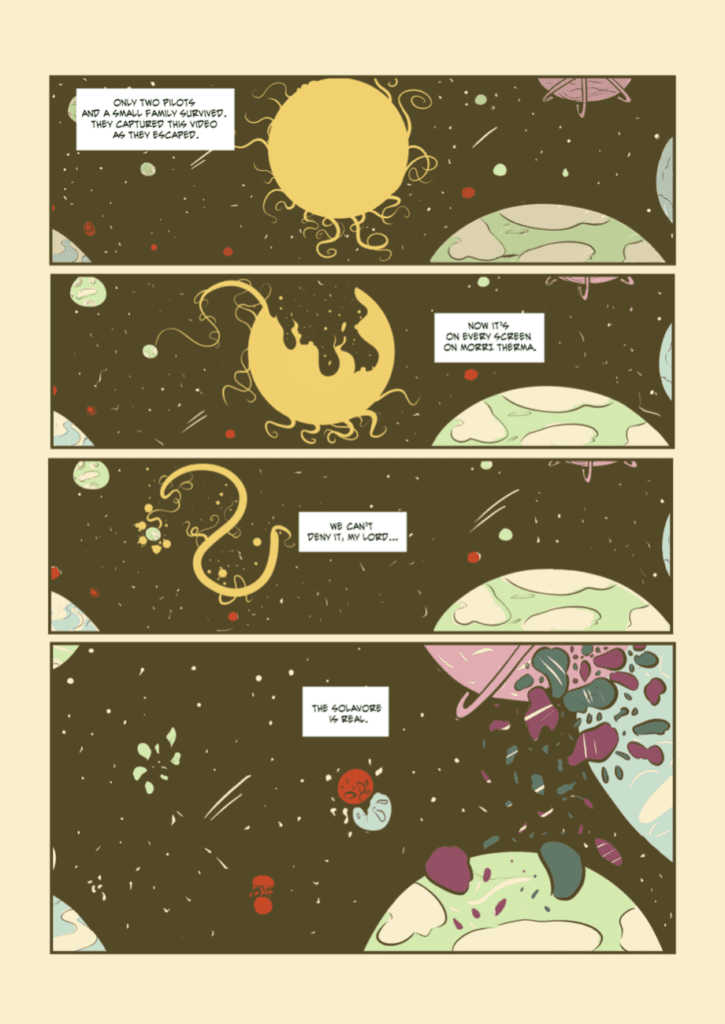
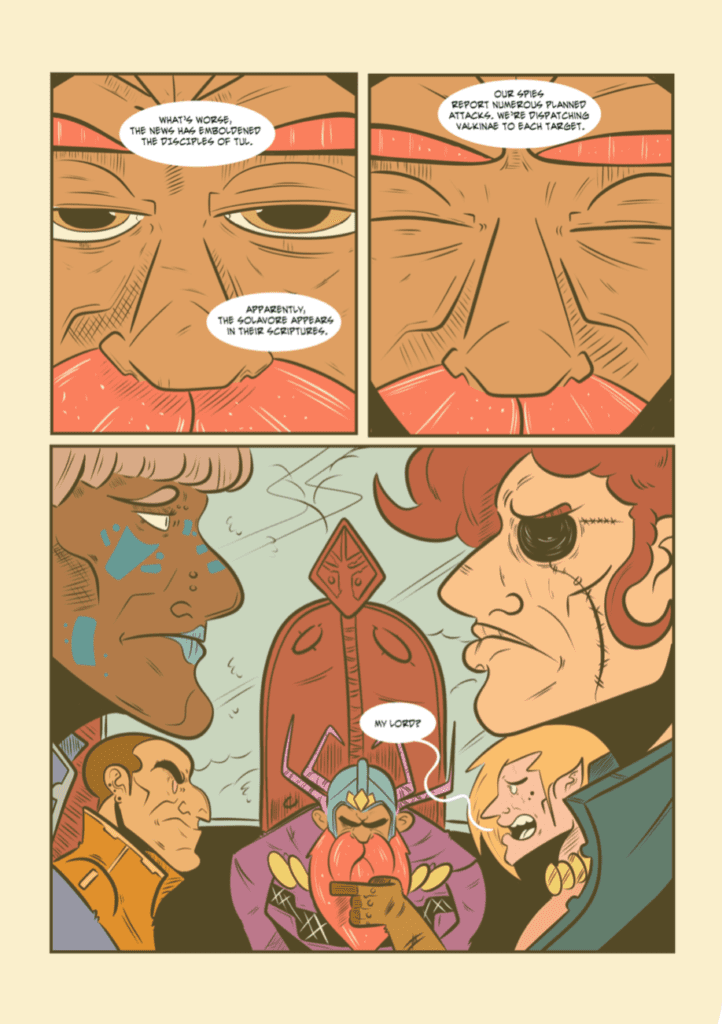
Writer Grant DeArmitt and artist/colorist/letterer Lane Lloyd’s story of cosmic horror, Hunt for the Solavore, is a brilliant mix of the subtle and the bombastic. With a script that keeps cards close to the vest, and a crazy no-holds-barred art style, this is a comic you won’t soon forget.
About Hunt for the Solavore:
A 42-page sci-fi saga about a beast that devours suns… and the king who dares to defy it.
Writing
DeArmitt wastes no time throwing us into the action. From page one, we are immediately following a family, running from something that is destroying their planet. Danger is everywhere and the stakes are high. But then, DeArmitt brings the pace to a sudden stop. We go from planets ending to a tired, old king. It’s a jarring transition, and deliberately so. DeArmitt keeps the reader’s attention, by shifting gears so suddenly, yet so seamlessly. And the script remains just as entrancing. DeArmitt speaks through the silences almost more than he speaks through the dialogue. It’s what is left unsaid that tells us everything we need to know about the characters and what they fear.
Really, this script has everything you could want. We get large, sci-fi level stakes, subtle human moments, and scenes of terrifying horror. DeArmitt manages to take all of these ingredients, and a truckload of some of the best world-building you’ll see, and squeezes them into a sleek 42 pages. Yet none of it feels rushed or busy. That’s because DeArmitt trusts his audience with a minimalistic script, with rarely more than a single word balloon per panel. DeArmitt is a writer who tells his stories in the margins and pauses of a comic.
Art & Coloring
Where DeArmitt’s approach to this story is subtle and simplified, Lloyd’s is vibrant and full of cartoony flare. At first glance, it seems like it’s the big action sequences in which Lloyd is in their element. They brilliantly show planets exploding and soldiers gearing up for war. But it’s in the smaller moments where Lloyd’s work really shines. These moments stand in such contrast to Lloyd’s wild art style, that they stand out as the quiet, beautiful moments that they are. When King Theosis, our protagonist, is closing his eyes at the sound of bad news, or when he stares back at his home planet and we can see his worried look in the reflection on the window, these are the moments that stick with you. But so does the horror of the Solavore. Its twisted body and its playful attitude when it comes to carnage, shown in how it looks almost as though it is celebrating through the battle, will keep you up at night.
Lloyd’s color palette is quite simple. They stick to reds, blues, purples and browns, giving the whole comic a uniform feel. But it’s in the woods, with a darker shade to the color palette, that the Solavore’s brilliant red eyes pierce through the night. Lloyd uses simple choices and a minimalist color scheme to devastating effect.
Hunt for the Solavore is a dance of subtle writing and crazy visuals. Hopefully, we’ll see lots more of Grant DeArmitt and Lane Lloyd’s work. For now, Hunt for the Solavore has gone out in digital format to backers of their Kickstarter and will be sent out in print in the following months. You can still get your copies at Lane Lloyd’s Gumroad. Follow Grant and Lane’s work on Twitter to support them, and check out MFR’s interview with them, back when they were just starting work on Hunt for the Solavore.
Robert Myer Burnett is an editor, producer, writer, and YouTube host of The Burnettwork where he has a lot to say about Star Trek, Star Wars, the MCU, and all things pop culture.
Robert delivers new episodes of his show every week. On it, he’ll cover the latest releases from Marvel, Disney, Warner Brothers, and the rest of mainstream Hollywood. Like many YouTubers commenting on film and television franchises with a big fanbase, Robert can be polarizing to some and insightful to others. He’s a man who’s a lifelong fan of things like Star Trek and Star Wars but also one who’s worked for decades behind-the-scenes on films like Lord of the Rings or Superman Returns and directed a movie with a guest appearance by William Shatner.
PopAxiom and Robert Myer Burnett, the tongue-in-cheek self-professed viceroy of verisimilitude and imagination connoisseur, spoke about going from fan to filmmaker and his upcoming movie Tango Shalom.
Loved Everything
“I wanted to make movies my whole life,” Robert begins the story of his connection to filmed storytelling. “The original Star Trek is the first thing I remember watching as a kid. I was enamored. Because of that, I watched anything to do with science fiction, fantasy, and horror.”
Robert grew up in Seattle, and “there was ‘Sci-Fi Theater’ on Sundays on Channel 11. I would come back from Sunday School and watch whatever was on. When I was five years old, I watched War of the Worlds for the first time. That was it, man. After I saw that, I loved movies.”
“Twilight Zone, Outer Limits, Star Trek, Hammer movies, all the 50s sci-fi, and Ray Harryhausen” are some of the early influences on Robert. “I wanted to do that, but I didn’t know it was possible to get into as a job.”
Now ten years old, things changed with the release of Star Wars “and everything in the wake of Star Wars, all the books on making the film, the documentary on the making. Suddenly, I’m seeing all this material being made about how movies are being made. I started reading Star Log magazine and Fangoria. Cinefantastique and in 1980, CineFX magazine came out which talked about visual effects. Starlog had a sister publication called CineMagic about movie-making. I was gone after that. By the time I was 11 or 12, I wanted to make movies.”
“At the same time,” he continues, “home video started to take off. For the very first time, you could own movies. I worked in one of the first video stores in Seattle. At that time, you could rent a movie for a month. Then, you would take it home, keep it for a month, and then buy the movie if you wanted for like fifty or sixty bucks.”
Between getting cable and having a VCR, Robert could “start studying movies. So, that’s what I did. I became completely enamored of movie-making. I worked in home video from the time I was 13 in 1980 to 1988. I loved everything about it.”
Special Features
The movie business includes many jobs, including entire companies devoted to working on special features for films released on laserdisc and DVD. “A friend of mine started a company called Kurtti-Pellerin producing laserdisc content,” Robert explains, “The laserdisc format starting in 84 with Criterion, their first releases were King Kong and Citizen Kane, they were the first laserdiscs that had special features. Throughout the 80s and 90s, special features were on laserdisc.”
In the 90s, Robert says he “moved to LA, I’d gone to film school, and I was working on low-budget movies. I started as the art department production assistant on Texas Chainsaw Massacre 3. In 99, I wrote and directed my first film, Free Enterprise. Pioneer Entertainment acquired our film for home video, for laserdisc, and then DVD. So, I made my first documentary for laserdisc. I’d done a few while I worked at a company called Full Moon as an editor. I’d done some special features for their videotapes and laser discs.”
“The company began exclusively working for Disney,” he continues, “In the early 00s, we were working on these extensive DVD special editions, which was the natural progression of the laserdisc stuff we were doing, and then we were awarded Lord of the Rings.”
The rise of DVD and BluRay created a healthy market for special features. “An MGM executive called me up one day asking if I’d produce the DVD for The Usual Suspects. I took it to Michael Pellerin, and he suggested I do it on my own. So, I started my own company Ludivico Technique, and we started doing DVD special editions. We did The Usual Suspects, X-Men 1 & 2, Valley Girl, and at the same time, I was working on things like Lord of the Rings and Tron.”
Embedded
Producing content for special features had Robert “traveling worldwide to shoot behind the scenes stuff.”
“One of the things I was able to do with my DVD or BluRay producing,” he says, “was that I would get embedded with productions. When I worked on The Lion, The Witch, and The Wardrobe, which shot in New Zealand, I was there for fourteen months.”
From the world of Narnia, Robert hopped over to Australia for Superman Returns. “I made a three-hour documentary on the making of that film. I was in Australia for 11 months. I was on set every day watching these movies getting made.”
About Tango Shalom
Robert’s latest film project is Tango Shalom which he helped produce, edit, and was VFX and post-production supervisor. “I was waiting for my car at the Rosevelt Hotel in Hollywood,” he begins the story of how he became part of the Tango Shalom team. “There was an AFM, American Film Market event where people come together to sell films to distributors.”
“A woman was waiting for her car,” he continues, “and we struck up a conversation. She was a producer on this movie, and they didn’t have an editor. She’s had it sitting on the shelf for almost a year. I said, ‘I’m a film editor.’ She gave me the director’s name, and suddenly I’m working on this movie.”
Making movies is not an exact science, especially when working in the independent realm. “As happens with independent film, you have to raise money and do what you can and then raise more money. So, we put it on the festival circuit. It had its world premiere in Jaipur, India, where it won some awards; it’s played in Turkey and Morocco. Now, it’s come to America. It’s been picked up for distribution by Vision Films, and it’s been great.”
So what is Tango Shalom? “It’s a low-budget movie, and it’s the story of a married Hasidic rabbi who believes he’s heard the word of God and God has told him to alleviate his financial difficulties and learn to dance the tango. Being that he’s a Hasidic rabbi, he’s not allowed to touch another woman other than his wife, but she doesn’t know how to tango.”
“He ends up coming across a young, sexy tango instructor,” Robert explains. “He has to figure out a way that she can help him achieve his goal of learning the tango and perhaps using that to alleviate his financial problems.:
“Tango Shalom gets a limited theatrical release on September 3rd in New York and LA; hopefully, it’ll expand, and then it goes to VOD at the end of October.”
YouTube
Three decades of working in the film and television industry and counting, how did YouTube become part of Robert’s creative endeavors? “In 2015, a friend of mine named John Schnepp, who passed away three years ago, was doing a show with John Campea on AMC, and then it moved to Collider. He asked me if I wanted to be a guest one day. Then, he kept inviting me back, and I became a series regular. We did it for three and a half years until he passed away. He was always telling me, ‘You should start your own channel.’
Robert had doubts about doing it on his own. “I said, ‘really?’ I’m kind of old, and do I want to get in on YouTube? He said, ‘You’ve already been doing it for three years.’ My girlfriend bought me a microphone and said, ‘It’s time.'”
“I didn’t know what I was going to do,” he explains of his approaching streaming life. “So, I talked about my industry experience and not review movies but talk about them and what I liked. I started regularly in late 2018 and all through the pandemic, and here I am, over a thousand episodes.”
Robert credits YouTube with doing something quite profound. “YouTube got me more in touch with my filmmaking and the audience. It re-ignited my passion for filmmaking because so many times you can get beat down by the industry.”
“Usually, since I do a morning show with John Campea about news, doing that and opining on the news of the day is not what I want to discuss,” he says about his approach to his show. “I like to talk about things philosophically and from a business perspective about what it all means. That’s kind of where I’m always coming from. We like all this stuff, but what does it mean in the larger context?”
Robert never thought he’d be discussing the industry on YouTube. “But I like the industry, I like the way that it works, and I like making films. I’m a big fan of all this stuff, so the YouTube channel was a natural extension.”