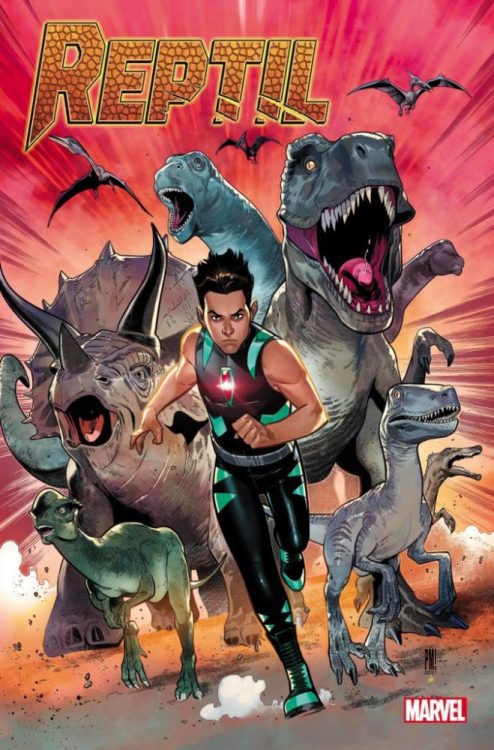
Marvel Comics’ Reptil #4 closes out the miniseries on a high note. Between a climatic battle against the series’ main villain and the title character’s concerns about his self control, there’s a strong sense of familial comfort in Mexican pride.
Background
Humberto Lopez (a.k.a. Reptil) just wanted to keep his head down after events like King In Black. Only for a new villain, Megalith, to hold what’s left of Reptil’s parents hostage for the source of his dinosaur shapeshifting power.
Reptil #4: Viva La Familia
Writer Terry Blas keeps Reptil #4 dedicated to the idea of a greater family as a form of empowerment. Seeing Berto with his family and community feels absolutely serene. So when Megalith arrives for Berto, there’s a genuine sense of intrusion. Having the entire Latin community stand with Reptil feels like authentic support.
This issue builds on everything in the previous three issues for a grand finale. Seeing Reptil assume the form of a Quetzalcoatlus isn’t just a resolution on his arc for self control, it’s a callback to earlier in the series with Berto’s parents. It feels like the end of one journey so a new one can begin.
Strike With Art
All of the artists of Reptil #4 play their parts in bringing out the very best in this series. Enid Balam’s pencils make the costumes, dinosaurs, and monster forms notable enough to remember. It certainly helps that every major character in this issue stands out further with bolder lines from Victor Olazaba’s inking. Not to mention the eye-catching colors of Reptil’s dinosaur forms and Megalith’s golems from Carlos Lopez.
Joe Sabino gives each line of dialogue a great bit of importance in Reptil #4 through fonts. Like when Berto speaks Spanish, the italics and lack of translation caption gives the impression of the community coming together against Megalith’s assault. That’s not even including how a stylized sound effect from Reptil’s Parasaurolophus form communicates with dinosaurs.
Take A Gander At Reptil #4
Reptil #4 completes a heartwarming empowerment story via a greater family. The way the title character communicates with others speaks volumes on aspirational identity. Through the efforts of the creatives, there’s a strong sense of artistic expression. Building upon everything that comes before in this series also leads to a grand finale.
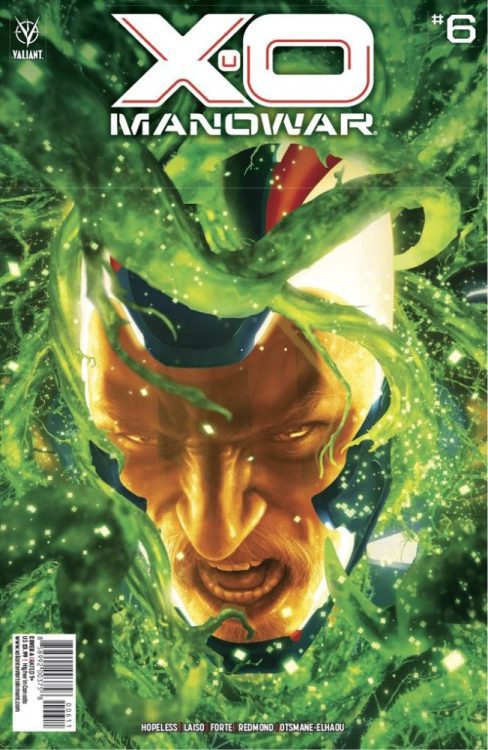
X-O Manowar #6 from Valiant Entertainment is out in comic stores now. Since issue 3, a plot has been developing that threatens the mundane life of Aric via his suit Shanhara. The revelation that something’s wrong boils to the surface with carefully paced reactions the reader catches onto.
Background
Aric of Dacia (a.k.a. X-O Manowar) works with billionaire Troy Whitaker to combat a nanite swarm. But after a near-death scenario, Aric’s suit Shanhara is in need of rest.
X-O Manowar #6: An Uneasy Recovery
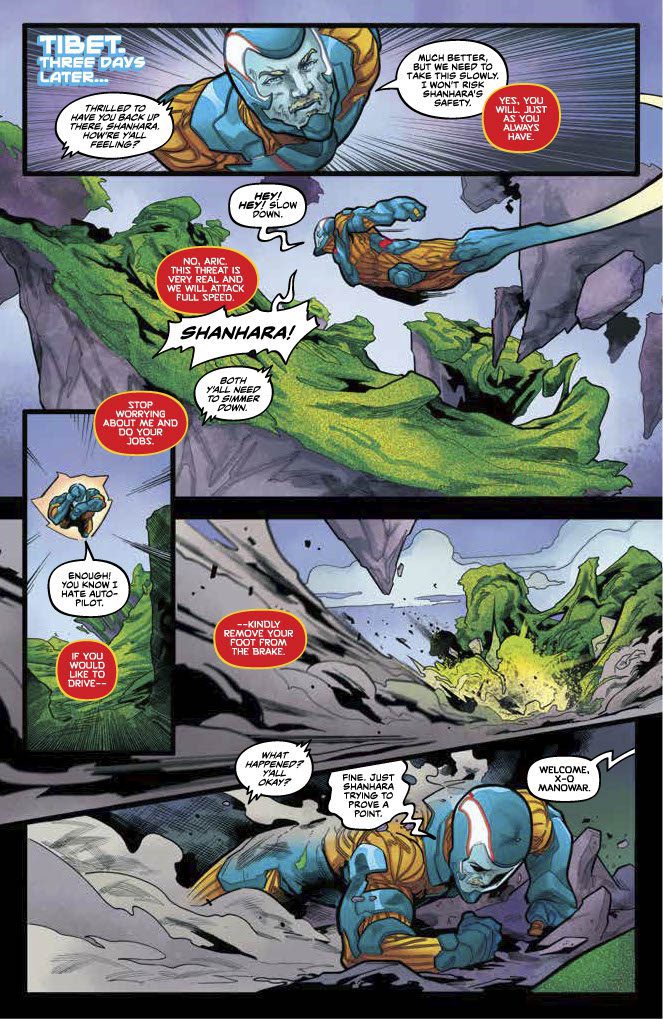
Dennis Hopeless continues the quietness of last issue into X-O Manowar #6 before moving into a major twist. At first, things seem still with Shanhara’s recovery, even dedicating a few pages to her and Aric taking downtime by rebuilding damage from issues back. Seeing the alien armor back in action feels genuinely rewarding. That is until the reader notices how Shanhara’s personality change since issue 4 affects the people around her. Seeing how dominating she gets with Aric to confront the nanite swarm feels disarming.
Check Out The Details
The art of X-O Manowar #6 tells most of the issue’s story. Emilio Laiso seems to having fun with the illustrations, like when Shanhara covers Aric’s head with a large ball. The way characters react to this funny moment is fitting after a moment of fear. Raffaele Forte’s inking emboldens theses reactions to add depth and impact to these moments and drive them home.
As for the issue’s direction, Ruth Redmond’s coloring and Hassan Otsmane-Elhaou’s lettering does most of the work. The background coloring sets up most of the atmosphere with floating mountains covered in moss-like nanites catching the readers attention. The lettering then smoothly guides the reader as characters exchange dialogue. Perhaps the most notable contribution however is how Shanhara’s voice is presented. Her red word balloons make her sound assertive and vindictive, unlike the return of her blue word balloon that’s full of concern.
Prepare Yourself With X-O Manowar #6
X-O Manowar #6 is getting into the real crux of the series’ run. There’s a well balanced plot in terms of pacing, with an even more impressive payoff. Through juxtaposition and eye-catchingly evocative artwork it sucks the readers in with a great plot. It all but doubles the anticipation for next issue.
Welcome to Self-Published Spotlight, a regular interview column where I will be highlighting self-published comics and the creators and small print publishers who make them.
When I laid eyes on the artwork of Rick Lopez’s comic, The Power, I was immediately blown away. My reaction was so visceral I knew it was a book and artist I had to follow. I reached out to Rick and we started communicating about comics, his work, and art in general. It was only a matter of time before I featured Rick in this column. So check out our chat and definitely head over to Rick’s online shop and pick up The Power!
Monkeys Fighting Robots: Rick, first off I know how busy you get, so thanks for taking the time to chat!
Rick Lopez: Absolutely! No problem at all, thanks for having me!
MFR: So what’s your comics’ secret origin? How did you get into the medium?
RL: Honestly, they were always around. I had a stack of Disney comics as a kid I loved, the hero comics were a bit harder to come by for me amidst the speculator boom though. Barnes and Noble was my LCS long before we got a legitimate shop in my area.
MFR: And when did you decide to start creating your own comics?
RL: For a few years I thought I’d just be writing comics and other people would draw my books. I had someone in line to draw The Power and it fell through. I did the script and thumbnails already so I just started it myself in early 2019 and learned a lot, Image Grand Design really changed the game for me though.
MFR: Let’s jump right into The Power. Can you give our readers a synopsis?
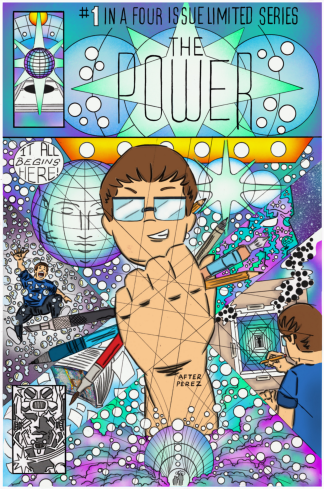
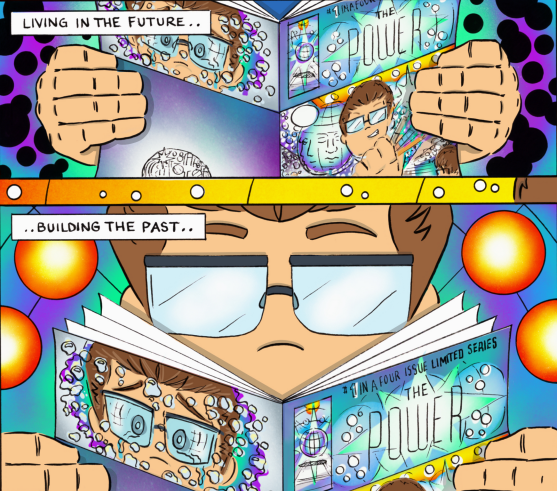
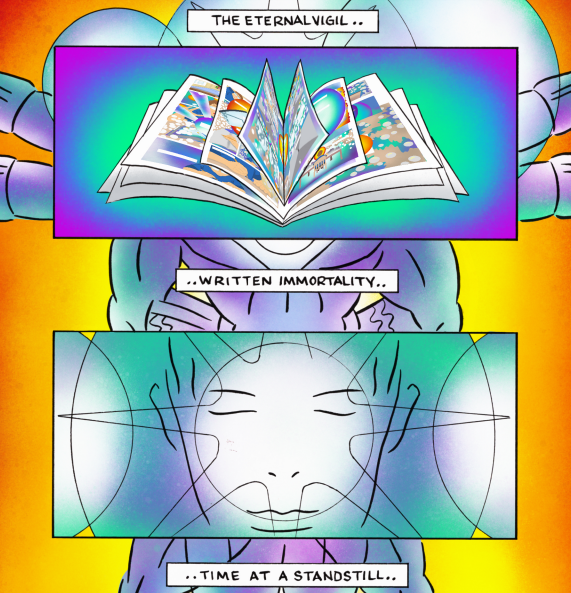
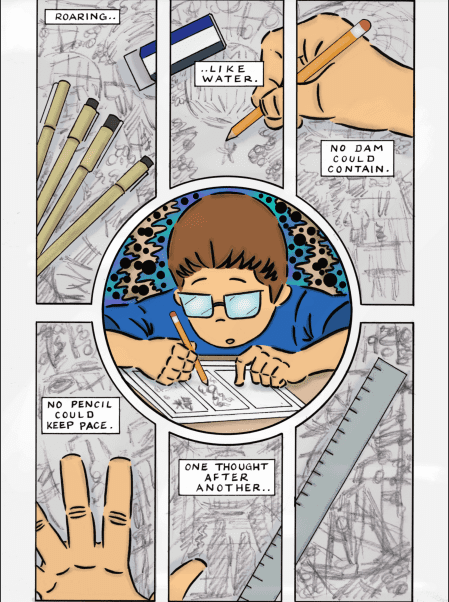
RL: The Power is a four-issue limited series about a boy creating a comic, only to discover a realm beyond space and time.. within his own mind! So it’s focused around the creation process and while we work we drift off to another more ethereal plane in our minds.
MFR: The art in The Power blew me away. Specifically, the colors and layouts, which seem to be a huge focus for you. What is it about these two elements that draws you to focus so much on them?
RL: Thank you, I really appreciate that! I think specifically with The PowerI’m trying to represent (the best that I can) those inner planes of the mind and the meta capabilities of the medium through the layouts and the colors so that in and of itself makes them so important.
MFR: Did you have any specific influences on The Power? What artists/books did you look at for inspiration?
RL: Grant Morrison is a huge inspiration to me in general, I would definitely say Morrison’s run on Animal Man and the Flex Mentallo mini-series are inherent influences on The Power.
MFR: I freaking love your homage covers. You’ve done Infinity Gauntlet #1 for issue one and the classic Miller Wolverine #1 for issue two. Why did you decide to do these homage covers and did you have others in mind? What other homage covers can we expect if you care to tease?
RL: The homages are a lot of fun to do but I also think it adds a bit of recognition to the book even just at a cover glance. I wanted to use as much from comics as I could really. Initially had planned on using a New Gods cover for #3 but opted for a Green Lantern Darryl Banks cover that I felt lent itself better for my book. That being said I have two Kirby covers planned four-issue 4 and the trade is still to come.
MFR: What’s your progression and creative process like? What’s the first thing you do when you decide to put pencil/pen to paper? What tools do you use?
RL: Usually I’ll thumbnail my ideas pretty small on scratch paper, scan those in, blown them up/move things around on Procreate, print onto 11×17 Bristol board, clean the pencils up a bit then I’ll use my light pad with another bristol to ink/tone the pages and scan them back onto procreate for colors and clean up. I think using both [digital and analog] is the key, I know a lot of people are going full digital but I can’t give up that human look and the original art that you get from inking traditionally. There are these Pilot double brush pens that I’m obsessed with and recommend a lot and the Uniball white signo pen is another amazing tool I use with every piece. Then of course Ticonderoga and Staedtler pencils, mechanical pencil, microns, deleter screentones, Ames lettering guide and procreate are all staples at the desk as well.
MFR: Was self-publishing always the route you were going with? Or did you have other publishing methods in mind?
RL: I think self-publishing was always the option, I kind of thought I would release everything all at once with The Power and got really far with layouts and pencils but ultimately I don’t think that was the best idea.
MFR: Self-Publishing, in general, is on a huge upswing. Patreon, Kickstarter and now Substack. As a creator, why do you think self-publishing is growing?
RL: I think a lot of creators are tired of giving away their best ideas to companies for them to own. We have all these apps at our fingertips to grow our own audience and reader base. We can make our Patreon, Kickstart our books and get the net big enough to live off of our own ideas without compromising to a corporation. Image Comics showed us this 30 years ago.
MFR: Besides The Power, what else have you worked on? And what else are you hoping to work on?
RL: My first works were 14 pages in Image Grand Design, I did a page in the Weapon Ecch book and another page for the upcoming BMN Year Wha book (that I need to finish), as well as 4 pages coming up in Wizerd #2 from Cosmic Lion Eli Schwab later this year. Craig CK and myself co-founded Next Panel Press, which is a bi-weekly collective of strips from a group of artists across the globe. My strip Cosmicat, is about a joint smoking feline outlaw making his way across the galaxy, as past, present, and future all begin to unfold around him! The 17th strip is about to drop this weekend so nearly enough to collect into a single issue. I collected the first seven into mini-comics I’ve been giving out with book orders though.
MFR: Where can our readers find you and your work?
RL:
There’s Someone Inside Your House is a fun yet all too familiar teen slasher film. It premiered this week at Fantastic Fest and while there’s more that worked, versus what didn’t, this movie is not breaking any new ground. Horror fans are getting spoiled this year with slashers films, and now another solid effort has joined in. There’s Someone Inside Your House might not make a lasting impression but it’s a solid horror film with a strong lead performance.
The late ’90s certainly sparked a slasher film craze with classics like Urban Legend and I Know What You Did Last Summer. More recently, slashers have been making a comeback. There’s Someone Inside Your House is the latest gem horror fans should love watching this Halloween season. Directed by Patrick Brice and written by Henry Gayden. The film stars Sydney Park, Theodore Pellerin, Asjha Cooper, Burkely Duffield, Dale Whibley, Diego Josef, and Jessie LaTourette.
There’s Someone Inside Your House follows Makani Young (Park), a senior in high school with a secret she’s ashamed of. Makani’s efforts to hide that secret are put in jeopardy when a killer terrorizes the town of Osborne, Nebraska. Her classmates are picked off one by one and the killer is determined to expose their victim’s secrets along the way. The killer doesn’t want a confession from anyone, they just want to brutalize and expose. Gayden probably relies too much on nostalgia, which could ruin the film for some. But this diverse group of teens makes for a gory good time.
Sydney moved to Nebraska to finish out high school after a traumatic experience at her old school. Now living with her grandmother, she hopes to shed her past and have a fun senior year with friends. Gayden’s screenplay provides audiences with a shy, reserved, yet smart final girl to invest in. Her group of friends each adds their charm to the overall experience. There’s Someone Inside Your House throws in several horror cliches. A popular student is killed at the start. The aftermath results in a town curfew, and an obvious red herring who won’t be the killer. Makani’s keeping more than one secret from her friends.
During the summer break, she was seeing Oliver (Pellerin), a local teen who is ridiculed at school. Since their split, he can’t seem to let her go. His behavior will tip-off horror audiences as the obvious red herring. Instantly filling out Billy Loomis criteria usually means his sketchy behavior rules him out as a suspect. Gory would be an understatement when describing the kills, but most are pretty bland. Nothing horror enthusiasts haven’t already seen before. Adapted from Stephanie Perkin’s novel, There’s Someone Inside Your House isn’t treading new territory. But the inclusion of social media shakes it up enough for a new generation of horror fans.
Unfortunately, the fun doesn’t get wrapped up satisfyingly and had the film’s finale played out differently, it could have been saved. Parks is incredible as Makani and the character’s growth is great to witness. Pellerin’s performance as Oliver is solid, but his red herring status is too obvious. Although he does capture the off-putting nature of Oliver adequately enough. Brice’s direction, while effective, provides no moments of tension. There are some wonderfully captured kills, but a sense of danger never kicks in. Its pacing is flawless though and there’s never a dull moment.
There’s Someone Inside Your House is an entertaining teen slasher film for today’s generation. Capturing the vibe of ’90s horror might be enough for older audiences to have fun with it. It’s an engaging horror film with a strong cast that keeps the film exciting during all the bloodshed in between. The film might be forgotten in a couple of years, but some horror fans might add it to their yearly watch list.
There’s Someone Inside Your House releases on Netflix on October 6, 2021.
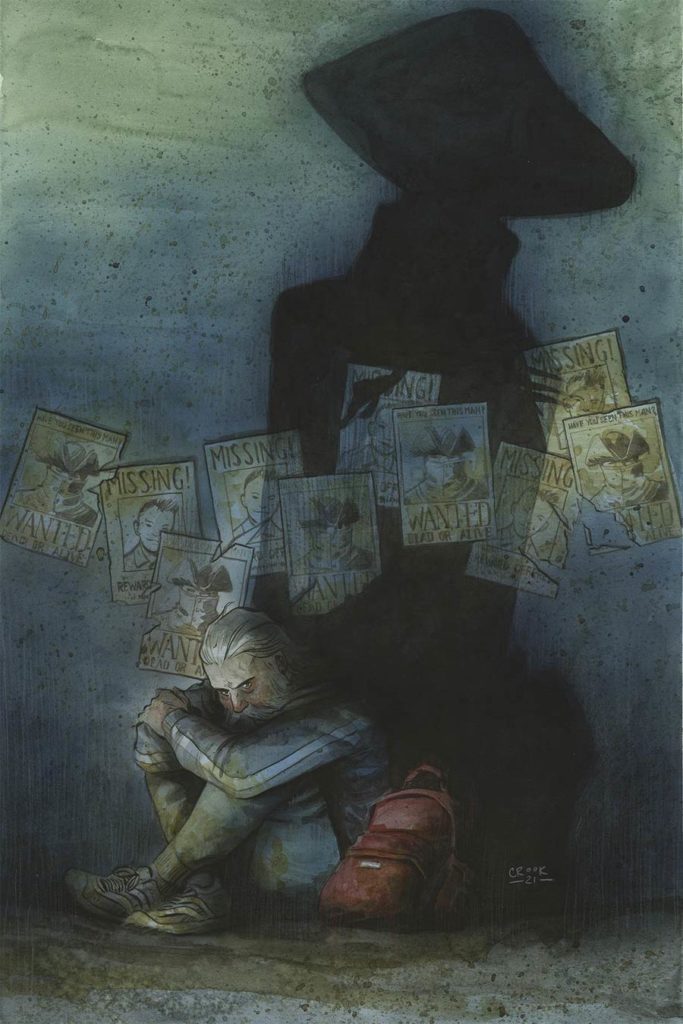
Writer Cullen Bunn (Harrow County, Dark Ark) and artist Andrea Mutti finish their dream-walking miniseries with Parasomnia #4. Though still unclear as to what’s truly happening here, this finale is less frustratingly vague about its plot and brings itself to a semi-ending that teases more to come. With a tightly paced script and atmospheric visuals, this issue seals Parasomnia as a wholly unique horror read that hopefully recerives a proper conclusion soon.
“As the nameless stranger battles nightmares in a dream world on his hunt for his missing son–his life and his family’s in the real world continue to fall apart in this chilling conclusion to this supernatural and melancholy tale.”
Writing & Plot
Cullen Bunn’s script for Parasomnia #4 succeeds partially for being more focused than its predecessors. There is a tighter focus on the parallels between the real world and the dream – and the lack of distance between them. This discrepancy has always been a part of this comic, but it’s always felt too clouded to be fully engaging. Issue #4 takes these points in the narrative and sharpens them to a climactic point. The story of our mask and tri-horned hat-donning protagonist is still a mystery, but his connection with reality is becoming clearer. Bunn’s pacing is consistently tense and pulls the reader along at a brisk, exciting speed.
The dialogue writing is at the perfect amount, just enough to get a feel for the characters but not enough to bog down the story. There’s a mythic intensity to how Bunn presents the dialogue of protagonist and his (presumably) Native American ally. This comic feels like a mix between a lone hero story along the lines of Conan or Berserk. However, it’s treated obviously mixed in with a supernatural thriller and familial horror story. The fact that this is the final issue of this specific series is both bold and odd. Without getting into spoilers, don’t expect any sense of finality when you finish this comic. I hope whatever Bunn has planned next arrives hot on the heels of this miniseries.
Art Direction
The most alluring aspect of Parasomnia has always been Andrea Mutti’s visuals. Here on this final issue, this fact remains. Mutti’s pencils and colors create a brilliant atmosphere and tone for this dream-walking thriller series. His thin penciling allows for fine character detail, shown in careful creases and expressions on every panel. The environments appear deceptively empty, but this is due to how Mutti creates the world here. His colors are made of hazy clouds of single hues that dominate entire sequences. Pages will turn from light greens to rustic browns then to purple without warning. This is a delightfully creative way to create the dreamscape feeling this comic needs. The lettering from Simon Bowland, who lends his incredible talent to The Dreaming, seems to have an easier job here. His contemporary fonts alter just enough to capture tone, but there’s nothing drastic here. Overall, this remains a tonally rich comic that other horror comic artists may want to take note of.
Verdict
Parasomnia #4 is a good comic but a bad ending. Bunn writes the most well-paced and entertaining script of this miniseries, but offers a conclusion with no finality. The moody and atmospheric visual work of Andrea Mutti continue to please and make for this comic’s best selling point. If there is truly more to come from this story, I hope it arrives soon. Be sure to grab this finale when it hits shelves on 9/29.
Dear Evan Hansen mixes strong performances with a questionable story addressing mental health issues. Based on the popular stage musical, this film adaptation provides an interesting protagonist whose motivations make it difficult to feel towards him. While the musical aspect is executed tremendously, certain moments of singing feel ill-timed. Dear Evan Hansen was a huge hit back in 2015, but this movie is destined to leave audiences divided because of how it handles the subject matter.
Mental health issues plague many people day in and day out and for Evan, it’s his social anxiety. What begins as a dramatic story about a teenager struggling to fit in becomes a manipulative game. Sure, the film will have audiences contemplating tough subjects. But Evan’s character progresses into an unlikeable person to have the film centered on. Directed by Stephen Chbosky and written by Steven Levenson, Dear Evan Hansen stars Ben Platt, Amy Adams, Julianne Moore, Kaitlyn Dever, Amandla Stenberg, and Colton Ryan.
The film follows Evan Hansen (Platt), a teen trying to cope with social anxiety by writing letters to himself after his therapist recommends it. Evan’s letter ends up in the hands of Connor (Ryan), a classmate who commits suicide. This event takes Evan on a journey that allows him to finally be accepted by his peers. Details disclosed about Evan throughout this film are in great supply, and that’s not an exaggeration. Evan is in high school, has social anxiety, goes to therapy, and might be a sociopath. His relationship with his mother (Moore) is almost nonexistent because he believes himself to be a bad son.
Dear Evan Hansen wants to take audiences on this self-discovery mission with Evan, but how it unfolds will make it a hard watch for some. The character of Evan is well developed, and there is a lesson he learns from this. However, Evan’s likable qualities are undone by his manipulative behavior in an attempt to finally be accepted. It does speak to how troubled he is, which should make him likable, but the lives he’s playing with are what creates an issue. Connor’s family is played like fools while Evan propels himself to social acceptance. Levenson’s screenplay is equally frustrating and thought-provoking, so it doesn’t translate into an enjoyable watch.
It’s not a poorly made movie, but its message is lost in the events that unfold on screen. Platt reprises his role as Evan Hansen and fans of the play should enjoy this aspect. He delivers a great performance as Evan and the singing along the way keeps you invested in the progression of this character. The performances are incredible to watch on screen. Platt’s age might be an issue for some, but he’s believable in this role. Chobsky’s direction keeps emotions high throughout most of this two-hour-long film. But when the vocals kick in, audiences might find it difficult to grow attached to any of these characters.
When the vocals kick in, all eyes and ears will be locked into each word. Some moments, such as when Evan’s lies are exposed, make the exceptional vocals feel out of place and unnecessary. It could be argued that the musical aspect should have been abandoned, but that could have been too big of a departure from the source material. Dear Evan Hansen impresses and then it disappoints, sometimes all at once during certain scenes. A compelling film that could have addressed mental health in a better way.
Dear Evan Hansen will leave audiences divided and that will at least spark important conversations. Strong performances keep you engaged, but the character of Evan isn’t going to sit right with many viewers. The success that the coming-of-age stage musical had won’t translate the same for this film adaptation. Dear Evan Hansen is a mixed bag that will have audiences talking.
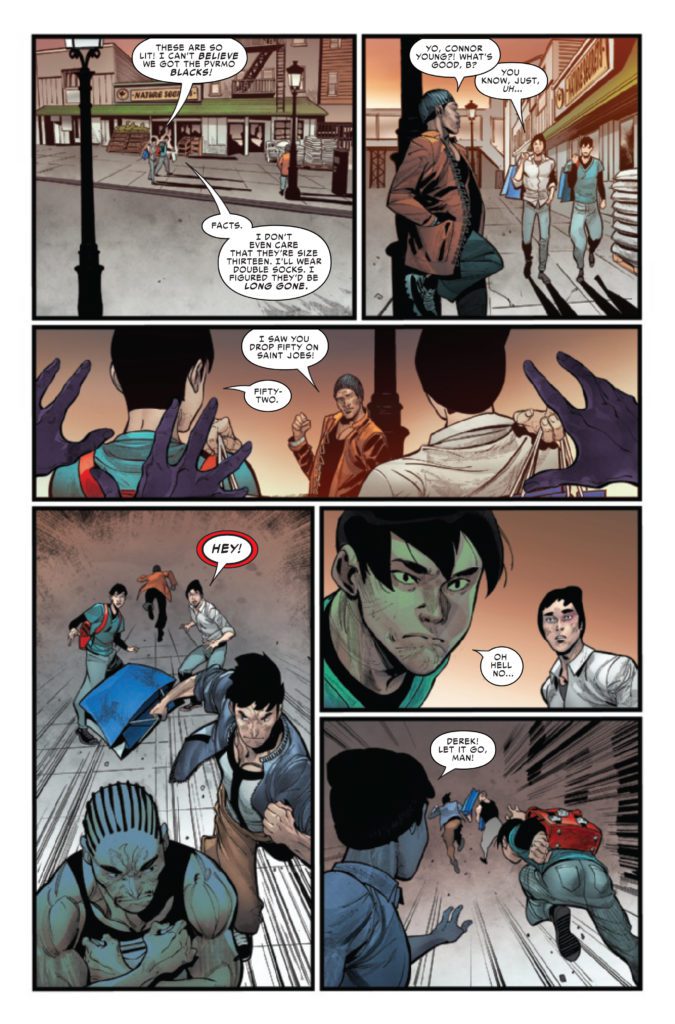
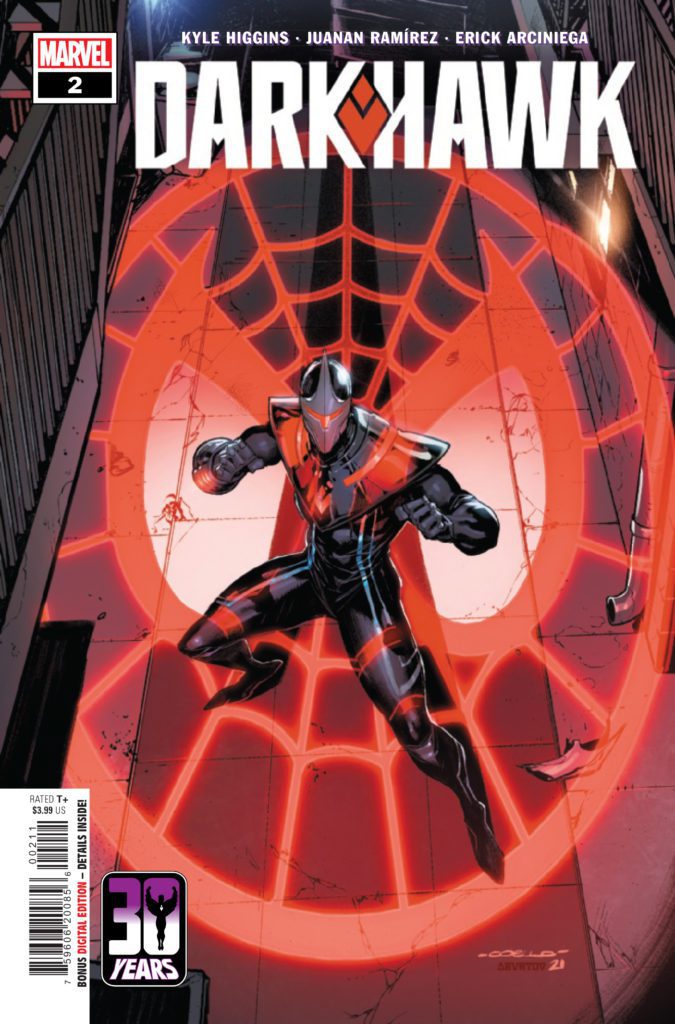
DARKHAWK #2 hits your local comic book store September 29th, but thanks to Marvel Comics, Monkeys Fighting Robots has an exclusive three-page preview for you.
About the issue: Connor Young: star point guard, recently diagnosed with MS and the new armored hero, DARKHAWK! But why was he chosen? Was it destiny? Fate? A cosmic coincidence? And what does it mean for his path forward? He’ll need to figure that out soon, before he has a run in with a certain web-slinger…
The issue is by writer Kyle Higgins and artist Juanan Ramírez, with colors by Erick Arciniega, and letters by Travis Lanham. The main cover is by Iban Coello and Jesus Aburtov.
Marvel is celebrating 30 years of Darkhawk. The character was created by Tom DeFalco and Mike Manley, and first appeared in Darkhawk #1 in 1991
Check out the DARKHAWK #2 preview below:
What’s your favorite Darkhawk story? Sound off in the comments!
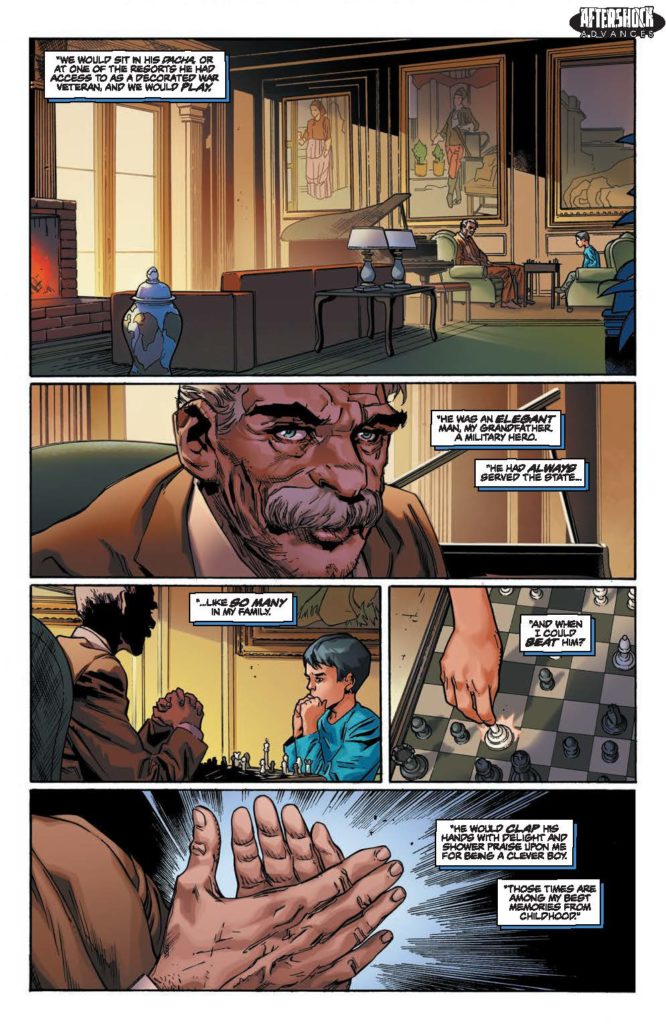
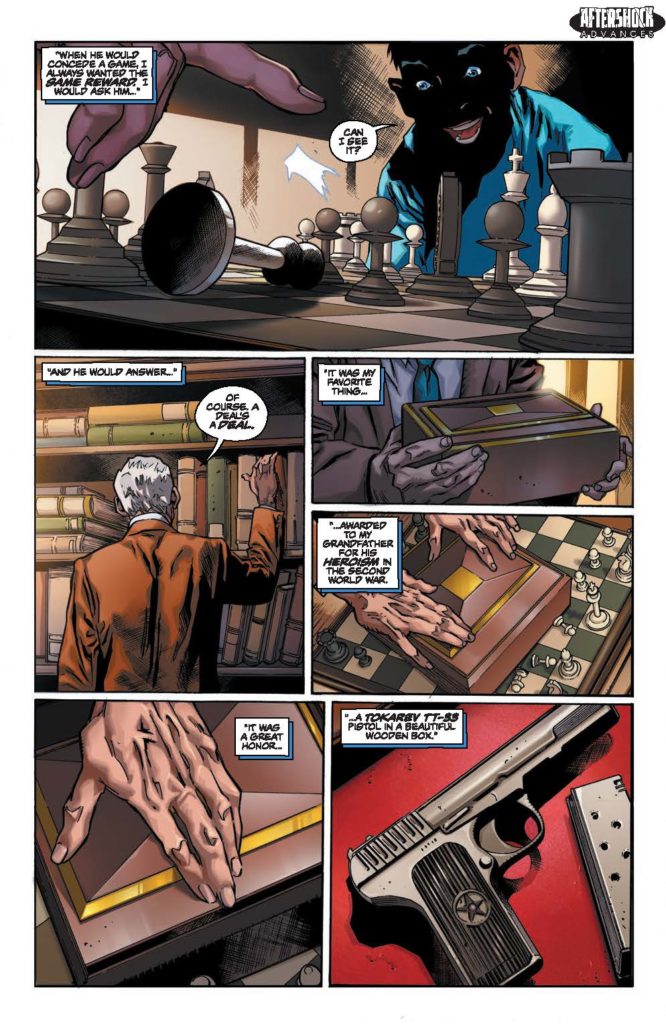
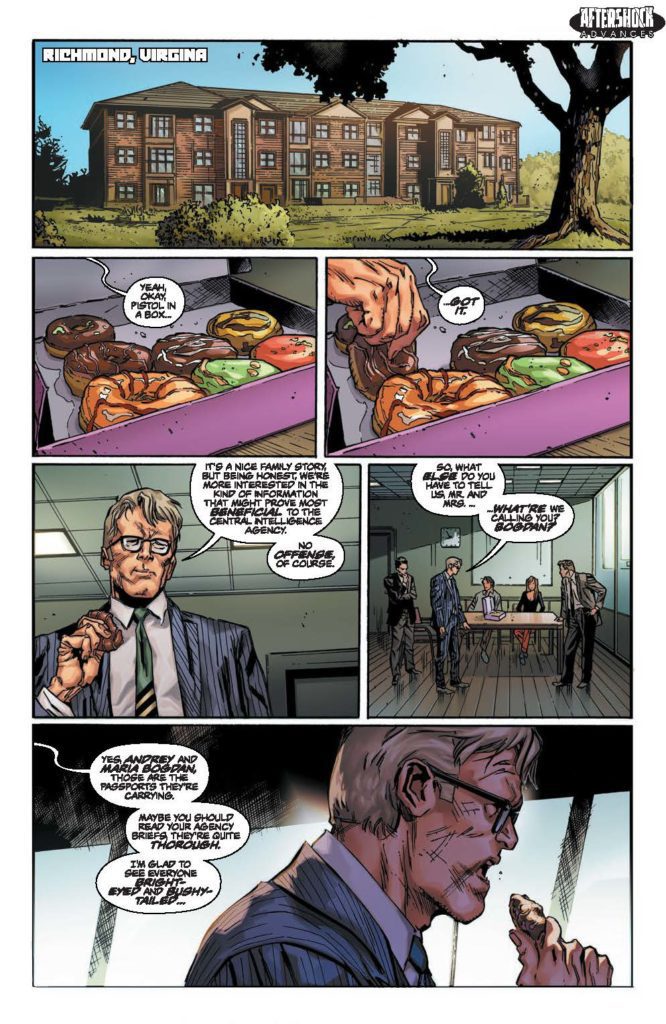
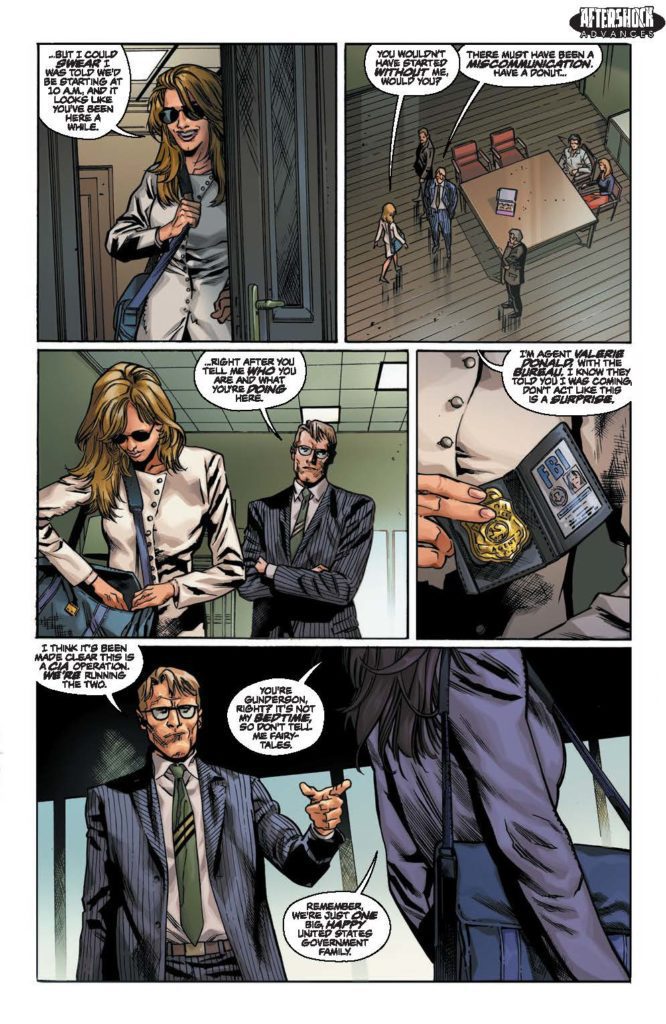
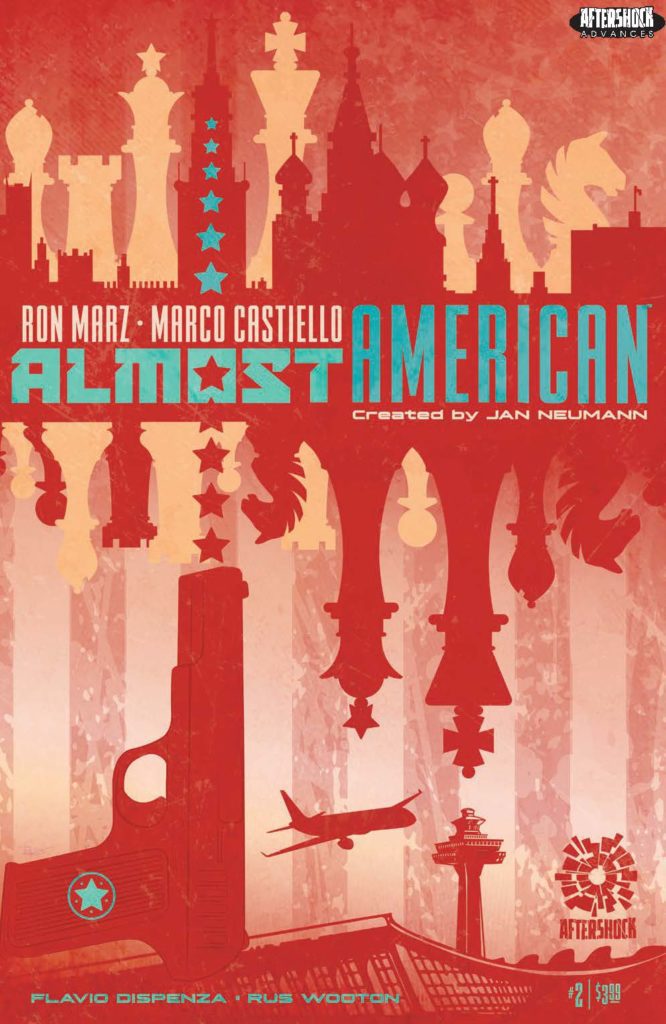
ALMOST AMERICAN #2 hits your local comic book store October 6th, but thanks to AfterShock Comics, Monkeys Fighting Robots has an exclusive four-page preview for you.
About the issue: Based on the real-life story of intelligence operative Jan Neumann, who fled his native Russia and found himself marooned along with his wife in America.
As the Neumanns adjust to being strangers in a strange land, trying to work with the FBI and CIA, a mysterious man from their past begins a deadly hunt for them. The true story is captured by acclaimed comics scribe Ron Marz (Green Lantern, Witchblade) and hot new artist Marco Castiello, working closely with the Neumanns. In the espionage world, truth is literally stranger than fiction!
The series is by writer Ron Marz and artist Marco Castiello, with colors by Flavio Dispenza, and letters by Rus Wooton. The cover and logo design is by Wooton.
Check out the ALMOST AMERICAN #2 preview below:
What’s your favorite AfterShock Comics title? Sound off in the comments!
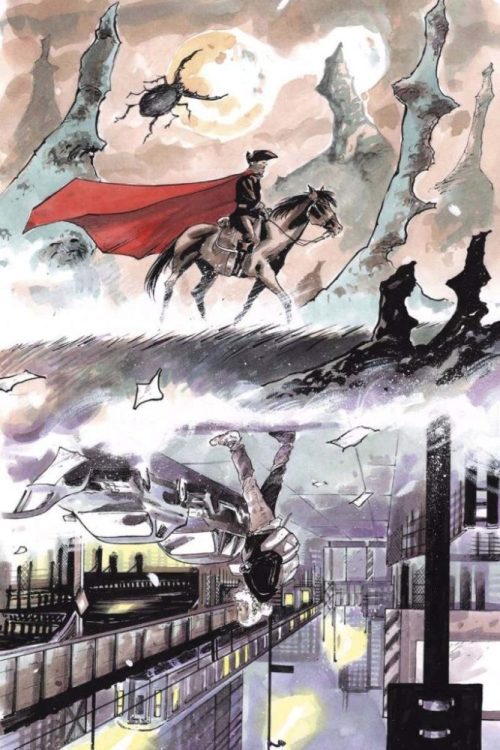
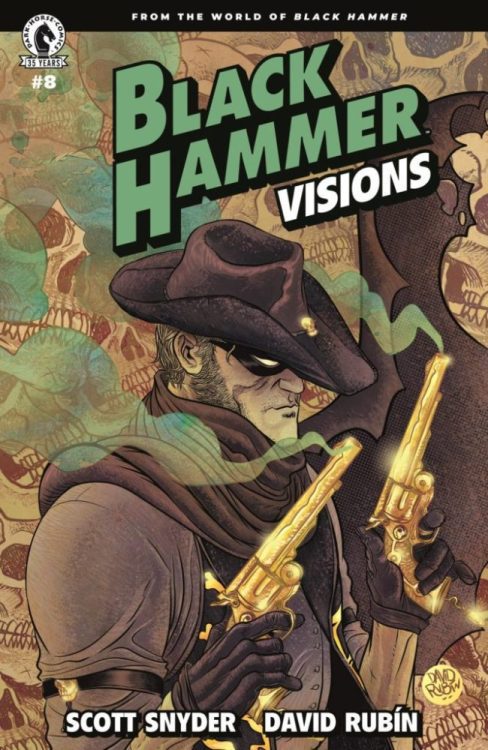
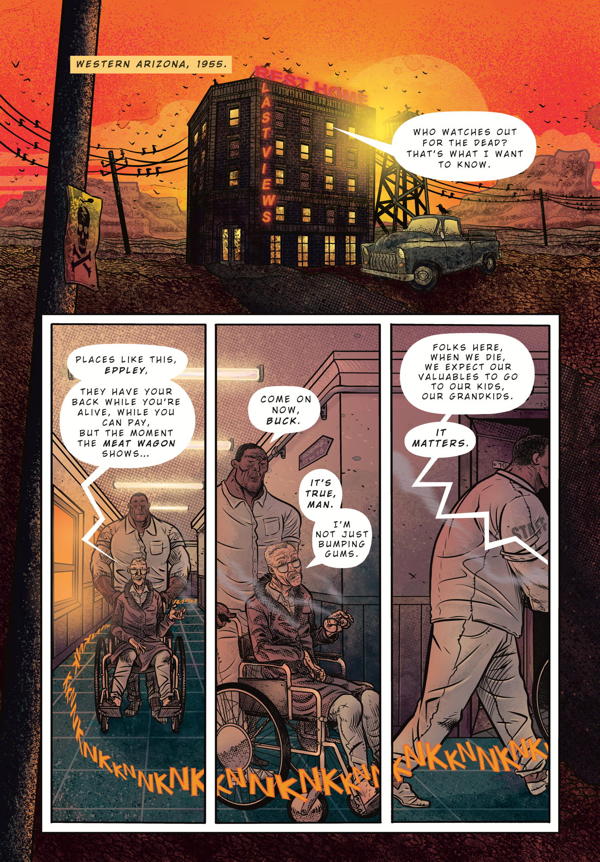
From page one of Dark Horse Comics’ Black Hammer: Visions #8, we witness a story that is laced with doom. Last Views Rest Home sits in a rocky landscape, with a beat up pickup truck, sagging power lines, and dozens of crows surrounding it. It’s 1955 in Arizona, and writer Scott Snyder and artist, colorist, and letterer David Rubín want us to know that this is a land of death. Black Hammer: Visions #8 is a darker chapter than we’ve seen before. And that’s exactly where this creative team shines.
Writing
Snyder tells us a story about the Horseless Rider. From a graverobber, destined for the gallows, to an avenger of the dead, the Horseless Rider comes a long way in a short amount of time. But Snyder fits the information in well. In another issue, Snyder’s script would feel heavy-handed. Yet this is a typical ghost story. One where the rules are laid out clearly for the protagonist. “Don’t do this, or else.” So when he breaks those rules, the mystical fallout can ensue.
Snyder writes in a way that is joyfully predictable. He wants you to know where it’s going from the start. Each story beat gives you a moment to scream at the page, begging the rider to turn back while he still can. But it’s already set in stone.
Art
Rubín’s characters are vibrant and full of life, while his backgrounds are barren and dead. It’s a fantastic juxtaposition. These are characters who are fighting desperately to stay alive in this land of the dead. They sweat in front of lifeless linoleum. They wrestle and rage in dark, twisting forests. Every act these characters do is an act of rebellion against their mortality.
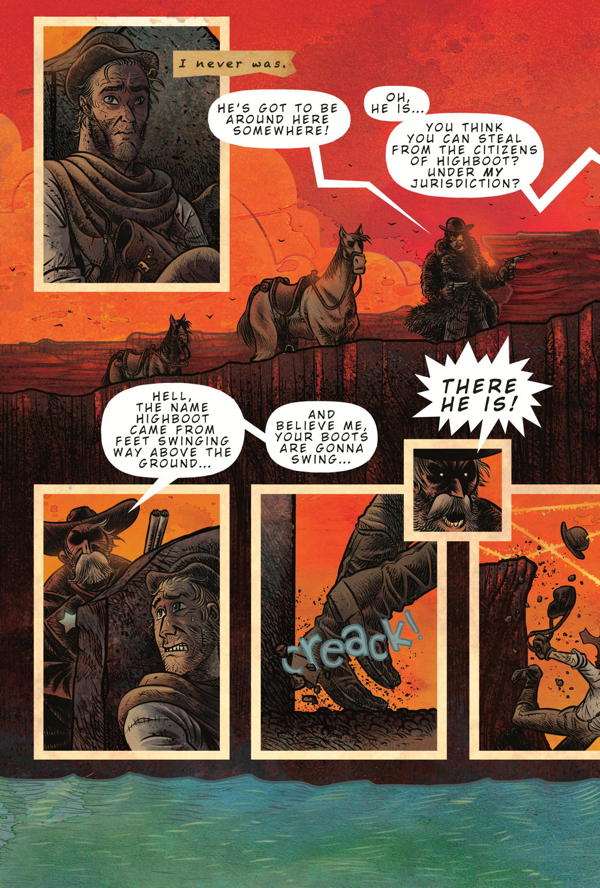
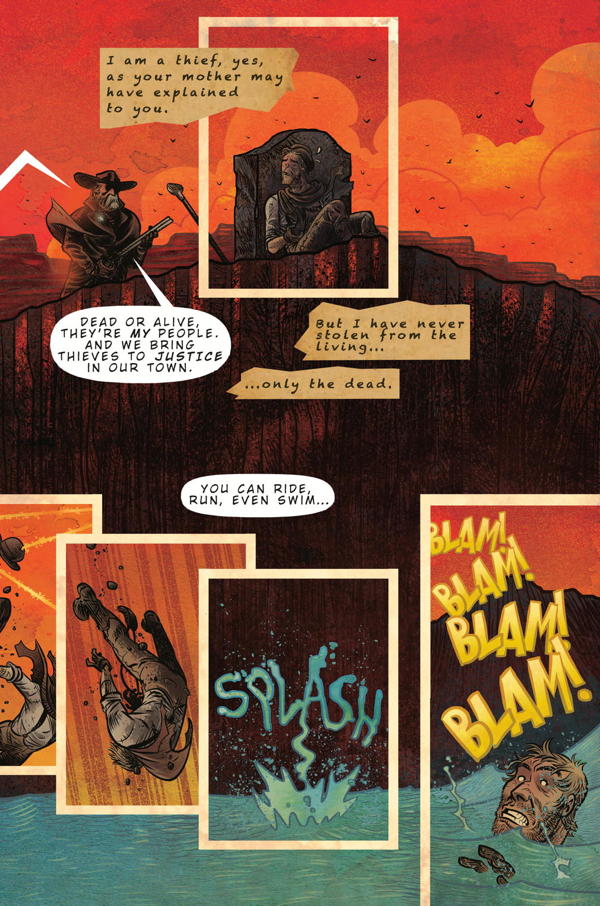
But it’s also Rubín’s page layouts that draw the reader in. He uses small panels to focus us in on little details. When one characters is caught hiding behind a headstone, the panels follow his dive off of a cliff and into a river. The sheriff’s angry face, noticing the graverobber, is in a small panel in the middle of the page. It’s front and center. Small, but a powerful force for setting things in motion.
Coloring
Death lurks in these pages. Rubín’s coloring makes a point of showing us that. When we see the orange and red sky over the old folks home, it’s the same sky as the one we see over the cemetery in the old West, two pages later. And as we follow the graverobber down the cliff and through a dark forest, the red in each scene intensifies. But we also see it in the story of our other protagonist, the old man in the rest home. A soft red glow is outside his window, almost guiding us into the next scene of the graverobber in the forest. Rubín manages to connect these storylines together seamlessly, while also giving them a color palette of their own.
Lettering
Rubín’s biggest struggle is his lettering. While his page layouts are dynamic and brilliant, his word balloon placement makes some of them hard to read. The order of dialogue isn’t always clear on the page, and some chunks of conversation feel like they have no rhythm or separation of story beats. Throughout the issue, Rubín shows a letter from the Horseless Rider to his boy. The lines from the letter show up as captions, pictured as pieces torn from a piece of paper that’s been browned with age. But one of these captions is actually the Horseless Rider addressing a character in the scene, yet it’s still shown like torn paper. The captions resume their way through the letter on the next page, with no reference to the interruption. It’s confusing and unclear, causing the reader to go back for a second try at figuring it out.
Yet Rubín’s sound effects are fantastic. The “CLOP! CLOP! CLOP!” of a horse walking through the woods is shown in small blue lettering on the bottom of a panel. The “M” in the “BLAM” of a gunshot actually traces the trajectory of the bullet. His sound effects work seamlessly into each scene, making every moment pop.
Snyder and Rubín are the right creative team for a story about the Horseless Rider. They tell us an old fashioned ghost story with plenty of style. Pick up Dark Horse’s Black Hammer: Visions #8, out from Dark Horse Comics September 22nd, at a comic shop near you!
Writer Sarah Gailey and artist Pius Bak return with another cutting chapter of satirical horror in Eat The Rich #2. Along with colors by Roman Titov and letters from Cardinal Rae, this issue digs into the heart of this story’s silly yet smart premise. With a painfully relevant message and great character art, this is shaping up to be one of the best class-conscious comics of the current era.
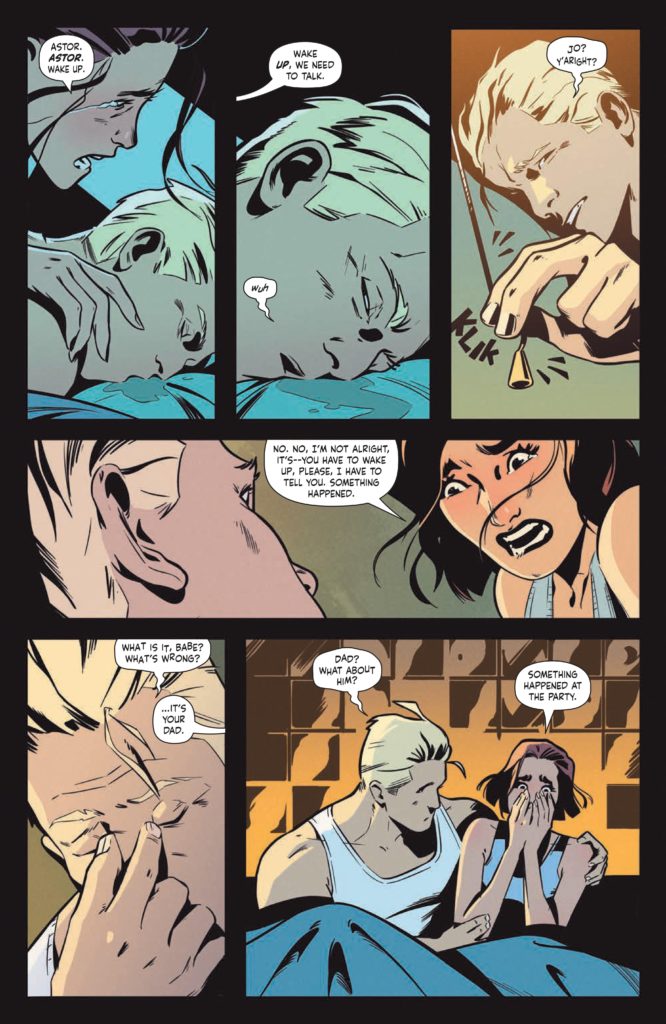
“Is Joey willing to pay with her life to uncover the gruesome secrets behind Crestfall Bluffs? Joey is beyond disturbed by what she has just witnessed, but when she confides in her boyfriend Astor, his reassurance about his family’s weird rituals and traditions only fuels her suspicions. As she digs further, what she finds produces more questions and danger than answers!”
Writing & Plot
What Sarah Gailey’s script for Eat The Rich #2 lacks in outright suspense it makes up for in twisted satire. Whereas the first issue offered a kind of Boots Riley-esque attitude, this one is more straight-forward thriller but with searing dialogue. The real heart of this comic comes from the aftermath of Joey’s discovery and a certain conversation she has in its wake. I obviously won’t talk spoilers, but this is the kind of brutally effective topical writing that makes a great socio-political comic. It’s satire at it’s most effective, when you honestly understand the victim’s decision to undergo her plight, then are horrified that you understand exactly why she would. It’s both hilarious and deeply, deeply disconcerting.
Gailey does fantastic work in creating relatable personal issues for each character. Despite the gruesome B-movie outer concept, Gailey put together a cast that makes you give a damn about what is happening. That’s how good horror works, of course. This being said I felt a couple of lines felt a bit awkward and out of place. Given their tone though, they could make sense in the story over the long run. Regardless, this is a wonderfully scripted comic with Gailey flexing their cleverness once more.
Art Direction
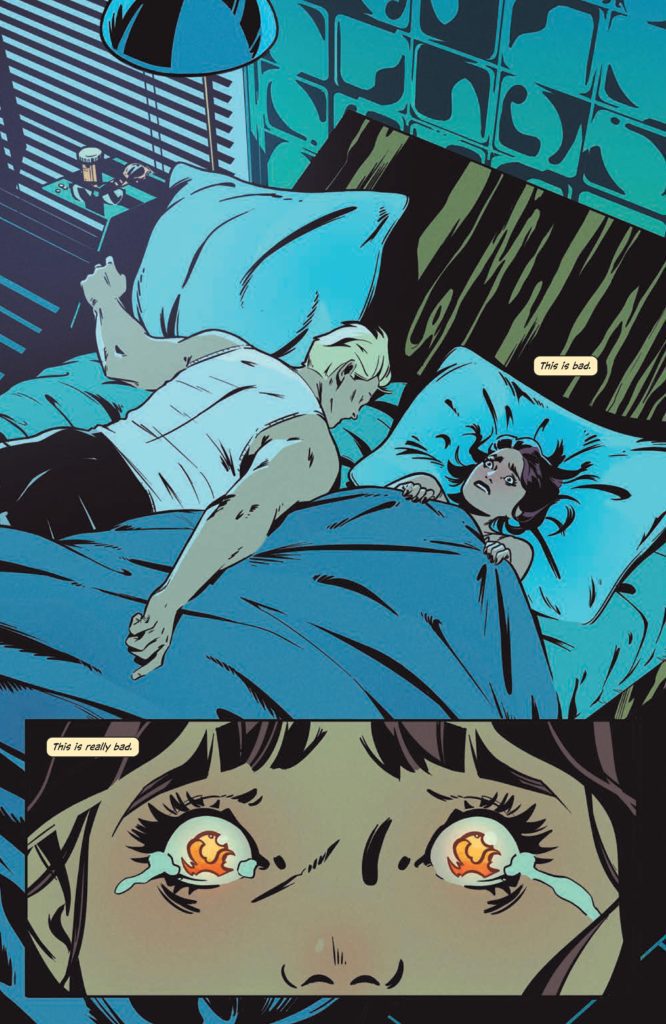
The visuals of Eat The Rich #3 are so full of personality and life thanks to Pius Bak’s art. His thin linework creates careful and detailed characterization into every moment on each panel. Joey’s nervous terror in the opening pages is palpable in the dark, claustrophobic-feeling room she and her boyfriend are in. Bak’s sense of scale when designing panels and rooms within panels is much of what creates tension within this comic. Just on the first few pages the shadows of Joey and Astor’s room seem to creep up on the frightened protagonist. However, when the panel shifts away from just Joey and opens up to include Astor, they temporarily retreat.
So much of the threat in this comic comes across as the house conspiring against them. On a lighter note, Bak’s facial animations are wonderfully spot-on. Watching Joey and whoever she’s speaking with exchange expressions and attitudes makes you feel like you’re in the room while you’re reading.
Coloring & Lettering
Roman Titov’s colors are a massive component of why this comic’s art style works so well. He utilizes a sort of washed out, vaguely pop-art color scheme that is semi-common among indie comics today. This isn’t a dig by any means, though. The almost flat colors add to the tongue-in-cheek satirical tone in a way, while also still allowing for shadows and darkness to highlight the comic’s horror aspects. The lettering from Cardinal Rae is simple and mostly straightforward but still mixes things up a bit. The clean modern font shifts and becomes bouncy and unclear during one scene to demonstrate how tired a character is at one point. This, and the other moments of changing bolds and italics, all work very well in establishing a reading experience. This is a stellar looking comic that matches its subject matter brilliantly well.
Verdict
Eat The Rich #2 is admittedly a less outright exciting issue than its predecessor, but it makes up for it with searing and saddening relevant satire. Sarah Gailey’s script balances sharp character focus with hilarious and depressing socio-political commentary. The visuals from Pius Bak and Roman Titov are thoughtfully directed and tonally spot-on. This is shaping up to be one of the best comic of its genre. Be sure to grab this issue when it hits shelves on 9/22!


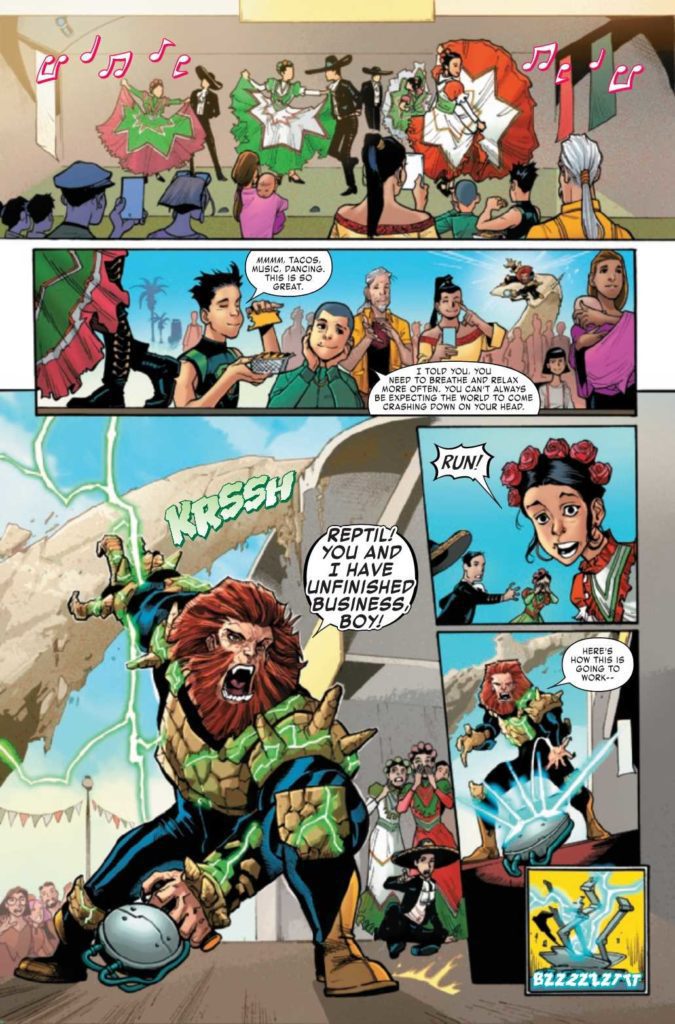 Writer Terry Blas keeps Reptil #4 dedicated to the idea of a greater family as a form of empowerment. Seeing Berto with his family and community feels absolutely serene. So when Megalith arrives for Berto, there’s a genuine sense of intrusion. Having the entire Latin community stand with Reptil feels like authentic support.
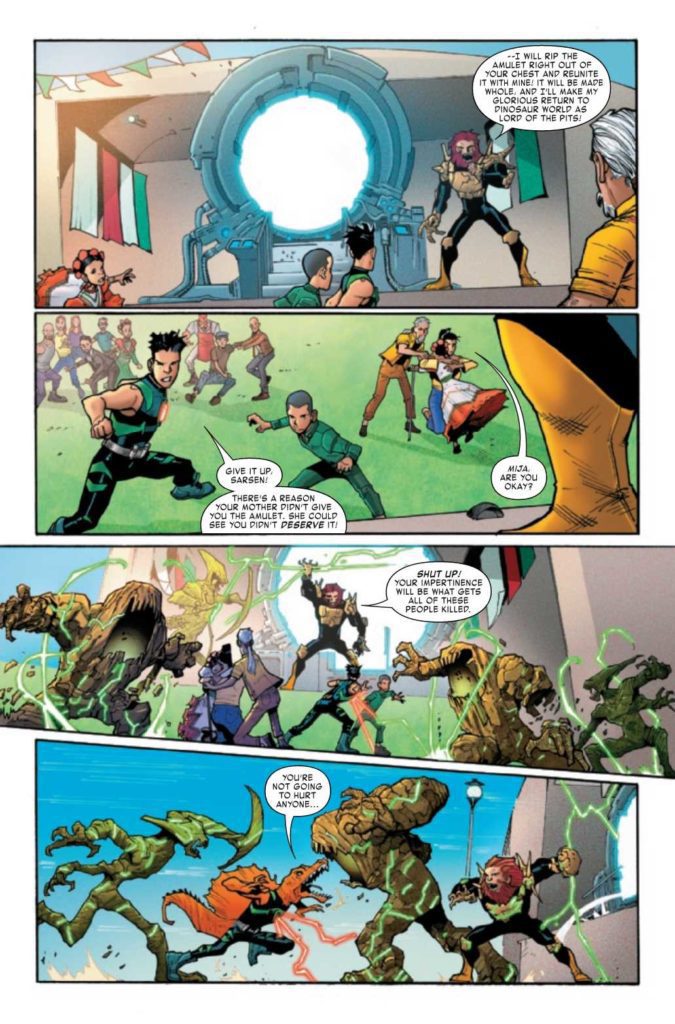 All of the artists of Reptil #4 play their parts in bringing out the very best in this series. Enid Balam’s pencils make the costumes, dinosaurs, and monster forms notable enough to remember. It certainly helps that every major character in this issue stands out further with bolder lines from Victor Olazaba’s inking. Not to mention the eye-catching colors of Reptil’s dinosaur forms and Megalith’s golems from Carlos Lopez.