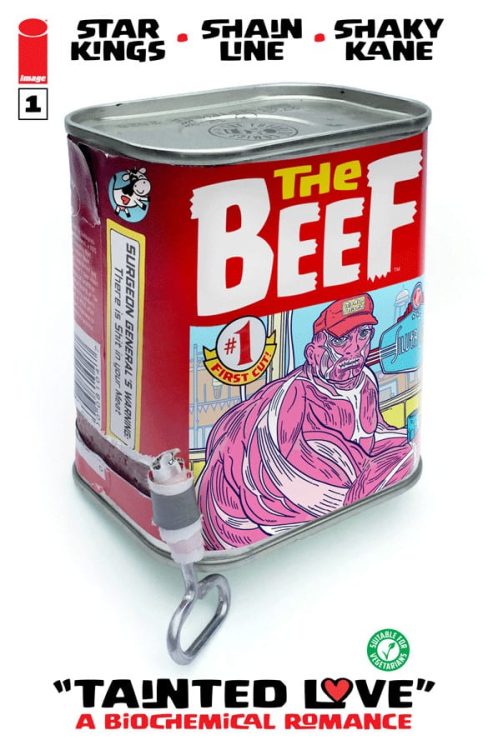
Image Comics’ The Beef #1 is a fantastically weird comic that is equal parts Silver Age fun and indie comics attitude and execution.
The Beef #1
‘Tainted Love’ part 1 Written by: Richard Starkings & Tyler Shainline Art and Coloring by: Shaky Kane Lettered by: Richard Starkings Design: John Roshell
Chuck is a mild-mannered meat factory worker who is a little in love with a strawberry picker named Mary Lynn. But everything changes when Mary Lynn falls victim to the Vodino Brothers.
Writing
It’s best to go into The Beef blind. The story that Richard Starkings and Tyler Shainline crafted seems simple enough; a small town where a slaughterhouse is the biggest thing in town. But it’s executed in such a bizarre way that it comes off as more surreal. The dialogue is often crude and blunt, especially the words ballooning out of villains the Vodino Brothers. The omniscient narration is equally harsh.
Protagonist Chuck Carter is appealing and relatable. We get to see him as both a child and an adult, a detail that creates a more developed character.
And without revealing much, there is something that happens that twists this story at the end. It really hooks you in and demands you read the second issue.
Art
Shaky Kane’s art is not only incredible, it’s integral to the success of the book. The line work and design have a definite indie comics vibe, think Daniel Clowes or The Hernandez Bros. The color palette is heavy on the primary colors but coupled with the pencils, it creates everything from the garish to the sublime. When the images depict violence, it’s also more shocking because of that ‘simplicity’.
The lettering, also by writer Starkings, is very clean and bold. It goes hand in hand with the tone of the art.
Conclusion
The Beef #1 is not going to be for everyone. It may be too off-putting for some. But if you enjoy a bite of the surreal every now and then this will taste just right for you. Give something different a try and read The Beef #1.
Disney’s Lady And The Tramp hits the home theater on Digital and Movies Anywhere February 20th and on Blu-ray a week later on the 27th. However, way you purchase Disney’s 1955 classic it will be packed with bonus features. Check out the list below.
Film Versions
Original Theatrical Edition – Enjoy this cherished Disney classic that captivates audiences of all ages.
Sing-Along Mode – Sing along with all your favorite songs as you watch the movie.
Inside Walt’s Story Meetings – As you view the film, hear reenactments of Walt’s story sessions with
animators and see how their ideas were realized on-screen.
New Signature Bonus Walt & His Dogs – Through archival recordings and photos, hear the tales of the dogs Walt Disney owned and loved over his lifetime.
Stories from Walt’s Office – Take a tour of Walt’s office suite on the Studio lot, carefully re-created to look just as it did when he occupied it.
How to Make a Meatball and Other Fun Facts About “Lady and The Tramp” – Watch a delicious lesson on how to make perfect meatballs with teen chef Amber Kelley and Oh My Disney Show Host Alexys Gabrielle.
Songs
“Peace on Earth”
“What Is a Baby/La La Lu”
“The Siamese Cat Song”
“Bella Notte”
“He’s a Tramp”
Classic Bonus Features
Diane Disney Miller: Remembering Dad – Walt’s daughter shares memories of her father and Disneyland’s early days, as well as a look at his apartment above the firehouse.
Never-Recorded Song – “I’m Free as the Breeze” – Take a listen to a song originally meant to be sung by Tramp.
Deleted Scenes
Introduction of Boris – Tramp wasn’t always meant to be Lady’s only suitor. Meet Boris the aristocrat
and Homer the peasant in this deleted scene.
Waiting for Baby – Lady watches as Jim Dear plans out his new son’s future in this early storyboard.
Dog Show – See the storyboards for this deleted scene in which Lady and Tramp unexpectedly find themselves in the middle of a dog show.
Classic Bonus Features on Digital Only*
Lady’s Pedigree: The Making of “Lady and the Tramp” – A behind-the- scenes look at the making of Walt Disney’s first feature-length animated film based on an original story.
Finding Lady: The Art of the Storyboard – Explore the origins of the storyboard and how they’re used by filmmakers today.
Original 1943 Storyboard Version of the Film – View a unique presentation of the original 1943 storyboards for “Lady and the Tramp.”
PuppyPedia: Going to the Dogs – Wild and wacky comedian Fred Willard takes us on an outing to the dog park to learn all about dogs and their owners.
Deleted Scenes
Turning the Tables – In this story-reel presentation, Tramp dreams of a world where dogs run the show and humans are on the other end of the leash.
The Arrival of Baby – In this alternate scene re-created from original storyboards and with original voice talent, Lady makes way for a new arrival.
Baby Arrives – Lady is baffled by the strange goings-on in the house—the arrival of a squealing bundle only deepens the mystery.
Lady’s Sweater – Lady gets a new sweater for her birthday and must figure out an ingenious way to lose it for good.
Trailers
1955 Original Theatrical Trailer – More than just a trailer, this preview features several minutes of footage from the film and introduces each major character.
1972 Theatrical Re-Issue Trailer – This trailer from the 1972 rerelease heralds Disney’s “happiest motion picture.”
1986 Theatrical Re-Issue Trailer – Released theatrically for the 1986 holiday season, this trailer highlights the love story between Lady and the handsome Tramp.
*Bonus features may vary by retailer
Do you plan to add Lady And The Tramp to your families’ collection? Comment below.
Jeff Lemire’s Eisner Award winning comic book series Black Hammer has been expanding its world. Starting with the stellar Sherlock Frankenstein, we got a look at the peripherals offered in this tragic universe. Doctor Star & The Kingdom of Lost Tomorrows is the next wave of expansion.
This time, creator and writer Jeff Lemire teams up with artist Max Fiumara and regular colorist Dave Stewart. Doctor Star tells the origin story of another hero from the golden age of heroes in Spiral City. Doctor Star came into prominence in 1942, along with the likes of Abraham Slam and Golden Gail.
Doctor Star’s story is one of scientific experimentation, heroism, and – of course – tragedy. Lemire tells the story of Doctor Jim Robinson from the perspective of an old, sad man. He, like the rest of the Black Hammer crew, is well past the active days of super heroism.
Things are a bit different this time. Black Hammer is a mystery book about a team of heroes and Sherlock Frankenstein was a deep dive investigation into the world of villainy. Doctor Star is a more focused story, telling the tale of one man. In doing so, we get to see more of the history of Spiral City and Black Hammer‘s America.
Max Fiumara and Dave Stewart maintain the rustic and dusty atmosphere from the other titles. As Doctor Star makes his big discovery and officially throws his hat into the superhero ring, the book comes to life. It’s also a book full of emotion, Fiumara does wonderful work conveying the accomplishments and tragedies of Doctor Jim Robinson. He also effortlessly illustrates the young and old version of Doctor Star.
Black Hammer is one of the most refreshing corners of the comic book industry. These spin-off series have proved to be completely necessary in building this world into something bigger. Dark Horse is 2-for-2 so far with these spin-offs. As long as they keep taking us new and unique places, keep them coming.
Doctor Star & The Kingdom of Lost Tomorrows is another must-read for Black Hammer fans.
The 1950s were a transitional time for comic books. Timely Comics heroes like the Human Torch, the Sub-Mariner, and even Captain America got shelved in the late ’40s. And though some were revived for a short time by Atlas Comics, Timely Comics’ updated ’50s moniker, the revivals just didn’t take. People had lost their interest in Timely/Atlas’s brand of superheroes, replaced by a hunger for new varieties of comic books.
The Monster or Horror Age of comics had its creepy hey-day but was, sadly, put in its grave before its time by the notorious Comics Code Authority. Although some horror titles found a way to survive for a while, most were unfairly targeted by the powers that were and eventually had to change their editorial bent or suffer bankruptcy.
This led writers and artists in a few different directions, some went to western comics, war comics, and adventure comics. The real-life dynamic duo, Joe Simon and Jack Kirby, did a little bit of everything. Not convinced that the market was yet saturated, they created a new kind of comic book for a readership that didn’t yet know what it was missing: romance comics flew off the shelves in the ’50s, selling exceptionally well as a result of the appetite for schmaltzy teen drama.
The Rise & Fall of Space & Robot Comics – Romancing Robin
Of course, some superhero material did get cranked out. Specifically, Superman and Batman both enjoyed relatively uninterrupted publication throughout the ’50s, but even these stalwart caped crusaders’ stories couldn’t avoid the teenage trend. Superhero story-lines of the ’50s are littered with romantic intrigue and often showcase the crime-fighters’ personal lives at the expense of showing the exciting vigilante action these heroes cut their teeth on.
For me, even though Superman and Batman comics of the ’50s saw the introductions of Krypto, Ace the Bathound, Brainiac, Bizarro, and the bottle-city of Kandor, Superman and Batman just weren’t the main attractions. As a jaded comics historian looking back on the age of wonder and optimism that was the ’50s, my favourite comics are ones that feature artists and writers’ far-fetched visions of the future — robots and all — and a few of the best ones come from people you’re probably familiar with for other work they did.
The Rise & Fall of Space & Robot Comics – Building a Dream Team
Writers were a dime a dozen back in the ’50s, but without the ever-present Stan the Man Lee both writing plots and editing Atlas’s entire lineup it’s doubtful that Timely’s descendant brand would have published anything. And, although many comics writers of this era have long since been forgotten, a prolific one was Stan’s brother Larry Lieber who would take Stan’s plots and turn them into scripts.
The Rise & Fall of Space & Robot Comics – Oh, brother!
Originally a comic book artist, in the late ’50s Stan convinced Larry to put his pencils to better use. When Larry protested, saying he wasn’t a writer, Stan just replied, “Oh, I’ve read your letters.” With that little bit of brotherly ego-stroking, Stan garnered himself a creative partnership that lasted for years.
No wonder Stan was able to get so much done in his storied career: he had his kid brother working for him. Although this working relationship might not be many people’s first choice, in interviews Larry always described Stan as a good writer, editor, and writing teacher who would only suggest minor edits to Larry’s scripts, never suggesting that Larry needed to start over from scratch.
The Rise & Fall of Space & Robot Comics – The Twilight Zone’s Outer Limits
Space & Robot comics of the ’50s offered more than just goofy adventures, although they often offered just that. With twist endings and scary scenarios, titles like Tales to Astonish, Tales of Suspense, House of Secrets, House of Mystery, and Outer Space were some of the precursors to immensely popular shows like The Twilight Zone and The Outer Limits.
Much like in The Twilight Zone, stories frequently involve characters getting some kind of ironic just deserts, like in Steve Ditko’s “My Secret” from Out Of This World#3. In it a man named Mr. Prentice is transported to another dimension as a result of coming into contact with a chemical compound he accidentally invented. His lab partner, after forty years of trying, subsequently recreates the compound and accidentally spills some on himself. Sent to the same alternate dimension, this second man hunts down Prentice and blackmails him, threatening to expose him as an alien to the people Prentice now lives among comfortably.
Unfortunately for the blackmailer, when he tells his and Prentice’s story to the police, they just arrest the blackmailer: the officer on duty informs the blackmailer that he doesn’t care where Prentice is from since he long ago established himself in the community as a trustworthy man. Blackmail, however, is just as illegal in this dimension as it is where Prentice and the blackmailer are from.
Although this story suffers from taking on too big an idea in too few pages and leads to an ultimately unsatisfying conclusion, it highlights the far-out scope that these kinds of publications had and showcases their poetic irony formula.
The Rise & Fall of Space & Robot Comics – “Domo Aregato, Incognito Roboto”
Stories about fantastic mechanical men were also on offer. “A Robot in Hiding” from Tales of Suspense #2 (cover date March, 1959) shows Joe Sinnott’s interpretation of the Lee/Lieber Brothers’ Asimovian script. A robot is on the run: the global police force, acting under direct orders from the despotic ruler of Earth Roderic Zante, is out to deactivate all of robot-kind.
The story opens on the fugitive robot in Zante’s throne room. Hidden behind a curtain preparing to kill the tyrant, the robot remembers the chain of events that brought him there: Zante gave the robo-cidal order and the rounding up of robot-kind began, the fugitive robot evading capture for a month until he found Zante at home.
The robot’s programmed trip down memory lane over, he walks up to Zante and presses him gently on the back. Zante slumps over limp; he was a robot all along. The vindicated fugitive robot surmises that Zante issued the order to deactivate all robots to ensure that no robots would recognize Zante for what he is, a defective and power-mad version of the same model of robot that recognized him and hunted him down. That Zante and the assassin-robot have the exact same face is strong evidence in support of the robot’s claim.
The Rise & Fall of Space & Robot Comics – There’s Always a Marvelous Silver Lining
As the ’50s came to their end, comics about space and robots along with westerns, war stories, and romance comics provided good business, but superheroes had started popping up again and sales were surprisingly good. Over at DC, readers were gobbling up stories about the all-new Flash Barry Allen. Premiering in Showcase #4 (cover date October, 1956), the scarlet speedster was making regular appearances in his eponymous title after only a year or two.
Hal Jordan also made the scene in the late ’50s. Appearing in Showcase #22, the new Green Lantern redefined another of National/DC’s old properties. And, like I said before, since Superman and Batman never really stopped publication, it was clear to Stan Lee that it was time for Atlas to get (back) into the superhero game, so that’s exactly what they did.
With King Kirby back among the fold, he and Stan the Man created not just one brand-new superhero but a team of four. And unlike the team of daring adventurers Kirby had previously created, the Challengers of the Unknown, this team was also a family. With a November, 1961 cover date, The Fantastic Four exploded onto the scene and ushered in what we Marvel fans like to call the “Marvel Age,” which saw the introduction of several fan favourites including Spider-Man, Daredevil, the Avengers, and the Incredible Hulk.
But, that’s a story for another article. For now, we must bid adieu to the innocence of ’50s space & robot comics. But parting is such sweet sorrow, for we shall meet a web-crawling wiseacre on the morrow.
The new Labyrinth comic from Boom! Studios is set to tell the origin of how Jareth (a role made famous by the late great David Bowie) became the Goblin King. Will this book appeal to fans of Jim Henson’s beloved film?
As Jareth watches Sarah struggle to make her way through the Labyrinth, he begins to tell Toby a story of a young couple who were plagued by goblins.
Writing
The main obstacle to overcome with this series is making sure it is something fans can resonate with it. There have been many attempts to make comic book continuations of the Labyrinth series but few have left any lasting impression. If writer Simon Spurrier has any hope of this book not falling into obscurity he will have to make it offers something interesting which the audience hasn’t seen before. Luckily, he succeeds.
The book captures the energy of Jareth but goes further by showcasing what his parents were like. It’s revealed his father had a history of being visited by the goblins which was beginning to drive him insane. Meanwhile his mother seems to be much like Sarah, a person who won’t give up on rescuing someone they love. Immediately this book makes you connect, albeit in different ways with these two characters. You find yourself despising the father and cheering from the mother. If they truly are the main characters of the entire series than it will be fascinating to see what transpires for them moving forward.
Artwork
The artwork for this series seems to capture the look of the original film perfectly. The art for Jareth is very recognizable without going full photorealistic with his character design. Also, the goblins and their previous king look much more menacing and sinister thanks to the work by Daniel Bayliss.
The color work by Dan Jackson offers some disturbing elements to the story. The way Jareth’s speech bubbles are different than anyone else’s helps the reader discern how his words are supposed to have more meaning. There also is a big difference between the human world from the world of the Goblins thanks made apparent through the colors in play.
The lettering by Jim Campbell helps to add a voice to the characters. The different fonts distinguish between the elegant speech of Jareth, the sneaky voice of the goblins, and the modest speech of the humans. It helps the reader immediately know which voice should be hears from panel to panel.
Conclusion
Jim Henson’s Labyrinth: Coronation is off to a great start. There is a bit of worry a full twelve issues may result in the project eventually running out of steam. Still, if every issue is as captivating as this one then Boom! Studios will have created a book which will leave Labyrinth fans more than happy they got lost in the nostalgia.
On the heels of the success of Deadpool, Fox has begun developing a plethora of films using their Marvel properties. Movies such as Deadpool 2, New Mutants and X-Force have been on the docket for some time while others have been thrown into development more recently. One film you can add to that list is Silver Surfer, which The Hollywood Reporter is reporting is currently in development.
In an article discussing the ways that the potential Disney-Fox merger may affect the future of Fox’s X-Men franchise, THR broke the news about the Silver Surfer movie. The stand-alone flick is set to be written by Brian K. Vaughan, who’s best known for his work in the comic world.
Vaughan has worked for both Marvel and DC, writing such books as Spider-Man and Batman. He also served as a writer, story editor, and producer on the TV series Lost.
The only other news provided about the project was that the studio is said to be moving 100 miles per hour on it. Fox may be determined to get the film into production before the merger becomes official leading to the rush.
Silver Surfer is no rookie when it comes to the film world. He famously appeared in 2007s Fantastic Four: Rise of the Silver Surfer, where he played an integral part in defeating the villainous Galactus.
Are you excited to see a Silver Surfer solo movie? Let us know in the comments below!
When it comes to small towns, many of them contain stories. Some of the tales include famous founders, landmarks, and achievements while some include something more mysterious. Something a bit darker. At least that’s the case in The Blackout Club.
A new cooperative survivor horror game from Question Games. A new studio whose several founders have worked as developers on multiple games including BioShock, Dishonored, and Prey. The Blackout Club‘s story centers on a group of teenagers who live in a small town with a dark secret.
One that may contain links to not only the disappearance of one of the group’s members but also the various lengths of blackouts they themselves have been suffering. “Our story is about vulnerable characters,” said studio Co-Founder Jordan Thomas. Up to four players can play the game at one time. Adding to its group dynamic and story.
Being a survival horror game, stealth gameplay is something that is key as players venture out into the night. Equipped with a cell phone to document and record the town’s secrets and the reason behind their friend’s disappearance. The Blackout Club has a release date of 2019 and will be available for Xbox One, PlayStation 4, and PC. Watch the trailer below!
In my years of reading Wonder Woman comics, I’ve noticed their stories generally go one of two ways. They will either turn to more emotional character-building stories or have the mighty Amazon on a quest reminiscent of Ancient Greek myths. The last arc tried its hardest to be the former but failed. Wonder Woman found herself face-to-face with the Silver Swan, a person who Diana used to visit before the Swan’s transformation. The aftermath had Swan back in a coma, Wonder Woman’s brother, Jason, vanishing and Darkseid plotting in the background. What will come next in the world of Wonder Woman?
**SOME SPOILERS BELOW**
Story:
We don’t open to the Amazon warrior, as one would expect in a Wonder Woman comic. Instead, we see the aftermath of the two-page interjection of the last issue. Darkseid is disciplining his Furies for being defeated by Steve Trevor and his men, noting this is a setback. Darkseid’s plan involves him activating a portal that would allow him to travel to the Amazon’s dimension, giving him the chance to enslave them. Meanwhile, Steve and Wonder Woman have a moment of respite and discuss what they’ve been up to in the past few issues.
This is definitely one of those issues that is used as a stepping-on point for the next story arc. The problem is that comics such as this one must have a good hook––Something to make the readers feel entertained as they read stories that they’ve read before. The closest thing to a hook are the battles that were shown which were kept only to a page at most per battle. There is even a pattern for the flow of this story that shows a lack of actual progression to the main plot. Talk about past, flashback to Wonder Woman punching a villain, back to present to talk about the past.
It makes the entire story feel like a chore for reading it. I will say that the ending has left me intrigued for the next issue, but it isn’t enough to save this one.
Art:
There is good in this issue and it comes in the form of the art team. Stephen Segovia is the artist in charge of pencils this issue and everything looks great. From character design to the setting, everything has great detail. The familiar colors of Romulo Fajardo Jr. help the illustrations pop off the page and make the world feel alive. The best piece that the pair work to create would be the reveal on the final page. I won’t spoil what it is, but it makes me wish the next issue has more of it. The art team went all out to make this issue look good and they succeeded 10 times over.
Conclusion:
Despite the art being top notch, it isn’t enough to redeem this issue. The story is essentially a recap with fight scenes we’d rather see in the foreground forced in as flashbacks. Next issue promises to truly start the next arc, so you might want to save your money for that one.
The ‘Jade Giant’ returns to its origins in a brand new series this summer with a unique spin on the character via the creative team of Al Ewing and Joe Bennett.
The comic book will tell the story of Bruce Banner, a quiet and calm, virtually unnoticed man, who never complains. You can kill him, but when night falls, something else will rise and it is the horror known as, The Immortal Hulk.
This new series continues Marvel‘s ‘new beginnings’ movement in revamping, reloading and, in some cases, overhauling its characters, including with new creative teams.
Currently, Immortal Hulk #1 will drop on June 6, 2018, while the other revamped character titles include: Avengers #1 (5/2), Venom #1 (5/9), Black Panther #1 (5/23), Thor #1 (6/13) and Captain America #1 (7/4). Also announced, though without a release date, was Cosmic Ghost Rider, who is featured in the pages ofThanos.
Click HERE for the official release from Marvel on the upcoming series.
Steve Rogers is back via an all-new creative team in award-winning writer Ta-Nehisi Coates and artist Leinil Yu.
That’s right, a brand new Captain America series is en route, as Marvel continues to roll out announcements of series as part of its ‘new beginnings’ movement in overhauling its characters with new creative teams.
The story picks up in the aftermath of a Hydra takeover of the United States, where Cap is a figure of controversy and a tarnished shield. A new enemy is rising as the Power Elite look to corrupt his symbol.
“I think it’s a really exciting time to be writing Captain America right now,” said Coates. “The country is in an interesting place and I look forward to inhabiting Steve Rogers’ character—this guy who has been a sort of awkward fit for the world. I hope fans are excited to see something different, and I think there are some really compelling villains old-school and Marvel fans will be familiar with.”
Fans can preview what is in store from this creative team when Marvel releases a Cap comic for Free Comic Book Day. Check out the preview HERE.
As of right now, Captain America #1 is set for a July 4, 2018, release and will follow Avengers #1 (5/2), Venom #1 (5/9), Black Panther #1 (5/23), The ImmortalHulk #1 (6/6) and Thor #1 (6/13). Also announced, though without a release date, was Cosmic Ghost Rider, who is spun from the pages of Thanos.
Click HERE for the official release from Marvel on the upcoming series.