Westworld brought an active, fast-paced storytelling episode to the fans this past Sunday night with the sixth episode of the second season, “Phase Space.”
With hour-long shows that have multiple storylines, the most effective way to keep the audience glued to his or her seat is by briefly touching on each storyline and organizing the episode like a DJ entertaining a crowding. “Phase Space” is an excellent example of how to do that well. There was early action to get your blood pumping, questions to get your mind thinking, several emotional moments that tugged on your heart strings, the twist, and the episode ended with a major reveal. Give a round of applause to the editor on a job well done.
Bernard Lowe’s plot thread is the most entertaining as he represents the audience trying to figure out the mystery. In “Phase Space” he introduces a new universe which will make it harder to establish who is where and when. The LOST elements of the show are mounting, and with only four episodes left the second season is building severe steam towards the finale.
Cinematically I wish the Samurai battle was filmed better. It looked very choreographed, and the filming angles were very generic. Director Tarik Saleh needed to take more risks with this scene, deeper filming angles balanced with extreme close-ups would have taken the action and emotion to the next level.
Overall, “Phase Space” progressed the story on all fronts. The intensity is building at the right time, and the talents of the cast and crew are shining brightly.
Fans of SyFy’s The Expanse got some good news late last week. At a well-timed appearance at the International Space Development Conference, Amazon’s CEO Jeff Bezos announced that Amazon would be taking over production of the show’s fourth season. Streaming on Amazon Prime Video, the fourth season will likely continue where this third season leaves off on June 27th. It’s great to see good shows revived by a streaming service. I wonder if the fan response to last week’s episode entitled “Delta-V” was behind it.
The Expanse Season 3, Episode 7: “Delta-V” – Time Waits for No Beltalowda
A solid chunk of time has passed since the previous episode “Immolation,” in which Errinwright’s treasonous war-mongering was put in place and a giant protomolecule…thing took off from Venus. Avasarala appears to be the new Secretary-General of Earth and asks for cooperation while a team of scientists, including Volovodov, make their way to Uranus to study “the ring.”
The ring, we find out, is the newest form that the protomolecule has constructed, and all parties in the Solar system are interested. Fred Johnson and Anderson Dawes represent the interests of the belters who have quite a bit of influence after the part they played in saving Mars from Mao’s protomolecule hybrids. The Nauvoo has been turned into a warship, now named the Behemoth, captained by Camina Drummer, Fred Johnson’s number 2 on Tycho Station. Naomi is also on the Behemoth, keeping a close watch on the crew.
The Expanse Season 3, Episode 7: “Delta-V” – “Mars can sue me!”
Although Naomi is aboard the Behemoth and Prax returned to Ganymede with Mei, the rest of the crew of the Rocinante are still aboard that fateful ship. But, their presence is unwelcome by the Martian government who believe the ship is still theirs. Never one to back down from a seemingly unwinnable battle, Holden intends to fight the planetary government but covering legal fees is expensive. To help defray the cost of the trial, Holden has agreed to allow a documentary film-making team to make a film about the Rocinante and her crew. Surprise, surprise…it’s not going that well.
The Expanse Season 3, Episode 7: “Delta-V” – “I don’t defecate where I masticate.”
Although nothing is confirmed one way or the other, the documentary film-maker implies pretty heavily that Amos is a former Baltimore mob boss named Amos Burton. The only answer Amos does provide is in the form of his clenched fist smashing the film crew’s remote-controlled camera. They may have touched a nerve, but, in addition to their camera, Amos also handily rebuffs both the female film-maker’s proposition and a follow-up proposition by the cameraman.
The film crew also pick up a tight-beam conversation between Alex and Bobbie, now formally reinstated in the Martian Marines. The two Martians have a good chat, and the camera picks up details about Alex’s divorce.
The Expanse Season 3, Episode 7: “Delta-V” – Diogo’s Return
Anderson Dawes has done it again. Simultaneously pissing off Drummer and Naomi, he has assigned ex-pirate Klaes Ashford as the first-officer of the Behemoth and instated Diogo Harari as an officer in the belter navy. For those who don’t remember Diogo, he helped Dawes escape Tycho Station with the Protogen scientist Paolo Cortazar way back in season 2.
On top of the new crew assignments, Naomi and Drummer are also dealing with a drug smuggling operation aboard the Behemoth. Although a certain amount of drug use is condoned on belter ships, a shuttle pilot’s deadly crash shows that things are out of control. After identifying the smuggler and dealer, Captain Drummer is preparing to blow the dealer out of the airlock when Ashford steps in. He says that they must present a reasonable and judicial front to the “inners” so that belters can gain their trust and respect. After a bit of hesitation, Drummer changes her plan. Any contraband should be piled in the airlock over the next two days. After that, anyone caught with any will be sent to the brig.
The Expanse Season 3, Episode 7: “Delta-V” – Melba Toast
A change in both characters and setting takes viewers to the Seung Un. A maintenance crew of two experienced belters and one nervous novice docks with the ship, and the nervous one, Melba, when left alone plants what looks like a bomb inside an access panel. When one of her fellow mechanics finds the device, Melba gets angry and bites down on what appears to be a capsule. She appears to gain super strength, and easily overpowers her crew-mate, lifting him up and crushing his skull against a bulkhead. Her gory work complete, Melba passes out next to her victim.
Not content with just a new setting, the episode’s end also featured a terrifying addition to The Expanse’s growing list of nightmarish things. The ring, mysterious and alien throughout this episode becomes pretty scary indeed when a belter racer out to impress his estranged girlfriend attempts to fly his ship through it. It seems, though, that his girlfriend will remain estranged. Upon entering the ring, although his ship seems to stay intact, the pilot’s body liquefies. It’s unclear whether this is a result of a change in momentum or some kind of force field that destroys organic life, but based on the name of this episode I’d guess the former.
The Expanse Season 3, Episode 7: “Delta-V” – It’s Miller Time
If that gruesome display wasn’t enough to get people talking, Detective Miller’s return was sure to be. Returning to his bunk after a shower, Holden hears someone muttering in his room. When he looks inside, he is surprised to find the man with the fedora waiting for him. As soon as he appears, though, Miller is gone. What does it all mean? I guess we’ll find out in “It Reaches Out.” One guess what “It” is.
This series will be a brief, semi-comedic review of the CW superhero shows. You can check out last week’s review post here. The only shows discussed will be ‘Arrow’, ‘Flash’, and ‘Supergirl’. There WILL be some spoilers discussed, so only look at the reviews you’re up to date on!
Supergirl, “The Fanatical” (May 21st)
Remember the Kara+James romance? Me neither (copyright CW)
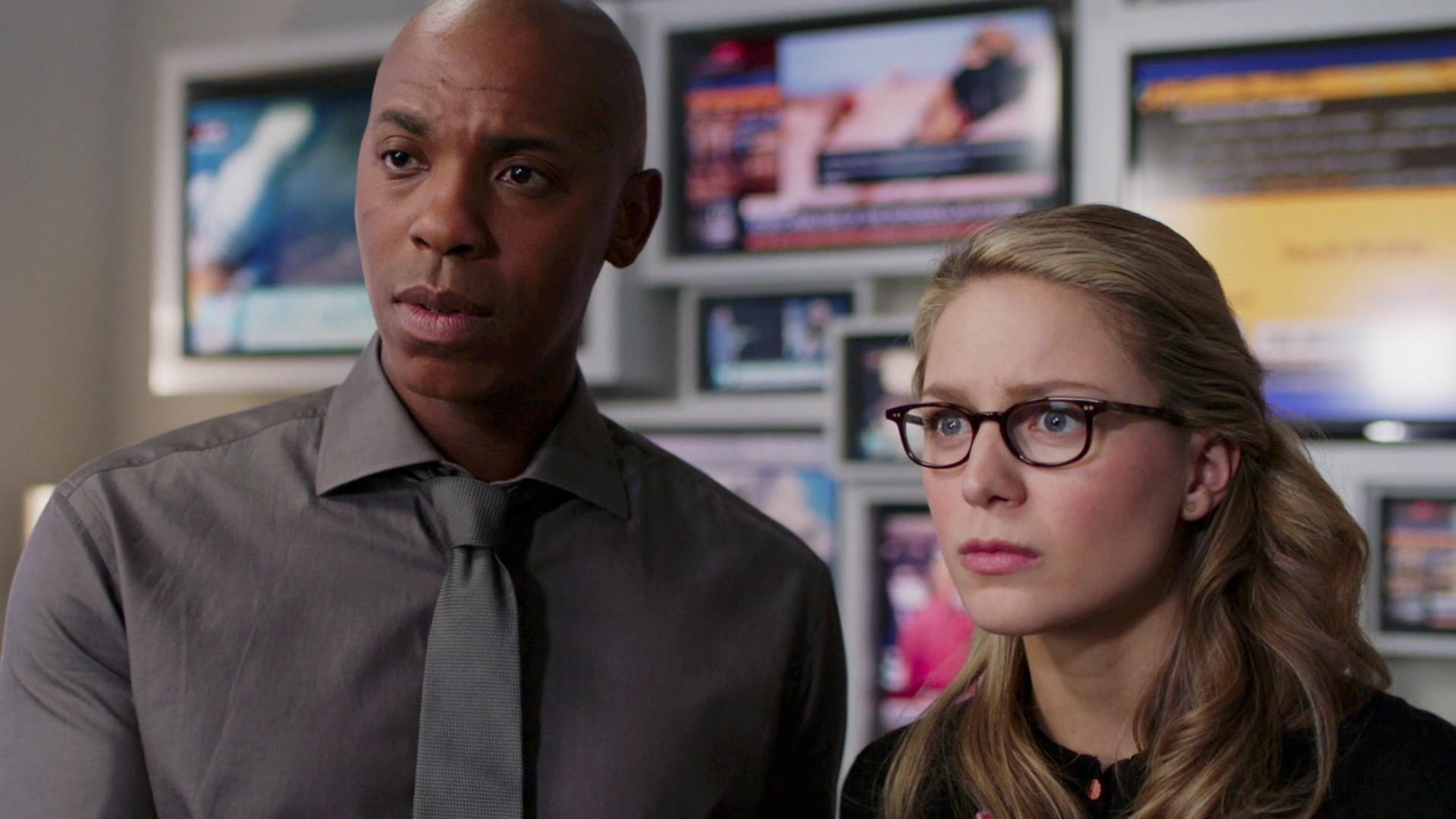
As the other CW shows finish up their seasons, SUPERGIRL starts wrapping up plot points. The return of the Krypton cult makes sense, but isn’t super exciting. If the new cult leader is supposed to be a familiar face, then the show should’ve set her up as much as the translator. The Kara-Lena conflict doesn’t have enough new wrinkles from last episode to feel fresh. That said, the episode giving Mechad Brooks something to do is a refreshing develop for the Guardian character. This episode could’ve swung a 7.5 if not for the confusing moral of what video games are supposed to do.
SCORE: 7/10 Bangarangs (okay, did SUPERGIRL know that song was gonna be a big part of DEADPOOL 2? Because that’s a spooky coincidence)
The Flash, “We Are The Flash” (May 22nd)
Do you guys just wanna watch INCEPTION instead? (copyright CW)
THE FLASH has a solid finale for what has been the Speedster’s greatest season. Barry finds a clever (albeit confusing) way to take on The Thinker. Killing the “good Clifford,” and focusing the effort on his stretchy vessel, made for a great reunion. That said, the clear standout of this episode is Tom Cavanagh, with his heartbreaking loss of intelligence, and apparent exit from Team Flash. We’ll have to wait and see if we’ll get a new Harrison next season – along with the new speedster. The return to a time-travel-related conflict isn’t super exciting, but it’s basically a given with Flash’s powers. In this standalone episode, THE FLASH wraps up a standout season with a greatly blend of heart, hilarity, and good storytelling.
Christopher Sebela and Joshua Hixson, the creators behind the upcoming Image Comics title, Shanghai Red, sit down with us at Monkeys Fighting Robots to discuss the makings of their bloody historical revenge epic.
Image Comics continues to break new genre barries on an almost monthly basis these days. One of their latest titles, Shanghai Red by Chris Sebela and Joshua Hixson, is a revenge story with a very real backdrop and setting not often seen in comics. The publisher describes it as follows:
Red is one of the hundreds shanghaied out of Portland in the late 1800s. Drugged, kidnapped, and sold to a ship’s captain, she wakes up on a boat headed out to sea for years, unable to escape or reveal who she truly is. Now, she’s on her way back, in a boat covered in blood, to find her family—and to track down the men responsible for stealing her life out from under her.
It’s actually more akin to the kind of prestigious show you would see on a network or streaming service (think Deadwood, Peaky Blinders, The Terror). It’s a fantastic title that shows you how versatile comics can be as a medium for any genre. Chris and Josh took some time to talk to us and tell us a bit about Shanghai Red.
Page from Shanghai Red
Monkeys Fighting Robots: Chris, How did you first come upon the whole concept of ‘shanghaiing’?
Chris Sebela: It’s become a term of more general use, so I’d heard it as part of the language, but after I moved to Portland and started investigating its general history, one thing that kept coming up was how it was this huge hub for people getting abducted into service on ships. Portland was the capital of the world in terms of shanghaiing at one point. Then I went on a tour of the Shanghai Tunnels and it was all over after that.
Was making Red female always part of the story? Chris: Yeah. It was the first thing I thought of, really. Because in those days, women who got shanghaied suffered a far worse fate than any guy who did. But it wasn’t just adding a layer of danger for Red. Not only was she stuck on this boat for years, but she had to keep herself disguised as a man to keep from suffering worse. It felt like it drove the stakes up and also made it more unique than just another story about a guy coming back for revenge.
So you have some themes and issues you hope to explore? Chris: Being a revenge book, a lot of it is about hate, anger, violence — about how far someone will go and what constitutes being made whole. At what point in the cycle do you feel like you’ve been paid back for what’s been taken from you by taking something from someone else?
On another level, a lot of this book is about identity. Red’s spent all this time drawing a line inside herself between her and Jack — the name she gives to herself when she dresses like a man to get the kind of work she wanted to get in a world where women were told to aim for domestic work and the like. She likes being Jack, but he’s also responsible for her being on the boat, so there’s a lot of conflict she deals with, trying to figure out which of them is the killer and which is the victim. It’s also about families, the kind we belong to and the kind we build for ourselves, and America in a weird period of time after the Old West was over but before our new modern age started up.
What made you choose comics as the medium to tell this story? Chris: I’ve been telling stories in comics for several years now and it’s the medium that makes the most sense to me. I like the structure, doling out information in 24-page bursts once a month, crafting issues that stand on their own as well as part of a bigger thing. It’s ridiculously challenging sometimes, so I never get lazy, I’m always up against some brand new problem or another. And I get to collaborate with artists like Josh, who bring it all to life, turn my idea of a story into something actual and real. I’ll dabble in other fields, but comics is what I love to do.
How much research do you have to do? Chris: A lot. More than most books, because our book is taking place in reality, in a very specific time and place in history, involving real people. Plus I like to build my books on top of a layer of facts so that anything really wild we put on top of it feels a bit more stable. I spent a lot of time in libraries and special collection files, taking lots and lots of notes. Read a lot of books on sailing and shanghaiing and Portland’s waterfront in the 1890s. I overloaded with info and then kinda let my brain go to work sorting out what’s most useful and the stuff that’s interesting but doesn’t really matter in the long run.
How big of a role is Portland going to play in the series? Chris: I’m not gonna be one of those writers who say it’s another character in the story, but this story doesn’t exist without Portland and its history. It was the tunnels that drew me in, they’re pretty unique to the story of shanghaiing because it really spoke to how ingrained this practice was into the DNA of Portland at the time. The town was so corrupt that everyone knew these tunnels were down there and home to all sorts of crimes and stuff and it was just business as usual.
So are are you a big history buff then? Chris: I am. I like to read nonfiction more than fiction and I’ll take a good documentary over a Hollywood film any day. There’s just so much in history that is completely messed up and over the top and unbelievable but it’s all true. I like it because, on one level, I just like stories. But on another, it almost gives me permission to go further in my own, because when the reality is that bizarre, anything I come up with will have to push pretty hard to overtake it.
How did you get hooked up with Josh? Chris: We met on Tumblr back in 2014 when Tumblr was something I actually used on a daily basis. I went thru his page and saw how great his stuff was and messaged him out of the blue, hoping he’d want to work together on something. Fortunately, he said yes and I pitched him on Shanghai. Luckily he said yes again and we started from there.
What’s your scripting approach when working with Josh? Chris: It changes a lot. Sometimes I’ll give Josh a complete script. Sometimes I’ll give him several pages while I figure out what comes next or just to see what he’ll do with them and use that as a springboard for stuff I hadn’t considered. That’s not an ideal way to work and I don’t recommend it, but mostly it’s just ultimate trust between us. We don’t go over thumbnails or anything, Josh just sends along inks in batches and they’re always better than the pages I sent him. So I keep doing what I’ve been doing and hope I don’t screw it all up.
How ahead have you written so far? Chris: The fifth issue is all done on my end, Josh has already wrapped the 4th issue and moved into 5, so we’re humming along. But, and I think this somehow got lost in the process, we’re just doing this as a 5 issue series. I do have ideas for a 2nd and 3rd arc that I would love the chance to do and dive more into the lives of Red and Jack and everyone else because I’ve grown attached to them. But I think ultimately, we just wanted to show up and tell a great story, so we’re not aiming much beyond that unless the response merits it.
Do you have an end to the story in mind? Chris: Yeah, for sure. I’ve had it in my head pretty much for the last 4 years. I think a few details have changed, but I know where we’re going, even final images. I like to have openings and closings handled before I get too deep into a story because the middle can shift wildly so long as you have your anchors. Hey, I made a boat metaphor!
Page from Shanghai Red
So Josh, on to you! How do you approach visual reference in a historical tale like this? Josh Hixson: I wish I had a more exciting answer but it’s mostly just a lot of googling and reading. It’s a somewhat easy process for things like props and clothes, but it gets trickier with architecture for specific locations; particularly with interiors. Chris was also super helpful with acquiring photo reference. A good portion of the work for reference is just me taking pictures of myself in clothes that best resemble the character’s wardrobes.
How do you create your art? Is it digital? Because it has a very ‘hand-drawn’ feel to it. Josh: It’s a mix of digital and traditional. I draw the thumbnail layouts by hand in a small notebook and then draw over those with digital pencils in photoshop. Then I print those out on copy paper and lightbox over them with ink on 11×17 Bristol. Lightboxing is basically just putting a piece of Bristol over the printed pencils and onto a table that lights up so you can see the pencils through the Bristol and ink over it. I like to ink traditionally but I think I’m gonna have to try to go all digital at some point. I’ll try anything that I think might save me some time.
I really love the striking gutters between your panels. What made you choose such a dynamic layout? Josh: I dunno, I’m a fan of keeping panels separated by a nice gutter, as opposed to having no gutter or having panels overlap. There’s a simplicity to it that I love. I used to try to do crazy things with panel arrangements or have them be their own element of the storytelling but it always felt forced. It’s the kind of thing where because it CAN be done in comics I felt like I had to experiment with it. At some point, I just accepted that I liked simple panel arrangements. It’s also because of the type of story Shanghai Red was, though. I might approach panel layouts differently if it felt right for the story.
Do you have any specific artistic influences? Josh: Yeah, too many to name. The people I tend to look to the most are guys like John Paul Leon, Sean Phillips, Paul Azaceta, and Jorge Zaffino. There are so many others but I almost always have those 4 artist’s books next to me when I’m drawing. For color, I’m pretty much always looking at Elizabeth Breitweiser. There’s really no one who does work like her. Her application of color is so unique and her palettes always blow me away. I could stare at her work all day.
Did you have a specific visual style for this story from the beginning? Josh: I don’t think I’ve been working long enough to have a specific visual style. I mean, I definitely tried to draw the book a certain way when I first started, but because that was a couple years ago I feel like my style evolved into something slightly different. I’ve always drawn with a kind of roughness which is definitely prevalent throughout the whole book, but I still feel like I have no idea what my style is. And I’m not really worried about that like I used to. I think it’s something you acquire slowly over time. Right now, I think I mainly just have a specific way I ink. I try to only worry about getting better at drawing and storytelling.
What do you look most forward to drawing in the world of Shanghai Red? Josh: I liked drawing the ‘revengey’ parts. Chris really went out of his way to up the brutality and always found new ways for the baddies to go down. It was fun trying to figure out the best way to show that on the page. There are a few scenes I’m thinking of in particular that are pretty messed up, to say the least, which were really fun to draw. I also loved drawing the more quiet and somber moments as well. Trying to evoke those kinds of emotions is probably my favorite part of storytelling and fortunately, Chris gave me ample opportunity to do that with this book.
What’s the process of working with Chris like? Josh: It’s been great. I haven’t worked with a ton of writers in my time but I don’t think it gets more easygoing than Chris. He’s always open to new ideas or trying things differently and really gave me a lot of liberty with the book to do what felt right. More than that I’m just really a fan of the work he does. I’m definitely biased but I also think Shanghai Red is some of his best work yet. There’s a kind of subtlety to this book and its characters that I love so much and tried to tap into. So yeah, I couldn’t be happier to be working on this book with Chris. I’m hoping there’s another Sebela story with my name on it down the road.
How long does it typically take you to finish an issue? Josh: Well, unfortunately, there’s never been a time where I wasn’t working on other projects while also doing Shanghai. I wish it was my only job but I do other work as well to pay the bills. So for some issues, the start to finish time was at least a couple months. But I average a page a day when I am working on comics so I know I could do it on a normal monthly schedule. I dunno, I think about the constraints of time a lot and how technically I could do 2 books in a month if I really tried, but I’ll always want as much time as I can get to make the book as good as possible. Within reason of course; too much time can also be a very bad thing.
Shanghai Red #1 is due out June 20th, 2018 from Image Comics.
Arrested Development’s fifth season arrives on Netflix this Tuesday and will resonate with fans due to the sharp writing and commitment to continuity.
Some might be a little taken back by the show building upon the storylines from season four, but in reality, it does make a ton of sense. Arrested Development has always made a point to highlight the absurdity that stems from family dysfunction. Why would we gloss over so many unresolved storylines from the previous season? So what if everyone on the show has aged. We aren’t here to admire the appearances; fans want to know what schemes are being cooked up by the Bluth’s this time.
Michael (Jason Bateman) and George Michael (Michael Cera) are still dating Rebel Alley (who is supposed to be Ron Howard’s illegitimate daughter played by Isla Fisher). Lindsay (Portia De Rossi) is trying to gain her mother’s affection by running for political office and engaging in fear-mongering. Tobias (David Cross) and Lucille (Jessica Walter) are together more often this season, especially since he’s now her court-appointed therapist. George Sr. (Jeffrey Tambor) and Gob (Will Arnett) are going through an identity crisis (one that involves accidentally taking too much estrogen and the other magician named Tony Wonder played by Ben Stiller in season four). Buster’s story arc is without question the best of the new season and could quickly be ruined by giving even the littlest of details.
Easily the biggest takeaways from this new season are how strong a performer Walter and Hale can be. At times, he will make use of his whole body to embrace a moment resulting in hitting a comedic beat even harder. Whether it’s a posture, the positioning of his fake hand, or busting into a fake Lucielle impression, Hale’s comedic genius is entirely on display in season five.
Walter is perfect in the fifth season spewing those acerbic one-liners which only Lucille can get away with and in doing so reminding the world why she’s the most essential member of this cast. Arrested Development wouldn’t nearly be as well received without her performance as the matriarch of the Bluth family. Mitchell Hurwitz (the show’s creator) understands this. The same can’t be said about Tambor. In light of recent events and especially with how the new season unfolds, it wouldn’t shock me to see him departing the show.
The rest of the cast play essential roles in the execution of season five. What was different this season was how the writers did an effective job of weaving in all of the cast into the main storyline (again can’t say much without ruining it). Doing this allowed for the chemistry to build between the cast members which at times seemed missing in season four. Maeby (Alia Shawkat) and George Michael (Cera) certainly have an interesting dynamic this season which involves pain meds and being kissing cousins.
Overall, the new season of Arrested Development has very little lag and returns to what made the show a success in its first three seasons. It’s undoubtedly binge-worthy and sets up for an inevitable (yet entertaining) sixth season.
Emilia Clarke is known for her powerful performances. The talented actress brought another one this weekend when she debuted as Qi’ra in Solo: A Star Wars Story. The only problem was that Clarke didn’t connect with the character right off the bat.
In an interview with Vanity Fair, Clarke revealed that before Ron Howard joined the film she struggled with notes from directors Phil Lord and Chris Miller:
“I’m not gonna lie. I struggled with Qi’ra quite a lot. I was like: ‘Y’all need to stop telling me that she’s “film noir,” because that ain’t a note.”
She went on to praise Howard’s ability as a director and how he kept the entire cast at ease:
He even feigned enthusiasm! I know for a fact he had that discussion with everybody. I think we all came to set feeling like his favorite. It makes for a really happy load of actors, with our egos.
The issues with Lord and Miller were no secret. According to sources inside the production, Han Solo actor Alden Ehrenreich had problems with the directing duo. It wasn’t until veteran director Ron Howard came into the picture that the production was able to get back on track.
Did you enjoy Solo: A Star Wars Story? Let us know in the comments below!
Solo: A Star Wars Story is now in theaters!
Board the Millennium Falcon and journey to a galaxy far, far away in Solo: A Star Wars Story, an all-new adventure with the most beloved scoundrel in the galaxy. Through a series of daring escapades deep within a dark and dangerous criminal underworld, Han Solo meets his mighty future copilot Chewbacca and encounters the notorious gambler Lando Calrissian, in a journey that will set the course of one of the Star Wars saga’s most unlikely heroes.
Han Solo can claim the Millennium Falcon made the Kessel Run in twelve parsecs, however his movie is gonna need more time to make $100 million at the domestic box office. Solo: A Star Wars Story made $83.3 million during its opening weekend. When it comes to other live-action Star Wars movies, Solo is the first in the franchise to not have a $100 million opening since Star Wars: Episode II – Attack of the Clones ($80 million) in 2002.
However the biggest difference between the two films is their budgets. While Attack of the Clonesmade $302.1 million overall domestically, it cost $115 million to make. While the production budget on Solo has not been revealed, let’s look at two of the films that preceded it. Star Wars: The Force Awakens cost $245 million to make, and Rogue One: A Star Wars Storycost $200 million.
While Star Wars: The Last Jedi’s production budget is also unavailable, it’s safe to say both it and Han’s origin storyare within that range. There are multiple reasons as to why the movie performed as it did. Some people cite Ron Howard’s replacing of Phil Lord and Christopher Miller made the movie feel disjointed. Others say they are not impressed with Alden Eherenreich’s portrayal of the famed smuggler.
It was recently revealed Ehrenreich signed a three-film deal with Lucasfilm, so for those who are not fans of him, it looks like he is here to stay. But let’s tether that news to another question. Is oversaturation becoming a problem in a galaxy far, far away? Back in 2012, Disney bought Lucasfilm for $4 billion. Since the release of The Force Awakens in 2015, the studio has made $2 billion domestically and $4.2 billion worldwide based on Box Office Mojo’s estimates.
So why is Disney making a harder push to get more and more Star Wars movies released over a shorter period of time? Why release a new movie every year, or every five to six months, and not every two or three? While the obvious answer is because they make a ton of money, there is another reason. Disney may have made its money back, but now it has to turn a profit as fast as it can with toy sales dropping. In an interview with Fortune, Gerrick Johnson, an analyst for BMO Capital Markets cited “movie fatigue” as a reason toy sales dropped last year.
Over 20 movies had toy tie-ins in 2017 including, of course, The Last Jedi. Prior to its release, Disney’s consumer products division sales dropped 13% to $4.83 billion for the fiscal year that ended on September 30. 38% of the toy industry’s entire revenue last year was credited to comic book and other classic characters. In 2013 Disney closed LucasArts, cancelling all of the upcoming games the studio had planned.
So despite making billions and owning nearly everything, it looks like Disney is hoping to profit off of Star Wars as fast and as much as they can. Even if that means burning out fans. The thing that hurts toy and ticket sales for Disney is outside of Rey, Kylo Ren, Finn, and Poe Dameron, they haven’t used the movies to create new memorable characters, or expand on characters outside of the Skywalker saga. Making the universe seem like a small sandbox. Especially with James Mangold recently being hired to write and direct a Boba Fett movie.
There are so many other characters and planets within the Star Wars universe. We don’t need to know the origins of every single one from the original trilogy. If you’re going to pump out as many Star Wars movies as possible, at least give us something and someone new and exciting.
The cosmic frontier of Marvel’s 616 comic book universe has been having a slow-moving renaissance. Gerry Duggan’s Guardians Of The Galaxy and Infinity Countdown, along with Black Bolt and The Mighty Thor, have been leading the charge in making the cosmic side matter again. The new Black Panther series takes to the stars as well, Ta-Nehisi Coates looks to make a healthy landscape even healthier.
***SPOILERS LIE AHEAD***
The Intergalactic Empire Of Wakanda gives Coates a fresh canvas, an opportunity to tell a different story. Right out of the gate, things are not only different for our hero, but also his supporting cast.
Ta-Nehisi Coates’ run on Black Panther has been fantastic. This new path for him is sure to be a whole new monster narrative.
We’ve seen Black Panther in space before, but not like this. He’s stripped of his name and title before being thrown into a galactic mess that he’s got to find his way back to the throne.
This is the rare case where the movie success translates well into the comic books in two instances. The first being M’Baku and Nakia being T’Challa’s closest allies on his new space adventure. The other being that with multiple MCU cosmic successes (GOTG, Infinity War), Marvel and their talent are more willing to go cosmic.
The visual appeal of this issue is undeniable. Thrilling action sequences, flawlessly laid out, and stunning set pieces explode with color and tempo.
The art also does most of the heavy lifting story wise, T’Challa doesn’t have a whole lot to say. Daniel Acuña is an absolute show-stopper. He’s the driving force of this phenomenal introductory issue.
Black Panther #1 is a major home run every way you slice it. Top to bottom, it’s a dazzling spectacle. Ta-Nehisi Coates continues to build on his already impressive legacy at Marvel, this generates even more excitement for his upcoming Captain America as well.
It has recently been announced a sequel to Shin Godzilla has been cancelled in favor of a new Toho Cinematic Universe. What does this revelation mean for the King of the Monster and the Ruler of Skull Island? Time to break down the important parts of this news.
The Monsterverse
With the news Godzilla license will be up for Legendary Pictures after 2020 after the 4th installment in the Monsterverse, Godzilla vs. Kong, there is a lot of revelations moving forward. First off it means Godzilla will not be able to appear in the Monsterverse until a new licensing agreement is reached and this will not be possible until the new Toho Cinematic Universe comes to an end. A large amount of time will pass before the King of The Monsters can return to Legendary Studios. This leads to the obvious question: Will The Monsterverse end in 2020?
Not necessarily. If Legendary Studios wishes to continue there is a lot of potential for additional movies in the franchise not starring Godzilla. Having more movies featuring King Kong would be of great benefit to the character. The majority of King Kong’s movies have focused on retelling the original 1933 story of the creature being taken from his home and going wild in New York. More films featuring Kong on Skull Island or facing monsters which are not Godzilla would help to add more mythology or opponents to the character’s history.
There also is the possibility of other non-Toho giant monsters being introduced to the Monsterverse. Perhaps even slowly introduce a larger threat which can’t be stopped until all of the monsters come together to fight it together. Much like Thanos in the Marvel Cinematic Universe, a world destroying monster or even an alien invasion could all be possible plots develop until Godzilla is able to return to America to help in the fight.
A Toho Cinematic Universe
Now it’s time to look at what will come from Godzilla returning to his home studio with the intent of a Cinematic Universe. This was tried previously during the Heisei Period of Godzilla Films (1984-1995) where the events of the films greatly impacted one another moving forward. There was also a character which made an appearance in the majority of these films known as Miki Saegusa (played by Megumi Odaka). Still, there was still plot holes and elements which didn’t make sense. A new series of films where the actual intent is a continued story would be entertaining and not completely impossible for the studio to pull off.
A return to a Japanese studio would could also result in the dream film becoming reality. The legendary battle between two giant monsters who surprisingly still have never battled despite fans wanting them to face off. Godzilla would be able to meet Gamera in combat. Think of it! Godzilla vs. Gamera. The King of the Monsters against the Guardian of the Universe. It is the dream match fans have been desiring for years.
For now, all fans can do is wait to see what happens with this new development. At least they shouldn’t be concerned though as giant monsters always will never truly be gone.
—
What do you think of the new development? Leave a comment below and let us know.
While this issue of Wonder Woman is fun and intriguing, the story’s focus begins to unravel.
In the aftermath of the Dark Nights: Metal event, a new pantheon of gods have stepped out of the shadows. These Dark Gods have slowly been approaching Earth and are causing mass hysteria around the globe. Wonder Woman faces off against this hysteria in the form of Cheetah while her brother, Jason, begins his quest to learn of his armor. As Diana defeats her old foe, she discovers that it isn’t just the human population that is affected by the Dark Gods coming. Just as she does, she comes face-to-face with her next challenge, Supergirl. Will Wonder Woman be able to subdue a mad Kryptonian?
**Some Spoilers Below**
Story:
Wonder Woman has an all-out brawl with the Girl of Steel. While we don’t get an explanation of how she is affected by the Dark Gods, it is an awesome fight between two of the strongest women in the DC universe. Meanwhile, Jason meets with the Fates to learn the origin of his armor, as well as his purpose. It is revealed that the armor was made and blessed by the Greek Pantheon, giving him new powers. Zeus sensed the Dark Pantheon coming long ago and created it to have Jason help Diana.
The biggest problem in this issue is that it isn’t staying with the protagonist. While that is not uncommon, the summary above should be a clear indication of the imbalance. While Wonder Woman throws down, it’s her brother, a side character, that pushes the plot forward. Even in the ending, which reveals the Dark Gods, Jason is forced to the front while Diana is shuffled to the side. The story with Jason is an interesting one, but focusing on him when it’s not even his book seems wrong. Yes, building him as a character is good, but the spotlight is more on him when it should be shared.
Art:
The best part of the issue is without a doubt the art. Stephen Segovia is the illustrator for the issue, and he knocks it out of the park. Most of the fun from the fight between Wonder Woman and Supergirl is because of the quality of the artwork. You can feel the weight behind every blow between them thanks to the detail Segovia puts in his work. Romulo Fajardo Jr. continues to color the arc, and he continues to make the characters pop. These two work well together and gives us an incredible feast for the eyes to behold.
Conclusion:
While the fight is fun, I can’t say this was a great issue. It has its moments and does well in building the character of Jason. The art team makes the whole issue look fantastic, but even they can’t hide the problem. Even if this is Wonder Woman’s book, there needs to be a balance between our leads.