Bendis’ first full issue of Man of Steel continues to shape mysteries and sets up an intriguing villain.
In November 2017, longtime Marvel Comics writer Brian Michael Bendis announced he would write for DC Comics. Shortly after, it was revealed that he would take over the Superman title after Tomasi and Gleason finished their run. When Action Comics #1000 came, it gave readers the first glimpse into Bendis’ story, which involves an axe-wielding monster that hunts Kryptonians. DC Nation #0 furthered that by hinting that the life of Clark Kent has changed in some way. With Superman being hunted and Clark being quiet, this reviewer asks, what has happened to our Man of Steel?
**Some Spoilers Below**
Story:
We see two storylines play out throughout the issue, following Superman and the villain, Rogol Zarr. In the past, Zarr observes the planet Krypton as they reach spacefaring technology. He speaks to a council of immortal beings with the belief the Kryptonians will begin to conquer the galaxy and asks to stop them. In the present, Superman has been investigating a slew of fires across Metropolis, noticing a pattern with all of them. He tries to report it as Clark Kent as an arson conspiracy but is shut down by the Planet.
While I was hoping to get more answers to Man of Steel’s current predicament, I can’t lie when I say I am intrigued by this new villain. There are plenty of stories that portray Krypton as unsavory, but this is the first time I’ve seen one where the villain sees himself as a hero. Rogol wants to end Krypton before they can control the galaxy, despite the council he answers by saying otherwise. There’s a backstory that is waiting to come out, and I can’t wait.
As for the present storyline, there is some mystery laid out by the arson, but I was left wanting more. It’s obvious that there is more to come, but after the mystery that was dropped in DC Nation #0, you’d expect some answers. There is a tease at the very end of the issue, but readers could have been given a little more than what we got.
Art:
Ivan Reis is the illustrator for the issue, and he does an overall good job. The design of the immortal council and Rogol himself are awesome, but it’s Superman stopping the fire that stands out. The detail in the fire and the way Superman puts it out is drawn fantastically. The only thing that could make it better is the masterful colorwork of Alex Sinclair. There are a few places that could have used some touching up, but it doesn’t detract from the book.
Conclusion:
Overall, this first issue was good. Not a masterpiece, but I’m intrigued to see it go on. The villain of the story has me hooked for more, despite the lack of answers in Clark’s life. The art team does very well for the opening, and I hope the next team will do just as well. If you’re still on the fence on Bendis’ writing, give this book a shot, you might like it.
The Walking Dead is one of the most popular shows on television right now; and with the concept combined with a passionate fanbase, the show could continue for another decade.
UPDATE: We can now confirm Andrew Lincoln will leave AMC’s The Walking Dead after season nine. According to Collider, Lincoln will appear in only six episodes.
With the fact Lauren Cohan will only appear in six episodes next season and the rumor season nine will be Andrew Lincoln’s last, it is time to recast characters on the show so the writing becomes the most critical aspect of the series. When writers are forced to change the narrative of a series because an actor leaves, the show suffers. The viewer never gets to see the true vision of the show. When Jeffrey DeMunn left the series in support of Frank Darabont, Dale was killed off way too soon, and major plot points were shifted to Scott Wilson’s Hershel Greene. Chandler Riggs was forced out by showrunner Scott Gimple, and Carl was killed off. In the comics, Carl’s story keeps evolving, and he has the most potential for growth in the book. The fans will never see Carl become a man because AMC did not recast the character and took the easy way out.
The Marvel Cinematic Universe has never looked back after recasting the HULK and WAR MACHINE. Edward Norton was a massive star ten years ago, but now Mark Ruffalo is the definitive Bruce Banner. Terrence Howard thought he was bigger than IRON MAN, but he quickly found out Marvel Studios had other ideas. Don Cheadle stepped into the character of Lt. Col. James ‘Rhodey’ Rhodes and proved to have better chemistry with Robert Downey Jr.
Lincoln and Cohen are great actors, but if they want to move on, let them, but don’t sacrifice the story in the process. When the story is the most essential part of a show, everyone wins; even if a fan favorite actor is replaced.
Who would recast as Rick or Maggie? Comment below.
Hulu’s The Handmaid’s Tale got pretty real with “First Blood” last week. Things aren’t going very well where June/Offred’s plan to free her daughter and escape to Canada is concerned. A tentative peace with Serena Waterford, basically June’s captor, seemed likely to gain June some small access to her captive daughter, but that plan went off the rails almost as soon as June asked to see her.
Nick’s new wife is eager to please, both around the house and in the bedroom. In most situations, this would probably be welcome news, but Nick’s new bride Eden appears to be about 12 years old. She says her mother taught her everything, but unless her mother taught her how to accelerate her aging, things will probably be a bit awkward.
The Handmaid’s Tale Season 2, Episode 6: “First Blood” – Flashback Mob
One very compelling bit of drama in “First Blood” was the flashback to Serena’s time as a campaigner for the biological destiny platform. At a speaking engagement, we see Serena booed offstage by an audience of university students. Fred demands that Serena be allowed to speak, which she does in the hall. After her impromptu address, Serena and Fred make their way outside to the waiting car. But just before she climbs in, Serena gets shot in the stomach.
Later at the hospital, Fred gives Serena the bad news: she will never bear children. Fred takes some time to cry, but Serena tells him to be a man. Cut to Fred holding a gun on the supposed perpetrator. He tells the suspected shooter that he felt hopeless watching his wife suffering and instructs the shooter that he’ll get to find out exactly what it’s like. Fred points his gun at the man’s wife, and shoots her in the head.
The Handmaid’s Tale Season 2, Episode 6: “First Blood” – A Picture’s Worth a Thousand Words
Showing off his gentler side, Fred brings a photo of Hannah to June. She thanks him and stares at the photo, the only connection she has to her daughter. In a less-than-charitable fashion, Fred proceeds to feel June up. A disgusted June is able to rebuff him by claiming she’s concerned about the health of the baby she’s carrying. This acts like a cold shower, and Fred leaves.
Meanwhile Nick, acting under instruction from June, consummates his and Eden’s marriage in a less-than-titillating fashion. Using a sheet with a hole in it, Nick and Eden “make love,” and Eden’s fears that Nick is a gender traitor are quashed.
In other Nick news, he also puts in a request to Commander Pryce to be reassigned away from the Waterford household, telling Pryce that there are many things about Waterford that Nick hasn’t told him.
The Handmaid’s Tale Season 2, Episode 6: “First Blood” – There is a bomb in Gilead
The climactic payoff of “First Blood” comes with the close of Ofglen’s story. The mute handmaid, stepping well out of her prescribed line during the opening of the Rachel and Leah Center, charges into the crowd of assembled commanders and detonates a suicide bomb. Viewers are left to wonder who, if any, of the commanders made it out alive. And what of the handmaids? A final shot shows a group of them running from the blast, but were they fast enough?
Sonic The Hedgehog from IDW Comics had an exceptional introduction with an issue a week being released in April, but now with the series going into a monthly release schedule, it will be put to the test. Will it survive the use of a common storytelling trope?
With the help of the Chaotix, Sonic The Hedgehog is able to come face to face with his old nemesis, Dr. Eggman!
Writing
The reintroduction of characters continues with the debut of the Chaotix and their new role in this world. Charmy, Espio, and Vector are now working as detectives. This gives them a unique purpose, especially since they were Knuckles’ strike team in the original comic series. It’s good they are getting a bit of an individual identity moving forward, which will allow them a chance to aid in the story with their role as investigators. This usefulness is proven as they discover what became of Dr. Eggman.
Writer Ian Flynn is portraying Eggman in a way which hasn’t been shown previously. Though it may be a trope but this will offer an interesting element of looking at the character. Also, it showcases Eggman is not the one sitting in the chair ordering the attacks on all the villages Sonic has rescued. A new villain is pulling the strings somewhere.
Artwork
The art team is shown to be working harmony with this issue. The pencil work by Tracey Yardley showcases some great expressions and very animated bits of action. The ink work by Jim Amash helps to add deep intensity between scenes.
The color works by Matt Herms offers a unique way of illustrating the flashbacks. It’s amazing what the use of a right amount of tone helps with showcases events happening in the past. It also adds a very eye-catching element with each turn of the page.
The lettering by Corey Breen allows for the perfect mixture to occur. The dialogue between characters allows for some great moments and the right amount of feedback to come from the sound effects.
Conclusion
A common trope may is used but its written so well the reader shouldn’t care. Sonic The Hedgehog is still on a streak of great issues and with the last page reveal, there will be a lot of action coming towards him and the audience in the next issue.
The variety of Marvel television shows has introduced the non-comic book savvy world to a plethora of superheroes, even if the characters haven’t realized this title yet. The titular characters of Freeform’s new series Cloak & Dagger are learning that they have extraordinary, new abilities, and we want to learn about their new powers with them.
Olivia Holt (Freeform/Alfonso Bresciani)
Tandy Bowen (Olivia Holt) and Tyrone Johnson (Aubrey Joseph) are the perfect yin and yang. One is a possible high school drop out who came from high society and now lives in an abandoned church away from the run-down trailer park life. The other spent their childhood in the ghetto but now attends a private school and lives in a beautiful house with square meals. They’re both likable, and there’s a sympathetic facet to each character.
In the first two episodes, “First Light” and “Suicide Sprints,” we learn that their powers are a result of a childhood tragedy, both occurring simultaneously, and pairing them at the same place at the same time when something strange happens. An accident saves them from the impending doom of their loved-ones.
We then meet these two again as teenagers, barreling down different paths in life, but brought together by chance. Or is it?
The perk of this story being a television series is that we have the time for more character development. We learn about their backstories as people but know little about their powers and the reasoning behind them. We’re just as confused as they are. What happened that gave them their abilities? How do they work? How can they control them? And why are the other-worldly abilities only coming out now? We’ll all find out, in due time.
Survivor’s guilt is one theme that sticks out as a commonality between the two. It’s a topic that’s touched on briefly, but it ties in with the Christianity tone that will weave throughout the series. Tandy, who takes up residence in an abandoned church, wonders if she’s really an angel, that she really died the night of the accident. Tyrone attends a Catholic high school where he’s a stand-out athlete and choir boy. The iconography is obvious, and it’s a great juxtaposition to the dark tone to the episodes. The two are referred to “The Divine Pairing” in trailers and promotional materials, and I’m excited to learn why this is.
Aubrey Joseph & Noelle Renee Bercy (Freeform/Alfonso Bresciani)
The editing of this show is brilliant. Each time the characters are experiencing a similar struggle, the camera goes from one to the other, braiding the pair’s stories together. The show has great rhythm. It makes us aware that, while the two are opposites, they have conflicts unique to themselves but are nonetheless similar.
Typical of other young adult shows on Freeform, the soundtrack is stellar. The songs are hard and edgy then soft and sweet, complimenting the story in an illuminating way. I even Shazammed a few of the tunes, just so I could download them later. (I tend to do this often with my other favorite Freeform shows.)
Olivia Holt (Freeform/Alfonso Bresciani)
This show definitely has potential to be a success. It’s on the perfect network; by being on Freeform, there’s more freedom for the violence, innuendo, and foul language. It’s late-teen angst, but with an edgy, gritty twist.
If you liked Spiderman: Homecoming and Shadowhunters, you’re bound to enjoy this new series. Cloak & Dagger premieres on Thursday, June 7 at 8:00 PM EST on Freeform.
Webcomics are a great, fun thing to read online, especially when they update every day. Sometimes, they even reach the end of their planned run. But what happens when authors wander off, lose focus, or fade off into the nethersphere of the internet? There’s no guarantee of an ending, and some projects just don’t work out. Abandoned webcomics are a common trap in the online world.
More often than not, the projects vanish a few years later, either because their domain expires or because the artists take down the comic themselves. But in a few cases, the abandoned webcomics survive – in one form or another – online.
Here’s a few examples of abandoned webcomics, what made them so good, and some of the circumstances that led to them being orphaned.
1. QUILTBAG (2011-2012)
After wrapping up the phenomenally successful Penny and Aggie, writer T Campbell decided to work on a sequel comic. The comic named QUILTBAG after one of the many acronyms used by the queer community was intended to follow Sara Velte (supporting character of P&A and out lesbian) to university, along with best friend, Lisa. Each chapter planned to focus on one letter of the acronym. (Queer/Questioning, Undecided, Intersex, Lesbian, Transgender, Bisexual, Asexual/Aromantic/Agender, and Gay)
The comic ran into issues quickly. Penny and Aggie had been designed originally with Gisèle Lagacé, who eventually stepped down as the artist but kept an active role in the comic. QUILTBAG, on the other hand, was written entirely by Campbell, and it shows both in the characterization and in the handling of queer issues. Campbell quickly realized he didn’t have quite the grounding required for the comic and canceled the comic two chapters in.
For its problems, though, QUILTBAG is still fun, quirky and well-illustrated. It’s worth a read, especially if you know its run was cut short. And unusually for abandoned webcomics, its cancellation was deliberate – a planned, if hasty end.
Unlike QUILTBAG, Wayward Sons: Legends (initially Wayward Sons, then Wayward Legends, and now somewhere in the middle) ran for a good long time before finally fading out. The comic is written by Benny R. Powell with art by Weilin Yang, Youjun Yang, and Kun Song is a science-fiction retelling of the myths and legends of Earth.
The end of Wayward Legends is shrouded in confusion. In 2013, there was an announcement that it would get a big screen adaptation, which is big news for a webcomic. Then, nothing. In 2014, the last comic page to this day posted. Comments here and there mentioned that an artist had died, without being clear.
Finally, in 2017, the Wayward Sons Facebook page clarified what had happened. Youjun Yang, one of the two artists, had been hit by a bus in China and died very suddenly. All the other artists spoke no English. Thus, the Wayward Sons team ground to a halt.
“Beginning shortly, we are rebooting from issue #1 retitled WAYWARD LEGENDS which will be available in comic book stores on a monthly basis shortly. This will be a specially priced comic at only $1.99 and consist of COMPLETELY remastered editions of the story. We updated the story as well as the artwork from the ground up, making for (we believe) an even better experience.”
This announcement, paired with the three-year wait and two kickstarters that had failed to deliver, left many fans unsympathetic and skeptical.
However, what there is of Wayward Sons…Legends…. Sons: Legends… is still up and free to read, for now. Whether or not it’s completely abandoned or just waiting for something to go right, the arcs as they stand are a fun superhero romp through the myths of Ancient Greece with a sci-fi lens. Just – like with all abandoned webcomics – don’t expect to see any more of it any time soon.
When the rest of his superhero family goes missing, Blue Yonder – real name Jared Davenport – ends up hiding out in a slum. More precisely, in the Claremont apartment block, with a bunch of washed up capes. Some of them are alcoholics, others disgraced cops, but all of them have things to hide. Jared ends up hiding there while trying to figure out what happened to his family.
Blue Yonder is a dark, somber and excellently-drawn take on the superhero genre, flavored more towards spies and trenchcoats than spandex. It’s got tinges of The Incredibles in parts, and The Usual Suspects in others.
Sadly, after the comic posted a page on December 17th, 2013, it then dropped off the map. There were promises from the creators that it would return after a hiatus:
“Yes, in some shape or form, Blue Yonder will be back. We are currently making the steps to get “Blue Yonder” up on Comixology. We are also planning to eventually release a mini-series about Jared Davenport in this Kid Sparrow identity. But due to unforeseen developments, we’ve really had to lengthen our timeline, and I’m sorry we’ve kept you guys in the dark!” -AlpineBob (May 11th 2014)
Since then it’s been radio silence. Perhaps the comic will come back someday. In the meantime, it’s a fun tribute to superheroes and a stunning work of art – one of the best beautiful in the world of abandoned webcomics.
Candi by Starline X Hodge is a college soap opera drawn in animesque style and four-panel strips. It’s almost-realistic with a touch of bizarre, a touch of wish fulfillment, and ultimately just fun.
Unlike many abandoned webcomics, it was a long run before it went down – it went onto hiatus in March 2016 after a 12-year run. Starline began a new comic in September 2017 and announced that not only is Candi still on hiatus; it’ll likely remain that way. She plans to either complete it with a text story or reboot it entirely.
Twelve years is a great length of time for any comic to run, and it’s a better fate for a comic than many of those above. Still, it’s sad not to get a proper resolution to the school lives of Candi, Trevor, Jess and the rest.
The oldest example on this list, and probably the oldest abandoned webcomic still up to read to free, Not In My Backyard!is a series of newspaper-style strips about a squirrel versus a dog. The artist, Dale Taylor, initially started drawing it in 1989. After several failed syndication attempts, he ended up posting the strip online in 1998 almost ten years later. The strip ran and updated on his domain, then ended abruptly in 2001 after several months of schedule slip.
Not In My Backyard! is very odd to look at, thirty-odd years after it was conceived. It’s an artifact of old newspaper strips, more akin to Garfield and Get Fuzzy! then the above webcomics. It’s silly and fun to read for the dumb puns and shenanigans. The abrupt ending doesn’t matter for a gag-a-day comic the same way it might otherwise.
—
It’s an oft-quoted maxim that ‘nothing vanishes off the Internet.’ Sadly, as much as this holds true for social media, it’s not true for webcomics. You can still read these five webcomics, but dozens more have gone, only preserved in half-complete torrents or Tumblr uploads. Some have printed versions floating around the world – others never made it that far. Hanna Is Not A Boy’s Name, Beyond Reality, and RPG World is just three examples of webcomics that vanished upon their untimely ends.
So when your favorite webcomic comes to a proper end or ships out beautiful printed books – appreciate it. And send your favorite artist a friendly email or two.
Have any of your old favorites stuck around, or alternatively, been subjected to the dreaded eternal hiatus?
Westworld brought an active, fast-paced storytelling episode to the fans this past Sunday night with the sixth episode of the second season, “Phase Space.”
With hour-long shows that have multiple storylines, the most effective way to keep the audience glued to his or her seat is by briefly touching on each storyline and organizing the episode like a DJ entertaining a crowding. “Phase Space” is an excellent example of how to do that well. There was early action to get your blood pumping, questions to get your mind thinking, several emotional moments that tugged on your heart strings, the twist, and the episode ended with a major reveal. Give a round of applause to the editor on a job well done.
Bernard Lowe’s plot thread is the most entertaining as he represents the audience trying to figure out the mystery. In “Phase Space” he introduces a new universe which will make it harder to establish who is where and when. The LOST elements of the show are mounting, and with only four episodes left the second season is building severe steam towards the finale.
Cinematically I wish the Samurai battle was filmed better. It looked very choreographed, and the filming angles were very generic. Director Tarik Saleh needed to take more risks with this scene, deeper filming angles balanced with extreme close-ups would have taken the action and emotion to the next level.
Overall, “Phase Space” progressed the story on all fronts. The intensity is building at the right time, and the talents of the cast and crew are shining brightly.
Fans of SyFy’s The Expanse got some good news late last week. At a well-timed appearance at the International Space Development Conference, Amazon’s CEO Jeff Bezos announced that Amazon would be taking over production of the show’s fourth season. Streaming on Amazon Prime Video, the fourth season will likely continue where this third season leaves off on June 27th. It’s great to see good shows revived by a streaming service. I wonder if the fan response to last week’s episode entitled “Delta-V” was behind it.
The Expanse Season 3, Episode 7: “Delta-V” – Time Waits for No Beltalowda
A solid chunk of time has passed since the previous episode “Immolation,” in which Errinwright’s treasonous war-mongering was put in place and a giant protomolecule…thing took off from Venus. Avasarala appears to be the new Secretary-General of Earth and asks for cooperation while a team of scientists, including Volovodov, make their way to Uranus to study “the ring.”
The ring, we find out, is the newest form that the protomolecule has constructed, and all parties in the Solar system are interested. Fred Johnson and Anderson Dawes represent the interests of the belters who have quite a bit of influence after the part they played in saving Mars from Mao’s protomolecule hybrids. The Nauvoo has been turned into a warship, now named the Behemoth, captained by Camina Drummer, Fred Johnson’s number 2 on Tycho Station. Naomi is also on the Behemoth, keeping a close watch on the crew.
The Expanse Season 3, Episode 7: “Delta-V” – “Mars can sue me!”
Although Naomi is aboard the Behemoth and Prax returned to Ganymede with Mei, the rest of the crew of the Rocinante are still aboard that fateful ship. But, their presence is unwelcome by the Martian government who believe the ship is still theirs. Never one to back down from a seemingly unwinnable battle, Holden intends to fight the planetary government but covering legal fees is expensive. To help defray the cost of the trial, Holden has agreed to allow a documentary film-making team to make a film about the Rocinante and her crew. Surprise, surprise…it’s not going that well.
The Expanse Season 3, Episode 7: “Delta-V” – “I don’t defecate where I masticate.”
Although nothing is confirmed one way or the other, the documentary film-maker implies pretty heavily that Amos is a former Baltimore mob boss named Amos Burton. The only answer Amos does provide is in the form of his clenched fist smashing the film crew’s remote-controlled camera. They may have touched a nerve, but, in addition to their camera, Amos also handily rebuffs both the female film-maker’s proposition and a follow-up proposition by the cameraman.
The film crew also pick up a tight-beam conversation between Alex and Bobbie, now formally reinstated in the Martian Marines. The two Martians have a good chat, and the camera picks up details about Alex’s divorce.
The Expanse Season 3, Episode 7: “Delta-V” – Diogo’s Return
Anderson Dawes has done it again. Simultaneously pissing off Drummer and Naomi, he has assigned ex-pirate Klaes Ashford as the first-officer of the Behemoth and instated Diogo Harari as an officer in the belter navy. For those who don’t remember Diogo, he helped Dawes escape Tycho Station with the Protogen scientist Paolo Cortazar way back in season 2.
On top of the new crew assignments, Naomi and Drummer are also dealing with a drug smuggling operation aboard the Behemoth. Although a certain amount of drug use is condoned on belter ships, a shuttle pilot’s deadly crash shows that things are out of control. After identifying the smuggler and dealer, Captain Drummer is preparing to blow the dealer out of the airlock when Ashford steps in. He says that they must present a reasonable and judicial front to the “inners” so that belters can gain their trust and respect. After a bit of hesitation, Drummer changes her plan. Any contraband should be piled in the airlock over the next two days. After that, anyone caught with any will be sent to the brig.
The Expanse Season 3, Episode 7: “Delta-V” – Melba Toast
A change in both characters and setting takes viewers to the Seung Un. A maintenance crew of two experienced belters and one nervous novice docks with the ship, and the nervous one, Melba, when left alone plants what looks like a bomb inside an access panel. When one of her fellow mechanics finds the device, Melba gets angry and bites down on what appears to be a capsule. She appears to gain super strength, and easily overpowers her crew-mate, lifting him up and crushing his skull against a bulkhead. Her gory work complete, Melba passes out next to her victim.
Not content with just a new setting, the episode’s end also featured a terrifying addition to The Expanse’s growing list of nightmarish things. The ring, mysterious and alien throughout this episode becomes pretty scary indeed when a belter racer out to impress his estranged girlfriend attempts to fly his ship through it. It seems, though, that his girlfriend will remain estranged. Upon entering the ring, although his ship seems to stay intact, the pilot’s body liquefies. It’s unclear whether this is a result of a change in momentum or some kind of force field that destroys organic life, but based on the name of this episode I’d guess the former.
The Expanse Season 3, Episode 7: “Delta-V” – It’s Miller Time
If that gruesome display wasn’t enough to get people talking, Detective Miller’s return was sure to be. Returning to his bunk after a shower, Holden hears someone muttering in his room. When he looks inside, he is surprised to find the man with the fedora waiting for him. As soon as he appears, though, Miller is gone. What does it all mean? I guess we’ll find out in “It Reaches Out.” One guess what “It” is.
This series will be a brief, semi-comedic review of the CW superhero shows. You can check out last week’s review post here. The only shows discussed will be ‘Arrow’, ‘Flash’, and ‘Supergirl’. There WILL be some spoilers discussed, so only look at the reviews you’re up to date on!
Supergirl, “The Fanatical” (May 21st)
Remember the Kara+James romance? Me neither (copyright CW)
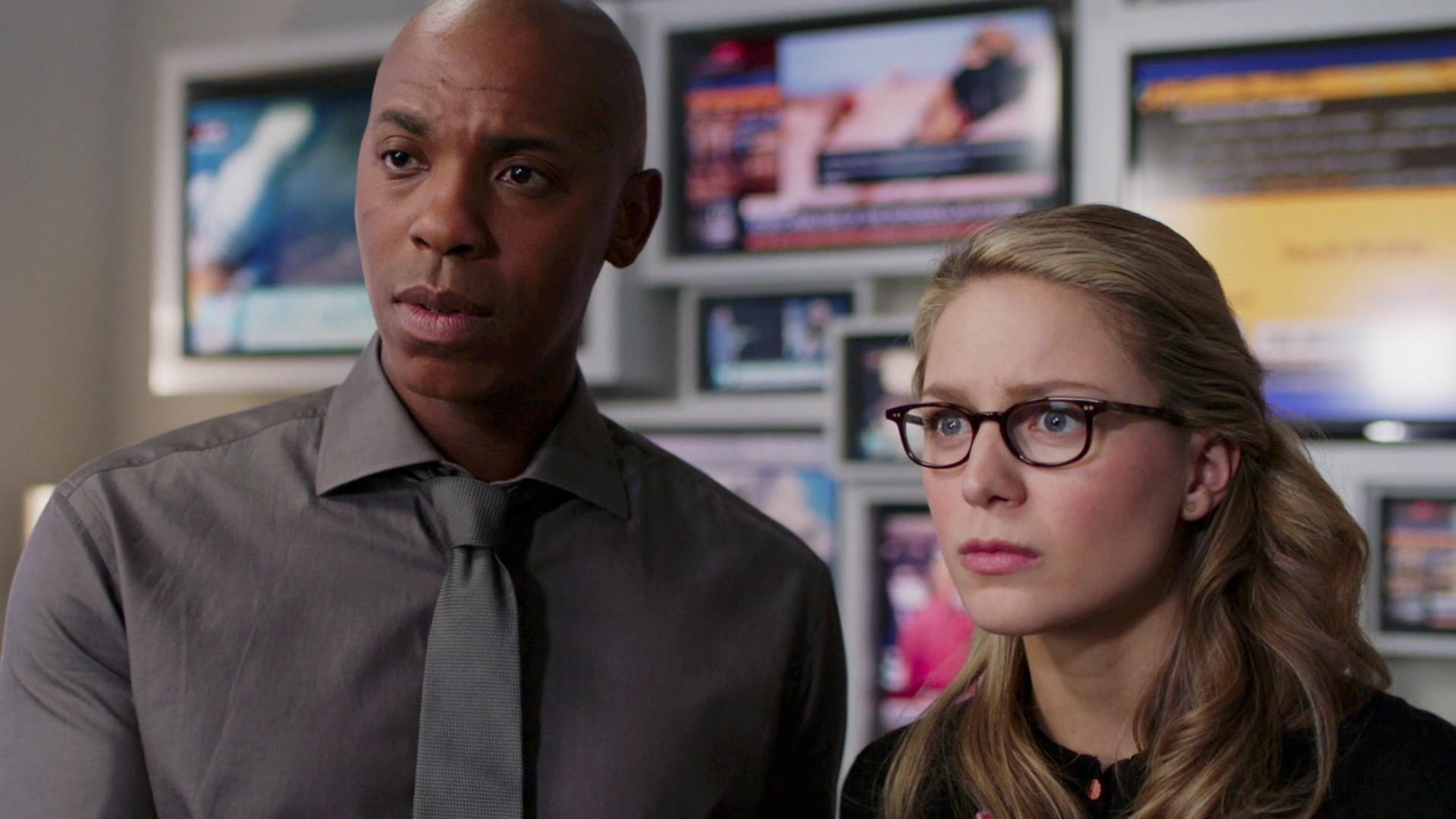
As the other CW shows finish up their seasons, SUPERGIRL starts wrapping up plot points. The return of the Krypton cult makes sense, but isn’t super exciting. If the new cult leader is supposed to be a familiar face, then the show should’ve set her up as much as the translator. The Kara-Lena conflict doesn’t have enough new wrinkles from last episode to feel fresh. That said, the episode giving Mechad Brooks something to do is a refreshing develop for the Guardian character. This episode could’ve swung a 7.5 if not for the confusing moral of what video games are supposed to do.
SCORE: 7/10 Bangarangs (okay, did SUPERGIRL know that song was gonna be a big part of DEADPOOL 2? Because that’s a spooky coincidence)
The Flash, “We Are The Flash” (May 22nd)
Do you guys just wanna watch INCEPTION instead? (copyright CW)
THE FLASH has a solid finale for what has been the Speedster’s greatest season. Barry finds a clever (albeit confusing) way to take on The Thinker. Killing the “good Clifford,” and focusing the effort on his stretchy vessel, made for a great reunion. That said, the clear standout of this episode is Tom Cavanagh, with his heartbreaking loss of intelligence, and apparent exit from Team Flash. We’ll have to wait and see if we’ll get a new Harrison next season – along with the new speedster. The return to a time-travel-related conflict isn’t super exciting, but it’s basically a given with Flash’s powers. In this standalone episode, THE FLASH wraps up a standout season with a greatly blend of heart, hilarity, and good storytelling.
Christopher Sebela and Joshua Hixson, the creators behind the upcoming Image Comics title, Shanghai Red, sit down with us at Monkeys Fighting Robots to discuss the makings of their bloody historical revenge epic.
Image Comics continues to break new genre barries on an almost monthly basis these days. One of their latest titles, Shanghai Red by Chris Sebela and Joshua Hixson, is a revenge story with a very real backdrop and setting not often seen in comics. The publisher describes it as follows:
Red is one of the hundreds shanghaied out of Portland in the late 1800s. Drugged, kidnapped, and sold to a ship’s captain, she wakes up on a boat headed out to sea for years, unable to escape or reveal who she truly is. Now, she’s on her way back, in a boat covered in blood, to find her family—and to track down the men responsible for stealing her life out from under her.
It’s actually more akin to the kind of prestigious show you would see on a network or streaming service (think Deadwood, Peaky Blinders, The Terror). It’s a fantastic title that shows you how versatile comics can be as a medium for any genre. Chris and Josh took some time to talk to us and tell us a bit about Shanghai Red.
Page from Shanghai Red
Monkeys Fighting Robots: Chris, How did you first come upon the whole concept of ‘shanghaiing’?
Chris Sebela: It’s become a term of more general use, so I’d heard it as part of the language, but after I moved to Portland and started investigating its general history, one thing that kept coming up was how it was this huge hub for people getting abducted into service on ships. Portland was the capital of the world in terms of shanghaiing at one point. Then I went on a tour of the Shanghai Tunnels and it was all over after that.
Was making Red female always part of the story? Chris: Yeah. It was the first thing I thought of, really. Because in those days, women who got shanghaied suffered a far worse fate than any guy who did. But it wasn’t just adding a layer of danger for Red. Not only was she stuck on this boat for years, but she had to keep herself disguised as a man to keep from suffering worse. It felt like it drove the stakes up and also made it more unique than just another story about a guy coming back for revenge.
So you have some themes and issues you hope to explore? Chris: Being a revenge book, a lot of it is about hate, anger, violence — about how far someone will go and what constitutes being made whole. At what point in the cycle do you feel like you’ve been paid back for what’s been taken from you by taking something from someone else?
On another level, a lot of this book is about identity. Red’s spent all this time drawing a line inside herself between her and Jack — the name she gives to herself when she dresses like a man to get the kind of work she wanted to get in a world where women were told to aim for domestic work and the like. She likes being Jack, but he’s also responsible for her being on the boat, so there’s a lot of conflict she deals with, trying to figure out which of them is the killer and which is the victim. It’s also about families, the kind we belong to and the kind we build for ourselves, and America in a weird period of time after the Old West was over but before our new modern age started up.
What made you choose comics as the medium to tell this story? Chris: I’ve been telling stories in comics for several years now and it’s the medium that makes the most sense to me. I like the structure, doling out information in 24-page bursts once a month, crafting issues that stand on their own as well as part of a bigger thing. It’s ridiculously challenging sometimes, so I never get lazy, I’m always up against some brand new problem or another. And I get to collaborate with artists like Josh, who bring it all to life, turn my idea of a story into something actual and real. I’ll dabble in other fields, but comics is what I love to do.
How much research do you have to do? Chris: A lot. More than most books, because our book is taking place in reality, in a very specific time and place in history, involving real people. Plus I like to build my books on top of a layer of facts so that anything really wild we put on top of it feels a bit more stable. I spent a lot of time in libraries and special collection files, taking lots and lots of notes. Read a lot of books on sailing and shanghaiing and Portland’s waterfront in the 1890s. I overloaded with info and then kinda let my brain go to work sorting out what’s most useful and the stuff that’s interesting but doesn’t really matter in the long run.
How big of a role is Portland going to play in the series? Chris: I’m not gonna be one of those writers who say it’s another character in the story, but this story doesn’t exist without Portland and its history. It was the tunnels that drew me in, they’re pretty unique to the story of shanghaiing because it really spoke to how ingrained this practice was into the DNA of Portland at the time. The town was so corrupt that everyone knew these tunnels were down there and home to all sorts of crimes and stuff and it was just business as usual.
So are are you a big history buff then? Chris: I am. I like to read nonfiction more than fiction and I’ll take a good documentary over a Hollywood film any day. There’s just so much in history that is completely messed up and over the top and unbelievable but it’s all true. I like it because, on one level, I just like stories. But on another, it almost gives me permission to go further in my own, because when the reality is that bizarre, anything I come up with will have to push pretty hard to overtake it.
How did you get hooked up with Josh? Chris: We met on Tumblr back in 2014 when Tumblr was something I actually used on a daily basis. I went thru his page and saw how great his stuff was and messaged him out of the blue, hoping he’d want to work together on something. Fortunately, he said yes and I pitched him on Shanghai. Luckily he said yes again and we started from there.
What’s your scripting approach when working with Josh? Chris: It changes a lot. Sometimes I’ll give Josh a complete script. Sometimes I’ll give him several pages while I figure out what comes next or just to see what he’ll do with them and use that as a springboard for stuff I hadn’t considered. That’s not an ideal way to work and I don’t recommend it, but mostly it’s just ultimate trust between us. We don’t go over thumbnails or anything, Josh just sends along inks in batches and they’re always better than the pages I sent him. So I keep doing what I’ve been doing and hope I don’t screw it all up.
How ahead have you written so far? Chris: The fifth issue is all done on my end, Josh has already wrapped the 4th issue and moved into 5, so we’re humming along. But, and I think this somehow got lost in the process, we’re just doing this as a 5 issue series. I do have ideas for a 2nd and 3rd arc that I would love the chance to do and dive more into the lives of Red and Jack and everyone else because I’ve grown attached to them. But I think ultimately, we just wanted to show up and tell a great story, so we’re not aiming much beyond that unless the response merits it.
Do you have an end to the story in mind? Chris: Yeah, for sure. I’ve had it in my head pretty much for the last 4 years. I think a few details have changed, but I know where we’re going, even final images. I like to have openings and closings handled before I get too deep into a story because the middle can shift wildly so long as you have your anchors. Hey, I made a boat metaphor!
Page from Shanghai Red
So Josh, on to you! How do you approach visual reference in a historical tale like this? Josh Hixson: I wish I had a more exciting answer but it’s mostly just a lot of googling and reading. It’s a somewhat easy process for things like props and clothes, but it gets trickier with architecture for specific locations; particularly with interiors. Chris was also super helpful with acquiring photo reference. A good portion of the work for reference is just me taking pictures of myself in clothes that best resemble the character’s wardrobes.
How do you create your art? Is it digital? Because it has a very ‘hand-drawn’ feel to it. Josh: It’s a mix of digital and traditional. I draw the thumbnail layouts by hand in a small notebook and then draw over those with digital pencils in photoshop. Then I print those out on copy paper and lightbox over them with ink on 11×17 Bristol. Lightboxing is basically just putting a piece of Bristol over the printed pencils and onto a table that lights up so you can see the pencils through the Bristol and ink over it. I like to ink traditionally but I think I’m gonna have to try to go all digital at some point. I’ll try anything that I think might save me some time.
I really love the striking gutters between your panels. What made you choose such a dynamic layout? Josh: I dunno, I’m a fan of keeping panels separated by a nice gutter, as opposed to having no gutter or having panels overlap. There’s a simplicity to it that I love. I used to try to do crazy things with panel arrangements or have them be their own element of the storytelling but it always felt forced. It’s the kind of thing where because it CAN be done in comics I felt like I had to experiment with it. At some point, I just accepted that I liked simple panel arrangements. It’s also because of the type of story Shanghai Red was, though. I might approach panel layouts differently if it felt right for the story.
Do you have any specific artistic influences? Josh: Yeah, too many to name. The people I tend to look to the most are guys like John Paul Leon, Sean Phillips, Paul Azaceta, and Jorge Zaffino. There are so many others but I almost always have those 4 artist’s books next to me when I’m drawing. For color, I’m pretty much always looking at Elizabeth Breitweiser. There’s really no one who does work like her. Her application of color is so unique and her palettes always blow me away. I could stare at her work all day.
Did you have a specific visual style for this story from the beginning? Josh: I don’t think I’ve been working long enough to have a specific visual style. I mean, I definitely tried to draw the book a certain way when I first started, but because that was a couple years ago I feel like my style evolved into something slightly different. I’ve always drawn with a kind of roughness which is definitely prevalent throughout the whole book, but I still feel like I have no idea what my style is. And I’m not really worried about that like I used to. I think it’s something you acquire slowly over time. Right now, I think I mainly just have a specific way I ink. I try to only worry about getting better at drawing and storytelling.
What do you look most forward to drawing in the world of Shanghai Red? Josh: I liked drawing the ‘revengey’ parts. Chris really went out of his way to up the brutality and always found new ways for the baddies to go down. It was fun trying to figure out the best way to show that on the page. There are a few scenes I’m thinking of in particular that are pretty messed up, to say the least, which were really fun to draw. I also loved drawing the more quiet and somber moments as well. Trying to evoke those kinds of emotions is probably my favorite part of storytelling and fortunately, Chris gave me ample opportunity to do that with this book.
What’s the process of working with Chris like? Josh: It’s been great. I haven’t worked with a ton of writers in my time but I don’t think it gets more easygoing than Chris. He’s always open to new ideas or trying things differently and really gave me a lot of liberty with the book to do what felt right. More than that I’m just really a fan of the work he does. I’m definitely biased but I also think Shanghai Red is some of his best work yet. There’s a kind of subtlety to this book and its characters that I love so much and tried to tap into. So yeah, I couldn’t be happier to be working on this book with Chris. I’m hoping there’s another Sebela story with my name on it down the road.
How long does it typically take you to finish an issue? Josh: Well, unfortunately, there’s never been a time where I wasn’t working on other projects while also doing Shanghai. I wish it was my only job but I do other work as well to pay the bills. So for some issues, the start to finish time was at least a couple months. But I average a page a day when I am working on comics so I know I could do it on a normal monthly schedule. I dunno, I think about the constraints of time a lot and how technically I could do 2 books in a month if I really tried, but I’ll always want as much time as I can get to make the book as good as possible. Within reason of course; too much time can also be a very bad thing.
Shanghai Red #1 is due out June 20th, 2018 from Image Comics.