Home Blog Page 456

Review: STAR TREK YEAR FIVE Is Destined To Be A Classic

Monkeys Fighting Robots

As more information slowly trickles out about the new Star Trek T.V. series, IDW Publishing continues to keep the Trek audience entertained with titles such as Star Trek Year Five. Acting as an homage to the original series and a companion to the number of live action versions readily available, Star Trek Year Five is pure indulgence for any Star Trek fan.
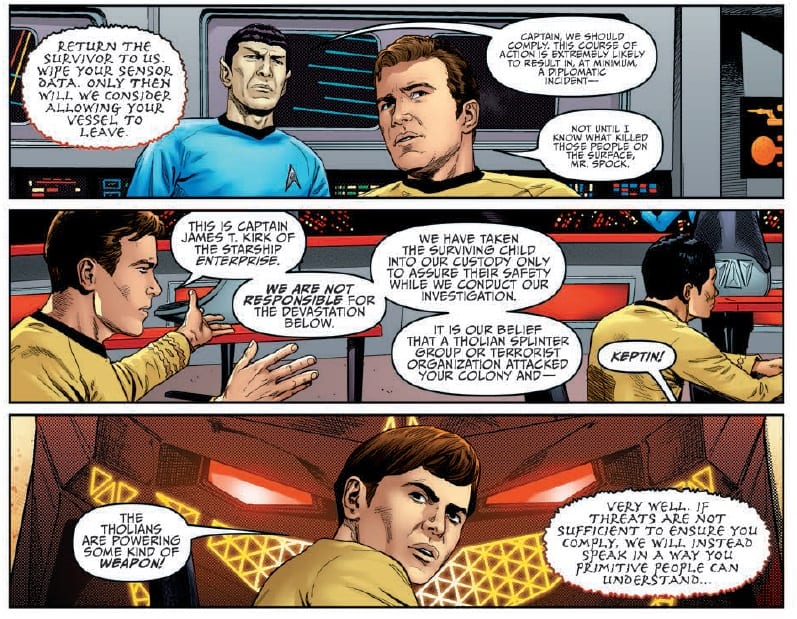
STAR TREK YEAR FIVE #2 Is Destined To Be A Classic
Star Trek Year Five #2 Credit: IDW Publishing

Writing/Story

After rescuing the only survivor of a massacre on an unexplored planet, Captain Kirk and the crew of the Enterprise face a Tholian threat which, if handled incorrectly, could start an interstellar war.

With the end of their mission so close, should Captain Kirk play it safe or stand his ground? How much is one life worth?

These are the questions that Jackson Lanzing and Collin Kelly ask in the second issue of Star Trek Year Five and they lead to some deep, sociological conversations. The original Star Trek series was always about ethical dilemmas and shining a light on society; Lanzing and Kelly have adopted this approach and there are a number of contemplative moments.

The script is speech heavy for the majority of the comic but it suits the type of story being told. This is Classic Star Trek and it is presented as such. It is a comforting contrast to the super-fast, action heavy versions audiences are faced with at the cinema or on T.V. That doesn’t mean Year Five isn’t exciting, it just has a different approach, inspired by Gene Roddenberry’s initial concept.

Lanzing and Kelly have captured the characters perfectly, so much so that you can hear the actors voice as you are reading. Their accents and inflections are woven into their speech so the reader can tell who is talking even when they are off panel.

STAR TREK YEAR FIVE #2 Is Destined To Be A Classic
Star Trek Year Five #2 Credit: IDW Publishing

Art

The wonderful character representation is also reflected in Stephen Thompson’s art work. He uses very precise, thin pencil lines to shape the figures and scenery, allowing for an impressive amount of detail. The visual style is clearly inspired by the original series and the images make you feel as though you are back in the 60’s watching the show on television.

Thompson uses the scenery to create frames within the panels thereby giving the scenes some depth. It also allows Thompson to lead the reader through the panels and across the page. The layouts are fairly standard, and there is a lot of exposition to fit in, so Thompson uses his framing techniques with shifting camera angles to drive the story forward.  The pacing of the comic comes from the changing panel shapes with the occasional page bleed punctuating moments of significance.

Both Charlie Kirchoff, on colors, and Neil Uyetake, on letters, follow the aesthetic set by Thompson. Kirchoff uses muted colors to give the pages that 1960’s atmosphere but emphasises the uniforms worn by the Enterprise crew. This is almost as important for the characters as their speech.

Uyetake spaces the speech balloons out, giving each sentence or paragraph space to breath. The information is laid out in a naturalistic, conversational way but still conjures up memories of watching the staged Original Series episodes.
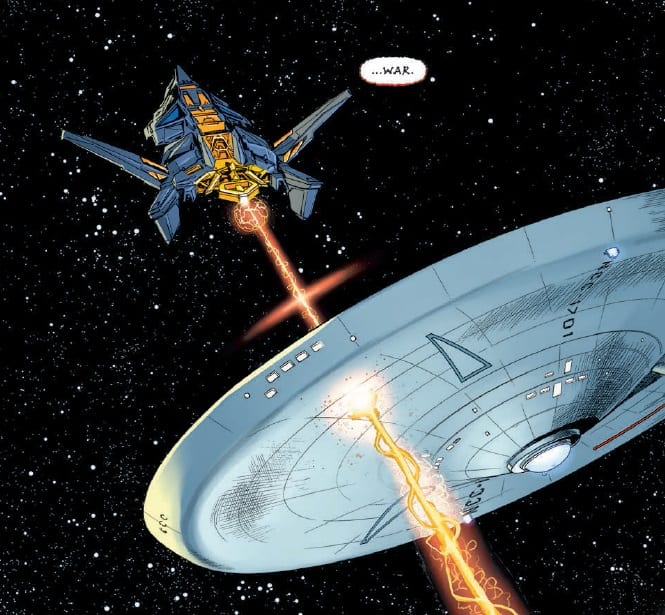
STAR TREK YEAR FIVE #2 Is Destined To Be A Classic
Star Trek Year Five #2 Credit: IDW Publishing

Conclusion

Star Trek Year Five is everything you could want from a Star Trek comic. It allows itself some indulgence in nostalgia, and references the Original series on a number of occasions, but not enough to make it just for fans. The central story is a strong, important story which can be read on a number of levels. On the surface it is a straight forward Sci-Fi romp with impending destruction around every corner but underneath there is a greater philosophy.

It is only two issues in but Star Trek Year Five is already shaping up to be a classic Star Trek comic, destined to be talked about for years to come.

Monkeys Fighting Robots Youtube

Review: DICK TRACY FOREVER #2, Fast Fists and Future Tech

Monkeys Fighting Robots

Dick Tracy Forever from IDW Publishing moves through the years as it pays homage to Dick Tracy and all the things that made the character so popular. After last months ‘early years’ issue, this month sees the classic Grotesques make an appearance as well as some of the futuristic technology that Chester Gould loved.

This is the Forties; this is where Dick Tracy made his name.

DICK TRACY FOREVER #2, Fast Fists and Future Tech
Dick Tracy Forever #2 Credit: IDW Publishing

Writing/Story

Just like the first issue, Dick Tracy Forever #2 offers up several stories surrounding the famous detective. The first features ‘that damned watch’ and focuses on the technological obsession from the original strip. This follows a ‘story within a story’ pattern with a kick at the end.  Michael Avon Oeming uses the narrative frame to tell a story about Dick Tracy from the point of view of the criminal, a rarity for Tracy fans. The story is comedic with an over exaggerated sense of dilemma. Its first narrator, English Bob, clearly thinks a lot of himself and comes with a thick layer of stereotyping. This is followed by a similar, although contrasting, voice for the second part of the story.

Although lacking any real substance, the opening tale is a humorous homage to the two-way wrist radio that has become synonymous with the character. The second story, however, is much more ambitious. Featuring several of the famous villains from Dick Tracy’s rogue’s gallery, The Two Dicks centres around a plot to produce poisonous gas for foreign agents. Chester Gould wrote several stories featuring German Spies during the Second World War era so it’s no surprise Oeming would venture into this territory.

The story is action packed with some very strong character moments. There are, however, a large number of characters featured and they suffer because of this. Oeming is able to give the characters more narrative time than the Disney movie spent on the grotesques featured in that production, but it still lacks any satisfying depth. It is as if the reader has come in at the end of the story having missed all of the build-up. One of the successful elements of Gould’s original strips was the lead in time for a story. He spent weeks building his characters before the inevitable chase across the country. Oeming has bypassed this and got straight to the climax. All of the elements of a great Dick Tracy story are there; evil villains; dastardly plans; gruesome deaths; elaborate traps; however, it all happens too fast.

Dick Tracy Forever Credit: IDW Publishing

Art

Oeming’s art work is suitably dynamic. He captures the characters beautifully, embodying them with life and emotion. His use of thick black lines makes everything bold adding a harshness to the stories. It is very blunt and to the point, just like Tracy’s attitude towards the law.

There is a dark atmosphere created by Oeming’s use of black but this relates to the stylistic element of the original strip more than it does to a narrative darkness as seen in Frank Millers’ Sin City comics, for example. Oeming enjoys contrasting the foreground and background, often reducing one or the other to almost black silhouette.

The colors are garish and unnaturalistic, much like the tone of the story.  Taki Soma uses color to emphasis character rather than depict reality which is exactly the correct approach for this comic. Broccoli Rabe is given a sickly green color that matches his name but also is an indication of his character. Tracy stands out in the panels because of his bright yellow coat; constantly the centre of attention in his own comic book.

Shawn Lee uses the lettering to break up the blackness in the backgrounds, cementing the speech over the top of the shadows. However, he uses coloured text boxes for the narration which indicates the separate characters but also reminds the reader that the visuals are flashbacks, told from the point of view of the speaker. The contrast between the clean whiteness of the speech balloons and the darker, colored narration boxes symbolise the time shift and the bias of the story teller.

DICK TRACY FOREVER #2, Fast Fists and Future Tech
Dick Tracy Forever Credit: IDW Publishing

Conclusion

Dick Tracy Forever is bold and brash. Much of the narrative is over the top action with wild visuals and design. It captures the feel of the expressive 1940’s Dick Tracy strips and pays homage to the characters that made that era of the strip so popular. The villains show the same despicable tendencies that Gould gave them 70 odd years ago.

The drawback with this monthly title is that Oeming is moving through the stories and the characters with such a speed that the reader does not get time to indulge in any of it. The story has no sooner started than a conclusion is reached. It would be nice to spend time with these characters and allow a sense of drama to build up. A character like The Brow could easily take up four monthly issues of storyline.

Dick Tracy Forever is a step in the right direction for the ever growing franchise but a commitment to a longer, more dramatic, ongoing story would allow the characters to shine and capture the hearts of old and new fans alike.

Monkeys Fighting Robots Youtube

INTERVIEW: Composer Fil Eisler Layers What/If On Netflix With A Rich Soundscape

New Netflix drama What/If comes from Revenge creator Mike Kelley who drew inspiration from a lot of 90s thrillers and pulled a coup by getting Renée Zellweger to star in a T.V. show for the first time ever as a regular cast member. Another addition to the team is composer Fil Eisler (Empire, Revenge) who layers the show with a little noir here and some industrial sounds there.

According to Netflix, What/If is a “neo-noir social thriller” that “explores what happens when acceptable people start doing unacceptable things.” It’s also an anthology series much like American Horror Story that will morph every season. Season one focuses on Anne Montgomery played by Renée Zellweger who makes a devious offer to a cash-strapped San Francisco couple named Lisa Ruiz-Donovan (Jane Levy) and Sean Donovan (Blake Jenner). From there, things unravel and descend into chaos as Anne manipulates everyone around her.

PopAxiom wondered … what if we could interview composer Fil Eisler about making music, What/If, and Superintelligence?

About What/If

netflix-composer-interview

Fil Eisler previously worked with What/If creator Mike Kelley on Revenge. However, the sounds of both shows are quite different. “We deliberately wanted to go in a different direction.”

What/If is undoubtedly influenced by 90s thrillers like Basic Instinct and Indecent Proposal. “They deliberately took a lot from that. There are even a few cameos.”

The music for What/If is a hybrid of sounds. “What we ended up coming to was that Anne Montgomery had this neo-noir orchestral sound but underneath that would be the machinations of this Machiavellian scheme going on.”

Fil says about Kelley, “ … makes things very twisted and dark, which is right up my alley.”

To achieve some of this twisted mix, Fil says, “I spent a lot of time delving in the world of modular synths.”

Elaborating on the score of What/If: “There’s a very dark, sort of industrial undertones but with this quiet and lush orchestral … over the top. Proper themes, proper melodies, so in a lot of ways it’s very old school.”

Nineties thrillers were light on the noir elements when it came to the score. For Fil, he went way old-school: “Film-noir to me goes way, way beyond … much further back. The 40s, 50s, and even 60s.”

Significant influences on the shows sound included, “… Bernard Herman, Miklós Rózsa … Alfred Newman.”

But Fil doesn’t think it was a conscious influence, “They’re sort of part of my DNA.”

Speaking of DNA

Fil Eisler was born in Prague and doesn’t remember life without music in the house. “We had a grand piano … so music was always around me from an early age.”

Growing up, Fil had an English grandmother who was a violinist and later taught music therapy. “She’d sit with me at the piano, and we’d make up stories with music.”

Sure, as a kid there was a lot of senseless key banging going on here sometimes but, Fil says, “It’s really fun and something I do now with my kids.”

As early as four or five, Fil started taking piano lessons and also sang in the choir. “My dad brought home a guitar once when I was around eight years old, and that was it. I fell in love with it. That became my instrument.”

Movies & Music

Fil grew up in a theatre-centric, classical music surrounding, so the idea of film scoring, “… came much later.” However, Fil was undoubtedly a fan of film too. “If there was something I was obsessed with besides music, it was movies.”

As a kid, Fil says, “I don’t know how much I made the connection … between films and who was making the music.”

But he does recall the kind of movies that made their way into his creative DNA. “Spielberg, James Bond, James Cameron, Ridley Scott … lots of horror movies and that was in the 80s, the sort of golden age of slasher films.”

Fil’s cinematic influences included many classic films: “I remember going to see Saving Private Ryan and Schindler’s List. The first time I saw Pulp Fiction and Heat,” Fil exclaims, “Oh my god, Heat, I saw that about five times in theaters.”

Movies like those made Fil, “… want to do that.”

Much like so many musical artists owe a lot to the Beatles, or Elvis for you Elvis people, Fil thinks the same goes for John Williams when it comes to scoring. “To this day he’s the master.”

Williams was a household name in the 80s because of Star Wars and Indiana Jones, oh, and E.T., oh, and … you get the point. But Fil, “… never thought of the music separate from the film.”

Fil adds, “I could always sort of close my eyes and see visuals with the music. It’s always been there.”

Wrapping Up

Another upcoming project from Fil is a film starring Melissa McCarthy called Superintelligence. It’s a comedy about something potentially terrifying — artificial intelligence.

But, as Fil puts it, “[Superintelligence] is not Terminator …” With James Corden as the voice of the A.I., it’ll be hard to not find Superintelligence charming.

As for the music: “Superintelligence is very much an orchestral score in the vein of a Williams or Silvestri.”

What’s next from the composer? “Right now I’m working on a movie called Wander Darkly with Sienna Miller and Diego Luna. It’s simply fantastic.”

Fil will soon be at work on the sixth and final season of the hit FOX series Empire.

Thanks to Fil Eisler and Rhapsody PR for making this interview possible.

Header image provided by JennKL Photography.

Monkeys Fighting Robots Youtube

Review: PUNK MAMBO #2 Delivers Strong Writing, Excellent Artwork

Monkeys Fighting Robots

Punk Mambo #2 finds the titular priestess in Haiti, following the trail of whoever is kidnapping the spirits. The loa are unhappy about Punk Mambo’s brazen lack of respect for her powers and the customs of voodoo. They need her, however, if they’re going to stop Uncle Gunnysack and recover their stolen comrades.

The Writing

The story is a bit more compact than in our first issue, allowing Bunn to delve into more characterization. The interactions between Punk Mambo and the loa flesh out her character, while giving personalities to the loa as well. We’re also introduced to Josef, a Haitian priest tasked by the loa to assist the mission. Throughout Punk Mambo #2, Josef plays an important role as an observant devotee to contrast with Punk Mambo’s lack of reverence.

Punk Mambo, as a character, doesn’t respect the spirits or the Voodoo faith in general. She’s essentially colonizing the religion and using it for her own personal gain. It’s a troublesome point, but Bunn doesn’t let that go unremarked upon. He employs the character of Josef as an effective foil who’s willing to challenge Punk Mambo and call out her behavior.

The dialogue in Punk Mambo #2 is strong and witty, making the characters feel very organic and believable. This tends to be one of Bunn’s strong suits, and he certainly doesn’t disappoint here.

A good deal of the issue focuses on the interactions between Punk Mambo, Josef, and Marie. That’s not to say, though, that there’s no action. The trio end up in a showdown with Uncle Gunnysack’s devotees in the book’s second half. That said, the fight doesn’t really seem to add much, as Uncle Gunnysack himself shows up shortly after. It’s nice in that it adds some dynamics to the otherwise subdued storytelling, and it allows Punk Mambo and Josef to showcase their abilities. It doesn’t really serve to advance the narrative much, though.

The Artwork

Adam Gorham’s lines for Punk Mambo #2 are excellent. He presents a lot of eye-catching, dynamic imagery throughout, and the work generally flows extremely well. Panels are meticulously detailed and vibrant, really grounding the reader in the environment.

One of Gorham’s strengths is in his expressive faces. Readers can detect subtle changes in characters’ expressions—a slight smirk, the furrowing of a brow—and pick up significant tonal information. Going off that point, his designs for the loa are awesome. Even if one knows nothing about Voodoo as a religion, you can still draw key context about what each spirit represents based on the way they’re portrayed. Uncle Gunnysack is perhaps the most impressive and imposing, looking something like a more-terrifying cross between Krampus and a pro wrestler.

The colorwork by José Villarrubia and letters by Dave Sharpe are on-point here, too. Villarrubia employs a wide palette of colors, with dark, radiating tones for the loa, but bright, softer colors for street scenes and marketplaces. Even Sharpe’s letterwork on the loa give the reader key insight into each spirit’s personality and tone.

Final Thoughts

Punk Mambo #2 keeps up the momentum from our first issue, while advancing and enriching the overall narrative. It’s a fun, engaging story, brought to life by quality artwork. Definitely check this out.

Monkeys Fighting Robots Youtube

Interview: David Pepose on SPENCER & LOCKE & Tips For Aspiring Writers

Monkeys Fighting Robots

Monkeys Fighting Robots talked with David Pepose at MegaCon 2019, where the writer discussed his series Spencer & Locke and offered up some advice for aspiring comics writers.

Check out the full interview with David Pepose here:

On Roach Riley, villain of Spencer & Locke 2:

“That was sort of the toughest part about writing our sequel: I wanted to make a villain that was just as worthy as our lead characters. Because our first arc was sort of “what if Calvin and Hobbes grew up in Sin City?” and it was a story about PTSD and trauma and mental illness and what are the lengths that the mind will go to protect itself from harm. So i was thinking, what’s the opposite of all that? And it took me a little while to get into that headspace.”

“Spencer and Locke, their trajectory, it’s a redemptive kind of arc, and what’s the opposite of that? Roach thinks, once you’ve had the worst day of your life, that’s it, nothing else can touch you. I looked to Heath Ledger’s Joker as a huge inspiration. Also Taxi Driver and The Deer Hunter. So once I got into that head space, the whole story kind of clicked for me in terms of its themes and how Locke would react to things and how Roach would slowly start taking control of the situation. He was kind of a hard character to stay in long term, but it was so rewarding to write.”

spencer & locke 2 comics david pepose jorge santiago roach riley

On his upcoming series Going to the Chapel:

“The easy log line is: it’s like Die Hard met Wedding Crashers. It’s about a wealthy bride who’s dealing with a serious case of cold feet, but before she can say anything, her wedding is taken over by a gang of Elvis-themed bank robbers. So she’s in it to play both sides against the middle, she wants to get out in one piece. It’s a love story! It’s a story about commitment and dysfunctional families and what does it take to say till death do us part?

I feel like rom-coms always get a bad rap… There’s a preconception of who’s allowed to consume and enjoy these things, and I think that’s nonsense. A lot of my favorite movies are twists on the rom-com genre… I think rom-coms are just as flexible of a genre as crime or science fiction. And so I wanted to write something that I thought I would really like to read, that both men and women would enjoy and have a lot of fun reading.

People said it’s like if 90’s Julia Roberts was in a 90’s Quentin Tarantino movie.”

going to the chapel preview david pepose action lab danger zone spencer locke

On what advice he has for aspiring comic book writers:

“Don’t get discouraged. There are going to be so many roadblocks that happen to you in comics… Things will fall through. It’s just the nature of the business. People get busy, they have family things come up, they bite off more than they can chew, and the things that writers have to remember is: you have it easy. You can write five scripts in the amount of time that one artist can draw one issue… So you have to kind of manage your expectations a bit. And when you find somebody who can go the distance, you really have to hold on to them tight.

On top of that, it takes time. It’s a marathon. It took nine months for the pitch for Spencer & Locke – just the pitch – to get put together. And then it took another six months to get an offer for it. And then it took another ten months to complete it! So when you start thinking of it like that, especially when you’re starting out in the creator-owned scene, these things aren’t fast. And the higher quality you’re shooting for, the longer it’s going to take.

My biggest suggestion for any writer out there is: learn other elements of the business. For me, I started as a reviewer, so I was able to articulate what I liked about comics art and what I didn’t like and the kinds of shots I liked, so I could discuss with an artist in the thumbnail stage what I liked. I took classes at Comics Experience online for coloring and lettering, and that helped me out in a BIG way, because if you’re able to look at your pages and be able to go in Photoshop and say, “hey what would it look like if we did this?” then you can convey that to your colorist and you guys can go back and forth about what would look best for this book to stay true to your vision but also do something that the colorist feels they’re a part of.

It’s a lot of communication. It’s a lot of back and forth. And it’s a lot of trial and error. No two teams work the same way.”

“Making comics is the hardest thing I’ve ever done, but it’s also the most worthwhile. Anybody out there who’s thinking they want to do a comic, do it. Start small, if you want. You don’t even have to start making the artwork. If you’re a writer, start with some short scripts until you feel confident enough that you can do a full issue script, until you can do a four issue art, you can do a six issue arc. A lot of people think, “oh I’m going to do 60 issue epic” and that’s not how it works, guys. Publishers don’t know who you are. Publishers are also naturally risk-averse. They’re very conservative with the choices they make, because of course they’re not looking to go into debt. They’re looking to at least break even on their books or hopefully bring back some sort of dividend. And so being able to say, “I have a self-contained story, it’s got a beginning, middle, and end, here’s what it is,” DON’T hold on to your twists, tell your editors exactly what this book is going to be, they know that you’re not biting off more than you can chew, they know that you’re not crazy, they know that maybe you can write. These are all things that publishers want to know.

And then once you start working with them, once you start turning in scripts, then they can know “oh ok they’re easy to work with, they can hit a deadline, they know how to write, they’re not crazy,” these are all things that go a long way to help your career in the long term.”


Spencer & Locke 2 is going on right now, and Going to the Chapel will be here later this year – add both to your pull list!

Thanks again to David Pepose for taking the time to talk with us.

Monkeys Fighting Robots Youtube

Interview: Joshua Williamson Talks FLASH: YEAR ONE & Upcoming BATMAN/SUPERMAN

Monkeys Fighting Robots

Monkeys Fighting Robots chatted with writer Joshua Williamson at MegaCon 2019, where he talked about his current Flash: Year One story, and what to expect from his upcoming Batman/Superman.

Watch the full interview with Joshua Williamson here:

Why is now the right time to tell Flash: Year One?

“Oh man, well, for me we’ve been building this big story with Barry since issue one, and we’re trying to tell this big narrative and sort of my view on who Barry is. Right now, in the story of The Flash, he is kind of at his worst. It’s like all the stuff that happened with Wally, all that stuff with Kid Flash, Iris is gone … he’s kind of alone.

During the Trickster storyline, he was confronted with the idea that he was questioning being happy. It made him reflect on himself, like, ‘what’s going on with me that i think being happy is weird?’ It made him confront how pessimistic he’d become, which is not who Barry Allen is, right? Barry Allen is an optimistic, hopeful person. He’d become so pessimistic.

At the end of the Trickster storyline, Trickster won. Like, The Rogues all escaped. Iron Heights was destroyed, The Rogues escaped, Trickster got away. And now you look at Barry and he’s like, ‘all The Rogues are free, Hunter is out there, I’ve got all these forces, all these things are happening,’ it’s just weighing down on him and he feels very pessimistic, he feels very overwhelmed by all this stuff. And then he meets Steadfast in issue 69 who’s like, ‘you need to remember something, you forgot something really important.’ And that’s what makes him relive that memory.

I wanted to put Barry at his most pessimistic before we do a story about… You know, he was an optimistic, hopeful kid. After his mom died he became this pessimistic person. What Geoff Johns said best was that after [Barry’s] mom died, he was always standing still, and then the lightning hits him and he becomes The Flash. But I wanted to show a story about how it wasn’t that easy. The powers don’t make him optimistic. The powers don’t make him hopeful. I wanted to show how he goes from this pessimistic person who then has the powers who then becomes the hopeful, optimistic person again. And so that’s what I was able to do with this story. I wanted to show that story again. And it’s perfect timing for this book because yeah, Barry’s pessimistic, but then for the next thing that’s coming – the thing after “Year One” – he needs to be optimistic and hopeful again. Even though there’s a lot of intense stuff coming at him, I want him to be that person again so he can tackle those problems.”

What can people expect from Batman/Superman?

“It’s got Batman and Superman in it, I’ll tell you that. It’s going to be spinning out of some of the stuff that’s been going on with Metal and some of the stuff that’s been going on with the Batman Who Laughs series. But it’s going to be its own story.

If you want to know what’s going on in the DC Universe, this is one of those books to keep an eye on. Stuff that happens in it will impact what happens in the DCU in 2020 in a major way.

But what’s happening is that Batman and Superman find out that there are characters in the DCU that are being possessed by the dark multiverse version of themselves. So kind of like there was the Dark Knights? We’re doing something like that where there are characters being corrupted and replaced by those people, and [Batman and Superman] have to figure out who they are. Which heroes, which characters have been turned, which have been infected by the Batman Who Laughs? So Batman Who Laughs is in it more as a presence; it’s more about them investigating these characters and trying to figure out who it is. Can they keep this a secret, or do they bring everybody in, right? Who do you trust in a situation like this?

So it’s mostly about that. David Marquez is drawing it and it looks awesome. I’ll show you a page when we’re done, but dude, it’s so good.”

He did show me a page after the interview, and I can confirm that it is, in fact, so good.

Was there any discussion about who’s name was going to come first in the title?

“Oh sure, but you know who won. It was Batman. We talked about that a lot in the beginning, and we kind of went back and forth, but the decision was made to make it Batman/Superman, which I was fine with.

To me, it’s both of their books. Just because [Batman’s] name is on top… It’s both of their books. And a lot of it has to do with a lot of Superman stuff. A lot.”


You can read Josh’s The Flash right now, while Batman/Superman #1 hits stores in August. You can also pick up his indepedent comics NailbiterBirthright, and Ghosted from Image Comics.

Thanks again to Joshua Williamson for taking the time to talk with us!

Monkeys Fighting Robots Youtube

Interview: Tom Taylor Talks DCEASED & FRIENDLY NEIGHBORHOOD SPIDER-MAN

Monkeys Fighting Robots

Monkeys Fighting Robots sat down with Tom Taylor at MegaCon 2019 and talked about the writer’s current superhero horror comic DCEASED, as well as what’s coming up in his Friendly Neighborhood Spider-Man series.

Check out the full interview with Tom Taylor here:

Tom on where “the line” is when writing a gruesome horror story like DCEASED:

“I haven’t found it yet … I just sort of hack at the line with a blunt knife and DC goes ‘sure, yeah.'”

On who Peter Parker is at his core:

“He’s just a very good person who wants to do good and help people around him and I love him.”

On bringing out readers’ emotions:

“I made Mitch Gerads cry on a plane [with Friendly Neighborhood Spider-Man #6]… YES! Yea, no, I’ve made lots of people cry in public and that’s always one of my favorite things.”

On what’s coming up in Friendly Neighborhood Spider-Man:

“You’re going to get to see an all new villain, actually. Not sure if I can say that, but I just said it!”


Thanks again to Tom Taylor for taking the time to talk with us. Tom’s currently writing DCEASEDFriendly Neighborhood Spider-Man, all of the Star Wars: Age of Resistance titles, and more. You can also watch his TV show The Deep on Netflix!

What’s your favorite Tom Taylor comic? Sound off in the comments!

Monkeys Fighting Robots Youtube

Exclusive Marvel Comics Preview: WAR OF REALMS: WAR SCROLLS #2

Monkeys Fighting Robots

War Of The Realms: War Scrolls #2 doesn’t hit your local comic book store until May 29, but thanks to Marvel, Monkeys Fighting Robots has an exclusive NINE-Page preview!

About the issue:
THE MUST-READ COMPANION TO THE WAR OF THE REALMS! From the Asgardian Bifrost, Daredevil watches Malekith and his forces lay waste to realms. Jason Aaron and Andrea Sorrentino take Daredevil — the God Without Fear — to places he never believed he would see! Then, Devin Grayson spins a tale of magic and its consequences as Doctor Strange casts a spell that will cost him dearly — and devastate the Asgardian pantheon! All this and more straight from the battlefield of WAR OF THE REALMS!

The creative team on the book:
Written by: Various, Jason Aaron, Devin Grayson
Art by: Various, Paul Davidson, Andrea Sorrentino
Cover by: Alan Davis

Check out the War Of The Realms: War Scrolls #2 below:
War Of The Realms: War Scrolls

War Of The Realms: War Scrolls

War Of The Realms: War Scrolls

War Of The Realms: War Scrolls

War Of The Realms: War Scrolls

War Of The Realms: War Scrolls

War Of The Realms: War Scrolls

War Of The Realms: War Scrolls

War Of The Realms: War Scrolls


How many of the War of Realms tie-ins are you picking up? Comment below with your thoughts.

Monkeys Fighting Robots Youtube

Review: The Tragedy of Astrid Arkham in DETECTIVE COMICS #1004

Monkeys Fighting Robots

The plot thickens in Detective Comics #1004, as we learn Astrid Arkham’s origins, and the root of her hatred for Batman.

As the daughter of Arkham Asylum’s head doctor Jeremiah Arkham, Astrid grew up within the walls of the facility. Seeing the asylum’s inmates as a surrogate family, she learns to hate Batman after learning about a tragedy within her own past. This hatred sets her on her mission to cleanse Gotham of Batman, and bring about the mysterious “Eclipse” she references.

The Writing

Much of Detective Comics #1004 is occupied by exposition, with Dr. Arkham relaying Astrid’s entire backstory. Dedicating this much time to exposition is a hard trick to pull off well. Tomasi manages to do it, though, delivering another excellent chapter in the story.

We see a young Astrid interact with The Joker, Clayface, and other members of the Batman’s rogue’s gallery. It’s a bit uncanny, to a degree. We see genuine affection for the girl from characters we’re not accustomed to seeing in such an intimate light. Her interactions with these characters in Detective Comics #1004 give motivation to her actions as an adult.

Given the circumstances, she develops a startlingly-reasonable interpretation of the dynamics between Batman and his enemies, only viewed from a completely different perspective. In her view, Batman is not a hero or a protector. Rather, he’s the shadowy monster who comes to spread fear and pain among her adopted family.

Detective Comics #1004

Astrid’s backstory does induce a little bit of chronological confusion. She’s presumed to be around twenty years old at the time of Detective Comics #1004. However, characters present from her first moments like Batman, Harley Quinn, and Poison Ivy don’t seem to have aged at all in that span of time. Of course, there are ways around that matter, as fan speculation meticulously points out.

That point notwithstanding, the writing is strong, establishing pathos and motivation for Astrid’s crusade. It advances the narrative well, and leaves us on the precipice of a climactic showdown.

The Artwork

Bradley Walker’s artwork in Detective Comics #1004 is once again on-point. The sequences illustrating Astrid’s past flow seamlessly across the page without defined panels, giving the work a dreamlike impression that reflects a sequence of interwoven memories. Scrolls of Astrid’s childhood drawings serve as a device to lay out the story, which is a very neat effect.

The way in which Walker draws the flashbacks contrast well with the present-day sequences. He closely-crops many of these images in tight, evenly-spaced, rectangular panels. The end result is a work that feels cohesive, without being dull.

Nathan Fairbarn’s eye for color really shines in the flashback sequences. He bathes the figures in a lot of single hues against the beige backdrop of the scroll, adding to the dreamlike, flashback vibe.

Final Thoughts

Tomasi and company don’t disappoint on Detective Comics #1004. An excellent chapter in an equally attention-grabbing run.

Monkeys Fighting Robots Youtube

Review: Overman Fights For The Reich in FREEDOM FIGHTERS #6

Monkeys Fighting Robots

Overman faces the Freedom Fighters!

During World War II, the Freedom Fighters fought against the Nazis to try and stop the Reich. Just when they appear to win, the Reich revealed a metahuman of their own: The Superman of this world. Dubbed Overman, the Kryptonian was able to overcome the Freedom Fighters and helped the Nazis take over the world. Decades pass and the Freedom Fighters bring Uncle Sam out of his dimension to face the Nazi party of today. When he was revealed to the world, however, the Fuhrer requests to reawaken Overman. Has Uncle Sam returned just to be defeated once again?

Freedom Fighters 6 cover

**Some Spoilers Below**

Story:

We open the story with the Nazis awakening their greatest weapon, Overman. He doesn’t say much but smiles at the fact he gets to help his Reich. Overman takes off to find the Freedom Fighters, who are handling a relic of their own. Uncle Sam is out cold after his explosive return, and the Freedom Fighters have no idea what to do with him. He eventually wakes up and gets up to speed with his new team. It turns out they were trying to bring him back for a while, referencing the events of the Multiversity: Mastermen comic. Before they can get comfortable with their new teammate, however, Overman finds them and attacks.

Freeddom Fighters 6 p1

Halfway through the series and the epic story shows no signs of stopping. This issue has badass action and extreme tension. It’s very rare to get comics that have readers on the edge of their seats, but Freedom Fighters has been able to do it time and time again. This time around the threat of Overman and, as expected, he brought a whole new level of terror and action. There was even a twist in the middle of the story that had this reviewer’s jaw hit the floor. The only problem with the issue, however, is the fact it doesn’t precisely align with Mastermen. It’s just a nitpick to a fantastic comic, and it shouldn’t stop readers from taking a look themselves.

Art:

The world of Freedom Fighters continues to look as amazing as it is grim. The battle between the team and Overman is the best-looking fight I’ve seen in a while. From the illustrations to the colorwork, this comic never stopped impressing. The best page is hands down the twist mentioned in the story section. The moment the reader saw the full-page spread, it filled me full of terror and delight. I love the look of this book, and I can’t imagine it with any other art team.

Freedom Fighters 6 p2

Conclusion:

Freedom Fighters continue to be the underdog series that deserves to be in the spotlight. It’s gritty, action-packed, and just a fantastic time. Even with these giant action sequences, there is a finely written story woven in. I highly recommend this comic as well as the series.

Monkeys Fighting Robots Youtube