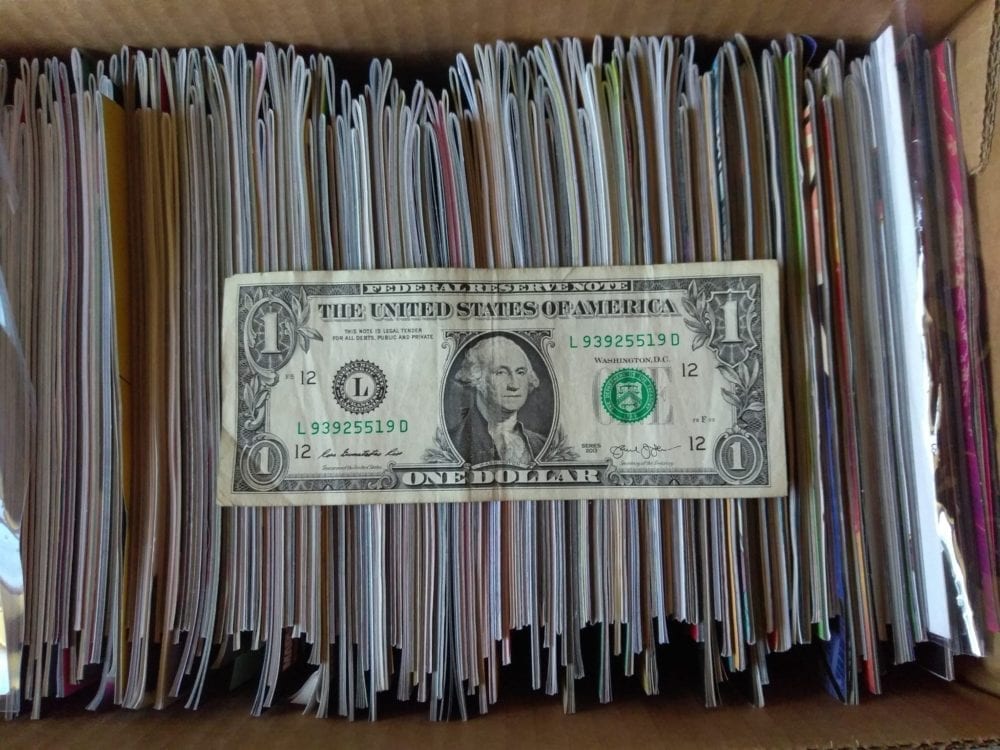
Welcome to ‘I’d Buy That For A Dollar’ a column where I will be exploring the weird and wonderful world of dollar bin diving. The only rule is each and every comic is purchased for one dollar (or less!).
For the very first column, we are gonna take a look at Marvel Comics’ X-FORCE #8 and First Comics’ WHISPER #5.
X-Force #8
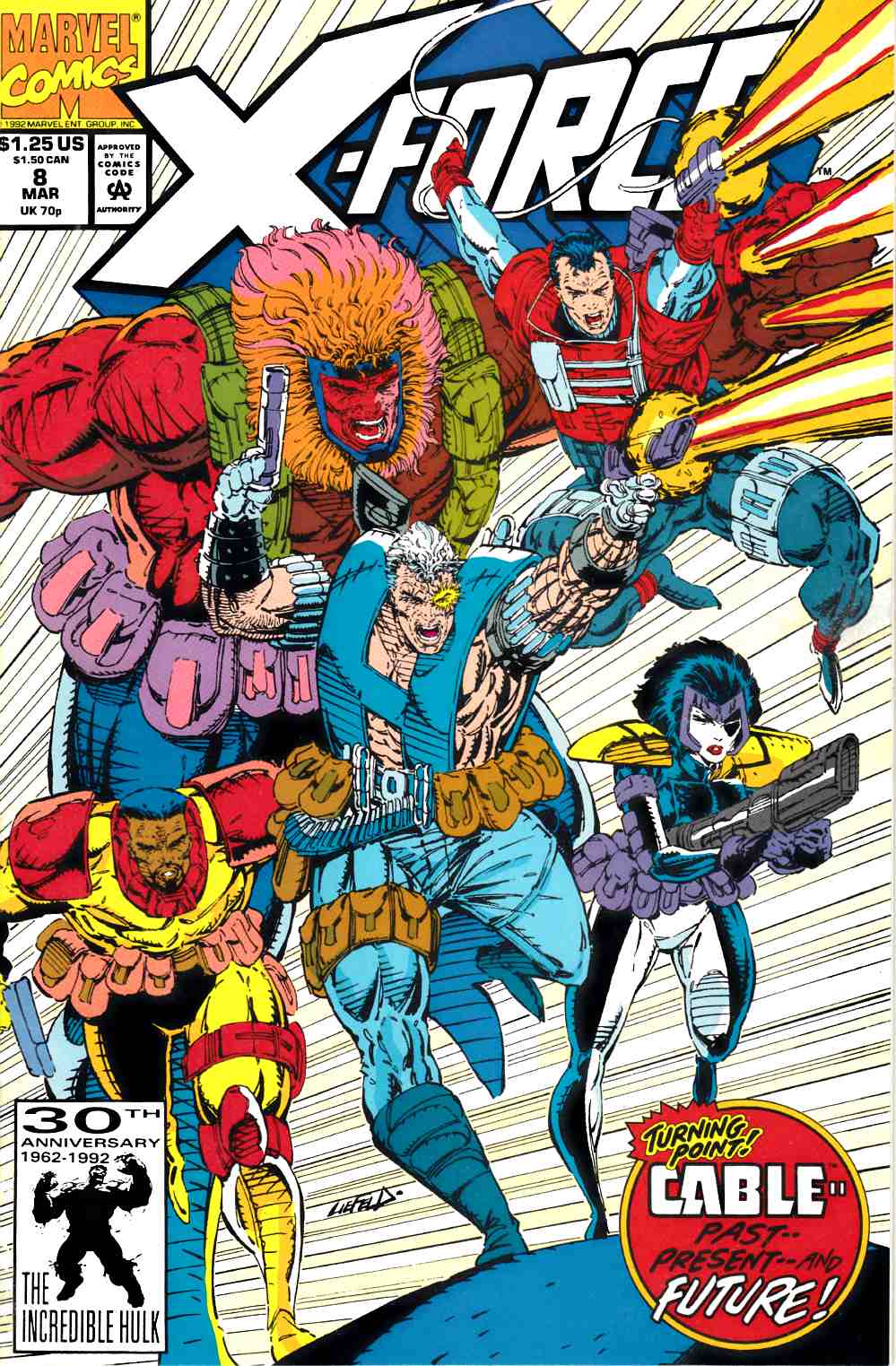
If you were reading comics in the 90s, then you were at least aware of Rob Liefeld’s X-Force. Spinning out of New Mutants, X-Force was one of Marvel’s biggest books at the time. But when Liefeld’s started to fall behind on penciling (probably due to his impending departure to help form Image Comics) fill-in artists were brought in. And in the case of X-Force #8, the guest penciler is none other than Mike Mignola, creator of Hellboy! I vividly remember being so disappointed at this at the time. As a young comics fan, I was really into Liefeld’s art. And seeing the blocky and weird images of Mignola sort of pissed me off. What a difference getting older and wiser makes because now X-Force #8 is a fucking gem of a dollar bin find. Just looking at it makes me wish Mignola had done a whole arc and not just this issue. Just check out the images below and tell me it’s not fun and fantastic. I dare ya!
I wish Mignola had drawn the cover too!This opening shop of the Wild Pack rules. Just look at the character Grizzly! Looks GREAT!This page layout with Baron Von Strucker in incredible!Very cool rendition of Cable. That white background is a great touch.
Overall X-Force #8 is a fun issue and well worth a dollar. It may even be my favorite issue in X-Force’s run. Grab it if you see it!
WHISPER #5
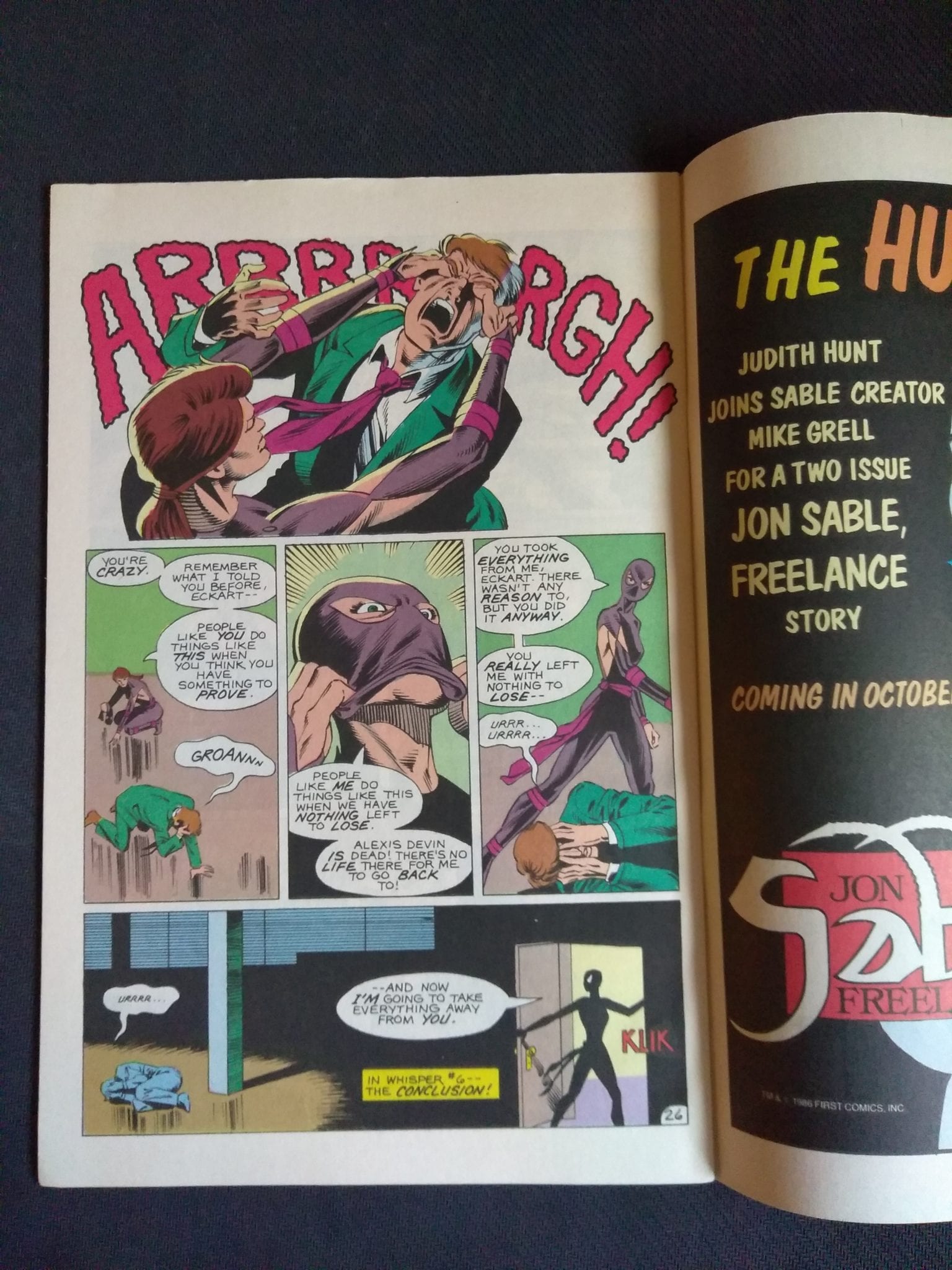
First Comics was a fairly large indie publisher in the 1980s. If you dollar bin dive, you’re going to see a lot of great books from First Comics. Like this one here, Whisper #5! Whisper was a ninja comic written by Steven Grant (who wrote for Marvel and had a solid run on The Punisher with the great Mike Zeck. He also wrote the indie comic 2 Guns which was turned into a Mark Wahlberg and Denzel Washington film a few years ago). The art in Whisper is by Norm Breyfogle (who also does the lettering here). Breyfogle had a well-received and lengthy run on DC’s Batman; helping create The Ventriloquist, Anarky, Jeremiah Arkham and Victor Zsasz. He also co-created, with Gerard Jones and Len Strazewski, Malibu Comics’ Ultraverse flagship hero Prime. Breyfogle sadly passed away on September 24, 2018.
Got it!There’s a lot of energy to this and it’s super fucking vibrant. It looks great on paper.
Some sick panel shapes and layouts!
I haven’t read much of Whisper, so it’s hard to get a story vibe from a fifth issue. But it has a fun vibe and it’s all about a female ninja! What the fuck is not to love about that?!?! If you find Whisper in a dusty long box, it’s also worth a buck.
There you have it folks, two books for two bucks! Have any of you seen these two books before? If you have, feel free to share your thoughts below. And share your own dollar been finds too.
You can find great dollar bins at almost every local comic shop. So find a shop, ask a comic clerk and start bin diving!
Got your own awesome dollar bin finds? Toss them at me! Send emails to manny@monkeysfightingrobots.com Follow me on Instagram: _idbuythatforadollar_
Tweet at me: @MannyG1138
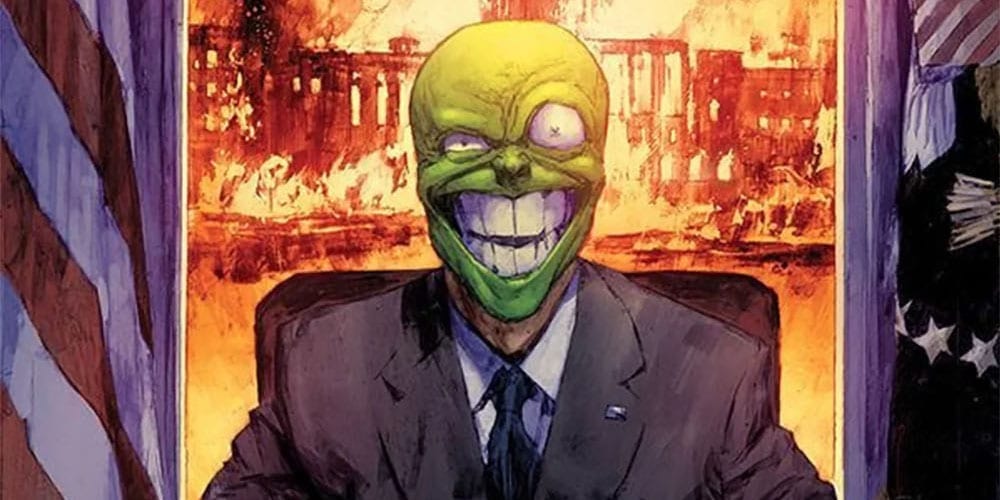
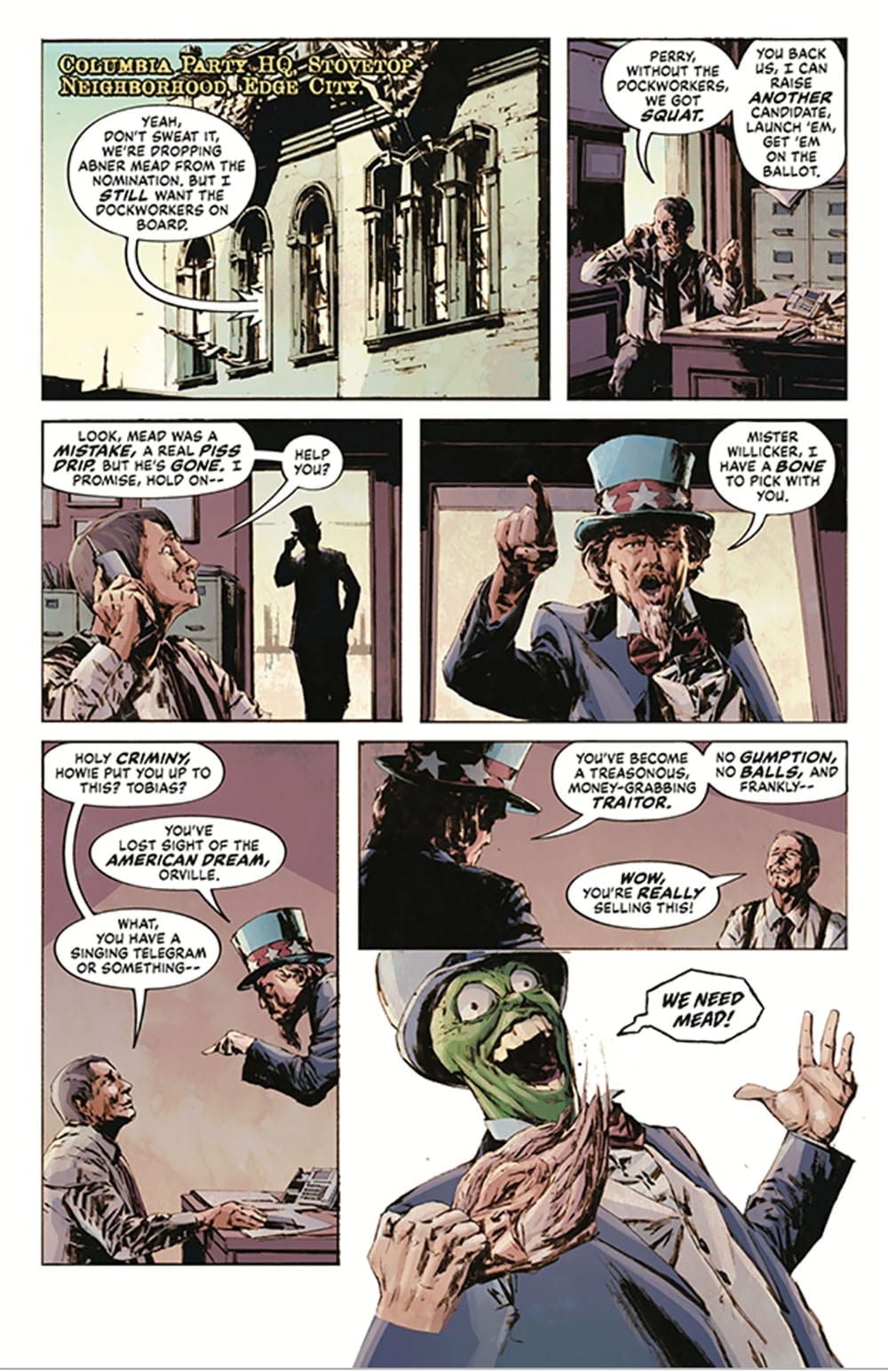
Fortunately for comic fans everywhere but unluckily for residents of Edge City, Big Head is back. The green, Looney-Tunes powered psychopath that changed Dark Horse Comics forever is finally on shelves again, and he’s got his worst plan for death and destruction yet: he’s running for President. Monkeys Fighting Robots got to chat with some of the team bringing you Big Head’s efforts to “Make America Green Again,” writer Christopher Cantwell and artist Patric Reynolds. Here’s what they had to say about I Pledge Allegiance to the Mask, the history of The Mask comics, and the rumored Mask movie reboot. Read on!
Grant DeArmitt for Monkeys Fighting Robots: Alright Chris, start us off. Where does I Pledge Allegiance to the Mask pick up? Has the time that passed in our world also passed in Edge City? Where’s The Mask now?
Christopher Cantwell: Time has definitely passed. I’d say this new chapter takes place now, or enough in the future that it’s like… tomorrow. But there is reference to the Big Head events of the late 80’s through the 90’s. Detective Kellaway has retired to California. Kathy, Stanley Ipkiss’ girlfriend, is also around and in her late 50’s. The Mask has been missing for about 20 years (since the comic title truly went dormant). But it’s still out there.
MFR: Patric, this book looks unlike anything we’ve ever seen in The Mask universe before. Why is that, and what inspires the new, grittier look for Big Head & co.?
Patric Reynolds: Before I came on board, the creative team wanted a different visual approach to this series. My editor, Daniel Chabon, suggested I be considered as the artist, and the gulf between the work that I usually do and the style of the previous iterations of The Mask is pretty wide to say the least. The team was looking for a grittier, darker, almost noir-ish look for the story, and I’ve had a fair amount of experience making comics inspired by those elements. As an artist I’m focused on using light not only to describe form and establish a time, place and mood, but also to use it as a presence, like an unseen character guiding the viewer through the page. Bending the visuals towards a more realistic wavelength can make a more visceral impact with the reader (if I do it right), and hopefully it can make the characters resonate on an emotional level.
MFR: Chris, you said in a previous interview that you scared yourself writing this book. What did you mean by that? What are you scared of?
Cantwell: I imagined the most absurd and horrifically violent things I could think of for Big Head’s killings. And then Patric made them scarier. I scared myself because it’s one thing to think of something like that, but another to see it actually happen on the page. I also removed almost all hope from the story threads in this book. Usually that accompanies darkness and violence in my stories. Here, not so much. And I was surprised at how easily I could pull all sunlight out of my soul.
MFR: Patric, Big Head is famous for his massive, Liefeld-spoofing choice of guns. Does this aspect of the character change in a comic released in 2019 America?
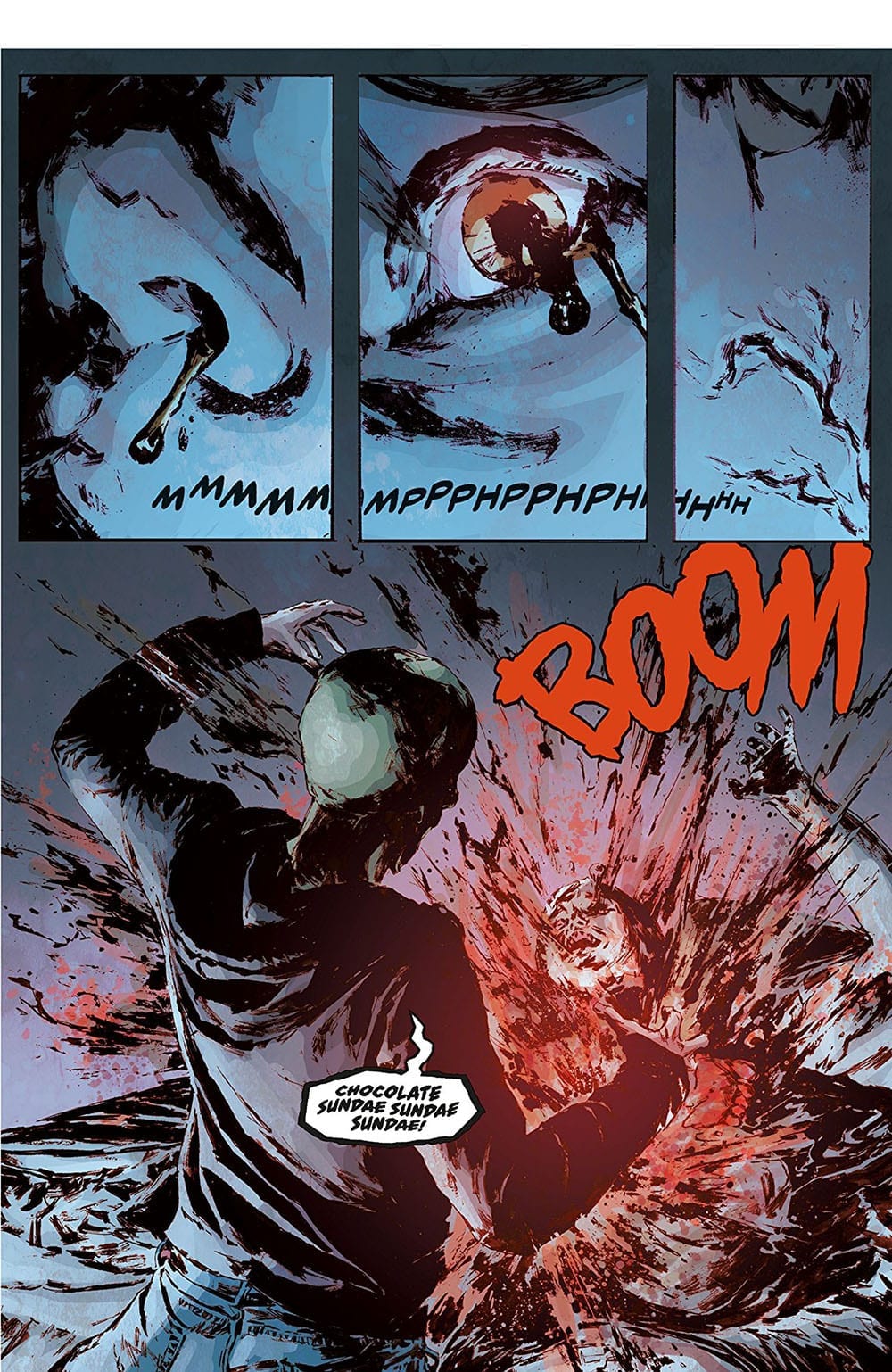
Reynolds: Chris has intentionally distanced the story from gun violence, and even the one instance where Big Head does pull out some ridiculously massive guns before a fight it’s played more as a joke or call-back…. and frankly this story doesn’t really need the presence of guns to make the violence impactful. It leaves room for a lot of creativity in the bloodshed, from a political rival getting flushed down a toilet, to a war-focused presidential candidate getting shot out of the turret gun of an Abrams tank, and finally to a new character cutting off his ear and eating in front of people just to prove what a loose cannon he is.
MFR: Chris, we’ve seen the horrible things that can happen when a person wears The Mask. Do you think we should ever empathize with the people who put it on?
Cantwell: It depends on who wears it. If deep down the person has a good heart, yes. But those people usually realize the Mask is bad and extract themselves from it. If the person was already a bad seed, definitely not. Stanley Ipkiss? No. Kathy, Kellaway? Yes. There are a couple characters who wear it in this story. One is a good person, and one merely professes to be, but actually they’re a piece of shit. The Mask just makes that truth known.
MFR: Patric, what’s your relationship with Lee Loughridge like? You flesh out this fantastic, neo-noir vision of Edge City together, can you give us a window into that process? What makes you work together so well?
Reynolds: Thank you very much for the positive comments! I met Lee back in 2009 while I was a student at the Savannah College of Art and Design and he was invited to their annual Comic Arts Forum as a guest artist. He looked through my portfolio and said “hell yeah I’d like to color your stuff!” We had followed each other on social media since then, but we didn’t have the chance to work on something together and our schedules never lined up. Last year I posted a Venom commission that I had painted for a client, and he surprised me by digitally coloring it on a whim and posting the gorgeous results. Right about the same time Daniel was asking me to paint variant covers for other Dark Horse titles, and I suggested that Lee do the digital coloring on them. I really liked how he enhanced the black and white images that I made, and I asked him to do some sample colors on some of the Hellboy and the BPRD: 1954 pages that I had done. He really killed it, and Daniel really liked what he did, too.
Reynolds: When Daniel offered me the job as an interior artist for I Pledge Allegiance to The Mask, I didn’t hesitate to suggest Lee to come on board as colorist. Lee has a great grasp of how important light is to the inks that I do and recognizes the intensity and the directions of the light sources really well. I love the way he captures the way light diffuses throughout the panels in various ways. Sometimes I’ll give him specific notes on certain panels before he starts (like “the only light source in the panel is coming from the TV,” or “the characters in the doorway are backlit by a pink neon sign,” etc.), but for the most part I just trust him to do his job. And he’s imbued the visuals with an indelible edge.
MFR: Ok, question for the both of you: Rumors of a reboot of The Mask have been swirling around the internet for a few months now. If you were in charge of this onscreen return of The Mask, what would it look like? Would it be like I Pledge Allegiance to the Mask?
Cantwell: I would combine The Mask and The Mask Returns and make the anti-heroes Kellaway and Kathy. Ipkiss would be in it for 20 minutes.
Reynolds: Well, if I were in charge I’d get Roger Deakins to be the cinematographer (I loved the way he realized the visuals in Blade Runner: 2049 and No Country for Old Men)…. or if David Fincher is available, I’d love to see how he’d translate the chiaroscuro of the visuals of this new series to the big screen. I actually study screen shots of their film work to help inform and inspire the work that I do.
MFR: And finally, another question for you both: I’ve read that this series would see The Mask “returning to its roots.” How do you think The Mask has changed since debuting in 1989? What’s the key to bringing it back there?
Cantwell: I think Big Head isn’t such an outlier in today’s world. Violence and chaos seem to be more a way of life, and a media-accepted means of moving through the culture and society. Big Head wouldn’t have to hide in the shadows so much. He could be out in the open. That’s what he does in this story. And he might even find an American populace that isn’t so shocked by his antics anymore.
Reynolds: Big Head is actually kind of… normal against the backdrop of 2019. Hyperbole tinged with ignorance and fear is becoming more of the norm, and someone as crazy, amoral, and dangerous as Big Head can absolutely become the leader of the free world. And ultimately, that’s the real terror.
You can follow the Big Head madness with I Pledge Allegiance to the Mask Issue One, which is one sale now, and with Issue Two, which is at your local comic shop next Wednesday, November 20th. For more interviews like this one, make sure to follow us on Twitter, and for all the best comic book discussion, stay tuned to Monkeys Fighting Robots.
The third season of Humans is the last season of the hit British sci-fi. This season saw a big surge change to the world of the series.
Season Three takes place a year after the events of Season Two. Synths the world over have gained consciousness causing chaos around the world. Thousands died due to the awakening, and within Britain Synths live in under-resourced camps. Because of this, tensions between humans and Synths rise, leading to a clash of ideas within the Synth community.
There are also changes for the Hawkins family. Laura (Katherine Parkinson) has become a Synths Rights activist and gets harassed constantly because of it. Joe (Tom Goodman-Hill) has separated from his wife and moved to a Synth-free town. While Mattie (Lucy Carless) feels responsible and guilty for all the Synth-related deaths because she released to computer code that awoke the Synths. Humans was a show that had a sociological edge to it. It looked at how society would have been impacted if humanity had robots helpers. The first season showed Synths being used as healthcare assistants and an underground culture of Synth brothels and smash cultures. The second season had some humans choosing to act like Synths. All three seasons had a villain who wanted to get revenge against humanity.
The third season had the biggest change because of Synths gaining self-awareness and how it affects the world. It goes through the philosophical issues that would arise if robots were sentient. Like what rights would they have, what is their place in society, and having their own existential crises because they only have a limited lifespan and have no way to reproduce.
The third season turns into X-Men because the Synth’s ideological split. Since I like X-Men , this was a big bonus for me. In the Synth camp, Max (Ivanno Jeremiah) calls for peace, understanding, and integration, while the new character, Agnes (Holly Earl), believes that a conflict between humans and Synths is inevitable. They are basically Xavier and Magneto. Within the camp, there’s a power struggle due to Max’s decisions that alienate the Synths in his camp. Agnes’ reasoning was understandable when the series revealed her backstory, and Earl was a terrific actress to play the role.
Mia’s (Gemma Chan) storyline involved her becoming a symbol for the Synth Rights movement. She challenges the status quo by well, acting human, and demanding rights. She lives within the human community but suffers abuse because her actions make her a lightning rod for anti-Synth extremists. Yet, Mia believed in passive resistance, so she could not rise to the bait.
Laura acts as the human eyes to the new situation. She gets invited to be a part of a government commission to come up with a policy to deal with the Synths. Sadly for Laura, her role was a token advocate for the Synths. She still gets to plead her case and argues the ethics about Synths. Her work at the commissions allows the audience to find out what’s happening beyond the UK. The Russian government had clamped down on Synths, while Scandinavian nations have adopted a more liberal policy.
The weakest storyline involved Niska (Emily Berrington). Niska’s story started with promise because she ends up in a relationship with a human woman (Bella Dayne), and they end up getting caught up in a terrorist attack, leading to Niska to go on the hunt. This storyline goes off the rails because Niska’s journey turns into a search for the legendary Synth that Sleeps. She suffers from visions that take Niska into the unknown. By the final episode, the series takes a huge turn left turn when the series reveals who The Synth that Sleeps was and what they offer Niska. It was like the writers were pulling things out of their ass, especially the final scene where a character becomes a psychic. It was out of place for a series that aimed to be realistic.
Toby (Theo Stevenson) and Sophie (Pixie Davies) were given short strife. They both had major arcs in the previous season – Toby got a girlfriend who was ‘Transynch,’ and Sophie started to act like a Synth. They didn’t have much to do in this season. Toby has to protect Sophie, so they end up on the sidelines.
The third season of Humans worked best as a sociological piece and was an incredibly strong final season until the last five minutes, where it falters.
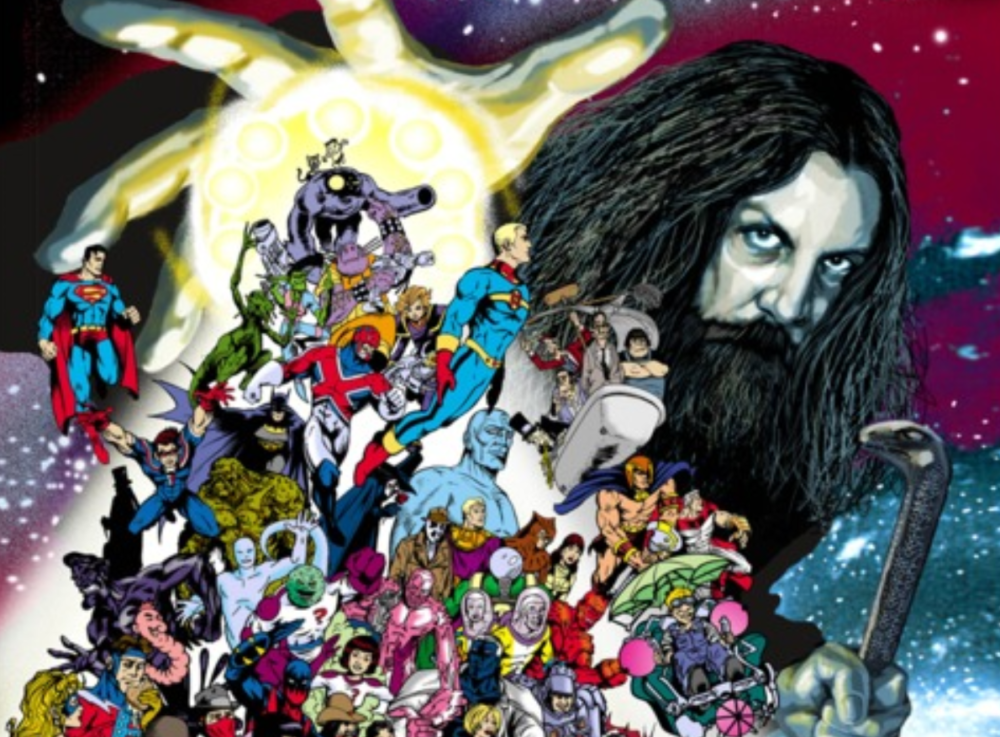
Few writers in any language have been able to bring about a flurry of political and artistic discussion upon the release of each new work. Even fewer have been able to change the way the medium they work in is viewed by both critics and the masses. One of these very few is the legendary comics writer Alan Moore. Upon finishing the final issue of the The League of Extraordinary Gentlemen this past Summer, the controversial icon confirmed that he would be retiring from the medium that brought him such acclaim. While Moore has done his best to distance himself from much of the work he has done in the past, there is no way to understate how that work has influenced and changed not just comics, but fiction and entertainment as a whole in the past few decades.
Miracleman; Cover by Garry Leach
Moore’s first well-known successes were created while writing for 2000 A.D. and Marvel UK. The Ballad of Halo Jones, described as a “feminist space opera,” is considered to be Moore’s best work for 2000 A.D. as a publisher. Unfortunately, the series was canceled due to a publishing disagreement (not the last time such a thing would occur). His other and even more famous early triumph was the resurrection of a British Silver-Age hero called “Marvelman,” later changed intoMiracleman. Moore’s revival places protagonist Michael Moran in a state of normal living, with visions of flight and power before remembering he was a superhero. Upon regaining his powers, he engages with twisted superhumans, alien experiments and, of course, Nazis. Moore blends classic superhero optimism with the contemporary dark places of the imagination, creating something far ahead of its time and often highly controversial. This examination of a superhero in a more realistic world was not only the first step towards the future of comics, but arguably a prototype for one of Moore’s later acclaimed works.
From Saga of the Swamp Thing; art by Stephen Bissette and John Totleben
In the mid-1980’s, an editor at DC comics named Karen Berger contacted Alan Moore as well as several other rising British writers to take over and revamp some of their failing or forgotten series. In February of 1984, Moore took over for writer Martin Pasko on Saga of the Swamp Thing. This is arguably where the writer’s legacy and influence would truly begin. Moore’s poetic handling of myth and obscure characters in DC’s pantheon was unseen in comics at the time, as well has his introduction of metaphysics and esoteric beliefs that drove the analytical points of the story. Moore still had a mouth for horror as well though, and his use of it in this series still places it as one of the best horror comics ever created. Artists Stephen Bissette and John Totleben were given plenty to work with, and brought the world to life in a flurry of artistic coloring choices and often gross detail. Saga of the Swamp Thing set a standard for not just the character, but for comics as a whole in the time of its release. DC decided to outright ignore the Comics Code Authority, a censor that prohibited “mature content” in comics and simply printed a “Mature Readers” logo on the covers. This lead to DC’s Mature Readers line of comics, which would later become the Vertigo imprint. Already, Moore would instigate the first major paradigm shift for the medium in decades. His greatest success, however, was yet to come.
Watchmen #1; Art by Dave Gibbons
In 1985, Alan Moore pitched an original story involving characters DC had acquired from the defunct Charlton Comics line. However, because DC had plans to utilize these characters in the future, they instead suggested that he create his own cast. As such, Moore teamed with artist and fellow Brit Dave Gibbons to start work on a new maxi-series. The concept was for an alternate history United States involving superheroes in a more “realistic” political portrayal. It also was meant to work as a deconstruction of the superhero genre, almost as a spiritual continuation of what Miracleman had attempted to accomplish. In 1986, the first issue of Watchmen was released.
Widely considered he greatest comic series of all time and one of the greatest novels of the 20th century, Watchmen was the unexpected massive success of the decade for the comics industry. Nothing like it had ever been attempted in the medium, and its closest contemporaries were other Alan Moore works such as Miracleman and V For Vendetta. Watchmen’s poignant and relevant political commentary reached a level of profoundness difficult to find even among the worlds of cinema and prose novels. Its other winning element was something that only comics could achieve at the time: criticism and commentary on the concept of the superhero. Each character in Watchmen represents a different perspective on superheroes based on their archetype. Dr. Manhattan is a god-level being capable of manipulating time and reality, and as such loses his ability to feel empathy. Ozymandias is a millionaire-genius who comes up with a plan to stop World War III by killing millions. Rorschach is a paranoid conspiracy theorist who came to his moral choice because of his abused upbringing. The Comedian is an amoral reprobate who takes pleasure in bloodshed because he knows no one will say anything. These “heroes” all come to their respective moral conclusions based on their backgrounds, beliefs and experiences combined with their reality. This is all set inside a sharp satire of 1980’s America’s political backdrop. However, this does not make Watchmen dated in any way. Moore’s criticisms in this series are so universally appealing that the observations have held up over thirty years later.
It’s almost impossible to overstate the influence Alan Moore and Dave Gibbons’ Watchmen had and continues to have on the comics medium and fiction as a whole. It’s widely considered the point where comics became a genuine literary art form in the same way novels and film are accepted as. While Watchmen may still be considered Moore’s most popular and influential work, it may not be quite as thought provoking as another of his works published by DC around this time. In 1981 while still working for Marvel UK, Moore and artist David Lloyd embarked on a purely politically charged tale of anarchism and vengeance against a totalitarian state. The first chapter of this story, titled V For Vendetta arrived in Marvel UK’s Warrior magazine in 1982. Unfortunately Warrior was shut down and left the story floating until DC agreed to continue publishing it as one of Moore’s conditions for signing on. Where Swamp Thing re-imagined horror comics and Watchmen revitalized the medium as a whole, V For Vendetta offered a political line of thought offered nowhere else in any entertainment medium at the time.
Ad for V For Vendetta; Art by David Lloyd
V For Vendetta is not a story about character and the lives of its characters as much as it is an analogue for political change and each character is a concept given form. The title character V is never analyzed past his persona. As such, he remains solely as a sort of living catalyst for political anarchism (Moore’s chosen political stance) more than an actual person. Evey Hammond, the protagonist of sorts, also functions as the audience’s window character. Her impoverished life and choices she’s had to make bring the reader into the world of desperation caused by Chancellor Adam Susan’s fascist regime. At the same time, it allows for the steady evolution of her understanding to permeate the reader’s thoughts as she is taken in and changed by V. Even the story’s central antagonist Chancellor Susan is more a satirical object than a person. The focus on the dictator’s unstable mental state and his ‘unusual’ desires play a bigger part than his actually leadership, making it clear that he’s more a metaphor for fascism as a whole. Vendetta’s ambiguity with its characters and story direction are made so as not to bludgeon the reader over the head with jargon and pro-ideological messaging. It’s created as more of a “for your consideration” when it comes to modern political thought. It’s certainly the most dense and difficult to approach of Moore’s early works at DC, but it’s also likely his most intelligent and provocative.
Despite any misgivings Alan Moore may have about superheroes and their place in culture, he did not shy away from the chance to write iconic stores about them. In 1986, Moore penned Superman: Whatever Happened to the Man of Tomorrow? This two-part story was created as a farewell to the classic Silver Age Superman of the era, as DC neared a modern reboot of the character with John Byrne following the Crisis on Infinite Earths event. Regular and iconic Superman artist Curt Swan joined Moore to tell a story that effectively closed the book on the Kryptonian’s classic mythology in a way that is satisfying and highly memorable. The frame narrative with Lois Lane recalling the final days of the Man of Steel makes for on of the most emotionally impactful stories found in mainstream comics, and also proves that Alan Moore understands that importance and meaning behind Superman. While “Man of Tomorrow” does contain darker moments with some of its villains, it still ends on a hopeful and bittersweet note that is absolutely the kind of note an emotional Superman tale should end on. Another Superman tale written by Moore, “For the Man Who Has Everything,” describes one of Kal El’s greatest internal struggles. On his birthday, Superman is trapped in the Fortress of Solitude by a parasitic plant that places him in a coma. While unconscious, the plant feeds him a hyper-realistic dream of what he most deeply desires: to be living happily with a family on Krypton. This one story has fueled much of the argument for Superman being a tragic character in many regards ever since its publication. Moore understands these characters well enough to hone in on their emotional centers while still respecting what they stand for.
Art by Brian Bolland
Unfortunately, Moore’s most famous superhero work is also the one he regrets the most. Batman: The Killing Joke is a one-shot graphic novel published in 1988 depicting Joker at his most heinous – and, strangely, most tragic. The Joker escapes from his cell at Arkham Asylum to shoot and paralyze Barbara Gordon, before capturing Jim Gordon himself in an attempt to drive the commissioner mad. The issue examines Joker’s life before being a super-criminal as a struggling comedian. The entire point of the story is that “one bad day” can make a sane person go mad. There’s obviously the parallel between Joker and Batman, with the latter’s loss of his parents, and their respective ways of responding to tragedy.
The Killing Joke is one of the most acclaimed comic stories of all time, considered required reading for Batman and comic fans as a whole. Moore himself however considers it “pointless” and “overly cruel,” While Moore has never been one to shy away from criticizing his own work, his feelings toward The Killing Joke are roughly analogous to his feelings towards DC Comics as a publisher. Roughly a year after the publication of his iconic Batman story, Moore’s disagreements with DC finally came to a head and he left the publisher.
From Promethea; Art by J.H. Williams III
It’s admittedly a bit strange to give an overview of Alan Moore’s most influential and essential works when all of his work under such a category were published by a company the writer himself loathes. Even after his most iconic work in the 1980’s, Moore continued to create comic series’ that are iconic in their own right. With his reputation as an ‘auteur’ comic writer, he was able to create comics that challenged readers with his own views on reality. These included fictional theses on metaphysics, theoretical history, occultism, magic, and other non-mainstream topics. Here are a few of those works worth checking out:
From Hell was published by Top Shelf and was drawn by Eddie Campbell, and is dense investigation into the life and identity of Jack the Ripper, specifically from Alan Moore’s perspective. It has a reputation as one of the most challenging comic works ever written, and actually requires Moore’s annotations to be able to truly make sense of the plot.
Promethea was published under Moore’s “America’s Best Comics” line under Jim Lee’s WildStorm imprint before it was purchased by DC (much to Moore’s chagrin). It tells the story of a college-age young woman’s transformation into the mythic figure Promethea, a peace-keeping warrior that merges with anyone who writes or studies her. Combining superhero action with some of Moore’s most poetic and imaginative passages along with J.H. Williams extraordinary art, this is likely the most visually stunning work in Moore’s portfolio.
The League of Extraordinary Gentlemen is likely one of Moore’s most famous works due to the awful film adaptation. This aside, League really deserves its reputation. Described as a “Justice League of literary characters,” League follows The Invisible Man, Allan Quartermain, Captain Nemo, Mina Harker, and others on a globetrotting journey against numerous threats political and supernatural. Collecting this series is a bit of a trial though, as the first three volumes are published by DC, and the rest by Top Shelf and Knockabout. As stated earlier, the final issue of this series is what spurred Alan Moore into retirement, so reading the whole saga would be a nice cap to finishing his bibliography.
Again, these are only what could be considered the most “essential” works for gaining insight into Alan Moore’s intelligent and poetic writing style. These works could be considered his most accessible, while still understanding what made Moore such a game changer for the industry. His capability to write relatable characters and identifiable environments on the one hand and then send concepts whirring past without making it too complicated. Unless of course, he wants to make it complicated. While his relationship with the comics is controversial and some of his work hard to parse, the effect his work has had on the medium cannot be oversold. Alan Moore’s decades of work and influence have earned him a restful retirement.
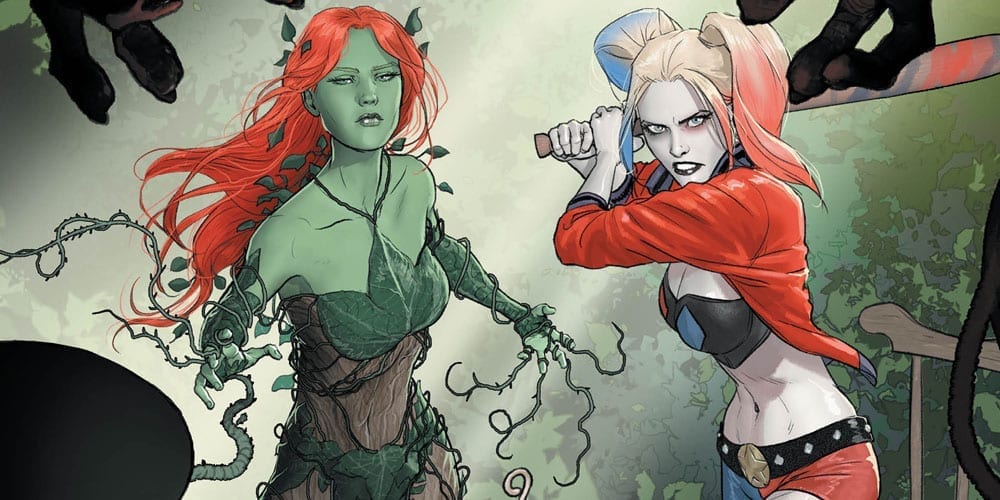
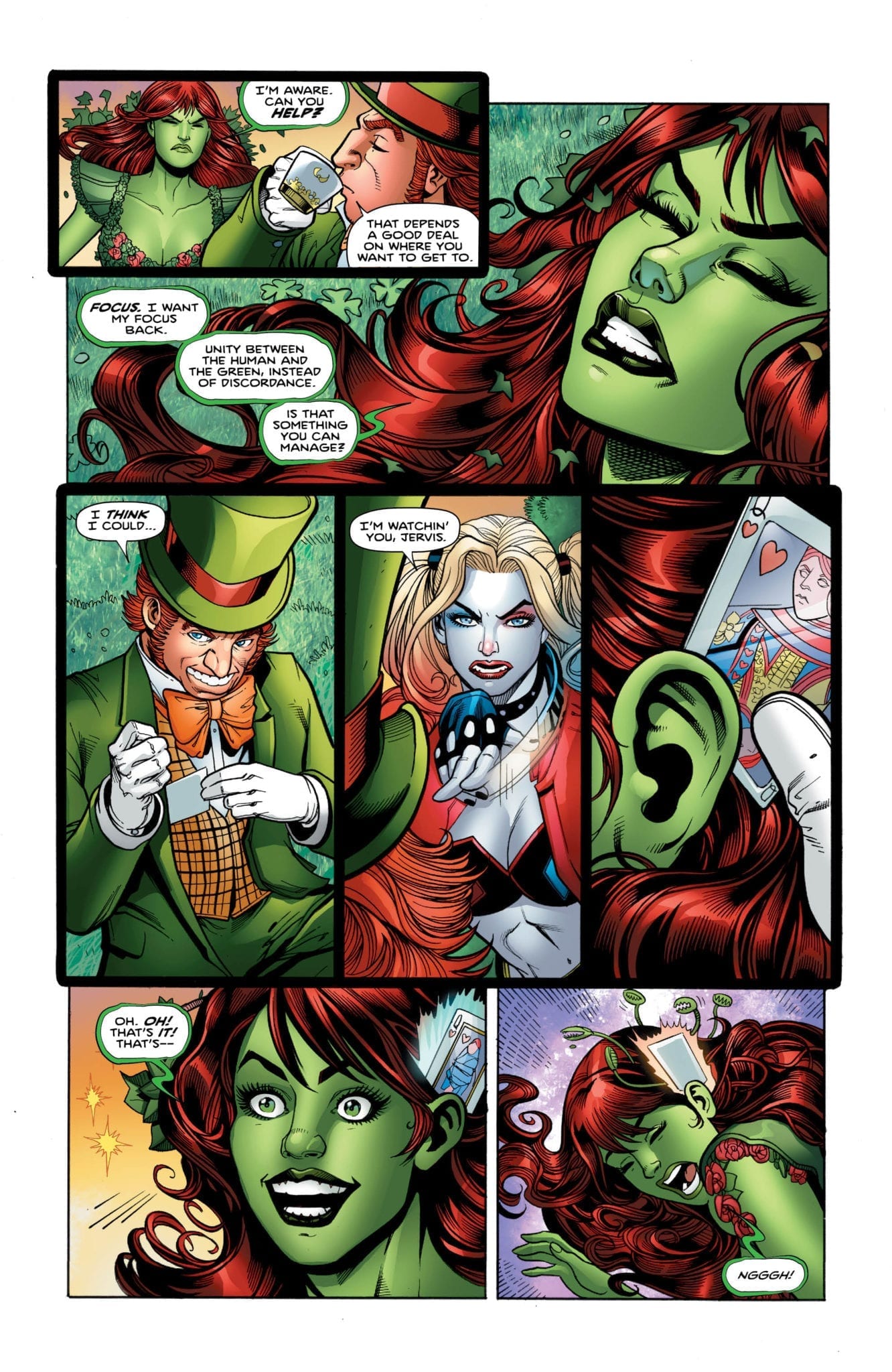
Harley Quinn & Poison Ivy #3 hits your local comic book store on November 13th, but thanks to DC Comics, Monkeys Fighting Robots has an exclusive five-page preview for you.
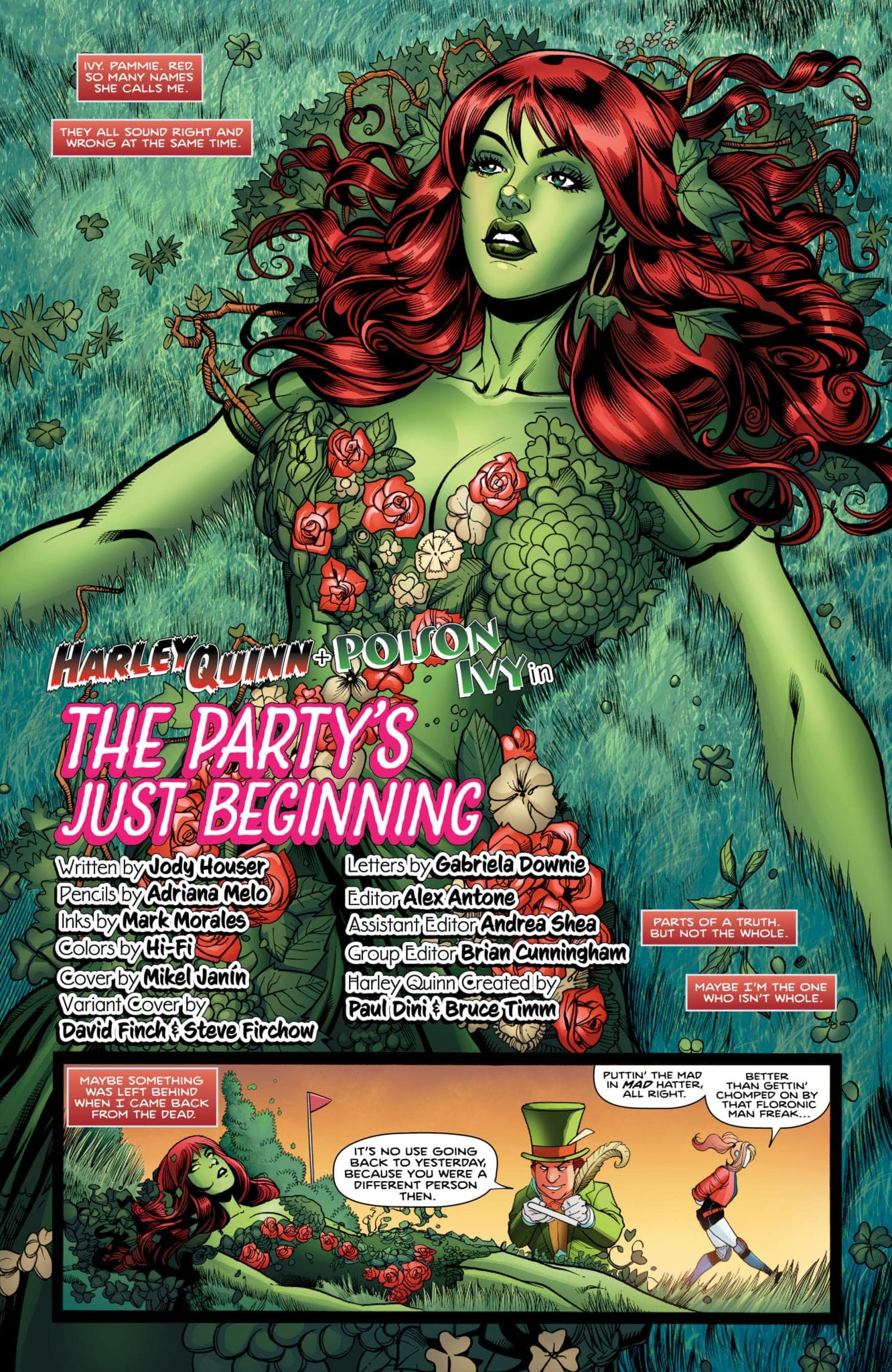
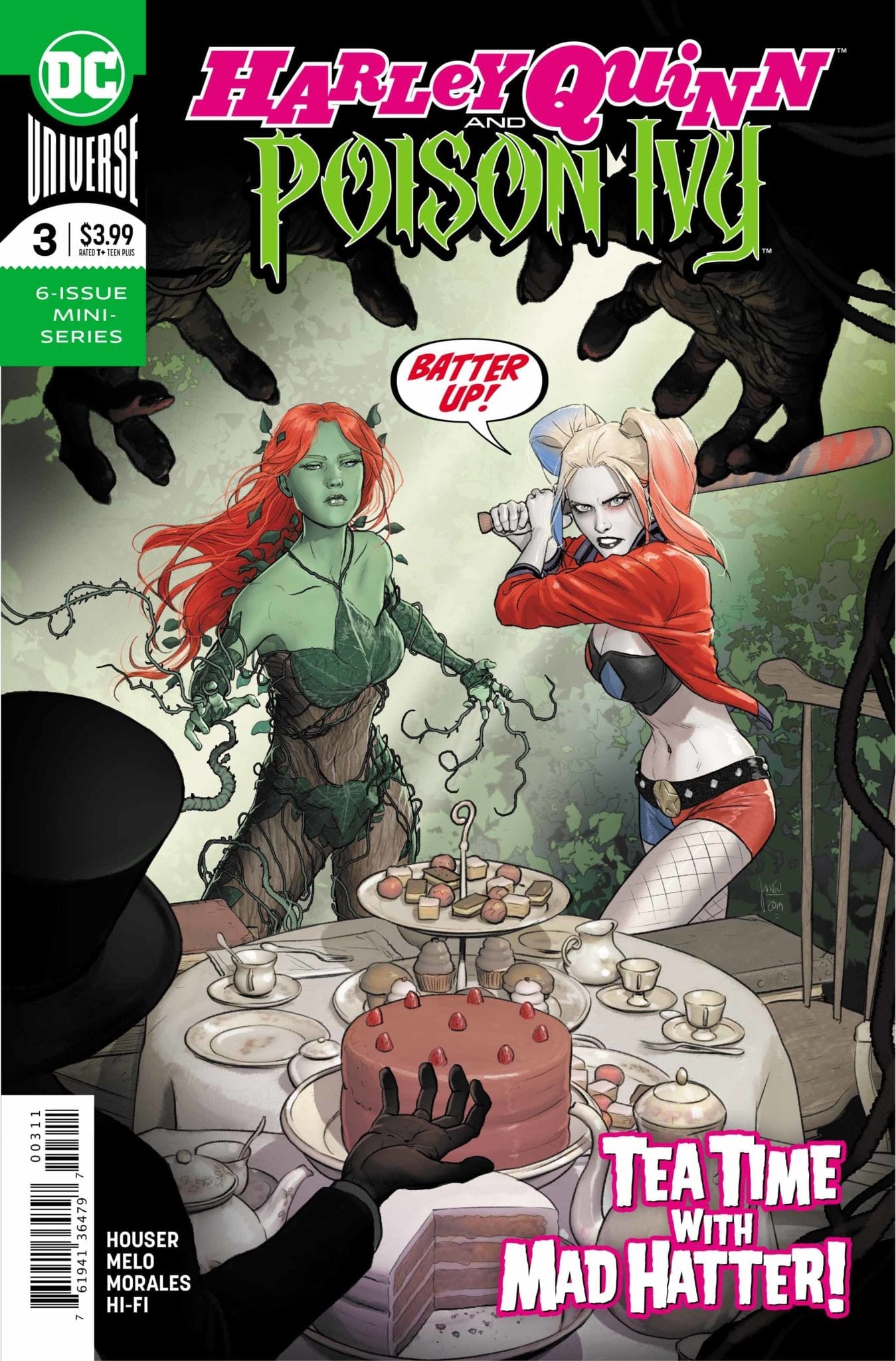
About the issue: Down the rabbit hole and through the looking glass, and what did Harley and Ivy find there? A tea party with some very unexpected and uninvited guests! It turns out the Mad Hatter has a game of his own to play, and Poison Ivy and Harley Quinn must decide between fight and flight. And is that gift Lex Luthor dropped off for Ivy actually of any use, or is it just a steaming pile of manure?
Harley Quinn & Poison Ivy #3 is written by Jody Houser, with pencils by Adriana Melo, inks by Mark Morales, colors by Hi-Fi, and letters by Gabriela Downie. The main cover is by Mikel Janin, with a two-piece variant cover set by David Finch and Steve Firchow.
As the solicit text suggests, this issue is a very Alice in Wonderland-themed story featuring the Mad Hatter. The six-issue miniseries sees Harley and Ivy trying to find understanding in the wake of Heroes in Crisis, which left the two ladies in very strange, new territory.
Check out the Harley Quinn & Poison Ivy #3 preview below:
Are you reading Harley Quinn & Poison Ivy? Sound off in the comments!
The music scene and the comic book industry have been trying to sing in harmony for quite some time, but they might finally be singing in tune now.
Some artists like Gerard Way actually take the time to make comics. A few comics like Murder Falcon and Gunning For Hits have soundtracks. However, unlike animation, these mediums seem to lack a synthesis. That’s mainly because of the pacing. However, “Z2 Comics” announced a new project where these mediums fuse. Is the graphic album the future of comics, or is it just another gimmicky business venture that will fail?
What’s A Graphic Album?
Z2’s Graphic Album project combines the company’s graphic novels with song albums. Starting in 2017 with Murder Ballads, the stories feature a soundtrack that users can only get with the book. The move is a success as more musicians like “BABYMETAL” and “Poppy” join the fray.
Believe it or not, Z2 is the second to come up with this idea. Skin & Earth by “Lights” gets that honor. The series is an example of parallel storytelling where songs from the album translate into pages. At times it also works vice-versa. Unfortunately, that same method also has flaws. Without a viable means of allowing one to exist along with the other, the album trumps the trade. Because who would want to spend extra money on something they might not want? Z2 avoids this with the songs only available with the graphic albums.
Comic Soundtracks
Music is a wider-reaching industry compared to comics. One of the reasons it’s so successful is because of how flexible its reach is. In comparison to visual media, audio allows users more diverse uses. Being a mostly hands-free medium, consumers use it for activities like exercise or mood settings. That latter part is why soundtracks are an essential part of movies. With comics taking a more cinematic approach like in The Authority and The Ultimates, why not include soundtracks?
One of the earliest examples available is Buffalo Speedway by “Yehudi Mercado.” As a tribute to the 90s pop culture, the initial releases include a mixtape. Naturally, the music doesn’t work out with the rise of digital media.
On that note, some alternative comics use those mediums in their comics. Gunning For Hits, for example, has a Spotify playlist prepared by “Jeff Rougvie.” Murder Falcon, on the other hand, features songs written by “Daniel Warren Johnson.” All of which are available online to play and download. Each series appeals to people’s love of music, from how the industry works to how it moves people. Unfortunately, there are some inherent flaws.
The Gap Between Rhythm and Panels
Aside from the obvious physical limitations of the mediums, the main problem is pacing. The tempo of a song is something that a user acclimates towards. Still, images meanwhile have people go at their own pace. Compare this to live-action shots or animation, and you find the inherent problem of this implementation. Fortunately, there is a way around this.
Breaking the Language Barrier
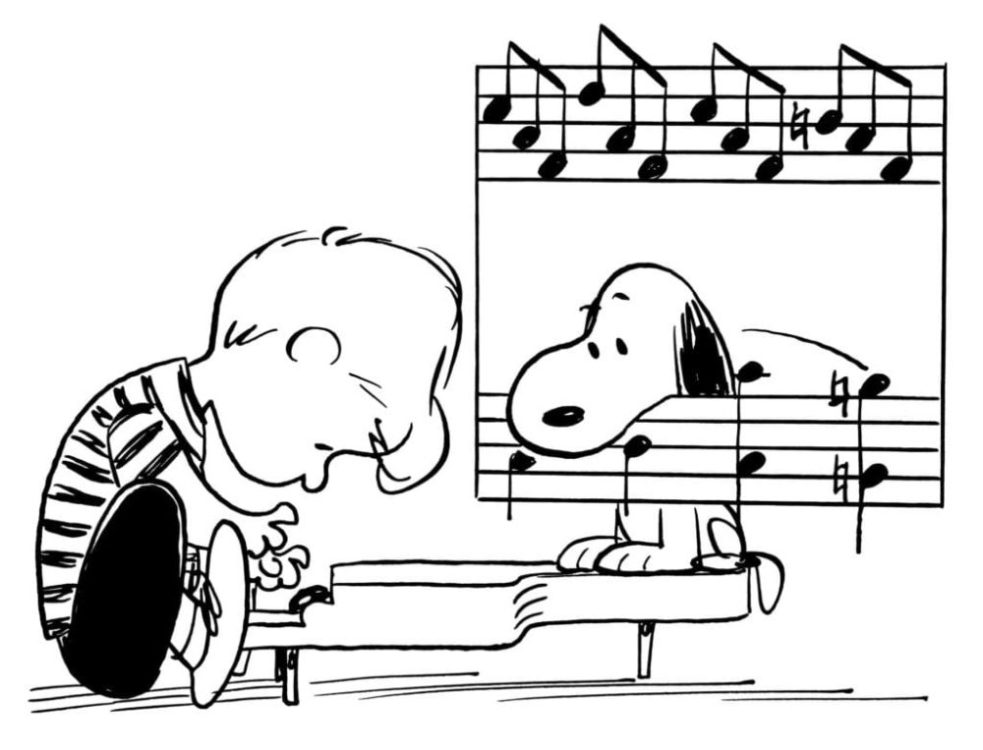
Music and comics are unique languages, and like all languages, they can be translated. Music’s components are pitch, rhythm, dynamics, and timbre. Comics are more complex in terms of layout, elements, and concepts. Comics scholar “Mikayla J. Laird” explains panel’s relationship with time. Rhythm is the best translation with those pieces. Everything else like gutters and tiers helps set the tone and pace as explained by “Scott McCloud,” hence, why dynamics and timbre suit them. Splashes or spreads, meanwhile are best for big emotional scenes; these require pitch and dynamics.
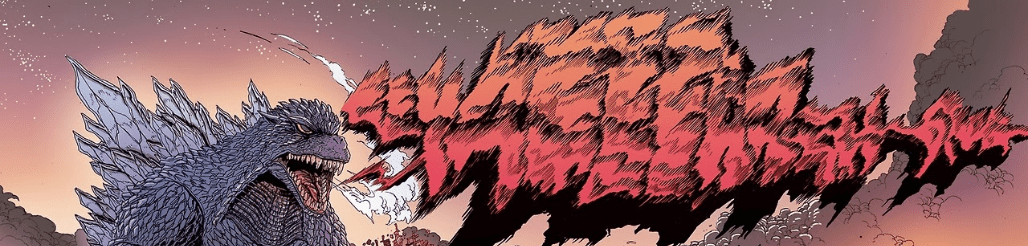
Then there are those elements like speech bubbles and captions. Those tend to take up the most time in pacing. That makes it the hardest to translate into music, but not impossible thanks to harmony, articulation, and dynamics. Sound effects, however, take up less time and also set the tone. Unlike gutters, the stimulations combine with the visuals for a unique sensation. As such, the best translations for this comes from timbre and dynamics.
Just look at how James Stokoe creates this.
Concepts, on the other hand, are dependent on the reader. Closure, for example, requires background knowledge while encapsulation captures the prime moments. For this, it’s going to require various combinations of musical components. Even then, there is still the wall of the human psyche.
Music Loopholes
It is next to impossible for physical comics to combine with music without help.
Let’s look at augmented reality. Marvel AR did not pan out well since it was little more than a digital pop-up book. However, Neon Wasteland by “Rob Shields” leads that field with a comic book that combines with interactive gaming. While it lacks complex sound effects, a musical loop combines with the game to create an immersive experience. That way, readers will feel like the game isn’t beginning or ending.
Motion comics seem like a more viable way of incorporating sounds. “Madefire Comics” has an entire brand in dedication to this. The sound effects and background music create a truly immersive experience. It even extends to virtual reality. Entire songs, however, require these experiences to act more like videos.
What About the Visually or Hearing Impaired?
Then there is the obvious problem that comes with sensory disabilities. How can anyone appreciate art if they can’t experience it the way others do? Nothing to worry about, people always find away. Comics Empower was a website that sold comics while telling stories through audio. Unlike podcasts or audio dramas, though, the experiences of reading a comic are on record. Unfortunately, the website is between ownership at the moment.
That’s all well and good but what does that have to do with music? Deaf people experience musical stimulation by feeling vibrations. That actually presents an idea on how every kind of person can experience more immersive comics; music and all.
For that matter, a couple of Line Webtoon‘s comics actually feature built-in music (DICE and Room of Swords), and fewer have vibration features (Chiller). Naturally, most of these features require a smartphone. The vibrations are also not very sophisticated for a full experience. Yet some Galaxy phones (e.g., S9) have touch screens with vibrational feedback. Technology marches on, and the possibilities are endless.
Ready For The Encore?
Comics and music are art forms that require a distinct understanding of one medium and translating it to the other. It’s a very difficult thing to master. But time marches on and people build upon ideas. The “Graphic Albums” of Z2 have so far have been successful with Eden as a best-seller. However, only time can tell if this will remain a success.
But what do you all think? Is this just going to be another failed fad, or could something come out of this? Leave your comments below.
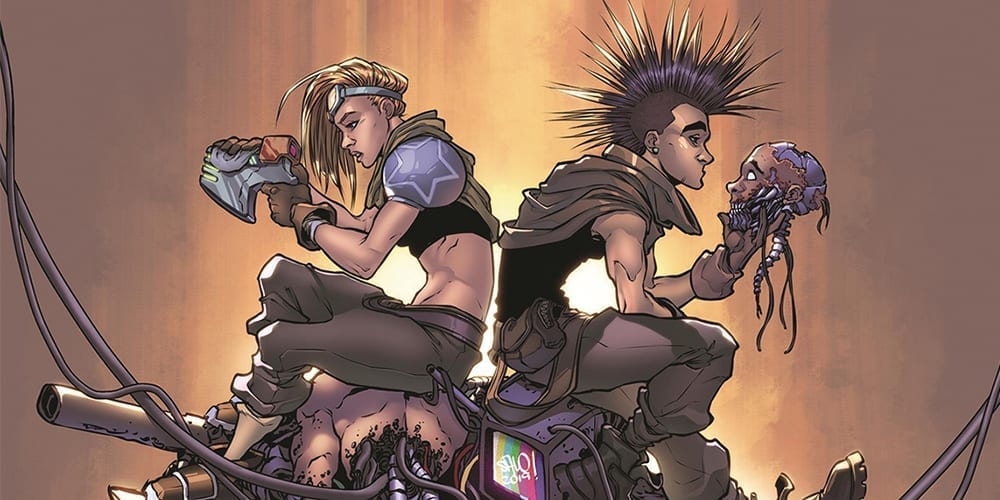
Scout Comics’ newest series, WRETCHES hits your local comic book shop on November 27th with a bombastic beginning to a spacefaring sibling escapade.
Interior art by Artist Salo Farias, Colorist Chunlin Zhao, Letterer Chas! Pangburn
A Story of Siblings
Wretches #1 opening pages are fantastic in their exaction, world building, plot, and characterization. But, speaking about the introductory pages would spoil the twists and turns that makes it feel so unique. These first few pages start the comic on a high octane note, while writer James E Roche keeps the pace throughout. This break neck speed is even felt on the calmer moments due to Roche’s fun, feisty dialogue.
Most of the snappy dialogue comes from the main siblings themselves—Shea and Sean. The way the duo bicker, yet care for each other breathes realism into them. The moments shared between them feel genuine as if they are real-world siblings that have a long-troubled history. This is due to how great Roche is at portraying them. If he doesn’t have a sibling, I’d be surprised.
The siblings are the main focus of Wretches #1, yet the other characters introduced feel unique and carry enough interest in their personality. As the story takes place in a science fiction future with space travel, Roche adds in some aliens and robotic augmented humans. Not much is said upon the species that inhabit Wretches, but Roche adds enough character showcased in each, making you want to come back to the worlds of Wretches.
Interior art by Artist Salo Farias, Colorist Chunlin Zhao, Letterer Chas! Pangburn
Art Runs In The Family
The energy that artist Salo Farias brings to Wretches #1 matches the story by teetering on the edge of a fun and serious sibling space adventure. Helping amplify the high octave feel in the opening, Farias portrays a quick chaotic chase sequence. During the finale of the chase, Farias drops the background of a cluttered crowd and opts for a history lesson matching the narration. This scene (seen below) is smart in its exaction with it easily telling the siblings history in the background, while the present story is still transpiring. Helping Farias keep the tone is the vibrantly deep colors by Chunlin Zhao.
Zhao portrays the planets with differing colors, helping distinguish them from each other. While on the planets Zhao showcases a great contrast of colors between the varying species, clothing, and landscapes. When the action and explosions start to occur Zhao amps the brightness as the blasts fill the panels. During these action-packed moments, the duo on art is aided by Chas! Pangburn’s lettering.
Pangburn helps the multitude of species stand out by having their dialogue boxes different colors, while making them unevenly shaped, helping emphasize their differing speech. The fun lettering moments aren’t limited to speech patterns. Throughout Wretches #1, Pangburn adds words to movements giving a greater emphasis on the action transpiring. Or when an explosion happens, Pangburn adds huge letters that greater the effect that the art duo showcase.
Interior art by Artist Salo Farias, Colorist Chunlin Zhao, Letterer Chas! Pangburn
From Rags to Wretches
On the Kickstarter page Roche talks about how the comic has evolved since his first concept in 2015. It would be interesting to see the original take on Wretches. But as it stands, Wretches #1 is a fantastic first issue that blends all of its parts elegantly.
Cover art by Ander Zarate
Cover Story: After knowing his character, It’s funny that Sean is doing a Shakespeare pose mixed with the Thinker on the cover. Wretches #1’s cover is the first one I can recall that includes the Letterers name!
Memorable Quote:“You humans have an odd way of saying thank you.” – Zed
Yeah, we have odd ways of expressing a multitude of emotions!
Dear Reader
Did you get a chance to check Wretches #1 out, or back it on Kickstarter? Let us know what you think down below!
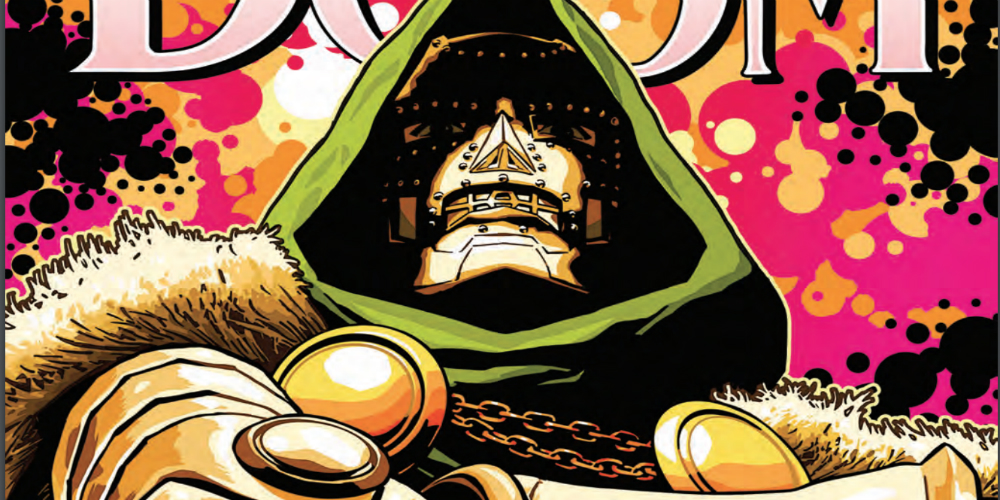
Doctor Doom is one of the most complex and challenging villains in the entire Marvel collection; Doctor Doom #2 by Christopher Cantwell, Salvador Larroca, Guru-eFX, and VC’s Cory Petit takes this stance and runs away with it.
Cantwell’s script, along with Larroca’s stellar art, is elevating an already prestigious comic character. Doctor Doom #2 reads and looks like one of the most in-depth and intense character analysis in the medium.
Picking up after Doom’s apprehension following the bombing of the Antlion site, Doctor Doom #2 sets the story’s goal on Doom’s “redemption.” It’s difficult for this character to be redeemed, despite several other series’ attempts, in light of his past actions, which is why Doom has remained one of the most complex characters in Marvel’s canon. But Doctor Doom #2 seems like one of the character’s last real chances at total redemption or eternal damnation.
Cantwell achieves this by using the majority of Doctor Doom #2 to focus on how people interact with Doom. Perhaps the most significant interactions are from Doctor Strange and Silver Sable. Strange, in an odd way, respects Doom in some amount. Cantwell shows this by having Strange, not Doom, correct the robot to appear in Reed Richard’s absence H.E.R.B.I.E. Herbie calls Doom, Mister Doom, which is typically a big no-no but Doom, walks away. Strange has to say that it’s Doctor. But during the plane ride, Strange seems unsure of Doom’s innocence. Even after Doom swears on his mother’s grave, Strange’s face is unknown as he is silent and cloaked in shadow.
In a way, this scene also reads like Cantwell’s attempt to immerse Doom full throttle into magic, if he wasn’t already. After Kang’s jailbreak and Doom is in absolute free-fall, he doesn’t have a tech solution like rocket boots or a jet pack; instead, he casts a spell to summon a force field. This is such a subtle touch that calls back on every aspect of Doom’s history, and it shows how in command Cantwell is of this character.
Awkward Reunion of Old Colleagues.
Legendary comic artist Salvador Larroca adds his hand to this series, and his super realistic and sleek style is the ideal match for this story. Particular notice should be taken to Larroca’s character design. Even some of the more outlandish characters like Kang and Doctor Strange look realistic to a certain extent, which special focus on their faces. Larroca can coax so much unease from his characters as they are unsure of Doom’s new intentions. The scene mentioned above between Strange and Doom in the jet plane rests on Larroca’s abilities and succeeds because of them.
The teaser for the next issue looks as if it will allow Larroca to go a little more fantastical, which I have no doubt he will flourish. Guru-eFX’s colors are a good match with Larroca’s art. eFX’s colors are stark and solid with no ambiguity, and they make good use of the color black as they highlight the ominous undertones that come with the color. Cory Petit’s letters are similarly stark and defined. Special note goes to his lettering of the character The Witness, as the spooky script he uses is the perfect amount of camp and humor that is needed before the story takes a dark twist.
Christopher Cantwell, Salvador Larroca, Guru-eFX, and VC’s Cory Petit should be commended for their work on Doctor Doom #2. It is hard to point out some if any flaws in the story’s execution. Doctor Doom #2 is shaping up to be one the most defining stories in not only its character’s history but the entirety of Marvel’s canon.
NO PURCHASE NECESSARY. Limit 1 admit-two passes per person. This film is not yet rated. Must be 13 years of age or older to win passes. Employees of all promotional partners and their agencies are not eligible. Void where prohibited. Entries must be received by 2:59 p.m. EST, November 15 to be eligible to receive pass. Winners will be contacted via e-mail to receive their pass. Sponsors not responsible for incomplete, lost, late or misdirected entries or for failure to receive entries due to transmission or technical failures of any kind. SEATING IS LIMITED, SO ARRIVE EARLY. PASS DOES NOT GUARANTEE A SEAT AT THE SCREENING. Refer to screening pass for further restrictions. ONE ENTRY PER PERSON.
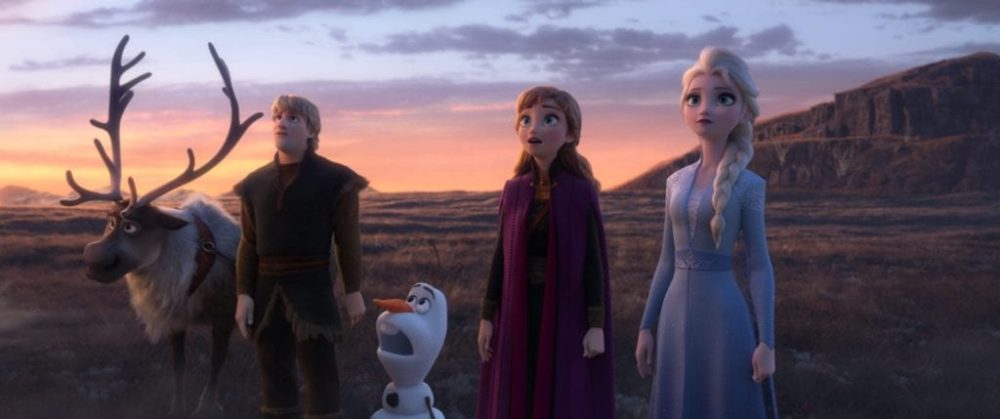
About the film: Why was Elsa born with magical powers? The answer is calling her and threatening her kingdom. Together with Anna, Kristoff, Olaf and Sven, she’ll set out on a dangerous but remarkable journey. In “Frozen,” Elsa feared her powers were too much for the world. In “Frozen 2,” she must hope they are enough. From the Academy Award®-winning team—directors Jennifer Lee and Chris Buck, producer Peter Del Vecho and songwriters Kristen Anderson-Lopez and Robert Lopez—and featuring the voices of Idina Menzel, Kristen Bell, Jonathan Groff and Josh Gad, Walt Disney Animation Studios’ “Frozen 2” opens in U.S. theaters on Nov. 22, 2019.
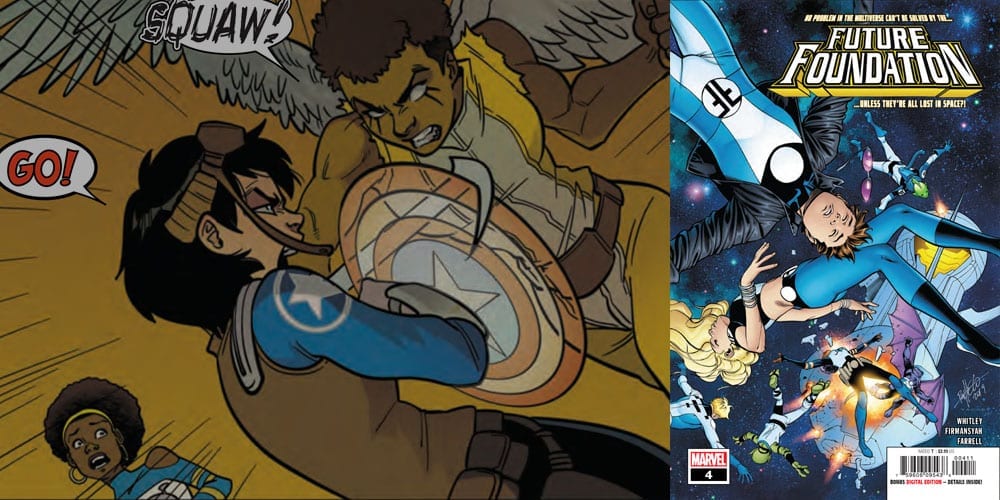
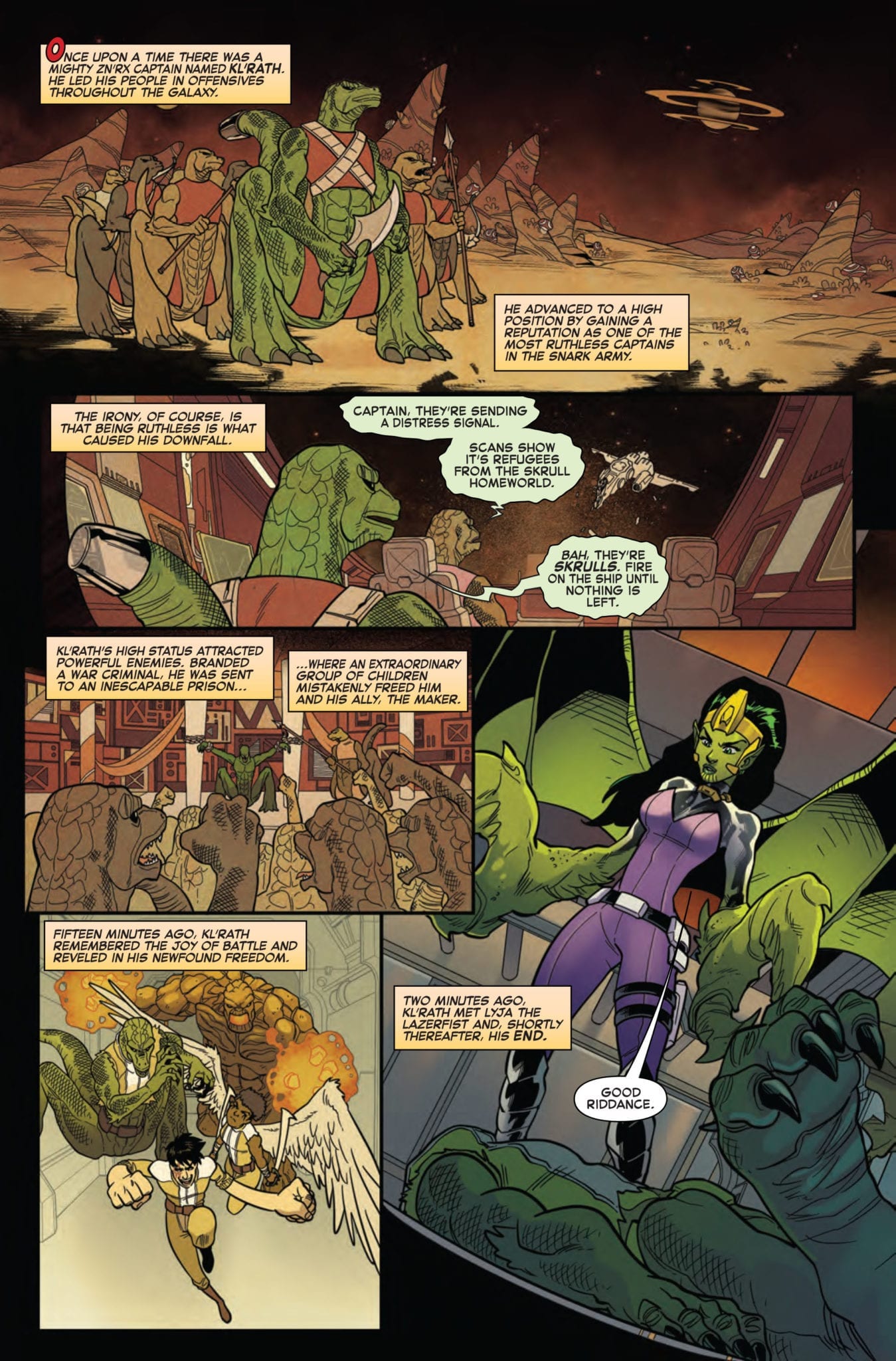
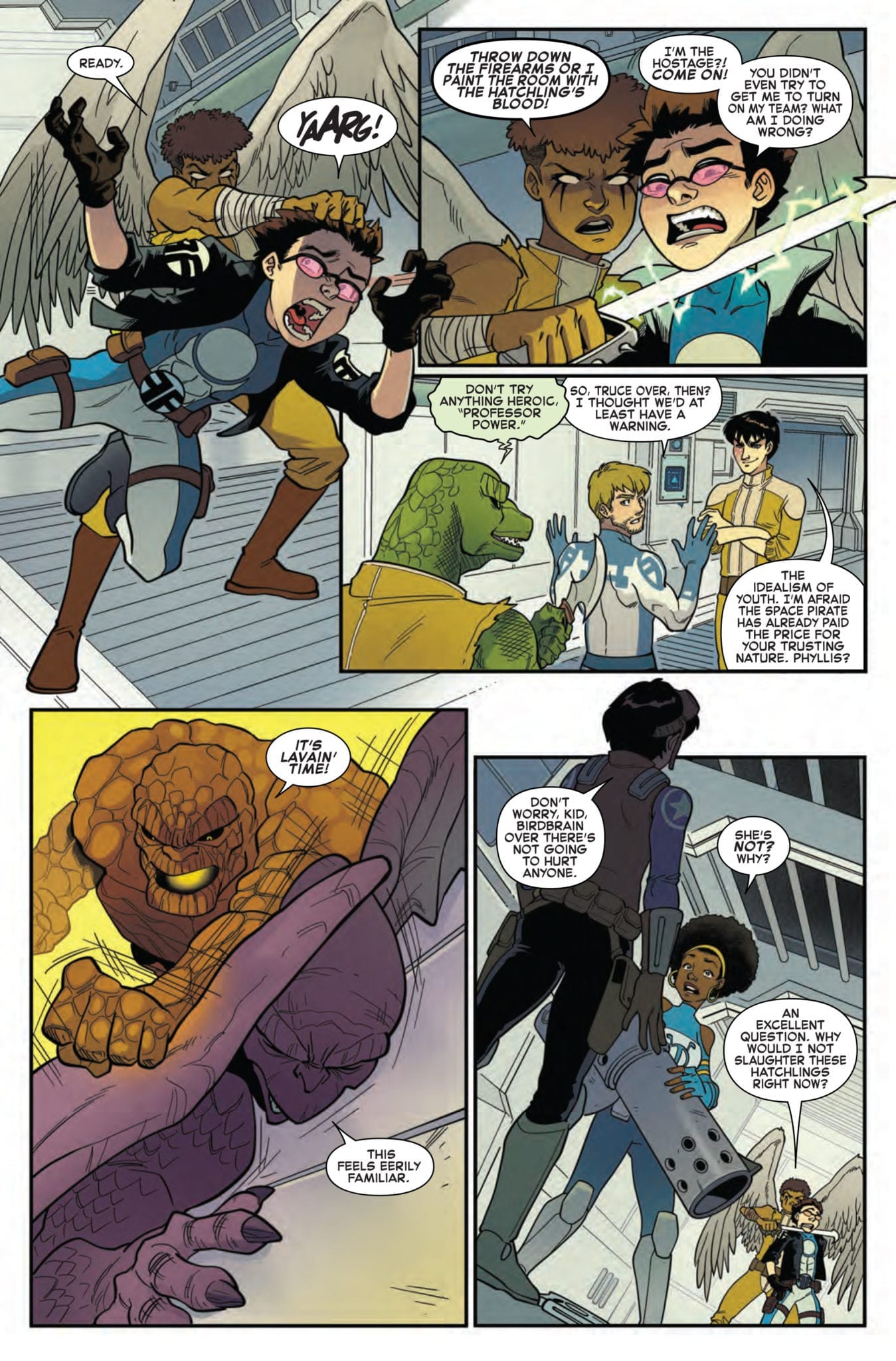
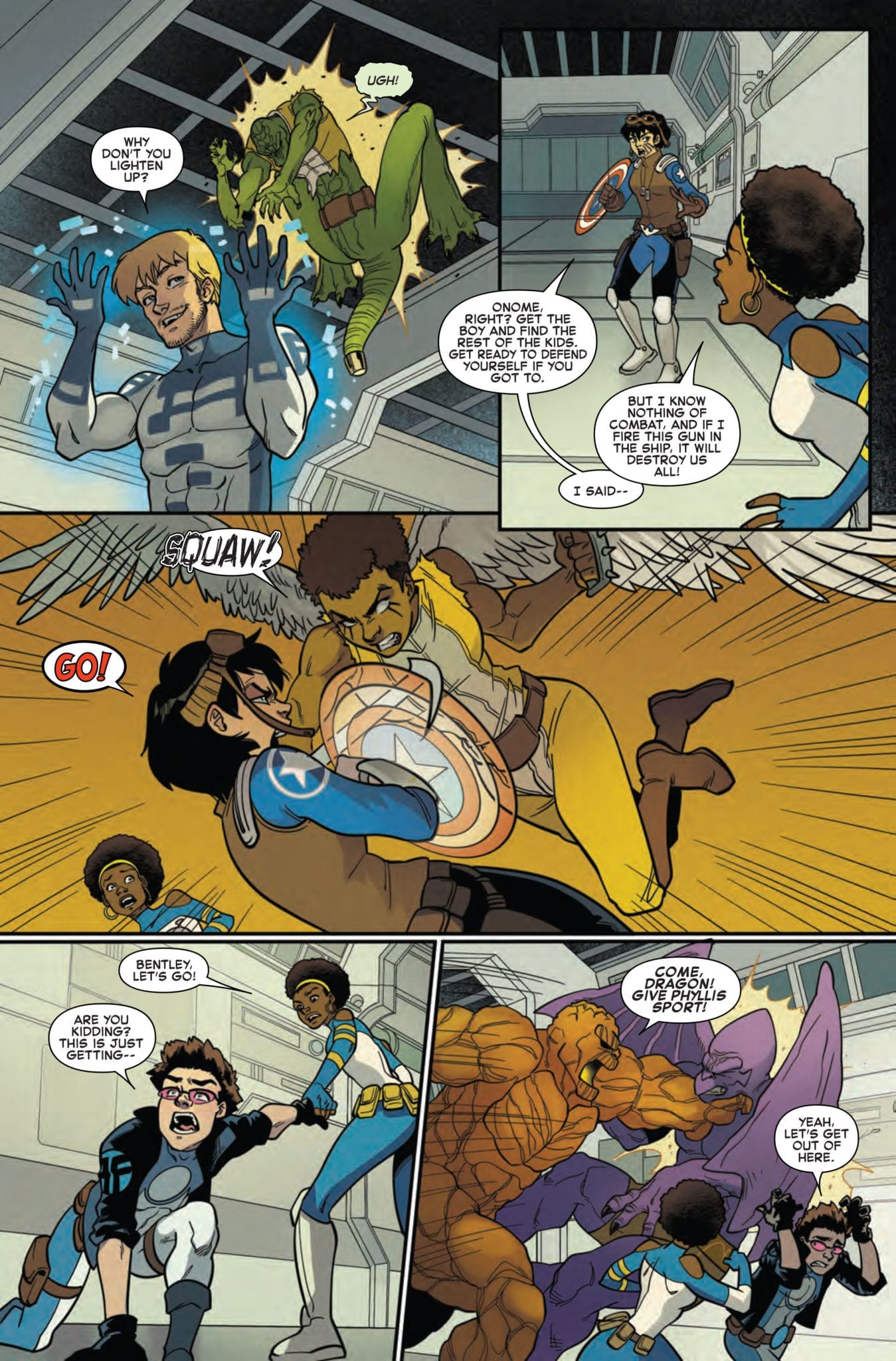
Future Foundation #4 hits your local comic book store November 13th, but thanks to Marvel Comics, Monkeys Fighting Robots has an exclusive five-page preview for you.
About the issue: LOST IN SPACE! The Future Foundation’s fight to save Molecule Man comes to a head! And there’ll be no rainbow after a storm like this. This issue, someone dies. Don’t miss Professor Power and his team meeting their Maker – and more!
Future Foundation #4 is by writer Jeremy Whitley and artist Alti Firmansyah, with colors by Triona Farrell and letters by Joe Caramagna. The cover is by Carlos Pacheco, Rafael Fonteriz, and Matt Yackey.
Check out the FUTURE FOUNDATION #4 preview below:
Are you reading Future Foundation? Sound off in the comments!
















 Let’s look at augmented reality. Marvel AR did not pan out well since it was little more than a digital pop-up book. However, Neon Wasteland by “Rob Shields” leads that field with a comic book that combines with interactive gaming. While it lacks complex sound effects, a musical loop combines with the game to create an immersive experience. That way, readers will feel like the game isn’t beginning or ending.
 For that matter, a couple of Line Webtoon‘s comics actually feature built-in music (DICE and Room of Swords), and fewer have vibration features (Chiller). Naturally, most of these features require a smartphone. The vibrations are also not very sophisticated for a full experience. Yet some Galaxy phones (e.g., S9) have touch screens with vibrational feedback. Technology marches on, and the possibilities are endless.