Home Blog Page 315

How JESSICA JONES: ALIAS, VOL. 2 Changed My Concept Of What A Comic Book Could Be

Plenty of people can tell romantic stories about reading Wonder Woman or Thor for the first time and being hooked on comics from then on. My introduction to the medium was decidedly less cool. My first books were the Disney comics stacked in between my sister’s growing collection of Spider-Man issues. I remember none of the plots of these books, making me wonder if they were plotted at all.

Later, when I got older and paid more attention to my sister’s comic books, I found myself bored with superhero stories. Why should I care about a silver dude surfing around space, talking like a caricature of an eighteenth-century gentleman? Nevermind the fact that I found the books overstimulating, looking like a deconstructed Zoetrope. All the action and overlapping dialogue and narration might have been too much for me then.

So, I didn’t read comic books for a long time. I bought into the pretension that superhero comic books were silly rags for boys and nerds—and I was totally neither. Yet I kept trying. I wanted to understand why my sister and millions of others love them. To this end, I took two comic-book related courses in college.

Then Marvel came to Netflix, and my point of view was forever altered.

A Heroine I Could Relate To

Beginning in 2015, Netflix gave us Marvel’s lesser-known heroes in their own set of series. Jessica Jones (created by Melissa Rosenberg) was the first one I watched and one of only three that I truly enjoyed. (I’m highly critical and selective, okay?) It was this gritty neo-noir show that gave me a “superhero” I could relate to. Unlike the larger-than-life super-powered mythical male figures or hyper-sexualized females, Jessica Jones is a leather jacket wearing, foul-mouthed private eye with PTSD who doesn’t want her powers. This I could dig.

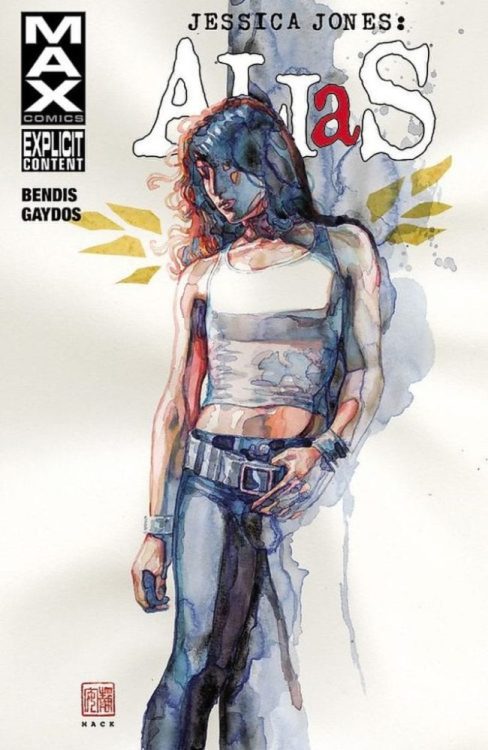
Once I finished the series, I read the out-of-sequence volume my sister had bought, which was even further down to Earth than the show. In Jessica Jones: Alias, Vol. 2, Jessica hardly uses her powers except when someone pisses her off. She’s just a person with the same relationship drama, dealings with bureaucracy, and work problems we all have—and in a real way instead of the tangential, histrionic manner we usually get from the big-time superheroes.

Written by Brian Michael Bendis with art by Michael Gaydos, Alias, Vol. 2 follows our anti-heroine on a five-issue arc as she investigates the disappearance of a sixteen-year-old girl from Lago, New York. The story is a quiet, small-town mystery. It’s got the classic murder, bullying, and outcast mutant trope as every reader would expect. Jessica is at the same time a private investigator just doing her job and a strange interloper who stirs up as much controversy as she uncovers. Her main transgression starts with her presence, but she also has sex with a cop and curses out a bigoted pastor (he foolishly calls mutants “abominations”).

How Bold, How Blue…

The story is told through dialogue and thought captions, no unnecessary narration here. This helps the story flow and progress naturally as if we see the events unfold in real-time. The at-times bold coloring and layout assist in creating a simultaneously realistic and cinematic look. A few pages are washed out with moody purple or cerulean, providing another kaleidoscopic means of getting inside Jessica Jones’ head.
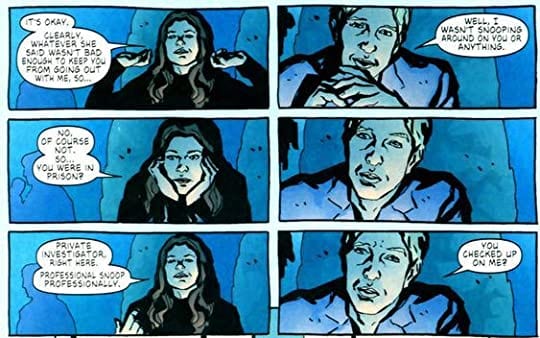
Jessica Jones in blue
Jessica on a date with Scott Lang, A. K. A. Ant-Man

In terms of layout, it’s like no other comic book I’ve read. Among the typical six-panel and nine-panel grids are pages whose panels look as if they’re drifting away. It’s reminiscent of high school PowerPoint presentations, but it isn’t just some cheap effect. It’s like a movie or a memory.

Of course, none of this is particularly unique to veteran comic book readers, especially lovers of irreverent misfit stories. But it’s these stories that color the world of comic books darker and more enticing.

Alias may not have been the exact catalyst for my commitment to reading comics, but it led to a more in-depth exploration behind the scenes. Subsequently, I took a history of comics and a comic book writing class at university. Now I have two comic book outlines burning holes in my hard drive. Some day the market will want an eight-page book about penguins in the North Pole converting to Judaism. When that day comes, I’ll have Jessica Jones to thank.
Monkeys Fighting Robots Youtube

REVIEW: DCEASED UNKILLABLES #3 Keeps Stakes High to the End

DCEASED Taylor DC Comics

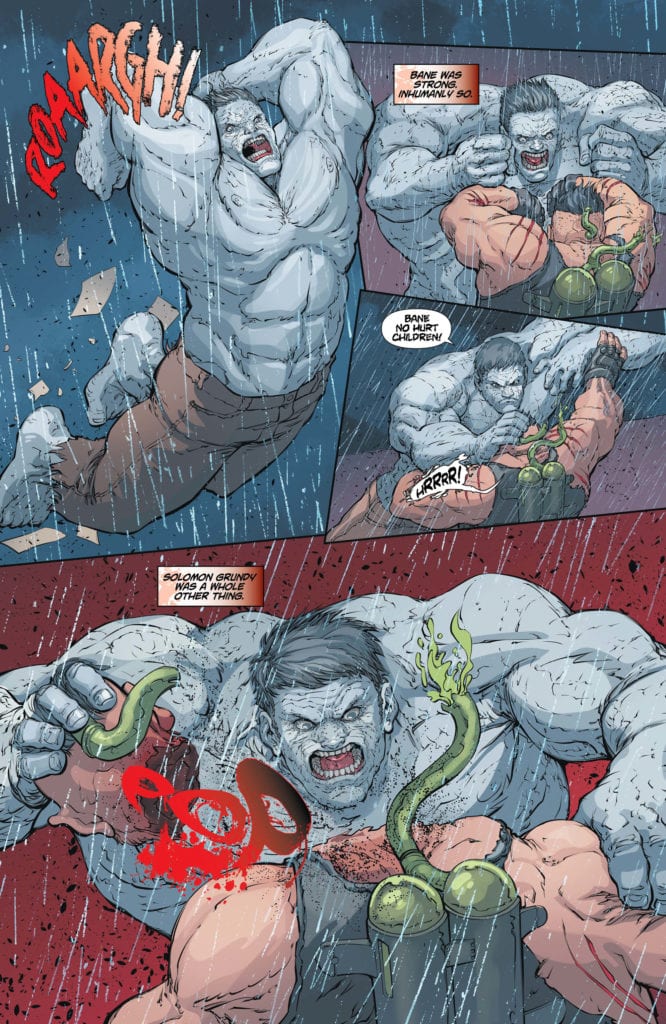
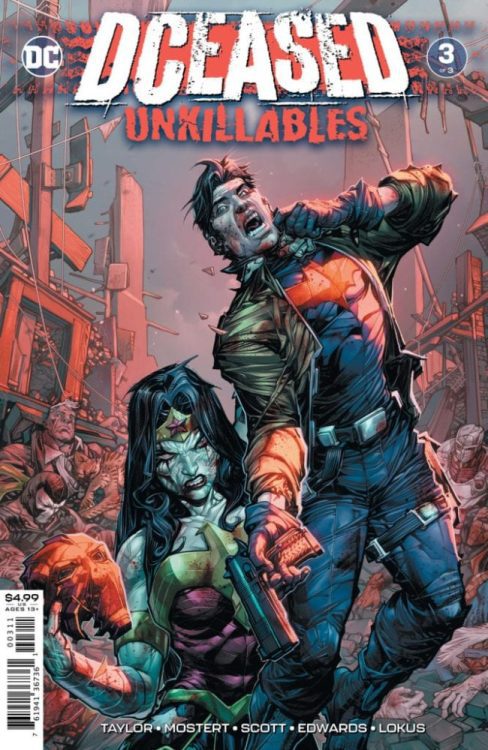
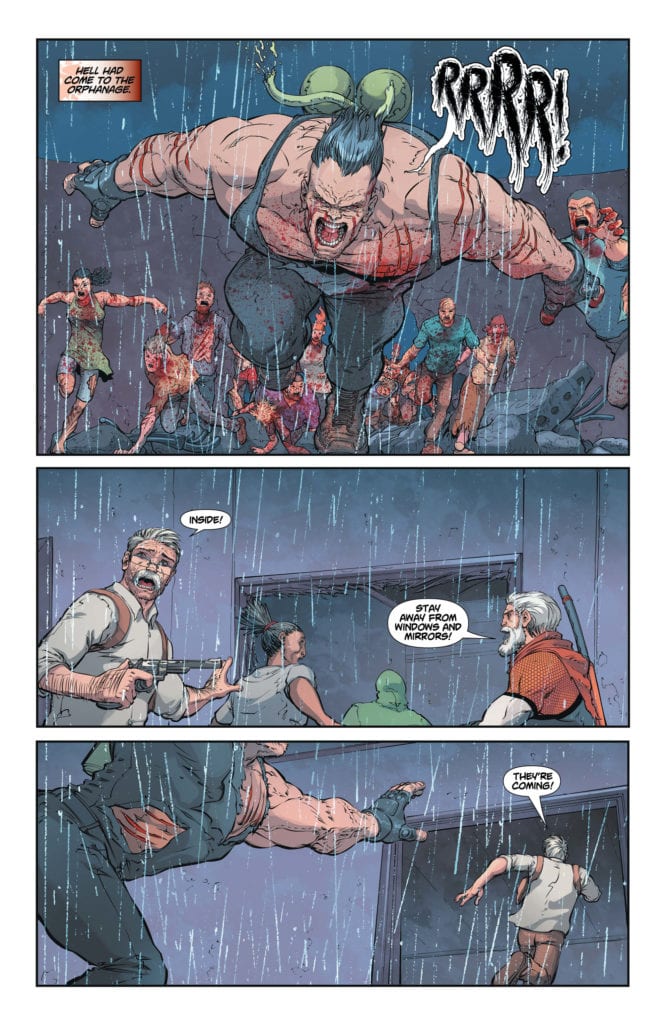
Written by Tom Taylor, with art by Karl Mostert, Trevor Scott and Neil Edwards, colors by Rex Lokus, and letters by Saida Temofonte, DCEASED Unkillables #3 speeds along to its conclusion without letting up on the gas. This raucous addition to the DCEASED universe knows how to keep stakes high for every second.

Writing

Taylor doesn’t pull punches with his finale. Many “unkillable” characters prove to be less than unkillable in this issue. But in the midst of the brutality and gore, Taylor sprinkles in gentler moments. On occasion, he pushes the gentle moments a hair’s breadth too far. Characters bare all with the simple looks on their faces, and so a few of their lines seem unnecessary. But mostly, Taylor hits his balance masterfully. Packaging the gentle moments with rough exteriors. So when Cheetah is called a “good kitty,” and we see her connect with the kids, we’re all the more on the edge of our seats when they are plunged back into danger.

DCEASED Taylor DC

Art

Mostert, Scott, and Edwards spend some time in the uncanny valley for this issue again. Many of the characters look just slightly off. The proportionality of their faces doesn’t look quite right, with noses and eyes that seem too small. While this does occasionally distract from the gentler moments Taylor sets up; the gory fight scenes are where these artists shine. With hands ripping through heads, and a particular moment where Deathstroke looks downright mythical, they have fun with the gruesome aspects of this issue.

Coloring

Lokus certainly helps with the gruesomeness. Nearly every panel of every page is speckled with blood. Lokus makes it look as though it’s raining down on the characters from above, in vibrant red. It’s not long before each bloody massacre takes on a darker color palette. Lokus gives moments of triumph a bright palette, while a page later, he’s coloring the same scene in darker tones. It’s the blood in the background that ties the whole thing together. Just as the vibrant red dries on the side of buses or characters faces to a dull brown, each moment has the potential to go from adrenaline-pumping victory to heartbreaking defeat.

DCEASED Taylor DC

Lettering

Temofonte continues to have fun with the lettering, as in previous issues. Sound effects are incorporated into the moments that are causing them. The sounds of guns are written in large red letters that look like the gore they cause. A car going up in flames creates a sound that looks like the fire itself. And it’s fitting that Temofonte’s sound effects take center stage in many of the panels. Her sound effects are often tied to an action that’s driving the scene.


This creative team has managed to create stakes and joy in a zombie apocalypse. As the world careens towards its end, we attach to these characters that are otherwise written off. Taylor balances quirkiness and brutality with brilliant results. Read the finale of a great series, DCEASED Unkillables #3, out now from DC Comics.

Monkeys Fighting Robots Youtube

Review: PLUNGE #3 Is The Perfect Balance Of Mystery And Horror

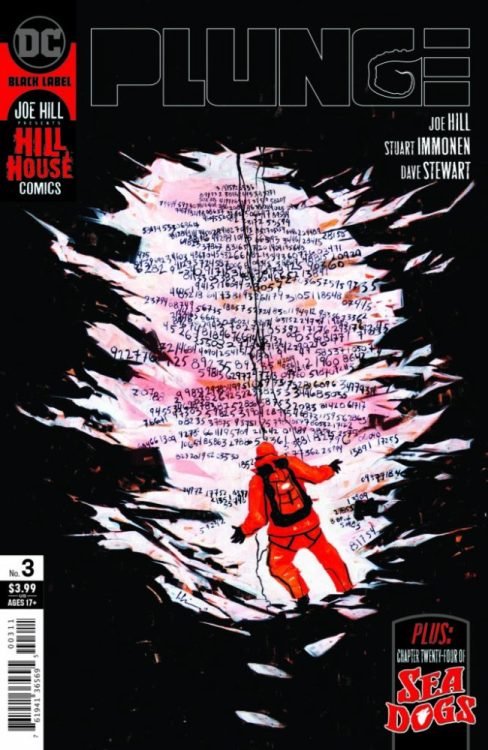
PLUNGE #3, hitting comic book stores on Tuesday, May 19th, continues writer Joe Hill’s thrilling new tale. This issue follows Captain Gage Carpenter and his crew search through the wreckage of Derleth, a ship that’s been lost for decades. But what our protagonists find will take this series from mystery to horror in one fell swoop.

Story

While Gage and Lacome investigate an anomaly on their ship, the rest of the crew have been searching the island where the Derleth‘s wreckage was found. Russell, prodded by curiosity, ventures deep into its many caves. But a surprising welcome party greets him right off the bat.

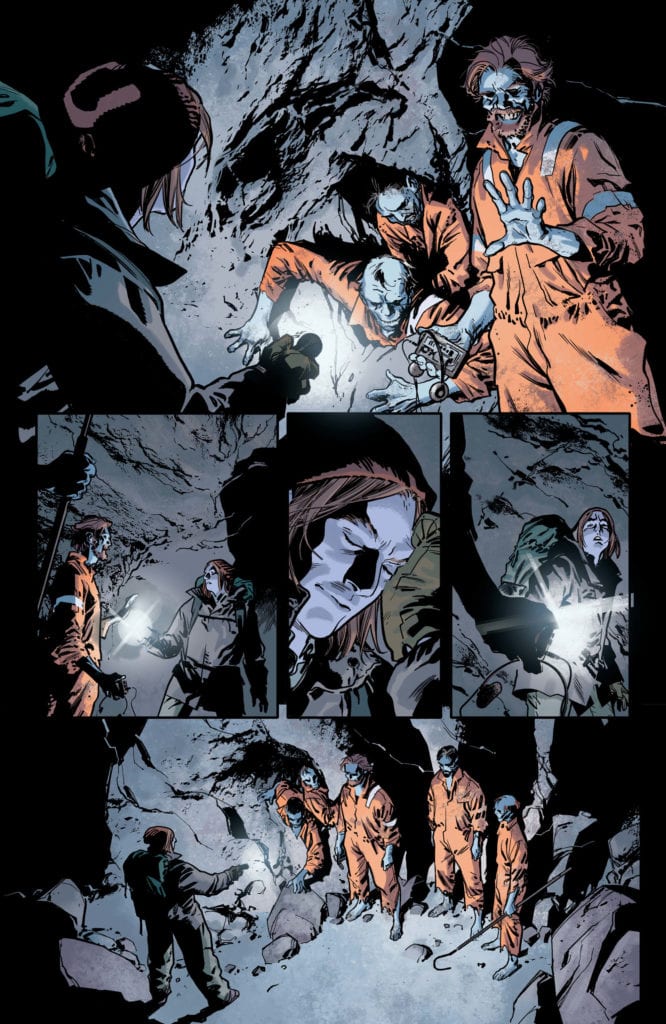
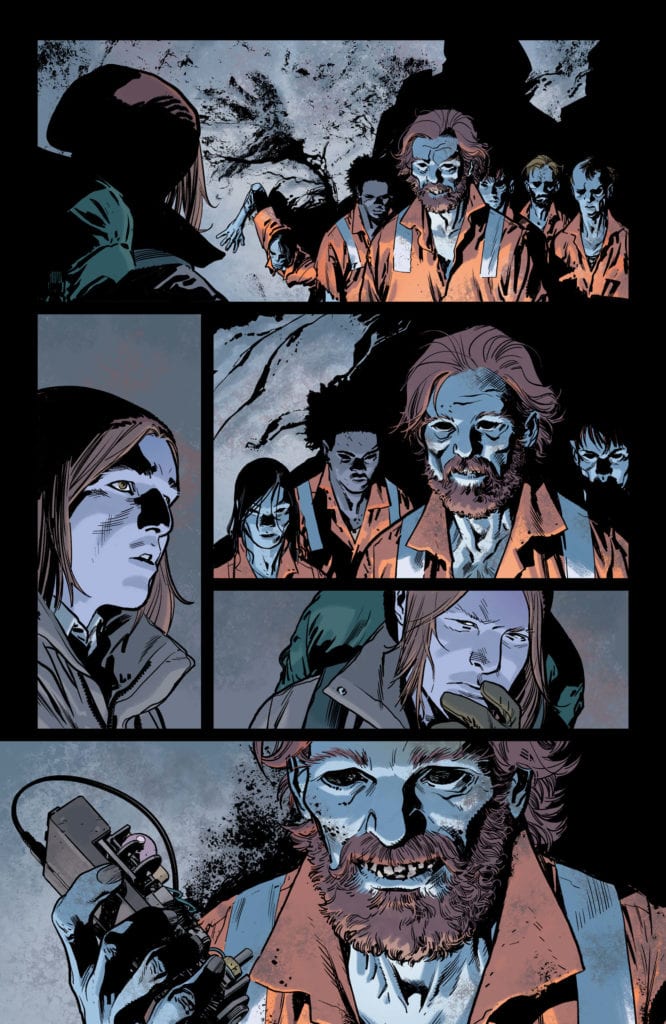
We find the supposedly dead crew of the Derleth greet Russell in all their ageless glory. What’s more, it appears they know a lot more about our protagonists than one would reasonably expect. But before Russell can learn more about them, the first mate, Julian, gives him a modified device with headphones, which turn out to be more than he bargained for.

Now it’s up to Gage to both rescue his brother from an unknown fate and unravel the mystery of the Derleth crew’s survival after 40 years.

Hill’s masterful series continues to up with ante with this thrilling issue. Readers will be anxious to learn more about Julian and his crew.

Artwork

Stuart Immonen’s penciling and ink work, Dave Stewart’s coloring, and Deron Bennett’s lettering add their own unique flavor to create beautiful horror themed illustrations. The panels are filled with wavy lines and dark shades set against lighter backdrops, upending readers’ visual expectations. Additionally, the cryptic fonts employed help emphasize the unsettling nature of each subsequent scene.

Conclusion

PLUNGE #3 takes us on a thrilling ride filled with suspense. Watching the crew dive deeper into the mystery of the Derleth will leave readers on the edge of their seats.

Why do you think the Derleth‘s crew has survived all this time? Let us know in the comments below!

Monkeys Fighting Robots Youtube

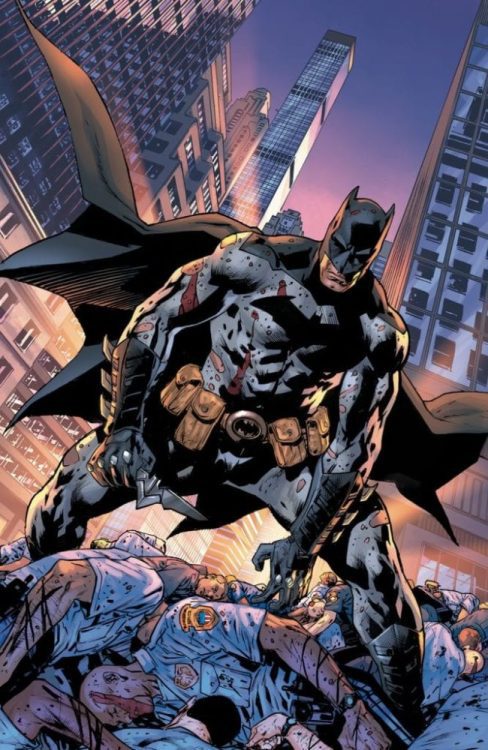
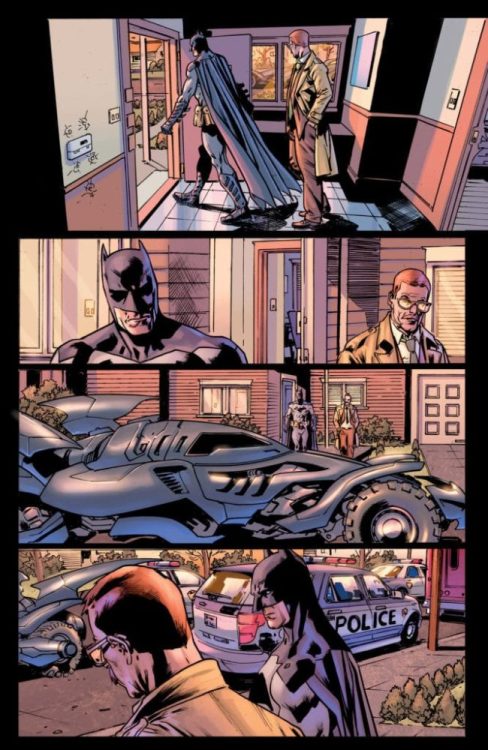
DC Comics First Look: THE BATMAN’S GRAVE #7

Batman's Grave #7

DC Comics has released a preview for the upcoming seventh issue of the 12-issue series The Batman’s Grave by Warren Ellis and Bryan Hitch.

Here’s DC’s official description of the comic:

In this seventh of 12-issue maxiseries written by Warren Ellis with art by Bryan Hitch, there’s a lunatic on the loose and a dead body inside a supposedly impregnable home. Members of the justice system are being murdered by a secret army, and nobody knows what’s happening. Does the Batman have the single clue that’s the key to the whole nightmare?

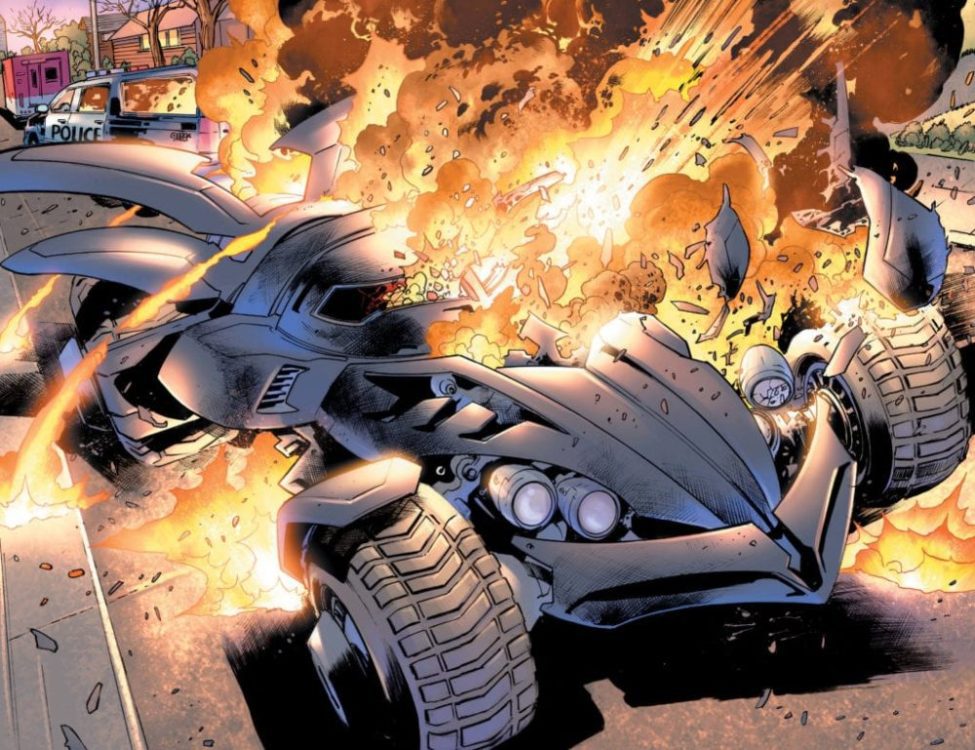
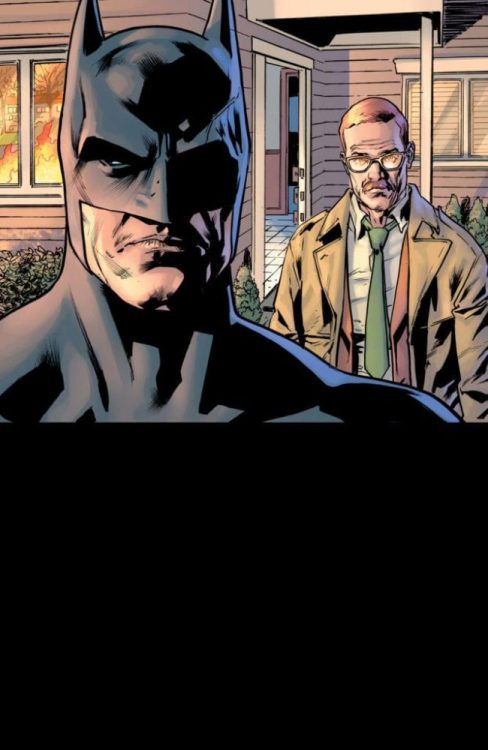
And here are the preview pages:

The Batman’s Grave #7 is scheduled to land in stores June 9.

Monkeys Fighting Robots Youtube

KILLING EVE – Meetings Have Biscuits | TV Review

After two episodes that set up the plotline for the season to come Killing Eve‘s third season starts to hit its stride with the third episode, “Meetings Have Biscuits.”

Eve, Carolyn, and Bitter Pill start to look through Kenny’s research about The Twelve and how it links to his death. They find a potential lead through the money trail. But The Twelve are aware of the investigation and send Villanelle to London to clean up.

“Meeting Have Biscuits” was vintage Killing Eve. It matches the heights of the show’s trademark wit and humor as well as having Villanelle do what she does best. The episode opens with Villanelle showing malicious and sadistic sides when on an assassination mission. One of Villanelle’s actions during the episode was kidnapping a baby and uses him as a way to annoy her handler. The baby’s appearance was a way show despicable Villanelle and Dasha were but still be oddly charming.

Most of the humorous moments come from the London team. Their first scene was in a bathroom with Carolyn having a bath and causally lets people in for a meeting. The actual meeting was filled with Shane Black style dialogue that helped made the show so popular to begin with. A couple of my favorite lines was Carolyn’s daughter making a snide commet and Eve revealing who Kenny was investigating.

As well as comedy Shane Black’s work was known for a crafting good thriller and like a Black story “Meetings Have Biscuits” works as a thriller. In the episode Villanelle and the London team were conversing to the same point – they were both looking for an accountant who worked for The Twelve. It had led to a tense conclusion as they race to the same point. The story involving the accountant and a missing $6 million makes “Meetings Have Biscuits” work both as an individual episode and adds to the wider mystery about The Twelve.

When Eve spoke with the Bitter Pill she reveals that Kenny was investigating The Twelve it was linked to events in the first season. It was a nice little callback for fans of the series and showed how extensive the shadow of The Twelve.

“Meeting Have Biscuits” also adds to the dynamic between Villanelle and Eve. When Villanelle receives her orders to go to London she states she’s not ready because of Eve.  And when she arrives in the city she spends as much time looking for ways to mess with Eve as she does to go on her mission. This culminated with Eve and Villanelle facing each other on a bus and despite Villanelle being a trained assassin Eve attacks her with fury. Villanelle does get the upper hand in their fight but Eve uses the sexual tension between the pair to save her skin.

“Meeting Have Biscuits” was a big step up for the third season. It has gone beyond the early point plots that each season has to go through and now starting to get its own identity.

Monkeys Fighting Robots Youtube

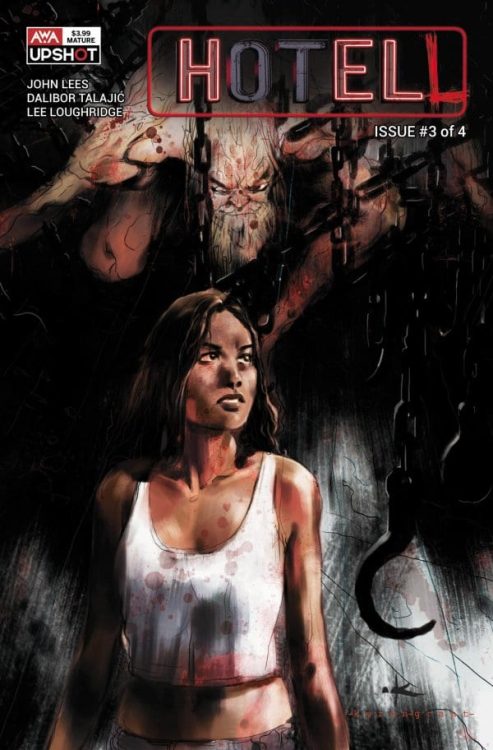
Review: HOTELL #3: Corpses Lie Where Stones are Unturned

Writer John Lees and artist Dalibor Talajic, along with colorist Lee Loughridge and Sal Cipriano return with another chilling chapter of short horror in “Hotell” #3. This issue brings the most haunting story yet, complete with tension, gore, and the uncovering of some of the secrets beneath Pierot Courts – secrets likely better off buried.

“You won’t find it on any map, but if you happen to be driving down Route 66 in the dead of night and you’re truly desperate for shelter, sanctuary or secrecy, you might see a battered sign on the side of the road. The Pierrot Courts Hotel – where the tormented make their last stand with the demons that haunt them…where many check-in, but few check out.”

Writing & Plot

John Lees is making full use of the horror anthology style with “Hotell” #3 by including yet another completely different kind of horror story. Instead of demonic infants or reanimated wives, this chapter includes as the hunt for a serial killer who once stopped for a night at – you guessed it – Pierot Courts out in the desert. He is hunted by a journalist with a personal stake in his choice of victims, and on her trail, she ends up at the same ominous hotel as it appears to her on her journey.

Not only is this issue its own unique horror entry in Lees’ series, but it’s a revealing dive into what some of the behind-the-curtain elements of this unnatural hotel. It’s an issue that actually improves on plot points from prior issues that were a bridge too far at the time by showing (not explaining) what caused some of those events. In the process, Lees also writes the most tense and visceral issue of this comic yet. The usual clever setup is matched by intense pacing and a classic “don’t go in there!” approach to the audience perspective. This is a comic that knows how to intelligently and creatively dish out some small secrets without spoiling the game, and can maintain one darkly satisfying time while doing it.

Art Direction

Dalibor Talajic‘s emphasis on character art and visions of terror create a horror series that is a consistent joy to look at in “Hotell.” Talajic’s focus on characterization is essential for a comic that delves into the backstories and psyches of its protagonists. There is an intimacy in the detail that makes the reporter’s perspective all the easier to interface with. A large part of crafting effective horror is being able to care about the protagonist as they face monstrous odds, and Talijic’s pencils take care of this on the visual end. He’s also given his chance to craft his most haunting creation of flesh and bone thus far, and it’s sure to be a satisfying thrill for monster fans. The colors provided by Lee Loughridge offer an all-encompassing atmosphere of darkness and dread, using shadows and eerie light effects to fill the dark corridors of this maddening hotel. Sal Cipriano’s letters finish off the visual front with a stylized use of traditional lettering that works especially well at establishing tension in the voice of the characters.

“Hotell” #3 is a gripping and intelligent chapter in this short-horror anthology series. John Lees writes an issue that is not only the most outright terrifying of the issues so far, but also divulges some of Pierot Courts secrets without giving too much away. Dalibor Talajic and Co. once again create an atmospheric and detailed visual experience that wraps the reader in this comic’s unnatural and growingly unsettling world. Get this issue from your local comic shop when it hits shelves on July 22nd!

Monkeys Fighting Robots Youtube

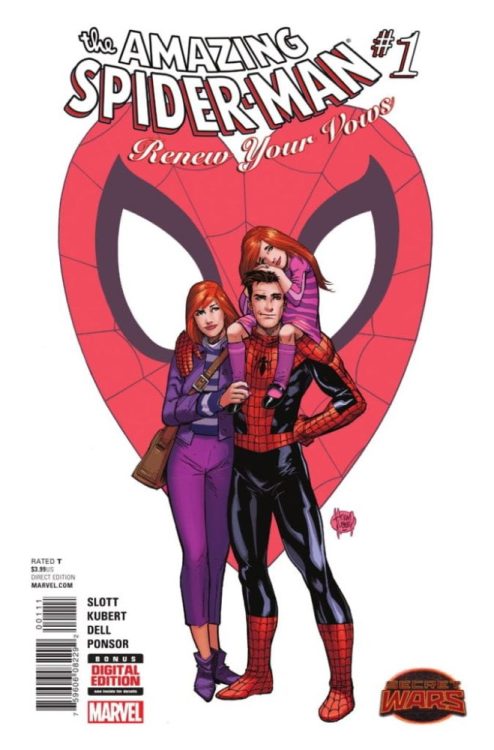
What It Means To Be A Family In AMAZING SPIDER-MAN: RENEW YOUR VOWS (2015) #1

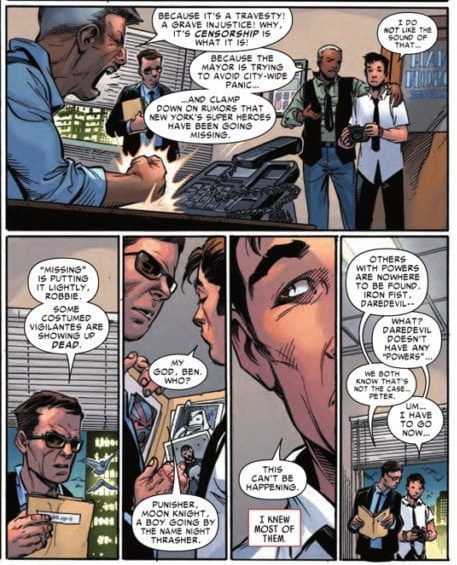
There were many highly anticipated spin-off stories to come out of Marvel’s 2015 Secret Wars event, but AMAZING SPIDER-MAN: RENEW YOUR VOWS (2015) #1 rocked the comics landscape unlike any other. Released in June of the same year, the inaugural issue paid service to Spidey fans by presenting a married version of Peter Parker and Mary Jane Watson, along with their daughter Annie. However, the the disappearance of the world’s superheroes led Peter on a fact-finding mission to protect his world and family.

Story

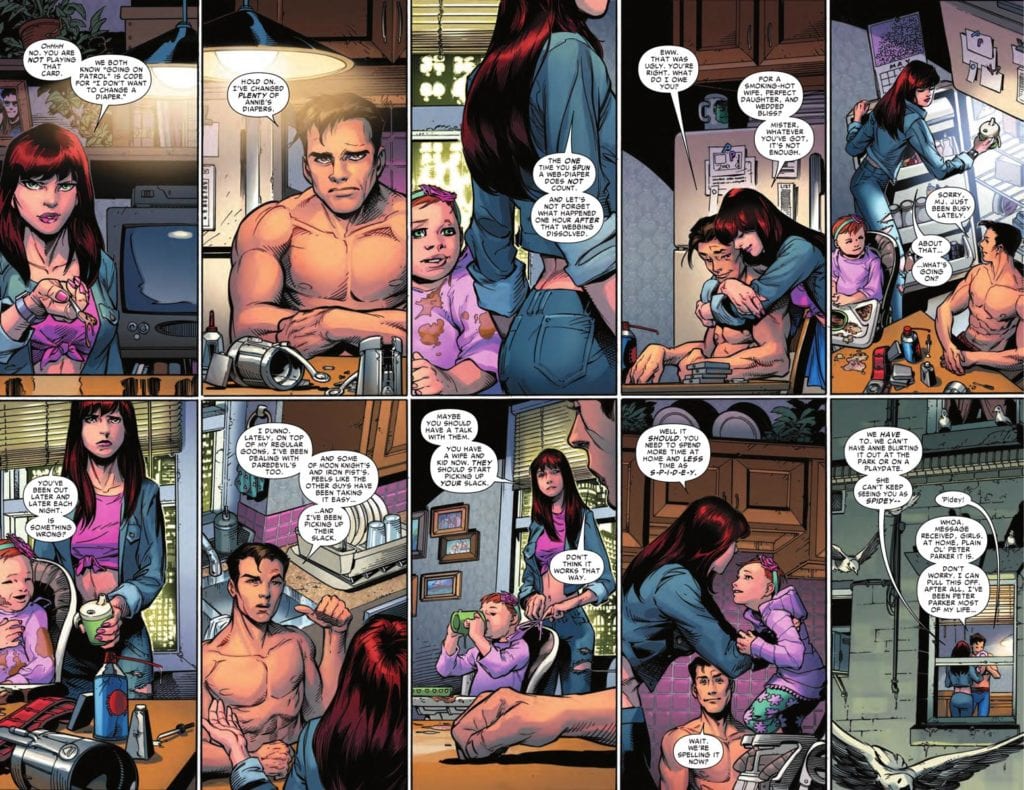
Our friendly neighborhood hero finds himself living the dream. With his marriage to Mary Jane, this narrative gives Peter the life he’s always wanted. But it’s not all pie in the sky. The interactions between the family is just what readers would expect in a Spider-Man marriage: arguments over Peter’s responsibilities.

Dan Slott presents readers an engaging portrayal of family life in one of the most popular comic couples. We see the highs, lows, and all-round average days anyone would expect. However, as their version of New York happens to find itself in Battleworld from the Secret Wars event, their peace cannot last for long. And readers find it begins with missing superheroes.

Peter finds himself unraveling this mystery while trying to be present for his new family. But when one of his most ferocious villains threatens their safety, will be cross a line in order to protect them?

Artwork

  • Pencils and Inks: Adam Kubert’s penciling and John Dell’s ink work work beautifully together in this issue. The details of Peter and Mary Jane pay homage to their classic designs over the years.
  • Colors: Justin Ponsor’s coloring work fits well with the tone of this book. The tones of even our colorful heroes are darker, reflecting the harsh realism revealed as the story progresses.
  • Letters: VC’s Joe Caramagna’s lettering helped frame the scenes of each panel, giving readers a place to focus their attention.

Conclusion

AMAZING SPIDER-MAN: RENEW YOUR VOWS (2015) #1 was one of the most beloved alternate Spidey stories. Seeing Peter and Mary Jane in a happy marriage once again is enough to encourage fans to pick this one up!

Did you enjoy seeing Peter and Mary Jane as parents? Let us know in the comments below!

Monkeys Fighting Robots Youtube

ELECTRIC SOUP: Frank Quitely’s Origin Story

Electric Soup #14
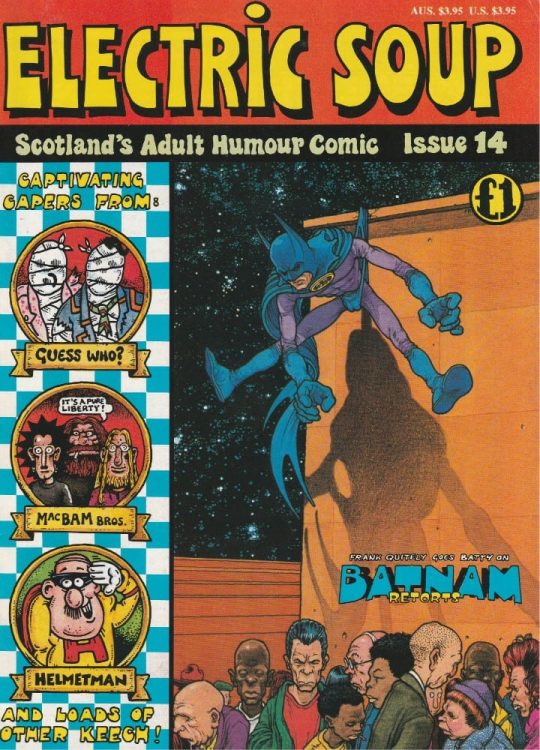
Electric Soup #14 cover Credit: Electric Soup Press/John Brown Publishing

Frank Quitely is a recognisable name in the comic book community. He has a distinguishable style of highly detailed caricature. Over the year’s he has won a number of awards, including an Eisner Award for his work on We3. He has worked on The Authority, Batman and Robin, All Star Superman, and JFK: Justice? F**k Knows.

Read that list again as there’s one title that isn’t as well known.

JFK: Justice? F**k Knows was a two page parody strip published in the Scottish adult humour magazine Electric Soup. The Comic was Quitely’s slip road into the super fast highway of his career and those early parody strips are the foundation that he has built his style around.

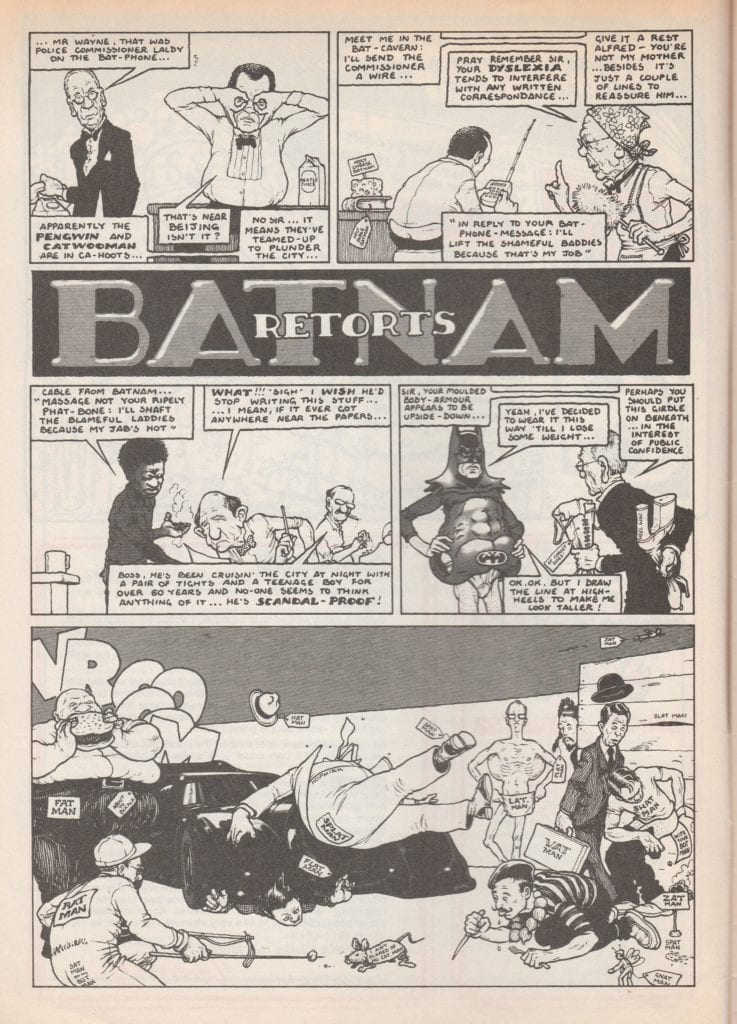
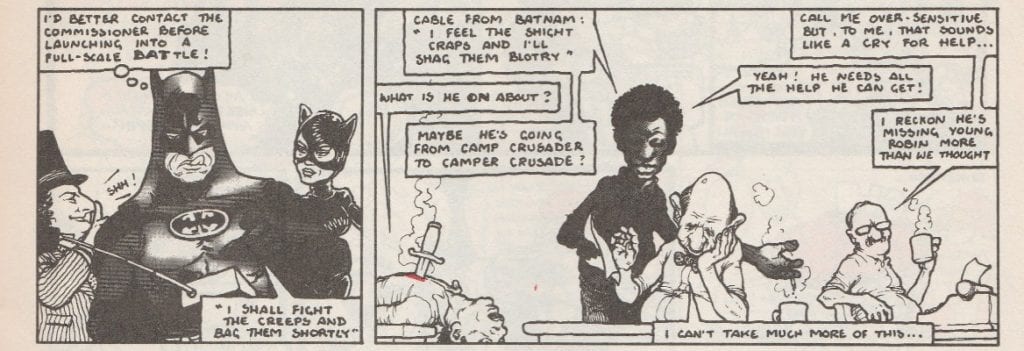
The most popular, and regular, strip that he produced for the magazine was The Greens, itself a parody of another comic strip The Broons. However, the most interesting out of the 17 issue run, and the one that was a taster for the work he was to produce, was called Batnam Retorts. Published in 1992, it riffed off of Tim Burton’s second caped crusader movie and highlighted Quitley’s flair for humanising superheroes.

Batnam Retorts
BATNAM RETORTS from Electric Soup #14
Credit: Electric Soup Press/John Brown Publishing

Scottish Broth

After being thrown out of the Glasgow School of Art, Quitely picked up a number of freelance illustration jobs, creating nightclub posters and drawing people’s pets. However, it was getting a regular strip in Electric Soup that started his comic career.

He wrote and illustrated one and two page cartoon stories that were often filled with cheesy gags and Glasgow humour. However, surrounded by more traditional humour magazine artwork and underground comic styles, Quitely’s work stands out. It has unique, thinly inked defining lines and an eloquent dynamism that flows from panel to panel.

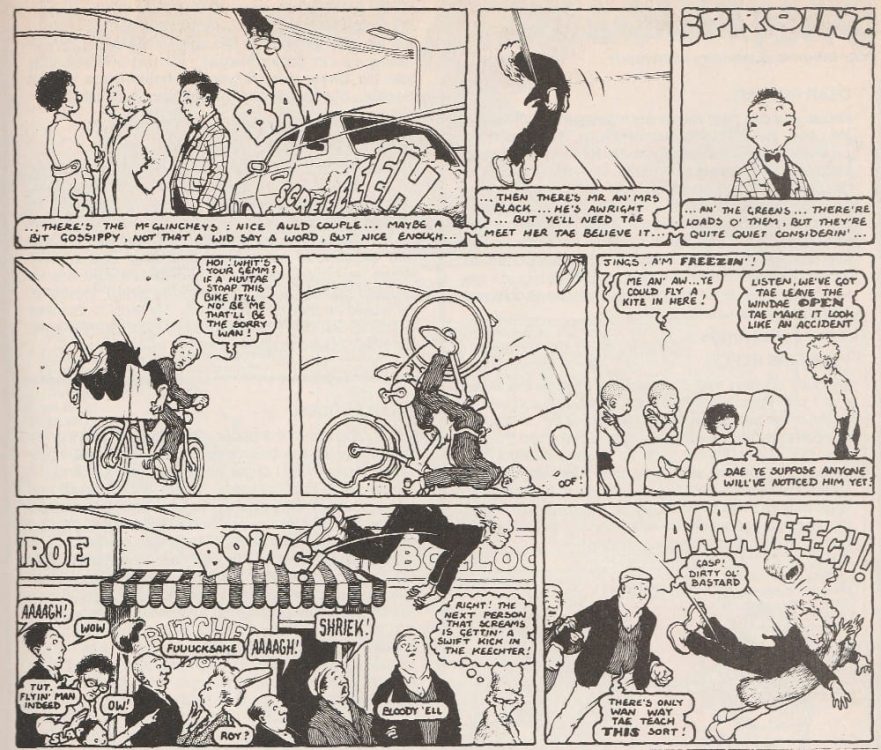
In The Greens episode for issue 12, the children try to play a prank on their Granpaw that results in a slapstick journey across Glasgow for the unconscious old man. Quitely draws the sleeping figure in a number of uncomfortable positions as he is ricocheted from panel to panel. The flow of the story is fed by the exaggerated actions of the old man’s body and the corresponding motion lines. Across the two pages Quietly controls the reading direction and the pace of the narrative with obvious skill.

The Greens
THE GREENS from Electric Soup #12
Credit: Electric Soup Press/John Brown Publishing

I’m Batnam

Quitley has said that it is his job to ‘make the illustrations provide a dynamic visual narrative’ and that is clear from his earliest work. In Batnam Retorts it isn’t a physical dynamism that Quitley aims for, although there is one panel that uses slapstick humour. The focus is on the contrast between the superhero characters and the civilian counterparts.

Forming the foundation of the overall joke for the strip, the interaction between the Tim Burton superhero archetype and, what can be considered as, real people is a theme that the artist takes with him throughout his career. He creates a visual contrast between the outlandish characters and the office dwelling police force. One row has an opening panel showing the bulky, black form of Batnam, gadget in hand and a grimace on his face (see below). This is juxtaposed with a panel of tired, coffee drinking men slouched at their desks. The backgrounds in both panels are bare but the contrast between Batnam and the Commissioner is clear.

Across the two pages of art this distinction between Supers and Ordinary is clearly displayed. The group of villains in their over the top outfits stand out against the street scene of everyday Glasgow folk.

Batnam Retorts
BATNAM RETORTS from Electric Soup #14
Credit: Electric Soup Press/John Brown Publishing

All Star

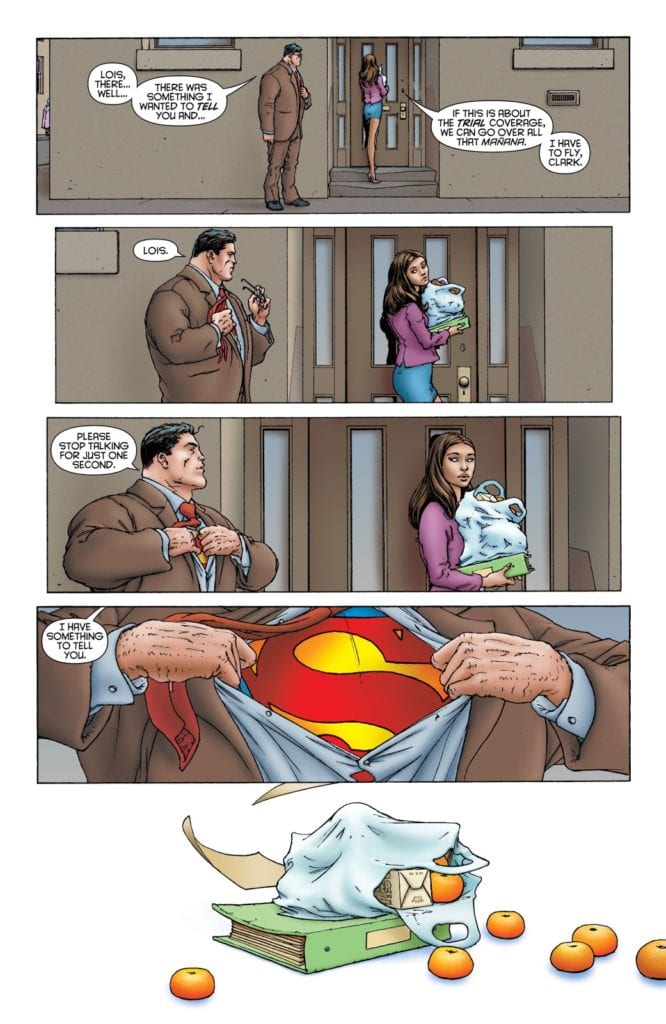
If you compare this strip to some of his later works, such as All Star Superman, the contrast between the super and the ordinary is still there, just on a larger scale. Quitely imbues his version of Clark Kent with all the humble, bumbling nature that made Christopher Reeve’s performance so memorable in the 1978 movie. The journalist is a true everyman, as uncomfortable in his suit and tie as everybody else. He then becomes an almost unstoppable force when he changes into his superhero costume.

Some of the contrast is down to the coloring by Jamie Grant who uses browns and greys for the ‘ordinary’ world and bright, garish colors for the super elements. However, Quitely illustrates Superman in a way that instantly gives him a superior air. The flat, energy absent scenes of Clark Kent fade away next to the dynamic visuals of the Man of Steel. In the comic Superman is trying to reconcile his life, preparing for his impending death, and Quitely is using the visuals to demonstrate how difficult that is. There are two distinct sides to Superman and they are worlds apart.

All Star Superman
All Star Superman #2 Art Credit: DC Comics

The Batman Link

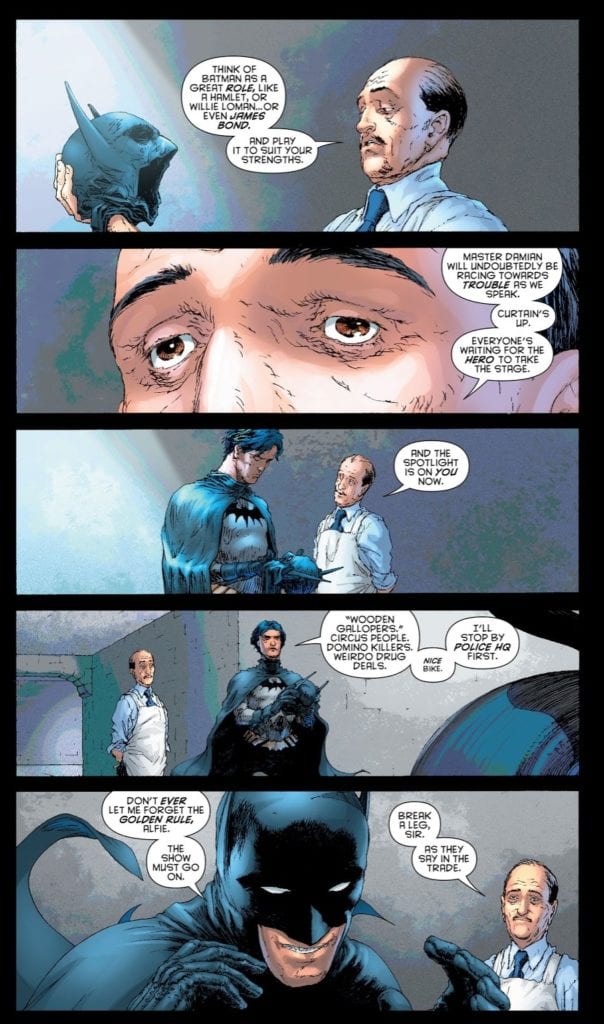
One thing that stands out from the Batnam Retorts comic strip is Quitely’s understanding of the dynamic between Bruce and Alfred, the human element of the Superhero story. In the movie, Batman Returns, Burton portrays the relationship as an aging father and unruly, awkward son. Quitely clearly picks up on this and uses it, however in just three panels he is able to tell you everything you need to know about both characters.

In his future career, Quitely goes on to draw Batman and Robin for DC comics and the relationship he illustrates between Dick and Alfred is the same. On a page from issue 3 (below), there is an exchange between the two characters that is almost a retelling of one panel from Batnam. In it Alfred helps Dick get ready as Batman, handing him his costume and giving him a pep talk. The exact same situation is portrayed in panel 4 of Batnam Retorts.

The way that Aflred looks at Bruce is the same in both comics. Even the butler’s appearance is very similar with an oval, wrinkled face topped with very little hair. Dick is different, but that jokey snarl at the bottom of the page mirrors the concentrating, tongue out, face of Bruce from Electric Soup.

The space that Quitely has to tell the story is different for both strips however he creates the same pacing and invokes the same character narration.

Batman and Alfred
Batman and Robin #3 Credit: DC Comics

Forever Forward

Frank Quitely has come a long way from his early days in Glasgow. Not physically, as he still lives and works there. And not technologically, as he still produces a lot of his work with ink on paper. However, his design work and page layouts have become almost as legendary as the characters he has drawn. With each new project Quitely pushes himself and his art to get the most out of a medium he clearly loves.

He recognises that comics are different from other mediums and uses different skill sets to tell a story. He also loves doing the unexpected, pushing the reader to accept more. Not only does he have control over his pencils and layouts, but he has complete control over the reading experience. This is something that is evident in the superb We3 but has been a part of his work from the very beginning.

The strips in Electric Soup may see like simple throw away gags but captured within them are the seeds of Frank Quitely’s greatness.

Monkeys Fighting Robots Youtube

Review: THE COMPLETE WITCHBLADE, VOL. 1 Is 90’s Action At Its Best

Review: THE COMPLETE WITCHBLADE, VOL. 1 Is 90's Action At Its Best

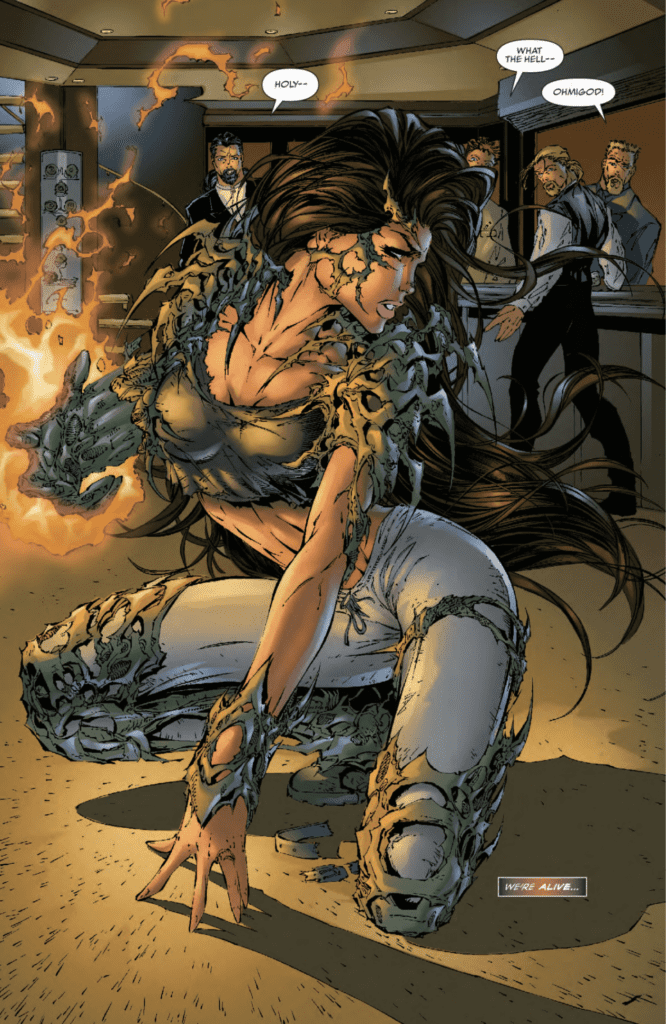
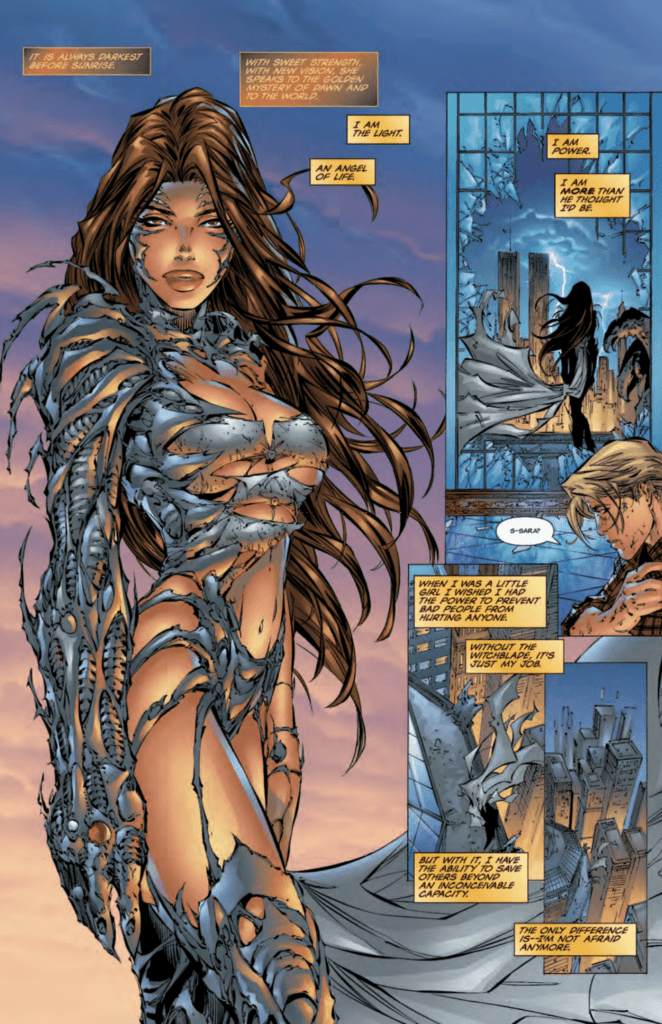
THE COMPLETE WITCHBLADE, VOL. 1, available from Image on September 2, 2020, the collection includes WITCHBLADE #1-19, THE DARKNESS #9 & 10, and TALES OF THE WITCHBLADE #1/2-3 from writers such as Warren Ellis, Brian Haberlin, David Wohl, Christina Z., and David Finch. The stories are original, the art is stellar, and the style is so 90’s you expect M.C. Hammer to make a cameo appearance wearing his signature parachute pants.

Review: THE COMPLETE WITCHBLADE, VOL. 1 Is 90's Action At Its Best

Writing

There’s a lengthy list of writers contributing to the volume, so we’ll focus on the creation. Witchblade, created by Marc Silvestri, David, Wohl, Brian Haberlin, and Michael Turner, is the story of an NYPD cop who bonds with an ancient weapon. The Witchblade’s origins are never clearly explained. It could be magic or alien or something else entirely. What the characters do discover is the Witchblade has been instrumental in many of the great conflicts throughout history, and it only bonds with women.

The Witchblade never explains why it chooses its host. Unlike Green Lantern and the rings of OA, there is no defining characteristic(s) that stand out. Sara Pezzini spends some time trying to figure out what the Witchblade wants from her, but the larger story arc is focused on high-level criminals that want to take the Witchblade for themselves. When competing gangs run into each other, gang wars break out, and Pezzini must fight to keep the peace.

The dialog between characters is fairly strong. Conversations felt authentic, and the writers succeeded in making sure every character had a distinctive voice. When you look at the collection as a whole, it’s easy to see how this could translate (with the right budget) into a film. Despite a few unresolved plot points, this is a comic story you’ve never seen before. High marks for pure originality.

Review: THE COMPLETE WITCHBLADE, VOL. 1 Is 90's To The Max

Pencils/Inks

The volume spans a lengthy art team, including Marc Silvestri, Tony Daniel, Nathan Cabrera, David Finch, and Billy Tan. For this review, we’ll focus on the collective result.

First, the art on practically every page is spectacular. You could remove a single panel from any part of the volume, and it would stand on its own as a work of art. The artist’s lines are super-refined, giving a hyper-realistic level of precision to every character, object, and background.

When the action happens, it’s big, loud, and dynamic. The artists hit the mark with storytelling that moves. You never feel like the story drags, and every page has so much detail during fights, you could spend days trying to notice everything.

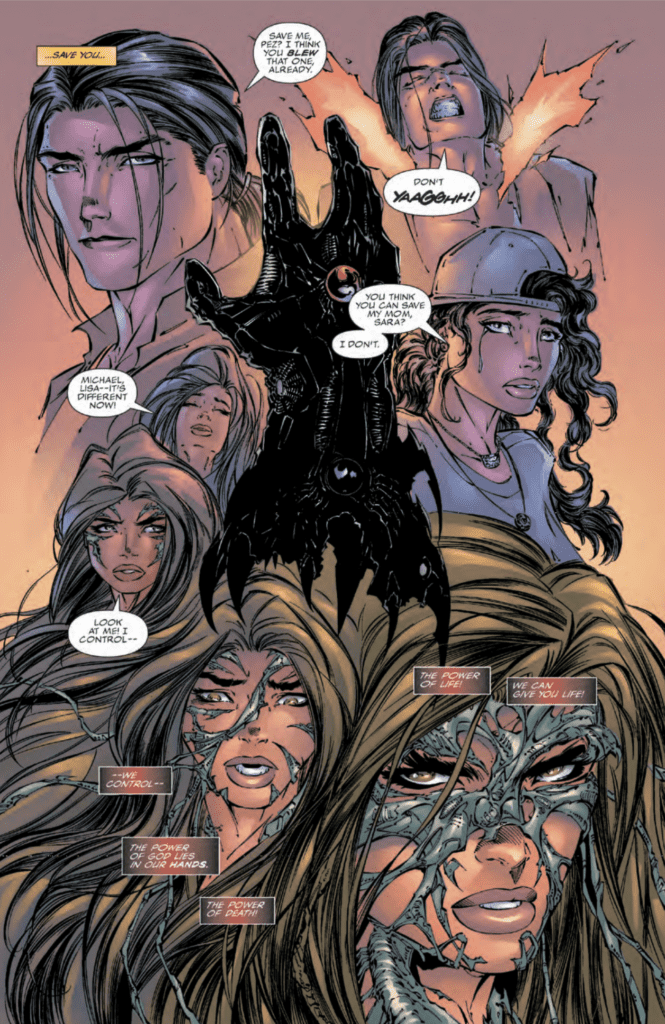
The time and detail it must have taken to draw the Witchblade armor is impressive. The armor is a cross between alien and demonic, with copious amounts of claw-like edges and appendages. Even on Pezzini’s slim frame, the armor is both impressive and imposing.

There’s one area in the art that may not work for you, depending on your taste. The artist’s really, really, really want Sara Pezzini to dress as skimpily as possible or be naked as much as possible, to the point of absurdity. When the Witchblade activates, it feels the need to shred almost every bit of Pezzini’s clothing. You could argue it’s very consistent with the style of the ’90s, but you could also see how this volume would be Exhibit A in the male gaze argument.

Review: THE COMPLETE WITCHBLADE, VOL. 1 Is 90's Action At Its Best

Coloring

The artists succeeded in an equally stellar job coloring this volume. When you consider the ultra-high level of detail, it must have taken a massive amount of effort to color within the lines. However, what stands out most is a small coloring choice in the super-criminal costumes. The artists combined deep red and gold in either the costume trim or an accessory. It’s not overt, but the subtle highlight of color gives the costumes a regal quality that makes the criminals seem more imposing.

Lettering

Even the action boxes and inner monologue boxes have exceptional detail in this volume. Rather than separating voices with different fonts or different box shapes, the letterers keep voices separate with distinct font and fill colors in each box. It’s a lot of work and color, but it pays off artistically. The Witchblade’s voice (Yes, it talks!) has a mood and tenor due to the color choices, and that gives every word emotional impact.

Conclusion

THE COMPLETE WITCHBLADE, VOL. 1, is a prime example of Image Comics at its creative height. The story is wholly original, and the art team’s output is awe-inspiring. If you’re not put off by the VERY 90’s aesthetic and salacious costume choices, this collection is worth your time.


Author’s Note: Local Comic Shops (LCS) are going through a tough time right now with the pandemic outbreak of COVID-19. Comics fans of every flavor that care about his or her LCS should try to do what they can. So, here’s my part:

If you’re in Northern Delaware, South East Pennsylvania, or Southern New Jersey area, please take a moment to visit Captain Blue Hen Comics in Newark, DE. Say ‘hi,’ pick up a book, order a book (they’re on Comichub.com), and let them know you support them.

If you’re nowhere near that area, please find YOUR LCS using Comic Shop Locator and lend your support.

Thanks, and stay safe.

Monkeys Fighting Robots Youtube

Maestro Hulk Origin Coming From Peter David, Dale Keown

Hulk Maestro

Longtime Hulk fans may remember one unsolved mystery from the classic storyline Future Imperfect: What is the secret origin of the character called Maestro? Now, after 30 years, the answer is about to be revealed.

With the current Immortal Hulk series going strong, and with the character’s newfound popularity courtesy of the MCU, Marvel has chosen to return to Future Imperfect. Writer Peter David — recently seen in Marvel Comics #1000 — will team with artists Dale Keown and Germán Peralta to finally tell the untold story.

David says,

“I had no idea that when I first created the Maestro for Future Imperfect, that he would have the kind of popularity and staying power he has now. Until now, I’ve only been able to allude to his origins, so I was thrilled to have the opportunity to explore them in this series, and I can’t wait for fans to see all the artwork that’s been coming in!”

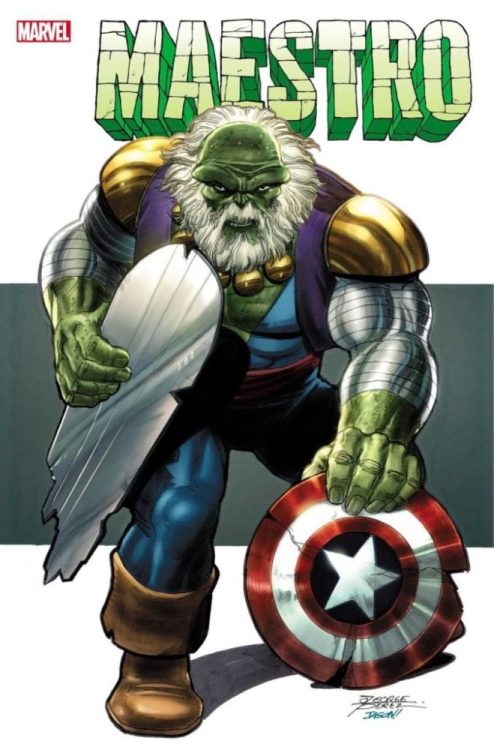
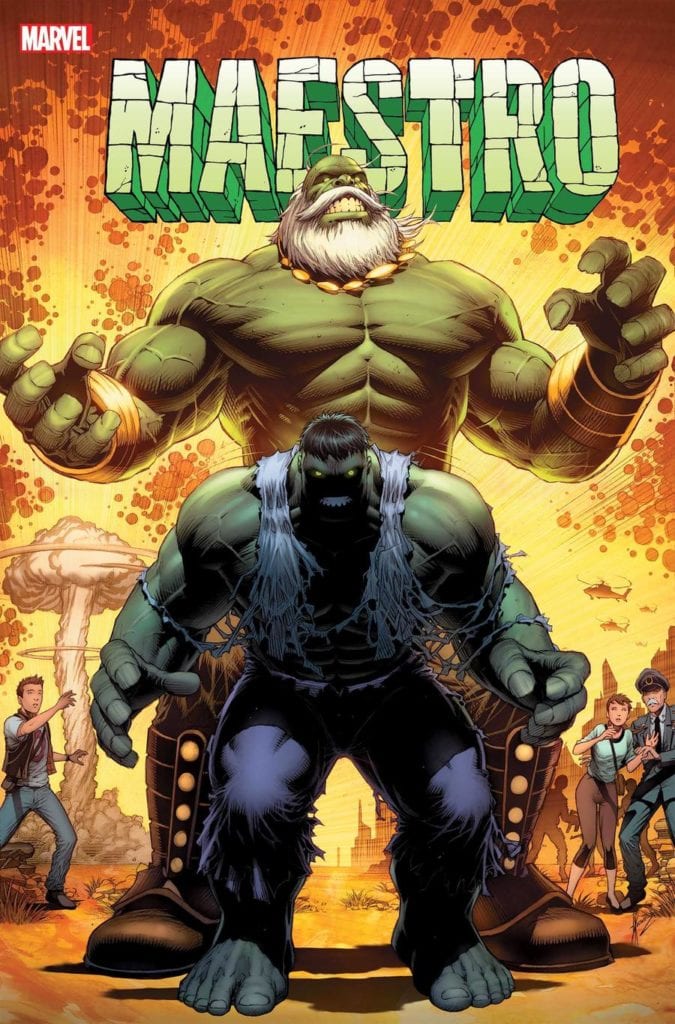
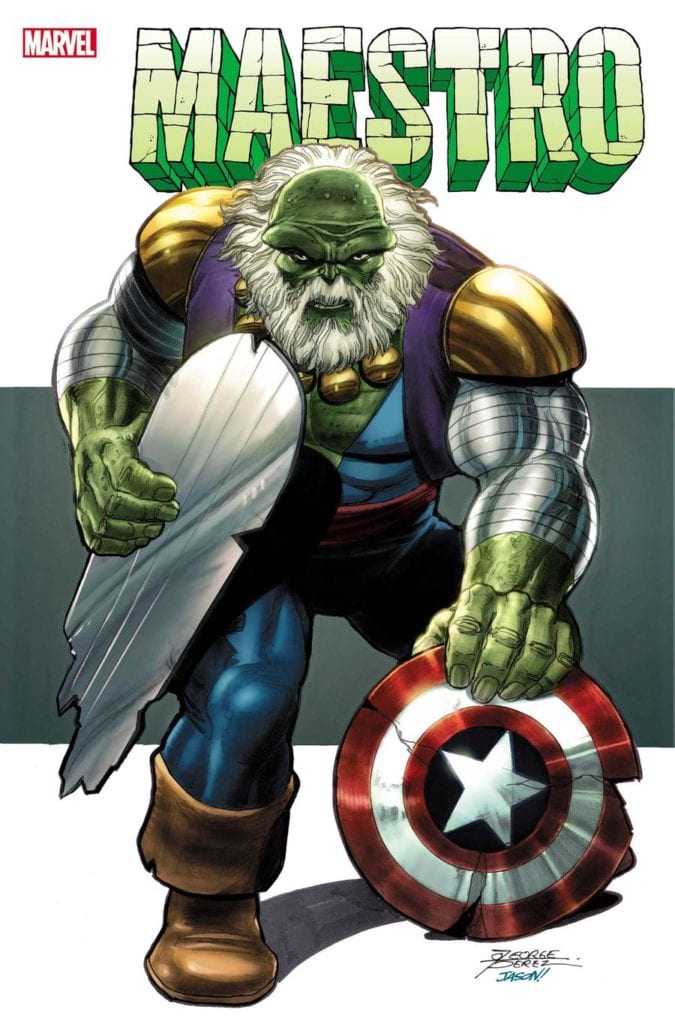
The official description is below, along with the main cover and variant cover by George Perez.

The Earth will tremble under his jade fist! Almost 30 years after the landmark story FUTURE IMPERFECT, legendary INCREDIBLE HULK scribe Peter David returns to the far-future version of the Hulk known as Maestro – the master of what remains of the world.  With astounding art from HULK veteran Dale Keown and rising star Germán Peralta, MAESTRO will answer questions that have haunted Hulk fans for years – and inspire some new ones along the way.

Hulk Maestro

Hulk Maestro

You can head over to Marvel for the full press release. Maestro #1 crashes into comic stores this August.

Monkeys Fighting Robots Youtube