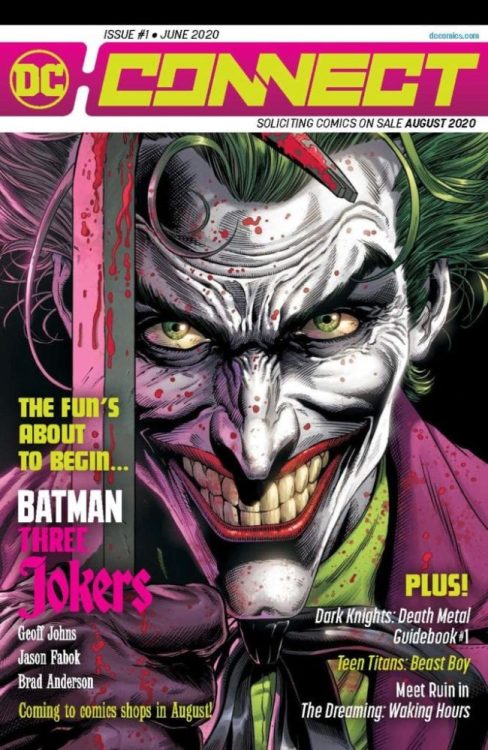
DC is rolling out a new digital product catalog called DC Connect, the publisher announced today. Connect will be the new, online version of the DC Previews catalog, which was found in comic stores. The first issue cover is already teeing up one of DC’s big books of the year: Three Jokers.
Check out the official description and images below:
DC ANNOUNCES DC CONNECT, AN ALL-NEW MONTHLY CATALOG
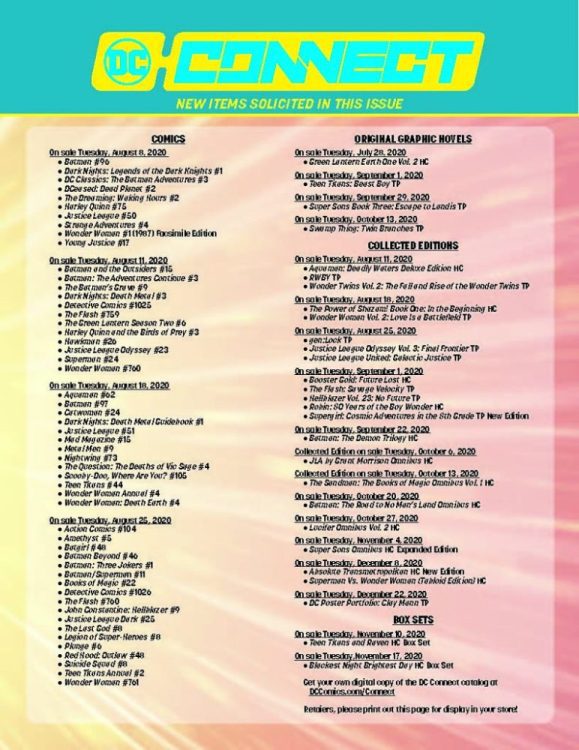
DC is pleased to introduce DC Connect, the new catalog of what’s coming from DC publishing each month! This downloadable, digital-only catalog features solicitation information for DC’s comic books, original graphic novels, collected editions, and collectibles—and that’s just the start!
In the coming months DC Connect will update and evolve in order to maximize the advantages of its digital format. Future issues will include expanded content, featuring talent interviews, preview pages from upcoming stories, behind-the-scenes looks at projects in development, multimedia content, and more! The catalog will also have a new look and layout compared to its predecessor, DC Previews, making it more engaging and easier to get the latest intel on current and future DC comic book projects.
Here’s a look at the debut cover to DC Connect, featuring stunning artwork by Jason Fabok and Brad Anderson for the highly anticipated miniseries Batman: Three Jokers, launching Tuesday, August 25. To learn more about the titles that are on sale in August, download the full PDF now from www.dccomics.com/connect.
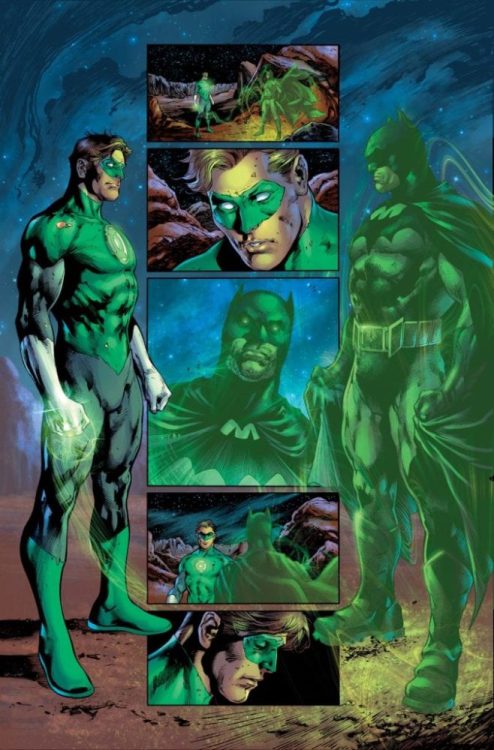
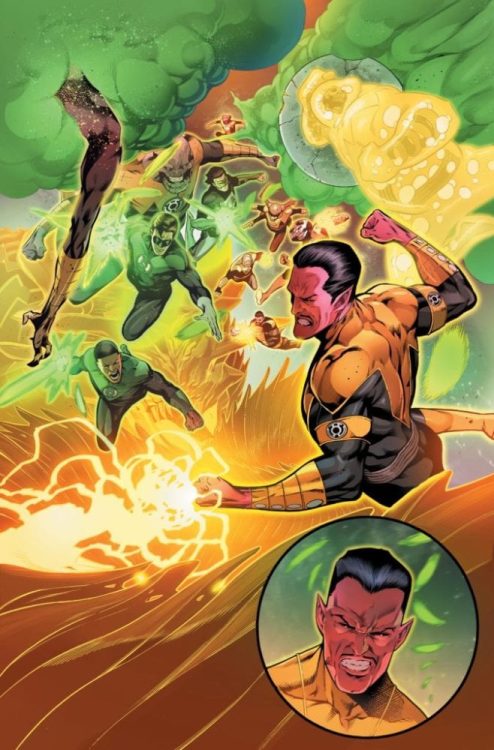
DC Comics has released some preview pages from the upcoming Green Lantern 80th Anniversary issue, including a reunion of Geoff Johns and Ivan Reis from their epic run in the earlier 2000s. Between this, the monthly title by Grant Morrison and Liam Sharp, and The Far Sector, it’s a great time to be a GL fan.
Check out the official story descriptions and pages below:
“BEWARE MY POWER!”
Your DC “First Look” at Pages from the Green Lantern 80th Anniversary 100-Page Super Spectacular #1
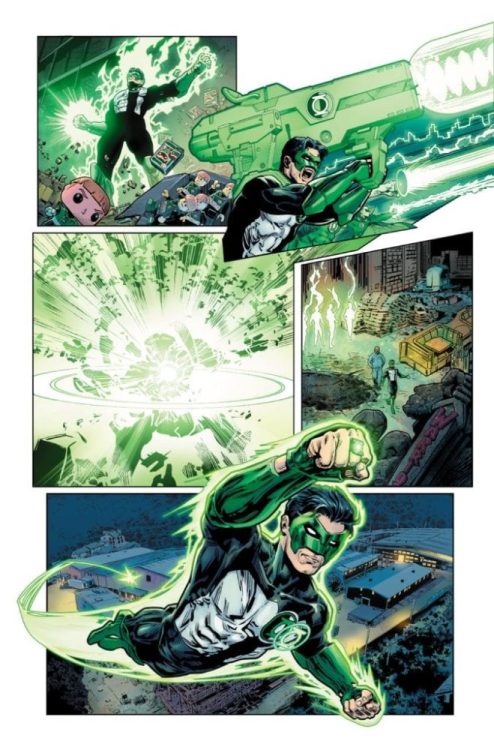
On June 23, join DC in celebrating eight decades of intergalactic justice and peacekeeping with the Green Lantern 80th Anniversary 100-Page Super Spectacular #1. You’ve already seen the incredible decade variant covers depicting the Green Lantern Corps across 80 years; here’s your first look at some of the awesome stories that make up this must-have collectors’ item:
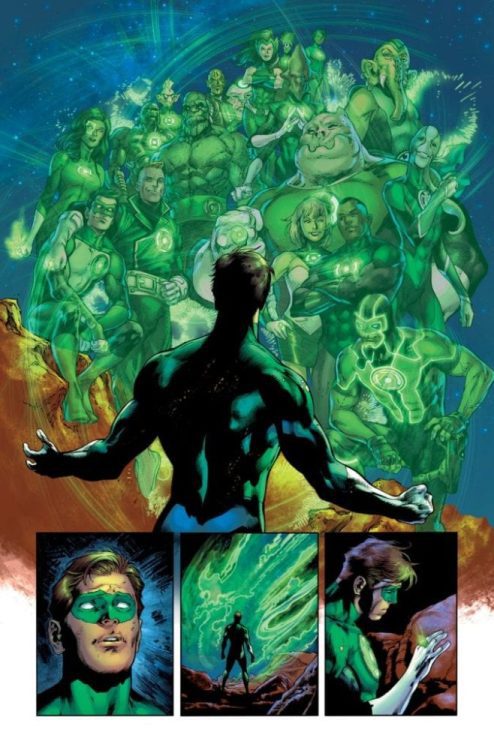
“Last Will,” by Geoff Johns and Ivan Reis
The team that brought you Sinestro Corps War and Blackest Night reunites to deliver one more story featuring the Emerald Warrior. Hal Jordan crashes onto an unknown planet with only enough power in his ring to send three messages out.
“Legacy,” by Ron Marz and Darryl Banks
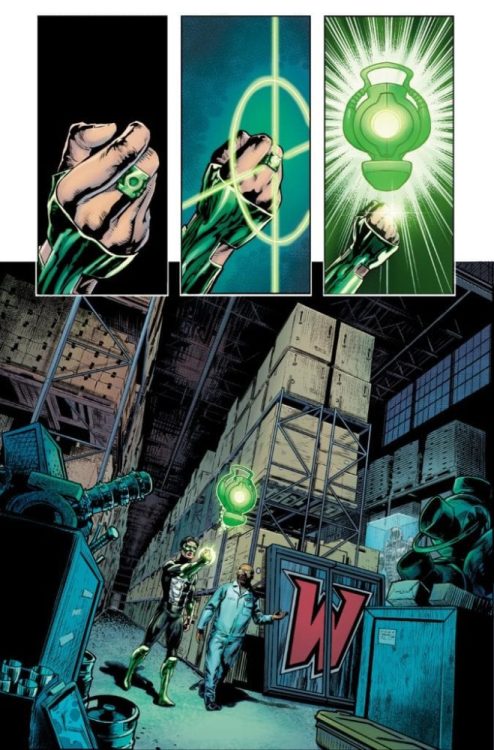
The co-creators of Kyle Rayner return to tell another adventure with the Torchbearer. Kyle travels to New York to grab a few things from the old Warriors location in storage, but he finds that not everything Guy Gardner displayed in his bar was totally safe.
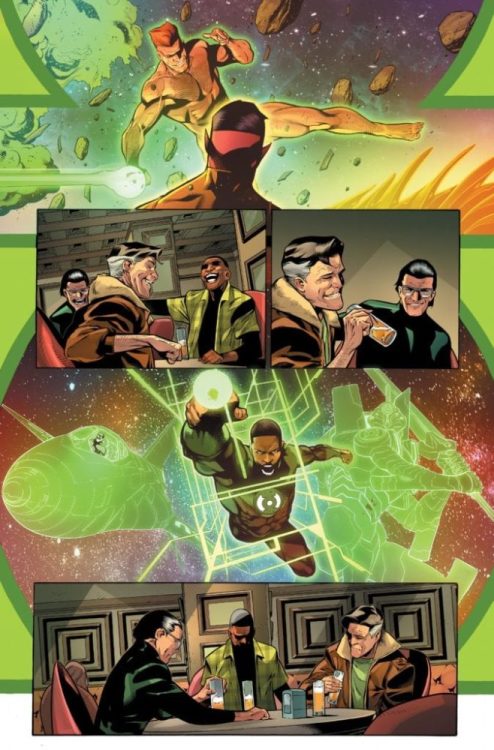
“Four,” by Robert Venditti and Rafa Sandoval
The team that brought you Hal Jordan and the Green Lantern Corps power up again for one more tale with the 4 Corpsmen. Hal Jordan, John Stewart, and Kyle Rayner reunite to reminisce and tell old war stories, but where’s Guy Gardner?
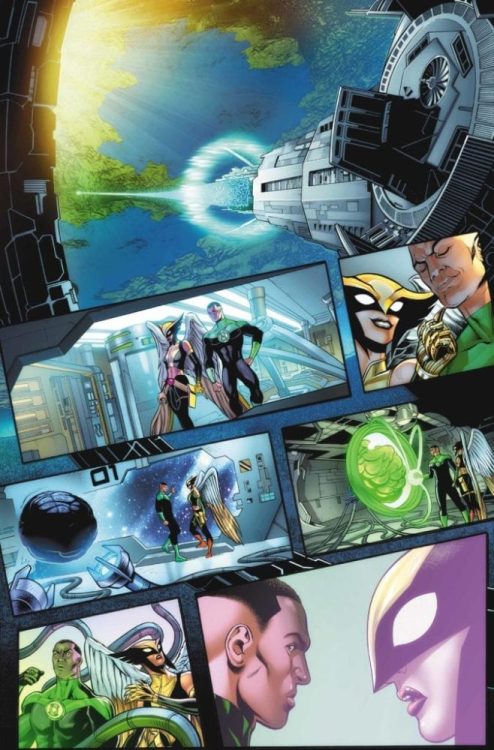
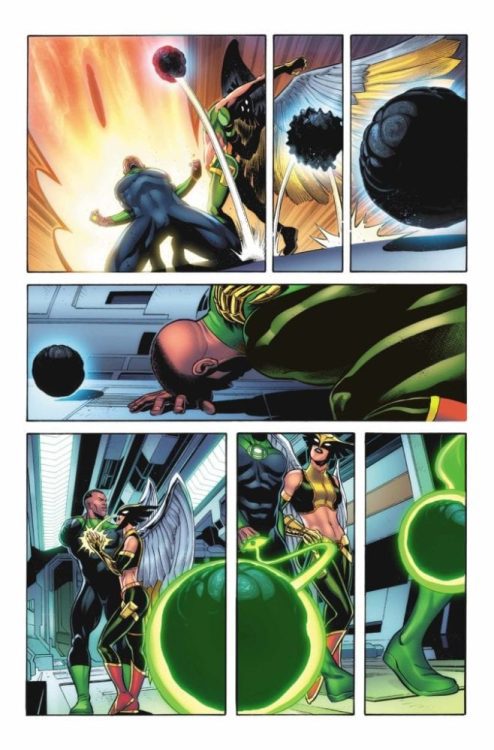
“Reverse The Polarity,” by Charlotte (Fullerton) McDuffie and ChrisCross
In a story that should pluck the heartstrings of any Justice League Unlimited fan, Charlotte (Fullerton) McDuffie and ChrisCross team up for an adventure featuring John Stewart and Hawkgirl. In this sweet tribute to the late Dwayne McDuffie. John and Kendra are trapped in the Watchtower by Dr. Polaris after her takes control of a mysterious element that enhances his powers.
The book also features Green Lantern tales from other celebrated talents, including Peter J. Tomasi/Fernando Pasarin, Denny O’Neil/Mike Grell, Sina Grace/Ramon Villalobos, Mariko Tamaki/Mirka Andolfo and Cullen Bunn/Doug Mahnke. A renowned collection of artists has also contributed tribute art recognizing the legacy of the Green Lantern Corps, including Far Sector artist Jamal Campbell, Green Lantern: Legacy artist Andie Tong, Catwoman artist Joelle Jones with Jordie Bellaire, Batman: Dark Knight: The Golden Child artist Rafael Grampa, and others.
The Green Lantern 80th Anniversary 100-Page Super Spectacular #1 arrives in comic book stores open and operating and digitally on Tuesday, June 23, 2020 for $9.99.
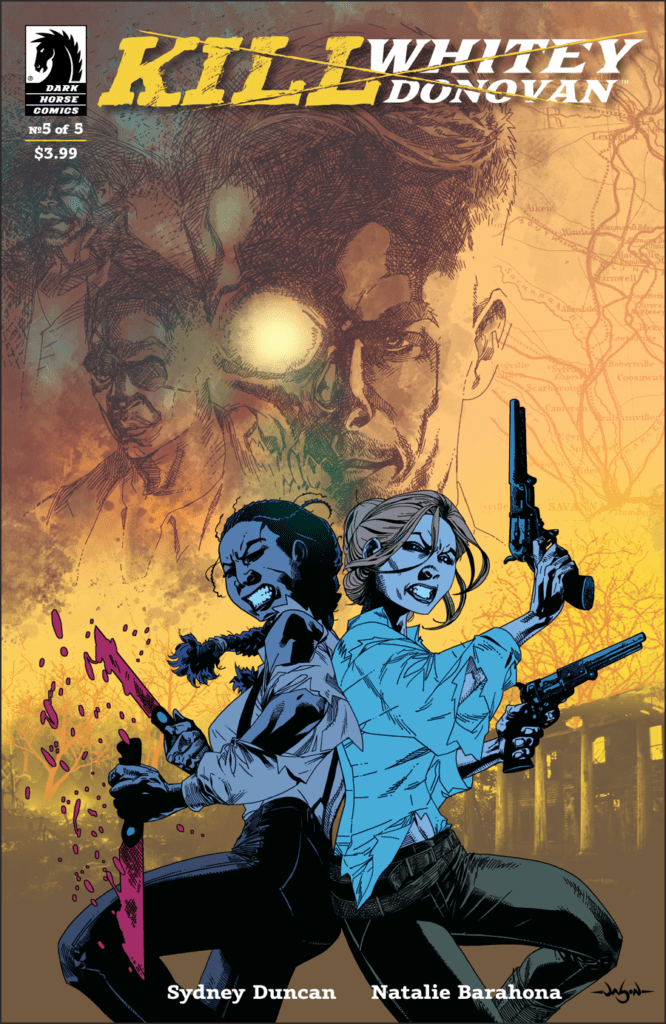
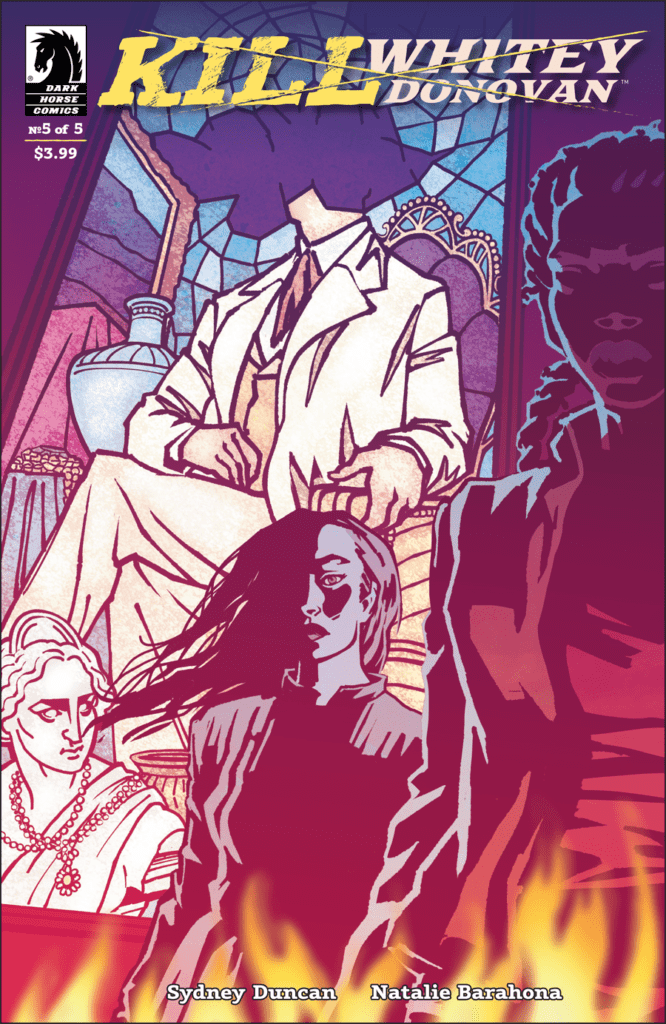
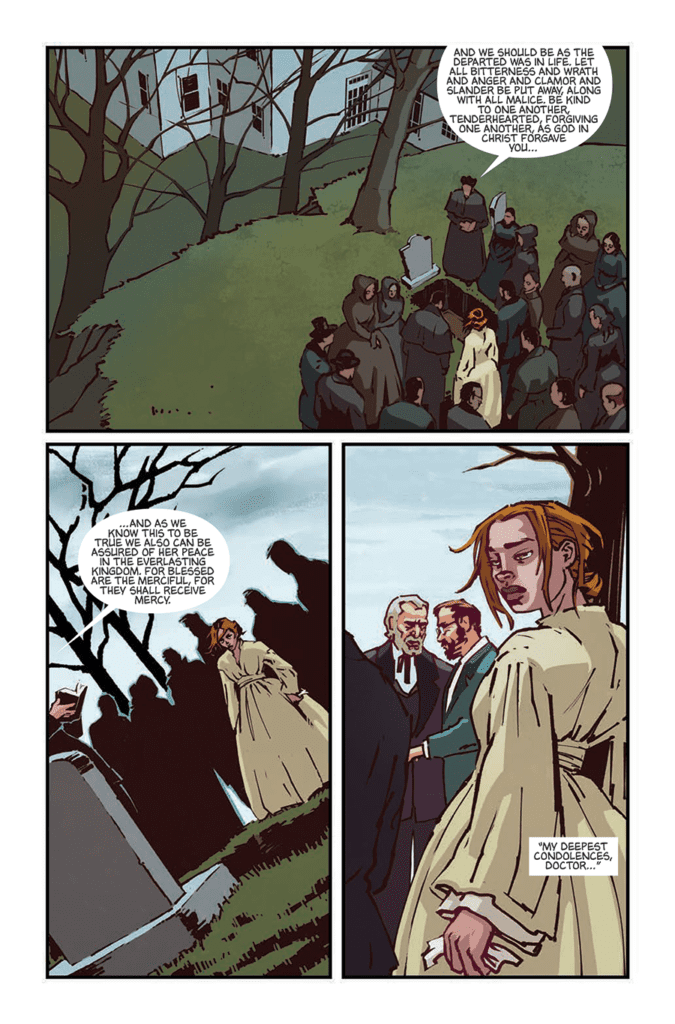
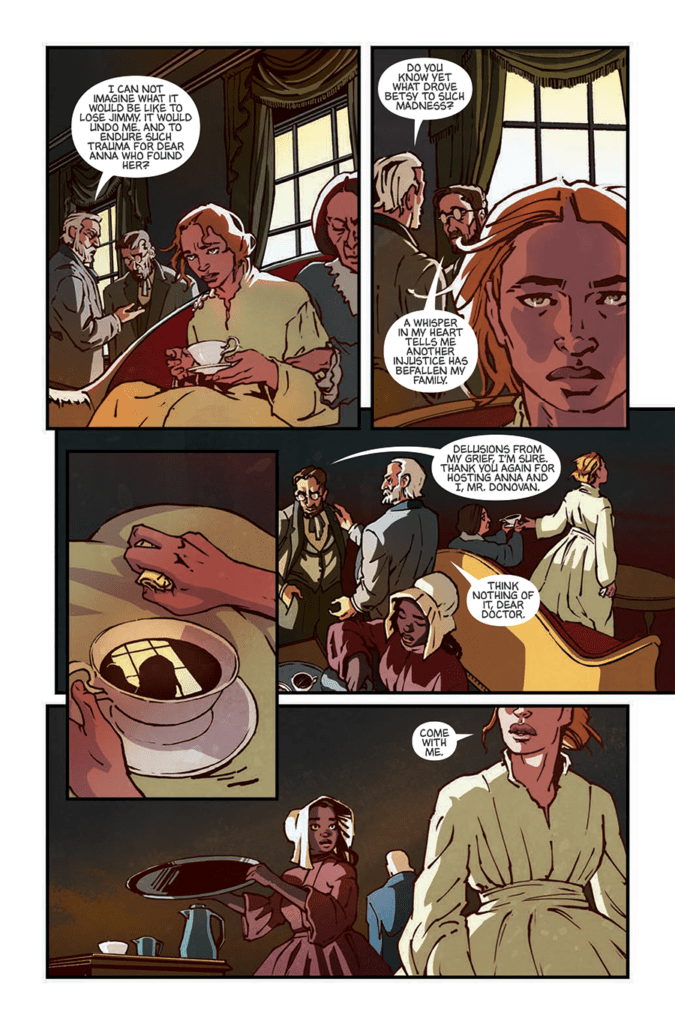
Writer Sydney Duncan and artist Natalie Barahona bring their Civil War-era quest for vengeance to a close with “Kill Whitey Donovan” #5. This final chapter raises the usual stakes and tension to an intense high and crafting the most intense conflicts in this mini-series thus far. It all ends in a state of brutal satisfaction with a promise of more retribution to come.
“As Atlanta burns around her, Anna finally tracks down and confronts ”Whitey” Donovan. But men like him aren’t easy prey, as she and Hattie will soon discover. Blood will be shed and their lives forever changed–all in the name of revenge.”
Writing & Plot
Sydney Duncan‘s intimate characterization and concise plotting throughout “Kill Whitey Donovan” culminate in a satisfyingly intense final issue. The plot that weaves from Anna and Hattie’s past explaining the journey they’ve taken and back to present creates the perfect emotional tension to end this revenge tale. The complexity of the relationship between the two leads, with Hattie being a slave and Anna the daughter of a slave-owning family, is never forgotten and continues to be an underlying pressure point in the plot. The backdrop of the American Civil War has been a brilliant atmospheric tool for the series that plants the reader firmly in the time period this comic takes place in. This is especially true for the finale, as Hattie and Anna face off against the man who took their lives from them while Atlanta is besieged by Union forces. The setup for the final conflict utilizes the facts and features from each character that have been detailed to craft a crowning moment that feels naturally focused while offering satisfying conclusions (?) for all characters involved. Duncan’s willingness to write scripts that make full use of comics as a visual medium creates stellar pacing and tension through this chapter’s climactic moments, especially in standoffs when all the cards are on the table. This is as fine an ending as any revenge story could ever hope for, and a fitting finale for the excellent character work in this mini-series.
Art Direction
For one last time, artist Natalie Barahona crafts a crisp and gorgeous visual experience for “Kill Whitey Donovan” in its final chapter. Her focus on character detail makes the protagonists easy to interface with as a reader while the villains are just as hateable and slimy as they should be. The gloomy, humid conditions of Civil War-era Georgia are met with the almost southern-gothic views of a burning Atlanta under by mortar fire. The stunning color choice not only fills in the details of the characters and environments, but saturates the story in a chaotic and opressive tone. The visuals of this series are rounded out by the crisp and concise lettering of Troy Peteri, whose more traditional font choice is cleverly varied with subtle changes in size and bolds to indicate volume and emphasis. Barahona’s ability to take Duncan’s script and turn it into such an intense and well-directed visual story is some of the best work of its kind in comics this year.
“Kill Whitey Donovan” #5 is a tension-filled, emotionally cathartic, and wholly satisfying end to this gripping mini-series. “Sydney Duncan’s script that focuses on the characters’ traumatic experiences and intense escapes finishes with a smart and rewarding bang. Natalie Barahona’s gorgeous and atmospheric artwork captures the audience in the story’s captivating final moments. This is a fitting ending to stellar comic, and one that may promise more on the horizon. Be sure to head to your local comic shop to grab this issue or pre-order the trade paperback!
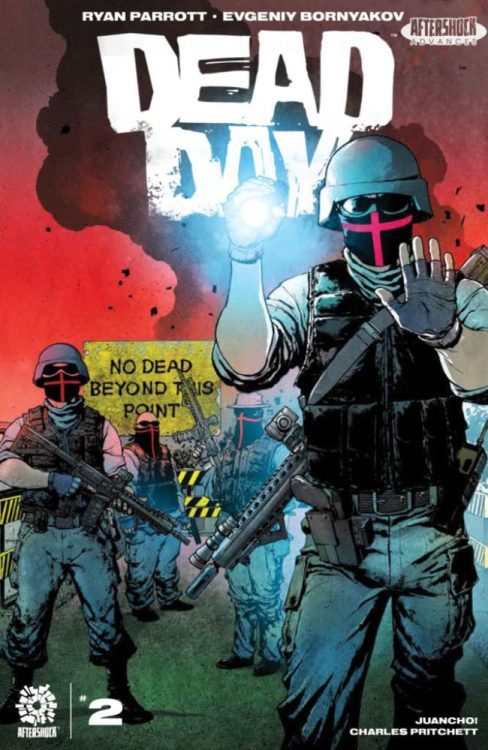
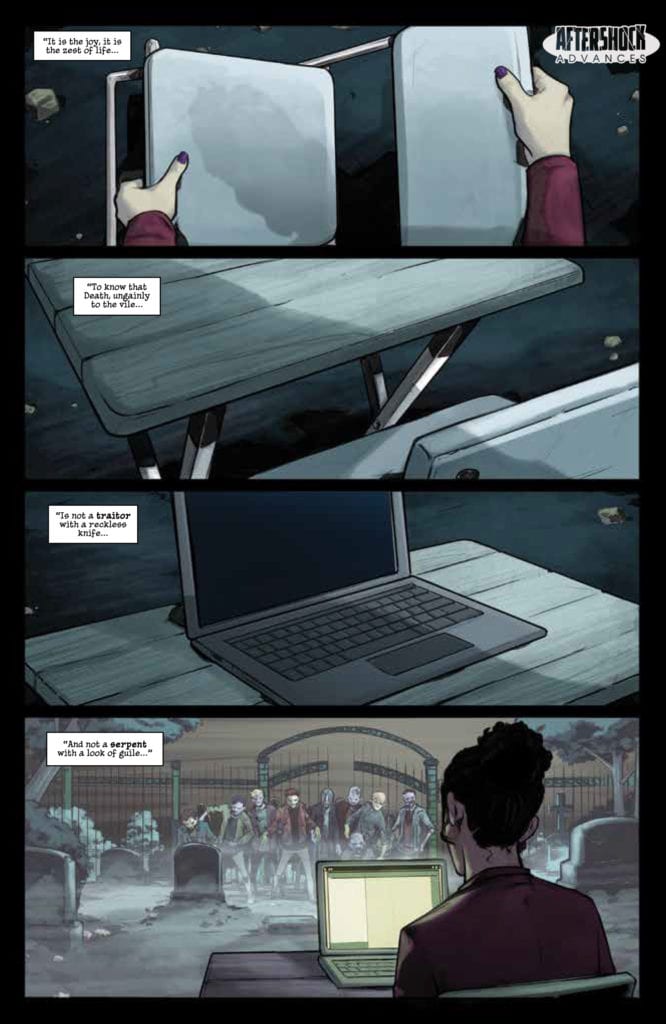
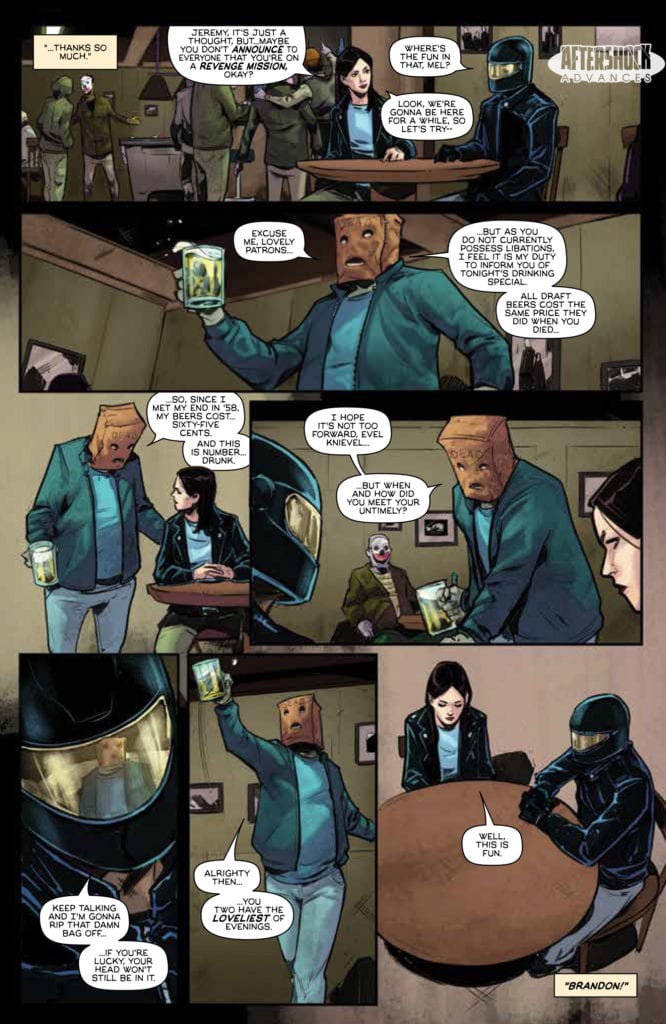
DEAD DAY #2 hits your local comic book store August 19th, but thanks to AfterShock Comics, Monkeys Fighting Robots has an exclusive four-page preview for you.
About the issue: As the dead begin to rise, Melissa follows a mysterious rider on a journey back into a life that could have been, and Brandon witnesses how both the faithful and faithless deal with the undead walking the earth.
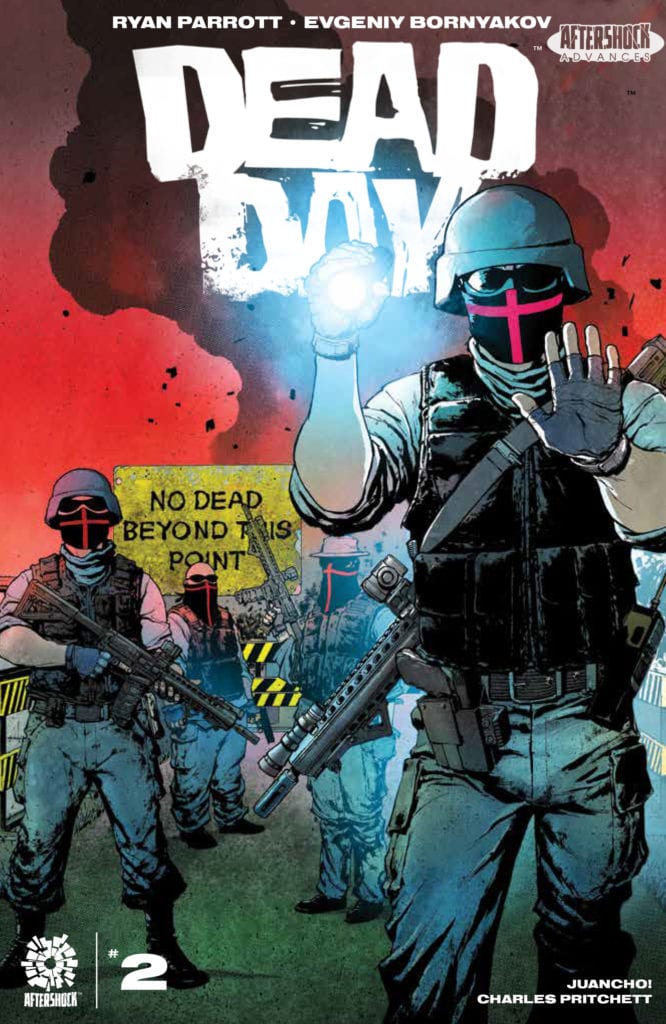
DEAD DAY #2 is by writer Ryan Parrott and artist Evgeniy Bornyakov, with colors by JUANCHO! and letters by Charles Pritchett. The main cover is by Andy Clarke with Jose Villarrubia.
The series is described as “an unnerving tale of existential horror with grave consequences.”
Check out the DEAD DAY #2 preview below:
Are you reading DEAD DAY from AfterShock Comics? Sound off in the comments!
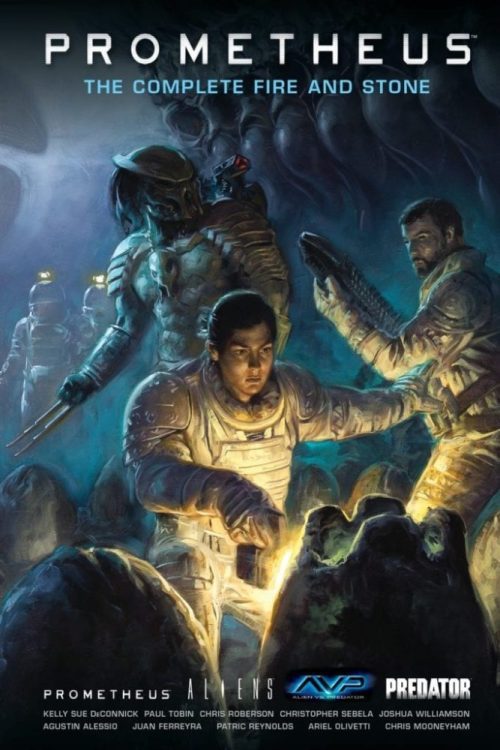
Prometheus: The Complete Fire and Stone is the big crossover event of Dark Horse’ Aliens vs. Predator universe. After the divisive introductions of the Prometheus movie, this series brings together different creative teams about an epic of obsession. With Ridley Scott’s films failing to meet expectations, Fire and Stone reuses the premise to do the concept justice.
Overall Story of Prometheus: Fire and Stone
Prometheus: Fire and Stone begins its epic with a salvage crew on the setting of the original movie, LV-223. The captain, Angela Hope, keeps from the crew that she intends to discover the events of the film. Coming off of YouTube Channel Wisecrack’s interpretation of Prometheus, however, such obsessions lead to disappointments. Yet that’s putting it mildly. As it turns out, a lot of people, including survivors from Aliens, also set up shop less than a century ago. And their lives turn for the worse as the actions of these people lead to the current cast’s predicaments. Just about everybody keeps crucial details (like Angela’s quest) to themselves, which leads to disastrous consequences. Most of which end up with people under attack by Xenomorphs.
The Flow of Themes
This cyclical nature outlines the themes of the respective franchise: from Prometheus come obsessions, leading to the brutal nature of Aliens, finishing with the need to overcome this brutality in Predator. Paul Tobin begins the series with how Captain Angela Foster’s obsession with learning the events of Prometheus leads her crew into danger. Chris Roberson meanwhile creates a prequel on Fire and Stone’s setting. One that sets up the conflict of the present by demonstrating how one character’s obsession melds with the setting.
All of which leads to the Predators as they clash with the Xenomorphs in Christopher Sebela’s story. Between all of the philosophical monologues by mutating cyborg Eldan, he pushes the climax of the series where the characters question their obsessions. The main Predator even gets the name Ahab in Joshua Williamson’s Predator run, referencing the conflict of Moby Dick. These obsessions could kill the rest of the cast despite becoming aware of their actions. All before going full circle with the Omega issue by Kelly Sue DeConnick, where the cast makes peace with their decisions, no longer burdened by their obsessions.
Artwork
The Prometheus Fire and Stone epic features many of the pencilers serve as inkers as well. This method allows for a myriad of detail. Juan Ferreyra in the Prometheus section, shows a photorealistic depiction almost looking like this is from the movie this series gets its title from. Patric Reynolds displays a more eerie style in the Aliens section with his depiction of the mountain base setting evoking feelings from the classic H.P. Lovecraft story At The Mountains of Madness. Ariel Olivetti employs more grotesque imagery in addition to the sleek details of the ship Alien vs. Predator takes place on. The fact Olivetti does the coloring with an airbrush shows the amount of detail into just Elden.
Chris Mooneyham’s art has a much rougher detail to display in Predator; the additional shading by John Lucas almost acts as an indicator of something hiding in the shadows to strike. Agustin Alessio finishes Prometheus Fire and Stone’s Omega issue with the photorealistic art, the grotesque imagery, the eerie, claustrophobic atmosphere while ditching rougher sides. Because with an ending about making peace even in the darkest place, who cares about potential actions?
Coloring
The above art styles are further accented by the numerous colorists. It is unknown how much of the coloring in Prometheus Fire and Stone is by Juan. By issue 2 onward, some of the tasks are shared with his brother Eduardo Ferreyra. Yet the cooperation between them goes into the depths of detail surrounding such a complex story. Especially with its equally vibrant setting. Aliens in the meantime gets its coloring by Dave Stewart, which between all of the shading highlights what it brings to all the other installments. This includes the cave notes in the mountain camp that the Prometheus cast likes to use as a reference. Dan Brown does something a little similar in Predator by highlighting the bright backgrounds against the darkened settings.
The rest of the series have their coloring by the penciler/inkers. The dedication these artists go to provide such detailed and elaborate artwork over the span of a few months is worthy of high praise. It’s practically comparable to the work of the late Frank Frazetta in his work with Conan the Barbarian. Each layer from the pencils, the inks, to color upon colors creates a fully realized image.
Lettering by Nate Piekos
The one constant throughout Prometheus The Complete Fire and Stone is Nate Piekos, the letterer. His presence and lettering ensure the reader that this entire epic stays connected. From the moment the Prometheus crew steps out the word balloons waste no time in displaying the scenery. Keeping dialog to a minimum allows for the really tense moments to move uninterrupted. For the bigger panels he has captions slow the reader down enough to fully embrace the artwork. If that’s not enough his ability to depict alien languages matches only with how he communicates with the creative teams. Because without their input, the Predator dialog would either be too short or too long to keep the reader focused.
Prometheus The Complete Fire and Stone is Epic
If Prometheus The Complete Fire and Stone was a movie, it would be the sequel that Alien Covenant failed to be. Continuing its themes of obsessive curiosities and its destructive aftermath, this entire event series does that theme justice. All by encompassing every thematic element from the franchises it shares a universe with. None of this would even be possible without the creative teams bouncing off each other the way they do. Unlike the movie studios’ getting in the way of what could be a great flick. It’s the communication between parties that make this series stand out.
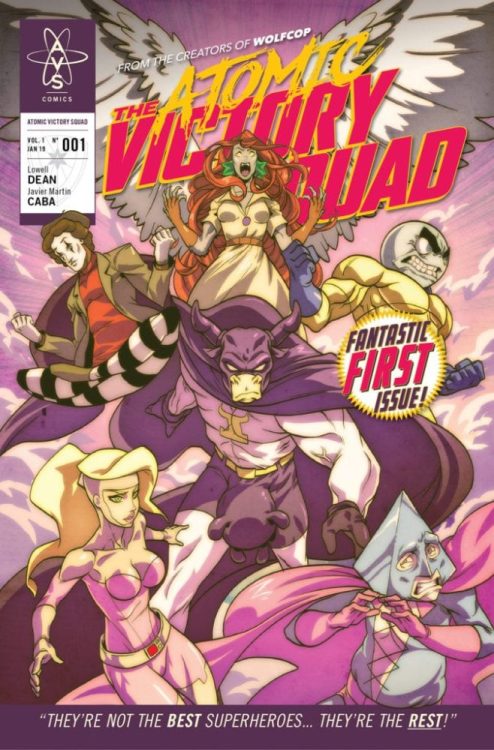
When earth’s greatest heroes die in The Atomic Victory Squad, all that’s left is a motley crew of obscure characters to save us; but can they?
This review covers The Atomic Victory Squad #1-4, written by Lowell Dean, director/creator of WolfCop. On art and colors is Javier Martin Caba, and Micah Myers on letters. As of the publication of this review, The Atomic Victory Squad #1 is on ComiXology, with the others soon to follow.
THE ATOMIC VICTORY SQUAD’S FORMATION
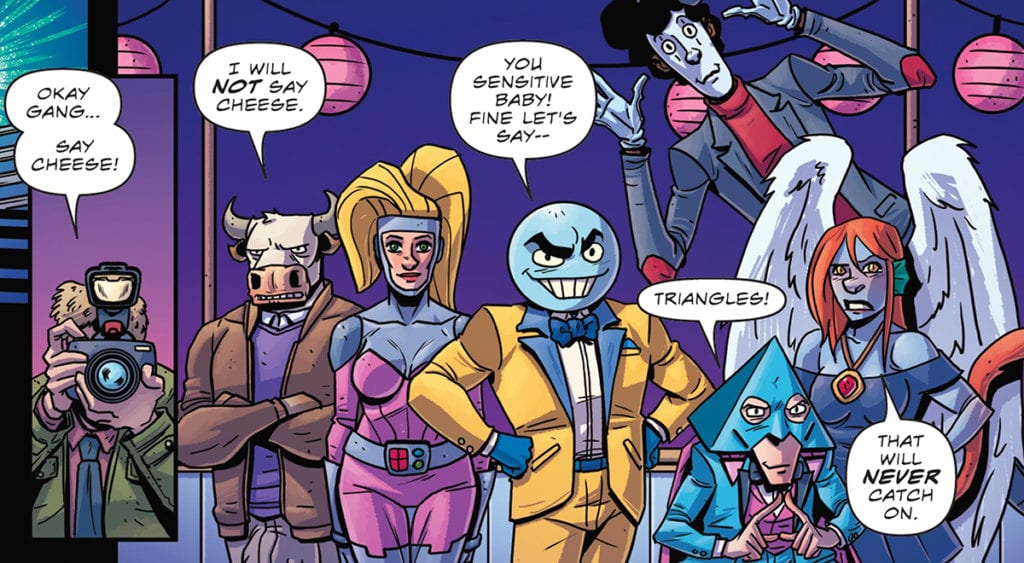
Dean uses the page count to his advantage by taking the four issues to flesh out the team. Granted, it seems that the origin story arc isn’t complete; the slow pace is nice. Instead of making it a quick-paced origin, Dean uses each issue to introduce you to the team. That’s The Atomic Victory Squad’s strength; it takes the time to make you root for the team. Yeah, some of the characters will annoy or piss you off from the get-go, but later on, you learn why they’re like that. You can tell this was the plan from the first issue, as Dean spends no time building up the old team. Instead, he kills them off so we can learn of the new team.
At first glance, The Atomic Victory Squad’s cover seems a bit cartoonish, especially the character designs which will have you thinking it may be for kids. However, don’t let the cover fool you because the inside is filled with drama, action, and themes more suitable for teenagers and up. Be that as it may, not all of these story elements pay off. These moments are a handful of jokes and humorous scenes. The Atomic Victory Squad does include some hilarious dialogue and some hijinks, yet it doesn’t always pay off. In a few cases the joke doesn’t hit the high notes as the others.
A family photo – Lowell Dean, Javier Martin Caba, and Micah Myers
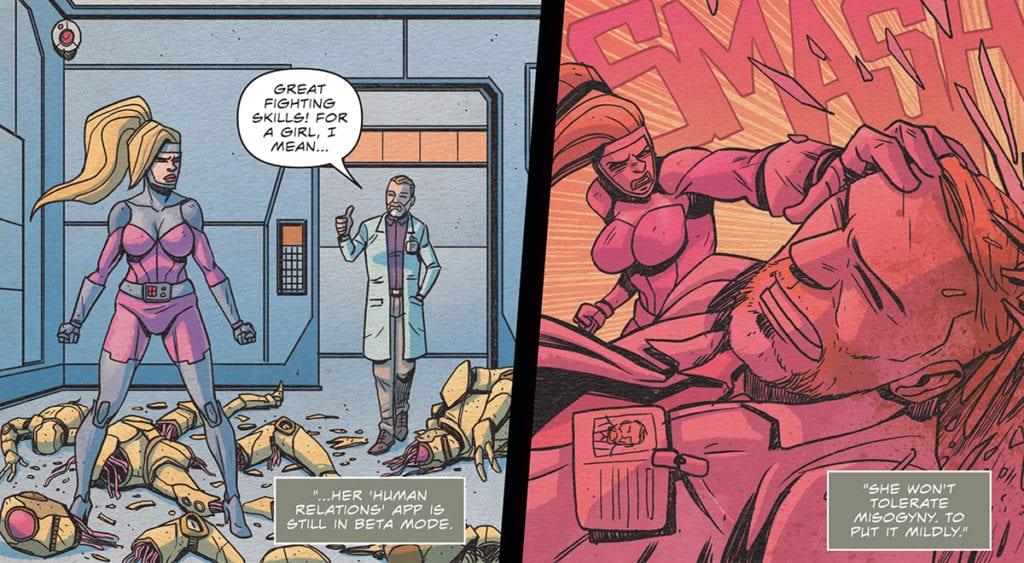
Yet, each character is endearing in their own manner. As The Atomic Victory Squad is Dean’s first steps in the comic writing game, there a few stumbles, but nothing that’ll kill your enjoyment.
THE CRAZY WORLD WE LIVE IN
Dean mentions a few times that this story has been living in his head since the ’80s. Included at the end of each issue are character designs he and others have created throughout the years. As great as those designs are, Caba’s art really brings them to life. The world at large in The Atomic Victory Squad isn’t ever fully shown, but the parts that are are quite interesting. Not only do humans inhabit the earth, but so do anthropomorphic animals and other oddities. However, Caba makes none of it look out of the normal. Instead, each design and background character seems like they belong.
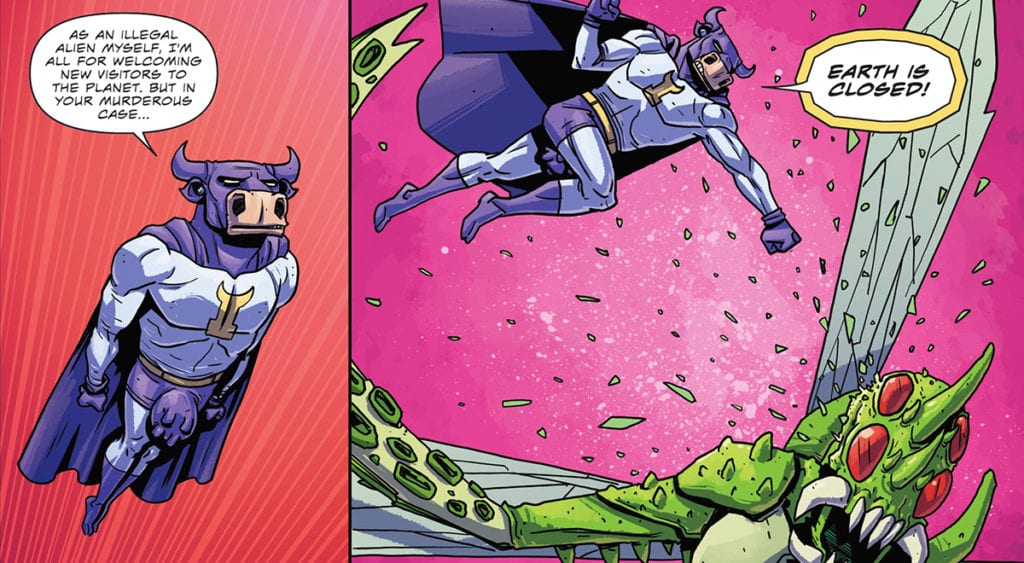
Yet, one of the funniest moments visually is when Invincibull’s (Alien Cow hero) planet is showcased. His planet, Cowtopia resembles earth, yet it has udders on it. The design makes absolutely no sense, but it matches the comic so well, and his hilarious to boot. Caba also handles colors, which he handles very well. The color palette throughout The Atomic Victory Squad matches the story’s tone. When the team starts to fight, the colors are bright, poppy and gives the scenes more emphasis. Nonetheless, when the scene transitions to a sneaking mission, the colors as well adapt.
Moooooove over Superman – Lowell Dean, Javier Martin Caba, and Micah Myers
MONSTER IS A BIG WORD
Much like Caba’s art helping tell the story, Myers’ lettering magnifies the scenes just as much. When the villain Ridando is introduced, its design is cool, but Myers’ lettering takes the introduction up a notch. Instead of having the villain use usual word balloons, Myers forgoes those and uses a huge gnarly looking font. Not only does that help set the villain apart, but it makes the creature even more terrifying. Howbeit, this doesn’t only apply to Ridando, as other characters often have unique fonts and colors.
Manners – Lowell Dean, Javier Martin Caba, and Micah Myers
THE FUTURE OF THE ATOMIC VICTORY SQUAD
While reading the four issues, I was often reminded of Axecop. If you didn’t know, Axecop was created by two brothers with the younger (aged 5) coming up with the ideas. It’s a fun, senseless ride at points, and that’s how Atomic Victory Squad feels. It makes sense as Dean started work on these when he was much younger in the ’80s. Yet, that’s what makes the first four issues a blast to read. At some points, it makes sense, while others it leaves you stunned, while still having fun. The origin stories of each character are fun to read, as well. Despite a few bumps, Atomic Victory Squad is a fun start to a new superhero team.
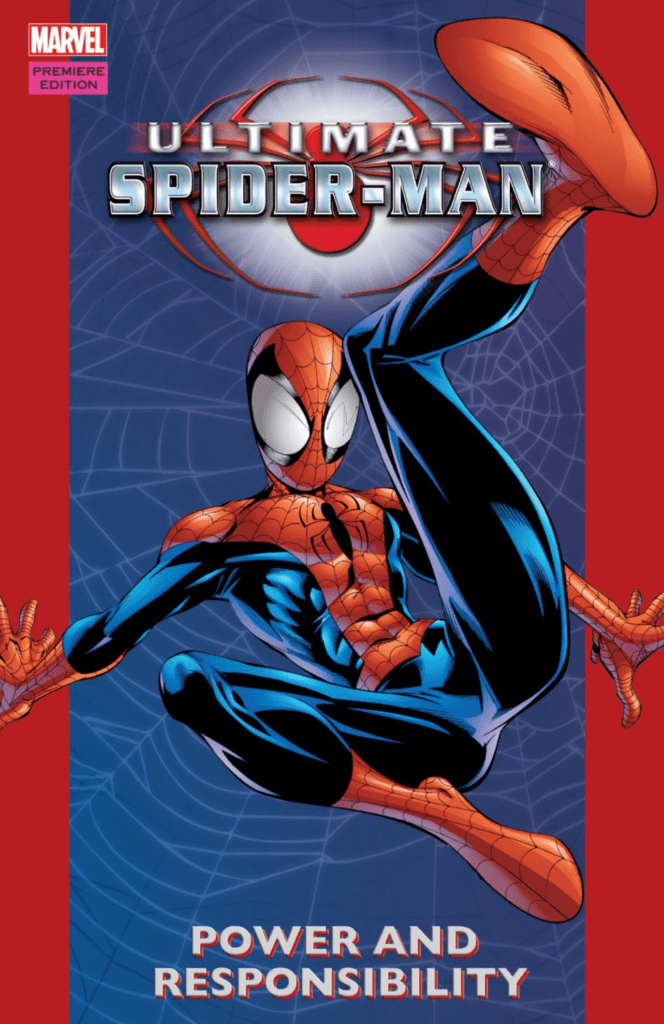
Twenty years after it’s initial launch, Ultimate Spider-Man Vol.1 continues to astound and show why this incarnation of the age-old character stood the test of time, while creating a myriad of media and spin-offs.
Ultimate Spider-Man Vol.1: Powers and Responsibility covers the first seven issues of the series. Beware of spoilers, and if you’re able to support your local comic book shop, pick a copy up there!
ULTIMATE SPIDER-MAN AND THE NEW ORIGIN
Before you even open Ultimate Spider-Man Vol.1, one colossal change rears its head; the origin story is seven issues. When compared to the original origin in Amazing Fantasy #15, that was only a few pages long. Nonetheless, this was nothing new with writer Brian Michael Bendis, who is known for being heavy with dialogue and taking his time. However, this extended origin was a smart move. Instead of trying to cram one issue full of backstory, Bendis is able to expand it throughout seven. The slow speed does work for some parts, but others feel like they drag on, yet nothing too bad.
Brian Michael Bendis, Mark Bagley, Art Thibert, Dan Panosian, Steve Buccellato, Marie Javins, Colorgraphix, Transparency Digital, Richard Starkings, Comicraft
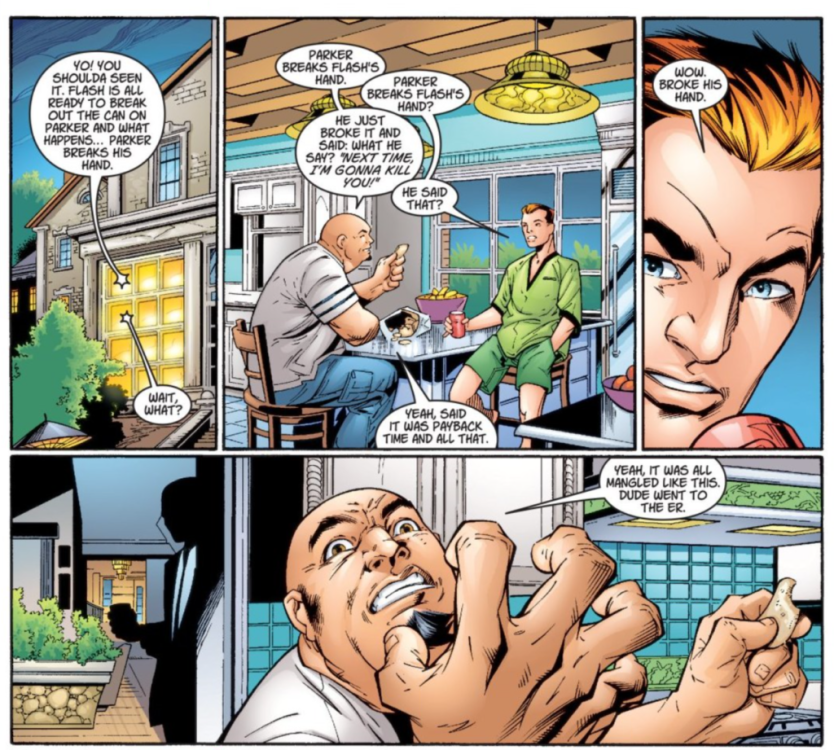
Bendis takes Spider-Man and gives him a more modern setting. Albeit, it released 20 years ago, some of the elements still relate to teenagers. By having the opportunity to expand the origin to multiple issues, he is able to focus on the everyday life of Peter Parker before and after the spider bite. This extra page count is both Ultimate Spider-Man VOL.1’s strength and weakness. At times it feels as if Bendis is working towards a word count instead of letting parts breathe. Sadly, this isn’t anything new with him, as he tends to get wordy in some of his works. However, this does lead to one of the story’s strengths—its characters.
Not only does Bendis write an amazing Peter and Spider-Man, but the other character’s voices just as well. Sometimes with teenager centric stories the characters feel like they are trying to hard to be young and “hip”. However, the characters in Ultimate Spider-Man VOL.1 don’t feel as such. Instead, they feel organic, especially for the Spider-Man persona that is just starting out.
ULTIMATE ORIGIN, ULTIMATE ART
Helping bring the new origin to life is Mark Bagley on art, with Art Thibert and Dan Panosian inking. Bagley went over 100 issues on art duty throughout Ultimate Spider-Man’s history, so it’s nice to look back at his first few. Bagley’s style melds nicely with the modern tone the team set out for, but at times his faces seem off. The amount of medium and close shots the team employs doesn’t help this weakness either. However, when Bagley hits his stride, it’s fantastic.
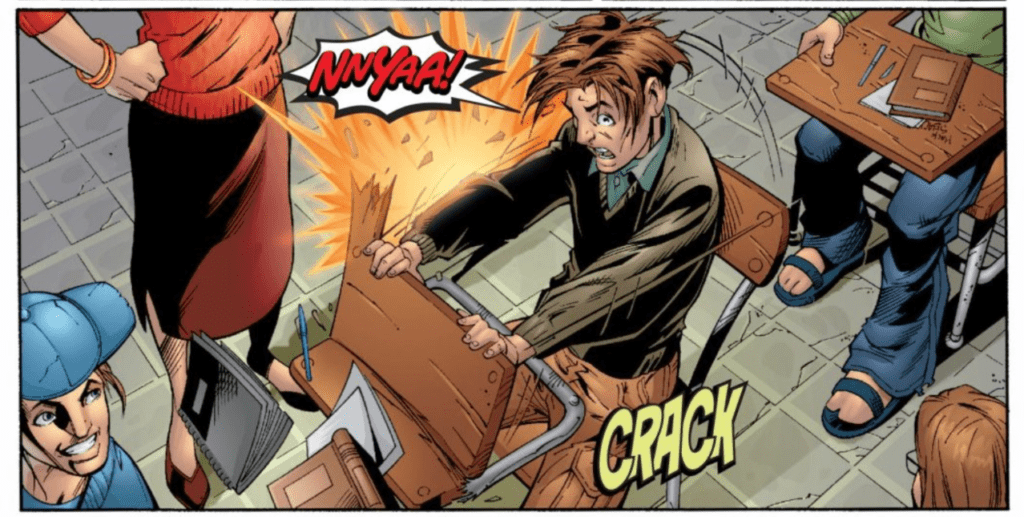
Contained within Ultimate Spider-Man Vol.1 are some iconic Spider-Man poses and some that would later become iconic. Not only that, since it was a new universe started from scratch, some designs got changed. Spider-Man’s suit wasn’t changed too much, yet the biggest change was Green Goblin. Instead of being a man in a suit, Green Goblin becomes a seven-foot-tall monster that’s extremely intimidating. This change at first might surprise you, – which it should with it being a new universe – but it works amazingly storywise.
The ink jobs by Thibert and Panosian work well throughout the series. The shade they add to Green Goblin’s muscles when he is introduces, makes him seem that much more terrifying. Yet, their inks sadly don’t help the obscure faces in some scenes. Nonetheless, their collaboration helps in most moments.
Brian Michael Bendis, Mark Bagley, Art Thibert, Dan Panosian, Steve Buccellato, Marie Javins, Colorgraphix, Transparency Digital, Richard Starkings, Comicraft
A COLORFUL NEW START
During the seven issues, colors are handled by Steve Buccellato, Marie Javins, Colorgraphix, and Transparency Digital. Having this many colorists working on the origin story seems like, at times, it would be a noticeable change, but that doesn’t transpire. Instead, the colors stay consistent with each other while helping the art. Spider-Man’s suit is bright and popping, making it fly off the page, especially compared to the other colors. For the most part, Ultimate Spider-Man Vol.1 feels grounded with the art and the colors helping. Yet, when it comes to Richard Starkings and Comicraft’s lettering, it’s a different story.
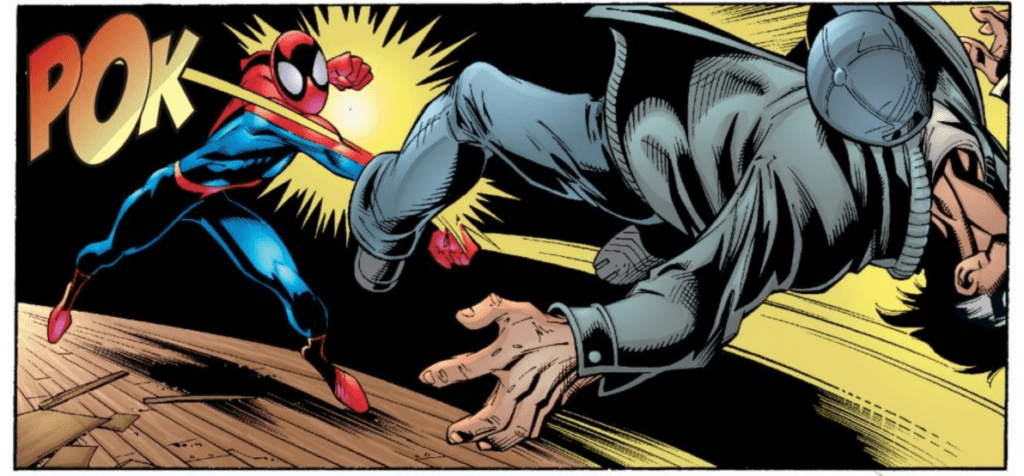
Whereas the art and colors have a more grounded feel, the sound effects feel as much as a comic as they come. Starkings and Comicraft make sure they are big, loud, and in your face. These sound effects give the panel an oomph that helps the action sound that much louder.
Brian Michael Bendis, Mark Bagley, Art Thibert, Dan Panosian, Steve Buccellato, Marie Javins, Colorgraphix, Transparency Digital, Richard Starkings, Comicraft
THE BEGINNING OF SOMETHING NEW
At times Ultimate Spider-Man Vol. 1 shows its age, but that’s to be expected. Be that as it may, it’s still an amazing jumping-on point for those that want to read about Spider-Man. Not only is it a well-updated origin, but it was a comic that inspired further Spider-Man media while making a fan of many at the time.
Brian Michael Bendis, Mark Bagley, Art Thibert, Dan Panosian, Steve Buccellato, Marie Javins, Colorgraphix, Transparency Digital, Richard Starkings, Comicraft
EVERYONE REMEMBERS THEIR FIRST
One of the reasons I wanted to look back at Ultimate Spider-Man Vol.1 was because this trade paperback (TPB) holds a special place in my heart. As the header indicates, it was my first. Not my first comic, but the first TPB I owned, which I received as a gift from my Grandma. I read it so many times as a kid; I had to tape the spine because it was falling apart. It finally met its demise at the hands of a kid. Alas, nothing lasts forever. With that in mind, what was your first trade?
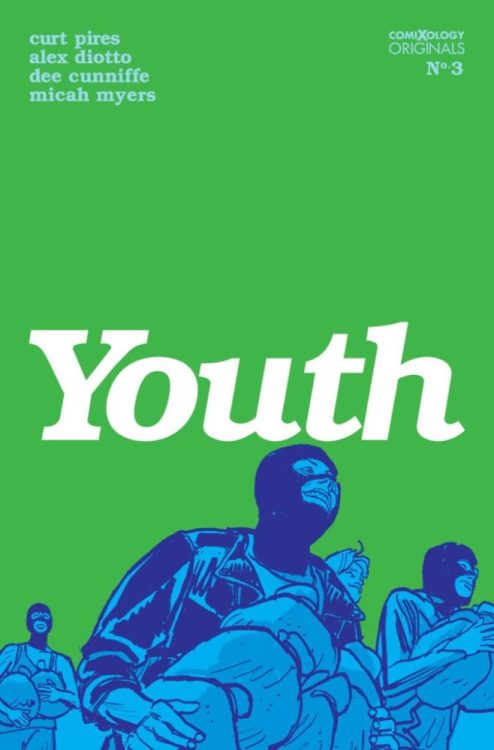
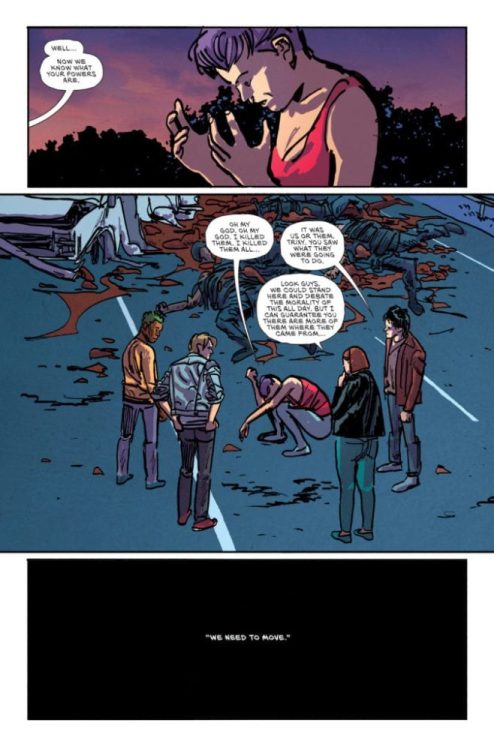
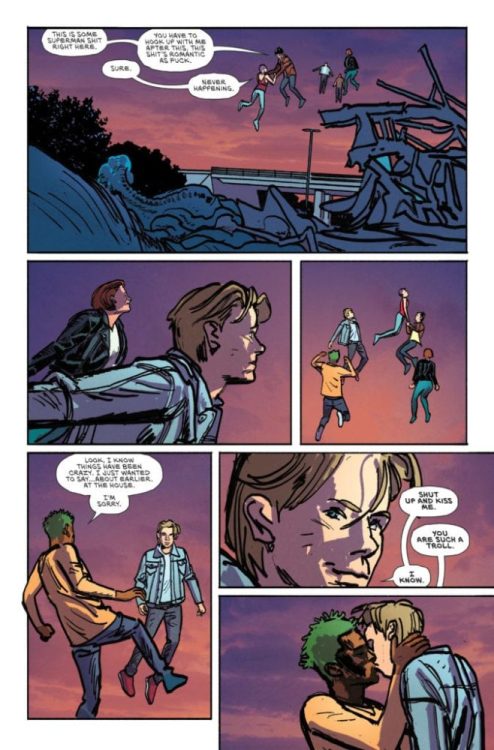
Youth #3 (of 4) hits comiXology on May 26, but thanks to the publisher, Monkeys Fighting Robots has an exclusive four-page preview. In issue three, the kids decide to rob a bank. What could possibly go wrong?
The ComiXology Originals series is written by Curt Pires, with art by Alex Diotto, Dee Cunniffe drops the colors, and you will read Micah Myers’ letters.
About the Youth: YOUTH is a coming of age story that tells the story of two queer teenagers as they run away from their lives in a bigoted small town, and attempt to make their way to California. Along the way, their car breaks down, and they join up with a group of fellow misfits on the road. Embarking together in a van traveling the country, they party and attempt to find themselves. And then something happens… YOUTH is Larry Clark’s KIDS meets CHRONICLE. X MEN by way of FRANK OCEAN. It smashes together the violence of coming of age with the violence of the superhero narrative–as well as the beauty.
Check out the YOUTH #3 preview below:
What comiXology Originals books are you reading? Comment below with your thoughts.
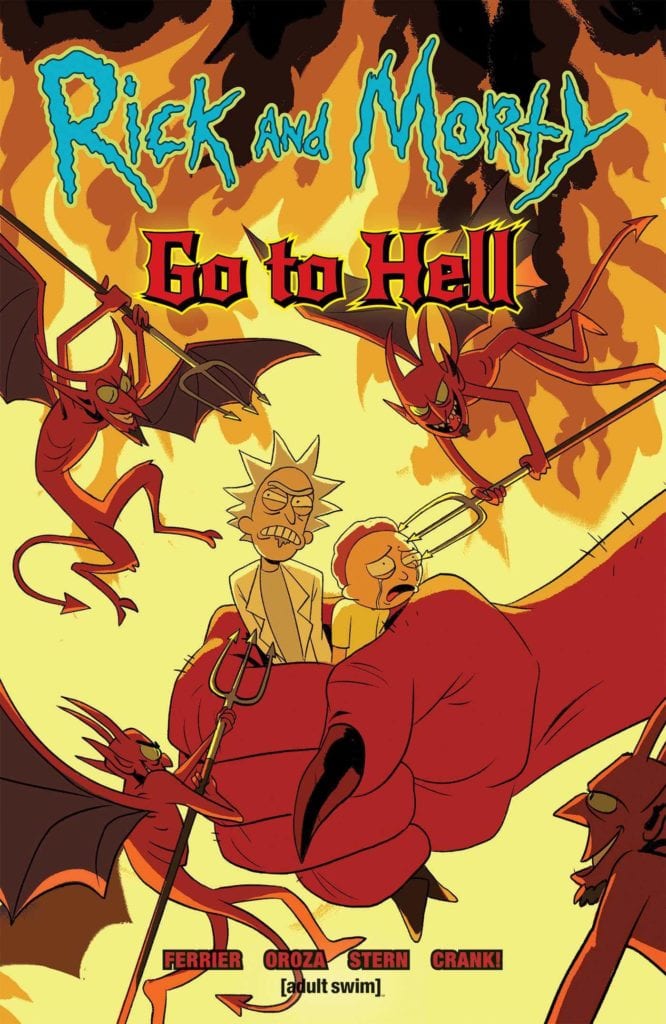
Since its premiere in December of 2013, Rick and Morty have grown into one of, if not the biggest shows Adult Swim had ever aired. To the five people who might not know the story, it follows Rick Sanchez and his grandson Morty as they travel across different realities and planets in raunchy comedic adventures. Due to this aspect of going to different realities, it allows the characters to cover various styles of adventures. From fighting aliens to traversing giant kingdoms, the adventures of Rick and Morty can be translated anywhere. This time around, their destination is a staple for most comic characters at one point or another. It’s time for Rick and Morty to go to Hell!
**Some Spoilers Below**
Story:
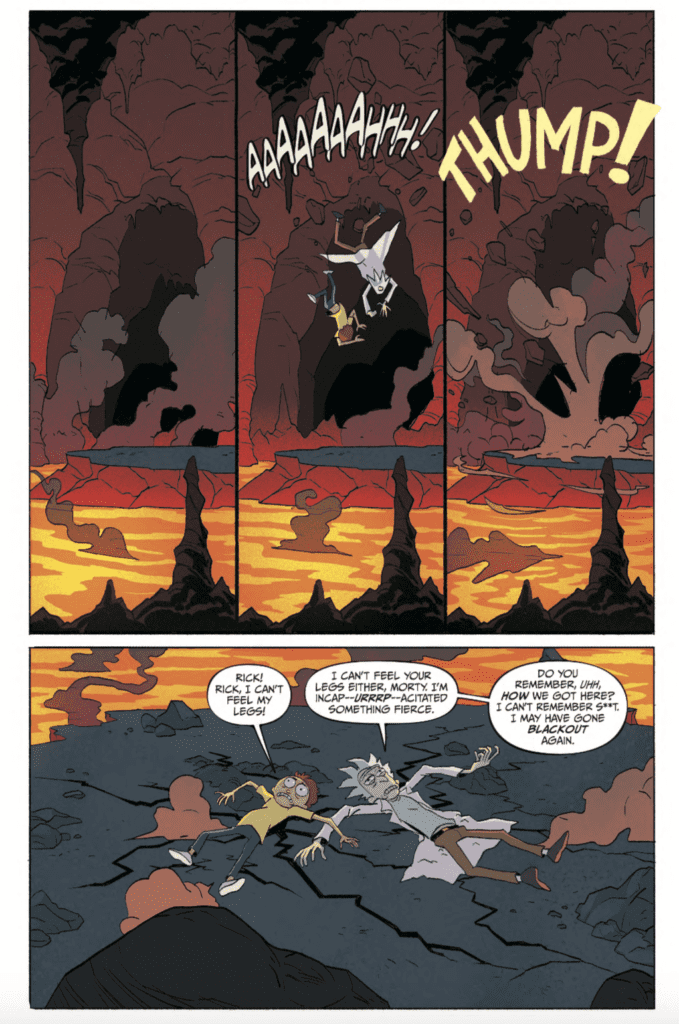
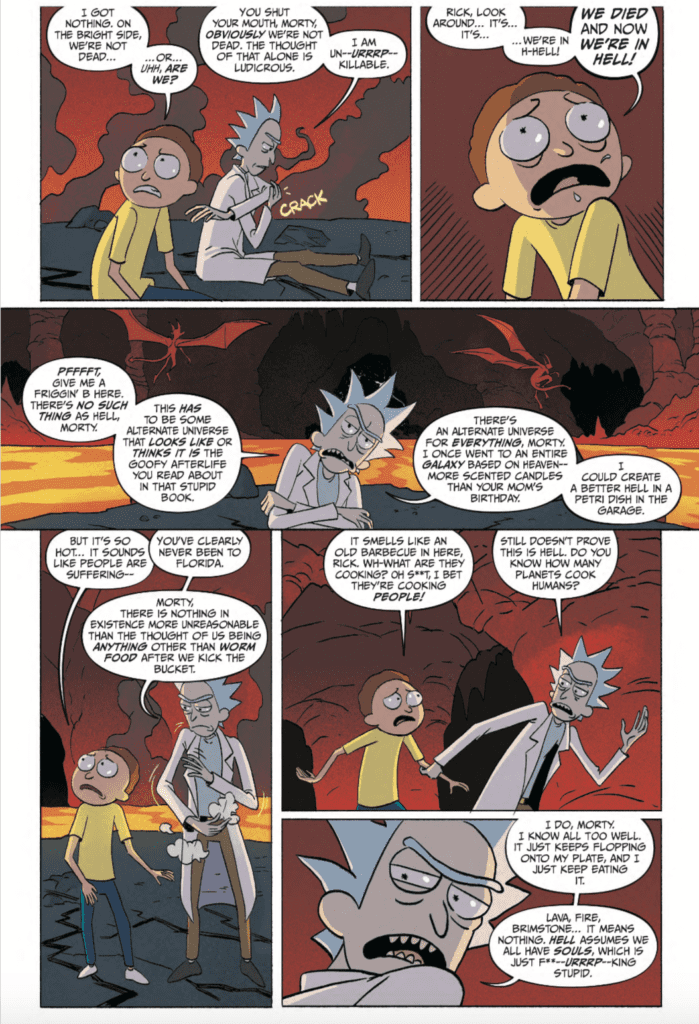
We open up with Rick and Morty crashing through the ceiling of Hell. Both of our protagonists can’t remember what happened before they crashed, but they take their surroundings in. While Morty begins to panic and wonders how they died, Rick doesn’t believe the place they arrived in is Hell. They soon come across other people, including the family, all confused about how they got there. Jerry believes that Rick is to blame, but the old scientist brushes him off as he takes Morty to the gates of Hell. The pair head into the fiery depths to get a grasp of where they are, though Morty has already accepted this place is Hell.
Maybe it’s because of the subject matter, but there was something that felt off about this issue. Rick is an atheist, and as such, believe the place they’re in is just a random reality that looks like Hell. This makes sense to Rick’s character, and he is written how he’s supposed to, but it still feels off. Usually, when comic book characters go to Hell, it’s to kill demons in the style of the Doom video game. Here, we’re dealing with denial, and it’s strangely unfunny.
That’s not to say that there aren’t funny parts in this comic. Morty pointing at the student Rick froze to death in the pilot, makes an appearance, as well as the human resources of Hell being the DMV, got plenty of laughs. Honestly, the funniest moment came from something as simple as Morty eating a burger made of maggots. The world(?) of Hell is actually fascinating, and I honestly can’t wait to see what the rest of the place looks like.
Art:
Constanza Oroza is the illustrator for this issue, and she captured the look perfectly. When I was first reading through it, I thought an artist from the show had to have played a part in the creation. When I reread it, I noticed that Oroza provided her own spin to the details. The slime from food, the tasing Morty gets at the gates, from the flames of Hell itself, she took the time to put as much detail as she could. It’s very well done, and I hope to see more very soon.
Conclusion:
Overall, this is a decent start for a Rick and Morty adventure. We have laughs where we need it, and commentary sprinkled throughout. Rick’s stubbornness to accept their situation is irritating, but that’s just his character. We know there is going to be a twist that will prove Rick right, but maybe we can get some sort of character development for Rick throughout this miniseries. When it comes to the art of the issue, Oroza did a fantastic job of capturing the feel of the original series while adding extra details. If you’re a fan of Rick and Morty, this might be a good comic for you.
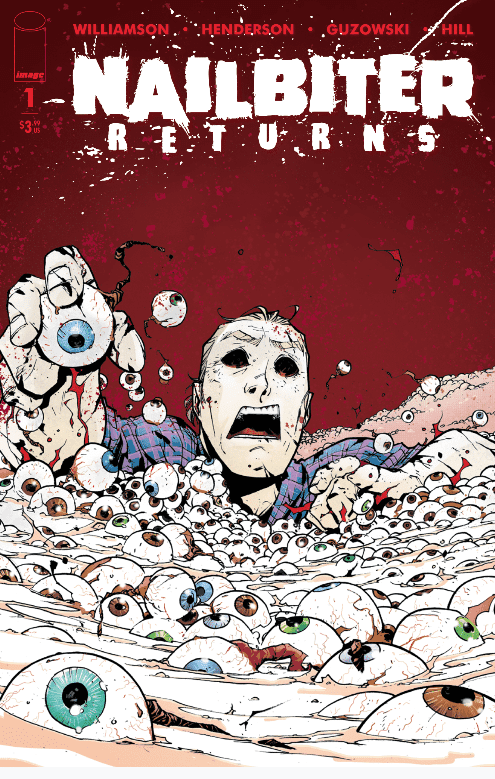
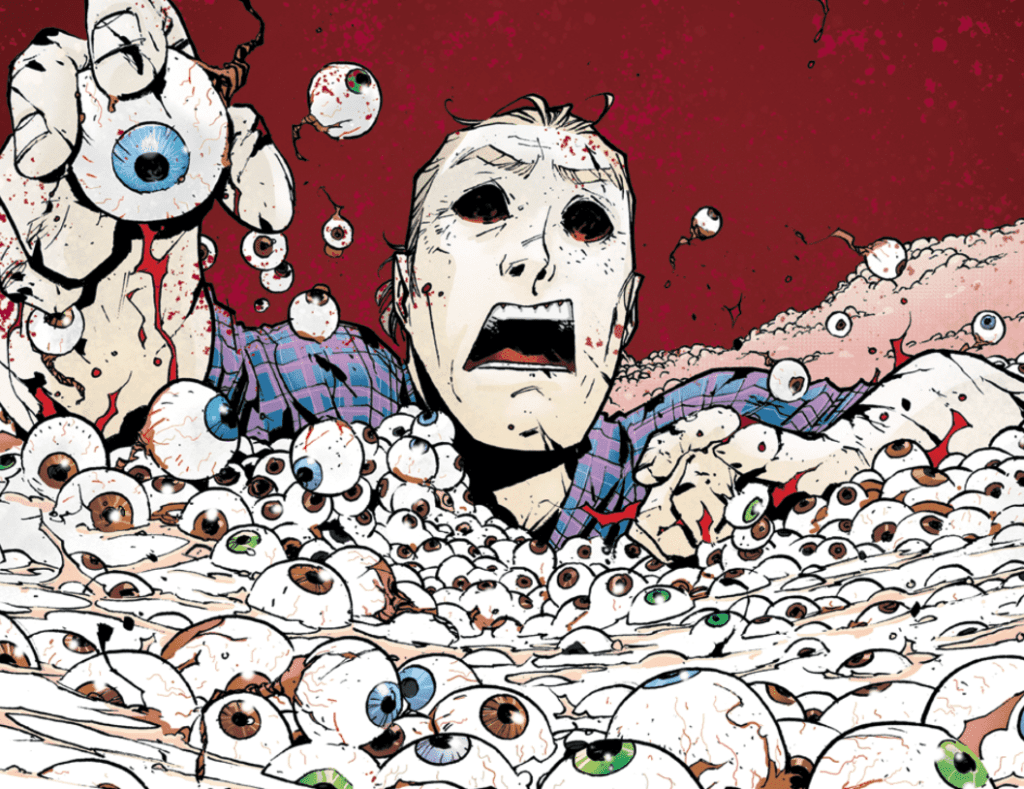
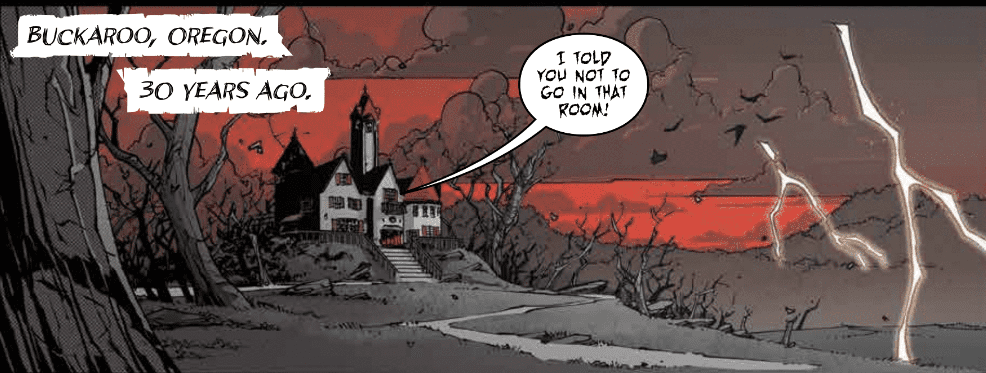
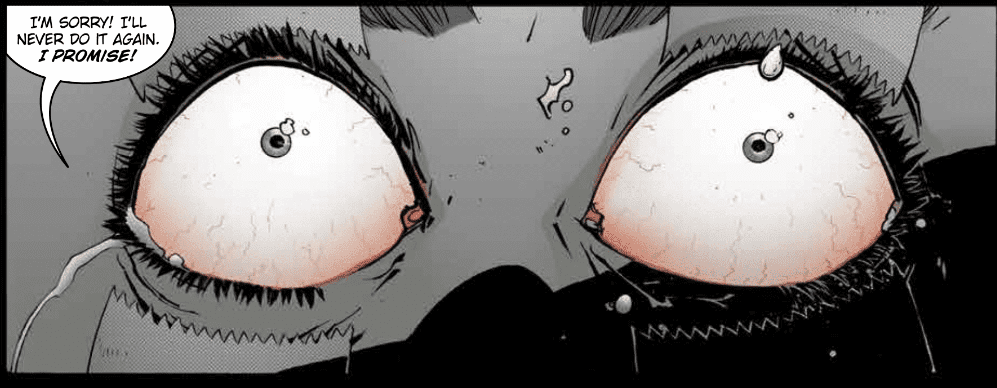
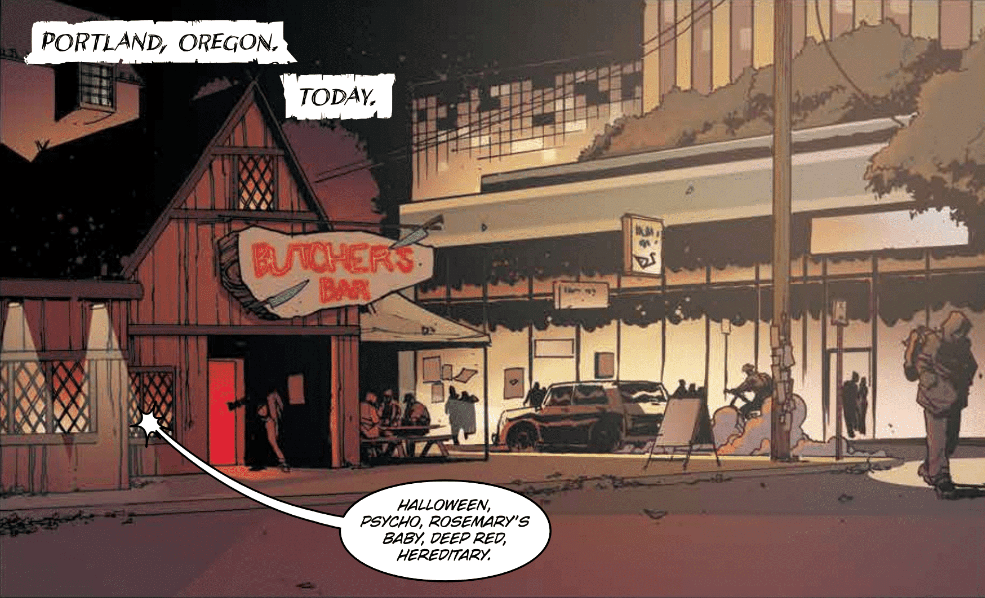
Sixteen serial killers have been birthed in Buckaroo, Oregon. Then came the Butcher in Black, Officer Vaughan, Agent Barker, the Devil Killer, and The Master. In Nailbiter Returns #1 from Image Comics, we learn there might have been a 17th butcher that is elated by eyeballs and an expert in eschatology.
Sequels
If there was ever a great time for Indie books to make a huge splash, now is that time. The big two publishers are scaling back the number of releases for the near future. DC and Marvel will not dominate the shelves in the first few weeks after shipping resumes. The time for Indie books to thrive is now.
We’ve learned from the film industry that sequels make money, they don’t even have to be decent, just tied into a previously successful franchise. Nailbiter was a fantastic series, so to return with a followup right out of quarantine is a fantastic move by Image Comics.
First Impressions
The Buckaroo Butchers are as unique as they are deadly. Some elicit instant fear and others seem silly, but it appears we’ll get a closer look at all of them. Something in this issue tells me so.
Creative Team
Joshua Williamson returns to writing with the same creative team. Mike Henderson restores Buckaroo with Adam Guzowski on colors and lettering by John J. Hill. I finished reading the first 30 issues before completely diving into this review. I wanted everything to be fresh.
Nailbiter is an amazingly well-written murder mystery that I’m reading for the first time since the initial monthly run. Nailbiter Returns picks up right after the end of Nailbiter #30. Reading through I noticed a misspelling in the artwork of Nailbiter Returns #1. The new eyeball fanatic has the list of Buckaroo Butchers on the wall and on it reads “HATE WATER”. It sounds like this new killer hates the very thing that allows him to live.
Henderson’s art looks just like the first 30 issues, and even more refined since then. The characters don’t look hyper realistic, but they don’t need to. Hill’s lettering is fantastic and appears reminiscent of the Joker terrorizing Gotham. Guzowski’s colors immerse us back into this creepy and mysterious universe. The palette is vibrant and jumps off the page thus keeping the eyes thoroughly entertained throughout. If you enjoyed the idea of Twin Peaks, but could do without all the weird, seemingly unrelated scenes, this is a great murder mystery for you.
Conclusion
Nailbiter Returns to the stands with a vengeance. There’s blood, there’s death, there’s old friends, and new acquaintances. With a little taste of YOU and Dexter, this run promises to delight. We learned the mystery of Buckaroo but many parts were missing. Are these the missing parts or just more chaos from the hellish depths of Buckaroo? The mystery unravels June 3rd.
What did you think of Nailbiter Returns? Are you excited to get back to the throat slashing world of the Buckaroo Butchers? Let us know in the comments below.