
Home Blog Page 312

Eddie Brock Is Back In Black In VENOM #25

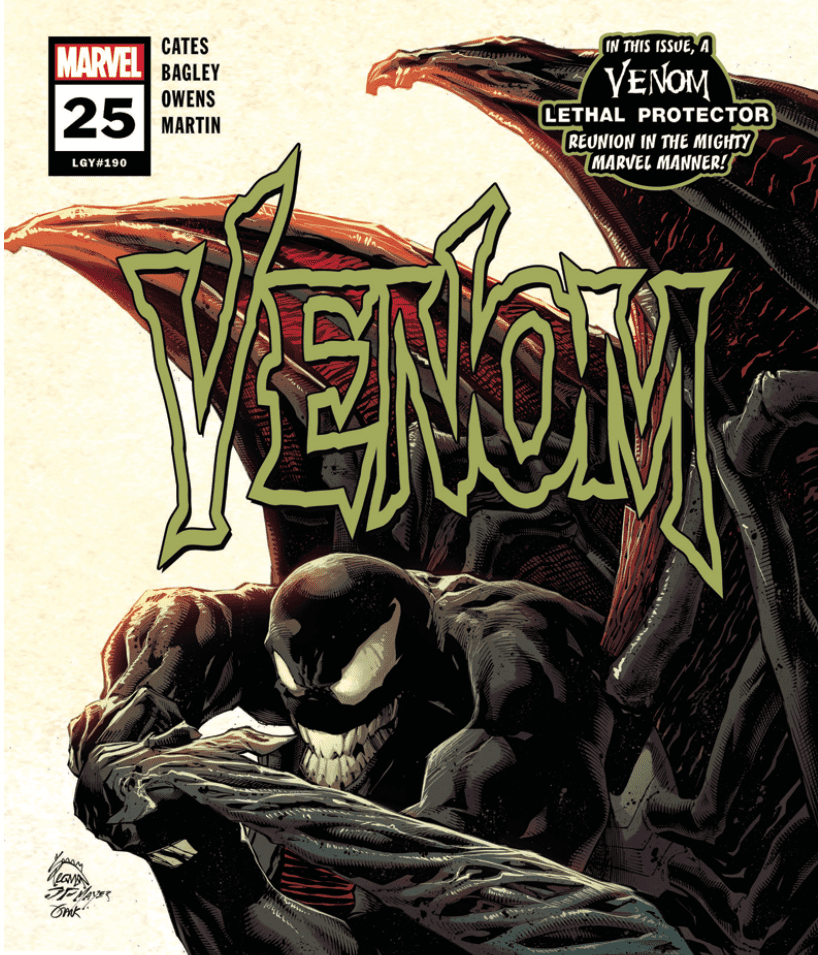
Venom #25 Cover

In Marvel Comics‘ Venom #25, on sale May 27, writer Donny Cates smoothly wraps up the first major branch of his run and leaves the reader anxiously waiting for the next chapter. This oversized issue serves as the culmination of “Venom Island” and a captivating preview of its follow-up. Plus, Cates indirectly thanks readers for their support and promises us that he’s just getting started.

Venom #25

Writer: Donny Cates

Penciler: Mark Bagley

Inker: Andy Owens

Color artist: Frank Martin

Letterer: VC’s Clayton Cowles

Two-Page Montage Sequence Artists: Ryan Stegman, JP Mayer & Frank Martin

Early in the issue, Cates expresses his appreciation for the fans’ loyalty with this series, you could just leave it at that. “You’ve stuck with me,” Eddie Brock says. “So thank you.” Later, Cates also assures us that the best is yet to come. Maybe he’s just discussing his own series. But it’s all too easy to connect Cates’ sentiment with the real world, where the COVID-19 pandemic has drastically affected the comic book industry. Comics are slowly resuming some semblance of normalcy, and that may be the reason Cates’ message to his readers particularly resonates. If nothing else, we can all agree, as Cates writes in this issue, that his Venom run as been bonkers from the start. He acknowledges that, at times, the series seems like it’s going off the rails. But, 25 issues in, it’s been a wild, fun ride and we can’t wait to see what comes next.

The week’s installment concludes “Venom Island,” but it also revisits some of the hero’s classic hits. Two staples of any Venom comic are the character’s morality (or lack thereof) and his relationship to symbiotes and/or other people. Cates has consistently explored these themes and they both come to the forefront here. On the first page, Brock asks, “Is Venom a good guy or a bad guy?” He then reflects on his morality, and penciler Mark Bagley brilliantly captures this emotional struggle. He shows prominent worry lines all over Brock’s face to convey Brock’s turmoil. The antihero questions his past self and wonders, “What was wrong with me?” as he shamefully covers his face with his hand. Lifelike facial expressions have always been a strength during Cates’ run, and Bagley continues that tradition.

Brock’s relationship with his son, Dylan, is also a major factor in this issue. When the Carnage symbiote possesses Eddie, it’s up to Dylan to save him. But the boy’s inexperience is costly, as he’s outmatched by Carnage’s powers. But one of Cates’ primary themes, that we are stronger together, tips the scales in Dylan’s favor. United once more, the father-son duo counter Carnage’s evil force with their connection. The art team’s subtlety adds a lot of nuance to a scene that begins with a fight involving a Tyrannosaurus rex.

As seen at the end of Venom #24, Dylan arrives on Venom Island in the form of a Tyrannosaurus rex, thanks to his symbiote powers. Bagley, inker Andy Owens and color artist Frank Martin combine to make the ensuing battle as wild as anything featured in Absolute Carnage. In a full-page spread, Carnage and the dinosaur battle against a blood red background, and the creature’s teeth look like they’re as sharp as knives. As exciting as this battle is, Cates and the art team dig deeper and pack it with emotional weight. Brock is mentally trapped in a prison cell that’s floating in a sea of blackness. The cell’s bars are scarlet red, clearly showing that Brock is imprisoned within Carnage. The fight continues to escalate but the real conflict comes in Brock’s mind, where he, Dylan and Carnage all vie for his soul. The war on both fronts sets up a thrilling climax that firmly changes the status quo in Venom.

Venom #25 is the perfect book to celebrate the return of comics as we know them. It pays tribute to the character’s past and paves the way for his promising future. With Cates at the helm, Venom remains in good hands, and we can’t wait see what happens next.

What did you think of Venom #25? Did you enjoy “Venom Island?”

Check out your local comic book shop to see if you can get Venom #25 and other books.
Monkeys Fighting Robots Youtube

AVENGERS #33 Brings A Fan-Favorite Hero Back To The Spotlight

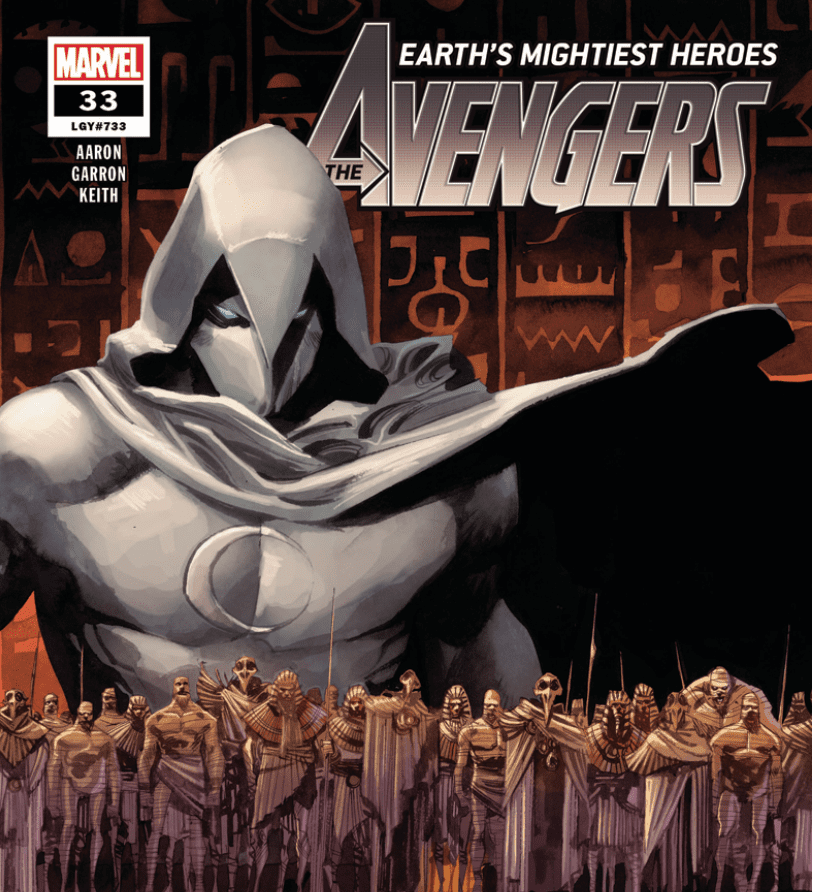
Avengers #33 Cover

Comics are back, and diving into writer Jason Aaron’s new Avengers epic is the perfect way to celebrate. In Marvel Comics’ Avengers #33, on sale May 27, Aaron kicks off “The Age of Khonshu” with a bang. By the end of the story, several of the Earth’s Mightiest Heroes have been taken off the board and the villain has already seemingly won the war.


Avengers #33

Story: Jason Aaron and Javier Garrón

Color artist: Jason Keith

Letterer: VC’s Cory Petit

Right away, the title of this arc reminds us of “Age of Ultron,” a famous Avengers story in which the team is immediately put on the defensive. The same structure is used here, as Moon Knight easily topples some of the Marvel Universe’s most famous heroes. For fans unfamiliar with the character, Aaron succinctly tells us everything we need to know about Moon Knight, who has faded into relative obscurity in recent years. But Aaron has publicly said he has plans for the hero, and they’re finally coming to fruition.

Aaron’s passion for this story is evident on every page; robust enthusiasm is packed into every word of dialogue and every line of narration. Rather than opting for a slow burn, Aaron begins this arc in a high gear, leaving us floored by the issue’s thrilling end. Moon Knight goes on an Easter egg hunt for the Avengers’ mystical powers and his practically effortless success is eye-opening. Aaron clearly views Moon Knight as a legitimate hero, and he wants the reader to feel the same way.

To show just how powerful The Fist of Khonshu is, Aaron and the art team combine to make him look almighty in several fight scenes. First, Moon Night travels to K’un-Lun, where he battles a reluctant Iron Fist. Danny Rand tries to reason with his peer, but the time for talking has passed. Moon Knight fights the martial art master, and Javier Garrón brings the energy of a classic kung fu movie to the scene. He uses numerous movement lines, emphatic impact points and narrow close-ups of the heroes’ hands to show the exchange of heavy strikes. Most notably, Garrón also shows multiple fists in the same panel to convey the rapid velocity of the blows. This effect is even more impressive when Moon Knight battles Thor.

A fight on the moon is quite fitting for the Fist of Khonshu. That’s where he meets Thor in the issue’s climax. After Moon Knight defeats several Avengers, Thor may be the most mighty adversary left standing. Thanks to Garrón, the God of Thunder looks majestic as he soars through the night sky; he receives a close-up in which he heroically soars with his cape billowing behind him. But the presence of the supermoon behind him spells potential doom for the Asgardian.

Even when Thor uses his legendary hammer to battle Moon Knight, he’s no match for the mystical hero. Garrón shows multiple images of Mjolnir, which are complemented by the work of color artist Jason Keith, to convey Thor’s strength. The God of Thunder rapidly swings the hammer, glowing with electric blue energy. But in a moment right out of Thor: Ragnarok, Moon Knight stops the hammer in mid-air, showing that he even outmatches the Asgardian. Once Thor falls, the Fist of Khonshu looks truly unstoppable.

With a heart-pounding introduction to his latest arc, Aaron resumes up his Avengers run with vibrant, contagious energy that’s sure to excite readers. Unlike other stories about the Earth’s Mightiest Heroes, there’s no alien invasion or universal threat here. Instead, they’re dominated by one of their own, which offers us a breath of fresh air.

What’d you think of Avengers #33? Are you glad to see Moon Knight in the spotlight?

Check out your local comic shop to see what books you can get this week.

Monkeys Fighting Robots Youtube

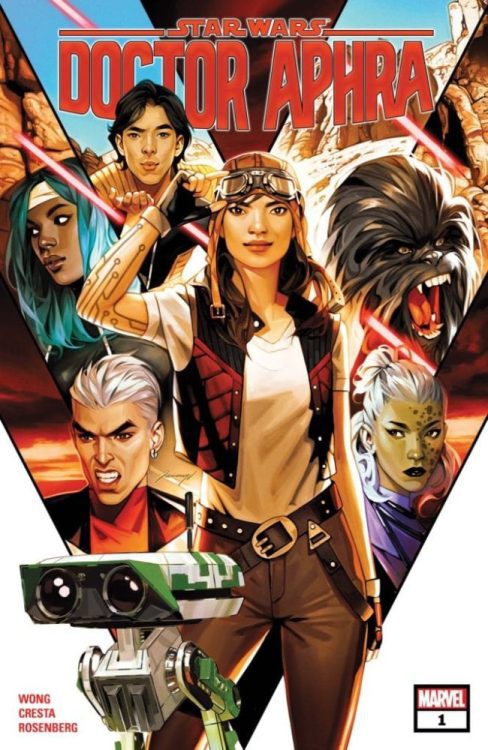
Why Aphra’s Forming A New Team In DOCTOR APHRA #1

Aphra is back, and with a new team in Star Wars Doctor Aphra #1.

The only and only, infamous Doctor Aphra is back in STAR WARS: DOCTOR APHRA #1, out this Wednesday from Marvel Comics. If you’re a fan of this mischief-maker, then you’ll be pleased to hear that she has survived her trials on Hoth, and is now assembling a new team.

***SPOILER WARNING***

Fans of Star Wars are surely aware of Doctor Aphra. She’s a force of chaos within the comic book world, and with good reason. Her love of gold tends to outweigh her love of life, and her ambition outweighs both.

That is probably the reason she’s found herself in hot water a time or two. Her first series ended with a moment of redemption, giving us fans something to be proud of her for. But now she’s back, apparently deciding that laying low isn’t as much fun as it sounds. Which actually sounds exactly like Aphra, don’t you think?

Doctor Aphra #1 is going to have to make a point of explaining several things, not least of which is the reason why she’s no longer hiding. Do recall the actions she took against Darth Vader in her final arc.

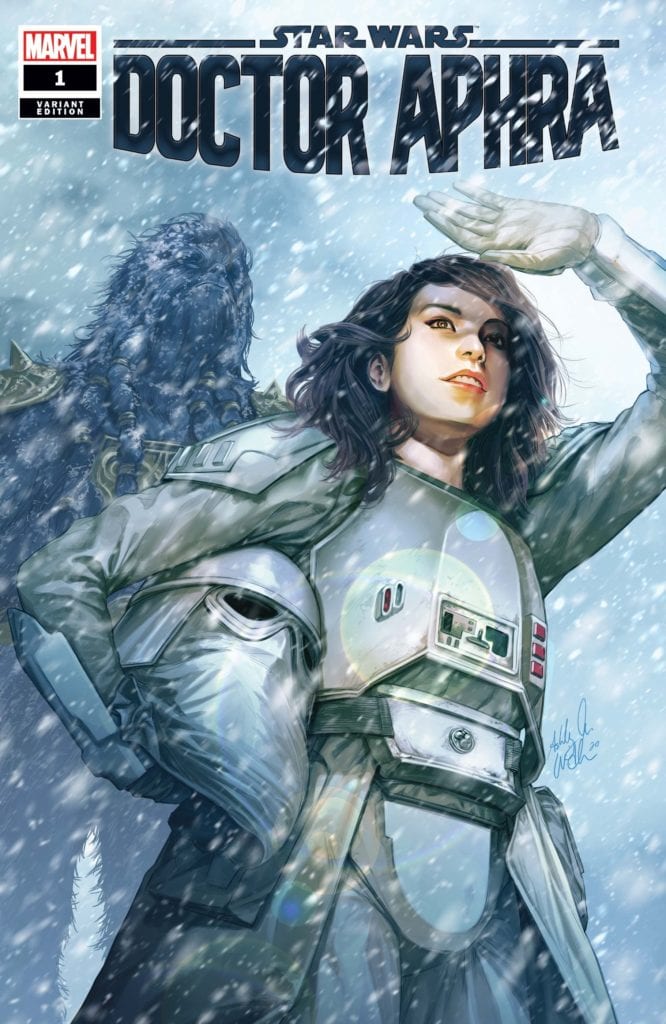
Doctor Aphra is rocking the Hoth look on Star Wars Doctor Aphra #1.

The Writing

If we’re honest, it never felt likely that Doctor Aphra would lie low for long. It’s just not her style. So the news of Doctor Aphra #1, as well as her formation of a new team, really shouldn’t have been a surprise at all.

Written by Alyssa Wong, this is a fun first issue to a brand new series, one that is naturally full of schemes, grudges, and heists. This is Aphra we’re talking about, after all. The first issue may have a lot it has to establish, and yet it felt comfortable having a bit of fun and showing off some banter between Aphra and the new characters.

Speaking of, like any formation issue, there is a team that we must get to know. The introduction of these adventurers fits the style of Aphra’s series thus far. By that, we mean, they have reason to be concerned about Aphra’s plans.

Each character introduced is unique from the other, and while we only got flashes into their history and personality, it was enough to get an idea of what is in store. More than that, a new antagonist has also been hinted at, making this a well-rounded issue.

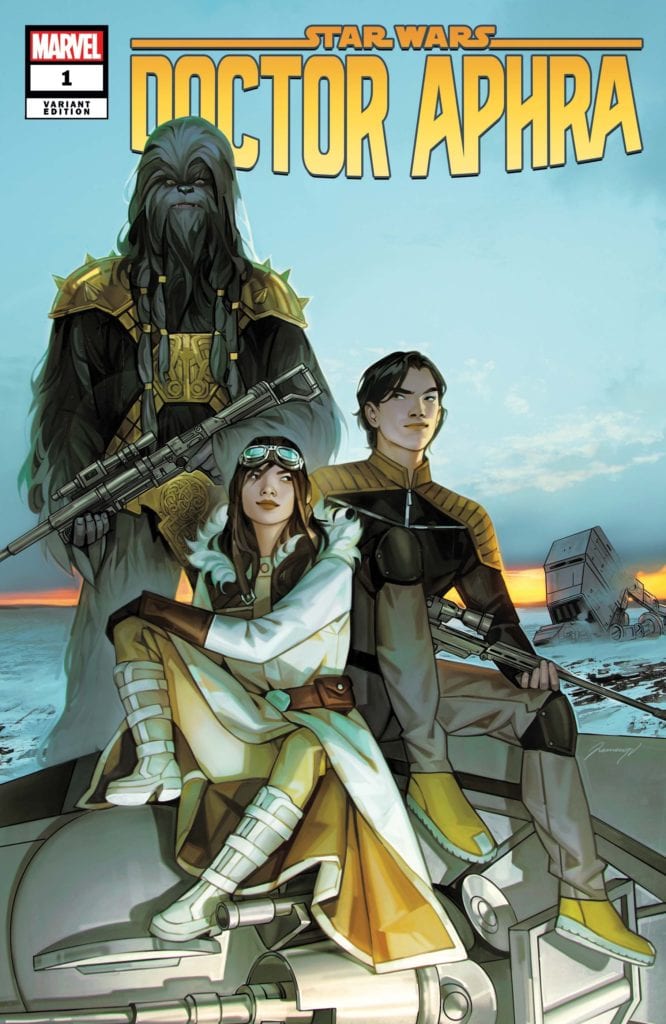
Doctor Aphra is spending some time with a couple of her crew mates.

The Art

The art within Doctor Aphra #1 is a thing of beauty. We’re talking about a variety of characters, with different backstories and characteristics worth portraying, plus so much more. Together Marika Cresta (art), Rachelle Rosenberg (colors), and VC’s Joe Caramagna (letters) brought yet another adventure to life.

The character designs are a particular highlight of the issue, though only one of many. All characters, both new and old, have memorable qualities to them, as well as some bold expressions worth featuring.

The backgrounds and color palettes are another highlight, naturally. Both of these help to accentuate the sense of movement (because of course, there’s at least one scene where Aphra is being shot at).

Let us not forget the lettering, which is perfection. There’s nothing more satisfying than the ‘click’ of a weapon pointed at our new leading characters, or the resounding response to their actions.

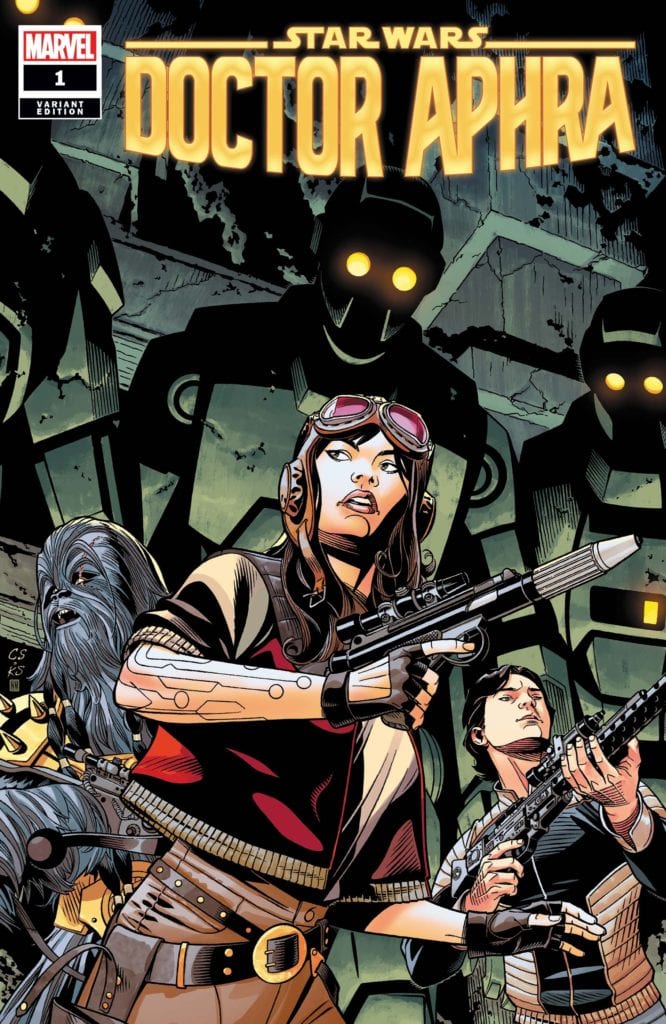
Trouble is looming on the horizon in Star Wars Doctor Aphra #1.

In Conclusion

Doctor Aphra #1 had a lot to live up to, as far as fans of her series are concerned. That being said, it does so with gusto. While she may have had a redeeming character arc recently, it’s clear that she is not ready to change her ways for good. Never change Aphra, never change.

Monkeys Fighting Robots Youtube

Now A Monster Has Come to Hunt In MERCY #2

A haunting cover for Mercy #2.

MIRKA ANDOLFO’S MERCY #2, out this Wednesday from Image Comics, continues the tale of the Woodsburgh Devil, and the townspeople who must suffer so. This tale is as haunting as it is beautiful, with plenty of horrors to go around.

A haunting cover for Mercy #2.

***SPOILER WARNING***

The eerie tale of Lady Hellaine is back with Mercy #2. This is the second issue in a six-part miniseries, one that is proving to be as traumatizing as it is mesmerizing. This series has already been getting a lot of attention, not least of which because it is both written and illustrated by Mirka Andolfo.

Last we saw, our unusual lady had made her way to the middle of nowhere (aka Woodsburgh), for reasons yet to be fully revealed to readers. If that was the only disturbing element of the series, the town would be so much safer.

But no, this little town has had it’s fair share of death and betrayal, going back over a decade now. A pattern that looks ready to repeat itself once again.

An ethereal version of Lady Hellaine can be found on the alternate cover for Mercy #2.

The Writing

There are many mysteries in Mercy #2. Or perhaps it is simply one mystery, with multiple faces. Regardless, there are lots for readers to work through in this issue. There are layers to this story, and that has already proven to be half the journey.

The tale itself is told through multiple perspectives, a clever storytelling technique that allows for revelations and obfuscation, depending on the need. We’re given glimpses of all over the town, and yet we don’t yet see how it’s all connected.

The intrigue surrounding Lady Hellaine increased significantly during this issue, as was surely the intent. What is surprising is the developing connection between her and several other members of the town. It’ll be interesting to see how that progresses over the next few issues.

It is fascinating how, in many ways, the characters in this series feel so human. Slightly ironic, given that at least one of them is anything but. The juxtaposition feels intentional and does well to highlight certain parts of human nature.

That’s ignoring the horror element as well, of which there is a significant amount of in Mercy #2. It weaves throughout the plot, in a way that feels both organic and shocking – a careful balance has been struck.

Lady Hellaine is looking more striking and intimidating than ever before.

The Art

While Mirka Andolfo was the lead artist for Mercy #2, they did receive help as well. They had Gianluca Papi as a color assistant and Fabio Amelia for the lettering. Together they created something cohesive and utterly…outstanding.

There is something so elegant about the art style within this series. That makes the horror elements all the more shocking and intense. Speaking of, the specific way in which the monstrous beings are drawn is oddly enchanting and fits in nicely with the series.

The colors in this issue are simply divine, from the elegant details on the women’s clothing to the decision to go with brightly colored dangers of the night. It’s all aesthetically pleasing while demanding that you stop and take note.

Finally, we have the lettering, which is carefully placed throughout the issue, with clear intent in mind. You are meant to notice all of the little details woven into the series, and the lettering has been done in such a way as to ensure that.

Better run faster, little one.

In Conclusion

Mercy #2 is a dramatic continuation of the series, proving that one can be both elegant and horrifying at the same time. This series may only have four issues left, but you just know that it’s going to pack a few punches in the meantime.

Monkeys Fighting Robots Youtube

Interview: Jeff Lemire And Phil Hester Build A Tight Bond With FAMILY TREE

Interview: Jeff Lemire And Phil Hester Build A Tight Bond With THE FAMILY TREE

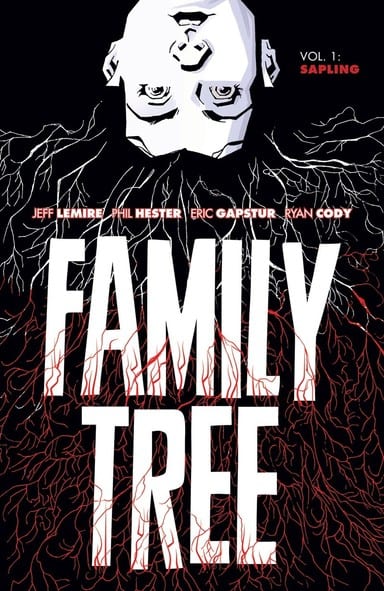
Family Tree, Vol. 1: Sapling hits your local comic book shop this week, but thanks to Image Comics, Monkeys Fighting Robots gets a chance to explore the creative relationship between Jeff Lemire And Phil Hester.

About the book:
When an eight-year-old girl begins to transform into a tree, her single Mom, troubled brother, and possibly insane Grandfather embark on a bizarre and heart-wrenching odyssey across the back roads of America, desperately searching for a way to cure her horrifying transformation before it’s too late.

You can read the first issue of Family Tree online.

Interview: Jeff Lemire And Phil Hester Build A Tight Bond With THE FAMILY TREE

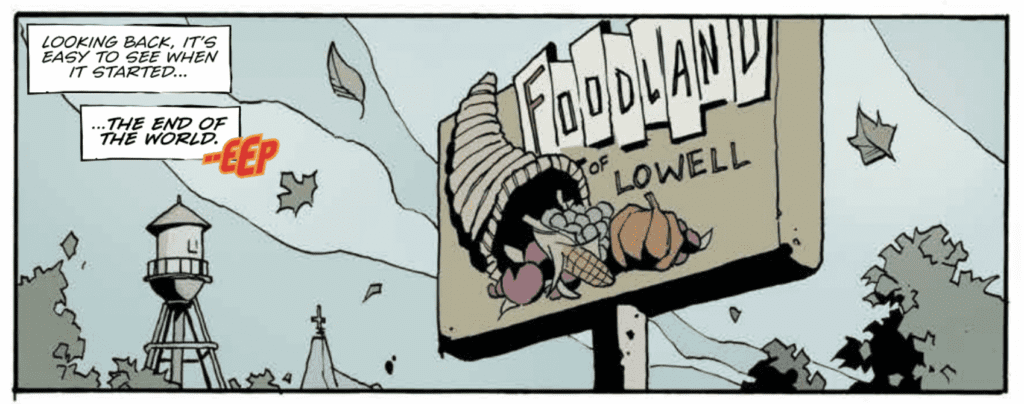
MFR: With the recent pandemic, we’ve seen a real-world example of how people react to pestilence. That’s something you begin to tackle with FAMILY TREE, along with the world feeling like it’s coming to an end. How do you feel when life is crazier than art?

LEMIRE: It’s very surreal to have written something like this right before the pandemic, that’s for sure. I did echoes of Family Tree in the way that things developed during the pandemic, mostly in how fast things moved and how it was just beyond our control, and we were swept up in it, much like the characters in the book.

HESTER: In all honestly, it’s no fun. I feel like horror works best when it comes back to the reader through a lens that allows them to separate a little, to see it in the abstract. I think that little bit of stagecraft makes the themes easier to process. When you’re hitting the exact same notes as the nightly news, it can get a little depressing. Thankfully, the series goes way, way beyond a typical pandemic tale, and enters a sort of metaphysical realm that may serve as the “lens” I was rambling about at the beginning of this answer forty years ago.

Interview: Jeff Lemire And Phil Hester Build A Tight Bond With FAMILY TREE

MFR: Jeff, From early on in this series, we get a real sense that we shouldn’t judge the otherworldly so quickly. While our gut instinct is to be afraid, that’s sometimes ill-founded. This is a theme in a lot of your work, like SWEET TOOTH, BLACK HAMMER, and ANIMAL MAN. FAMILY TREE is another brilliant example. What draws you to this theme and keeps bringing you back?

LEMIRE: Seeing the beauty in horror and in unusual things is something I’ve always been drawn to. I also like subverting expectations when I can as a storyteller, so I think it comes from both those places. In the case of Family Tree, I was really drawn to the idea of a return to nature and that maybe, in some ways, we would be better off if that happened.

MFR: Speaking of ANIMAL MAN, there seem to be traces of SWAMP THING here. Is there a SWAMP THING influence, and if so, can talk about why it resonates with you?

LEMIRE: I suppose the nods to Swampy are obvious. I have always loved that book and that character and, ironically, the first time I saw Phil’s work was when he was drawing Swamp Thing. I love the aesthetic of the character, but I also loved how Alan Moore used him as a vehicle to explore things beyond just the genre trappings. I try to do that in my work too.

Interview: Jeff Lemire And Phil Hester Build A Tight Bond With FAMILY TREE

MFR: Phil, many of these characters have a rough and tumble look about them. It seems to be an extension of his or her personality, and it works very well. Did you plan for this world to have that kind of vibe, or was that something you discovered as you sketched out the characters?

HESTER: I know what the story was about before I started, so the idea of very “lived-in” characters seemed appropriate. They’ve all been through a lot, and are headed for worse, so I wanted to show that wear and tear on them, especially Judd, who has officially one of my favorite characters to draw in my career.

MFR: Phil, the panels in FAMILY TREE are continually changing shape and function. They jump off the page and feel intrinsically linked to the storytelling. How do you feel this approach has lent itself to the series as opposed to a more traditional approach?

HESTER: The story has a very dreamlike, inescapable tone to it. It’s like when you can’t run in a nightmare, but find yourself being dragged inexorably toward what you’re trying to avoid. I want every page, or at least every scene, to have that kind of yawning vortex vibe about it. The pages have a lot of open ends and deep whorls that you sort of fall into as a reader. I want the readers to be trapped in this comic.

MFR: When you’re plotting, outlining, and designing the characters and their world, how do you approach an original story compared to something at Marvel or DC?

LEMIRE: We certainly have more freedom to just build it all from the ground up and not have to fit it into anyone else’s vision or world. It really comes down to that, the freedom to explore ideas and to write and draw for ourselves and each other rather than a publisher.

HESTER: Frankly, I approach them the same way. It’s just that at the Big Two, there are more people to rein me in.

Interview: Jeff Lemire And Phil Hester Build A Tight Bond With FAMILY TREE

MFR: You both write AND draw – how does that impact or change your dynamic and collaboration process? Do either of you approach this project differently than you would with a partner who strictly writes OR draws?

LEMIRE: For me, I think it just means giving Phil the freedom to tell the story visually. I know he is a great writer and storyteller, so I don’t need to focus too much on trying to dictate that in my scripts. Rather, I just need to give him the framework to do what he does so well, and then I get to focus on plot and character and dialogue.

HESTER: I think it helps us respect the other person’s effort a bit more. I know where the line is as a collaborator. If Jeff asks for something in a script, I know that he needs it. He’s been on my side of the equation, so he’s not going to ask for anything that’s not crucial.

MFR: FAMILY TREE has a good amount of white space, can you talk about the color palette Ryan Cody used in the first volume?

HESTER: Ryan’s been great. When we were trying to find the right palette, I kept pushing him to wash out the colors even more, almost to the point the book barely had color at all. He found that groove and became a master of it. Like I said earlier, I want this book to feel like a dream, so it’s pretty important to me that the color be non-literal. It should only make sense in the context of the book. Ryan’s mastered that, as has Eric Gapstur on inks. Every itchy line I lay down gets even itchier when I get it back from Eric.

Interview: Jeff Lemire And Phil Hester Build A Tight Bond With FAMILY TREE

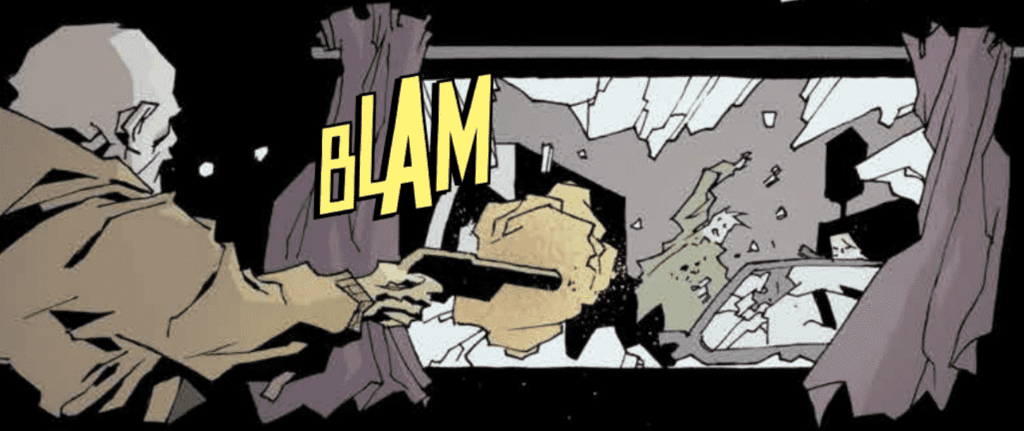
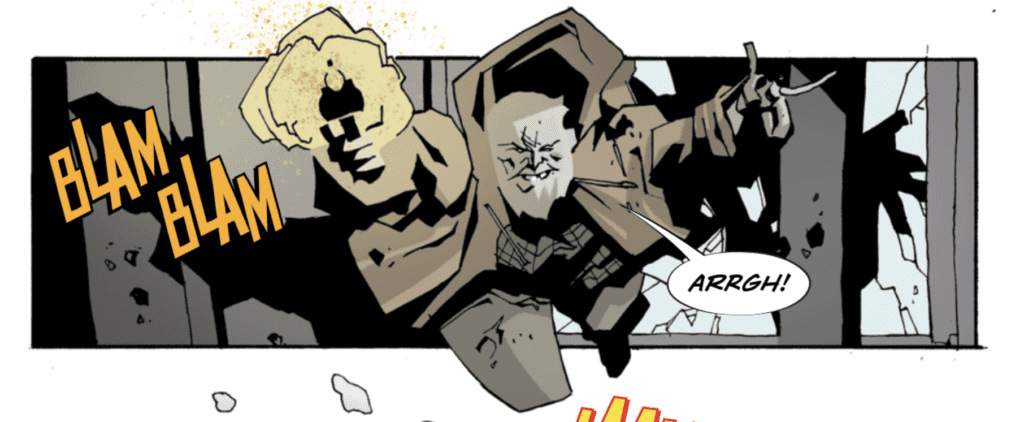
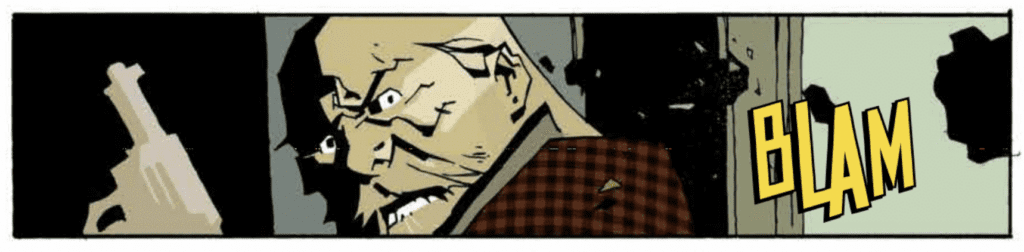
MFR: By the end of the first volume, Steve Wands’ “BLAM” becomes so iconic and jumps off the page during action sequences. What’s it feel like when the story, art, and letters work in harmony during an intense action sequence like at the end of the first volume?

LEMIRE: That all comes from trust. Letting every member of the creative team contribute and do their thing. When you do that, it allows for everyone to feel like a real team, and hopefully that shows on the page.

HESTER: It’s a joy to see everyone firing on all cylinders. Steve letters so many books that I’m always amazed at how he never loses focus regarding what makes this project special.

MFR: With the COVID-19, the comic book industry is at an evolutionary moment. What do you think the comic book industry will look like in 10 years?

LEMIRE: Obviously it won’t matter because the world will be covered in human trees by then.

HESTER: No one knows, especially anyone telling you they do.


Have you been reading Family Tree? Comment below with your thoughts.

Family Tree #4 was an alarming and dramatic issue, one that was unafraid to show the brutality and desperation that comes from fighting for your life. This is an issue that will leave fans on the edge of their seat, waiting for the fifth issue to drop. – Cat Wyatt

Monkeys Fighting Robots Youtube

DC Comics First Look: BATMAN: THE SMILE KILLER

Batman Smile Killer

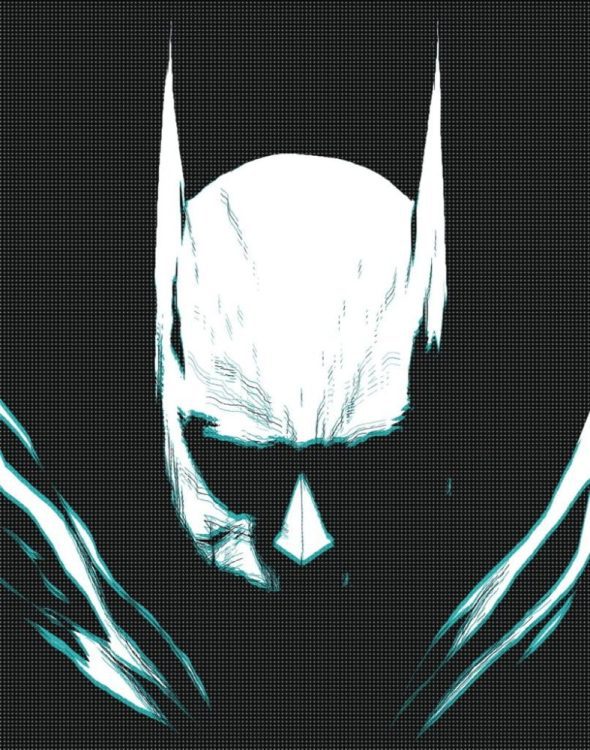
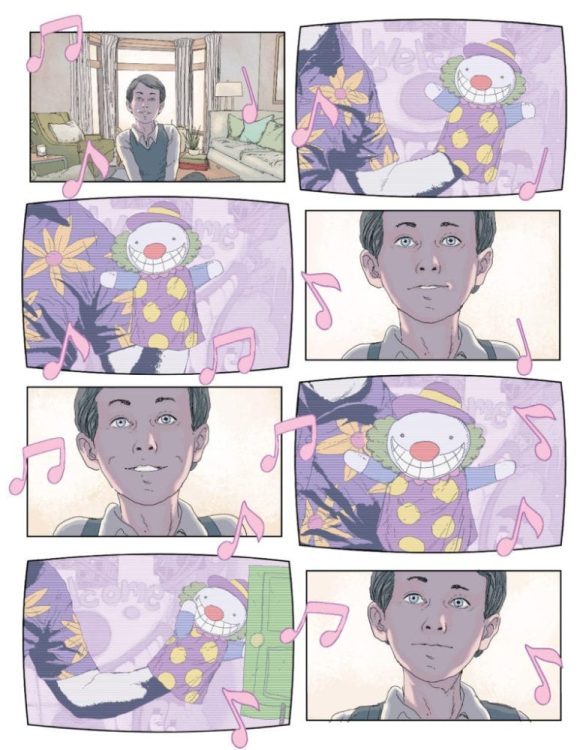
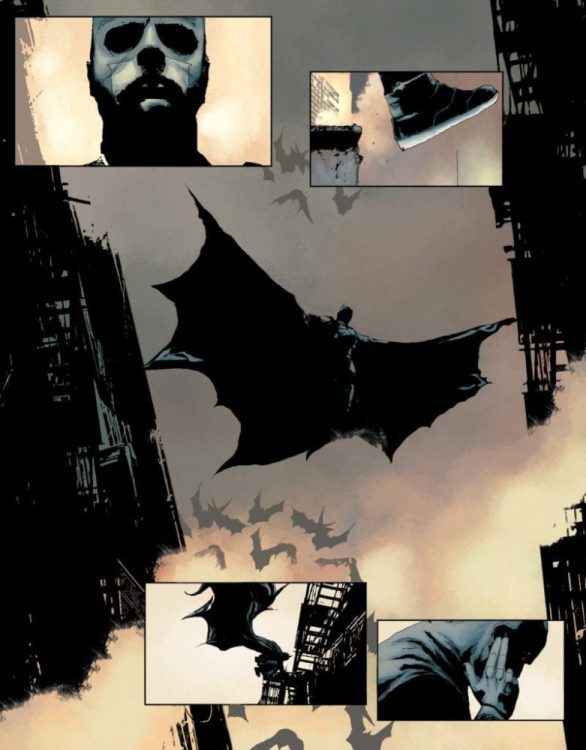
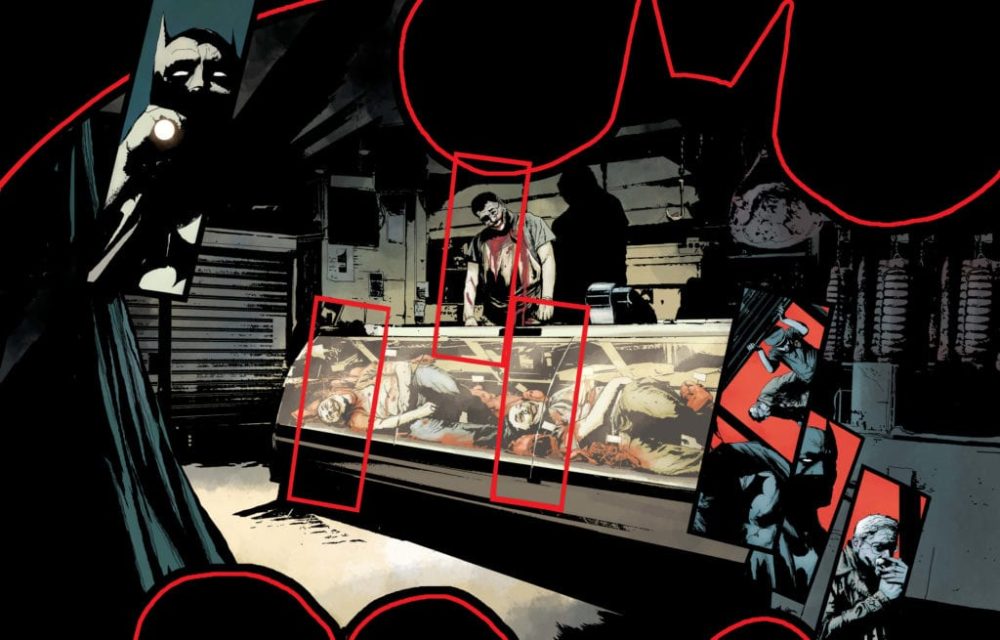
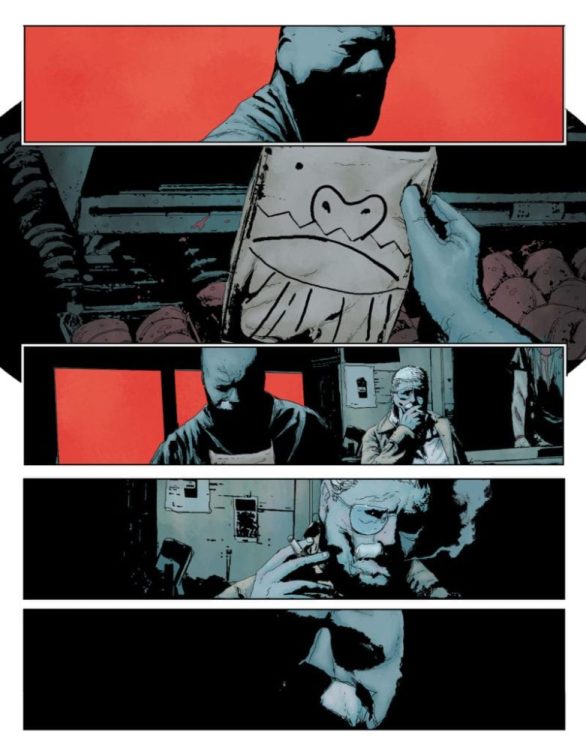
Jeff Lemire and Andrea Sorrentino — the creative team behind Joker: Killer Smile — are reuniting for a new Batman one-shot: The Smile Killer. DC is calling this an “epilogue [that] takes a different look at the Clown Prince of Crime, through the eyes of a young Bruce Wayne and his favorite cartoon television show.” The Black Label book will debut in June.

Here’s the official description from DC, along with some preview pages:

Bruce Wayne grew up watching The Mr. Smiles Show – and the show might have been watching him back! And not only was young Bruce watching, he was listening… listening as Mr. Smiles spoke across the airwaves only to him… Lemire and Sorrentino land one last gut-punch to the mythos of the Batman, turning it on its head in the most devastating trick The Joker has ever devised!

Batman: The Smile Killer is a $5.99 Prestige Format one-shot available on Tuesday, June 23, 2020.

Monkeys Fighting Robots Youtube

REVIEW: SUICIDE SQUAD #5 Bounces Back with a Vengeance!

Suicide Squad Tom Taylor DC

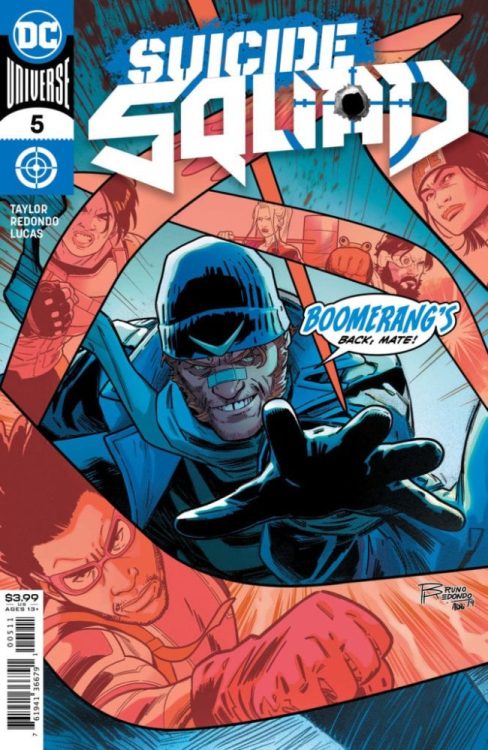
Suicide Squad #4 was the first in this series to not get a perfect score in my reviews. After three brilliant issues, the writing began to slip a little as it became exposition-heavy. However, if DC Comics’ Suicide Squad #5 tells us anything, it’s that this creative team knows how to bounce back with a vengeance. Back to cranking out one of the best series on the stands, writer Tom Taylor, artist Bruno Redondo, colorist Adriano Lucas, and letterer Wes Abbott make Suicide Squad #5 the ride of a lifetime.

Writing

Taylor almost seems to specifically go out of his way to show he can do great exposition. As the issue opens, one of the new Squad members begins to talk about his childhood. But instead of retelling past stories that feel slightly out of place, Taylor allows Redondo’s art to do most of the work there. We see and hear just enough to piece together who this character is. Taylor makes us love a character we’ve barely met in the space of four pages, while never missing a beat in the main plot. And as the issue comes to a close, and a major question gets answered, we’re left with more questions than ever. Taylor manages to keep us balanced on the edge of our seats, and it’s clear he’s going to keep us there.

Suicide Squad Tom Taylor DC

Art

Part of the reason Taylor’s minimalist approach to writing works in this series is because Redondo’s art communicates so much. We learn a ton about the characters through his art. When things get violent, Redondo shows us who the characters are who set their jaws, and who the characters are who light right up. And you don’t blame them for lighting up, as one specific use of violence in this issue is one of the funniest things you’ll see in any comic. But Redondo also knows how to pull our heartstrings. And he does it by not trying too hard. In one scene, two characters say goodbye to each other for the last time, but Redondo makes it seem almost nonchalant. Yet there is something more intimate about it for that reason. These characters know each other too well to weep and moan. The pain is implied. The fact that Redondo can break our hearts one minute, and make us laugh out loud the next is a testament to his extreme range.

Coloring

Lucas continues to make so much about this series fun. From purple glasses to neon backgrounds. Lucas is the one who comforts us when things get tragic and cheers us on to get into the shenanigans. The grittiness and the tragedy in this series are always offset by Lucas. He’s one of the reasons this series is so balanced and versatile. Shocking violence quickly gives way to bright yellow backgrounds and delighted characters. Lucas hasn’t just set a tone for this series; it’s like he sits down at every page and says, “How can I make this as beautiful as possible?” When colors aren’t jumping off the page, they’re bleeding into one another. It doesn’t feel like looking at a comic book page. Each panel feels like a meticulously crafted work of art.

Suicide Squad Tom Taylor DC

Lettering

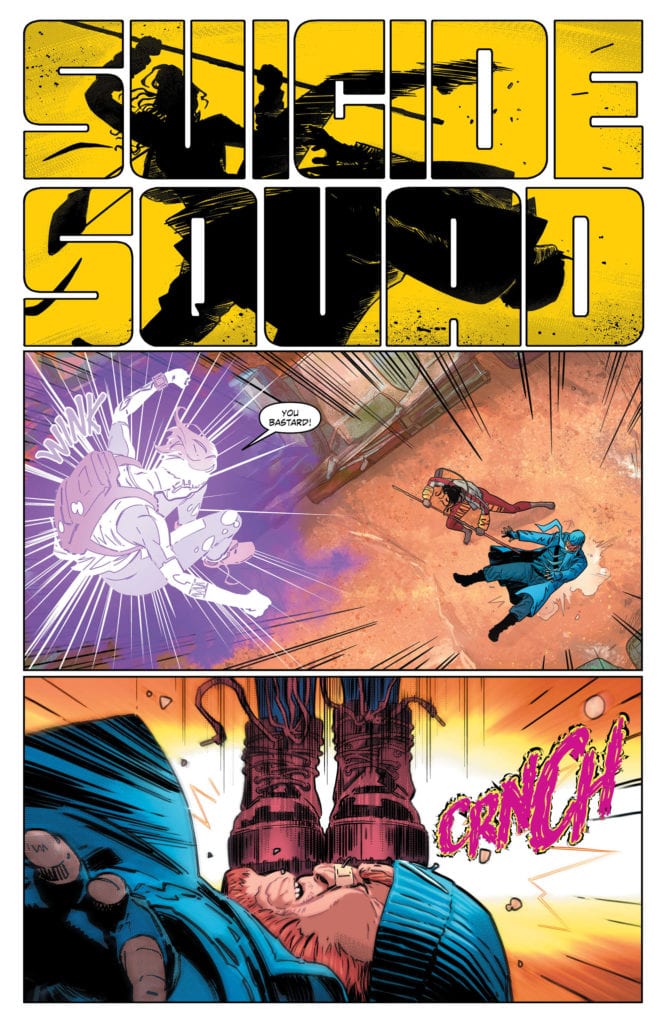
Abbott’s lettering makes you feel what the characters are feeling. When Captain Boomerang’s hand is brought down on one of his boomerangs, the red lettering looks like it’s cut into skin. And when one character stomps vengefully on another’s face, the bright pink lettering gives a sense of her twisted joy. But there are two specific moments where Abbott hits it out of the park. When things boil to a head, and someone fires the first shot, Abbott doesn’t write a sound effect. But it works. Because, at that moment, time almost seems to freeze, and everyone’s words are caught in their mouth. In the opposite vein, when one character tragically blows up, the “BOOM” takes up the whole panel in the background. It seems to go on forever. Abbott shows us first what it’s like to feel the shock of violence, and be lost for words, and then what it’s like to lose someone dear and feel as though nothing exists beyond that moment.


Read this series. Buy this issue. DC Comics has struck gold with this creative team. Taylor, Redondo, Lucas, and Abbott mesh-like Shakespeare and hard liquor. They’re the perfect team, writing a book that’s going to be a classic. If for no other reason, than for this issue alone. Suicide Squad #5 is out from DC Comics now!

Monkeys Fighting Robots Youtube

Interview: Deep Dive With Remy Boydell Creator Of 920LONDON

Interview: Deep Dive With Remy Boydell Creator Of 920LONDON

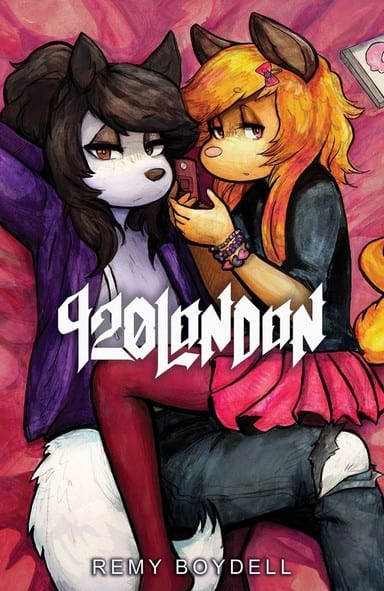
920London hits your local comic book shop on June 10, but thanks to Image Comics, Monkeys Fighting Robots gets to take a deep dive with creator Remy Boydell.

About 920London:
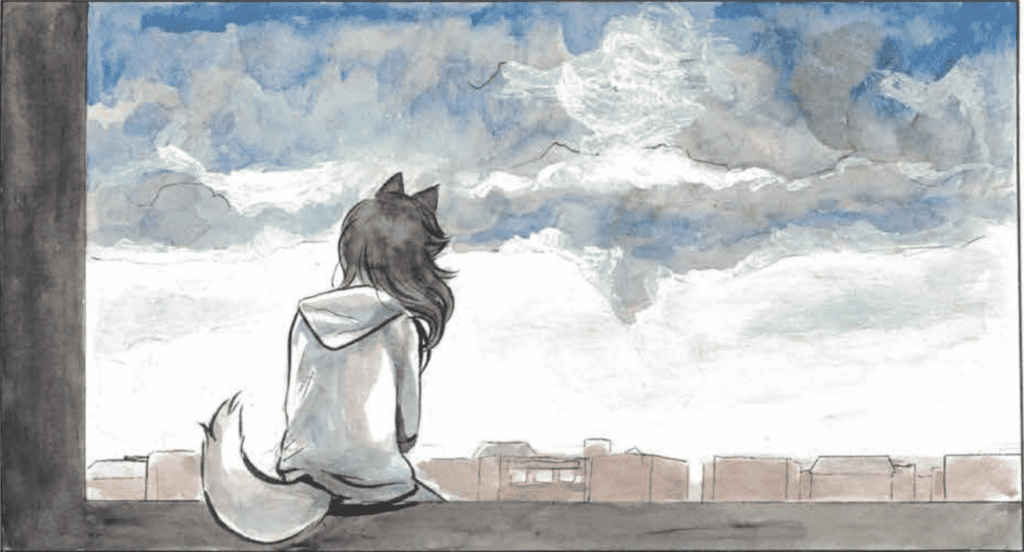
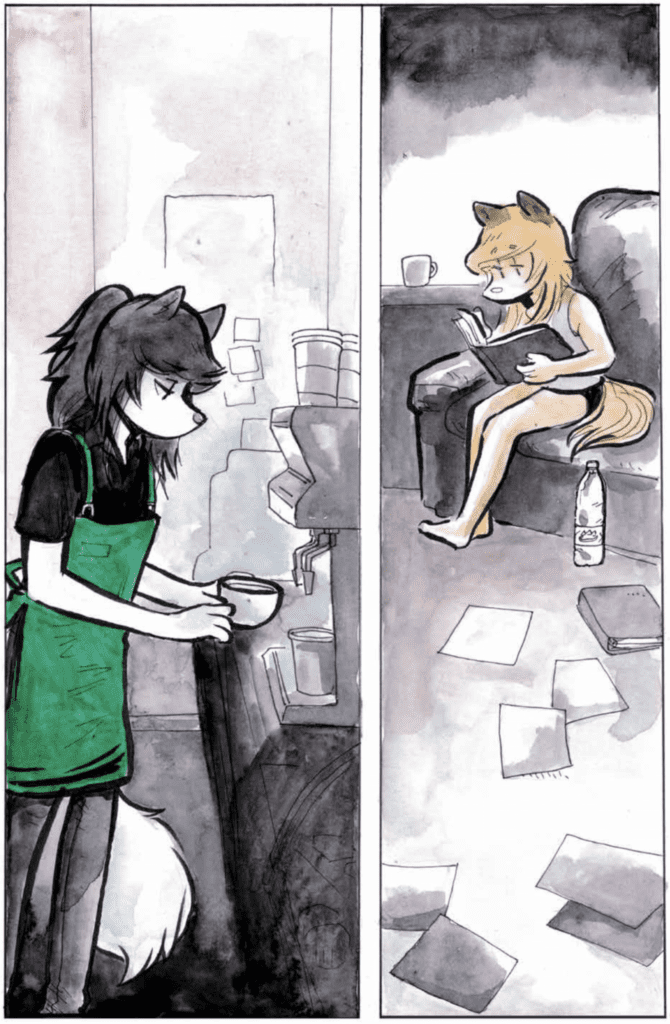
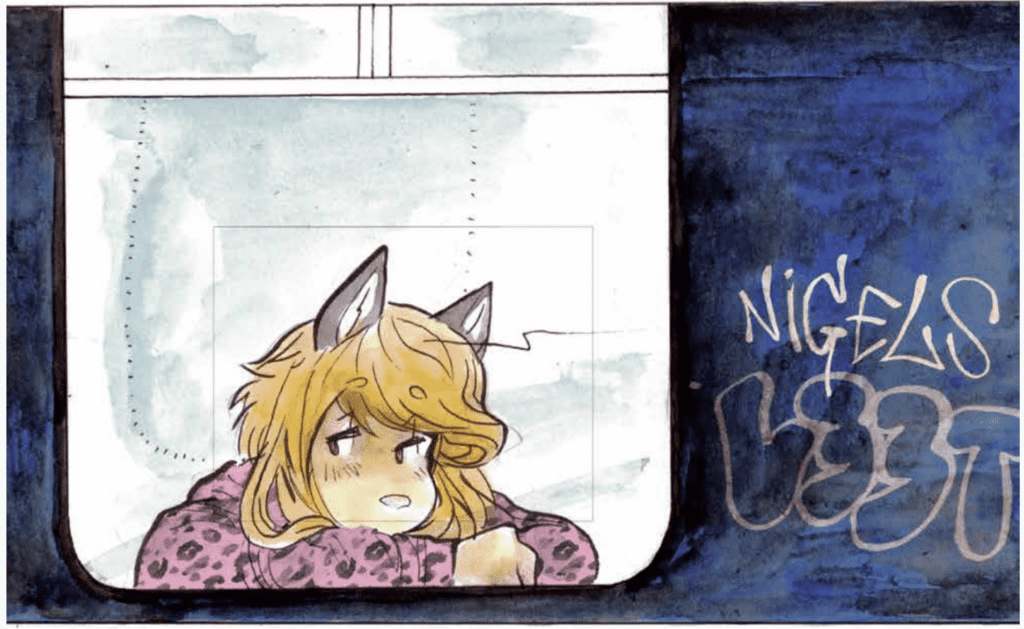
2005, north of London. A doomed romance between two emo kids. More than friends, less than lovers, they’re trying to grow shrooms before the world ends. Send help.

Interview: Deep Dive With Remy Boydell Creator Of 920LONDON

920London is a perfect read for anyone at this time. COVID-19 has turned the world on its head, and this book reflects on 90% of the emotions you are going through right now. This is not my typical read, but the characters grew on me, and by the end, I was emersed in their universe.

Enjoy the Remy Boydell Interview Below

MFR: Did you need to make 920London, or did you want to make this book?

Boydell: I think I was definitely pretty depressed when I started! At the same time, I realized I could tap into something by working from the things that I originally fully loved around 2005. Hopefully, the book stands on its own though.

By the time it was finished, a couple of things had happened which made it feel like it had come ‘full circle,’ so I felt I’d made the right choices. I was happy to get Jorden Haley on board for the book’s title/logo; I liked his design work for Mindless Self Indulgence. I also tracked down one of the original artists that I remembered loving from back in the day on Deviantart (a Chilean artist who goes by Paroro), and it felt great to reminisce.

MFR: For me, your book has a bit of a Trainspotting feel to it. What are your influences that brought 920London to life?

Boydell: This was the first time I’ve gone outside of a square panel format for a whole book, so I wrestled with paneling, and re-read a lot from Asano Inio. The book is also a bit of a callback to the UK tv series ‘Skins,’ which is pretty nostalgic for me.

Interview: Deep Dive With Remy Boydell Creator Of 920LONDON

MFR: 920London was a very therapeutic read for me with the chaos and massive loss of life of COVID-19. Do you think about or realize how impactful your work can be on a reader?

Boydell: I don’t really think about how people are going to react to my work, since I’m too far inside of it, I can’t really ‘get’ it. I don’t know what the world will be like when I’m two years into a project, so all I can do is just put the book out. For people still quarantining/social distancing, I think the anxiety and sense of longing might be relevant, but I can’t speak for anyone else. I’m really happy that it felt therapeutic for you, that means a lot to me.

MFR: The silent pages and chapters acted like time jumps and deepened the relationships of the main characters for me. Can you talk about the silent pages and what they mean to you.

Boydell: This sounds strange in the context of print books, but I came up posting art on Tumblr, and I started doing splash pages that work as extended beat panels to just like, demand a bit more attention in the context of a vertically scrolling feed. I tried hard to edit the dialogue down as much as possible, I did a fair bit of that when I was editing the script of ‘The Pervert,’ and I wanted to pare stuff down as much as I could. I don’t know why; it just felt important.

Marlo Mogensen, a friend who’s much more eloquent than I am, described the characters existing in a kind of trauma limbo. There’s a fair amount of silence and disconnect between them. I just love a good full silent page.

Interview: Deep Dive With Remy Boydell Creator Of 920LONDON

MFR: As soon as you mentioned Ween, I started to give the book a soundtrack. What did you listen to when you were working on 920London?

Boydell: Ween was name-dropped in honor of my friend Charlie, who, during production of the book was sort of carving his life into a rudimentary shrine to Gene and Dean Ween.

I haven’t updated my iPod since I worked on the book, so I have a real list. The quality of the music varies violently:

The Secret Handshake, Amy Can Flyy, brokeNCYDE, Cobra starship, EATMEWHILEIMHOT, Hellogoodbye, I SET MY FRIENDS ON FIRE, Ima Robot, The Medic Droig, Metro Station, Paramore, The Rasmus, She Wants Revenge, 30H!3, The Arctic Monkeys, The Killers, Hadouken!, Breathe Carolina, Red Jumpsuit Apparatus, The Raconteurs, Dance Gavin Dance, Modest Mouse, Henry Homesweet, The Fratellis, Cute Is What We Aim For, Panic! At The Disco, Avril Lavigne, MCR, MSI.

I’m definitely missing a few, I know I had the soundtrack for the show ‘Skins’ going at one point too.

Interview: Deep Dive With Remy Boydell Creator Of 920LONDON

MFR: The indie comic book scene is a very crowded marketplace, what will success look like for 920London?

Boydell: I don’t think it’s crowded, I think there’s a good amount of indie comics. (We need) more indie comics. If someone reads it and makes their own weird comic, that would feel like success to me.

I’m not being glib, I genuinely met the goal I had for my last book in terms of numbers of copies sold, and that kind of thing can be a bit hollow. If anyone is unsure of their ability and worried the comic they genuinely want to write will repel or annoy their peers, please go for it.

MFR: Because of the emotional impact of COVID-19 and how the world has been shut down, what is your emotional state going to be like on June 10 when your book finally drops on the public?

Boydell: I feel grateful to everyone at Image; they’ve been working incredibly hard through a lot of chaos to get books out. I try not to focus on the reception of work, and I’m pretty deep into my next project already, I’ve been animating for a while. Having said that, it makes me happy to see a bit of fan art; I save it all carefully.

MFR: Thank you for your time, and best of luck with 920London.

Boydell: Thank you!!


What did you think of the interview? Comment below with your thoughts.

Monkeys Fighting Robots Youtube

BLEED THEM DRY #1 – Diving Into A Whole New World

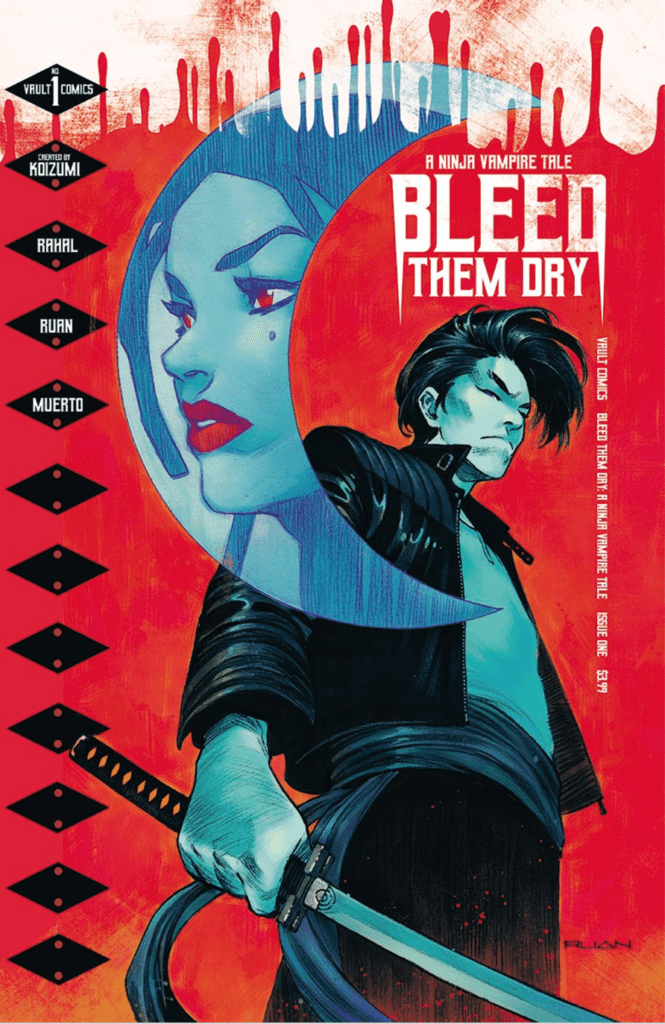
Bleed Them Dry #1 cover

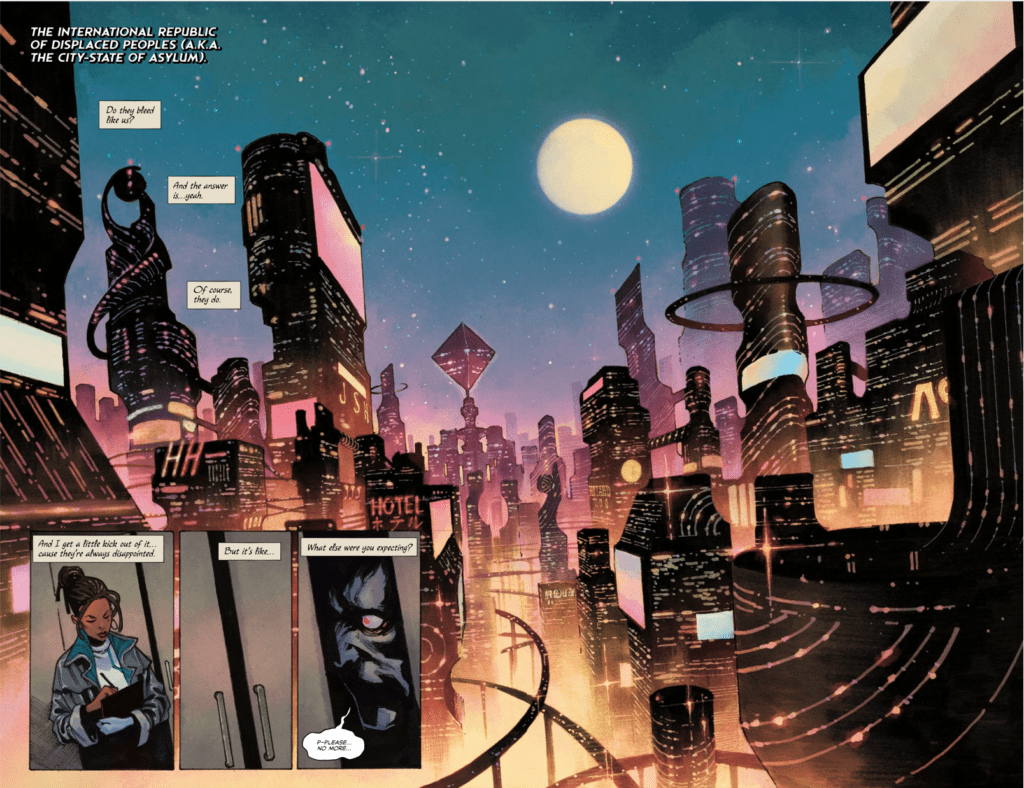
Bleed Them Dry #1 begins a new series by Vault Comics in some post-disaster cyberpunk world. One where vampires who coexist with humans are not the most interesting thing about it. Instead, a ninja is going around killing these supposed immortals who hide a dark agenda. And the detective in charge of the case finds herself going deep into a potential conspiracy.

Bleed Them Dry #1 Background

Let’s talk about the creator Hiroshi Koizumi’s vision. Bleed Them Dry combines two things that fascinate audiences: vampires and ninjas. It’s not an exaggeration to say that vampires are a pop-culture norm. From the Castlevania Netflix series, new Vampire: The Masquerade video games and even Sony is trying to capture the craze with Morbius. This reflects the world in Bleed Them Dry #1; vampires have an entire culture that has been long established. For example, they can take blood substitutes in place of coffee. It’s a world readers just want to know more about, even if they have to theorize.

Especially since the allure surrounding the blood-sucking immortals is anything but mundane, the main character’s partner Atticus Black presents himself as the smooth-talking figure who steals the spotlight. With the way he talks, he always ensures that he’s on top of any discussion. This makes him interesting and a little intimidating, perfectly encapsulating the revelation near the end of the issue. A revelation that pushes POV character Harper Halloway into the hands of the ninja vampire slayer. Something that series writer Eliot Rahal is more than eager to show.

Artwork

Setting and pace for vampire citySeries artist Dike Ruan illustrates an always changing perspective where momentum shifts accordingly. In just the first pages, a police procedure quickly establishes its stakes, all while presenting the setting of Bleed Them Dry #1. The best part comes from how they never get in one another’s way. With a city like Asylum who wouldn’t want to feel like they’re on a ride. Thanks in no small part to Deron Bennett’s letters. Perhaps the best display of this comes from how Ruan and Bennett have Atticus’ quickdraw cuts a vampire. The bisected panels in addition to the letters popping out of the word balloon perfectly illustrates this action.
Colorist Miquel Muerto provides an equally shifting tone. The bright lights of the city of Asylum live up to its name, where the main characters feel safe. But then when something in shadows appears, this safety becomes compromised. It takes someone who knows their way around the shadows to feel safe again. Hopefully, Halloway finds that with her savior.

Bleed Them Dry #1 Is The Beginning of Something Great

Bleed Them Dry #1 does its job by introducing the reader to a world of intrigue. This opening issue wastes no time putting everything about the city of Asylum on display. From the coloring that emphasizing the themes of light and darkness to the flow of movement. Because in a world full of vampires, there’s always something more exciting. This issue certainly has me waiting for the next one where the ninja hopefully comes into focus.

Monkeys Fighting Robots Youtube

The History of Shazam: From Fawcett Comics to the Big Screen

The History of Shazam: From Fawcett Comics to the Big Screen

Since 1940 the World’s Mightiest Mortal has been fighting crime, but his journey through the years has been long and difficult. Several times Shazam has been off the comic book shelves completely, and this article is here to inform you about how the Big Red Cheese eventually found his way onto the big screen.

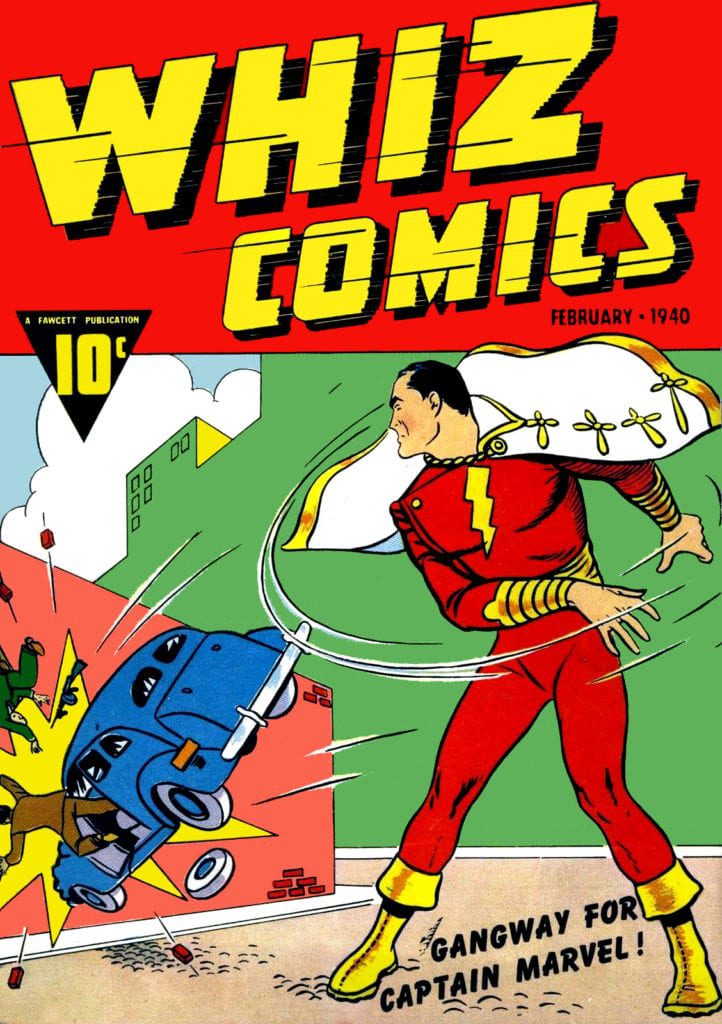
Shazam, originally sporting the name Captain Marvel, first appeared in Whiz Comics #2, which was published in 1940 by Fawcett Comics. Captain Marvel was a simple golden age hero but stood out among the rest because his alter ego was a ten-year-old boy. The child was able to transform between normal child and superhero by merely uttering the magic word Shazam. This secret identity allowed children to relate to Captain Marvel more than any other hero, and Fawcett comics was able to connect to even more people with the introduction of Mary Marvel and Captain Marvel Jr. After a short while, Fawcett introduced more fantastical ideas into their issues, which led to characters like Mr. Tawny, a talking tiger, and Hoppy the Marvel Bunny, who possessed the same powers as Shazam. This strange group of superheroes, combined with the fantastical adventures they went on, made the Marvel Family (no association with Marvel comics, which had not adopted that name at the time) a beloved superhero team. At one point, sales of Captain Marvel rivaled that of even Superman.

Cover of Whiz Comics #2

As Captain Marvel was in his prime, issues arose in the form of a lawsuit. National Comics (eventually to become the DC Comics we know today) sued Fawcett Comics because Captain Marvel was similar to Superman in too many ways. There were even instances where actions performed by Captain Marvel mirrored that of Superman in earlier issues, such as pulling an elevator up by its cable. The case was complex and took twelve years, cementing it as one of the longest-running legal battles in all of comic book publication history. National Comics emerged victorious, and the case resulted in Fawcett Comics being forced to cancel all superhero-related comic books, including those containing Captain Marvel or the Marvel Family.

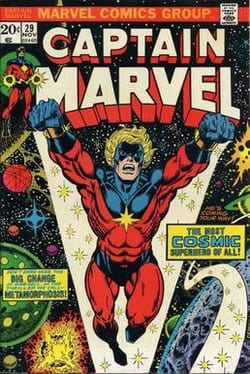
During this time Fawcett Comics was unable to publish anything featuring Captain Marvel, and the trademark they possessed on the name lapsed. This allowed Marvel Comics to use the name for a character of their own: a predecessor of the Captain Marvel that premiered in the Marvel Cinematic Universe in 2019. This Captain Marvel was male and has a very similar origin to the Carol Danvers Captain Marvel that is in the mainstream today. Carol Danvers took over as the Marvel Universe’s Captain Marvel in 2012 (and there were additional heroes who held the mantle after the original’s death in 1982.)

Marvel Comics Captain Marvel

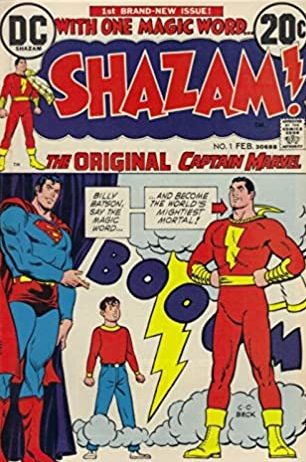
Even though Fawcett Comics was unable to publish anything containing the character, the original Captain Marvel — eventually to be known as Shazam — was far from extinct. In 1972, DC entered into an agreement with Fawcett Comics to license the Marvel Family of characters, and the world’s mightiest mortal found his way onto comic book pages again. However, due to Marvel Comics now possessing a character named Captain Marvel, the series that DC premiered in 1973 was entitled Shazam!: The Original Captain Marvel. Marvel later forced DC to change the subtitle to The World’s Mightiest Mortal, resulting in the character’s name appearing nowhere on the cover of each issue. This eventually led to people referring to Captain Marvel as Shazam, and was what caused his name to eventually be changed.

Cover of Shazam 1973 Revival

The 1973 series Shazam!: The World’s Mightiest Mortal initially had C.C Beck doing the art. He was the artist of Captain Marvel in the Golden Age, so the new series continued to have a feeling of Golden Age comic books well into the Silver Age. This archaic art style turned many off from the new series, and even the creators had a distaste for what they were publishing. This series also made it so that the Marvel Family existed on Earth-S, separate from DC’s Earth-1 main continuity. Despite only lasting 35 issues, the 1970’s revival of Shazam was important because it marked the first time Captain Marvel returned to the page when he could have been left unused forever.

Shazam made several appearances in the late seventies and eighties in series such as in Justice League and All-Star Squadron, but never got a series of his own. He played a role in Crisis on Infinite Earths, which also brought Captain Marvel from Earth-S to the main continuity.

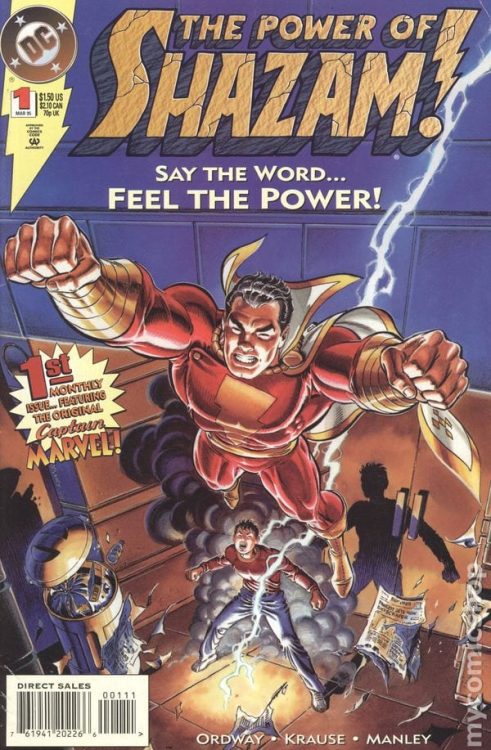
In 1994, The Power of Shazam! written and illustrated by Jerry Ordway was released, bringing back the beloved character in a new art style similar to mainstream comic books at the time. The graphic novel led into an ongoing series of the same name, which was a more realistic version of Captain Marvel than we had seen before that still managed to bring the fun and fantastic characters from the golden age into play. Throughout the series, Hoppy the Marvel Bunny, Mr. Mind, and several other goofy characters made appearances in a more realistic setting. This revival of the character is some fans’ favorite portrayal, and it is well deserved. The series ran until 1999.

The Power of Shazam Cover

After the cancellation of Power of Shazam!, it was a while before the hero saw a series of his own. In the early 2000s, Shazam made appearances in JSA, Infinite Crisis, and 52 without very significant roles. He was also featured heavily in the 12-issue maxiseries Justice, but it wasn’t until the maxiseries The Trials of Shazam! that the Shazam family was the focus of a story. This series had Captain Marvel take on the role of the Wizard, and focused on Captain Marvel Jr. attempting to pass certain trials to prove he could become the new hero Shazam. This maxiseries made many changes to the Shazam lore, but sadly very few had a significant effect because DC continuity was rebooted as a result of the New 52 rebranding.

After the New 52 relaunch, Shazam was not given a series of his own, and initially did not seem to exist in the new continuity. Luckily, in the back of issues of Justice League, fans were treated with a new origin for the world’s mightiest mortal. This time, several changes were made to the origin of Shazam, including a much larger cast of supporting characters, more people who can summon the magic of the wizard, and officially changing the name of the hero to Shazam. Many had already been referring to Captain Marvel as Shazam, so the name change was expected. Written by Geoff Johns, the new origin brought freshness to the character and introduced him to many readers who were unfamiliar to the character.

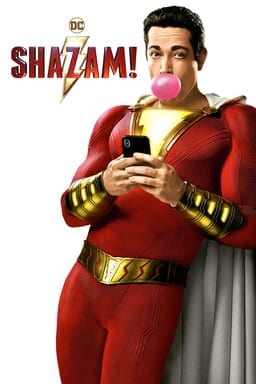
In 2019, the film Shazamarrived in theaters. Directed by David F. Sandberg and starring Zachary Levi, the movie heavily reflected the origin set forth by Johns during the New 52. The most prominent change of the film, other than Doctor Sivana being the main villain instead of Black Adam, is that Shazam is now incapable of saying his own name. In the Johns story, he added a clause that Shazam needed to say his name with meaning to transform, but in the movie any attempt made by Shazam to say his own name will result in him transforming back into Billy Batson.

Shazam Movie Poster

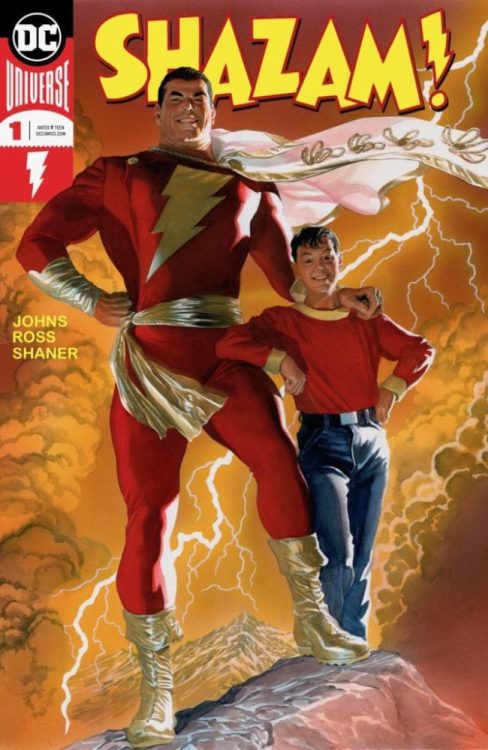
Currently, Shazam has his own ongoing series started in 2018 and written by Johns, which will hopefully continue for many years. Johns has slowly introduced new ideas to Shazam lore, while also bringing back beloved characters and villains for the whole Shazam Family to interact with.


What’s your favorite appearance of The Big Red Cheese? Leave your answer in the comments below!

Monkeys Fighting Robots Youtube