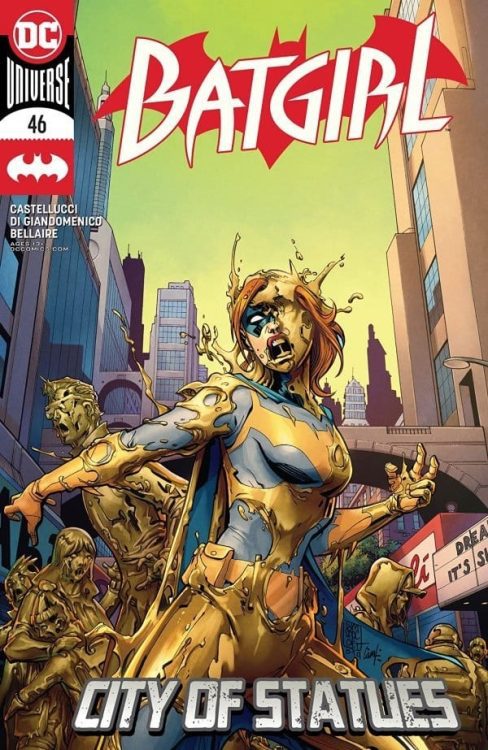
Staying Gold is literal on the cover of Batgirl #46
BATGIRL #46, available now from DC Comics, concludes the latest plot arc, while leaving fans more concerned than ever about the fate of a beloved heroine.
Staying Gold is literal on the cover of Batgirl #46
***SPOILER WARNING***
Batgirl has been doing a brilliant job of holding her own in recent times. Yet the recent cameo from Batwoman is a poignant reminder of Batgirl’s past – and origin. With everything going on in Batman’s series, as well as other events, it forces fans to remember Batgirl’s roots.
Even while she’s actively trying to forge something new for herself here. She’s trying to change her city for the better. Not just focusing on crime, but by helping to create better laws, cleaner initiatives, the works.
She’s also working on her personal life, which is something that too many heroes and vigilantes neglect. When the work gets tough, you need an escape, as well as a support system. That’s a lesson Barbara has learned again and again, and yet sometimes she still struggles to open up.
That brings us to Batgirl #46, ‘Stay Gold’ is a plot arc that brings all of these elements together. Her past, her concerns for the city, her determination to protect others, all of it. The question is, what is she going to learn from the process?
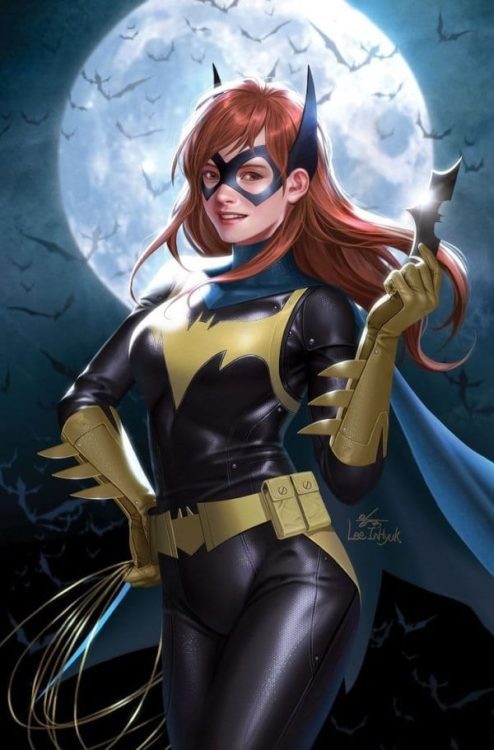
Barbara is looking young and ready for a fight on this alternate cover of Batgirl #46.
Writing
Batgirl #46 was written by Cecil Castellucci, who has been doing an excellent job of creating new events and dilemmas for our heroine to come up against. This issue is just as humanizing as the rest. Reminding fans that even pros in the hero industry need reminders of who they are outside of the costume.
The events that occurred within these pages were tense – as they should always be when many lives are at stake. Honestly though, it’s all of the secondary elements that make this issue shine. Batgirl’s focus on saving people – and trying to make a connection through that unified determination. Her driving passion, her empathy. It’s all laid out clear as day here.
The cameos were a nice touch too, of course. As were the elements surrounding her other life efforts, such as the political fallout from what occurred. That’s to say nothing of the budding relationship that has been hinted at for so long.
All things considered, there’s so much going on within this issue. Castellucci has proven again and again that they can create complex plots, ones that involve more than one plot arc. They have done it again here, with a conclusion that will literally make fans scream.
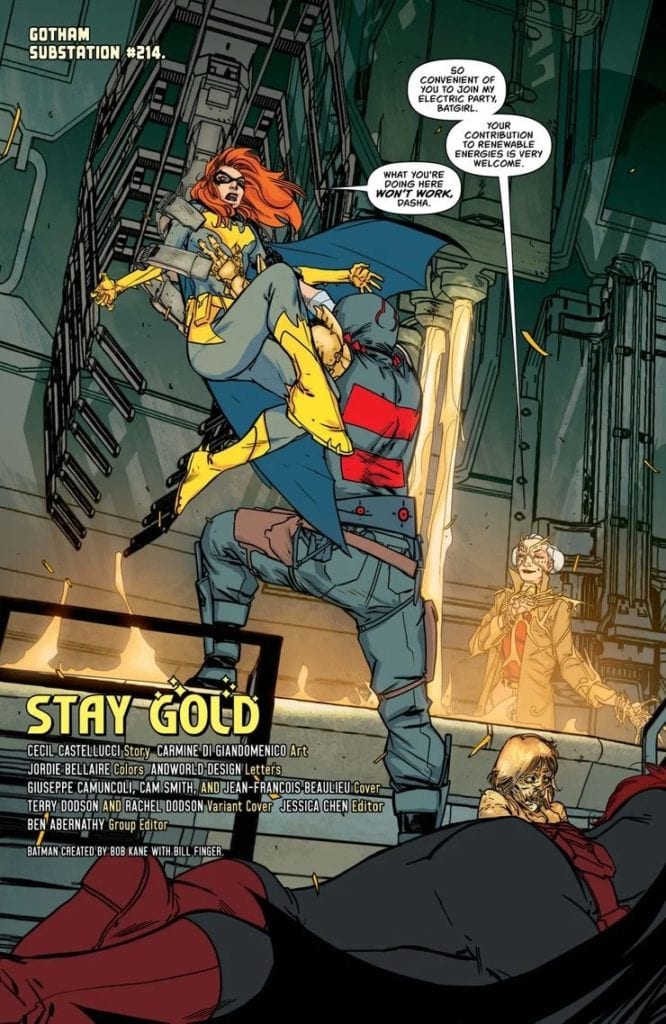
Diving right into the action, huh?
Art
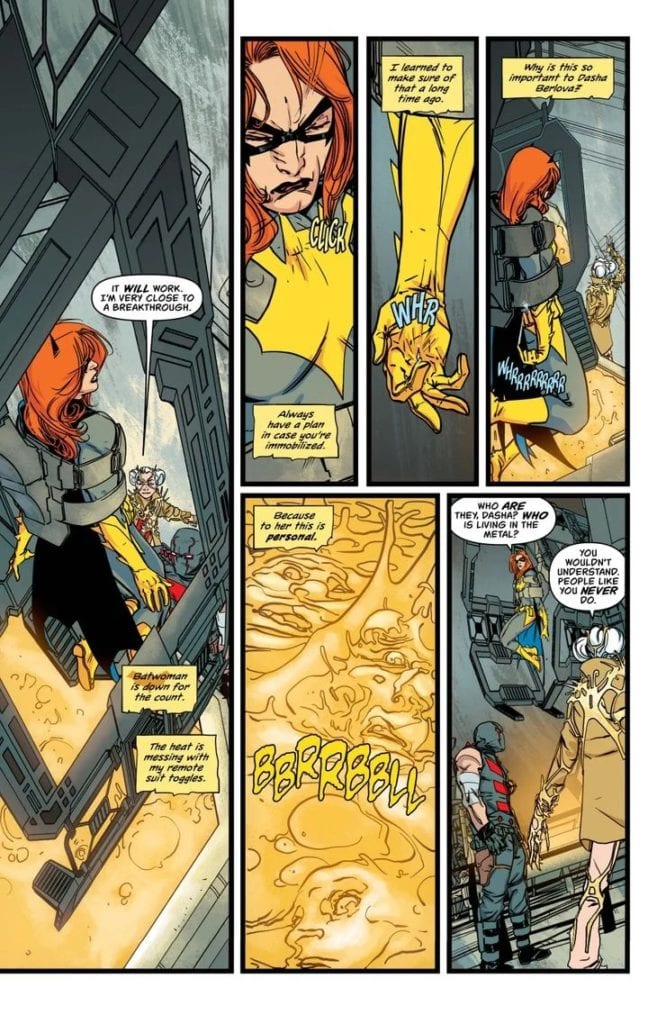
The artwork behind Batgirl #46 is bold and brilliant. There are many shining points to talk about here, some of them being more literal than others. The action is fast and dramatic, the colors bright, and so much more.
Carmine Di Giandomenico was the lead artist for this issue. They provided a solid support system for this plot. There was something organic yet horrifying about the latest villain, something that you just can’t look away from.
Then there are the colors, provided by Jordie Bellaire. They’re so bright and vibrant. For example, the gold actually does read as just that – in a terrifying molten form, of course. Put against a vivacious blue backdrop, and it’s actually quite stunning. That’s merely one example of the smart designs that occurred within these pages.
Finally, there’s the lettering, provided by Andworld Design. The lettering in this issue is an ideal example of a solid support system. The lettering does exactly what it needed to here, without even thinking about distracting from that luminous artwork.
The molten gold brings with it horrifying implications.
Conclusion
Batgirl #46 was a surprising issue, no matter how you look at it. Batgirl has once again solved a problem through completely different means, all while showing everything that makes her special. She’s made great progress, especially these last few issues. All of that simply makes the conclusion all the more alarming. It’s going to be a long wait for Batgirl #47.
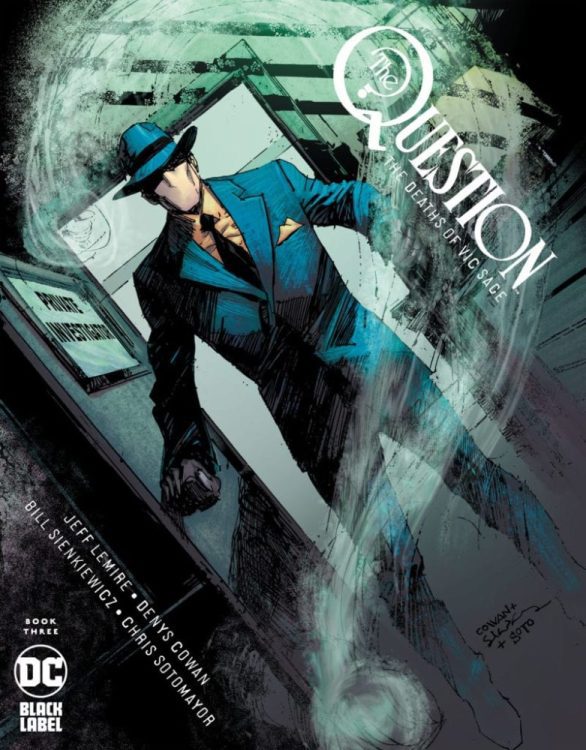
DC Comics released The Question: The Deaths of Vic Sage #3 this past week on June 16. Writer Jeff Lemire continues to weave a tale of intrigue and mystery with one of DC’s most painfully underutilized characters and does so with a profound respect for the history and essence of the character. I’m sure this is helped by having classic Question artist Denys Cowan doing pencils for the issue, who is accompanied by Bill Sienkiewicz on inks. Chris Sotomayor joins them as the colorist along with letterer Willie Schubert.
Writing
Lemire continues Vic’s vision quest through his past lives. After exploring his life in the Old West, Vic now finds himself in the 1940s, working as a private investigator searching for Jacob Fuller, a labor rights advocate. Vic takes on the case from Jacob’s sister, and fellow union activist, Margaret Fuller. Considering The Question’s Objectivist origins, putting him on the side of collective labor over-against upper-class business owners is a clever reversal of Steve Ditko’s original intent for the character. That is the beauty of Lemire’s work on this series. It reminds me of Grant Morrison’s run on Batman in that Lemire has incorporated all of the elements of The Question’s publication and media depictions into his story: the black and white moralist, the PI, the journalist, and even the mystic, all while redefining those stories for modern audiences. Most specifically, Lemire defines the Question’s concern for justice around social issues like race and labor rights.
There’s also a very brief “blink, and you’ll miss it” reference to the Justice Society of America, which seems to indicate that this story is attached to a larger universe. Whether that universe is self-contained or attached to the main DC continuity (in the same way that the Netflix Marvel shows “are” a part of the MCU) is something that I’m sure plenty of fans will probably talk about in chatrooms.
Lemire continues to weave a strong, complex narrative as Vic Sage attempts to overcome evil and keep history from repeating itself once again.
Pencils/Inks
I can’t say enough about Cowan and Sienkiewicz’s art in this book and the series as a whole. Sienkiewicz’s inks are a perfect complement to Cowan’s pencils. Both men’s talents were made to draw this Question story. Their work expertly creates the noir feel of this issue, capturing the cynical and dark corners of Hub City in 1941. This should be no surprise since this isn’t Cowan’s first time drawing The Question, and Sienkiewicz has shown his penchant for noir in Brian Michael Bendis’s Alias. This is Cowan and Sienkiewicz at their best!
Coloring
Sotomayor shines in this issue. His muted colors help to create the noir atmosphere for this story. He also knows how to occasionally brighten certain details up that make them “pop” off the page, usually those of The Question’s outfit. The blue on the cover provides a nice contrast to the dark world the characters inhabit.
Lettering
Adding to the noir sensibility is Schubert, who provides the “voice over” in lettering that looks like it could’ve been written on a typewriter. All of the little lettering details combine to help create the proper atmosphere for this story. Whether it’s Vic’s handwriting on a notepad or the font style of the many newspapers he passes by (one of which contains that JSA easter egg I mentioned earlier), Schubert’s lettering adds as much to the noir elements of this story as the pencils, inks, and colors.
When Lemire and company set out to write their series about The Question, I wonder if they realized how relevant it might be for our current time. Culturally, the series has dealt with issues of racism, both in the present and the past, including police brutality. In issue #3, labor rights are highlighted, and again, police are shown as a means for quelling social protests and outrage. On a more personal level, with the passing of Denny O’Neil this month, it seems only fitting that his former collaborator from The Question series in the 80s, Denys Cowan, is doing the art for this series.
Perhaps this is the promise of DC’s Black Label. People can have the time and freedom to write great stories that relate to the world in meaningful and authentic ways.
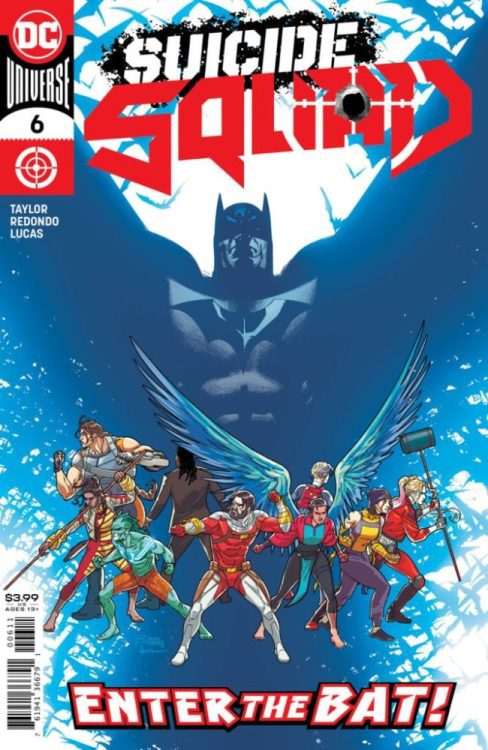
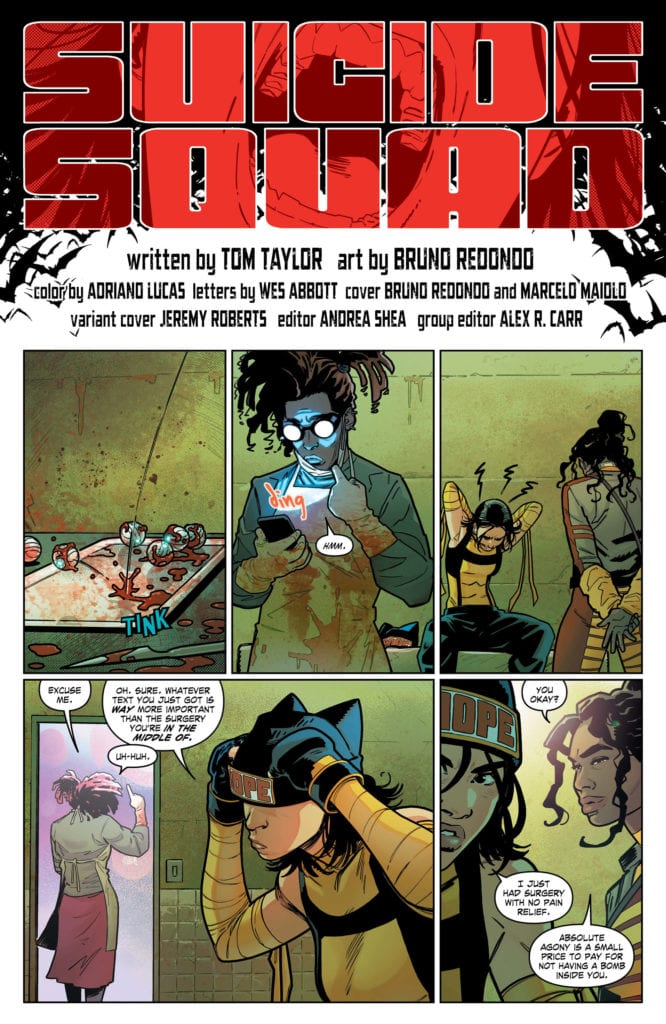
Writer Tom Taylor, artist Bruno Redondo, colorist Adriano Lucas, and letterer Wes Abbott have done it again. Another stellar issue in the series that is Suicide Squad. DC Comics’ Suicide Squad #6 is a ridiculous mess. But would you really want to see this loveable team of psychopaths any other way?
Writing
Taylor is always having fun with this series. And his characters are too. It’s one thing to put a cast of colorful characters up against great odds and see them struggle. It’s another to see them love every second of it. With new developments coming to light, and Batman on their tails, Taylor revels in the shit hitting the fan. Not only does he put the Squad into crazy positions, but he regularly gives them a moment where they step out and notice the ridiculousness of what’s going on. Taylor knows how to keep the ball rolling without dwelling on exposition. Briefly, we get a moment between Osita and Deadshot that seems a little premature, mutual respect and trust that still feels unearned. But Taylor’s treatment of Batman is a spectacle to pardon all grievances. Batman is placed outside of his element, his defensiveness and failure at banter make it a highlight of the series so far. Honestly, give this man a Batman run. Unless… he’s the Tom that already has one?
Art
It’s amazing to see Redondo use the same techniques, to very different effects. At one point, we see the Suicide Squad running out of a dingy operating room when Chaos Kitten stops them. She’s found a puppy, which she then holds up to Osita, asking to keep it. There is very little movement across that page. We see Chaos Kitten see the dog, we see her hold the dog up to Osita for two panels, and then two panels of them closing the doors to their getaway truck. It’s funny. Redondo gives this moment room to breathe in the midst of a getaway. They’re adopting a dog while they’re on the run. But later, as we see Batman tailing them, Redondo uses a similar technique. Very little movement on the page. But this time, all the panels are on the same line, and Batman is placed so he’s never fully in frame. We don’t get the feeling that much time has passed. Instead, it looks as though Batman has moved through the crime scene and gotten what he’s needed in a flash. Redondo’s use of time on the page is masterful. His little variances make something go from hilarious to badass.
Coloring
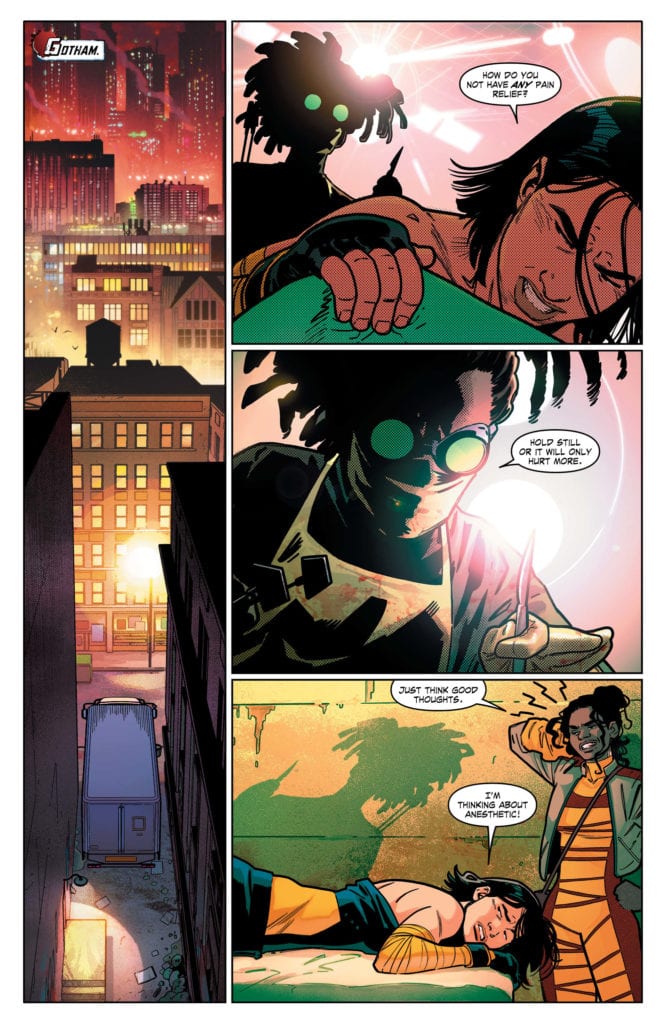
Lucas gives us the Gotham City of our nightmares. Of course, we get the dark streets, but we also get the brightly lit back-alley doctor’s offices. The fluorescent feel to those pages makes the colors looked washed out and sickly. Fitting, given that anyone would feel sickly in that environment. Outside, the sky is a dark red, like blood. Lucas never lets us forget that the Suicide Squad is now in Batman’s town. It even feels like a vampire’s playground. The bright yellows and greens that interrupt the color scheme feel strangely comforting, but they don’t come often. It’s like the Squad is trying to leave their mark on Gotham, but Gotham already knows who she is. And so, each impression the Squad tries to make is drowned out by the city’s overwhelming personality.
Lettering
Abbott should get a medal. He has his work cut out for him. Everything in this issue makes a noise—the ding of a text message or the bark of a dog. But the real fun begins when the Squad faces off with Batman. Abbott pays homage to the 1960’s Batman TV Show with sound effects that make you want to do the batusi. And they seamlessly give way to the regular sound effects of this series. Pointing out, in a way, that Abbott’s regular style isn’t far off from the fun of the Adam West TV show. And Abbott goes beyond just fun. He uses the sound effects to communicate what’s going on in a character’s head. In a moment when Deadshot stands his ground against Batman, he shoots a Batarang out of the air. “DANG!” is spelled out in large letters. You’d wonder how much Lawton immediately regretted facing the Bat, if Abbott hadn’t just told us.
DC Comics’ Suicide Squad is fun, hilarious, badass, and heartfelt. Often all at once. This creative team has proven themselves over and over on other projects, but here they make the perfect team. Suicide Squad #6 is another ridiculous chapter in a bonkers series. Get your copy, out from DC Comics on Tuesday, June 23rd!
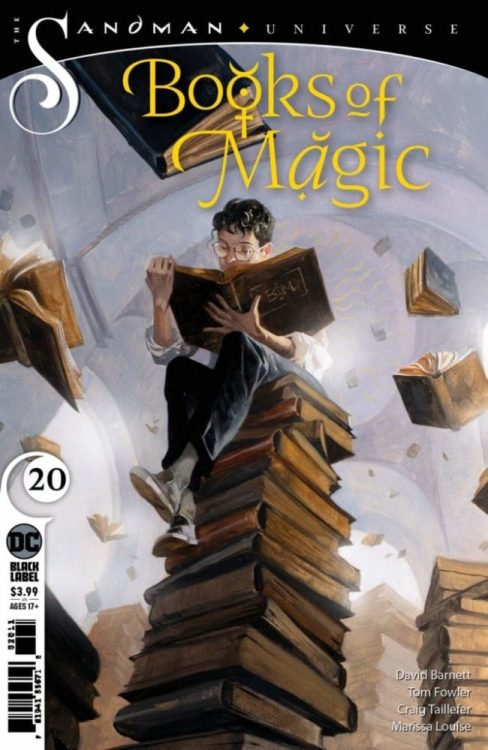
BOOKS OF MAGIC #20 hits comic book stores on Tuesday, June 23rd, concluding writer David Barnett’s two-part arc featuring the realm of Festival. Last issue Timothy Hunter and his new crush Izzy found themselves inadvertently traveling to this locale while attempting to find the Glastonbury Festival. There they ran into Twig, an old time rocker looking for his friend Geoff. The trio then finds good news and bad news; Geoff is in Festival, but he’s refusing to let anyone else leave.
Story
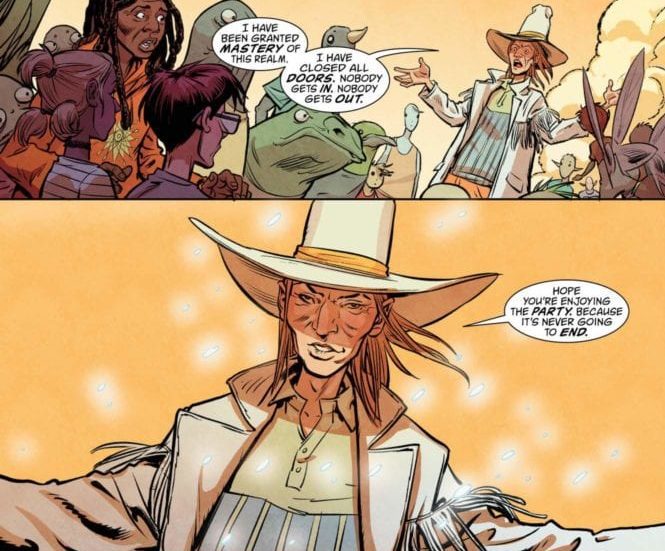
By some unknown means, it appears Geoff has gained complete control over the realm of Festival. So much control, in fact, that he was able to coordinate the mass influx of beings from all of the magical realms.
Tim, being of the most sober mind we’ve seen him in his current run, immediately attempts to reason with Geoff (with Twig’s help). But the newly crowned king of Festival reveals he has no intention of returning to his disappointing mortal life for reasons readers will be anxious to learn.
Barnett’s script in this issue and last’s provides readers with a more lighthearted tale to provide balance to the previous arc. Coming out of a darker arc into a story that focuses on the zany unpredictability of magical realms like Festival was just what we needed.
Artwork
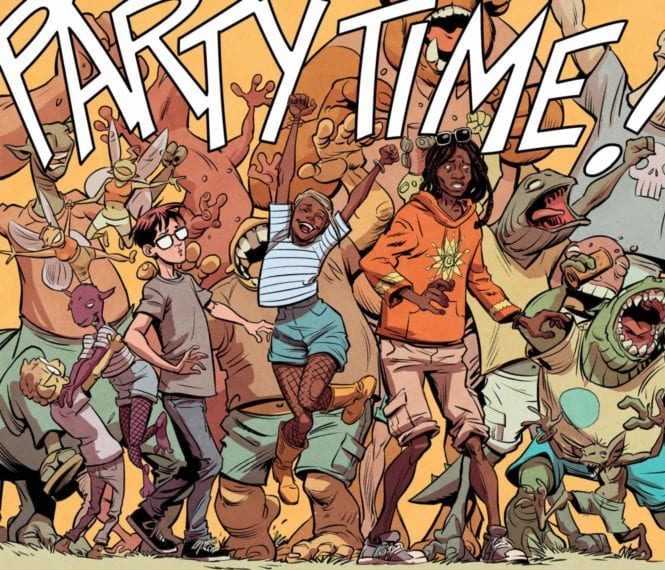
Tom Fowler’s penciling and Craig Taillefer’s ink work, Marissa Louise’s coloring, and Todd Klein’s lettering created a brilliant visual representation of Festival. The illustrations of the events taking place in Festival are full of bright colors and detailed designs. One can feel the energy from each page. And the lettering adds to this with effective use of onomatopoeia, making it look like the words part of the scenes themselves.
Conclusion
BOOKS OF MAGIC #20 offered a heart-felt conclusion to this arc. We’re so used to darker storylines in this series; it’s nice to let some light shine through every now and then.
What realm do you think Tim will visit next? Let us know in the comments below!
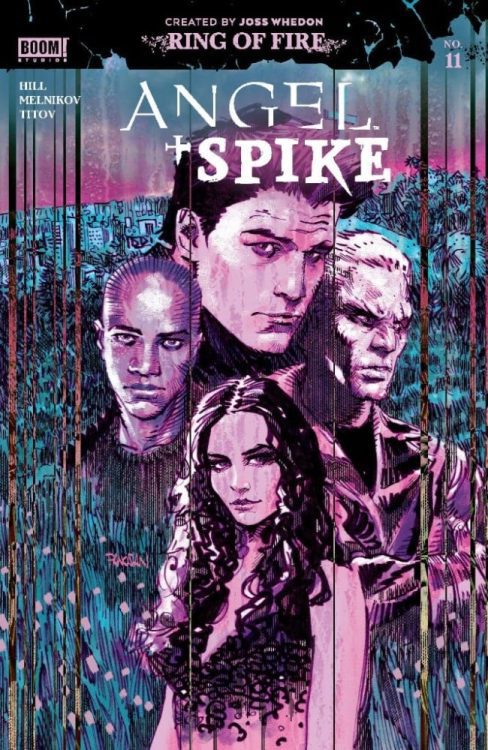
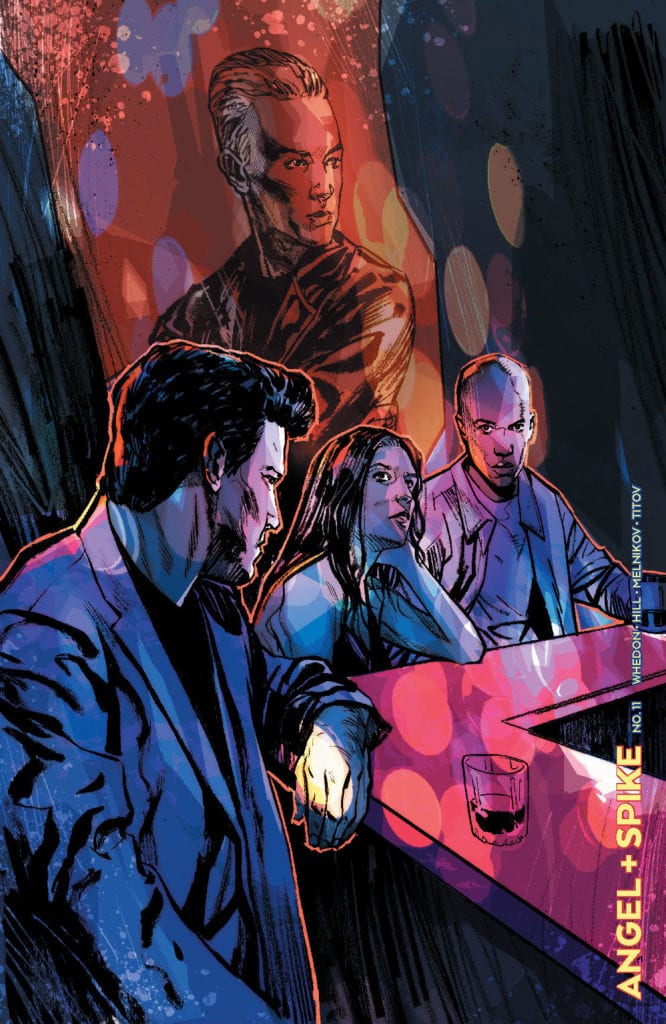
With the Hellmouth crossover still affecting the story-lines, this weeks Angel + Spike #11 has to deal with the fallout as well as new horrors. Continuing the re-imaging from BOOM! Studios, this series has proven to be a hit with fans and new readers alike. Seemingly unfazed by the character’s legacy, the creative team have made Angel their own and continue to push the boundaries of expectation and creativity.
Angel + Spike #11 Credit: BOOM! Studios
Tales To Tell
There’s a killer demon on the loose in Los Angeles but then again, when isn’t there?
While Angel broods, forced to face part of his past by Lilth, the rest of the gang get to work saving the day. Unfortunately for Fred, saving the day will come at a cost and she will be forced to face her own demons. And on the edges, creeping ever closer, are the infamous law firm Wolfram and Hart.
Despite the title, this issue is all about Angel and Fred. Bryan Edward Hill has crafted a story comparing the two characters and their individual plights. Hill puts his cast members into situations indicative of their personalities and then allows the narrative to draw out their fears. Both Angel and Fred have to face an aspect of themselves and their reactions tell the reader everything they need to know about the characters.
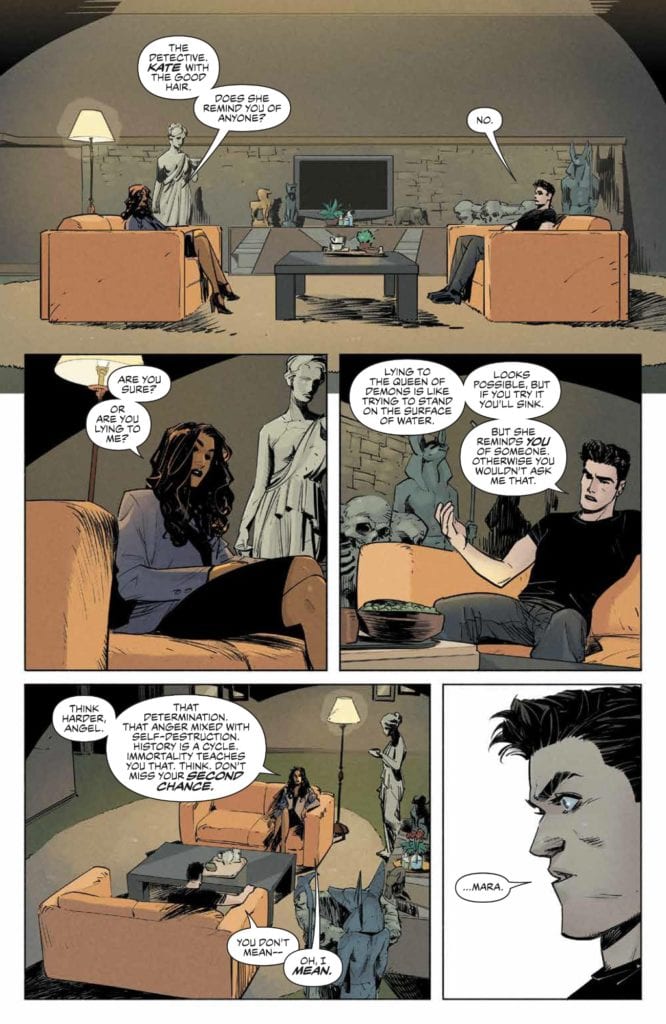
Angel broods. Hill literally allows the vampire to sit out of the action and has him engage in a number of conversations. Slowly the therapy-like sessions reveal a little of Angel’s past and Hill is able to play with new ground, expanding on the character’s history which he has hinted at in previous issues.
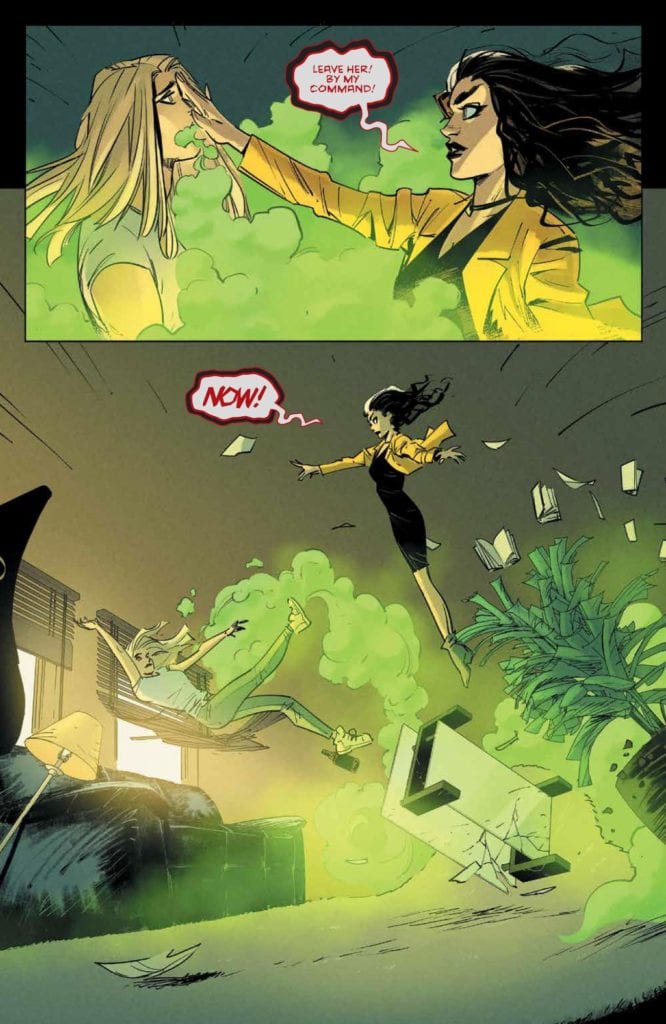
In turn Fred is facing a dilemma that is very much in the present. She has trust issues and this means she doesn’t know where to turn. Afraid of what her new team mates might think of her she desperately leans on the only other person who appears to be able to help: Lilah. To contrast Angel’s journey, Hill shows the reader exactly how powerful Fred is becoming and the temptations she faces. Fred is the action star in this issue.
Angel + Spike #11 Credit: BOOM! Studios
Running or Sitting
Gleb Melnikov fills this issue of Angel with energy. Whether it is the magical energy emanating from Fred or the personality confrontations between Angel and couch partners, there is a constant electric air on the pages. You can almost feel it crackling from the panels. Melnikov is quick to set the scene in the first panel and then use each following image to tease the cast’s characteristics to the foreground. When he does pull the point of view back it is always for a heart stopping, powerful moment in the narrative.
The pacing is pitch perfect for the story Hill is telling. It is not overrun with action and doesn’t skip through the contemplative moments. Melnikov gives each scene the space it requires to breathe, allowing the narrative to grow slowly and the impact of each revelation to sink in.
His line work is sharp and to the point which gives the comic an eerie, uncomfortable feel. The companion comic, Buffy, has a lighter tone and in comparison is definitely aimed towards a younger audience. Angel is more adult in nature. Not because it is gorier or more explicit in nature, but the themes it deals with, such as the corruption of innocence, is less black and white. It’s not as straightforward as good versus evil. Fred’s move towards Lilah is almost understandable in the circumstances and so is Angel’s reluctance to get involved with Kate.
Angel + Spike #11 Credit: BOOM! Studios
Letters and Tones
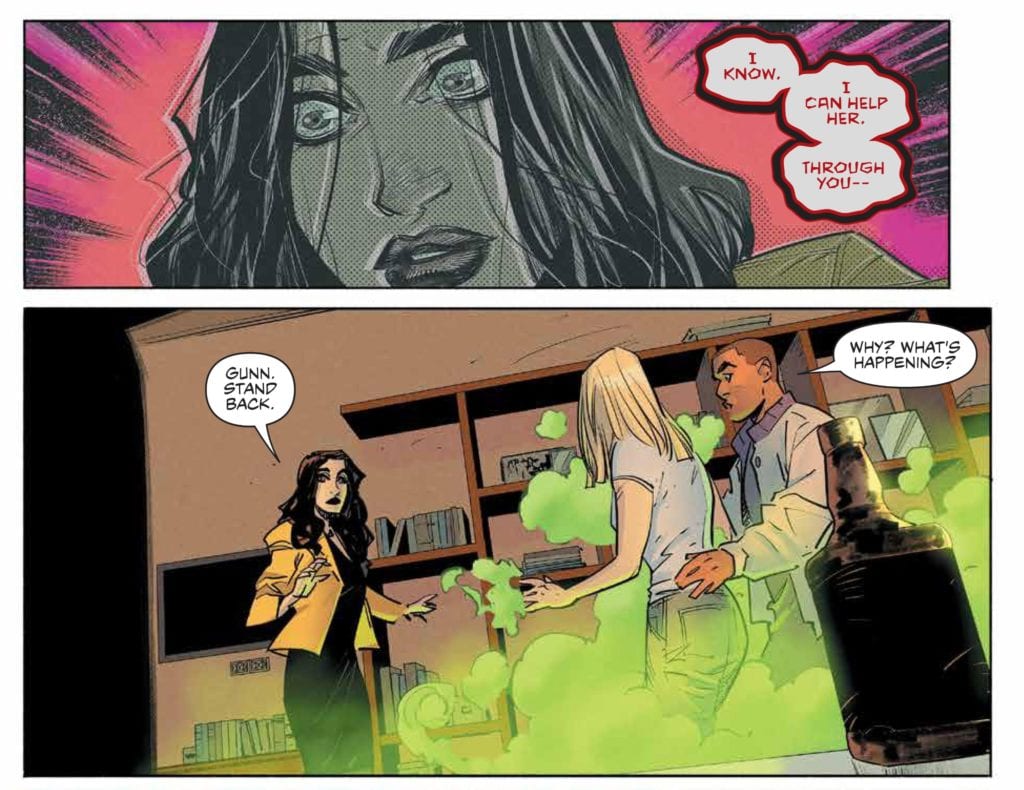
Ed Dukeshire has created some exquisite speech balloons for this issue of Angel. When Fred’s inner demon comes out, her tone and personality dramatically change all because of the thick, harsh borders Dukeshire uses. The change in text color also helps to stamp the character voice onto the scene. You can hear the disturbing tones rattling around your brain as you read these pages.
Dukeshire uses more subtle changes in the text and speech balloons in other sections of the comic, but these are equally as effective for creating individual voices for the cast members. These shifts in tone and mood are assisted by the color work of Roman Titov. Quiet moments of introspection are softly colored with mundane shades and plenty of shadow. This all changes when the scenes shift into supernatural realms where Titov brings out the horror with unsettling color choices.
Angel + Spike #11 Credit: BOOM! Studios
Conclusion
Angle + Spike has a growing cast but Hill manages to keep focus on the story and not become sidetracked with obsessive fan service. This issue is packed with character development and the world Hill is building is both familiar and brand new. Overall it feels like part of one of the best episodes of the television series.
The artwork is superbly fitting for Hill’s take on the Vampire with a Soul and with every issue the entire creative team push the bar a little bit higher. This run of Angel has become a must read for fans of the franchise and beyond.
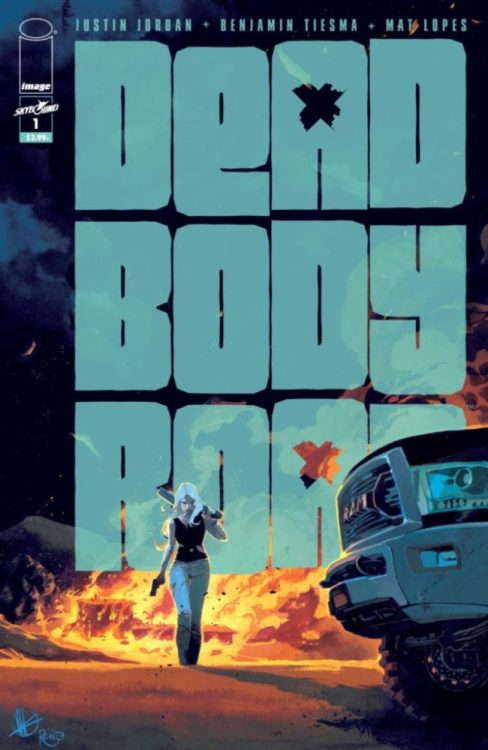
A potent mix of Justified and Winter’s Bone, writer Justin Jordan (Reaver, Luther Strode) and artist Benjamin Tiesma’s “Dead Body Road: Bad Blood” #1 is an atmospheric right-hook of small-town crime and punishment. With colorist Mat Lopes and letters by Pat Brosseau, this opening issue is the opening shots of what could turn into one of the best crime comics of the year.
“Bree Hale has left a lot behind in her life. Crime. The military. But she can’t leave behind her own family, and when the local crime boss puts a hit out on her brother, there’s nothing she won’t do to save him. Absolutely nothing.”
Writing & Plot
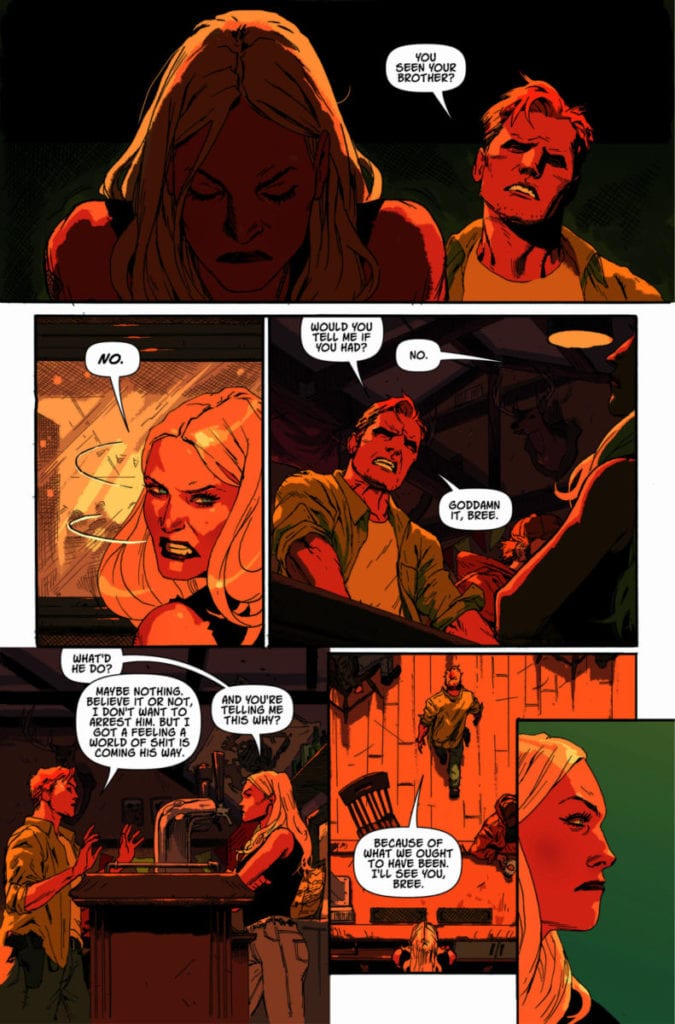
Justin Jordan clearly knows how to set up a powder keg of a vigilante justice story in this first issue of “Dead Body Road.” The intense face-to-face meetings of badass bar owner Bree Hale and the crooked members of local organized crime are loaded with tension. The backstory of Bree, her history with the town, and her relationships with other characters are delivered with sharp dialogue and potent use of detailed scripting. As a protagonist, Bree Hale is almost instantly likable. She’s a rugged, take-no-crap woman with a troubled past that she has quietly decided to distance herself from. When the heat turns up against one of her own, she becomes an absolute badass, and it’s clear that she is going to be a thrill to watch for the rest of this series. This kind of small-town local justice has obviously been done before in any and all mediums (see above comparisons), but it’s such a satisfying sub-genre to see done right, and Jordan knows what he’s doing in writing this comic.
Art Direction
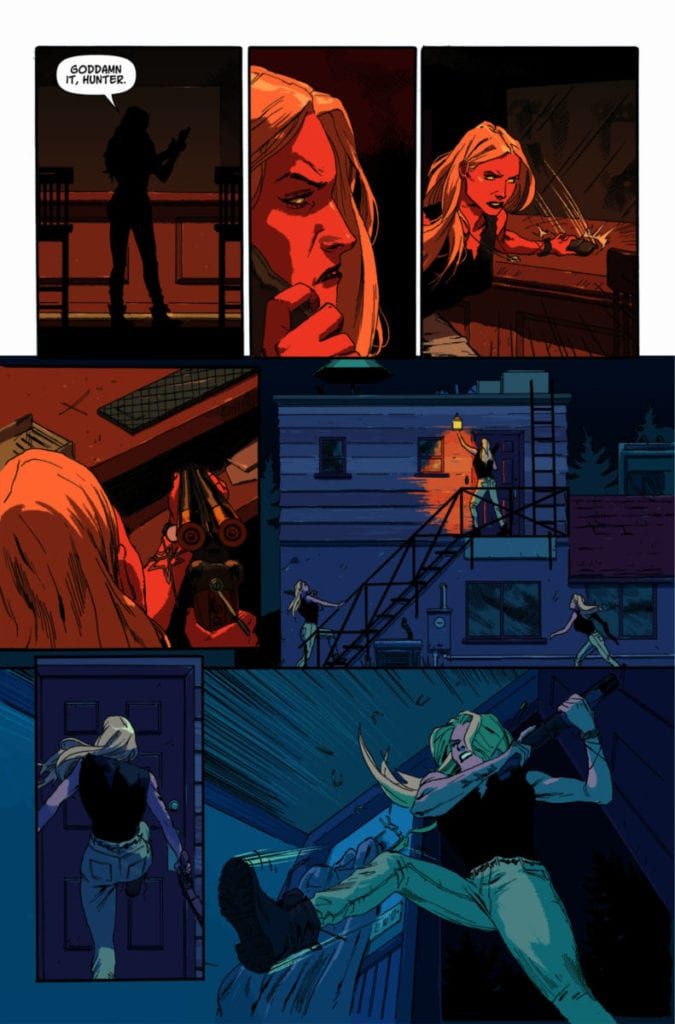
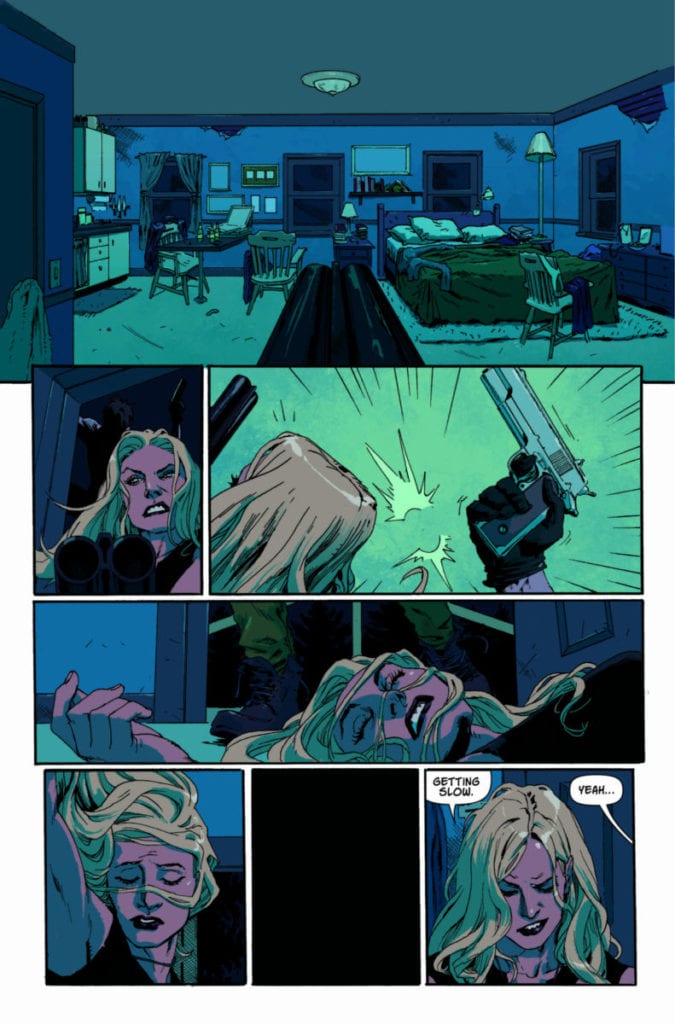
The real stunner in Benjamin Tiesma‘s artwork on “Bad Blood” is his character detail. The attention paid to the characters’ facial expressions is immense, and it sells the comic’s character-driven narrative style. This is a story ruled by deviousness, panic, and anger, and the character both savior and villain are all duly drawn to easily feature such a range. The environment is a detailed representation of your average rural backwater as well, dominated by the local bar and roadside motel. The aesthetic is tied together by Mat Lopes’s faint, grainy colors, which sells the dark middle of nowhere setting as well as the crime-movie inspired film reel look. The whole issue takes place at night (as these stories often do), so the visuals being so dominated by faint colors and shadows is a practical necessity and not just a stylistic choice. The lettering is fine in the fact that it does its job, but disappointingly the font never alters in form whatsoever to match a character’s tone. This fact is almost unnoticeable due to Tiesma’s feature art, but the fact remains. Overall, “Dead Body Road” #1 is an artistically sold comic that nails the aesthetic for this kind of story.
“Dead Body Road: Bad Blood” #1 is an enticing and gritty start to this small-town vigilante justice comic mini-series. Jordan’s script is full of naturalistic and slick dialogue while leaving plenty of room for the art to talk. Benjamin Tiesma and Mat Lopes’s work is detailed and character-focused, pulling the reader into the panels with fantastic character art and grainy aesthetics. If you want to get in on this sawed-off shotgun blast of a comic, be sure to pick it up from your local comic shop on 6/24!
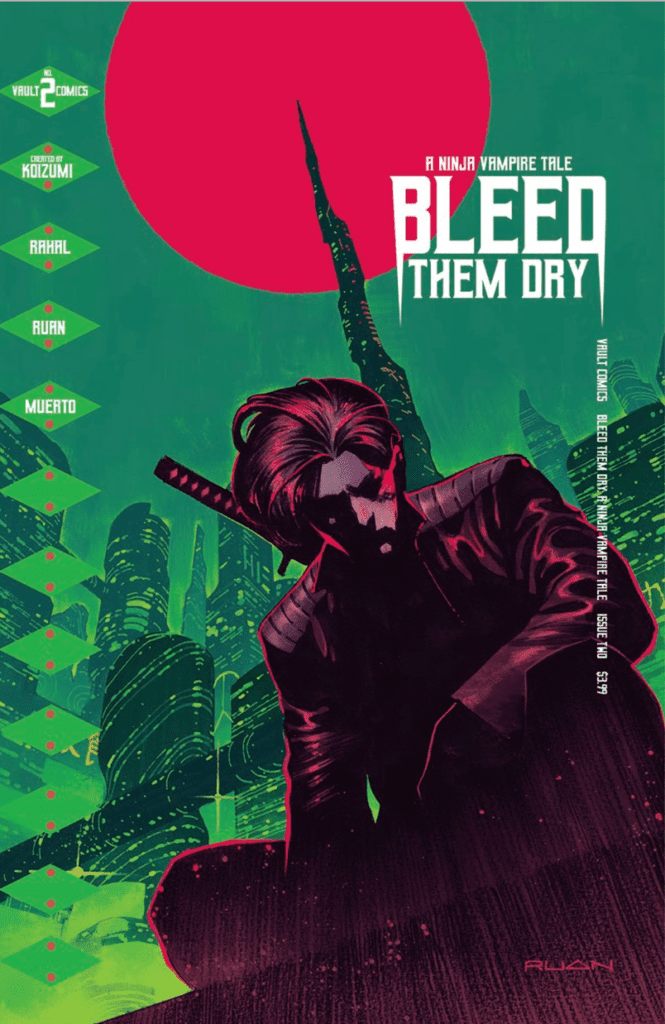
Bleed Them Dry #2 from Vault will end the month of July with a revelation that changes the readers’ perspectives. After the first issue introduces the world of vampires and their dark secrets, readers are eager for more. After this issue this series might become addicting.
Bleed Them Dry #2 Story
Bleed Them Dry #2 keeps a keen interest on the vampires, especially as it relates to Detective Harper Halloway. Coming to terms with last issue’s revelations, she finds comfort in her savior Toyo Yamamoto. This act however isn’t just Eliot Rahal writing a character arc; it’s building Hiroshi Koizumi’s world. In comparison to last issue, this chapter displays how vampires actually run the world. Despite how relatively peaceful Asylum looks, there are dark secrets abound. As for Atticus Black, he also comes to finding his world changed thanks to gaining prosthetics. With the way he reacts readers can only imagine what this means for him.
Artwork
Dike Ruan continues to displays very impressive architecture and detail in Bleed Them Dry #2. The buildings and their unique shapes would present marvels, but seeing them from a lower angle denotes a different feeling. A feeling of unfamiliarity and suffocation, the same applies to Black waking up to his impressively detailed prosthetics. But what really sets that feeling home is the coloring by Miquel Muerto. The watercolors of the buildings’ lights feel like illusions against the dark structures. This make the lights feel less like a means of comfort and more of a distraction. Even the natural sunlight feels like an enemy due to its bleak whiteness causing Black to burn.
Lettering
The lettering by Justin Birch of AndWorld Design continues to display every word as an extension of character. Throughout Bleed Them Dry #2 word balloons show how the characters express themselves. Most vampires have their word balloons surrounded by a red outline when their emotions are high. With knowledge that “immortals” make up the higher ups of Asylum, the police captain’s discussion with the mayor has an additional layer of weight. He tries all that he can to avoid upsetting the mayor less he feels her wrath. Yet it’s the time when the colored captions speak at minimum where emotions are at their highest. Toyo in particular always feels cool even in the face of danger; yet his yellow-orange captions express that it’s because Toyo feels he already lost his place in the dark but vibrant world.
Bleed Them Dry #2 Is A Transfusion
Bleed Them Dry #2 enhances an already impressive story by diving into another part of the world. As the world of vampires in commodity reveals its darker undertone. These revelations give not just a new perspective but waits around the corner. There are still questions that need answers and any enlightenments will come with a price.
Do you think this series has something going for it? Is it as addicting as the above describes? Leave your thoughts in the comments.
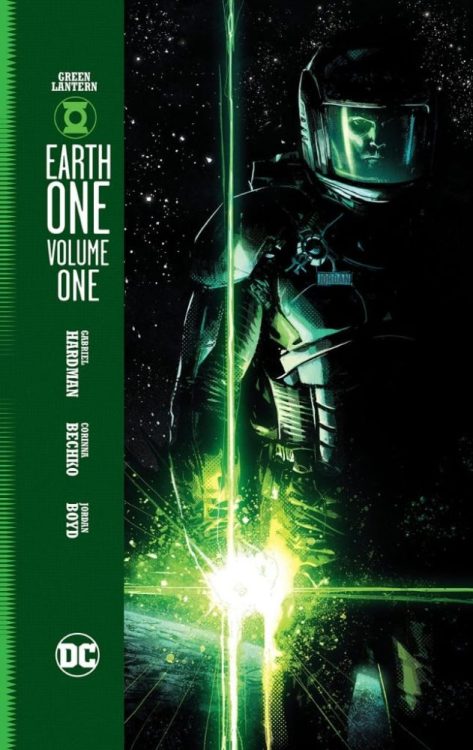
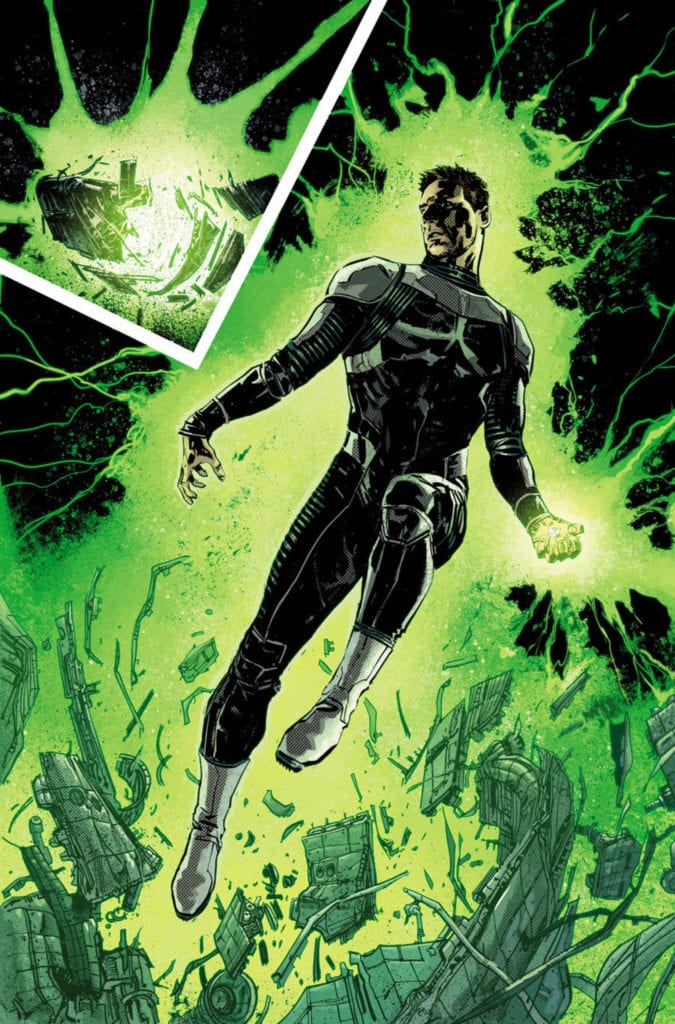
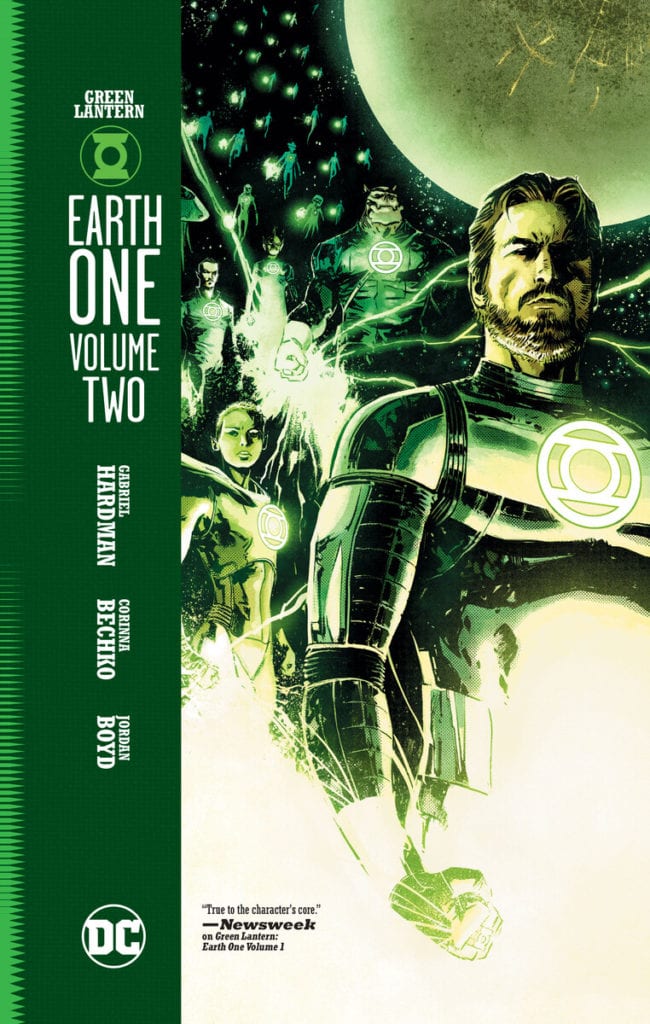
With Volume Two of Green Lantern Earth One due out from DC Comics this summer, I thought I would take the opportunity to catch up with Volume One. Released in 2018 as a hard-backed, stand alone reinvention of the Green Lantern story, Earth One has visual and creator appeal.
Writer Corinna Bechko and artist Gabriel Hardman have produced some outstanding work in recent years, most notably Invisible Republic. This politically themed science fiction series, which also included Jordan Boyd as colorist, was an intriguing, impressively constructed narrative. The style and themes used in Invisible Republic are transferred across to Green Lantern Earth One which produces a more grounded superhero comic; in the beginning at least.
Green Lantern Earth One Vol 1 Credit: DC Comics
Opening Manoeuvres
Hal Jordan is an outcast from NASA and working on an intergalactic mining operation. His team are searching for the mother-lode in the asteroid belt between Mars and Jupiter. What they find instead is a derelict spacecraft and potential proof of alien life.
Unfortunately for Hal, a disintegrating spaceship on a cold hard rock in the middle of space in just the start of his problems.
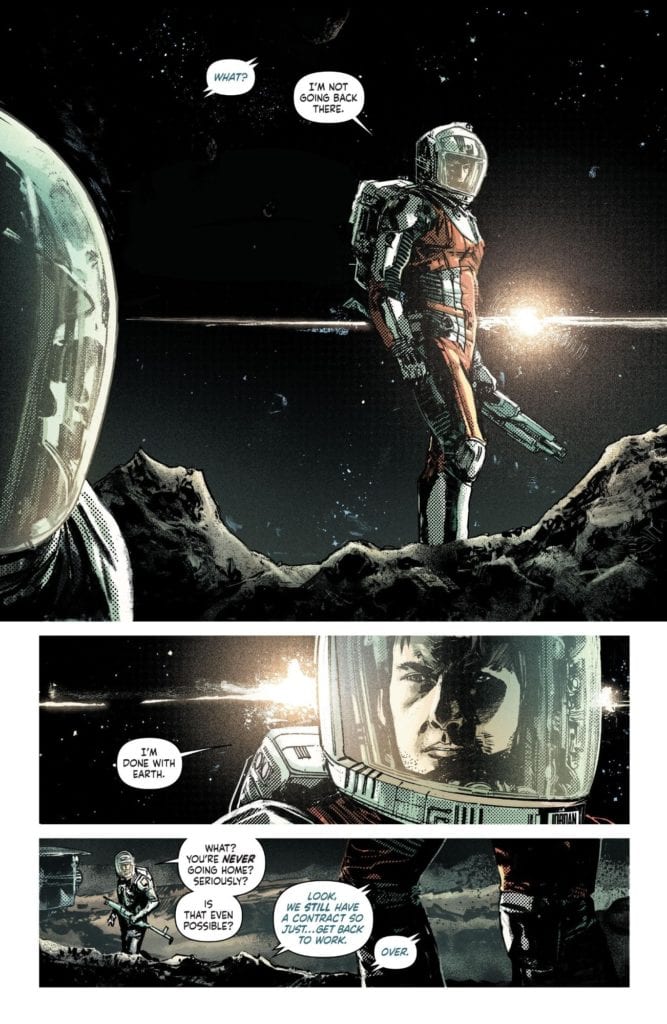
The opening of Green Lantern Earth One is atmospheric and hard on the science. Everything starts off very mundane with Corinna Bechko slowly introducing Hal Jordan to the readers through the character’s work colleagues. Bechko slips pieces of the astro-miners history into the conversations between workers, building up the man that many DC Comics readers will already know.
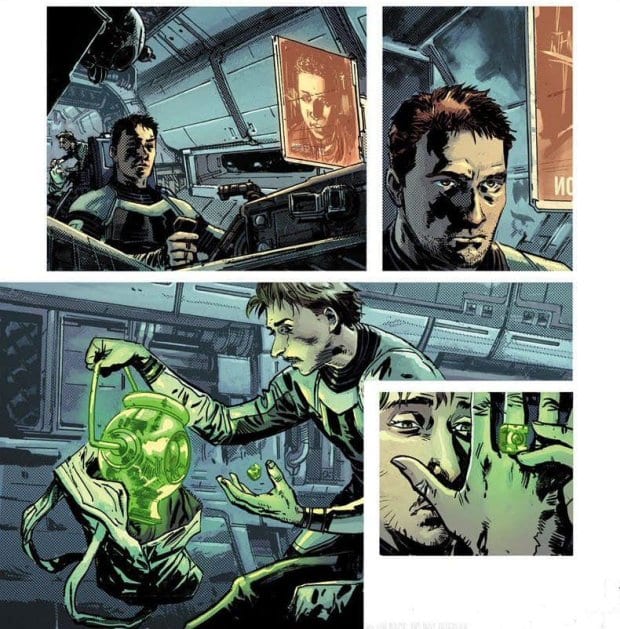
As the first act progresses it verges on horror, especially with the darkness that Gabriel Hardman brings to his artwork. The discovery and inevitable search of the derelict spacecraft calls back to 1979’s Alien movie. There is a real sense of claustrophobia to the scenes and the threat level is very high. Hardman’s dynamic inking and Jordan Boyd’s dark, oppressive colors trap the reader helplessly in space with Jordan and his fellow adventurer. There are moments where you will involuntarily stop breathing.
Green Lantern Earth One Vol 1 Credit: DC Comics
Act Two And Beyond
Once the famous Lantern and power ring are discovered an emerald green hue begins to seep into the artwork. This has a rippling effect that runs throughout the book with more and more color becoming evident, lightening the mood. Hardman’s art continues to flow across the pages with some outstanding panel designs. The shape and composition of the panels match the energy and the actions of the scene they encapsulate. It’s difficult not to be impressed by the sloping panels that appear as the derelict ship starts to slip down a cliff face. Hardman tilts the viewpoint like a camera, twisting and turning the reader with the action.
The artwork pushes the reader out into the depths of space, following Hal on his unbelievable journey. The design work begins to stand out with the introduction of new worlds and life forms. Everything becomes a contrast to the mundanity of the mining ship and it’s small, narrow visioned world. As Bechko drags Hal and the reader through a life changing adventure, Hardman and Boyd bombard you with visual delights and trickery.
As the narrative stakes get bigger, so it seems does the artwork. The pages and panels become more overwhelming with a constant increase in extra’s filling the images. The sequences become chapters, almost like single issues collected together, each gaining momentum as the threat level increases. Until the final, out of this world confrontation that would need a Marvel Movie budget to pull off on the big screen.
Green Lantern Earth One Vol 1 Credit: DC Comics
Intended Audience
The review could end there with the additional line ‘if you’re a fan of Green Lantern then you will definitely love this book’, however I wouldn’t feel comfortable about it. This is because I don’t know if that statement is true.
Personally, I have no interest in the character and that turned into a large stumbling block for this book. The reason I bought Earth One was because of Corinna Bechko and Gabriel Hardman, and by the end it still hadn’t created an interest in Hal or the Lanterns. It took me four weeks to read this book. I would read a few pages, put it down, and then pick up something else to read instead. There are elements of this comic I love but nothing about the character’s legacy or the Green Lantern Corps world captivates me. And, unfortunately, this did not change that.
As a result, I personally found the story tiresome, although the characters were well written. There are clearly references that I did not understand but fans of the regular series will probably lap up. Unfortunately, without a character to root for the story looses pace and any drama is replaced by a mild desire to simply finish reading the book.
Green Lantern Earth One Vol 2 Cover Credit: DC Comics
Conclusion
If you love galactic superheroes and reluctant hero stories then this will appeal to you. It has creative worlds and a host of exciting aliens all linked together by glowing green lanterns. It appears to have all of the elements required for a good Green Lantern comic and it has some very exciting storytelling. This will probably appeal to fans of the character. Unfortunately, as soon as the lantern was introduced my interest died.
Green Lantern Earth One is a beautiful book. The artwork is impressive and there are storytelling techniques on display that could keep a fan of comics obsessed for hours. Unfortunately the story does not contain the same momentum and it is too easy to put this book down. It does not have enough appeal for non-superhero fans and will leave those readers out in the cold. Having said that, people who love their DC comics should be picking this, and Volume 2, up.
Nightwing Annual #3, out this week from DC Comics, tells a Nightwing story that longtime fans will love, in that it tells a tale set 18 months in the past before the infamous “Ric” storyline began. This is Dick Grayson at the height of his powers. Dan Jurgens, as a writer, shows his worth as perhaps DC’s most underrated scribe, always sent into course-correct stories that have spun away from the core of who the characters are. He is joined here by artist Inaki Miranda, colorist Nick Filardi, and Andworld Design on Lettering. Together, they weave a tale that thematically touches on a number of the stories told about Dick Grayson over the last decade, including the Court of Owls, crimefighting in Blüdhaven, and involvement with international spy agencies.
Writing
Fans who have missed good ole’ Dick Grayson will love this issue. Jurgens gives us the Dick we’ve all missed since he was shot in the head by KGBeast. This is the fun, wise-cracking Nightwing, confident in his own skin and in who he is. It begins at the Condor base with the Condors watching footage of Condor Red’s encounter with an amnesiac Ric in Nightwing issues 67-68. The issue is mostly a glorified flashback to the Condors’ attempt to recruit Nightwing into their organization 18 months beforehand. It ends with their realization that this amnesiac man in the Talon outfit from Nightwing 67-68 was in fact Nightwing.
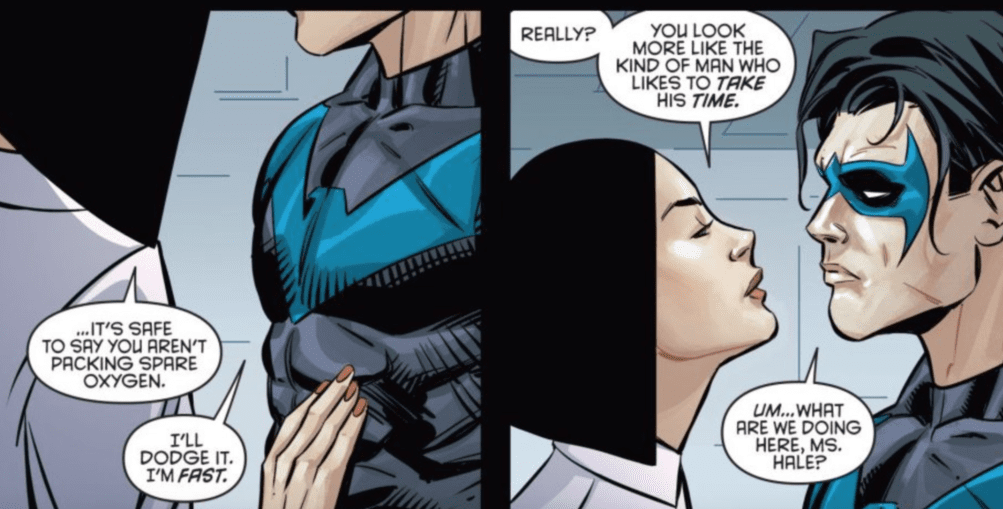
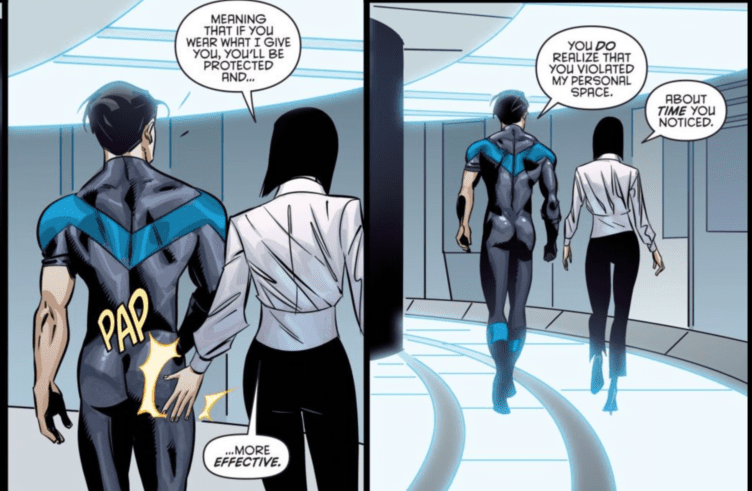
Jurgens can’t help himself, though, when it comes to playing up the sexual objectification of Nightwing, specifically the obsession with Nightwing’s ass.
I mean, what in the actual hell? Nothing like some humorous sexual harassment in the age of #MeToo I suppose.
Art
The art in this issue captures the energy and action of this issue. Miranda conveys the quickness of the characters’ actions and appropriately fits the high octane nature of what a Nightwing book should be. Whether it’s Nightwing’s acrobatics, the Condors flying through the air, or even the fight with Blockbuster, the art helps to capture the fun, action-packed nature of each scene.
Coloring
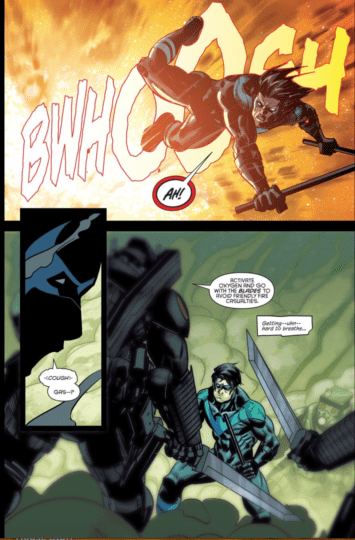
Filardi’s colors are solid in this issue. Any page featuring Dick and Condor Red really “pops” with the contrasting blue, black, and red from the characters’ costumes. Filardi can capture the nuances of the various background colorings needed to convey Nightwing stuck in a cloud of poisonous gas or Nightwing caught in an explosion.
Half of this comic is actually just panels of either of those things, with a brief interlude at the Condor base.
Lettering
The lettering does a good job not only allowing each character’s voice to come through but more importantly, it helps to communicate the action and sound effects (as indicated by the lettering for the explosion above). It helps to shape this issue into a fun, action-adventure (exactly what Nightwing should be) with every “ugh!” and “gyahhh!”
Conclusion
Nightwing Annual #3 was an overall fun and action-packed issue, albeit a bit “by the numbers.” Again, it was good to have a story with the Dick Grayson we all love and miss. It seems to be setting up a future confrontation with the Condors, so I’m imagining Jurgens may be paving the way for stories with Dick being involved in a world of intrigue and spies.
After founding the rock band, The Anti-Job Amanda Jones found a new musical career path as a composer for film and television shows like Cherish the Day on OWN and Twenties on BET.
For Cherish the Day, the young composer is creating music for a unique anthology series. Cherish The Day is eight episodes that each takes place on a single day in the lives of a couple. For Twenties, it’s a series covering the lives of three young friends who are trying to find their way through life.
PopAxiom spoke with Amanda about her life making music and her road to making music for Ava DuVernay (A Wrinkle In Time) and Lena Waithe (Master of None).
Chemistry to Concerts
For Amanda, music’s been in her life since the beginning. “I started playing piano around 3. Growing up, my dad loved listening to Motown music, and my mom was all about Whitney Houston and Toni Braxton.”
The piano was only the start for Amanda. “There was always music in the house. Around 10, I played clarinet in the school band.”
Rebellious teenage years lead to the discovery of a new instrument that would capture Amanda’s heart. “Around 14 or 15, a friend of mine let me borrow her guitar, and that’s the instrument I’ve fallen in love with.”
However, all that music in her life still didn’t mean Amanda focused on becoming a professional musician. “I went to Vassar College intending to be a chemistry major. A lot of my family works in healthcare. But I fell in love with the music department and switched music from my minor to major.”
City of Angels
Amanda graduated from Vassar in 2010 and then made a big move. “I moved out to LA and started a band [The Anti-Job]. We did the tour circuit for quite a while, and we still play today.”
Now with the drive to make a career out of music, The Anti-Job became Amanda’s, well, job. “Initially, that was my primary focus: touring, performing, album. That was the cycle. Around 2014, I was grinding my gears in the LA music scene and wanted to incorporate other aspects of the music industry into my life.”
Naturally, living in LA means it’s inevitable that you’ll meet people in the film and TV industry. That often leads to “… getting sucked into the entertainment industry.”
For Amanda, she began living that reality. “I’d met a couple of composers along the way and started to think it was a viable career path. So, I set down that path. I took some classes … as a refresher, which plugged me into the SoCal film and television scene.”
Amanda’s education and experience lead to a new gig with an orbit around some composing superstars. “I worked with a music production assistant for Hans Zimmer … John Powell. I worked with film and television composers like Michael Levine, a great friend, and mentor.”
Communication Is Key
The push to become a composer included partaking in a variety of workshops and programs. “… One in particular through ASCAP and Project Involve paired up-and-coming directors with up-and-coming composers … it’s kind of like speed dating … I did that twice. It was amazing. You work on a short film that premiered at the LA Film Festival. Five years later, I’m still working with some of the people I met.”
“‘Finding ‘your director’” is a goal all composers should try and achieve. Amanda’s advice correlates directly to reality, where the most famous on-going pairing of director and composer is likely John Williams and Steven Spielberg. But they are one of many inseparable combos. “Sergio Leone and Ennio Morricone or Ryan Coogler and Ludwig Göransson.”
Collaboration thrives on communication. And finding that director for a composer means a new level of communication. “A large component is being able to communicate well.”
Lionsgate
Amanda began working at Lionsgate, the film studio behind The Hunger Games, Twilight, and John Wick. “It was such a great opportunity to understand the nuts and bolts of the industry.” Her job entailed vetting and hiring critical positions in the music department. “I was responsible for hiring composers, music editors, and supervisors. I worked with showrunners, and it was just awesome.”
The joy in Amanda’s voice is undeniable when she talks about her experience at Lionsgate. “I worked on Greenleaf and Dear White People. Step Up for YouTube Red.”
In 2018, Amanda took the next step. “I had the opportunity to score my first feature film that’s coming out this year. It’s called One Angry Black Man.”
Amanda’s excitement was super-rocket fuel for her skills as a music-maker. “I was so excited to score my first feature that I wrote all the music in two weeks!”
Since 2018, Amanda’s flowed from one project to the next. “I did two feature documentaries and then my first pilot [Twenties on BET].”
Sundance
On a whim, Amanda took a trip to Sundance. “I tried to meet as many directors. The only thing I could talk about was this pilot.”
The pilot, a show created by Lena Waithe (Queen & Slim, The Chi), was enough to land Amanda, a new gig that put her on a popular HBO series. “I met Dime Davis, who is a director for the Black Lady Sketch Show on HBO. She thought I’d be great for it.”
Back in LA, the work began. “We got together, and I went through the classic vetting process. I got the script, I marked it up and spoke with all the creatives. And I was able to hop on the Black Lady Sketch Show.”
Amanda scored six episodes of the Black Lady Sketch Show, and then Twenties got picked up by BET.” Amanda scored the series then hopped on another Lena Waithe project, How To Make Love To A Black Woman.
Now, she’s going back to her roots for Home, a series on Apple TV. On the score, Amanda gets to “… play guitar and sing.”
About Cherish the Day
One Day, in 2019, Amanda received a phone call saying, “Hey, Ava DuVernay wants to meet you at noon.” Amanda arrived to learn about a new show Ava was producing called Cherish The Day.”
The series airs on OWN, Oprah’s network. Ava handed Amanda a script and asked the composer to “… write cues that you think would be part of the sonic palette of the series.”
The excitement-fueled Amanda went into action. “I read the script lightning fast. I wrote two demos and sent them to her [Ava].”
However, two weeks went by without a response before she heard the exciting words “… we’d love to have you on Cherish The Day.”
Who inspires Amanda’s creative side? “I would have to say more bands than composers but from my earliest years, The Temptations. They inspired me to play guitar. I love bands like Yes, Deerhoof, but also John Williams and Ennio Morricone. I’m a big classic rock fan, so Jimmy Hendrix, Led Zeppelin, Black Sabbath … all that stuff. Bjork is pretty awesome.”
Amanda looks for bands who are bold. “I love bands that aren’t afraid to have long-form songs or be very cinematic in their writing. That’s inspired me. I try to bring that to my work.”
When asked what remake Amanda would love to be a part of, she responds with a little talked about late 80s gem. “… Less Than Zero.”
Amanda is driven and wants to make better music for documentaries, television, and film. She is setting her next major goal quite high. “I’d love to get my feet wet in a Marvel or DC movie. Any fantasy or comic, pulp stuff.” Seems ambitious, but remember, she’s friends with Ava DuVernay, who is helming New Gods for the DCEU.
What’s coming next from The Anti-Job composer? “I’m working on a docu-series for Live Nation called Cradle To Stage. Dave Grohl is one of the executive producers, and it’s all about rock stars and their moms. It’s based on [Virginia Grohl] her book. Also, working on a feature documentary called Krimes, that’s about artists who were formally incarcerated and how they used art as this liberating tool. Black Lady Sketch Show season two is coming out later this year.”
Are Twenties and Cherish the Day on your watch list?
Thanks to Amanda Jones and Rhapsody PR for making this interview possible.
Header photo credit goes to Ian Spanier.
Want to read more interviews like this? CLICK HERE.