Home Blog Page 452

Go On A Far-Out Adventure in SILVER SURFER BLACK #1

Monkeys Fighting Robots

From the fantastical story to the psychedelic art, Silver Surfer Black #1 balances between a mind-bending space romp and a touching exploration of a beloved character.
Silver Surfer Black #1
From the start, Silver Surfer Black #1 examines the heart of the titular character.

Silver Surfer Black #1

Story: Donny Cates and Tradd Moore

Art: Tradd Moore

Colorist: Dave Stewart

Letterer: VC’s Clayton Cowles

Warning: the following article contains spoilers for Silver Surfer Black #1. Reader discretion is advised.

STORY

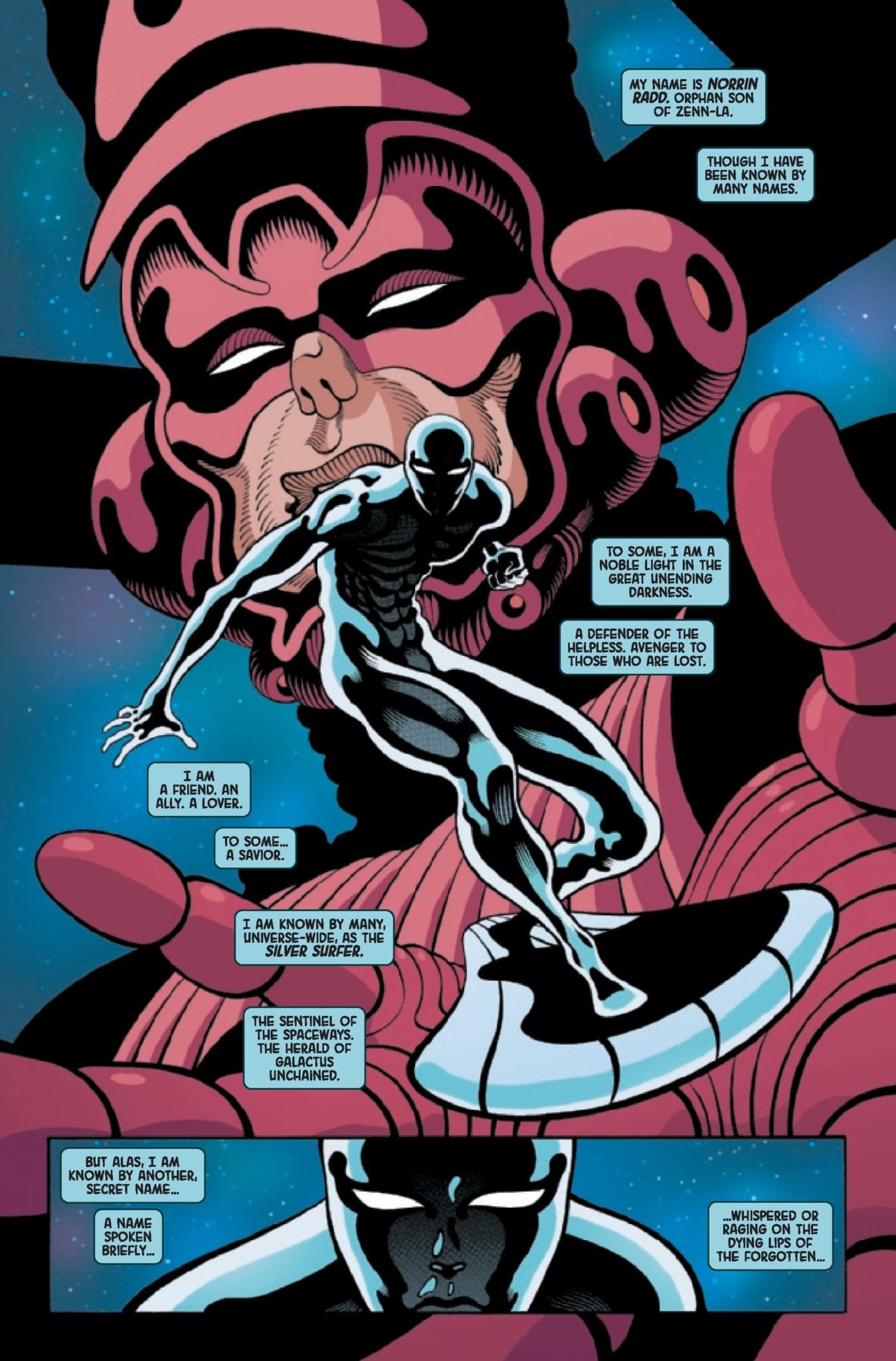
Though Silver Surfer is one of Marvel’s most powerful cosmic characters, he hasn’t received many chances to show why he’s a beloved hero in recent years. Fans of the character were likely disappointed when he literally fell into a black hole in Guardians of the Galaxy #1. But Donny Cates, the writer of this Guardians series and Silver Surfer Black, clearly has important plans for Norrin Radd. In the span of one issue, the Surfer saves the other heroes from the black hole, pulls himself back from the brink of destruction, fights alien gods and meets the “big bad” in Cates’ Venom series. That’s all in a day’s work for Silver Surfer.

With just a few lines, the narration from Radd’s perspective Cates and co-writer Tradd Moore help readers unfamiliar with the Surfer understand the character’s classic struggles. From describing Radd’s guilt over his role in Galactus’ destructive feeding to showing his preference to use non-violent methods, the writers construct an accessible starting point for new readers and an entertaining reintroduction for those who already know the character.
Silver Surfer Black #1
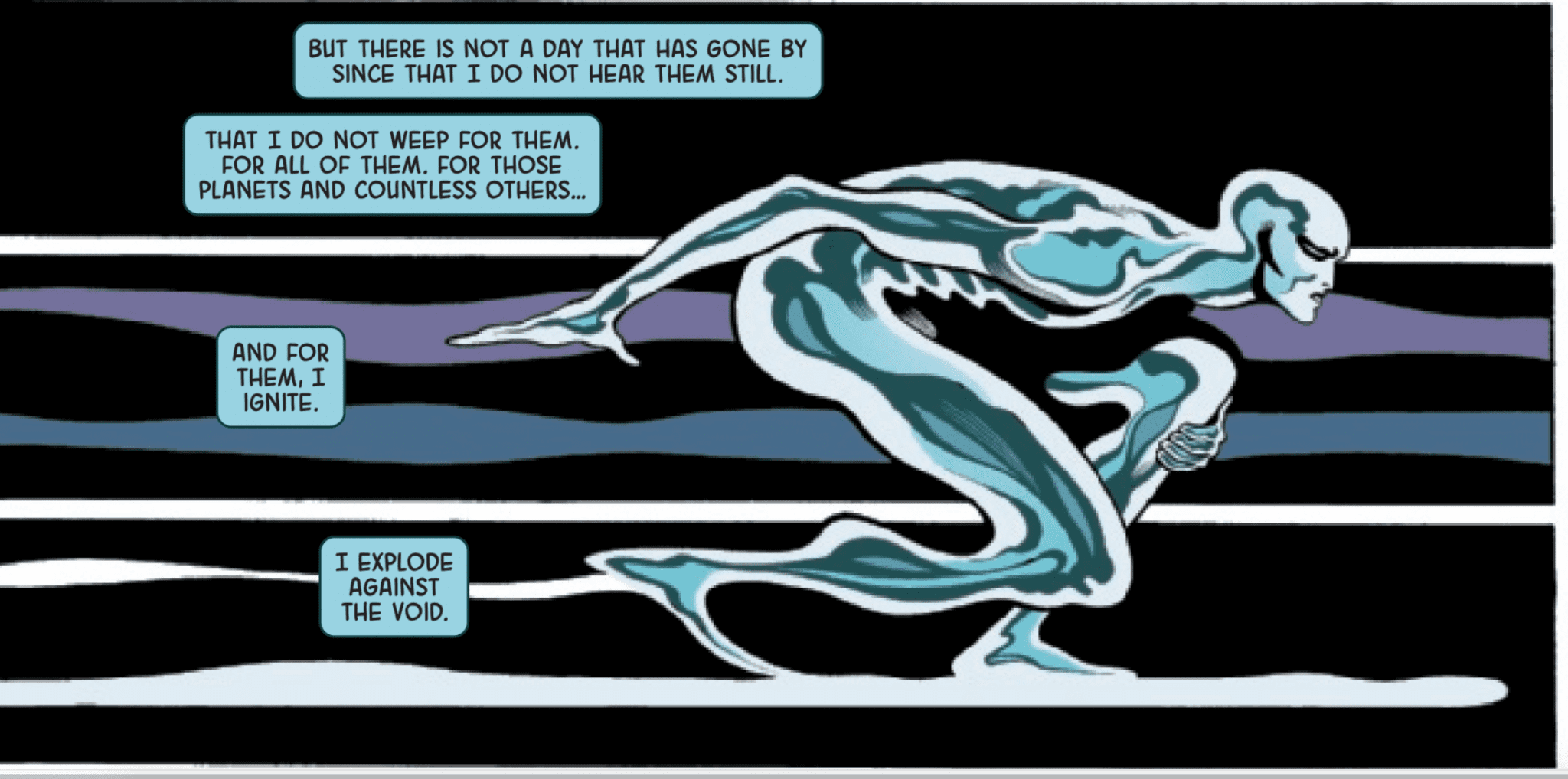
The narration is consistently stunning.

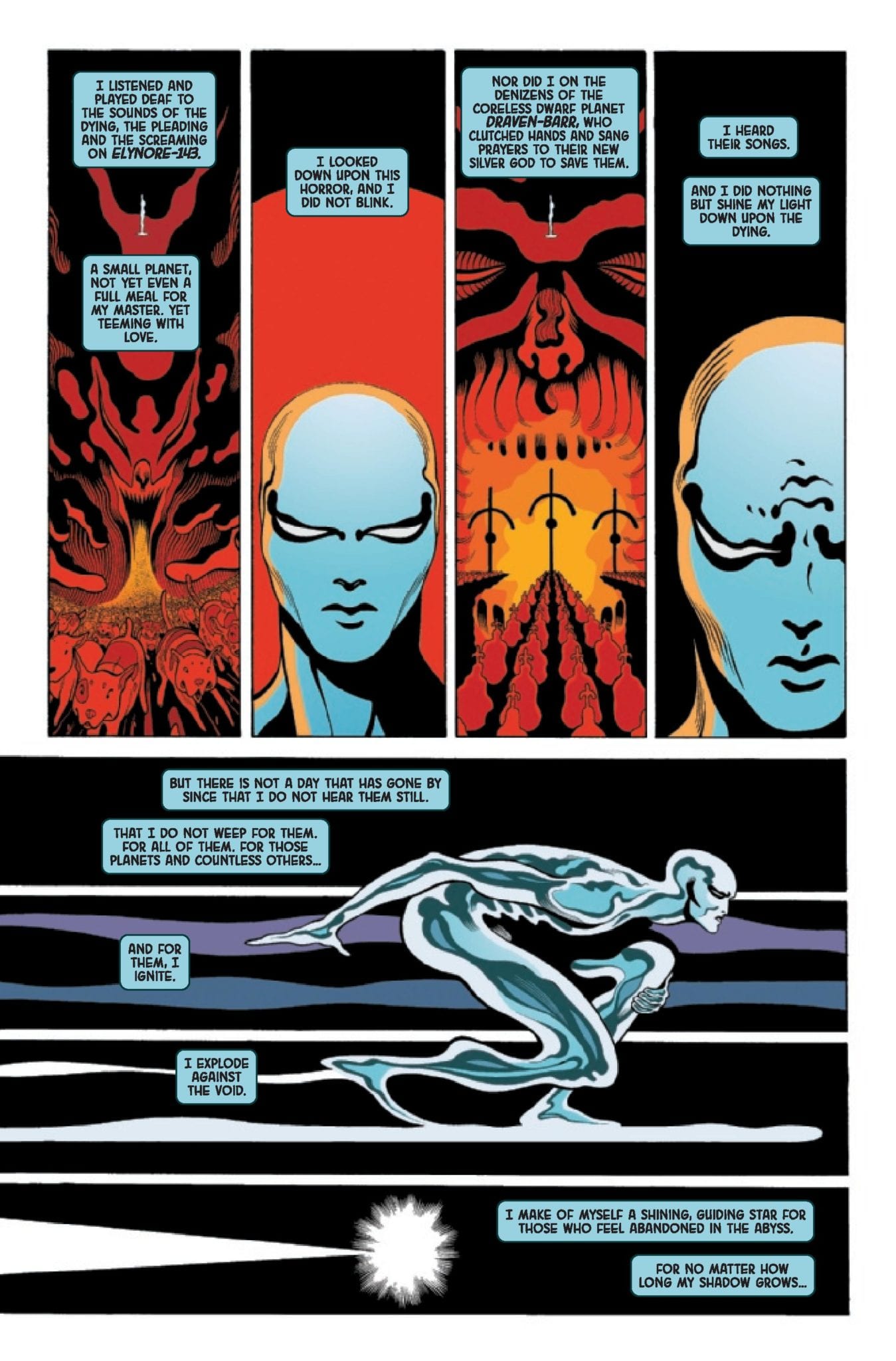
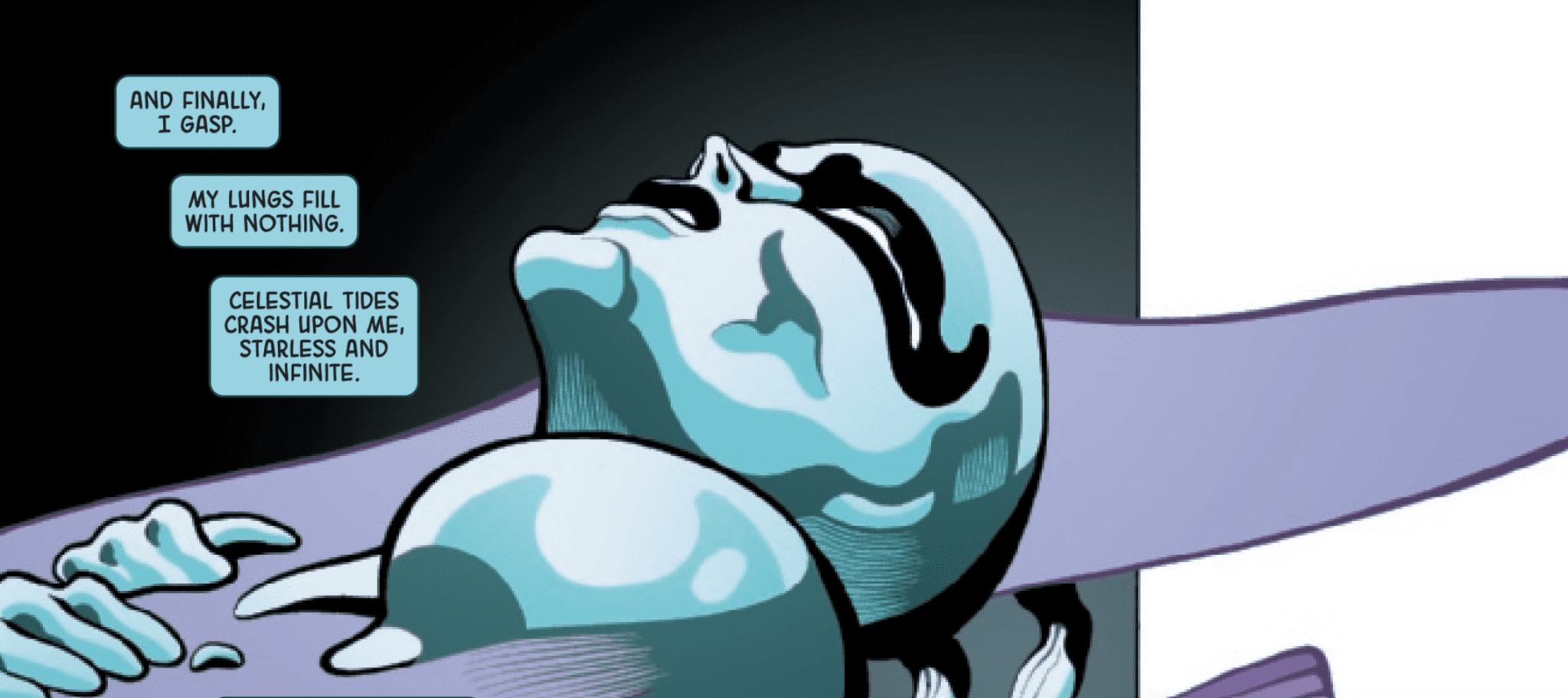
By using eloquent prose, Cates and Moore make the narration the strongest element of the issue; a number of the lines make the reader stop and dwell for a moment on the passionate words. “I listened and played deaf to the sounds of the dying, pleading and screaming of [these] people,” the Surfer says. “I heard their songs. And I did nothing but shine my light down upon the dying.” Radd’s guilt is devastatingly tangible and his remorse makes him even more sympathetic.

Logically, this issue focused on the Surfer as an individual; though the writers show how Radd saved the other heroes from the black hole, they spend too much time on this plot thread. Instead, the majority of the story focuses on the Surfer’s fight to survive his own journey through the metaphorical and physical darkness. After he uses the last of his strength to rescue his allies, he tumbles through space, where he’s “unmade” while reality distorts around him.
Silver Surfer Black #1
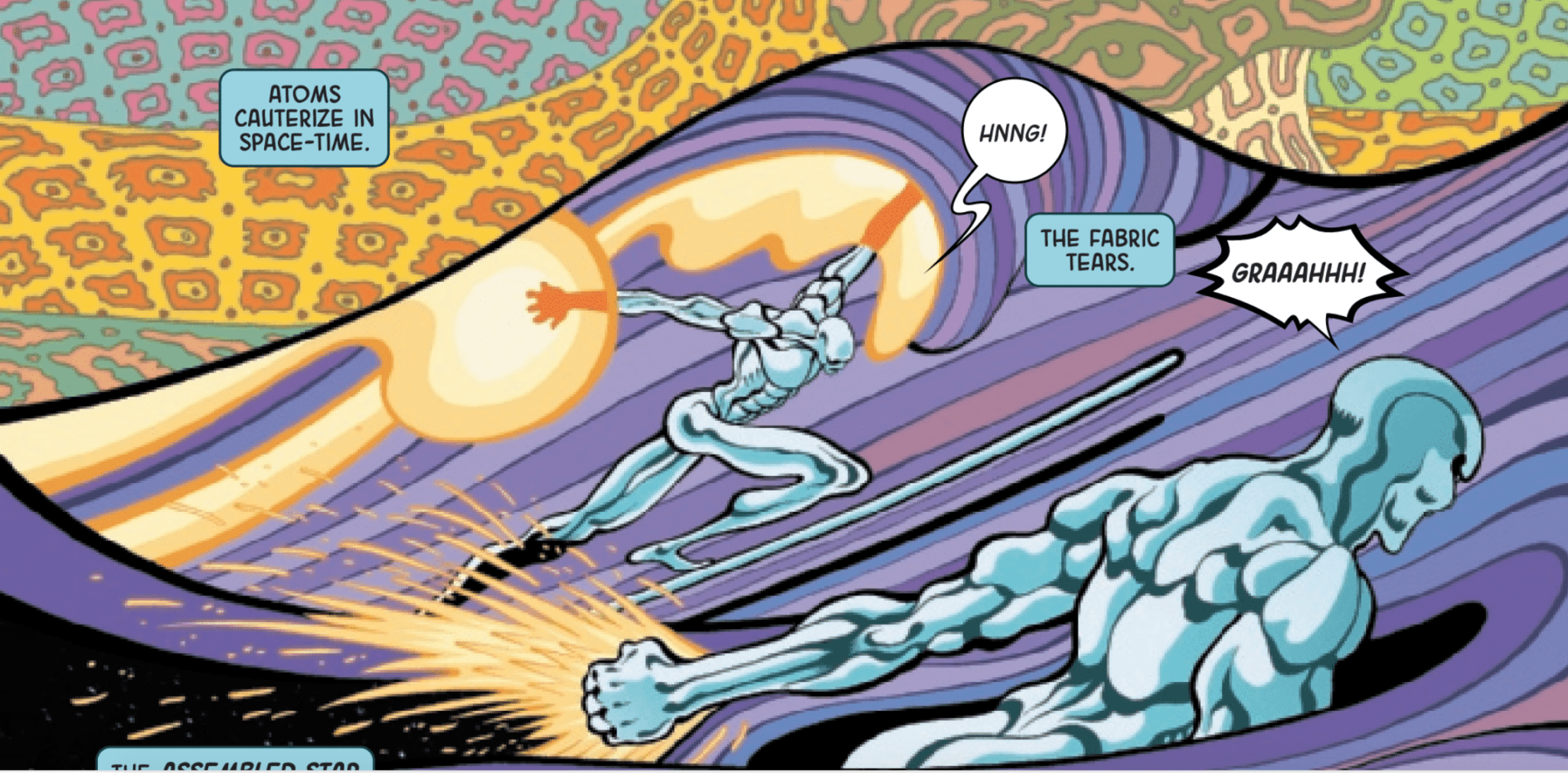
The Surfer falls through a black hole and Tradd Moore’s art makes the experience feel trippy.

The journey nearly brings Radd to the end of his rope; “I drown [and] I am lost,” he says. Of course, no matter the circumstances, the Sentinel of the Spaceways doesn’t give up. In just one issue, Cates and Moore break the Surfer down and build him back up again. After a brief healing process, he answers the call when a killer must be brought to justice.

Radd’s search for the killers bring him to a foreign planet and, when he’s attacked by some sentries, the Surfer demonstrates the full extent of his powers when they refuse to peacefully yield. Once again, though the Radd finds himself in a no-win situation, he perseveres. Cates and Moore make the hero’s brave tenacity shine as bright as the silver that covers his skin. “Though weakened, I am far from helpless,” he says. “Though outnumbered, I am unafraid. And, though far from home, without a soul in the universe to come to my aid , I never battle alone,” he continues. The Surfer has regained his place as one of the most impressive characters in the Marvel Universe.

Silver Surfer Black #1
Thanks to a mysterious black goo, the Silver Surfer’s hand lost its shine.

Part of that journey back to the top can be credited to a mysterious black goo. The substance tips the scales in Radd’s favor during his fight with the sentries, who turn out to be alien gods. After touching the goo, Radd’s hand turns black. The Surfer unloads with a massive burst of energy that enables him to defeat the gods. The mystery of the black goo is one of the few unanswered questions left at the end of the issue. Hopefully, the rest of the miniseries will explain the Surfer’s transformation and the power that fueled it.

ART

Silver Surfer in a black hole
The Surfer’s trip through a black hole feels psychedelic.

When trying to describe the artwork, one word keeps coming to mind: trippy. During Radd’s trip through the black hole, Moore warps the Surfer’s body in bizarre ways that enhance the story’s fantastical tone. Similarly, the alien gods look like they’re creatures from Alice in Wonderland, which adds to the dream-like quality of the art. Likewise, colorist  Dave Stewart uses bright, vibrant and unusual hues of many colors, including celestial pinks and purples.

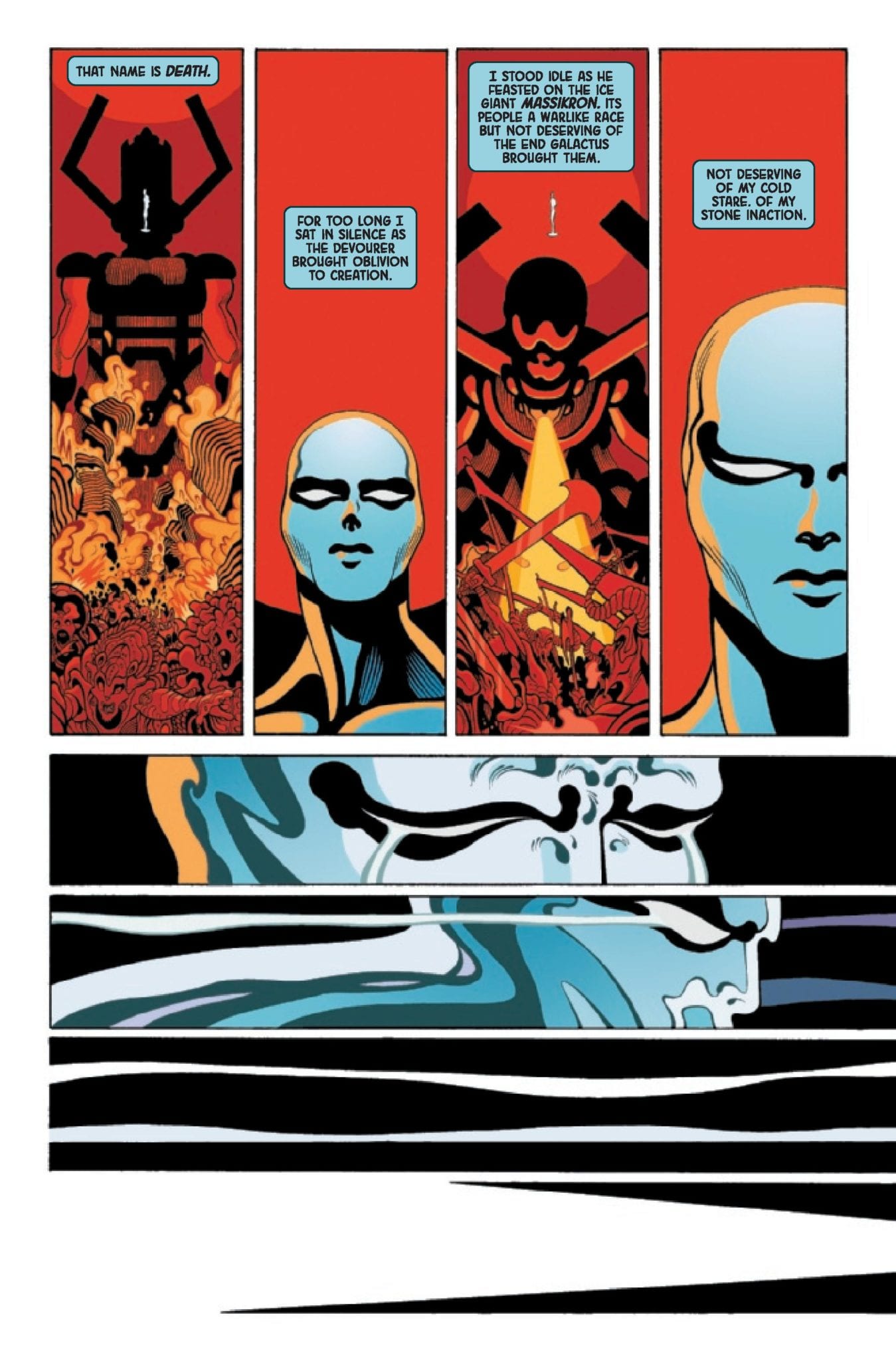
Throughout the issue, the artwork complements the story by elevating its emotional impact. When the narration suddenly shifts from talking about himself to discussing a discussion of Galactus’ violent feeding habits, Stewart uses blood red for the background to augment the jarring juxtaposition. Moore makes Galactus’ face look demonic and, in some panels, like the classic version of Frankenstein’s Monster. Moore and Stewart combine with the narration to make the Devourer of Worlds and his destruction horrifying. This excellent cooperation, between the story and the art, can be found on each and every page of the issue; few comics can claim that.

Galactus in Silver Surfer Black #1
Galactus looks like Frankenstein’s Monster in Silver Surfer Black #1.

With Silver Surfer Black #1, Marvel delivers an exceptional introduction to a new miniseries and it also functions fairly well as a standalone issue. The art is consistently a sight to behold and the narration deserves to be reread multiple times for its heartfelt expressiveness.

What’d you think of Silver Surfer Black #1? Do you plan to continue reading the miniseries?

Monkeys Fighting Robots Youtube

AMAZING SPIDER-MAN #23 – “The Beast” Never Dies

Monkeys Fighting Robots

Nick Spencer’s “HUNTED” arc has concluded, but there’s plenty of fallout. AMAZING SPIDER-MAN #23 gives us an epilogue to Kraven’s final hunt.

asm 23 cvr

***SPOILERS LIE AHEAD***


Imagine hunting and killing your whole family of clone brothers to prove yourself to your father. Imagine then having that father swiftly taken away from you by your own hand. The final image of your father underneath your swelling, bloody hands is him in a Spider-Man outfit.

Kraven may be gone but his clone-son may be even more tragic and deranged given the origin we just experienced. He passes on his name and entire identity to this clone-son who will be the new Kraven The Hunter going forward. It may damper the emotional resonance of this story, but it’s pretty well done as far as clone replacement stories go–especially in Amazing Spider-Man comics.

Spencer has setup a whole mess of future threads. The Savage Six becoming an official gang is the most exciting. If we learned anything from Superior Foes Of Spider-Man and all the scenes with Boomerang in this run of Amazing Spider-Man, it’s that Nick Spencer makes C and D level super villains into top tier characters.

Taskmaster and Black Ant repair their bromance after a “Tasky” betrayal. Their relationship has been an absolute joy and another instance where Spencer has been able to take lower tier villains and transform them into your new favorite characters.

We get some closure on Peter’s horror vision of Mary Jane as he races home to find that she was actually fine. This is where we get another tease for the future story that Spencer has been slowly building towards since the very first issue.

We don’t know anything about this centipede stalker operating in the shadows, but Spencer has been playing the slow-burn perfectly and the hype is growing. One of the most enjoyable elements of this Amazing Spider-Man run has been the old school approach to building tension and drama. It’s rewarding to read Spidey comics again, we seem to have a lot to look forward to.

One of the biggest treats of Amazing Spider-Man #23 is the return of artist Ryan Ottley. We get to see his iconic take on the symbiote suit as well as a large chunk of heroes and villains we hadn’t previously seen him illustrate.

Ottley still blows me away with Spidey’s movement and poses every time he graces the book with his talent. It’s not a flashy style, but it’s one that fits the character and his movements perfectly.

Texture is something that Ryan Ottley excels at, and there’s plenty of it in Amazing Spider-Man #23. From Lizard’s scales to Taskmaster’s skull, there’s a bunch of different textures on display that readers can easily imagine what they would feel like under their finger.

Colorist Nathan Fairbairn gives these textures more depth and does wonderful work blending colors together in scenes like the prisoners escaping only to be met by the Avengers and Fantastic Four. A lot of the characters in this issue have very simple color layouts but Fairbairn keeps the pages very lively.

At the time of this review, the final page was not shared with us by Marvel. The mysterious funeral attendee’s identity remains a secret until Wednesday. My first guess would have to be Kraven’s brother, The Chameleon. Be sure to check out the issue on 6/12!

Monkeys Fighting Robots Youtube

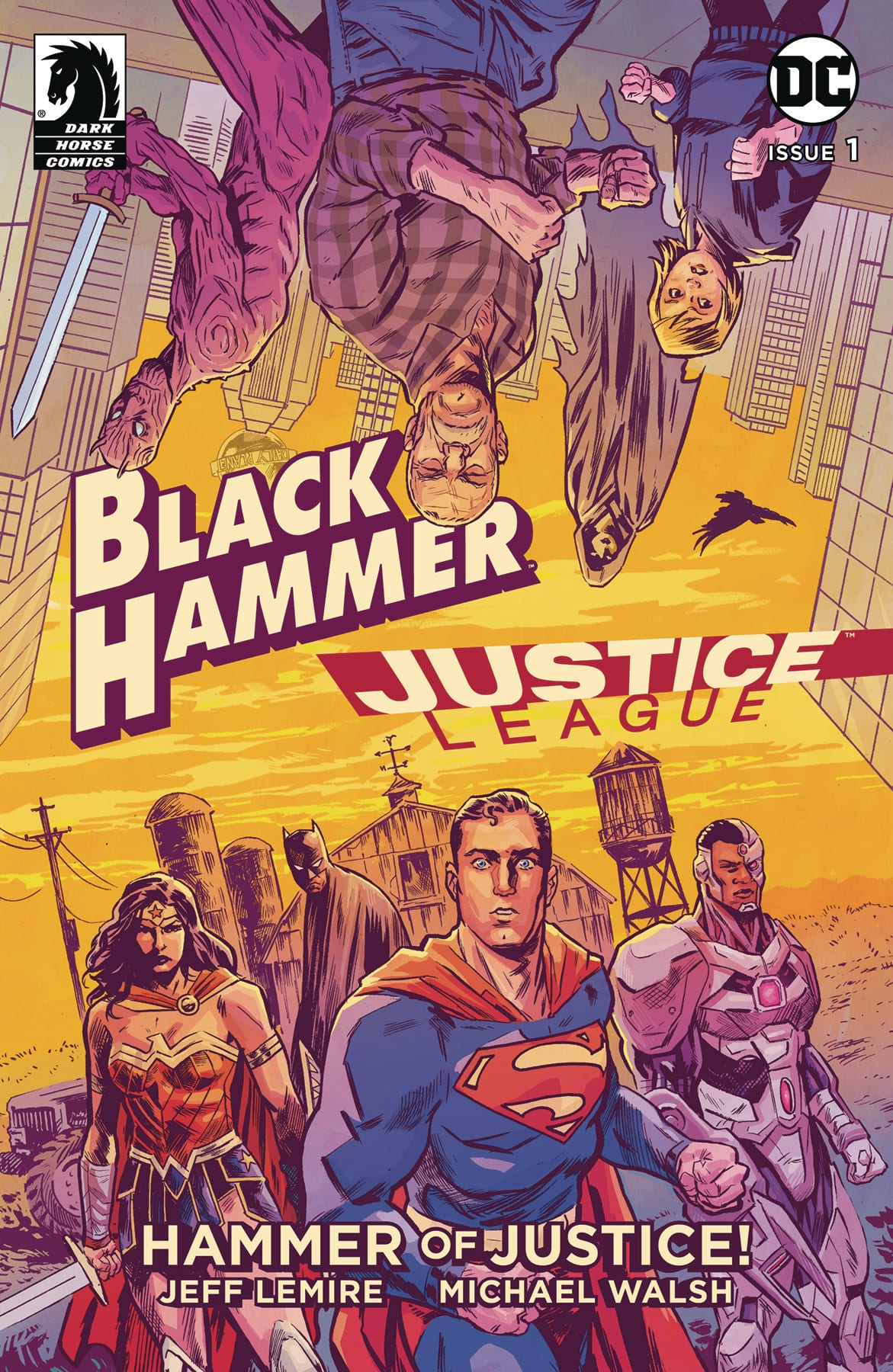
Advance Review: BLACK HAMMER/JUSTICE LEAGUE #1 Begins The Company Crossover We Need

Monkeys Fighting Robots

Black Hammer/Justice League #1 by Jeff Lemire, Michael Walsh and Nate Piekos sets up one of the most interesting, mysterious and unique company/character crossovers we have seen. It’s a superhero ‘event’ as only the Black Hammer family could do.

A strange man arrives simultaneously on Black Hammer Farm and in Metropolis, and both worlds are warped as Starro attacks! Batman, Green Lantern, Flash, Wonder Woman, Superman, and more crossover with Golden Gail, Colonel Weird, and the rest of the Black Hammer gang!

Black HammerBlack Hammer/Justice League #1
Written by: Jeff Lemire
Art by: Michael Walsh
Letters by: Nate Piekos

Black Hammer created by Jeff Lemire and Dean Ormston

This review contains MILD SPOILERS

Story

Black Hammer has always been a comic that is ABOUT comics. In telling his own unique superhero epic, Lemire and company have also been playing with genre tropes and expectations. So bringing in a well-known property like the Justice League opens up all kinds of possibilities. This initial issue is mostly set up and it’s simple (mild spoilers will follow): a strange man appears to both the Black Hammer characters and the Justice League; he switches the places of both. Oh, and the JL were fighting Starro when it happens. So now we have the JL characters living on the idyllic ‘farm’ and the BH dropped right into the middle of a fight with a giant space starfish. Either situation is now ripe for awesome possibilities.

Lemire also does a great job making this accessible to new readers that maybe aren’t very familiar with BH. Comic fans will, of course, recognize what the various BH characters are supposed to represent, but casual readers are given enough info to get a grasp as to who these characters are. The Justice League is well known enough, and Lemire (who has written the JL characters before in various comics) writes them a way that is very recognizable.

The story also seems to be very important to the overall ongoing Black Hammer mystery, so diehard fans this is not just a cash grab or throwaway ‘event’. It fits in with everything that has been going on.

Art

All of the various Black Hammer books always have great and unique art. This one is no different. Michael Walsh falls in line with all the other BH family of artists. The linework here has one foot in the superhero world (especially in the JL scenes) with the layouts, dynamic poses and energetic panels. And the BH scenes perfectly match the more scratchy, muted and ‘eerie’ feeling the main title gives out. Walsh is handling pencils, inks and colors and just straight up doing a bang up job. Like all Black Hammer books, it’s very pretty to look at.

Conclusion

If you have or have not been reading Black Hammer, then Black Hammer/Justice League #1 is a must buy. It’s a perfect introduction to this world for new readers AND it’s thrown a wrench in the ongoing mystery for the longtime fans. It’s truly the best of both worlds.

Black Hammer/Justice League #1 is scheduled to be released on July 10, 2019. 
 

Monkeys Fighting Robots Youtube

Why H1 Is Exactly What The Comic Book Industry Needs

Monkeys Fighting Robots

It takes more than a promising premise and a notable name to reasonably predict the success of any project. But, early on, all signs indicate that Humanoids’ H1 Universe could be an alternative to big-name players like Marvel and DC. Now, with the release of Ignited #1, the world has been introduced to this new line of comics, which is headed by acclaimed writer Mark Waid.

H1 Ignition Cover
Ignition is the spark that sparks the H1 Universe

Along with the other H1 architects, Waid is saying all the right things about what readers can expect to find in this universe. In Ignition, the Free Comic Book Day special issue that launched H1, Waid states, “in superhero universes, there’s always a certain status quo that must be maintained. Not here…. The possibilities of H1 are endless and very dangerous.” That “status quo” has worked for decades and it’s why Marvel and DC continue to be so successful. But, amongst other downsides, the formula has become predictable; most of the time, you know what to expect in an Avengers story. Though it’s still highly enjoyable because it uses the same beloved characters, we should welcome an enticing attempt to break the mold.

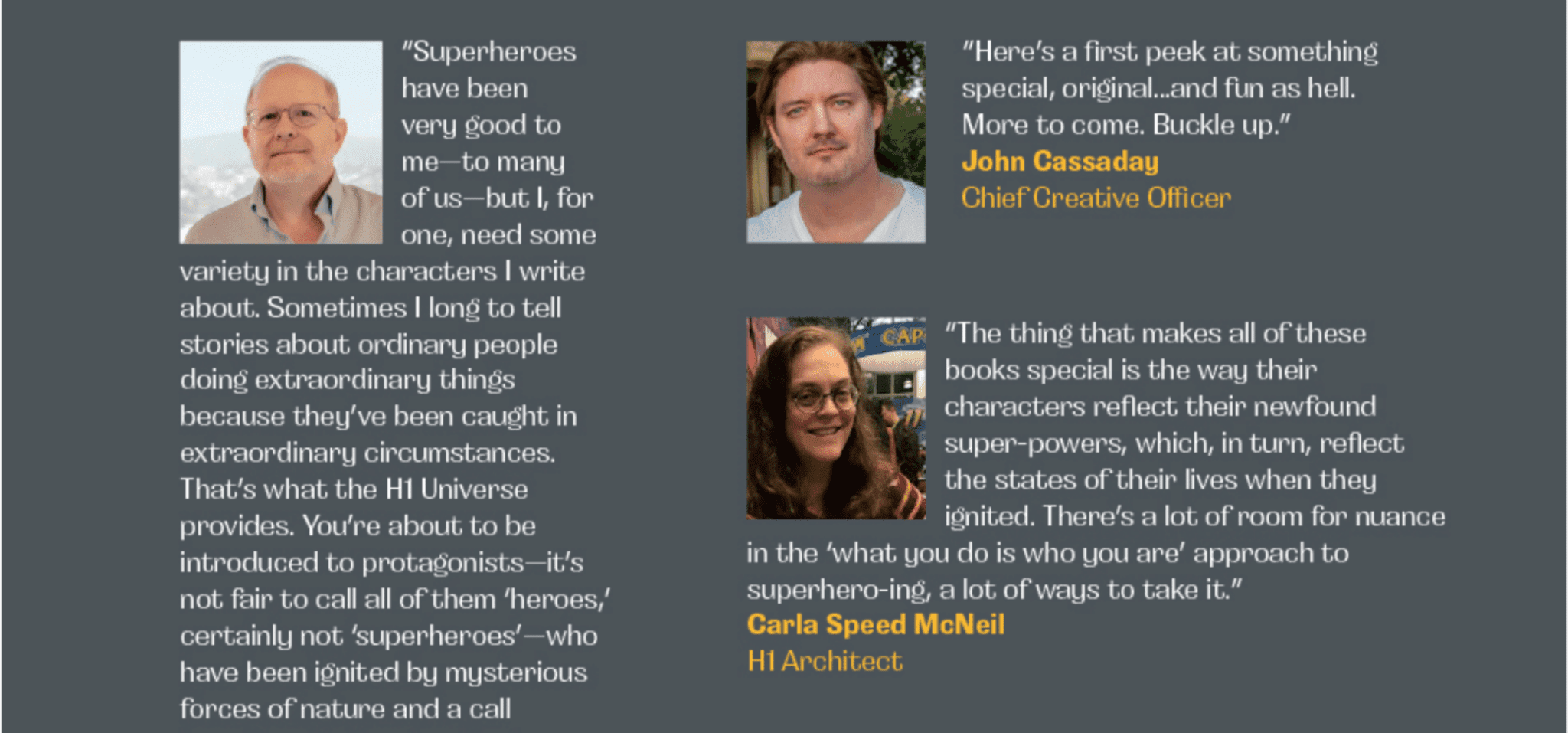
Ignition Quotes
Mark Waid and other H1 Architects are saying the right things but can they deliver?

Speaking of which, one of the most compelling aspects of H1’s mission statement is its rejection of genre. Like Waid, Jonathan Lang, the writer of the upcoming Meyer series, was quoted in Ignition. He states, “at other publishers, genre was always pushed front and center, sometimes at the expense of the character’s authenticity. H1 provides the vehicle to get stories into a truly diverse and character-based world. This is not a marketing ploy. It’s in H1’s very DNA.” Forcing stories to fit into strict genres and categories has been a criticism of comics for quite some time. Similarly, many fans have wanted to see the Marvel Cinematic Universe branch out of typical superhero cinema and explore romance, horror and other genres. Based on Lang’s quote, it sounds like H1 will focus on placing its characters in diverse styles of storytelling. Mark that as another point in H1’s favor.

With this new line, Humanoids strives to deconstruct genre and reject other patterns of the industry. But these encouraging signs only offer an incomplete peek at the reasons comic book fans should be excited. We all have different reasons for reading comics. Many fans use them to escape from the real world; it can be liberating to get lost in worlds where heroes like Batman and Captain Marvel roam. But this escapism has a price: comics sometimes struggle to genuinely tackle real-world issues. Once again, H1 seeks to buck this trend.

In Ignition, Kwanza Osajyefo, an H1 Architect, states, “it’s been said that the best stories touch on actual issues. Ignited stabs at the nerve of what’s happening in our real life. The series approaches superhumanity in a more real and relevant way.” H1’s comics embrace the problems that pervade the world as we know it and, potentially, they’ll serve an alternative function in the reader’s life. Rather than offering pure escapism through wild, fantastical stories, H1 will allow readers to remain engaged with reality by pulling narrative threads right from the headlines.

Ignited Synopsis
With Ignited, H1 shows that its stories will be heavily grounded in reality.

Waid drills the point home when he discusses the inspiration for Ignited. He asks, “what if the Parkland survivors had the power and resources to effect change on a monumental scale?” According to the writer, that’s exactly the pitch for the series. Waid, who references himself as a “socially conscious political wonk “ says these comics are firmly tied to the world we live in every day. This realistic approach could allow H1 to powerfully explore meaningful topics.

Still not convinced? The diversity of H1’s creative team is the most encouraging component of the new universe’s foundation. As the Director of Creative Development Waid spearheads the project and a wide range of voices will help shape his vision. The team consists of Osajefyo (co-writer of Ignited,) Magdalene Visaggio & Darcie Little Beaver (Strangelands) Devin Grayson (Omni,) Lang (Meyer,) Quinton Peeples (Big Country) and Helen Mullane (Nicnevin and the Bloody Queen.) Combined with the other aforementioned factors, this diversity could legitimately set H1 apart. It’s 2019 and the most powerful players in the game (Marvel and DC) are still struggling to consistently incorporate fresh perspectives. Both companies have been criticized because the majority of their comics are still written by straight white men. As a result, H1 has an opportunity, like with other complaints against DC and Marvel, to answer fans’ hopes by emphasizing diversity and inclusiveness.

Right now, it’s way too early to say that H1 will be successful or that it’ll ever challenge the most successful publishers. But, with this new comic book universe, Humanoids is taking a number of common criticisms of comics and building itself a platform by addressing them. It’s a good time to be a comic book fan and H1 could make it even better by revolutionizing the industry.

What do you think about H1? Do you think it has the potential to make a difference in the comic book industry?

Monkeys Fighting Robots Youtube

Review: TRUST FALL #1 Strives For Artistic Brilliance

Monkeys Fighting Robots

Criminal Underworlds, family gatherings and dynamic magical violence form the backbone of AfterShock comics‘ new series Trust Fall.

Ash is a young woman trapped inside her family home. She has a ‘gift’, some call it a blessing, some call it a curse, but her gift means she is over protected by her family. They keep her house bound except for special missions and as a result her view on the world is slightly off-kilter.

 TRUST FALL #1 Strives For Artistic Brilliance
Trust Fall #1 Credit: AfterShock Comics

Writing

Christopher Sebela introduces the reader to this world from the point of view of Ash. We see the world as she sees the world; see it as she has come to understand it. The city she lives in, known to her as The Wild, is like any other major city in the world but Sebela is able to distort the image because of Ash’s unique world view. In a lot of respects, she has lived a sheltered life and Sebela brings this out through the narration.

There is a running theme based on ‘definitions’ throughout the comic, with Sebela portraying the world from the inside of this emerging criminal family. Ash’s view of the people around her has been manipulated by her family and her upbringing. Sebela is setting up his central character for a fall, referenced in the title and again in the early pages of the comic. The reader gets to know the world Ash lives in, as she sees it, so that we can then learn about the ‘real’ world in time with Ash.

Trust Fall is set up as a coming of age story, a tale of self-discovery in a criminal world tinged with magic. Family features as the central point for Sebela’s discussion, as he makes it clear that families can be loving, protecting, and caring but also, cruel, manipulative and self-centred. In Trust Fall Sebela is asking what it means to be a part of a family, for good or bad.

TRUST FALL #1 Strives For Artistic Brilliance
Trust Fall #1 Credit: AfterShock Comics

Art

Chris Visions’ art work is overflowing to the point that the pages can barely contain it. He creates a sense of dynamism that affects not only the images within the panels but the panels themselves.

The layouts are anything but consistent. He mixes up the use of gridded pages with stacked images to push the narrative forward and create a vibrant, ever moving, atmosphere. The action sequences are outstanding and capture the chaotic nature of the violence they portray. The boarders break down and gutters disappear as one action leads into the next, extending a brief moment in time so that it seems to last much longer.

The overlaid conversation gives the moment more of a temporal rigidity as the act of reading enforces a sense of timing onto the reader however, the energy created by the visuals takes over and pushes the reader forward at a much faster pace.

Even when you get to sedate scenes, such as a family meal, Visions’ art work is bursting with uncontrollable energy. The emotional conflicts between the characters is represented not only through the figures interactions but the layouts and colors. There is a physical sense of overpowering and oppression around the table. Trust Fall’s emotional impact is relayed through the art work, while Sebela’s narration and speech unleashes the plot.

There is a lot of exposition and narrative throughout Trust Fall but it’s barely noticeable as Hassan Otsmane-Elhaou threads it into the art work as if they are one and the same. He stacks and overlays the speech balloons to match Visions art style, creating a multi layered image. Often the speech is the main focus for the reader, leading them through the page but at other times, the lettering slips into the back ground almost, to allow the art to tell the story.

TRUST FALL #1 Strives For Artistic Brilliance
Trust Fall #1 Credit: AfterShock Comics

Conclusion

Trust Fall is a densely packed first issue in every sense. There is a solid plot inhabited by a number of very strong characters. Sebela has crafted his world building into the story structure so that it works on several levels to give the reader a deeper understanding of the characters and settings.

This layering is then visually represented to perfection by both Visions and Otsmane-Elhaou. The aesthetic of Trust Fall stands out from the crowd and makes a significant mark in the sea of comic books that are available. The energy is so vibrant that a quick flick through would entice any reader.

As first issues go, you couldn’t ask for more; Trust Fall has emotion, intrigue, action, and stunning visuals.

Monkeys Fighting Robots Youtube

Review: ORPHAN AGE #3 Shines A Light On The Victims

Monkeys Fighting Robots

Continuing the journey through the empty wastelands of America, Orphan Age from AfterShock Comics takes a sedated look at survival in a harsh world. It has more in common with the 1970’s Terry Nation T.V. series The Survivors than it does The Walking Dead but whatever it’s influences Orphan Age has a compelling story to tell.

ORPHAN AGE #3 Shines A Light On The Victims
Orphan Age #3 Credit: AfterShock Comics

Writing/Story

In this issue Princess must learn a number of lessons. In order to survive in the world, she must face the realisation that the utopian ideal she grew up with was a cover to protect her from the cruelties of nature. Not everyone was as lucky as her father when the Adults died 20 years previously.

Each issue of Orphan Age stands alone as a discussion around one aspect of Ted Anderson’s future world.  In this third issue, the concept of nature and nurture is examined as Princess comes face to face with an uneducated, uncivilised survivor of the mysterious incident that left the world in the shape it is.

Anderson uses the confrontation to illustrate Princess’ upbringing and compare it to the characters around her. It is also a catalyst for Daniel, Princess’ protector, to speak about his past and final allows the reader to see some of the transitional period between before the incident and the present of the comic.

Although the Feral character in this issue is nothing more than a plot device to question the current status que around the characters and the world, it is an effective one. A simple character that is neither hero or villain provides Anderson with an opportunity to compare the central cast. He is able to advance the world view while developing the characters via a simple, yet effective, narrative.

In plot sense not very much happens in this issue but as it is all about creating character driven drama, Anderson is successful in providing an emotionally gripping story.

ORPHAN AGE #3 Shines A Light On The Victims
Orphan Age #3 Credit: AfterShock Comics

Art

For this issue to succeed, Nuno Plati has to focus on the details and bring the characters to the foreground. So much of this comic is drawn from a medium or close up view point so that when there is a wide shot it really stands out. The relationships of the central three characters is reflected via the environment and their impact upon it. At times they blend into it, as if they are comfortable within the world they live. Other times they stand out, shocking grey figures against a garish orange backdrop, as far from the world as they can be while still being a part of it.

The ever changing conflict that they encounter as they travel across this America is visually more evident in this issue than it has been in previous issues. The color work by Plati and Joao Lemos really stands out and, in turn, makes the character’s conflicts stand out. The story may be sedate but the force of the art work is not. There are some powerful images and the extreme close ups with heavy black lines give the comic an emotional weight.

There is a claustrophobia to Orphan Age, despite the vast wilderness that it is set in. This is brought about by the tight points of view that Plati uses for his panels and is aided by Marshall Dillon lettering. His stark white speech balloons stand out against the naturalistic backgrounds and intentionally crowd the characters. This serves as a reinforcement of the character driven narrative but also makes the open, large vista panels that much more impactful. Not only is the reader able to see something of this world but it free from sound and speech; it becomes an all-encompassing space which in turn emphasises the closeness of the characters.

Dillon’s placement of the speech covers the backgrounds, removes any void and traps the characters together in an emotional and physical struggle for space.

ORPHAN AGE #3 Shines A Light On The Victims
Orphan Age #3 Credit: AfterShock Comics

Conclusion

Orphan Age is a comic about three characters and their emotional journey. That concept is more evident in this issue than in previous ones and the character work, both narratively and visually, is extremely engaging. Princess has an innocence which is slowly being eroded away and the tragedy of this can be seen in Plati’s panels of her. His framing and composition, although following a fairly ridged layout with grids and white gutters, is surprisingly emotional. He creates a huge empathy for Princess within the reader.

It has taken a few issues for Orphan Age to find its feet but this issue is definitely the best so far. Emotional and thought provoking. Plus, it is a great jumping on point for new readers.

Monkeys Fighting Robots Youtube

INTERVIEW: Composer Dominik Scherrer Marries Sounds For Amazon’s The Widow

The Widow is an Amazon thriller series that takes Kate Beckinsale from Wales to the Congo where danger and intrigue await. Emmy-nominated composer Dominik Scherrer adds the sonic layer that takes all the drama to new heights.

The Widow stars Kate Beckinsale as Georgia Wells, a widow who lost her husband in a plane crash in Africa three years earlier. However, a news report on violence in the Congo leads Georgia to believe that her hubby is still alive and well. Soon, the titular widow is chasing the mystery but in her way are thugs, a husband that doesn’t want to be found, and the African heat which reportedly took its toll on Kate Beckinsale.

PopAxiom made a vow to Dominik Scherrer that we would interview him for better or worse, until about 30 minutes do us part, about making music, the award-winning Requiem, and Amazon’s The Widow.

Award Winner

The night before our interview, Dominik received his second Ivor Novello Award, this time for Best Television Soundtrack for the score to the Netflix/BBC series Requiem. The Ivor is an Oscar-level big deal in the UK, and so the post-award celebration was undoubtedly a big deal too. “It was certainly a late night last night.”

Dominik’s work on Requiem included co-composer Natasha Khan, better known as musical act Bat for Lashes. “Natasha had worked previously with Chloë Thomson, the cinematographer on Requiem and she was the one who suggested bringing in Natasha.”

The rest is award-winning history. “We did a few weeks together in my studio where we were kind of bashing out ideas and came up with some crazy stuff. It was quite a lot of fun.”

Audio-Visual

Dominik comes from a musical family and trained in the “flute and piano” from an early age. But, like most teenagers, Dominik, “… felt a need to rebel against that whole … classical music environment. I had a band and bought a synthesizer and moved more into rock territory. I was singing and making more contemporary music.”

Classical training lead to a rebellious age of experimentation. But there was always an audio-visual component to making music for Dominik. “I was always interested in image and music together. So, when I was a teenager, I was making films as well. One of the main reasons was so that I could have films to write music too.”

Those movies were, “… an adaptation of German literature. I was into the ‘Werner Herzog school of filmmaking.'”

Later, Dominik, “… started to write these operas that were made for the screen. At the same time, a lot of people started to ask me to write soundtracks for their films.”

A few dozen or so scores later: “Eventually I sort of realized ‘I’m a film composer now.'”

About The Widow

Generally, Dominik says, “These kinds of projects, you’re not really given specific direction. Your job as a composer is to put together a concept. And then you discuss that.”

However, he adds a desire from director Sam Donovan to have, “A lot of vocals. It’s always emotive to have voices.”

Creating music for a television series is a process that includes some evolution. “On a 50-minute episode, there might be 35-40 minutes of music.” And The Widow is eight episodes long.

But Dominik thinks, “The first episode is always the hardest, but as it goes on, you can relax more into the score.”

widow-amazon-series

Into the Congo

Helping to inspire the soundscapes of the show is the location which Dominik says, “… has to be reflected in the score.”

He adds, “Rather than having a few instruments here and there that it should be part of the DNA of the score.”

Dominik shares a little musical knowledge about the sounds of the region: “One of the amazing things the Congo is famous for is these amazing guitar riffs. There are some amazing artists. I thought that could be translated into something that would work in a thriller context.”

About The Widow‘s thrill ride, Dominik says, “It ramps up definitely.”

Wrapping Up

Dominik was classically raised but certainly branched out to all corners of the music-sphere. So, what’s in his creative DNA? “Bach, that’s still the big thing that lit the musical fire and stays with me all the time.

Inspiration from the less classical realm includes, “Nick Cave. I first heard him when I was 15 or 16 and his band The Birthday Party.”

In the film soundtrack world, there’s always John Williams. But, for Dominik, “The collaborations between director Peter Greenway and composer Michael Nyman like A Zed & Two Noughts (1985) or The Cook, the Thief, His Wife & Her Lover (1989) expanded the way film and music could coexist. I was electrified by work like that and began my search to explore more possibilities.”

All eight episodes of The Widow are available on Amazon. And more music from Dominik is on its way. “I’m working again with Tom Shankland, who I’ve worked with a few times in the past. He was a director on Ripper StreetAgatha Christie’s MarpleThe Missing. We’re working on an eight-part BBC/Netflix drama set in the 70s in southeast Asia.” Dominik will even be heading to Bangkok to record tracks for the new series, so, stay tuned!

Thanks to Dominik Scherrer and Impact24 PR for making this interview possible.

Monkeys Fighting Robots Youtube

Review: GRAVEYARD SLAUGHTER #1 Offers Spine-Tingling Horror and 80s Nostalgia

Monkeys Fighting Robots

Graveyard Slaughter is a new horror anthology comic book headlined by writers Cullen Bunn and Kevin Watkins, along with an impressive roster of artists. With just over three weeks left on its Kickstarter campaign, the book is described as “dedicated to rekindling the feel of the horror movies you might have picked up at your local video store.” And much like those schlock films in the back of the video store, this is an entertaining piece of vintage horror worth checking out.  

Way back when, a video store was the place to check out the movies after it had left theatres. In those same stores, there were some movies deemed too shocking for the front-most shelves. In the darker, chilling corners were gonzo flicks of the 80s like Creepshow, Fright Night, or Hellraiser. Nowadays, streaming and video-on-demand are the main methods of content consumption. Still, fans of that particular era of horror films are eager for a nostalgic trip back to that video store and its more spine-tingling offerings. If this resonates with you, Graveyard Slaughter just might be the book to scratch that itch.

graveyard-slaughter-cover

Story

Graveyard Slaughter is comic book anthology that embraces the bloody madness and nostalgia of 80s VHS gore. Those passionately curated horror sections of the deep dive video rental stores. We invite you to get a membership at our video store…Video Hell. Graveyard Slaughter will be running on Kickstarter all through June. Once funded…we plan on delivering the book by Halloween 2019.

Over 50 terrifying pages of madness co-written by New York Times best-selling author Cullen Bunn and Kevin Watkins. Art provided by legendary Ghost Rider artist, Javier Saltares; rising star Pumpkinhead artist Blacky Shepherd; Gary Bedell and Adam McLaughlin. Letters provided by A Larger World Studios’ Troy Peteri. Introduction provided by Bram Stoker Award winning and best-selling author Paul Tremblay.

Graveyard Slaughter contains four short tales of terror, each involving teens or kids paying a horrendous price while playing a game. Another four vignettes weave around the short stories, each a terrifying instance in “your local Video Hell.”

Each story manages to deliver on the gruesome, campy material to varying degrees. Both Bunn and Watkins clearly love the sub-genre, and it shows in this anthology. One standout is Kill With One Eye Open, about a group of teens sitting around a campfire, listening to the tale of a maniac slasher. You can easily tell where the story is supposed to go, which it does. However, just before it ends, the story veers in a twisted and fun way that is sure to delight the reader’s inner monster.

Art

The cover alone is a truly satisfying piece of artwork. It wholly evokes that 80s horror vibe with its neon purple highlights, collage of campy monsters, shelves of VHS tapes in the backdrop, and an arcade console at its center.

Four artists bring an array of styles to Graveyard Slaughter – Javier Saltares, Blacky Shepherd, Gary Bedell and Adam McLaughlin. Troy Peteri of A Larger World Studios provides the letters for the entire book. Each story is presented in black and white illustrations, giving the book a bleak and otherworldly air. The lack of color also gives the book a low-budget feel, much like the films it takes its inspiration from.

The artists don’t hold back when it comes to the gore and horror. The blood, monsters, and dismemberments will truly make your skin crawl. One particular image that stands out is at the end of the third Video Hell segment featuring a facelift (of sorts) reminiscent of the terrifying illustrations found in Scary Stories to Tell in the Dark.

Conclusion

There really isn’t too much to look for under the surface of Graveyard Slaughter, which is by no means a negative comment. Come for the monsters, the gore, and the scares, and stay for the exact same reason. It’s truly an enjoyable read for anyone that loves the camp, gore, and horror that the 1980s did so well.

Graveyard Slaughterhouse is scheduled to be released just in time for Halloween 2019. You can check out and support the Kickstarter campaign here.

Monkeys Fighting Robots Youtube

Marvel Comics Exclusive Preview: SILVER SURFER BLACK #1 By Donny Cates And Tradd Moore

Monkeys Fighting Robots

SILVER SURFER BLACK #1, written by Donny Cates with art by Tradd Moore and Dave Stewart, hits your local comic book shop on June 12, but thanks to Marvel Comics, Monkeys Fighting Robots has an exclusive preview for you.

“When Donny Cates wrote the first issue of the new GUARDIANS OF THE GALAXY series, we both agreed that Silver Surfer’s adventure wasn’t going to end there, that there was still more story to be told about what happened to all the cosmic heroes that got sucked into the Black Order’s wormhole. But Donny’s imagination really kicked into gear when artist Tradd Moore signed on! Readers won’t realize it, but SILVER SURFER: BLACK is a culmination of everything Donny has been writing since his THANOS run. And Tradd Moore is delivering some of the craziest visuals seen in a Marvel Comic today,” said Editor Darren Shan via Marvel.com.

PSA – I don’t think you are prepared for Moore’s art on this book! Please sit down before proceeding to the preview.

About SILVER SURFER BLACK #1 (of 5):

Spinning out of GUARDIANS OF THE GALAXY #1, almost the entire galaxy’s defenders have been blown through a black hole, including the Silver Surfer! But the story doesn’t end there… In order to fight back the oblivion, Surfer will have to fight to save his own soul and not lose himself to the void. Follow the Sentinel of the Spaceways on a journey that will change him forever!

Check out the four-page preview below.

Marvel Comics Exclusive Preview: Donny Cates' SILVER SURFER BLACK #1

Marvel Comics Exclusive Preview: Donny Cates' SILVER SURFER BLACK #1

Marvel Comics Exclusive Preview: Donny Cates' SILVER SURFER BLACK #1

Marvel Comics Exclusive Preview: Donny Cates' SILVER SURFER BLACK #1

Marvel Comics Exclusive Preview: Donny Cates' SILVER SURFER BLACK #1


What do you think, are you going to add SILVER SURFER BLACK to your pull list? Comment below with your thoughts.

The Silver Surfer was created by Jack Kirby and first appeared in the comic book Fantastic Four #48, published in 1966.

Monkeys Fighting Robots Youtube

Marvel Comics Exclusive Preview: SYMBIOTE SPIDER-MAN #3 (OF 5)

Monkeys Fighting Robots

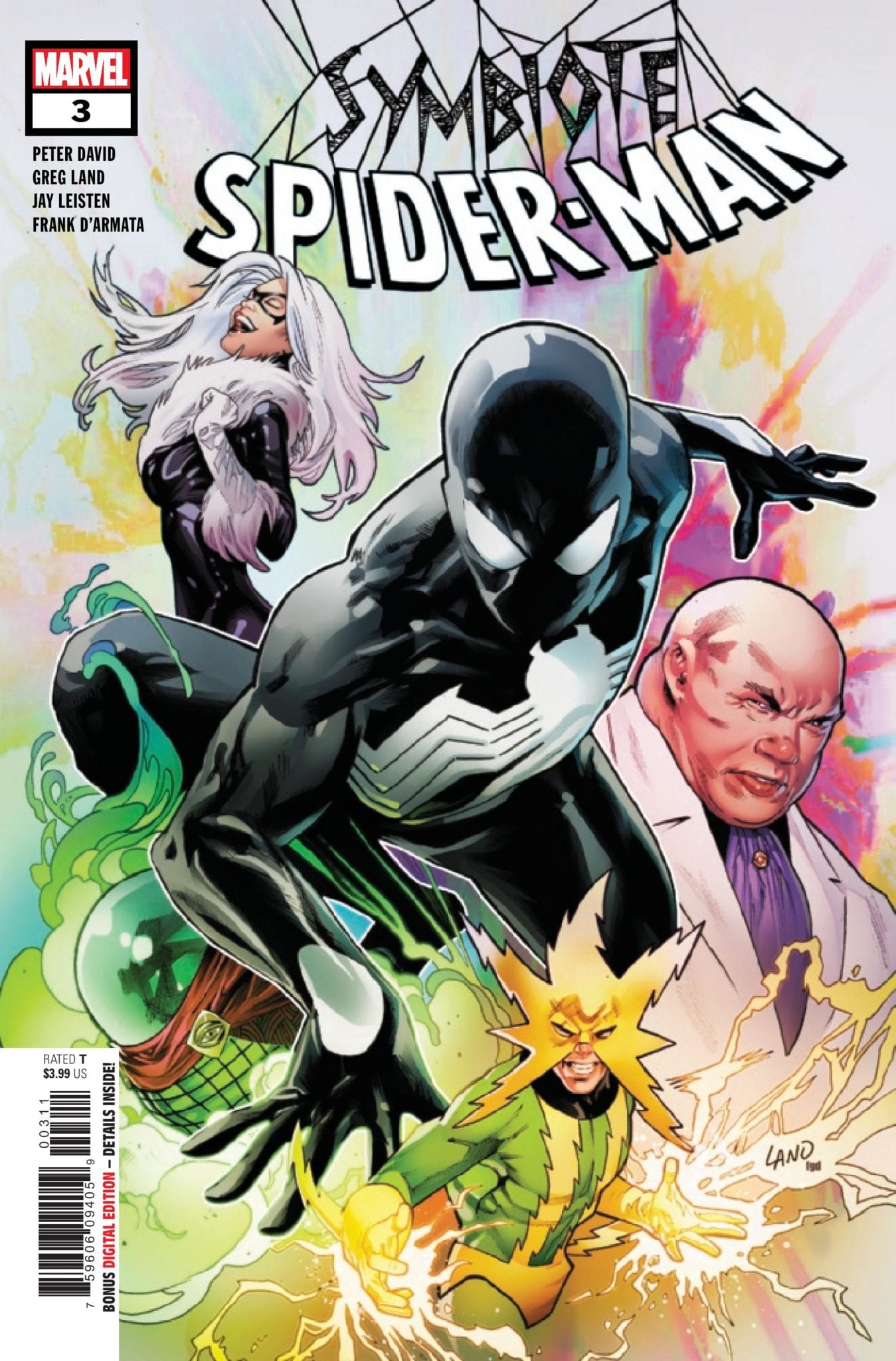
SYMBIOTE SPIDER-MAN #3 written by Peter David, with art by Greg Land hits your local comic book shop on June 12, but thanks to Marvel Comics, Monkeys Fighting Robots has an exclusive preview for you.

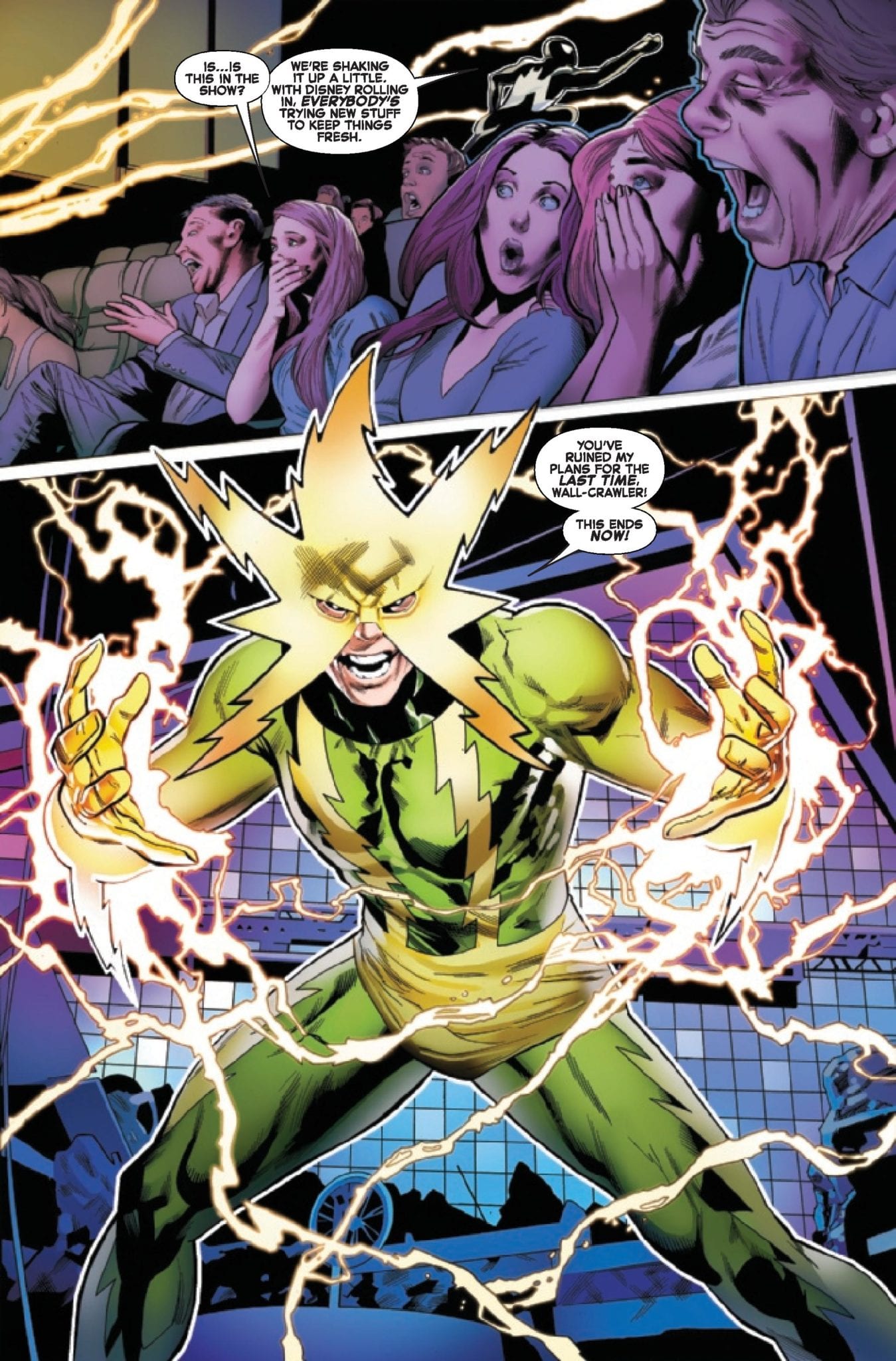
Electro has a ridiculous costume but looks amazing when done right. Land is one with the force in SYMBIOTE SPIDER-MAN #3.

About SYMBIOTE SPIDER-MAN #3 (OF 5):

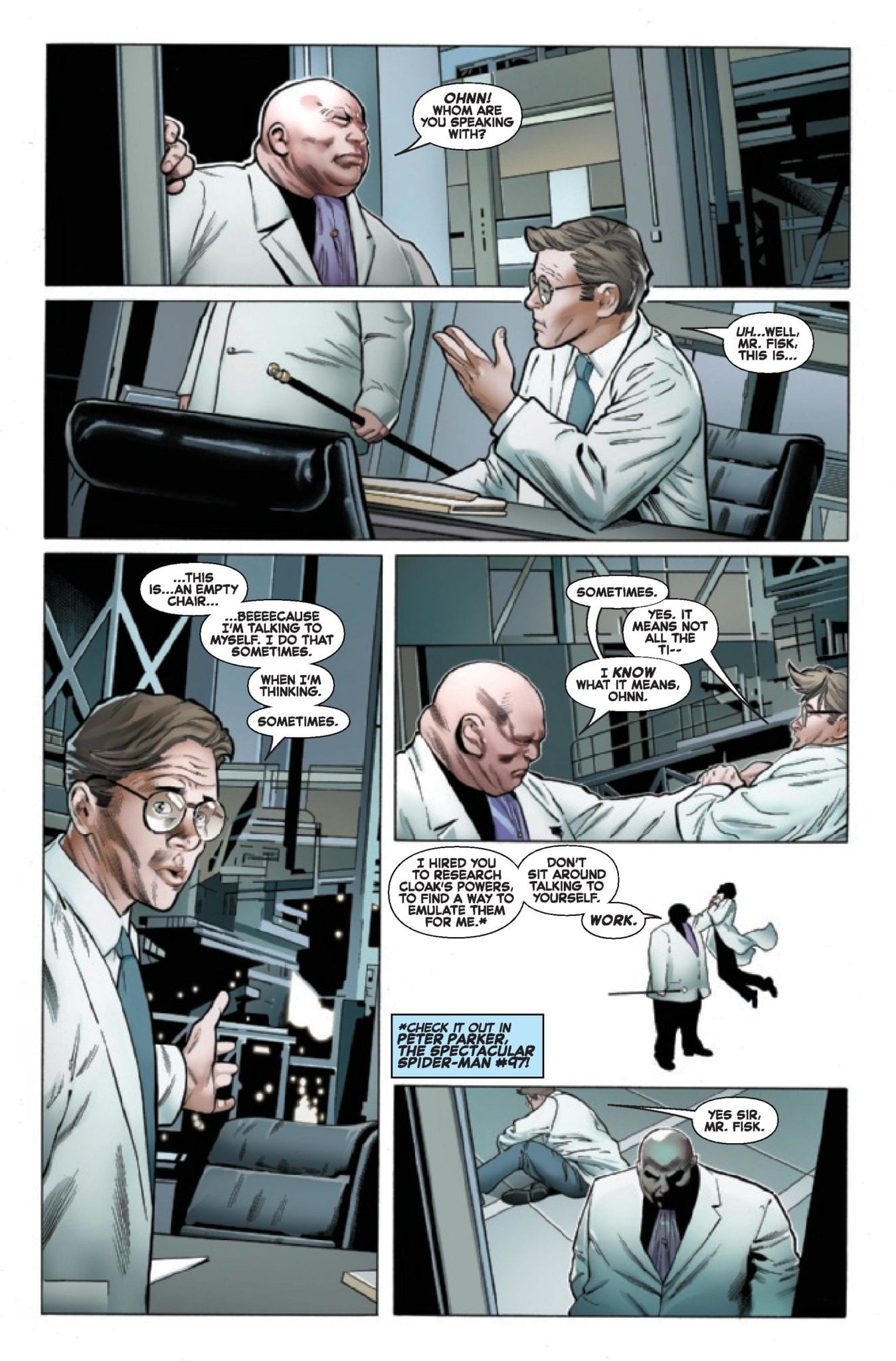
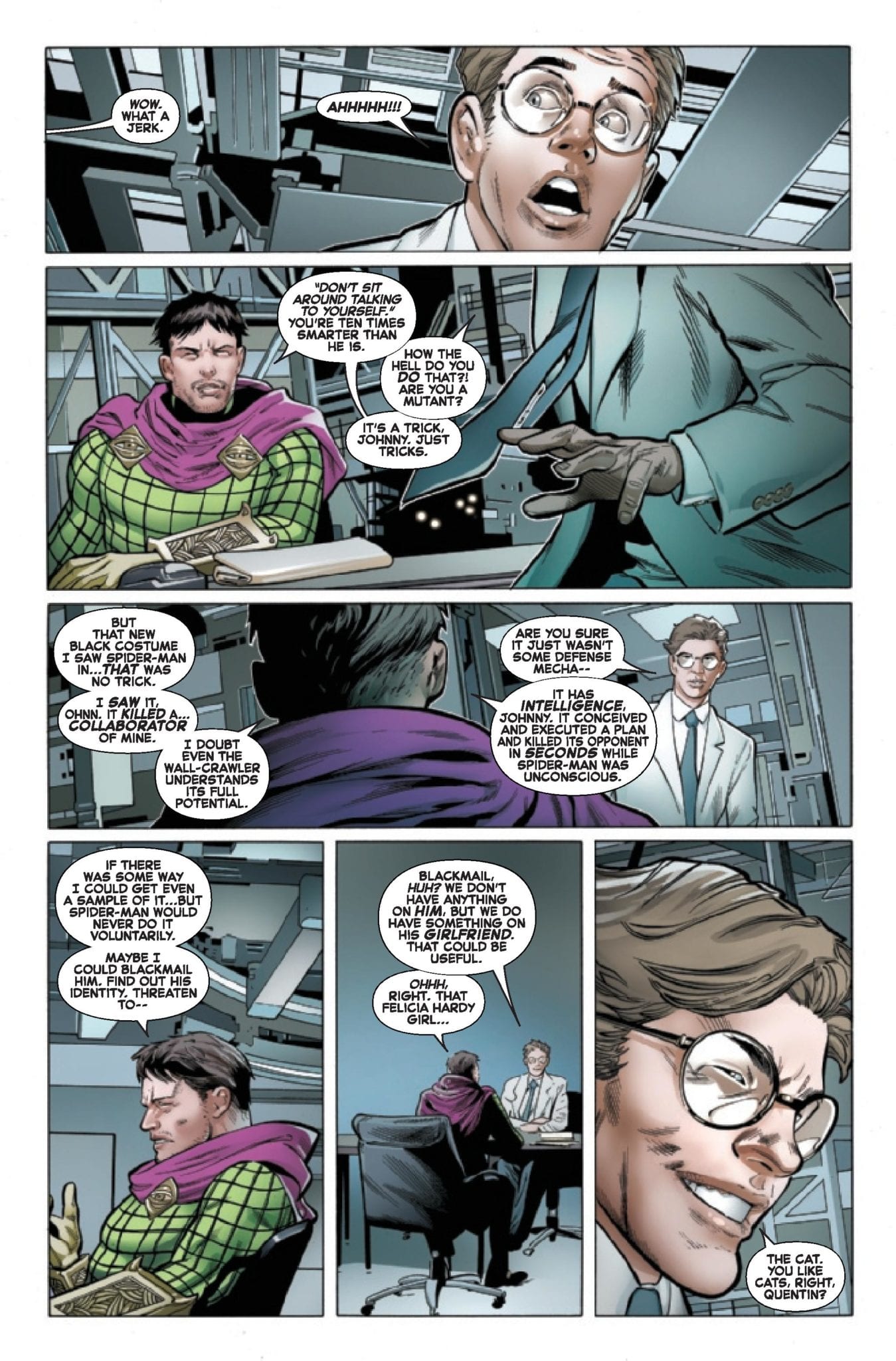
From comic titans, Peter David and Greg Land, comes the third installment of an all-new Spider-Man tale set during the original ALIEN COSTUME SAGA. After glimpsing the strange abilities of Spider-Man’s bizarre black suit, Mysterio is determined to uncover the secrets of the enigmatic ensemble – secrets Peter Parker hasn’t even realized. Uncovering a shameful secret from Black Cat’s past, Mysterio may have found the blackmail necessary to get close to the suit, and in doing so will set Felicia down a path where any misstep could result in her losing Peter forever.

Check out the four-page preview below.
Marvel Comics Exclusive Preview: SYMBIOTE SPIDER-MAN #3 (OF 5)

Marvel Comics Exclusive Preview: SYMBIOTE SPIDER-MAN #3 (OF 5)

Marvel Comics Exclusive Preview: SYMBIOTE SPIDER-MAN #3 (OF 5)

Marvel Comics Exclusive Preview: SYMBIOTE SPIDER-MAN #3 (OF 5)


Are you reading SYMBIOTE SPIDER-MAN, do you like these prequel books? Comment below with your thoughts.

Monkeys Fighting Robots Youtube