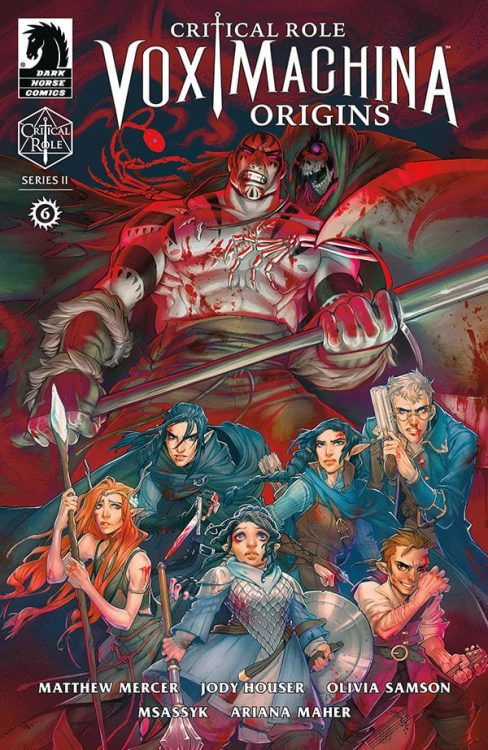
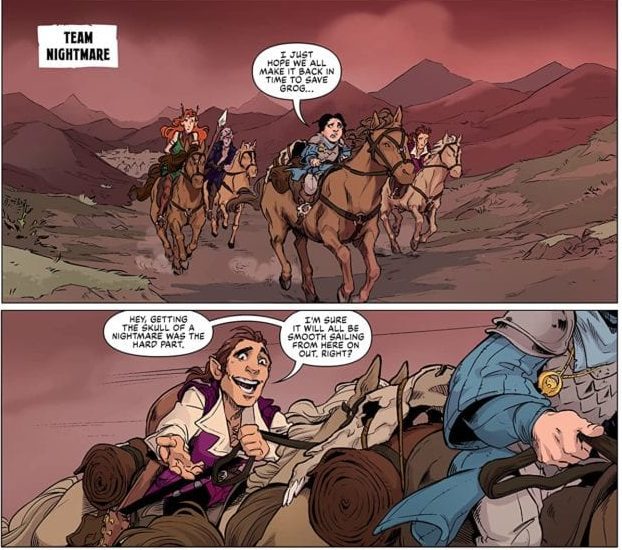
Vox Machina has finally found the necessary ingredients for a mystical exorcism that will save their beloved Grog. CRITICAL ROLE: VOX MACHINA ORIGINS II #6, available in comic book stores on Wednesday, June 3rd, concludes Volume II. Readers will be happy to find this issue brings Team Nightmare and Team Nymph Heart together in the chambers of the Realmseer, one of the most accomplished users of the arcane. But with the evil spirit inhabiting Grog making more frequent appearances, this adventure’s conclusion will be a real nail-biter.
Story
The race to save Grog is at its most crucial moment as our heroes travel to the Realmseer’s study for the ceremony. The ever deepening scar on Grog’s chest spurs the group to quicker action before his body is entirely controlled by Drath.
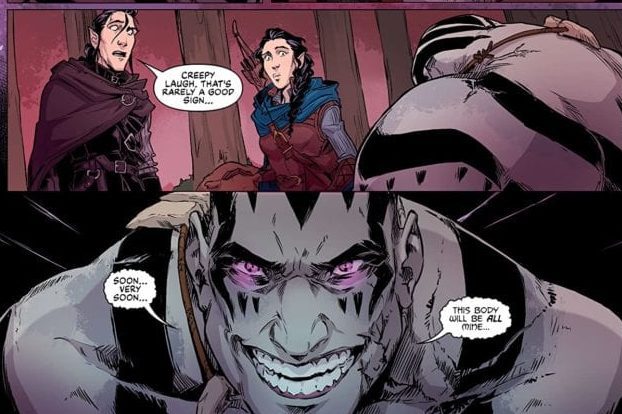
The heroes eventually arrive at the arcane master’s chambers and commence with the ritual. But the process isn’t as straightforward as one would have hoped. Drath fights back against the magic in brutal fashion, vowing to murder the lot of them.
Jody Houser’s script encapsulates everything readers love about Critical Role and the Vox Machina party. We’re enthralled by this band of heroes who offer quirky looks at their life despite the sobering conditions surround them. The strength of their personalities is only matched by the action-packed sequences.
Artwork
Olivia Samson’s penciling and ink work, Msassyk’s coloring, and Ariana Maher’s lettering offered the perfect tapestry for this issue. Readers get clear depictions of desperation on each hero’s face as they race across the sprawling landscapes, filled with greens, browns, and other earthy hues. We feel as if we’re inhabitants of this world and a part of the story. And the font styling adds to the high intensity of the situation, employing large and small sizing when applicable.
Conclusion
Dark Horse’s CRITICAL ROLE: VOX MACHINA ORIGINS II #6 is exactly the conclusion we were waiting for. We find an ending that closes one door and opens a dozen more.
Were you satisfied with the conclusion of Grog’s arc? Let us know in the comments below!
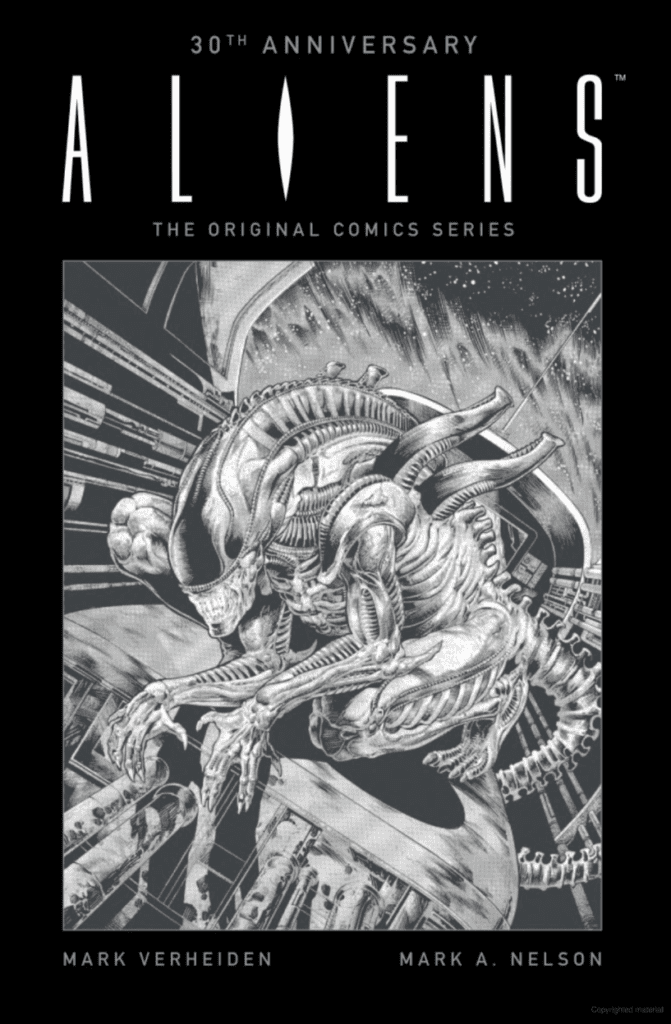
Most modern comic books make use of a colorist who plays a very significant role in the final art that a reader will see. However, Aliens: The Original Comics Series from Dark Horse Comics is composed entirely of black-and-white images, and uses this to its advantage.
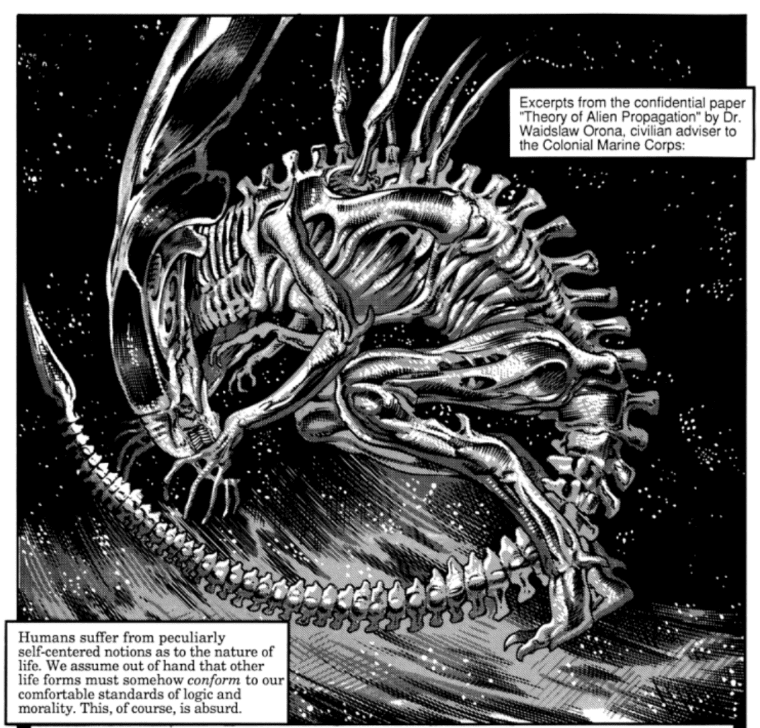
Aliens: The Original Comics Series was published in 1988 and 1989, and tells the story of the characters Newt and Higgs from the movies Alien and Aliens. The series was written by Mark Verheiden and illustrated by Mark A. Nelson. Nelson specialized in black-and-white art done using the now mostly unused Duoshade process. The process involved painting a chemical onto a specially treated paper, and allowed Nelson to create stunning and incredibly detailed illustrations. While other comic books rely heavily on the colorist to create an atmosphere in his or her stories, the black-and-white art of Aliens works heavily to its advantage.
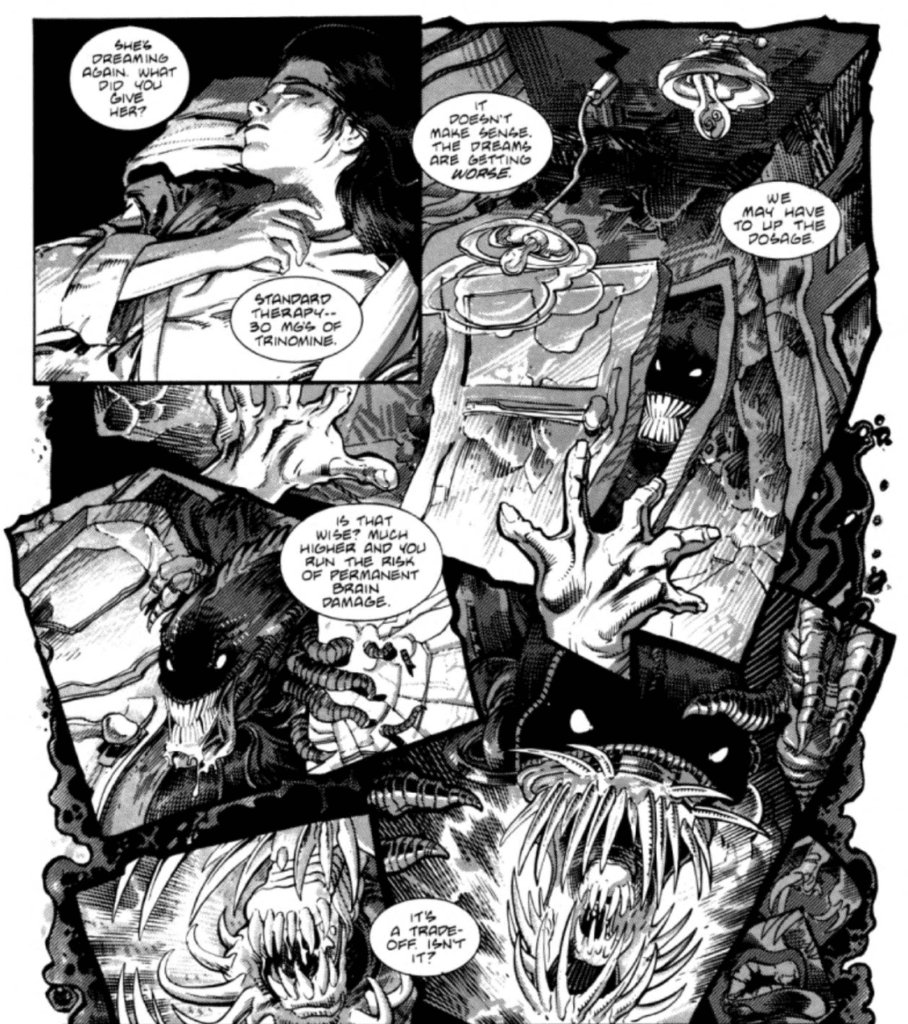
The most effective way that the colorless art helps Aliens: The Original Comics Series is through establishing tone and atmosphere. From very early in the series, it is clear that Verheiden intended the story to focus on the horror aspect of the franchise. By having a black and white color palette, the story is given new depth and allows for tones of fear and suspense to be prevalent throughout the series. For example, Newt experiences several nightmares in the beginning of the series that depict the Xenomorphs, or dream interpretations of the creatures. Due to the Duoshade process and how it allows for incredible detail using black, these dream sequences are drawn beautifully in heavy shadow, helping to make clear the terror that Newt is experiencing.
The black-and-white color palette also assists in developing suspense in areas veiled in shadow, such as those in Newt’s dreams. Not only are many people afraid of the dark, but areas such as this leave the reader in suspense of what horrific beings could be lurking in the shadows.
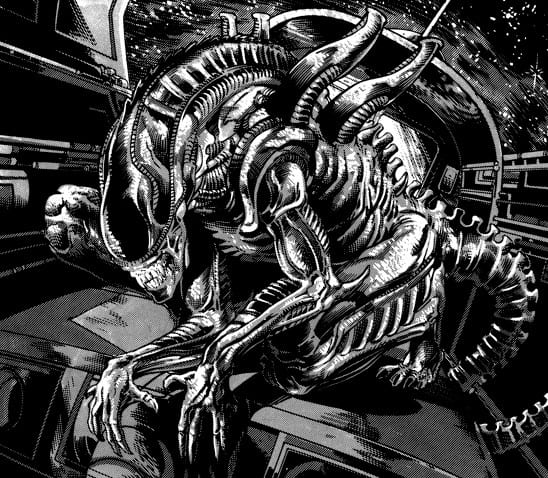
Perhaps the most important way that the black-and-white aesthetic serves Aliens: The Original Comics Series is through illustrations of the Xenomorphs themselves. As the title characters, it is essential that the Xenomorphs are drawn well, and through the Duoshade process, Nelson can bring the horrifying characters onto the page to life. Since the Xenomorphs in the movies are completely black, nothing is lost in the transition to the page. Also, since the Xenomorphs are black and the humans are illustrated with white and gray tones, they act as a foil of one another. The Xenomorphs represent evil, and humans represent the good. Although humans as good does not hold true for many of the characters in the series, this contrast between the Xenomorphs and the humans is an effective technique that would be impossible if the illustrator had chosen to portray the story in full color.
In all, Aliens: The Original Comics Series is an amazing read, telling the stories of Newt and Higgs after the events of the second Alien movie. While this story may have been removed from the official canon after the release of Alien³, it is worth a read by anyone who is a fan of the Alien franchise. Some may believe that color inherently makes a comic book better, but Aliens: The Original Comics Series quickly dismisses that claim.
Are there other black-and-white comic books that you are a fan of? Let me know in the comments below!
Summer for the movie season works like this: It heats up in May, gets broiling hot in June and July then starts to cool off only slightly in August before dropping off dramatically for the September cool down. Here we are in June, and 30 years of cinematic history reveals just how hot the silver screen gets this time of year.
One-hundred-plus years of filmmaking provides a long, rich, and deep history to look back on. Retro reviews and analysis of old films are practically necessary full-time specialties. Month after month, films release, vying to make as much money and grab as much attention as possible. Some rise, some fall, but regardless of financial success, the lasting effect of a film in popular culture is unpredictable.
So, where does that leave previous box office champs? Let’s take a look back ten, twenty, and thirty years ago at the box office hits released in June.
1990 • Total Recall • 119.3 million
The movie screen was a busy place in the summer of 1990. Taking the top spot at the box office was Total Recall starring none other than Arnold Schwarzenegger. The former Hercules in New York star was one movie away from reaching peak Arnold with Terminator 2: Judgement Day. Total Recall, based on the Philip K. Dick story “We Can Remember It for You Wholesale,” was a crossroads of talent at its finest. Co-stars of the film included Ronny Cox (RoboCop), Michael Ironside (The Perfect Storm), and Sharon Stone (Basic Instinct). Behind the camera was Paul Verhoeven, who was riding high off of RoboCop and was still years away from creating the timeless classic Starship Troopers.
It’s hard to write about 1990 and keep it short. Coming in second to Total Recall was Dick Tracy, the super-stylized comic strip turned film with a cavalcade of stars including Al Pacino (TheGodfather), Dustin Hoffman (Hook), and Madonna (A League of Their Own). Tom Cruise-d into third with Top Gun on the ground Days of Thunder from director Tony Scott (True Romance). Eddie Murphy scored another hit with the sequel to 48 Hours, Another 48 Hours. RoboCop 2 from director Irvin Kirshner (Empire Strikes Back) came in last with 45 million, a marked decline from the previous film.
2000 • The Perfect Storm • 182.6 million
The year 2000 marked a peculiar June for the box office. Where 1990 cranked out a lot of pop culture gems still referenced to this day, ten years later, and the winner of June was The Perfect Storm starring George Clooney. It follows the crew of a commercial fishing vessel, directed by Wolfgang Petersen (Das Boot, NeverEnding Story) and based on the non-fiction book by Sebastian Junger. Called the Andrea Gail, the boat never returned after being caught in a weather phenomenon referred to as the “perfect storm” of 1991. Along for the ride with Clooney was Mark Wahlberg (The Happening), John C. Reilly (Step Brothers), and Michael Ironside (Total Recall).
The Perfect Storm is a fine film if a little lost to memory in the minds of most cinephiles. Following it at the box office is the mostly panned Big Momma’s House starring Martin Lawrence. The Patriot with Mel Gibson made 113 million closely followed by the animated Chicken Run. Gone in 60 Seconds with Nicholas Cage and Angelina Jolie rounds out the top five. June 2000 featured a tight numbers two through five, as an average of only four million dollars separated the four films.
2010 • Toy Story 3 • 415 million
June 2000 was a little strange. But June 2010 was back to things as usual with a handful of big hits still resonating today. Taking the top spot is Toy Story 3 from Pixar, which delivered yet another fantastic story paired with stunning computer-generated visuals. New characters such as Jessie and Lots were born thanks in part to the wonderful vocal talents of Joan Cusack (Working Girl) and Ned Beatty (Rango).
Caption the number two spot is the third installment of The Twilight Saga, Eclipse. Kristen Stewart and Robert Pattison return for the vampire-werewolf-human love triangle. The reboot of The Karate Kid starring Jaden Smith (After Earth) and Jackie Chan (Rush Hour) beat Adam Sandler’s “comedy” Grown Ups for third place. Landing in the final spot is The A-Team starring Bradley Cooper about America’s favorite band of ex-soldiers on the run helping those in need.
June 2020 & Predictions
The box office is at a standstill now. Indie film The Wretched won the box office for several weeks. Christopher Nolan’s Tenet will likely be the next big film release, but as the pandemic continues, we’ve got new problems here in the United States to contend with too. So, who knows?! However, for those who are safe, healthy, and able, there’s plenty of content to consume on your favorite video viewing device through streaming channels across the interwebs.
Clint Barton is here to save the day - and create a bit more chaos.
HAWKEYE VOL. 1: MY LIFE AS A WEAPON originally released back in March of 2013. Yet it’s still a comic stuck in the minds (and hearts) of many. Myself included. It simultaneously was and was not like many other comics I’ve read.
Clint Barton is here to save the day – and create a bit more chaos.
Hawkeye is not a series afraid of humor. In fact, Hawkeye rather shines in that element. So it’s really no surprise that his entire series launches on a moment of tension and surprising humor. “Okay–This looks bad…”
Yet that isn’t the reason this series carried so much import and impact. Clint Barton is a superhero. He’s one of the Avengers for crying out loud. Yet he’s human. Very, very human. He has no powers to speak of. He’s flawed. He makes mistakes (sometimes a lot of them).
He’s also deaf. Now, this is an element that could easily have been thrown into the mix and then mostly left alone. But that is not what Hawkeye: Vol. 1: My Life As A Weapon did. No, it embraced everything about his deafness, from Clint learning ASL and lipreading to every other little detail you might think of.
It’s the first time I can recall seeing a hero that was anything truly outside of the ‘standard hero mold,’ so to speak. It was a moment, or series of moments, so flawlessly woven into the narrative. There was no major deal made about Clint’s deafness. He merely was. It was part of him.
Okay — This looks bad.
Since then, I’ve seen many heroes who deviated from that ‘standard hero mold.’ It’s been beautiful to see it happen. To see new heroes pop out, with new styles and new messages. Yet Clint Barton will always hold a special place in my heart, for being so perfectly who he is. No shame, no regrets. Just a man trying to save the day.
More to the point though, Hawkeye Vol. 1 (as well as the rest of the series) brought about one of my favorite variations of Hawkeye. A version I desperately keep hoping to see in the MCU, be it in the movies or his Disney+ series. Realistically, there are many fans out there rooting for this very thing as well.
Got yourself pretty banged up.
Hawkeye Vol. 1: My Life As A Weapon had a pretty stellar team behind the scenes. Maybe that was why it carried with it so much confidence. Matt Fraction was the writer for the project, with artists such as David Aja, Javier Pulido, Matt Hollingsworth, Annie Wu, Alan Davis, Francesco Francavilla, and Chris Eliopoulos all working alongside him.
Together they created something unique, and dare I say, fun. One of the best things about Clint Barton is that, as I’ve stated above; he’s human. He’s free to make mistakes. Sometimes major ones. He’s also perfectly capable of getting himself in messes that are way over his head – and yet somehow surviving it all.
Despite all of that and all of the other crap that life tends to dump on him, Clint has a fairly healthy outlook on life. Sure, he gets down sometimes (who doesn’t?). But he always gets back up. Best of all, he’ll almost always have a line or two to make his readers smile. Sometimes that alone can mean the world.
Nothing quite like causing traffic and destroying property to relieve your anger.
Hawkeye Vol. 1: My Life As A Weapon has one more reason for me to hold it near and dear to my heart. Kate Bishop. That amazing, sassy, and snarky girl. I adore her and everything about her. Including (especially) all of the ways in which she calls Clint out. Her inclusion in this series was absolute perfection, at least partially due to the important conversation(s) it started.
The fact that she’s able to keep up with Barton’s messed, and save the day a time or two herself is certainly another highlight of the volume. As is her constant snark and sass – she’s more like Barton than either of them realize.
All of these elements, and more, are the reason why Hawkeye Vol. 1: My Life As A Weapon will always be one of my top favorites. It’s a series I fall back into reading whenever I need a laugh or a bit of encouragement. Okay, sometimes I read it as a reminder that things can always be worse; after all, just look at the messes Barton gets into.
Daisy's life is about to be forever changed in The Red Mother Volume 1.
THE RED MOTHER VOLUME 1, available now from Boom! Studios is the beginning of a haunting and alarming tale. This is a brutal telling like no other, bringing the innocent to the forefront in hopes of solving their own mysteries.
Daisy’s life is about to be forever changed in The Red Mother Volume 1.
***SPOILER WARNING***
The Red Mother Volume 1 is arguably one of the most haunting and disturbing introductions around. This is a series intent to leave the readers with nightmares, courtesy of the graphic nature, and even more alarming implications.
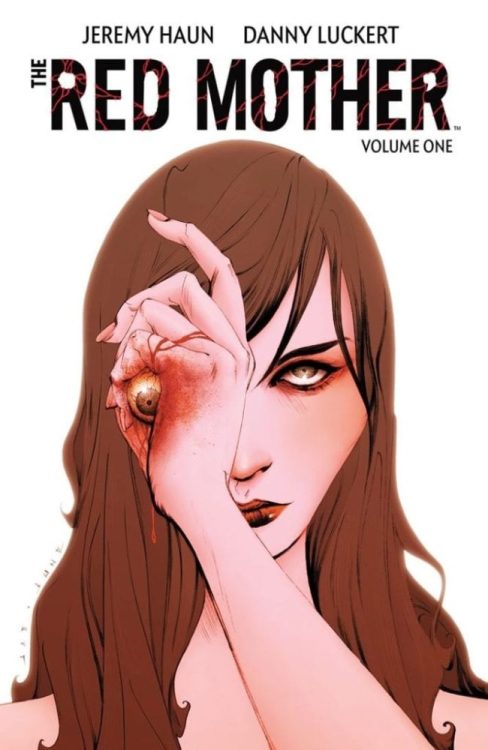
Daisy was just a normal woman. She had her everyday concerns, but she had enough money to help her get through most of that. That is, until the day she was attacked. The day she lost her eye and her boyfriend.
Now she’s left with a mystery on her hands. A mystery that nobody else seems willing to acknowledge exists. After all, that would just make her life and the following horrors to easy to bear.
One note before we dive into the review; The Red Mother Volume 1 has several graphic elements, one of which revolves heavily around the loss of an eye. If this is the sort of thing that makes you squeamish, you should look away now.
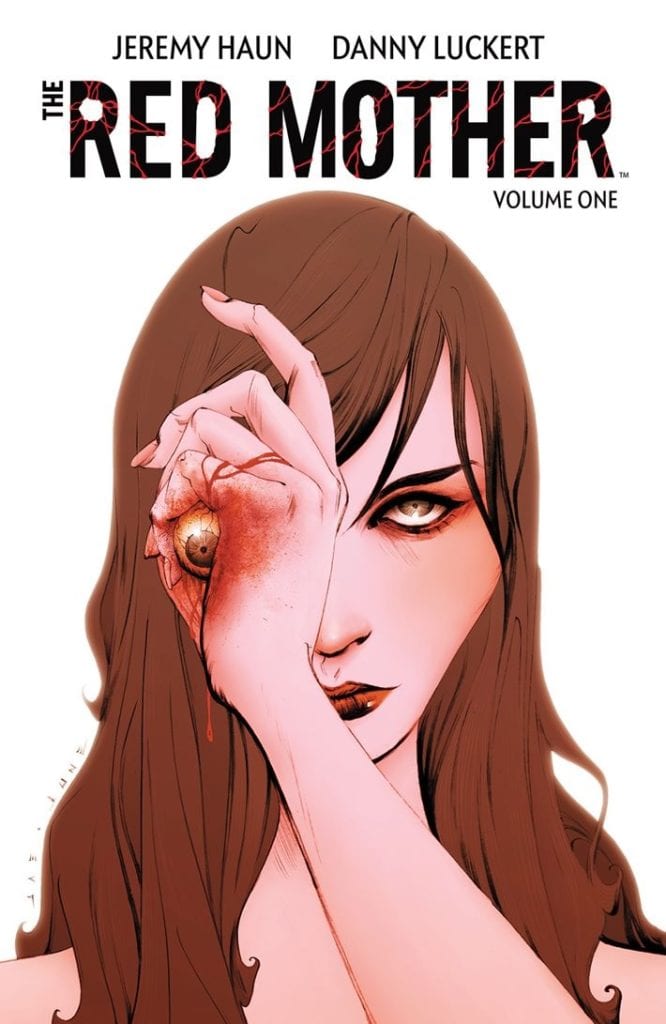
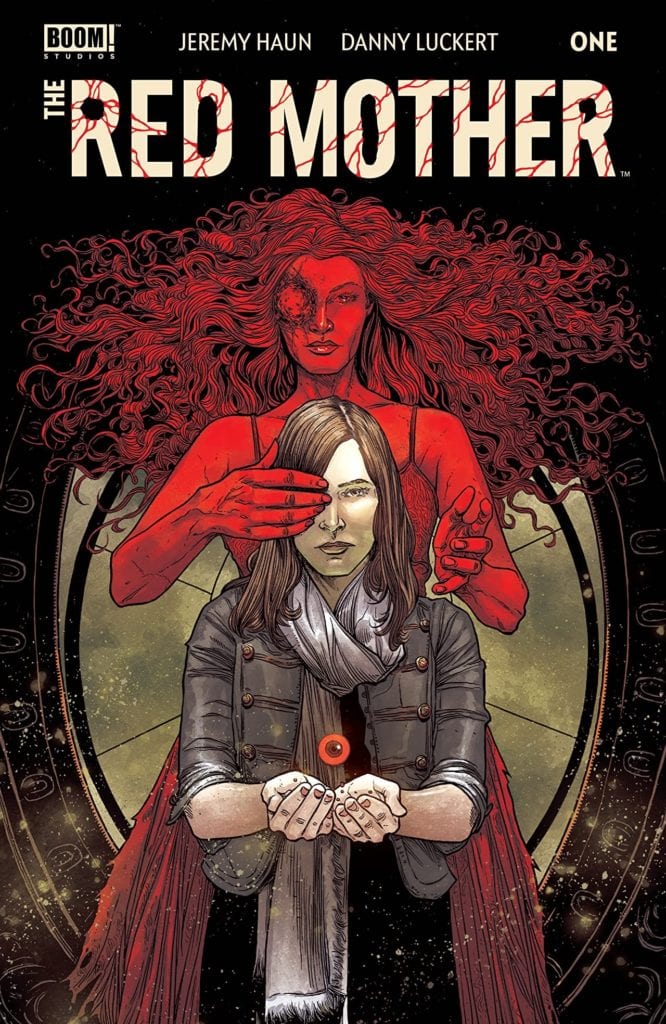
Daisy and The Red Mother are featured on this hauntingly beautiful cover.
The Writing
Jeremy Haun is the mind behind The Red Mother Volume 1, so if you wake up with terrors in the middle of the night, just go ahead and blame him for all of that. This series is already proving to be every bit as disturbing and graphic as promised.
There are a lot of ways to tell a horror story. But one of the most terrifying things a writer can do is make you fear the normal. By putting his horrors in plain sight, Jeremy Haun has given Daisy, and thus the readers, real reason to be terrified.
Blended with the horror of the unknown, and this tale gets fairly dark. Mercifully, it is balanced out with a healthy dose of intrigue. There are puzzles within this tale, and Daisy seems determined to solve them for us.
All of these elements work together to create something shockingly gripping and haunting. It’s safe to say that this is a tale you’re not going to want to look away from.
A monster in the darkness?
The Art
Where the writing of The Red Mother Volume 1 is haunting, the artwork is outright terrifying. The artists behind this project were not afraid to go graphic when needed. Likewise, they knew how to use the horror of their surroundings to excellent use.
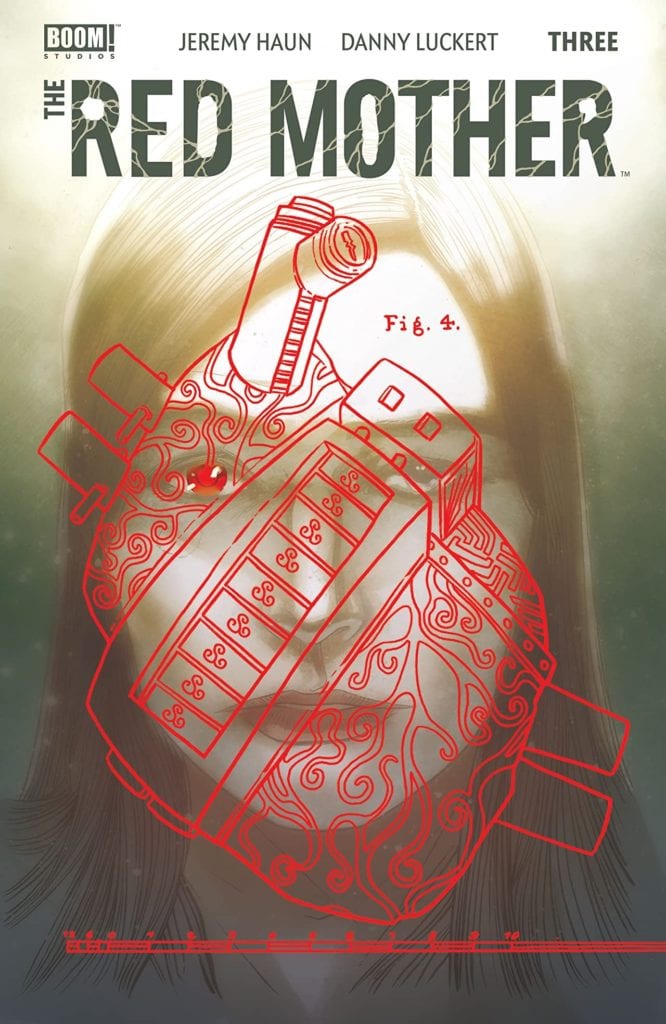
Danny Luckert (artist) and Ed Dukeshire (letterer) worked well together here. They created something vibrant and alarming all in once. The covers are an absolute highlight, to be sure. They’re eye-catching, demanding that the readers pick up an issue and read more.
The artwork within the pages balances on a very fine line. There are lush details and color palettes, all of which can switch at a moment’s notice. There’s the normal, and then there’s the terrifying. At any given moment you can never quite know what to expect.
The mystery of a puzzle that has been dropped in one’s lap.
In Conclusion
The Red Mother Volume 1 is an intense and intriguing start to an all-new horror series. This is admittedly a series that can get graphic at times, and yet it still appreciates the subtle elements that can come with horror. The combination is where this series shines and will prove to be memorable.
Welcome to Self-Published Spotlight, a regular interview column where I will be highlighting self-published comics and the creators and small print publishers who make them.
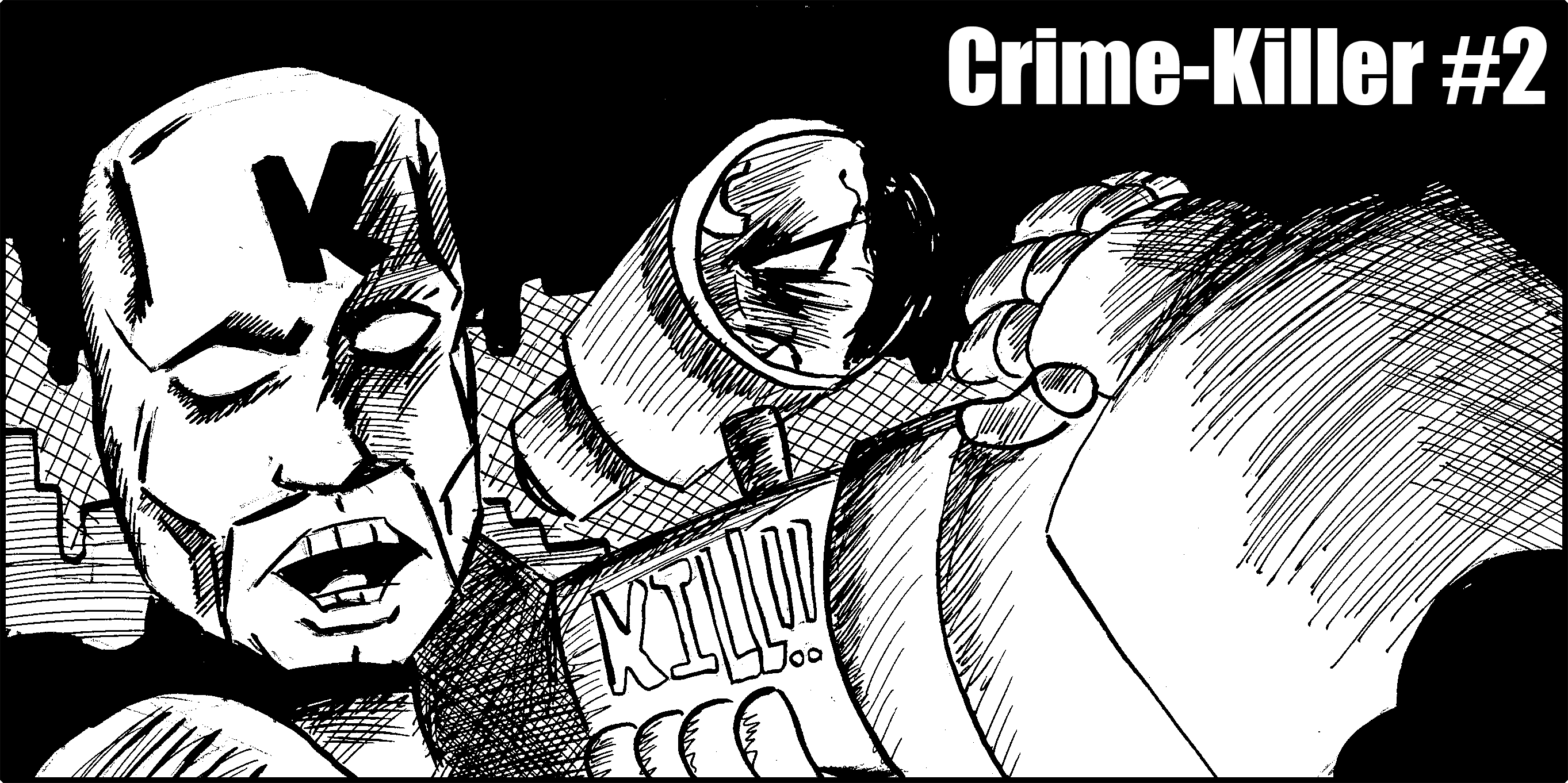
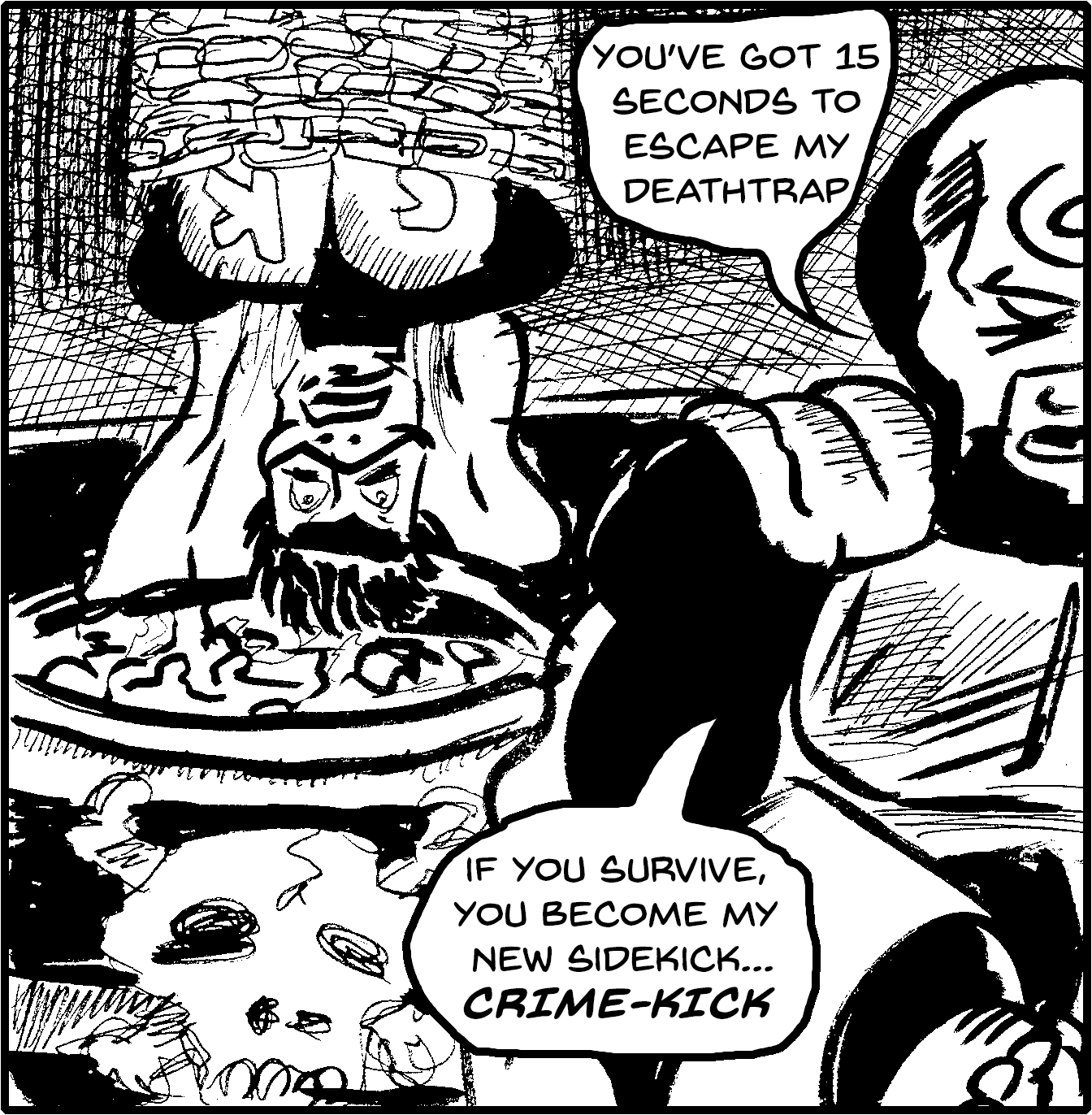
The beauty of self-published comics is you can make them anything you want and usually are the sole, complete work of one individual. So what you usually get is a totally singular, unbridled creative creation. Brian Judge’s CRIME-KILLER is such a book. Outlaw in both style, humor and attitude, CRIME-KILLER will make you laugh hard. It’s both a parody and an embracing of grim and gritty comics. Anyway let’s let Brian take it away and explain his comic!
Monkeys Fighting Robots: First of all, thanks for taking the time to chat with me, Brian. How are you holding up in this new normal? Brian Judge: Doing as good as I can! As a recent college graduate, I’ve been spending a lot of my time working on my comics while I continue to leech off my parents like a parasite. So yeah, doing good!
MFR: So, for those folks who don’t know your work, can you tell us a bit about yourself and your comix? Judge:Yeah. I’m Brian. I draw stories about goblins who drink their own pee and a bunch of violent superheroes living in Big Dick City. Also diary comics
MFR: Yeah, Crime Killer is what first caught my eye on your Instagram account. I think you posted like a picture of a stack of Crime-Killer books and somehow that ended up on my feed. I had to have it. Judge: Oh yeah! You’re talking about the Crime-Killer complete comic compendium!
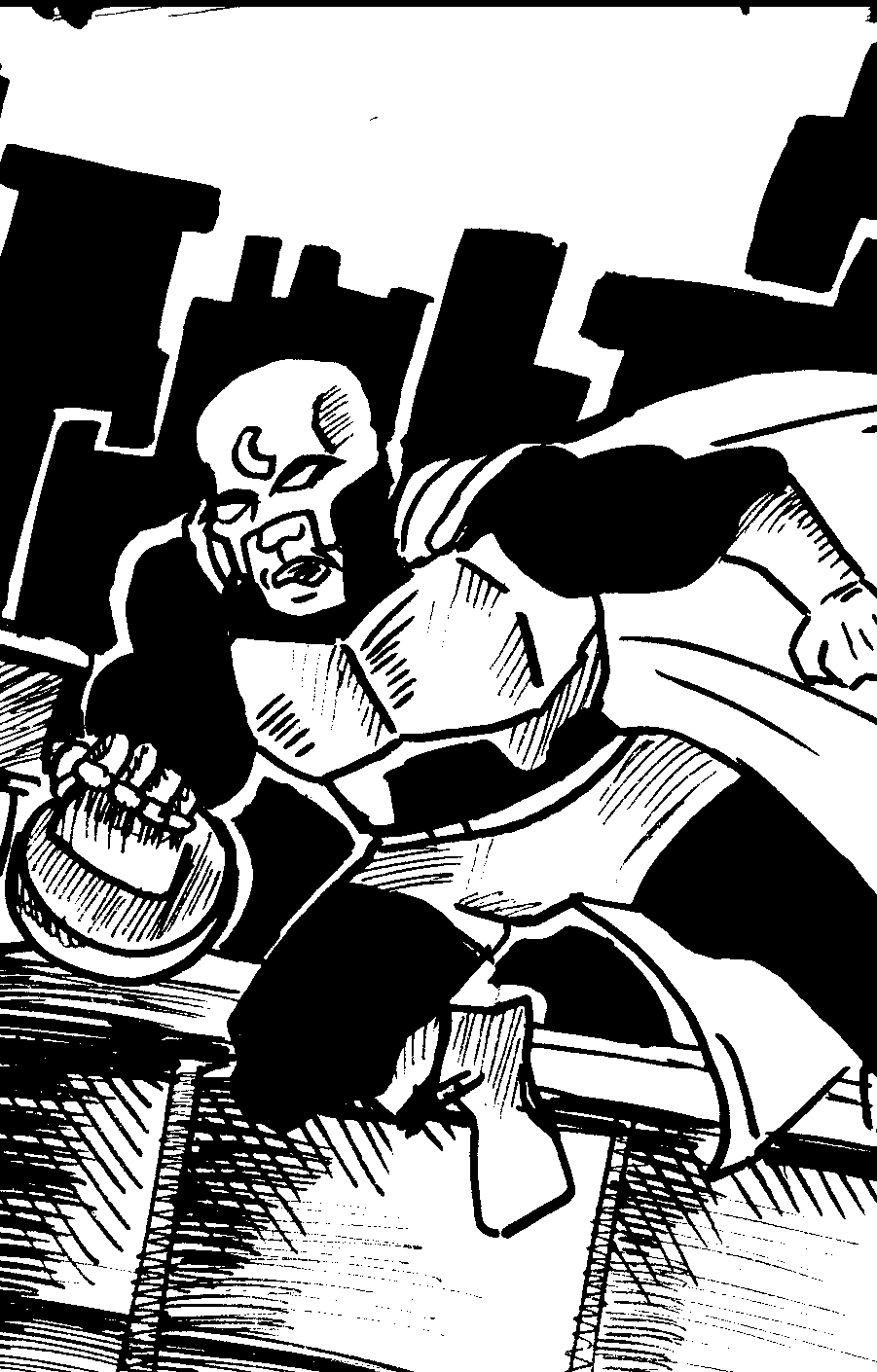
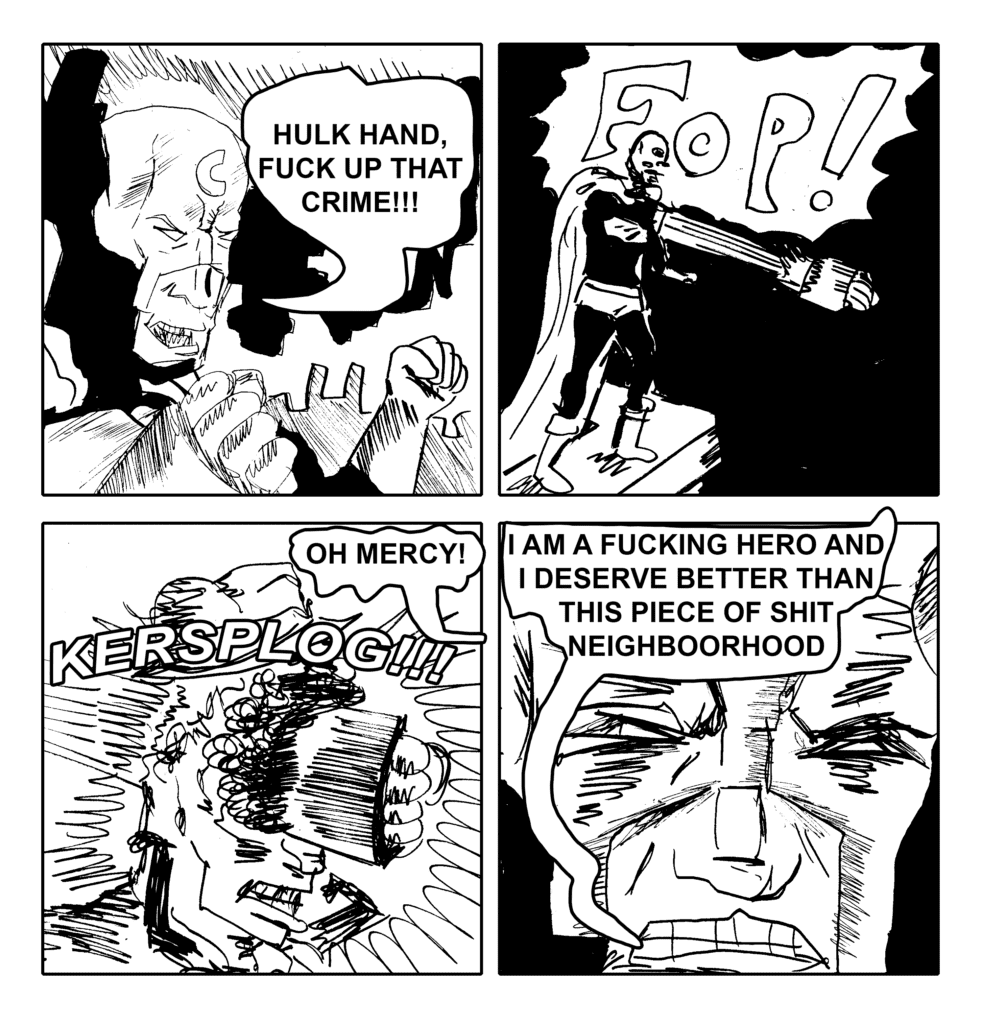
MFR: And when and how did you create Crime Killer? And for our readers, who is Crime Killer? Judge:I came up with the idea for Crime-Killer during a party with some friends. We were all drinking and having a good time and I drew a little comic about a superhero fighting a mugger on a piece of scrap paper. I wanted to keep it short so I had the guy use a giant fist to blow a hole through him while he curses about how much he hates his job. I thought it was funny so I used that as the storyboards for the first crime killer comic. After the first story, I wanted to make more. It’s easy for me to get burnt out on a project but Crime-Killer was always fun to draw. Crime-Killer is anger incarnate. He’s the vengeful angst-ridden superhero who hates his job just as much as he hates crime. Crime-Killer is here to kill your crime!
MFR (laughing) The book made me laugh so much. I love the filthy language and hyperviolence. I also love the layouts. The simple square panels add to the humor for some reason. Judge: I’m glad you enjoy it! I’m the type of weirdo who laughs at horror movies during the bits where the 7 ft maniac cuts a teenager in half with a giant chainsaw. It’s so ridiculous, I wanted to capture that feel.
MFR: You also sent me a couple of mini-comics, Barbo (which has to be the smallest comic I have ever read) and The Untitled Willow Fan Comic. Both of these are very different from CK. Can you tell me a bit about these two? Judge: I like to challenge myself with every comic I do. Crime-Killer was about loosening up with my art. BARBO is a short story set in the Grublins universe. I wanted to try my hand at world-building with a grand fantasy universe about shitty goblins enslaved to humans. I’m not really into fantasy stuff, more of a sci-fi guy, so I tried making a story I would be interested in. I made the willow comic as a weird test. I was getting into diary comics and I wanted to see if I could make an entire book about one subject matter. Naturally, I chose to write about my experiences playing the NES video game adaptation of the Ron Howard cult classic “Willow” starring the dude who was the Ewok in Star Wars.
MFR: (laughing): Going back to Instagram, you use Instagram not only to promote comics but as a format to publish them as well, something I have started to see a few cartoonists do (Like Ben Marra). What makes IG such a great tool for cartoonists? Judge: IG let’s comic people connect to each other. I love making comics and I’d still be making them even if I wasn’t on Instagram. The fact that you can include up to 10 images in a post means to me that I get to tell the internet a 10-panel comic. That’s a cool power, y’know? I’ve met a ton of amazing cartoonists through IG. This is where we can share our work.
MFR: Oh definitely. There’s a huge community there. Like The Cartoonist Kayfabe crew. Judge (laughing): Also, I just wanna say that I’ve been using Instagram to publish comics wayyyy before Ben Marra started his series. I mean I doubt he even knows who I am let alone follows me, but y’know. (laughs). Oh and Oh yeah! Kayfabe’s amazing! They’re also instrumental figures in the growing comix culture.
MFR: Your art style reminds me of underground comix, mad magazine and outlaw comics Judge: Thanx! I get that a lot.
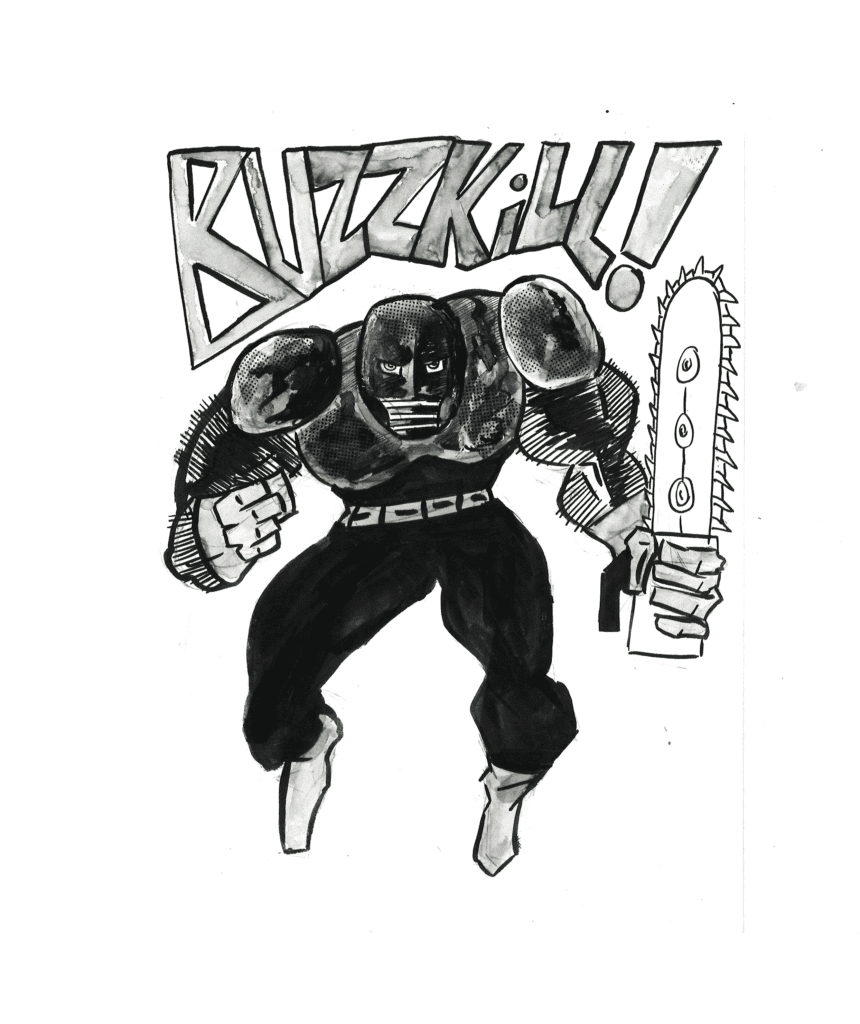
MFR: Who/What are your biggest influences? Like what made you want to make comics? Judge: All the basics. Kirby, Ditko, etc. I’m really into comics In general and I get really influences by whoever I’m reading right now. I’ve been really getting into Savage Dragon which I used as inspiration for my recent Buzzkill comic. Easy answer: I took one comic art class in high school. My teacher was a guy named Chris Kemple. He is what makes me want to draw. I should say Chris Kemple is a comic artist himself. Red Vengeance is his book and it is one of the most fundamental things to me as a cartoonist. He made that. If he can do it, so can I.
MFR: I love Savage Dragon. I buy any issue I see I don’t have. I just re-read volume one too! Judge: Oh yeah! Savage Dragon is flipping GREAT! I’m on vol 2 of the archives.
MFR: Oh and I love Buzzkill and thanks for the sketch! Judge: Yeah dude! I’m glad you dig it!
MFR: What are you working on right now? Judge: Man, I got like 5 projects running at any given moment. I’ve got a daily series going on right now that’s driven by user suggestions. I’m making a collage book creating a new narrative out of existing comics, I’m working on a story about Pac-Man, and I gotta do a backup story for Buzzkill for when I put it to print. The user suggestion one is called Afterlife Adventure. Every day I post a 10-panel comic that serves as the latest chapter to this ongoing story of a guy called Billy Texas trying to get into Heaven. Right now he’s talking with a giant bee to take over the afterlife.
MFR: Yeah! I was reading that and am glad you brought it up. What a great concept. And where else can people find your work? Judge: Outside of Instagram? Not much. I’ve got an online store (oneandonlycomics.bigcartel.com) and I’m included in a few comic zines too like Milk and Honey Comics.
MFR: Well thanks again for chatting dude. That was fun! Judge: Yeah dude! I had a good time!
You can check out new daily work from cartoonist Brian Judge on his Instagram.
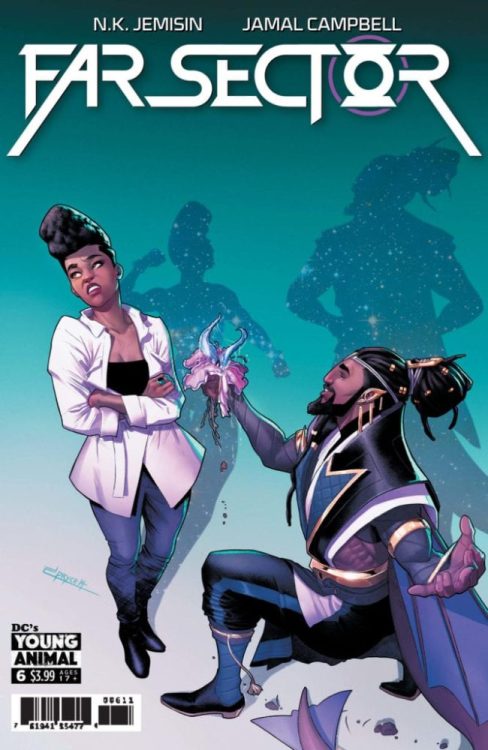
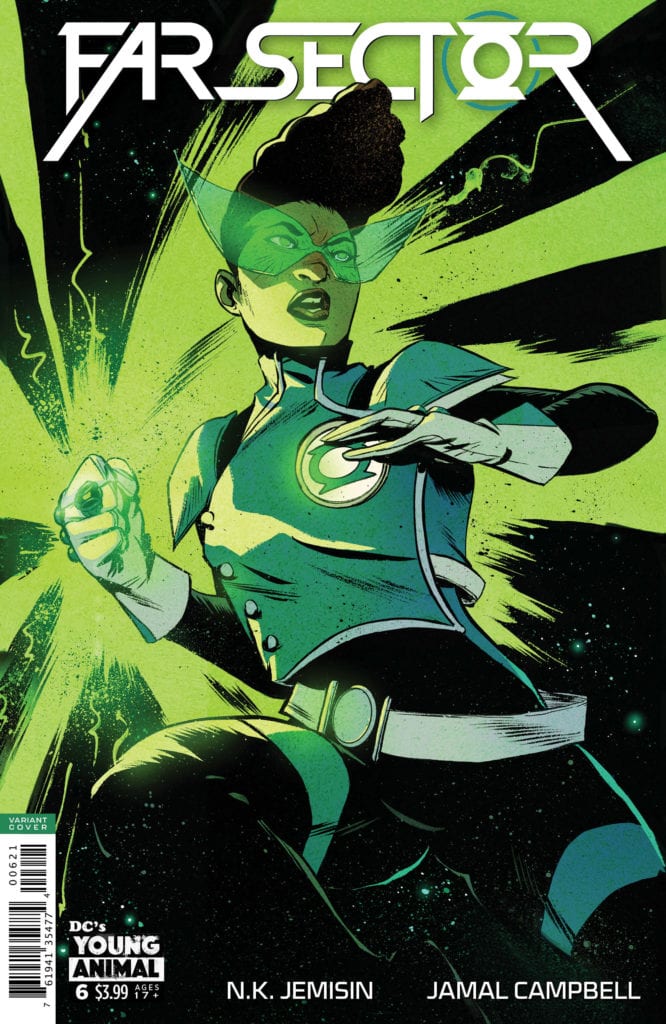
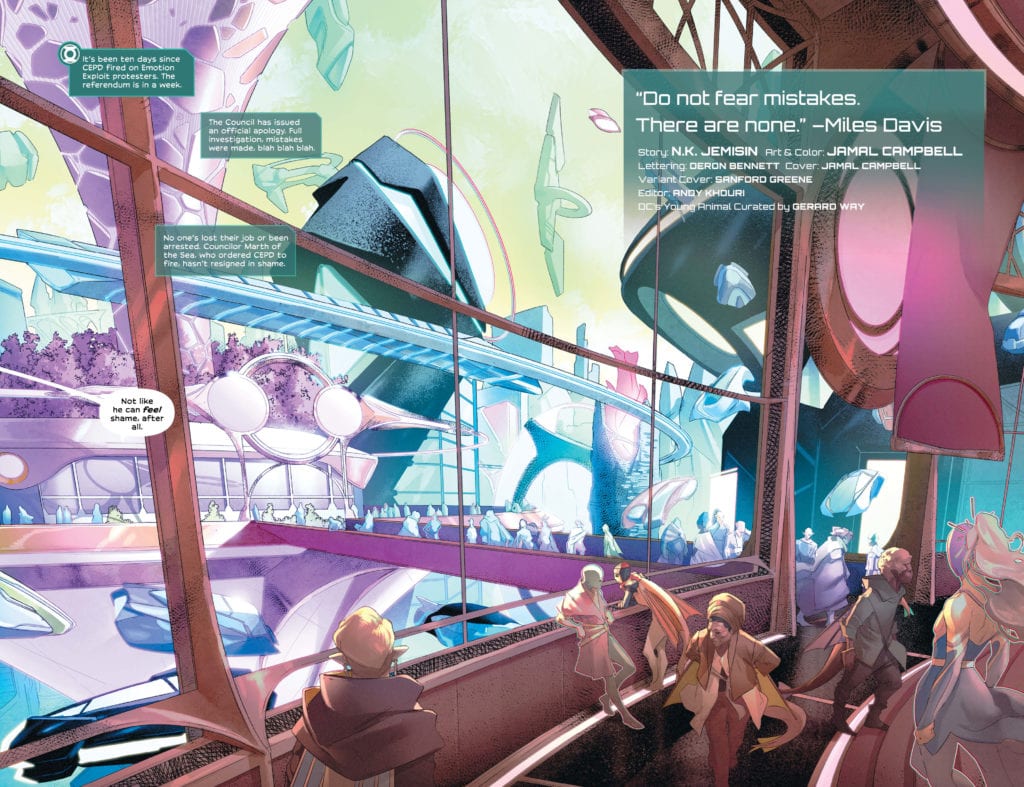
Writer N.K. Jemisin and artist Jamal Campbell, with Deron Bennett on letters, bring out the 6th issue of “Far Sector.” This series’ continued focus on the internal struggles of Jo Mullein with a hefty dose of social commentary via sci-fi makes this another stellar chapter. With engaging and tender character moments and a dose of heavy-hitting action, this is yet another excellent issue of one of the best series coming out of DC right now.
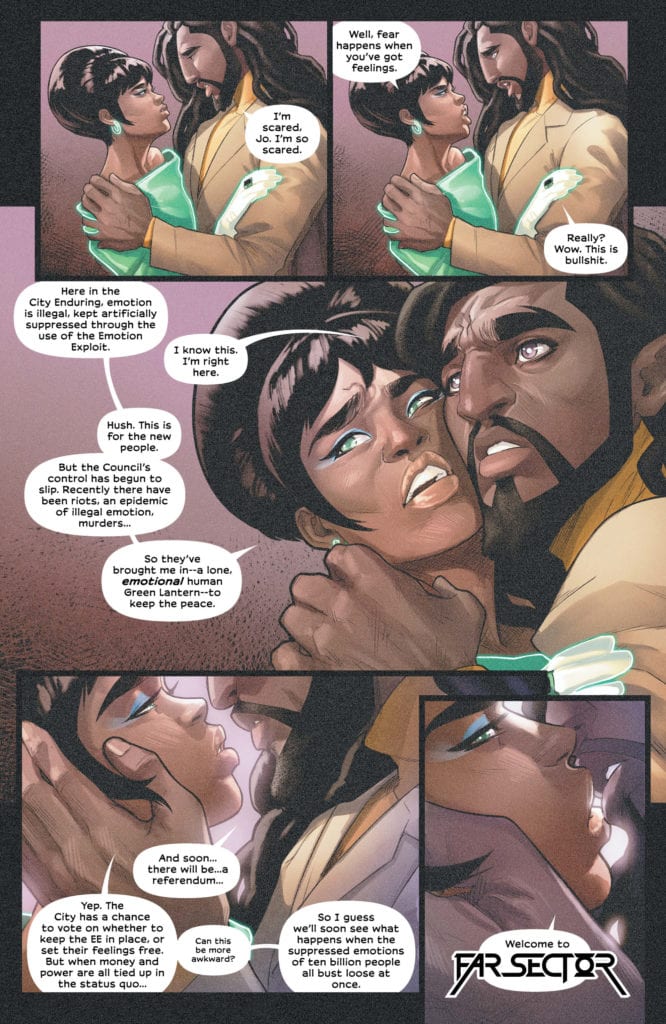
“Tensions in the City Enduring are high as the Emotion Exploit-the mandatory genetic tech that strips citizens of their emotions in the name of peace-is up for referendum. But Jo’s attentions are divided when Councilor Marth makes a surprising and distinctly emotional overture…”
Writing & Plot
This issue is heavy with emotional and tender moments for both Green Lantern Jo Mullein and the characters she’s been spending time with on the City Enduring. Following the prior issue’s tragic shooting of civilians by police forces, Mullein is on her own guilt trip for not being able to do enough to stop this. This emotional tone carries through much of the comic and paints her interactions with other characters. The issue escalates from here to some unexpected romance and ends with a plot twist doused in some badass Lantern-on-robot combat action. Pacing and tonal shifts feel tight and natural, and nothing ever feels out of place. Everything from the hard truths to the comedic bits and the romance into the action all feels structured. Events occur, and Mullein is allowed to sit and ponder the consequences so that the reader can absorb everything that has occurred. The longer this story goes, the more engaging it has become. The dialogue and narration have the usual intoxicating flair of naturalism and almost poetic poignancy. At this rate, “Far Sector” will be one of the most well-written comics DC has released in the past decade.
Art Direction
There could never be enough praise for Jamal Campbell‘s artwork on “Far Sector.” His consistently hyper-detailed designs for both characters and environments pull readers into the story instantly. His wide array of vivid colors shine like vaporwave neon in different palettes on every page. The variety in alien and cyborg-like character designs along with the rest of Campbell’s hyper-polished artwork makes for a stunningly gorgeous comic to look at for every issue. It’s the perfect art for a sci-fi series like this is. The letters from Deron Bennett are crisp and range in font sizes for the perfect emphasis on a character’s words. “Far Sector” continues to be a visual marvel from month to month.
The recent events in “Far Sector” have been given a renewed importance in the wake of recent events in our own reality. The establishment’s use of violence to silence the many in need has suddenly become the front and center of headlines once again. This new wave of unrest has made “Far Sector” a comic of considerable topical importance at this moment, with N.K. Jemisin and Jamal Campbell being commentators as well as storytellers. This is what good science fiction is though, isn’t it? “Far Sector” is a fantastically executed addition to the tradition of social commentary via sci-fi. If this comic can stay this consistent through the latter half of its 12-issue run then it will surely be one of the most easily recommendable titles not just out of DC, but in written fiction from these past few years. Pick up “Far Sector” #6 from your local comic shop on 6/2!
My first exposure to comics was in the early 90s. Born in 1984, the first comic I ever saw was the final issue of the “Death of Superman.” I had watched the old George Reeves Superman show on cable at my grandparents, so I knew who Superman was. I just didn’t think he could die. I began to collect comics after this, starting with DC Comics but eventually becoming a collector of Spider-Man and the X-Men. Little did I know at the time that I was becoming a comic book fan during one of the most gimmicky eras in comic book history (made all the more humorous by the fact that my first exposure to comics was the gimmick-extraordinaire of all comic book events!). At one point, I probably had every issue of the infamous Clone Saga as well as all the lead-ins and tie-ins to the X-Men: Onslaught event.
I stopped collecting comics not too long after the end of the Clone Saga and Onslaught. Sure, I would check in to see what the characters were up to every once in awhile (back when comics could be found on grocery store magazine shelves), but I became detached from that world. It wasn’t until 2004’s “Avengers Disassembled” storyline that I started to get pulled back into comics. Wanting to read this story eventually led to my finding out about Marvel Unlimited, Marvel’s online subscription service with thousands of their comics available online, and Marvel Unlimited led me to The Ultimates.
In 2000, Marvel launched their Ultimate Comics imprint, which featured a reimagining of many of their characters and gave writers, particularly Brian Michael Bendis and Mark Millar, the de facto architects of the line, creative freedom in reimagining many of Marvel’s characters, their origins, and their relationships. While Bendis and Mark Bagley launched the line with Ultimate Spider-Man in 2000, for me, Millar’s The Ultimates was the biggest game-changer.
Millar reimagined the Avengers (from here on out dubbed “The Ultimates”) as a group of flawed individuals working as special government agents for S.H.I.E.L.D. The team, led by an African-American version of Nick Fury, who was inspired and helped inspire his portrayal by Samuel L. Jackson in the MCU (the character was depicted as white in main continuity), was placed into the political setting of the early 2000s, with the War on Terror still in its early years. George W. Bush even made some notable appearances throughout both The Ultimates and The Ultimates 2. Looming in the background of the Ultimates storyline, and in the Ultimate line of comics in general, was Nick Fury’s concerns about superhumans as the new weapons of mass destruction and the preparation for a superhuman arms race.
While people who grew up in the 1980s may feel like they’ve “been there, done that” when it comes to depicting superheroes as though they operated by real-world politics and morality, this was new to me. My only exposure to comics, as I said, had been 90s gimmicks and my dad’s old Silver Age DC comics.
All of the characters had similarities to their main universe counterparts, but with a cynical edge. Bruce Banner still transformed into the Hulk, but the Hulk was now a horny cannibal. While Hank Pym had domestically abused Janet Van Dyne in the main Marvel universe, Millar dialed the abuse up to eleven. Quicksilver and the Scarlet Witch were depicted as secret agents working for S.H.I.E.L.D., exchanging their services to expunge their records for crimes committed working with their father Magneto and to free mutant prisoners. Possibly the most intriguing change of all (to me) was the ambiguity created around the character of Thor. Millar plays up the Jesus-imagery with the language of the son of god (Odin) coming to Earth to save it (from big business, the military-industrial complex, etc.) after having had a nervous breakdown at 30 when he realized his “true identity.” Both of Millar’s Ultimates tales inform the reader throughout the majority of the run that Thor is actually a mental patient who procured technology meant to create a Norwegian super-soldier. Millar does a great job keeping the reader guessing about this throughout his run.
Of course, The Ultimates would not have been what it was without the cinematic art of Bryan Hitch. Hitch’s visual storytelling had as much to do with making The Ultimates what it was as Millar’s scripting did.
The Ultimates impact can probably be most felt in the first Avengers movie. Black Widow and Hawkeye as S.H.I.E.L.D. agents and partners, the Avengers as a team working for S.H.I.E.D., even the Chitauri are all influences from The Ultimates. I might make myself unpopular for saying this, but I wasn’t as big of a fan of the first Avengers movie as I wanted to be. Why? I wanted MORE Ultimates’ influences. I wanted a bit more of the politics of The Ultimates. I wanted the superhuman arms race and shapeshifters infiltrating S.H.I.E.L.D. I wanted something a little…darker. At least, that’s how I felt at the time.
Recently, I revisited The Ultimates, and one thing that struck me now, unlike then, was the cynicism. It was too cynical for me. I’m not sure I could point to a particular moment. Maybe it was when the Ultimates thought Thor had leaked government secrets, and the Wasp tells Fury that he had “ruined their first team-up” with Captain Britain and a bunch of European super soldiers. Maybe it was the twincest between Quicksilver and Scarlet Witch. Perhaps it is when Bruce Banner is condemned to death for his rampages as the Hulk, and the letter he leaves saying the Ultimates were his family is met with a comment from one of his teammates about what a sad man he was and she barely talked to him.
Maybe it’s a sign that cynicism and “realism” have run their course for me when it comes to comic books; however, that doesn’t keep me from appreciating the times we had. Millar and Hitch crafted something special with The Ultimates, and while I’ve moved on, their storytelling left its mark.
What did you think of The Ultimates? Is there a comic book that had a personal impact on you? Comment below and let us know!
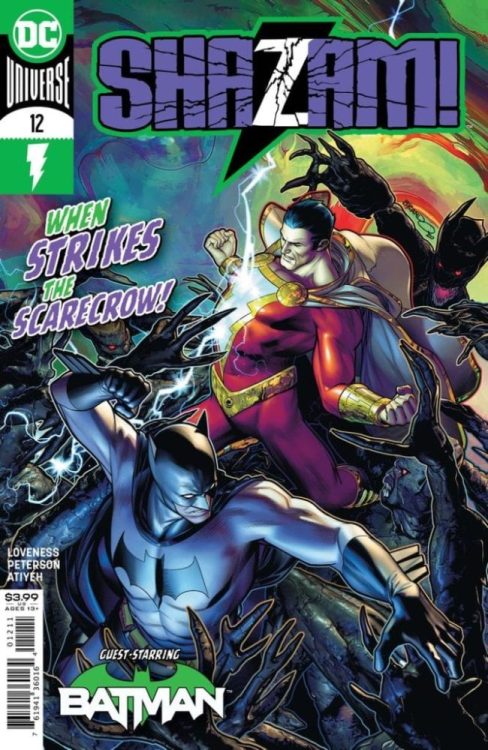
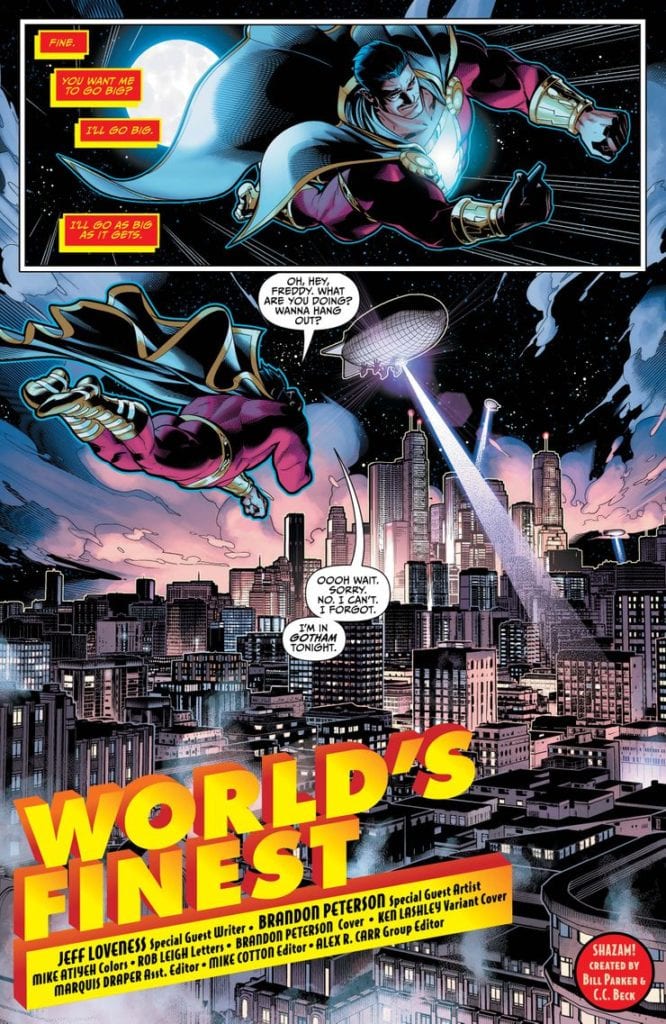
In DC Comics’ Shazam #12 (on sale June 2,) special guest writer Jeff Loveness sends Billy Batson to Gotham, where he hopes to join the “big leagues” of superheroes. During this road trip, Loveness explores Billy’s insecurity, often veiled by his arrogance, and leaves the hero as a stronger character.
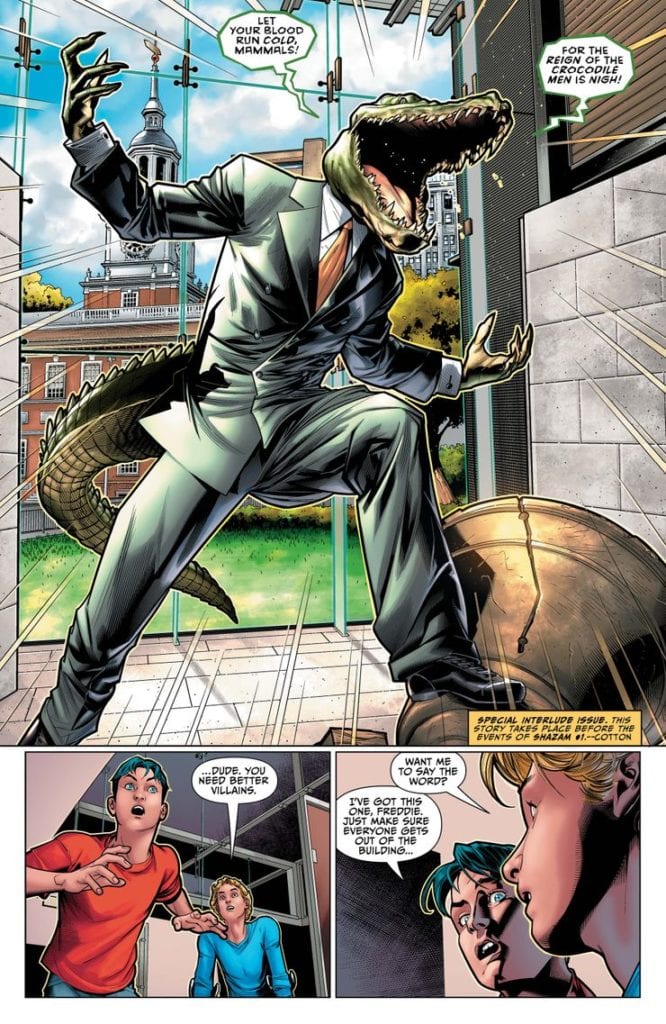
Shazam needs beter villains, so he goes to Gotham to find some.
Shazam 12
Writer: Jeff Loveness
Artist: Brandon Peterson
Colors: MIke Atiyeh
Letters: Rob Leigh
It’d be easy to assume that this week’s issue of Shazam is skippable; it takes place before the series begins, so a story by the special guest writer may seem inconsequential. But a one-off trip to Gotham ultimately teaches Billy Batson a transformative lesson: fear can make us stronger.
This message may seem fairly basic, but for a young caped crusader like Billy, it has the potential to make him a better hero. To maximize the moral’s impact, Loveness juxtaposes Billy’s naiveté with the growth we see at the end of the story. As with other Shazam stories, Billy’s brash behavior can make it hard to root for him. Hoping to prove himself as a legitimate hero, he foolishly charges into Gotham. Billy bites off more than he can chew, leading to a nearly disastrous face-off with the Scarecrow.
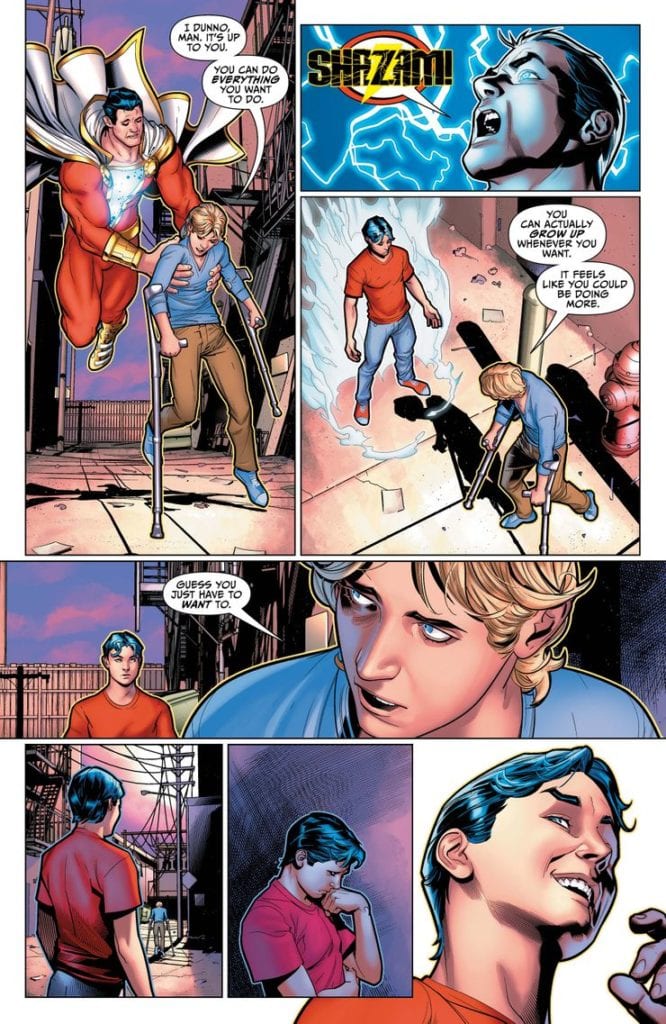
Freddy Freeman encourages Billy to step outside his comfort zone.
Early on, Loveness establishes Billy’s ego as the fatal flaw in this self-contained story. After Shazam easily defeats Crocodile Man, Billy’s closest friend, Freddy Freeman, repeatedly tells him he needs better villains. Freeman drives the point home with an emphatic point, where artist Brandon Peterson adds to the emotional delivery of the line. Freddy emphatically states, “It feels like you could be doing more. Guess you just have to want to.” Here, Peterson shows Freddy walking away from Billy and giving him harsh side-eye. Freddy’s words are the catalyst for Shazam’s trip to Gotham, as Billy wants to prove his friend wrong. Starting with the first shot of Gotham, Loveness and the art team constantly contrast Billy’s innocence with Gotham’s darkness.
Billy doesn’t exactly fit in Gotham.
In his bright red costume, Shazam sticks out like a sore thumb when Peterson shows him flying above the menacing Gotham skyline. Once the Scarecrow enters the picture, this difference is even clearer. The villain looks like nightmare fuel come to life; Peterson exaggerates his demonic mask to make him even more terrifying. This horror isn’t confined to the Scarecrow, though; while Billy feels the effects of the villain’s gas, Peterson shows Billy fearfully screaming while he’s trapped in the symbol on Shazam’s costume. Here, the art augments Loveness’ script because it complements the narrative that Billy is scared of being a superhero.
Loveness explores this theme and wraps it up by the end of this issue; working with Batman helps Billy see that heroes can find strength in fear. But there’s room for more development of this dynamic. A character being afraid of their responsibilities as a caped crusader isn’t an original concept; plenty of superheroes grapple with this concern. But Billy’s young age makes it an even more compelling theme, especially as it relates to his work with Justice League-level heroes. Hopefully, another writer will pick up the seeds Loveness plants in this issue.
Shazam #12 features a complete standalone story that offers a wholesome message. It’s a perfect jumping-off point for new readers and/or a brief interlude for long-term fans of the series. Plus, it offers a chance to see Shazam team up with Batman, which is a dynamic we haven’t seen much recently.
What’d you think of Shazam #12? Do you like seeing Shazam fight alongside Batman?
Check your local comic shop to see if you can get Shazam #12 there.
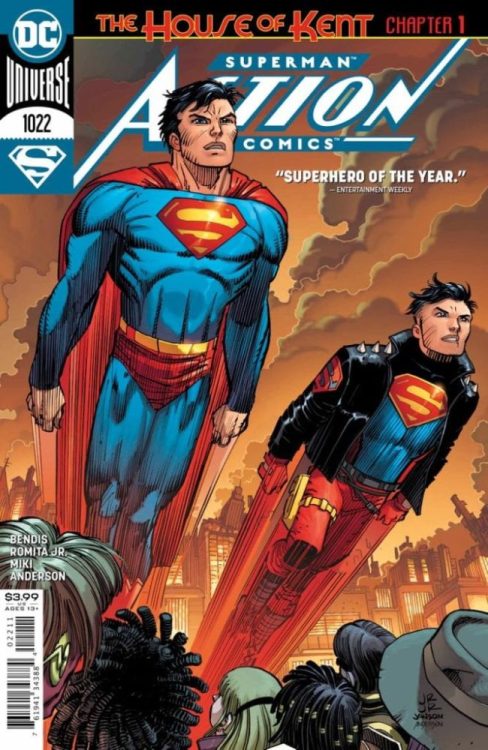
In Action Comics #1022, on sale June 2,writer Brian Michael Bendis’ secondary Superman series is back in a big way. This week’s issue launches an investigation that will drastically shift the status quo, both for Clark Kent’s world and the greater universe. Bendis strongly hooks the reader by planting the seeds for a massive inquiry into the temporal tampering that has affected the DCU since DC Rebirth.
Action Comics #1022
Writer: Brian Michael Bendis
Penciler: John Romita Jr.
Inker: Danny Miki
Color Artist: Brad Anderson
Letterer: Dave Sharpe
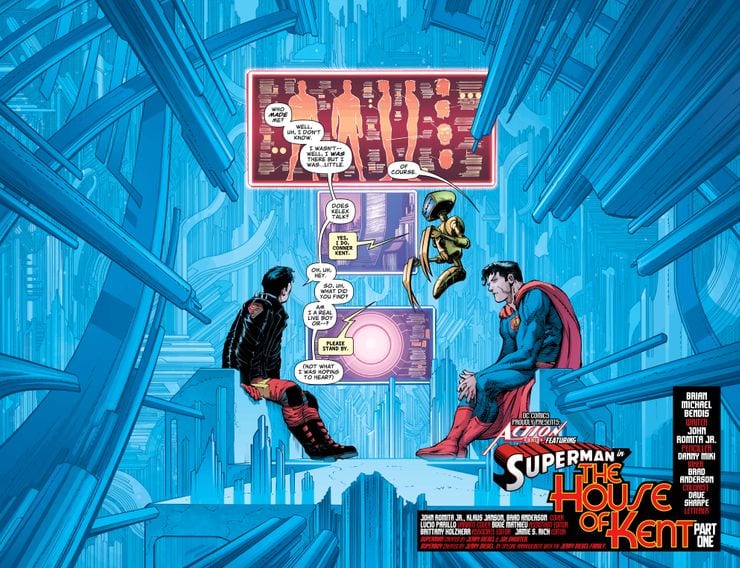
Superman wants to know all about Conner Kent.
“Who made you, Conner?” Superman asks his newfound ally, Conner Kent. The Man of Steel quickly asks this seemingly straightforward question on one of the issue’s opening pages. Readers already know that Conner is a hybrid clone of Superman and Lex Luthor. But Bendis complicates this knowledge as he adds in a curveball: Conner thinks he’s from an alternate version of Superman’s Earth. Naturally, this uncertainty leads Superman to seek out the DCU’s greatest intellects, from Mr. Terrific and Will Magnus to The Blue Beetle and Batman.
Seeing this impressive meeting of the minds is one of the highlights of the issue. At times, in either of Bendis’ Superman books, the writer doesn’t fully capitalize on the massive toolbox at his disposal; aside from occasional cameos and plugs for his Wonder Comics series, Bendis tends to work within Superman’s world. But here, in an encouraging change of pace, he brings in several fan-favorite characters. Though it’s only the first issue of a new arc, Bendis’ willingness to utilize other heroes is promising.
The dramatic meeting at the Hall of Justice is as can’t miss as it gets. Mr. Terrific and Ray Palmer scan Conner, desperately trying to figure out where he’s from. Penciler John Romita Jr. shows the technological might of the Justice League, as the gadgets they use are state of the art, if not beyond the real world’s capabilities. The beginning of this investigation shows that these heroes are already on the case. Will Magnus calls it a lead in their inquiry into the universe’s reboot, which terrifies Mr. Terrific, who’s alarmed by the potential ramifications of their digging. This meeting offers a preview of a stark ideological clash between Mr. Terrific and Superman.
Mr. Terrific and most of his peers are concerned about the universal reboot; they’ve been analyzing the effects of recent crises on their reality. Meanwhile, as always, Superman is optimistic to a fault. “The universe will do what it has to,” he says. “We’re all alive and well. There’s a lot of delightful news to unpack here.” In a world where the reboot ripped Wally West’s family way from him, that’s an excessively naive thing to say. Given the Man of Steel’s central role in Doomsday Clock, Bendis could be preparing a long-term journey for the hero, who will have to confront and change this passive view of the universe in order to battle its new puppeteer, Doctor Manhattan.
There’s plenty of room to explore the dynamic between Conner and Jonathan.
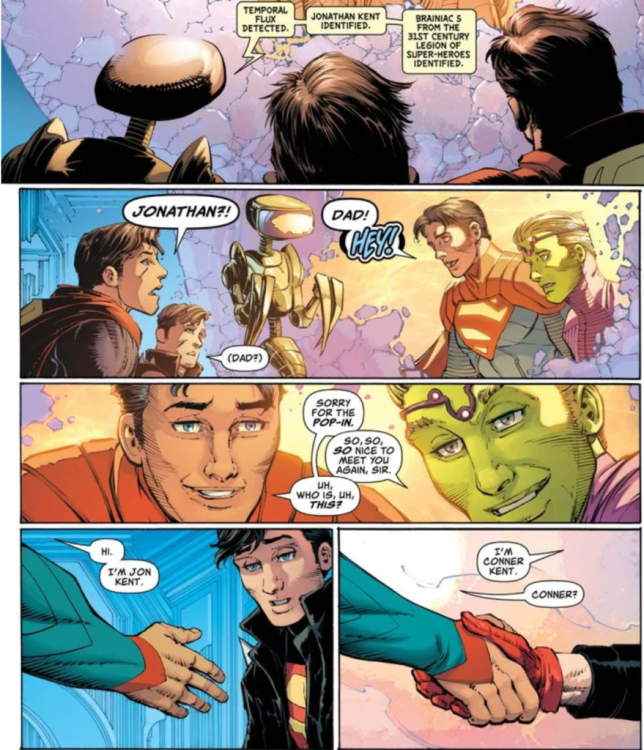
As it turns out, Conner’s appearance is an investigative lead, which takes Superman and his allies to Smallville. There, Romita and color artist Brad Anderson juxtapose the warm, inviting Smallville countryside with the cold, detached laboratory seen in the Hall of Justice. The grass is beautifully green, there’s not a cloud in the bright blue sky and you can practically smell the corn in the air of Romita’s landscape. It’s the perfect place for a reunion between Superman, his son, Jonathan, and Conner. Ma and Pa Kent are happy to see their boys, but the mood slightly sours when Superman feels left out of a startling realization. Romita shows the Last Son of Krypton turning his back away from his family, as the frustrated hero questions his place in the Conner-centered mystery. Unlike Barry Allen and Wally, Superman has no recollection of Conner. Bendis clearly suggests that Manhattan’s manipulation is even more complicated than we first thought, and we’ll have to wait and see the full scope of his involvement.
The intrigue surrounding DC Rebirth continues to unfold, even after Doomsday Clock wrapped up. Whether or not Action Comics #1022 actually leads to a substantive progression remains to be seen. But at least one thing is certain: Bendis hooks the reader with a compelling opening to this investigation, which could kick this series into high gear.
What’d you think of Action Comics #1022? What do you think will happen next?
Check out your local comic shop to see if you can get Action Comics #1022 there.