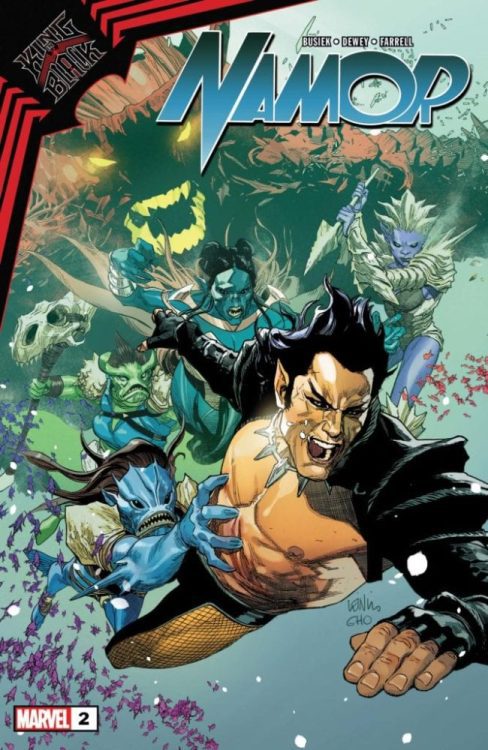
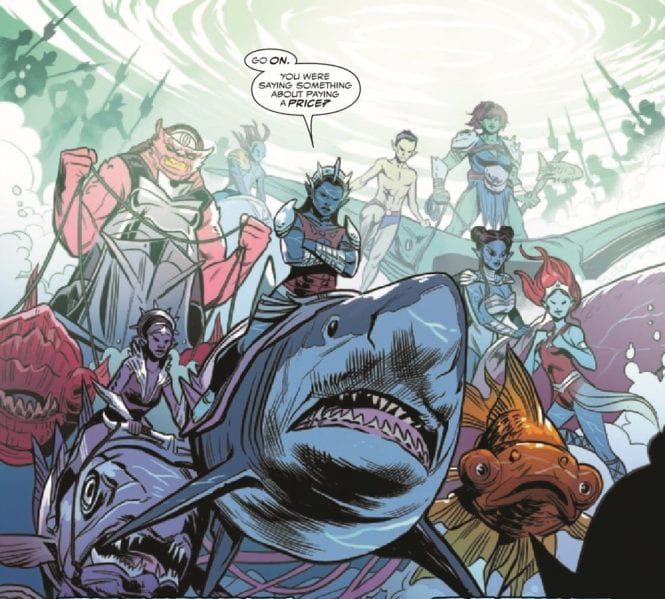
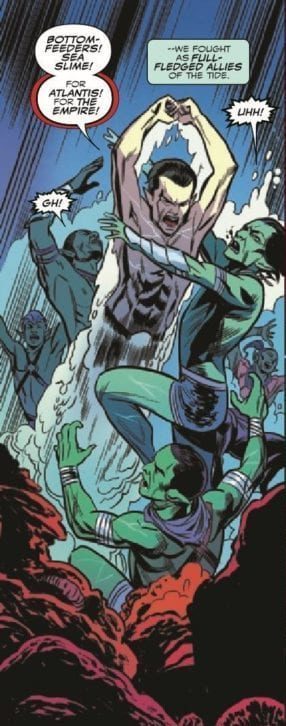
KING IN BLACK: NAMOR #2 hits comic book stores on Wednesday, December 30th, diving deeper into Namor’s younger years. Last issue detailed the sea dweller’s introduction to the Swift Tide warriors. Now, readers will follow Namor and this groups into dark depths, revealing a power older than the sea itself. Can our water warriors stand against a power spawned by the symbiote king Knull?
Story
The story opens with a view of an Atlantean village being attacked by local bandits in search of food. But the Swift Tide soon arrives to meet them with Namor and his friends in tow.
Readers get to enjoy a younger, more idealistic version of Namor as he fights for a cause he believes in. This element, present throughout this issue, help us sympathize more deeply with the character—especially when compared to his older, jaded self.
The story continues as the Tide seeks out a mythic relic called the Unforgotten Stone. In the process, we learn of the moral difficulties facing Namor’s friend Attuma. As an outsider of sorts, he’s able to find sympathy for the hungry raiders. This revelation explores Namor’s capacity for mercy in brilliant fashion.
Unfortunately, this moment is soon broken up by the Tide’s pressing task to find the Stone. Soon the horrors of old gods and twisted beings will come front and center.
Kurt Busiek’s writing takes readers on the rollercoaster that is Namor’s life with the Tide. We see his joy and unexpected sense of horror at what his compatriots find in the dark depths.
Artwork
Benjamin Dewey’s penciling and ink work, Tríona Farrell’s coloring, and ‘VC’S Joe Caramagna’s lettering worked together wonderfully in this expansive issue. The spanning scenes of undersea Atlantean mountains and temples set the atmosphere perfectly. They and the characters set within them stand out from these backgrounds while complementing each other. And the lettering, much like the water throughout the setting, seems to flow with the currents in an engaging way.
Conclusion
The expansive story told in KING IN BLACK: NAMOR #2 establishes more backstory for both Namor and the mysterious forces of Knull. We can’t wait to see where the creators take this prequel next!
Would you like to learn more about the Stone’s history? Let us know in the comments below!
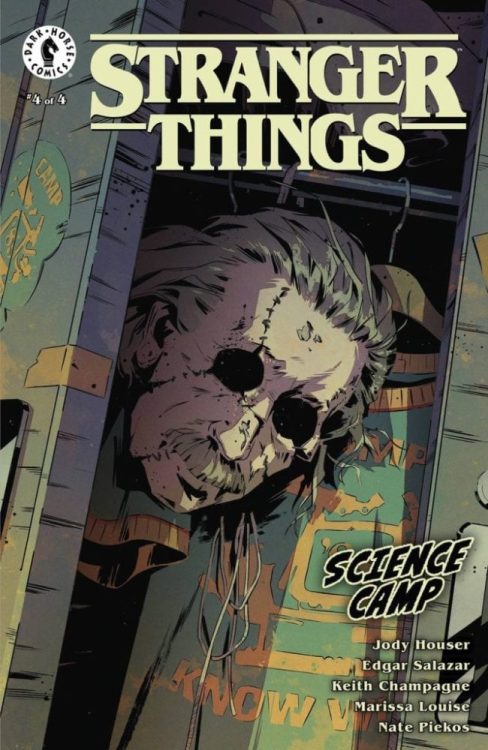
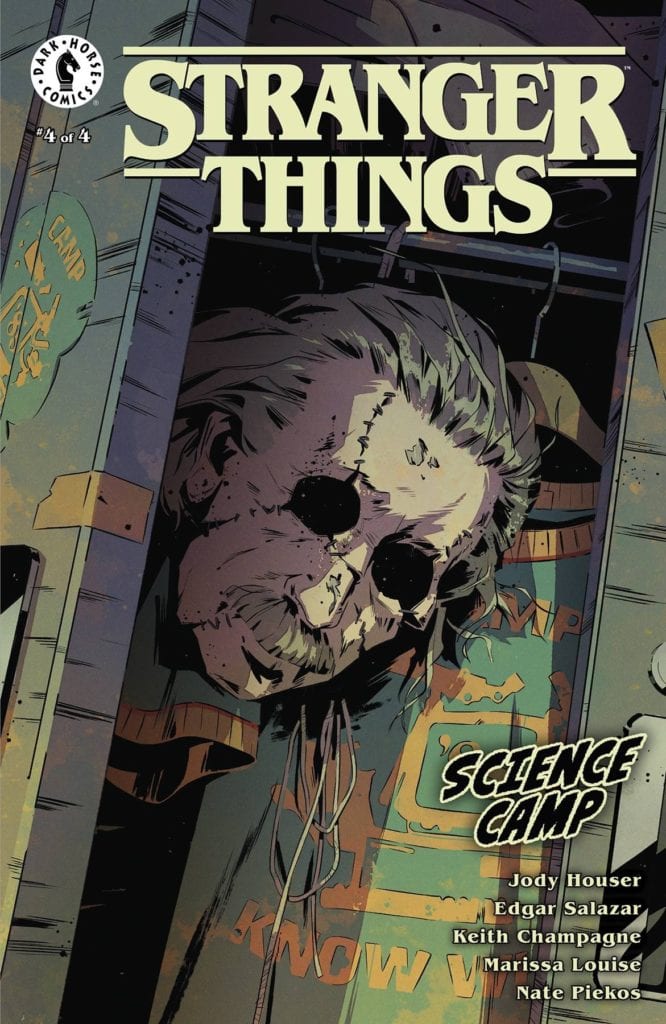
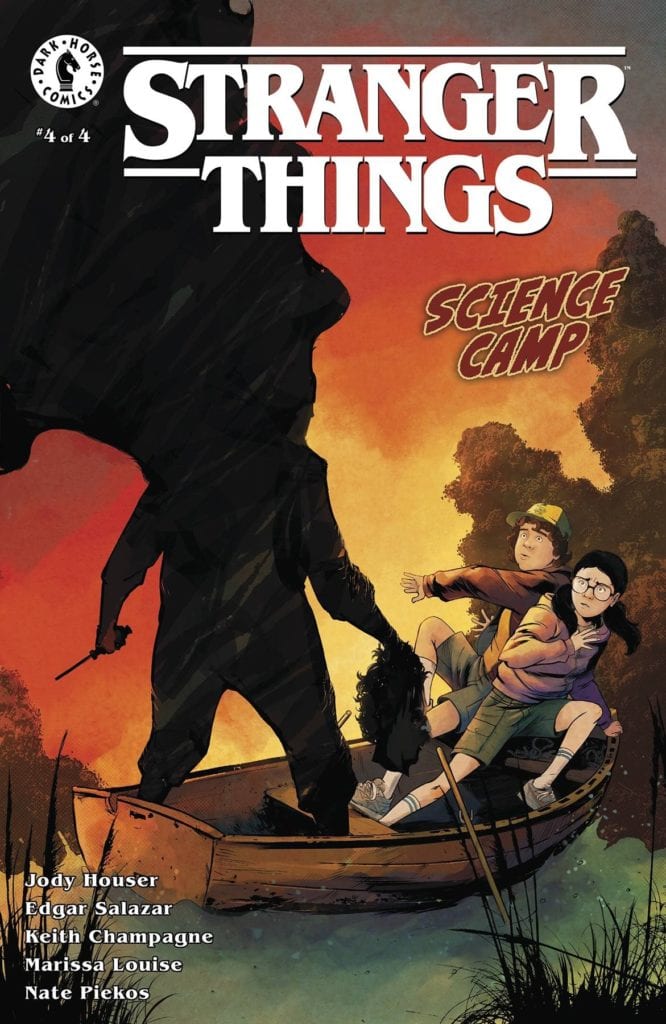
The mysterious stranger makes another appearance in Stranger Things Science Camp #4.
STRANGER THINGS: SCIENCE CAMP #4, available Wednesday, December 30th from Dark Horse, finishes one of the latest Stranger Things series, as it is time that Dustin’s solo story comes to an end. On the bright side, we finally get to know what happened that one time at Science Camp.
The mysterious stranger makes another appearance in Stranger Things Science Camp #4.
The most recent season of Stranger Things had a lot of fun referencing Dustin’s time at Science Camp. It portrayed everything from making Dustin feel left out (for all that he missed over the summer), to making fun of his ‘imaginary girlfriend’ who is actually quite real. And quite brilliant.
That did leave fans just a little bit curious to see what actually happened while he was away at camp. Most of us (myself included) pictured an adorably nerdy camp, with a meet-cute designed just for Dustin and his new lady love.
As it turns out, things didn’t quite go as planned – which begs the question; why didn’t Dustin tell his friends the whole story. Except that maybe he didn’t think they’d believe him? After all, they didn’t believe the girlfriend story either.
Stranger Things: Science Camp #4 wraps up an intriguing plot, one that brought with it more danger and twists than most of us would have predicted. It’s good to know that Dustin’s experience in Hawkins has left him well-prepared.
A new battle may just be waiting in Dustin’s future (or is it his past?).
The Writing
It’s almost hard to believe that this series is only four issues long, and yet Stranger Things: Science Camp #4 is without a doubt the final wrap on this adventure. Over the course of these four issues, fans got to see what Dustin looked like when he was flying solo. As it turns out, he’s actually the cool kid. At least, when you put him in the context of a bunch of science and math fans.
Written by Jody Houser, this final issue answers at least two of the major questions lingering on our minds. Mainly, what the heck is going on, and how it leads to Dustin getting a girlfriend. Both fit in nicely with the larger world.
It’s impressive how many risks were taken in this short series, given how confined the timeline itself it. We all know full well what happened to Dustin before and after, which is fairly limiting. Yet there were some surprises in store.
Obviously, the big reveal of what happened isn’t quite to the same scale as what we’re used to seeing El fight – but that’s okay. In a way, this plot actually felt more human because of it. Plus, there’s something comforting in the familiar concept of a bunch of kids stepping up to try and save the day. Isn’t that the core of the series?
The Art
The artwork in Stranger Things: Science Camp #4 is more or less exactly what you’d expect. It features some brilliant forest scenes, but otherwise, it really does look like a camp that sprung straight out of the ’80s.
Edgar Salazar (pencils) and Keith Champagne (inks) created the ideal foundation for this plot. There’s no doubting the location, identity of characters – or the very real fear on their faces. While sometimes their expressions are comically overdone, it does feel intentional – we’re talking about the massive emotions that run through kids, after all.
Marissa Louise’s colors work wonders to set the scene. The lush and vibrant greens are reminiscent of all that time spent in camps, for obvious reasons. It makes for a stark contrast against the brighter oranges and earthy tones pulled in to balance it all out.
The lettering, provided by Nate Piekos of Blambot, is the icing on the cake, more or less. It’s what ties everything together while managing to remain understated in the best of ways.
Conclusion
And so concludes Stranger Things: Science Camp #4, a fun adventure revolving around one of the kids we’ve come to know so well. It was refreshing seeing one of them off on their own, and how well they can stand up in the big bad world. All thanks to their past experiences, of course.
The answers this series brought along were mostly expected – but with a couple of fun twists along the way. It held true to the core premise of the main series, while having a bit of fun along the way.
After the somber end of Season Three, the kids of Bridgeton Middle School continue with their struggles with puberty.
Season Four picks up where Season Three had left off: Andrew and Nick’s friendship has broken down. Unfortunately, Andrew and Nick have to spend the summer together at camp and Nick starts to suffer from anxiety. Jessi has to move to New York City, and she suffers a relapse into depression. Missi has an identity crisis due to her mixed-race heritage. And Jay and Lola start a relationship.
Despite Big Mouth being an animated show filled with surreal sequences, dirty jokes, and monsters, it’s one of the most relatable shows currently on TV, especially for teenagers. Many people would have suffered from the same issues the Big Mouth characters have suffered from.
Nick and Jessi were the characters who had the biggest arcs in the season. Nick was one of the most confident members of the group. He has already had some relationships with girls and his biggest concern was he was the most underdeveloped out of all the teens. However, in this season Nick suffers from anxiety – the new monster in the series was Tito the Anxiety Mosquito and she acted as the voice of self-doubt. She amplifies what the characters were already feeling.
Nick had the worst summer possible because he was lonely and bullied which led to him suffering from panic attacks. Even after the summer Nick, Tito still comes back to make Nick’s life difficult. Nick also sees a future version of himself that has all his worst attributes and shows his worst fear: being alone.
Jessi’s story was poignant. Tito comes and ruins Jessi’s life during her first day at a new school, and this led to the return of the Depression Kitty. Together they work against Jessi, making her feel terrible which led to Jessi making decisions. Even her hormone monster, Connie, helped Jessi make bad decisions. In the series Connie, Depression Kitty, and Tito encourage Jessi into a relationship with a pretentious arty kid – Connie encouraged Jessi’s attraction to Michael, whilst Depression Kitty and Tito tell Jessi he’s the only way she can have any sense of self-worth. All this leads to Jessi being pressured into doing something she was reluctant to do. I was thinking ‘don’t do it Jessi’ which shows how invested I was into the arc.
Jessi’s story was like the teenage version of Inside Out. The Depression Kitty, Tito, and Connie amplify all of Jessi’s emotions. There was even a reference to Inside Out when Jessi breaks down in tears during her first day at school.
Andrew, Missi, and Matthew have arcs and important moments. Andrew had two major storylines – the first was the storyline at camp where he participated in the bullying against Nick, the second was developing a fear of death. Andrew suffered from constipation when at camp, leading to metaphorically act like a piece of shit. Yet this leads to Andrew and Nick restoring their friendship and calling back to the first episode where the pair were willing to embarrass each other to help each other out.
Missi’s revolved around her identity. She has lived a sheltered life to the point she doesn’t realize why her dad gets stopped at the airport. It’s only when Missi meets her cousins where they encourage her to embrace her heritage. Missi gets a new look and in “A Very Special 9/11 Episode” she speaks with DeVon, the only black student in her grade. DeVon states Missi should be confident in her identity, but he has a troubling revelation that he changes the way he speaks depending on his surroundings. Both Missi and DeVon were kids from a middle-class suburb, so their experience was going to be different from other African Americans.
The show lampshades that Missi was voiced by a 37-year-old white woman and with the current political climate many animated shows have recast with voice actors of color. Big Mouth was no expectation, but they simply didn’t change Missi’s voice. Partly this was due to Jenny Slate already much of her dialogue for the fourth season, but the main reason was to highlight Missi’s metamorphosis during the series and the voice change was a major plot point. Ayo Edebiri’s voice was slightly deeper than Jenny Slate’s, but the difference was minor and the change could be argued that Missi’s maturing so her voice would get deeper.
Matthew’s storyline involved his sexual identity and coming out. This was difficult for him because his mother was a religious conservative, and his dad was a Navy veteran. The family home was covered in patriotic American symbols. Many gay viewers could relate to Matthew’s plight.
My favorite episode of the season was “Horrority House,” the ninth episode. In that episode the teens have a bad trip and experience their worst fears. It made for a powerful episode as Nick, Jessi, Andrew, Missi, and Matthew have surreal experiences and come to important realizations. The season finale followed a similar pattern to the finales in Season One and Two because the characters have to save one of their friends.
Season Four introduces a new character for the first three episodes, Natalie. Natalie was the first major transgender character. The previous summer she arrived as Gabe but suffered hardships when puberty struck. Natalie was anxious because she didn’t know where she fitted in because everyone knew her as a boy the previous summer. I hope that Big Mouth explores asexuality in a future season.
Season Four was a more dramatic season of Big Mouth but it was not without comedy. Maurice the Hormone Monster was his usual crude self and there plenty of gross-out humor. Missi’s hormone monster, Mona was entertaining, but I admit it might be because she used a lot of Britishisms.
This was an excellent season of Big Mouth filled with lots of character growth and self-realization. Big Mouth shows it’s more than sex jokes and gross-out humor.
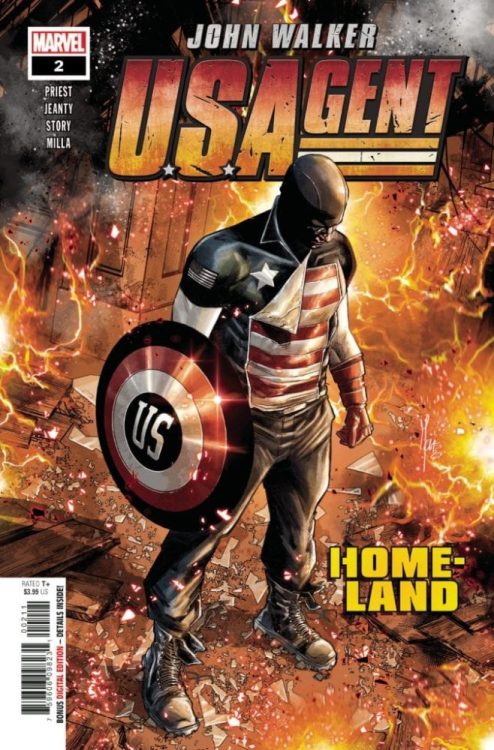
U.S Agent #2 out now from Marvel Comics features The Falcon and the Winter Soldier‘s co-star John Walker. Writer Christopher Priest tackles the difficult task of characterizing an ex-Captain America by hooking the reader with intrigue. Joining him are penciler Georges Jeanty, inker Karl Story, colorist Matt Milla, and letterer Joe Sabino.
Background
John Walker was U.S. Agent; now he’s just a government contractor working numerous small jobs. One of them just happens to send him to a small southern town entering a conflict with a former SHIELD base led by his sister.
U.S Agent #2: Little White Lies
John is a difficult character to fi in today’s modern world, being a tried-and-true redneck. Priest’s history with morally ambiguous characters like Deathstroke gives him a leg up on portraying John. U.S Agent #2 centers the main conflict on the Southern American identity between John and Kate. Despite their origins, they couldn’t be any more different. Their relationship is very strenuous, with John remembering Kate abandoning him in a fire as a child.
Every conversation between them in U.S Agent #2 feels like a family feud for moral dominance; John’s more conservative approach to the conflict is a bit dishonest as he gets the town’s help with his similarities to Captain America. Kate favors a more direct approach that involves kicking down doors. Despite her own Southern origins, Kate looks down on the townspeople calling them “hicks.” She is also willing to exploit John’s motivations to get him out of the way, the memory of their brother no less. The reader can practically feel the tension between them, keeping them guessing on what happens next.
U.S.Art!
Jeanty’s pencils cover a wide array of situations, often in the form of shifting dynamics between characters. John and Kate’s arguments throughout U.S Agent #2 display how Kate tries to control the situation. Kate taking away and doing repairs to John’s vehicles, demonstrates the power she has over him. The story accents the space they share; they often share the same line work, which becomes more apparent when they share sights.
The coloring from Milla is best when it comes to the backgrounds that blank out with colors suggesting moods of events; light blue-greens indicate a casual background while purple shows a state of confusion. The lettering by VC’s Sabino displays moments that each hold importance. Not least of which are the panels featuring titles and details like they are segments of a documentary. These moments highlight every little thing that happens, like displaying the town’s feeling on gun safety. They’re moments that juxtapose with Kate’s view of the people; despite West Virginia’s more conservative status, the people aren’t hostile.
The Plot Thickens in U.S Agent #2
Within U.S Agent #2 comes a shift in dynamics; here John Walker looks more sympathetic with how the reader sees his sister. With how manipulative and standoffish Kate seems, readers can’t help but think back on what John values, especially as John’s southern identity may be what puts him and Kate into further conflicts. All of this together makes U.S. Agent a good read that gets readers intrigued as the plot moves forward.
Join us for our first episode of a new interview series called “Unsung Heroes!” In this series, we interview the folks that don’t get the spotlight they deserve: letterers, colorists, editors, and more! These are some of the people who are the comic book industry’s lifeblood but don’t seem to be discussed much, even when discussing their work.
In our first interview, we chat with the magnificent Clayton Cowles. Cowles has lettered more than 2800 comics. In our conversation, we discuss some of his work, how he got started, and the day-to-day being a letterer.
Cowles began his career in 2009, the same year he graduated from the Joel Kubert School. He began work that year on COWBOY NINJA VIKING for Image Comics and went on to work for Marvel Comics immediately after. Cowles is currently lettering fan-favorite runs on BATMAN, DAREDEVIL, KING IN BLACK, and X-MEN, among many others.
Cowles is currently lettering so many projects that we missed one at the end of the video. On top of his work on X-MEN for Marvel, Cowles is also lettering X OF SWORDS. Check out the brilliant work he’s putting out and follow him on Twitter at @ClaytonCowles.
We’ll be posting more of these videos in the months to come, but if you’d like us to interview someone, drop it in the comments!
Welcome to Self-Published Spotlight, a regular interview column where I will be highlighting self-published comics and the creators and small print publishers who make them.
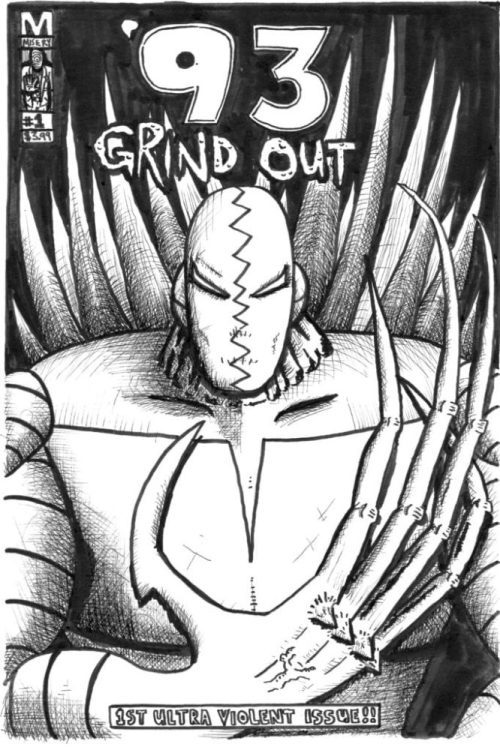
It’s the last week of 2020, and I’m talking to Sam Locke Ward, creator of one of my favorite discoveries of 2020, the ’90s zine/mini-comic celebration that is ’93 GRIND OUT. The book is the ultimate ’90s comic (in the best way!) spiked with a punk rock attitude and D.I.Y. production. Sam’s passion for the medium is infectious, something that comes across both in his work and in this interview. So check it out and then check out Sam’s comics!
Monkeys Fighting Robots: Sam, first of all, thanks for taking the time to talk to us. I follow your social media enough to know you’re a busy guy! So for our readers that don’t know anything about your comics and yourself, why don’t you give us a rundown?
Sam Locke Ward:Hi Manny! I suck at interviews but here goes nothing…I’m a DIY comic maker and musician from Iowa. I write and draw my own comics and self publish them as zines. I am currently working on a few projects; an obscene faux ’90’s comic called ’93 Grind Out, a funny crime & horror serial called Voyage Into Misery with my collaborator Josh Mead and a bi-weekly strip called Futile Wrath for my local arts paper Little Village Magazine (side note: Futile Wrath won the Association Of Alternative News Media Award for the cartoon of the year, which was pretty wild.)
MFR: How did you great into comics? And How did you get into making comics?
SLW: I’ve loved reading comics my whole life and I’ve always dabbled in drawing from a very young age. I had low self-esteem about my visual art for a long time and making a full-blown comic always seemed insurmountable. In 2016 I had this epiphany that if I really wanted to make a comic the best way to do it was to just force myself to make one. I decided the best way to get better was to make A BUNCH of comics. So I took on this project to write and draw a monthly comic for a year. It was called Beasts Of Heaven. I made 12 issues of it (one every month!). It was an attempt to quiet my self-editor. Having a self-editor is good but it’s pretty easy to self edit yourself into complete nonproductivity. What I learned was it’s best to just make mistakes and take note of them instead of letting your mistakes completely rule your output. It’s better to make something that’s flawed than to make nothing that is perfect.
MFR: And what led you to self-publishing?
SLW:For me, I see self-publishing comics as an extension of the same philosophy as self-releasing music records. It’s really the same aesthetic. I came out of the indie-punk/ home taper music scene. I started putting out tapes, records and CDs in the late ’90s. Over the last 20 years, I’ve self-released well over 50 records at this point. I always just saw it as the obvious thing to do. You record your own records, you make copies yourself, you throw your own indie shows with your friends and you sell records at the shows. I just transposed that whole philosophy into making comics.
MFR: This year has changed the comics industry so much. We’ve seen a huge explosion in self-published work. As a self-publisher, why do you think indie books did so well this year?
SLW: Well, I’m as much a reader and fan as I am a “publisher” but I for one know I was reading a lot more this year! As a fan I’m a follower of artists. If a musician or artist makes a fan of me I’m gonna seek out everything they’ve done and follow their stuff going forward.
MFR: Where do you think comics are going in 2021?
SLW: I really don’t know where anything is going but I’m here for it. I’m personally planning on doing my best to keep making zines and comics at a solid clip for the foreseeable future.
MFR: Your books specifically are mini-comics. Why did you choose to put the books out like that?
SLW: I love zines! I think it’s a great format to self-release comics in. Earnestly full-size comics cost a fortune to print and ship. Zines are blue-collar comics, you can literally ship them in an envelope. Everyone can make zines and everyone should make zines. That’s one of the great things about comics. Literally, anyone could make the biggest blockbuster they can imagine. All they need is a writing utensil and paper. Comics is all-inclusive.
MFR: My personal favorite of yours is ’93 Grind Out, which you both write and draw. What inspired this incredible ode to ’90s comics?
SLW: At the beginning of the pandemic I felt completely stifled. I had one of the worst bouts of writer’s block I’ve ever had in my life. I couldn’t play music, I couldn’t write and I had no desire to draw. All I could do was stare at various screens and worry. A few months into it I started really thinking about and revisiting the comics that excited me when I was a kid (I was obsessed). And not just thinking about the comics I had read but I started thinking specifically about the unmade comic I wanted to create when I was a kid. Which was a multigenerational team book where people perished and others would come into the fold in this giant endless soap opera. Of course, I never did that! ha. But anyway I had this idea about wouldn’t it be funny or cool if I took that idea and crammed it into a 4 issue miniseries. Just let it be a bloodbath. Unlike 90’s books, there is no plan to try to use the characters ever again after this series. So I’m free to crash the car because I’m never gonna drive it again. That’s how I see Grind Out, I’m crashing an old car.
MFR: What a great way to put it! So, Voyage Into Misery, another one of your titles, is drawn by Meatbag. Who is Meatbag and how do you guys work together?
SLW: Meatbag is the great Josh Mead, an artist from Minneapolis, MN. He’s a long time collaborator with me on music and comics. He’s a respected noise musician and artist in his own right doing poster work for many Minneapolis and Iowa City bands over the last 3 decades. He draws The Human Coil stories in the Voyage Into Misery comic that I write. We’ve been working on it for a few years now. Human Coil is this paranormal gumshoe vigilante for hire. He’s the antithesis of the classic Ditko detective characters. Basically, we come up with ideas together over these long phone conversations, then I send Josh scripts and he turns them into beautiful comics. He’s an amazing artist and friend.
MFR: What’s your process like? Like what’s a usual timeline from concept to publishing? Do you assemble the books yourself?
SLW: Unless I’m writing for someone else I do everything on the page and I try all kinds of different experiments. I really don’t have a set process. I’ve never put together anything bigger than a zine together and yes I put them all together myself. If anyone has a zine I made I guarantee that I stapled it. Sometimes I work fast sometimes I work slow. Once I finish drawing it’s only a matter of days until I print it. I consider Ed Wood to be my patron saint. “Print!”
MFR: So how often would you say you make comics?
SLW: I work pretty manically, like either not at all or I can’t stop. I’m all over the place.
EPSON MFP image
MFR: What are you working on now?
SLW: I just finished a short story for the “Jaws! Through The Multiverse” anthology comic. Now I’m juggling simultaneously doing ’93 Grind Out #3, the next Voyage Into Misery and the next Futile Wrath strip. I hope to have all 3 done by the end of December.
MFR: And where can readers find and get some of your stuff?
His Dark Materials has returned for a second season. Based on the second novel of the trilogy, The Subtle Knife, the second season expands the story beyond Lyra’s World.
Lyra (Dafne Keen) and Will (Amir Wilson) have traveled through portals in their respective worlds and find themselves in a city only inhabited by children. The young pair agree to help each other with their respective quests: to find out what Dust is and find Will’s father. In Lyra’s world, Asriel’s actions have started a chain reaction that leads to The Magisterium and The Witches preparing for war. Whilst in Will’s World, physicist Mary Malone (Simone Kirby) has been researching Dark Matter which could be linked to Dust.
The previous series suffered from a sluggish start as it tries to turn a 400-page novel into an eight-episode series. These fears were amplified for the second season because it was based on the shortest novel in the series. Fortunately, the second season was more consistent but any hopes that the TV version of His Dark Materials would be a faithful adaptation have gone out the window. His Dark Materials was a hybrid of book moments brought to life, broadly following the storyline of The Subtle Knife, and inventing and changing things for the TV show. From a book fan’s perspective “Tower of the Angels” was the best episode. It followed the events of the novel closely as Will and Lyra reluctantly go on a mission for a shadowy figure. The changes that were made were for that episode were either minor or filling a gap.
Mrs. Coulter (Ruth Wilson) was the MVP of this season. She had a season-long arc due to her obsession with Lyra. Mrs. Coulter goes on a mission to find and protect Lyra. The TV version of the character was more like the character in the novels who had a steely focus and more cunning. She was less of the rage monster that she was in the first season. Whilst Mrs. Coulter was more in line with the character in the book the series did invent events – she met two characters she never did in the novels. These scenes were to explore her character and show the differences between her world and Will’s World.
Mrs. Coulter’s search for Lyra culminated in a tense conclusion in the fifth episode, “The Scholar.” This episode creates new conflicts for the series, but it was damn good drama as mother and daughter face off against each other. Mrs. Coulter’s dark soul was on display in the sixth episode, “Malice” when it was revealed she had a special power.
The first half of the season did add more events to extend the story. The season showed more events in Lyra’s World. The first two episodes showed the power struggles within the Magisterium and Father MacPhail’s (Will Keen) rise to power. The conflict between The Magisterium and The Witches was amped up for the series. There literally go to war with each other. The aim was to make the series longer and prevent the Witches from going to the other worlds so soon and it did lead to some dramatic and action scenes.
Not all the changes worked. There were plenty of small scenes that added just so an episode can meet the required run time. An example of this was in the second episode, “The Cave,” when Will met his estranged grandparents. It was a scene that would have been cut under normal circumstances. The weakest episode in the series was “Malice,” the sixth episode of the series because it was the most meandering – very little happened that continued the story.
Most of the changes that were made for the series were so it could suit the TV format. An example of this was the reveal of what the Witches called Lyra. This was done to make the reveal more dramatic for a TV audience, especially people who haven’t read the novels. The series slowly built up the biblical references involving His Dark Materials’ new creation myth. One of the strengths the second season had over the books was explaining what Dust was – Mary Malone explained the substance was conscious Dark Matter.
The first season of His Dark Materials was a dark series: it was a series that featured kidnapping, human experimentation, death, and children literally losing their souls. The second season introduced the Spectres. These were ghost-like creatures that eat souls, making their victims nothing more husks. There were a scarier idea. There were like the Demeanors from the Harry Potter franchises because they also soul-sucking ghost creatures.
Whilst the second season of His Dark Materials was mostly a serious affair, there were moments of levity. Most of these moments involved the cultural differences between Lyra and Will’s Worlds and Lyra’s privileged background compared to Will’s hardships.
As an interpretation of The Subtle Knife, the second season of His Dark Materials was an excellent piece of TV and an improvement over the previous season. It felt less dragged out and the changes that were made worked in the context of the TV show.
Disney’s Soul is a visual delight that will warm everyone’s heart this holiday season. It delivers a thought-provoking story about appreciating the smaller aspects of life even if you aren’t where you want to be. We all want to have a purpose, a reason to live, and Pixar will gladly teach us about it through this film. Soul has enough heart, humor, ambition, and themes to intrigue everyone that watches it.
Pixar is known for its life messages and themes that have been incorporated into several family films over the last two decades. The Toy Story franchise is an example of this trend, and Soul continues it in the best way possible. The subject matter presented may be considered too dark for children, but children should be exposed to this type of film because it might be an inspirational watch for them. Directed and co-written by Pete Docter, Soul stars Jamie Foxx, Tina Fey, Angela Bassett, Daveed Diggs, Questlove, and Phylicia Rashad. The film follows Joe Gardner (Foxx), a man who isn’t satisfied with the direction of his life. Joe has always wanted to be a hit jazz player, and when the opportunity comes his soul becomes detached from his body.
Jamie Foxx as Joe Gardner in Soul
From there, Joe is transported to the Great Before, a world before life where souls in training are prepared for life on Earth. Joe is partnered with 22 (Fey), a soul who has a very dark view of life and doesn’t think it’s worth living. Mike Jones and Kemp Powers co-wrote this script with Docter, and it’s a solid script for the most part. The character of Joe is presented as this person who has wasted his life, and life can seem like that if you constantly ignore the impacts you have on others. Also, this film raises tough life questions, and what we should focus on while on earth. Joe is convinced his life has been useless since he isn’t doing what he is passionate about, and his passion has distracted him for years. The writers do a great job at allowing Joe’s interactions with 22 to make him see that a passion shouldn’t be your defining purpose in life.
His development overtime is fun to watch, as he learns his purpose in life goes beyond jazz music. The script wonderfully calls out the notion of what being successful means to many. Soul address the idea of achieving fame, or a high profile profession as being successful. However, success can be achieved through other aspects in life such as paving the way for others without knowing it. Having the relationship play out between Joe and 22 sends the film’s message home. While one doesn’t want to live, the other overlooks the life he’s already been successful in. Eventually, they both learn that life isn’t meant to figure out before it starts, and your purpose in life can be much more than attaining a successful career.
22 and Joe Gardner in Soul
Docter will keep emotions high during Soul because it touches on sensitive topics for many. It is a film that reminds everyone to just live life, be patient with yourself, and enjoy the small contributions along the way. Again, an existential crisis being the backdrop for a film discussing the meaning of life might be too much for kids, but it’s something they can learn from. While Joe and 22 might not be as memorable or likable as past Pixar characters, Fey and Foxx’s performances will keep viewers engaged. Their voices assist in the emotions viewers will feel for the two misguided souls, and Foxx brings Joe’s down in the dumps vibe to life amazingly.
Soul isn’t without its flaws, and it might not be talked about years from now like past Disney projects. Still, its message encompasses everything Pixar has touched on in previous films, and it’s one of the better-animated films released this year in terms of filmmaking. A film that seeks to remind people of all ages to not be afraid to live, and to live life to the fullest.
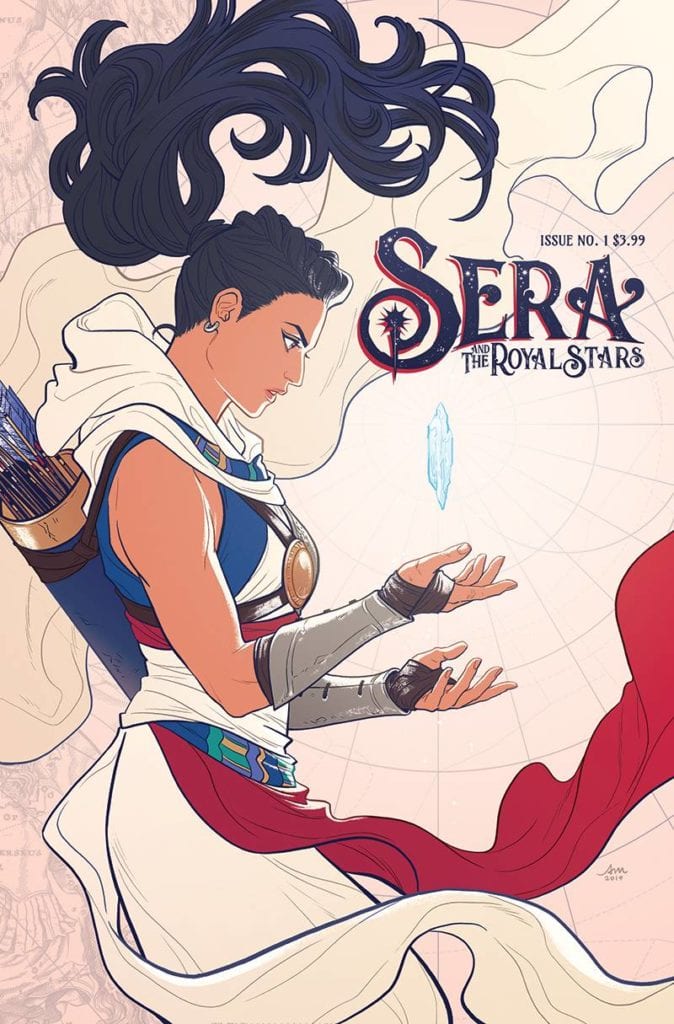
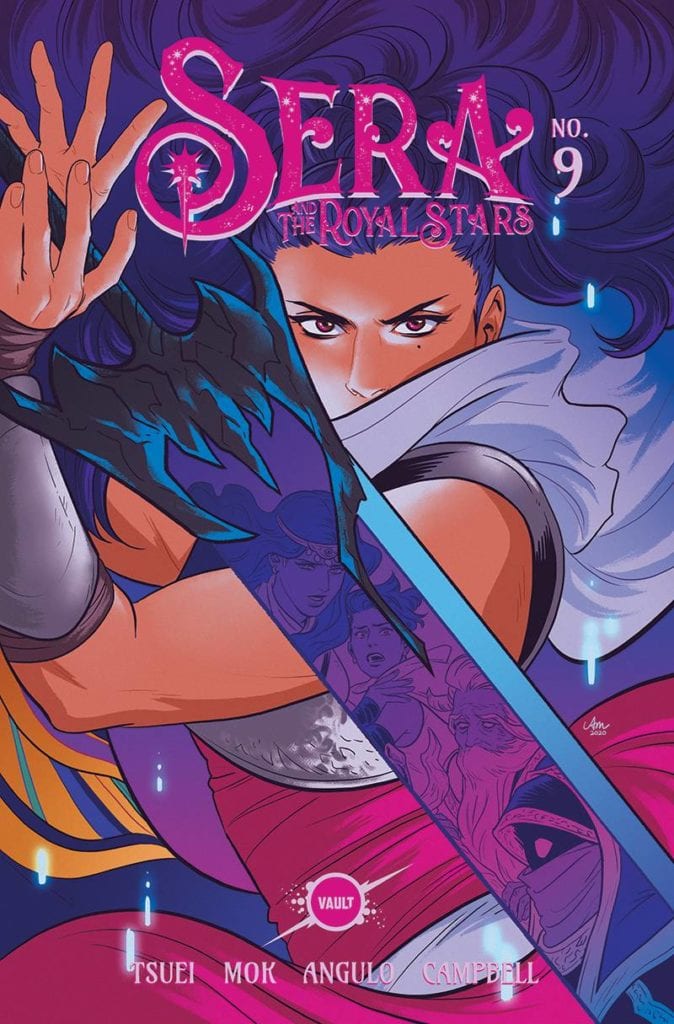
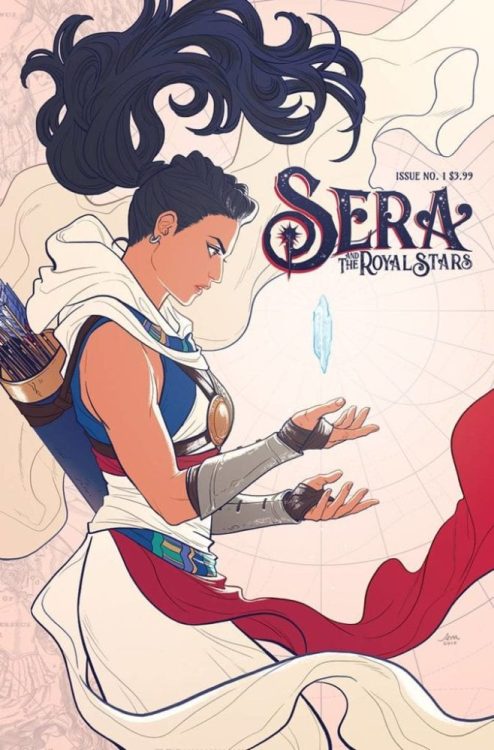
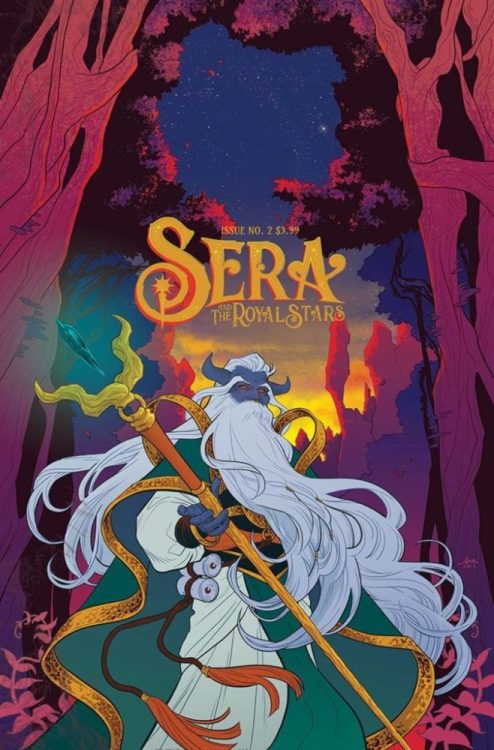
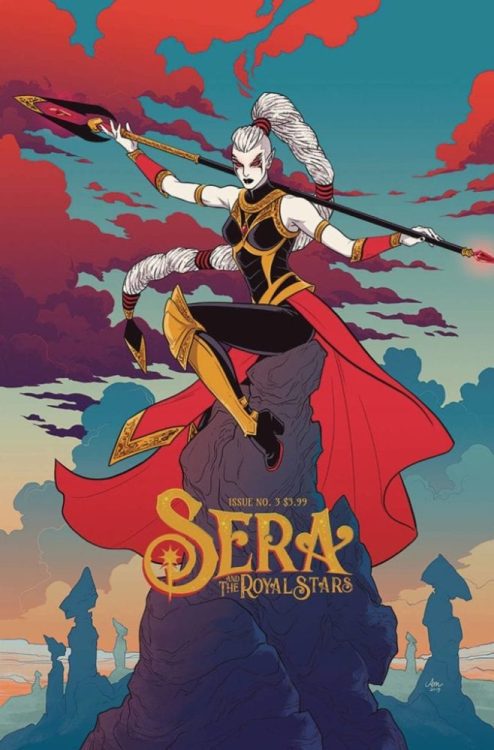
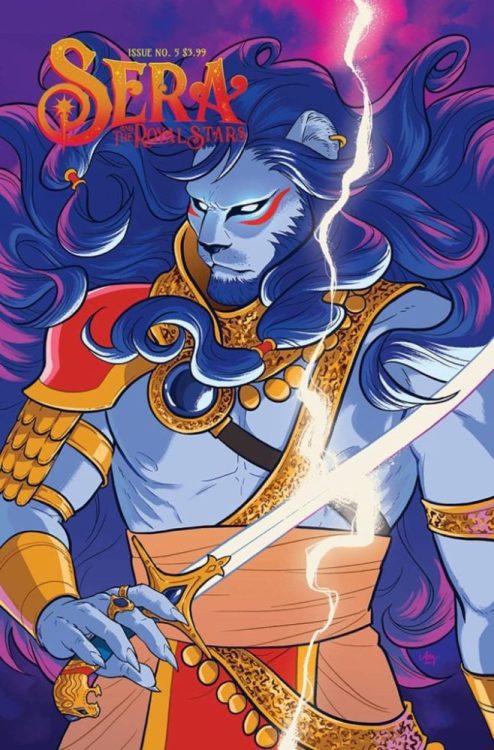
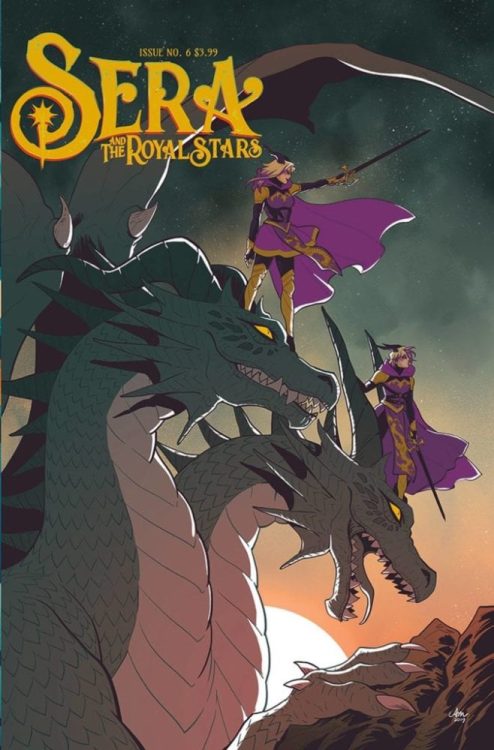
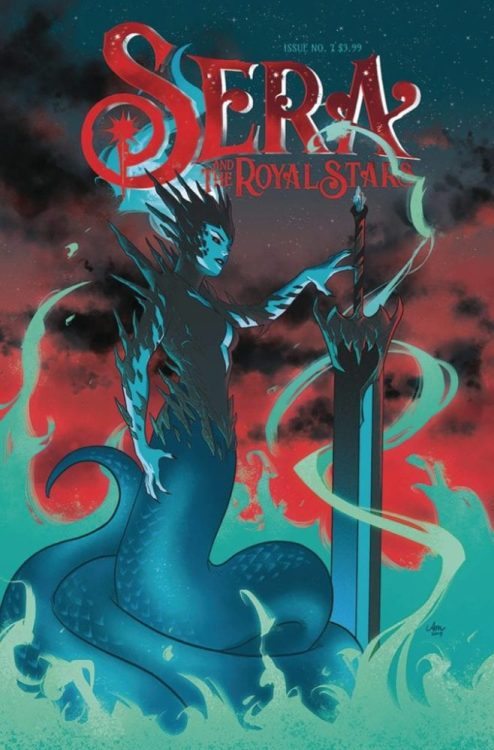
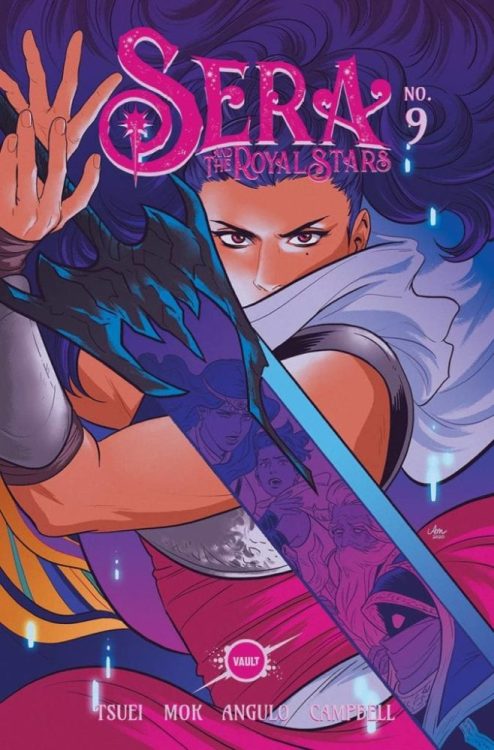
Vault Comics’ Sera and the Royal Stars came to a close recently, and Monkeys Fighting Robots sat down with creators Jon Tsuei and Audrey Mok to take a look back at the stellar series (pun absolutely intended).
For the uninitiated, Sera is an epic 10-issue fantasy series by Tsuei, Mok, colorist Raúl Angulo, and letterer Jim Campbell. It’s the story of Sera, princess of Parsa, a land struck by civil war and famine. With everything going on at home, Sera is reluctantly called on a quest to find the Royal Stars — fallen stars trapped on earth — and return them to the heavens in order to save her people.
It is a beautiful and moving tale about family, loyalty, duty, and awesome battles between cosmic deities.
Read on for our full interview with Tsuei and Mok:
Monkeys Fighting Robots: How does it feel to bring Sera to a close?
Jon Tsuei: It’s bittersweet for sure. I’m incredibly proud of the work we’ve accomplished as a team, but I’m just as sad to say goodbye to this world and its cast of characters. I miss working with the team and I miss the characters. Sera will always be very close to my heart.
Audrey Mok: Definitely emotional. I feel like I came to a point in which I can finally understand the characters and the world enough to draw freely for this story, by that time, it’s close to ending. I already miss working on this story with the team. Although it’s kind of bittersweet to bring Sera to a close, I certainly had a lot of fun bringing this story to life. It has been an absolute pleasure to be working on Sera with such an amazingly talented team.
MFR: The Royal Stars we meet over the course of the series each feel so unique and well developed. Can you speak to how you two created them and fleshed them out?
JT: The main inspiration for the four main stars (Aldebaran, Antares, Fomalhaut and Regulus) comes from a Zoroastrian text called the Bundahishn. In modern day astrology these four stars are called the Royal Stars of Persia. So, I looked to various myths tied to the individual stars and their constellations to uncover their personalities. From there, I gathered some reference for what I saw in my mind’s eye and sent it over to Audrey, who worked her design magic to bring all of the stars to life. I’ll leave it to Audrey to talk more about the design process.
Fleshing out the stars was pretty organic. I’m a firm believer that stories exist in some reality separate from our own. They are living, breathing things that we as storytellers bring forth into our own plane of existence. Once you learn to see and hear these characters, they tell you where they want to go.
AM: After Jon introduced me to the main inspiration for the stars, and explained more about concepts along with various kinds of references, we began exchanging countless emails discussing the looks for the Stars, according to their personalities and their individual fighting styles. We also decided on using different color palettes for the stars inspired by their constellations, which helps a lot when it came to designing their costumes.
It was my first time working on a fantasy story, so I spent a lot of time doing research. Other than reading the history of the region Sera is based from, I drew inspiration from a lot of different sources as well. I adopted ideas from movies, game character designs, even runway shows. With these ideas, it helped develop unique designs for the four stars.
MFR: What have you each learned about making comics over the course of creating Sera? How has your perception of the medium evolved?
JT: If the past two years has taught me anything it’s that life is much bigger than comics and sometimes life is going to force you to pivot. But even when the universe is throwing you curveballs, you can absolutely find joy in your art when you’re working with such a talented and devoted group of creators. Audrey, Raúl Angulo, Jim Campbell, Adrian Wassel and everyone who worked behind the scenes at Vault made every moment of Sera something incredibly special to me and I will always cherish the time we had working together.
AM: I have had a particular visual, or a style, I wanted to try bringing into Sera in the beginning stages. As I mentioned above, this was my first fantasy story, there were a lot of things I wanted to push myself with Sera as an artist. With that specific artistic approach in mind, my art occasionally became stiff, but I also learned to remind myself from time to time that when it comes to making art, you have to let yourself “go”. Sometimes you just have to trust your instincts, and let your creativity lead you.
MFR: How did your collaboration process evolve as the series progressed?
JT: There was more back and forth in the beginning stages. We were still trying to figure out the language of Sera, both visually and thematically. But as time went on, the trust between us grew and the process quickened. We didn’t need to consult each other as often, but that didn’t stifle the quality of our work. I like to think we became more efficient and really trusted each other’s creative instincts.
AM: Totally agree with Jon here. At the early stages, there were a lot of things we needed to discuss with one another, as we were still figuring out a lot of details along the way. I think it was around issue 3 that the language of Sera had finally become solid.
MFR: What have you enjoyed most about working with one another?
JT: For me, it’s the excitement of working with Audrey. Throughout the process, I couldn’t wait to see new designs or pages by her because I was always blown away. That excitement and anticipation is fuel for my writing. Aside from the excitement I feel about Audrey’s work, I think we learned to speak the same creative language and that level of collaboration really is something special. No matter what I introduced in the script, be it a new character or a difficult scene, Audrey always delivered in a way that is truly unique to her style and voice as an artist. I couldn’t have asked for a better partner and collaborator.
AM: Reading Jon’s scripts is for sure one of the many excitements! I couldn’t wait to know where Jon will bring us in the coming issue every time I finished reading the new script.
For me, some of the most memorable parts when it comes to reading, is the emotion that you feel throughout the reading experience. Jon’s words are straightforward, with a great balance of heavy emotional and occasional comedies. As an artist, to be able to visualise the weight of those words onto paper is the most exciting part. Also, simply the fun of bringing the story to life together as a team, I enjoyed that very much.
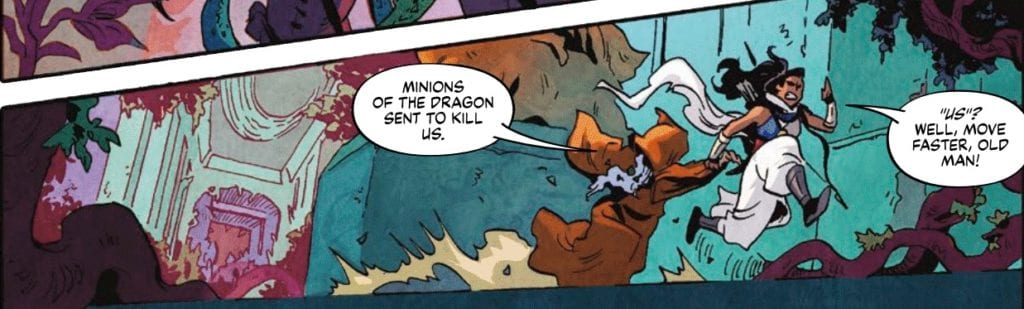
MFR: I really love the little moments of humor sprinkled throughout Sera — they’re like perfect balances of witty dialogue and hilarious visuals.
Are these moments scripted like this, or do they come about organically in the collaboration process? How do you two manage to strike such a strong balance?
JT: That reference you have is from issue #1. We were still establishing the tone of the story at that point. I called for the panel to be funny, but I had no idea Audrey would shift her style so much to really sell the comedy. Some of my favorite panels in the series are when Audrey makes that stylistic change.
There were times when Audrey brought her own humor to the series. One of my favorite panels is when Sera, Aldebaran and Antares fall through the cave in issue #3. My script called for Aldebaran to fall with his arms crossed and looking upset. Audrey drew exactly that, but she drew him falling upside down! It made that panel so much funnier than I had intended. The story has some heavy emotional moments, but too much of that back to back would have made the story feel too heavy. The comedy throughout the series gives the reader a chance to take a breath and digest the story. As storytellers, I think we feel when it’s necessary.
AM: When it comes to comedy, I tend to exaggerate facial expressions and character gestures to convey the humour. When we were still finding the tone for Sera in our beginning stages, I remember asking Jon and the team if some of the facial expressions would be too overly exaggerated for the story. But later when we established the voice for the series, I find that the light moments of humor are just as important as the emotional heavy scenarios.
Fomalhaut almost always appeared in some of my favourite funny moments, but with his character design only showing one eye, it’s quite hard to convey humour simply through his expressions, but it was an enjoyable challenge nonetheless.
MFR: This line from issue #9 really stood out to me, and I think it’s an important question for people to consider, especially after this year: “Are the lives of those you know more precious than the lives of those you don’t? Who among us gets to make that distinction?” — Why was it important for you to explore this theme in Sera?
JT: It’s very interesting to think about where Sera is emotionally in issue #9 in relation to 2020. At that point in the story, Sera is overwhelmed by everything that’s happened thus far and part of her wants to give up because it’s too damned much. Ultimately, she puts her personal feelings aside to do what’s best for humanity. I wrote that line around February of 2020, so it was before we began to feel the full weight of the pandemic. I think Western society has a tendency to praise individualism over other characteristics, but the heroes we celebrate are often those who sacrifice themselves for others. We as individuals are a part of a greater whole and I think we should take that responsibility seriously.
AM: There are far more things we, as an individual human being, can accomplish when we work together as a team. Sometimes we need to focus on the full picture, other than what we see on the surface.
MFR: And off the back of that last question, how did 2020 change your perception of the story you were telling?
JT: Of the many themes in the story the one that is a constant in almost every issue is the theme of family. I’ve always known that family is important to me, but being forced to stay distant from my family this year has really highlighted its importance. I don’t think my perception of the story itself has changed much, but what has changed is my appreciation for the little moments you have with those you love because you never know when that could be taken away from you.
AM: I don’t think this year has changed my perception of the story itself. 2020 has been a hard time, but I’m lucky to be able to spend time with my family and loved ones. I certainly appreciate more the little things that happened around me, because you never know what will happen next.
MFR: What do you hope readers took away from Sera and the Royal Stars?
JT: Sera couldn’t have achieved what she did without the love and support of her family, friends and mentors. That’s true for all of us. If things get too hard, lean on your loved ones. You’re not alone and you don’t have to go through it alone. Love and support one another because together we can overcome the impossible.
AM: One of my favourite parts of this story, it’s actually when Sera struggled, ended up deciding to leave the Stars at the end of issue 5, and went back to her family. Leaving is a choice, a step towards the next, but not the end. Everything we do comes with a consequence. But the courage to take the first step in doing what you think is right at that moment, is a brave decision, just like how at the beginning, Sera left Setareh on a journey to free the stars.
MFR: And without spoiling the final issue, what does the future of the Royal Stars look like? Do either of you see yourselves revisiting this world in one way or another?
JT: I definitely think there are more stories to tell in that universe and I hope one day we’ll get to revisit it together. If working on the series has taught me anything, it’s that Sera and all her companions are living, breathing people who exist in a world separate from our own, but nonetheless real. You don’t have to imagine what happens next, because they’ll tell you if you listen.
AM: There are certainly a lot of stories we can build around in Sera’s world, and I would love to tell them with the team if that time comes!
Thank you again to Jon Tsuei and Audrey Mok for taking the time to talk with us. Sera and the Royal Stars #10 is out now.
Based on Andrzej Sapkowski’s fantasy series, The Witcher was Netflix’s attempt to make an adult fantasy series. They spared no expense with the first season having action sequences, CGI effects, and a big-name star in the title role.
Geralt of Rivia (Henry Cavill) roams the lands as a monster hunter for hire. He’s a skilled swordsman and a mutant which gives him some magical powers, but he suffers from discrimination because of it. Yennefer of Vengerberg (Anya Chalotra) is a hunchbacked woman who gets trained to be a mage to advise rulers across the land. Ciri (Freya Allan) is a princess who has to go on the run when her kingdom falls to the Nifgaardians. Their paths start to merge as the series progresses.
Sapkowski’s series of novels and short stories have a cult following but the series really grew in popularity due to the video game series. Audiences outside of Poland will properly think of the video games first. Netflix hoped The Witcher would be their Game of Thrones, but it was more like a TV version of Conan the Barbarian.
Both The Witcher and Conan the Barbarian followed beefy men of few words who did missions for various kings, lords, or townspeople. Geralt and Conan inhabit incredibly violent worlds and they were only a small part of it. The action and swordplay in the series felt like a throwback to the 1980s due to all the bloodletting and monster hunting. Despite the violence and some dark subject matter, the series did at times have a campy tone like in the fifth episode “Bottled Appetites.”
The first season of The Witcher was based on the first two books in the series: The Last Wish and Sword of Destiny. These books were collections of short stories and because of this Geralt’s story had a monster of the week structure to them. They were standalone adventure with only a loose connection to them. This was worst with the first two episodes which led to the question where was the series going? The storylines only started to merge by the fourth episode, “Of Banquets, Bastards and Burials” where a debt owed to Geralt would have ramifications later in the series.
The most interesting character in the series was Yennefer. Yennefer started off as a bullied nobody due to her deformity and finds out she had magical powers. Her journey was one where she went from a scared young woman who was forced to become a powerful mage. She was the character that grew the most and suffered a lot. One of her most important moments was when she chooses to have surgery to make her beautiful, but it came at the cost of her fertility. Yennefer’s poignant moment was in the fourth episode when she was trying to protect her chance and she revealed her world view.
Ciri’s story wasn’t as interesting. She had to go on the run in the woods and meet the elves whilst the forces of evil hunt for her. She’s only important because her destiny was tied to Geralt’s. She was a plot device.
The showrunner, Lauren Schmidt Hissrich, told TV Guide that she was influenced by Christopher Nolan’s Dunkirk. Schmidt Hissrich copied the different timelines structure. Yennefer’s story took place over 70 years, Geralt’s story was 20 years long, and Ciri’s lasted only a few weeks. However, this wasn’t clear in the first episode where Geralt got embroiled with a conflict between a wizard and the fall of Cintra and Ciri going on the run happened simultaneously. The first episode felt like a proof-of-concept rather than starting a series. It doesn’t help that none of the characters aged and technology, fashion, and culture don’t change during the series. The timelines only start to merge by the fifth episode.
J. R. R. Tolkien looms large over the high fantasy genre. George R. R. Martin and Robert Jordan were influenced by Tolkien and there’s a fine line for a fantasy story to be seen as inventive or generic. Sapkowski was Polish so he did draw from Eastern European influences which audiences from beyond that region might not be so aware of. This led to some interesting monsters and curses. I personally like the magic system in the series because it’s stated that there is a price for using magic and the training academy for the mages reminded me of The White Tower in The Wheel of Time series. Characters also referred to a genocide against the Elves which sounds like it would play an important role in future seasons.
The political situation of The Witcher was less interesting. The conflicts, kingdoms, and cultures were undercooked. Tolkien’s Middle Earth and Martin’s Westeros felt much richer and more defined. Lord of the Rings and A Song of Ice and Fire told different stories – Lord of the Rings was about the ultimate battle between good and evil whilst A Song of Ice and Fire went for a more realistic portrayal of medieval politics. To be fair to the series Geralt was low down in the social order so he wasn’t going to get too involved with court politics.
The first season of The Witcher can give audiences a fantasy fix and will please fans of fantasy action and violence. Just don’t expect the complicated world-building and characterization that’s present in some of their rivals.