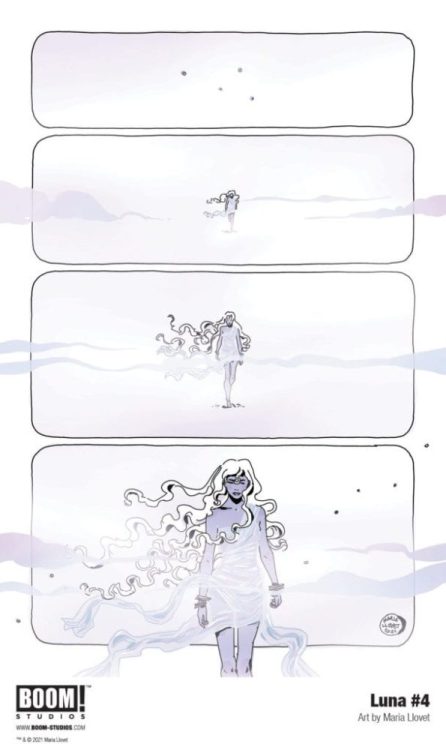
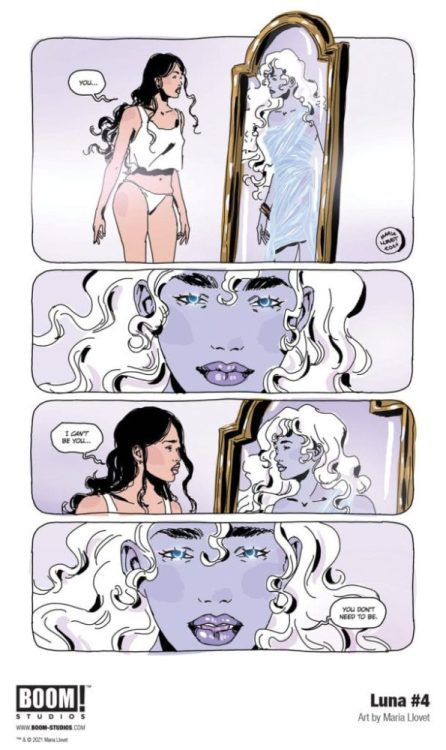
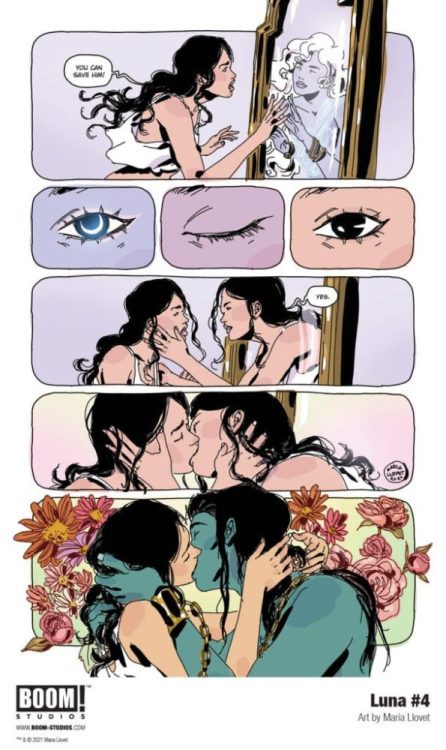
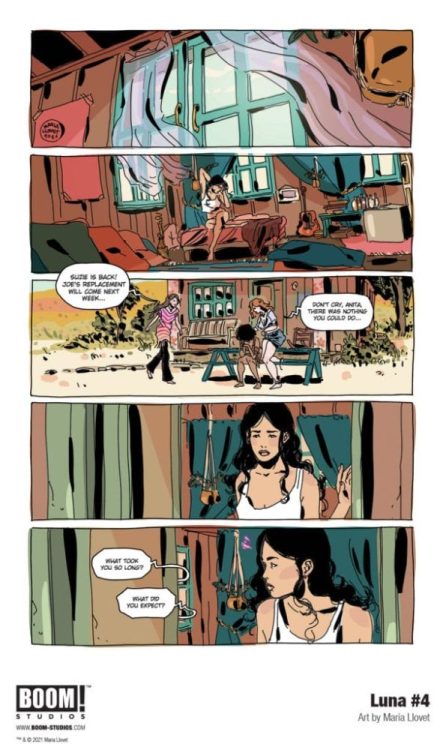
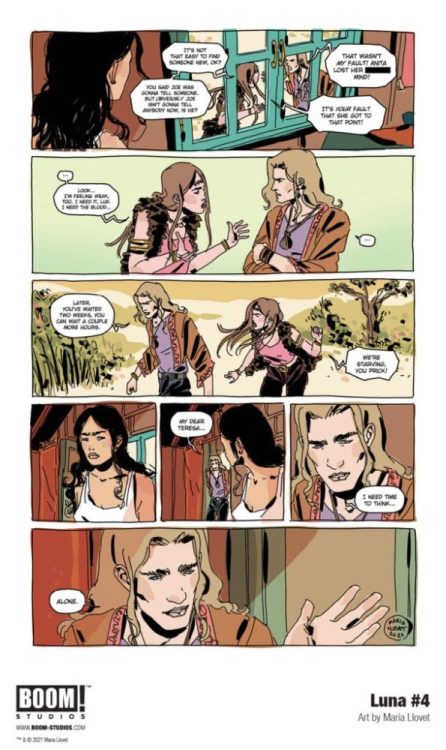
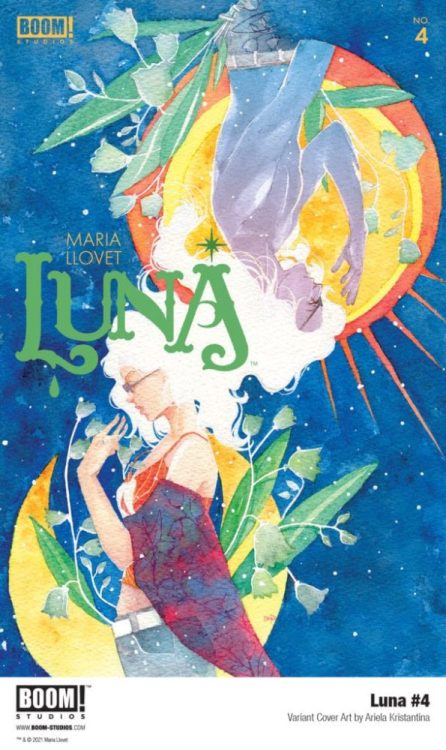
Maria Llovet’s LUNA #4 from BOOM! Studios hits your local comic book shop on May 19, but Monkeys Fighting Robots has an exclusive five-page preview for our readers, thanks to the publisher. Llovet creates the main cover with a variant cover by Ariela Kristantina.
About the issue: In this darkly erotic series, an innocent young woman finds herself drawn to a mysterious commune where the search for immortality collides with the true power of enduring love. Lux reveals the truth to Teresa that threatens to disrupt everything. Teresa is poisoned. And then things get really bad.
LUNA #4 features a main cover art by series artist Maria Llovet and a variant cover by artist Ariela Kristantina (Chain).
Digital copies can be found at comiXology, iBooks, Google Play, and Madefire.
Separation has the potential to go down as one of the weakest horror films this year. It’s an intriguing film at the start, but then shifts into a lifeless blend of cliches, horrid direction, wasted acting from those involved, and several other questionable filmmaking decisions. Coming from the same director that has worked on The Boy, Brahms: The Boy 2, and The Devil Inside, this film being a trainwreck should come as no surprise. A horror film with a divorce driving most of its narrative, Separation fails to come off as anything other than an insult to its viewers.
The amount of effort that went into this film seems minimal, but as mentioned above the acting is decent enough. It’s impressive that a horrendously executed film managed to acquire some terrific performers. Separation’s early moments are promising, but once tragedy strikes it progressively gets worse. Directed by William Brent Bell, and written by Josh Braun and Nick Amadeus. Separation stars Brian Cox, Violet McGraw, Madeline Brewer, Mamie Gummer, and Rupert Friend. The film follows Jeff Vahn (Friend), a failed artist who is going through a divorce from his wife, Maggie Vahn (Gummer). At the center of their unhealthy exchanges is their daughter, Jenny Vahn (McGraw). After an unfortunate accident, Jenny finds solace in her artist father and a new ghostly best friend.
Rupert Friend as Jeff in Separation
Braun and Amadeus have a screenplay that shows potential, but Separation falls flat on several angles. However, after initially viewing the film, it does have a clever transition from being a haunted house film to becoming a whodunnit. Jeff and Maggie’s crumbling marriage is taking a toll on not only them but their daughter as well. Maggie’s father, Paul Rivers (Cox), is brought into it and none of these characters are likable. Jenny, the young girl who is the target of this ghostly presence is the closest person for viewers to care about while watching this film. Maggie is understandably upset at Jeff for being unemployed but is presented as being aggressively rude to him, while Jeff just takes it all in from not only her but his father-in-law too.
Characters bickering over child custody back and forth in a lazy manner for most of its runtime doesn’t provide room to particularly care what happens. The writing in Separation attempts to be shocking but is anything but shocking once the conflict is resolved. The development for these characters is weak, but Jeff does have a new career path by the end of the film, so his character growth is present in ways. In fact, Jeff’s growth as an artist is made to be more important than his growth as a father, so his growth is uneven. The whodunnit side of this film is poorly done because the film decides to pretend it can outsmart its audience. Instances in Separation make it abundantly clear who is to blame, but viewers will be treated to prolonged stalling as the film progresses. While the script isn’t overly bad, or illogical, it’s just very lazy and the film never feels like it has the emotional weight it’s looking for.
Violet McGraw stars as “Jenny Vahn” in director William Brent Bell’s SEPARATION, an Open Road Films / Briarcliff Entertainment release. Credit : Open Road Films / Briarcliff Entertainment
Bell’s direction is void of any tension building, odd pacing choices, and it just feels like it’s coasting through to the credits. There are moments to spark terror, but even those moments are lackluster due to this poor direction. Thankfully, the performances are adequate to keep your interest. Cox is wonderful as the unlikable father-in-law, as many would expect. McGraw and Friend are terrific as father and daughter, and this relationship is one of the only believable aspects in this film. The chemistry is there, and you want to see this relationship blossom. McGraw is terrific as this heartbroken little girl who just wants her parents to get along, and viewers will feel for her. Also, Separation does include some rather chilling puppet imagery throughout, and it’s amplified by the decision to hide them in the shadows when they appear.
Separation struggles to leave an impact, despite its solid setup at the start to get audiences interested. McGraw and everyone involved should be proud of their efforts though because they managed to make the most out of a rough situation. The art department for this film is also a major highlight. If there is anything to be learned from this film, it’s that going through a divorce can be a struggle, but that doesn’t mean audiences should have to suffer with you.
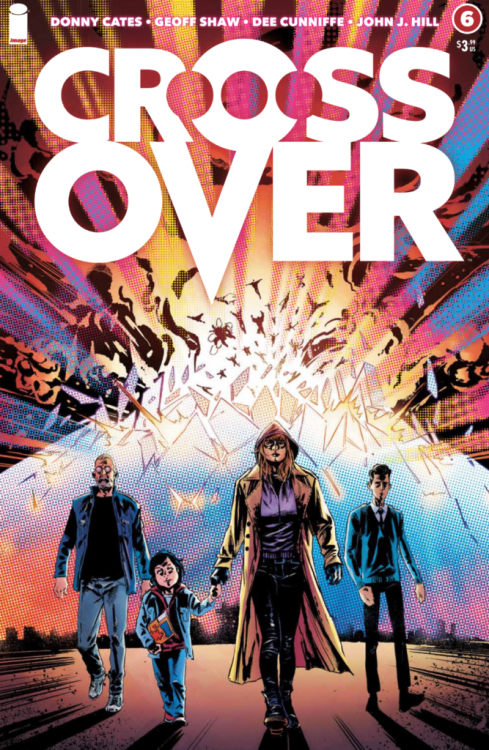
Crossover #6, out now from Image Comics, is the unforgettable conclusion to the “Kids Love Chains” arc and introduces exciting new twists.
Donny Cates pulls no punches in Crossover #6. If you thought the story elements in the previous issues were shocking or featured amazing crossovers from other series, you will not be prepared for what is in store in this issue. The story twists in unexpected ways, more crossovers than we have ever seen occur, and nearly every page is filled with thrilling action. Crossover #6 is one of the best, if not the best, issues in the series and is a perfect way to bring the arc to its conclusion. There is enough closure to be satisfied, but there is still much more to be resolved, and the issue even introduces new tantalizing bits of information that hook in readers.
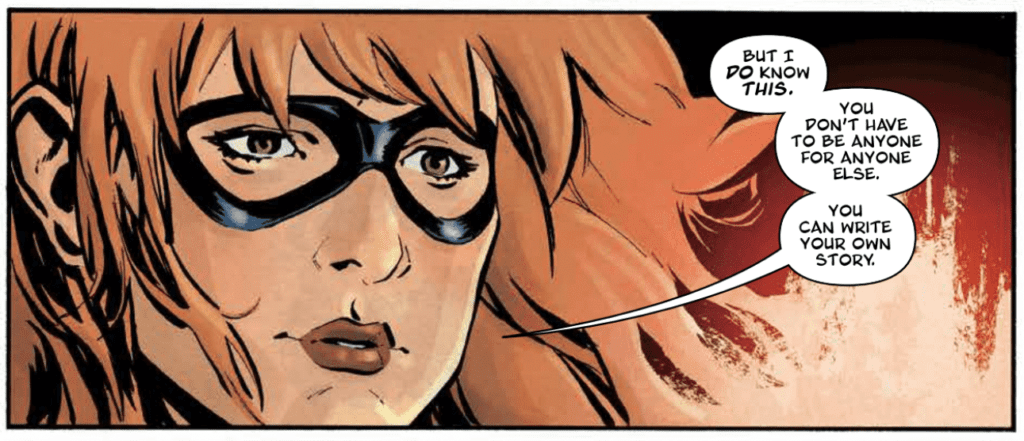
Crossover #6 lets Geoff Shaw’s artistic abilities shine more than ever before in the series through intense action, dramatic moments, and character-heavy pages. There are so many gorgeous spreads in the issue that feature precise detail and many things going on that I can’t imagine the time and effort that went into it. The forms in the action scenes are full of energy and make the chaos incredibly apparent, and the facial expressions of the issue make certain that the emotional moments of the issue pack a punch. Shaw puts forth some of his best work in this issue, and it’s not something you would want to miss.
In an issue full of many comic book characters from many different genres, the coloring needs to match the colorful nature of these characters. Dee Cunniffe does this and more in Crossover #6 and delivers a broad palette and many impressive coloring techniques. Some of the issues’ backgrounds have a gorgeous rainbow pattern, beams of light have stunning lens flare effects, and Cunniffe makes the many different heroes from many different genres somehow work together in a single coherent style. The characters are from many books with various artists, and still, the coloring of the issue somehow makes them all fit together. It is a daunting task that Cunniffe pulls off superbly.
Crossover #6 contains lots of action, which John J. Hill enhances with bold fonts for sound effects. Hill also gives a certain amount of dynamism to sound effects by having each be stretched along a specific path. This is used in some cases to guide the reader’s eye along the page, which makes the action more seamless. Hill also has words extend past the borders of their speech bubble, demonstrating the volume behind the character’s dialogue.
Crossover #6 is an issue that takes the series down an unexpected path and reveals exciting information that will be further developed in later arcs. It is a fantastic conclusion to the series’ first arc and is not something you should miss if you have been enjoying the series.
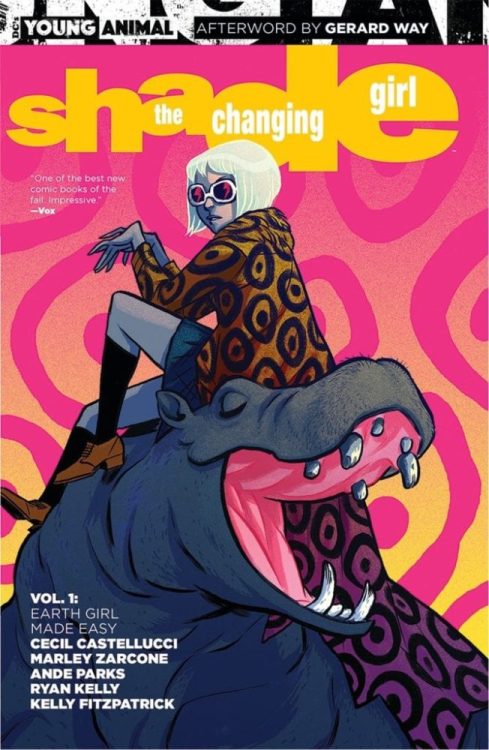
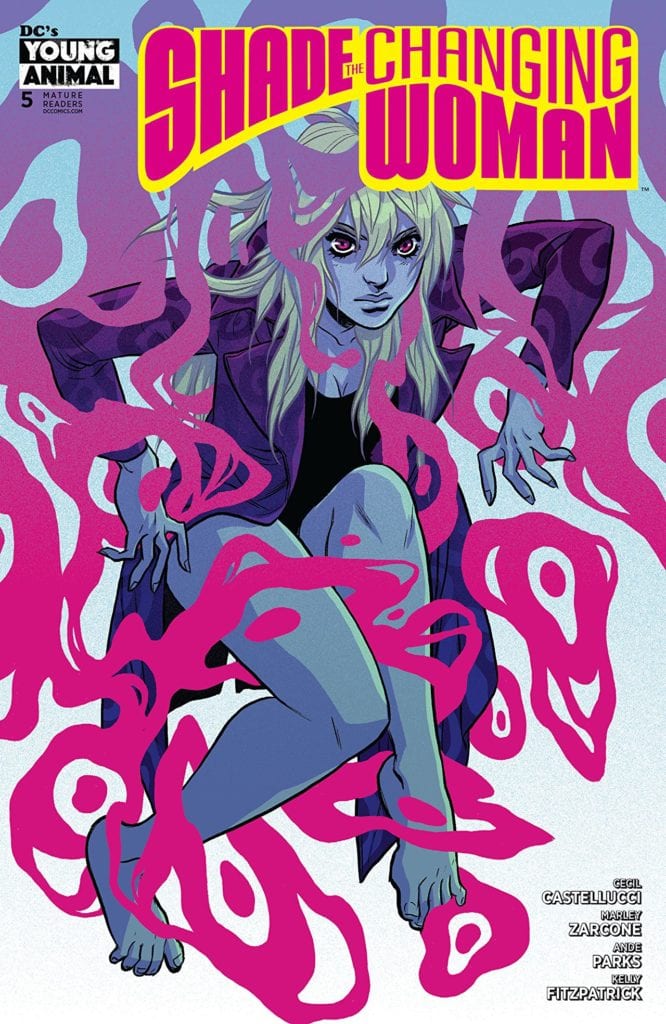
In 2016, writer and My Chemical Romance frontman Gerard Way came together with DC Comics to create the Young Animal imprint. This imprint would function similar to how the original Vertigo imprint did back in the 1980’s, with new writers breathing life into failing or nearly forgotten characters and giving them a contemporary twist. The initial lineup of books included Way teaming with artist Nick Derington for a new Doom Patrol as the imprint’s flagship title. He also collaborated with writer Jon Rivera and artist Michael Avon Oeming for a resurrection of long-forgotten Silver Age spelunker Cave Carson in Cave Carson Has A Cybernetic Eye. They even added a new (and genuinely really cool) Gotham vigilante with Mother Panic, created by Way, Jody Houser and Tommy Lee Edwards. While I consider every one of these to be fantastic and upsettingly overlooked (except arguably Doom Patrol, generally considered the best run on that property since Morrison), the one I feel most attached to is Cecil Castellucci and Marley Zarcone’s Shade the Changing Girl and its sequel Shade the Changing Woman. This soft sequel to Peter Milligan’s criminally underrated Shade the Changing Man from the Vertigo wave ( incidentally a reimagining of the Steve Ditko character of the same name) is an emotionally sincere, unique, psychedelic, and beautiful piece of storytelling about growing and learning to embrace the people who stand by you.
“There’s no such thing as a little bit of madness. Far away on the planet Meta, Loma’s going nowhere fast. She’s dropped out of school, dumped her boyfriend, and is bored out of her mind. She longs to feel things. That’s where her idol, the lunatic poet Rac Shade, and his infamous madness coat come it. Loma steals the garment and makes a break across galaxies to take up residence in a new body: Earth girl Megan Boyer. Surely everything will be better on this passionate primitive planet with a dash of madness on her side and this human girl’s easy life. Only now that she’s here, Loma discovers being a teenaged Earth girl comes with its own challenges and Earth may not be everything she thought it’d be. Megan Boyer was a bully whom everyone was glad was almost dead, and now Loma has to survive High School and navigate the consequences of the life she didn’t live with the ever-growing and uncontrollable madness at her side. Not to mention that there are people back on her homeworld who might just want Shade’s coat back.”
Don’t let the fact that Shade The Changing Girl is a sequel hold you back from reading it. While there are some references and context to be gleaned from having read Milligan’s series, Castellucci and Zarcone’s comic is perfectly digestible on its own. Treating Rac Shade (Milligan’s protagonist) as a sort of disembodied and nearly forgotten celebrity is appropriate for both the messaging of the prior comic and its elusive real-world status. Girl/Woman is a sort of commentary and inverse of Milligan’s comic. Loma receives much more personal development and awakening as a person while wearing the madness vest than Rac did, even with Loma starting out worshipping the prior comic’s mad poet protagonist. Where Man contained that classic British snark combined with unapologetic strangeness and imagination, Girl/Woman combines the latter of these styles with a modern teenage yearning. Its visions of aliens, interspecies love, and plots to destroy the Earth are brought back around to the complex interpersonal relationships that are warped and rebuilt by the context of Loma’s entering our society. The big twist? She does it by possessing the body of a recently deceased high school student. This series is as much a psychological deep dive as it is a psychedelic space adventure, and these elements work in tandem to craft one of the most unique comics of the past decade.
Cecil Castelucci’s writing throughout this series swings from poetic narration to the grounded, expression-filled dialogue of modern-day teenagers. Loma herself is an edgy, madness-obsessed experience hunter whose obsession with following in Rac Shade’s misbegotten footsteps has landed her in a situation she doesn’t realize she wants to be in. At the same time, the recently deceased high schooler whose body she has possessed was popular for all manner of conniving, unsavory reasons. This comic explores the concepts of idol worship, contentment, sexual attraction, and the old adage of “the grass is always greener,” while also staging the rising threat of interstellar war in the background. This comic does a lot, and while it can certainly seem overly weird and convoluted to certain readers, lovers of this kind of artful discussion and oddity within comics will find an absolute gem here. There is an intense beauty within this series’ words and events, and it is emotionally and mentally uplifting for the right crowd.
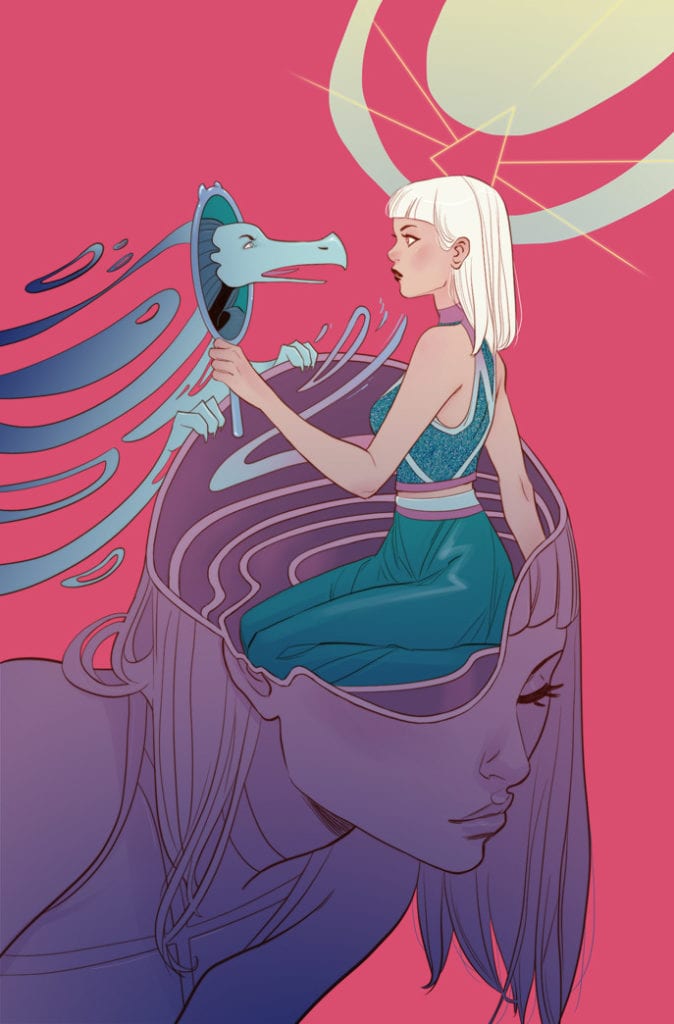
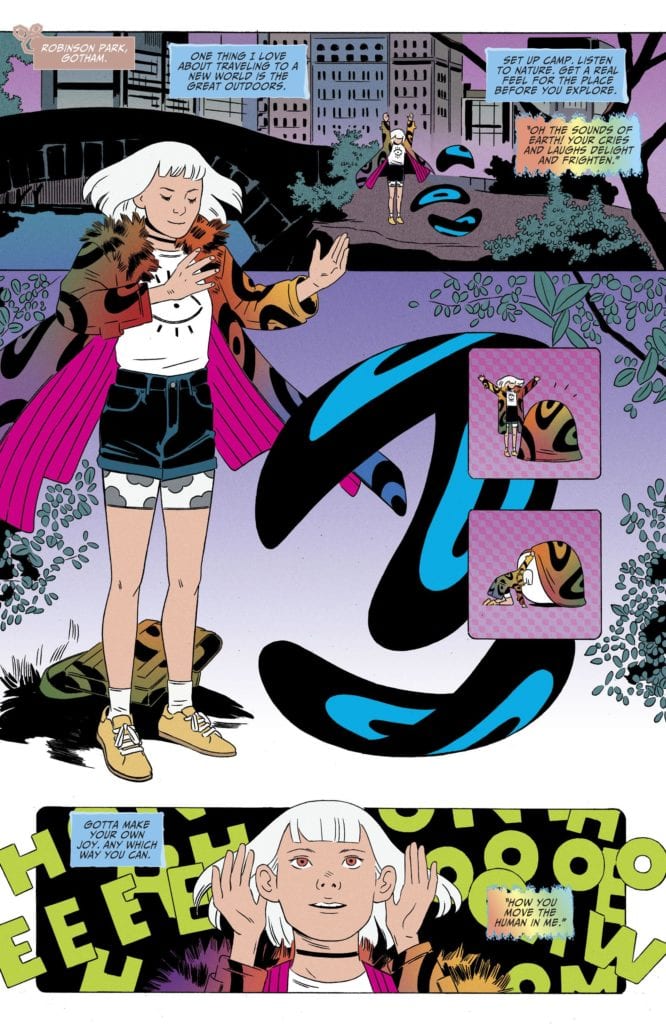
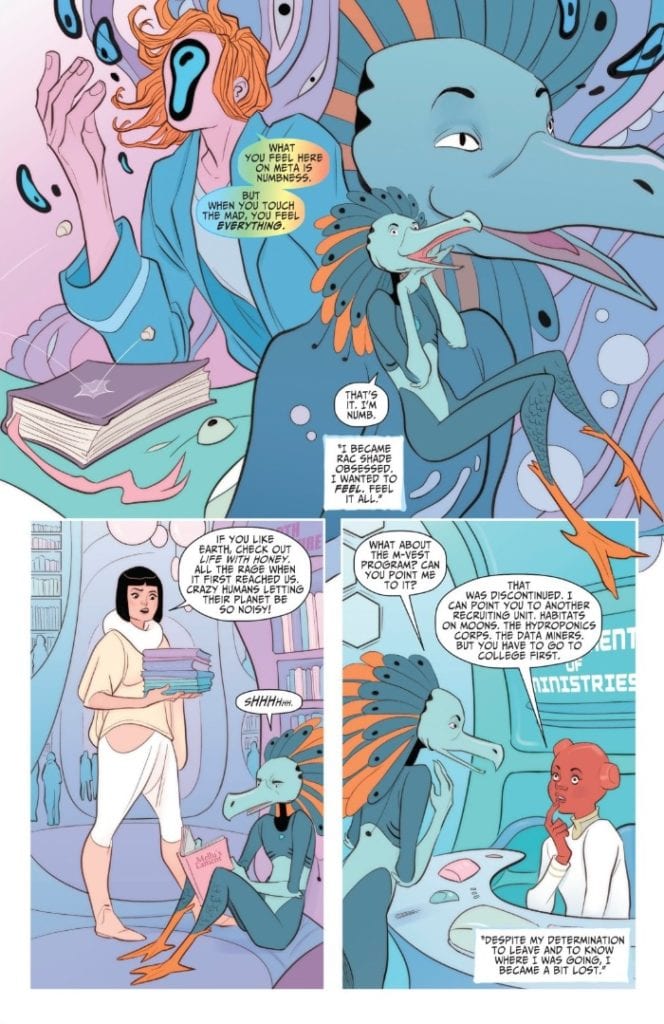
As brilliant as the writing is in this series, the visuals will reach out and drag your eyeballs across each issue’s panels. Becky Cloonan’s ever-inviting covers are mesmerizingly colorful and full so of personality that matches the vibe of the story that you’ll wish she drew the interiors as well; that is, until you see Marley Zarcone and Kelly Fitzpatrick’s panels. This comic is a masterwork in creative comic design, with panels utilizing the reality-bending nature of Loma’s madness vest to create psychedelic floating transitions from one sequence to the next. The comic has a dream-like feel to its composition that works perfectly for its poetic words. The character and environmental art contrasts to these wildly colorful oddities, with a simplicity and flatness that is strangely perfectly fitting. The detail in character animations and different designs is made up by very fine pencil work from Zarcone, with thicker lines that create open spaces for color to fill in. Fitzpatrick’s colors are the artistic highlight of this series, with all of the big mind-bending forays into madness and the illustrations of alien worlds being given a massive array of hues that thematically fit the scene. Earth is often portrayed in a rather small and comparatively dull visual range, while the planet Meta is a little more varied but still has a similar situation. The insane trips into the artistic world of Loma’s experimentation with madness explodes with life however, and is the main visual draw of the comic. This is one of the most visually unique comics from the past decade, and it’s a gorgeous experience from beginning to end.
Shade The Changing Girl and its sequel Shade The Changing Woman are fascinating and deeply insightful forays into human emotion, desire, and art. Castelucci’s thoughtful and poetic scripts intermingle with realistic character concerns and troubles that make the world here seem tangible although it is quite literally always on the brink of absolute madness. Although certainly not for everyone , I still wholeheartedly believe this is one of the most underrated and under read comics of the past decade, and an absolute gem in DC’s Young Animal lineup.
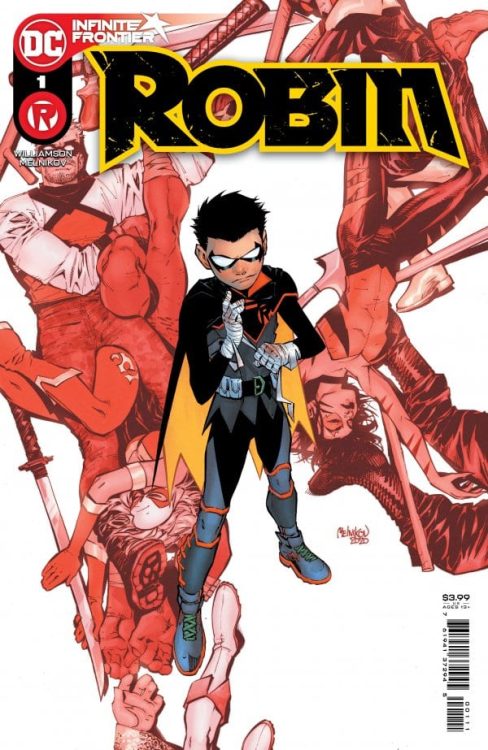
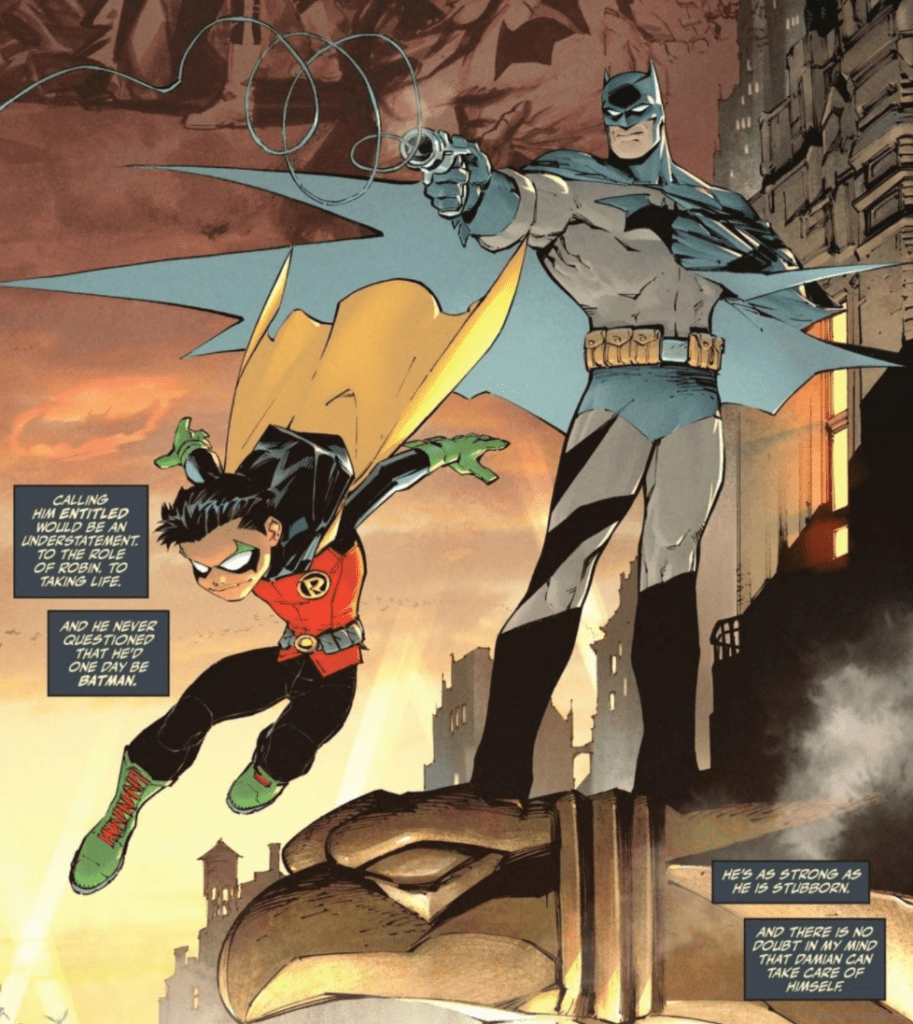
Robin #1, out now from DC Comics, throws Damian into a situation unlike any we’ve ever seen before as he goes on a journey of self-discovery.
Things are not easy for Damian Wayne at the moment. After Alfred was brutally murdered right before his eyes, Damian decides to go on a journey similar to the one his father went on during his training. It is a mission that causes him to meet many new faces, stop many bad people, and get into many exciting fights.
Written by Joshua Williamson, Robin #1 is an exciting introduction to this new journey Damian is embarking on. Williamson fills the issue with fights, new characters, and plenty of context so that new readers don’t feel lost. The issue’s ending is particularly notable: kicking off the series with an enormous cliffhanger that is so confusing I’m not sure how anyone can resist picking up the second issue just for the closure.
Gleb Melnikov is well-versed in dynamic poses, and this skill shines through in Robin #1. The fight scenes that comprise much of the issue are gorgeous because of Melnikov’s incredible ability to draw figures that look like they are in motion. Melnikov also uses many shadows in his compositions and often uses plain backgrounds when the reader should be focusing on what the characters are doing. These are simple and effective ways that Melnikov turns Robin #1 into a thrilling first issue.
It should come as no surprise that Melnikov’s colors pair wonderfully with his art, and the way the two work hand-in-hand in Robin #1 is fantastic. One technique that Melnikov uses is to drastically change the palette of a scene for a single panel to add energy and highlight the significance of a panel. This is done during the final blow of some fight scenes, and it causes the most climactic moments of the conflict to stand out.
Robin #1 has many names dropped in its dialogue, and ALW’s Troy Peteri takes advantage of every one of these moments by giving each name a stylized font. When introducing a new character, an infamous organization, or a title, Peteri makes the font stand out. Peteri is not afraid to have fun and provides an astonishing variety of styles in Robin #1, and it significantly helps to increase the energy of the issue.
The work of Williamson, Melnikov, and Peteri create an impressive first issue of this new series and promises much to be seen in the future.
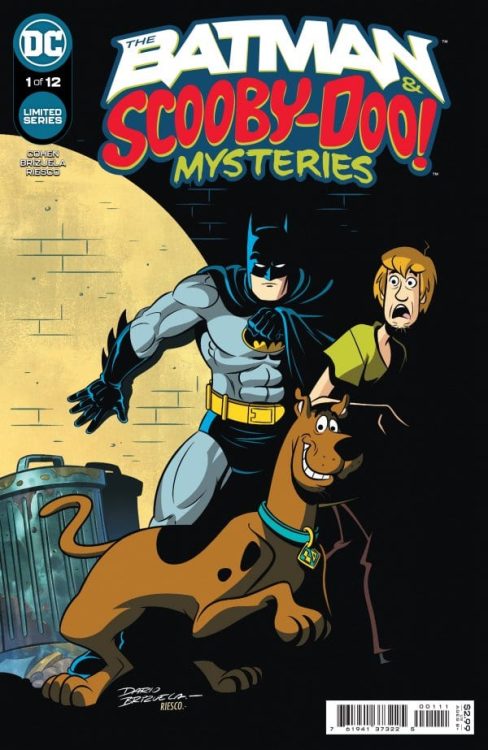
You might think Batman, Scooby-Doo, and missing gloves is the setup to a bad joke, but it’s actually the start of a fun new mystery from DC Comics. Available now,The Batman & Scooby-Doo Mysteries #1 is written by Ivan Cohen and illustrated by Dario Brizuela. Colors and lettering were done by Franco Riesco and Saida Temofonte, respectively.
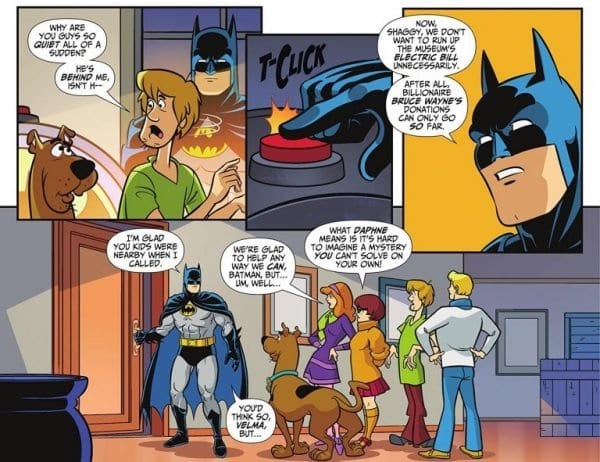
The Batman & Scooby-Doo Mysteries #1 opens the planned twelve-part limited series with a deceptively simple glove theft. Batman calls Mystery Inc. when he finds that someone broke into the Gotham Museum of Culture. Whoever broke in also stole the purple gloves off Batman’s Year One costume. The story gets wacky when Batman suggests time travel to catch the suspected thief in the act.
Who would have considered time travel in a story like this? Well, Ivan Cohen had the bright idea, and his writing capitalizes on other delightful hallmarks of Scooby-Doo and Batman. Each character has the chance to deliver quippy, idiosyncratic dialogue as we’d hear it in the cartoons.
Glove Story
Even Batman is funny, albeit in an ironic way, with the majority of his jokes relating to the Dark Knight’s true identity. Such tongue-in-cheek humor relies on dramatic irony and fans’ prior knowledge of the characters, but the story is still accessible to everyone.
BATMAN MEETS WITH MYSTERY INC.
In keeping with Cohen’s nostalgic, referential writing, Brizuella’s art style borrows greatly from the Hanna-Barbera cartoon. It’s all soft lines, curves, and broad expressions. Brizuela also uses plenty of master shots and medium shots to punch up the jokey dialogue and lend an actual sense of space to the otherwise two-dimensional style.
Additionally, Riesco’s colors are equally cartoonish, carrying familiar bright, warm, and bold tones. Riesco also emphasizes purple, green, and orange in backgrounds to evoke the costumes of each Mystery Inc member. Moreover, Riesco managed to get Batman’s purple gloves to stand out among his panoply, seemingly using a particular shade not used elsewhere in the book. That subtle choice, in combination with Brizuella’s illustration, adds cinematic flair to the mystery.
From Joke to Joke
To the same degree, Temofonte’s lettering is at turn bold and cartoony with just enough SFX to sell the jokes. Yet no dialogue bubble or effect feels out of place or forced, for that matter. It all seamlessly flows from joke to joke to wacky encounter with the same pace as the original cartoon, thanks to Temofonte.
Thanks to a creative team with as much love for Mystery Inc. and Batman as the oldest fans, The Batman & Scooby-Doo Mysteries #1 serves up tons of fun. It may be the most heartwarming comic I’ve read so far this year. So, I will definitely be tuning in for the next eleven installments of the series.
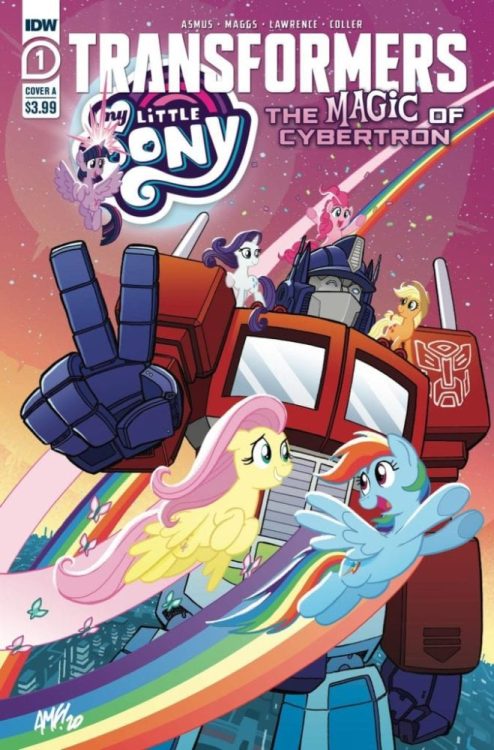
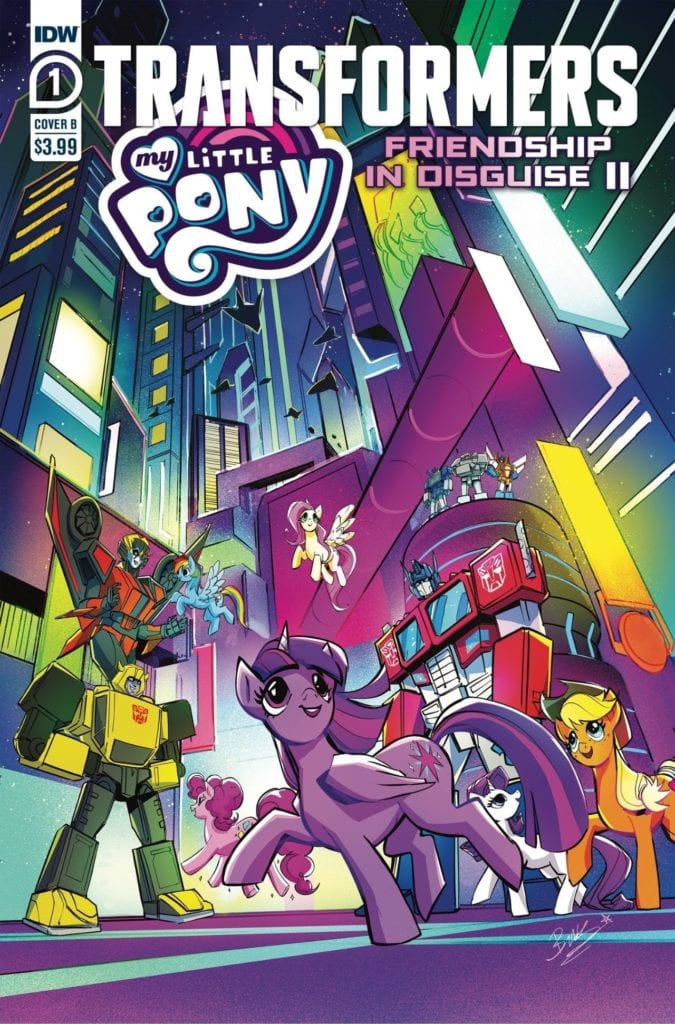
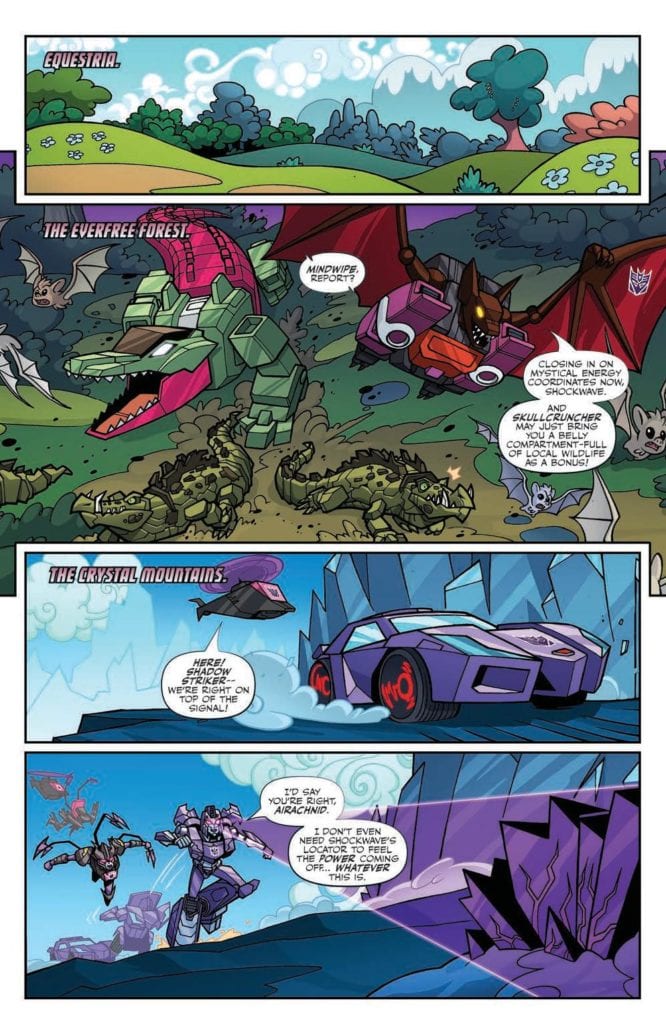
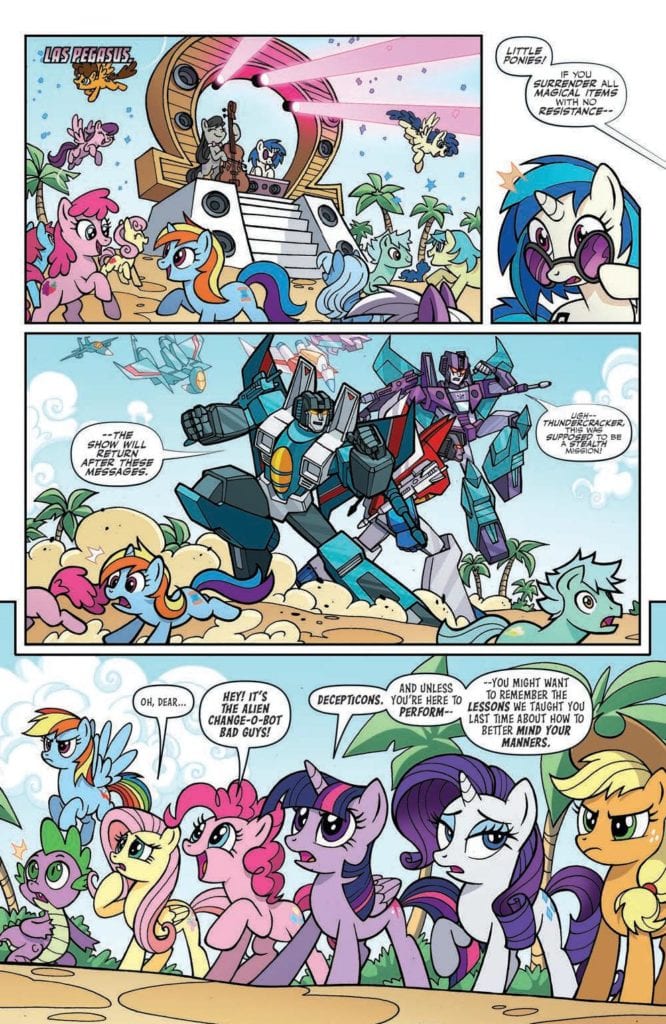
My Little Pony/Transformers 2 #1 out this week from IDW comics features the return of one of the most entertaining crossovers in recent years. The magic cast of My Little Pony teaming up with the galaxy-spanning cast of the Transformers series. This magical crossover is made possible thanks to James Asmus (writer), Jack Lawrence (pencil and inks), Luis Antonio Delgado (colors), Jake M. Wood (letter), Sam Maggs (writer), Casey W. Coller (pencils/inks), Joana LaFuente (colors) and Neil Uyetake (letter).
While using a modified Spacebridge to bring magic to Cybertron, the Decepticons end up unleashing a more powerful evil from Equestria than they ever could’ve imagined—looks like the only way out of this one is to team up!
Writing
The story picks up from the previous miniseries. Basically, the Decepticons invade Equestria in an attempt to obtain magic. Things escalate fast as the Autobots come to the aid of the ponies only for the evil King Sombra to be released. With his own magic, King Sombra brainwashes many individuals setting up this new miniseries. This use of brainwashing and odd pairings will result in odd pairs moving forward. It already looks like Shockwave and Starscream will be pairing up with some ponies and going on adventures. Ridiculous as ever but this is what makes it so entertaining.
The first of the crossover and it’s an interesting pair. Furious Arcee and Greenlight meeting up with Scootaloo’s aunts. The ladies find themselves teaming up to take down a new threat. The peak of this story is the discovery of Scootaloo and her new friends. It’s incredibly heartwarming.
Artwork
The art by Jack Lawrence in the first story “The Magic of Cybertron” has a nice whimsical style to it. The second story “A Real Mother” with art Casey W. Coller has a more defined look to it. Coller’s work results in a great one-page splash later in the issue.
The colorwork by Luis Antonio Delgado and Joana La Fuente adds different elements to their individual stories. With Delgado, the color helps to add to the mystical and scientific elements of the story. Meanwhile, La Fuente’s colorwork adds striking detail to each of the characters making them stand out even more.
The lettering by Jake M. Wood and Neil Uyetake brings a great auditory aspect to the issue. A special shoutout goes to Uyetake for perfectly recreating the sound of what a Transformers changing from is. It’s a sound effect you hear as soon as you read it.
Conclusion
My Little Pony/Transformers 2 #1 is more of what fans want. Various ponies teaming up with various Transformers for some hilarious stories. Hopefully, fans will give this miniseries just as much attention as they did the first one. If they do the publisher will take notice and a third miniseries could be on the horizon.
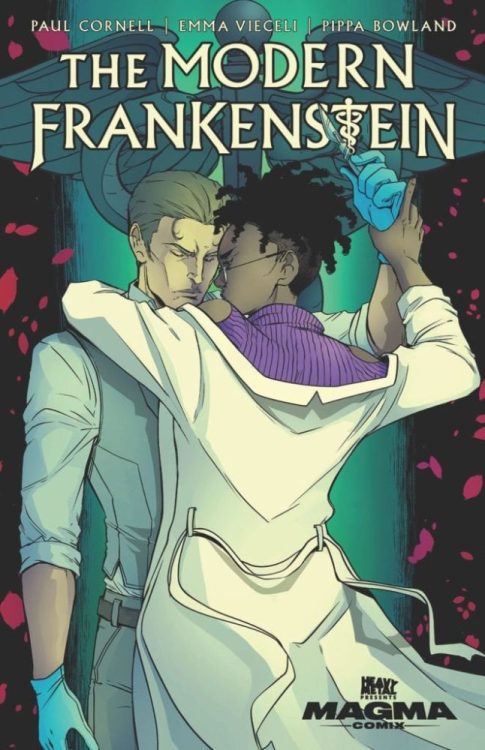
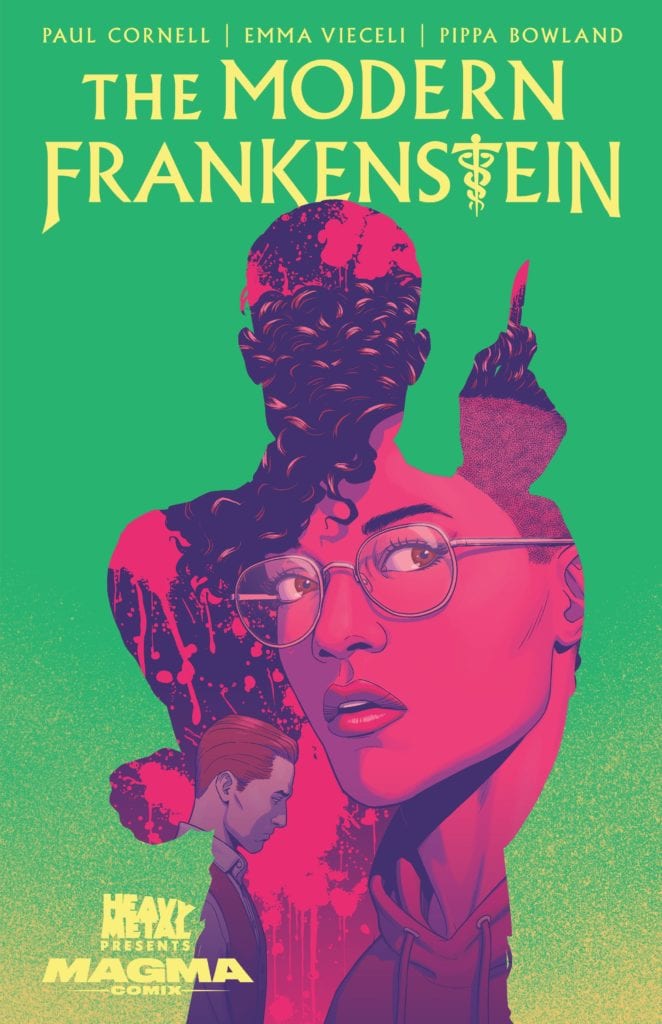
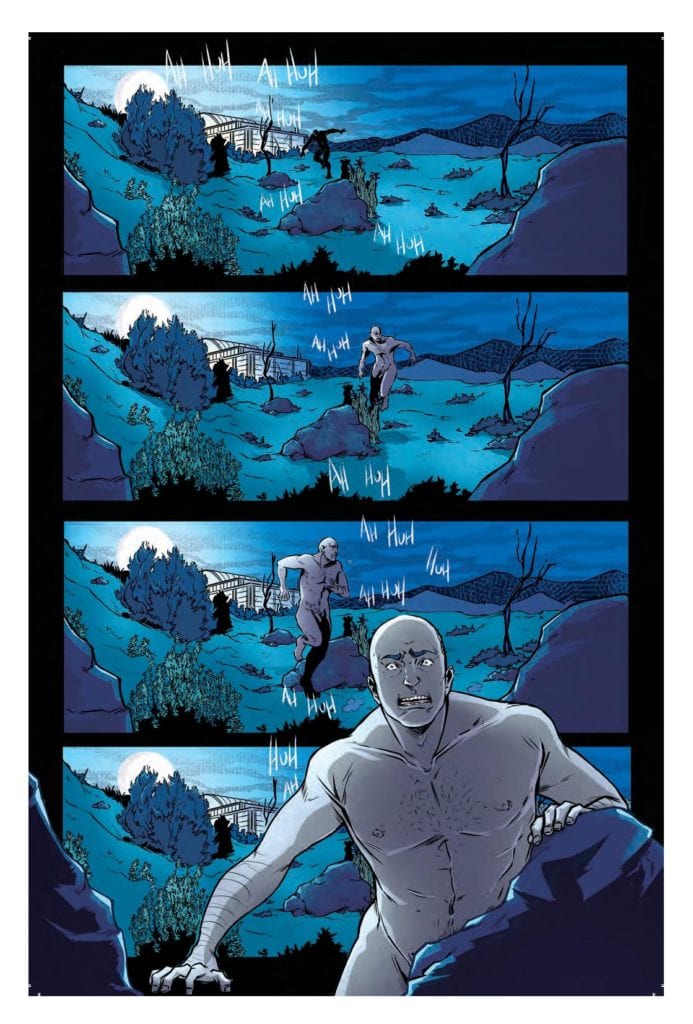
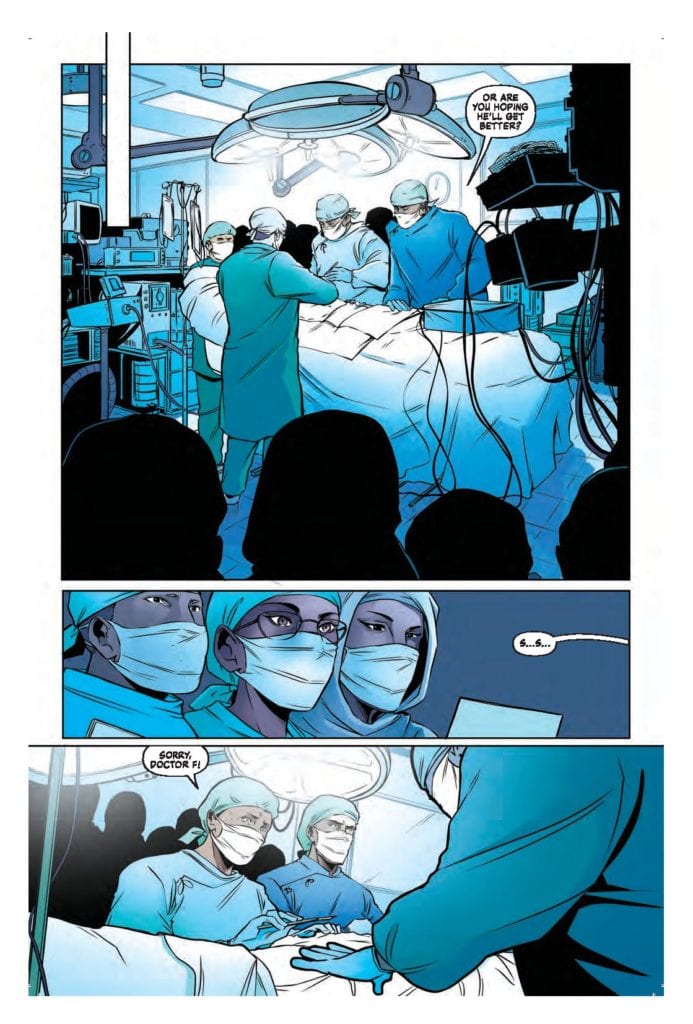
The Modern Frankenstein #1 out this week from Magna Comix is a reimagining of the classic story of Frankenstein. In a more familiar time, Dr. Frankenstein is a man pushing the boundaries of medicine, and his student Elizabeth finds him to be fascinating. This engrossing tale arrives thanks to Paul Cornell (writer), Emma Vieceli (pencils and inks), Pippa Bowland (color), and Simon Bowland (letterer).
Elizabeth Cleve is a brilliant young medical student, attracted to the waspish, charismatic surgeon James Frankenstein. He wants to further medical science… by all means necessary. So how far is Elizabeth prepared to go?
Writing
The story of Frankenstein is a tale of a scientist who wishes to create life. In TheModern Frankenstein, the doctor is conducting experiments outside what many could call ethical. From a throwaway line, it is established the name Frankenstein is not common as if the classic novel doesn’t exist. Writer Paul Cornell makes it clear through world-building and events although this Frankenstein wishes to push the boundaries of science further, he is not with a soul. Many of the decisions he makes seem to weigh on him.
The character interactions help to make the issue so engrossing. The aspect of the romance introduced between Elizabeth and Dr. Frankenstein is palpable and not forced. You can feel Elizabeth falling in love with the good doctor. Respecting his dedication, his intelligence, and his compassion. Basically, you are shipping them by the end of the first issue.
Artwork
The pencils and inks by Emma Vieceli offer great emotional depth to the characters. Elizabeth with her fascination with Dr. Frankenstein is shown to be observing him and his work with excessive curiosity. From the way she is drawn it is easy to tell Elizabeth has a distinct interest in her teacher without the story having to spell it out.
A fascinating aspect of the colorwork by Pippa Bowland comes off in a little detail. The most noticeable thing from page to page is the interesting color choice for Elizabeth’s eyes. A bright orange color is used, which seems to help establish Elizabeth as a character who is passionate and eager to learn all she can.
The lettering by Simon Bowland adds a narrative flow to the issue. By following the word bubbles, it helps to give the reader a visual path from panel to panel. There also is a distinct amount of bolding through the issue. This seems to show Bowland helping to convey when the writer wants words to have an impact.
Conclusion
The Modern Frankenstein #1 is the start of something intriguing. A classic retelling with one of the main aspects being to focus on what it takes to love someone like Frankenstein, a doctor who is researching into areas of science most men would dare not trend. It will be no surprise when this series has many falling in love with it.
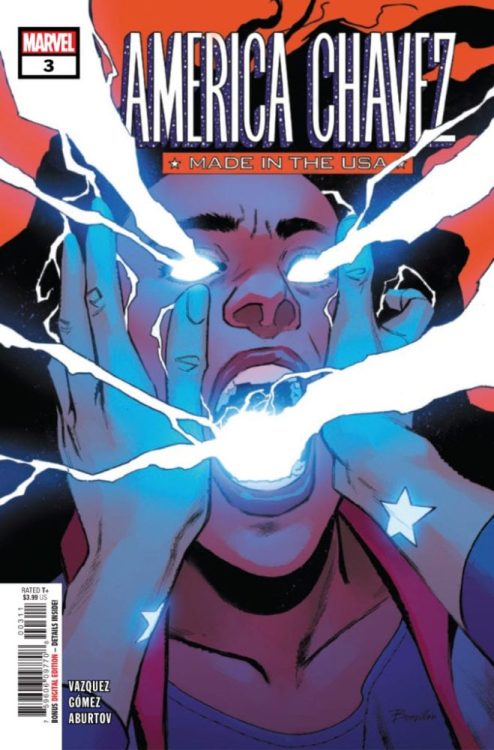
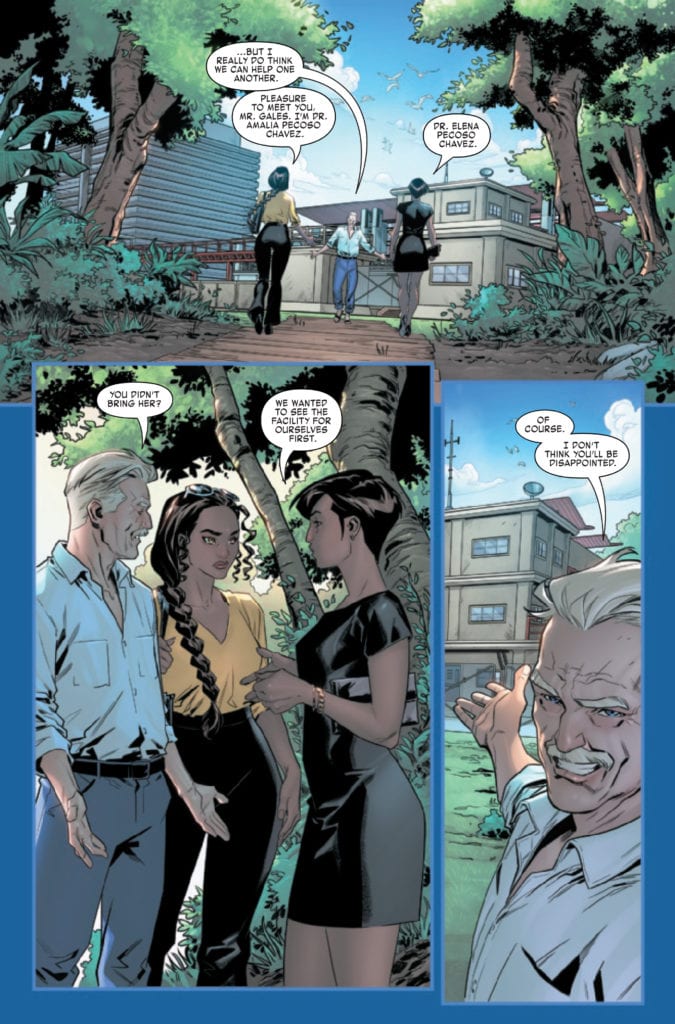
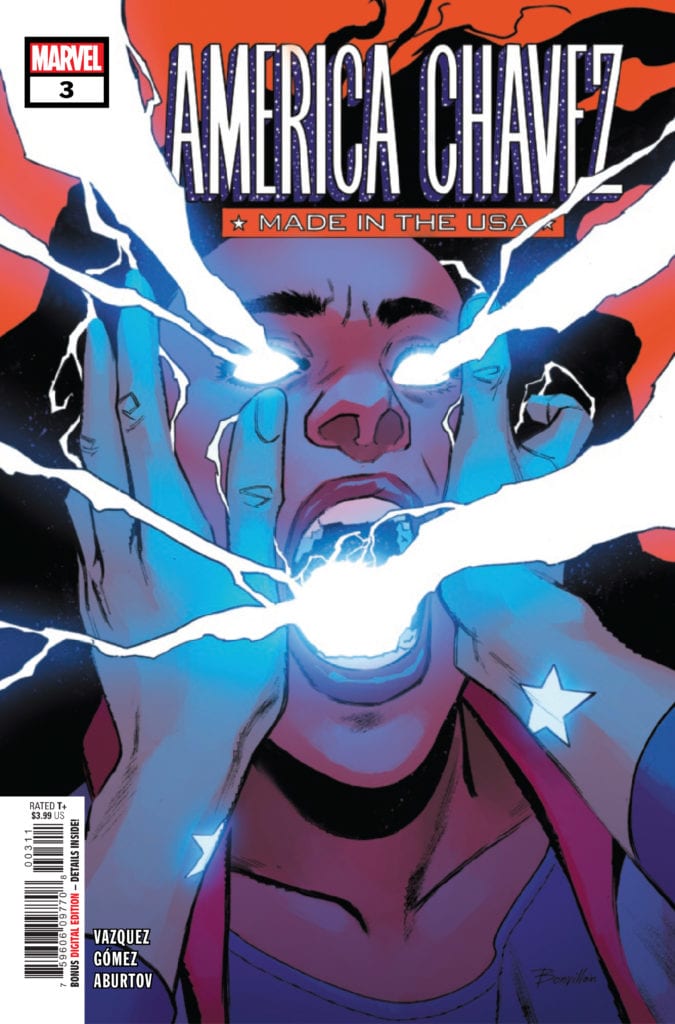
AMERICA CHAVEZ: MADE IN USA #3 hits your local comic book store May 5th, but thanks to Marvel Comics, Monkeys Fighting Robots has an exclusive preview for you.
About the issue: WHERE’D YOU GO, AMERICA?
The face of America’s mysterious tormentor is revealed – and while whom America sees is shocking, to say the least, it’s what they say that will shake the foundations of everything she knows. And then? It’s just a matter of whether or not to believe them…
The issue is by writer Kalinda Vazquez and artist Carlos Gómez, with colors by Jesus Aburtov, and letters by Travis Lanham. The main cover is by Sara Pichelli and Tamra Bonvillain, and the variant is by Betsy Cola.
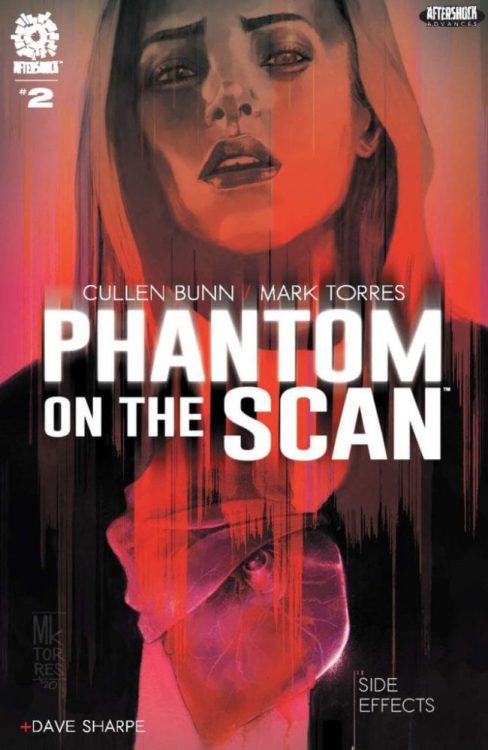
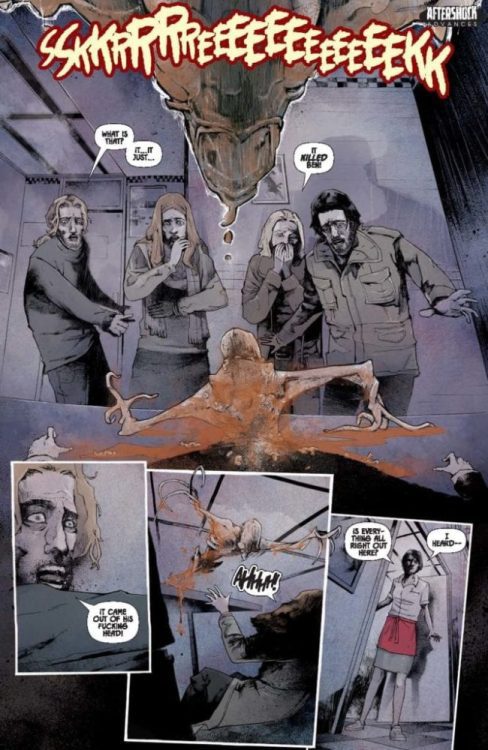
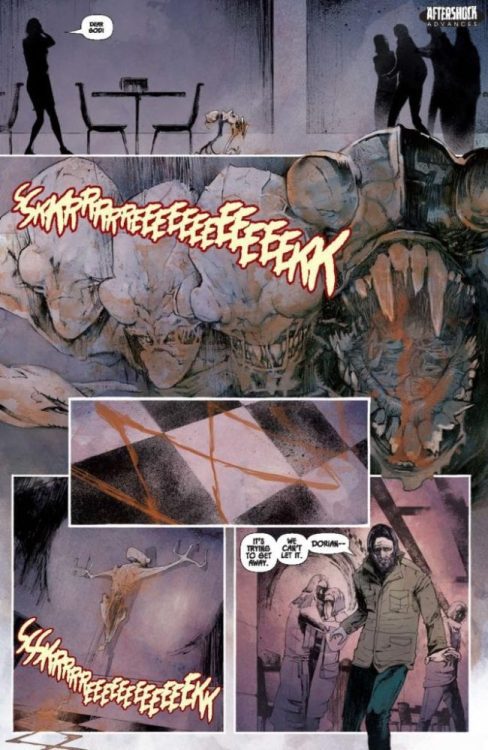
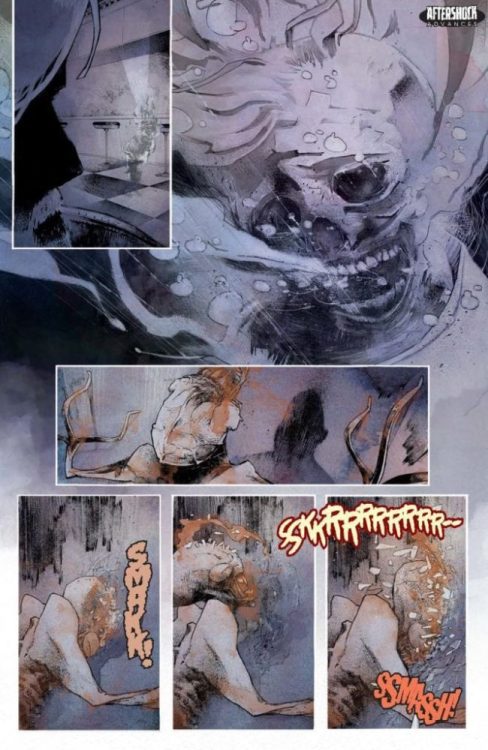
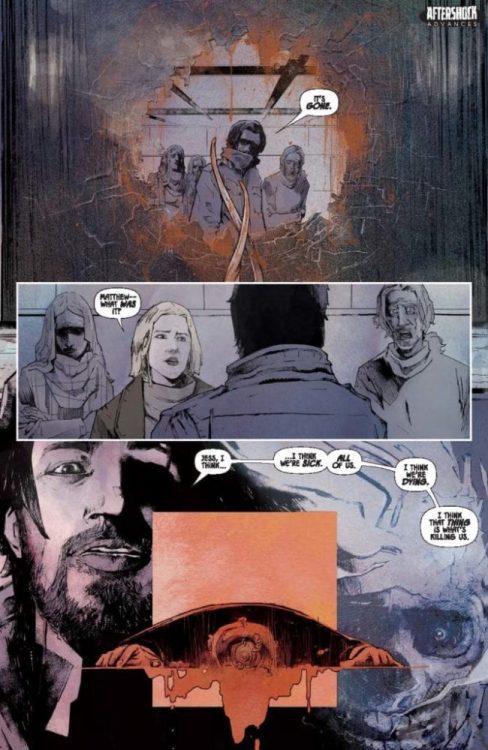
PHANTOM ON THE SCAN #2 hits your local comic book shop on May 19, thanks to AfterShock Comics, Monkeys Fighting Robots has an exclusive four-page preview for our readers. The book is written by Cullen Bunn, with art and colors by Mark Torres, and you will read Dave Sharpe’s letter work.
About the issue: A group of frightened psychics gather to learn how and why their gifts are killing them. What is the mystery that binds them together? What is the source of their powers? And how is the clandestine Trellux Institute involved? As they pursue the answers to these questions, they discover that they’re also being stalked by human killers – killers with powers of their own.