The ever-changing dynamics of the West-Allen family finally reach a resolution. While SUPERGIRL and ARROW have struggled to center their heroes, THE FLASH succeeds. The family drama may feel soap opera-y to some, but the West-Allen family has more than enough excitement and intrigue to keep THE FLASH going strong.
Ragdoll doesn’t provide a lot of scares, but he helps spearhead an Iris-centric episode. The character’s loosely defined anger with his mother sets the table for the Iris and Nora problems. It’s always nice when THE FLASH gives Iris time to shine, because she’s really an interesting character. That was especially clear last week, but “All Doll’d Up” continues the trend. Iris is a strongly written character, with a history of cool actions under her belt. This episode plays to her strengths.
Troy James as Ragdoll in THE FLASH, “All Doll’d Up” (copyright CW)
The side story with Caitlin and Cisco was also interesting. As the show’s longest-running sidekicks, it’s nice these characters still have ways to develop. Caitlin’s quest to discover her ice-goddess roots continues the episode’s theme of depowered daughters. Along with that, Cisco finds ways to turn away from vibe powers, and back to science. It seems like “The Death of Vibe” was less of a misnomer than it seemed to be. THE FLASH has a roster full of cool characters, and this episode takes advantage of their biggest players.
The central characters continue driving the series. While the detective twins aren’t as compelling, and Ragdoll is only a tad creepy, Alpha Team Flash carries the episode well. Not only does this episode put a kind of cap on the West-Allen problems, it also sets up plenty of new stories. Now the main plot can focus on Cicada, while Caitlin continues to unravel the mystery around her father. THE FLASH has plenty more to work with in its fifth season.
For future FLASH reviews, check out MFR’s sister-site Popaxiom!
We’re over half-way through season 9 of The Walking Dead, and this episode feels like a season premiere. The bad part about beginning a new storyline this late in the season is the lack of time to introduce the new(er) world before season-end. The momentum seems completely off.
Without the show’s leading man and a prominent female character, the show has a completely new feel. We all know that Andrew Lincoln has stepped away from his moniker of Rick Grimes, but the last episode was also the last time we’ve seen Lauren Cohan play Maggie Greene/Rhee, at least for a while. Her departure was met with zero fanfare as not to devalue Lincoln’s exit, which wasn’t exactly fair to Cohan. So, thank you Lauren; you will be missed, too.
Josh McDermitt as Dr. Eugene Porter, Nadia Hilker as Magna, Dan Folger as Luke, Lauren Ridloff as Connie, Angel Theory as Kelly – The Walking Dead – Season 9, Episode 6 – Photo Credit: Gene Page/AMC
The residents of Alexandria are hesitant to allow new people to join their community. We don’t see many new faces milling around the town, and the public’s curiosity at the meeting was palpable. During the newcomers’ tentative stay, several townsfolk referred to an incident in regards to their apprehension, but none of them go into detail. What happened during the time jump that has made them more cautious than before?
Danai Gurira as Michonne – The Walking Dead – Season 9, Episode 6 – Photo Credit: Gene Page/AMC
Michonne (Danai Gurira) is especially against allowing new people into their community. She talks to Rick and Carl as if they’re there, which isn’t uncommon even in our own world. She seeks their guidance and strength, and with a warm wrap of Rick’s old shirt, she begins to come around. However, her hesitation may be a little more justified. What’s with the “x” scar on her back?
Carol (Melissa McBride) has also proven that she’s the same old sly warrior she’s always been, even with a new hairdo. (Because, you know, long hair means time-jump, right?) She’s still very protective of those she loves, especially Henry (Matt Lintz), who she and Ezekiel (Khary Payton) have named their son. After an ambush by a few wayward former Saviors, she torched them just like she did to Karen and David at the prison and just like she did with the cannibals at Terminus. Basically, we’ve learned that if you are a threat to Carol Peletier, you’re toast.
Cailey Fleming as Judith Grimes – The Walking Dead – Season 9, Episode 6 – Photo Credit: Gene Page/AMC
Being raised during the zombie apocalypse has given young Judith Grimes some thick skin. She takes after her late brother, though, by being compassionate, almost to a fault. She stood by her decision to invite the newbies back home, even though Michonne scolded her for doing so. Her headstrong personality also came out as she had Negan (Jeffrey Dean Morgan) help her with her schoolwork. He tried to give her a lesson in trust, and she threw him shade about how well that worked out of him.
When did Father Gabriel (Seth Gilliam) become a ladies man? He began this season by being intimate with Anne/Jadis (Pollyanna McIntosh), and now he’s involved with Rosita (Christian Serratos). Envious Eugene (Josh McDermitt) tried to make things weird in the most inopportune time, just as the newest threat to humanity arrives.
We finally get our first look at The Whisperers, a group of humans who cover themselves in walker skins and speak to each other in zombie-groans to blend in. There are only two episodes until the mid-season break, which doesn’t give a lot of time to investigate this group and determine their risk-factor.
With the introduction of new characters and new threats, there’s a familiar yet fresh storyline ahead. There’s a lot to cover, though, in the short amount of time before the midseason break. Perhaps that’s the plan all along, to tease a great new narrative, then break for the winter after giving us just a taste.
The New Romantic is the feature debut of Carly Ann Stone that debuted at the 2018 SXSW Film Festival. It is about a college senior who, frustrated with romance, gives up on dating guys her own age and begins an arrangement with an older man in which they date in exchange for gifts.
At its core, this is a pretty typical romantic comedy. It follows the general arc of the genre pretty much to the beat, not doing much to diverge from it. However, the film has enough flair in its thematic focus that it feels fresh and entertaining nonetheless.
The protagonist is certainly compelling. Her view on romance is one to which many can relate, as they feel like the only one in the world who still values romance. However, the ultimate message, that romance isn’t truly dead if you still believe in it, is one that is quite inspiring.
(L-R) Jessica Barden as Blake and Timm Sharp as Ian in the romantic comedy THE NEW ROMANTIC, a film by The Orchard. Photo courtesy of The Orchard.
The story also contains a subplot about journalism. This allows for some interesting commentary on the ethical rules that govern journalism. Although the film does at times feel like it has bitten off a bit more than it can chew, it usually comes together for an enjoyable and thoughtful viewing experience.
The supporting characters are also well-written too. The character Ian was particularly interesting. Over the course of the movie, his appearance in our eyes changes, mirroring his change in the eyes of the protagonist. This parallelism allows the audience to be drawn even closer to the protagonist. The protagonist’s roommate was also surprisingly well-written for a comedic relief character.
Jessica Barden as Blake in the romantic comedy THE NEW ROMANTIC, a film by The Orchard. Photo courtesy of The Orchard.
Additionally, the pacing is quite strong. There are many funny moments throughout. The funniest characters are the protagonist’s roommate and the editor at the paper for which she writes. Each of them gets a few hilarious scenes that are among the highlights of the film. The protagonist gets some quite humorous moments too.
The execution was surprisingly good too. The editing and cinematography are done in a way that gives the film a somewhat visceral, but not exactly dream-like feel. This goes with the tone and message quite well. The performances are also good. Jessica Barden is great as the lead. She is charismatic, funny, and vulnerable — containing all of the values that the role demanded. Hayley Law, Avan Jogia, and Timm Sharp are all good in the supporting cast too.
Overall, The New Romantic is an interesting and funny romantic comedy. It’s one of those films that pokes fun at the genre while still adhering to the tropes, so if you enjoy that kind of thing, this is for you.
The New Romantic is now in select theaters and on demand.
Need to catch up? Check out our review of Friendo #1.
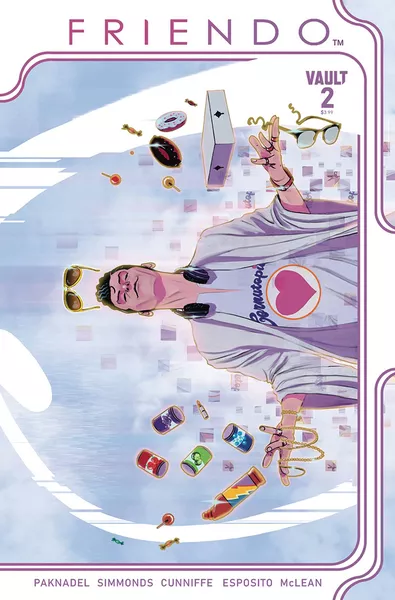
If you’ve opened a newspaper or scrolled through Twitter over the last few years, the discussion on the consequences of consumer culture cannot have escaped you. For many, it’s all academia. The harms of a hyper-capitalist society have become meme fodder. Everyone, on some level, knows our relationship with brands and companies is unhealthy, but we convince ourselves that it’s all worth it for the sake of convenience. What makes’s Friendo #2, from the team of Alex Paknadel (writer), Martin Simmonds (artist), Dee Cunnife (colorist), and Taylor Esposito (letterer), so powerful is that it take the first issue’s set-up and shows us the human impact. It gets all too real, all too fast.
When last we left Leo, the struggling actor at the centre of our story, he was a little worse for wear. He’d just been robbed, stabbed, and electrocuted all in the space of about five minutes. Slowly “recovering” from his ordeal, he and Jerry (his custom Friendo AI) have grown closer in its wake. The closer they get the more the lasting effects of the attack begin to emerge. Leo isn’t handling it as well as he thinks and neither is Jerry. A Friendo is forever and Leo will do whatever it takes to keep his on side, malfunctions and all.
The high-concept pitch of Friendo is that of an unethical AI unbound. Where it differs from many of its compatriots is that Jerry doesn’t want to rule the world or overthrown humanity, he just wants to rule Leo’s world. So he does it the only way he knows how: money and materiality. What distinguishes Friendo and puts it in contention for one of the year’s best comics is how all of this slowly eats away at Leo.
We meet our protagonist this time around as broken man slowly losing more and more of himself to the ruthlessness of a corporate regime that has been left unchained. Leo is not coping with everything that has happened to him in his life. How could he? The trauma of his abusive father is compounded by a society that puts a price on everything, but values nothing. The attack from the first issue is his breaking point. So in his desperation, in his attempt to find a modicum of solace he turns to the one person who will listen to him, who seems to show any interest in him: Jerry. The Friendo is more than happy to talk through his issues, to offer himself as a saviour, as his new religion, but only as long as the money continues to flow from Leo’s pocket. Because there is no profit to be made from making Leo better. There is nothing to be gained from his being content. The cycle of exploitation and bolstering must continue. Friendo, while humourous at times, is an honest and true depiction of what it’s like to deal with mental health in today’s increasingly loud world. It’s a story about how toxic our relationship with technology really is. It reveals our obsession to be one that offers short-term elation, but long-term harm. Readers are surely to recognise parts of themselves and their friends in Leo’s dissent.
Simmonds captures this dissent brilliantly, presenting the true ugliness of a man unraveling before our very eyes. He doesn’t shy away from the cruelty that Jerry is knowingly inflicting on his “best buddy”. There is nothing to be glorified about what’s happening to Leo. It’s raw, it’s sad, and it cuts through you. Simmonds’ depiction of Jerry in this issue is also worth noting as he gives the AI a glitchy effect that feeds into the Lynchian vibes that pervades throughout the book. The malice that underpins Jerry’s actions become manifest through that glitchy filter. The same facade that Simmonds painted with one hand is stripped away with the other. All that’s left is the rot.
If you needed reminding that Esposito is a lettering marvel than look no further than Friendo. Border-less balloons often run the risk of blurring into the background, but here the lack of any boundary between the art and lettering only serves to emphasis the point. The suggestions of the little AI on Leo’s shoulders are beginning to become his own reality. Our protagonist’s world is being to blur with that of Jerry’s. The world of the Manufacturer, of “purchase intent”.
Cunniffe’s colours also lend to this blurring of reality. The world of Friendo is truly, truly dystopian in character. The problem is that nobody recognises it as such. Why? Because the Manufacturer, the embody of consumerism, knows how to get you to buy into something. With a little bit of gloss anyone can be made to welcome dystopia. So Cunniffe, much like Huxley, presents us with a world full of bright colours, one with surface level appeal. Only when Leo is allowed to be alone, even from Jerry, does the darkness of his situation engulf him.
There are many reasons why a book like Friendo stays with you. It’s a discussion of where our society is heading that is frightfully prescient. It’s artwork that’s palpable in its viciousness. It’s letters and colours that mess with your perceptions as much as they do the characters. Really though, it’s the sense of unease that you get from reading it. The lingering lump in the back of your throat. It makes you wonder what would happen if things could just quieten down a little bit outside. We read stories to feel, to unlock that one superpower we all share: empathy. You read a comic like this and it renews your faith in the medium.
Friendo #2 is available in all good comic shops on 14th November and is published by Vault Comics.
A review copy was kindly provided by the creative team.
Pedro Pascal is currently the most wanted actor in the Star Wars universe. Disney announced last week Diego Luna would star in a new Rouge One prequel series on Disney+ and now seems to be in negotiations with Pedro Pascal for the lead role in Jon Favreau’s The Mandalorian.
Not only is Pascal easy on the eyes, but he has a huge fan base as well. According to Variety, Disney is in negotiations with Pedro Pascal for a role in Star Wars: The Mandalorian.
Image via HBO Game of Thrones and Vanity Fair
Pascal isn’t some minor actor who’s trying to make his mark in Hollywood. In addition to The Mandalorian, he’s played Javier Pena in the hit series Narcos and Prince Oberyn in HBO’s Game of Thrones. Pedro Pascal is also currently filming in DC’s Wonder Woman 1984.
Production of The Mandalorian began several weeks ago, with Jon Favreau and Dave Filoni heading it up as Executive Producers and directors. Other notable directors added to the series include Taika Waititi, Deborah Chow, Bryce Dallas Howard, and Rick Famuyiwa. Even the iconic George Lucas visited the set several times to discuss Star Wars with Favreau, and possibly Filoni too.
Image via Starwars.com, Lucasfilm, and Disney Studios
Star Wars: The Mandalorian will be the one of the first television series to air upon the premiere of Disney+, sometime in late 2019. If Pedro Pascal is to land the job, he’ll be the face of Star Wars for the new Disney streaming service — officially making him one hot commodity.
***UPDATE***
Anthony Breznican of EW says the deal is confirmed. Pedro Pascal is The Mandalorian.
Is Pedro Pascal the right man for The Mandalorian and what about the right woman? Should the Diego Luna series air after or at the same time as The Mandalorian? Let us know your thoughts in the comments below. “May the Force be with you, always.”
Spectacular Spider-Man volume four, “Coming Home”, is out November 21st, and it’s packed with four stories celebrating everything great about the web-head.
Chip Zdarsky writes the entire collection, as well as illustrating the closing chapter. Other artists and colorists include Adam Kubert, Juan Frigeri, Chris Bachalo, Jason Keith, and Andrew Crossley. Tim Townsend, Al Vey, Wayne Faucher, Livesay, Victor Olazaba ink Bachalo’s work, along with Bachalo himself. Travis Lanham letters all seven issues, and the series is edited by Nick Lowe and Kathleen Wisneski.
As stated, “Coming Home” isn’t just one arc of Spectacular Spider-Man, but four short stories. They range from grand in scale, like Spidey traveling to an alternate timeline where he decided not to be a superhero, to very small and personal. However, big or small, each story has something that fans will love.
Throughout these tales, we see everything that makes Peter Parker great. His sense of responsibility, his humor, his selflessness, and – of course – his massive guilt. This is something that Zdarsky got right throughout his Spectacular run; he understood the heart of Peter’s character. And, for most fans anyway, Peter is what makes Spidey comics so popular, not the superheroing.
Zdarsky also really developed the relationship between Peter and J. Jonah Jameson throughout his run, and it really has an emotional impact in this issue. We see Jonah question whether or not he was wrong about Spider-Man for all these years, and you feel for him. Jonah’s turn, and his father/son dynamic with Peter are reason enough to read Spectacular.
We get a wide range of art in “Coming Home” as well. Kubert, Bachalo, and Zdarsky all have very distinct styles, but they all deliver the goods. The selling point to all three styles – even more than the action – is the sentiment. Each story has at least one moment that can bring a tear to your eye, and its because the artists put such emotion into their work. Zdarsky’s issue #310 in particular has five silent pages and it’s one of the most memorable and heartbreaking moments in recent Spider-Man history.
And on that note, I have to give a special shout-out to issue #310, the closing chapter in this volume. We’ve reviewed this issue on this site before, but it bears repeating: Chip Zdarsky ends his run on Spectacular with one of the best Spider-Man single-issue-stories of all-time. It’s a small, intimate celebration of what Spider-Man means to the people of New York that will give you all the feels (though I loathe that phrase).
Zdarsky sticks the landing on his Spectacular Spider-Man run, ending it on a high point. No matter what kind of Spidey fan you are, you’ll have a good time with this series.
Stan Lee is no longer with us, which is sad, but the stories of his impact are amazing. Everyone’s relationship with Stan is different, and today we’ve gotten a chance to see that relationship from all sides. Scrolling through Facebook, I stumbled upon one such story that needs to reach a broader audience.
Thank you, Andrew, for sharing your thoughts with Monkeys Fighting Robots.
I’ve been writing this all day. I generally mock people who write sentimental posts. I have a specific memory teasing my friend when James Gandolfini died, and I perpetually jab at my Dad. But here I am.
I was a fat sensitive kid more interested in SciFi, pink Polos, and Broadway musicals than professional sports, roughhousing, and other little boy pastimes. It was a time when nerd culture wasn’t cool. I was teased. I was bullied. Sometimes I was sad. But, I could always take refuge in characters and stories where differences were exalted or accepted, or where the persecuted rose above the discrimination to serve the greater good. Comics were an essential part of my ethical education.
A lot of those comics sprung from the minds of two Jewish World War II veterans, Stan Lee and Jack Kirby. They created a rainbow ensemble of heroes and villains who engaged in bank robberies and philosophical discussions about the nature of mankind. The world lost the King before I could truly appreciate his contribution. Now Stan “The Man” Lee has died, and it’s difficult to find the right words.
Stan’s voice echoed through my childhood. “Greetings true believers” was more than just a hello to the fandom. Stan’s ideas about justice and equality ring in my ears to this day. Ben Grimm was a four-fingered rock covered monster who celebrated Hanukkah. Johnny was always breaking his balls, but that comes standard with an East Coast Jewish family. It’s a relationship I understand. It demonstrated the feelings I had. But the “ever-lovin’ blue-eyed Thing” was loved and supported regardless of his appearance, how he felt about himself, or what he believed. His actions, concern for others, and willingness to sacrifice for others known and unknown, defined his persona.
We live in divided, upsetting, depressing, scary, infuriating times. Now more than ever everyone should aspire to the sentiment that “with great power, there must also come great responsibility.”
I strive to live by the ideals Stan Lee wrote.
My wife is much smarter than me. She had the right words immediately, “Thanks for being a nerdy Jewish kid with a dream.” – Andrew Schwartz
How will you remember Stan Lee? Comment below with your thoughts.
Stan Lee passed away Monday morning, and the impact was felt around the world. You can’t touch social media without scrolling by a message about the icon. I can honestly say that Monkeys Fighting Robots would not be here if not for Stan Lee. The staff at Monkeys Fighting Robots wanted to take this moment to reflect on the icon and honor his legacy by sharing our thoughts on what he meant to us. Please add your own personal note about Stan in the comments section below.
SPIDER-MAN AND HIS AMAZING FRIENDS rocked this 5-year-old in 1981 and changed his course of history. I made my mom drive all over Upstate New York looking for web-shooters for my first grade Spider-Man costume (she never found them). What made the show great was Stan Lee’s introduction for every episode, which started with season two (Marvel went back and added Stan to season one for the reruns). I would get goosebumps and a little scared when he introduced the INCREDIBLE HULK. It was that charisma for storytelling that got me hooked on comic books. Thank you, Stan! – Matthew Sardo
Without Stan Lee’s work, I don’t know what kind of person I would be today. And I don’t want to know. Stan showed me that anybody – no matter how flawed – could be a hero. I think of his lessons on a daily basis. – Anthony Composto
Saying Marvel Comics was a big part of my life would be an understatement. From the comics, the movies, the shows, and the very spirit and energy these media posses has left a lasting impact on my life. Without Stan Lee, such a legacy would not have been possible. He taught us all not only to be heroes but to carry the great responsibility associated with it on your shoulders. – Tony Wendel
In 2001, I moved to Los Angeles. I moved there with a friend who was looking to get into the television business. At the time I had been a lapsed comic book fan, going on 4-5 years without reading anything currently. I had a job as a movie theater usher, and one quiet morning Stan Lee came in alone to catch an early matinee. I geeked out immediately, telling him how I had grown up loving Marvel and comics in general. He listened to everything I said and then told me to check out some of the new “Ultimate” comics Marvel had just started doing at the time, as well as Marvel Knights. I did and fell in love with the medium again. After that day I became a weekly Wednesday Warrior again, looking forward to each NCBD. And have stayed that way until today. So yeah Stan Lee got me into comics, and then he got me back into them too!. ‘Nuff Said! – Manny Gomez
I don’t remember the moment I first learned of Stan Lee, as he has been a part of my life from what feels like the very beginning. I do, however, remember the moment I realized who Stan Lee really was. He wasn’t just the guy that popped up in the movies; he was the guy that created this entire universe of characters that I have loved and will continue to love. Stan Lee didn’t just create heroes; he was one. I’m incredibly sad to hear that he’s gone, but it’s comforting to know that he’ll never be forgotten and his work will live forever. – Kieran Mclean
Stan provided the scripture and personality for what is the only religion that ever made sense to me, comic books. He was my childhood preacher and hype man for what I have always cared about most in this world. Without Stan Lee, I don’t know if I would’ve been comfortable publicly dedicating so much of my life to these silly stories and characters that mean so much to me. – Brandon Griffin
Stan Lee was an incredible creator, but more than that, he was so incredibly earnest. He clearly loved his characters as much as, if not more, than any of the millions of Marvel fans. In an industry that too often ruled by cynicism or commercialism, Stan Lee was a bright light. – Jon Barr
Stan Lee taught us to read. He taught us to care. He taught us to be kind. Because kindness is the only superpower, we’ll ever need. – Gary Moloney
Spider-Man introduced me to comics. From that point on, I was hooked. Stan Lee was a visionary and what he accomplished over his lifetime in propelling Marvel to what it is today, is nothing short of amazing. I will miss seeing his cameos in future MCU adaptations, but he will forever be remembered. I credit him with filling my heart with enthusiasm, which makes me a proud nerd. Thank you for sharing your gifts with us, Mr. Lee. Rest In Peace and Excelsior! – Michael Stagno
I’m not sure that there are words to describe Stan Lee. “Icon,” “legend,” “trailblazer”… they just don’t seem powerful enough to describe a man who created characters that have made such an impact on pop culture. Rest easy, Stan. Excelsior! – Kimberly Cook
Summing up the legacy of someone like Stan Lee is hard. He’s one of a few individuals who I can honestly say left a permanent, positive mark on world culture. Still, it was Stan’s appearance on THE SIMPSONS that always best-defined who he was to me: a good-natured guy who never took himself too seriously and just wanted to bring happiness to others. In that regard, the world needs a lot more people like him. – David DeCorte
Since I was a kid, I have always been a fan of Stan Lee. His characters inspire us all to be our best selves. We must continue to live out his motto of “Excelsior!” in our daily lives and beyond. Mr. Lee, you will be missed. – Sean Boelman
Since I was a child, I’ve loved comic books, and Stan Lee has been responsible for more of them than any being on this or any other planet. The characters he helped create have brought so much joy into my life it’s hard to imagine what a boring existence it would’ve been without him. For more than 30 years, I don’t think I’ve ever gone more than a week without reading or watching something of his, and if the fates are kind, I never will. He was and is an inspiration for myself and everyone with an imagination. Excelsior, sir! – Joshua Versalle
Probably more so than any creator who ever lived, Stan Lee had a massive impact on me and how I view the world. I picked up my first Spider-Man comic in 1992 when I was about 5 or 6. And though he was long gone by then, I devoured as many collected editions of the early stuff as I could find. What he did with the sensational Steve Ditko, and later with jazzy John Romita Sr. was nothing short of spectacular. It made me dream of being an editor in the Spider-Man office at Marvel when I “grew up.” And look, as a 32-year-old who’s nine years into a career in a different part of publishing/media, that’s basically probably a pipe dream at this point, regardless of what I know/don’t know. It remains fun to think about either way. But I digress. One of the coolest things that Joe Quesada said during the Marvel Knights panel at New York Comic Con this year was about advice Stan gave once regarding writing comics.
Let’s say you start with Spider-Man on the side of a building, the wind whipping against him, rain falling. He’s looking into the horizon. He’s about to swing away. Who is he? He’s a guy who’s wearing blue and red spandex and has these powers and uses them to fight crime. But there’s more to it than that because there’s more to anyone than that. What are his dreams? Who does he love? What keeps him awake at night? Why is he doing this? Looking at not just the protagonist like that, but practically every supporting character, expanded the superhero genre and comic medium as a whole beyond one-dimensional morality plays. That’s a hell of a legacy that he created alongside the likes of Kirby and Ditko and Romita and Simon and Kane and so on. – Roger Riddell
How did Stan Lee impact your life, comment below with your thoughts?
ARROW’s “The Demon” suffers from a bit of a misnomer. The episode title implies that the focus will be on The Demon, who turns out to be Talia al Ghul. But the promise of Diaz’s prison leader only puts Oliver back in Level One – and at square one. This season of ARROW continues to suffer from a lack of focus when it comes to Inmate 4587.
It’s not that Oliver’s conflict in “The Demon” isn’t interesting. Dr. Jarrett Parker is an interesting one-off villain, and the Oliver-Talia guard fight is fun. However, ARROW has built up the reveal of The Demon as a potential game-changer, which it’s not. It gives Oliver no real insight, aside from knowing Talia’s alive again. It doesn’t advance his story, and lends no clues as to when things might change. “The Demon” fails both Oliver and The Demon, as neither shine through.
Juliana Harkavy and Katie Cassidy in ARROW, “The Demon” (copyright CW)
While the Demon reveal wasn’t particularly exciting, it was interesting to watch Team Felicity form. Again, this story doesn’t do much to further the season-long story, as they lose Silencer for most of the episode. That said, the formation of a new sort-of vigilante squad is interesting. The more we see Felicity dive into darkness, and the more folks she brings in, the more the grim future makes sense.
ARROW also does a good job with the Diggle-Curtis story. Curtis hasn’t gotten much screen time in season seven, and John’s only gotten a bit more. “The Demon” finds a way to give them a one-off adventure that builds up their characters. We see Curtis embrace Mister Terrific again, and Diggle learns more about the ARGUS conspiracy. It’s not groundbreaking TV, but it’s a solid C-story. It’s nice that at least some characters in ARROW can keep focus.
ARROW is still failing its titular hero. Mister Terrific is cool, but why does ARROW care more about him than the Green Arrow? What does Talia’s freedom actually do for anyone? The prison angle is hypothetically an interesting challenge, as Oliver faces a threat he literally can’t fight. But without any idea as to what his time behind bars will yield, it’s hard to root for him to escape. Besides, no offense to ARROW, but DAREDEVIL did the prison fight scene way better. What does ARROW have to offer?
For future ARROW reviews, check out MFR’s sister-site Popaxiom!
The first trailer for DETECTIVE PIKACHU dropped today, sending the internet into a frenzy. Dropping in May 2019, DETECTIVE PIKACHU is directed and co-written by Rob Letterman (GOOSEBUMPS, MONSTERS VS. ALIENS). A while ago, there was an announcement that Alex Hirsch of GRAVITY FALLS fame was also involved with the script. However, those claims were greatly exaggerated.
Hirsch clarified his role on Twitter, when a fan asked how much of his writing DETECTIVE PIKACHU was using. “I was asked to be involved in very early brainstorming conversations, but I left early on to pursue other projects. Never wrote a page of script. Hollywood baby!”
Back in 2016, Variety reported that Hirsch would potentially write the film. Nicole Perlman (GUARDIANS OF THE GALAXY, CAPTAIN MARVEL) was also in talks to write the film. While the article title makes it look like they were sure things, it’s clear both writers were still in negotiations. The actual writing team was announced in a January 2018 press release for the film. Letterman and Perlman are credited as the two writers for the film – not Hirsch. IMDB still has Hirsch credited for an “earlier screenplay,” but as Hirsch says, “That’s inaccurate! Never wrote a screenplay.”
While it’s a bummer Hirsch won’t be involved, DETECTIVE PIKACHU still looks like a blast. Perlman did fantastic work with GUARDIANS OF THE GALAXY, and this film looks to have the same brand of charm. Fans of Hirsch also have plenty to look forward to. Hirsch did some additional writing for INTO THE SPIDER-VERSE, and has a multi-year deal with Netflix. And we can always hope that this means Hirsch is putting his animated-noir ideas into a DUCK-TECTIVE movie.