Home Blog Page 474

DETECTIVE COMICS #1000 Review: Ellis and Cloonan’s Platonic Ideal of Batman

Monkeys Fighting Robots

It’s been quite the week for Batman fans, hasn’t it? Much of the public discourse leading up to the release of Detective Comics #1000, due to no fault of its own, has been about the morality of the character, his essence, and what he should stand for in today’s society. Now approaching his 80th birthday, the question of who Bruce Wayne actually is remains worth exploring. Over ten pages, the team of Warren Ellis (writer), Becky Cloonan (artist), Jordie Bellaire (colourist), and Simon Bowland (letterer) offering their answer to that conundrum and in doing so, offer up what may be the platonic ideal of Batman.

“The Batman’s Design” is a story that channels Year One in its visual tone and focus on the Dark Knight’s street-level activities. It steers into the Caped Crusader’s status as an expert tactician by having our hero walk us through his plan to take down a group of semi-religious extremists fueled by an ideology that says “[they’re] not being listened to”. The pages that follow serve to demonstrate Batman’s true superpower: his mind. There is never any doubt of the outcome of these interactions, but is presents the methodology which underpins his ability to deal with any situation and tips the hat to Morrison’s idea of the Bat-God.

Cloonan’s linework when combined with Bellaire’s colours invokes the feel of Mazzucchelli’s work on the character. Bombastic oranges and reds highlight the moments of filled with adrenaline where characters act on instinct or fear. It represented the uncertainty coursing through every fiber of their being as they wait to be picked off one-by-one. In contrast Batman, for most of this story, is bathed in dark blues and greys. His ways are quieter, calmer and motivated by logic. It makes for all the more powerful when Batman has to accept his own fears and uncertainties, becoming surrounded by orange hues as he does.

Bowland’s captions replicate handwritten diary entries helping to draw attention to the honesty that pervades the narration. There is the very real sense that these are the personal thoughts of a deeply secretive and private man laid bare. Being so, Bruce is able to let his guard down to the readers. Part of him acknowledges that he enjoy the violence of his work and yet he also recognises the foolishness of such actions be it brought about by the fist or the barrel of a gun. Indeed, in the end force does not, and cannot, win the day. Empathy does. In the comics’ final moments, we see the kindness and emotional intelligence that betrays Bruce Wayne’s true character.

Ellis, Cloonan, Bellaire, and Bowland’s take on Batman is one that understands the central role that trauma plays in the legend of Bruce Wayne. Trauma turned a frightened little boy into a broken man dedicated to keeping other’s from suffering as he did. He may be vengeance, he may be the night, but man is a fundamentally a creature of empathy. The character’s mission may have begun as an expression of anger against a world that allowed his parents to die in front of him but that has never been his prime motivator. No. What drives Bruce Wayne to do what he does is the same thing that influenced his decision to take an orphaned boy as his ward, to ensure that that young man didn’t end up like him. Empathy has always been the core of Bruce Wayne’s character as much as he may try to deny it. “The Batman’s Design” is a tale that reminds us that even when you’re hurting, when you feel you’re alone, you don’t have to have to give into the hate and the pain. You can chose to live. You can chose to be more. Bruce Wayne couldn’t. Batman exists to ensure others can. There is arguably no better encapsulation of why the Dark Knight’s legacy has endured than this creative team’s contribution to Detective Comics #1000.

A review copy was kindly provided by the publisher.

Monkeys Fighting Robots Youtube

Review: ICE CREAM MAN #11 Blurs The Line Between TV And Reality

Monkeys Fighting Robots

While recent issues gave readers a taste of the Ice Cream Man’s powers, ICE CREAM MAN #11 ramps them up to a new level. The nefarious character is now the host of a variety of reality television shows. But the catch is he’s capable of pulling unwitting victims into the show from the comfort of their own homes. And the programs appear to be quite deadly.

ice cream man #11 cover art

Story

W. Maxwell Prince opens this story much like previous issues of the series, introducing a new character who’s thrown into a bleak situation. This time  the spotlight is on Will, a 30-something who is whisked off onto a reality dating show while sitting at home with his relatives. Though shocking in and of itself, the true horror comes when he realizes the contestants and managers are animate mannequins who want to “improve” him.

Will proceeds to jump, unwillingly, from one show to the next. Most of these mimic real-life programs like The Bachelorette or Family Feud. But terror strikes when the Ice Cream Man reveals himself to be each show’s host, forcing Will to undertake grotesque trials to escape. We note his utter hopeless throughout each task as he strives to find a way back to his family.

Prince’s ability to capture the emotions of the distressed Will keeps readers glued to each panel. And it’s only exacerbated by the Ice Cream Man’s terrifying puppet master control over his victim. One feels like we’ve only seen a glimpse of the horrific power this being wields.

Art

Martin Morazzo, Chris O’Halloran, and Good Old Neon give the issue an unsettling, slightly cartoony look that’s perfectly fitting of the story’s nature. Morazzo’s penciling creates a sense of surrealism in Will’s realistic expressions in the face of such dire circumstances. O’Halloran’s bright coloring draws attention to the goriness of each subsequent game show. And Neon’s lettering sets the pace for each horrific scene, tying these artistic elements together.

Morazzo and O’Halloran’s main cover artwork serves as both a tone setter and an expository scene to help manage readers’ expectations. We immediately feel a sense of sympathy for Will as he attempts to break out of the television screens.

Babs Tarr’s variant cover places the entire focus on the Ice Cream Man’s demonic nature. She gives him a sinister-looking expression reminiscent of The Joker from Batman comics. The highly-detailed bugs in his ice cream only add to this effect.

ICE CREAM MAN #11 COVER B art

Conclusion

ICE CREAM MAN #11 isn’t for the faint of heart, but it’s an irresistible work of art. The issue’s horrific spin on reality television makes for a great horror story and reveals more about the Ice Cream Man’s true nature.

How powerful do you think the Ice Cream man really is? Let us know in the comments below!

Monkeys Fighting Robots Youtube

INTERVIEW: Michel Fiffe on G.I. JOE ‘SIERRE MUERTE’ and COPRA

Monkeys Fighting Robots

Michel Fiffe has been very busy lately. Last year saw him bring back Bloodstrike over at Image. This year he’s not only taken on a new G.I. Joe mini-series, ‘Sierre Muerte’, from IDW, he’s also brought his cult favorite series Copra to a new home at Image. Michel took a little bit of time to have a chat with us at Monkeys Fighting Robots to talk about all of this and a little more. Read on and then make sure you check out both G.I. Joe: Sierre Muerte and Copra!

MFR: So let’s start with some history. Where you a huge G.I. Joe fan? The comic and the toys?

Michel Fiffe: Mostly the cartoons. I became a fan of the comics as a seasoned reader. I was hypnotized by Larry Hama’s free-flowing, intricate soap opera.
MFR: For those who didn’t pick up issue #1, can you roughly give us a synopsis for ‘Sierra Muerte’? And where does issue #2 find the characters?
Fiffe: Everything hits the fan, so we’re left to see if these characters reckon with the possibility that their existence is indeed a vortex of meaninglessness or not. It’s a barn burner.
Michel Fiffe
MFR: Can you hint at where the story is heading (without spoiling of course)?
FIFFE: Dammit, Manny, there’s no way to not spoil it!
MFR: Did anything specific inspire ‘Sierre Muerte’? 
FIFFE: My desire to see more Latin American nations, fictional or not, represented in the Joe-verse.
MFR: Did you have any access to research on the property, or did you just use your own knowledge as a fan?
FIFFE: I had access to my back issues for general inspiration, but I wasn’t citing anything specific from previous material.
MFR: What about the G.I. Joe universe do you find appealing? What drew you to the project? Fiffe
FIFFE: A disparate group of hard-asses with fully realized personalities and an iconic nemesis to constantly confront? There’s no way I wasn’t gonna find this appealing.
MFR: Are there any other old/childhood properties you want to take a stab at?
FIFFE: There are a couple, yeah, but nothing I can even begin to daydream about. Too swamped.
MFR: Ok, time for some favorites. Favorite Joe? Favorite Cobra? What about a favorite episode of the cartoon? And finally favorite old school issue of G.I. Joe?
FIFFE: Rock N Roll. Cobra Commander. The movie. Issue 104.
 MFR: Okay if we can briefly talk about Copra’s move to Image. What sparked that move?
FIFFE: My desire to no longer self publish and concentrate on making COPRA comics on the regular again.
Fiffe
MFR: For those folks not privy to Copra’s concept, give us a rundown. 
FIFFE: The Dirty Dozen by way of a psychedelic newsprint press. Revenge & violence, live & laffs, fleshed-out characters, all hand-crafted by me. It’s exactly what I want an action comic book to be.
MFR: What do you hope to get from having Copra under the Image Comics banner?
FIFFE: More people discovering the title.
MFR: Are you going to expand the Copra world? Spin-offs? Guest creators? Anything like that?
FIFFE: Nothing like that. I just wrapped up a mini-series and have no plans to ever deviate from the core series. I might have a pin-up or some fan art, but most of it will be 100% me.
MFR: Are there any other projects on deck you can talk about?
FIFFE: C-O-P-R-A
MFR: Okay, final question! What stuff are you digging lately? TV Shows, comics, movies…anything you have taken in that has really has been awesome?
FIFFE: Jesusfreak is a great comic, highly recommended. Been listening to Secret Chiefs 3 for weeks on end at this point. This season of The Bachelor stunk but I bet Paradise is gonna be good. Legacy Music Hour forever!
Monkeys Fighting Robots Youtube

Review: DETECTIVE COMICS #1000: BATMAN’S GREATEST CASE Investigates The Mystery Of Family

Monkeys Fighting Robots

Batman fans are in for a treat with Tom King’s addition to DETECTIVE COMICS #1000. What sets his story apart from most traditional Batman stories is its unexpected tone. These stories tend focus on the theme of fear to move the narrative along, but King’s version is filled with hope. BATMAN’S GREATEST CASE highlights the importance of family in the midst of life’s tragedies, revealing a more humanized version of the Dark Knight.

Story

King sets the scene with a conversation between Damien Wayne and Dick Grayson off-panel as Bruce Wayne makes his way through his parent’s cemetery. Damien asks his step-brother if he knows a secret about Bruce Wayne, to which Dick shrugs off. The reader then sees a wider shot of the rooftop and notices other present Family members.

BATMAN'S GREATEST CASE cover panel

King dives into the various conversions reminiscent of a family reunion. Seeing each character respond to the mystery of their gathering brilliantly shows the humanity of these larger-than-life figures. We see Jason Todd undergo an anxiety-filled trail of thought, wondering whether or not Bruce decided to kick him out of the group. Another scene features Barbara Gordon bemoaning her past relationship with Dick, who never seemed to tire of reminding her of his time as Batman. These conversations remind us even superheroes have worries and regrets.

What really brings this issue together is the dual storytelling. The reader watches the Bat Family interact one minute and then catch a view of Bruce in his parents’ graveyard. King continues telling the story this way even after Bruce shows up to meet the Family, revealing the graveyard scene to have taken place at a different time. This non-linear narrative style helps readers focus less on the events and more on the characters themselves.

King’s mingling of these thematic elements creates a balanced story that is neither too depressing nor cheerful. The Bat Family members offer more insight into Bruce’s persona than any monologue could accomplish by itself. Most importantly, we learn that what drives Batman the most isn’t fear, justice, or darkness; it’s family.

Art

Tony S. Daniel, Joëlle Jones, Tomeu Morey, and Clayton Cowles do a great job of highlighting each character’s unique personality through the issue. From Dick’s tousled, messy hair to Cassandra Cain’s stoic yet distracted gaze, Daniel and Jones’ pencils serve as effective visualizations of their personalities. Morey complements these illustrations with a mix of bright and dark colors to show the extremes in temperament of the heroes.

the Bat Family

The mini-issue is largely dialogue driven, and Cowles’ lettering greatly assists King’s storytelling. He effectively uses the dialogue boxes and bubbles to frame the characters, drawing the reader more into each panel’s subjects.

Conclusion

This story dives deep into the heart of Batman as told through those closest to him. King and the art team’s story of the necessity and joy of family counter-balances the mythos’ over-reliance on loneliness as a thematic element. It’s an enjoyable breath of fresh air among the darker Batman stories.

What did you think of this family-focused issue? Let us know in the comments below!

Monkeys Fighting Robots Youtube

DETECTIVE COMICS #1000 Review: Snyder Cracks Batman’s Longest Case

Monkeys Fighting Robots

Creators Scott Snyder and Greg Capullo dish up a mystery spanning Bruce Wayne’s entire career in Batman’s Longest Case, the opening story in the massive Detective Comics #1000.

The story essentially exists in two parts. First, we have a montage of Batman piecing together clues stemming from his very first case as Batman. This suddenly pivots to the present when he finally reaches the end of the breadcrumb trail.

Given the compact space allowed for the story (just eight pages), this feels like a strange choice. The first half is all summary, not all of which seems to add up completely, but it accomplishes the primary goal of evoking tension. However, that intrigue deflates somewhat when the twist in the story appears.

This may have been better suited to a book allowing more space to flesh-out the story, rather than Detective Comics #1000. That’s especially true if the organization introduced in the second half becomes a recurring element of Batman lore.

Detective Comics #1000 Snyder

Capullo’s artwork does a good job of maintaining interest and ratcheting-up the tension throughout the story. He employs tightly-cropped illustrations, broken-up and punctuated by Batman’s monologue. However, he pulls back into a more conventional layout after revealing the culprits behind the mystery.

Batman’s Longest Case is enjoyable overall, and a fun introduction to this monumental, milestone issue. Ultimately, though, it feels like a sketch of a broader story, rather than a short, self-contained vignette.

Monkeys Fighting Robots Youtube

Review: HEROES IN CRISIS #7 Adds More Clues to the Mystery

Monkeys Fighting Robots

The previous issue of Heroes in Crisis was primarily a introverted look at three DC heroes in, well, crisis – Wally West Flash, Harley Quinn, and Gnarrk. The installment concluded with a shocking (and confusing) revelation as to who might be behind the horrendous murders in the Sanctuary.

Heroes in Crisis #7 uses three different styles of artistry to convey the three different storylines – or timelines – taking place. As the clues continue to pile up, the heroes must learn to stop pointing fingers in order to figure out who the real mastermind is.

**Some Spoilers Below**

Heroes in Crisis #7 Cover

Story

The Trinity may have uncovered the true killer responsible for the deaths at Sanctuary, but the artificial intelligence that ran the institution is the one thing standing between them and the culprit. Now Batman, Superman and Wonder Woman must face off with their own creation—and face the consequences for what they created. Also, as the truth is uncovered, Booster and Harley go from being enemies to allies.

What tangled webs Tom King has woven. As Heroes in Crisis enters its final issues, it’s still fairly unclear who committed the Sanctuary murders. Readers will find themselves needing to double back to previous issues, or even going back to the very beginning, to reexamine the information that has been shared thus far.

Writing

In this particular issue, King uses three narratives to continue his intricate murder mystery. The brief interaction between Batman and Barry Allen Flash is amusing, with the Scarlet Speedster speaking in a sort of hyper-tongue as the duo searches for Booster Gold’s whereabouts.

The bulk of Heroes in Crisis #7 involves Harley Quinn pummeling Booster Gold after witnessing him murder Wally West, all while Batgirl and Blue Beetle watch from the sidelines. Here, King crafts some interesting moments of inner-conflict, particularly with Booster ready to give up on everything and let Harley dole put a fatal blow.

Then there’s the Wally West segment, which finds the speedster lamenting a timeline he longs to return to. Here, King adds the next (potentially big, yet highly frustrating) piece to his puzzle. Using his speed force power, Wally speeds up the blooming of a red rose. And from out of that blossomed rose comes — Poison Ivy, with no skin, showing a green muscular system instead. How this affects the rest of the story will have to be answered in the next issue. It has to, for the readers’ sake. 

Heroes in Crisis 7 Cover Variant

Art

Each narrative (or perspective, or timeline) is illustrated by different artists, which in itself is worth noting. Clay Mann handles the scenes involving Wally West, including his confessionals, and delivers some of the best art in comics today. Though the story may leave some readers vexed, it’s hard to deny that Heroes in Crisis is a visually stunning book. Mann’s characters have a great range of expressions, perfect for a book dealing with emotional issues.

Travis Moore takes over for the pages with Harley, Booster, Batgirl, and Blue Beetle. Moore continues his admirable work, creating a similar aesthetic as Mann’s.

Jorge Fornes illustrates the pages with Batman and Barry Allen Flash. His artwork has a much different look than Mann and Moore’s. It’s certainly not as picturesque as the rest of the book, but it holds its own in a more vintage style of pencils.

Tomeu Morey’s colors brings the three styles of artistry together in Heroes in Crisis. It’s textured and simply striking.

Conclusion

As Heroes in Crisis draws to a close, the seventh issue offers truly compelling moments that deal with introspection, particularly between Wally West and Booster Gold. As the clues continue to pile on, however, it’s still difficult to say if it will all pay off in the end.

Who – or what – do you think is the mastermind behind the Heroes in Crisis deaths? Share in the comments!

Monkeys Fighting Robots Youtube

Review: Interplanetary Road-Tripping in SHARKEY THE BOUNTY HUNTER #2

Monkeys Fighting Robots

Sharkey and his traveling companion, Extra-Billy, are on an interplanetary road trip in Sharkey the Bounty Hunter #2.

The pair makes a pit-stop for Sharkey to track the notorious terrorist Edra Deering. However, Sharkey’s rivals and former allies are out to make like hell for him any way possible in this energetic follow-up to the series’ stellar debut.

The Writing

Millar does an excellent job with Sharkey the Bounty Hunter #2, developing much of what he introduced in the first issue. There, he established a lot of the characters and the world, giving us a solid narrative footing. Here, we flesh-out the relationships and dynamics between different individuals, specifically between Sharkey and his fellow(?) bounty hunters.

Sharkey and Extra Billy bickering their way across space occupies a large portion of the book. But, by the issue’s end, the two manage to develop a bit of a rapport, and even bond a bit. The dynamic between the two characters could easily fall off the cliff into annoying. However, Millar manages to keep their interactions genuinely charming in Sharkey the Bounty Hunter #2.

We discover a bit more about Sharky’s past, and his abilities, through his interactions with other bounty hunters. The writer plants story threads to develop later, like alluding to a double-cross that left him broke and living out of an ice cream truck.

The Artwork

Like the writing, Simone Bianchi’s artwork takes what was good in the first issue and doubles-down on it. The different cityscapes and species are a visual treat, and Bianchi presents everything with dynamic energy and great flow.

Bianchi again handles both color and pencil work for this issue. It’s hard, at many points, to distinguish the two (that’s meant in the best way possible). The book blends dreamy, watercolor-styled images with detailed illustrations, reinforcing the alien tone. Everything is incredibly vibrant.

Final Thoughts

Sharkey the Bounty Hunter #2 takes everything that worked in the debut issue and pushes it along. Excellent storytelling and artwork in what is, probably, one of the best new comics of 2019 so far.

Monkeys Fighting Robots Youtube

Scream it Loud: VOLUME to Debut in 2019 at Scout Comics

Monkeys Fighting Robots

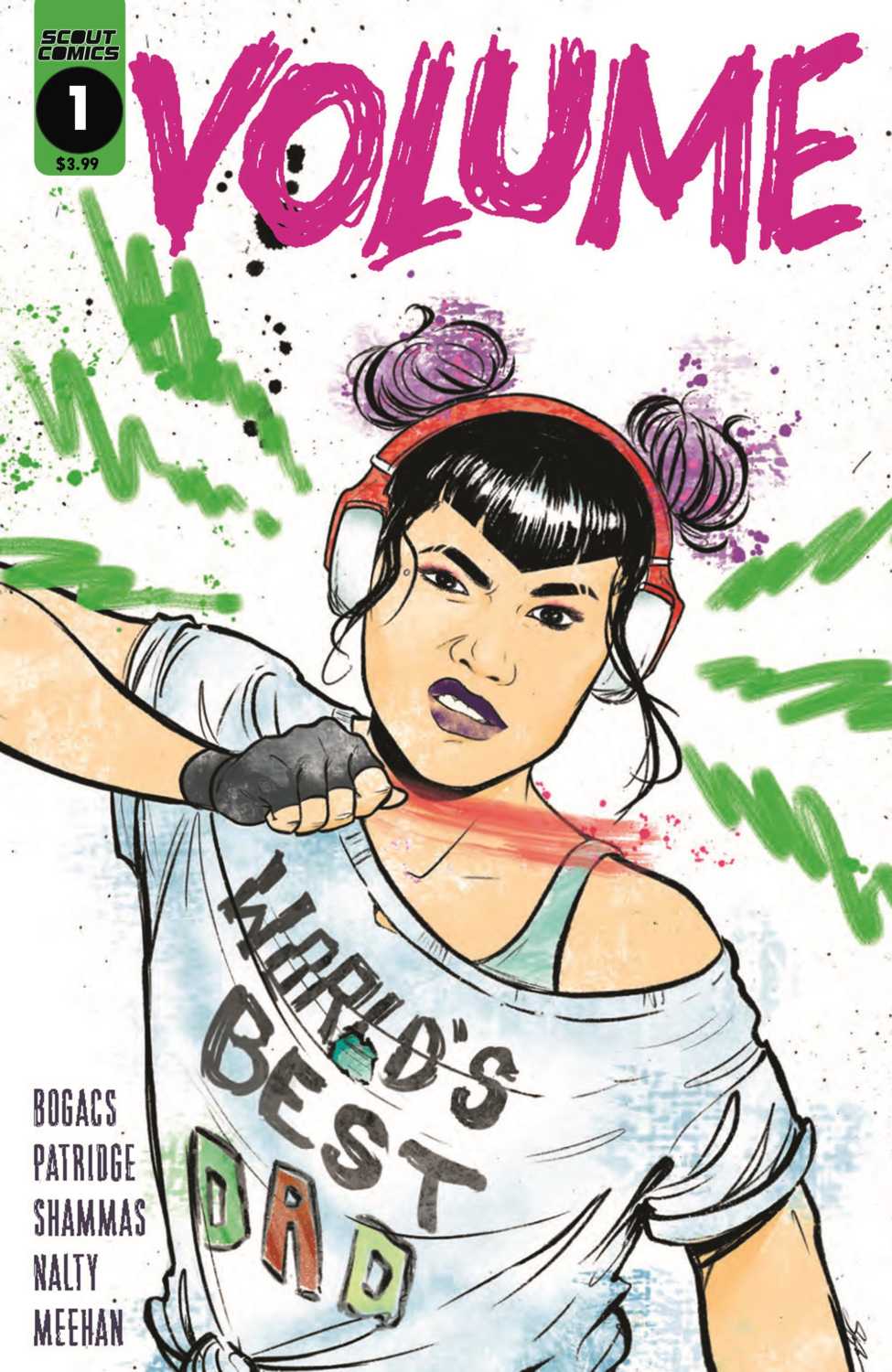
The creative team of Christof Bogacs, Skylar Patridge and Nadia Shammas, are set to debut Volume in 2019 at Scout Comics, a story of teenage angst and rebellion.

The story will take place in the future, which is overseen by a populist dictatorship called, The Regime. Essa, a teenager fed up with the bland and colorless world, seeks to stand up against them through the noise that is one killer rock song.

Volume has been rattling around in my head for a while now,” Said Bogacs. “This is me venting all my pent-up teenage rage in an immature display of punching, explosions and song lyrics. The best part is I get to pull Skye and Nadia into the fray with me!”

The creative trio is on a mission to take a created world devoid of personality and smash it with color and punk music, but also capture what encapsulates the way teen girls are seemingly silenced and undervalued.

Volume #1 will land on shelves in 2019. For more information regarding this upcoming series or any other Scout titles, please contact Publisher James Pruett at: james.pruett@scoutcomics.com.

Check out the cover for the first issue, above, and a sneak peek at some interiors, below.

Monkeys Fighting Robots Youtube

Review: TRANSFORMERS #2 Building Tension With Immaculate Style

Monkeys Fighting Robots

This week sees the release of the second issue of Transformers from IDW Publishing. Still basking in the glow of the new,  The World In Your Eyes part 2 continues the story of Cybertron before the civil war and the civil unrest brewing on the horizon.

Breathing new life into these giant robots is no easy task but Brian Ruckley has a large artistic team helping him do just that. Drawing on Transformers lore to bring something new to the readers is the driving force behind this reboot and IDW Publishing are committed to making this a success.

Cover art detail
Transformers #2 Credit: IDW Publishing

Writing/Story

After the shock of finding a dead body at the end of the last issue, Rubble and Bumblebee attempt to go about their business as if nothing has changed. For Rubble this is easier as he lacks experience in almost everything but for Bumblebee this proves to be harder. No unnatural deaths have occurred on Cybertron in generations.

Brian Ruckley splits this issue into two sections. The first is a classic police procedural with a murder mystery at its heart.  Ruckley gives the readers a victim, some suspects, and an investigating team. Like all good ‘cop’ stories the effects of the crime are far reaching. Ruckley makes this very clear but then reins it in so the reader is left in the dark as to the true consequences.

This is a wonderful play on pulp fiction novels; the inconsequential aspects of the story often feature heavily in the final outcome. Because of the way Ruckley structures the narrative, the reader can make this literary connection and in turn starts to suspect everything.

This leads into the second part of the story where Megatron is leading an Ascenticon march. An unknown assailant attempts to assassinate the future Decepticon leader which adds more layers to the overall story. At each turn Ruckley teases the reader with information producing a surprisingly thrilling comic.

Ruckley has also used the structure of this issue to slowly increase the underlining tension relating to the coming civil war. As a stand-alone issue it might not be as obvious but when compared to issue 1 of Transformers, the civil unrest element of the story has grown. It only took up a few pages from the last issue but here more pages are dedicated to the Ascenticon’s and their rebellious nature. The increase in page number in turn increases the importance of the storyline. Ruckley is using the structure of the ongoing comic to enhance the narrative.

Interior art detail
Transformers #2 Credit: IDW Publishing

Art

Just like last issue, the two different storylines have different artists working on them. The style between Angel Hernandez and Cachet Whitman aren’t too dissimilar and the transition from one artist to another does not jar the reading experience. Hernandez’s fluid style matches the innocent characters featured in the first part of the narrative and his scenery is beautifully alien. In contrast Whitman has a more mechanical look suited to the inner city settings.

The artists, along with the two colorists Joana Lafuente and Josh Burcham, make each section of Cybertron physically and tonally different. The emotional reaction from the reader to the two halves of the story is controlled by the subtly different art styles.

Tom B. Long layers the speech balloons across the panels directing the reader. His caption boxes for Rubble’s inner monologue on the opening page have a mechanical, computerised edge but with a naivety reflecting Rubble’s new life. Long also uses short balloon tails for most of the speech except on rare occasions, such as the appearance of Orion Pax as a hologram. By altering the tail length it distinguishes the speech and gives the impression of distance. Long is making a point about the different locations and story elements: not only is Orion Pax physically further away but the action in the city is thematically distant from the quiet life in the wilderness of Cybertron.

Interior art
Transformers #2 Credit: IDW Publishing

Conclusion

As a murder mystery, Transformers issue 2 works beautifully. A range of suspects and motives have been laid out by Ruckley; a number of which will be red herrings. He is building a story to engage the reader without filling each page with violence. These Transformers are just trying to live their lives which makes them relatable: not something you can often say about giant alien robots.

The other aspect of the comic, the civil unrest, is also unfortunately relatable in today’s political climate. The fact that most people reading this comic will know where this is heading, Civil War, only adds to the growing tension of the situation. The creative team use that to manipulate the reader.

This new Transformers comic is a pleasure to read and the focus on a few characters works to its advantage.  There is plenty here for long time readers and new readers alike. The style of the narrative is also a fresh direction for the giant robots. By building the narrative slowly the creators engage the readers and hook them into the expanding storyline.

Monkeys Fighting Robots Youtube

TRUST FALL, a Story of Family, Superpowers and Thievery, Coming this Summer

Monkeys Fighting Robots

Coming this summer, from creators Christopher Sebela and Chris Visions, comes the new series, Trust Fall, at AfterShock, the publisher that encourages its fans to read dangerously.

The story follows a dysfunctional family of thieves with superpowers, led by Ash Parsons, who can teleport objects, but not herself. She lives isolated and has never actually been a real part of the world as she relies on her family to catch her after each and every heist. The crime family depends heavily on Ash as she can steal things they otherwise wouldn’t be able to move. Growing weary of being used, once she starts to push back, the scenario won’t be favorable for all involved.

“It’s both fast and brutal but with a beating heart in the middle of it all,” Sebela said. “We’re not just rolling out a neat concept and coasting on that, we’re trying to give all this stuff life, give things stakes, give you characters you can care about, root for or against.”

Keep an eye out for Trust Fall, which drops on June 12 and click HERE for the Deadline presser, which announced the upcoming series, which includes some interiors as well.

What do you think, are you ready to dive into this heist tale? If you had superpowers, what kind of things would you get into? Let us know in the comments section below.

Monkeys Fighting Robots Youtube